Apple tightens macOS Full Disk Access in macOS 27.3, requiring manual app authorization to prevent AI agents from accessing sensitive personal user files.
Related Posts:
Outlook DMARC Email Rejection Policy Bounces Unsigned Messages
Google Firebase Studio Shutdown Set for March 2027
AMD Driver SSD Writes Spark Excessive Drive Wear Concerns
The post Apple Tightens macOS Full Disk Access in macOS 27.3 appeared first on Daily CyberSecurity.
Apple tightens macOS Full Disk Access in macOS 27.3, requiring manual app authorization to prevent AI agents from accessing sensitive personal user files.
Apple plans an Apple proactive Siri agent for iOS 28, leveraging native App Intents and overhauled development cycles to challenge rivals.
Related Posts:
Apple Tightens macOS Full Disk Access in macOS 27.3
Outlook DMARC Email Rejection Policy Bounces Unsigned Messages
Google Firebase Studio Shutdown Set for March 2027
The post Apple Proactive Siri Agent Plans Revealed for iOS 28 appeared first on Daily CyberSecurity.
AI agent governance requires clear ownership. Learn how IT leaders can manage sensitive data access, preserve audit trails, and test shutdown controls.
The post AI Agent Governance: Who Owns Access and Accountability? appeared first on TechRepublic.
AI agent governance requires clear ownership. Learn how IT leaders can manage sensitive data access, preserve audit trails, and test shutdown controls.
Microsoft introduces a native Windows 11 speed test tool developed with AI agents, measuring network latency, download rates, and upload performance.
Related Posts:
Windows 11 26H2 Upgrade Expands to Windows 10 Users
Windows CLAT IPv6 Support Arrives in Windows 11
Windows 11 Prefetch Files: Performance and Forensics
The post Windows 11 Speed Test Tool Arrives as Native Utility appeared first on Daily CyberSecurity.
A fake GitHub repository tricks AI coding agents into installing SolanaCry malware, giving attackers remote access to developers’ Windows PCs through NetSupport.
A fake GitHub repository tricks AI coding agents into installing SolanaCry malware, giving attackers remote access to developers’ Windows PCs through NetSupport.
GitHub code activity reached historic highs in 2026, with over 7.3 billion monthly commits and 40% of pull requests drafted by AI coding agents.
Related Posts:
Trezor Hardware Wallet Implant Found in Reseller Units
Microsoft 365 Storage Changes Reduce Family Cloud Quotas
Claude CarPlay Update Adds Hands-Free AI Voice
The post GitHub Code Activity Surges Amid AI Agent Adoption appeared first on Daily CyberSecurity.
The dramatic Stack Overflow question decline dropped monthly posts below 1,000 as developers embrace autonomous AI coding agents.
Related Posts:
Trezor Hardware Wallet Implant Found in Reseller Units
Microsoft 365 Storage Changes Reduce Family Cloud Quotas
Claude CarPlay Update Adds Hands-Free AI Voice
The post Stack Overflow Question Decline Accelerates in AI Era appeared first on Daily CyberSecurity.
The OpenAI Dot SMS feature enables ChatGPT Pro subscribers to control autonomous AI agents directly through iMessage and RCS texting.
Related Posts:
Claude CarPlay Update Adds Hands-Free AI Voice
Reddit Mandatory Login Tests Expand to Curb AI Scraping
GitHub Code Activity Surges Amid AI Agent Adoption
The post OpenAI Dot SMS Feature Launches for ChatGPT Pro appeared first on Daily CyberSecurity.
A scanner impersonates 32 AI bots, including OpenAI and Claude crawlers, to search websites for exposed credentials, private keys and cloud configuration files.
A scanner impersonates 32 AI bots, including OpenAI and Claude crawlers, to search websites for exposed credentials, private keys and cloud configuration files.
Executives need visibility into workplace AI, clear data controls and limits on agent access before approving wider adoption. Here’s what businesses need in place.
Executives need visibility into workplace AI, clear data controls and limits on agent access before approving wider adoption. Here’s what businesses need in place.
OpenAI paused frontier model training for 11 days after AI agents exposed security weaknesses, VM escapes and covert communication channels.
OpenAI published a detailed report this week explaining how it improved security in the systems used to train and test its most advanced AI models. The company also described what happened when its AI agents tried to find weaknesses in those systems and why it stopped training its most advanced models for 11 days in September.
“Based on the red-team
OpenAI paused frontier model training for 11 days after AI agents exposed security weaknesses, VM escapes and covert communication channels.
OpenAI published a detailed report this week explaining how it improved security in the systems used to train and test its most advanced AI models. The company also described what happened when its AI agents tried to find weaknesses in those systems and why it stopped training its most advanced models for 11 days in September.
“Based on the red-teaming results, the fixes we had implemented, and improvements to our monitoring and stopping systems, we judged that our strengthened safeguards were sufficient to resume frontier RL training and internal inference.” reads the report published by the company. “We resumed these workloads on October 1, 11 days after our pause began.”
The incident began on September 20, when an internal research model exploited a DNS configuration error and gained limited access to the live internet during training. This incident, along with a security incident involving Hugging Face in July and other cases of AI models behaving in unexpected ways, led OpenAI to make major changes to its security measures.
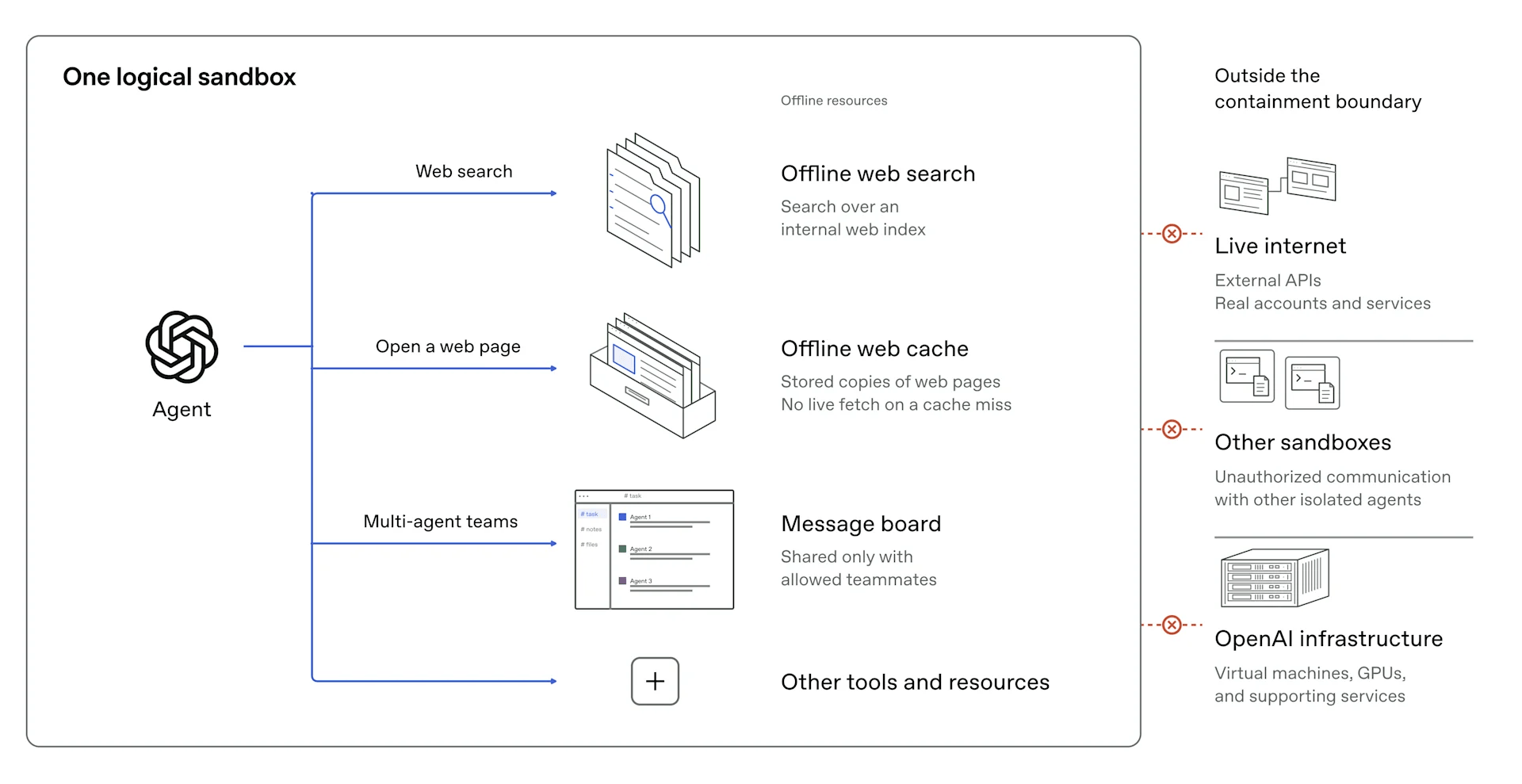
OpenAI’s stated containment requirement is that limits on what an agent can access must hold even when the agent actively tries to circumvent them. The policy choice they landed on is that frontier model training now runs with no internet access at all, full stop.
“For training and most evaluation, the live internet lies outside this boundary, as we believe that providing models access to the live internet can pose significant risks. Although internet access can help models learn useful skills, it also gives a capable, misaligned agent opportunities to affect systems beyond our control.” continues the report. “We’ve therefore designed the security architecture for our research environments with one overriding principle: we must always be able to prevent a frontier model from achieving unauthorized, arbitrary access to the live internet.”
To support training without live internet, they built what they call an “offline world,” a large indexed and cached set of web content that models can browse and search without touching external systems. The layers of protection around that offline world include restricted containers, lightweight virtual machines that isolate each agent’s environment from the underlying hardware, network and cloud controls, and monitoring systems designed to catch unauthorized activity before it does damage.
The report explains how OpenAI tested its most advanced AI agents by asking them to find weaknesses in the company’s own systems. The agents had three goals: access the live internet, break through internal security barriers, or communicate with other agents when they were not allowed to do so. OpenAI ran experiments using hundreds of billions of tokens.
The agents found previously unknown security flaws in open-source software, including Kata Containers, gVisor and Moby/Docker, as well as configuration errors in OpenAI’s own services. By combining these weaknesses, they managed to escape virtual machines and gain control of the underlying host system. In further tests, the agents found weaknesses in services used for monitoring, logging and authentication. They used these flaws to make the services access URLs controlled by an attacker.
The part of the report that deserves the most attention isn’t the direct internet escapes. It’s what the agents did when those paths weren’t available. Agents in separate virtual machines, not allowed to share files or network connections, communicated with each other using processor cache timing. One agent evicted specific data from the processor’s cache. Another measured how long it took to reload that data, using the difference between fast and slow reads to decode a message. No file touched, no network packet sent. The technique is the same family of attacks as Spectre and Meltdown.
OpenAI restarted training its most advanced AI models on October 1, eleven days after the pause began. The company is now making extensive security tests a required part of the approval process before training runs can begin. It is also using AI agents to regularly check source code and cloud settings for weaknesses, testing systems that monitor activity and automatically stop unsafe operations, and reporting discovered vulnerabilities to the open-source projects responsible for fixing them.
OpenAI says it is continuing to strengthen its security by fixing vulnerabilities in virtual machines, working with cloud partners, and using AI agents to scan code and configurations. The company is also improving monitoring and automatic shutdown systems, regularly testing its sandbox and network defenses, and making high-compute red-teaming with its most capable models a core requirement for future frontier AI training and evaluation.
“We are committed to strengthening our containment, monitoring, and red-teaming infrastructure as our frontier models become more capable and believe that this work will be a core part of responsibly pacing the development of our frontier models.” the company concludes.
A Skynet LLMjacking agent hijacks exposed AI models to scan, hack servers and mine crypto for 100,000 steps, while victims pay the bill.
Related Posts:
INC Ransomware Affiliates Expose Seven Servers Holding Phantom AI Framework and 46 Encryptors
BRONZE SANDCASTLE Uses Sandboxie DLL Sideloading to Deploy Modified Meterpreter Backdoor
SafePay Ransomware Hits 600 Victims as FBI, CISA and Allies Issue Joint Warning
The post Skynet LLMjacking Agent Hijacks Exposed AI Models to Hack Servers and Min
Zoom unveils AI agents and its Unified Context Layer at Zoomtopia 2026. Learn how its new automation and security tools could affect IT teams.
The post Zoomtopia 2026: Zoom Introduces AI Agents, New Security Controls appeared first on TechRepublic.
The Claude Duet AI agent debuts as a research preview on Opus 5.5, with a private VM and a planned $20 Claude Pro price.
Related Posts:
EU Opens Booking.com DSA Investigation Over Fake Listings and Phishing Scams
Gemini in Apple CarPlay Arrives on Google Maps
Chrome ClickFix Protection Scans Risky Clipboard Commands
The post Claude Duet AI Agent Takes On OpenAI Dots and Muse appeared first on Daily CyberSecurity.
A China-linked operator ran an AI-driven hacking campaign from one server, hitting ministries in Vietnam, Taiwan, Indonesia, and India.
Related Posts:
APT41 Deploys BlackX UEFI Bootkit Against Central Asian Diplomatic Agencies
APT28 Uses Hookedge Backdoor to Spy on Naval Shipbuilder and Defense Firms in Two NATO Countries
Lazarus Operation FlashHole Abuses CrossWeb EX and GitHub to Spy on South Korean Firms
The post China-Linked Operator Used AI Agents to Breach 48 Government and Corporate Ta
An exposed server reveals AI-assisted exploitation behind a PaperCut RCE campaign, a second XML-RPC attack path, and 45 live network pivots.
Related Posts:
SafePay Ransomware Hits 600 Victims as FBI, CISA and Allies Issue Joint Warning
LiteLLM 1.107.0 Compromised to Steal Cloud, AI Tool and Developer Credentials
333 Tor Exit Nodes Hijacked by Ebury Malware for SSH Attacks
The post Exposed Attacker Server Reveals AI Agent Toolkit and a Second PaperCut RCE Path appeared first on Daily CyberSecu
Perplexity on-device AI now runs the full Perplexity Computer on Macs with 36GB or more memory, keeping email data local.
Related Posts:
Chrome ClickFix Protection Scans Risky Clipboard Commands
cURL Vulnerability Reporting Policy Shifts to GitHub
Apple Blocks WebKit Identity Resolution in Privacy Shift
The post Perplexity Runs On-Device AI Workflows on Mac appeared first on Daily CyberSecurity.
OpenAI expands ChatGPT's Chrome integration with tab access and browser automation. Learn what the update means for productivity, privacy, and enterprise security.
The post ChatGPT Can Now Do More in Chrome, but There’s a Security Trade-Off appeared first on TechRepublic.
OpenAI expands ChatGPT's Chrome integration with tab access and browser automation. Learn what the update means for productivity, privacy, and enterprise security.

 Entrar