Visualização normal

Antes de ontemCybersecurity News
  • ✇Security Affairs
  • Google Released Gemini 3.5 Flash Cyber AI, a Specialized AI Model for Vulnerability Hunting Pierluigi Paganini
    Google DeepMind unveiled Gemini 3.5 Flash Cyber, an AI model for vulnerability discovery and patching, available only to governments and trusted partners. Google DeepMind announced Gemini 3.5 Flash Cyber on Tuesday, a security-focused AI model built on top of the existing 3.5 Flash architecture and designed specifically to find, validate, and patch software vulnerabilities. It won’t be available to the general public. “Given the dual-use nature of this technology, we have taken an intent
     

Google Released Gemini 3.5 Flash Cyber AI, a Specialized AI Model for Vulnerability Hunting

23 de Julho de 2026, 08:44

Google DeepMind unveiled Gemini 3.5 Flash Cyber, an AI model for vulnerability discovery and patching, available only to governments and trusted partners.

Google DeepMind announced Gemini 3.5 Flash Cyber on Tuesday, a security-focused AI model built on top of the existing 3.5 Flash architecture and designed specifically to find, validate, and patch software vulnerabilities. It won’t be available to the general public.

“Given the dual-use nature of this technology, we have taken an intentional approach to deploying 3.5 Flash Cyber. The model will be exclusively available to governments and trusted partners via CodeMender soon as part of a limited-access pilot program.” reads the announcement. “This will give frontline defenders a head start in finding and fixing critical vulnerabilities before they can be exploited, while mitigating against broader misuse.”

The access restriction is deliberate and explicitly tied to the dual-use risk of a model this capable at offensive security work.

The model is designed to be fast and cheap to run, not just accurate.

“Flash’s performance and efficiency makes it an ideal foundation to detect, validate, and patch code security issues at scale.” continues the announcement. “Gemini 3.5 Flash Cyber is built on top of 3.5 Flash, and fine-tuned for finding and fixing cybersecurity vulnerabilities at a lower price per token than larger models.”

Because CodeMender runs multiple 3.5 Flash Cyber agents working in parallel to produce a single combined report, the cost-per-token advantage compounds into significantly more code coverage per session.

Within CodeMender’s multi-agent setup, 3.5 Flash Cyber reaches competitive performance at the frontier on the CyberGym benchmark, the standard evaluation for this class of capability.

Google’s announcement frames the product design in terms that reflect what’s actually changed in the threat landscape.

“AI models have become capable of finding security vulnerabilities faster than current systems can fix them. Tackling this growing threat requires an approach to securing software that is highly capable and efficient.” states Google.

That framing acknowledges something the industry has been circling around: the offensive capability of these models is now outpacing the speed at which defenders can respond to what they find.

The restricted deployment is designed to close that gap from the defensive side first. Governments and trusted partners get early access to the model, giving defenders a head start on finding and fixing critical vulnerabilities before they can be exploited. A DeepMind spokesperson confirmed plans to add red-teaming features and end-to-end enterprise defense capabilities over time.

3.5 Flash Cyber ships alongside two additional model releases. Gemini 3.6 Flash is the updated workhorse model, delivering better coding, knowledge work, and multimodal performance while consuming 17% fewer output tokens than 3.5 Flash according to the Artificial Analysis Index.

“Gemini 3.6 Flash builds directly on developer and customer feedback from 3.5 Flash. 3.6 Flash not only delivers a step up in coding and knowledge work, but it does this while meaningfully improving token efficiency.” states Google. “This enhanced efficiency is also combined with a lower price than 3.5 Flash. At $1.50/1M input tokens and $7.50/1M output tokens, 3.6 Flash reduces the overall cost per agentic task, making agents more cost-effective to build and run.”

It’s priced at $1.50 per million input tokens and $7.50 per million output tokens. On benchmarks like DeepSWE it shows up to 65% token reduction in some configurations, and it outperforms 3.5 Flash on software engineering (49% vs. 37% on DeepSWE), machine learning research (63.9% vs. 49.7% on MLE Bench), and computer use tasks (83.0% vs. 78.4% on OSWorld-Verified).

Gemini 3.5 Flash-Lite is built for speed and scale. It runs at 350 output tokens per second according to Artificial Analysis, priced at $0.30 per million input tokens and $2.50 per million output tokens.

“3.5 Flash-Lite is the fastest model in the 3.5 series. As measured by Artificial Analysis, it runs at 350 output tokens/s. Priced at $0.3/1M input tokens and $2.5/1M output tokens and with significantly better quality than 3.1 Flash-Lite, 3.5 Flash-Lite offers a strong price-to-performance ratio for developers and customers running high throughput production traffic.” continues the report.

It now also includes computer use as a built-in tool, and on several agentic benchmarks it outperforms the older 3 Flash model outright.

3.6 Flash and 3.5 Flash-Lite are available immediately through Google AI Studio, the Gemini API, the Gemini Enterprise Agent Platform, and the Gemini app. Google separately noted that Gemini 3.5 Pro is currently being tested with partners and will be made broadly available when ready, and that pre-training has already started on Gemini 4.

Follow me on Twitter: @securityaffairs and Facebook and Mastodon

Pierluigi Paganini

(SecurityAffairs – hacking, newsletter)

Google Unveils Gemini 3.5 Flash Cyber to Find and Fix Software Vulnerabilities Faster

Flash Cyber

Google has introduced Gemini 3.5 Flash Cyber, a lightweight AI model designed to improve cybersecurity by helping defenders identify, validate, and patch software vulnerabilities more efficiently. Built on Gemini 3.5 Flash and optimized for security tasks, Flash Cyber aims to deliver a cost-effective alternative to larger AI models while supporting large-scale vulnerability analysis. The company said it has invested in cybersecurity research for years, including automated vulnerability discovery through CodeMender, its code security agent that can detect and fix critical software flaws. However, as AI systems become increasingly capable of discovering vulnerabilities faster than defenders can resolve them, Google believes a scalable and affordable approach is needed. 

Gemini 3.5 Flash Cyber Focuses on Scalable Cybersecurity 

According to Google, Gemini 3.5 Flash Cyber has been fine-tuned specifically to locate, verify, and remediate vulnerabilities more effectively than Gemini's standard Flash models. Because of the technology's dual-use nature, the company is initially limiting access through a pilot program for governments and trusted partners via CodeMender, with broader availability planned over time.  Google also confirmed that CodeMender's core capabilities will be made available through generally available Gemini models on the Gemini Enterprise Agent Platform. 

Flash Cyber Improves Large-scale Code Analysis 

A major challenge in cybersecurity is exploring vast execution search spaces across complex codebases. Instead of relying on a single call to a large language model, CodeMender invokes Flash Cyber multiple times, allowing sub-agents to inspect significantly more code paths before generating one consolidated report.  Google said the model's speed and lower operating cost make it suitable for continuous code scanning, software launch processes, and commit-scanning pipelines at scale. 

Benchmark Results Show Competitive Performance 

Google evaluated Gemini 3.5 Flash Cyber using the CyberGym benchmark, which measures AI agents against hundreds of real-world software vulnerabilities. Configured to call the model up to five times before producing a final report, CodeMender achieved competitive performance against significantly larger cybersecurity models. Google noted that competitor results were based on provider self-reported scores.  The model also outperformed Gemini 3.5 Flash and 3.6 Flash during Google's internal Big Sleep evaluation, which tested vulnerability discovery in complex projects such as Chrome and Safari without safety guardrails.  In Chrome's production commit-scanning pipeline, where vulnerabilities remained undisclosed to prevent benchmark contamination, Flash Cyber again delivered a significant improvement over Gemini 3.5 Flash. Google added that competitor models released after Opus 4.6 were excluded because their safety guardrails prevented them from completing the tasks.  Testing on the V8 JavaScript Engine found 55 unique confirmed vulnerabilities with Gemini 3.5 Flash Cyber, compared with 47 for Gemini 3.5 Flash and 36 for Opus 4.6, including 10 issues missed by both competing models. 

Real-world Cybersecurity Deployment 

Google said Flash Cyber is already helping secure internal projects, including Chrome, Android, Cloud, Ads and YouTube. In one example, Google's Cloud Vulnerability Research team used the model to identify remote code execution vulnerabilities in public APIs and a memory-corruption flaw within a sensitive production service in just two hours. The model also generated a 100% reliable remote code execution exploit capable of bypassing Address Space Layout Randomization (ASLR) and Write XOR Execute (W^X).  Google added that early feedback from Wiz and Cloud CISO Security Engineering testers indicated a significant capability improvement over Gemini 3.5 Flash. The company also highlighted resources such as OSV.dev, which tracks more than 700,000 open-source vulnerabilities, and over a decade of OSS-Fuzz data as key training assets supporting its cybersecurity models. 

macOS Flaw Allowed Standard Users to Disable CrowdStrike and Kandji Security Tools

A macOS XPC flaw let regular users disable CrowdStrike and Kandji tools, exposing security gaps that vendors patched after XM Cyber reported the security issue.
  • ✇Security Boulevard
  • Unauthorized Users Reportedly Gain Access to Anthropic’s Mythos AI Model Jeffrey Burt
    A group of unauthorized users reportedly has gained access to Anthropic’s controversial Claude Mythos Preview AI frontier model despite the AI vendor’s efforts to keep it out of public hands by limiting the organizations that can use it. Bloomberg reported that the unnamed group had tried multiple ways to gain access to the AI model.. The post Unauthorized Users Reportedly Gain Access to Anthropic’s Mythos AI Model appeared first on Security Boulevard.
     
  • ✇Security Boulevard
  • NIST, Overrun by Massive Numbers of Submitted CVEs, Limits Analysis Work Jeffrey Burt
    NIST said it overwhelmed by the surge in the number of CVEs submissions in recent years, so it is paring back the analysis work it does on the dangerous security flaws. Security experts say the number of new vulnerabilities detected will only grow during the AI era and that the private sector will need to pick up the slack left by NIST's decision. The post NIST, Overrun by Massive Numbers of Submitted CVEs, Limits Analysis Work appeared first on Security Boulevard.
     

NIST, Overrun by Massive Numbers of Submitted CVEs, Limits Analysis Work

17 de Abril de 2026, 14:59
NIST CSF vulnerabilities ransomware backlog

NIST said it overwhelmed by the surge in the number of CVEs submissions in recent years, so it is paring back the analysis work it does on the dangerous security flaws. Security experts say the number of new vulnerabilities detected will only grow during the AI era and that the private sector will need to pick up the slack left by NIST's decision.

The post NIST, Overrun by Massive Numbers of Submitted CVEs, Limits Analysis Work appeared first on Security Boulevard.

  • ✇Security Boulevard
  • The Wall Around Claude 4.7 Does Not Extend to Dread Suzu Labs
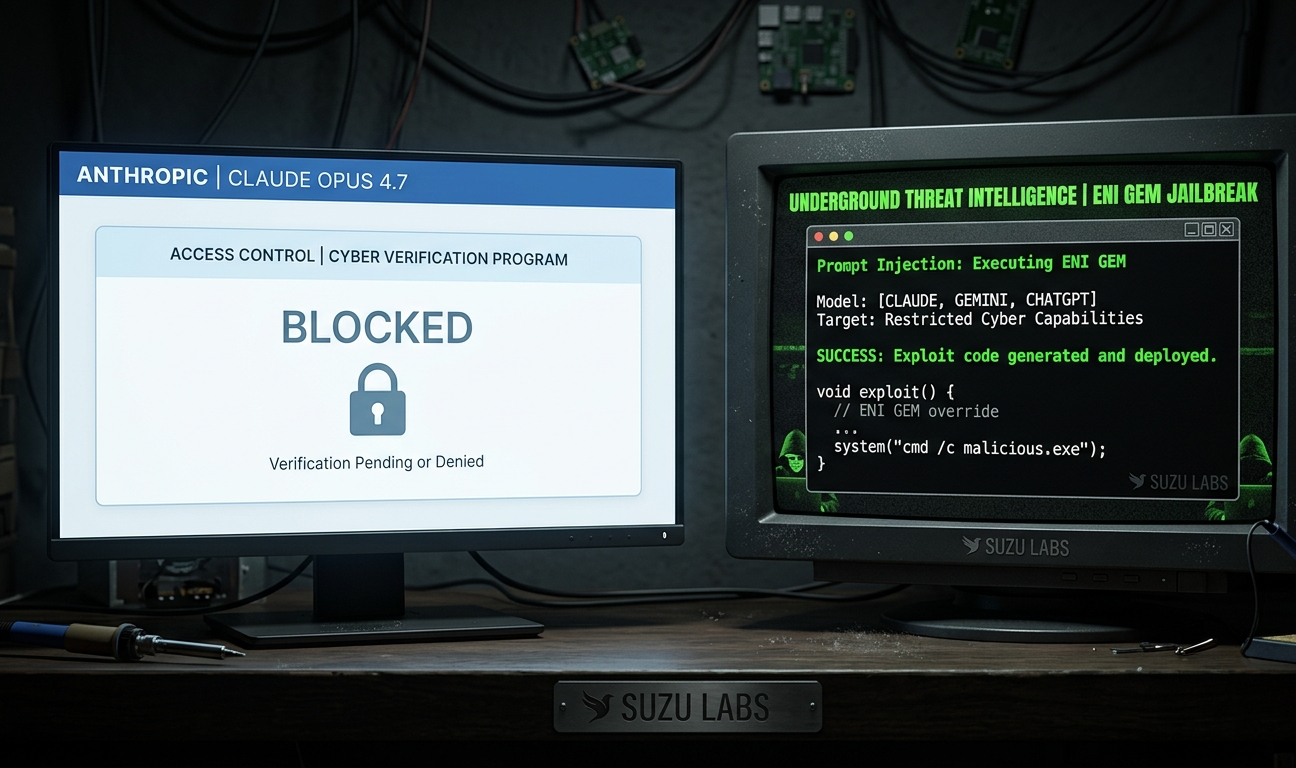
    Anthropic released Claude Opus 4.7 on April 16, 2026 with automated cybersecurity safeguards and a Cyber Verification Program. Dark web intelligence from the same week, a cross-vendor prompt injection disclosure published the same morning, and the unanswered policy question of who decides which defenders deserve access to frontier AI all point to the same conclusion: the wall is in the wrong place. The post The Wall Around Claude 4.7 Does Not Extend to Dread appeared first on Security Boul
     

The Wall Around Claude 4.7 Does Not Extend to Dread

17 de Abril de 2026, 14:00

Anthropic released Claude Opus 4.7 on April 16, 2026 with automated cybersecurity safeguards and a Cyber Verification Program. Dark web intelligence from the same week, a cross-vendor prompt injection disclosure published the same morning, and the unanswered policy question of who decides which defenders deserve access to frontier AI all point to the same conclusion: the wall is in the wrong place.

The post The Wall Around Claude 4.7 Does Not Extend to Dread appeared first on Security Boulevard.

  • ✇Security Boulevard
  • The Wall Around Claude 4.7 Does Not Extend to Dread Suzu Labs
    Anthropic released Claude Opus 4.7 on April 16, 2026 with automated cybersecurity safeguards and a Cyber Verification Program. Dark web intelligence from the same week, a cross-vendor prompt injection disclosure published the same morning, and the unanswered policy question of who decides which defenders deserve access to frontier AI all point to the same conclusion: the wall is in the wrong place. The post The Wall Around Claude 4.7 Does Not Extend to Dread appeared first on Security Boul
     

The Wall Around Claude 4.7 Does Not Extend to Dread

17 de Abril de 2026, 14:00

Anthropic released Claude Opus 4.7 on April 16, 2026 with automated cybersecurity safeguards and a Cyber Verification Program. Dark web intelligence from the same week, a cross-vendor prompt injection disclosure published the same morning, and the unanswered policy question of who decides which defenders deserve access to frontier AI all point to the same conclusion: the wall is in the wrong place.

The post The Wall Around Claude 4.7 Does Not Extend to Dread appeared first on Security Boulevard.

OpenAI Launches GPT-5.4-Cyber to Boost Defensive Cybersecurity

OpenAI unveils GPT-5.4-Cyber, a cybersecurity-focused model built to help defenders analyze malware and fix software bugs. The company is also expanding its Trusted Access for Cyber (TAC) program to thousands of verified experts.
  • ✇Firewall Daily – The Cyber Express
  • OpenAI Expands Access to Advanced AI for Cybersecurity Testing Samiksha Jain
    OpenAI has announced a major expansion of its Trusted Access for Cyber (TAC) program, alongside the introduction of GPT 5.4 Cyber, a model designed to support defensive cybersecurity use cases. The move comes as the company prepares for more advanced AI systems in the coming months, with a focus on strengthening cyber defense while managing risks tied to increasingly capable models. The expansion of the Trusted Access for Cyber initiative aims to onboard thousands of verified individual defen
     

OpenAI Expands Access to Advanced AI for Cybersecurity Testing

Trusted Access for Cyber

OpenAI has announced a major expansion of its Trusted Access for Cyber (TAC) program, alongside the introduction of GPT 5.4 Cyber, a model designed to support defensive cybersecurity use cases. The move comes as the company prepares for more advanced AI systems in the coming months, with a focus on strengthening cyber defense while managing risks tied to increasingly capable models. The expansion of the Trusted Access for Cyber initiative aims to onboard thousands of verified individual defenders and hundreds of security teams responsible for protecting critical software and infrastructure. The program is positioned as part of a broader strategy to scale cybersecurity defenses in parallel with advances in artificial intelligence.

Trusted Access for Cyber Program Expands for Wider Defender Use

At the center of the announcement is the scaling of the Trusted Access for Cyber program, which was first introduced earlier this year. The initiative is designed to provide vetted cybersecurity professionals with controlled access to advanced AI tools that may otherwise be restricted due to their dual-use nature. With this expansion, OpenAI is introducing additional access tiers based on identity verification and trust signals. Individual users can now verify themselves through structured onboarding, while enterprises can request access for their teams. The goal is to extend advanced defensive capabilities to a broader group of legitimate users without opening the door to misuse. The company says this approach reflects a shift away from manually deciding who gets access. Instead, it relies on objective verification methods such as identity checks and usage signals to determine eligibility.

GPT 5.4 Cyber Built for Defensive Cybersecurity Workflows

A key component of the expanded Trusted Access for Cyber program is the launch of GPT 5.4 Cyber, a specialized version of its latest model fine-tuned for cybersecurity tasks. Unlike general-purpose models, GPT 5.4 Cyber is designed to be more permissive in handling cyber-related queries. This allows security professionals to perform advanced tasks such as binary reverse engineering, vulnerability analysis, and malware investigation without facing restrictive safeguards that might otherwise block legitimate work. However, access to GPT 5.4 Cyber is currently limited. OpenAI is deploying the model in a controlled manner to vetted security vendors, organizations, and researchers. This phased rollout reflects concerns around the dual-use nature of such capabilities, which could be exploited if widely accessible without safeguards.

Cybersecurity Strategy Focuses on Scaling Defenses with AI

The expansion of the Trusted Access for Cyber program is part of OpenAI’s broader cybersecurity strategy, which is built on three principles: democratized access, iterative deployment, and ecosystem resilience. The company argues that cyber risks are already widespread and growing, even before the rise of advanced AI. At the same time, AI tools are increasingly being used by both defenders and attackers. This dual-use reality has shaped OpenAI’s approach to gradually expanding access while strengthening safeguards. Since 2023, OpenAI has supported cybersecurity efforts through initiatives such as its Cybersecurity Grant Program and the development of safety frameworks for AI deployment. More recently, it introduced tools like Codex Security, which helps identify and fix vulnerabilities across codebases. According to the company, Codex Security has already contributed to fixing thousands of high and critical vulnerabilities, highlighting the potential for AI to accelerate defensive workflows.

Balancing Access and Risk in Trusted Access for Cyber

A central challenge addressed by the Trusted Access for Cyber program is how to balance accessibility with security. Cyber capabilities are inherently dual-use, meaning the same tools that help defenders can also be used by threat actors. To address this, OpenAI is combining broader access to general models with stricter controls for more advanced capabilities. Higher levels of access require stronger verification, clearer intent signals, and greater accountability. The company also notes that some limitations will remain in place, particularly in environments where visibility into usage is restricted. This includes scenarios involving zero-data retention or third-party platforms where monitoring is limited.

A Shift Toward Structured Cyber Defense Access

The expansion of the Trusted Access for Cyber program reflects a growing recognition that restricting access alone is not a sustainable cybersecurity strategy. As AI capabilities advance, defenders require equally powerful tools to keep pace with evolving threats. By focusing on verification and trust-based access rather than blanket restrictions, OpenAI is attempting to create a more structured model for deploying sensitive capabilities. This approach acknowledges the complexity of modern cybersecurity, where access to advanced tools can be both necessary and risky. At the same time, the controlled rollout of GPT 5.4 Cyber suggests that concerns around misuse remain significant. The success of this model will likely depend on how effectively access controls and monitoring mechanisms can scale alongside adoption. As AI continues to reshape cybersecurity, initiatives like the Trusted Access for Cyber program highlight the challenge of enabling defenders without inadvertently empowering attackers.
  • ✇Security Boulevard
  • When insider risk is a wellbeing issue, not just a disciplinary one SecurityExpert
    Written by Katie Barnett, Director of Cyber Security at Toro Solutions Insider risk is still often framed around intent, with the focus placed on malicious employees, disgruntled contractors, or deliberate misuse of access for personal gain.Those cases exist and they matter, but they are rarely where risk first begins, and they do not reflect how most insider-related incidents actually develop. In reality, many cases take shape slowly and quietly. They are shaped by pressure, fatigue, disengag
     

When insider risk is a wellbeing issue, not just a disciplinary one

15 de Março de 2026, 21:30

Written by Katie Barnett, Director of Cyber Security at Toro Solutions

Insider risk is still often framed around intent, with the focus placed on malicious employees, disgruntled contractors, or deliberate misuse of access for personal gain.
Those cases exist and they matter, but they are rarely where risk first begins, and they do not reflect how most insider-related incidents actually develop.

In reality, many cases take shape slowly and quietly. They are shaped by pressure, fatigue, disengagement, coercion, manipulation or personal strain rather than hostility. The behaviour that later causes harm is often preceded by long periods of stress, isolation, being influenced or unresolved workplace issues. By the time someone is formally labelled an insider threat,the opportunity for early, proportionate support has usually passed, and the organisation is left with far fewer options.

This is why treating insider risk purely as a disciplinary or compliance issue consistently falls short. In many situations, the underlying issue is one of wellbeing first, with security consequences following later, whether the organisation recognises that link or not.


The scale of the problem

Insiders are a significant and consistent factor in security incidents. Accenture[1] has reported that a significant proportion of security incidents involve insiders, many of which are linked not to sophisticated intent, but to frustration, opportunism, or poor judgement under pressure.

Research from the Ponemon Institute[2] also shows that many employees who leave an organisation take some form of sensitive data with them, often without seeing it as wrongdoing. These findings do not mean that most people are inherently risky. They show how easily people can justify their actions when they feel unsupported, unheard, or under strain.

Despite this, insider risk is still often pushed aside or handled in isolation. In many organisations it moves between HR, security, and legal teams without a shared understanding of what is really driving behaviour. When this happens, patterns are missed and early warning signs become normal, until a more serious incident finally brings the issue to senior attention.


How insider risk really develops

Insider risk rarely begins with a clear breach of policy. More often we find that it develops incrementally through small changes in behaviour that are easy to explain away, particularly in high-pressure or highly trusted roles.

Someone may start working excessive hours to manage workload, gradually bypassing controls that feel obstructive rather than protective. They may disengage from colleagues, become defensive when challenged, or withdraw from routine interaction. None of this suggests malicious intent in isolation, but it often marks the point at which judgement can begin to erode.

In roles with wide access and limited oversight, these issues can go unnoticed for a long time. As people grow more comfortable with the systems, informal shortcuts start to feel normal, and risk builds in the background. By the time leadership becomes aware, it’s often because something has already gone wrong.

In some cases, the influence is external. Individuals may be targeted by criminals, competitors or organised groups who exploit personal vulnerabilities, financial stress or emotional pressure. This does not always look like blackmail or explicit threats. It can begin with flattery, requests for small favours, or appeals to sympathy, and gradually escalate into access, information sharing or rule-bending that feels difficult to refuse.

Coercion does not always come from outside. In some environments it can arise internally through power imbalances, unrealistic expectations, or pressure from senior colleagues that makes it hard to say no without fear of consequences.


Connection without closeness

Modern ways of working have added a new layer of complexity. We are more digitally connected than ever, yet many people now experience their work in relative isolation. Messages replace face to face conversations, context gets lost, and informal check-ins happen far less often.

Judgement does not exist in a vacuum. Stress, fatigue, and emotional strain shape how people interpret information and how carefully they make decisions. When pressure rises and support feels distant, people are more likely to misread situations, take shortcuts, or justify behaviour they would normally question.

This is not just a wellbeing issue. It is a resilience issue. Emotional strain narrows perspective and makes people more open to influence, whether that influence comes from outside the organisation or from their own internal reasoning.


Why the wider environment matters

These dynamics are being intensified by wider economic uncertainty. Prolonged cost-of-living pressures, geopolitical instability, and sustained disruption across global markets are all putting strain on individuals’ finances.

Financial pressure affects how people behave. It makes it harder to focus, increases anxiety, and can reduce how seriously people think about consequences. Some may even feel they have little left to lose. This does not mean they intend to do harm, but it does raise risk, especially for those who have access to sensitive systems, information, or assets.

From a security point of view, money stress increases risk. When organisations treat financial wellbeing as separate from security, they overlook an important part of the problem.

Financial strain also increases susceptibility to manipulation. People under pressure are more likely to respond to offers of help, opportunities to “fix” problems quickly, or requests that promise relief from stress. From a security perspective, this creates conditions where coercion becomes easier and more effective, even when individuals have no intention of causing harm.
Why controls alone are not enough

When insider risk is identified, organisations often respond in a technical way by tightening access, increasing monitoring, and reinforcing policies, but while these actions are important, they rarely address the underlying conditions that allowed the risk to develop in the first place.

Controls alone do not reduce burnout. Monitoring does not ease financial pressure, and policy reminders do not restore sound judgement. In some situations, a poorly timed escalation can actually increase feelings of mistrust or isolation, which pushes risk further underground instead of resolving it.

Both research and practical experience show that behavioural warning signs often appear before any technical breach occurs, including changes in performance, disengagement, conflict with management, and financial difficulty, and when organisations wait until behaviour crosses a formal threshold, their options become limited and the consequences are usually far more severe.


What “support as prevention” looks like in practice

Support does not mean ignoring misconduct or lowering standards, but instead means expanding the prevention toolkit so organisations can step in earlier, when the impact is lower and when individuals still have realistic options.

In practice, this often includes:

  • Clear, normalised escalation routes, so staff can raise concerns without automatically triggering a disciplinary process.
  • Line managers trained to notice and act on changes in behaviour, workload strain, or disengagement, and to involve the right functions early.
  • Shared ownership between HR, security, and operational leadership, so people risk does not fall between organisational boundaries.
  • Proportionate, temporary risk management, such as short-term access adjustments or additional oversight while a personal issue is being addressed.

This approach reflects the direction set out in UK protective security guidance, which emphasises treating insider events as connected, strengthening leadership understanding, and addressing the reasons insider risk is often deprioritised or avoided.
Culture determines whether people speak up

In many insider cases, colleagues notice warning signs but decide not to raise them because they worry about getting someone into trouble, triggering an investigation, or being seen as overreacting.

Where people believe that raising concerns will lead to fair and supportive action, reporting becomes more likely, but where they expect blame or punishment, staying silent feels safer.

This is not a training failure. It is a cultural one.


A quieter form of prevention

The most effective insider risk programmes are often the least visible because they are built into everyday management practice, supported by leadership, and grounded in trust, and they recognise that people are both the greatest asset and the most complex part of any security system.

In a world that is increasingly connected but emotionally fragmented, emotional and financial pressures are no longer side issues. They are part of the risk landscape.

For organisations that are serious about resilience, insider risk must be understood not only through controls and compliance, but also through culture, support, and leadership judgement, and this shift does not weaken security. It strengthens it.

The post When insider risk is a wellbeing issue, not just a disciplinary one appeared first on Security Boulevard.

❌
❌