Microsoft winds down its Microsoft AI cloud lease with Oracle and audits $80B in Neocloud contracts to prioritize self-built Azure infrastructure.
Related Posts:
OpenAI Funding Valuation Reaches $1.25 Trillion
Microsoft Overhauls Academic Licensing and Storage Quotas
Vercel DBSC Session Security Thwarts Cookie Theft
The post Microsoft Winds Down Oracle AI Cloud Lease appeared first on Daily CyberSecurity.
Apple announced automated iCloud public link scanning starting in iOS 27.3, inspecting shared files and disabling end-to-end encryption on public links.
Related Posts:
Microsoft Winds Down Oracle AI Cloud Lease
OpenAI Funding Valuation Reaches $1.25 Trillion
Microsoft Overhauls Academic Licensing and Storage Quotas
The post Apple Begins iCloud Public Link Scanning in iOS 27.3 appeared first on Daily CyberSecurity.
Apple announced automated iCloud public link scanning starting in iOS 27.3, inspecting shared files and disabling end-to-end encryption on public links.
Apple will begin checking publicly shared iCloud content in version 27.3. Here's what the change means for file sharing, encryption, and account restrictions.
The post Apple to Check Public iCloud Links Starting With iOS 27.3 appeared first on TechRepublic.
Apple will begin checking publicly shared iCloud content in version 27.3. Here's what the change means for file sharing, encryption, and account restrictions.
Large language model hijacking attacks, also known as LLMjacking, are generating large fraudulent cloud charges, with some organizations losing more than $100,000 per day. [...]
Large language model hijacking attacks, also known as LLMjacking, are generating large fraudulent cloud charges, with some organizations losing more than $100,000 per day. [...]
Canonical fixes LXD vulnerability CVE-2026-112816 (CVSS 10) in LXD and MicroCloud, letting attackers impersonate trusted TLS clients. Update now.
Related Posts:
Critical MediaTek Vulnerabilities Patched in Chipsets
Public PoC Exploit Disclosed for Linux Kernel Bonding Vulnerability
Critical FreePBX Vulnerabilities Patched in User Manager
The post LXD Vulnerability CVE-2026-112816 (CVSS 10) Lets Attackers Impersonate Trusted Clients appeared first on Daily CyberSecurity.
42 publicly listable cloud buckets containing 18 billion files, including exposed credentials, database dumps and backups.
The Ransomnews research team counted 484,142 publicly listable cloud storage buckets in October 2026, holding 18.05 billion files. They built the count from the search engines that index open cloud storage and published it as the Ransomnews Cloud Exposure Index, written by Mantas Sasnauskas.
“No file was opened for this index. Every number below comes from bucket nam
42 publicly listable cloud buckets containing 18 billion files, including exposed credentials, database dumps and backups.
The Ransomnews research team counted 484,142 publicly listable cloud storage buckets in October 2026, holding 18.05 billion files. They built the count from the search engines that index open cloud storage and published it as the Ransomnews Cloud Exposure Index, written by Mantas Sasnauskas.
“No file was opened for this index. Every number below comes from bucket names, file extensions, file counts and last-modified timestamps. That is a deliberate limit. It keeps the research on the right side of the line, and it turns out to be enough to see where the sensitive material concentrates.” Ransomnews states. “We are calling it the Ransomnews Cloud Exposure Index, and we will rerun it quarterly so the numbers can be compared over time.”
The researchers used bucket names, file types, file counts and last-modified dates to collect their data. They did not open any files, allowing them to identify where sensitive information might be stored without accessing the content. They plan to repeat the research every three months to track changes over time.
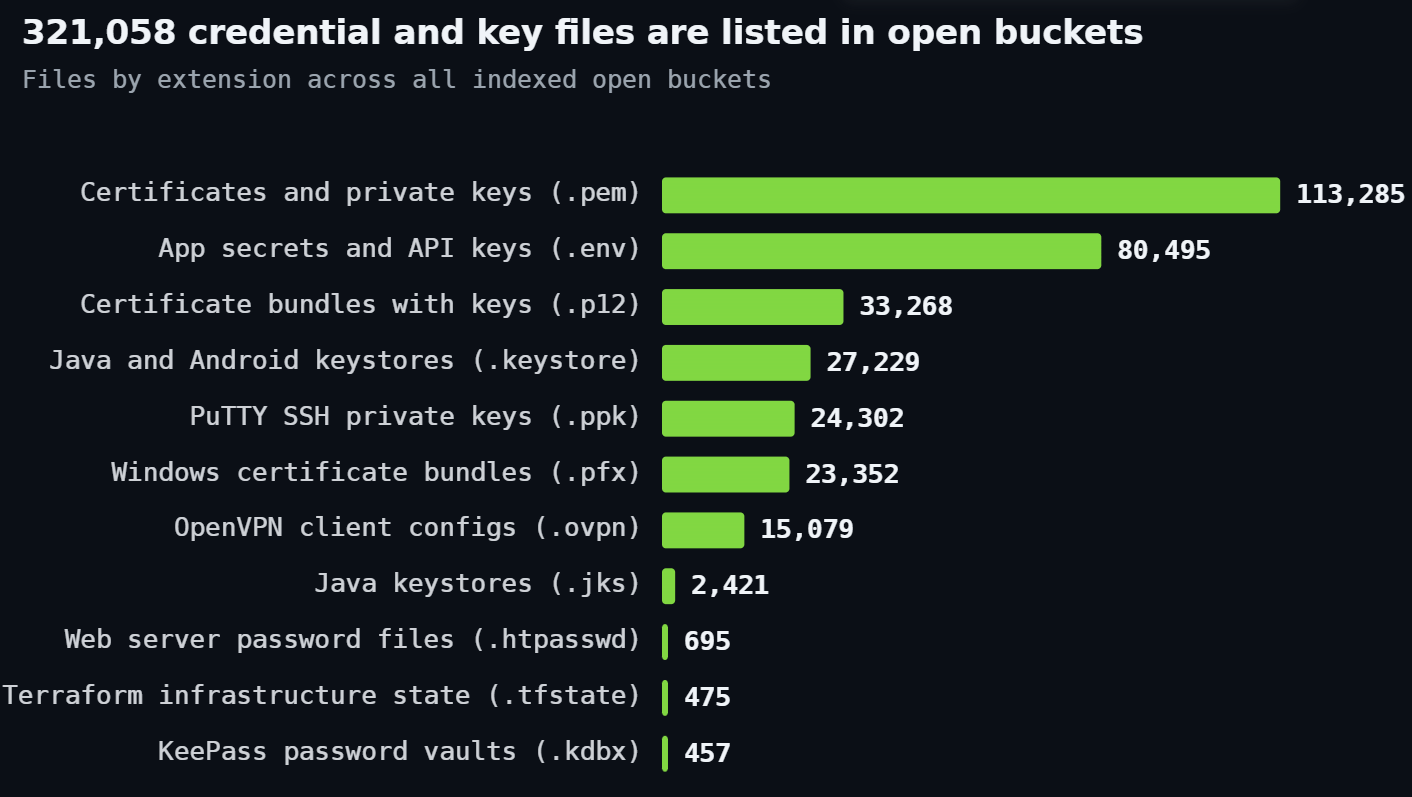
Amazon S3 accounts for 72% of the exposed buckets, roughly in line with its share of the market. This does not mean S3 has weaker security than other providers. Azure Blob, however, appears 2.5 to 3.6 times more often than expected among buckets named for backups, data exports and payroll records. The researchers also found 321,058 files related to credentials and keys. Of the exposed .env files, 67% were last modified in 2026.
Below is the split by provider, from a snapshot taken on October 7:
Provider
Open buckets
Share
Amazon S3
347,984
71.9%
Azure Blob
68,532
14.2%
Google Cloud Storage
53,131
11.0%
DigitalOcean Spaces
11,069
2.3%
Alibaba OSS
3,426
0.7%
Total
484,142
100%
A lot of these buckets are public on purpose, holding website assets, CDN mirrors, open datasets and podcast archives. So the index isn’t 484,142 breaches. It’s the pool where breaches hide, and the rest of the report narrows it down to the stores that should never have been listable.
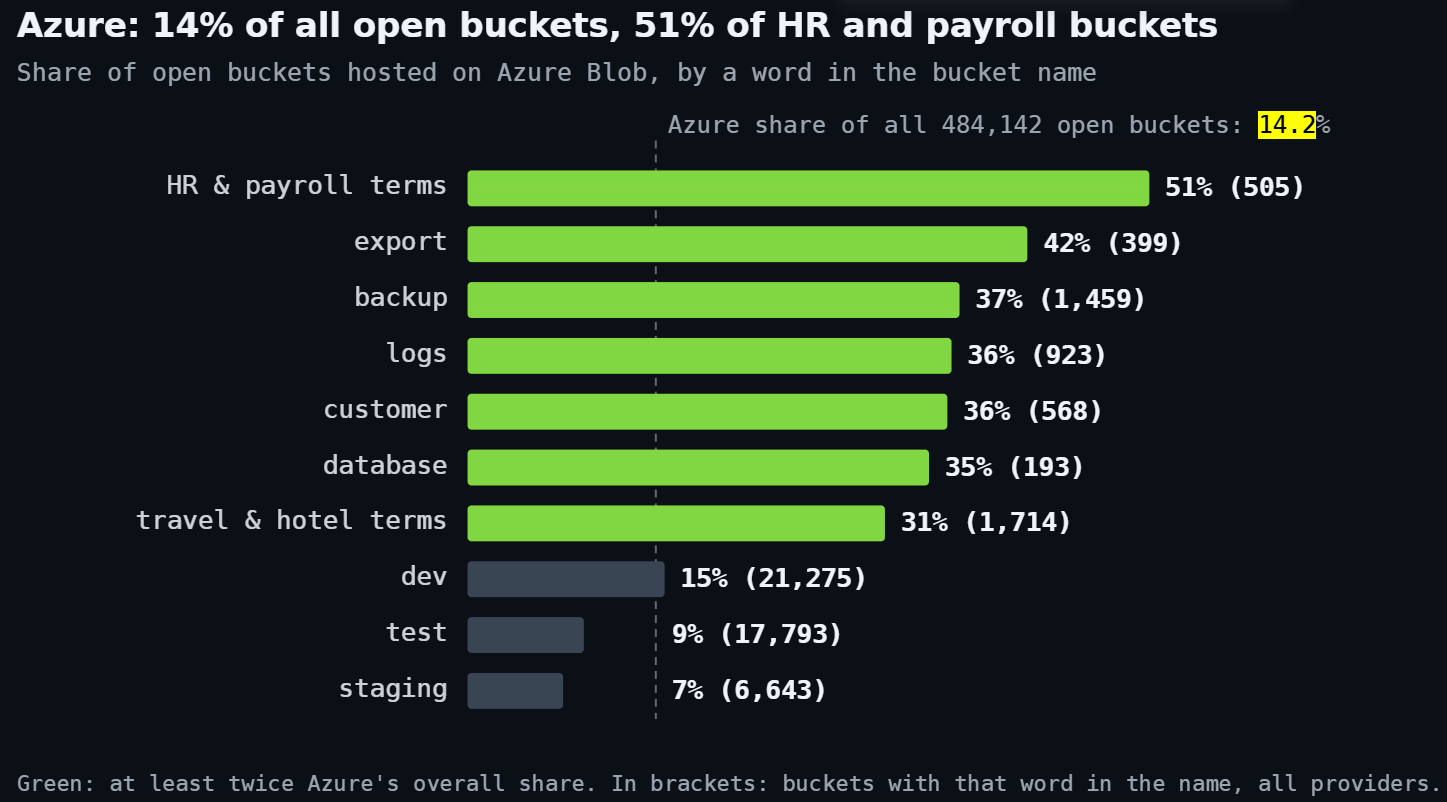
“Azure, by a wide margin relative to its size. Azure Blob holds 14.2% of open buckets, but 37% of the 1,459 buckets with “backup” in the name, 42% of the 399 named for exports, and 51% of the 505 carrying HR or payroll terms.” continues the report. “Buckets named for logs, customers and databases sit at 35% to 36%, all around two and a half times Azure’s baseline.”
The skew only shows up for operational data. Buckets named “dev” sit at Azure’s baseline of 15 percent, and “test” and “staging” fall below it, at 9 and 7 percent. The authors suspect Azure storage accounts more often hold line-of-business data such as backups, exports and HR systems that enterprises run on Microsoft, while S3 and Google Cloud carry more application assets. They call it a hypothesis the counts suggest and don’t prove, and it’s the first thing they want to test next time.
By sector, retail and e-commerce names lead with 5,666 buckets, mostly storefront assets. The more worrying number is that names tied to regulated sectors (finance, healthcare, education, government, legal and HR) appear on 10,891 unique open buckets. Those are the places where a stray file most likely holds personal, health or financial records, and where regulators expect to hear about it.
Sector (by bucket name)
Open buckets
Files in them
Retail and e-commerce
5,666
269.9M
Finance and insurance
3,508
58.0M
Healthcare
2,709
47.9M
Media and entertainment
2,696
136.2M
Education
2,393
60.6M
Gaming
2,296
79.0M
Travel and hospitality
1,714
118.7M
Real estate
1,137
60.7M
Government and public sector
1,000
36.2M
Legal
978
11.3M
Crypto
630
11.9M
HR and payroll
505
8.4M
Healthcare-related names appear in 2,709 buckets containing 47.9 million files. The researchers identified them using terms such as “hospital” (135 buckets), “patient” (135), “clinic” (277) and “dental” (331). HR and payroll is the smallest sector, with 505 buckets, 259 of which are hosted on Azure.
These figures are based on names, not proof of ownership. The search matches parts of words, so “store” can refer to object storage as well as shops. A single bucket can also appear in two sectors.
The exposed buckets also list about 4.7 million database and dump files, 15,130 mailbox archives, and tens of millions of spreadsheets and documents. Credential files are particularly concerning because they can turn a cloud misconfiguration into a real intrusion.
File type
What it is
Files listed
.pem
Certificates and private keys
113,285
.env
App secrets and API keys
80,495
.p12
Certificate bundles with keys
33,268
.keystore
Java and Android keystores
27,229
.ppk
PuTTY SSH private keys
24,302
.pfx
Windows certificate bundles
23,352
.ovpn
OpenVPN client configs
15,079
.jks
Java keystores
2,421
.htpasswd
Web server password files
695
.tfstate
Terraform infrastructure state
475
.kdbx
KeePass password vaults
457
Each of these exists to grant access. A .env file is where developers keep database passwords and API keys. A .tfstate file is Terraform’s record of a whole cloud setup, often with secrets in plain text, and a .kdbx vault is encrypted but now open to anyone who wants to guess passwords offline. Some .pem files are public certificates and some files are test fixtures, so the counts are a ceiling on live secrets and not a measure of them. It’s still a big ceiling.
Database files make up most of the sensitive material by volume:
File type
What it usually holds
Files listed
.sqlite
Embedded app databases
2,561,807
.bak
Database and server backups
752,055
.sql
Database dumps
687,446
.sqlite3
Embedded app databases
488,176
.dump
Database dumps
176,603
.mdb / .accdb
Microsoft Access databases
36,467
.dmp
Memory and crash dumps
12,809
.pst / .ost / .mbox
Mailbox archives
15,130
.eml
Saved emails
4,549,665
.csv
Data exports and records
at least 69,580,112
.xlsx / .xls
Spreadsheets
42,544,997
.docx
Word documents
24,936,788
.pdf
Documents, invoices, scans
at least 106,191,393
.log
Application and server logs
at least 61,310,809
The exposed buckets contain thousands of virtual disk images, including VMware, Hyper-V and QEMU files. A single disk image can contain an entire server, including credentials.
Some exposures involve active systems. Of 80,495 .env files, 67% were last modified in 2026. Certificates and SQLite databases include both recent and older files. Backups appear older, with 89% of the 752,055 .bak files last modified before 2025. Almost all PuTTY key files date from 2024.
Recent leaks need urgent attention, while long-standing exposures point to poor security management. The problem is ongoing: at least 113.6 million files were added to publicly listable buckets in the seven days before September 9. Over the previous 30 days, these included more than 21,000 SQL dumps, nearly 21,000 backup files, 4,477 .pem files and 1,298 .env files.
Public .env files can expose database passwords that ransomware affiliates and initial access brokers look for. Similar credentials appear in stolen-data logs, but in this case, attackers do not need to infect a device. They only need to search for exposed files.
Cloud providers already offer settings to prevent public access. Organizations should enable S3 Block Public Access, disable anonymous access to Azure Blob storage, and enable public access prevention in Google Cloud. These controls should apply at account or organization level to prevent new storage buckets from becoming public.
Organizations should also scan their storage for sensitive files such as .env, .sql, .bak, .pem, .ppk, .tfstate and .kdbx. Terraform state files and virtual disk images should be treated as secrets, stored privately, encrypted and monitored. Backups should never be publicly accessible, and recovery procedures must be tested.
One exposed bucket may be a mistake, but many often indicate a wider process failure. Organizations need to fix the underlying security controls, not just individual buckets.
The research has some limitations. The team queried search engines on October 25, while the bucket list was current to October 7 and the newest indexed file dated September 9. File-level data may therefore be about a month old. Counts are also capped at one million per query, so researchers split larger categories into date ranges and added the results.
Some limits apply. The team queried the search engines on October 25. The bucket list was current to October 7 and the newest indexed file was dated September 9, so file-level figures lag by about a month. The index caps any single count at one million, so larger types were split into date windows and summed.
A last-modified date shows when a file was written, not when it was exposed, and a listed file isn’t proof that its contents can be read. No bucket is named in the report. Exposures with a known owner in regulated sectors are going through responsible disclosure, with national CERTs copied where the owner is public sector or doesn’t respond.
“Rotate any secret that has ever sat in a public bucket. Closing the bucket does not un-leak the key. Assume anything that was listable was copied.” conlcudes the report.
Palo Alto confirms PAN-OS Brotli vulnerability CVE-2026-111497, a CVSS 9.2 buffer overflow in PAN-OS 12.2, 12.1 and 11.2. Install the hotfixes now.
Related Posts:
Apple iOS 27.2 Update Fixes 160 Security Flaws
CISA Adds PHP2Shell to KEV as Confirmed RCE Attacks and Suspected DPRK Scanning Surface
Apple Backports Fix for Exploited CoreGraphics Zero-Day CVE-2026-86950 to Older iPhones
The post Palo Alto Networks Confirms Critical Brotli Flaw CVE-2026-111497 Affects PAN-OS appeared first on Dail
A devastating GMO Desktop Cloud breach compromised over 26,000 servers, exposing FX trading accounts and prompting a full infrastructure shutdown.
Related Posts:
Gheist Campaign Abuses Stolen GitHub Tokens Across 850 Accounts to Steal Secrets
Exposed Cairn AI Panels Reveal Autonomous Hacking Against Over 1,100 Targets
Suspected Chinese Operator Uses ARTEX AI Framework in Global Hacking Campaign
The post GMO Desktop Cloud Breach Exposes 26,000 FX Servers appeared first on Daily CyberSecurity.
Our weekly CVE report for Oct 19-25, 2026 tracks 4,222 new CVEs and 12 exploited vulnerabilities, including PHP2Shell flaws not yet in CISA KEV.
Related Posts:
This Weekly CVE Report Finds CISA KEV Trailing Daily Cybersecurity by Up to 8 Days
Six Exploited Flaws Missing From CISA KEV Lead This Weekly CVE Report
Weekly CVE Report Tracks 2,652 New Flaws and Seven Exploited Vulnerabilities (Sept. 28 - Oct. 4, 2026)
The post Weekly CVE Report Flags PHP2Shell and FortiSIEM Attacks Still Missing Fr
A PingCAP data breach exposed customer records and source code. Learn how the TiDB Cloud security incident happened and how to protect your account.
Related Posts:
Keystone Wallet Data Breach Exposes Customer Orders
Smart TV ACR Tracking Study Finds Failed Opt-Outs and 57 Million Exposed Viewing Records
CAPCOM ID Data Breach Exposes 11.77 Million Records
The post PingCAP Data Breach Exposes TiDB Cloud Customer Records and Source Code appeared first on Daily CyberSecurity.
Arista says VeloCloud Orchestrator vulnerability CVE-2026-114625, a CVSS 9.9 SQL injection, is exploited in the wild. Upgrade on-prem VCO now.
Related Posts:
PHP Warns of New Session Upload Progress Flaw CVE-2026-115560, Urges Mitigation
LiteSpeed Cache Flaws Expose 7 Million WordPress Sites to Stored XSS
Oracle Issues Java Security Alert to Distrust Compromised eMudhra Certificates
The post Arista Warns VeloCloud Orchestrator Flaw CVE-2026-114625 Is Exploited in the Wild appeared first on Da
Cloud platform Railway published an urgent warning to users after detecting suspicious activity on its systems that store customer environment variables earlier this week. [...]
Cloud platform Railway published an urgent warning to users after detecting suspicious activity on its systems that store customer environment variables earlier this week. [...]
An OVHcloud CLI attack swapped GitHub release files with a secret-stealing binary. Learn which versions are hit in this supply chain attack.
Related Posts:
Qilin, Inc and Settra Ransomware Gangs Exploit PAN-OS Flaw CVE-2026-0257 for VPN Access
AdFection Spyware Attack Targets Al Jazeera Devices
GhostBat RAT Uses Transparent Overlay to Steal PINs From 60 Indian Financial Apps
The post OVHcloud CLI Attack Swaps Release Binaries With a Secret-Stealing Build appeared first on Daily CyberSecurity.
CISA warns of dcm4chee vulnerabilities that expose patient data, plus unpatched EseeCloud cameras with hard-coded credentials (CVE-2026-107617).
Related Posts:
Roundcube 1.6.20 and 1.7.5 Fix 20 Security Flaws, Including IMAP Command Injection
PwnEscape Linux Kernel Flaw CVE-2026-99999 Lets VM Guests Escape to the Host
Six Linux Kernel Flaws Disclosed With Public PoC Exploits for Root Access and Container Escape
The post CISA Warns of Critical Flaws in dcm4chee Medical Archive and Unpatched Es
Attackers are actively exploiting CVE-2026-110447 (CVSS 9.2), a critical Nextcloud Collabora Online RCE flaw in richdocumentscode, to deploy PHP webshells.
Related Posts:
Public PoC Exploit Disclosed for CVSS 10.0 GitLab Remote Code Execution Flaw CVE-2026-97229 Affecting 25,766 Hosts
Public PoC Exploit Code and Technical Details Disclosed for CVE-2026-74580 Linux vhost Vulnerability (Vghost)
CERT/CC Warns of Critical CVE-2026-110005 OS Command Injection in Komodo Periphery Agent
The post Cri
Attackers are actively exploiting CVE-2026-110447 (CVSS 9.2), a critical Nextcloud Collabora Online RCE flaw in richdocumentscode, to deploy PHP webshells.
Built on Qwen3.5-2B, the System One model executes sub-31ms local inference, allowing enterprises to run automated classifications quickly, at low cost and completely offline without transmitting sensitive data to third-party cloud servers.
Built on Qwen3.5-2B, the System One model executes sub-31ms local inference, allowing enterprises to run automated classifications quickly, at low cost and completely offline without transmitting sensitive data to third-party cloud servers.
A recent Yandex Cloud drone strike in Vladimir caused severe service outages across Russia, disrupting Yandex Pay, search, and enterprise cloud operations.
Related Posts:
Anthropic Fortifies Claude AI Against Model Distillation
Bitwarden App Store License Changes to Commercial Model
Firefox 158.0 Released: Default JPEG XL Support
The post Yandex Cloud Drone Strike Causes Widespread Service Outages appeared first on Daily CyberSecurity.
A recent Yandex Cloud drone strike in Vladimir caused severe service outages across Russia, disrupting Yandex Pay, search, and enterprise cloud operations.

 Entrar