❌

Visualização normal

Antes de ontemCybersecurity News
  • ✇HACKMAGEDDON
  • October 2026 Cyber Attacks Statistics Infographic Paolo Passeri
    Thirty-one days, 438 incidents, one attack every 100 minutes. This infographic distills October 2026 into a single scroll. Cyber Crime was the loudest motive, while nearly half of all attacks left their motivation unknown. Malware led the arsenal, exploited public-facing applications opened the most doors, and Information & Communication took the brunt of targeting.
     

October 2026 Cyber Attacks Statistics Infographic

5 de Novembro de 2026, 10:59
Thirty-one days, 438 incidents, one attack every 100 minutes. This infographic distills October 2026 into a single scroll. Cyber Crime was the loudest motive, while nearly half of all attacks left their motivation unknown. Malware led the arsenal, exploited public-facing applications opened the most doors, and Information & Communication took the brunt of targeting.
  • ✇HACKMAGEDDON
  • October 2026 Cyber Attacks Statistics Paolo Passeri
    October 2026 closed with 438 recorded cyber incidents. Cyber Crime drove 44.1% of them, while nearly half of all motivations remained undetermined. Malware led the named attack techniques at 15.7%, ahead of Vulnerability Exploitation and Account Takeover. Exploiting public-facing applications was again the top initial access vector, and Information & Communication was the most targeted sector. The report breaks down motivations, attack vectors, initial access, sectors and geography.
     

October 2026 Cyber Attacks Statistics

5 de Novembro de 2026, 10:59
October 2026 closed with 438 recorded cyber incidents. Cyber Crime drove 44.1% of them, while nearly half of all motivations remained undetermined. Malware led the named attack techniques at 15.7%, ahead of Vulnerability Exploitation and Account Takeover. Exploiting public-facing applications was again the top initial access vector, and Information & Communication was the most targeted sector. The report breaks down motivations, attack vectors, initial access, sectors and geography.
  • ✇HACKMAGEDDON
  • November 2026 Cyber Attacks Timeline Paolo Passeri
    Follow the cyber attacks of November 2026 as they happen. This live HACKMAGEDDON dashboard is updated every day with newly vetted incidents. It shows the leading motivations, attack vectors, targeted sectors and countries on an interactive map, plus a filterable, searchable timeline linking to each source.
     

November 2026 Cyber Attacks Timeline

3 de Novembro de 2026, 07:46
Follow the cyber attacks of November 2026 as they happen. This live HACKMAGEDDON dashboard is updated every day with newly vetted incidents. It shows the leading motivations, attack vectors, targeted sectors and countries on an interactive map, plus a filterable, searchable timeline linking to each source.
  • ✇Security Affairs
  • Volt Typhoon Used Silent Train to Hide Zero-Day Attacks Pierluigi Paganini
    Volt Typhoon used disposable relay chains to hide zero-day attacks on critical systems. Lumen linked Silent Train to at least four zero-days. Lumen’s Black Lotus Labs has spent three years tracking a covert network it calls Silent Train, which it ties to Volt Typhoon, the China-linked APT group. The cybersecurity firm says the network hid exploitation of software flaws the vendors didn’t know about yet. Black Lotus sent hundreds of victim notifications along the way, and the investigations t
     

Volt Typhoon Used Silent Train to Hide Zero-Day Attacks

29 de Outubro de 2026, 07:34

Volt Typhoon used disposable relay chains to hide zero-day attacks on critical systems. Lumen linked Silent Train to at least four zero-days.

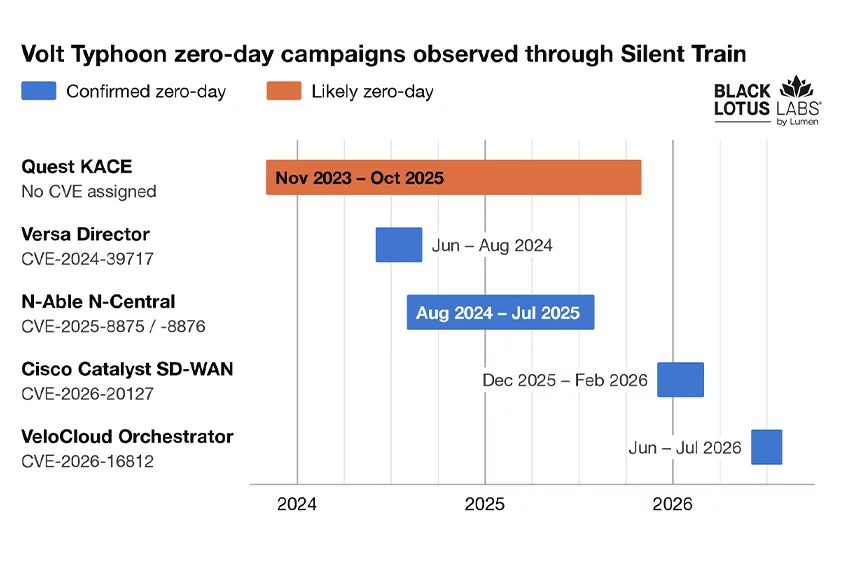
Lumen’s Black Lotus Labs has spent three years tracking a covert network it calls Silent Train, which it ties to Volt Typhoon, the China-linked APT group. The cybersecurity firm says the network hid exploitation of software flaws the vendors didn’t know about yet. Black Lotus sent hundreds of victim notifications along the way, and the investigations that followed revealed the exploitation of at least four confirmed zero-days and one likely.

“Volt Typhoon’s Silent Train is a covert network designed to gain and maintain access to the technologies businesses rely on to manage devices, networks and critical operations.” reads the report published by Lumen. “Black Lotus Labs® tracked how the group used rapidly changing chains of compromised infrastructure to conceal its activity while exploiting previously unknown vulnerabilities in centralized management platforms.”

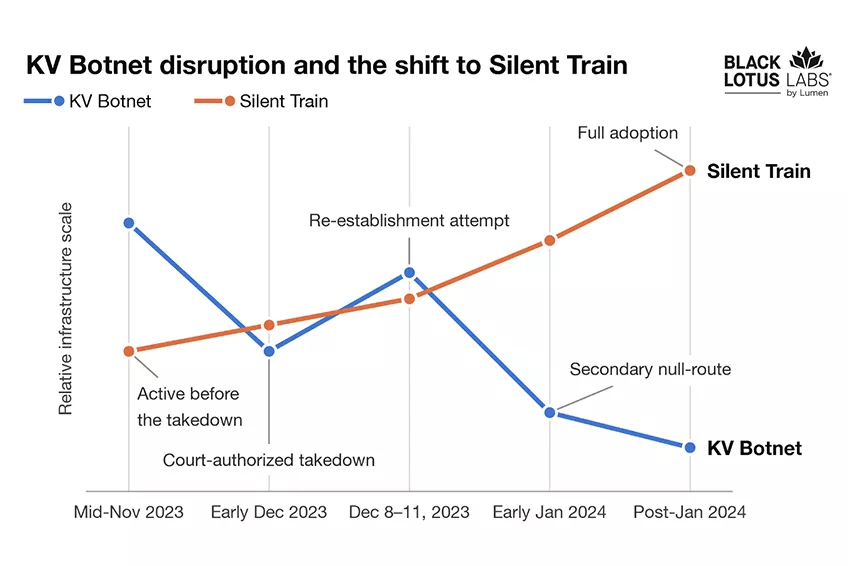
Silent Train first showed up in November 2023, shortly before the first takedown of the KV-botnet, Volt Typhoon’s earlier network of hijacked routers. Activity rose after the second disruption. The group dropped persistent infrastructure and moved to disposable chains of compromised devices that it could rebuild whenever it wanted.

Each session began on a rented server outside the United States. It then passed through another server and compromised small-office routers, home devices and IoT equipment in other countries. Finally, the traffic passed through a compromised device in the U.S., close to the target. This helped the attackers make their activity look like normal local traffic and bypass location-based blocks and IP reputation filters. On average, the chains passed through about four devices before reaching a U.S. IP address. Some used as many as six.

Lumen identified more than 27 types of devices used in the network, including TP-Link routers and Fortinet appliances. Some of these devices had no known vulnerabilities, suggesting that Volt Typhoon may have used previously unknown exploits to compromise them and create relay points.

“We observed more than 27 device classes exploited and used in Silent Train operations, ranging from SOHO and IoT devices like TP-Link routers and Netgear Orbi devices to enterprise platforms like Fortinet appliances and CyberPanel servers.” the report continues. “Some relay device types lack known vulnerabilities, suggesting Volt Typhoon leveraged undisclosed zero-day exploits to set up a single relay in a four-to-six hop chain and indicating a willingness to commit significant resources to protecting future access capabilities.”

The attackers exploited exposed web interfaces and installed only the tools needed to connect the devices through SSH. These included temporary SSH services, keys, configuration files and tools already available on the systems. At the end of each session, they removed all traces of their activity and dismantled the relay chain. Sessions lasted about four hours on average, although some lasted only minutes. The attackers could also build a new chain in less than two minutes, suggesting that they had partly automated the process.

The group worked with strict discipline. New device types arrived about one per quarter, and about one per month during the 2023 and 2024 build-out, always tested outside the U.S. first. Roles never changed: Intelbras modems served only as overseas relays, Netgear Orbi devices only as the U.S. hops facing victims, and the server providers stayed separated by layer too.

By early 2025, enterprise platforms like Fortinet, Cisco, PRTG, Mirth Connect and CyberPanel joined as final hops. They stayed up one to three months and supported several intrusions. The group also added reverse tunnels using the open-source proxies Chisel and FRP, and the old and new methods ran in parallel.

Volt Typhoon used Silent Train only during key stages of its attacks, including exploiting vulnerabilities, stealing credentials and data, and maintaining access to compromised systems. Each session targeted between one and five victims, often just one organization. The activity was carried out by human operators, mainly from Monday to Friday, between 9 a.m. and 10 p.m. China Standard Time. The group also paused operations for several weeks around Chinese New Year.

The group targeted tools used to manage endpoints and networks, as well as SD-WAN systems and other control platforms. These systems can manage hundreds or thousands of devices, allowing attackers to reach many systems without moving through the network in the usual way. This approach also helped them leave fewer traces. After the attacks, investigators found webshells running in memory, stolen credentials, misuse of built-in features such as remote file transfers, and deleted logs.

The four confirmed zero-day campaigns hit Versa Director in 2024, N-able N-central through CVE-2025-8875 and CVE-2025-8876, Cisco Catalyst SD-WAN through CVE-2026-20127, and VeloCloud Orchestrator through CVE-2026-16812. The Cisco bug is a CVSS 10.0 flaw, and the group kept exploiting it well after Cisco disclosed it in February 2026. In the Versa case, the group used an in-memory JAR webshell to limit forensic evidence and reach downstream customers.

The likely fifth is Quest KACE. The campaign hit more than 30 victims and faded after Quest’s October 2025 security updates.

“The campaign affected more than 30 victims, followed vendor remediation timelines and declined after Quest’s October 2025 security updates.” the report states. “Despite limited forensic evidence, the available data supports a moderate-confidence assessment that Volt Typhoon exploited a zero-day vulnerability.”

The actor stayed on the KACE server and used its admin features to take credentials.

Victims include telecoms, government agencies, defense contractors, satellite and emergency communications, universities with ROTC programs, managed service and IT firms, and critical infrastructure such as water, energy, transportation, maritime, rail and aviation. What they share is access to bigger networks or customers. Hawaii, California and Texas were the top locations for several years. Lumen can’t say why, but the pattern fits pre-positioning for a crisis in the Indo-Pacific.

“For enterprise leaders, the lesson is clear: systems with broad administrative reach can become high-value gateways to the entire organization and its customers. Reducing internet exposure, accelerating patching, strengthening access controls and preserving security telemetry are essential to detecting threats earlier and limiting their impact.” Lumen concludes.

Follow me on Twitter: @securityaffairs and Facebook and Mastodon

Pierluigi Paganini

(SecurityAffairs – hacking, China)

  • ✇Security Affairs
  • Silent Lynx: Kazakhstan-Linked Hackers Target Russian Refinery and Government Pierluigi Paganini
    Silent Lynx, a group likely based in Kazakhstan, targets Russian energy and government entities in espionage campaigns across Central Asia. Researchers from Cisco Talos and Recorded Future published a detailed paper on a threat actor they call Silent Lynx (aka UAT-6275, TAG-193), a Kazakhstan nexus group conducting espionage across Central Asia. The targets include the Orsk Oil Refinery in southern Russia, about 25 kilometers from the Kazakhstan border, and the government of Nizhny Novgo
     

Silent Lynx: Kazakhstan-Linked Hackers Target Russian Refinery and Government

15 de Outubro de 2026, 15:33

Silent Lynx, a group likely based in Kazakhstan, targets Russian energy and government entities in espionage campaigns across Central Asia.

Researchers from Cisco Talos and Recorded Future published a detailed paper on a threat actor they call Silent Lynx (aka UAT-6275, TAG-193), a Kazakhstan nexus group conducting espionage across Central Asia.


The targets include the Orsk Oil Refinery in southern Russia, about 25 kilometers from the Kazakhstan border, and the government of Nizhny Novgorod, a major city about 425 kilometers east of Moscow. The city lies where the Volga and Oka rivers meet, an important waterway system connected to the Caspian Sea. This target may be significant because Kazakhstan depends on the Caspian basin.

The group has been running targeted intrusion campaigns against government bodies, diplomatic missions and civil society organizations across Central Asia since at least 2024.

“Silent Lynx (overlapping with activity tracked as UAT-6275 by Cisco Talos and as TAG-193 by Recorded Future) is a persistent threat actor that has conducted targeted intrusion campaigns against government ministries, diplomatic missions and civil society organizations across Central Asia since at least 2024.” the paper states. “The group maintains a strong focus on high-value public sector organizations in the Commonwealth of Independent States (CIS), frequently leveraging spear-phishing campaigns conducted through compromised government email accounts and malware staging through trusted public services such as GitHub to increase credibility and infection success rates.”

The group overlaps significantly with clusters previously documented under names like YoroTrooper, ShadowSilk, and Hydra Saiga, all pointing at the same underlying activity.

The toolkit is deliberately lightweight: PowerShell-based reverse shells, proprietary shells written in C++, C#, and Go, commodity tunneling tools, and spear phishing emails sent through compromised government email accounts in Tajikistan and Kyrgyzstan to add credibility. GitHub, Telegram, and hijacked legitimate servers all serve as staging platforms. Nothing about it is technically flashy, which is part of why the group has stayed active for years without much public attention.

The researchers found links that go beyond technical evidence. In March 2026, a Tajik government agency contacted a Silent Lynx server, shortly after Kazakhstan’s lower house of parliament ratified a Treaty on Allied Relations with Tajikistan. In early April, a Belarusian government entity appeared on the same infrastructure, about a week before Kazakhstan’s president met with the Belarusian foreign minister in Astana. These links do not prove the reasons behind the activity, but the researchers highlight them in their paper, and they are difficult to ignore.

The connection to the Orsk refinery also has a clear context. A Ukrainian drone attack in August forced the refinery to shut down for months. Russia had already asked Kazakhstan to help make up for the resulting loss of refining capacity. If a Kazakhstan-linked actor was collecting intelligence on Russian energy infrastructure at that time, it could have been assessing the economic impact or trying to understand how the disruption might affect Kazakhstan’s own export pipelines. The researchers stress that they do not have enough evidence to identify a specific motive. However, they present the facts and let readers draw their own conclusions.

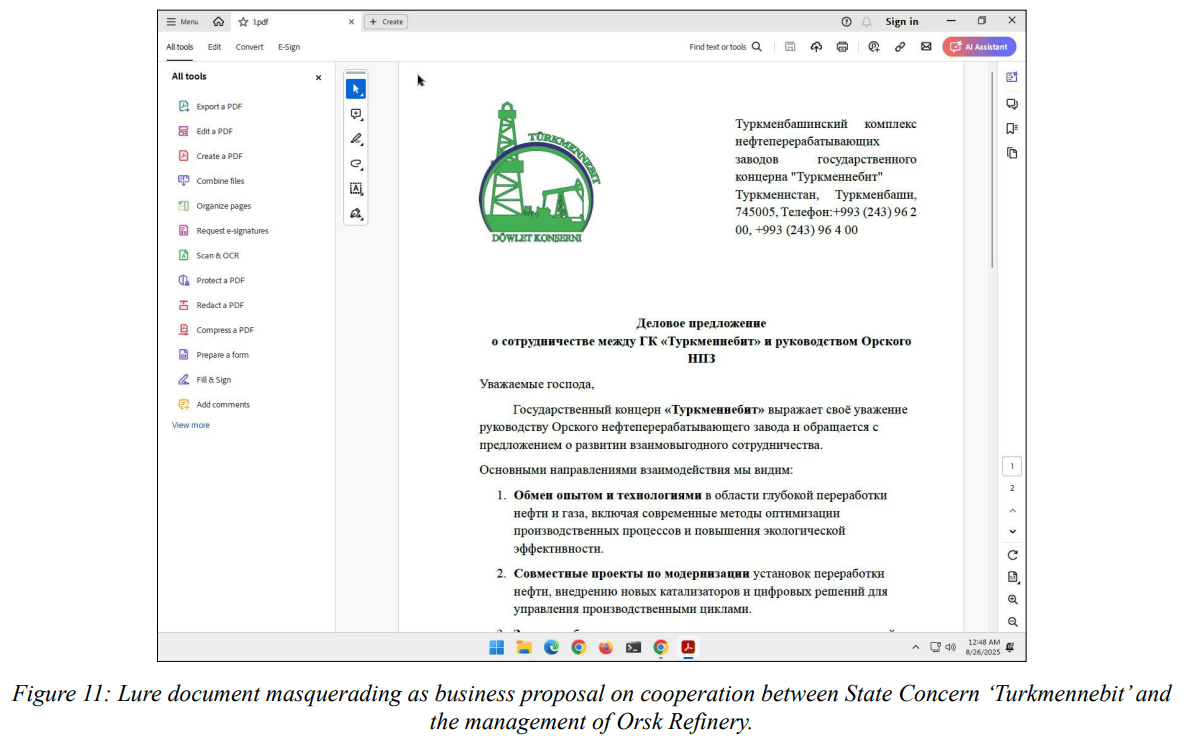
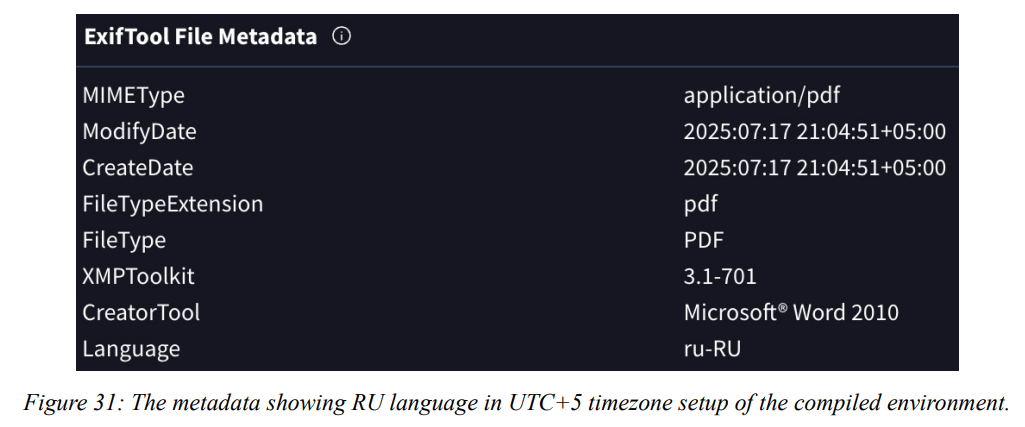
“A sample compiled in August 2025 was observed using a document titled Деловое предложение о сотрудничестве между ГК «Туркменнебит» и руководством Орского НПЗ (translated: Business proposal on cooperation between State Concern ‘Turkmennebit’ and the management of Orsk Refinery) (see Figure 11). We assess that this sample may be targeting Russia’s critical energy infrastructure, given the close integration of the Russian BREAK THE SILENCE: TRACKING SILENT LYNX THROUGH EXPOSED INFRASTRUCTURE SHEN & VÖGELE 10 VIRUS BULLETIN CONFERENCE OCTOBER 2026 and Kazakh energy sectors.” continues the report. “The document outlines proposals for developing mutually beneficial cooperation, with a particular focus on the exchange of expertise, technologies, and industry best practices. It is worth noting that the author of this PDF file is ‘pickle rick’ and the document was created just one hour after the payload was compiled. The name ‘pickle’ is aligned with the name ‘pickl’ we observed in the PickleShell PDB string3.”

SILENT LYNX

What gave the group away wasn’t a sophisticated interception, it was their own operational sloppiness. They left open directories exposed on public servers containing live tooling, staged payloads, and one very incriminating shell command history showing keyboard input typed in Latin with a Russian keyboard layout active, so “whoami” came out as “црщфьш.” GitHub commit timestamps across 77 commits fit working hours in Astana, Kazakhstan, at 95 percent, compared to only 51 percent if you plot them against Moscow time. Administration connections to Silent Lynx servers came from ProtonVPN egress IPs geolocated to Kazakhstan, exclusively on weekdays between 7 AM and noon local time.

The group’s servers were also being reached from those VPN addresses, which Proton typically assigns based on geographic proximity. Two malware samples were uploaded to VirusTotal from Kazakhstan within minutes of compilation, which is classic anti-detection testing behavior and points to the operator location directly.

“We identified several additional indicators that strengthen the assessment of a Kazakhstan-based origin. The first derives from what appears to be malware detection-testing activity conducted through VirusTotal.” continues the report. “Two samples showed this pattern: an early Chvost sample12 was uploaded to VirusTotal only 86 seconds after compilation, while a second sample13 was uploaded approximately four minutes after compilation. Both samples were uploaded from Kazakhstan, and the same uploaders had submitted additional tools that were later observed in Silent Lynx campaigns.”

A researcher at Johns Hopkins School of Advanced International Studies told Reuters that the case highlights an important point: cyber espionage is no longer the domain of a few major powers. Smaller countries are also developing their capabilities and running long-term operations against neighboring states, often driven by serious geopolitical interests.

Silent Lynx is also becoming more technically advanced. In April 2026, the group used an exploit for the first time to deliver malware. It abused a WinRAR path traversal flaw (CVE-2025-8088) to place malicious files directly in the Windows Startup folder, without requiring victims to enable macros. The group also stored a public proof of concept for a FortiWeb authentication bypass vulnerability on its own command-and-control (C2) server. Researchers have also found signs of growing interest in Linux systems. After relying mainly on social engineering for two years, Silent Lynx appears to be building a more advanced set of attack tools.

Full joint Virus Bulletin paper with full indicators of compromise, malware hashes, and infrastructure details is available here.

Follow me on Twitter: @securityaffairs and Facebook and Mastodon

Pierluigi Paganini

(SecurityAffairs – hacking, SILENT LYNX)

Q3 2026 Cyber Attacks Statistics Infographic

15 de Outubro de 2026, 09:01
Ninety-two days, 588 incidents, one attack roughly every four hours. This infographic distils the Q3 2026 cyber attacks statistics into the numbers that matter: motivations, top techniques, initial access, targeted sectors and geography.
  • ✇HACKMAGEDDON
  • Q3 2026 Cyber Attacks Statistics Paolo Passeri
    In the third quarter of 2026, I recorded 588 cyber incidents. Cyber Crime accounted for 77.1% of motivations, Malware was the most common attack technique at 31.9%, and Exploit Public-Facing Application (T1190) led initial access at 30.4%. Information and Communication was the hardest-hit sector.
     

Q3 2026 Cyber Attacks Statistics

15 de Outubro de 2026, 09:00
In the third quarter of 2026, I recorded 588 cyber incidents. Cyber Crime accounted for 77.1% of motivations, Malware was the most common attack technique at 31.9%, and Exploit Public-Facing Application (T1190) led initial access at 30.4%. Information and Communication was the hardest-hit sector.
  • ✇HACKMAGEDDON
  • September 2026 Cyber Attacks Statistics Infographic Paolo Passeri
    September 2026 saw 181 confirmed cyber incidents, roughly one every four hours. Cybercrime drove 73.8% of attacks and espionage 19.1%. Malware led the techniques with 53 campaigns, ahead of Remote Code Execution with 32. More than a quarter of breaches started with an exploited public-facing application, and the United States was the most targeted country at 23.0%. This infographic summarizes the month's key numbers from the HACKMAGEDDON timeline.
     

September 2026 Cyber Attacks Statistics Infographic

7 de Outubro de 2026, 06:31
September 2026 saw 181 confirmed cyber incidents, roughly one every four hours. Cybercrime drove 73.8% of attacks and espionage 19.1%. Malware led the techniques with 53 campaigns, ahead of Remote Code Execution with 32. More than a quarter of breaches started with an exploited public-facing application, and the United States was the most targeted country at 23.0%. This infographic summarizes the month's key numbers from the HACKMAGEDDON timeline.
  • ✇HACKMAGEDDON
  • September 2026 Cyber Attacks Statistics Paolo Passeri
    September 2026 recorded 182 cyber incidents, and Cyber Crime drove roughly three in four of them (73.9%). Malware was the top attack vector at 27.8%, exploitation of public-facing applications led initial access at 28.9%, and Information & Communication was the most targeted sector. Explore the full statistics, from the daily trend to the geographic distribution.
     

September 2026 Cyber Attacks Statistics

7 de Outubro de 2026, 06:30
September 2026 recorded 182 cyber incidents, and Cyber Crime drove roughly three in four of them (73.9%). Malware was the top attack vector at 27.8%, exploitation of public-facing applications led initial access at 28.9%, and Information & Communication was the most targeted sector. Explore the full statistics, from the daily trend to the geographic distribution.
  • ✇HACKMAGEDDON
  • October 2026 Cyber Attacks Timeline Paolo Passeri
    A live view of the month's vetted cyber incidents, updated as new events are confirmed. Explore the timeline, filter by attack type, and see motivations, techniques, initial access methods, targeted sectors and target countries on an interactive map.
     

October 2026 Cyber Attacks Timeline

5 de Outubro de 2026, 05:31
A live view of the month's vetted cyber incidents, updated as new events are confirmed. Explore the timeline, filter by attack type, and see motivations, techniques, initial access methods, targeted sectors and target countries on an interactive map.
  • ✇Security Affairs
  • Oxygen Forensics, A Russian-run forensics firm spent a decade inside European police departments Pierluigi Paganini
    DOJ charges against Oxygen Forensics reveal the Russian-linked firm also sold forensic software to EU projects and European police forces for years. Last week’s Justice Department indictment of Oxygen Forensics looked, at first, like an American procurement scandal. CEO Lee Reiber and Russian co-founder Oleg Davydov stand accused of hiding that the company was Russian-owned and its software built in Russia, while it sold forensic tools to the Pentagon, the Secret Service, and other US agenci
     

Oxygen Forensics, A Russian-run forensics firm spent a decade inside European police departments

30 de Setembro de 2026, 10:26

DOJ charges against Oxygen Forensics reveal the Russian-linked firm also sold forensic software to EU projects and European police forces for years.

Last week’s Justice Department indictment of Oxygen Forensics looked, at first, like an American procurement scandal. CEO Lee Reiber and Russian co-founder Oleg Davydov stand accused of hiding that the company was Russian-owned and its software built in Russia, while it sold forensic tools to the Pentagon, the Secret Service, and other US agencies. Politico’s reporting shows the reach went a lot further than Washington.

“The CEO of a Virginia-based software company and a Russian national have been arrested on a federal criminal complaint charging them with concealing from U.S. government agencies that their company was owned and controlled by Russian nationals and that its software was developed in Russia, the Justice Department announced today.” DoJ states. “Reiber allegedly represented to the government that the company had no foreign ownership or control and that its software was developed in the United States, when in fact five Russian nationals, including Davydov, owned and controlled the company and its software was developed in Russia.”

According to documents reviewed by Politico, Oxygen Forensics was involved in two EU-funded projects designed to improve how European investigators collect and share digital evidence.

The first, EVIDENCE, ran from 2014 to 2016 and received more than €1.9 million in EU funding. Oxygen was consulted alongside organizations such as Europol, Eurojust and the European Anti-Fraud Office’s digital forensics unit.

The second project, INSPECTr, was funded through Horizon 2020. It developed software that allowed investigators to combine evidence extracted with tools such as Oxygen’s with data from other systems. The project continued until 2023, after Russia’s invasion of Ukraine.

“The second project, INSPECTr, backed under Horizon 2020, an EU research and innovation funding arm, was designed to help European police bring together and analyze digital evidence collected using different tools. It built software that could take evidence extracted with Oxygen Forensics and make it easier for investigators using other systems to access and analyze it.” reports POLITICO. “Although both of those EU-backed projects were launched well before Russia’s February 2022 full-scale invasion of Ukraine and subsequent European sanctions, INSEPCTr continued to operate until 2023.”

The European Commission said Oxygen was not a formal member of either consortium and did not receive direct EU funding. It also noted that Russian entities have been excluded from Horizon Europe projects since the war began.

That may be technically correct, but the issue is broader: Oxygen was still consulted on EU-funded projects dealing with digital evidence and investigative technology, even if it was not officially part of the project or directly funded by the EU.

The domestic Russian side of this story is the part that should worry European agencies more than the funding technicality does. The same five people who secretly owned Oxygen Forensics also controlled MKO Systems, a Russian company selling the same underlying technology to the FSB and Russia’s Interior Ministry. That’s not two unrelated businesses that happen to share a founder. That’s one piece of forensic technology with two sets of customers who are, depending on how you look at it, on opposite sides of several ongoing investigations.

And the client list in Europe, once you start counting, is long. Police agencies in Germany, Spain, Italy, and Poland accredited or purchased Oxygen’s products, according to EU tender records. Hungary’s police signed a contract worth roughly €27,000 in December 2024, running through the end of last year. A prosecutor’s office in Sardinia listed Oxygen among its recognized mobile-extraction systems as recently as April 2026, and a Spanish National Police inspector accredited by the company co-authored a 2026 study on cracking WhatsApp data on Android and iPhone. Romania and Latvia bought in as recently as this September, days before the arrests.

There is also a more worrying case outside the EU. French outlet Disclose reported that Oxygen’s software was provided to Moroccan authorities through an EU-funded border management program covering the Maghreb. The EU also paid for training courses where Oxygen employees trained Moroccan police to use the software.

In other words, a tool allegedly controlled by Russian interests was being used to train foreign law enforcement, with the training funded by the EU.

Some agencies are now reacting. Romania’s National Anticorruption Directorate told Politico it will stop using Oxygen’s products after the ownership issue became public. However, this does not change any data that may already have been extracted using the software.

Other national police agencies contacted by Politico did not respond.

“In December 2022 and October 2023, Reiber falsely certified to the U.S. government that Oxygen Forensics had no immediate or highest-level owner. According to the affidavit, in November 2023, a reporter asked Reiber about Oxygen Forensics’ ownership and its connection to the Russian company.” continues DoJ. “Reiber then wrote to Davydov and two other Russian owners that public reporting on the connection “could destroy this entire opportunity,” referring to a pending contract with the National Computer Forensics Institute, and that the “current existence of this company hangs in the balance.””

Natalia Krapiva at Access Now put the stakes about as plainly as they can be put: civil society groups had flagged Oxygen’s Russian links for years, and this case just confirmed what they’d been saying.

“If in fact Russian-made software designed for the FSB and Investigative Committee was used for handling EU Commission criminal evidence database, it raises a serious possibility of sensitive information being compromised and accessed by Russian authorities,” Krapiva told Politico. “We call on the EU and every government using these tools to suspend them and fully investigate how a Russian-owned company spent a decade inside Western law enforcement.”

Follow me on Twitter: @securityaffairs and Facebook and Mastodon

Pierluigi Paganini

(SecurityAffairs – hacking, Oxygen Forensics)

September 2026 Cyber Attacks Timeline

29 de Setembro de 2026, 05:56
A live, continuously updated timeline of the cyber attacks reported in September 2026 — tracking threat actors, attack techniques, targeted sectors and countries as each incident is vetted and added.

August 2026 Cyber Attacks Statistics Infographic

22 de Setembro de 2026, 05:09
A one-page visual briefing on August 2026's global cyber attack landscape: 218 confirmed incidents, a rising four-in-five share driven by profit-motivated crime, and a back-to-back spike that delivered 34 attacks in just two days.
  • ✇HACKMAGEDDON
  • August 2026 Cyber Attacks Statistics Paolo Passeri
    August 2026 statistics report breaks down 218 confirmed cyber incidents by motivation, attack vector, initial access technique, and target sector. Financially motivated Cyber Crime drove more than 4 in 5 attacks, Malware remained the weapon of choice, and Information & Communication infrastructure bore the brunt of targeting across 70 countries.
     

August 2026 Cyber Attacks Statistics

22 de Setembro de 2026, 05:09
August 2026 statistics report breaks down 218 confirmed cyber incidents by motivation, attack vector, initial access technique, and target sector. Financially motivated Cyber Crime drove more than 4 in 5 attacks, Malware remained the weapon of choice, and Information & Communication infrastructure bore the brunt of targeting across 70 countries.
  • ✇HACKMAGEDDON
  • 16-31 August 2026 Cyber Attacks Timeline Infographic Paolo Passeri
    A one-page visual summary of the 16–31 August 2026 cyber attacks timeline: 110 incidents broken down by motivation, attack technique, initial access vector, targeted sector, and country — Cyber Crime and Malware led the period, with Information & Communication the hardest-hit sector.
     

16-31 August 2026 Cyber Attacks Timeline Infographic

17 de Setembro de 2026, 06:45
A one-page visual summary of the 16–31 August 2026 cyber attacks timeline: 110 incidents broken down by motivation, attack technique, initial access vector, targeted sector, and country — Cyber Crime and Malware led the period, with Information & Communication the hardest-hit sector.
  • ✇HACKMAGEDDON
  • 16-31 August 2026 Cyber Attacks Timeline Paolo Passeri
    The second half of August 2026 brought 110 confirmed cyber incidents, with Cyber Crime once again the dominant motivation at 78% of attacks. Malware remained the weapon of choice, exploitation of public-facing applications (T1190) continued to lead initial access, and Information & Communication emerged as the hardest-hit sector. This timeline breaks down the period by motivation, attack technique, initial access vector, target sector, and country.
     

16-31 August 2026 Cyber Attacks Timeline

17 de Setembro de 2026, 06:45
The second half of August 2026 brought 110 confirmed cyber incidents, with Cyber Crime once again the dominant motivation at 78% of attacks. Malware remained the weapon of choice, exploitation of public-facing applications (T1190) continued to lead initial access, and Information & Communication emerged as the hardest-hit sector. This timeline breaks down the period by motivation, attack technique, initial access vector, target sector, and country.
  • ✇HACKMAGEDDON
  • 1-15 August 2026 Cyber Attacks Timeline Paolo Passeri
    Cyber crime dominated the first half of August 2026, driving 108 confirmed incidents in just fifteen days. Malware remained the attacker's weapon of choice, a third of breaches traced back to an exploited public-facing application, and Public Administration emerged as the hardest-hit sector.
     

1-15 August 2026 Cyber Attacks Timeline

2 de Setembro de 2026, 06:46
Cyber crime dominated the first half of August 2026, driving 108 confirmed incidents in just fifteen days. Malware remained the attacker's weapon of choice, a third of breaches traced back to an exploited public-facing application, and Public Administration emerged as the hardest-hit sector.

1-15 August 2026 Cyber Attacks Timeline Infographic

2 de Setembro de 2026, 06:46
A single-page visual breakdown of the 108 cyber attacks recorded between August 1–15, 2026 — from the motivations behind them and the sectors hit hardest, to the tactics attackers used to get in.
  • ✇HACKMAGEDDON
  • July 2026 Cyber Attacks Statistics Paolo Passeri
    July 2026 saw 188 confirmed cyber attacks across 69 countries, with financially motivated Cyber Crime driving three in four incidents. Malware remained attackers' weapon of choice, exposed public-facing applications were the most common way in, and Information & Communication infrastructure absorbed the heaviest share of targeting. Here's the full breakdown of who attacked, how, and where.
     

July 2026 Cyber Attacks Statistics

13 de Agosto de 2026, 06:26
July 2026 saw 188 confirmed cyber attacks across 69 countries, with financially motivated Cyber Crime driving three in four incidents. Malware remained attackers' weapon of choice, exposed public-facing applications were the most common way in, and Information & Communication infrastructure absorbed the heaviest share of targeting. Here's the full breakdown of who attacked, how, and where.

16-31 July 2026 Cyber Attacks Timeline Infographic

6 de Agosto de 2026, 08:12
103 confirmed cyber incidents reported between 15 and 31 July 2026 — including attacker motivations, top techniques, initial access vectors, hardest-hit sectors, and targeted countries, all in one interactive HACKMAGEDDON timeline.
❌
❌