Visualização normal

Antes de ontemCybersecurity News
  • ✇Security Affairs
  • Akira Ransomware Uses Safe Mode to Bypass EDR Pierluigi Paganini
    Akira attackers used Safe Mode to disable EDR before deploying ransomware, but memory issues caused the encryptor to fail. An Akira ransomware affiliate broke into a company through an MFA-less SonicWall VPN on August 4, stole credentials and file shares, and then rebooted the compromised host into Safe Mode with Networking to kill the security tools before launching the encryptor. The plan worked on the EDR. It did not work on the ransomware. “After gaining access via an exposed SonicWal
     

Akira Ransomware Uses Safe Mode to Bypass EDR

17 de Agosto de 2026, 04:15

Akira attackers used Safe Mode to disable EDR before deploying ransomware, but memory issues caused the encryptor to fail.

An Akira ransomware affiliate broke into a company through an MFA-less SonicWall VPN on August 4, stole credentials and file shares, and then rebooted the compromised host into Safe Mode with Networking to kill the security tools before launching the encryptor. The plan worked on the EDR. It did not work on the ransomware.

“After gaining access via an exposed SonicWall VPN, an Akira affiliate rebooted the victim host into Safe Mode with Networking to defeat EDR, a first for this ransomware variant in our telemetry.” reads the report published by Huntress.

“In this incident, Safe Mode also broke the ransomware. In its stripped-down memory environment, the Akira process tree hit an out-of-virtual-memory failure seconds after launching.”

The attacker also added AnyDesk to the Safe Mode registry before rebooting, so their remote access survived the restart even though everything else didn’t. For ten minutes, the host had no working EDR and Defender’s real-time protection was down.
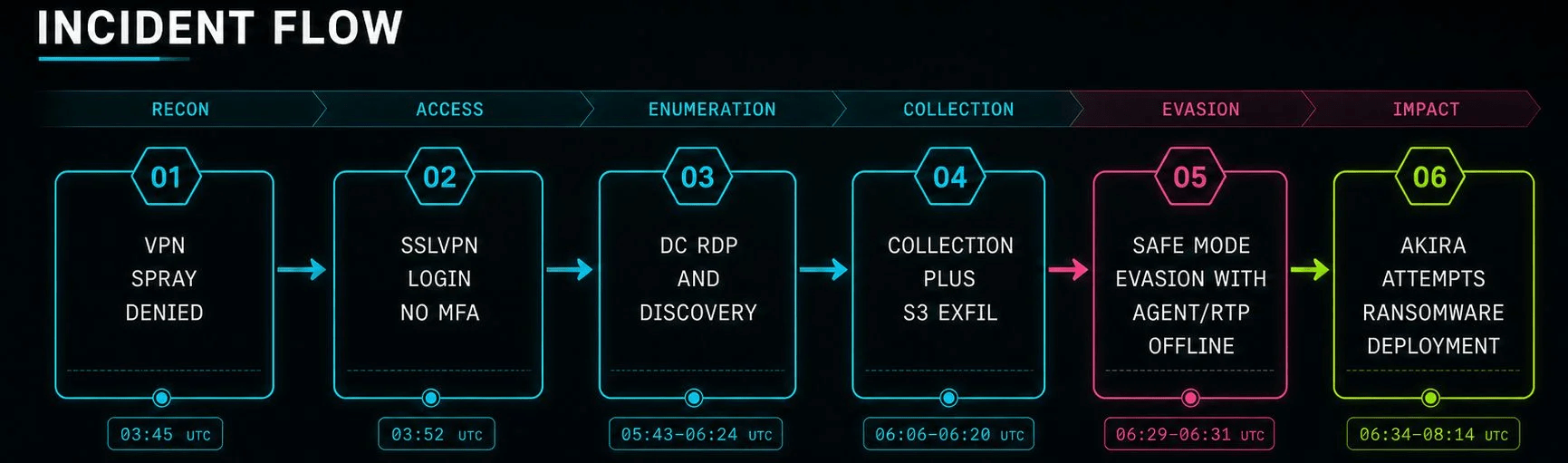
The attack followed Akira’s standard playbook almost exactly: VPN credential spray resolved into a successful login at 03:52 UTC, then two hours of quiet before the operator RDP’d to the domain controller, dumped all Active Directory users and computers with a PowerShell enumeration that disabled truncation to capture every group membership, archived mapped file shares with WinRAR using the same flags documented in previous Akira campaigns, and uploaded the data to an attacker-controlled S3 bucket using s5cmd. Exfiltration happened before any encryption attempt, which matters, because it means the victim can still be extorted even when the ransomware fails.

The ransomware failed because Safe Mode limited available memory. About 13 seconds after launching, akira.exe triggered multiple memory errors, apparently overwhelming the stripped-down environment and causing the encryption process to fail.

akira.exe executed at 06:34:29 UTC and spawned its child-process burst at 06:36:21 UTC. About 13 seconds later, the host started throwing memory errors:” continues the report. “Safe Mode boots with a stripped-down environment and constrained virtual memory, and the Akira process tree appears to have starved it, getting the “Out of Virtual Memory” pop-up and the cascade of PowerShell hard errors line up exactly with the moment the payload tried to kick things off.”

Defender’s scheduled scan eventually detected akira.exe as Ransom:Win32/Akira.B!ibt, but couldn’t quarantine it while real-time protection was disabled in Safe Mode. The file was only removed after the attacker rebooted back to normal mode, restoring Defender’s protections, at which point their own anti-EDR move undid itself.

Huntress notes that Snatch and AvosLocker have abused Safe Mode for years, but this is the first time the company observed Akira using it. The more uncomfortable takeaway is that a host with more RAM or a larger page file might have given the encryptor enough memory to run successfully in Safe Mode. Akira’s developers could also reduce the payload’s memory footprint to make Safe Mode launches reliable, which means the same lucky failure won’t necessarily repeat.

The detection guidance is specific: alert on msconfig.exe or bcdedit activity, watch for Kernel-Boot Event ID 27 with a SAFEBOOT load option, Kernel-General Event ID 12 with BootMode=2, and third-party services stopping. Also watch for remote-access tools being added to the Safe Mode service registry, that’s the tell that the operator is planning to maintain access through the reboot.

“The takeaway is a little uncomfortable. While Safe Mode blinded our controls, it may also have prevented the encryption it was meant to enable. That’s a lucky side effect of the attacker’s own mistake in these circumstances, not a defence you can plan around.” concludes the report. “Ultimately, this could be a case of winning the battle, but not the war. It’s possible that a host with more physical memory or a larger page file might give akira.exe enough virtual memory to encrypt the endpoint in Safe Mode.  Akria’s developers or affiliates could retool the encryptor to reduce its memory demands or make its Safe Mode launch sequence more reliable, meaning that the same failure may not occur in a future intrusion.”

Follow me on Twitter: @securityaffairs and Facebook and Mastodon

Pierluigi Paganini

(SecurityAffairs – hacking, Akira Ransomware)

  • ✇Security Affairs
  • Inside GentleKiller: The EDR-Killer Powering The Gentlemen Pierluigi Paganini
    The Gentlemen equips affiliates with a centralized EDR-killer suite, rapidly weaponizing BYOVD exploits to disable security tools before ransomware attacks. ESET published a detailed breakdown of The Gentlemen‘s technical infrastructure on June 18, the result of months of incident-level investigation corroborated by the group’s own internal data leak from May 2026. Since emerging in late 2025, The Gentlemen has claimed 504 victims and established itself as one of the five most active ransomw
     

Inside GentleKiller: The EDR-Killer Powering The Gentlemen

20 de Junho de 2026, 12:30

The Gentlemen equips affiliates with a centralized EDR-killer suite, rapidly weaponizing BYOVD exploits to disable security tools before ransomware attacks.

ESET published a detailed breakdown of The Gentlemen‘s technical infrastructure on June 18, the result of months of incident-level investigation corroborated by the group’s own internal data leak from May 2026. Since emerging in late 2025, The Gentlemen has claimed 504 victims and established itself as one of the five most active ransomware operations in Q1 2026. What sets them apart isn’t the ransomware payload. It’s what they hand to affiliates before the payload ever runs.

Most ransomware-as-a-service operators leave affiliates to find their own tools for disabling endpoint security. The Gentlemen took a different approach.

“Gentlemen demonstrates an interesting approach: operator-managed EDR killers, ready to use by affiliates.” reads the report published by ESET. “While most ransomware gangs continue to delegate EDR killing to affiliates, Gentlemen has chosen to centralize this function by offering affiliates a ready-to-use, standardized EDR-killer suite. This decision makes Gentlemen an attractive operator for affiliates as it materially lowers the entry barrier for them, making their job consequently easier.”

The leaked internal data confirmed what ESET had hypothesized since February 2026: the group’s leader, operating under the handle zeta88, openly discussed maintaining and distributing EDR killer packages to affiliates.

The centerpiece of that suite is GentleKiller, an in-house framework with at least eight distinct variants. Each one impersonates a different legitimate product and abuses a different vulnerable or malicious kernel driver through a technique called Bring Your Own Vulnerable Driver, or BYOVD.

“GentleKiller is by far the most prevalent EDR killer observed in the Gentlemen ecosystem. At the time of writing, we are aware of at least eight distinct variants, each impersonating a different legitimate product and abusing a different vulnerable or malicious driver.” states ESET.

“When abstracting away the impersonation layer and the specific drivers used, the underlying code reveals numerous structural and behavioral commonalities that strongly suggest the use of a shared development template. This template is reused across variants, with only minimal modifications.”

The eight variants target drivers from Kaspersky, FACEIT Anti-Cheat, Valorant, Javelin, Safetica, Zemana, Qihoo 360, IObit, and the PoisonX rootkit. Across all variants, GentleKiller hunts for over 400 processes belonging to 48 distinct security products, including CrowdStrike, SentinelOne, Microsoft Defender, Sophos, Carbon Black, and ESET itself.

The researchers pointed out that the speed of adaptation is the other defining characteristic.

“This design prioritizes ease of deployment and operational flexibility for affiliates, while minimizing development effort for the operators.” continues the reèprt- “It allows the Gentlemen operators to integrate abused drivers into their toolset very soon after an EDR killer PoC is disclosed. This was the case with UnknownKiller and PoisonKiller, which were adopted within a matter of days.”

ESET measured this in days. The UnknownKiller and PoisonKiller proof-of-concepts were both adopted within days of their public release.

Beyond GentleKiller, the suite incorporates three third-party tools. HexKiller, previously associated exclusively with the Warlock ransomware gang, uses a Baidu Antivirus driver and appeared in Gentlemen intrusions staged in the same GentlemenCollection directory as GentleKiller. ThrottleBlood, more commonly seen in MedusaLocker and DragonForce affiliate attacks, uses a TechPowerUp driver. HavocKiller, disclosed publicly by Huntress in March 2026, was already active in Gentlemen intrusions dating back to January 23rd. ESET’s assessment is that all three were acquired externally by the operators and then standardized with the same defense evasion layer applied to GentleKiller: binary protection via Enigma or Themida, filenames mimicking security vendors, fabricated version information, copied digital signatures, and matching icons.

The victimology breaks a pattern that defines most major ransomware operations. Where Qilin, DragonForce, and Akira all show heavy US concentration, often around half their victims, The Gentlemen’s list skews toward Southeast Asia, South America, and Western Europe. The leaked data suggests this isn’t random: the group selects victims primarily based on FortiGate misconfiguration rather than geography, and centrally distributes targets to affiliates. That’s a structured selection process rather than affiliates each picking their own prey.

ESET also found a Rust-based credential stealer called OxideHarvest, also tracked as buildx641, linked to one of the group’s affiliates. It targets Chrome, Edge, Firefox, Brave, Opera, OperaGX, Vivaldi, Waterfox, and a dozen other browsers, using supplied credentials to log into specified hosts, pull browser credentials, and write them to an output file. Unlike GentleKiller, which shows clear evidence of in-house development, OxideHarvest is attributed to an affiliate named quant rather than the core operators.

Brian Krebs published evidence on June 10 of the true identity of hastalamuerte, the group’s founder, identified as 36-year-old Russian national Alexander Andreevich Yapaev, a former affiliate of Qilin, Embargo, LockBit, Medusa, and BlackLock.

“The breach tracking service Constella Intelligence reports that Hastalamuerte’s Telegram ID is connected to another username — “bu4vs” — and to the Russian phone number 79127650004.” wrote Krebs. “Pivoting on this phone number in Constella fetches multiple records from hacked Russian government databases showing it is assigned to one Alexander Andreevich Yapaev, a 36-year-old from Izhevsk.”

According to the report, The Gentlemen rapidly weaponizes newly disclosed BYOVD proof-of-concepts, often incorporating vulnerable driver exploits into operations within days of public release.

For defenders, the ESET report’s practical implication is this: GentleKiller’s process targeting list is now public, which means defenders can use it to design monitoring and detection strategies that remain effective even against variants that haven’t been built yet.

“Gentlemen demonstrates an interesting approach: operator-managed EDR killers, ready to use by affiliates. While most ransomware gangs continue to delegate EDR killing to affiliates, Gentlemen has chosen to centralize this function by offering affiliates a ready-to-use, standardized EDR-killer suite.” concludes the report. “This decision makes Gentlemen an attractive operator for affiliates as it materially lowers the entry barrier for them, making their job consequently easier.”

Follow me on Twitter: @securityaffairs and Facebook and Mastodon

Pierluigi Paganini

(SecurityAffairs – hacking, The Gentlemen)

  • ✇Security Boulevard
  • Security Architecture for Hybrid Work: Enterprise Guide  Darren Kyle
    With 52% of U.S. employers adopting hybrid models, traditional perimeters are failing. Discover how to build a robust hybrid work security architecture using Secure SD-WAN, SASE, Zero Trust Network Access (ZTNA), and automated threat detection (SIEM/SOAR) to protect a dispersed workforce in 2026. The post Security Architecture for Hybrid Work: Enterprise Guide  appeared first on Security Boulevard.
     
  • ✇Security Boulevard
  • What the Nike Breach Teaches Us About the Microsegmentation Imperative of Integrating with EDR Agnidipta Sarkar
    At 14:37 UTC on January 22, 2026, Nike appeared on WorldLeaks’ Tor-based leak site. The countdown timer showed 48 hours until 1.4 terabytes — 188,347 files — would be dumped onto the dark web for anyone to download. Included in the trove of files are assets from Nike’s research and development (R&D) and product creation […] The post What the Nike Breach Teaches Us About the Microsegmentation Imperative of Integrating with EDR appeared first on ColorTokens. The post What the Nike Breach Teach
     

What the Nike Breach Teaches Us About the Microsegmentation Imperative of Integrating with EDR

20 de Fevereiro de 2026, 07:10

At 14:37 UTC on January 22, 2026, Nike appeared on WorldLeaks’ Tor-based leak site. The countdown timer showed 48 hours until 1.4 terabytes — 188,347 files — would be dumped onto the dark web for anyone to download. Included in the trove of files are assets from Nike’s research and development (R&D) and product creation […]

The post What the Nike Breach Teaches Us About the Microsegmentation Imperative of Integrating with EDR appeared first on ColorTokens.

The post What the Nike Breach Teaches Us About the Microsegmentation Imperative of Integrating with EDR appeared first on Security Boulevard.

❌
❌