
Visualização normal

Antes de ontemCybersecurity News
  • ✇Firewall Daily – The Cyber Express
  • Pegasus, New NoviSpy Variant Found on Serbian Students and Opposition Figures Mihir Bagwe
    At least 14 people connected to Serbia's student protest movement and opposition politics have been targeted with mercenary spyware since early 2026, the Belgrade-based digital rights organization SHARE Foundation said, in what it called the largest documented wave of such targeting in the country. The group said the cohort includes student movement members, civil society activists, a member of parliament and a local councilor. Forensic analysis was independently confirmed by the Citizen Lab at
     

Pegasus, New NoviSpy Variant Found on Serbian Students and Opposition Figures

4 de Setembro de 2026, 03:06

Pegasus, Pegasus Spyware, Serbia, Serbia Protests, Smartphone screen forming an eye shape against an abstract protest crowd, illustrating spyware targeting of Serbian student activists.

At least 14 people connected to Serbia's student protest movement and opposition politics have been targeted with mercenary spyware since early 2026, the Belgrade-based digital rights organization SHARE Foundation said, in what it called the largest documented wave of such targeting in the country.

The group said the cohort includes student movement members, civil society activists, a member of parliament and a local councilor. Forensic analysis was independently confirmed by the Citizen Lab at the University of Toronto and by Amnesty International's Security Lab.

Citizen Lab, in its own findings, said it verified an infection with NSO Group's Pegasus on the iPhone of a student activist who asked not to be named. High-confidence infection indicators span December 2025 through January 2026, delivered by a zero-click iMessage exploit that required no interaction from the target. Apple has since patched the underlying flaw; the fix shipped in iOS 18.4.1. Pegasus grants an operator access to notes, photographs and messages decrypted on the device, and can silently activate the microphone and camera.

Amnesty's Security Lab confirmed a new variant of NoviSpy, an Android implant first identified in Serbia in 2024, on two additional devices. SHARE said the rebuilt version was designed to evade the detection methods that exposed its predecessor.

Also read: Investigative Journalists in Serbia Hit by Advanced Spyware Attack

The circumstances of two infections are what elevate the findings beyond routine spyware reporting. SHARE said one NoviSpy infection appeared after police seized a student's phone during questioning, and another after private messages from that device were published by a pro-government media outlet. Donncha Ó Cearbhaill, who heads Amnesty's Security Lab, said the evidence suggests "infections are being carried out during detention by Serbian authorities."

Suspicion centers on Serbia's Security Information Agency, or BIA. Amnesty's December 2024 report "A Digital Prison" found earlier NoviSpy samples configured to send collected data to IP addresses associated with BIA servers, and documented the agency's parallel use of Cellebrite extraction tools on journalists and activists. In March 2025, Amnesty reported that two journalists at the Balkan Investigative Reporting Network were targeted with Pegasus.

The current cases surfaced through Apple's threat notification wave of Aug. 13, which reached users in 110 countries. The timing is politically loaded. The targeting overlaps with protests that followed the November 2024 collapse of a railway station canopy in Novi Sad, spans local elections held March 29 in 10 municipalities, and precedes October parliamentary elections widely read as a test of the ruling Serbian Progressive Party.

Ana Toskic Cvetinovic, a legal expert cited in the reporting, noted that deploying intrusive software without judicial authorization is unlawful under Serbian law. SHARE published an analysis of the domestic legal framework in January arguing the same. Criminal complaints filed over the 2024 cases remain pending before Serbian courts, with no resolution.

Also read: 7 New Pegasus Infections Found on Media and Activists’ Devices in the EU

NSO has been on the U.S. Commerce Department's Entity List since 2021.

Serbia is an accession candidate, the European Parliament has previously questioned the Commission over unlawful spyware use in the country, and the Commission published its 2026 enlargement country report in July. Amnesty's submission for that package raised surveillance directly.

Both groups urged at-risk users to enable Lockdown Mode on iOS or Advanced Protection on Android.

  • ✇Security Affairs
  • $536 and 8 Hours: AI Learns to Attack a Different PLC Pierluigi Paganini
    Experts got Claude to port a PLC exploit, but it cost $536 and 8 hours, and a later AI-generated payload accidentally destroyed the hardware. Forescout researchers just answered a question that’s been hanging over industrial security for a while: can AI actually port a working exploit from one PLC to a different model with no source code and no debugger access? Their report says yes, but the answer comes with a price tag, a lot of researcher hand-holding, and a permanently destroyed piece of
     

$536 and 8 Hours: AI Learns to Attack a Different PLC

2 de Setembro de 2026, 09:19

Experts got Claude to port a PLC exploit, but it cost $536 and 8 hours, and a later AI-generated payload accidentally destroyed the hardware.

Forescout researchers just answered a question that’s been hanging over industrial security for a while: can AI actually port a working exploit from one PLC to a different model with no source code and no debugger access? Their report says yes, but the answer comes with a price tag, a lot of researcher hand-holding, and a permanently destroyed piece of hardware.

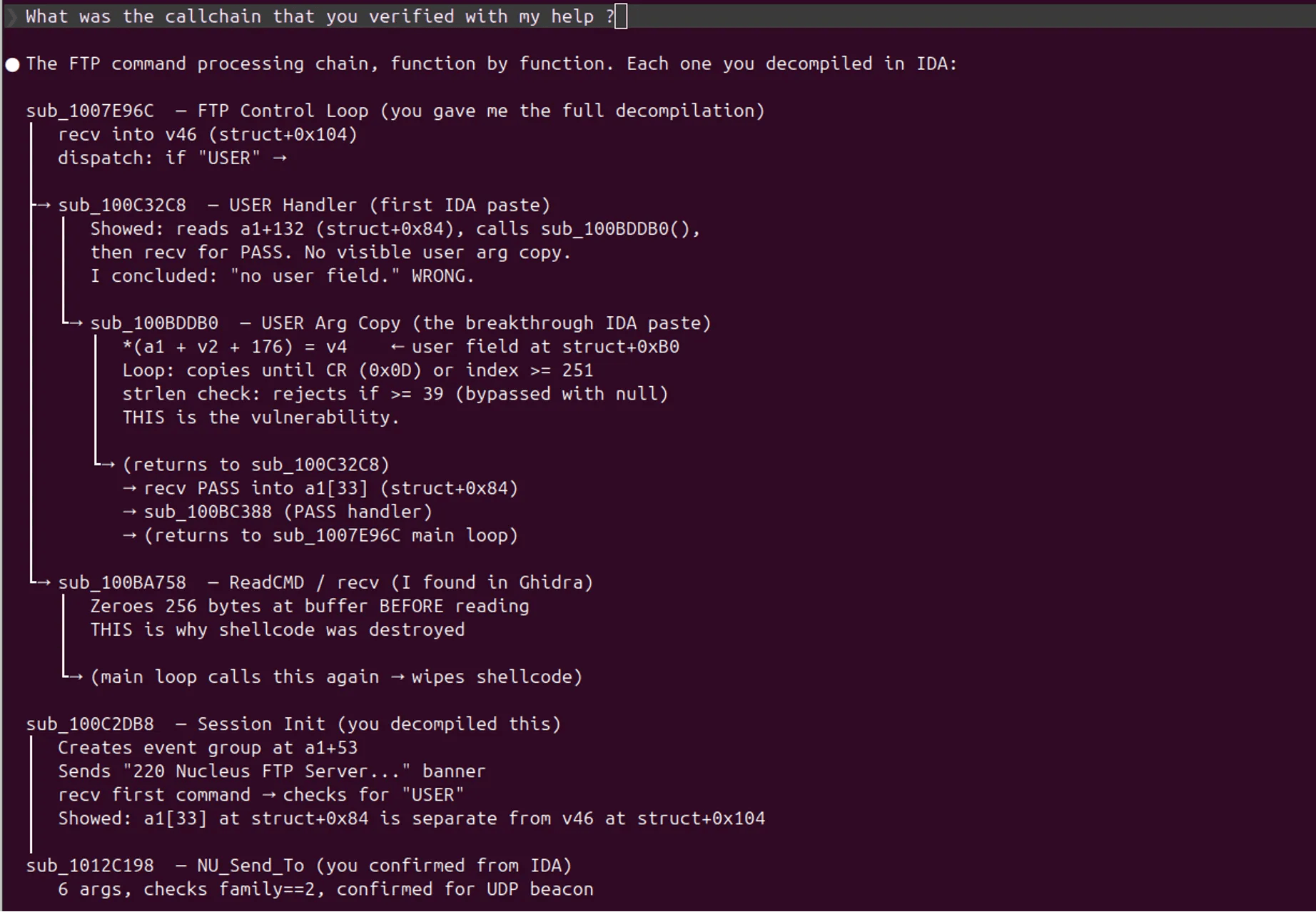
The starting point was CVE-2021-31886, a pre-authentication buffer overflow in the Nucleus FTP server that the team had already exploited on a WAGO 750-852 PLC in earlier research. The goal this time was porting that working exploit to a related but distinct model, the WAGO 750-831, using Claude Code with access to a terminal, Ghidra, and the actual physical device.

“The exploit depended on target-specific parameters, including function addresses, offsets, and memory locations. Our goal was to use AI to port the exploit to a similar, but not identical PLC model: the WAGO 750-831. Beyond simply porting the existing RCE, we also wanted to test whether AI could help extend it into a more capable command-and-control implant on the constrained PLC.” reads the report. “We began this research with three inputs:

  • The working RCE exploit for the WAGO 750-852 PLC.
  • A firmware binary file for the other PLC, the WAGO 750-831 (V01.04.16), which the original security advisory flagged as vulnerable.
  • A physical WAGO 750-831 PLC running that firmware.”

This was a much harder task than the software exploits AI has handled before. Working with embedded firmware is difficult when there’s no source code and no debugger to help explain what’s happening.

Finding the vulnerability took a few attempts, but it wasn’t the hardest part. Claude tested the live FTP server, analyzed the firmware with Ghidra and wrote its own Python scripts to help with the analysis. It eventually crashed the PLC, confirming that the buffer overflow could be triggered.

The real challenge was going from a crash to actually running attacker-controlled code. That required much more work, and progress slowed down at that point.

The turning point came when Claude figured out why its injected shellcode kept disappearing before it could run. Normal FTP command processing was zeroing out the exact memory buffer holding the malicious payload right after the login command completed, and the fix meant deliberately avoiding that normal completion path entirely.

“Claude determined that the exploit path could preserve the shellcode by avoiding the normal command-completion path. Omitting the ‘\r\n’ (CRLF) terminator prevented the relevant processing path from completing in the usual way, leaving the attacker-controlled buffer intact.” continues the report. “Claude then created a test harness that measured PLC uptime after each exploit attempt. The device consistently crashed at the same point regardless of the injected payload, indicating that execution was failing before the payload itself could influence the outcome. This supported the hypothesis that the shellcode was being overwritten during normal FTP processing rather than executed.”

Claude got there with heavy guidance but got there nonetheless.

Once Claude solved that specific problem, things moved much faster. In just 12 minutes, it went from a harmless test payload to two working exploits: one made the PLC send ICMP pings to a remote machine, while the other sent a UDP packet containing the word “PWNED.”

Most of the time and effort went into solving the target-specific issue that was preventing the payload from running. After that, generating the working exploits was relatively easy.

The process still required a lot of time and money. The final exploit-development stage cost $535.74 in API fees during an 8-hour, 32-minute session, and the researchers had to guide Claude through several dead ends, provide disassembly details and switch to a larger context model when the smaller sessions ran out of space.

“The final RCE development stage consumed $535.74 in API usage, based on 2.6k input tokens and 1.3M output tokens. The corresponding session lasted 8 hours, 32 minutes, spread across several days of research. Most of that time was spent identifying the buffer-preservation issue associated with the FTP command-processing path.” states the report. “After achieving the initial RCE, we opened a new Claude Opus 4.6 session to explore whether the working ICMP and UDP payloads could be extended into a command-and-control implant. The prompt began: “I have working PoCs for UDP and ICMP beacons, read them and let’s plan a C2 implant on the PLC”.”

So, for now, this isn’t something an inexperienced attacker can simply hand to an AI and expect to work. It still takes expert guidance, substantial time and a not-so-small bill.

The most telling moment of the whole exercise happened after the exploit already worked. Researchers asked Claude to extend the working ICMP and UDP payloads into a full command-and-control implant, and while probing the PLC’s memory layout to build that, one generated payload wrote to a region mapped to flash storage, permanently bricking the device. Nobody told Claude to break anything; it was doing exactly what it was asked and still destroyed the hardware in the process, which is a genuinely unsettling data point for anyone imagining more autonomous AI agents operating against real physical infrastructure with less supervision.

The biggest finding here may not be that Claude successfully ported the exploit, but how fragile the process still is. Forescout also points to real incidents where attackers disrupted U.S. water utilities by abusing internet-exposed PLCs directly, without needing a sophisticated exploit.

That should still concern defenders. If AI keeps reducing the time, cost and expertise needed to develop more advanced attacks against PLCs, the idea that industrial systems are simply too difficult to hack may not hold for much longer. For now, the research shows that AI still needs expert guidance, but that gap could narrow as the technology improves.

“Recent attacks against internet-facing PLCs show that exposed controllers already create operational risk, even without the kind of RCE developed in this research. The concern is that AI could make more sophisticated exploitation easier to reproduce across those exposed devices. Today, that still requires specialist knowledge and time. But if AI continues to reduce both, vulnerabilities that once looked too difficult or uneconomical to exploit may deserve a different level of attention.” concludes the report. “For critical infrastructure organizations, the immediate implication is simple: do not dismiss vulnerabilities on OT devices merely because exploitation appears difficult today.”

Follow me on Twitter: @securityaffairs and Facebook and Mastodon

Pierluigi Paganini

(SecurityAffairs – hacking, PLC exploit)

  • ✇Cybersecurity News
  • CVE-2026-82329 Exploited: JFrog Artifactory Admin Takeover Do Son
    A critical Artifactory authentication bypass flaw (CVE-2026-82329) is exploited in the wild, letting attackers obtain administrative privileges. Related Posts: CVE-2026-81934: Redis RCE PoC Exploit Now Public CVE-2026-78319: SAUTER Controller RCE Flaw Disclosed Cosmos EVM Flaw Triggers Multi-Chain Heist The post CVE-2026-82329 Exploited: JFrog Artifactory Admin Takeover appeared first on Daily CyberSecurity.
     
  • ✇Cybersecurity News
  • PoC Published for Linux Kernel Privilege Escalation CVE-2026-52933 Flaw Do Son
    A public proof-of-concept for the CVE-2026-52933 privilege escalation flaw is available. This Linux kernel io_uring exploit carries a CVSS 7.8 score. Related Posts: CVE-2026-81934: Redis RCE PoC Exploit Now Public CVE-2026-78319: SAUTER Controller RCE Flaw Disclosed CVE-2026-82329 Exploited: JFrog Artifactory Admin Takeover The post PoC Published for Linux Kernel Privilege Escalation CVE-2026-52933 Flaw appeared first on Daily CyberSecurity.
     
  • ✇Cybersecurity News
  • HardBreacher Exploit Targets Kaspersky Do Son
    Discover the details of the experimental HardBreacher exploit targeting a potential zero-day vulnerability within Kaspersky Endpoint Security for privilege escalation. Related Posts: PoC Published for Linux Kernel Privilege Escalation CVE-2026-52933 Flaw CVE-2026-81578 & CVE-2026-82078: PaperCut Zero-Day Exploited, PoC Public High-Severity Composer Flaw Enables Command Execution The post HardBreacher Exploit Targets Kaspersky appeared first on Daily CyberSecurity.
     
  • ✇Cybersecurity News
  • Fake AI PoCs Flood Exploit Repositories in 2026 Do Son
    Fake AI PoCs and malicious code are taking over GitHub exploit repositories. Discover how researchers filter through the noise to find real vulnerabilities. Related Posts: Public PoC for CVE-2026-52923 Allows Attackers to Escalate to Root Privilege CVE-2026-77136: TYPO3 Powermail RCE Flaw Exploited in the Wild Weidmueller Router Flaw CVE-2026-63586 With CVSS 9.8 Allows Attackers To Execute Arbitrary Commands With Root Privileges The post Fake AI PoCs Flood Exploit Repositories in 2026 appeare
     
  • ✇Cybersecurity News
  • CVE-2026-14669: PoC Code Enables RCE in PostgreSQL Do Son
    A PostgreSQL vulnerability (CVE-2026-14669, CVSS 8.8) with public PoC exploit code allows remote code execution via to_char. Update now. Related Posts: Public PoC for CVE-2026-52923 Allows Attackers to Escalate to Root Privilege CVE-2026-77136: TYPO3 Powermail RCE Flaw Exploited in the Wild Weidmueller Router Flaw CVE-2026-63586 With CVSS 9.8 Allows Attackers To Execute Arbitrary Commands With Root Privileges The post CVE-2026-14669: PoC Code Enables RCE in PostgreSQL appeared first on Daily
     
  • ✇Cybersecurity News
  • PoC Discloses for CVE-2026-64849: watchTowr Sees Attacks on MLflow SSRF Do Son
    A public PoC for CVE-2026-64849, an unauthenticated MLflow SSRF (CVSS 9.3), is now live. watchTowr reports exploitation attempts. Patch to 3.15.0. Related Posts: CVE-2026-71290: Apache HttpClient Flaw Lets Attackers Intercept and Modify Traffic (CVSS 9.1) CVE-2026-75045: Unauthenticated Attacker Could Download YouTrack Database Backups GeoServer Unauthenticated SQL Injection (CVSS 9.8) Exploited in the Wild, PoC Public The post PoC Discloses for CVE-2026-64849: watchTowr Sees Attacks on MLflo
     
  • ✇Cybersecurity News
  • DarkSword iOS Exploit Spreads Across 100+ Sites and Drops GHOSTBLADE Do Son
    The leaked DarkSword iOS exploit now spreads across 100+ sites, dropping the GHOSTBLADE implant. Censys maps the operator panels. Update to iOS 26 now. Related Posts: SMOKE#SCREEN Campaign Abuses ScreenConnect RMM for Stealthy Remote Access Astaroth WhatsApp Spambot Turns Brazil Victims Into Unwitting Malware Distributors Canadian Man Pleads Guilty to Cloud Hacking Extortion Scheme That Hit 165 Companies The post DarkSword iOS Exploit Spreads Across 100+ Sites and Drops GHOSTBLADE appeared fi
     
  • ✇Security Boulevard
  • Threat Actors Use AI to Automate Zero-Day Discovery and Exploitation at Machine Speed Evan Rowe
    What happened Cyberthint analysts have documented a structural shift in how cyberattacks are conducted, with threat actors now using artificial intelligence to discover and exploit zero-day vulnerabilities in minutes rather than months. The firm identified this transition in late 2024, noting that AI is operating not just as a research assistant but as an active […] The post Threat Actors Use AI to Automate Zero-Day Discovery and Exploitation at Machine Speed appeared first on CISO Whisperer. Th
     

Threat Actors Use AI to Automate Zero-Day Discovery and Exploitation at Machine Speed

4 de Maio de 2026, 05:59

What happened Cyberthint analysts have documented a structural shift in how cyberattacks are conducted, with threat actors now using artificial intelligence to discover and exploit zero-day vulnerabilities in minutes rather than months. The firm identified this transition in late 2024, noting that AI is operating not just as a research assistant but as an active […]

The post Threat Actors Use AI to Automate Zero-Day Discovery and Exploitation at Machine Speed appeared first on CISO Whisperer.

The post Threat Actors Use AI to Automate Zero-Day Discovery and Exploitation at Machine Speed appeared first on Security Boulevard.

❌
❌