Visualização normal

Antes de ontemCybersecurity News
  • ✇Firewall Daily – The Cyber Express
  • US Puts $10 Million Bounty on Alleged Iranian Cyber Chief Samiksha Jain
    The U.S. State Department has posted a $10 million reward for Amir Yaryab, a senior Iranian official accused of leading the Islamic Revolutionary Guard Corps Cyber-Electronic Command (IRGC-CEC) Cyber Operations Command and directing multiple hacking groups targeting critical infrastructure across the United States, Europe and the Middle East. According to the Rewards for Justice program, Yaryab allegedly oversees cyber operations conducted by IRGC-CEC-affiliated groups including CyberAv3ngers
     

US Puts $10 Million Bounty on Alleged Iranian Cyber Chief

7 de Setembro de 2026, 02:51

$10 Million Reward for Amir Yaryab

The U.S. State Department has posted a $10 million reward for Amir Yaryab, a senior Iranian official accused of leading the Islamic Revolutionary Guard Corps Cyber-Electronic Command (IRGC-CEC) Cyber Operations Command and directing multiple hacking groups targeting critical infrastructure across the United States, Europe and the Middle East. According to the Rewards for Justice program, Yaryab allegedly oversees cyber operations conducted by IRGC-CEC-affiliated groups including CyberAv3ngers, Dadeh Afzar Arman (DAA) and Mehrsam Andisheh Saz Nik (MASN). U.S. officials accuse these groups of using malware and conducting cyber and cyber-enabled information operations against civilian infrastructure worldwide.

$10 Million Reward for Amir Yaryab

The $10 million reward for Amir Yaryab seeks information leading to his identification or location. The offer applies to individuals acting at the direction or under the control of a foreign government who participate in malicious cyber activities against U.S. critical infrastructure in violation of the Computer Fraud and Abuse Act. [caption id="attachment_113961" align="aligncenter" width="600"]$10 million reward for Amir Yaryab Image Source: https://rewardsforjustice.net/[/caption] Yaryab is also accused of directing Shahid Hemmat and Shahid Shushtari, two groups linked to cyberattacks against U.S. organizations. The sectors allegedly targeted include defense, news, shipping, travel, energy, financial services and telecommunications. The six Iranian officials named in the advisory are linked to Iran's Islamic Revolutionary Guard Corps and its Cyber-Electronic Command.

Iranian Cyberattacks Target PLCs

The allegations also involve attacks against programmable logic controllers (PLCs), highlighting concerns around Iranian cyberattacks targeting industrial systems rather than focusing only on data theft. U.S. officials said Iranian-linked hackers compromised industrial control systems, specifically targeting the Vision series of PLCs manufactured by Israel-based Unitronics. These devices are used across water and wastewater, energy, food and beverage, manufacturing and healthcare sectors. The attackers exploited default credentials on the devices and left anti-Israel messages. Some of the compromises reportedly rendered the PLCs inoperative. The CyberAv3ngers group, which is linked to the IRGC-CEC, claimed responsibility for attacks against Unitronics Vision PLCs in October 2023. Beginning in November 2023, the group compromised default credentials in PLCs across the United States and left messages on the devices' digital screens.

CyberAv3ngers Attacks Critical Infrastructure

CyberAv3ngers has also claimed responsibility for attacks affecting other infrastructure. In October 2023, the group claimed it had breached ORPAK Systems, a provider of gas station solutions in Israel. The group said it had obtained the company's database and intended to publish it through its Telegram channel. The attack was reported to have disconnected 200 gasoline pumps from the system in the occupied Palestinian territories. In December 2023, CyberAv3ngers also claimed to possess and sell 1TB of data allegedly linked to Israel's electricity infrastructure. The group advertised the dataset for 5 Bitcoin, with an initial 100GB portion also offered at the same price.

U.S. Agencies Warn of PLC Cyberattacks

Concerns over critical infrastructure attacks involving PLCs continued into 2026. A joint advisory issued on April 7 by the FBI, CISA, NSA and other agencies warned that Iran-linked threat actors were actively exploiting internet-facing PLCs. The advisory said several organizations had experienced operational disruptions and financial losses after attackers interfered with industrial processes. The developments come amid broader U.S. actions against Iranian-linked cyber activity. The Justice Department accused Iran-connected hackers of breaching employee email accounts associated with the Department of Labor, the Federal Energy Regulatory Commission and multiple United Nations organizations. The Treasury Department also sanctioned Iranian nationals over cyberattacks targeting critical infrastructure. The State Department's reward offer places Amir Yaryab and the alleged activities of IRGC-CEC-linked groups at the center of the U.S. effort to identify individuals responsible for malicious cyber activity targeting critical infrastructure.
  • ✇Firewall Daily – The Cyber Express
  • CISA, FBI Urge Clearer Communication During Major Outages Samiksha Jain
    The CISA and FBI, along with cybersecurity agencies from Australia, Canada, New Zealand and the U.K., have released new guidance on outage communications for service providers dealing with major IT and OT outages. The guide calls for prompt, factual and audience-specific communication during disruptions caused by malicious cyber activity or non-malicious events. Titled “Communicating Under Pressure: Best Practices for Service Providers,” the guidance says effective communication is critical to
     

CISA, FBI Urge Clearer Communication During Major Outages

3 de Setembro de 2026, 02:37

outage communications

The CISA and FBI, along with cybersecurity agencies from Australia, Canada, New Zealand and the U.K., have released new guidance on outage communications for service providers dealing with major IT and OT outages. The guide calls for prompt, factual and audience-specific communication during disruptions caused by malicious cyber activity or non-malicious events.

Titled “Communicating Under Pressure: Best Practices for Service Providers,” the guidance says effective communication is critical to limiting operational impact when IT and OT outages affect customers, network defenders, critical infrastructure owners and operators, and the public. It recommends that organizations clearly communicate what is known, what remains unknown and what is still under investigation, while providing frequent updates as circumstances change.

Outage Communications Should Start With Facts

The agencies recommend that service providers establish an outage communications plan before an incident occurs. The plan should define incident thresholds, escalation paths, target audiences and procedures for status pages, customer and partner notices, and regulatory communications. Organizations are also advised to establish cross-functional incident teams involving engineering and operations, communications, legal, risk and compliance, and customer support.

The guidance calls for clearly defined roles, including an incident lead, communications lead and spokesperson. It also recommends parallel workstreams so technical teams can focus on diagnosing and remediating the root cause while communications teams manage external messaging and leadership handles strategy and regulatory requirements.

For organizations responding to cyber incidents, the guidance places particular emphasis on balancing transparency with operational security. If malicious activity is suspected or confirmed, external communications should not compromise investigations, containment efforts or other response activities. Organizations are also advised against making premature conclusions when the root cause remains under investigation.

Service Providers Urged to Tailor Messages

The guidance recommends segmenting communications for technical teams, executives and the public. Audiences can include enterprise IT teams and security operations centers, employees and customers, government partners and regulators, critical infrastructure owners and operators, as well as the media and general public.

During an outage, organizations should lead with a concise summary covering affected systems, user impact, scope and the known cause without speculation. The agencies also advise against vague descriptions such as “service degradation” and recommend messaging that can be understood quickly during high-pressure situations.

Transparency is another central principle. Service providers are advised to state what they know and do not know, use a single source of truth such as a status page, and focus communications on actionable guidance rather than reputation management. Customers should be told what actions they need to take or clearly informed when no action is required.

The guidance also calls for continuous, time-stamped updates that show the incident timeline, actions taken, and recovery milestones. Organizations should maintain a single status page and align external messaging with legal, contractual and sector-specific reporting obligations.

Agencies ultimately frame effective outage communications around five principles: immediate acknowledgement, technical and actionable information, transparency, accountability, and continuous updates. For service providers, the guidance positions communication as an important part of incident response, alongside technical remediation and recovery.

FBI Seizes China-Linked Hacking Platforms QScan and QTRouter Used Against Critical Infrastructure

26 de Agosto de 2026, 14:33

FBI seizes QScan and QTRouter, China-linked platforms used to hide intrusions and target U.S. critical infrastructure.

The U.S. Department of Justice and the FBI have seized two platforms, QScan and QTRouter, used by a China-linked group to hide cyberattacks and target critical infrastructure. The operation matters because it shows how state-backed actors no longer need to build every part of an attack from scratch: they can rely on shared scanning tools, compromised devices, commercial proxy services, and rented servers.

U.S. authorities attribute the activity to a group known as QTFY, which they say operated through the China-based company Nanjing Xinjiuwei Network Technology Company. According to the Justice Department, the group offered hacking services to paying clients that included China’s Ministry of State Security and the People’s Liberation Army.

“The Justice Department and FBI announced court-authorized domain seizures today to deny malicious cyber actors access to two complementary hacking platforms known as “QScan” and “QTRouter,” used to target U.S. critical infrastructure and other sensitive networks. As described in court documents unsealed in the Southern District of California, a People’s Republic of China (PRC) state-sponsored group known as “QTFY,” employed by China-based Nanjing Xinjiuwei Network Technology Company (南京鑫玖维网络科技有限公司), created and operated QScan and QTRouter.” reads the press release published by DoJ.

According to the Justice Department, QTFY targeted NASA, the Federal Reserve, the Departments of Energy, Justice, and Health and Human Services, the National Institutes of Health, and the U.S. Senate. Those are not random targets caught in a broad scan.

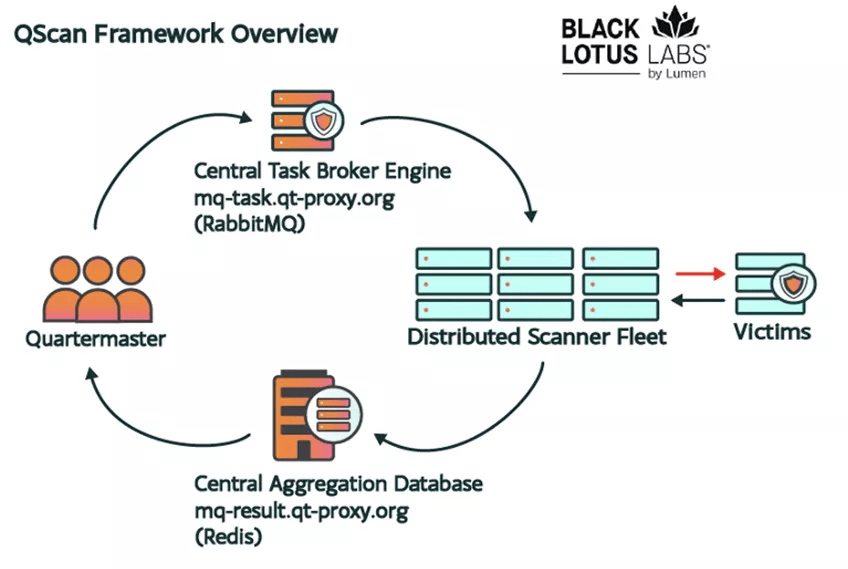
QScan and QTRouter had different jobs. QScan searched the internet for vulnerable devices and automatically infected thousands of exposed Internet of Things devices. Those compromised routers, cameras, appliances, and other connected systems were then added to QTRouter, a proxy network used to route malicious traffic through systems located outside China.

That approach makes attribution and blocking harder. A victim may see an attack coming from what appears to be a local router, a legitimate commercial proxy, or a virtual private server rented in another country. Blocking traffic by country or IP address becomes far less useful when the attacker is borrowing the identity and location of other people’s devices.

“QScan scans and automatically infects thousands of “internet-of-things” (IoT) devices worldwide, which are then added to the QTRouter network of QTFY-controlled devices. QTRouter consists of these compromised IoT devices, as well as commercial proxy service devices and leased virtual private servers.” continues DoJ. “QTRouter then serves as an “obfuscation network” – meaning it allows QTFY and other malicious cyber actors to conceal the PRC-origin of their computer intrusion activities because the malicious communications appear to originate from computers (such as those compromised by QScan) that are outside of the PRC and may even be local to the targeted networks.”

The government did not merely take down a website. The seized domains were hard-coded into QScan and QTRouter and used for core functions such as authentication and command-and-control communication. By taking control of those domains through a court order, the FBI made the malware platforms unable to operate as intended.

This is a useful example of technical disruption rather than simple attribution. Publicly naming a group matters, but it does not stop an operator who already has access to vulnerable devices and a working relay network. Taking away the infrastructure they need to manage that network is more disruptive, at least until they rebuild it.

“Because the seized domains were hard-coded into both the QScan and QTRouter malware and used for essential tasks such as communication and authentication, the court-authorized seizures made QScan and QTRouter inoperable.” DoJ states.

The broader operation looks like an industrial service model. QTFY allegedly used QScan to map targets, identify weaknesses, and compromise devices; it then used QTRouter and other proxy layers to hide where the activity actually came from. Lumen’s Black Lotus Labs described the group as a “digital quartermaster,” meaning it supplied infrastructure and services that could support multiple operations at the same time.

“To support its primary objectives, the quartermaster runs a secondary, completely decoupled target profiling utility called “QScan.” While the core proxy network focuses on managing stateful session paths, the QScan framework operates as the front-end scout.” reads a report published by Lumen. “The operations of this quartermaster demonstrate the high degree of industrialization occurring within China-nexus cyber operations. By shifting away from fragmented, ad hoc setups and toward shared multi-tenant utility networks, state-sponsored actors can execute complex campaigns with a high degree of anonymity and speed, and at a global scale.”

The group reportedly exploited both old and newly disclosed vulnerabilities in widely deployed products, including Fortinet SSL-VPN, Citrix ADC, Microsoft Exchange, F5 BIG-IP, Apache Log4j, Atlassian Confluence, Check Point gateways, CrushFTP, Ivanti appliances, and BeyondTrust Remote Support. This is not a reminder that organisations need magic detection. It is a reminder that old vulnerabilities remain useful because somebody, somewhere, will still leave them unpatched.

The attack chain also included web shells, remote-access trojans, stolen or legitimate credentials, and compromised IoT devices used as nearby relay points. That combination allows an attacker to blend into normal-looking traffic and avoids the obvious infrastructure that defenders have learned to block. A hostile connection that looks like a local consumer router is still hostile; it just has better camouflage.

This seizure follows earlier FBI actions against China-linked botnets. In 2025, the FBI removed PlugX malware from more than 4,000 infected U.S. computers linked to Mustang Panda. In 2024, it disrupted a botnet of hundreds of thousands of IoT devices associated with Flax Typhoon, while in 2023 it acted against a Volt Typhoon botnet used to conceal activity targeting U.S. and foreign critical infrastructure.

“For defenders, the operational lesson is straightforward. Inventory internet-facing assets, patch known vulnerabilities quickly, remove unsupported devices, monitor unusual outbound proxy traffic, and do not assume that an IP address tells you who is behind an attack. The same applies to IoT equipment: a router, camera, network appliance, or smart device left exposed and unmanaged can become part of someone else’s attack platform.

“This disruption announced today is among a series of court-authorized technical operations against indiscriminate hacking activities by the PRC.” concludes DoJ.

Follow me on Twitter: @securityaffairs and Facebook and Mastodon

Pierluigi Paganini

(SecurityAffairs – hacking, QTRouter)

FBI Pegasus Records Expose a Blind Spot in US Spyware Oversight

18 de Agosto de 2026, 09:05

Federal court records show how far the FBI’s Pegasus review progressed — and why new US spyware reporting will still leave major gaps in government hacking transparency.

The post FBI Pegasus Records Expose a Blind Spot in US Spyware Oversight appeared first on TechRepublic.

  • ✇Firewall Daily – The Cyber Express
  • Hackers Target Social Media Accounts to Steal Explicit Content, FBI Warns Samiksha Jain
    The FBI is warning the public about sexual exploitation actors illegally accessing social media and personal accounts to steal explicit images and videos from adult and underage victims. The stolen material, also known as non-consensual intimate images (NCII), is being posted or sold on criminal marketplaces, often without the victim's knowledge. According to the FBI, these actors use social engineering and cyber intrusion tactics to target specific individuals or general targets of opportunity
     

Hackers Target Social Media Accounts to Steal Explicit Content, FBI Warns

13 de Agosto de 2026, 03:10

sexual exploitation actors

The FBI is warning the public about sexual exploitation actors illegally accessing social media and personal accounts to steal explicit images and videos from adult and underage victims. The stolen material, also known as non-consensual intimate images (NCII), is being posted or sold on criminal marketplaces, often without the victim's knowledge.

According to the FBI, these actors use social engineering and cyber intrusion tactics to target specific individuals or general targets of opportunity. After gaining access to accounts, they steal explicit content and share it through community forums or illicit marketplaces.

The FBI said personally identifiable information, including a victim's name, date of birth, email address, phone number and social media username, is often posted alongside the stolen material. This can expose victims to continued harassment and re-victimization.

How Sexual Exploitation Actors Access Accounts

The FBI has identified several methods used by sexual exploitation actors to gain access to victims' accounts.

Password and PIN Targeting

In password/PIN targeting, actors use high-volume password and PIN attempts against social media and personal accounts. The information used in these attempts can come from data leak sites, social media and open-source information.

When victims are known to the actors, curated lists may include personal details such as names, date of birth or variations of those details.

Social Media Customer Service Impersonation

Another tactic involves social media customer service impersonation through text messages. Victims may receive messages claiming their account is being disabled or locked unless they provide a verification code.

The actor then requests a password reset, causing a code to be sent to the victim. If the victim shares the code, the actor can reset the password and access the account.

Phishing Emails

The FBI also warns about phishing campaigns using look-alike domains and email accounts designed to appear as social media customer support.

These messages may claim there has been a new login and contain an embedded link asking the victim to change their password. Clicking the malicious link can give the actor access to the account.

Stolen Content Can Lead to Further Attacks

Once explicit content is stolen, sexual exploitation actors may post or sell it while including personal information about the victim. The FBI said victims can subsequently face harassment, sextortion, stalking or other targeted attacks.

The actors may also advertise stolen content through a victim's own social media page, increasing the potential for further exposure.

FBI Shares Steps to Protect Accounts

The FBI advises people to avoid storing sensitive images or videos on social media platforms or other internet-accessible sites.

It recommends using unique, complex passphrases and PINs along with multi-factor authentication (MFA). Password information directly associated with a person's identity, including names or birthdays, should be avoided.

Users should also be cautious with links received through emails and text messages. The FBI recommends going directly to the relevant website to address account concerns and checking URLs before clicking.

Unrequested temporary passwords, PIN resets or access codes should also be treated with caution. The FBI advises users not to share login information, even when someone claims to represent a platform or service.

People who believe their explicit content was stolen or leaked can provide information through the FBI's NCII reporting site. The FBI also advises the public to continue reporting fraud, scams and cyber threats to the Internet Crime Complaint Center or a local FBI Field Office.

FBI, NCAA Warn Hackers Are Targeting College Athletes’ Private Photos

12 de Agosto de 2026, 12:17

Hackers are targeting college athletes’ accounts to steal intimate photos, prompting a new FBI and NCAA initiative focused on prevention and support.

The post FBI, NCAA Warn Hackers Are Targeting College Athletes’ Private Photos appeared first on TechRepublic.

  • ✇Firewall Daily – The Cyber Express
  • Gunra Ransomware Builds a New Attack Network Through RaaS Samiksha Jain
    Gunra ransomware has expanded its operations through a structured ransomware-as-a-service (RaaS) affiliate program, prompting the FBI, CISA and other agencies to issue a joint advisory warning organizations about the threat. The Gunra ransomware variant uses a double-extortion model, encrypting victim data while threatening to publish stolen information on a dedicated leak site if ransom demands are not met. The FBI first observed Gunra in April 2025 as a double-extortion ransomware variant d
     

Gunra Ransomware Builds a New Attack Network Through RaaS

11 de Agosto de 2026, 08:01

Gunra ransomware

Gunra ransomware has expanded its operations through a structured ransomware-as-a-service (RaaS) affiliate program, prompting the FBI, CISA and other agencies to issue a joint advisory warning organizations about the threat. The Gunra ransomware variant uses a double-extortion model, encrypting victim data while threatening to publish stolen information on a dedicated leak site if ransom demands are not met. The FBI first observed Gunra in April 2025 as a double-extortion ransomware variant derived from leaked Conti ransomware source code.

Gunra Ransomware Shifts to Affiliate Model

By early 2026, the group had expanded through a formal ransomware-as-a-service affiliate program advertised on dark web forums. The program provides affiliates with a management panel, configurable ransomware builder, cross-platform locker payloads and affiliate documentation. The FBI also observed Gunra operating under new branding aliases, including Golden Community, while recruiting penetration testers and ethical hackers as initial access brokers. Gunra initially focused on Windows environments before introducing a Linux variant and moving toward broader cross-platform targeting. Victims observed on the group’s dedicated leak site include organizations across the Americas, Europe, the Middle East, Africa and the Asia-Pacific. Targeted sectors include healthcare and public health, financial services and insurance, critical manufacturing, transportation, government services, utilities, academia, media and communications, retail, and professional and nonprofit services. Gunra ransomware

VPN Vulnerabilities Used for Initial Access

According to the advisory, Gunra actors primarily gained initial access by exploiting known vulnerabilities in internet-facing devices, including firewall and VPN gateways. The FBI observed exploitation of CVE-2024-55591 and CVE-2025-24472, authentication bypass vulnerabilities affecting specific FortiOS and FortiProxy versions. The Republic of Korea’s National Police Agency also observed Gunra actors exploiting credential exposure and SSH access control weaknesses in internet-facing VPN gateways to obtain unauthorized remote access. After gaining access, attackers used tools including Impacket utilities to move laterally through victim networks using SMB. In one case, actors compromised an SSL-VPN appliance using default credentials where account lockout controls were absent. They later used stolen session information to access internal virtual desktop infrastructure and move through systems including Active Directory servers and IT personnel workstations.

Data Theft Precedes Encryption

The double-extortion ransomware operation involves stealing sensitive information before encrypting systems. The FBI observed Gunra actors collecting business-critical documents, databases, personally identifiable information, and internal email communications. In at least one case, the actors used a malicious executable called main.exe to exfiltrate data from Microsoft OneDrive and SharePoint. Compressed archives containing sensitive information were also transferred to the Mega file-sharing service, with the volume of exfiltrated data reaching tens of terabytes. For encryption, Gunra uses ChaCha20 and RSA-4096 algorithms and has been observed using the .ENCRT extension for encrypted files. A documented sample from July 2025 used the .CRYPT extension. The ransomware also uses Windows Management Instrumentation to delete volume shadow copies before encryption, while one victim had backup and archived data deleted from both primary and disaster recovery infrastructure.

Agencies Urge Patching and Network Segmentation

The authoring agencies recommend that organizations prioritize patching known exploited vulnerabilities in internet-facing systems, including VPN gateways and RDP-exposed infrastructure. They also advise implementing and testing offline, immutable backups stored in physically separate and segmented locations. Network segmentation is another key recommendation, intended to restrict lateral movement and limit the spread of ransomware between systems. The agencies also recommend reviewing domain controllers, servers, workstations and Active Directory environments for unrecognized accounts, auditing administrative privileges, requiring MFA where possible and testing security controls against the Gunra techniques mapped to the MITRE ATT&CK framework. The joint advisory was published August 10, 2026, as part of the ongoing #StopRansomware initiative.
  • ✇Firewall Daily – The Cyber Express
  • FBI, LinkedIn Warn Job Seekers of Employment Scams and Exploitation Samiksha Jain
    Employment scams are increasingly being used to target job seekers, with the FBI and LinkedIn joining forces to educate applicants about fraudulent job opportunities and the warning signs of potential exploitation. The FBI's Internet Crime Complaint Center received 24,688 reports of employment scam victimization in 2025, with nearly $363 million in reported losses. The FBI defines employment fraud as a scheme designed to deceive someone into believing they have been, or could soon be, hired f
     

FBI, LinkedIn Warn Job Seekers of Employment Scams and Exploitation

Employment scams

Employment scams are increasingly being used to target job seekers, with the FBI and LinkedIn joining forces to educate applicants about fraudulent job opportunities and the warning signs of potential exploitation. The FBI's Internet Crime Complaint Center received 24,688 reports of employment scam victimization in 2025, with nearly $363 million in reported losses. The FBI defines employment fraud as a scheme designed to deceive someone into believing they have been, or could soon be, hired for a job. However, officials warn that these schemes are not always focused on stealing money from victims. They can also be used to recruit money mules, collect personally identifiable information, or force people into labor.

Employment Scams Exploit Trust in Job Opportunities

LinkedIn, which has more than 1.3 billion members across more than 200 countries and regions, said people submit approximately 10,000 job applications every minute on the platform. The company uses automated systems and human oversight to detect and remove fraudulent activity. According to LinkedIn, automated defenses remove 98.7% of detected spam and scam content before members see it, while 99.5% of detected fake accounts are stopped proactively. LinkedIn also uses verification indicators to show when certain information about people, companies, recruiters, and candidates has been confirmed. Despite these measures, the company said scammers are becoming more sophisticated, with artificial intelligence making it cheaper, faster, and easier to impersonate legitimate individuals. One warning sign highlighted by LinkedIn is when a recruiter or company representative attempts to move a conversation away from LinkedIn's messaging platform. Doing so can allow scammers to bypass the platform's protections and reporting tools.

Money Mule Scams Turn Job Seekers Into Financial Intermediaries

One major form of employment scams involves recruiting victims as money mules. Scammers may advertise legitimate-sounding positions such as cryptocurrency transaction specialist, accounts receivable assistant, remote financial coordinator, or payment processing agent. After being hired, victims may receive money in their personal bank accounts, often through peer-to-peer payment applications. They are then instructed to withdraw the funds, convert them into cash, gift cards, or cryptocurrency, and transfer them elsewhere in exchange for a small commission. The money is generally linked to other scams or compromised accounts. Victims may face legal consequences, account closures, and seized funds despite being deceived into participating.

Stolen PII Employment Scams Target Personal Information

Another type of fraud uses fake employment opportunities to collect stolen PII. Job titles may include onboarding specialist, HR assistant, compliance reviewer, or know your customer and identity verification agent. Victims may be asked to collect identity documents from customers, forward files, verify accounts, handle one-time codes, open accounts, submit applications, or organize data into spreadsheets and shared drives. Instead of directly moving stolen money, victims become part of a process designed to harvest personal information.

Forced Labor Can Begin With a Fake Job Offer

The FBI also warns that some employment scams can become gateways to human trafficking and forced labor. Victims may be offered jobs abroad or remote positions and encouraged to travel internationally, with Southeast Asia identified as a known hotspot. After arriving, victims may have their passports confiscated and be told they must repay travel costs. Some are then forced to work in scam compounds, where they are required to contact targets. Victims may face monitoring, threats, or physical abuse if they fail to meet quotas.

FBI Warns Job Seekers About Employment Scam Red Flags

The FBI and LinkedIn advise applicants to research companies carefully and watch for warning signs. For money mule scams, red flags include requests to use personal bank accounts for business transactions, bypass normal payroll systems, move money quickly, open new accounts, or use cryptocurrency and gift cards. For scams involving stolen PII, applicants should be cautious if they are asked to handle sensitive identity documents without a legitimate compliance structure, receive files through informal channels, or are pressured to bypass normal safeguards. Potential forced labor scams may involve unusually high pay for vague overseas jobs, demands for quick relocation, employer-controlled travel arrangements, vague contracts, early moves to encrypted messaging apps, or instructions to keep the job secret from family. The FBI and LinkedIn said educating job seekers can help disrupt employment fraud before victims become involved. Anyone who believes they have been targeted should contact their financial institution immediately and report the incident to the FBI's Internet Crime Complaint Center with as many details as possible.

Russian Hackers Used a Zimbra Zero-Day to Steal Emails Without Link Clicks

Russian hackers from the TA488 group exploited a Zimbra webmail flaw triggered when emails were opened or previewed, stealing credentials and up to 90 days of messages from victims.

Fake FBI Agents Use IC3 Complaint Scams to Target Fraud Victims

Fake FBI agents are using deepfake videos, spoofed IC3 websites and false recovery claims to steal money and personal information from people who were scammed before, the FBI warns.

Residential Proxy Risks: Understanding Google’s Latest Action Against 2 Million Strong NetNut

3 de Julho de 2026, 09:00

Google announced that it helped take down NetNut, a 2 million strong malicious residential proxy network. The incident highlights the growing risks posed by residential proxy networks that quietly conscript consumer devices into services used by cybercriminals and nation-state actors alike.

The post Residential Proxy Risks: Understanding Google’s Latest Action Against 2 Million Strong NetNut appeared first on The Security Ledger with Paul F. Roberts.

FBI and Spanish Police Arrest Alleged Cyber Army of Russia Reborn Member

Spanish police and the FBI arrested an alleged Cyber Army of Russia Reborn member as international efforts against pro Russia cyberattacks continue worldwide.
  • ✇Security Affairs
  • FBI: TeamPCP Compromised Dev Tools to Steal Cloud Credentials Pierluigi Paganini
    FBI says TeamPCP poisoned trusted developer tools to steal cloud credentials, spread malware through software updates, and extort victims. On July 2, 2026, the FBI published a FLASH alert identifying the criminal group called TeamPCP and detailing how it compromised widely used developer and security tools to steal credentials from victim environments at scale. The targets weren’t end users. They were the tools developers trust every day inside their build pipelines. TeamPCP is behind mul
     

FBI: TeamPCP Compromised Dev Tools to Steal Cloud Credentials

4 de Julho de 2026, 04:55

FBI says TeamPCP poisoned trusted developer tools to steal cloud credentials, spread malware through software updates, and extort victims.

On July 2, 2026, the FBI published a FLASH alert identifying the criminal group called TeamPCP and detailing how it compromised widely used developer and security tools to steal credentials from victim environments at scale. The targets weren’t end users. They were the tools developers trust every day inside their build pipelines.

TeamPCP is behind multiple supply chain attacks, in the past, they targeted PyPI packages and NPM repositories, and most recently the “Mini Shai-Hulud” campaign also caught two OpenAI employees. The pattern is consistent: go after the tools developers trust, poison the supply chain, and let the downstream damage multiply.

TeamPCP’s method was straightforward and effective: inject malicious code into legitimate software packages, push the trojanized versions through normal distribution channels, and wait for CI/CD pipelines to pull them in automatically. The modified tools installed credential-stealing malware and persistent backdoors without any visible sign that anything had changed.

“TeamPCP actors have conducted large-scale software supply chain compromises by targeting widely used developers and security tools, gaining access to victim environments and extracting sensitive data, including but not limited to cloud access tokens, SSH keys, and Kubernetes secrets.” FBI’s FLASH states.

The confirmed list of modified tools includes Trivy, a widely used container vulnerability scanner; KICS, a static analysis tool for infrastructure-as-code; LiteLLM, a popular library for routing requests across AI model APIs; and the Telnyx Python SDK.

These aren’t niche utilities. They’re commonly integrated into enterprise CI/CD pipelines, cloud infrastructure workflows, and security scanning processes. Hitting them means hitting a large number of organizations simultaneously through a single poisoned update.

The group also deployed four distinct malware families. CanisterWorm harvested cloud access tokens, credentials, and API keys for AWS, GCP, and Azure. SANDCLOCK extracted AWS credentials, Kubernetes ServiceAccount tokens, local environment variables, and cryptocurrency wallet data. Mini Shai-Hulud was a self-replicating worm designed to spread across both npm and PyPI registries. Miasma was a variant of Mini Shai-Hulud that propagated across those same open-source registries while harvesting credentials and poisoning configuration files.

The worm component is the part that deserves particular attention. Mini Shai-Hulud and its Miasma variant didn’t just infect the initial target and stop. They spread across open-source package registries autonomously, harvesting credentials and poisoning configuration files as they went. The FBI confirmed two GitHub repository names used for exfiltration: tpcp-docs and docs-tpcp. If either of those repository names appears in your GitHub organization, the worm created it using stolen credentials.

“By weaponizing these supply chain entry points, the threat actors were able to introduce malicious code into victim environments at scale. TeamPCP has also engaged in extortion and collaboration with cyber actors from other threat actor groups, including publishing victim names on a public leak site and threatening disclosure of stolen data.” states the alert.

The FBI warns that credentials and data stolen in this campaign should be considered permanently compromised, as they could be reused by TeamPCP or affiliated threat actors in future attacks, even months or years after the initial breach.

“Organizations impacted by this campaign should treat exfiltrated data and credentials as a persistent risk, as affiliated threat actors are likely to weaponize them long after the initial compromise.” concludes the alert.

That’s not a hypothetical. It means credentials stolen in this campaign may surface in attacks months or years from now, even after the immediate incident is closed.

How they got into npm accounts?

One technique the FBI specifically flags is worth calling out: TeamPCP exploited npm package maintainer accounts by targeting stale or expired recovery email domains. If a developer registered an npm account years ago with a work email that’s since been decommissioned, the domain may be available for registration. Whoever registers it can use the password reset flow to take over the npm account and publish malicious versions of whatever packages that maintainer owns. It’s an old technique, and it still works because nobody audits their old recovery emails.

The four CVEs associated with this campaign are CVE-2026-33634, CVE-2026-48027, CVE-2026-45321, and CVE-2025-55182. Six IP addresses appear in the indicators: 83.142.209.11, 45.148.10.212, 83.142.209.194, 83.142.209.203, 94.154.172.43, and 67.217.57.240. The indicator set also includes 27 file hashes and a set of domains including checkmarx[.]zone, models.litellm[.]cloud, git-tanstack[.]com, and recv.hackmoltrepeat[.]com, among others. The indicators in this alert are derived from Palo Alto Unit 42’s technical research into the campaign.

The FBI’s recommendations focus on the specific mechanisms TeamPCP exploited. Pin GitHub Actions workflows to verified commit SHA hashes rather than floating version tags, since floating tags can be redirected to point at malicious commits without changing the reference in your workflow file. Rotate all CI/CD secrets, publishing tokens, and cloud credentials that were accessible during the campaign’s active window. Enforce least-privilege permissions on CI/CD service accounts and scope registry publishing tokens to prevent them from being used across repositories.

Require phishing-resistant MFA on all accounts with code repository or package registry publishing access. Enforce a minimum package age threshold of at least seven days across package installation environments, which gives the community time to detect and report malicious versions before they propagate widely. Audit npm maintainer accounts for stale or expired recovery email domains. Implement runtime behavioral monitoring on CI/CD pipeline runners to catch unexpected outbound network connections.

On credential hygiene specifically: store secrets in dedicated encrypted secret managers, not in code or configuration files; prefer temporary credentials over static ones; rotate everything immediately after any suspected compromise; and scan repositories and logs for exposed secrets with automated tooling.

“TeamPCP has also engaged in extortion and collaboration with cyber actors from other threat actor groups, including publishing victim names on a public leak site and threatening disclosure of stolen data.” The FLASH concludes.

That collaboration angle means the stolen data has already been shared beyond the original group.

Organizations that believe they’ve been hit should report to their local FBI field office or to IC3 at ic3.gov, and should retain CI/CD pipeline logs, network logs, affected package names and versions, any exposed credentials, and any extortion communications they’ve received.

Follow me on Twitter: @securityaffairs and Facebook and Mastodon

Pierluigi Paganini

(SecurityAffairs – hacking, TeamPCP)

FBI Seizes NetNut Domains as Google Disrupts 2M Device Proxy Network

FBI and Google disrupt NetNut after domains linked to its residential proxy network are seized, exposing abuse of 2 million TVs and streaming devices worldwide.
  • ✇Firewall Daily – The Cyber Express
  • Alleged Scattered Spider Member Arrested in Finland, Extradited to U.S. Samiksha Jain
    An alleged member of the Scattered Spider cybercrime group has been extradited from Finland to the United States to face federal charges related to conspiracy, cyber intrusion, and fraud. U.S. authorities said the case marks another step in their ongoing efforts to prosecute individuals accused of participating in high-profile cybercrime operations linked to the notorious hacking group. Peter Stokes, 19, a dual U.S. and Estonian citizen, made his initial appearance in federal court in Chicago a
     

Alleged Scattered Spider Member Arrested in Finland, Extradited to U.S.

Scattered Spider

An alleged member of the Scattered Spider cybercrime group has been extradited from Finland to the United States to face federal charges related to conspiracy, cyber intrusion, and fraud. U.S. authorities said the case marks another step in their ongoing efforts to prosecute individuals accused of participating in high-profile cybercrime operations linked to the notorious hacking group.

Peter Stokes, 19, a dual U.S. and Estonian citizen, made his initial appearance in federal court in Chicago after being extradited from Finland.

According to the U.S. Department of Justice, Stokes was arrested by Finnish authorities in April following an Interpol Red Notice and was transferred to the United States last week. A criminal complaint filed in the Northern District of Illinois accuses him of participating in cyberattacks carried out as part of the Scattered Spider group.

Scattered Spider Linked to More Than 100 Network Intrusions

According to the complaint, Scattered Spider, also known as Octo Tempest, UNC3944, and 0ktapus, has been associated with more than 100 network intrusions. Authorities allege the group's activities have resulted in over $100 million in ransom payments and millions of dollars in additional damages suffered by victims.

Investigators said the group targeted companies across the United States by obtaining access to employee accounts through fraudulent methods.

Once inside corporate networks, the attackers allegedly encrypted data or exfiltrated sensitive information to remote servers before demanding cryptocurrency payments to restore access or prevent the public release of stolen data.

Complaint Details Alleged Luxury Retailer Cyberattack

The criminal complaint describes an alleged cyber intrusion that occurred in May 2025 involving a luxury jewelry retailer.

Federal prosecutors allege that Stokes and other co-conspirators breached the retailer's computer systems, exfiltrated company data, and demanded approximately $8 million in cryptocurrency as ransom. According to court documents, the retailer's security team successfully removed the threat actors from its network before any ransom payment was made.

Although the company did not pay the ransom, authorities said it still incurred losses of at least $2 million due to business disruption, investigation costs, and mitigation efforts following the incident.

Operation Riptide Targets Cybercrime Networks

The extradition and criminal charges were announced by the Department of Justice, the U.S. Attorney's Office for the Northern District of Illinois, and the FBI. The investigation also involved the FBI's Copenhagen Law Enforcement Attaché Office, the FBI Las Vegas Field Office, the Justice Department's Office of International Affairs, and Finland's National Bureau of Investigation.

Officials said the case forms part of Operation Riptide, an ongoing FBI campaign focused on disrupting cybercriminal actors, infrastructure, financial networks, and fraud schemes targeting Americans.

According to the FBI, Americans reported more than $20 billion in cybercrime losses last year, representing a 26% increase compared with the previous year.

Authorities Cite International Cooperation

Assistant Attorney General A. Tysen Duva said the charges stem from years of investigative work by the Justice Department, the U.S. Attorney's Office, and the FBI, adding that authorities would continue working together to pursue cybercriminals operating across international borders.

U.S. Attorney Andrew S. Boutros said the alleged attacks caused significant disruption to businesses across the United States and emphasized the government's commitment to prosecuting individuals involved in cyber intrusions.

FBI Special Agent-in-Charge Douglas S. DePodesta also highlighted the role of international law enforcement partnerships in identifying alleged members of the hacking group and pursuing cross-border cybercrime investigations.

Recent Guidance on Scattered Spider Threat

The arrest follows recent law enforcement efforts targeting the Scattered Spider threat group. In July 2025, the FBI and CISA released updated guidance describing the group's latest attack techniques, including the use of DragonForce ransomware to encrypt VMware ESXi servers.

The advisory urged organizations to maintain isolated offline backups, implement phishing-resistant multifactor authentication (MFA), and apply application controls to manage software execution.

Separately, in November 2025, two alleged Scattered Spider members appeared before Southwark Crown Court in the United Kingdom and pleaded not guilty to charges related to the August 2024 cyberattack on Transport for London (TfL).

The Department of Justice emphasized that the complaint against Stokes contains allegations only. As with all criminal cases, he is presumed innocent unless and until proven guilty in court.

  • ✇Security Affairs
  • SSU and FBI Uncover Russian Cyber Espionage Operation Against Officials and Military Personnel Pierluigi Paganini
    Ukraine’s SSU and the FBI Just Confirmed Russian Intelligence Has Been Systematically Hacking Messenger Accounts for Years. The Security Service of Ukraine (SSU), working jointly with the FBI, has formally exposed a sustained Russian intelligence campaign targeting the messaging accounts of government officials, military personnel, politicians, and activists across Ukraine, Europe, and the United States. The operation is ongoing. The goal isn’t disruption; it’s intelligence collection.
     

SSU and FBI Uncover Russian Cyber Espionage Operation Against Officials and Military Personnel

29 de Junho de 2026, 05:57

Ukraine’s SSU and the FBI Just Confirmed Russian Intelligence Has Been Systematically Hacking Messenger Accounts for Years.

The Security Service of Ukraine (SSU), working jointly with the FBI, has formally exposed a sustained Russian intelligence campaign targeting the messaging accounts of government officials, military personnel, politicians, and activists across Ukraine, Europe, and the United States.

The operation is ongoing. The goal isn’t disruption; it’s intelligence collection.

“Cyber ​​experts of the Security Service of Ukraine together with the Federal Bureau of Investigation exposed Russian special services in systematic cyberattacks on messengers of officials, military personnel, politicians and activists from Ukraine, Europe and the USA.” read the alert by SSU.

“The purpose of these ‘hacks’ is to gain access to sensitive information of a military, political and economic nature that was exchanged between users, as well as to steal their personal data.”

The attack method is low-tech by design. Operators send SMS messages impersonating platform support bots, asking targets to hand over account credentials, confirmation codes, PINs, or account recovery keys. The SBU notes that these messages tend to arrive in the morning hours, when targets are physically and emotionally less guarded. Timing is a social engineering choice, not an accident.

The scope is broader than most people assume.

“The SBU emphasizes that Russian special services and hackers associated with them attack not only organizations, officials or public figures, but also personal accounts of Ukrainians.” continues the alert.

This isn’t a targeted elite program. It’s a mass collection operation with a tiered approach: high-value targets get more sophisticated techniques, ordinary citizens get the SMS impersonation play. The SBU didn’t attribute the campaign to a specific group by name, but prior reporting from Google, the FBI, and CISA ties similar activity to clusters tracked as UNC5792 and UNC4221, both linked to FSB operations, as well as Star Blizzard.

The FBI’s June 26 advisory added a new technique to what the March warning described. Russian operators have evolved from chasing one-time verification codes to specifically targeting Signal Backup Recovery Keys, which unlock an account’s entire message history and remain valid even if the user creates a new account with the same phone number afterward. This is a meaningful escalation: a stolen verification code expires, a stolen Recovery Key doesn’t.

QR codes are another active vector the SBU specifically calls out. Scanning a QR code received from an unknown bot or user can silently link the attacker’s device to the victim’s account, a technique Google’s Threat Intelligence Group documented against Signal’s linked-devices feature in early 2025.

“Russian hackers use a variety of tools and methods for such cyberattacks. For example, to extract passwords to an account, the enemy most often uses SMS messages on behalf of ‘support teams.'” states SSU.

The variety matters: blocking one delivery mechanism doesn’t stop the campaign, because the operators rotate techniques and targeting lists continuously.

The SBU’s practical guidance covers the basics that still fail most users in practice. Check active sessions in your messenger regularly and end anything you don’t recognize. Enable two-factor authentication with a complex alphanumeric PIN, not a four-digit code. Never provide confirmation codes, PINs, passwords, or recovery keys to anyone, regardless of how legitimate the request appears. Don’t scan QR codes from unknown sources. Don’t follow suspicious links even from accounts you know, because that account may already be compromised. Anyone who receives a suspicious message in a messenger can report it to the SBU’s Cybersecurity Situation Center at incident@dis.gov.ua.

Last week, the FBI and CISA updated their March 2026 warning about Russian intelligence phishing campaigns, and the new advisory adds a detail that wasn’t in the original: the operators have shifted their primary objective from stealing verification codes to stealing Signal Backup Recovery Keys.

Follow me on Twitter: @securityaffairs and Facebook and Mastodon

Pierluigi Paganini

(SecurityAffairs – hacking, Ukraine)

Iranian Hacker Arrested Over Alleged $3.4 Billion Cyberattack on USA Infrastructure

Iranian hacker

An alleged Iranian hacker accused of hacking US infrastructure has been arrested in Montenegro following a joint operation by Montenegrin police and the U.S. Federal Bureau of Investigation (FBI). The suspect is expected to face charges related to computer fraud, hacking, conspiracy, and identity theft after authorities linked him to a years-long cyber campaign that reportedly caused more than $3.4 billion in damages. 

Iranian Hacker Faces Computer Fraud and Hacking Charges 

The 39-year-old suspect, who holds dual Iranian and Turkish citizenship, was arrested in the Adriatic coastal town of Kotor, Montenegro. According to local police, he is wanted by the Southern District Court of New York on charges of conspiracy to commit computer fraud, hacking, and identity theft.  The case will now be referred to a High Court judge in Montenegro's capital, Podgorica, where extradition proceedings are expected to begin. 

Alleged Cyberattack on USA Universities Caused Billions in Damage 

In an official statement, Montenegro's police directorate alleged that the Iranian hacker had been involved in large-scale hacking operations since 2013.  "From 2013 onward, … he carried out massive hacking attacks … targeting more than 150 universities in the United States, causing damage estimated at over $3.4 billion," the statement said.  Authorities claim the stolen data and access to compromised university accounts were used to benefit Iran's Islamic Revolutionary Guard Corps (IRGC) and other Iranian organizations, including universities. Investigators allege the campaign formed part of a broader cyberattack on USA institutions aimed at acquiring sensitive academic data and digital access. 

Extradition Process Underway 

Following the arrest, Montenegrin authorities confirmed that the suspect remains in custody while legal proceedings continue. If approved, he will be extradited to the United States to face charges tied to computer fraud, identity theft, and extensive hacking operations.  The FBI participated in the investigation that led to the arrest, although the agency was not immediately available for comment after the announcement. 

Iranian Cyber Operations Remain Under Scrutiny 

The latest arrest comes amid continued concerns over Iranian-linked cyber activity. Iran and the IRGC have long been associated with state-sponsored cyber operations targeting U.S. organizations and infrastructure.  In April, U.S. cybersecurity, intelligence, and law enforcement agencies warned that Iranian hacking campaigns targeting equipment across critical U.S. infrastructure had intensified. The warning highlighted an increase in attempted intrusions, reinforcing concerns over future cyberattacks on the USA.  The arrest marks a new development in an international investigation into one of the largest alleged cybercrime cases involving an Iranian hacker, with prosecutors pursuing charges that include conspiracy, computer fraud, hacking, and identity theft linked to billions of dollars in reported losses. 

Imposter scams cost Americans $3.5 billion in 2025 – and it’s getting worse

19 de Junho de 2026, 10:51
Someone is pretending to be your bank, your government, or your local planning office. And according to the FTC, they're making billions doing it. Read more in my article on the Fortra blog.
  • ✇Firewall Daily – The Cyber Express
  • FBI Warns of a Hidden Web Tactic Fueling Phishing and Ransomware Samiksha Jain
    The FBI Warns of Malicious Traffic Distribution Systems being increasingly used by cybercriminals to redirect internet users to phishing pages, malware downloads, ransomware attacks, and online financial scams. In a newly released Public Service Announcement (PSA), the Federal Bureau of Investigation cautioned that cybercriminals are leveraging Traffic Distribution Systems (TDS) to gain access to victim networks while evading traditional security controls. According to the FBI, TDS technology
     

FBI Warns of a Hidden Web Tactic Fueling Phishing and Ransomware

FBI Warns of Malicious Traffic

The FBI Warns of Malicious Traffic Distribution Systems being increasingly used by cybercriminals to redirect internet users to phishing pages, malware downloads, ransomware attacks, and online financial scams. In a newly released Public Service Announcement (PSA), the Federal Bureau of Investigation cautioned that cybercriminals are leveraging Traffic Distribution Systems (TDS) to gain access to victim networks while evading traditional security controls. According to the FBI, TDS technology is designed to route internet traffic to different destinations after users visit websites, click advertisements, download applications, or engage with online promotions. While the technology itself has legitimate uses, cybercriminals are exploiting it to selectively redirect users to compromised websites and fraudulent login pages.

FBI Warns of Malicious Traffic Distribution Systems Used in Cyber Attacks

As the FBI Warns of Malicious Traffic Distribution Systems, the agency explained that cybercriminals often drive victims to a malicious TDS through various methods, including Social Engineering, phishing emails, malicious advertisements, and compromised websites. One common technique involves Search Engine Optimization (SEO) Poisoning, where fraudulent advertisements are designed to imitate legitimate websites. Users who click these links may unknowingly enter a redirection chain controlled by threat actors. Cybercriminals also compromise legitimate websites by exploiting weak passwords, outdated plugins, and vulnerable website themes. Once administrative access is obtained, attackers can modify website code to automatically redirect visitors to a malicious TDS infrastructure.

How Traffic Distribution Systems Help Evade Detection

According to the FBI, Traffic Distribution Systems (TDS) can bypass traditional firewall protections that would normally block access to malicious websites. The system uses multiple intermediate nodes before directing users to the final destination, making it more difficult for defenders to identify and block malicious activity. In addition to hiding malicious infrastructure, attackers use TDS platforms to gather information about visitors. Data collected may include:
  • IP address
  • Operating system
  • Geographic location
  • Device information
  • Browser details
The FBI noted that this information allows attackers to determine whether a victim is a suitable target. It also enables cybercriminals to avoid detection by presenting harmless content to users they are not interested in targeting, including security researchers and analysts.

Phishing, Malware, and Ransomware Risks

The FBI warned that users reaching the end of a malicious redirection chain may encounter Phishing Pages, financial fraud schemes, or malware downloads. In some cases, attackers use malware delivered through a TDS to gain access to victim networks. The agency stated that compromised accounts and network access obtained through these methods may later be sold to other criminal groups, including Ransomware operators. The PSA highlights how a single visit to a compromised website or malicious advertisement can ultimately lead to broader cybersecurity incidents.

FBI Shares Protection Measures

To reduce the risk of compromise, the FBI advised individuals to verify website URLs before clicking advertisements or promotional links. The agency also recommended keeping software, website plugins, and themes updated to address known vulnerabilities. Additional recommendations include:
  • Using strong passwords
  • Enabling Two-Factor Authentication (2FA)
  • Installing reputable security plugins and web application firewalls
  • Downloading software only from trusted developers
For businesses, the FBI recommended monitoring endpoints for suspicious activity involving JavaScript, PowerShell, and script execution tools. Organizations are also encouraged to strengthen phishing awareness training, regularly audit website administration accounts, and patch content management systems and third-party components.

FBI Urges Victims to Report Incidents

The FBI encouraged individuals and organizations that believe they have been affected by activity linked to malicious TDS infrastructure to report the incident through the Internet Crime Complaint Center (IC3) and contact their local FBI field office. The agency emphasized that cybercriminals continue to evolve their techniques for delivering malware and conducting online fraud, making vigilance and proactive cybersecurity measures essential for both individuals and businesses.
❌
❌