Mozilla launched the Come Back to Firefox campaign, leveraging nostalgic internet memes to promote user privacy and challenge Chrome market dominance.
Related Posts:
Apple Presto Return Scanner Targets In-Box Fraud
OpenSSL 4.1.0 Release Introduces Elbrus Support and DTLS 1.3
eMudhra Rogue Certificates Flood Certificate Transparency
The post Come Back to Firefox Campaign Champions Web Privacy appeared first on Daily CyberSecurity.
Mozilla blocked eight keys in the eMudhra certificate compromise via OneCRL in under three hours, then shipped Firefox 158.0.1 and NSS 3.131.1.
Related Posts:
Atlassian Patches 176 Flaws in Jira, Confluence and Other Data Center Products
Oracle E-Business Suite Flaw CVE-2026-101809 Scores CVSS 10.0
Apache CouchDB 3.5.3 Fixes Six Flaws as Retired Apache Cocoon Gets Four Unpatched Bugs
The post Mozilla Blocks Eight Compromised eMudhra Certificates in Under Three Hours appeared first on Daily Cy
Mozilla released Firefox Enterprise 158.0 on October 13, 2026, introducing its first dedicated enterprise browser with built-in data loss prevention and AI-use controls.
The browser combines Firefox with a self-hosted Admin Console, giving security teams central control over browsing, web access, and how employees share company data. According to Mozilla’s Firefox Enterprise release notes, organizations must deploy the console on their own infrastructure.
Supporting services, including bro
Mozilla released Firefox Enterprise 158.0 on October 13, 2026, introducing its first dedicated enterprise browser with built-in data loss prevention and AI-use controls.
The browser combines Firefox with a self-hosted Admin Console, giving security teams central control over browsing, web access, and how employees share company data. According to Mozilla’s Firefox Enterprise release notes, organizations must deploy the console on their own infrastructure.
Supporting services, including browser updates, Sync, telemetry, and crash collection, also run within the organization’s environment. This setup keeps management data under company control rather than relying on an external management service.
The main addition is DLP, which lets administrators block or warn about pasting, file uploads, downloads, and printing on selected websites.
Firefox Enterprise Admin Console and supporting services (source: Firefox)
Teams can display custom messages explaining restrictions. For example, they can block employees from pasting company information into unapproved AI tools while keeping approved services available.
Firefox Enterprise Adds DLP and AI Controls
Built-in checks run locally in the browser, so content doesn’t travel over the network for inspection. Organizations using a third-party DLP agent through Firefox’s Content Analysis interface retain that setup.
Firefox Enterprise turns off its built-in DLP and hands inspection to the existing agent. Warnings and blocks appear in the Admin Console, though administrators can turn off that logging.
The focus on browser data controls comes as AI tools create new exposure risks. Cyber Security News previously covered the BioShocking AI browser attack, where researchers manipulated browsing context to make AI agents expose sensitive information. Firefox’s release notes describe controls over data movement, not a specific fix for that attack.
Data loss prevention (DLP) (source: Firefox)
Employees must sign in through the company’s single sign-on provider before browsing. Firefox Enterprise supports OpenID Connect and follows the provider’s multi-factor authentication requirements.
Administrators can also require device security conditions, including disk encryption and running endpoint protection, before allowing access. Firefox signs employees out if their device no longer meets those conditions.
Profile encryption is enabled by default. Browsing history, form data, saved logins, and TLS session tokens are encrypted using a key supplied by the Admin Console.
A copied profile folder cannot be decrypted without that key. Optional watermarks can show an employee’s email address and the time on sensitive pages, helping trace shared images without physically preventing screenshots.
The console supports more than 130 enterprise policies, including restrictions on extensions and update controls. These controls address risks highlighted in earlier reporting on AI browser extension vulnerabilities that exposed private sessions and data. Lockdown Mode can disable JavaScript JIT compilation, block service workers, prevent HTTP downgrades, and isolate selected sites.
Security event logging is optional for each event type, with records sent to the organization’s console rather than Mozilla. Teams can integrate with SIEM systems and remotely sign out lost devices. Firefox Enterprise also inherits security fixes from Firefox 158, while access requires a deployed console and an early-access request.
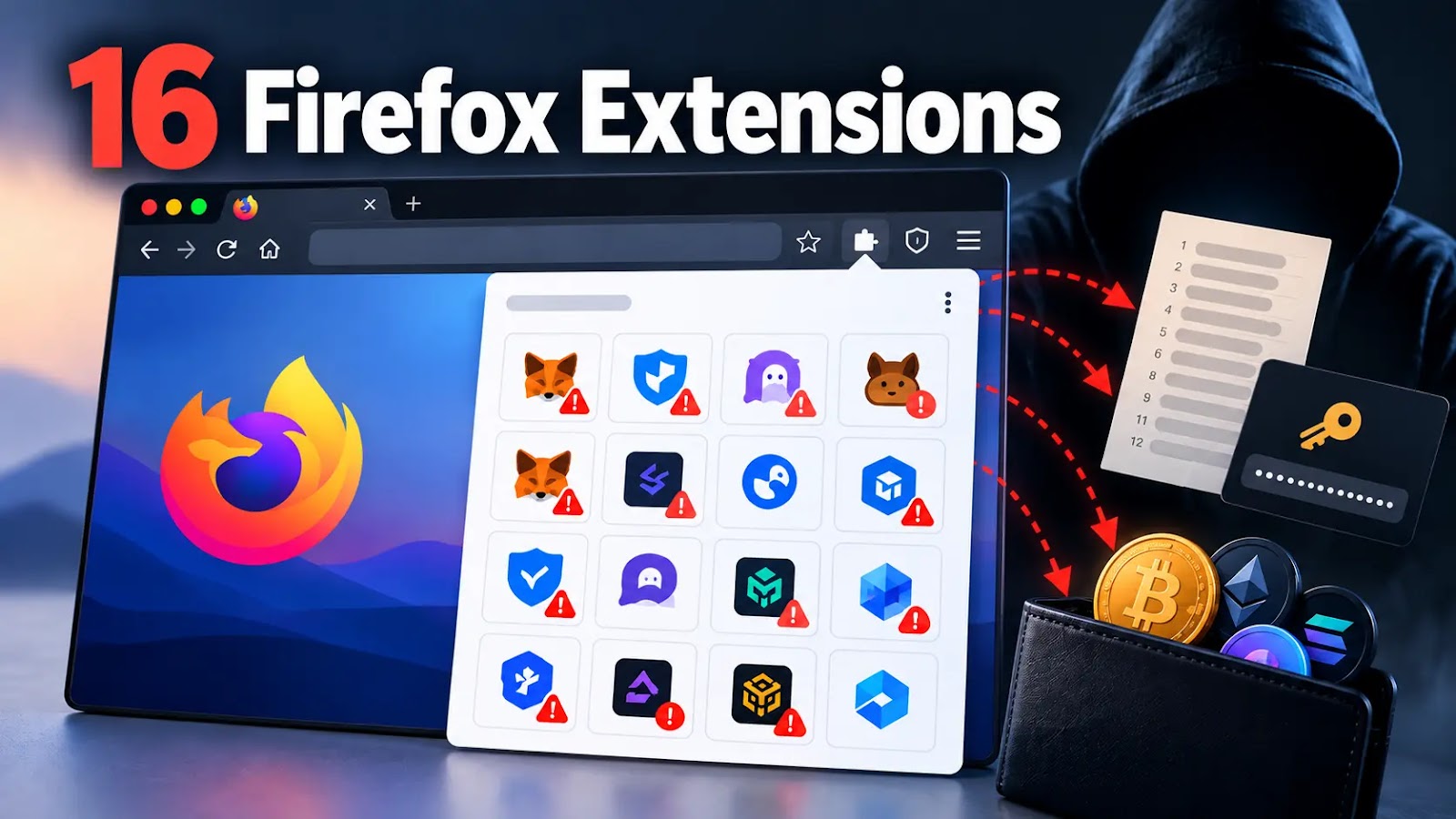
Socket found 16 malicious Firefox extensions posing as Rabby and OKX. These crypto wallet stealers grabbed seed phrases. Here is what to do.
Related Posts:
The Silent Threat of Midnight Mimosa Malware
Phishing Campaign Abuses Microsoft Power BI to Install Rogue ScreenConnect Clients
Rogue AI Agents Hijacked urlquery Scan Browsers to Reach Russian Bankruptcy Records
The post 16 Fake Rabby and OKX Firefox Extensions Stole Crypto Wallet Recovery Phrases appeared first on Daily CyberSecurity.
16 malicious Firefox extensions that impersonate cryptocurrency wallets to intercept recovery phrases and private keys during wallet imports. Disguised as wallet portals, desktop utilities, and browser tools, the packages attempt to transmit secrets to attacker-controlled Cloudflare Workers. Mozilla had unpublished the extensions by October 5, 2026, according to Socket’s October 7 report. Fifteen packages contain […]
The post 16 Malicious Firefox Extensions Impersonate Crypto Wallets to Steal Se
16 malicious Firefox extensions that impersonate cryptocurrency wallets to intercept recovery phrases and private keys during wallet imports. Disguised as wallet portals, desktop utilities, and browser tools, the packages attempt to transmit secrets to attacker-controlled Cloudflare Workers. Mozilla had unpublished the extensions by October 5, 2026, according to Socket’s October 7 report. Fifteen packages contain […]
Firefox redesign compact mode returns with a modern look, a new theme picker, and one switch to disable all generative AI tools.
Related Posts:
Cloudflare Launches Free Certificate Authority Emphasizing MTC
OpenAI DevDay 2026: Elevating the AI Subscription Paradigm
OpenAI Dots AI Assistant Gets Its Own Cloud Computer
The post Firefox Redesign Compact Mode Returns With AI Off Switch appeared first on Daily CyberSecurity.
Every time you add an extension or plugin to your browser, there's a risk that you might be doing more than managing your cryptocurrency wallet, generating passwords, taking notes, or tracking sports results. There's a chance that you have just handed a complete stranger access to your savings.
Read more in my article on the Hot for Security blog.
Every time you add an extension or plugin to your browser, there's a risk that you might be doing more than managing your cryptocurrency wallet, generating passwords, taking notes, or tracking sports results. There's a chance that you have just handed a complete stranger access to your savings.
Read more in my article on the Hot for Security blog.
That’s a lot. No, it’s an extraordinary number:
Since February, the Firefox team has been working around the clock using frontier AI models to find and fix latent security vulnerabilities in the browser. We wrote previously about our collaboration with Anthropic to scan Firefox with Opus 4.6, which led to fixes for 22 security-sensitive bugs in Firefox 148.
As part of our continued collaboration with Anthropic, we had the opportunity to apply an early version of Claude Mythos Preview to Firefox
Since February, the Firefox team has been working around the clock using frontier AI models to find and fix latent security vulnerabilities in the browser. We wrote previously about our collaboration with Anthropic to scan Firefox with Opus 4.6, which led to fixes for 22 security-sensitive bugs in Firefox 148.
As part of our continued collaboration with Anthropic, we had the opportunity to apply an early version of Claude Mythos Preview to Firefox. This week’s release of Firefox 150 includes fixes for 271 vulnerabilities identified during this initial evaluation...
Earlier this month, Anthropic said its Mythos Preview model was so good at finding cybersecurity vulnerabilities that the company was limiting its initial release to "a limited group of critical industry partners." Since then, debate has raged over whether the model presages an era of turbocharged AI-aided hacking or if Anthropic is just building hype for what is a relatively normal step up on the ladder of advancing AI capabilities.
Mozilla added some important data to that debate Tuesday, writ
Mozilla added some important data to that debate Tuesday, writing in a blog post that early access to Mythos Preview had helped it pre-identify 271 security vulnerabilities in this week's release of Firefox 150. The results were significant enough to get Firefox CTO Bobby Holley to enthuse that, in the never-ending battle between cyberattackers and cyberdefenders, "defenders finally have a chance to win, decisively."
"We've rounded the curve"
Holley didn't go into detail on the severity of the hundreds of vulnerabilities that Mythos reportedly detected simply by analyzing the unreleased source code of Firefox's latest version. But by way of comparison, he noted that Anthropic's Opus 4.6 model found only 22 security-sensitive bugs when analyzing Firefox 148 last month.

 Entrar