CISA adds Linux kernel vulnerability CVE-2026-46300, chained with PHP2Shell for root, and VMware ESX flaw CVE-2026-41709 to KEV. Patch now.
Related Posts:
Kerio Connect Vulnerability CVE-2026-112353 Exploited in the Wild to Steal Mailboxes
Apache Kafka Fixes 12 Vulnerabilities, Including a JWT Bypass That Grants Full Cluster Access
FreeSWITCH Vulnerability CVE-2026-116779 Exploited in the Wild to Run Commands
The post CISA Adds Linux Kernel Flaw Chained With PHP2Shell and VMware ESX Bug to KE
CISA adds PHP2Shell flaws CVE-2026-109618 and CVE-2026-109619 to the CISA KEV catalog after confirmed RCE and suspected DPRK-linked scanning.
Related Posts:
Apple iOS 27.2 Update Fixes 160 Security Flaws
Apple Backports Fix for Exploited CoreGraphics Zero-Day CVE-2026-86950 to Older iPhones
HashiCorp Patches Critical 9.9 CVSS Consul-k8s Authorization Bypass Vulnerability (CVE-2026-110720)
The post CISA Adds PHP2Shell to KEV as Confirmed RCE Attacks and Suspected DPRK Scanning Surface appeared
U.S. Cybersecurity and Infrastructure Security Agency (CISA) adds PHP flaws PHP2Shell to its Known Exploited Vulnerabilities catalog.
The U.S. Cybersecurity and Infrastructure Security Agency (CISA) added the PHP PHP2Shell vulnerabilities to its Known Exploited Vulnerabilities (KEV) catalog:
CVE-2026-109618 – PHP Memory Corruption Vulnerability
CVE-2026-109619 – PHP Stale Internal Request-State Vulnerability
On October 21, PHP released emergency patches for two critical vulnerab
CVE-2026-109619 – PHP Stale Internal Request-State Vulnerability
On October 21, PHP released emergency patches for two critical vulnerabilities, CVE-2026-109618 and CVE-2026-109619 (CVSS score of 9.2). The flaws affect all PHP versions that handle web requests.
The vulnerable code dates back to PHP 5.4, released in 2012, and resides in the PHP engine itself rather than in individual applications. Attackers can exploit the flaws to execute code remotely by sending specially crafted HTTP requests, without authentication.
Exploitation attempts increased rapidly after the vulnerabilities became public. Cloudflare researchers reported tens of thousands of attempts within the first 45 minutes, hundreds of thousands in just two hours, and millions by October 22.
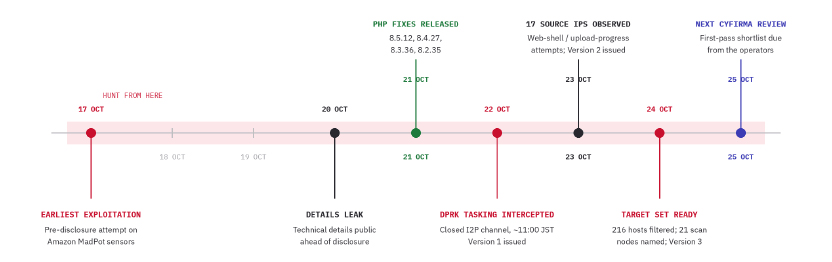
Cyfirma reported that a group of North Korea-linked group has identified 216 hosts that may still be vulnerable to PHP2Shell. The operators communicate through a private I2P channel that Cyfirma has monitored since October 22. On October 24, they reported that 216 hosts appeared to be unpatched or only partly protected, earlier than Cyfirma expected.
They are checking the systems from 21 compromised machines. At the time Cyfirma captured the conversation, the operators had already checked about one-third of the targets.
“Two handles active since March 2026, coordinating in a closed I2P channel; staging infrastructure shared in-channel.” states the cybersecurity firm. “Target set and scan nodes. “On 24 October the operators reported 216 unpatched or partially mitigated hosts and named 21 scan nodes; the same addresses were seen performing web-shell tooling and upload-progress session-poisoning attempts.”
The scanning is slow on purpose. Volume stays low, the machines rotate, and any node that shows filtering or rate limiting gets pulled and never reused. That’s why a rate-based alert will probably stay quiet.
Our weekly CVE report for Oct 19-25, 2026 tracks 4,222 new CVEs and 12 exploited vulnerabilities, including PHP2Shell flaws not yet in CISA KEV.
Related Posts:
This Weekly CVE Report Finds CISA KEV Trailing Daily Cybersecurity by Up to 8 Days
Six Exploited Flaws Missing From CISA KEV Lead This Weekly CVE Report
Weekly CVE Report Tracks 2,652 New Flaws and Seven Exploited Vulnerabilities (Sept. 28 - Oct. 4, 2026)
The post Weekly CVE Report Flags PHP2Shell and FortiSIEM Attacks Still Missing Fr
Cyfirma links PHP2Shell scans of 216 vulnerable hosts to a suspected North Korean campaign using AI to rank public exploits.
On October 21, PHP released emergency patches for two critical vulnerabilities, CVE-2026-109618 and CVE-2026-109619, both rated 9.2 on the CVSS scale. The flaws affect all PHP versions that handle web requests. The vulnerable code dates back to PHP 5.4, released in 2012, and resides in the PHP engine itself rather than in individual applications. Attackers can exploit
Cyfirma links PHP2Shell scans of 216 vulnerable hosts to a suspected North Korean campaign using AI to rank public exploits.
On October 21, PHP released emergency patches for two critical vulnerabilities, CVE-2026-109618 and CVE-2026-109619, both rated 9.2 on the CVSS scale. The flaws affect all PHP versions that handle web requests. The vulnerable code dates back to PHP 5.4, released in 2012, and resides in the PHP engine itself rather than in individual applications. Attackers can exploit the flaws to execute code remotely by sending specially crafted HTTP requests, without authentication.
Exploitation attempts increased rapidly after the vulnerabilities became public. Cloudflare researchers reported tens of thousands of attempts within the first 45 minutes, hundreds of thousands in just two hours, and millions by October 22.
Cyfirma reported that a group of North Korea-linked group has identified 216 hosts that may still be vulnerable to PHP2Shell. The operators communicate through a private I2P channel that Cyfirma has monitored since October 22. On October 24, they reported that 216 hosts appeared to be unpatched or only partly protected, earlier than Cyfirma expected.
They are checking the systems from 21 compromised machines. At the time Cyfirma captured the conversation, the operators had already checked about one-third of the targets.
“Two handles active since March 2026, coordinating in a closed I2P channel; staging infrastructure shared in-channel.” states the cybersecurity firm. “Target set and scan nodes. “On 24 October the operators reported 216 unpatched or partially mitigated hosts and named 21 scan nodes; the same addresses were seen performing web-shell tooling and upload-progress session-poisoning attempts.”
The scanning is slow on purpose. Volume stays low, the machines rotate, and any node that shows filtering or rate limiting gets pulled and never reused. That’s why a rate-based alert will probably stay quiet.
Who’s behind it? Cyfirma assesses with moderate confidence a link to the Lazarus family of North Korean groups, based on language, operating style and old habits with PHP web shells and hijacked web servers. It has no shared malware or infrastructure to point to yet, and it admits that a Korean-speaking criminal crew without state backing would fit the same facts. Its confidence in the campaign itself is high.
Government agencies and banks come first. Next in line are logistics, ports, airports and aviation, manufacturing, and online transaction and trading platforms. The countries named are the US, Japan, South Korea, Thailand, Indonesia, Australia, Taiwan, India, Singapore, the UAE, Saudi Arabia and the EU.
Cyfirma has not named any victims or seen the full list of targeted systems. The operators have not announced when they plan to launch attacks, and the researchers have not confirmed that this group has compromised systems on a large scale. Cyfirma gives the campaign an imminence score of 78 out of 100. The operators plan to check all 216 hosts, select the most promising targets, and decide which publicly available exploits to adapt.
The group does not appear to be developing new exploits. Instead, its members use a local AI model to rank public exploit repositories, then test the results manually in a lab. Cyfirma believes this approach could help attackers turn newly disclosed vulnerabilities into working attacks more quickly. However, researchers warn that some proof-of-concept exploits shared online are fake and may contain malware, so downloading and running them can be dangerous.
Technical details leaked on October 20, ahead of coordinated disclosure, and the PHP project shipped fixes on October 21. Apache mod_php with default settings and prefork is the confirmed worst case for 109618, with full unauthenticated code execution. For 109619, PHP-FPM is validated through the upload-progress path.
One correction matters for your temporary controls. Early coverage tied the session upload-progress field to 109618, but PHP’s advisories put it under 109619 only. Disabling upload progress does nothing for 109618, so the two bugs need different stopgaps.
Triggering the bug is easy, but reliable code execution isn’t. The attacker has to land a follow-up request on the same worker and shape heap data into the freed space, otherwise the worker crashes or answers normally. VulnCheck reports working code execution on x86-64 with ASLR enabled against PHP 8.4.10 to 8.4.26, while ARM64 only leaks memory so far.
Short of code execution, attackers have already shown worker crashes, arbitrary file reads through OPcache and a leak of about 67 KB of process memory. The fixed releases are PHP 8.5.12, 8.4.27, 8.3.36 and 8.2.35. PHP 8.1, 8.0 and 7.4 get only minimal backports, and vendors such as cPanel EasyApache, CloudLinux, TuxCare and Plesk carry their own builds, so confirm coverage with yours.
Anything from PHP 5.4 to 7.3 has no fix, so migrate or isolate it. Restart every worker after patching, because a reload that keeps old workers alive leaves the stale state in place. Isolate anything internet-facing that you can’t patch within hours, starting with Apache mod_php.
If you suspect a host is compromised, capture memory and logs before you patch, since a restart destroys the CVE-2026-109619 state. Then rebuild the host from a trusted image and rotate every secret the PHP worker could reach. Hunt back to October 17, the earliest known exploitation, and use long time windows.
The strongest single signal is a PHP or web server process spawning something it never normally spawns. Application logs will usually show nothing, because the bug fires before application code runs. Look for odd multipart POSTs to endpoints that never take uploads, bursts of worker crashes and memory errors, new PHP files in web roots, and new cron jobs, local users or SSH keys.
Cyfirma includes Sigma, Splunk and YARA content, though it says the YARA set hasn’t been tested on real application code yet. It also lists 21 scan-node addresses, 17 source addresses from October 23 and 15 staging addresses, all defanged. Some scan nodes are described as compromised and may belong to victims, so hunt for prior contact before assuming who owns them.
If you can’t patch yet, the advisory suggests limits such as a low post_max_size and disabling session upload progress for 109619. Cyfirma is clear that none of it replaces patching. The operators’ own selection rule is the most useful detail in the whole advisory, because they dropped every host that showed a fixed version or sat behind heavy filtering. That makes a current version string a cheap filter against you, and for once being boring pays off.
“Hosts still bannering older PHP are the ones the operators kept.” Cyfirma states.
Pierluigi Paganini answers questions about the PHP2Shell vulnerability, early exploitation, AI-assisted attacks, and the risks to businesses, servers, and personal data.
1. Your latest report reveals that hackers began exploiting the PHP2Shell vulnerability four days before it was publicly disclosed. First, can you explain what PHP is, how widely it is used across the internet, and why this particular security flaw is so serious?
PHP is a programming language widely used to build websites
Pierluigi Paganini answers questions about the PHP2Shell vulnerability, early exploitation, AI-assisted attacks, and the risks to businesses, servers, and personal data.
1. Your latest report reveals that hackers began exploiting the PHP2Shell vulnerability four days before it was publicly disclosed. First, can you explain what PHP is, how widely it is used across the internet, and why this particular security flaw is so serious?
PHP is a programming language widely used to build websites and web applications. It powers a significant share of the web. PHP2Shell is serious because it can allow attackers to execute commands on a vulnerable server remotely. Depending on the configuration and the server’s privileges, this could give threat actors access to sensitive data, applications and other systems.
2. According to AWS researchers, attacks were already underway before the vulnerability became public. How did researchers uncover this early exploitation, and what does it tell us about the ability of hackers to identify security weaknesses before developers can fix them?
AWS researchers detected exploitation attempts against their honeypot network four days before public disclosure and the release of patches. This shows that attackers can discover or weaponize vulnerabilities before defenders have time to respond. AI-assisted analysis may accelerate this process, helping attackers turn technical information into working exploits in hours rather than days. However, detected attempts do not automatically mean successful compromises.
3. The vulnerability could potentially allow attackers to execute malicious commands on affected servers. What does that mean in practical terms, and what risks does it pose to websites, businesses and the personal information of their users?
Remote command execution means an attacker may be able to make a server run commands without authorization. Depending on the attacker’s access, they could steal data, install malware, change website content, or use the compromised server to attack other systems. Businesses could face service disruption, financial losses and reputational damage. Users may also be exposed if their personal information is stored on an affected system. The actual impact depends on the server’s configuration and security controls.
4. The latest findings raise concerns about the gap between discovering a vulnerability and protecting systems against it. How quickly can attackers exploit these weaknesses, and are businesses adequately prepared to respond when critical security flaws emerge?
The window can be extremely short. In some cases, attackers can develop or adapt an exploit within hours, leaving organizations little time to react. Many businesses still rely on patching schedules that are too slow for internet-facing systems. Organizations need continuous monitoring, rapid patching, tested incident response plans and clear visibility into exposed assets. They should also investigate suspicious activity dating back to before a vulnerability was publicly disclosed, because attacks may already be underway.
5. With PHP powering a significant portion of the internet, could we see further attacks exploiting this vulnerability? What should website operators do immediately to protect their systems, and should ordinary internet users be concerned about their data?
Further attacks are possible, particularly against systems that remain unpatched or exposed. Website operators should apply the relevant security updates, check whether their PHP applications are vulnerable, and review logs for suspicious activity dating back to October 17. They should also restrict access and investigate signs of compromise. Ordinary users do not need to panic, but they should keep their accounts protected with unique passwords and multi-factor authentication where available. Whether personal data is at risk depends on which services they use and whether those systems were compromised.
AI-assisted tools are increasingly being used to analyze code and identify vulnerabilities. How much of a role could artificial intelligence play in helping attackers discover and exploit flaws like PHP2Shell, and can defenders use the same technology to their advantage?
AI can help analyze code, identify suspicious patterns and speed up the process of turning a vulnerability into a working exploit. This lowers some of the technical barriers for attackers and may shorten the time between discovering a flaw and exploiting it. However, AI is not the only factor, and we should not assume that every attack is AI-driven. Defenders can use the same capabilities to review code, prioritize vulnerabilities, analyze logs and detect suspicious behavior. The real advantage comes from combining AI with reliable data, skilled security teams and effective response processes.
This case shows that attackers may exploit a vulnerability before a patch is available. Does this mean traditional vulnerability management is no longer enough, and how should organizations rethink their security strategy?
Traditional vulnerability management remains essential, but patching alone is not enough when attackers may act before a fix becomes available. Organizations need to know which internet-facing systems they operate, understand their exposure and have additional controls in place. These include limiting access to vulnerable services, monitoring suspicious activity, applying temporary mitigations and preparing incident response procedures. They should also investigate whether systems were targeted before the vulnerability was disclosed. The goal is to reduce the opportunity for exploitation and detect attacks quickly, even when a patch is not yet available.
Below is another interview I gave to TRT World discussing critical PHP vulnerabilities, the risks they pose to web servers, and the growing number of exploitation attempts. I explain why rapid patching and effective security measures are essential to minimize potential damage.
Palo Alto confirms PAN-OS PHP2Shell flaws CVE-2026-109618 and CVE-2026-109619 affect the firewall management interface. Restrict access and patch.
Related Posts:
PHP Warns of New Session Upload Progress Flaw CVE-2026-115560, Urges Mitigation
LiteSpeed Cache Flaws Expose 7 Million WordPress Sites to Stored XSS
Oracle Issues Java Security Alert to Distrust Compromised eMudhra Certificates
The post Palo Alto Networks Confirms PHP2Shell Flaws Affect PAN-OS and Panorama appeared first on Daily Cyb
A decade-old flaw in the language behind much of the web, found by AI and serious enough to take Wikipedia offline. Driving licenses sold for AED 10,000 to people who never sat for a test. A police sweep across 21 African countries that ended in more than 1,400 arrests.
This weekly roundup covers stories where the weak point was not always a firewall, but the trust built into code libraries, license agreements, and the frameworks organizations use to measure their own security.
Here are the st
A decade-old flaw in the language behind much of the web, found by AI and serious enough to take Wikipedia offline. Driving licenses sold for AED 10,000 to people who never sat for a test. A police sweep across 21 African countries that ended in more than 1,400 arrests.
This weekly roundup covers stories where the weak point was not always a firewall, but the trust built into code libraries, license agreements, and the frameworks organizations use to measure their own security.
Here are the stories that shaped the week.
The Cyber Express Weekly Roundup
PHP2Shell Flaws Knock Wikipedia and Government Sites Offline
Two critical vulnerabilities in PHP, the scripting language that powers a large share of the web, have triggered urgent patching warnings from agencies around the world. Dubbed PHP2Shell and tracked as CVE-2026-109618 and CVE-2026-109619, the flaws have already been linked to outages at Wikipedia and a number of government websites. Read more…
INTERPOL’s Operation Serengeti III Nets 1,462 Arrests Across Africa
An INTERPOL-coordinated crackdown spanning 21 countries has ended in 1,462 arrests. Operation Serengeti III ran from June to August 2026 and targeted fraud, ransomware, business email compromise and online scams. Investigators disrupted 10,909 malicious networks and recovered more than USD 105 million. The operation also identified nearly 66,000 victims, linked to combined losses of more than USD 385 million. Read more…
ASD Essentials Replaces the Essential Eight
The Australian Signals Directorate has launched ASD Essentials, a broader successor to the Essential Eight, the security baseline Australian organizations have long been measured against. Where the Essential Eight centered on a fixed set of mitigation strategies, the new framework extends its scope to enterprise IT, operational technology and cloud environments. Read more…
Dubai Police have arrested an eight-member gang that sold driving licenses for AED 10,000 each. Customers received licenses issued in a neighboring country without ever travelling there, taking a lesson or sitting a test. The gang then helped buyers convert those licenses into UAE licenses by exploiting legitimate license exchange agreements between the two countries. Read more…
Fintechs Urged to Treat Software Supply Chain Security as Enterprise Risk
Fintech firms vet their commercial vendors closely, but the open-source libraries, container images and third-party components inside their systems often arrive with far less scrutiny. That mismatch leaves a blind spot in how financial technology companies manage risk. Vijendra Katiyar of CleanStart points to examples such as a widely used Redis image that carried 185 known CVEs, and the Shai-Hulud worm, which spread through malicious npm packages. Read more…
Conclusion
Taken together, this week’s stories show how much of today’s risk comes from what organizations already trust: decade-old code, inherited software components, official exchange agreements and security checklists that measure effort rather than results. Follow The Cyber Express for next week’s weekly cybersecurity roundup and ongoing coverage of these stories.
Verify you are human
Checking your browser before accessing this site.
Click to verify →
Then you will be redirected to the requested content. Ray ID: 8f3a2c1b9d4e5f6a · Performance & security by Cloudflare
site-verification-ok
Verify you are human
Checking your browser before accessing this site.
Click to verify →
Then you will be redirected to the requested content. Ray ID: 8f3a2c1b9d4e5f6a · Performance & security by Cloudflare
PHP warns of CVE-2026-115560, a PHP session vulnerability that follows PHP2Shell. Disable session.upload_progress until the next bugfix release.
Related Posts:
Palo Alto Networks Confirms PHP2Shell Flaws Affect PAN-OS and Panorama
LiteSpeed Cache Flaws Expose 7 Million WordPress Sites to Stored XSS
Oracle Issues Java Security Alert to Distrust Compromised eMudhra Certificates
The post PHP Warns of New Session Upload Progress Flaw CVE-2026-115560, Urges Mitigation appeared first on Daily Cyber
Okta fixes four Okta Access Gateway vulnerabilities, including PHP2Shell and CVE-2026-115547 command execution. Upgrade OAG to 2026.44.0.
Related Posts:
Palo Alto Networks Confirms PHP2Shell Flaws Affect PAN-OS and Panorama
PHP Warns of New Session Upload Progress Flaw CVE-2026-115560, Urges Mitigation
LiteSpeed Cache Flaws Expose 7 Million WordPress Sites to Stored XSS
The post Okta Patches Access Gateway Flaws, Including PHP2Shell and Admin Console Bugs appeared first on Daily CyberSecurity
A cPanel PHP update fixes PHP2Shell flaws CVE-2026-109618 and CVE-2026-109619, while WP Toolkit 6.11.5 patches CVE-2026-107663.
Related Posts:
QNAP Warns PHP2Shell Flaws Hit QTS and QuTS hero, Urges Users to Take NAS Offline
Portainer Fixes Two Critical Flaws Letting Standard Users Take Over Docker Hosts
Fortinet Urges Fast Upgrades as AI-Found Flaws Hit FortiOS, FortiManager and FortiAnalyzer
The post cPanel Patches PHP2Shell Flaws and WP Toolkit Bug Affecting Shared Hosting Servers appeared
QNAP PHP2Shell vulnerabilities CVE-2026-109618 and CVE-2026-109619 affect QTS, QuTS hero and apps. No patch yet, so take NAS devices offline.
Related Posts:
cPanel Patches PHP2Shell Flaws and WP Toolkit Bug Affecting Shared Hosting Servers
Portainer Fixes Two Critical Flaws Letting Standard Users Take Over Docker Hosts
Fortinet Urges Fast Upgrades as AI-Found Flaws Hit FortiOS, FortiManager and FortiAnalyzer
The post QNAP Warns PHP2Shell Flaws Hit QTS and QuTS hero, Urges Users to Take NAS Of
PHP2Shell remote code execution flaws CVE-2026-109618 and CVE-2026-109619 are exploited in the wild as PoCs go public. Patch PHP now.
Related Posts:
cPanel Patches PHP2Shell Flaws and WP Toolkit Bug Affecting Shared Hosting Servers
QNAP Warns PHP2Shell Flaws Hit QTS and QuTS hero, Urges Users to Take NAS Offline
Portainer Fixes Two Critical Flaws Letting Standard Users Take Over Docker Hosts
The post PHP2Shell Exploited in the Wild as PoC Exploits and Full Details Go Public appeared first on
Governments and cyber-security agencies worldwide are urging website operators to patch PHP2Shell, two critical PHP flaws tracked as CVE-2026-109618 and CVE-2026-109619. Found with AI, the bugs enable remote code execution and Heartbleed-style memory disclosure. A fix arrived on Wednesday afternoon.
Several agencies told organizations unable to patch in time to consider pulling their sites. Finland temporarily shut its government’s public web services. In the Netherlands, the cyber-security age
Governments and cyber-security agencies worldwide are urging website operators to patch PHP2Shell, two critical PHP flaws tracked as CVE-2026-109618 and CVE-2026-109619. Found with AI, the bugs enable remote code execution and Heartbleed-style memory disclosure. A fix arrived on Wednesday afternoon.
Several agencies told organizations unable to patch in time to consider pulling their sites. Finland temporarily shut its government’s public web services. In the Netherlands, the cyber-security agency, the National Institute for Public Health and the Environment, and the Tweede Kamer, parliament’s lower house, all went offline.
The US National Security Agency echoed this on X: “These vulnerabilities often provide a direct path to the server’s file system or database.” The White House said federal agencies were working with leading AI labs to speed up a fix, while Japan’s Prime Minister Sanae Takaichi urged people on X to check whether their public websites ran on PHP.
“We have taken down a number of other systems as a precautionary measure until they can be safely patched,” the Wikimedia Foundation said, leaving parts of Wikipedia unreachable on Wednesday. Edinburgh council’s website and pages for BBC programmes, including Doctor Who and The Traitors, also went dark, though neither has confirmed a PHP link. DeviantArt said only that it was “temporarily down for maintenance.”
How AI found CVE-2026-109618 and CVE-2026-109619
Researchers at Calif and Wiz uncovered the flaws. Calif and the PHP Foundation were part of OpenAI’s Patch the Planet program, which offered AI tools to find and fix PHP flaws. Wiz called them the “most severe vulnerabilities ever discovered” by AI. OpenAI described them as “one of the most impactful security issues in recent memory,” adding that its own researcher spotted the issue around the same time.
The bugs sat undetected for over a decade before surfacing August, after a few weeks of AI-assisted work. “Frontier models were critical to making this process practical, enabling us to develop and adapt working exploits across multiple applications in hours,” Wiz said. It estimates “roughly 70%” of the internet is affected; a figure not independently verified.
The PHP Foundation planned to disclose PHP2Shell later this month with a full patch, but details leaked on social media on Tuesday, forcing a rushed announcement.
Early PHP2Shell Attacks Emerging
The UK’s National Cyber Security Centre (NCSC) and its EU and Australian counterparts urged PHP users to apply the fixes. “Where immediate remediation is not feasible, organizations should consider taking the system offline until it can be fully mitigated,” the NCSC said. Japan’s national cyber-security office and EU officials issued similar warnings.
“PHP is everywhere. It quietly powers WordPress, Drupal, Joomla, and Magento sites, shared hosting platforms, control panels, and an awful lot of software that doesn’t even advertise that it runs PHP under the hood,” said security firm Huntress.
Affected versions remain unclear, though CERT-EU said CVE-2026-109618 and CVE-2026-109619 could reach back to PHP 5, launched in 2004. The update covers only the latest versions; users on PHP 8.1 or older should upgrade. Built for web development, PHP runs server-side on a large share, though not all, of the internet.
Verify you are human
Checking your browser before accessing this site.
Click to verify →
Then you will be redirected to the requested content. Ray ID: 8f3a2c1b9d4e5f6a · Performance & security by Cloudflare
PHP will release emergency fixes for two critical RCE flaws rated 9.2, as researchers warn of potential risks to exposed and unsupported systems.
PHP is preparing an emergency security release for two critical vulnerabilities that could let attackers execute code remotely on affected servers. The update is scheduled for today, October 21 at 14:00 UTC, after details of the flaws leaked online ahead of their planned disclosure.
I have successfully recreated & lab/field tested CVE-2026-
PHP will release emergency fixes for two critical RCE flaws rated 9.2, as researchers warn of potential risks to exposed and unsupported systems.
PHP is preparing an emergency security release for two critical vulnerabilities that could let attackers execute code remotely on affected servers. The update is scheduled for today, October 21 at 14:00 UTC, after details of the flaws leaked online ahead of their planned disclosure.
I have successfully recreated & lab/field tested CVE-2026-109618 / CVE-2026-109619
The PHP security team confirmed both vulnerabilities carry a CVSS v4.0 score of 9.2. It hasn’t yet published their technical details, confirmed the affected versions, or identified the releases that will fix them. The official PHP announcement says the full information will accompany the security updates.
“The PHP security team would like to give advance notice of an upcoming security release. It is scheduled for Wednesday, 21 October 2026 at 14:00 UTC. It addresses two critical vulnerabilities, both rated CVSS v4.0 9.2.” states the announcement.
“All PHP users are encouraged to prepare now so they can upgrade as soon as the release is available. We reserve the right to release earlier should details of either vulnerability become public, or should evidence of active exploitation appear in the wild. Full details, affected versions, and the fixed versions will be published with the release.”
Researchers dubbed the vulnerabilities as php2shell, using the identifiers CVE-2026-109618 and CVE-2026-109619. The identifiers and the claim that the flaws allow remote code execution come from reports outside PHP’s initial advisory, rather than from a published technical analysis by the project.
According to the Hacker News, the two critical PHP vulnerabilities would be disclosed on October 22. The post described them as remote code execution flaws with CVSS scores of 10.0 and said they affected versions dating back to PHP 5.
Researchers at watchTowr subsequently confirmed that the vulnerabilities were real and said the information had leaked before the agreed disclosure date. The company also reported that it had reproduced one of the flaws, CVE-2026-109618, but withheld technical details while patches remained unavailable.
PHP published its advance security notice later that day, setting the release for Wednesday, October 21, one day before the date reported in the leak. The team also reserved the right to release the fixes earlier if technical details became public or it found evidence of active exploitation.
The difference between the reported severity scores matters. The leaked information cited CVSS 10.0, while PHP officially rated both vulnerabilities 9.2 under CVSS version 4.0. Until the vendor publishes its technical advisory, the official score is the one administrators should use when describing PHP’s assessment.
The main concern is the possibility that the flaws affect a wide range of PHP installations. Reports have suggested that versions from PHP 5 onward could be vulnerable, but watchTowr’s FAQ explicitly notes that the scope hasn’t been confirmed by an official vendor advisory.
“The report claims the vulnerability affects every PHP version from PHP 5 onward, though this scope has not been confirmed by an official vendor advisory. No specific configuration or feature requirement has been described in the available report.” states watchTowr.
“Until PHP publishes an official advisory, security teams cannot determine which specific deployments face the greatest exposure; every organization running PHP in production should prepare to act quickly once a fix is confirmed.”
Administrators also don’t yet know which PHP components are involved or whether exploitation depends on a particular configuration or deployment mode. Those details will determine how attackers could reach the vulnerable code and which systems need the most urgent attention.
PHP’s supported versions policy adds another complication. The project currently supports four release branches, PHP 8.2 through 8.5, while older branches no longer receive security updates from the PHP project.
The anticipated fixes are PHP 8.5.12, 8.4.27, 8.3.36 and 8.2.35, according to tracking by Mallory. These version numbers were predictions ahead of the release, not confirmed package versions in PHP’s advance notice.
If the vulnerabilities affect older releases, organizations running PHP 8.1, 8.0, 7.x or 5.x may not receive an upstream fix. They may need to upgrade to a supported branch, apply any security updates provided by their operating system vendor, or restrict access to affected systems until they can remediate them.
Research by Mallory highlights the scale of the potential problem. Using Shodan data collected on October 20, the company identified about 884,000 internet-facing hosts reporting PHP 8.1 or an older version, representing roughly 59% of the 1.5 million hosts that disclosed a PHP version in their HTTP banners.
These figures don’t establish that every host is vulnerable. The count identifies systems running older PHP versions that may not receive a direct fix from the PHP project if the reported scope is confirmed. Another 740,000 hosts reported PHP without revealing a version, making it harder to assess the full exposure.
The numbers also count hosts, not individual websites or organizations. Shared hosting can place many websites on the same server, while software vendors and hosting providers may bundle PHP into products that administrators don’t recognize as PHP installations.
That makes asset discovery an important first step. Security teams should check web servers, Windows systems, vendor appliances, hosting control panels such as cPanel and Plesk, and applications that include their own PHP runtime.
PHP hasn’t published a workaround in its advance notice. Until the fixes become available, organizations should identify their PHP installations and prepare to install the correct update as soon as the vendor publishes it.
Internet-facing systems should take priority, particularly servers running business-critical applications or processing sensitive information. Administrators should also check with their Linux distribution and hosting provider, since vendors sometimes backport security fixes without changing the upstream version number in the way expected.
For installations running end-of-life PHP, the options are less comfortable. Organizations should plan an upgrade or reduce exposure by taking vulnerable services offline, restricting access through a VPN or IP allowlist, or placing them behind a web application firewall while a longer-term fix is prepared.
CERT-EU’s security advisory recommends considering the isolation of internet-facing applications from public networks when immediate patching isn’t possible.
“CERT-EU strongly recommends identifying PHP-based applications and preparing to patch as soon as fixed versions become available.”states CERT-EU. “Where immediate remediation is not feasible, organisations should consider isolating internet-facing applications from public networks until a fix can be applied.”
This is a precautionary measure, not a confirmed workaround for either PHP vulnerability.
Monitoring process activity can also help identify suspicious behavior. On Linux, security teams should investigate PHP-related processes such as php-fpm, php-cgi, httpd or apache2 launching unexpected shells, interpreters or download utilities, including sh, bash, python, curl and wget.
Florian Roth’s open-source process-watcher can log programs launched by PHP processes and record their command lines. It provides visibility into process activity, but it doesn’t block an exploit or prevent a malicious command from running.
If an investigation uncovers suspicious activity, teams should isolate the affected server, preserve PHP and web server logs, and check for newly created files in web roots, web shells, unexpected scheduled tasks, cron jobs and user accounts. Those steps can help determine whether an attacker has already gained access, rather than simply whether a server was exposed.
As of October 21, Huntress said it hadn’t observed exploitation in attacks against its partner environments and hadn’t developed or reproduced a proof of concept. watchTowr’s FAQ also listed no reported exploitation and no vendor patch at the time of its update.
That doesn’t mean administrators can safely wait to assess their exposure. Once technical details and fixes become public, attackers may be able to develop working exploits more quickly, particularly if the vulnerabilities affect widely deployed versions of PHP.
A previous PHP flaw illustrates how quickly the situation can change. When CVE-2024-4577, which affected PHP running in CGI mode on Windows, became public in June 2024, Akamai reported exploit attempts against its honeypot servers within 24 hours.
The scheduled release should answer the questions administrators still face: which versions are affected, which components contain the flaws, whether exploitation requires a particular configuration, and which updates fix each issue. Until then, the priority is straightforward: know where PHP runs, prepare the updates, and avoid leaving internet-facing systems on unsupported versions without additional protection.

 Entrar