
Visualização normal

Antes de ontemCybersecurity News
  • ✇Firewall Daily – The Cyber Express
  • Cyble and DRONA Launch New Push to Close India’s Cybersecurity Gap Editorial
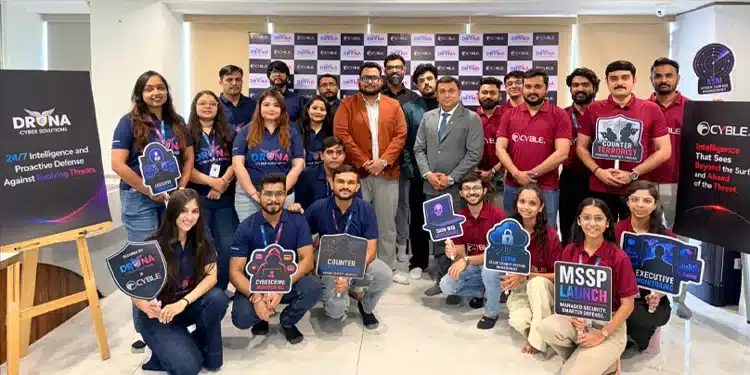
    AHMEDABAD (INDIA) — Cyble, the global AI-native cybersecurity company, and DRONA Cyber Solutions, the Ahmedabad-headquartered security operations firm, have launched an AI-powered cyber defense initiative in Ahmedabad, combining threat intelligence, investigation and endpoint enforcement through a joint managed security model. The AI-Powered Intelligence for Cyber Defense initiative was formally launched Tuesday at DRONA Cyber Solutions' Command and Control Centre, where the companies presented
     

Cyble and DRONA Launch New Push to Close India’s Cybersecurity Gap

26 de Agosto de 2026, 07:07

Cyber Yodha Campaign

AHMEDABAD (INDIA) — Cyble, the global AI-native cybersecurity company, and DRONA Cyber Solutions, the Ahmedabad-headquartered security operations firm, have launched an AI-powered cyber defense initiative in Ahmedabad, combining threat intelligence, investigation and endpoint enforcement through a joint managed security model.

The AI-Powered Intelligence for Cyber Defense initiative was formally launched Tuesday at DRONA Cyber Solutions' Command and Control Centre, where the companies presented a live technical demonstration showing how an intrusion attempt can be detected, investigated and contained.

The launch comes as India faces a growing cybercrime burden. India recorded 28.15 lakh cybercrime cases in 2025, a 24 percent increase over the previous year, with reported losses reaching ₹22,495 crore. The government's 1930 cybercrime helpline received 32.4 million calls during the year. Of the complaints filed, 55,484 were converted into FIRs. AI-powered cyber defense While large enterprises and banks increasingly have dedicated security teams, budgets and incident response capabilities, many manufacturers, hospital chains, schools and mid-sized businesses, particularly across Tier-2 and Tier-3 cities, continue to operate without comparable security resources.

AI-Powered Cyber Defense Takes Center Stage in Ahmedabad

Rather than focusing solely on formal remarks, Cyble and DRONA used the launch to demonstrate the initiative through a live technical exercise for the media. The demonstration began with material recovered from infostealer logs circulating on a criminal forum, alongside a lookalike domain registered to impersonate a target organisation. Analysts traced the infrastructure, established a pattern of previous activity associated with the same actor and demonstrated the detection and containment of an intrusion attempt on an endpoint.

The final containment action was authorised by a human analyst rather than executed automatically. The demonstration brought together multiple capabilities. Cyble Vision provided the initial detection through continuous monitoring of criminal marketplaces and leak sites.

Cyble Hawk supported the investigative process and attribution, while Cyble Titan handled endpoint enforcement, using hardware-level integrity checks to support its assessment. DRONA analysts remained at the centre of the process, making decisions that the system was deliberately not permitted to make independently. Cybersecurity Collaboration Mandar Patil, Executive Vice President at Cyble, said the initiative was designed to address a longstanding gap between threat detection and action for mid-sized businesses.
"India is not short of alerts. It is short of what happens next," Patil said. "We have spent a long time in this industry watching mid-sized businesses get told about a threat and then having nowhere to take that information. What we are launching today is not another alert. It is a complete chain — intelligence before the attack, investigation that would stand up to scrutiny, enforcement on the device, and a person accountable for the decision at the end of it."
Dhruv Pandit, Co-Founder and CEO of DRONA Cyber Solutions, said the initiative reflects the operational needs of organisations that require immediate action rather than another security dashboard.
"A factory owner calling us at two in the morning does not want to be shown a dashboard," Pandit said. "He wants to know what happened, he wants it contained, and he wants someone to take responsibility for what happens next."

From the Command Centre to Gujarat University, India

The Gujarat University engagement was not simply a conventional cybersecurity student session. It was a technical session titled “Kavach: Beyond the Surface — Threat Intelligence from the Dark Web Depths,” hosted by the Department of Biochemistry and Forensic Science, Gujarat University, in collaboration with Cyble.

The session brought together speakers from Cyble and DRONA Cyber Solutions to examine areas including dark web threat intelligence, government and PSU cybersecurity projects, digital forensics and incident response (DFIR), and the transition of threat intelligence from information to action.

Mandar Patil and Augustin Kurian of Cyble discussed the dark web threat intelligence landscape. Prathmesh Pawar spoke about government and PSU cybersecurity projects, while Brijesh Kapadiya addressed DFIR and Vijay Mali discussed moving threat intelligence from information to action. The keynote was delivered by Prof. Dr. Kapil Kumar, Coordinator, Department of Biochemistry and Forensic Science. AI-powered cyber defense

The session highlighted several practical aspects of cybersecurity work. The dark web was discussed not simply as a hidden part of the internet, but as a structured ecosystem requiring dedicated intelligence-gathering and threat-discovery methods. DFIR was presented as an area where speed and process are as important as technical expertise.

Another key takeaway was the importance of turning threat intelligence into action. Rather than treating intelligence as information alone, the session focused on how it can inform practical security decisions.

Patil told students that the cybersecurity industry faces a shortage of professionals with practical skills in analysing and validating threat intelligence.
"The gap this industry has is not a gap of ideas. It is a gap of people who know how to do the work," Patil said. "What separates a useful analyst from an alert-reader is the ability to ask whether a piece of intelligence is actually true before you act on it."
Augustin Kurian, Editor-in-Chief of The Cyber Express, told students that threat intelligence and journalism share an emphasis on verification.
Every story we publish about a breach, a ransomware group or a leaked database starts exactly where today's demonstration started — with intelligence somebody had to go and find, verify, and decide was worth acting on," Kurian said. The instinct we have tried to build at The Cyber Express is the same instinct a good analyst needs: do not report, and do not act on, what you have not verified.
The programme also involved technical and production teams supporting the session. Screen, sound and lighting were handled by the technical team under the guidance and supervision of Aditya More, while Misha Alagiya, Kavya Maharaja, Pathak Ami, Omi and Nandini supported stage management and photography.

A Broader Cybersecurity Collaboration

Both companies emphasised that the partnership is not intended to represent a single solution to India's cybersecurity deficit. Cyble and DRONA maintain relationships with other partners, service providers and government bodies.
"India's exposure is too large for any single partnership to take credit for solving," Patil said. "What matters is whether more of these collaborations exist a year from now, and whether the businesses we are talking about today — the ones without a security team — actually have somewhere to turn."

The AI-Powered Intelligence for Cyber Defense initiative will be delivered through DRONA's Ahmedabad command centre, with the companies indicating an intent to extend the service model to customers elsewhere in India over time.

The initiative also folds into DRONA's existing Cyber Yodha Campaign, a national programme aimed at building 50 integrated cybersecurity command centre labs and training more than 100,000 defenders.

  • ✇Firewall Daily – The Cyber Express
  • Britain Gains Access to Ukraine’s ‘Goldmine’ of Battlefield AI Data Samiksha Jain
    The UK Ukraine AI partnership will give Britain access to Ukraine’s Avengers AI Labs, bringing together Ukrainian battlefield experience, operational data and engineering expertise with the UK’s AI ecosystem. The agreement, signed by President Volodymyr Zelenskyy and Prime Minister Andy Burnham in Ukraine, will focus initially on defence and national security. Under the partnership, British innovators and researchers will gain access to data and insights collected across the battlefield. The
     

Britain Gains Access to Ukraine’s ‘Goldmine’ of Battlefield AI Data

26 de Agosto de 2026, 02:26

UK Ukraine AI partnership

The UK Ukraine AI partnership will give Britain access to Ukraine’s Avengers AI Labs, bringing together Ukrainian battlefield experience, operational data and engineering expertise with the UK’s AI ecosystem. The agreement, signed by President Volodymyr Zelenskyy and Prime Minister Andy Burnham in Ukraine, will focus initially on defence and national security. Under the partnership, British innovators and researchers will gain access to data and insights collected across the battlefield. The UK government described Avengers AI Labs as a “goldmine of battlefield data,” offering researchers access to real-world operational information used to train AI models.

How Avengers AI Labs Uses Battlefield Data

The data is collected through thousands of daylight cameras and infrared sensors deployed across the battlefield. The systems capture images and information involving tanks, artillery, air defence systems, infantry and aerial targets, including Shahed drones and reconnaissance UAVs. The data is used to train AI models to recognize and classify battlefield objects. Ukraine’s Defense Ministry has previously said that systems trained using the Avengers Labs platform analyze more than 100,000 drone video feeds each month and help identify about 70% of enemy targets in real time. The UK’s access to the platform is intended to allow British startups, researchers and engineers to work with operational insights and develop technologies based on real-world datasets. The partnership will initially bring together engineers, academics, businesses and military operational expertise from both countries to address national security challenges. The two countries will also explore additional platforms for future collaboration.

UK Ukraine AI Partnership Test New Defence Technology

Several pilot projects involving British startups have already been rolled out as part of the agreement. The companies named are Bristol-based Sintela, Oxford’s Mind Foundry and London’s Skyral. The first technology is due to be deployed at a UK defence site to help protect bases from protestors and hostile actors seeking intelligence. The project combines Ukrainian data with UK technology and turns buried fibre-optic cables into an AI-enabled sensor. The technology could also be used in other critical locations, including airports, prisons, railways and energy plants, according to the information released about the partnership. A second project will examine the development of next-generation low-power AI chips designed for future drones, robotics and autonomous systems. If successful, the technology could support machines designed to operate for longer, respond faster and function in environments where conventional systems face limitations.

AI Sovereignty and Defence Innovation

The agreement forms part of the UK and Ukraine’s 100 Year Partnership and expands cooperation between the two countries in AI and defence technology. The UK will provide access to its universities, researchers, technology companies and AI ecosystem, while Ukraine will provide access to operational experience and datasets generated during the war. Minister for AI Kanishka Narayan described the arrangement as AI sovereignty in practice, focused on developing national capabilities and turning frontline experience into technologies for military and critical infrastructure protection. The partnership also follows the UK government’s announcement that defence firm MBDA can release classified information on UK components for the long-range SCALP missile to establish local assembly lines in Ukraine. The broader agreement is intended to combine Ukrainian battlefield data with British scientific, engineering and technology expertise, with the initial focus remaining on defence, national security and the development of future defence technology.
  • ✇Firewall Daily – The Cyber Express
  • Australia-India PACTS to Deepen Cybersecurity and Tech Collaboration Samiksha Jain
    Australia and India have unveiled the Australia-India PACTS, a new framework designed to deepen bilateral cooperation on cybersecurity, critical technologies, supply chain resilience, digital resilience, and defence research. The new partnership replaces the 2020 Framework Arrangement on Cyber and Cyber Enabled Critical Technology Cooperation and aims to strengthen national security, economic growth, and regional stability across the Indo-Pacific. The two countries said the Aus
     

Australia-India PACTS to Deepen Cybersecurity and Tech Collaboration

Australia-India PACTS

Australia and India have unveiled the Australia-India PACTS, a new framework designed to deepen bilateral cooperation on cybersecurity, critical technologies, supply chain resilience, digital resilience, and defence research.

The new partnership replaces the 2020 Framework Arrangement on Cyber and Cyber Enabled Critical Technology Cooperation and aims to strengthen national security, economic growth, and regional stability across the Indo-Pacific.

The two countries said the Australia-India Partnership on Cyber, Critical Technologies and Supply Chains (PACTS) builds on two decades of research collaboration, operational coordination, and policy engagement. It also reflects their shared commitment to creating secure digital ecosystems while promoting trusted technology partnerships.

Australia-India PACTS Built on Five Pillars

The Australia-India PACTS is structured around five pillars that will drive collaboration between governments, research institutions, universities, and the private sector. The framework is intended to increase two-way investment in emerging technologies while supporting innovation and the commercialisation of research.

The first pillar focuses on supply chain resilience by strengthening trusted technology supply chains and promoting secure trade. Both countries will establish a bilateral mechanism for trusted vendor frameworks and work together to improve undersea cable security through the Quad Partnership for Cable Connectivity and Resilience. The partnership also includes collaboration on semiconductor research, critical minerals, and trade diversification.

Australia-India PACTS Expands Critical Technology Collaboration

The second pillar focuses on critical technologies, with Australia and India planning to strengthen cooperation in artificial intelligence, telecommunications, biotechnology, advanced materials, and space technologies.

The framework also supports the development of international standards for trustworthy AI and encourages collaboration between academic institutions and industry to promote responsible AI deployment. The two countries will also explore joint research, investment initiatives, and commercial partnerships in emerging technologies to strengthen long-term economic security across the Indo-Pacific.

Australia-India Prioritises Cybersecurity

A major component of the partnership is Australia India cybersecurity cooperation. Under the third pillar, both governments will work together to counter cybercrime, deter malicious cyber activity, strengthen cyber policy coordination, and protect critical infrastructure.

The framework proposes a consolidated bilateral mechanism for cyber and ICT cooperation, expanded engagement in United Nations cyber processes, increased trade opportunities for cybersecurity businesses, and practical workshops involving government agencies and industry stakeholders.

The partnership will also establish a cyber technology skills incubator to promote knowledge exchange and workforce development.

Australia-India PACTS Advances Digital Resilience

The fourth pillar focuses on digital resilience across the Indo-Pacific. Australia and India will collaborate on trusted Digital Public Infrastructure initiatives and promote scalable digital solutions that support connectivity, healthcare, education, renewable energy, critical infrastructure, and digital transformation.

The partnership also seeks to expand pilot projects that help countries across the region build adaptable digital ecosystems while strengthening regional capabilities.

Defence Research and Governance Framework

The fifth pillar strengthens defence science collaboration through joint research, innovation partnerships, and greater engagement between Australia's Defence Science and Technology Group and India's Defence Research and Development Organisation.

Areas of cooperation include maritime surveillance, advanced materials, defence innovation, and stronger links between defence start-up ecosystems.

The Australia-India PACTS will be jointly overseen by the Australian Deputy Secretary of the International and Security Group within the Department of the Prime Minister and Cabinet and the Indian Deputy National Security Advisor. Annual Senior Officials Meetings will review progress, assess emerging cyber and technology risks, and identify future collaborative projects under each pillar.

With the launch of Australia-India Partnership on Cyber, Critical Technologies and Supply Chains (PACTS), both countries have outlined a long-term roadmap that brings together cybersecurity, critical technologies, supply chain resilience, digital resilience, and defence cooperation under a single strategic framework aimed at strengthening security and technology collaboration across the Indo-Pacific.

❌
❌