Visualização normal

Antes de ontemCybersecurity News
  • ✇Graham Cluley
  • Smashing Security podcast #479: How a fake police officer nearly stole Graham’s cryptocurrency Graham Cluley
    Graham gets a phone call from the police. Well, someone who sounds convincingly like the police. There's just one small problem: what they really want is the 24-word seed key to Graham's cryptocurrency wallet. Meanwhile, if you've stayed in a hotel recently, the free Wi-Fi you connected to might have come with an unexpected extra: an all-you-can-eat buffet of "Captive Crunch" for a Russian intelligence-linked hacking group. And a group calling itself the "ExFilSquad" has walked off with 6
     

Smashing Security podcast #479: How a fake police officer nearly stole Graham’s cryptocurrency

5 de Agosto de 2026, 20:10
Graham gets a phone call from the police. Well, someone who sounds convincingly like the police. There's just one small problem: what they really want is the 24-word seed key to Graham's cryptocurrency wallet. Meanwhile, if you've stayed in a hotel recently, the free Wi-Fi you connected to might have come with an unexpected extra: an all-you-can-eat buffet of "Captive Crunch" for a Russian intelligence-linked hacking group. And a group calling itself the "ExFilSquad" has walked off with 600,000 records of the UK's teachers and head teachers from the Department for Education — sending an unusually polite ransom demand. All this and more in episode 479 of the "Smashing Security" podcast with cybersecurity expert and keynote speaker Graham Cluley, and special guest Danny Palmer.
  • ✇Firewall Daily – The Cyber Express
  • PNLD Data Breach Exposes Police and Government Contact Details on Dark Web Ashish Khaitan
    The PNLD data breach has exposed contact information belonging to police officers, government partners, criminal justice professionals and customers after data from the Police National Legal Database (PNLD) was published on the dark web. The data breach at PNLD, identified on July 26, 2026, also affected some users of Ask the Police, raising concerns about targeted phishing attacks.  PNLD Data Breach Exposes Police and Contact Details  According to PNLD, the compromised data includes names, or
     

PNLD Data Breach Exposes Police and Government Contact Details on Dark Web

PNLD data breach

The PNLD data breach has exposed contact information belonging to police officers, government partners, criminal justice professionals and customers after data from the Police National Legal Database (PNLD) was published on the dark web. The data breach at PNLD, identified on July 26, 2026, also affected some users of Ask the Police, raising concerns about targeted phishing attacks. 

PNLD Data Breach Exposes Police and Contact Details 

According to PNLD, the compromised data includes names, organizations and work email addresses of police officers, police staff, criminal justice professionals, government partners and customers. The incident also exposed the names and email addresses of some individuals who had previously submitted questions through Ask the Police. UK government guidance warns that such information could enable attackers to craft more convincing phishing emails targeting named officers and affected individuals.  In its official statement, PNLD said, "There is no evidence to suggest that passwords or other security credentials have been compromised." The organisation clarified that it provides legal information, products and services to UK police forces and criminal justice organisations. It also stressed that PNLD is not the Police National Computer or the Police National Database, is not a crime-recording system, and does not store confidential information relating to victims, witnesses or offenders. 

PNLD Notifies Authorities and Affected Users 

Following the PNLD data breach, the organization said it had contacted all affected organizations and provided additional guidance. Individuals impacted through Ask the Police have also received notification emails with further information PNLD confirmed that it has informed the Information Commissioner's Office (ICO) and is working with the National Crime Agency (NCA) and specialist cybersecurity organizations as the investigation continues.  Its statement noted: "We are continuing to investigate a data security incident affecting the Police National Legal Database (PNLD), which was identified on Sunday 26 July." It added that compromised information had been published on the dark web and reiterated that there is no evidence that passwords or other security credentials were accessed.  Regarding Ask the Police, PNLD said the platform was affected because it is hosted on the same infrastructure, resulting in the publication of some users' names and email addresses. 

Investigation Continues as Key Questions Remain 

As of August 3, 2026, PNLD had not disclosed how many people were affected by the data breach at PNLD, when the intrusion began, how long unauthorized access lasted or the total volume of data obtained. Its public breach notice lists the categories of exposed information but does not include a victim count.  PNLD's 2025-26 annual summary reported 108,429 police registrations and support for all 43 Home Office police forces. However, the organization emphasized that this figure represents its user base and should not be interpreted as the number of people affected by the breach.  The organization's 2023-24 annual summary stated that PNLD uses Microsoft Power Platform technology. On August 3, 2026, The Hacker News reported that the breach notification page referenced assets hosted on Microsoft's content.powerapps.com domain. While this supports the platform connection, it does not indicate how the attackers accessed or extracted the compromised data. 
  • ✇Security Affairs
  • PNLD Confirms Data Breach Affecting UK Police and Justice Staff Pierluigi Paganini
    UK police legal database breach exposed officers’ names and work emails, increasing phishing risks. NCA is investigating. The Police National Legal Database (PNLD), the legal reference system used by all 43 Home Office police forces in England and Wales, confirmed that a data breach exposed the contact details of police officers, staff, and criminal justice professionals and published them on the dark web. The breach also hit Ask the Police, a public Q&A service hosted on the same platfo
     

PNLD Confirms Data Breach Affecting UK Police and Justice Staff

3 de Agosto de 2026, 09:23

UK police legal database breach exposed officers’ names and work emails, increasing phishing risks. NCA is investigating.

The Police National Legal Database (PNLD), the legal reference system used by all 43 Home Office police forces in England and Wales, confirmed that a data breach exposed the contact details of police officers, staff, and criminal justice professionals and published them on the dark web. The breach also hit Ask the Police, a public Q&A service hosted on the same platform. The National Crime Agency is involved in the investigation.

“Information including the names, organisations and work email addresses of police officers, staff and other criminal justice professionals, government partners and customers has been compromised and published on the dark web.” reads the notice of data breach. “There is no evidence to suggest that passwords or other security credentials have been compromised.”

UK police is investigating the security breach with the help of the National Crime Agency (NCA) and private cybersecurity firms.

The PNLD reported 108,429 police registrations in its 2025-26 annual summary, which gives some sense of the potential user base affected, though PNLD has not disclosed how many individuals are actually in the breached dataset. No victim count, no timeline of when the intrusion began, no statement on how much data was taken.

“The data security incident primarily affected the Police National Legal Database (PNLD) which hosts the Ask the Police site.” continues the notice. “As a result, some names and email addresses of people who have previously submitted a question to Ask the Police have been published on the dark web.”

Ask the Police is a public-facing service where anyone can submit questions to the police. The exposure of those submitters’ names and emails alongside police officers’ work contact details creates two distinct risk categories: named officers are now more vulnerable to targeted phishing, and members of the public who contacted police services have had that fact made visible on criminal forums.

“PNLD also provides legal information, products and services to UK police forces and criminal justice organisations; it is not a crime recording system and does not hold confidential information relating to victims, witnesses, or offenders.” concludes the notice.

All affected organizations were promptly notified, provided guidance, and the incident was reported to the UK Information Commissioner’s Office (ICO).

The extortion group ExfilSquad listed PNLD on its leak site on July 26, though PNLD has not attributed the incident to the group.

Cybersecurity firm VenariX reviewed samples associated with 11 of ExfilSquad’s 15 claimed victims and found structures consistent with Microsoft Dataverse across all of them, pointing toward a likely campaign pattern involving misconfigured Microsoft Power Pages portals, public-facing sites where overly permissive table access settings can expose data to anyone who visits the page without logging in.

PNLD’s 2023-24 annual summary stated the database uses Microsoft Power Platform technology, and the breach notice page references assets on Microsoft’s content.powerapps.com domain, which corroborates the platform connection. That said, neither PNLD’s notice nor VenariX’s report has confirmed a PNLD-specific endpoint, permission setting, or access route, the Power Pages hypothesis remains exactly that: a hypothesis consistent with the evidence, not a confirmed root cause.

“The reviewed data is most consistent with extraction from public Microsoft Power Pages portals that were configured to allow anonymous users to read Dataverse records.” states VenariX. “Microsoft documents that Power Pages can expose Dataverse tables through its portal Web API using the /_api/<EntitySetName> route, and that access is governed by table permissions assigned through web roles.

A likely flow is:

Public Power Pages portal → Anonymous Users web role → Broad table permission → Power Pages Web API or legacy OData feed → Dataverse data export

For any organization running Microsoft Power Pages: VenariX recommends reviewing Anonymous Users table permissions, Web API settings, and legacy OData feeds, then validating access from an unauthenticated browser session. Microsoft provides a tenant-level control that blocks unauthenticated users from reading Dataverse data while still allowing public form submissions. That’s the kind of configuration that should have been validated before deployment, not after a breach.

Police officers and staff whose details were exposed should be alert to targeted phishing that uses their name, organization, and work email, the exact combination now available on the dark web.

Follow me on Twitter: @securityaffairs and Facebook and Mastodon

Pierluigi Paganini

(SecurityAffairs – hacking, UK Police)

Hackers steal sensitive data from UK Department for Education and police

Details of parents and staff, including email addresses and phone numbers, are among data taken by cybercriminals

The Department for Education and a police database have been targeted by a cyber-attack, exposing more than 740,000 pieces of data.

Details of government officials, senior school leaders, university staff, police officers and members of the public have been taken by hackers.

Continue reading...

© Photograph: Dave Hunt/AAP

© Photograph: Dave Hunt/AAP

© Photograph: Dave Hunt/AAP

  • ✇Firewall Daily – The Cyber Express
  • Dubai Police Warns Against Online Scams Promising Work and Visit Visas Samiksha Jain
    The Dubai Police fraudulent visa ads warning has cautioned the public against scams offering work visas, residency visas, and visit visas in exchange for money. According to the Anti Fraud Centre at Dubai Police's General Department of Criminal Investigation, fraudsters are using social media platforms and messaging apps to circulate fake visa offers by impersonating official entities or using the names of unlicensed companies. The advisory was issued as part of Dubai Police's Be Aware of Fra
     

Dubai Police Warns Against Online Scams Promising Work and Visit Visas

Dubai Police fraudulent visa ads

The Dubai Police fraudulent visa ads warning has cautioned the public against scams offering work visas, residency visas, and visit visas in exchange for money. According to the Anti Fraud Centre at Dubai Police's General Department of Criminal Investigation, fraudsters are using social media platforms and messaging apps to circulate fake visa offers by impersonating official entities or using the names of unlicensed companies. The advisory was issued as part of Dubai Police's Be Aware of Fraud campaign, which aims to raise awareness about online scams and help residents identify fraudulent schemes.

Dubai Police Fraudulent Visa Ads Circulating on Social Media

According to Dubai Police, scammers are promoting visa services through advertisements and messages that claim to offer work, residency, or visit visas for a fee. The Anti Fraud Centre said these advertisements are designed to convince victims to transfer money by falsely claiming to represent government authorities or licensed visa service providers. Some also use the names of unlicensed companies or offices to appear legitimate. Dubai Police urged the public not to rely on such offers and reminded residents that all visa procedures should be completed only through competent authorities or legally approved offices.

Authorities Urge Public to Verify Visa Offers

The Anti Fraud Centre said verifying the source of a visa service is the first step in avoiding visa fraud. Residents have been advised to confirm the authenticity of any visa offer or application process through official channels before making payments or sharing personal information. The centre also warned against dealing with intermediaries or unknown individuals claiming they can arrange visas through unofficial means. Dubai Police said people should not be misled by promises of guaranteed visas or job opportunities that are offered outside the legal process.

How to Report Fraud Attempts

Dubai Police has asked members of the public to report any fraud or attempted fraud immediately. Reports can be submitted through the Dubai Police Smart App, the eCrime platform for cybercrime reports, or by calling 901. The Anti Fraud Centre reiterated that staying informed and verifying service providers through official channels remain the most effective ways to avoid falling victim to fraudulent visa schemes.
  • ✇Firewall Daily – The Cyber Express
  • Dutch Police Arrest Key Suspect in €100M Global Crypto Investment Scam Samiksha Jain
    A major global crypto investment scam investigation has led to the arrest of an alleged key figure behind an international criminal organization accused of defrauding victims of more than €100 million every month. Dutch police announced multiple arrests across Europe following a long-running investigation into a fraud network that allegedly employed over 700 people operating from around 20 call centers worldwide. The main suspect, a 46-year-old dual Israeli and Polish national,
     

Dutch Police Arrest Key Suspect in €100M Global Crypto Investment Scam

global crypto investment scam

A major global crypto investment scam investigation has led to the arrest of an alleged key figure behind an international criminal organization accused of defrauding victims of more than €100 million every month. Dutch police announced multiple arrests across Europe following a long-running investigation into a fraud network that allegedly employed over 700 people operating from around 20 call centers worldwide.

The main suspect, a 46-year-old dual Israeli and Polish national, was arrested at an airport in Poland on May 26 at the request of Dutch authorities. Investigators believe he played an indispensable role in the organization, which allegedly carried out large-scale investment fraud targeting victims across multiple countries.

Global Crypto Investment Scam Network Operated Through Worldwide Call Centers

According to Dutch police, the organization functioned like a professional company with approximately 700 employees spread across nearly 20 offices globally. Individuals working as financial advisors scam operators allegedly contacted victims daily through online platforms and telephone calls while posing as legitimate investment professionals.

Authorities said the organization was structured with a central headquarters overseeing multiple teams, each assigned to target victims in specific countries. Employees reportedly worked under pseudonyms and used technical measures to hide their identities and locations.

[caption id="attachment_113134" align="aligncenter" width="600"]global crypto investment scam Excerpts from emails that victims sent to scammers[/caption]

As part of the investigation, Belgian police arrested five individuals believed to have worked as fraudulent financial advisors.

Multiple Arrests Made Across Europe

The investigation resulted in several coordinated arrests during May and July.

On July 7, authorities arrested two Dutch nationals aged 45 and 34, along with a 34-year-old Belgian, all residing in Cyprus. A 25-year-old suspect was also arrested in Belgium the same day. On July 10, police arrested a 44-year-old Dutch national in Athens.

The main suspect has since been extradited to the Netherlands, where an examining magistrate ordered 14 days of pre-trial detention. Dutch authorities indicated that additional arrests remain possible as the investigation continues.

How the Global Crypto Investment Scam Worked

Investigators said the online investment scam relied on building long-term trust with victims. Individuals posing as account managers or financial advisors maintained frequent contact through phone calls and online communication, sometimes over several months.

Victims were encouraged to begin with relatively small investments that appeared to generate immediate returns. Police said the investment platforms displayed convincing but fabricated profits, even though no actual investments were being made.

As confidence grew, victims were persuaded to transfer increasingly larger amounts, often in the form of cryptocurrency fraud payments. Instead of being invested, investigators said the funds were diverted directly to the criminal organization.

Authorities also warned that victims who stop investing may later be contacted by so-called recovery companies requesting upfront deposits to recover lost funds. Police believe these recovery operations may also be connected to the same fraud networks.

Hundreds of Complaints Linked to Investment Fraud

Dutch authorities have received approximately 550 reports connected to the organization, while Belgian police have recorded around 200 complaints. Investigators estimate the total number of victims worldwide could reach tens of thousands.

The financial losses reported by victims in the Netherlands alone amount to nearly €25 million, with many individuals losing well over €10,000.

Dutch police said officers proactively contacted some victims after discovering that many remained unaware they had fallen victim to cyber fraud.

Financial investigators are now examining whether assets linked to the suspects can be frozen or seized.

Digital Infrastructure Taken Offline

Investigators said the criminal organization remained active since at least 2021 and relied heavily on concealed digital infrastructure to evade law enforcement.

By tracing financial transactions, IP addresses, and other digital evidence, the Dutch police identified offices, suspects, and critical infrastructure supporting the operation. Authorities worked with commercial service providers to take key elements of the network offline.

The investigation also involved Europol, with intelligence shared across multiple countries to support ongoing criminal prosecutions.

Officials said the case demonstrates the scale and sophistication of modern investment fraud operations and highlighted continued international cooperation to dismantle cyber-enabled financial crime networks.

  • ✇Graham Cluley
  • Smashing Security podcast #473: How a hacker could have Rickrolled the entire World Cup Graham Cluley
    A polite caller from your bank says there is a problem with your account. Don't worry - they'll send someone round to help. They'll even take your cards away to keep them safe. The scam has run rampant, until Dutch police plastered blurred photos of 100 suspects across billboards, supermarkets, and TikTok, with a two-week ultimatum to turn themselves in... or else. Meanwhile, a security researcher called Bob DaHacker got her hands on the live broadcast controls for every match of the 2026 FIF
     

Smashing Security podcast #473: How a hacker could have Rickrolled the entire World Cup

24 de Junho de 2026, 20:10
A polite caller from your bank says there is a problem with your account. Don't worry - they'll send someone round to help. They'll even take your cards away to keep them safe. The scam has run rampant, until Dutch police plastered blurred photos of 100 suspects across billboards, supermarkets, and TikTok, with a two-week ultimatum to turn themselves in... or else. Meanwhile, a security researcher called Bob DaHacker got her hands on the live broadcast controls for every match of the 2026 FIFA World Cup. She could have Rickrolled the entire planet, but actually spent days trying to find anyone at FIFA who would pick up the phone. Plus! Don't miss our featured interview with Black Kite's Jeffrey Wheatman exploring ransomware and extortion attacks across Europe. All this and more in episode 473 of the "Smashing Security" podcast with cybersecurity expert and keynote speaker Graham Cluley, and special guest Danny Palmer.

TfL Hackers Plead Guilty After Breach Exposed Customer Data and Cost £29 Million

Transport for London cyberattack

Two alleged members of the cybercrime collective Scattered Spider have pleaded guilty to their roles in the Transport for London cyberattack, an incident that disrupted services, exposed customer data, and resulted in approximately £29 million in losses and recovery costs for London's transport authority. The guilty pleas were entered by Thalha Jubair, 20, from East London, and Owen Flowers, 18, from Walsall, West Midlands, on the opening day of proceedings at Woolwich Crown Court. The pair had been due to stand trial on June 22 but changed their pleas to guilty.

Transport for London Cyberattack Led to Major Disruption

According to the National Crime Agency (NCA) and City of London Police, TfL's network was infiltrated between August 31 and September 3, 2024. The breach forced all 28,000 employees to attend TfL offices for password resets and caused significant operational disruption across the organization. The TfL cyberattack also resulted in unauthorized access to data held within TfL's Oyster refunds system. The incident affected the authority's customer refund process, delaying reimbursements for some customers. In addition, the application system for Oyster photocards used by children and young people was temporarily shut down. Authorities said the attack caused substantial financial damage, with TfL reporting losses and recovery costs totaling approximately £29 million.

Investigation Linked Attackers to Scattered Spider

Jubair and Flowers were arrested at their homes on September 16, 2024, following a joint investigation conducted by the NCA and City of London Police. Investigators identified both individuals as members of Scattered Spider, a cybercriminal collective that has been linked to a number of high-profile intrusions. During searches of Flowers' residence, officers recovered laptops, desktop computers, hard drives, and USB storage devices. Evidence recovered from one Acer laptop included a screenshot showing connectivity to TfL infrastructure. [caption id="attachment_112868" align="aligncenter" width="600"]Transport for London cyberattack Source: NCA[/caption] Authorities also found evidence indicating Flowers had accessed an online marketplace that sold breached credentials. Investigators further discovered videos recorded by Flowers that allegedly showed Jubair accessing TfL systems during the attack. The investigation revealed that the two communicated through Telegram and collaborated using an online workspace platform that allowed multiple participants to work remotely on shared systems.

Additional Allegations Involving US Healthcare Networks

The investigation extended beyond the Transport for London cyberattack. When Flowers was first arrested on September 6, 2024, NCA officers identified evidence suggesting unauthorized activity targeting the networks of SSM Health Care Corporation and Sutter Health in the United States. Court records show Flowers pleaded guilty to charges related to a conspiracy to conduct unauthorized acts against SSM Health Care Corporation's computer systems with intent to impair operations. He also admitted attempting unauthorized acts against Sutter Health's systems with the same intent. Jubair additionally faced a charge for failing to disclose PINs or passwords associated with devices seized during the investigation. Authorities noted that Flowers breached bail conditions on two occasions in March and May 2025.

Law Enforcement Highlights Impact of Cybercrime

Paul Foster, Deputy Director and head of the NCA's National Cyber Crime Unit, described the case as a lengthy and highly complex investigation. He said the attack demonstrated that cybercrime has significant real-world consequences, affecting public services and causing millions of pounds in losses to critical national infrastructure. Foster also highlighted the growing threat posed by cybercriminal groups operating from the UK and other English-speaking countries, citing Scattered Spider as a notable example. Deputy Commissioner Nik Adams of the City of London Police said the cyberattack had a significant impact on essential public services and daily operations. He emphasized that individuals responsible for targeting critical organizations and causing financial harm would be pursued through coordinated law enforcement efforts. The investigation received support from the West Midlands Regional Organised Crime Unit and British Transport Police. Jubair and Flowers are scheduled to be sentenced at Woolwich Crown Court on July 16.

Dubai Police Warns Against Viral Energy Drink Videos Targeting Children on Social Media

Viral Energy Drink Videos

Dubai Police has issued a public warning about the growing spread of viral energy drink videos on social media platforms that encourage excessive consumption, particularly among children and teenagers. Authorities said many of these videos are designed solely to attract views and engagement while ignoring the serious health risks linked to overconsumption of energy drinks. The warning was issued by the Cybercrime Department under the General Department of Criminal Investigation at Dubai Police, which urged parents to closely monitor the type of online content their children are exposed to and educate them about the dangers of blindly imitating viral internet trends. According to Dubai Police, the increasing popularity of online challenges and influencer-driven content has made harmful behavior appear entertaining or harmless to young audiences. Officials stressed that some creators prioritize social media reach over public safety, exposing children to risky habits without discussing potential consequences. [caption id="attachment_112092" align="aligncenter" width="1024"]Energy Drink Videos Source: Dubai Police[/caption]

Energy Drink Videos Raise Serious Health Concerns

Dubai Police highlighted that excessive intake of energy drinks can lead to severe medical complications. Authorities warned that consuming high quantities of caffeine and stimulant-based beverages may cause heart rhythm disorders, convulsions, loss of consciousness, and in extreme cases, sudden cardiac arrest. Children and adolescents are considered particularly vulnerable to these effects because their bodies may react more strongly to stimulant ingredients commonly found in energy drinks. The police also noted that overconsumption can trigger a wide range of additional health issues, including poisoning, stomach disorders, anxiety, irritability, poor concentration, memory problems, sleep disturbances, high blood pressure, and rapid heartbeat. Officials said the concern is not limited to physical health alone. Repeated exposure to viral energy drink videos can normalize dangerous behavior among younger audiences who often attempt to replicate online trends without understanding the risks involved.

Dubai Police Urges Parents to Monitor Online Content

As part of the advisory, Dubai Police encouraged parents and guardians to maintain active supervision of the digital content consumed by children. Authorities emphasized the importance of discussing online safety and helping children identify misleading or harmful trends circulating on social media platforms. The force urged families to explain that not all viral content is trustworthy or safe, especially when it promotes unhealthy or dangerous actions for entertainment purposes. Dubai Police also advised the public to rely on verified medical and health sources for information regarding food, beverages, and wellness-related trends instead of depending on influencer content or unverified social media posts. The warning reflects broader concerns among authorities globally about how social media algorithms can rapidly amplify risky trends, especially among younger users who are highly engaged with short-form video platforms.

Public Asked to Report Harmful Online Content

Dubai Police called on community members to report any digital content that promotes dangerous behavior or threatens public safety. Authorities said reports can be submitted through the Dubai Police smart application, the dedicated E-Crime platform, or by contacting the non-emergency helpline at 901. Officials stressed that public reporting plays an important role in limiting the spread of harmful online material and protecting vulnerable groups from unsafe internet trends. The department also reminded social media users to think critically before participating in online challenges or consuming products promoted through viral content.

Dubai Police Expands Cyber Awareness Efforts

Alongside the warning, Dubai Police highlighted its ongoing efforts to improve public awareness around cyber safety and digital risks through its awareness e-platform. The online platform provides educational material in both Arabic and English and covers various topics related to cybercrime prevention, online fraud awareness, digital safety, and safe internet usage. According to Dubai Police, the platform is designed for all sections of society, including parents, children, employees, business owners, and regular internet users. Authorities said the initiative aims to help residents recognize online manipulation tactics, avoid cyber-related threats, and make safer decisions while using social media and digital platforms. The latest advisory on viral energy drink videos adds to growing efforts by law enforcement and public health authorities to address the real-world risks created by harmful social media trends targeting younger audiences.

Dubai Police Smash International Scam Empire in Massive FBI and China-Led Operation

Operation Tri-Force Sentinel

In a major international enforcement action, Operation Tri-Force Sentinel, led by Dubai Police, in coordination with the FBI and Chinese Police, has dismantled a large transnational fraud network involved in global financial scams. The Operation Tri-Force Sentinel crackdown resulted in the arrest of 276 individuals linked to organised cyber-enabled fraud activities spanning multiple countries, primarily involving suspects from Southeast Asia. The Operation Tri-Force Sentinel was carried out under the UAE Ministry of Interior and focused on disrupting criminal syndicates running high-yield investment scams, commonly known as HYIS, “pig butchering” schemes, and virtual currency fraud. Authorities confirmed that nine major fraud centres were dismantled during the coordinated action.

276 Arrests and Nine Fraud Centres Dismantled in Operation Tri-Force Sentinel

As part of the operation, law enforcement agencies executed synchronized raids that dismantled three major criminal syndicates operating fraud centres. These centres were responsible for large-scale financial deception campaigns targeting victims across several regions. The operation led to the arrest of 276 suspects, with authorities confirming that the network used advanced social engineering techniques. Victims were reportedly engaged through digital platforms, where trust was gradually built before financial exploitation took place. Dubai Police also confirmed the arrest of a key leader of one of the syndicates in Thailand, carried out in coordination with the Royal Thai Police. The enforcement action marked one of the most significant coordinated strikes against cyber-financial crime groups in recent times under Operation Tri-Force Sentinel. [caption id="attachment_111753" align="aligncenter" width="553"]Operation Tri-Force Sentinel Image Source: Dubai Police[/caption]

Dubai Police, FBI, and Chinese Police Coordination 

Dubai Police played a central role in directing and executing Operation Tri-Force Sentinel, enabling real-time intelligence sharing between international partners. The collaboration with the FBI and Chinese Police was described as critical to the success of the operation. Dubai Police stated that the operation reflects a proactive strategy to combat evolving transnational financial crime threats. The agency emphasized that coordinated international efforts were essential to dismantling complex criminal networks operating across borders. The FBI highlighted the significance of joint enforcement efforts, stating that the operation demonstrates the effectiveness of coordinated global action in disrupting large-scale fraud schemes. It further noted that the partnership with the UAE authorities, particularly the Dubai Police, played a key role in achieving operational success. Chinese Police also reaffirmed their commitment to combating telecom and financial fraud crimes. They emphasized continued cooperation with global law enforcement agencies to address emerging cross-border criminal activities targeted in Operation Tri-Force Sentinel.

Transnational Fraud Networks and Financial Crime Disruption

The dismantled network operated multiple fraud centres using structured and organised digital fraud models. These included investment scams and cryptocurrency-related fraud schemes that have increasingly affected victims across several countries. Authorities noted that the criminal groups involved in Operation relied heavily on psychological manipulation and digital engagement strategies to execute financial scams at scale. The coordinated enforcement action disrupted key operational infrastructure of these networks in a single phase.

International Cooperation Strengthened 

This operation highlights the growing importance of international cooperation in tackling financial crime networks that operate beyond national borders. The joint action between Dubai Police, the FBI, and the Chinese Police demonstrates strengthened coordination in intelligence sharing and enforcement execution. Officials involved in the operation emphasized that continued collaboration is essential to countering sophisticated fraud networks. The success of Operation reflects the ability of global law enforcement agencies to respond jointly to complex cyber-enabled financial threats. The operation marks a significant step in global efforts to combat organised fraud networks and reinforces the role of coordinated international enforcement in addressing cross-border financial crime.
  • ✇Firewall Daily – The Cyber Express
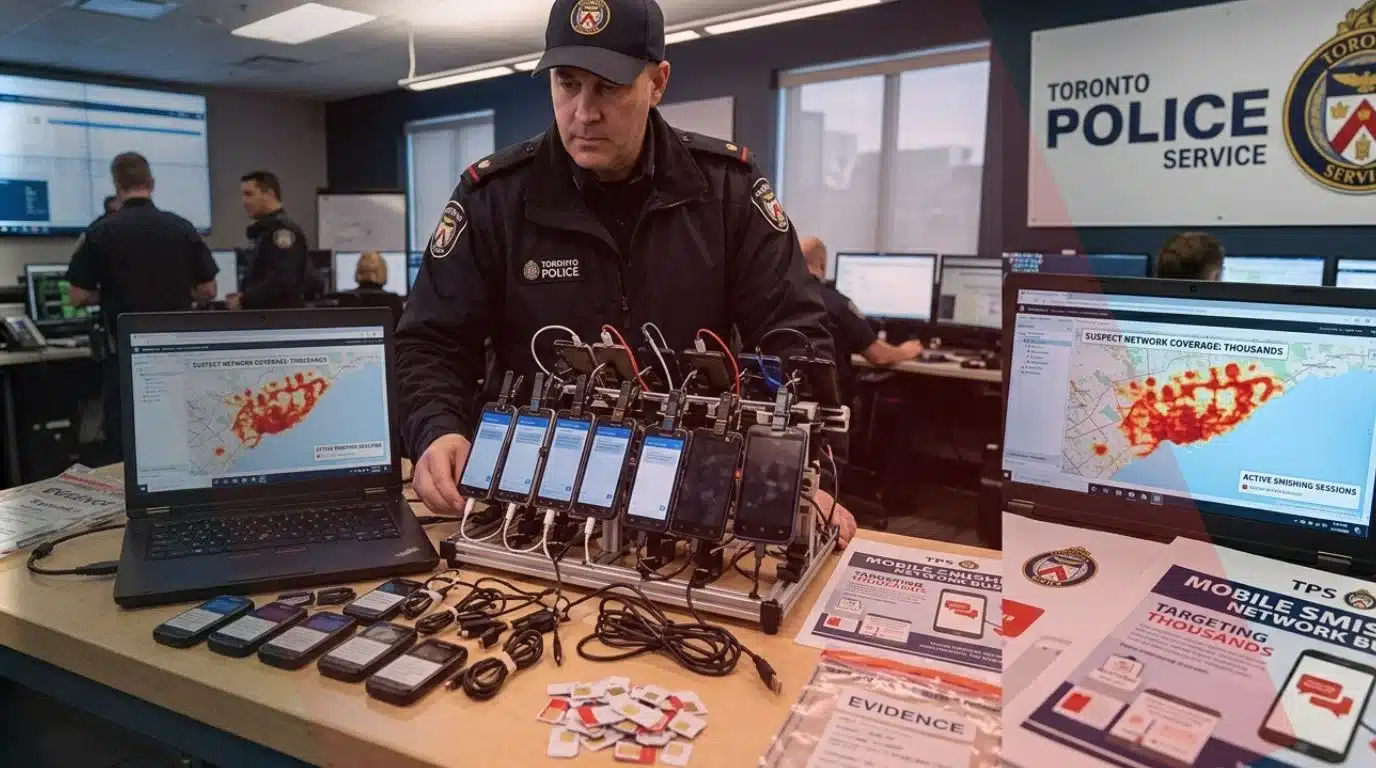
  • Toronto Police Bust Mobile Smishing Network Targeting Thousands Samiksha Jain
    A major Canada SMS blaster cybercrime case has come to light as Toronto Police charge three men with 44 offences in what authorities describe as a first-of-its-kind investigation in the country. The case, part of Project Lighthouse, highlights a growing threat where cybercriminals use mobile technology to target thousands of people at once. The investigation began in November 2025 after a security partner alerted police to a suspected SMS blaster operating in downtown Toronto. What followed w
     

Toronto Police Bust Mobile Smishing Network Targeting Thousands

Canada SMS blaster cybercrime case

A major Canada SMS blaster cybercrime case has come to light as Toronto Police charge three men with 44 offences in what authorities describe as a first-of-its-kind investigation in the country. The case, part of Project Lighthouse, highlights a growing threat where cybercriminals use mobile technology to target thousands of people at once. The investigation began in November 2025 after a security partner alerted police to a suspected SMS blaster operating in downtown Toronto. What followed was a months-long probe into a sophisticated operation that combined mobility, deception, and large-scale disruption.

What Is the Canada SMS Blaster Cybercrime Case?

At the center of the Canada SMS blaster cybercrime case is a device that mimics a legitimate cellular tower. When nearby mobile phones connect to it, users receive fraudulent messages that appear to come from trusted organizations. These messages often include links to fake websites designed to steal sensitive information such as banking credentials and passwords. This method is widely known as “smishing,” a form of phishing carried out through text messages. However, the scale and mobility of the device used in this case set it apart from typical cyber fraud schemes. Deputy Chief Rob Johnson said the operation posed serious risks beyond financial fraud. He noted that the technology had the capability to reach thousands of devices simultaneously, raising concerns about public safety.

Large-Scale Disruption Across the Greater Toronto Area

Investigators found that the SMS blaster was not stationary. It was operated from vehicles, allowing suspects to move across the Greater Toronto Area and deploy the device in multiple locations. According to Detective Sergeant Lindsay Riddell, tens of thousands of devices connected to the rogue network over several months. Police also recorded more than 13 million network disruptions, during which affected devices were unable to connect to legitimate cellular networks. These disruptions had serious implications. During those moments, access to emergency services such as 9-1-1 could have been impacted, making the Canada SMS blaster cybercrime case not just a financial threat but also a public safety concern.

Arrests and Seizure of Devices

Toronto Police executed search warrants on March 31 at residences in Markham and Hamilton, leading to the arrest of two suspects. Authorities seized multiple SMS blasters along with a significant amount of electronic evidence. A third individual later turned himself in on April 21. All three now face a combined total of 44 charges linked to the operation. The Canada SMS blaster cybercrime case involved extensive coordination between multiple agencies, including the Royal Canadian Mounted Police National Cybercrime Coordination Centre, regional police services, financial institutions, and telecom providers. Officials say this collaboration was key to identifying and disrupting the activity.

A New Type of Cyber Threat in Canada

Law enforcement officials emphasized that this is the first known case of SMS blaster technology being used in Canada. The case reflects how cyber-enabled crimes are becoming more advanced and harder to detect. Authorities noted that while the technology is new, the objective remains the same: to gain unauthorized access to personal and financial information. The Canada SMS blaster cybercrime case shows how attackers are combining traditional fraud tactics with newer tools to scale their operations.

Public Advisory and Safety Measures

Police are urging the public to remain cautious when receiving unexpected text messages. Users are advised not to click on suspicious links or share personal information through unsolicited messages. Officials recommend accessing banking services only through official applications or by directly entering website addresses into browsers. Victims of suspected fraud are encouraged to report incidents to law enforcement. Deputy Chief Johnson also acknowledged the role of the Toronto Police Coordinated Cyber Centre and partner agencies in handling the investigation. He stressed that staying informed and vigilant remains one of the most effective defenses against such threats.
❌
❌