Google’s new Android app store program brings one-tap installs and automatic updates, but US users are excluded, and marketplaces face a $10,000 annual fee.
The post Google’s New Android App Store Program Costs $10,000 a Year appeared first on TechRepublic.
Google’s new Android app store program brings one-tap installs and automatic updates, but US users are excluded, and marketplaces face a $10,000 annual fee.
Yoba malware uses fake ChatGPT and Claude apps to sideload malware through signed installers and deploy a cryptocurrency miner.
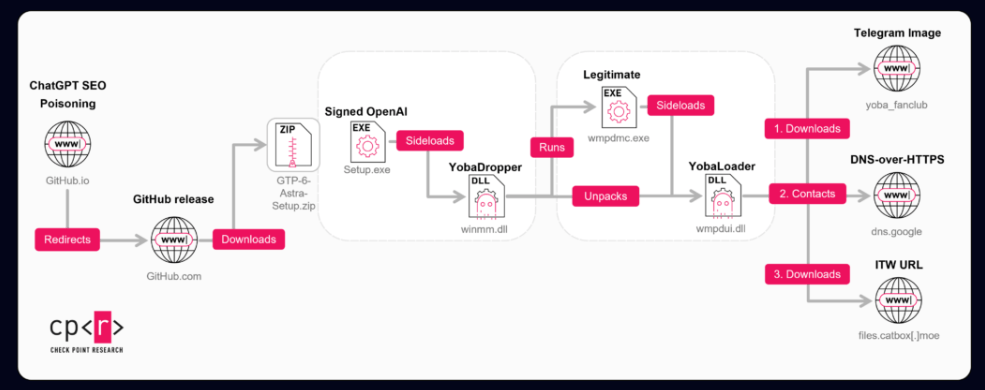
Check Point Research has spent two months tracking a campaign it calls Yoba, which uses the popularity of AI tools to spread a custom malware chain. The attackers build fake GitHub projects that pose as AI desktop applications such as GPT-5.6 Sol, GPT-6 Astra and Claude Opus. The projects look convincing and run on real GitHub infrastructure, which helps them seem l
Yoba malware uses fake ChatGPT and Claude apps to sideload malware through signed installers and deploy a cryptocurrency miner.
Check Point Research has spent two months tracking a campaign it calls Yoba, which uses the popularity of AI tools to spread a custom malware chain. The attackers build fake GitHub projects that pose as AI desktop applications such as GPT-5.6 Sol, GPT-6 Astra and Claude Opus. The projects look convincing and run on real GitHub infrastructure, which helps them seem legitimate to potential victims.
“These projects look convincing and use real GitHub infrastructure, which helps them appear legitimate to potential victims. The website exhibits search-targeted content and suspicious installer-delivery tactics consistent with an SEO-poisoning lure.
Inside the installers, there is a malicious component we refer to as the YobaDropper. This dropper includes another component, the YobaLoader, which is responsible for contacting attacker-controlled infrastructure and fetching the final payload.” reads the report. “In this report, we describe how victims are lured to these fake projects, how the YobaDropper and YobaLoader work together, and how the attackers ultimately use this chain to run unwanted software on infected systems.”
The lure is simple. Each project has a repository, a GitHub.io page describing the software, and a ZIP release with the malware. The repositories show no fake stars or forks, yet they still rank among the top Google results, most likely through SEO poisoning that optimizes titles, descriptions and hosting domains.
The first repository appeared around July 2026, but the first malicious releases landed only on August 30 and 31, and a third followed about five days later on September 4. Each repository uses a different Outlook address, and commit times point to UTC+4, UTC-4 and UTC+3, which Check Point reads as a deliberate attempt to hide the actor’s real time zone.
Here’s the trick that gives the report its title. Each ZIP holds a legitimate signed executable from OpenAI or Anthropic, named Setup.exe, next to a malicious winmm.dll. The signed program loads the DLL on its own, a technique known as DLL sideloading, which is often used to bypass security protections.
The ZIP files were not even password-protected. Attackers often use passwords to prevent security tools from automatically unpacking and scanning files. However, these binaries already had very low detection rates because they used anti-sandbox and other techniques to avoid analysis. The DLL’s compilation date is another clue: it was built on the same day it was added to the archive, unlike the legitimate files around it.
The dropper, called YobaDropper, checks the environment before running. It calculates a hash of the name of the program that launched it and continues only if the name is Setup.exe. This means that sandboxes that run the DLL on its own will fail this check. When that happens, the process does not exit. Instead, it sleeps 200,000 times for 5.5 seconds each, a total of about 12.73 days.
The malware also avoids victims in CIS countries by checking the keyboard layout. It excludes Russian, Belarusian, Tajik, Armenian, Azerbaijani, Georgian, Kazakh, Kyrgyz, Turkmen, Uzbek, and Tatar. Interestingly, Ukraine, which has often appeared in similar exclusion lists, is not included.
Next, the malware requests administrator privileges. If the user does not have them, it displays the message “Please run this program as Administrator.” and exits. The victim must then restart it with administrator rights.
Once it has the required privileges, the malware creates a folder called WMProcess under ProgramData. It copies the legitimate WMPDMC.exe file from System32 into this folder and places the second-stage payload there under the name wmpdui.dll.
The malicious code achieves persistence by using a scheduled task dressed up as Microsoft. The author is set to Microsoft Corporation, the description says it collects device metadata for Windows Media Player, and it starts three minutes after boot as Local System. The task launches the legitimate program, which sideloads the malicious DLL.
The second stage, YobaLoader, shares code with the dropper, which points to the same developer. It only runs under WMPDMC.exe and uses a different seed for its hashing than the dropper does, which separates the stages and weakens hash-based detection. Its job is to find its payload without a classic command server.
It goes to a Telegram channel, t[.]me/yoba_fanclub, and downloads the channel’s profile picture. The last 50 bytes of the image seed a domain generator that builds names from word lists in the form adjective-noun-verb-number on dedyn[.]io. Change the picture and the operator gets a new domain.
Then it asks Google’s DNS-over-HTTPS service for a TXT record on that domain. The reply is signed, and the loader checks the signature before decrypting it, which gives a link to a payload on Catbox. Check Point says this reliance on DoH and common hosting aims to bypass passive DNS monitoring and some gateway protections, and the campaign avoids dedicated command-and-control infrastructure, using Telegram, Tor, Catbox and DoH instead.
The operator can choose how the payload runs. It can inject it into svchost.exe, save it as an executable after removing the Zone.Identifier mark, or run it as a hidden PowerShell script while bypassing execution policies.
“Finally, the injected payload into svchost.exe is an XMRig 6.26.0 miner with a hidden command line targeting a TLS-enabled onion mining endpoint through a local Tor SOCKS5 proxy. It can unpack and start Tor 0.4.9.12 plus lyrebird 0.8.1, monitor user-input activity to pause mining, and conditionally load the WinRing0 driver service for MSR-based mining optimization.” continnues the report.
The miner uses Tor to connect to an encrypted mining server. It can start its own Tor components, use about 85% of CPU threads, and pause mining when the user is active. It resumes after 240 seconds of inactivity and can load the WinRing0 driver to optimize mining performance.
However, YobaLoader is not limited to cryptocurrency mining. Its DNS tasking system allows operators to deliver any PE executable or PowerShell payload, meaning future attacks could distribute other malware families.
Earlier versions appeared in June 2026. They used Cursor.exe for sideloading, a startup shortcut for persistence, and excluded only Russia. They also used .aber[.]ir instead of dedyn[.]io and included anti-debugging and anti-VM checks that later versions dropped.
Check Point believes the attackers may have Russian origins and mainly operate in the UTC-4 time zone, but this is an assessment, not a confirmed attribution.
Defenders should look for suspicious WMPDMC.exe copies under ProgramData, fake Microsoft scheduled tasks, Telegram-related traffic, DNS lookups for dedyn[.]io through dns.google, and unexplained high CPU usage.
“The Yoba campaign shows how attackers can use trusted platforms and the current interest in AI tools to distribute malware in a way that looks believable and harmless at first glance. By packaging their code together with well-known software names and hosting it on GitHub, they lower the chances that users or basic security checks will immediately flag the files as suspicious.” concludes the report. “Organizations should be cautious about installing “AI helpers” or similar tools from unverified repositories and should enforce policies that restrict running software from unknown sources. Combining user awareness with basic technical controls.”
The Google Registered App Stores program brings seamless one-click app installs and background updates to verified third-party Android marketplaces.
Related Posts:
Android Phone Number Verification Is On by Default
Android 17 Bionic Bug Triggers String Parsing Flaw
Android Scam Protection Gets Gemini AI Upgrades
The post Google Registered App Stores Launch for Android appeared first on Daily CyberSecurity.
Check Point reveals the Yoba malware campaign. This GitHub Yoba malware campaign uses signed OpenAI and Anthropic binaries to sideload YobaLoader.
Related Posts:
Fake FedEx Tax Invoice PDFs Deliver Fileless Sirius Backdoor to Windows Systems
Fake Phantom, Jupiter, and Bitget Firefox Extensions Steal Crypto Recovery Phrases
Brazilian Magecart Group Hits Convertr Ecommerce Platform in Plausible Analytics Supply Chain Attack
The post Yoba Malware Campaign Sideloads Payloads Through Signed OpenAI
The Australian App Store ruling orders Apple to allow sideloading and outside payments by March 1, 2027. Apple will appeal.
Related Posts:
iOS 27.1 iPhone Duo Release Targets Foldable Hardware
OpenAI Cuts Internet Access for Frontier Model Training
Google Privacy Policy Change Raises Gmail Ad Concerns
The post Australian Court Forces Apple to Open the App Store appeared first on Daily CyberSecurity.
BRONZE SANDCASTLE uses Sandboxie DLL sideloading to run a modified Meterpreter backdoor in memory against targets in Asia and Africa.
Related Posts:
Skynet LLMjacking Agent Hijacks Exposed AI Models to Hack Servers and Mine Crypto
INC Ransomware Affiliates Expose Seven Servers Holding Phantom AI Framework and 46 Encryptors
SafePay Ransomware Hits 600 Victims as FBI, CISA and Allies Issue Joint Warning
The post BRONZE SANDCASTLE Uses Sandboxie DLL Sideloading to Deploy Modified Meterpreter Bac
A new DragonForce backdoor hides in Microsoft Teams TURN relays and falls back to MQTT. See how it works and how defenders can spot it.
Related Posts:
Moroccan Intelligence Deploys Vast Surveillance Panopticon
New 2CLoader Malware Delivers Vidar and Remus Infostealers While Dodging Sandboxes
BPFDoor Backdoor and New AVERAT Implant Hide in SMTP Traffic on Telecom Edge Devices
The post DragonForce Backdoor Adds MQTT Fallback to Microsoft Teams TURN Command Channel appeared first on Daily CyberS
Microsoft details NeedyMantis malware, a modular backdoor that uses DLL sideloading to keep long-term access in telecom, academic, and government networks.
Related Posts:
UAT-11587 Targets Asian Governments With Antino Backdoor
PaperCut Zero-Day Attack Hides AdaptixC2 Implant Inside Fake Microsoft Copilot
New MacSync macOS Infostealer Targets Crypto Wallets
The post Microsoft Details NeedyMantis Malware Used for Long-Term Access in Targeted Intrusions appeared first on Daily CyberSecurity.
Microsoft details NeedyMantis malware, a modular backdoor that uses DLL sideloading to keep long-term access in telecom, academic, and government networks.
Security researchers uncovered the new PAPERMILL cybercrime cluster. Learn how the PAPERMILL cybercrime cluster uses tax lures to deploy VenomRAT.
Related Posts:
Tajin Group Phishing Network Linked to Guarantee Marketplaces
GhostCode Phishing Kit Targets Enterprise Microsoft Accounts
Smishing Triad Phishing Kit Exposed by Group-IB
The post PAPERMILL Cybercrime Cluster Delivers VenomRAT via Tax Lures appeared first on Daily CyberSecurity.
Google’s new Android verification flow adds a 24-hour wait for apps from unverified developers as broader identity checks approach.
The post Google Tightens Android Sideloading: Unverified Apps Now Face a 24-Hour Wait appeared first on TechRepublic.

 Entrar