 Entrar
Britain Gains Access to Ukraine’s ‘Goldmine’ of Battlefield AI Data
26 de Agosto de 2026, 02:26





A researcher discovered an exposed directory containing the tools of an attacker who compromised more than 14,000 Dahua cameras between June 17 and July 22, 2026, mainly in Ukraine and Russia. Hunt.io reconstructed the operation, named Operation CameraSwarm, from the leaked files and telemetry.
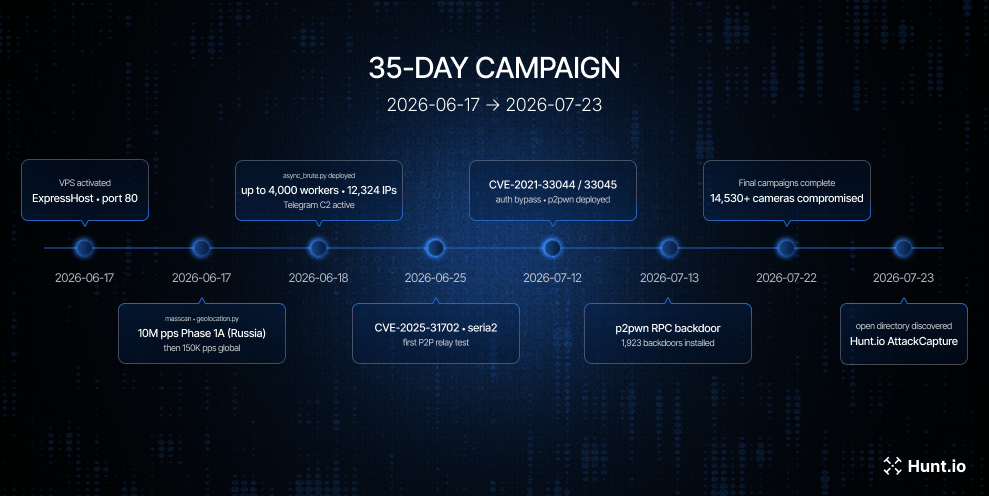
The find started with a mistake. On 23 July, Hunt.io’s AttackCapture system crawled a server at 154.86[.]119.60 and pulled down 2,616 files across 234 subdirectories, 407 MB in total, from an HTTP directory the operator had left wide open. That single slip handed researchers the operator’s scanning engine, exploit chains, exfiltration bot, and a Windows stealer staged on the same box.
“This is the second Dahua-related camera compromise operation we’ve traced back to an exposed operator directory in as many weeks. Where last week’s investigation centered on a Russian-speaking operator running a purpose-built platform against 58 cameras, this one is a different scale entirely.” reads the report published by Hunt.io.
The brute-force engine alone reached over 12,300 unique addresses. A separate authentication-bypass chain, built around two 2021 Dahua vulnerabilities, planted a persistent backdoor account on 1,923 cameras, an account stored independently of the admin password that survives both a password change and, on most firmware, a factory reset. A third path skipped IP addresses entirely and reached 283 cameras purely by serial number, through Dahua’s own cloud relay.
That third path is the part worth sitting with. Most of those cameras were exposed online without authentication.
Dahua’s cloud relay lets any app reach a camera sitting behind NAT using nothing but its serial number, and authentication to that relay runs on credentials baked identically into every Dahua client ever shipped. The operator’s own code logs the result of probing this channel at scale: 89.4 percent of live serials returned an open, no-authentication channel. Nine out of ten cameras, reachable by anyone who could guess or harvest a serial number.
“The device never authenticates the connecting party. It authenticates the session, via a token the cloud issued before the device was contacted. Obtaining that token requires only the fixed SDK credentials shared by every legitimate Dahua application.” continues the report. “The only real barrier to reaching any camera through this path is knowing its serial number, precisely what the operator’s harvesting pipeline exists to produce at scale.”
Getting from the tunnel session to full admin access still requires valid credentials or an authentication bypass. However, the attacker’s own logs suggest that most exposed cameras did not need this final step.
There are also two important details about the reported CVEs. The tool links its persistent backdoor technique to CVE-2024-39943, but that CVE actually refers to a different command-injection flaw in Rejetto’s HTTP File Server. The technique is valid, but the CVE reference is wrong. Likewise, the relay abuse is not CVE-2025-31702, which Dahua describes as a narrower authenticated privilege-escalation flaw. Incorrect CVE references can send defenders looking for the wrong fix.
Hunt.io also found something that had nothing to do with cameras: a UPX-packed Windows binary, tagged as SalatStealer, staged on the same server alongside a PowerShell script that disables Windows Defender five different ways, including a Group Policy key built to survive reboots and Defender updates. The researchers treat it as a separate, unrelated capability riding along on shared infrastructure, not part of the camera campaign proper.
What stands out across the whole toolkit is that none of it was built from scratch. The brute-force engine, the bypass chain, the relay tooling, the recovery-code generator: each traces to a different public repository, credited (sometimes accurately) to at least six other developers. The operator assembled, patched, and rewrote, layering Russian comments over Spanish code in one component recovered in three separate stages of the same rewrite.
“The same toolkit also recovers stored device passwords outright, through a routine that derives its decryption key entirely from values the attacker already holds, device class prefix and serial number, so no device secret is needed. A residual Spanish comment in that code confirms it came from the same upstream source as the original brute-forcer.” states the report.a
The offline recovery-code generator is arguably the most consequential piece precisely because it doesn’t need a compromised device at all. Given a live serial number, it derives a code entirely offline that unlocks Dahua’s cloud-level account-recovery flow, no current credentials required. Removing a backdoor account doesn’t touch this. Only Dahua changing how the code is derived would.
For anyone running Dahua gear, or the OEM-rebranded lines built on the same backend (Amcrest, Lorex, Annke, Swann, among others), the practical checklist is short: check for a p2pwn account and remove it, disable P2P on any device where it isn’t actually needed, confirm firmware is patched against the 2021 bypass pair, and rotate every credential that camera ever held, since the exfiltration bot grabbed those too. None of that fixes the recovery-code problem. That one sits with the vendor.
Follow me on Twitter: @securityaffairs and Facebook and Mastodon
(SecurityAffairs – hacking, newsletter)
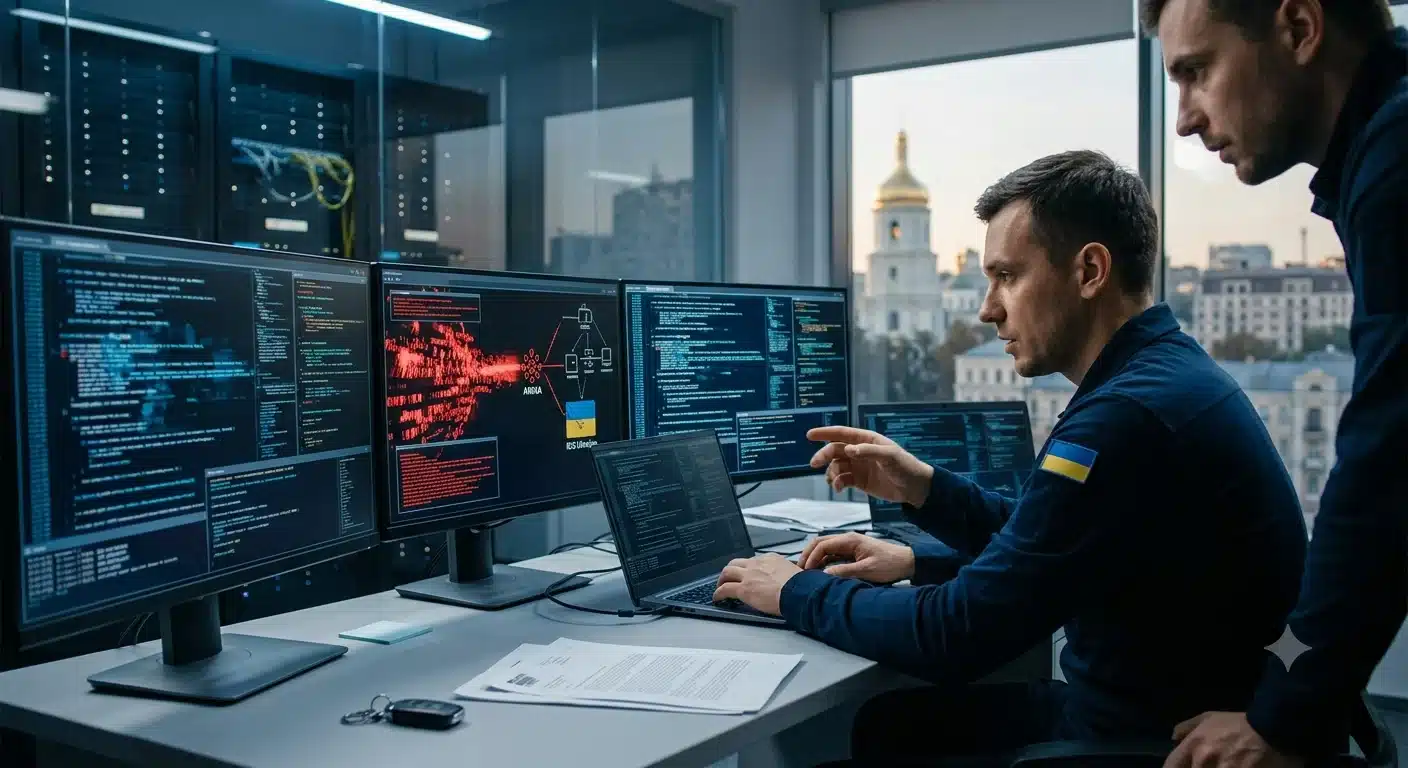

CERT-UA published a new advisory attributing a phishing campaign to UAC-0099, a Russia-aligned threat actor active since at least mid-2022 and previously known for exploiting WinRAR vulnerabilities and using phishing emails to deliver malware families including LONEPAGE, MATCHBOIL, and DRAGSTARE.

The latest campaign, observed earlier this summer, uses a trojanized Notepad++ plugin as the infection mechanism. It’s a meaningful change in delivery method for a group that’s been refining its toolset steadily for three years.
The attack starts with a phishing email carrying an image attachment. Clicking it opens a URL hidden behind a link shortener, which redirects to a file-sharing service such as EasySend[.]co where a ZIP archive waits. Inside the ZIP is a VBScript file disguised as a PDF document.
Running the VBScript triggers two things simultaneously. A legitimate decoy PDF downloads and opens in front of the victim to hold their attention, while in the background the script fetches a second archive called Evernote.zip. That archive contains a full working copy of Notepad++ version 8.8.3, a malicious DLL plugin named NppExport.dll, a password-protected RAR archive called updater.rar, and a legitimate WinRAR executable.
“The mentioned archive contains a VBS script with a double extension, the name of which may intentionally contain a significant number of spaces before the final .vbs extension , for example “Zavodskyi rayon.pdf .vbs”. In turn, when launched, the script will download a decoy file (for example “Zavodskyi rayon.pdf”) and the “Evernote.zip” archive.” reads the advisory. “The archive contains a full set of Notepad++ program components version 8.8.3, as well as the “/plugins/NppExport/” directory, which contains a third-party plugin library “NppExport.dll”, a password-protected archive “updater.rar” and the WinRAR executable file “winrar.exe”.”
The VBScript extracts everything and launches Notepad++, which loads NppExport.dll as it starts up. The victim sees a text editor open normally and has no reason to suspect anything happened.
The malicious DLL, codenamed LUNCHPOKE by CERT-UA, uses the bundled WinRAR binary to unpack the password-protected archive. That archive contains two files: RemoteLibUpdater.exe and InitTest.dll. LUNCHPOKE copies them to a specific directory and creates a scheduled task that runs RemoteLibUpdater.exe every three minutes. The three-minute interval is aggressive and keeps the implant active even after unexpected process termination.
“The file “NppExport.dll” is classified as a LUNCHPOKE utility , the main purpose of which is to create the directory ” %PUBLIC%\Libraries\fFthY3-Ytrevc3w-ab3\ “, extract the contents of the archive “updater.rar” to it using a password (in particular, the files “RemoteLibUpdater.exe” and “InitTest.dll”), copy the standard utility “schtasks.exe” to the file ” %PUBLIC%\Wallpapers\Background.exe ” and create a scheduled task with the name ” \W1n3r-U09oTy-Ap5\Updates ” to run the file ” %PUBLIC%\Libraries\fFthY3-Ytrevc3w-ab3\RemoteLibUpdater.exe ” with the arguments “setup nodisplay” every three minutes (the name of the directory ” fFthY3-Ytrevc3w-ab3 ” changes).” states CERT-UA.
RemoteLibUpdater.exe is BURNYBEAR, a loader whose job is to execute InitTest.dll. That DLL is a modified version of MATCHBOIL, a C#-based loader capable of fetching and running additional payloads, now designated MATCHBOIL.V2. The update indicates active development on the toolchain rather than a static deployment.
BURNYBEAR includes an unusual built-in sabotage behavior.
“The executable file “RemoteLibUpdater.exe” is classified as a BURNYBEAR utility , the functionality of which is designed to load the DLL file “InitTest.dll”. However, if “RemoteLibUpdater.exe” is launched incorrectly, namely without specifying arguments, BURNYBEAR instead activates logic designed to exhaust computer resources (RAM and CPU).” states the report.
That behavior serves a dual purpose: it makes behavioral analysis harder by producing unexpected output if someone runs the binary without the correct arguments, and it provides a rough sandbox detection mechanism since automated analysis environments often execute binaries without arguments.
This campaign arrives alongside a separate U.S. government advisory documenting Laundry Bear, another Russia-linked actor, running a phishing campaign against Zimbra mail servers belonging to Western government and commercial organizations since at least July 2025. That campaign uses a “half-click” exploit abusing CVE-2025-66376 to deliver malicious JavaScript called ZimReaper, which can harvest email communications without requiring the victim to click anything beyond opening a malicious email in a vulnerable webmail client. The U.S. government’s assessment of Laundry Bear’s intent is unambiguous:
CERT-UA recommends updating WinRAR, 7-Zip, and Notepad++ to their latest versions to close known vulnerabilities that groups like UAC-0099 use to facilitate follow-on stages once they’ve established a foothold.
The campaign’s use of a bundled legitimate WinRAR executable rather than relying on one already installed is notable: it means the attack chain doesn’t depend on the victim having a vulnerable version present, which makes the update recommendation more relevant as a general hygiene measure than as a specific remediation for this particular campaign. Organizations receiving unexpected emails with image attachments that open URLs through link shorteners should treat those as high-risk regardless of what the displayed content looks like.
Follow me on Twitter: @securityaffairs and Facebook and Mastodon
(SecurityAffairs – hacking, Notepad++)
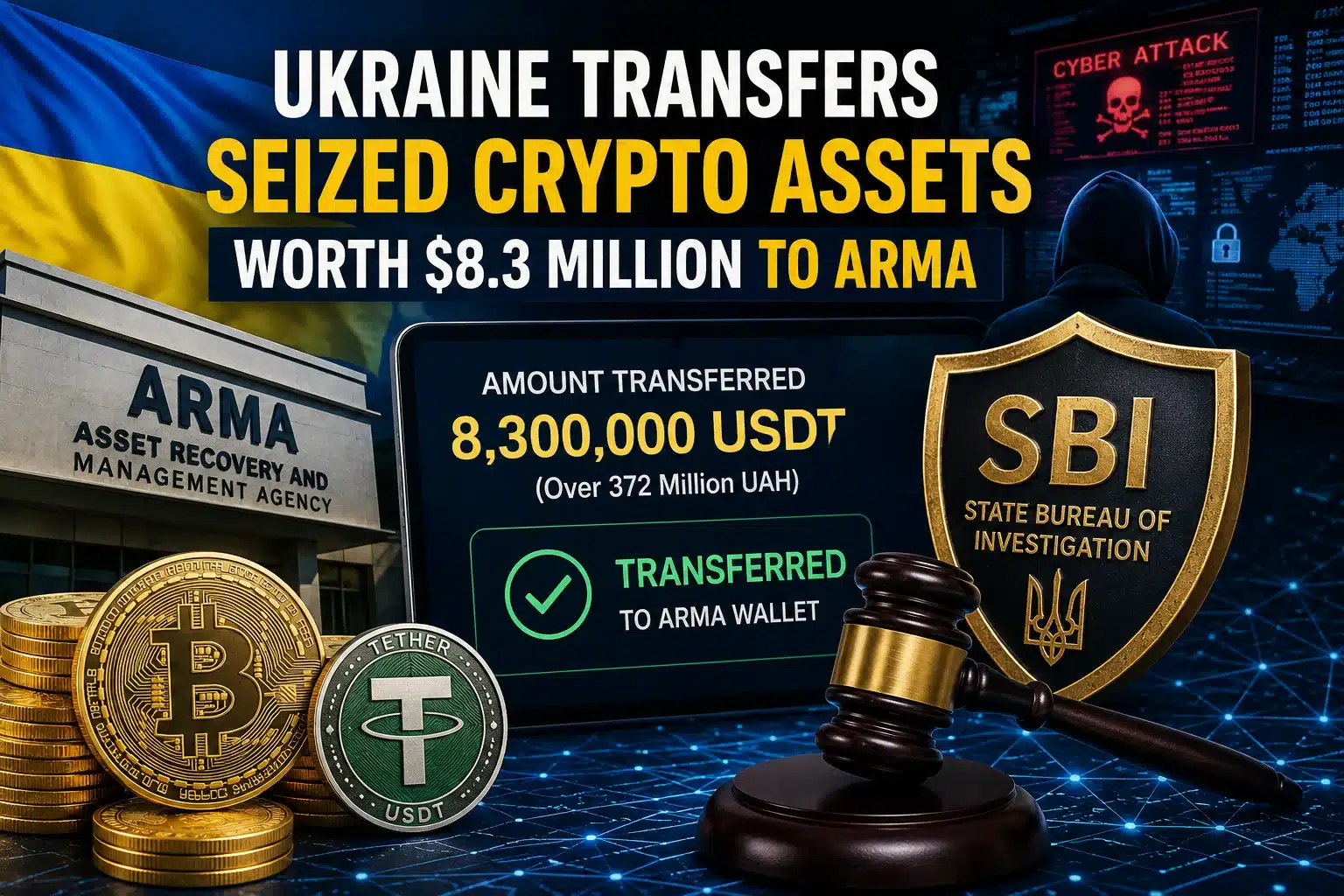
Ukraine has transferred Seized Crypto Assets worth more than 8.3 million USDT to the country's Asset Recovery and Management Agency (ARMA), marking the first time virtual assets have been placed under the agency's management following a court decision. The transfer follows an investigation led by the State Bureau of Investigation into an international hacking group accused of carrying out cyberattacks, extortion, and money laundering across Europe and the United States.
According to Ukrainian authorities, the transferred cryptocurrency is valued at more than 372 million hryvnias and represents a milestone in the country's efforts to manage digital assets linked to criminal investigations.
The State Bureau of Investigation said the transfer was completed as part of an ongoing criminal investigation conducted in cooperation with the DVB of the National Police and U.S. law enforcement agencies.
Investigators determined that the virtual assets were stored in crypto wallets controlled by a member of the organized hacking group. Following a court order, more than 8.3 million USDT was transferred to ARMA's official crypto wallet.
Authorities said this is the first practical case in Ukraine where seized digital assets have been transferred to ARMA for management, demonstrating the country's ability to handle new categories of assets within the legal system.
According to investigators, members of the international hacking group carried out large-scale cyberattacks against individuals and companies in Europe and the United States.
The investigation alleges the group stole confidential information, demanded ransom payments, and laundered criminal proceeds in Ukraine through the purchase of residential properties, vehicles, and other high-value assets.
Authorities estimate that the criminal group's activities caused losses exceeding $100 million.
As part of the pre-trial investigation, four members of the group, including its alleged organizer, were detained and placed in custody.
The investigation resulted in the cryptocurrency seizure and the confiscation of additional assets with a combined value exceeding $11.1 million.
According to the State Bureau of Investigation, the seized property includes residential buildings, apartments, vehicles, approximately $1 million in cash, and digital assets equivalent to more than $8.3 million.
The Office of the Prosecutor General is providing procedural oversight for the criminal proceedings.
The State Bureau of Investigation said that after converting the cryptocurrency into fiat currency, authorities plan to purchase military bonds.
According to the agency, the initiative is intended to support Ukraine's economy during martial law while ensuring that assets obtained through criminal activity are redirected for state purposes.
Officials described countering transnational cybercrime and ensuring effective mechanisms for the seizure and management of criminal assets as key priorities.
ARMA said receiving the cryptocurrency marks an important step in the evolution of Ukraine's asset management system.
The agency stated that the successful transfer reflects coordinated efforts between the State Bureau of Investigation and the Office of the Prosecutor General, enabling the execution of the court's decision and preserving the value of the seized assets.
ARMA added that it is continuing to develop mechanisms for managing all categories of seized property, including real estate, corporate rights, and virtual assets, to ensure their preservation in the interests of the state and society.
The agency said the case demonstrates that as cybercriminals increasingly use digital technologies to conceal illicit proceeds, authorities must also strengthen their ability to manage and preserve cryptocurrency and other digital assets seized during criminal investigations.
The Security Service of Ukraine (SSU), working jointly with the FBI, has formally exposed a sustained Russian intelligence campaign targeting the messaging accounts of government officials, military personnel, politicians, and activists across Ukraine, Europe, and the United States.
The operation is ongoing. The goal isn’t disruption; it’s intelligence collection.
“Cyber experts of the Security Service of Ukraine together with the Federal Bureau of Investigation exposed Russian special services in systematic cyberattacks on messengers of officials, military personnel, politicians and activists from Ukraine, Europe and the USA.” read the alert by SSU.
“The purpose of these ‘hacks’ is to gain access to sensitive information of a military, political and economic nature that was exchanged between users, as well as to steal their personal data.”
The attack method is low-tech by design. Operators send SMS messages impersonating platform support bots, asking targets to hand over account credentials, confirmation codes, PINs, or account recovery keys. The SBU notes that these messages tend to arrive in the morning hours, when targets are physically and emotionally less guarded. Timing is a social engineering choice, not an accident.
The scope is broader than most people assume.
“The SBU emphasizes that Russian special services and hackers associated with them attack not only organizations, officials or public figures, but also personal accounts of Ukrainians.” continues the alert.
This isn’t a targeted elite program. It’s a mass collection operation with a tiered approach: high-value targets get more sophisticated techniques, ordinary citizens get the SMS impersonation play. The SBU didn’t attribute the campaign to a specific group by name, but prior reporting from Google, the FBI, and CISA ties similar activity to clusters tracked as UNC5792 and UNC4221, both linked to FSB operations, as well as Star Blizzard.
The FBI’s June 26 advisory added a new technique to what the March warning described. Russian operators have evolved from chasing one-time verification codes to specifically targeting Signal Backup Recovery Keys, which unlock an account’s entire message history and remain valid even if the user creates a new account with the same phone number afterward. This is a meaningful escalation: a stolen verification code expires, a stolen Recovery Key doesn’t.
QR codes are another active vector the SBU specifically calls out. Scanning a QR code received from an unknown bot or user can silently link the attacker’s device to the victim’s account, a technique Google’s Threat Intelligence Group documented against Signal’s linked-devices feature in early 2025.
“Russian hackers use a variety of tools and methods for such cyberattacks. For example, to extract passwords to an account, the enemy most often uses SMS messages on behalf of ‘support teams.'” states SSU.
The variety matters: blocking one delivery mechanism doesn’t stop the campaign, because the operators rotate techniques and targeting lists continuously.
The SBU’s practical guidance covers the basics that still fail most users in practice. Check active sessions in your messenger regularly and end anything you don’t recognize. Enable two-factor authentication with a complex alphanumeric PIN, not a four-digit code. Never provide confirmation codes, PINs, passwords, or recovery keys to anyone, regardless of how legitimate the request appears. Don’t scan QR codes from unknown sources. Don’t follow suspicious links even from accounts you know, because that account may already be compromised. Anyone who receives a suspicious message in a messenger can report it to the SBU’s Cybersecurity Situation Center at incident@dis.gov.ua.
Last week, the FBI and CISA updated their March 2026 warning about Russian intelligence phishing campaigns, and the new advisory adds a detail that wasn’t in the original: the operators have shifted their primary objective from stealing verification codes to stealing Signal Backup Recovery Keys.
Follow me on Twitter: @securityaffairs and Facebook and Mastodon
(SecurityAffairs – hacking, Ukraine)

Image Source: Cyber Police Department, National Police of Ukraine[/caption]

Ukrainian cyber defenders reported a newly intensified cyber campaign that is targeting Ukraine’s healthcare system and local government agencies, with attackers deploying increasingly sophisticated malware and social engineering tactics.
In a fresh advisory, the CERT-UA said the activity—linked to a threat cluster tracked as UAC-0247—spiked between March and April 2026, with clinical hospitals, emergency services, and municipal bodies bearing the brunt of the attacks.
The campaign begins with phishing emails disguised as offers of humanitarian assistance—a tactic designed to exploit trust during wartime conditions. Victims are urged to click on links that appear legitimate, sometimes backed by convincingly crafted fake websites or compromised third-party resources.
Behind the scenes, however, the links trigger a multi-stage infection chain that ultimately gives attackers remote control over the victim’s system.
Once clicked, victims download an archive containing a malicious shortcut file. This file activates a built-in Windows tool to execute remote code, initiating a sequence that includes decoy documents to avoid suspicion.
The attack escalates quickly. Malicious executables are deployed via scheduled tasks, injecting code into legitimate system processes such as RuntimeBroker.exe to evade detection.
Recent campaigns show an evolution in sophistication, with attackers introducing multi-stage loaders and custom executable formats. Payloads are often encrypted and compressed, making analysis and detection more difficult.
At later stages, attackers deploy reverse shell tools—including variants resembling “RAVENSHELL”—to establish encrypted communication with command-and-control servers and execute remote commands.
To maintain long-term access, attackers install a custom backdoor known as AGINGFLY, a C#-based malware designed for full remote system control. The tool enables:
Unlike conventional malware, AGINGFLY dynamically retrieves and compiles its command logic from remote servers, making it more adaptable and harder to detect.
Complementing this is a PowerShell-based tool dubbed SILENTLOOP, which helps maintain persistence and retrieves command server addresses—sometimes even pulling them from Telegram channels.
Once inside a network, attackers move quickly to expand access. CERT-UA observed tools like CHROMELEVATOR being used to extract browser credentials, while ZAPIXDESK targets WhatsApp data.
The attackers also conduct internal reconnaissance using both custom scripts and publicly available tools such as RUSTSCAN. For stealthy movement across networks, tunneling tools like LIGOLO-NG and CHISEL are deployed.
In at least one case, attackers went further—embedding the XMRIG cryptocurrency miner inside a modified version of the legitimate WireGuard application, highlighting a secondary motive of financial gain.
The campaign isn’t limited to civilian infrastructure. CERT-UA noted an incident in March where individuals connected to Ukraine’s defense sector were targeted via the Signal platform.
Attackers distributed a trojanized version of software used by FPV drone operators, packaged as a seemingly legitimate update. In reality, the download triggered a DLL side-loading attack that installed the AGINGFLY backdoor.
CERT-UA recommends reducing exposure by restricting the execution of high-risk file types such as LNK, HTA, and JavaScript files. The agency also urges organizations to limit the use of native Windows tools like mshta.exe and PowerShell where possible, as these are frequently abused in attacks.

Russian state has tolerated parallel probiv market for its convenience but now Ukrainian spies are exploiting it
Russia is scrambling to rein in the country’s sprawling illicit market for leaked personal data, a shadowy ecosystem long exploited by investigative journalists, police and criminal groups.
For more than a decade, Russia’s so-called probiv market – a term derived from the verb “to pierce” or “to punch into a search bar” – has operated as a parallel information economy built on a network of corrupt officials, traffic police, bank employees and low-level security staff willing to sell access to restricted government or corporate databases.
Continue reading...
© Photograph: Alexander Zemlianichenko/AP
© Photograph: Alexander Zemlianichenko/AP
© Photograph: Alexander Zemlianichenko/AP
