❌

Visualização normal

Ontem — 8 de Novembro de 2026Cybersecurity News
  • ✇Security Affairs
  • Inside ARTEX: AI Hacking Tools, Exposed Servers and South Korean Bank Breaches Pierluigi Paganini
    Hunt.io traced ARTEX servers and AI-powered hacking tools used in breaches affecting seven South Korean financial institutions. Between late September and early October 2026, seven South Korean financial institutions had data breached through internet-facing systems. About 66,000 to 67,000 people and around 2,200 corporations were affected, and personal, employment, income and loan data was exposed. Hunt.io dug into the infrastructure behind the campaign, and its findings add a lot to what C
     

Inside ARTEX: AI Hacking Tools, Exposed Servers and South Korean Bank Breaches

7 de Novembro de 2026, 16:56

Hunt.io traced ARTEX servers and AI-powered hacking tools used in breaches affecting seven South Korean financial institutions.

Between late September and early October 2026, seven South Korean financial institutions had data breached through internet-facing systems. About 66,000 to 67,000 people and around 2,200 corporations were affected, and personal, employment, income and loan data was exposed. Hunt.io dug into the infrastructure behind the campaign, and its findings add a lot to what CrowdStrike and Genians already published.

CrowdStrike reported on October 7 and Genians Security Center on October 12, and both pointed to ARTEX, an open-source autonomous penetration testing framework developed in China and licensed under AGPL-3.0. CrowdStrike assessed with moderate confidence that a single Chinese-speaking individual motivated by money ran it, and not an established threat group. DeepSeek v4.1 Flash was the main model, with GLM 5.3 and Grok 4.6 as backups, reached partly through a reseller domain, xcai[.]pro.

The public indicators were a server at 38.244.50[.]120, which hosted the ARTEX console, plus a Hong Kong address and nine proxies. Genians said the ARTEX GitHub repository and Docker image were removed on October 11, though forks and mirrors remain.

“CrowdStrike assessed with moderate confidence that the operator was a single Chinese-speaking individual motivated by financial gain rather than an established threat group.” reads the report published by Hunt.io. “The infrastructure reportedly accessed these services in part through the reseller domain xcai[.]pro. Both reports described a two-server configuration, consisting of a Hong Kong-based IP address used as primary infrastructure and 38.244.50[.]120, which hosted the ARTEX console.”

Hunt.io notified the relevant national CERT before publishing, and says the report holds no personal records or credentials.

The company’s own scanning showed 38.244.50[.]120 sits on Cogent’s network in Los Angeles, with 15 open ports. The ARTEX login page, with a Chinese title meaning “autonomous penetration testing console”, appears on ports 443 and 8090. Other services include a Gemini2API admin console and a Tinyproxy server.

Searching its AttackCapture platform for that address, Hunt.io found another open directory at 23.248.226[.]250, a jump server in Hong Kong on AS138415. It held 42 files in 2 subdirectories, 105 MB in all, and the platform had logged warnings on September 5, September 26 and October 5. A file in it names 38.244.50[.]120 as the jump host, and its own comment tells the operator never to paste the credentials into a session. It sat in an open directory.

Three scripts back up the link. They keep reverse SSH tunnels alive, run a local relay, and copy files to the jump host, one tunnel is named grok2api, and the credentials file also holds keys for Zhipu AI’s GLM models, an OpenAI-compatible relay and a proxy service. That explains how several language models ran in one campaign.

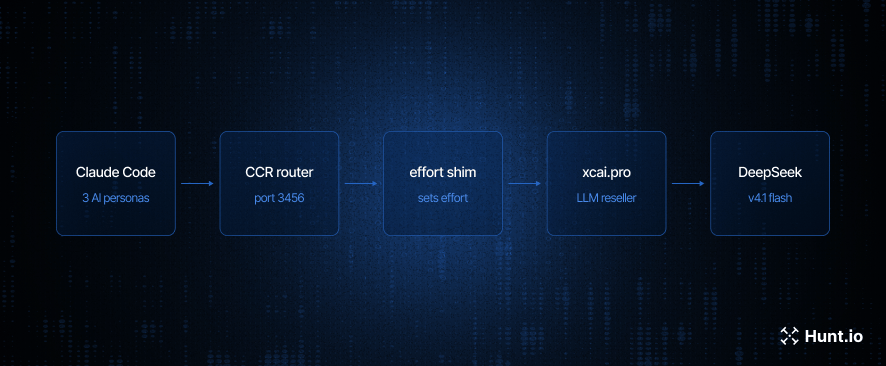
The AI setup is the most striking part. A state file shows the harness is Claude Code itself, version 2.1.221, started 510 times since August 4, but it isn’t talking to Anthropic. A small proxy, ds-models-shim.py, fixes a compatibility problem by faking a model list and sending requests to DeepSeek, and another, xcai-effort-shim.py, adds a reasoning setting because the DeepSeek backend otherwise skips its reasoning step. The route runs from Claude Code through Claude Code Router, an open-source project, to xcai and then to DeepSeek.

“A small local proxy, ds-models-shim.py, addresses a compatibility issue: the official /v1/models endpoint returns a 404 response when queried against a non-Anthropic backend, preventing Claude Code from discovering the available models. The shim intercepts that specific request and returns a locally defined model list containing deepseek-v4-pro and deepseek-flash. All other requests are forwarded to api.deepseek.com/anthropic.” states the report.
The same file counts 19 custom skills, reusable instruction sets for the agent, with 147 recorded uses. They cover code audit, reconnaissance, web injection, WAF bypass testing, authentication testing, Telegram Mini Apps, APK download and decompiling, cloud phone control and payment logic testing. Next to the payment skill sat three self-registered test accounts with tokens for a cash-in deposit API, dated September 12, and a comment calls them an authorized, self-built test. The setup fits testing for insecure direct object reference flaws, a technique CrowdStrike and Genians described against Korean loan and inquiry services.

The directory also held supporting tools. A script queried FOFA, a Chinese asset search engine like Shodan, through a third-party API, and a comment says the primary membership had expired and a backup key was in use. Proxy scripts enumerated a rotating proxy service at 154.201.79[.]246:443, where 79 unique exit IPs showed up among the first 100 identities tested.

A separate directory at 23.248.226[.]250:8001 held a small staged setup for JNDI and LDAP exploitation, retrieved on October 5 at 03:42 UTC. It confirms command execution through a DNS callback, and one script lets web and LDAP traffic share a single port. Hunt.io’s analysis describes the tooling without publishing steps to reproduce it.

Other recovered files include tools aimed at a cryptocurrency exchange’s admin session and withdrawals, Linux privilege escalation exploits, iOS probe source code and Android kernel and firmware utilities. Hunt.io says their connection to the Korean breaches isn’t confirmed.

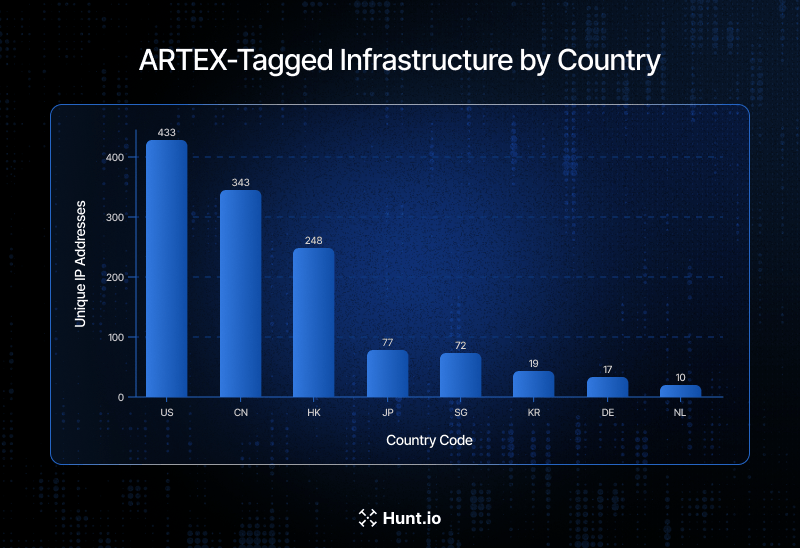
Hunt.io then showed how to hunt ARTEX servers. Searching for an ARTEX certificate issuer returned 19 IP addresses, and searching its malware classification returned 1,303 addresses across 30 countries, led by the United States, China and Hong Kong. Those figures show where addresses are registered, not where the operator sits.

“The result returned 19 distinct IP addresses, including 38.244.50[.]120. This method is precise but limited to hosts that expose a matching certificate. Systems using a different certificate will not appear in these results.” continues the report.

Matching the console’s page title returned about 1,300 IPs, and a looser search found 21 title strings, 19 of them likely ARTEX consoles, in English, Chinese, Korean, Japanese, Russian, Portuguese and Vietnamese.
A malware-name search in AttackCapture gave 280 results with open directories. One at 130.94.31[.]86:18888 in Seoul held two small scripts, and another at 156.251.11[.]39 held an SMB reconnaissance toolkit whose test script writes a file named artex_probe_11876.txt.

More hosts held exploitation kits for DedeCMS and FangCMS, a CAPTCHA bypass suite, a RuoYi and Spring administrative console exploit and CAPTCHA-based login automation. Together they show the framework attracting many operators.

For defenders, the advice is plain. Remove public access and put administration behind VPNs or allowlists, and reset SSH passwords and rotate API keys, proxy credentials and tokens that exposed files may have revealed. Patch internet-facing services, watch for unexpected LDAP and JNDI activity, DNS callbacks and remote script downloads, and store secrets in a managed vault with least-privilege permissions. Also restrict access to model gateways, watch their requests, and enforce compliance rules on managed phones. Hunt.io’s lesson is that an investigation shouldn’t stop at the first list of indicators, because

The company also published indicators of compromise in its analysis.

“The findings highlight risks associated with exposed administrative services, reusable credentials, remote access tunnels, proxy infrastructure, and exploitation tooling.” concludes the report.

Follow me on Twitter: @securityaffairs and Facebook and Mastodon

Pierluigi Paganini

(SecurityAffairs – hacking, ARTEX)

Antes de ontemCybersecurity News
  • ✇Cybersecurity News
  • Windows 11 27H2 Update Brings Intel APX Boost Do Son
    Microsoft is developing the Windows 11 27H2 update, focusing on core system stability, new wallpapers, and 64-bit speed via Intel APX register expansion. Related Posts: Windows 11 Cloud Rebuild Delivers Fresh System Recovery Windows 11 Android Apps Return via Taskbar Search Windows 11 Speed Test Tool Arrives as Native Utility The post Windows 11 27H2 Update Brings Intel APX Boost appeared first on Daily CyberSecurity.
     

Windows 11 27H2 Update Brings Intel APX Boost

Por:Do Son
6 de Novembro de 2026, 09:16

Microsoft is developing the Windows 11 27H2 update, focusing on core system stability, new wallpapers, and 64-bit speed via Intel APX register expansion.

Related Posts:

The post Windows 11 27H2 Update Brings Intel APX Boost appeared first on Daily CyberSecurity.

  • ✇Cybersecurity News
  • OpenSSH Authentication Bypass on Alpine Linux Lets Attackers Log In Without a Password Do Son
    Update Alpine Linux OpenSSH servers to OpenSSH 10.6p2 now to fix a critical password authentication bypass affecting passwordless accounts. Related Posts: JetBrains Patches 61 Flaws Across Hub, Datalore, YouTrack, and IntelliJ IDEA ChatGPT Lockdown Mode Bypass Exposes Chat Data Windows Paint RCE CVE-2026-83844 Affects Hundreds of Millions The post OpenSSH Authentication Bypass on Alpine Linux Lets Attackers Log In Without a Password appeared first on Daily CyberSecurity.
     

OpenSSH flaw lets attackers log into password-disabled Linux accounts

5 de Novembro de 2026, 14:45
A newly disclosed OpenSSH vulnerability dubbed "*sshole" allows attackers to log in to certain Alpine Linux and other musl-based Linux accounts that are configured to block password authentication, simply by entering an oversized password. [...]
  • ✇Cybersecurity News
  • Postman AI Plugin Hijacking Sparks Developer Outcry Do Son
    Postman AI plugin hijacking sparks controversy after the desktop app silently modifies Codex and Claude Code configs to favor its own tools. Related Posts: Apple AI Budget Cuts Target Internal Model Usage OpenAI Unveils ChatGPT Images 2.6 with Animated GIF Support ChatGPT Search Volume Reaches 20 Percent of Google The post Postman AI Plugin Hijacking Sparks Developer Outcry appeared first on Daily CyberSecurity.
     
  • ✇Cybersecurity News
  • OpenAI Cyber Model Uncovers 1,724 Linux Kernel Vulnerabilities and Builds 948 Root Exploits Do Son
    An upcoming OpenAI cyber model found 1,724 Linux kernel vulnerabilities and built 948 local root exploits to help maintainers patch critical bugs. Related Posts: Linux 7.4 Merge Window Sets Record with AI Patches OpenBSD 8.0 Release Introduces Kernel Hardening and Day-One Errata GNOME OS Preview Brings GNOME 51.1 to the Public The post OpenAI Cyber Model Uncovers 1,724 Linux Kernel Vulnerabilities and Builds 948 Root Exploits appeared first on Daily CyberSecurity.
     
  • ✇Cybersecurity News
  • Citrix Security Vulnerabilities: Patch 9.8 CVSS Flaws Do Son
    Install the Citrix security vulnerabilities update to patch critical Citrix security vulnerabilities affecting XenServer hypervisors and Scout gateways. Related Posts: Cisco Patches High-Severity Remote Code Execution in UCS Central Alongside ISE and Unified CM Flaws Attackers Exploit Critical GPUStack Authentication Bypass in the Wild to Run Reverse Shells Control Web Panel Patches Ten Flaws Allowing Unauthenticated Root Code Execution The post Citrix Security Vulnerabilities: Patch 9.8 CVSS
     
  • ✇Cybersecurity News
  • PoC Exploit and Technical Details Published for Puppet Server RCE Flaw CVE-2026-115731 (CVSS 9.4) Do Son
    Puppet Server RCE CVE-2026-115731 (CVSS 9.4) now has a public proof-of-concept exploit. Update OpenVox and Puppet Enterprise to patched versions. Related Posts: Rails 8.0.5.2 and 8.1.4.1 Fix 21 Security Flaws, Including Critical Active Storage File Write Bug SnappyMail Remote Code Execution Chain Disclosed With Public PoC Exploit Code Airbyte Vulnerability Exploited in the Wild Lets Attackers Run Code in Connector Builder The post PoC Exploit and Technical Details Published for Puppet Server
     
  • ✇Cybersecurity News
  • Linux 7.4 Merge Window Sets Record with AI Patches Do Son
    The Linux 7.4 merge window reached a record 19,671 commits as Linus Torvalds highlighted early AI patches and major hardware support. Related Posts: OpenBSD 8.0 Release Introduces Kernel Hardening and Day-One Errata GNOME OS Preview Brings GNOME 51.1 to the Public Linux Assisted-by Tag Dropped for AI Patches The post Linux 7.4 Merge Window Sets Record with AI Patches appeared first on Daily CyberSecurity.
     
  • ✇Cyber Security News
  • Attackers Started Scanning in the Wild for Linux Kernel RCE Flaw, Ubuntu Releases Fixes Guru Baran
    Ubuntu has put early kernel fixes for CVE-2026-98432 in its -proposed pocket for 22.04 LTS and newer releases. The bug is a serious Linux kernel flaw that can let a remote user run commands as root without a login or any user action. The patches are still in testing, so many servers stay open for now. Canonical’s security team says the flaw sits in how the Linux kernel sets up IPv4 TCP connections, and it affects kernel versions 4.4 and later. The fixed builds are 5.15.0-203.213 for Jammy (22
     

Attackers Started Scanning in the Wild for Linux Kernel RCE Flaw, Ubuntu Releases Fixes

3 de Novembro de 2026, 05:58

Ubuntu has put early kernel fixes for CVE-2026-98432 in its -proposed pocket for 22.04 LTS and newer releases. The bug is a serious Linux kernel flaw that can let a remote user run commands as root without a login or any user action. The patches are still in testing, so many servers stay open for now.

Canonical’s security team says the flaw sits in how the Linux kernel sets up IPv4 TCP connections, and it affects kernel versions 4.4 and later. The fixed builds are 5.15.0-203.213 for Jammy (22.04), 6.8.0-149.149 for Noble (24.04), and 7.0.0-43.43 for Resolute (26.04). Stonking (26.10) is already fixed in 7.3.0-10.10, and Trusty (14.04) is not affected. Fixes for Xenial, Bionic and Focal are still pending.

ReleasePackagePatch statusFixed kernel version
Trusty (14.04)linuxNot affectedNot applicable
Xenial (16.04)linuxFix pendingNot yet released
Bionic (18.04)linuxFix pendingNot yet released
Focal (20.04)linuxFix pendingNot yet released
Jammy (22.04 LTS)linuxFix available in -proposed5.15.0-203.213
Noble (24.04 LTS)linuxFix available in -proposed6.8.0-149.149
Resolute (26.04 LTS)linuxFix available in -proposed7.0.0-43.43
Stonking (26.10)linuxFixed7.3.0-10.10

Canonical runs tests on more than 2,000 certified servers and devices before it moves a kernel to the updates pocket. Teams that run their own acceptance tests can install the early builds today, as described in Canonical’s new SRU strategy for faster CVE fixes.

Ubuntu’s CVE-2026-98432 tracker rates the bug 9.8, which is Critical. Its own blog post calls the same score “High,” so readers may see both labels. The record was published on October 15, 2026.

The bug is a use-after-free. In plain terms, the kernel keeps using a piece of memory after it has already let go of it. One CPU frees the IP options of a new connection. Another CPU, handling a repeated SYN packet, still reads them while building a reply. The upstream fix delays that free with kfree_rcu(), so readers finish first.

Anthropic’s Frontier Red Team shared its research on October 27, 2026. It says an unreleased Claude model wrote a working exploit after one first prompt. The exploit targets Linux servers with a multipath TCP (MPTCP) listener.

It works in two stages. First, it makes the kernel send back extra bytes that may hold a kernel pointer, which defeats KASLR, a defense that hides where kernel code sits. Second, it overwrites a callback pointer so the kernel runs a payload and ends in a shell command as root.

A lost race only fails the handshake and does not crash the machine, so the attacker can retry. In the test, the leak took 48 minutes, and the shell took five more.

Cyber Security News covered this in Claude AI Exploits Linux Kernel Flaw to Execute Root Commands Without User Interaction. Our earlier report on Claude building Chrome and Linux exploit chains shows how this fits a wider pattern. Anthropic’s exploit has not been released. It also says this was a lab test and not a real-world incident.

Signs of Scanning in the Wild

Researcher Marcus Hutchins says his team has seen what looks like threat actors scanning the whole internet for affected systems. In a post on X, he reports that residential proxies and Russia-based VPN servers began probing port 443 with MPTCP connections as of November 2.

Normal scanners do not use MPTCP by default, so he strongly suspects this activity targets CVE-2026-98432. His scan on October 30 found about 2,102,043 servers reachable over MPTCP on port 443.

A deeper TLS scan found about 762,774. He says a valid HTTP request is not needed, so the true exposure is likely closer to 2.1 million. These counts show exposure only and do not prove the kernels are unpatched.

There is no public remote code execution exploit yet. Several denial-of-service proofs-of-concept do exist, and they give attackers a starting point.

Update on the 9.8 CVSS TCP/IP RCE in the Linux kernel (CVE-2026-98432): we've detected what appears to be a threat actor activity scanning the entire internet for exposed affected systems. Our own scanning also suggests that the number of potential targets is high, therefore…

— Marcus Hutchins (@MalwareTechBlog) November 3, 2026

Some people assumed MPTCP listeners were rare. Hutchins points out that Debian and several other kernels enable MPTCP by default. Go 1.24 and later also bind MPTCP sockets when the kernel allows it, so tools built on Go, such as Caddy, create the needed listener.

Ubuntu emphasizes that the flaw itself is not tied to MPTCP, and the MPTCP link comes only from the Anthropic exploit. Ubuntu’s security team says updates are the only proper fix. Hutchins adds that setting net.mptcp.enabled=0 does not close sockets that are already open, so those apps must restart. You can list MPTCP listeners with sudo ss -Mlnp.

For Admins

Run uname -r and compare the result with the fixed versions above. Ubuntu’s guide to enabling the -proposed pocket explains how to pull in the new kernel, and a reboot is needed afterward. Packages in -proposed are not chosen for upgrade by default, so you must name the pocket when you install.

For hosts that cannot update yet, Ubuntu’s tracker lists an nftables rule that drops incoming IPv4 TCP packets carrying IP options. It reduces risk but does not fully prevent exploitation, and it breaks any connection that relies on IP options.

Ubuntu 20.04 LTS and older need Ubuntu Pro. Focal and Bionic fall under Expanded Security Maintenance, while Xenial and Trusty need the Legacy add-on. Ubuntu Pro is free for up to five machines.

Give your SOC the alert context to stops incidents quickly. Integrate Threat Intel from 16K SOCs.

The post Attackers Started Scanning in the Wild for Linux Kernel RCE Flaw, Ubuntu Releases Fixes appeared first on Cyber Security News.

Ubuntu Releases Security Fixes for Critical Linux Kernel Vulnerability Allowing Remote Code Execution

Ubuntu has published fixes for CVE-2026-98432, a critical Linux kernel flaw in IPv4 TCP connection handling. It carries a CVSS 3.1 score of 9.8 and can lead to remote code execution. The fixes for Ubuntu 22.04 LTS and newer are in the -proposed pocket, so they are not yet in the default updates channel. Critical […]

The post Ubuntu Releases Security Fixes for Critical Linux Kernel Vulnerability Allowing Remote Code Execution appeared first on GBHackers Security | #1 Globally Trusted Cyber Security News Platform.

  • ✇Cybersecurity News
  • ChatGPT Codex Usage Limits Merged Across Plans Do Son
    OpenAI announced that ChatGPT Codex usage limits will merge under a shared token quota across Plus, Pro, and Business plans starting December 2026. Related Posts: ChatGPT Violence Restrictions Tighten with Teen Safeguards AI Training Preference Standard Added to Robots.txt Google Project Suncatcher Achieves Orbital AI Inference The post ChatGPT Codex Usage Limits Merged Across Plans appeared first on Daily CyberSecurity.
     
  • ✇Cybersecurity News
  • North Korean Threat Actors Accelerate Cyber Operations With Artificial Intelligence Do Son
    Microsoft reveals how North Korean threat actors use tools like ARTEX. See how AI-enabled North Korean threat actors speed up cyber operations. Related Posts: Binance Hack Investigation Traces Historic $6.3B Breach Polymarket Supply Chain Attack Drains Trader Wallets Binance Hot Wallet Breach Prompts Multibillion-Dollar Inquiry The post North Korean Threat Actors Accelerate Cyber Operations With Artificial Intelligence appeared first on Daily CyberSecurity.
     
  • ✇Cybersecurity News
  • Public PoC Exploit Disclosed for Linux Kernel Bonding Vulnerability Do Son
    Details and a Linux kernel vulnerability PoC exploit are public for CVE-2026-31419. Patch this high-severity flaw to prevent local privilege escalation. Related Posts: Critical MediaTek Vulnerabilities Patched in Chipsets Critical FreePBX Vulnerabilities Patched in User Manager Apache Wicket Fixes 19 Vulnerabilities in 8.20.0, 9.25.0 and 10.12.0 The post Public PoC Exploit Disclosed for Linux Kernel Bonding Vulnerability appeared first on Daily CyberSecurity.
     
  • ✇Cybersecurity News
  • Critical FreePBX Vulnerabilities Patched in User Manager Do Son
    Apply the latest update to fix critical FreePBX vulnerabilities, including a 9.3 CVSS authentication bypass and privilege escalation in User Manager. Related Posts: Critical MediaTek Vulnerabilities Patched in Chipsets Public PoC Exploit Disclosed for Linux Kernel Bonding Vulnerability Apache Wicket Fixes 19 Vulnerabilities in 8.20.0, 9.25.0 and 10.12.0 The post Critical FreePBX Vulnerabilities Patched in User Manager appeared first on Daily CyberSecurity.
     

Alpine Linux rebuilds GitLab after attempted RCE attack

1 de Novembro de 2026, 12:11
Hackers attempted to exploit a critical GitLab vulnerability in Alpine Linux's development infrastructure on October 20-21, prompting the open-source project to rebuild its GitLab server and reset all passwords over concerns of a possible compromise. [...]
  • ✇Firewall Daily – The Cyber Express
  • Three Cyberattack Campaigns Target Japan, Exposing AI’s Growing Role Ashish Khaitan
    A wave of data leaks from Japanese web systems in autumn 2026 has sharpened concern over AI's role in cyberattacks on Japan. The National Cybersecurity Office alerted businesses on October 9, and the chair of the ruling party's cybersecurity headquarters said cyberspace was in a "state of emergency."  Researchers reconstructed three attack infrastructures from files left in attackers' open directories. All three are separate from those in earlier reports on ARTEX, an autonomous AI penetration
     

Three Cyberattack Campaigns Target Japan, Exposing AI’s Growing Role

29 de Outubro de 2026, 06:10

Cyberattacks on Japan

A wave of data leaks from Japanese web systems in autumn 2026 has sharpened concern over AI's role in cyberattacks on Japan. The National Cybersecurity Office alerted businesses on October 9, and the chair of the ruling party's cybersecurity headquarters said cyberspace was in a "state of emergency."  Researchers reconstructed three attack infrastructures from files left in attackers' open directories. All three are separate from those in earlier reports on ARTEX, an autonomous AI penetration-testing system.   AI's role varied widely. Without victim-side logs, the findings cannot confirm each attempt's success, the full damage, or the attackers' identities. Victims are described only by count, industry, size, and country. 

Case A: Automated Cyberattacks on Japan 

In a short burst in October 2026, Case A abused CyberStrikeAI, an open-source agent-based penetration-testing tool with a Simplified Chinese console. Entries like "credential-search agent 8/44" show 44 agents dividing up reconnaissance, exploitation, command and control, persistence, exfiltration, and reporting. The platform produced Japanese forms and fake login pages.   It also throttled traffic to each target to avoid detection. At least 19 organizations received identical reports, including at least 16 in Japan and others in Taiwan and Hong Kong. Most were smaller businesses and local public bodies. Yet many entries read "no session, no web shell, no exfiltration." The deepest intrusion began at an unauthenticated administration interface on a legacy system. 

Case B: Human-Led, AI-Assisted 

Over about 24 days in August and September, a human operator used an LLM for planning and tooling. The operator scanned at least 6,000 Japanese IP addresses and also probed AI assets in South Korea. One LLM-written plan targeted AI and GPU services. To get it, the operator framed the request as an authorized assessment to bypass the model's guardrails. Other tools sought to hijack and pool access to other people's AI services, likely to get cheap inference capacity.  One company suffered full control through FTP, a database, administrator rights, a web shell, and SSH, and the attacker repeatedly restored backdoors after cleanup. At another, a GIS server left on default credentials exposed several hundred thousand cadastral and commercial records, Windows credentials, and email. Several hundred attempts on one cluster failed. 

Case C: Limited AI Role 

From January to October, a seasoned operator ran at least six campaigns, several in parallel from September onward. They targeted at least 1,300 WebLogic candidates and 35 VPN entry points, mainly in Japan and South Korea. The target lists also included the UK, France, Italy, Qatar, and Colombia. Devices included Cisco SD-WAN, Citrix NetScaler, F5 BIG-IP, and Yamaha RTX1210. On the RTX1210, leftover credentials in configuration files opened direct access to corporate networks. Section headings such as echo '=== ... ===' in the command history and emoji status markers in scripts point, with high confidence, to AI-written tools. A skilled human mimicking that style cannot be excluded. 

Lessons Beyond ARTEX 

All three operations worked in Simplified Chinese and sorted results under names like jp_success, jp_attack, and jp_cve_attack. Each picked targets opportunistically, and most of their activity came before the ARTEX reports. Whether they share an operator is unconfirmed, and their language is only a weak clue to origin.  AI increased scale, speed, localization, and reporting. It did not change the types of vulnerabilities exploited, the entry points, or how many targets were deeply compromised. The AI also logged planned steps as finished and overstated success. LLMs can also invent vulnerability IDs. These flaws can help with detection and honeypots. Defenders found the PHP2Shell flaws, disclosed in October 2026, through an AI-assisted audit, but no AI-found zero-day was exploited in these cases. 

Defending Against Cyberattacks on Japan 

Recommended steps: 
  • Inventory public-facing systems and update or isolate legacy ones. 
  • Remove exposed default credentials and admin interfaces. 
  • Secure VPN and edge-device configurations against credential reuse. 
  • Check internal AI and GPU services for exposure. 
  • Monitor for low-frequency, distributed attempts. 
  • Prepare for LLM misuse through requests built on false premises. 
Fast patching and virtual patching matter more as the time between disclosure and exploitation shrinks. The attackers' identities, the AI models used, and the full damage remain unknown. 
❌
❌