❌

Visualização normal

Antes de ontemCybersecurity News
  • ✇Cybersecurity News
  • Apple Bans Nudify Apps in Strict App Store Overhaul Do Son
    Apple bans nudify apps and nonconsensual deepfakes under strict new App Store guidelines requiring developers to proactively block illicit content. Related Posts: TP-Link Moves Router Assembly to the United States Google DMA Compliance Under EU Review After Fine ChatGPT Chrome Extension Now Reads Your Open Tabs The post Apple Bans Nudify Apps in Strict App Store Overhaul appeared first on Daily CyberSecurity.
     

Apple Bans Nudify Apps in Strict App Store Overhaul

Por:Do Son
20 de Outubro de 2026, 01:28

Apple bans nudify apps and nonconsensual deepfakes under strict new App Store guidelines requiring developers to proactively block illicit content.

Related Posts:

The post Apple Bans Nudify Apps in Strict App Store Overhaul appeared first on Daily CyberSecurity.

  • ✇Firewall Daily – The Cyber Express
  • Ofcom Investigates Pornhub Parent Aylo Over Age Checks Samiksha Jain
    Ofcom has opened an investigation into Aylo, the service provider of Pornhub, over its Pornhub age checks, examining whether the platform has met its legal obligations to prevent children from accessing pornographic content under the UK Online Safety Act. The investigation focuses on a new age assurance process introduced by Pornhub in May 2026 for some users. The process relies on signals from Apple indicating that UK users attempting to access Pornhub may have completed Apple’s own age checks
     

Ofcom Investigates Pornhub Parent Aylo Over Age Checks

24 de Setembro de 2026, 02:28

Pornhub age checks

Ofcom has opened an investigation into Aylo, the service provider of Pornhub, over its Pornhub age checks, examining whether the platform has met its legal obligations to prevent children from accessing pornographic content under the UK Online Safety Act.

The investigation focuses on a new age assurance process introduced by Pornhub in May 2026 for some users. The process relies on signals from Apple indicating that UK users attempting to access Pornhub may have completed Apple’s own age checks.

Under the Online Safety Act, responsibility for ensuring that age assurance is highly effective rests with the service provider, regardless of where in the process an age check takes place.

Ofcom Questions Pornhub’s Age Assurance Process

Ofcom said it is concerned that Aylo may not have carried out sufficient due diligence and testing before introducing the new process. The regulator is examining whether the system is sufficiently effective in preventing children from encountering pornography.

The investigation will assess whether Aylo complied with two key requirements under the Online Safety Act: using highly effective age assurance to prevent children from seeing pornography and completing a suitable and sufficient assessment of children’s access to the service.

Ofcom will also examine how Aylo implemented the process and whether the necessary due diligence was completed before deployment. The investigation will not determine how Apple operates its own age checks.

George Lusty, Ofcom’s Director of Enforcement, said online age checks are an important protection against children encountering inappropriate or harmful material and that technology companies are expected to ensure such systems are highly effective before deployment.

Ofcom Sets Out Investigation Process for Pornhub Age Checks

Ofcom said its investigation will begin with gathering and analysing evidence to determine whether a breach has occurred. If the regulator finds evidence of a compliance failure, it can issue a provisional decision to the company.

[caption id="attachment_114372" align="aligncenter" width="600"]Pornhub age checks Image Source: Ofcom[/caption]

Aylo would then have an opportunity to respond to Ofcom’s findings before a final decision is made.

If Ofcom determines that a company has broken the law, it can require the platform to take specific steps to comply with its obligations or address harm caused by the breach. The regulator can also impose fines of up to £18 million or 10% of qualifying worldwide revenue, whichever is greater.

Ofcom Expands Enforcement Against Intimate Image Abuse

The investigation comes alongside a separate Ofcom enforcement programme targeting the spread of illegal intimate images, including explicit AI-generated deepfakes.

Ofcom has said platforms should have automated hash matching technology in place by September 30 to detect and prevent the sharing of illegal intimate images. Platforms without hash matching must demonstrate that other systems and processes are equally effective at curbing the spread of non-consensual intimate images, or NCII.

Companies that fail to meet their legal duties could face fines of up to 10% of their global annual revenue.

Ofcom has partnered with SWGfL, which operates the StopNCII.org database and Revenge Porn Helpline, to share information and expertise on tackling intimate image abuse online.

The regulator is also seeking evidence from academics, survivor and victim support groups, and other stakeholders about how women’s and girls’ experiences online have changed.

Ofcom said the evidence will contribute to a report on industry progress in reducing online harms to women and girls. The regulator will also consider whether formal recommendations to the UK government are needed if industry action falls short.

The two enforcement efforts highlight Ofcom’s broader focus on requiring online services to put effective safeguards in place before harmful content or access risks materialise.

The Cyber Express Weekly Roundup: Hiscox’s SMB Warning, a Nintendo Switch Flaw, and a Record Deepfake Takedown

18 de Setembro de 2026, 09:51

weekly roundup September 18 2026

This weekly roundup covers a stark small-business cyberattack report out of the UK, a hardware flaw exposing Nintendo Switch owners to nearby attackers, the largest known seizure of AI deepfake porn websites, a candid conversation on AI's role in offensive security, new US legislation targeting elder fraud, and a fresh national threat-intelligence partnership in the UAE.  From consumer hardware to national policy, this week's developments show that exposure isn't limited to large enterprises or nation-state targets — small businesses, individual console owners, and everyday victims of fraud and non-consensual imagery are all squarely in scope, even as governments and industry move to close the gaps. 

The Cyber Express Weekly Roundup 

UK Small Businesses Face Higher Cyberattack Rates Than Global Peers, Hiscox Report Finds 

UK small firms are being hit by cyberattacks at a rate well above the global average, according to Hiscox's 10th annual Cyber Readiness Report. The survey of nearly 7,000 smaller businesses worldwide, including 1,000 in the UK, found that 38% of UK firms suffered a successful attack in the past year, compared with a 29% global average — the highest rate among all markets surveyed. Read more… 

Cyble Signs MOU with UAE Cyber Security Council to Boost National Threat Intelligence 

Cyble, an AI-native cybersecurity firm, has signed a Memorandum of Understanding with the UAE's Cyber Security Council to strengthen the country's national threat intelligence capabilities. Announced in Abu Dhabi in September 2026, the agreement centers on delivering advanced threat intelligence, early warning capabilities, and insights into emerging cyber risks facing government and critical infrastructure entities across the UAE. Read more… 

Nintendo Switch Flaw Let Nearby Attackers Run Code, Steal Data 

Nintendo has patched a flaw in the original Switch that let nearby attackers hijack its QR-code-based "Send to Smartphone" feature to run unauthorized code or steal data, including account information stored on the console. Tracked as CVE-2026-82079, the bug affected consoles on firmware older than version 23.0.0; the Switch 2 is unaffected. Read more… 

Manhattan D.A. Seizes 12 Deepfake Porn Websites in Largest Known Takedown of Its Kind 

The Manhattan District Attorney's Office has seized 12 websites allegedly used to create, sell, and distribute AI-generated deepfake pornography targeting roughly 1,200 real people without their consent. Announced by D.A. Alvin L. Bragg Jr., it's described as the largest known seizure of AI-generated celebrity deepfake websites to date, and the investigation is ongoing. Read more… 

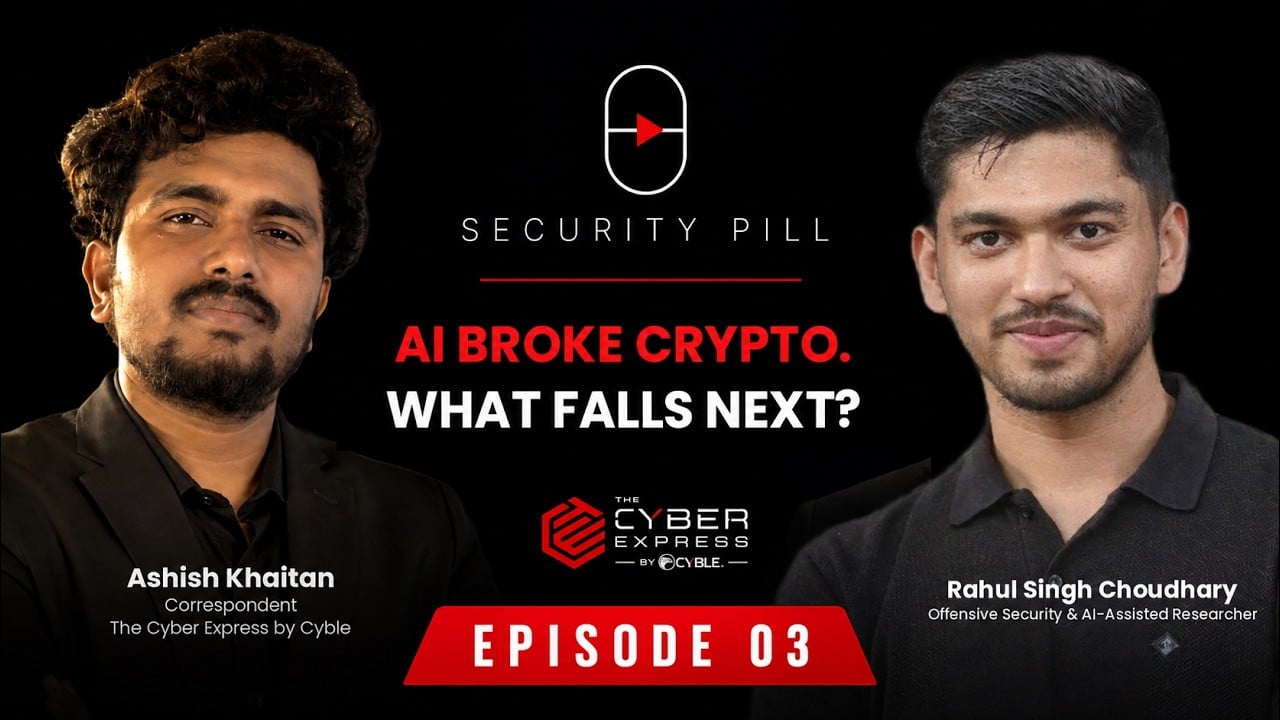
Rahul Singh Choudhary on AI's Growing Role in Cryptanalysis and Offensive Security 

In the latest episode of Security Pill Season 2.0, The Cyber Express interviewed cybersecurity analyst Rahul Singh Choudhary about how AI is reshaping cryptanalysis, vulnerability research, and penetration testing. The conversation opens with a key question: has AI moved from merely assisting security research to actively participating in it — particularly around the cryptographic assumptions underpinning wallets, exchanges, and smart contracts? Read more… 

US House Passes GUARD Act to Boost Law Enforcement Fight Against Elder Fraud, Crypto Scams 

The U.S. House of Representatives has passed the bipartisan GUARD Act (H.R. 2978) on September 15, 2026, aimed at strengthening law enforcement's ability to combat elder financial fraud and cryptocurrency scams. Co-led by Representatives Josh Gottheimer, Zachary Nunn, and Scott Fitzgerald, the bill now heads to the Senate. Read more… 

Weekly Cybersecurity Takeaway 

This week's developments span the full spectrum of cyber risk — from small UK businesses absorbing a disproportionate share of attacks, to a hardware-level flaw putting console owners at physical-proximity risk, to AI tools being weaponized for non-consensual imagery at unprecedented scale.   Meanwhile, policy responses are accelerating on multiple fronts: US lawmakers are moving to arm local investigators against crypto-enabled elder fraud, and the UAE is deepening its national threat-intelligence posture through public-private partnership.  Taken together, the stories point to a widening gap between the speed of exploitation — whether by scammers, deepfake operators, or nearby attackers exploiting hardware — and the pace of institutional response, even as that response visibly picks up. 

💾

AI is already reshaping how crypto and blockchain systems get attacked — and defended. In this episode of Security Pill Season 2.0, we speak with Rahul Singh...

AI Won’t Replace Cybersecurity Jobs, It’ll Replace the Toil – Harsha Reddy Explains What’s Next

14 de Agosto de 2026, 03:56

AI, Cybersecurity, Harsha Reddy

As enterprises race to bolt AI onto every business process, security leaders are being forced to answer a harder question than "should we adopt it" — it's "who's accountable when it goes wrong." To unpack this, The Cyber Express sat down with Harsha Reddy, Head of Information Security at Veterinary Emergency Group (VEG).

With nearly two decades in security leadership — including senior roles at Lixil and American Standard before joining VEG — Harsha brings a practitioner's view of where AI is genuinely changing the CISO's job, and where it's mostly just hype and shadow adoption.

Watch the Full Interview:

Harsha Reddy Explains Why AI Will Replace Tasks, Not Defenders

Harsha pushes back on the narrative that AI will hollow out security teams, pointing to Gartner research showing that while most fields are projected to lose jobs to AI, cybersecurity is expected to gain them. In his view, the technology is mainly absorbing the "toil" — log review, alert triage, evidence gathering — that keeps analysts from actually defending.

Also listen to S1 Episode: Awareness and Education at Young Age is the Answer to Cybersecurity Skill Gap

“It's the analyst who refuses to use AI that will get replaced by an analyst who uses it,” he says.

On adoption, Reddy points to a 2024 Microsoft-LinkedIn survey in which most executives called AI critical to their business, yet a majority had no formal plan and most had employees already bringing in their own tools. That gap, he argues, is why so many organizations are now dealing with AI-related data leaks. "Many organizations started onboarding AI like software when they should be onboarding it like staff." His fix isn't more restrictions — blocking AI just pushes it into the shadows — but guardrails, an internal AI enablement committee, and measuring actual business value instead of token consumption.

The conversation also digs into deepfake-driven fraud, why training employees to spot deepfakes is “a losing bet” at machine speed, and how he decides when to greenlight a new AI tool versus telling a business unit “not yet.”

The conversation closes with our newly introduced rapid-fire round "Express Shots" — Claude vs. ChatGPT, passkeys vs. passwords, and Reddy's prediction for the biggest cybersecurity threat of 2030.

💾

Read the latest updates Firewall Daily news and insights on The Cyber Expres, your trusted source for cybersecurity and information technology updates."
❌
❌