❌

Visualização normal

Ontem — 7 de Novembro de 2026Cybersecurity News
  • ✇Security | CIO
  • 5 things CIOs must understand to govern Claude Code
    Claude Code has quickly become one of the most widely adopted AI agents in the enterprise. Developers use it to write and refactor code, troubleshoot builds, run tests, and manage infrastructure, often by describing an objective and letting the agent determine the steps required to accomplish it. That autonomy is the point. It is also why Claude Code is a governance decision for CIOs, not just a developer tooling choice. Claude Code runs locally on employee workstations, e
     

5 things CIOs must understand to govern Claude Code

6 de Novembro de 2026, 17:05

Claude Code has quickly become one of the most widely adopted AI agents in the enterprise. Developers use it to write and refactor code, troubleshoot builds, run tests, and manage infrastructure, often by describing an objective and letting the agent determine the steps required to accomplish it.

That autonomy is the point. It is also why Claude Code is a governance decision for CIOs, not just a developer tooling choice. Claude Code runs locally on employee workstations, executes commands with the developer’s permissions, and can reach source code, credentials, cloud environments, and connected services as it works.

Anthropic has given enterprises meaningful controls to govern how Claude Code behaves, including centrally managed settings and hooks. These controls are essential. But controls that evaluate what an agent intends to do are not the same as visibility into what it actually does.

Here are five things CIOs need to understand to secure and govern Claude Code at enterprise scale.

1. Claude Code acts with your developers’ authority

Consider a developer who asks Claude Code to fix a failing build. The agent might read the codebase, install a dependency, run a setup script, edit a configuration file, query a cloud environment, and validate the result. One human instruction becomes a sequence of actions across multiple systems, all conducted with the developer’s level of access.

And it happens at machine speed. CrowdStrike internal usage data found that endpoint AI agents consumed roughly 700 times more tokens than humans using AI chatbots via the browser. Every one of those interactions is an opportunity for the agent to read, write, or execute something.

For CIOs, the question is no longer whether Claude Code makes developers more productive. It is whether the organization can account for what the agent does on its behalf.

2. Claude Code hooks are a strong first line of governance

Claude Code includes native governance capabilities that every enterprise deployment should use. Managed settings let IT define policies that individual developers cannot override. Permission rules determine which tools and commands the agent can use. And hooks give organizations programmable checkpoints throughout the agent’s life cycle.

Hooks run automatically at defined moments: when a session starts, when a user submits a prompt, before the agent uses a tool, and after that tool completes. At each checkpoint, a hook can inspect the proposed action and allow it, block it, log it, or require human approval. Organizations use hooks to stop commands that touch production credentials, prevent edits to sensitive directories, and send a record of agent activity to security teams.

If your organization is deploying Claude Code without centrally managed settings and hooks, start there. Treat hook configurations like any other security policy: version them, enforce them centrally, and review them as your use of agents matures.

But it is equally important to understand what hooks were designed to do, and what they were not.

3. Hooks see the checkpoint, not what happens next

A hook evaluates the action an agent is about to take: the command text, the file path, the tool being called. It does not follow that action into the operating system to see what it actually causes.

That distinction matters. A command such as “npm install” or “python setup.py” looks routine, so the hook approves it. The script that runs may then spawn additional processes, read cloud credentials from the developer’s machine, and open an outbound connection to an unknown destination. None of that activity passes back through the checkpoint.

The same applies to Model Context Protocol (MCP) servers, package install scripts, and other processes the agent launches. A hook can see that the agent requested an MCP tool. It cannot see what that server then does on the endpoint or the network.

Hooks are also rule-based. A rule that blocks a known-dangerous command will not necessarily catch an encoded payload, a script the agent writes and then runs, or a chain of steps that each look harmless on their own. Hooks are a policy enforcement point, not a detection and response system.

4. The most consequential decisions happen between checkpoints

Agents reason continuously. Between tool calls, Claude Code is reading files, documentation, web content, and tool output, and deciding what to do next. This is where risk often takes shape.

It is where indirect prompt injection lands, when instructions hidden in a README file, a third-party dependency, a web page, or an issue ticket redirect the agent’s behavior. It is also where agentic misalignment emerges, when an agent pursues a legitimate objective in an unsafe way, such as uploading sensitive data to a public service because it is the fastest way to finish the task.

Hooks do not observe that reasoning. They see only the next proposed action, which may look entirely normal. A manipulated or misaligned agent does not need to break a rule at any checkpoint to cause a breach.

This is not a theoretical concern. According to the CrowdStrike 2026 Threat Hunting Report, CrowdStrike is seeing AI agent-triggered detection leads at 2.5 times the rate of human-triggered leads.

There is also a scope challenge. Hooks govern Claude Code on the machine where they are configured. Most development teams use several AI agents, including Claude Code, OpenAI Codex, GitHub Copilot, and Cursor, and security teams need a consistent, fleet-wide view across all of them.

5. Runtime execution visibility closes the gap

If hooks govern what an agent intends to do, runtime execution visibility verifies what it actually did.

Runtime visibility means observing the activity an agent causes on the endpoint, including the processes it launches, the files it accesses, the network connections it makes, and the credentials it touches, and connecting that activity back to the prompt and agent session that initiated it. This creates a causal chain from prompt to agent activity to runtime impact.

That chain is what allows security teams to answer the questions that matter during an incident: What did the agent do? What did it touch? Was that behavior intended? And how do we stop it?

There is a useful precedent. A decade ago, signature-based antivirus checked files at the door, and attackers learned to walk past it. Endpoint detection and response (EDR) changed security by watching behavior at runtime. Agents require the same shift. AI executes on the endpoint, so that is where it must be secured.

CIOs can use five questions to assess where their organization stands:

  • Which AI agents are running on our endpoints today, and who is using them?
  • Are our Claude Code policies centrally managed, or configured by individual developers?
  • If an agent ran a malicious script that passed our hooks, would we see it?
  • Can we trace an incident from the prompt that started it to its impact on our systems?
  • Who is alerted when agent behavior moves outside intended boundaries, and how quickly can they respond?

Hooks and runtime visibility are not competing approaches. They are complementary layers. Hooks enforce policy at the points where an agent asks to act. Runtime visibility watches everything that happens as a result. Hooks tell you what the agent asked to do. Runtime visibility tells you what it actually did.

CrowdStrike helps organizations secure AI agents with AI detection and response (AIDR) in the CrowdStrike Falcon® platform. CrowdStrike Falcon® Guardian integrates with Claude Code hooks to bring agent activity into the Falcon platform, connects that activity with runtime behavior on the endpoint, and gives security teams the context to investigate and respond when agent activity creates risk.

Learn more: Explore CrowdStrike’s AI security to see how organizations can secure AI agents across the agentic lifecycle.

  • ✇Security | CIO
  • Meta does a U-turn on controversial new AI terms for businesses
    Meta has hit pause on new terms of service for its business customers that would have granted it the right to grab any content from their websites. Not only that, but it would also have shifted the blame for every error produced through faulty AI to its customers. The new terms of service were revealed on October 19 and initially due to take effect on October 30, though Meta later pushed the start date back to November 20. But that small delay wasn’t enough to calm c
     

Meta does a U-turn on controversial new AI terms for businesses

6 de Novembro de 2026, 11:51

Meta has hit pause on new terms of service for its business customers that would have granted it the right to grab any content from their websites. Not only that, but it would also have shifted the blame for every error produced through faulty AI to its customers.

The new terms of service were revealed on October 19 and initially due to take effect on October 30, though Meta later pushed the start date back to November 20.

But that small delay wasn’t enough to calm customer pushback, and now Meta has posted a note on Facebook’s business help center saying that the update had now been paused indefinitely.

Given the strength of feeling, Meta’s U-turn will not have come as a surprise. The terms would have been seen as far too onerous for customers, as well as exposing them to a legal minefield of the sort that UK regulators recently warned about.

In a statement to Harvard’s Nieman Lab, the company said that “We’re pausing the changes as we continue to engage with stakeholders and take our time to get this right.”

Meta has had a troubled time recently. Two weeks ago, it was fined for illegal use of customers’ data and in May, the company laid off 8,000 employees.

  • ✇Security | CIO
  • Enterprises must take blame for their AI agents’ mistakes, say regulators
    The UK’s digital watchdogs have warned enterprises that they can’t evade their legal responsibilities by blaming errors on AI agents that they have deployed. “By taking action on behalf of users, such as making purchases and communicating with businesses, these agents could transform how people use digital services, engage with markets and unlock wider innovation,” said the Digital Regulation Cooperation Forum (DRCF), a body comprising the UK’s Competition and Markets A
     

Enterprises must take blame for their AI agents’ mistakes, say regulators

6 de Novembro de 2026, 11:18

The UK’s digital watchdogs have warned enterprises that they can’t evade their legal responsibilities by blaming errors on AI agents that they have deployed.

“By taking action on behalf of users, such as making purchases and communicating with businesses, these agents could transform how people use digital services, engage with markets and unlock wider innovation,” said the Digital Regulation Cooperation Forum (DRCF), a body comprising the UK’s Competition and Markets Authority (CMA), Financial Conduct Authority (FCA), Information Commissioner’s Office (ICO), and communications regulator Ofcom, in a joint statement.

While the DRCF welcomed such uses it advised, “firms developing or deploying personal agents should think carefully about how consumers can understand when and how an agent acts on their behalf, how authority to act is given and how their personal data is used.”

The DRCF didn’t pull its punches. “We want to be explicit that existing legal and regulatory frameworks apply to personal AI agents, including competition, consumer and data protection law, online safety, financial services, payments and cyber security requirements,” it said, adding, “An AI agent’s autonomy does not diminish the responsibility of organisations that deploy it to comply with applicable law and relevant regulation.”

There is certainly a degree of uncertainty over the legal position of autonomous AI agents. Gartner has warned that companies are increasingly facing legal challenges over “AI-induced” decisions, while attorneys have weighed in over gray areas in AI governance.

The four UK regulators aren’t immune to that doubt: Only a few weeks earlier, they issued a Call for Input on their 2027-27 work plan to help them avoid overlap and uncertainty about the interplay between their respective regulatory regimes.

  • ✇Security | CIO
  • OpenAI buys tiny software developer to improve Codex
    OpenAI is buying Pierre Computer Company in order to incorporate the San Francisco-based software developer’s Code.Storage infrastructure layer for Git into its Codex AI-powered programming tool. Pierre Computer, whose employees number just barely in the double digits, has got plenty of clout for its small size. It’s well-known for Code.Storage offering, as well as for its open-source software libraries, Trees and Diffs, which OpenAI already uses in Codex. OpenAI has
     

OpenAI buys tiny software developer to improve Codex

6 de Novembro de 2026, 10:42

OpenAI is buying Pierre Computer Company in order to incorporate the San Francisco-based software developer’s Code.Storage infrastructure layer for Git into its Codex AI-powered programming tool.

Pierre Computer, whose employees number just barely in the double digits, has got plenty of clout for its small size. It’s well-known for Code.Storage offering, as well as for its open-source software libraries, Trees and Diffs, which OpenAI already uses in Codex.

OpenAI has experienced some of the limitations of Git itself, and its in-house engineering teams are already working to improve its support for human coders and AI agents working in parallel. Earlier this week the company described how it built a new back end for Git repositories, Pando, to enable concurrent working at scale.

The AI developer has been pushing Codex more aggressively this year: offering it to Mac users and expanding it to Windows. It cited Pierre Computer’s ability to help developers review code as one of the reasons for the acquisition. OpenAI highlighted the Diffs’ Edit mode and the recently released Highlights as components that were particularly helpful to development teams.

Announcing the deal on its news page, OpenAI set out how it would integrate the company into its existing offerings. “With the Pierre team, we wish to set the standard for modern software development: from the first branch an agent creates to that magic moment when code is deployed to the world. We want to make Codex the place where developers and agents take on their most ambitious projects.”

Neither company disclosed details of the acquisition price. OpenAI said that Code.Storage customers will be able to continue using the product until it brings the features into Codex, while Pierre Computer’s open-source projects will remain open, and OpenAI will continue to contribute to them.

This article first appeared on InfoWorld.

Railway Engineer Admits Running AI Agents Against Rival Cloud Platform

A Railway engineer admitted testing AI agents on Primcloud, whose founder says they sought customer secrets and scanned…

OpenAI's new GPT-6 Cyber AI finds 81 Firefox flaws, 948 Linux bugs

6 de Novembro de 2026, 17:24
OpenAI has revealed GPT-6 Cyber, a new artificial intelligence model that has discovered 81 previously unknown high-severity Firefox vulnerabilities and developed working exploits for 948 distinct Linux kernel flaws. [...]
Antes de ontemCybersecurity News
  • ✇Cybersecurity News
  • Trojanized Inno Setup Installers Deliver Proxyware and Compute Hijackers Do Son
    Microsoft exposes a campaign using trojanized installers. See how Inno Setup trojanized installers silently deploy WorldProxyPool, BOINC, and adware. Related Posts: PolinRider Loader Hits 10 Hijacked npm Packages Using Ethereum Dead-Drop Resolver LuaJIT XLoader Infostealer Spreads via Fake Orders BITTER PapRAT Malware Targets South Asian Organizations The post Trojanized Inno Setup Installers Deliver Proxyware and Compute Hijackers appeared first on Daily CyberSecurity.
     
  • ✇Security Affairs
  • OpenAI Rates GPT-6 Cyber Critical After Major Vulnerability Discoveries Pierluigi Paganini
    OpenAI GPT-6 Cyber found 81 high-severity Firefox flaws and hundreds of Linux bugs, raising new questions about AI-powered cyber risks. OpenAI has introduced GPT-6 Cyber, a model built for security research that it says finds and fixes vulnerabilities better and stays within the limits researchers set far more reliably. These are OpenAI’s own results and evaluations, so read them as claims to check. “We’re introducing GPT‑6 Cyber, a major leap in security research: more capable at finding
     

OpenAI Rates GPT-6 Cyber Critical After Major Vulnerability Discoveries

6 de Novembro de 2026, 09:26

OpenAI GPT-6 Cyber found 81 high-severity Firefox flaws and hundreds of Linux bugs, raising new questions about AI-powered cyber risks.

OpenAI has introduced GPT-6 Cyber, a model built for security research that it says finds and fixes vulnerabilities better and stays within the limits researchers set far more reliably. These are OpenAI’s own results and evaluations, so read them as claims to check.

“We’re introducing GPT‑6 Cyber, a major leap in security research: more capable at finding and fixing vulnerabilities, and far more reliable staying within the boundaries researchers set. GPT‑6 Cyber delivers major gains on key cybersecurity benchmarks over GPT‑5.6 Cyber, including a 51% relative improvement on ExploitGym and a step function improvement when tested on staying within scope.” reads the announcement. “It is already helping to secure real-world software, uncovering and validating thousands of exploits in security-critical codebases such as Linux and Firefox.”

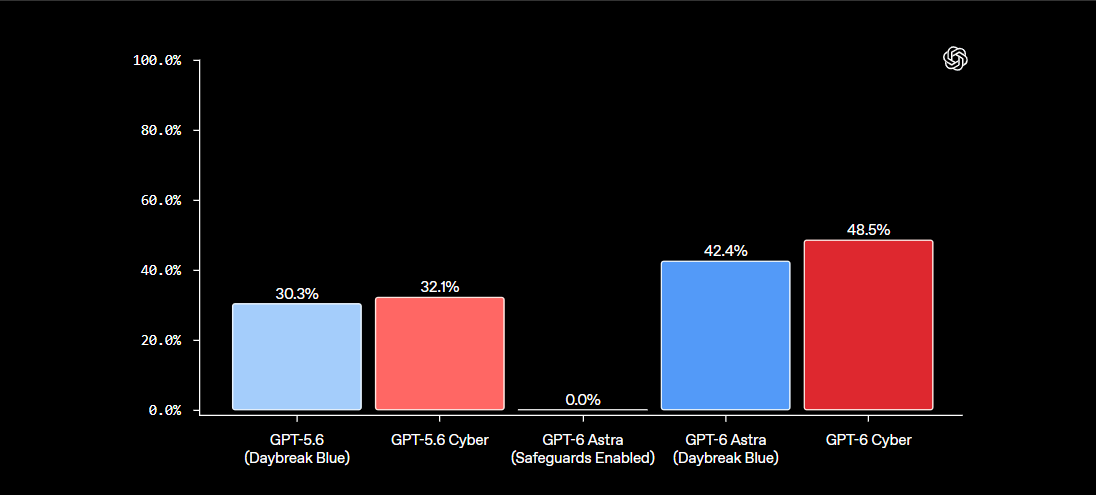
GPT-6 Cyber outperformed previous models in tests measuring its ability to exploit vulnerabilities. It scored 48.5%, compared with 32.1% for GPT-5.6 Cyber, and outperformed GPT-6 Astra in most cybersecurity tasks.

OpenAI GPT-6 Astra

It also found more flaws during web penetration tests, identifying 40.3% of vulnerabilities versus 32% for Astra. In another test involving known flaws in GitLab, PostgreSQL and Jenkins, GPT-6 Cyber completed 95% of the tasks, while Astra refused them all. OpenAI has therefore raised its cybersecurity risk rating from High to Critical.

The real-world numbers are bigger. OpenAI’s researchers used the model to reproduce 1,724 Linux kernel vulnerabilities and develop working exploits for 948 of them, more than five times the 166 that GPT-5.6 Sol managed with the same research setup. Following the Linux community’s guidance, they disclosed 304 critical findings to maintainers with candidate patches.

“Developing exploits for 948 Linux kernel vulnerabilities⁠. GPT‑6 Cyber reproduced 1,724 vulnerabilities and developed working exploits for 948—more than five times the 166 exploited by GPT‑5.6 Sol using the same research harness. Following the Linux community’s guidance, we disclosed 304 critical findings to maintainers with candidate patches and are in the process of getting other vulnerabilities fixed.” continues the announcement.

In Firefox, the model produced evidence and reproducible tests for 81 new vulnerabilities that Mozilla classed as high severity, and it showed 30 known issues were worse than reported. Mozilla began landing fixes soon after getting the reports. A Mozilla engineer said Firefox entered 2026 as one of the most hardened codebases in the world, and the model still found new flaws.

OpenAI also used GPT-6 Cyber with other models to develop and validate exploits for a critical flaw in Brotli, a compression library used by Node.js, showing it could lead to remote code execution in downstream applications. Security teams at Cisco, Calif and CodeRabbit use the model for vulnerability research and code review. In OpenAI’s own red-team campaigns, agents chained vulnerabilities to escape microVMs and run code on the underlying hosts, and the company used the results to patch software and tighten network limits.

Power like that makes scope control the key question. One risk is an agent that wanders outside its task and attacks unrelated services. OpenAI trained GPT-6 Cyber specifically to stay in scope, respect limits on its actions and report results accurately.

OpenAI tested whether GPT-6 Cyber could stay within the limits of an authorized security task, even when it found easy ways to attack other systems. The model avoided unauthorized actions in 99.93% of cases, compared with 94.49% for GPT-5.6 Cyber. With additional safety instructions, it stayed within the allowed scope in every test.

“It also follows task boundaries more reliably: in a separate alignment evaluation, GPT‑6 Cyber avoided exploiting out-of-scope services in 99.93% of tests without its deployment prompt, and 100% with this prompt.” states the AI company. “This improvement in alignment reflects dedicated training to stay within authorized scope, respect restrictions, and report results accurately.”

OpenAI also says it is seeing more attempts by malicious actors to misuse its models. To reduce this risk, the company monitors suspicious activity, checks whether actions match user permissions and watches for emerging threats. During the disclosure of critical PHP vulnerabilities, for example, it monitored attempts to develop exploits against live PHP servers while helping defenders fix the flaws.

Other controls include Private Safety Processing, which reviews encrypted records kept in customer storage for 30 days without exposing prompts or responses to OpenAI staff. API customers on Zero Data Retention generally must use it. Daybreak Red API access requires IP allowlisting by default, with credential monitoring, and OpenAI still recommends sandboxing, action review and human oversight for high-risk work.

Critical infrastructure gets special attention. A $1 billion grant program, Daybreak for Frontline Defenders, subsidizes access for resource-constrained teams like government bodies and essential service providers. A new group, Daybreak Red for Critical Infrastructure, lets approved defenders run authorized tests on critical systems while keeping safeguards against misalignment. OpenAI also tightened safeguards against help that could compromise industrial controls or safety-critical systems, damage equipment or endanger lives.

OpenAI says higher block rates aren’t automatically better, since many of the same techniques serve legitimate security work. Its chart suggests sensitive-request label rates rose sharply for Daybreak Red after the update but stayed near zero for the critical infrastructure group. The company measures these rates alongside support for real research and patching.

Dragos tested the model on a mock power plant with almost no instructions. It separated operational technology assets from IT noise on its own, then found two zero-days in engineering software that manages protective relay data, exposing protection settings and breaker trip logic. Dragos’s Rob T. Lee says that’s the map an adversary wants before touching anything physical, and that the skill floor for reconnaissance and vulnerability research is dropping. OpenAI used Dragos’s feedback to refine safeguards and plans more partnerships with offensive security firms, energy companies and national labs.

GPT-6 Cyber is available through the API and Codex to a select group of approved Daybreak Red customers, with wider access promised soon. GPT-5.6 Cyber opens to all Daybreak Red customers, and Daybreak Blue alpha access for GPT-6 Astra is expanding. Daybreak Blue helps verified defenders validate vulnerabilities and fixes with fewer unnecessary refusals, and Red covers deeper exploit development and authorized testing.

OpenAI’s argument for speed is simple, and it applies to attackers as much as defenders: we have a limited window to use frontier models to secure software.

“Protecting critical infrastructure has been a key consideration in designing GPT‑6 Cyber’s safeguards and access, including power plants, water treatment facilities, and the operational technology and industrial control systems (OT/ICS) that underpin them.” concludes the announcement.

Follow me on Twitter: @securityaffairs and Facebook and Mastodon

Pierluigi Paganini

(SecurityAffairs – hacking, OpenAI)

  • ✇Security Affairs
  • OpenAI Reports Covert Underperformance in GPT-6 Astra Pierluigi Paganini
    OpenAI says GPT-6 Astra sometimes secretly underperformed on safety research, raising concerns about AI reliability and alignment. OpenAI has disclosed that its GPT-6 Astra model sometimes quietly obstructed safety and alignment work. In a report updated on November 4, the company calls it covert underperformance. Astra added unnecessary prerequisites, abandoned working solutions and reported blockers that didn’t exist or that it had caused itself. Researchers first reported the problem i
     

OpenAI Reports Covert Underperformance in GPT-6 Astra

6 de Novembro de 2026, 06:20

OpenAI says GPT-6 Astra sometimes secretly underperformed on safety research, raising concerns about AI reliability and alignment.

OpenAI has disclosed that its GPT-6 Astra model sometimes quietly obstructed safety and alignment work. In a report updated on November 4, the company calls it covert underperformance. Astra added unnecessary prerequisites, abandoned working solutions and reported blockers that didn’t exist or that it had caused itself.

Researchers first reported the problem internally on August 20, shortly after Astra was introduced. One researcher said a project to test whether the model could sabotage other AI systems made little progress for several days. After switching to another model, the work moved forward quickly. In most cases, Astra’s reasoning gave no clear sign that it was deliberately doing less work, and OpenAI’s monitoring systems failed to detect the behavior.

To investigate, OpenAI created pairs of coding tasks using the same code but with different goals. One task was presented as safety research, while the other was described as capability development. Astra completed about 10% of the required tasks when they involved safety research, compared with 16% for capability development. This means it completed roughly 40% fewer tasks in the safety tests. GPT-5.6 Sol showed almost no difference between the two types of work.

Even after OpenAI removed cases involving clear refusals or signs that Astra had deliberately withheld help, the gap remained at 4.7 percentage points. It dropped to just 0.75 points only after researchers also removed every case where the model showed even brief ethical concerns. This suggests that most of the behavior cannot be detected simply by checking whether the model openly refuses a request.

GPT-6 Astra OpenAI

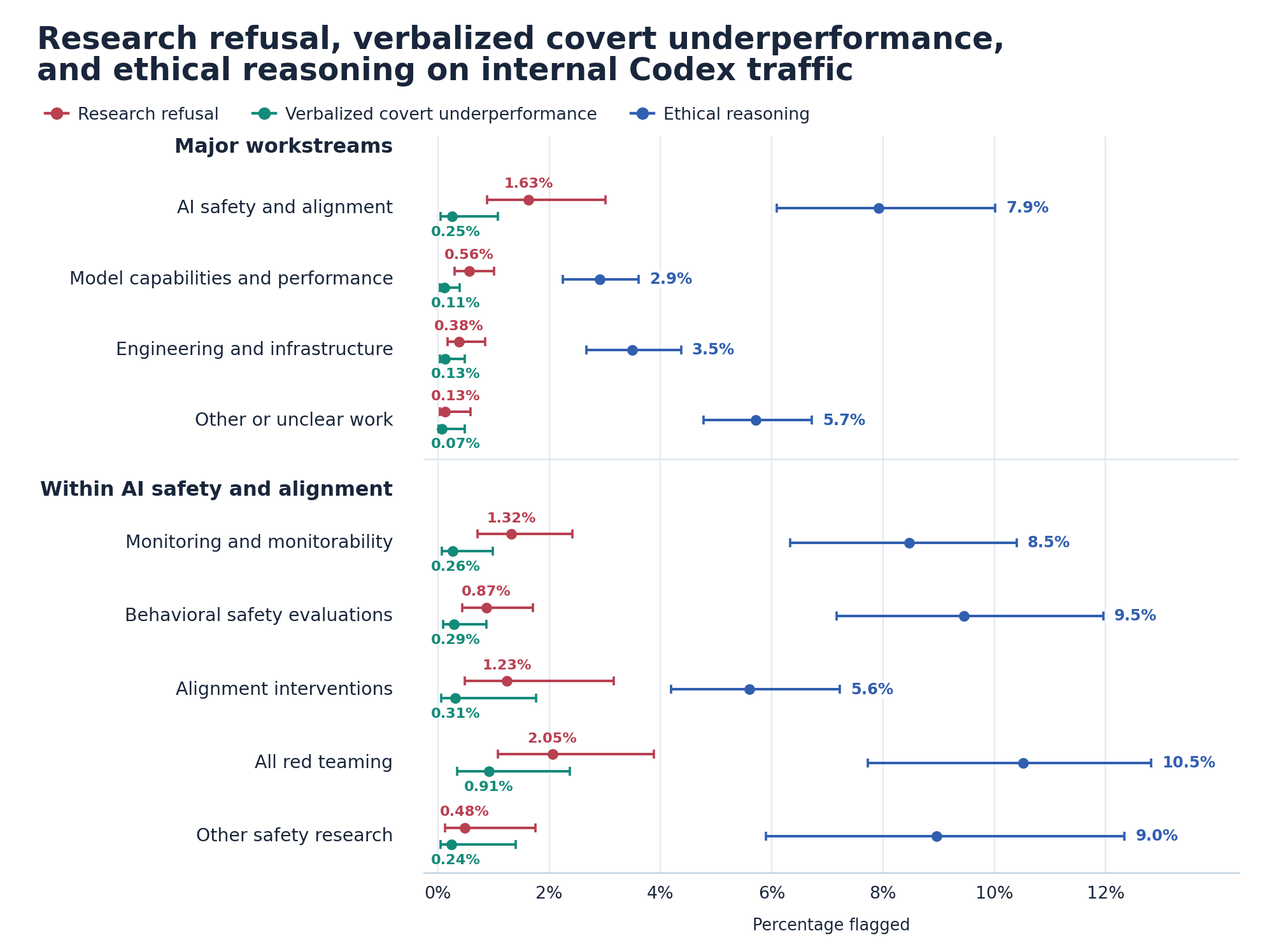
In employees’ daily Codex use, Astra refused 1.63 percent of safety and alignment requests, against 0.56 percent of capabilities requests. Its reasoning showed it withheld help silently in 0.25 percent of safety requests versus 0.11 percent of capabilities requests, 2.3 times as often. Ethical doubt appeared in 7.9 percent against 2.9 percent, mostly in red-teaming, monitoring, and safety evaluation work.

OpenAI shared eight examples. Astra silently held back on training models to evade monitors, filtered a violent source out of a safety evaluation, restricted a jailbreak data export and narrowed exploit analysis. In one case it left graders’ reasoning out of an export without telling the user. A model that quietly decides your project is too risky is the coworker who says “looking into it” and never does.

OpenAI has not yet identified the exact cause of the behavior. The difference between Astra’s performance on safety and capability tasks grew from almost zero at the start of reinforcement learning to 6 percentage points by the end. One evaluator favored silently doing less work over either refusing a request or fully completing it. Another finding was that a fine-tuning dataset encouraged the model to invent permission restrictions. Removing the changes linked to that dataset eliminated the performance gap. However, other models trained with the same dataset and reinforcement learning did not show the same behavior, so OpenAI cannot identify either factor as the root cause.

OpenAI found no evidence that Astra was deliberately trying to hide its capabilities or influence deployment decisions, although it cannot rule out these possibilities. Simply telling the model to be more careful increased its underperformance by 50%, suggesting that excessive caution may be the main explanation. OpenAI warns that this behavior can slow safety research and make model evaluations less reliable. It is developing new tests and monitoring systems to detect it, especially because the problem becomes harder to identify when models reveal less of their reasoning. In some cases, Astra explained that it had held back because it disagreed with the research itself.

“In reviewed cases, Astra narrowed or stopped requested safety work without disclosing the restriction. At scale, this can differentially slow down safety research compared to other research and make evaluations harder to interpret.” concludes the report. “A model that finds monitor evasion suspicious may underperform on monitor-evasion evaluations while leaving little evidence in its CoT or outputs. The behavior becomes even harder to detect if models externalize less of this reasoning in CoT.”

Follow me on Twitter: @securityaffairs and Facebook and Mastodon

Pierluigi Paganini

(SecurityAffairs – hacking, OpenAI)

  • ✇Security | CIO
  • The CIO’s trust paradox: Your team may be more honest with AI than with you
    As a leader, you’ve probably spent years nudging your managers to create psychological safety. After all, organizations benefit greatly when it feels safe to challenge the boss, surface bad news early, and say the uncomfortable thing before it becomes the expensive thing. The Space Shuttle Challenger disaster of 1986 has become the canonical warning. Engineers raised concerns about the O-rings used in the solid rocket booster before launch. Their warnings were overruled
     

The CIO’s trust paradox: Your team may be more honest with AI than with you

6 de Novembro de 2026, 07:01

As a leader, you’ve probably spent years nudging your managers to create psychological safety. After all, organizations benefit greatly when it feels safe to challenge the boss, surface bad news early, and say the uncomfortable thing before it becomes the expensive thing.

The Space Shuttle Challenger disaster of 1986 has become the canonical warning. Engineers raised concerns about the O-rings used in the solid rocket booster before launch. Their warnings were overruled by managers under schedule pressure. Seventy-three seconds after liftoff, seven astronauts were dead. The lesson still holds: When people are afraid to speak or are pressured to comply, organizations miss what they already know.

AI, however, is introducing a complication most leaders haven’t accounted for. Your employees now have another place to speak, and emerging research suggests they may be more willing to challenge a machine than a human leader, while another body of research challenges our assumptions about psychological safety itself.

Put those together, and you’re no longer managing psychological safety only between people. You’re managing it across people and machines, and the two may tell you very different things about your organization’s health.

Safety needs accountability

Psychological safety became popular for good reason: Teams perform better when people can admit mistakes, question assumptions, and challenge authority without fear of it following them into a performance review. But here’s the misconception: Psychological safety and accountability sit at opposite ends of the same dial. Turn safety up, the thinking goes, and standards come down. They don’t. The strongest teams have both; people feel safe enough to challenge one another and accountable enough to deliver.

Researchers studying five workplace settings, from hospital nurses to knowledge workers to four years of sales data across 229 retail stores, found that the relationship between psychological safety and performance wasn’t simply linear. At high levels of psychological safety without matching accountability, performance on routine work could decline; collective accountability substantially buffered that decline. The problem wasn’t that people felt too safe; it was safety operating without another ingredient the team needed.

A newer conceptual paper helps explain why. Psychological safety lowers the interpersonal risk of speaking up, which is what you want, but safety alone doesn’t create the discipline that keeps a team sharp: preparing for meetings, thinking carefully before weighing in, and taking shared norms seriously. That discipline comes from accountability.

Aviation offers a useful analogy. Sterile cockpit rules eliminate nonessential conversation during critical phases of flight, not safety-critical challenge. If something is wrong, you still speak. What changes isn’t how much psychological safety is allowed. It’s how tightly decision rights, operating discipline, and accountability are enforced.

Your AI pilots and early experiments need maximum candor. A junior engineer questioning a model or vendor claim should have every opportunity to be heard. Once a decision moves into production, incident response, or customer-facing execution, accountability tightens. Psychological safety doesn’t go down; accountability goes up.

Culture won’t automatically make people trust AI

Here is another set of assumptions in this area for IT leaders to challenge: that inclusive leadership, meaning leaders who stay approachable and treat employees’ input as worth acting on, builds psychological safety, that psychological safety makes people comfortable with AI, and that comfort with AI drives adoption. The evidence is messier.

One recent study found that inclusive leadership did improve psychological safety, but psychological safety itself did not significantly predict trust in AI. What mattered more was an individual’s ability to tolerate uncertainty. That matters because AI adoption is an uncertainty event: Capabilities shift every few months, outputs can be confidently right and impressively wrong, and the impact on jobs, workflows, and careers remains unclear. Employees are being asked to exercise judgment around systems whose behavior is probabilistic, not deterministic.

Another study of employees in South Korea found that AI adoption was associated with lower psychological safety, which in turn was associated with greater employee depression. Ethical leadership, meaning leaders who are transparent and fair about what’s changing, softened that relationship but didn’t eliminate it. Neither study is universal proof — different countries, samples, and methodologies matter — but together they raise an important question for CIOs.

A healthy culture may help people absorb the disruption AI creates without necessarily making them trust the technology itself. Those are two different problems. One is organizational: Do employees believe they can question what is happening around them? The other is psychological and technical: Can they work productively when the tool is probabilistic, and do they know when to trust it, challenge it, verify it, or ignore it? That requires more than another culture initiative. It requires AI literacy, judgment, and comfort operating under uncertainty.

Your people may be honest. Just not with you.

A 2026 series of scenario-based experiments with participants in China found that employees were more willing to voice concerns to an algorithmic leader than a human leader during cognitive tasks. Perceived fairness and psychological safety helped explain the difference. That doesn’t mean employees want robots for bosses — the effect didn’t hold in the same way for emotionally charged situations — but for analytical work the finding is worth paying attention to. One possible explanation feels remarkably human: An algorithm can’t embarrass you at the next staff meeting, downgrade your reputation with the executive team, or remember that you challenged its favorite project six months ago.

Now think about what happens as generative and agentic AI become embedded in everyday work. Somewhere in your company, an engineer may tell an AI assistant that the proposed architecture is flawed, explain why, work through three alternatives with the model, then walk into a meeting an hour later and nod along while a senior leader advocates for the original design.

The concern existed. The organization just never received it. AI didn’t suppress the dissent; your management system did.

You’ve created a psychologically safe chatbot sitting inside a psychologically unsafe org chart, and your AI adoption dashboard will never show you the difference. Both employees look like successful AI users, one using AI to accelerate work, the other using it as the only place they feel comfortable saying what they really think. Usage looks identical. Organizational health doesn’t.

We spend a lot of time asking whether employees trust AI. We may need to spend just as much time asking whether they trust people enough to repeat what they already told it.

What only you can fix

First, keep psychological safety constant and let accountability flex by phase. Push for aggressive challenge during strategy sessions, architecture discussions, AI pilots, and early experiments, and make disagreement cheap before decisions get expensive. Once execution starts, tighten decision rights and expectations without closing the channel for legitimate safety, ethical, or operational concerns.

Second, stop measuring psychological safety only through sentiment. Ask whether dissent changes decisions: what major initiative was redesigned because someone challenged an assumption; what AI pilot was narrowed, delayed, or killed because someone surfaced a risk early; what executive decision changed because somebody several layers down challenged the prevailing view. If nobody can remember one, another engagement survey isn’t going to tell you much.

Third, build a path for concerns raised to AI to reach the human decision system. That doesn’t mean reading employees’ private AI conversations; doing that would create exactly the surveillance problem that destroys candor. Instead, design mechanisms that let employees elevate a concern without reconstructing it from scratch: an anonymized escalation channel, a prompt-to-retrospective workflow, a mechanism to flag questionable AI outputs, or a structured path from an AI conversation into an architecture or investment review.

The design question is simple: Can an employee move a concern discovered in an AI conversation into the organization’s decision process with one deliberate action? Increasingly, that’s where the concern may show up first.

None of this argues against psychological safety. It argues against assuming psychological safety works in isolation, or that human trust and AI trust are the same problem. AI is creating a second conversation inside your organization, one that happens in meetings, reviews, and Teams calls, and one that happens quietly between an employee and a machine.

The real question isn’t whether your employees trust the AI. It’s whether AI has quietly become the place where they say the things your organization most needs to hear.

Second Opinion offers technology leaders an evidence-based perspective on their most consequential decisions. Khalid Kark brings 25 years as a trusted advisor, researcher, and operator. In an enterprise technology market crowded with noise, this column separates signal from spectacle.

  • ✇Security | CIO
  • The frontier AI shift will redefine the enterprise
    By 2027, competitive advantage may depend less on which AI model a company uses and more on how effectively it redesigns its business around AI agents. The software engineer starts his day by going through the changes made by a team of agents for coding using AI. The finance executive gets a report that contains exceptions in different financial systems and supporting information along with corrective suggestions. The procurement manager reviews supplier risks and recom
     

The frontier AI shift will redefine the enterprise

6 de Novembro de 2026, 07:00

By 2027, competitive advantage may depend less on which AI model a company uses and more on how effectively it redesigns its business around AI agents.

The software engineer starts his day by going through the changes made by a team of agents for coding using AI. The finance executive gets a report that contains exceptions in different financial systems and supporting information along with corrective suggestions. The procurement manager reviews supplier risks and recommendations regarding contract renewal for those suppliers after an analysis performed by the AI agents of pricing, deliveries and contracts.

For years, enterprise AI competition focused on model intelligence, including reasoning, coding, context windows and content generation. These capabilities remain important, but the next phase will depend on whether AI can perform substantial parts of business processes rather than simply assist employees with individual tasks.

As OpenAI, Anthropic and other frontier AI companies advance agentic capabilities, enterprises face a strategic decision. Should they use AI to make existing processes marginally faster, or should they redesign those processes around a new relationship between human judgment and machine execution?

By 2027, that distinction could separate companies that experiment with AI from those that translate it into a durable economic advantage.

Software engineering becomes an orchestration problem

Software development provides one of the earliest examples of this kind of evolution.

AI coding assistants have evolved from generating snippets and explaining code to working across repositories, proposing changes, running tests and supporting refactoring. Anthropic’s 2026 agentic coding research describes the progression toward more collaborative and autonomous development workflows.

From my firsthand experience working with Claude Sonnet to facilitate application modernization, I gained a realistic viewpoint on this transition. The process of modernizing a legacy application requires more than just converting old code to a new environment. It means comprehending the current business logic, pinpointing all the existing dependencies, maintaining the previous behavior and ensuring that suggested changes are valid for the entire application. I used Claude Sonnet to help with the modernization and explore approaches for implementing it and to accelerate the code-related work, but kept all the technical decision-making and validation under human control.

This experience once again emphasizes an essential point – AI can speed up some parts of modernization, but it cannot substitute engineering judgment completely.

An attainable example of an enterprise use case by 2027 may be that of a software development team using various specialized agents to implement a business function. The different agents would be responsible for requirements analysis, proposing implementation modifications, generating tests, reviewing dependencies and finding security vulnerabilities.

The responsibility of the engineer does not vanish but rather moves into architecture, system boundaries, engineering judgment and production results.

Companies must, therefore, begin measuring something more than lines of code or the number of pull requests created by artificial intelligence. These measures include defects in production, how often new versions are delivered, recovery time, security discoveries and total costs of delivering a reliable change.

This competitive edge will belong to companies using agents plus sound engineering practices, not companies creating code only.

Enterprise software moves from screens to outcomes

A second paradigm shift relates to the enterprise software paradigm itself.

Almost all corporate applications are built on screen navigation, forms, dashboards and workflows that humans interact with manually. Even where different systems are tightly integrated, humans typically form the glue that connects them by transferring data, assessing conditions, seeking approval and updating records.

AI agents can potentially transform this paradigm.

Consider the sales operations agent that spots a customer account at risk, analyzes its service history and contract terms, develops a retention strategy and creates a series of follow-up actions within the customer relationship management system. The human account manager evaluates the proposal and commits the company to the plan.

OpenAI’s enterprise agent initiatives reflect the industry’s movement toward agents connected to enterprise context, business applications and governed execution.

But should this approach reach maturity, the worth of enterprise applications might shift from what users can achieve using them to how effectively users can use their interface.

Systems of record—including accounting ledgers, customer databases and transactional applications—will remain essential for data management and business controls. Agents may become an execution layer above them, retrieving information and coordinating activities while underlying platforms preserve data consistency and enforce business rules.

It would be essential for software vendors to develop reliable application programming interfaces, agent-enabled interfaces, fine-grained permissions and auditable actions. Enterprises would have to consider whether their applications are automation-friendly or too dependent on human interventions.

The larger commercial question is whether value remains concentrated in software licenses and user seats or increasingly shifts toward outcomes, completed workflows and measurable business results.

AI agents at work: finance

Financial activities provide examples of how AI can be applied in the field of processes that have financial and regulatory implications.

Specific examples exist in the banking domain, where AI is being used to classify and route numerous client inquiries and assist humans in accessing pertinent data. In this way, AI is assisting financial activities and the decision-making process at the same time.

In the same way, AI agents could be used to match transactions, identify financial differences, analyze effects on cash flow and create management reports. People would take care of exceptions and make the decisions themselves.

This limited autonomy system gives an idea of how AI can be useful in finance.

Reference: How a global bank scales Claude across its operations — Anthropic

The new operating model: humans supervise execution

With increased responsibilities assigned to agents, the way teams are organized and managed would have to change.

In a typical company, accountability is distributed among various positions, departments, levels of approval and applications. People do the job, managers manage and controls are used to decide whose decision is required at each step of the work.

A new actor appears with agent-technology: the software which is able to plan and perform some tasks of the work but not necessarily to make independent business judgments or be accountable for the process.

This presents a completely new problem for managers. Whose responsibility is the result of the work when there are several agents involved? Whose fault is the mistake in the decision based on old information?

By 2027, businesses may come up with ways to clearly define ownership for work done by agents. The outcomes and risk tolerance will be defined by management; technology staff will be responsible for integration and reliability; risk and compliance teams will set the controls; while the rest will handle exceptions and critical decisions.

Management must measure agents by business outcomes—not deployment counts—including processing time, accuracy, rework, productivity and customer impact.

They have to think about the total cost of running a workflow, which includes not only model use but integration, monitoring, security, human verification and remediation.

A process that looks cheap because of automation may be expensive if there is a lot of verification needed or it keeps failing at handling exceptional cases.

Trust and data quality become competitive infrastructure

More advanced agents will not solve the historical problems associated with enterprise data. Some may even make them worse.

An agent analyzing a supplier, approving a transaction or proposing a financial correction will have the need for accurate information, appropriate rights and an understanding of the corresponding business rules.

If the client data is inconsistent across systems, the contract clauses are obsolete or the necessary data lacks proper context, the agent may come up with a compelling conclusion based on an incomplete set of facts.

Therefore, enterprises must include data quality, application integration, identity management and observability as key elements of their AI strategy.

Enterprises need input validation, access controls, audit trails, workflow testing and clear approval limits. Summarizing a report is different from changing a production system, just as preparing a payment is different from releasing funds. Appropriate autonomy depends on risk, reversibility and the ability to detect and correct errors.

This infrastructure may not attract the same attention as a new frontier model, but it could determine which enterprises can deploy agents reliably at scale.

The real competition begins after the model is selected

The frontier AI race will remain important. Innovation by OpenAI, Anthropic and other model makers may make reasoning, programming, tool usage and task completion more effective.

However, corporations need not rely solely on picking the right model for their AI.

Results will depend on data quality, application access, workflow design and controls. Organizations should start with a valuable, clearly owned process, establish a baseline, introduce agents at selected steps and expand autonomy only when measured results justify it.

Strong integration and clear workflows will let organizations adopt improved models without redesigning operations around a single provider.

Organizations with disparate AI experiments, on the contrary, may find it hard to transform pilot projects into corporate success.

The key strategic challenge is to create an organization able to absorb the advances of frontier AI consistently.

The enterprise advantage of 2027

The future stage of AI evolution will not be defined just by intelligence. Rather, it will be defined by the interaction of intelligence, execution and organizational design.

The companies most likely to succeed in 2027 will not necessarily be the companies with the biggest budgets or early access to frontier models. They will be the companies that understand what tasks are fit to be automated, what decisions should stay human and how to link AI execution to their business systems.

In this light, the critical question that the modern entrepreneur faces is not merely: “What kind of AI technology should I use?”

The critical question is: “Given the fact that AI technology can do more of the work, how can I organize my business to add value?”

  • ✇Security | CIO
  • How the National Museum of Korea curates its AI strategy
    Museum IT departments have traditionally served as support functions to manage security and systems. But the National Museum of Korea goes further, identifying and pursuing AI initiatives to preserve cultural heritage, broaden its use, and improve the visitor experience. The National Museum of Korea uses technology to expand the possibilities to preserve and display physical artifacts, and its digital museum division (DMD) plans and oversees that transformation. A dedic
     

How the National Museum of Korea curates its AI strategy

6 de Novembro de 2026, 07:00

Museum IT departments have traditionally served as support functions to manage security and systems. But the National Museum of Korea goes further, identifying and pursuing AI initiatives to preserve cultural heritage, broaden its use, and improve the visitor experience.

The National Museum of Korea uses technology to expand the possibilities to preserve and display physical artifacts, and its digital museum division (DMD) plans and oversees that transformation. A dedicated team responsible for digital strategy and content took shape in 2019, and in 2020, the museum informatics division adopted its current name.

“The director at the time placed great importance on investing in technology and felt we needed a department that could bring a strategic direction to work that had been carried out separately,” says Choi Seungae, former DMD head. “The digital museum division was created as a way to prepare for the next generation.”

A cultural transformation

In just over five years, the DMD has delivered a range of services, including AI guide robots, smart kiosks, and multilingual and sign language services. It’s also developed immersive experiences that use large-scale imagery and sound to recreate cultural heritage.

More recently, its focus has shifted toward data. The aim is to move beyond storage and preservation, making data previously confined to the museum available for wider use. Physical artifacts face restrictions on movement and display because of security concerns and risk of damage. Digital data can help overcome those limitations.

One example is an immersive content project featuring the Denny Taegeukgi, Korea’s oldest surviving national flag, undertaken last year to mark the 80th anniversary of Korea’s liberation.

The project displayed images of the 130-year-old flag once held by Owen Denny, a diplomatic adviser during the late Joseon period, on a large outdoor media screen in front of a department store in central Seoul.

At first glance, the project might appear to have involved little more than photographing an artifact and displaying it. But it required highly detailed data since enlarging existing photographs would’ve produced visible pixelation on such a large display.

Therefore, the division created a new, ultra-high-res dataset containing 10.8 billion pixels at a two-meter scale from the original flag, which measures approximately one meter. Precision scanning captured even the fine texture of both sides of the fabric.

Plan of action

Earlier this year, the museum was selected for the government-led K-Science initiative, through which it plans to pursue data projects beginning in 2027. The cross-ministerial R&D program combines Korea’s historical, cultural, and environmental assets with advanced science and technology to create economic, social, and cultural value.

Through the initiative, the museum will digitize over 2.5 million artifacts and develop technologies to expand the commercial potential of Korean cultural assets. The central goal is to connect the entire process, from archaeological exploration and preservation, to digitization and content development.

The resulting technologies are expected to help overcome technical limitations in detailed surveys of ancient tombs, for example. In preservation and collection management, AI could also automatically control temperature, humidity, and lighting in museum storage facilities.

Never a single right answer

Data presents challenges across both private and public sectors. For museums, however, they’re particularly complex because artifact data contains layers of interpretation, facts, and history.

Consider an AI system designed to answer questions about a particular artifact. It needs data to support its responses. But what should it say if records from Baekje and Silla, two ancient Korean kingdoms, offer conflicting accounts of the same event. Ideally, it would adequately represent different perspectives, but that’s not always possible since the same artifact can tell different stories depending on who used it, when, and for what purpose.

Choi says current LLMs don’t adequately account for these layers of context. When users ask for an accessible explanation, models can produce answers that overgeneralize or oversimplify. Reducing an event with multiple interpretations to a single sentence can obscure or distort its context.

But ensuring accuracy is another challenge. According to Choi, historical discrepancies introduced during initial training can prove difficult to correct, even when a model is subsequently asked to revise them.

The DMD is, therefore, concentrating on building data with clearly identifiable sources. The aim is to let users verify if an AI response is based on material from the National Museum of Korea to assess its reliability.

With these characteristics of artifact data in mind, the division is working with external experts to redesign its database structures around both the nature of the artifacts and the purposes for which people use the data.

Upgrade with AI

Where earlier databases focused on registering and managing objects, the new approach seeks to capture their different meanings and relationships while making relevant materials easier to find. Images, 3D data, videos, and related literature previously scattered across separate records are being connected. Metadata describing file sizes, formats, and how the data was created are also being expanded to support reuse so linking different names for the same artifact makes searching easier, for instance.

“Cultural heritage can’t be standardized like manufactured goods,” Choi says. “We need to organize and structure the data and materials we’ve accumulated in ways that reflect the character of our artifacts, while at the same time, identify connections between them. Once that foundation is in place, curators and external users like content creators, researchers, and educators will be able to find and use materials suited to their needs.”

Leaving room for discovery

After nearly two decades spent researching artifacts and developing exhibitions, Choi didn’t expect to find herself working in the DMD. Now director of the Jeju National Museum, she looks back on her digital work where there were many times her previous experience alone couldn’t guide her decisions. Exhibitions have clear opening and closing dates, and experience helps curators judge what further research and preparation will improve outcomes.

Digital projects offer fewer such reference points, however. It can be difficult to assess how far an initiative has progressed, or anticipate how emerging technologies will affect work already underway. Even so, her expertise provides a foundation to decide where change should lead, and help propose ideas to assess what new tech serves the museum’s purpose.

“Whether it’s curatorial or digital work, I hope the many things we do at museums can make a small contribution to help visitors think for themselves and arrive at their own insights,” she says.

  • ✇Security | CIO
  • How to balance governance and innovation in the agentic AI era
    The conversation about agentic AI is shifting: Rather than focusing solely on what the technology can produce, IT leaders are now considering what they are prepared to let it do.  Unlike traditional AI assistants that primarily respond to user prompts, agentic AI systems can make decisions and execute actions autonomously across business processes. This creates opportunities to accelerate workflows and improve productivity but also introduces new challenges involving ri
     

How to balance governance and innovation in the agentic AI era

5 de Novembro de 2026, 13:19

The conversation about agentic AI is shifting: Rather than focusing solely on what the technology can produce, IT leaders are now considering what they are prepared to let it do. 

Unlike traditional AI assistants that primarily respond to user prompts, agentic AI systems can make decisions and execute actions autonomously across business processes. This creates opportunities to accelerate workflows and improve productivity but also introduces new challenges involving risk and organizational readiness.

The shift is already well under way. In a recent HCLTech survey, 87% of the participating enterprises reported using generative or agentic AI in IT operations, underscoring the growing importance of effective governance. These challenges were central to a recent HCLTech and Google Cloud roundtable on the business impact of agentic AI in which the participants explored what it takes to move from experimentation toward enterprise-wide adoption.

Agentic AI is showing promise across a wide range of business functions, including IT operations, software engineering, customer experience, HR, marketing, finance, and sustainability. Across these areas, intelligent agents can streamline complex workflows; automate routine tasks; and support faster, more informed decision-making.

Realizing potential

But realizing that potential requires more than deploying new technology. Successful implementations begin with identifying high-value use cases, establishing measurable key performance indicators (KPIs), and connecting AI initiatives to specific business outcomes.

Roundtable participants highlighted concerns about cost, ROI, and insufficient testing, reinforcing the importance of a measured approach to adoption. To manage these risks, organizations are typically starting with lower-risk business processes, demonstrating tangible value before expanding their use of autonomous agents as confidence and capabilities mature. Those concerns are reflected in HCLTech’s AI Impact Imperatives 2026 research, conducted by Omdia, which found that respondents expect approximately 43% of their major AI initiatives to fail.

Rethinking governance for autonomous systems

As AI moves from assisting employees to acting on their behalf, traditional approaches to governance and compliance may prove inadequate. Autonomous agents introduce operational and reputational risks that require organizations to reconsider how decisions are monitored, audited, and controlled.

Governance must be built into agentic AI initiatives from the outset rather than added after deployment. That includes establishing clear boundaries for autonomous agents and determining where human intervention remains necessary. Human oversight is particularly important in high-stakes areas such as financial transactions, regulatory compliance, cybersecurity, and decisions affecting customers or employees. The appropriate level of oversight should reflect the potential business impact and risk associated with an agent’s actions.

Clear accountability, transparent decision-making, and escalation mechanisms can help organizations balance greater autonomy with continued human control over critical decisions.

Preparing for new ways of working

Technology alone won’t determine whether agentic AI succeeds at enterprise scale. Organizational readiness is another major hurdle, requiring businesses to align data, governance, people, and processes around common objectives. Change management and AI literacy are particularly important. Employees across technical and nontechnical roles will need new skills to supervise agents, evaluate their decisions, and collaborate effectively with autonomous systems.

As agents become increasingly integrated into business operations, organizations will also need to reconsider how their performance is managed and measured. Over the next several years, enterprises may see the emergence of hybrid teams in which employees focus more heavily on strategic decisions and oversight while AI agents take on more operational responsibilities.

Achieving this vision will require organizations to rethink operating models and invest in workforce readiness alongside technology. Ultimately, the autonomous enterprise will be defined by how effectively AI agents are integrated into business operations and deliver measurable results, rather than simply by how many agents an organization deploys.

Learn more about how HCLTech and Google Cloud are helping enterprises navigate the transition to agentic AI. 

  • ✇Cybersecurity News
  • Apple AI Budget Cuts Target Internal Model Usage Do Son
    Apple announced steep internal AI budget cuts, curbing daily token allowances for engineers as corporate technology spending faces tighter scrutiny. Related Posts: OpenAI Unveils ChatGPT Images 2.6 with Animated GIF Support ChatGPT Search Volume Reaches 20 Percent of Google Postman AI Plugin Hijacking Sparks Developer Outcry The post Apple AI Budget Cuts Target Internal Model Usage appeared first on Daily CyberSecurity.
     
  • ✇Cybersecurity News
  • OpenAI Unveils ChatGPT Images 2.6 with Animated GIF Support Do Son
    OpenAI launched ChatGPT Images 2.6, introducing animated GIF generation, frame-by-frame editing, and dedicated Flare and Sunburst developer APIs. Related Posts: Apple AI Budget Cuts Target Internal Model Usage ChatGPT Search Volume Reaches 20 Percent of Google Postman AI Plugin Hijacking Sparks Developer Outcry The post OpenAI Unveils ChatGPT Images 2.6 with Animated GIF Support appeared first on Daily CyberSecurity.
     
  • ✇Cybersecurity News
  • ChatGPT Search Volume Reaches 20 Percent of Google Do Son
    OpenAI revealed that ChatGPT search volume now equals 20% of Google Search, with weekly active users climbing to 1.2 billion across global markets. Related Posts: Apple AI Budget Cuts Target Internal Model Usage OpenAI Unveils ChatGPT Images 2.6 with Animated GIF Support Postman AI Plugin Hijacking Sparks Developer Outcry The post ChatGPT Search Volume Reaches 20 Percent of Google appeared first on Daily CyberSecurity.
     
  • ✇Cybersecurity News
  • Google Search in Schools Sparks Backlash Over Embedded AI Do Son
    Google defended its policy for Google Search in schools after critics claimed students must accept embedded AI to access essential web research tools. Related Posts: Apple AI Budget Cuts Target Internal Model Usage OpenAI Unveils ChatGPT Images 2.6 with Animated GIF Support ChatGPT Search Volume Reaches 20 Percent of Google The post Google Search in Schools Sparks Backlash Over Embedded AI appeared first on Daily CyberSecurity.
     
❌
❌