Visualização normal

Hoje — 9 de Setembro de 2026Cybersecurity News
  • ✇Cybersecurity News
  • ClickFix Browser Attack Steals Crypto via Google Sheets Do Son
    A ClickFix browser attack uses Google Sheets C2 to inject a crypto web skimmer into Chrome. See how Cisco Talos traced the theft. Related Posts: Redis Cryptomining Botnet Hijacks 3,562 Servers for Monero Pegasus Spyware Hits Serbian Student Activist via Zero-Click iMessage Node.js Malware Attacks Target Tech and Finance Sectors The post ClickFix Browser Attack Steals Crypto via Google Sheets appeared first on Daily CyberSecurity.
     
  • ✇Cybersecurity News
  • Asahi Linux M3 Support Reaches the Mainline Kernel, but GPU and Display Remain Gaps Do Son
    Asahi Linux M3 support reaches the mainline kernel with Wi-Fi and storage working, but GPU, Thunderbolt, and display remain in development. Related Posts: Linux Kernel 7.1 Reaches End of Life CERN to Move 2,200 Accelerator Control Machines to Debian 13 Debian 11 Reaches End of Long Term Support The post Asahi Linux M3 Support Reaches the Mainline Kernel, but GPU and Display Remain Gaps appeared first on Daily CyberSecurity.
     
  • ✇Security Affairs
  • North Korea-linked Hackers Hide a Backdoor Inside HAProxy Pierluigi Paganini
    North Korea-linked hackers hid a backdoor inside HAProxy, masking C2 traffic and stealing data while keeping the load balancer working normally. North Korean-linked hackers found a genuinely clever hiding spot for their malware: inside the actual source code of HAProxy, the load balancing software running at the edge of two South Korean companies’ networks. Rapid7’s research documents a previously undocumented Linux toolkit hitting South Korea’s automotive and media sectors, and the depth of
     

North Korea-linked Hackers Hide a Backdoor Inside HAProxy

8 de Setembro de 2026, 06:11

North Korea-linked hackers hid a backdoor inside HAProxy, masking C2 traffic and stealing data while keeping the load balancer working normally.

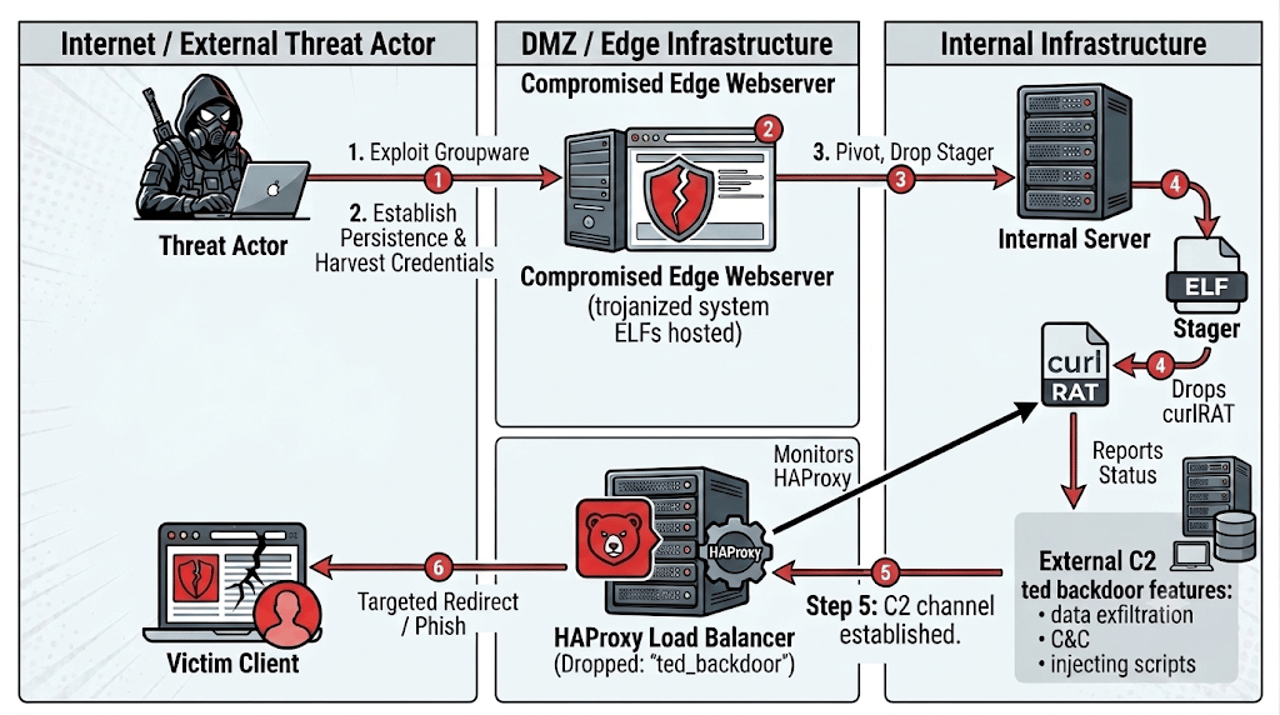
North Korean-linked hackers found a genuinely clever hiding spot for their malware: inside the actual source code of HAProxy, the load balancing software running at the edge of two South Korean companies’ networks. Rapid7’s research documents a previously undocumented Linux toolkit hitting South Korea’s automotive and media sectors, and the depth of integration here goes well beyond a typical backdoor bolted onto a system.

“A new Linux toolkit, identified by Rapid7 Labs, has been targeting organizations across South Korea’s automotive and media industries with minimal detection. The campaign made use of a HAProxy instance named “ted backdoor”, alongside trojanized versions of crond, agetty, atd, sshd, and polkitd.” reads the report published by Rapid7. “This previously undocumented framework enabled threat actors to execute remote commands on compromised servers, inject malicious scripts into web traffic, perform credential harvesting, and engage in long-term surveillance.”

The implant, which Rapid7 calls the “ted backdoor” based on debug strings the attackers left behind, isn’t a separate process running alongside HAProxy. It’s compiled directly into HAProxy’s own source code as a custom plugin, using the software’s native filter API, internal memory management, and event scheduler to intercept HTTP traffic while completely legitimate load balancing keeps running normally on top of it.

“The standout feature of this toolkit is its depth of integration with the target environment. The ted backdoor is compiled as part of the victim’s existing HAProxy version 2.8.12.” continues the report. “It uses its native filter API, internal memory pools, event scheduler, and process management infrastructure to intercept traffic and hide from monitoring, while genuine load balancing traffic operates as expected.”

Rapid7 explains, which is really the whole thesis of why this backdoor is so hard to spot: it’s not an addition to the software, it’s woven into it.

The backdoor receives commands through a surprisingly simple trick. The attackers send a request for a fake image at /favorite_list_2x_m500_ico.jpg. This switches the HAProxy filter into command-and-control mode.

The malware then saves the command in a named pipe and removes traces of the request from HAProxy’s internal counters. It also clears the forwarding buffers, so the request never reaches the backend server. The command ends at the load balancer, leaving nothing in the application logs to show that it happened.

This ability to erase its own traces makes the backdoor very different from a normal web shell. The C2 requests never reach the backend server and are also removed from HAProxy’s statistics.

As a result, neither the application logs nor HAProxy’s connection logs show that the attack happened. A security team checking the logs could find nothing suspicious because the backdoor has already erased the evidence.

Beyond remote command execution, the backdoor can quietly inject malicious scripts or entirely swap out page content for specific victims matched by IP address, browser fingerprint, or even a hidden authentication credential smuggled inside the Accept-Language header, effectively turning a company’s own load balancer into a watering hole against its own visitors. It also hooks response bodies carefully enough to hide the size difference caused by injected content, stripping the header that would let a browser notice the byte-range mismatch. That’s a level of protocol-level care that suggests real HAProxy internals expertise, not a quick copy-paste job.

The main backdoor also comes with a separate toolkit that modifies common Linux system daemons such as crond, agetty, atd, and sshd. These programs continue to work normally but also carry malicious features.

One component acts as an SSH keylogger. It captures passwords that administrators enter in plain text and quietly records them. Another tool, called curlRAT, contacts a remote server every 12 hours by default, or every 30 seconds when the attacker enables its fast-poll mode.

curlRAT also checks whether the system runs inside a virtual machine. If it does not find the expected signs, it refuses to run. This behavior suggests the attackers designed the malware to avoid sandboxes and other analysis environments.

Attribution here sits at medium confidence, and Rapid7 is upfront about the limits of what the evidence actually shows. The targeting pattern, simple XOR-based encryption, a custom substitution cipher, and command-server infrastructure already linked to APT37 by other threat intelligence feeds all point toward North Korean state involvement, with some technical overlap also drawing comparisons to a concurrent Lazarus Group campaign against South Korean media sites.

“Further evidence is necessary to make a more definitive assessment. Moreover, the presence of ngx_* prefixed routines within the ted backdoor suggest code reused from an nginx backdoor. The ngx_* prefixed routines were observed during the latest Funnull campaign, where (similar to our case) a custom nginx filter was registered to hook HTTP traffic, and simple XOR encryption was applied to the configuration file.” Rapid7 states. “However, other than a similar naming convention, no significant code-level overlaps exist to support a stronger linkage.”

If your organization runs HAProxy, or really any edge component handling SSL termination and traffic routing, the practical lesson here is uncomfortable but simple: that software deserves the same scrutiny as your actual application servers, not less. The Hacker News confirmed in early September that the specific command domains used in this campaign have already gone dark, returning no DNS records at all, which is useful for reviewing historical logs but does nothing to stop whatever comes next from the same operators. Checking a load balancer’s own logs isn’t enough anymore when the backdoor’s entire design goal is making sure those logs never see it in the first place.

“ted backdoor and curlRAT were designed to persist during long-term espionage operations with the ability to steal cookie sessions, credentials, redirect selected users, conduct drive-by download attacks, and hide evidence of the tampered page to a specific range of IPs to evade detection.” concludes the report. “Defenders should treat any edge component managing user traffic, SSL, or runtime modules with the same strict security standards as their main application servers. Relying on the component’s own logs is not enough; securing these systems requires independent network correlation, memory behavioral analysis, and binary integrity checks.”

Follow me on Twitter: @securityaffairs and Facebook and Mastodon

Pierluigi Paganini

(SecurityAffairs – hacking, North Korea)

Antes de ontemCybersecurity News
  • ✇Cybersecurity News
  • Silver Fox Fake Software Installers Disable Windows Defender Do Son
    Silver Fox fake software installers impersonate Razer and Edge to disable Windows Defender and deploy malware. See how the campaign works. Related Posts: PHP Web Server Rootkit Targets F5 BIG-IP Devices StreamRat Banking Trojan Targets Spanish Android Users The Gentlemen Ransomware Deploys in Under 24 Hours The post Silver Fox Fake Software Installers Disable Windows Defender appeared first on Daily CyberSecurity.
     
  • ✇Cybersecurity News
  • Linux Kernel 7.1 Reaches End of Life Do Son
    The Linux Kernel 7.1 EOL has officially arrived. Discover the final updates and learn why you must upgrade to the latest stable LTS releases immediately. Related Posts: CERN to Move 2,200 Accelerator Control Machines to Debian 13 Debian 11 Reaches End of Long Term Support Linux Nears USB4 Support for Apple Silicon The post Linux Kernel 7.1 Reaches End of Life appeared first on Daily CyberSecurity.
     

Linux Kernel 7.1 Reaches End of Life

Por:Do Son
7 de Setembro de 2026, 00:33

The Linux Kernel 7.1 EOL has officially arrived. Discover the final updates and learn why you must upgrade to the latest stable LTS releases immediately.

Related Posts:

The post Linux Kernel 7.1 Reaches End of Life appeared first on Daily CyberSecurity.

How a hole in Lenovo’s login system let hackers walk into 5,000 Dropbox accounts

7 de Setembro de 2026, 07:30
If you ever linked your Dropbox account to a Lenovo ID - perhaps to make life easier when logging in via a Lenovo laptop - you might want to take heed. Read more in my article on the Hot for Security blog.

Tengu Mirai-Style Linux Bot Hides as Kernel Worker to Launch DDoS and Proxy Attacks

A newly analyzed Linux malware sample, dubbed Tengu, combines Mirai-style botnet tradecraft with broad persistence, DDoS, SSH probing, and proxy capabilities. The stripped 32-bit ELF masquerades as a Linux kernel worker process while targeting servers, embedded devices, and IoT-adjacent systems. It has no symbols, uses NX protection and partial RELRO, and carries a SHA-256 hash […]

The post Tengu Mirai-Style Linux Bot Hides as Kernel Worker to Launch DDoS and Proxy Attacks appeared first on GBHackers Security | #1 Globally Trusted Cyber Security News Platform.

  • ✇Cybersecurity News
  • FreeSWITCH api-chat RCE Exploited in the Wild, Patch Now Do Son
    A FreeSWITCH vulnerability in api-chat enables remote code execution and is exploited in the wild. Upgrade to 1.11.3 now to stay safe. Related Posts: Linux Kernel Vulnerability CVE-2024-26582: Public PoC Reaches Root Shell NTLM Reflection Bypass CVE-2026-24294 Gets Public PoC Exploit Public Details Disclosed: MediaTek t7xx WWAN Flaw The post FreeSWITCH api-chat RCE Exploited in the Wild, Patch Now appeared first on Daily CyberSecurity.
     
  • ✇Cybersecurity News
  • CVE-2026-52924 PoC Exploit Disclosed: 9.8 CVSS Linux Root Privilege Escalation Do Son
    Security researchers released a Linux CVE-2026-52924 PoC exploit. Check flaw details and patch instructions to secure your systems against root takeovers. Related Posts: MikroTik RouterOS Vulnerability Exploited in the Wild: Patch and Defense Blueprint StyleSmuggler: Magento Zero-Day RCE Exploited in the Wild CVE-2026-75754 (CVSS 10): ASUS Control Center Root RCE The post CVE-2026-52924 PoC Exploit Disclosed: 9.8 CVSS Linux Root Privilege Escalation appeared first on Daily CyberSecurity.
     
  • ✇Cybersecurity News
  • GPT-6 Astra Updates Codex Pricing Do Son
    Discover the new GPT-6 Astra Codex pricing policy. OpenAI now removes multiplier penalties for contexts exceeding 272K, offering flat rates up to 1M tokens. Related Posts: Google Workspace Integrates Gemini Live Features Court Upholds Edge Gatekeeper Exemption Microsoft Defender Intercepts Legitimate Links The post GPT-6 Astra Updates Codex Pricing appeared first on Daily CyberSecurity.
     

GPT-6 Astra Updates Codex Pricing

Por:Do Son
4 de Setembro de 2026, 00:20

Discover the new GPT-6 Astra Codex pricing policy. OpenAI now removes multiplier penalties for contexts exceeding 272K, offering flat rates up to 1M tokens.

Related Posts:

The post GPT-6 Astra Updates Codex Pricing appeared first on Daily CyberSecurity.

  • ✇Cybersecurity News
  • Plex Issues Urgent Security Update for Media Server and Desktop Do Son
    Plex urges an urgent security update to Media Server 1.43.3 and Desktop 1.115.0. NAS and Docker users may need to patch manually. Related Posts: MikroTik RouterOS Vulnerability Exploited in the Wild: Patch and Defense Blueprint StyleSmuggler: Magento Zero-Day RCE Exploited in the Wild CVE-2026-75754 (CVSS 10): ASUS Control Center Root RCE The post Plex Issues Urgent Security Update for Media Server and Desktop appeared first on Daily CyberSecurity.
     
  • ✇Cybersecurity News
  • CERN to Move 2,200 Accelerator Control Machines to Debian 13 Do Son
    CERN's Debian migration moves 2,200+ accelerator control machines off Red Hat, driven by RHEL's raised x86-64 CPU baseline. Related Posts: Debian 11 Reaches End of Long Term Support Linux Nears USB4 Support for Apple Silicon Debian AI Policy: Responsible Generative AI Use Wins Vote The post CERN to Move 2,200 Accelerator Control Machines to Debian 13 appeared first on Daily CyberSecurity.
     

SonicWall Warns of Two Actively Exploited SMA1000 Zero-Days, One Rated Maximum Severity

3 de Setembro de 2026, 04:47

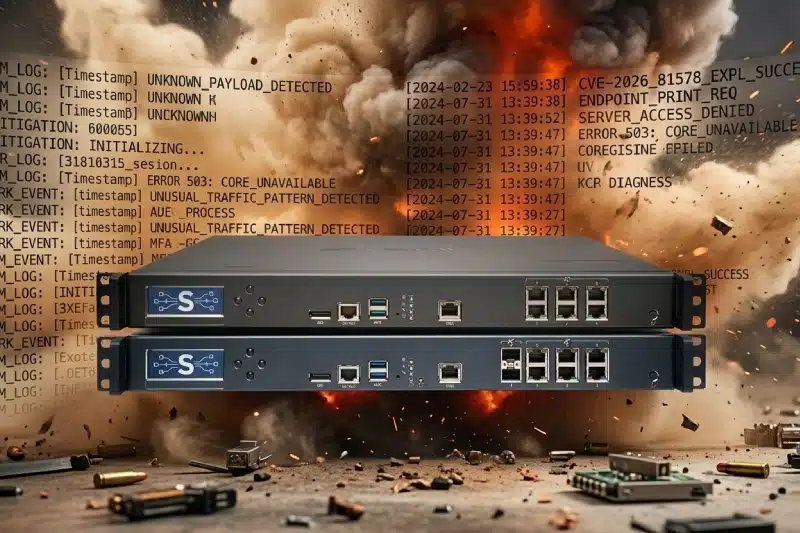
Graphic showing SonicWall SMA1000 devices, CVE-2026-83548, the maximum-severity SonicWall SMA1000 pre-authentication vulnerability

SonicWall disclosed this week that attackers are chaining two previously unknown vulnerabilities in its SMA1000 secure access appliances to run commands on unpatched devices, and urged customers to install an emergency hotfix.

The more severe flaw, CVE-2026-83548, is a pre-authentication server-side request forgery weakness in the appliance's Appliance Work Place interface, rated 10.0 on the CVSS scale. It lets a remote attacker with no credentials reach sensitive internal functionality. The second, CVE-2026-83549, is an operating-system command injection bug in the Appliance Management Console rated 7.8; on its own it requires administrative authentication, but paired with the SSRF flaw it yields remote code execution.

The vendor said it found both issues internally and then observed them being used together in live attacks. SonicWall has not published indicators of compromise or described the attackers.

Affected products are the SMA1000 series 6210, 7210 and 8200v, in both hardware and virtual form. Fixed builds are 12.4.3-03526 and later, and 12.5.0-02952 and later. SonicWall firewalls running SSL-VPN and the separate SMA 100 line are not affected.

Remediation guidance goes beyond patching. SonicWall told customers to contact its support organization to review appliances for signs of intrusion and, where compromise is suspected, to re-image or redeploy the device, rotate all credentials and reset TOTP tokens — an acknowledgment that one-time-password seeds stored on a breached appliance survive a software update. The company said customers should move to the hotfix release as quickly as possible.

Shadowserver Foundation scanning has tracked more than 400 internet-exposed SMA1000 appliances, though an unknown share of those are already patched. The small install base belies the risk profile. These are remote-access gateways that sit at the network edge and hold credentials for the environments behind them.

The disclosure extends a difficult run for the product line. Attackers exploited a separate pair of SMA1000 zero-days in July 2026, tracked as CVE-2026-15409 and CVE-2026-15410, to deploy custom malware; CISA later confirmed ransomware operators were abusing that access.

Read: CISA Adds SonicWall SMA1000 Vulnerabilities to KEV Catalog Following Active Exploitation

Another zero-day surfaced in December 2025. Seventeen SonicWall vulnerabilities across the company's product families currently sit in CISA's Known Exploited Vulnerabilities catalog. Edge appliances from SonicWall, Ivanti, Citrix and Fortinet have collectively become the preferred initial-access route for ransomware affiliates and espionage crews, because they are internet-facing by design and rarely instrumented with endpoint detection.

  • ✇Firewall Daily – The Cyber Express
  • DOJ Investigates Cyberattack Targeting Hundreds of Thousands of X Users Ashish Khaitan
    A cyberattack on X users that targeted hundreds of thousands of accounts has prompted an investigation by the US Department of Justice (DOJ), with Attorney General Todd Blanche saying sophisticated cybercriminals attempted to exploit the platform's password-recovery system. The DOJ is working with Elon Musk's X, formerly known as Twitter, to identify those responsible for the attempted attack, according to Blanche's statement on Wednesday. The incident involved hundreds of thousands of X user
     

DOJ Investigates Cyberattack Targeting Hundreds of Thousands of X Users

3 de Setembro de 2026, 02:30

cyberattack on X users

A cyberattack on X users that targeted hundreds of thousands of accounts has prompted an investigation by the US Department of Justice (DOJ), with Attorney General Todd Blanche saying sophisticated cybercriminals attempted to exploit the platform's password-recovery system. The DOJ is working with Elon Musk's X, formerly known as Twitter, to identify those responsible for the attempted attack, according to Blanche's statement on Wednesday. The incident involved hundreds of thousands of X users and was disrupted before the targeted accounts could be captured, Blanche said.

Blanche Says DOJ Is Tracking Those Behind Cyberattack on X Users 

In a statement posted on X, Blanche described the incident as a password-recovery attack carried out by "sophisticated cyber criminals." He said X managed to disrupt the effort and prevent user accounts from being taken over.  Blanche wrote: 
This week, sophisticated cyber criminals attempted a password-recovery attack on hundreds of thousands of X users. X disrupted the attack to prevent user accounts from being captured. But, as we’ve shown, the Justice Department will stop at nothing in its pursuit of cyber fraudsters and scammers. We are working closely with @X to track down the criminals behind this week’s attack. There is no refuge for those that perpetrate their criminal schemes from behind computer screens." 
The attorney general did not disclose additional technical details about the cyberattack on X users, including how the attackers attempted to exploit the recovery system, whether any individual accounts were compromised, or where the suspected criminals were operating from.  The DOJ investigation is intended to identify those responsible for the attempted intrusion, with Blanche emphasizing that authorities would pursue individuals involved in cyber fraud and scams even when those activities are conducted remotely. 

How the Password-Recovery Attack Works 

A password-recovery attack generally targets the systems users rely on when they have forgotten their login credentials. These processes can include "forgot password" features, account-recovery forms, and other mechanisms designed to help legitimate users regain access to their accounts. Attackers may attempt to exploit weaknesses in those processes to obtain access to accounts. In the incident involving X, the platform was able to disrupt the effort before the targeted accounts were captured, according to Blanche. The scale of the attempted cyberattack on X users—hundreds of thousands of accounts—makes the incident notable, although the attorney general did not provide a breakdown of how many accounts were actually affected or whether any users suffered losses. 

AI-Driven Cyberattacks Add to Growing Security Concerns 

The X incident comes against a wider backdrop of increasing cybersecurity threats facing companies and organizations around the world.  Businesses have been dealing with a rise in AI-driven cyberattacks as well as ransomware campaigns capable of stealing sensitive information, interrupting operations, and creating significant financial and operational damage.  The growing use of artificial intelligence in cyber operations has raised concerns that attackers can automate or accelerate parts of their campaigns. At the same time, organizations are exploring ways to use AI-based systems to identify vulnerabilities and strengthen their defenses.  The DOJ has also been pursuing cases involving sophisticated cyber operations. Days before news of the cyberattack on X users, the department announced an operation targeting QTFY, described by US authorities as a Chinese cyberespionage platform. 

DOJ Previously Targeted QTFY Cyberespionage Platform 

According to the Justice Department, QTFY had targeted several US institutions and organizations. Those named by the department included the US Senate, the Federal Reserve, and NASA, among others.  The action against QTFY highlights the broader range of cyber threats confronting US institutions, from espionage operations to attacks aimed at obtaining access to online accounts.  The latest investigation involving X therefore comes amid a broader push by US authorities to identify and disrupt cyber criminals and state-linked cyber operations. 
  • ✇Cybersecurity News
  • Amatera Password Stealer Abuses Service Workers and Smart Contracts Do Son
    A new Amatera password stealer campaign abuses WordPress and EtherHiding. Learn how this Amatera password stealer infects browsers. Related Posts: Malicious Browser Extensions Drain Crypto Wallets PackClient RAT: New C2 Framework Sold on Telegram Miraak Post Exploitation Framework Adopts Database C2 The post Amatera Password Stealer Abuses Service Workers and Smart Contracts appeared first on Daily CyberSecurity.
     
  • ✇Cybersecurity News
  • Debian 11 Reaches End of Long Term Support Do Son
    Debian 11 LTS ends on August 31, 2026. Discover upgrade options and extended paid support details for enterprises still running the older Linux version. Related Posts: Linux Nears USB4 Support for Apple Silicon Debian AI Policy: Responsible Generative AI Use Wins Vote California Exempts Linux from Age Verification The post Debian 11 Reaches End of Long Term Support appeared first on Daily CyberSecurity.
     

Debian 11 Reaches End of Long Term Support

Por:Do Son
1 de Setembro de 2026, 22:18

Debian 11 LTS ends on August 31, 2026. Discover upgrade options and extended paid support details for enterprises still running the older Linux version.

Related Posts:

The post Debian 11 Reaches End of Long Term Support appeared first on Daily CyberSecurity.

  • ✇Cybersecurity News
  • CVE-2026-9586: Switchvox RCE Exploited in the Wild Do Son
    CVE-2026-9586, a critical Sangoma Switchvox vulnerability, is exploited in the wild, giving unauthenticated attackers SQL injection and remote code execution. Related Posts: Critical Google Chrome Vulnerabilities Patched in New Update CVE-2026-80047: Hugging Face Transformers Library Vulnerability CVE-2026-68162: Linux Kernel Root Escalation PoC Public The post CVE-2026-9586: Switchvox RCE Exploited in the Wild appeared first on Daily CyberSecurity.
     
  • ✇Cybersecurity News
  • Cambodia Malware Campaign Uses PNG Files to Deliver SparkRAT Do Son
    A Cambodia malware campaign hides SparkRAT in PNG files and abuses a vulnerable driver to kill antivirus, Acronis TRU reports. Related Posts: Dark Caracal Deploys New GoCaracal Malware Framework BREEZE COMET Threat Actor Attacks Brazilian Banks AnonyMousKIT Uses AI Voice Calls to Unlock Stolen iPhones The post Cambodia Malware Campaign Uses PNG Files to Deliver SparkRAT appeared first on Daily CyberSecurity.
     
  • ✇Cybersecurity News
  • Codex Modifies Long Task Management Do Son
    The Codex context mechanism redesign introduces persistent notes and history tools. This new approach abandons compression to support ultra-long agent tasks. Related Posts: EU Classifies ChatGPT as Search Engine ChatGPT Advertising Revenue Soars Gemini Notebook Adopts Dynamic Quota System The post Codex Modifies Long Task Management appeared first on Daily CyberSecurity.
     

Codex Modifies Long Task Management

Por:Do Son
1 de Setembro de 2026, 00:49

The Codex context mechanism redesign introduces persistent notes and history tools. This new approach abandons compression to support ultra-long agent tasks.

Related Posts:

The post Codex Modifies Long Task Management appeared first on Daily CyberSecurity.

  • ✇Cybersecurity News
  • Linux Nears USB4 Support for Apple Silicon Do Son
    Discover how the Asahi Linux project is successfully pushing vital USB4 protocol drivers for Apple Silicon directly into the mainline Linux kernel. Related Posts: Debian AI Policy: Responsible Generative AI Use Wins Vote California Exempts Linux from Age Verification Ubuntu 26.04.1 LTS Released with Crucial Bug Fixes The post Linux Nears USB4 Support for Apple Silicon appeared first on Daily CyberSecurity.
     

Linux Nears USB4 Support for Apple Silicon

Por:Do Son
31 de Agosto de 2026, 23:31

Discover how the Asahi Linux project is successfully pushing vital USB4 protocol drivers for Apple Silicon directly into the mainline Linux kernel.

Related Posts:

The post Linux Nears USB4 Support for Apple Silicon appeared first on Daily CyberSecurity.

❌
❌