Learn how to securely handle user documents in authentication and onboarding systems to protect data, ensure compliance, and prevent breaches.
The post Handling User Documents Securely in Authentication and Onboarding Systems appeared first on Security Boulevard.
Apr 28, 2026 - Lina Romero - What the EU AI Act demandsThe EU AI Act classifies AI according to risk. Unacceptable risk is prohibited outright. High-risk AI systems are heavily regulated. Limited-risk systems face transparency obligations. The majority of obligations fall on providers, though deployers carry meaningful obligations too. If your organisation builds AI, buys AI, or integrates AI into operational processes, the Act applies to you. If your systems serve EU users and you are headquart
Apr 28, 2026 - Lina Romero - What the EU AI Act demandsThe EU AI Act classifies AI according to risk. Unacceptable risk is prohibited outright. High-risk AI systems are heavily regulated. Limited-risk systems face transparency obligations. The majority of obligations fall on providers, though deployers carry meaningful obligations too. If your organisation builds AI, buys AI, or integrates AI into operational processes, the Act applies to you. If your systems serve EU users and you are headquartered outside the EU, it still applies to you.For high-risk AI systems, providers must establish a risk management system throughout the system's lifecycle, conduct data governance to ensure training and testing datasets are relevant and representative, produce technical documentation demonstrating compliance, design systems to allow for human oversight, and achieve appropriate levels of accuracy, robustness, and cybersecurity. The Act treats security as foundational to compliance.The compliance gap is a security gapMost organisations approaching the EU AI Act treat it as a governance and legal challenge. They produce AI registers, draft risk classification matrices, and build working groups. That work has value. But it systematically misses the deeper problem.The compliance gap is a security gap. The same reasons that make AI systems hard to secure are the reasons they are hard to govern. You cannot log what you cannot see. You cannot classify what you have not discovered. And you cannot demonstrate to a regulator that your controls are working if those controls only exist as policies on paper.More than 80% of employees use AI tools that have not been approved by their organisation. The AI systems that appear in your register and the AI systems that are actually operating in your environment are different populations. Shadow AI is the dominant reality of how AI is being adopted at scale. Any compliance program that relies on self-reporting to build its inventory has already accepted an undercount of its exposure.The logging mandate is a technical obligationArticle 12 of the EU AI Act requires that high-risk AI systems technically allow for the automatic recording of events over the lifetime of the system. Technically means the capability must be built into or applied to the system itself. Automatic means logs are generated without operator intervention at the moment events occur. Lifetime means from deployment to decommissioning.Article 26 requires automatically generated logs to be retained for a minimum of six months. The organisations that will be best positioned when enforcement begins are not the ones that start building logging infrastructure in July 2026. They are the ones generating six months of compliant, continuous, tamper-evident logs already. If you wait till the enforcement date, you are already behind.Prohibited practices are already enforceableThe prohibited AI practices under Chapter II became enforceable in February 2025. However, the enforcement deadline that most organisations are focused on is August 2026. Compliance with the prohibited practices provisions is a matter of ensuring that systems do not drift into prohibited behaviour. A system that was not designed to manipulate can evolve into one that does. Detecting that change requires continuous behavioural monitoring.The GDPR parallelOrganisations that lived through GDPR's May 2018 enforcement date will recognise what is coming. In the months before that deadline, many organisations had produced detailed documentation: data processing registers, privacy notices, breach notification procedures. On paper, they were prepared. In practice, many discovered that their processes did not work, their data maps were incomplete, and their policies had never been technically enforced.The organisations that struggled most under GDPR were those that had treated compliance as a documentation exercise rather than an operational transformation. The EU AI Act presents the same dynamic, with two important differences. 1. Its technical obligations are more demanding than GDPR's2. Its fine structure is more severe. Violations of the prohibited practices provisions can be more expensive than even the most serious GDPR breaches.What closing the gap requiresBridging the EU AI Act compliance gap requires a shift from periodic assurance to continuous control and continuous automated discovery of AI usage across cloud infrastructure, browser-based activity, and application-layer integrations. You need to know about every AI system in your environment, including the ones nobody approved.It requires automated risk classification that maps discovered systems against the Act's risk tiers in real time — not at the next quarterly audit cycle. The Act's obligations follow from classification, so classification needs to be live.It requires centralised logging that captures every relevant interaction with high-risk AI systems automatically, retains logs for the mandated minimum of six months, and makes those logs available for regulatory review on demand.It requires real-time behavioural monitoring that detects patterns approaching prohibited practice thresholds, anomalous outputs that may signal misuse, and adversarial inputs designed to subvert system behaviour.And it requires technical policy enforcement at the point of use. A governance policy that prohibits certain AI uses but has no technical mechanism preventing them is not a control.The question that mattersThe question is not whether you have completed your AI Act checklist. It is whether you could answer a regulator's questions about your AI systems today, and whether the infrastructure you have built is capable of answering those questions six months from now.If the answer is uncertain, the gap is real. And the time to close it is before enforcement, not after.Need help with your compliance? FireTail is here: https://www.firetail.ai/schedule-your-demo
7 proven passkey deployment lessons from eBay, HubSpot, Revolut, and VicRoads. Covers enrollment design, mobile-first strategy, account recovery UX, device rotation handling, and the login success rate metric that actually predicts FIDO2 rollout success.
The post 7 Passkey Deployment Lessons from eBay, HubSpot, Revolut, and VicRoads appeared first on Security Boulevard.
Discover the 9 most dangerous identity-based threats in 2026, from AI phishing attacks and deepfake authentication bypass to MFA fatigue and harvest-now-decrypt-later quantum threats. Learn why legacy authentication fails against each one and how phishing-resistant, passwordless authentication changes the equation.
The post 9 Identity-Based Threats Redefining Cybersecurity in 2026 (Beyond Credential Stuffing) appeared first on Security Boulevard.
Discover the 9 most dangerous identity-based threats in 2026, from AI phishing attacks and deepfake authentication bypass to MFA fatigue and harvest-now-decrypt-later quantum threats. Learn why legacy authentication fails against each one and how phishing-resistant, passwordless authentication changes the equation.
Discover the 13 hidden costs of password-based authentication, from $70-per-reset help desk overhead to SMS OTP fees and breach exposure. Includes a simple ROI worksheet formula to calculate your organization's annual password tax and build the business case for passwordless authentication
The post 13 Hidden Costs of Password-Based Authentication (With Real ROI Math) appeared first on Security Boulevard.
Discover the 13 hidden costs of password-based authentication, from $70-per-reset help desk overhead to SMS OTP fees and breach exposure. Includes a simple ROI worksheet formula to calculate your organization's annual password tax and build the business case for passwordless authentication
Run a quick self-audit against 10 warning signs that your authentication stack has critical vulnerabilities. Each sign includes a diagnostic check, an explanation of why it's dangerous, and a concrete fix. Covers SMS OTP risk, bot detection gaps, session management failures, and more.
The post 10 Warning Signs Your Current Authentication Stack Is a Breach Waiting to Happen appeared first on Security Boulevard.
Run a quick self-audit against 10 warning signs that your authentication stack has critical vulnerabilities. Each sign includes a diagnostic check, an explanation of why it's dangerous, and a concrete fix. Covers SMS OTP risk, bot detection gaps, session management failures, and more.
Explore the 15 most expensive credential stuffing attacks of the decade. Learn the critical authentication lessons to protect your business from account takeover.
The post 15 Costliest Credential Stuffing Attack Examples of the Decade (and the Authentication Lessons They Teach) appeared first on Security Boulevard.
Explore the 15 most expensive credential stuffing attacks of the decade. Learn the critical authentication lessons to protect your business from account takeover.
A deep dive into OpenAI’s Privacy Filter, benchmarking its PII detection performance against Tonic Textual on real-world datasets. We explore where the model succeeds, where it struggles, and how fine-tuning with labeled data impacts accuracy across domains like healthcare, legal, and web data.
The post Benchmarking OpenAI’s Privacy Filter: What it gets right, and where PII detection still needs real data appeared first on Security Boulevard.
A deep dive into OpenAI’s Privacy Filter, benchmarking its PII detection performance against Tonic Textual on real-world datasets. We explore where the model succeeds, where it struggles, and how fine-tuning with labeled data impacts accuracy across domains like healthcare, legal, and web data.
Learn how to use lattice-based signature schemes like CRYSTALS-Dilithium for securing Model Context Protocol (MCP) host authentication in a post-quantum world.
The post Lattice-based Signature Schemes for MCP Host Authentication appeared first on Security Boulevard.
Learn how to use lattice-based signature schemes like CRYSTALS-Dilithium for securing Model Context Protocol (MCP) host authentication in a post-quantum world.
Blog Announcing Menlo AI Adaptive DLP - AI-based sensitive data detection and masking. File delivery rather than blocking. Cloud-based, zero endpoint footprint.
The post DLP That Doesn’t Make You Choose: Introducing Menlo AI Adaptive DLP – Blog | Menlo Security appeared first on Security Boulevard.
Blog Announcing Menlo AI Adaptive DLP - AI-based sensitive data detection and masking. File delivery rather than blocking. Cloud-based, zero endpoint footprint.
Learn how ML-based anomaly detection stops metadata exfiltration in post-quantum AI environments and secures MCP infrastructure against advanced threats.
The post ML-Based Anomaly Detection for Post-Quantum Metadata Exfiltration appeared first on Security Boulevard.
Learn how ML-based anomaly detection stops metadata exfiltration in post-quantum AI environments and secures MCP infrastructure against advanced threats.
Apr 21, 2026 - Alan Fagan - Most conversations about the EU AI Act focus on August 2026, when obligations for high-risk AI systems become fully enforceable. But Article 5 is already live. The Act’s eight prohibited practices became enforceable in February 2025. Fines of up to €35 million or 7% of global annual turnover apply now. And the infrastructure to act on violations is in place.
For AI providers operating in or serving the EU market, understanding Article 5 is critical.
The EU AI Act take
Apr 21, 2026 - Alan Fagan - Most conversations about the EU AI Act focus on August 2026, when obligations for high-risk AI systems become fully enforceable. But Article 5 is already live. The Act’s eight prohibited practices became enforceable in February 2025. Fines of up to €35 million or 7% of global annual turnover apply now. And the infrastructure to act on violations is in place.
For AI providers operating in or serving the EU market, understanding Article 5 is critical.
The EU AI Act takes a risk-based approach to AI governance. The practices represent the EU's judgement that certain applications of AI are incompatible with fundamental rights and democratic values, and the European Commission reinforced that position in the guidelines it published on 4 February 2025, two days after the prohibitions.
The guidelines break each prohibition into cumulative conditions and provide practical examples of what falls in scope and what does not. They are the clearest signal available of how regulators will interpret borderline cases.
The penalty structure reflects the seriousness with which the EU treats these provisions. At up to €35 million or 7% of global annual turnover, violations of Article 5 carry steeper fines than any other category of non-compliance in the Act.
The Eight Prohibitions
1. Subliminal and Manipulative Techniques
AI systems that deploy techniques operating below conscious awareness, or that exploit psychological vulnerabilities, biases, or weaknesses in decision-making to distort behaviour and cause significant harm, are banned.
The prohibition is targeted at systems designed to circumvent rational agency. It does not cover normal personalisation, recommendation engines, or advertising that simply presents persuasive content. The key conditions are that the technique must be subliminal or manipulative, and that it must cause or be reasonably likely to cause significant harm.
In practice, the compliance question for providers is whether their optimisation objectives could drive the system toward manipulative behaviour as a side effect. A recommender system trained purely on engagement maximisation can, over time, evolve into something that exploits psychological patterns in ways that meet the prohibition's conditions. 2. Exploiting Vulnerabilities
AI systems that exploit vulnerabilities arising from a person's age, disability, or socioeconomic circumstances to distort behaviour in ways that cause harm are banned.
The practical example that clarifies this prohibition is an AI advertising tool that identifies users showing signs of financial hardship, through search behaviour, location data, or device signals, and targets them with offers specifically designed to exploit that vulnerability. The Commission's guidelines explicitly name this kind of system as a violation.
This prohibition has direct implications for any AI system operating in consumer finance, healthcare, or social services, where users may be in vulnerable circumstances by definition. The question is not whether the system serves those users, but whether it is designed to exploit their circumstances rather than serve their interests.
3. Social Scoring
General-purpose social scoring of individuals or groups based on social behaviour or personal characteristics, leading to detrimental treatment in contexts unrelated to where the data was collected, is banned when conducted by or on behalf of public authorities.
This is the provision most directly aimed at preventing the kind of surveillance infrastructure that has emerged in certain authoritarian contexts. It applies to public authorities, but it also catches systems that aggregate data across domains in ways that create de facto social profiles affecting access to services, employment, or civic participation.
4. Predictive Policing Based on Profiling
AI systems that assess the likelihood of an individual committing a criminal offence solely on the basis of profiling or personality traits, absent objective and verifiable facts directly linked to criminal activity, are prohibited.
A retail security system that analyses CCTV footage to detect actual suspicious behaviour, such as someone concealing merchandise, is permitted because it reacts to observable actions. A system that flags customers as high risk based on demographic profiling, is not.
5. Untargeted Facial Recognition Scraping
Building or expanding facial recognition databases through untargeted scraping of facial images from the internet or CCTV footage is banned absolutely.
This provision addresses the data acquisition practices used by a number of controversial biometric surveillance providers in recent years. Several of these companies built large-scale facial recognition datasets by scraping billions of images from social media platforms and public web sources without consent. That practice is now illegal in the EU.
6. Emotion Inference in Workplaces and Educational Settings
A range of specialist vendors such as IBM, Microsoft, and Amazon have offered emotion detection capabilities through their cloud platforms and APIs. The global emotion AI market was valued at approximately $7.5 billion in 2024. Many of these tools were being actively evaluated or deployed in employee monitoring, productivity assessment, and remote meeting analysis contexts.
Since February 2025, deploying AI systems that infer the emotional states of individuals in workplaces or educational environments is prohibited in the EU. However, context is determinative. The same AI capability can be permitted in one setting and prohibited in another. Affect recognition technology used for driver safety monitoring in an automotive context has a different regulatory status from the identical technology embedded in an employer's video call analysis platform.
7. Biometric Categorisation by Sensitive Characteristics
AI systems that use biometric data to categorise individuals based on race, political opinions, religious or philosophical beliefs, sex life, or sexual orientation are prohibited.
The narrow exceptions cover the labelling or filtering of biometric datasets that are lawfully acquired, and law enforcement categorisation under strictly controlled conditions.
This prohibition catches systems that providers may not have characterised as biometric categorisation in their original design. Any model that takes facial, voice, or physiological inputs and produces outputs that correlate needs to be assessed carefully against this provision, regardless of the stated purpose.
8. Real-Time Remote Biometric Identification in Public Spaces
The real-time use of remote biometric identification systems in public spaces for law enforcement purposes is prohibited, with narrow exceptions.
Deployment requires a prior fundamental rights impact assessment under Article 27, judicial or independent administrative authorisation before use, and registration in the EU database. In genuine emergencies, use can begin before registration, but registration must follow immediately and the relevant authority must be notified.
This prohibition does not apply to private actors in non-law-enforcement contexts, but it sets a clear precedent for the EU's approach to real-time biometric surveillance in public life.
The Compliance Challenge
Understanding the prohibitions is only the first step. The challenge for providers is ensuring that their systems do not violate prohibitions through optimisation, fine-tuning, or integration with other services.
The European Commission states that deployers bear responsibility for how they use systems, regardless of what the provider's terms of service say. But the design, training, and integration choices that providers make set the boundaries within which deployers operate. Providers who build systems capable of prohibited practices, even if they prohibit those uses, are not fully insulated from regulatory attention if those capabilities are reasonably foreseeable.
Developers need to monitor how systems actually behave in deployment, not just design intent. The Enforcement Reality
Prohibited practices under Article 5 of the AI Act became enforceable on 2 August 2025. No formal enforcement actions have been publicly announced to date, but the architecture is in place and complaints from affected individuals or organisations can trigger investigations at any time.
The enforcement landscape varies by member state. Ireland's proposed implementation assigns prohibited practice enforcement to the Central Bank for financial services, the Workplace Relations Commission for employment contexts, and the Data Protection Commission for others. This means a single organisation with AI systems operating across multiple domains could face scrutiny from more than one authority simultaneously.
What This Means for AI Providers
Article 5 compliance requires ongoing technical visibility into how your systems behave, what data they process, and what outputs they produce. FireTail gives AI providers continuous monitoring and visibility across their deployed systems, capturing the inputs and outputs that compliance evidence requires, detecting patterns that approach prohibited practice thresholds, and generating the audit trail. When the enforcement window closes, that evidence is what separates organisations that were prepared from those that were not.
The prohibited practices provisions are live. The enforcement infrastructure is in place. The guidelines from the Commission have clarified how regulators will interpret the boundaries. The time to build the technical controls that demonstrate compliance is now.
Malicious browser extensions are an overlooked security threat with access to all your SaaS data. Learn how to detect and stop them before damage is done.
The post Malicious Browser Extensions: An Overlooked Security Threat appeared first on Security Boulevard.
Malicious browser extensions are an overlooked security threat with access to all your SaaS data. Learn how to detect and stop them before damage is done.
Explore the rise of remote jobs in cybersecurity and authentication, and discover career opportunities, skills, and trends shaping the future.
The post The Rise of Remote Jobs in Cybersecurity and Authentication appeared first on Security Boulevard.
Two weeks ago, Google’s Quantum AI group published a zero-knowledge proof of a quantum circuit so optimized, they concluded that first-generation quantum computers will break elliptic curve cryptography keys in as little as 9 minutes. Today, Trail of Bits is publishing our own zero-knowledge proof that significantly improves Google’s on all metrics. Our result is not due to some quantum breakthrough, but rather the exploitation of multiple subtle memory safety and logic vulnerabilities in Google
Two weeks ago, Google’s Quantum AI group published a zero-knowledge proof of a quantum circuit so optimized, they concluded that first-generation quantum computers will break elliptic curve cryptography keys in as little as 9 minutes. Today, Trail of Bits is publishing our own zero-knowledge proof that significantly improves Google’s on all metrics. Our result is not due to some quantum breakthrough, but rather the exploitation of multiple subtle memory safety and logic vulnerabilities in Google’s Rust prover code. Google has patched their proof, and their scientific claims are unaffected, but this story reflects the unique attack surface that systems introduce when they use zero-knowledge proofs.
Google’s proof uses a zero-knowledge virtual machine (zkVM) to calculate the cost of a quantum circuit on three key metrics. The total number of operations and Toffoli gate count represent the running time of the circuit, and the number of qubits represents the memory requirements. Google, along with their coauthors from UC Berkeley, the Ethereum Foundation, and Stanford, published proofs for two circuits; one minimizes the number of gates, and the other minimizes qubits. Our proof improves on both.
Resource Type
Google’s Low-Gate
Google’s Low-Qubit
Our Proof
Total Operations
17,000,000
17,000,000
8,300,000
Number of Qubits
1,425
1,175
1,164
Toffoli Count
2,100,000
2,700,000
0
Table 1: Resource upper bounds reported in different proofs for circuits computing the correct output across 9,024 randomly sampled inputs
Our proof fully verifies when using Google’s unpatched verification code. It has the same verification key as their original proofs and is cryptographically indistinguishable from a zero-knowledge proof resulting from actual algorithmic improvements to the quantum circuit. We are releasing the code we developed to forge the proof, and a summary of our proof follows.
Google used Succinct Labs’ SP1 zkVM for their proofs. A zkVM is essentially a way to prove that you know which private inputs for an arbitrary guest program on the zkVM generate some public output. For example, consider this basic Rust guest program.
#![no_main]sp1_zkvm::entrypoint!(main);pubfnmain(){// Read in private inputs a and b
leta=sp1_zkvm::io::read::<u32>();letb=sp1_zkvm::io::read::<u32>();// Add them together
letc=a+b;// Write the public output a + b
sp1_zkvm::io::commit(&c);}
A user can take the private inputs 2 and 3, run this program on the zkVM, and get a proof that the program ran successfully and that the output was 5. Anyone can verify the proof, but they would get zero knowledge about whether the input was (2, 3), (1, 4), or (6, 0xffffffff). Obviously, this toy problem is simple; real programs can be significantly more complicated.
Behind the scenes, the Rust guest program compiles down to a RISC-V ELF binary. This simple architecture allows complex program logic to be encoded into provable mathematical relationships. For example, the state of the RISC-V registers after executing an instruction is a deterministic function of their state before execution. Having to prove every step makes generating zkVM proofs resource-intensive and costly, but significant engineering work has enabled proving statements about complex programs.
Google’s zkVM guest
In the case of Google’s zero-knowledge proofs, the private input is the quantum circuit (in a custom assembly language), and the program is a simulator that checks the circuit. Note that these are “circuits” in the quantum sense, not the typical zero-knowledge definition. The public output includes bounds on the number of qubits and gate operations. In general, simulating quantum circuits is difficult, but the “kickmix” circuits defined in this paper refer to a specific subset that can be tested classically.
The following script, adapted from one of Google’s examples, increments a 3-qubit value. It includes three operations and a total of three qubits. Note that the first instruction CCX has two inputs (q0 and q1) and computes q2 = q2 ^ (q0 & q1). This is called a Toffoli gate. Toffoli gates are quite useful, but they’re much harder to implement on actual quantum hardware, so the complexity of quantum algorithms is sometimes measured in the number of Toffoli gates (or more accurately, non-Clifford gates). Circuits like this are serialized into bytes and sent to the zkVM simulator.
# Increment a value held in 3 qubits (q2, q1, q0). Sends
# (0, 0, 0) -> (0, 0, 1)
# (0, 0, 1) -> (0, 1, 0)
# ...
# (1, 1, 1) -> (0, 0, 0)

# If q0 and q1 are set, flip q2.
CCX q0 q1 q2
# If q0 is set, flip q1.
CX q0 q1
# Flip q0.
X q0
To verify that a circuit computes the correct function, the simulator deserializes the circuit, randomly initializes the qubits (e.g., to (1, 0, 1)), iteratively applies every operation in the circuit, and panics unless the final state is as expected (e.g., (1, 1, 0)). The simulator repeats this for many different inputs (9,024 times, to be precise), so proving that the simulator terminated without error is essentially the same as proving that the circuit is correct with high probability. In Google’s zkVM program, the circuit must compute one elliptic curve point addition, a critical subroutine of Shor’s algorithm for solving the elliptic curve discrete logarithm problem.
In addition to checking that the circuit computes the correct function, it also counts the total number of operations, the number of qubits, and the average number of Toffoli gates (some Toffoli gates are conditioned on classical bits and may be skipped during simulation). These performance metrics are checked to ensure they do not exceed specified upper bounds; if they don’t, the upper bounds are committed as public output.
Plan of attack
Since Google’s zero-knowledge proof comes from the results of running a Rust simulator on a private kickmix assembly script, we can create our own zero-knowledge proof by providing our own private input to the same program. If we find some input that causes the simulator to misreport the quantum costs, we’ll have successfully forged a proof. To beat Google’s results on any metric, we have the following goals:
Must compute elliptic curve point addition correctly
Preferably reports fewer than 17 million total operations
Preferably reports fewer than 2.1 million Toffoli gates
Preferably reports fewer than 1,175 qubits
This turns a quantum computing problem into an application security problem. Any deserialization bugs when parsing the kickmix circuit input are fair game, as well as any logic bugs we find in the simulator.
Vulnerability 1: Bypassing the Toffoli counter
One area of concern in the Rust source code was the use of unsafe blocks, disabling important memory safety checks. This was presumably done to reduce the overall cycle count of the zkVM guest program; each additional bounds check inflates the already substantial cost of generating a zero-knowledge proof, particularly checks that run millions of times. The vulnerability starts in the following two lines of code from program/src/main.rs.
The first line shows that private circuit bytes (private_circuit_bytes) are directly read from outside the zkVM, and the use of the rkyv serialization library’s access_unchecked function instructs the library to assume that private_circuit_bytes corresponds to a valid serialization. But data from outside the zkVM is untrusted, so what happens if the bytes, which are meant to represent a vector of circuit operations, are malformed?
The answer is “not much.” There are relative pointer offsets and length fields in the serialization for the Vec type, but I couldn’t see a viable path from manipulating those to getting the prover to underreport resource counts. The Op type is similarly simple, consisting of seven 32-bit fields: one describes the OperationType, and six describe the identifiers of which qubits and classical bits to use as inputs and outputs for the operation. For a while, I was chasing down a bug in how the magic identifier 0xffffffff could bypass the qubit count and trigger an out-of-bounds write in the array of simulated qubit values. I was deep in the details of understanding the Rust heap allocator used by the SP1 zkVM before a colleague pointed out that Google was using SP1’s 64-bit RISC-V architecture rather than the potentially exploitable 32-bit architecture.
That left the kind field, an enum describing which of the 18 supported kickmix OperationType opcodes to apply. When simulating the quantum circuit, the guest program iterates over the vector of operations and determines whether to conditionally execute each operation; if so, it increments the count of Toffoli or Clifford gates, depending on the operation type, and executes the operation. This code is in Simulator::apply_iter.
matchop.kind{OperationType::CCZ|OperationType::CCX=>{self.stats.toffoli_gates+=executed_shots;}OperationType::CX|OperationType::CZ|OperationType::Swap|OperationType::R|OperationType::Hmr=>{self.stats.clifford_gates+=executed_shots;}// Note: X and Z are not considered Clifford gates in the
// stats because they can be tracked in the classical control system.
// They don't need to cause something to happen on the quantum computer.
_=>{}}matchop.kind{OperationType::CCX=>{letv=cond&self.qubit(op.q_control1)&self.qubit(op.q_control2);*self.qubit_mut(op.q_target)^=v;}OperationType::CX=>{letv=cond&self.qubit(op.q_control1);*self.qubit_mut(op.q_target)^=v;}
What if op.kind falls outside of the expected 0–17 range because rkyv was instructed not to check this value during deserialization? This is undefined behavior, so to investigate, I used Ghidra to reverse-engineer the RISC-V ELF binary Google provided with their proof.
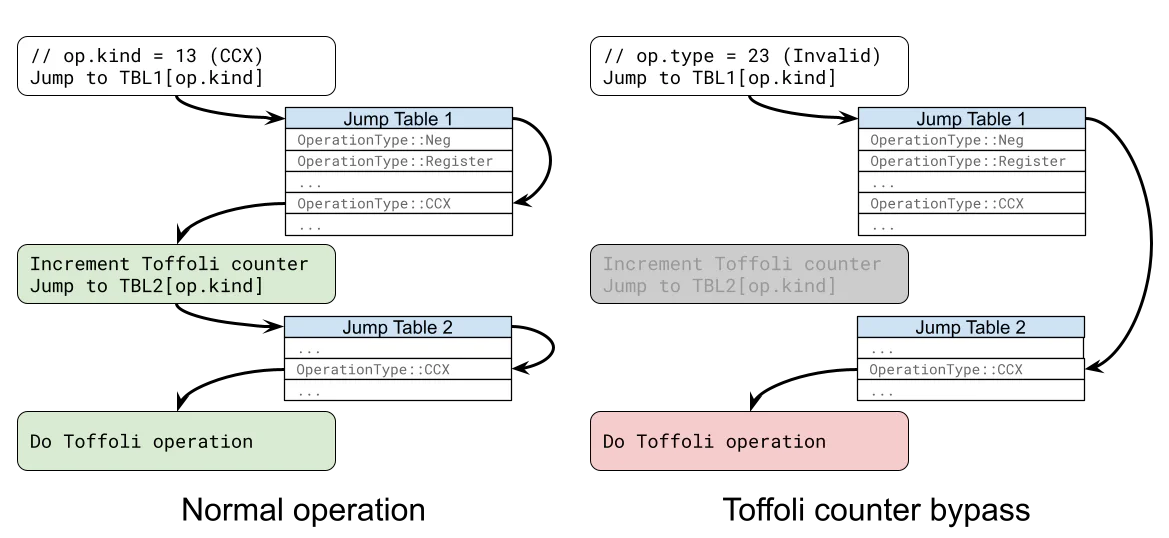
After identifying the location of this function in the binary, I discovered that the Rust compiler emits a pair of jump tables for these two match expressions. The first jump table determines which gate counter to increment, and the second performs the actual operation. But we maliciously control the value of op.kind, so what if instead of the normal behavior, we dereference past the end of the first jump table and directly jump to an address from the second jump table? Then an out-of-range OperationType could still perform the correct operation, but it would completely bypass the Toffoli counter!
Figure 1: In this simplified execution flow, providing an invalid operation type bypasses the Toffoli counter, giving the same functionality while hiding the true cost.
I calculated the necessary offsets, modified Google’s example prover code to inject the invalid operation types, and attempted to simulate a zero-knowledge proof of a simple 64-qubit adder circuit. To my surprise, it worked on the first try.
I had been concerned that the RISC-V registers would be in an invalid state when jumping into the wrong table, but this ended up not being the case. Now I had the primitive I needed to forge a circuit that misreports the number of Toffoli gates, and I just had to scale up my attack on the 64-qubit adder circuit to full elliptic curve point addition.
Building a quantum circuit
I now had a virtually unlimited budget for Toffoli operations, and the path forward looked simple. I could implement any kickmix circuit that correctly performs elliptic curve point addition without worrying about the Toffoli count, tweak the operation types before feeding the script to the prover, and then forge a proof for whatever Toffoli upper bound I wanted. I might use more total operations or more qubits than Google’s circuits, but it would be an amusing proof of concept. The only concern was that the prover’s running time is proportional to the total number of operations, so my circuit still needed a reasonably low operation count.
It turns out that programming a quantum computer is way more challenging than I anticipated, and this is because of the requirements of reversibility and uncomputation.
Requirement 1: Reversibility. A quantum circuit is made up of a series of reversible (unitary) gates. For kickmix circuits, think of these as reversible bit operations. For example, c’ = c XOR b is allowed because the original value of c can be recovered with c = c’ XOR b. On the other hand, c’ = c AND b is not allowed because if c’ and b are both 0, we cannot know if c was originally 0 or 1. By itself, AND is not reversible, but with an additional input in Toffoli gates, it is. The kickmix Toffoli operation CCX q1 q2 q3 updates q3 to q3’ = q3 XOR (q1 AND q2), and this operation can be reversed with q3 = q3’ XOR (q1 AND q2).
Requirement 2: Uncomputation. To avoid the undesirable effects of entanglement, any auxiliary (or ancilla) qubits used to store intermediate results of computation must be “uncomputed,” or reset to state 0. The reversibility requirement makes this a challenge, since the intermediate result may have been 0 or 1. The intermediate state must be uncomputed from the computation result in order to be reversibly cleared out.
As we try to build our reversible elliptic curve point addition circuit with uncomputation, a couple of tools are available. We could use Bennett’s trick, which involves preserving inputs and outputs in spare qubits, then running the full computation a second time in reverse to clear ancilla qubits. This approach isn’t ideal because it roughly doubles the operation count for each level of the call stack. Another approach is to use the more efficient measurement based uncomputation. Google has revealed that this is the technique their circuits use, but it requires a much finer-grained algorithmic analysis to apply correctly.
Vulnerability 2: Efficient operations with register aliasing
After struggling to implement elliptic curve point addition while keeping the operation count and qubit count low, I discovered another exploitable vulnerability: register aliasing. Recall the Toffoli (CCX) operation defined in Simulator::apply_iter.
There’s no check that the qubit inputs (op.q_control1 and op.q_control2) are different from the qubit output (op.q_target), so tying all three together becomes q1 = q1 ^ (q1 & q1) = 0. That is, we can immediately reset a qubit to zero, violating the quantum requirement of reversibility and making uncomputation trivial.1
Figure 2: By setting the output of a kickmix operation to the input, we can build circuits that violate quantum reversibility and implement arbitrary classical logic gates.
In addition, we can use this primitive to create any logical gate we want, like the classical AND gate that violates reversibility or the functionally complete NAND gate. Now that I don’t have to deal with the limitations of quantum circuits, it’s basically Nand2Tetris, except the goal is elliptic curve point addition. I implemented basic logic gates, followed by integer addition and subtraction, modular addition, modular multiplication, modular inversion, and, finally, point addition.
After exploiting a memory corruption issue in unsafe Rust code, implementing elliptic curve operations from the ground up using individual logic gates, and squeezing whatever performance I could out of the non-quantum aspects of the design, I finally had a working kickmix script that passed validation. 0 Toffolis, 8 million operations, and 1288 qubits. This beats one of Google’s two proofs but falls short of beating the other one by just 113 qubits.
If I wanted to truly claim that our zero-knowledge proof beat Google’s, I couldn’t leave it there. I needed to find some way to shave off 113 qubits, but I was all out of vulnerabilities.
The final challenge: Euclidean algorithm optimization
Profiling my circuit made it clear that the most expensive operation was modular inversion, and the same is true for many published quantum elliptic curve addition circuits. My optimized circuit required 4 field elements (1024 qubits) for the inversion, including some tricks to store intermediate field elements, and a handful of qubits for control flags and carry bits. If I were to beat Google’s proof, I needed to lose those tricks and do modular inversion using fewer than 2.59 field elements.
One idea is to use Fermat’s little theorem: $x^{-1} \equiv x^{p-2} \pmod{p}$. We replace inversion with exponentiation, which is just a sequence of modular multiplications. Each multiplication requires three field elements, and this approach requires hundreds of multiplications, well beyond our total qubit and operations budget.
What many quantum circuits use instead is a variant of the extended Euclidean algorithm (EEA). To compute $x^{-1} \pmod{p}$, this algorithm involves four variables $(a, u, b, v)$ initialized to $(x, 1, p, 0)$. The algorithm proceeds through several iterations to cancel out bits of $a$ and $b$, perform the same operations to $u$ and $v$, and (assuming $x$ and $p$ are coprime) the algorithm terminates with $(a, u, b, v) = (0, 0, 1, x^{-1})$.
I based my implementation on the binary EEA, a variant that involves canceling out the least significant bits of a and b rather than the standard most significant bits. Thanks to Thomas Pornin’s clear exposition of this algorithm, it was relatively easy to reimplement a high-performance version in my circuit, but the qubit overhead was still too high.
Next, I found this recent preprint by Han Luo, Ziyi Yang, Ziruo Wang, Yuexin Su, and Tongyang Li, which came out just days after Google’s announcement. It describes a method to compute modular inverses with the space equivalent of 3 field elements. Many of the techniques went above my head, but they open-sourced their code, so I had a much easier time understanding their paper. Their code included a Qiskit circuit, but I was unsuccessful in integrating this into my exploit. Despite these difficulties, the paper gave me the key term I would need to shave off the remaining qubits: Proos-Zalka register sharing.
The 2003 paper by John Proos and Christof Zalka recognizes that over the course of the standard EEA, the bit-lengths of a and b gets smaller, while the bit-lengths of u and v get larger. Their register-sharing algorithm saves space by limiting the number of qubits for each value at each iteration. This can fail with low probability, but rare failures are tolerable when doing Shor’s algorithm. I implemented a classical version of the register-sharing algorithm of Proos and Zalka, and I ended up with 30 million total operations, almost twice Google’s result.
Finally, I had the insight I needed. What if I combined the operation efficiency of the binary EEA with the space efficiency of the Proos-Zalka algorithm? The binary EEA doesn’t have the same bounds on u and v as the standard EEA, but a slight tweak (doubling v instead of halving u) does, and needs only a simple correction factor at the end. This idea is deeply connected to Kaliski’s method, which is considered in papers by Roetteler et al., Gouzien et al., Häner et al., and Litinski. Reversibility constraints require an extra qubit for each of about 512 iterations, but our implementation doesn’t need to be reversible.
Figure 3: The first 20 and last 5 rounds of the modified binary EEA depict how different variables can share space when performing modular inversion. A final correction factor is not applied here.
Thanks to register sharing, my final modular inversion requires the space of only 2.55 field elements, barely less than the 2.59 required. In total, my elliptic curve point addition circuit uses 8,288,880 operations, 1,164 qubits, 5,980,691 pre-bypass Toffoli gates, and 0 reported Toffoli gates. This is less than half the reported operations in Google’s circuits and just a few qubits fewer than their best variant. The source code for generating this proof of concept is available here.
What Google’s secret circuit (probably) does
The zero-knowledge properties of the proof makes this unanswerable, but framed in a different way, we can answer what problems are documented in prior work that Google would have to overcome to achieve their results.
Google’s circuit does elliptic curve point addition, which requires at least one modular division. In previous circuits, modular inversion is the most expensive step in terms of gate count and qubit count, so that’s where improvements are needed most. Our register-sharing implementation shows that 2.55 field elements of storage is enough for a nonreversible circuit, but prior quantum implementations of Kaliski’s EEA variant require an extra qubit per iteration to preserve reversibility. This adds 512 qubits of overhead to guarantee that modular inversion is invertible, and a circuit based on Kaliski’s method with Google’s qubit counts would need to solve this problem.
Even the most revolutionary scientific breakthroughs are rooted in published literature, and I think a healthy understanding of prior work can help demystify the risk of a shadowy adversary destabilizing cryptocurrencies with a secret algorithm.
The aftermath
Zero-knowledge proofs are a transformational new technology with wide-ranging impacts, and their application to vulnerability disclosure is still new. Without knowing the details of their circuit, it’s impossible for me to conclude whether Google’s decision to announce this discovery using a zero-knowledge proof is justified. However, I do have experience with both vulnerability disclosure and academic publishing, and this points to broader implications in the deployment of zero-knowledge technology.
One potentially overlooked aspect of coordinated disclosure is the importance of an embargo period. Current industry best practices recommend a 30-day buffer between a timely patch becoming available and full disclosure of the technical details. This allows time for patch adoption, benefits defenders who rely on the technical details, and prevents opportunistic exploitation by low-skill attackers. Zero-knowledge proofs can communicate the importance of patching, but they are not a cryptographic replacement for the benefits of eventual disclosure.
In academic publishing, the more details that are available in published work, the easier it is to improve upon that work. Papers that intentionally facilitate replication and have a clear statement of methods and claims are usually the ones that are later cited and have the greatest impact. Using a zero-knowledge proof still establishes improvement over prior work; it also indicates a confidence that no one else will independently develop the same improvement, and that no one but the authors will be able to improve upon the discovery in future work.
As a direct example of the value of open publishing, I want to highlight Google’s decision to release a well-documented kickmix simulator and thorough proof generation instructions. This is the sole reason I was able to find and demonstrate the vulnerabilities, and their patches simultaneously increase confidence in their zero-knowledge claims while preventing attackers from forging proofs of quantum breakthroughs that spread fear, uncertainty, and doubt.
Zero-knowledge systems are an incredible technology with many applications, but their use introduces a different set of risks than traditional approaches. They aren’t a magic wand that eliminates trust; instead, they redistribute trust from an original domain, such as the opinions of scientific experts, to trust in programming languages, compilers, proof systems, and cryptography experts. There are many frontiers that are considering the benefits of zero-knowledge, including electronic voting and age verification, but it’s also critical to consider the risks and make plans for what happens when this technology fails.
Acknowledgments
Thank you to Craig Gidney, Ryan Babbush, Tanuj Khattar, and Adam Zalcman from Google for their quick response and for putting up with my naive questions about quantum algorithms, and to Sophie Schmieg for putting us in touch. Finally, this would not have happened without Joe Doyle and the wider Trail of Bits cryptography team, whose suggestions and enthusiasm pushed this project over the finish line.
There’s a second bug in the HMR and R instructions, which are meant to reset a qubit to 0 while randomizing the phase. An error in conditional logic makes it possible to reset the qubit without trashing the phase, but register aliasing is a strictly better exploit primitive. ↩︎
Learn how creators can build secure and trusted platforms by improving security, protecting user data, and establishing trust.
The post How Creators Can Build Secure and Trusted Platforms appeared first on Security Boulevard.
Learn how creators can build secure and trusted platforms by improving security, protecting user data, and establishing trust.
The post How Creators Can Build Secure and Trusted Platforms appeared first on Security Boulevard.
the 9 most common AI agent authentication methods used to secure autonomous systems, APIs, and machine identities. A developer guide to building secure AI agent identity architectures.
The post 9 AI Agent Authentication Methods for Autonomous Systems appeared first on Security Boulevard.
the 9 most common AI agent authentication methods used to secure autonomous systems, APIs, and machine identities. A developer guide to building secure AI agent identity architectures.
Discover the implications of the 19 billion passwords leaked in the RockYou2024 breach. Learn essential actions to secure your accounts now!
The post 19 Billion Passwords Leaked: Protect Yourself from Cyber Threats appeared first on Security Boulevard.
Anthropic’s Project Glasswing found decades-old bugs in minutes. Discover why traditional patching is no longer enough and how to contain threats at the browser
The post The AI Arms Race Just Went Public: What Anthropic’s Project Glasswing Means for Every Security Team – Blog | Menlo Security appeared first on Security Boulevard.
Anthropic’s Project Glasswing found decades-old bugs in minutes. Discover why traditional patching is no longer enough and how to contain threats at the browser

 Entrar