Visualização normal

Antes de ontemCyber Threat Intel
  • ✇Malwarebytes
  • Microsoft Defender vulnerabilities are being exploited in the wild
    Two Microsoft Defender vulnerabilities are being actively exploited in the wild. On May 20, 2026, the Cybersecurity and Infrastructure Security Agency (CISA) added a notable set of actively exploited vulnerabilities to its Known Exploited Vulnerabilities (KEV) catalog. The KEV catalog tracks vulnerabilities known to be exploited in the wild and sets patch deadlines for Federal Civilian Executive Branch (FCEB) agencies. Five of the added vulnerabilities are quite old by vulnerability standa
     

Microsoft Defender vulnerabilities are being exploited in the wild

21 de Maio de 2026, 14:36

Two Microsoft Defender vulnerabilities are being actively exploited in the wild.

On May 20, 2026, the Cybersecurity and Infrastructure Security Agency (CISA) added a notable set of actively exploited vulnerabilities to its Known Exploited Vulnerabilities (KEV) catalog. The KEV catalog tracks vulnerabilities known to be exploited in the wild and sets patch deadlines for Federal Civilian Executive Branch (FCEB) agencies.

Five of the added vulnerabilities are quite old by vulnerability standards. Patches were released in 2008, 2009, and 2010. But the Microsoft Defender vulnerabilities are from this year. Those two are:

  • CVE‑2026‑41091 (CVSS score 7.8 out of 10): a Microsoft Defender elevation of privilege vulnerability. A local attacker who already has some access to a machine can abuse Defender to gain SYSTEM‑level permissions, effectively giving them full control over Windows.
  • CVE‑2026‑45498 (CVSS score 4.0 out of 10): a Microsoft Defender denial‑of‑service vulnerability. Here, an attacker can interfere with Defender in a way that disrupts its normal operation. If attackers can crash or disable your antivirus engine on demand, they can create a safer environment for their malware to run undetected.

You should take patching these vulnerabilities seriously if:

  • You rely on Microsoft Defender as your primary endpoint protection
  • You manage Windows systems in a business, school, or local government environment
  • You have shared machines, terminal servers, or any environment where multiple users log on to the same system

As you’d expect from us, we don’t advise relying on Windows Defender alone. There are better options available, and they are not mutually exclusive.

How to patch

Security products are software, and software has bugs. When those bugs end up in a list of known exploited vulnerabilities, ignoring them is like leaving your front door open because “the alarm will catch anyone coming in.” 

Make sure Windows Update is enabled and set to receive updates for Microsoft products. Defender platform updates are often delivered alongside regular cumulative updates.

Also check that recent Microsoft Defender security intelligence and platform updates are installed.

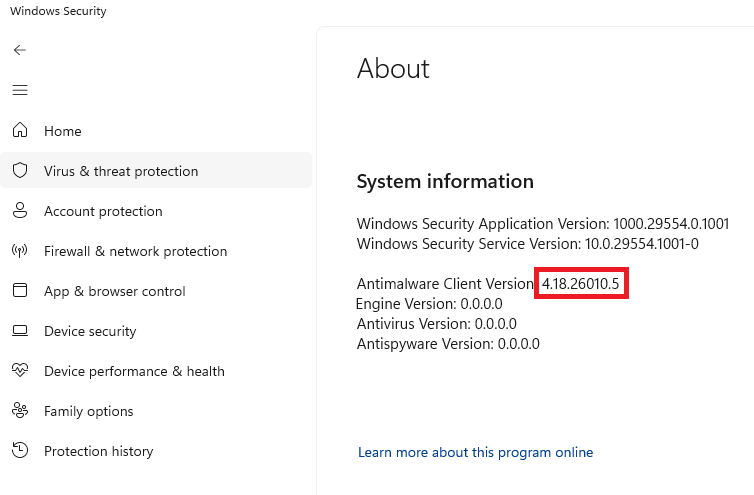
The first version of the Microsoft Defender Antimalware Platform with these vulnerabilities addressed is 4.18.26040.7.

You can usually find that version number in Windows Security:

  1. Open Start and search for Windows Security
  2. Go to Virus & threat protection
  3. Click Settings or the gear icon
  4. Open About
Windows Defender version number

Even with auto-update enabled, I didn’t receive this patch immediately. Defender platform updates can lag behind definitions or only appear when a cumulative Windows update lands. Microsoft typically releases updates for the Microsoft Defender Antimalware Platform once a month, or as needed to protect against new threats. 

So, I’ll have to wait. Good thing I’m protected.


We don’t just report on threats—we remove them

Cybersecurity risks should never spread beyond a headline. Keep threats off your devices by downloading Malwarebytes today.

  • ✇SOC Prime Blog
  • CVE-2026-20127: Cisco SD-WAN Zero-Day Exploited Since 2023 Daryna Olyniychuk
    New day, new vulnerability in the spotlight. We’re once again seeing how quickly weaponized flaws in widely deployed platforms turn into real operational risk. Coverage of maximum-severity Cisco bugs (CVE-2025-20393, CVE-2026-20045), as well as the Dell RecoverPoint zero-day CVE-2026-22769, shows that attackers are increasingly prioritizing edge-facing infrastructure that quietly controls traffic flows, identity paths, and service availability. That story continues with CVE-2026-20127, a critic
     

CVE-2026-20127: Cisco SD-WAN Zero-Day Exploited Since 2023

26 de Fevereiro de 2026, 08:56
CVE-2026-20127 in Cisco Catalyst SD-WAN Controller

New day, new vulnerability in the spotlight. We’re once again seeing how quickly weaponized flaws in widely deployed platforms turn into real operational risk. Coverage of maximum-severity Cisco bugs (CVE-2025-20393, CVE-2026-20045), as well as the Dell RecoverPoint zero-day CVE-2026-22769, shows that attackers are increasingly prioritizing edge-facing infrastructure that quietly controls traffic flows, identity paths, and service availability.

That story continues with CVE-2026-20127, a critical authentication bypass affecting Cisco Catalyst SD-WAN Controller (formerly vSmart) and Cisco Catalyst SD-WAN Manager (formerly vManage). Cisco Talos reports the flaw is being actively exploited and tracks the activity as UAT-8616, assessing with high confidence that a highly sophisticated threat actor has been exploiting it since at least 2023.

GreyNoise’s 2026 State of the Edge Report shows why confirmed exploitation in edge-facing network control systems demands urgent action. In H2 2025, GreyNoise observed 2.97 billion malicious sessions from 3.8 million unique source IPs targeting internet-facing infrastructure, underscoring how quickly exploitation traffic scales once attackers focus on an exposed surface.

Register for SOC Prime’s AI-Native Detection Intelligence Platform, backed by cutting-edge technologies and top cybersecurity expertise to outscale cyber threats and build a resilient cybersecurity posture. Click Explore Detections to access the comprehensive collection of SOC content for vulnerability exploit detection, filtered by the custom “CVE” tag.

Explore Detections

Detections from the dedicated rule set can be applied across multiple SIEM, EDR, and Data Lake platforms and are mapped to the latest MITRE ATT&CK® framework v18.1. Security teams can also leverage Uncoder AI to accelerate detection engineering end-to-end by generating rules directly from live threat reports, refining and validating detection logic, auto-visualizing Attack Flows, converting IOCs into custom hunting queries, and instantly translating detection code across diverse language formats.

CVE-2026-20127 Analysis

Cisco Talos describes CVE-2026-20127 as an issue that allows an unauthenticated remote attacker to bypass authentication and obtain administrative privileges on the affected system by sending crafted requests. Cisco’s public advisory ties the root cause to a peering authentication mechanism that is not working properly.

A successful exploit can let an attacker log in to a Catalyst SD-WAN Controller as an internal, high-privileged, non-root account, then use that access to reach NETCONF and manipulate SD-WAN fabric configuration. That kind of control-plane access is exactly what makes SD-WAN incidents so disruptive, as the attackers are in a position to shape how the network behaves.

Multiple government and partner advisories describe a common post-exploitation path. After exploiting CVE-2026-20127, actors have been observed adding a rogue peer and then moving toward root access and long-term persistence within SD-WAN environments. Talos adds that intelligence partners observed escalation involving a software version downgrade, exploitation of CVE-2022-20775, and then restoration back to the original version, a sequence that can complicate detection if teams only validate the “current” running version.

Because exploitation is confirmed and impacts systems used to manage connectivity across sites and clouds, CISA issued Emergency Directive 26-03 for U.S. federal civilian agencies, with an accelerated requirement to complete required actions by 5:00 PM (ET) on February 27, 2026. FedRAMP also relayed the same urgency to cloud providers supporting federal environments. 

CVE-2026-20127 Mitigation 

According to Cisco’s advisory, CVE-2026-20127 affects Cisco Catalyst SD-WAN Controller and Cisco Catalyst SD-WAN Manager regardless of device configuration, across these deployment types:

  • On-Prem Deployment
  • Cisco Hosted SD-WAN Cloud
  • Cisco Hosted SD-WAN Cloud – Cisco Managed
  • Cisco Hosted SD-WAN Cloud – FedRAMP Environment 

Cisco also notes there are no workarounds that fully address this vulnerability. The durable fix is upgrading to a patched release, with the exact fixed versions listed in Cisco’s advisory under the Fixed Software section.

Users are urged to start by prioritizing patching as the only complete remediation and verify the fixes are actually in place across every in-scope Catalyst SD-WAN Controller and Manager instance.

Next, to reduce the attack surface while users patch and validate, CISA and the UK NCSC guidance emphasize restricting network exposure, placing SD-WAN control components behind firewalls, and isolating management interfaces from untrusted networks. In parallel, SD-WAN logs should be forwarded to external systems so attackers cannot easily erase local evidence.

Finally, it is better to treat this as both a patching and an investigation event. Cisco recommends auditing /var/log/auth.log for entries like “Accepted publickey for vmanage-admin” coming from unknown or unauthorized IP addresses, then comparing those source IPs against the configured System IPs listed in the Manager UI (WebUI > Devices > System IP). If users suspect compromise, Cisco advises engaging Cisco TAC and collecting the admin-tech output (for example, via request admin-tech) so it can be reviewed.

Because the reported activity can include version downgrade and unexpected reboot behavior as part of the post-compromise chain, public guidance also recommends checking the following logs for downgrade/reboot indicators:

  • /var/volatile/log/vdebug
  • /var/log/tmplog/vdebug
  • /var/volatile/log/sw_script_synccdb.log

To strengthen coverage beyond patching and mitigation steps, rely on the SOC Prime Platform to reach the world’s largest detection intelligence dataset, adopt an end-to-end pipeline that spans detection through simulation while streamlining security operations and speeding up response workflows, reduce engineering overhead, and stay ahead of emerging threats.


FAQ

What is CVE-2026-20127 and how does it work?

CVE-2026-20127 is a critical authentication bypass in Cisco Catalyst SD-WAN Controller and SD-WAN Manager that lets an unauthenticated attacker send crafted requests and gain administrative access due to a broken peering authentication check.

When was CVE-2026-20127 first discovered?

Cisco disclosed it in late February 2026, while Cisco Talos reports evidence that CVE-2026-20127 has already been exploited in real attacks since at least 2023.

What risks does CVE-2026-20127 pose to systems?

It can hand attackers control-plane access, enabling them to add a rogue peer, change SD-WAN fabric configuration via NETCONF, and move toward persistence and root-level control, including downgrade-and-restore activity tied to chaining with CVE-2022-20775.

Can CVE-2026-20127 still affect me in 2026?

Yes. If you have not patched, or you patched without checking for compromise, you may still be at risk.

How can you protect from CVE-2026-20127?

Upgrade to Cisco’s fixed releases, restrict exposure of SD-WAN control components, and review logs for signs of suspicious access; involve Cisco TAC if anything looks abnormal.


The post CVE-2026-20127: Cisco SD-WAN Zero-Day Exploited Since 2023 appeared first on SOC Prime.

  • ✇Security Intelligence
  • 4 trends in software supply chain security Sue Poremba
    Some of the biggest and most infamous cyberattacks of the past decade were caused by a security breakdown in the software supply chain. SolarWinds was probably the most well-known, but it was not alone. Incidents against companies like Equifax and tools like MOVEit also wreaked havoc for organizations and customers whose sensitive information was compromised. Expect to see more software supply chain attacks moving forward. According to ReversingLabs’ The State of Software Supply Chain Security
     

4 trends in software supply chain security

28 de Janeiro de 2025, 11:00

Some of the biggest and most infamous cyberattacks of the past decade were caused by a security breakdown in the software supply chain. SolarWinds was probably the most well-known, but it was not alone. Incidents against companies like Equifax and tools like MOVEit also wreaked havoc for organizations and customers whose sensitive information was compromised.

Expect to see more software supply chain attacks moving forward. According to ReversingLabs’ The State of Software Supply Chain Security 2024 study, attacks against the software supply chain are getting easier and more ubiquitous.

“For example, Operation Brainleeches, identified by ReversingLabs in July, showed elements of software supply chain attacks supporting commodity phishing attacks that use malicious email attachments to harvest Microsoft.com logins,” the report stated.

It is easier to conduct software supply chain attacks, so they are increasing at an alarming rate. The ReversingLabs report saw a 1,300% increase in threats coming from open-source package repositories last year. That’s the bad news.

The good news is that cybersecurity teams and government entities recognize the risks coming from the software supply chain, and there is a lot of action toward defending against these attacks and steps to solidify security before the software is released into the wild.

Who controls the software?

Who controls the software and who controls the device are the game-changers in software supply chain security, according to Xin Qiu, Sr., Director of Security Product Marketing and Management at CommScope. But that’s hyper-focused down to the developers and system engineers creating the software and setting up the systems. The problem is that there is little integration within an organization to enable effective control.

Companies have a lot of tools, but they are scattered around, says Qiu. Everyone is siloed, doing things in different ways. That approach has to change.

It is the federal government that is taking the lead in tackling software supply chain security with technical regulations and laws.

“To improve your software supply chain security, you need to have a common standard,” says Qiu. “I think this is a good way to fill those gaps.”

The most recognizable action taken by the government entities was the Executive Order(EO) from the Biden administration, which addresses the nation’s cybersecurity but especially emphasizes protecting the software supply chain. In conjunction with that EO, a cross-sector group representing different government agencies, the Enduring Security Framework (ESF) Software Supply Chain Working Panel, put together a comprehensive guide for recommended practices of security in the software supply chain for developers. NIST also has a framework to secure the software supply chain.

4 security solution trends for the software supply chain

But government guidelines and regulations only go so far, and it is up to organizations to better equip themselves with the tools, solutions and processes that allow developers, engineers and security and IT teams to address risks within the software supply chain. There are a number of ideas and tools out there, some initiated by the government, that are trending in the battle against vulnerabilities and threats.

1. Secure by design

At RSAC2024, CISA Director Jen Easterly and a panel of cybersecurity professionals gave a panel on CISA’s Secure by Design initiative. The idea is to build security into products and make it a business feature and core technical requirement rather than the more standard approach of treating security as a failure. “During the design phase of a product’s development lifecycle, companies should implement Secure by Design principles to significantly decrease the number of exploitable flaws before introducing them to the market for widespread use or consumption,” the initiative’s website states.

Part of the presentation was the introduction of the initial group of businesses that took the Secure by Design pledge. According to CISA, “By participating in the pledge, software manufacturers are pledging to make a good-faith effort to work towards the goals listed below over the following year.” The pledge includes a list of goals for developers and organizations to work toward. These goals include standards around MFA, reducing default passwords and better transparency around vulnerability disclosure and reporting. More than 200 organizations have taken the pledge so far.

Learn how cybersecurity shapes supply chain resilience

2. Software bill of materials (SBOMs)

SBOMs are a nested inventory of all the components that make up a software application. The components can include open source, third parties, patch status and licenses. SBOMs have become a key part of the software supply chain security structure and are endorsed by CISA as a way for developers to build a community that works together to share ideas and experiences around operationalization, scaling, technologies, new tools and use cases. To encourage SBOM use and understanding, CISA facilitates regular meetings from those across the software development and design community and also offers a resource library.

SBOMs can help an organization identify risks, especially in third-party and proprietary software packages: track vulnerabilities within the different components; ensure compliance and help the team make better security decisions by being more aware of the component parts of their software.

3. Supply-chain levels for software artifacts (SLSA) frameworks

SLSA is a security framework to safeguard the integrity of software artifacts. It is a checklist of standards to better improve the integrity of the software, prevent tampering and exploitation and keep the infrastructure and application packages secure. The framework was based on Google’s production workloads and offers a structured approach to evaluating the security posture of software components throughout the supply chain.

4. Governance, risk and compliance (GRC) management

GRC management is used to mitigate security risks within a software development supply chain while ensuring the software meets required regulatory compliances and security standards. Some of the areas that GRC monitors include:

  • Identifying risks across the entire software supply chain
  • Vendor risk management and assessment of third-party security posture before integrating the software into your organization’s system
  • Compliance management to meet industry and government standards
  • Policy enforcement across the development lifecycle
  • Incident response after a cyber incident caused by the software supply chain

GRC management tools can also be used with SBOM analysis.

The evolving puzzle of software supply chain security

This is just a sample of the tools and solutions used to protect the software supply chain from risk. As security is more consciously built into the software and developers and engineers share information in communities rather than working in silos, there is a fighting chance of slowing the threats against the software supply chain.

The post 4 trends in software supply chain security appeared first on Security Intelligence.

  • ✇Security Intelligence
  • Are attackers already embedded in U.S. critical infrastructure networks? Jonathan Reed
    The threat of cyberattacks against critical infrastructure in the United States has evolved beyond data theft and espionage. Intruders are already entrenched in the nation’s most vital systems, waiting to unleash attacks. For instance, CISA has raised alarms about Volt Typhoon, a state-sponsored hacking group that has infiltrated critical infrastructure networks. Their goal? To establish a foothold and prepare for potentially crippling attacks that could disrupt essential services across the na
     

Are attackers already embedded in U.S. critical infrastructure networks?

21 de Janeiro de 2025, 11:00

The threat of cyberattacks against critical infrastructure in the United States has evolved beyond data theft and espionage. Intruders are already entrenched in the nation’s most vital systems, waiting to unleash attacks. For instance, CISA has raised alarms about Volt Typhoon, a state-sponsored hacking group that has infiltrated critical infrastructure networks. Their goal? To establish a foothold and prepare for potentially crippling attacks that could disrupt essential services across the nation.

Volt Typhoon embodies a threat far beyond everyday cyber crime. It indicates the dangerous reality of cyber pre-positioning — a tactic that allows cyber actors to infiltrate systems, maintain persistence and potentially launch massively destructive operations. With lifeline sectors such as communications, energy, transportation and water and wastewater systems under threat, the question is no longer if attackers are embedded within U.S. infrastructure but how deeply they have rooted themselves. And the implications directly impact national security.

Nation-state pre-positioning goes beyond espionage

Employed by nation-state actors, pre-positioning goes beyond mere intelligence gathering. By silently lurking within critical infrastructure networks, actors gain the capability to wreak havoc at a moment’s notice. These intrusions, particularly in sectors like water systems and energy grids, serve little espionage value, per Anne Neuberger, the Deputy National Security Adviser for Cyber and Emerging Technologies. This indicates that the infiltrations are likely precursors to far more disruptive objectives.

Volt Typhoon’s methodical approach has allowed them to infiltrate U.S. systems for extended periods — up to five years in some cases — without detection. They’ve targeted the infrastructure that millions of Americans depend on daily. In a time of heightened geopolitical tension, a well-timed cyberattack could grind vital systems to a halt, leaving the nation vulnerable to cascading failures across multiple sectors. The fallout could be unprecedented, impacting national security, the economy and everyday life.

Volt Typhoon’s tactical mastery

Volt Typhoon is no ordinary hacking group. This state-sponsored entity has displayed a level of sophistication that challenges even the most robust cybersecurity defenses. Through its living-off-the-land (LOTL) tactics, the group exploits legitimate network administration tools, blending seamlessly with normal traffic and making detection extremely difficult. Their use of known vulnerabilities in public-facing devices such as routers and VPNs allows them to gain access, while compromised administrator credentials give them the power to burrow deeper into networks and assess operational technology (OT) systems.

The group’s calculated patience is noteworthy. Instead of seeking short-term gains, they carefully study their targets and gain an understanding of the nuances of the systems they infiltrate. In one case, Volt Typhoon spent nine months moving laterally through a water utility’s network, gaining access to crucial OT assets, including water treatment plants and electrical substations. These infiltrations are more than a technical breach — they represent a looming threat to physical infrastructure that could manifest in catastrophic failures.

Read CISA cybersecurity advisories

The FOCAL Plan’s strategic response

In the face of these threats, CISA has developed a robust response: the Federal Civilian Executive Branch (FCEB) Operational Cybersecurity Alignment (FOCAL) Plan. This strategic framework aims to shore up federal cybersecurity defenses by driving coordinated action across agencies. The FOCAL Plan outlines how federal agencies can adopt best practices to defend against pre-positioning and other sophisticated cyber threats, promoting a holistic approach from prevention to incident response.

The FOCAL Plan focuses on five critical areas: asset management, vulnerability management, defensible architecture, cyber supply chain risk management and incident detection and response. Each area plays a crucial role in safeguarding federal systems from persistent threats like Volt Typhoon:

  1. Asset management: Without knowing what assets exist within an organization, it is impossible to protect them. The FOCAL Plan emphasizes comprehensive, continuous visibility into all IT and OT assets to ensure that any unauthorized access can be detected and mitigated quickly.

  2. Vulnerability management: Regular vulnerability scanning and timely patching prevent hackers from exploiting known weaknesses, shutting down one of their primary entry points.

  3. Defensible architecture: Organizations must build resilience into systems, assuming that attacks will happen. This includes implementing zero trust principles to restrict lateral movement within networks and limit the damage attackers can do, even if they gain access.

  4. Supply chain risk management: This addresses the growing reliance on third-party vendors. With many cyberattacks exploiting vulnerabilities in third-party systems, the FOCAL Plan emphasizes the need for agencies to closely monitor their supply chains and ensure that their vendors adhere to strict cybersecurity protocols.

  5. Incident detection and response: This is the FOCAL Plan’s approach to real-time cyber defense. CISA urges agencies to deploy advanced tools like endpoint detection and response (EDR) systems, which can identify and respond to threats before they cause significant damage. The ability to share threat intelligence and coordinate responses across federal agencies is essential for ensuring that the government can act swiftly in the event of an attack.

Mitigation urgency and action

The threat landscape outlined by Volt Typhoon’s actions calls for an urgent response — not just from federal agencies but from every organization that operates critical infrastructure. The key to stopping attackers from exploiting pre-positioned access is to adopt a mentality of constant vigilance and proactive threat hunting. It’s not enough to react to attacks after they happen. Organizations must actively hunt for threats, continually monitor their systems and act quickly to patch vulnerabilities before they can be exploited.

CISA’s FOCAL Plan provides a framework, but it is up to individual organizations to implement these measures at every level. Regular security audits, comprehensive asset management and adherence to the latest cybersecurity best practices are non-negotiable. Organizations must be prepared for the reality of an attack, ensuring that they have backup systems in place. It’s vital to practice incident response through tabletop exercises and maintain open communication channels with CISA and other federal agencies.

The harsh reality is that many organizations may already have pre-positioned attackers within their networks. The objective now is to limit the damage they can do and to ensure that attackers cannot trigger even more widespread disruption.

The clock is ticking

The presence of cyber actors like Volt Typhoon in U.S. critical infrastructure is not hypothetical — it’s happening now, and the consequences of inaction could be devastating. The ability of these attackers to remain hidden within networks for years, studying their targets and preparing for destructive actions, underscores the importance of robust, proactive cybersecurity measures.

The FOCAL Plan is a step in the right direction, but the fight against pre-positioned cyber actors is far from over. It will require a sustained, coordinated effort between federal agencies, private organizations and international allies to ensure that U.S. critical infrastructure is protected and remains resilient.

Explore cybersecurity services

The post Are attackers already embedded in U.S. critical infrastructure networks? appeared first on Security Intelligence.

  • ✇News – Security Intelligence
  • Insights from CISA’s red team findings and the evolution of EDR Jonathan Reed
    A recent CISA red team assessment of a United States critical infrastructure organization revealed systemic vulnerabilities in modern cybersecurity. Among the most pressing issues was a heavy reliance on endpoint detection and response (EDR) solutions, paired with a lack of network-level protections. These findings underscore a familiar challenge: Why do organizations place so much trust in EDR alone, and what must change to address its shortcomings? EDR’s double-edged sword A cornerstone of cy
     

Insights from CISA’s red team findings and the evolution of EDR

13 de Janeiro de 2025, 12:30

A recent CISA red team assessment of a United States critical infrastructure organization revealed systemic vulnerabilities in modern cybersecurity. Among the most pressing issues was a heavy reliance on endpoint detection and response (EDR) solutions, paired with a lack of network-level protections.

These findings underscore a familiar challenge: Why do organizations place so much trust in EDR alone, and what must change to address its shortcomings?

EDR’s double-edged sword

A cornerstone of cyber resilience strategy, EDR solutions are prized for their ability to monitor endpoints for malicious activity. But as the CISA report demonstrated, this reliance can become a liability when paired with inadequate network defenses. Here’s why:

  1. Tunnel vision on endpoints: EDR excels at identifying threats on individual devices but struggles with network-wide attacks. This leaves gaps when hackers exploit lateral movement or unusual data transfers — activities that often require network-level visibility to detect.
  2. Playing catch-up with threats: Traditional EDR tools depend on recognizing known indicators of compromise (IOCs). Advanced attackers can easily sidestep these tools by using novel techniques or blending in with legitimate activity.
  3. Blind spots in legacy systems: Legacy environments often go unnoticed by EDR, giving attackers free rein. In the CISA case, these systems allowed the red team to persist for months undetected.
  4. Overwhelmed defenders: Even when EDR generates alerts, security teams can become desensitized by a flood of notifications. As seen in the CISA assessment, critical warnings can slip through the cracks simply because defenders are too stretched to respond.

Common EDR pain points

The challenges highlighted in the CISA report mirror broader issues organizations face with EDR:

  • Detection without context: EDR tools often spot anomalies on endpoints but fail to connect the dots across the broader network. This lack of context can leave organizations blind to coordinated attacks.
  • Weak network integration: Without network-layer defenses, EDR struggles to identify malicious activities like unusual traffic patterns or data exfiltration, key tactics in advanced breaches.
  • Fragmented systems: Many organizations operate a patchwork of security tools, leaving critical gaps in coverage and making it harder to correlate data across endpoints, networks and cloud environments.
Explore threat detection and response services

The next evolution of EDR

Recognizing these shortcomings, cybersecurity is rapidly evolving beyond traditional EDR. Here’s how:

  1. Extended detection and response (XDR): XDR takes EDR to the next level by integrating endpoint, network and cloud data into a single platform. This broader scope allows organizations to see the full attack picture and respond more effectively.
  2. AI-driven insights: Cutting-edge EDR solutions now harness machine learning to detect subtle behavioral anomalies. By identifying deviations from normal activity, these tools catch threats even when no IOCs exist.
  3. Zero trust security: Zero trust architectures take endpoint defense a step further by ensuring no device or user is trusted by default. This integration of endpoint, identity and network security reduces dependence on EDR alone.
  4. Network visibility: Modern EDR tools are incorporating network traffic analysis to close the gaps identified in the CISA report. Monitoring traffic for anomalies, such as unusual data flows or external connections, bolsters defenses.
  5. Cloud-native solutions: As businesses embrace hybrid and cloud environments, EDR is evolving to provide seamless coverage across on-premises and cloud systems, addressing vulnerabilities in these critical areas.

Why do gaps persist?

Even with these advancements, many organizations struggle to fully address EDR’s limitations:

  • Resource strains: Small security teams often lack the bandwidth or expertise to implement and manage advanced solutions like XDR.
  • Budget constraints: Upgrading to integrated platforms or modernizing legacy systems can be costly.
  • Legacy challenges: Outdated environments remain vulnerable, acting as weak points that attackers can exploit.
  • Leadership missteps: As the CISA report pointed out, organizations sometimes deprioritize known vulnerabilities, leaving critical gaps unaddressed.

Building a more resilient future

The CISA red team findings are a wake-up call: Endpoint protection alone is no longer enough. To outsmart today’s sophisticated adversaries, organizations must adopt a layered defense strategy that integrates endpoint, network and cloud security. Solutions like XDR, zero trust principles and advanced behavioral analysis offer a path forward — but they require strategic investments and cultural shifts.

The post Insights from CISA’s red team findings and the evolution of EDR appeared first on Security Intelligence.

  • ✇Security Intelligence
  • The 5 most impactful cybersecurity guidelines (and 3 that fell flat) Mike Elgan
    The best cybersecurity guidelines have made a huge difference in protecting data from theft and compromise, both in the United States and around the world. These guidelines are comprehensive sets of recommended practices, procedures and principles designed to help organizations and individual people safeguard their digital assets, systems and data from malicious attacks. They can cover a wide range of practices and exist in part to collect and share best practices and strategies based on indust
     

The 5 most impactful cybersecurity guidelines (and 3 that fell flat)

31 de Dezembro de 2024, 11:00

The best cybersecurity guidelines have made a huge difference in protecting data from theft and compromise, both in the United States and around the world.

These guidelines are comprehensive sets of recommended practices, procedures and principles designed to help organizations and individual people safeguard their digital assets, systems and data from malicious attacks. They can cover a wide range of practices and exist in part to collect and share best practices and strategies based on industry standards and expert knowledge. Crucially, they’re frequently updated to address evolving threats and technological advancements.

Truly effective cybersecurity guidelines serve as a roadmap for maximizing security. They are comprehensive, addressing both technical and organizational aspects. They come with clear governance structures, detailed implementation plans and the flexibility to adapt. And they recognize the importance of the human element, focusing on user empowerment and education rather than assuming and criticizing user ignorance.

However, not all cybersecurity guidelines are created equal. The least effective practices tend to overemphasize technology at the expense of human factors, neglect usability considerations, fail to address operational aspects or lack provisions for continuous assessment and improvement.

Here are the five cybersecurity guidelines that have made the biggest positive impact and three that could use some work.

1. NIST CSF

The National Institute of Standards and Technology (NIST) Cybersecurity Framework (CSF) is one of the most effective and influential cybersecurity guidelines. One reason for that is that it’s comprehensive and built around five core functions: identify, protect, detect, respond and recover. This structure provides organizations with a holistic view of cybersecurity risk management, ensuring that all critical aspects are addressed.

The NIST CSF evolved over three main iterations: Version 1.0 was initially released in 2014, followed by a minor update to Version 1.1 in 2018 and a major overhaul with Version 2.0 in 2024.

It’s also flexible. Organizations of all sizes and across various sectors can readily adapt the framework to their specific needs, making it widely applicable.

2. ISO 27001

The ISO 27001 standard has made a big difference in global cybersecurity due to its highly systematic approach and emphasis on continuous improvement. It offers a structured methodology for identifying, assessing and treating information security risks. As an internationally recognized standard, ISO 27001 certification is respected across various industries and borders.

3. CIS Controls

The Center for Internet Security (CIS) Controls have become widely adopted as a practical and effective set of cybersecurity guidelines. The guidelines are characterized by prioritized actions, addressing the most critical security measures and helping organizations allocate resources efficiently. The framework’s tiered implementation allows organizations to tailor their strategy based on size and cybersecurity maturity. CIS regularly updates the controls to address emerging threats and evolving best practices.

Explore cybersecurity services

4. CSA Cloud Controls Matrix

The Cloud Security Alliance (CSA) Cloud Controls Matrix stands out thanks to its cloud-specific focus, addressing the unique security challenges inherent in cloud computing. Its comprehensive coverage spans multiple security domains, including application security, encryption and identity management. The matrix’s interoperability aligns with other major standards and regulations, facilitating compliance across multiple frameworks for organizations.

5. PCI DSS

The Payment Card Industry Data Security Standard (PCI DSS) has greatly improved payment card security despite its industry-specific nature. Organizations handling payment card data must comply with PCI DSS, ensuring widespread adoption. The standard offers detailed and actionable requirements for protecting cardholder data. And it regularly evolves to address emerging threats and technologies in the payment card industry.

Some cybersecurity guidelines haven’t made such an impact

Sadly, some cybersecurity guidelines haven’t been received as fondly as the five listed above. Here’s the cybersecurity guidelines Hall of Shame:

The TSA’s initial pipeline directive

In the wake of the Colonial Pipeline cyberattack, the Transportation Security Administration (TSA) issued its initial pipeline security directive, known as Security Directive Pipeline-2021-01, on May 27, 2021.

The directive aimed to enhance cybersecurity measures for pipeline owners and operators across the United States.

The initial directive mandated several key requirements for pipeline companies. It called for the designation of a Cybersecurity Coordinator who would be available 24/7 to respond to incidents and coordinate with government agencies. Additionally, companies were required to report cybersecurity incidents to the Cybersecurity and Infrastructure Security Agency (CISA) within 12 hours of detection.

Many cybersecurity experts viewed it as hastily implemented and based on inadequate industry consultation. The directive was too prescriptive in some parts and too vague in others, according to critics. And it was slammed as being too inflexible.

The directive was revised and satisfied many of the industry criticisms.

The UN cyber crime treaty

The United Nations finalized and approved a new global cyber crime convention in August, marking a significant milestone in international efforts to combat cyber crime. The treaty is a milestone because it’s the first cyber crime treaty negotiated and accepted by consensus among all UN member states (after three years of negotiations).

But some critics say the treaty would effectively criminalize cybersecurity research, that it’s outdated and overly prescriptive. They say it might actually weaken global cybersecurity.

Draft U.S. cyber reporting rules

The Cybersecurity and Infrastructure Security Agency (CISA) has recently proposed draft rules for cyber incident reporting in the United States, which could impact how critical infrastructure companies report cyberattacks to the federal government.

The draft rules target companies that own or operate systems deemed critical infrastructure by the U.S. government. This includes sectors such as healthcare, energy, manufacturing and financial services. The rules also extend to companies with operations vital to a sector’s functionality, including various service providers.

Some organizations have expressed concern that the reporting requirements may be burdensome (especially to smaller organizations), costly and overlapping with existing requirements.

The National Association of Manufacturers said the rules are overly broad and could affect more than 300,000 entities, casting doubt on whether all target organizations are involved with “critical infrastructure.”

The best cybersecurity guidelines strike the right balance

Cybersecurity guidelines are intended to improve security. And the best ones are vital tools that advance organizations toward that objective. Crafting excellent guidelines requires plentiful industry input, with comprehensive and broad issues covered and plenty of flexibility to allow for different organizational sizes and types.

The post The 5 most impactful cybersecurity guidelines (and 3 that fell flat) appeared first on Security Intelligence.

  • ✇Security Intelligence
  • CISA’s cyber incident reporting portal: Progress and future plans Sue Poremba
    On August 29, 2024, CISA announced the launch of a new cyber-incident Reporting Portal, part of the new CISA Services Portal. “The Incident Reporting Portal enables entities and individuals reporting cyber incidents to create unique accounts, save reports and return to submit later, and eliminate the repetitive nature of inputting routine information such as contact information,” says Lauren Boas Hayes, Senior Advisor for Technology & Innovation, at CISA. Shortly after the announcement, Sec
     

CISA’s cyber incident reporting portal: Progress and future plans

27 de Dezembro de 2024, 11:00

On August 29, 2024, CISA announced the launch of a new cyber-incident Reporting Portal, part of the new CISA Services Portal.

“The Incident Reporting Portal enables entities and individuals reporting cyber incidents to create unique accounts, save reports and return to submit later, and eliminate the repetitive nature of inputting routine information such as contact information,” says Lauren Boas Hayes, Senior Advisor for Technology & Innovation, at CISA.

Shortly after the announcement, Security Intelligence reported on how the portal was designed and how it differs from other cyber incident reporting structures. We noted that CISA’s biggest advantage was its ability to assist the reporting organization with response and remediation.

“Any organization experiencing a cyberattack or incident should report it — for its own benefit and to help the broader community. CISA and our government partners have unique resources and tools to aid with response and recovery, but we can’t help if we don’t know about an incident,” said CISA Executive Assistant Director for Cybersecurity Jeff Greene in a formal statement covering the portal’s announcement.

Four months later

Since the announcement in August, a lot has happened. There was a presidential election, and a new administration will take charge on January 20. The current CISA director and other political appointees will step down. The agency’s future is uncertain as of this writing, particularly regarding who will oversee it and whether its functions will be divided across different federal departments. Still, it is expected that its work will continue.

Before these changes occur, we wanted to check in with CISA to follow up on the portal’s progress and what the future might look like.

Explore cybersecurity services

Long history of collecting cyber incident reports

CISA was first created in 2018, but federal agencies have collected cyber incident reports for decades.

“The launch of the Incident Reporting Portal is a significant step forward for CISA’s ability to collect operationally relevant data from reporters in a system which is more usable for reporters,” says Hayes. “The vision for the Incident Reporting Portal is for CISA’s Incident Reporting Portal to continue to enhance the functionality of the system to enable entities to share submitted reports with colleagues or clients to facilitate more effective third-party reporting, communicate directly with CISA, and access information and services relevant to the reporter.”

The portal is expected to make compliance with the Cyber Incident Reporting for Critical Infrastructure Act of 2022 easier. This act will “require CISA to coordinate with Federal partners and others on various cyber incident reporting and ransomware-related activities” across the 16 sectors, agencies and industries deemed “vital to the health, economy and security of the community or region.”

Hayes adds that while reporting under the Cyber Incident Reporting for Critical Infrastructure Act of 2022 will not be required until the Final Rule goes into effect, the agency encourages critical infrastructure owners and operators to voluntarily share information on cyber incidents prior to that date to help prevent other organizations from becoming victims of similar incidents.

“Sharing information allows us to work with our full breadth of partners to help prevent attackers from compromising other victims using the same techniques,” says Hayes.  “Sharing information can provide insight into the scale of an adversary’s campaign.”

Why reporting is vital to overall cybersecurity

While reporting cyber incidents to the portal is voluntary at the moment, all organizations are encouraged to share the information. If they feel the need, they can do so anonymously. As cyberattacks and nation-state threats become more sophisticated and increasingly target critical infrastructure industries, sharing this information with CISA allows the agency to help other organizations prepare for emerging threats and implement preventive measures before the damage is done.

“Isolating cyberattacks and preventing them in the future requires the coordination of many groups and organizations,” CISA explained. “By rapidly sharing critical information about attacks and vulnerabilities, the scope and magnitude of cyber events can be greatly decreased.”

And it isn’t just CISA that uses this information. According to the U.S. Government Accountability Office (GAO), 14 federal agencies are responsible for protecting critical infrastructure from cyberattacks, many in unexpected ways. For example, TSA, which handles airport security screening, is also responsible for safeguarding the country’s gasoline pipelines.

“Entities representing critical infrastructure owners and operators told us there are great benefits in getting information about threats from federal agencies,” the GAO reported.

What comes next

Despite a changing presidential administration, CISA is moving forward. It is planning a future designed to keep the critical infrastructure safe from cyber threats, which, in turn, will provide a layer of protection for the nation’s citizens and businesses.

“Sharing information allows us to work with our full breadth of partners so that the attackers can’t use the same techniques on other victims and can provide insight into the scale of an adversary’s campaign,” Jeff Greene was quoted in Federal News Network. “CISA is excited to make available our new portal with improved functionality and features for cyber reporting.”

As for the Incident Reporting Portal’s future, Hayes says, “In the future, we are planning to implement additional features that will take time to develop and incorporate user feedback. Our user experience team is actively working to get feedback on how we can improve the system over time.”

The post CISA’s cyber incident reporting portal: Progress and future plans appeared first on Security Intelligence.

  • ✇News – Security Intelligence
  • FBI, CISA issue warning for cross Apple-Android texting Jennifer Gregory
    CISA and the FBI recently released a joint statement that the People’s Republic of China (PRC) is targeting commercial telecommunications infrastructure as part of a significant cyber espionage campaign. As a result, the agencies released a joint guide, Enhanced Visibility and Hardening Guidance for Communications Infrastructure, with best practices organizations and agencies should adopt to protect against this espionage threat. According to the statement, PRC-affiliated actors compromised net
     

FBI, CISA issue warning for cross Apple-Android texting

16 de Dezembro de 2024, 11:00

CISA and the FBI recently released a joint statement that the People’s Republic of China (PRC) is targeting commercial telecommunications infrastructure as part of a significant cyber espionage campaign. As a result, the agencies released a joint guide, Enhanced Visibility and Hardening Guidance for Communications Infrastructure, with best practices organizations and agencies should adopt to protect against this espionage threat.

According to the statement, PRC-affiliated actors compromised networks at multiple telecommunication companies. They stole customer call records data as well as compromised private communications of a limited number of people. Sen. Mark R. Warner (D-Virginia) told the Washington Post that the threat actors listened on audio calls and even moved between networks. As a result, many media sources reported that texts between Android and Apple devices are not secure.

Historic and sophisticated cyberattack

The headlines of the Washington Post deemed it the worst telecom hack in our nation’s history, per a top U.S. senator. On the surface, this seems a bit melodramatic, with only 150 identified victims. However, experts predict the affected number of people will go into the millions. Warner, who serves as chairman of the Senate Intelligence Committee, went as far as to say that Salt Typhoon makes Colonial Pipeline and SolarWinds “look like child’s play.”

The data collected during the attack falls into two categories, reported NBC. The first included call records showing the time and number called, with most records in the Washington, D.C. area. The other included listening to live calls of specific targets, which may include Donald Trump and Kamala Harris.

However, the most concerning aspect of the attack is the national security implications. Richard Forno, Principal Lecturer in Computer Science and Electrical Engineering at UMBC, explained in UMBC Magazine that Salt Typhoon compromised the portals used by U.S. intelligence and law enforcement. As a result, he says that the attackers may have gotten information about which Chinese spies and informants counterintelligence agencies were monitoring, which those targets can then use to avoid detection.

“U.S. officials have said that many of the ways Salt Typhoon penetrated its targets was through existing weaknesses with the infrastructure. As I’ve written previously, failing to implement basic cybersecurity best practices can lead to debilitating incidents for organizations of all sizes. Given how dependent the world is on networked information systems, it is more important than ever to maintain cybersecurity programs that make it difficult for attacks to succeed, especially for critical infrastructure like the phone network,” wrote Forno.

Reducing the risk of Salt Typhoon

With words like espionage and intercepting texts thrown around, the biggest question on people’s minds is how to protect themselves from this threat. Many experts are currently recommending using encrypted apps, such as WhatsApp and X, instead of traditional texting.

“Encryption is your friend, whether it is on text messaging or if you have the capacity to use encrypted voice communications, even if the adversary is able to intercept the data if it is encrypted, it will make it impossible, if not really hard, for them to detect it. So, our advice is to try to avoid using plain text,” said Jeff Greene, CISA Executive Assistant Director for Cybersecurity, during a press briefing reported by USA Today.

Forbes also reported that an FBI official recommended citizens use a cell phone that automatically receives timely operating system updates. Additionally, the phone should have responsibly managed encryption and phishing-resistant multi-factor authentication (MFA) for email, social media and collaboration tool accounts.

“So it’s somewhat ironic that one of the countermeasures recommended by the government to guard against Salt Typhoon spying is to use strongly encrypted services for phone calls and text messages – encryption capabilities that it has spent decades trying to undermine so that only ‘the good guys’ can use it,” wrote Forno.

To learn how IBM X-Force can help you with anything regarding cybersecurity including incident response, threat intelligence, or offensive security services schedule a meeting here.

If you are experiencing cybersecurity issues or an incident, contact X-Force to help: US hotline 1-888-241-9812 | Global hotline (+001) 312-212-8034.

The post FBI, CISA issue warning for cross Apple-Android texting appeared first on Security Intelligence.

❌
❌