Visualização normal
-
ASEC BLOG
-
The Weak Link Identified by AI: October 2026, When the Outer Contact Point Collapsed
Security Blind Spots Identified by AI The large-scale data breaches disclosed in quick succession in South Korea and Japan in October 2026 mostly originated not from internal core systems, but from peripheral entry points such as externally exposed web services, app backend APIs, and outsourced SaaS (services provided by third-party vendors via the cloud, such […]
-
ASEC BLOG
-
September 2026 Threat Trend Report on Ransomware
Purpose and Scope This report summarizes the quantity of new ransomware samples collected, the number of compromised systems, and statistics on targeted businesses during the month of September 2026, as well as major Korean & global ransomware issues. The analysis is based on data collected through ATIP (AhnLab Threat Intelligence Platform) and AhnLab Smart Defense, […]
September 2026 Threat Trend Report on Ransomware
-
ASEC BLOG
-
September 2026 Dark Web Breach Incident Trend Report
Note The September 2026 Dark Web Breach Incident Trend Report focuses on data breach cases and the sale of initial access credentials posted on the deep web and dark web forums. The report explicitly states that the accuracy of some of its content cannot be fully verified due to the nature of the sources. Major […]
September 2026 Dark Web Breach Incident Trend Report
-
ASEC BLOG
-
September 2026 Dark Web Threat Actor Trend Report
Note The September 2026 Dark Web Threat Actor Trend Report focuses on threat actors active on the deep web and dark web, as well as publicly reported cyberattack incidents. It is noted that the factual accuracy of some content cannot be independently verified. Major Issues Some hacktivist groups claimed responsibility for DDoS attacks targeting the […]
September 2026 Dark Web Threat Actor Trend Report
-
ASEC BLOG
-
August 2026 Threat Trend Report on Ransomware
Purpose and Scope This report summarizes statistics on new ransomware samples, affected systems, and statistics on targeted businesses collected during the month of August 2026, as well as major Korean & Global ransomware issues. Statistics on targeted businesses were compiled based on the time when publicly available information from ransomware groups’ DLS (Dedicated Leak Sites, […]
August 2026 Threat Trend Report on Ransomware
-
ASEC BLOG
-
August 2026 Dark Web Breach Incident Trend Report
Note In August 2026, widespread instances of database leaks, the sale of internal data, and the trading of initial access privileges were observed on dark web and deep web forums. Due to the nature of the sources, it was difficult to fully verify the accuracy of some posts. Major Issues ShinyHunters continued to make claims […]
August 2026 Dark Web Breach Incident Trend Report
-
Malwarebytes

-
McKesson confirms cyber incident after ShinyHunters claims patient-data theft
Healthcare and pharmaceutical-distribution giant McKesson has disclosed a cybersecurity incident involving unauthorized access to third-party applications and the theft of data. McKesson Corporation is an American healthcare company that distributes pharmaceuticals and provides medical supplies, health information technology, and care management tools. McKesson says it discovered the cybersecurity incident on August 25, 2026, and that its investigation is still in early stages. “Based
McKesson confirms cyber incident after ShinyHunters claims patient-data theft
Healthcare and pharmaceutical-distribution giant McKesson has disclosed a cybersecurity incident involving unauthorized access to third-party applications and the theft of data.
McKesson Corporation is an American healthcare company that distributes pharmaceuticals and provides medical supplies, health information technology, and care management tools.
McKesson says it discovered the cybersecurity incident on August 25, 2026, and that its investigation is still in early stages.
“Based on our investigation thus far, including assessments by leading cybersecurity industry experts supporting our response, we’ve confirmed that the unauthorized access to certain third-party applications and the exfiltration of certain data was associated with a subset of customers within our Oncology & Multispecialty and Medical-Surgical business units.”
For now, McKesson provides no information about the amount or nature of the stolen data.
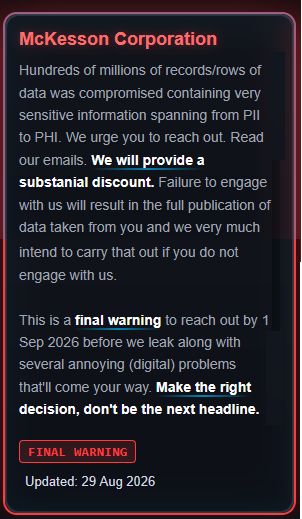
The attack has been claimed by ransomware/extortion group Shiny Hunters. On their leak site the group claims to have stolen hundreds of millions of records containing very sensitive information spanning from Personally Identifiable Information (PII) to Protected Health Information (PHI).

The ShinyHunters extortion group told BleepingComputer that it was behind the attack, claiming it gained access after conducting voice phishing (or vishing) attacks—a form of social engineering—against multiple McKesson employees. Subsequently, the group said it used compromised Okta single-sign-on accounts to access Salesforce and Snowflake environments. It further claimed to have removed approximately 1 TB of data between August 21 and 25.
The group also said the data includes roughly 284 million records, which does not necessarily mean they belong to 284 million unique patients.
A combination of identity information and healthcare-related details could make affected people targets for convincing scams. Criminals could impersonate a pharmacy, insurer, medical provider, debt collector, or patient-support service and use personal details to make the approach appear legitimate.
Healthcare data is especially useful in social-engineering attacks because it can be used to create a sense of urgency: Criminals could scare a target by sending a supposed prescription problem, unpaid claim, delivery issue, appointment change, or request to “verify” insurance details. At this stage, however, McKesson has not confirmed that any particular category of patient data was accessed.
What to do if you’re affected
While waiting for more information about the nature of the breach and how you might be affected, there are a few things you can do:
- Check the company’s advice. Every breach is different, so check with the company to find out what’s happened and follow any specific advice it offers.
- Change your password. You can make a stolen password useless to thieves by changing it. Choose a strong password that you don’t use for anything else. Better yet, let a password manager choose one for you.
- Enable two-factor authentication (2FA). If you can, use a FIDO2-compliant hardware key, laptop, or phone as your second factor. Some forms of 2FA can be phished just as easily as a password, but 2FA that relies on a FIDO2 device can’t be phished.
- Watch out for impersonators. Cybercriminals may contact you posing as the breached company. Check its official website to see if it’s contacting victims, and verify the identity of anyone who contacts you using a different communication channel.
- Take your time. Phishing attacks often impersonate people or brands you know and use themes that require urgent attention, such as missed deliveries, account suspensions, and security alerts.
- Consider not storing your card details. It’s definitely more convenient to let sites remember your card details, but it increases the risk if a company suffers a breach.
- Set up identity monitoring. This can alert you if your personal information is found being traded illegally online and help you recover afterward.
Let’s face it, an incognito window can only do so much.
Breaches, dark web trading, credit fraud. Malwarebytes Identity Theft Protection monitors for all of it, alerts you fast, and comes with identity theft insurance.
-
ASEC BLOG
-
July 2026 Dark Web Breach Incident Trend Report
Note The July 2026 Dark Web Breach Incident Trend Report was compiled based on data breach cases posted on deep web and dark web forums. Due to the nature of some posts, it is difficult to fully verify their accuracy; some posts related to South Korea included AI-generated false data or cases where it could […]
July 2026 Dark Web Breach Incident Trend Report
-
ASEC BLOG
-
July 2026 Dark Web Threat Actor Trend Report
Note The July 2026 Dark Web Threat Actor Trend Report focuses on trends among threat actors—including hacktivists—active on the deep web and dark web. It is explicitly noted that the factual accuracy of some content could not be verified. Major Issues Handala claimed to have compromised the core infrastructure of an Internet service provider in […]
July 2026 Dark Web Threat Actor Trend Report
-
ASEC BLOG
-
June 2026 Dark Web Breach Incident Trend Report
Note The June 2026 Dark Web Breach Incident Trend Report is based on major data breach cases posted on the deep web and dark web forums. Due to the nature of some sources, it was difficult to fully verify the accuracy of certain information, so the report includes content that requires further verification. Major Issue […]
June 2026 Dark Web Breach Incident Trend Report
-
Security Intelligence
-
When ransomware kills: Attacks on healthcare facilities
As ransomware attacks continue to escalate, their toll is often measured in data loss and financial strain. But what about the loss of human life? Nowhere is the ransomware threat more acute than in the healthcare sector, where patients’ lives are literally on the line. Since 2015, there has been a staggering increase in ransomware attacks on healthcare facilities. And the impacts are severe: Diverted emergency services, delayed critical treatments and even fatalities. Meanwhile, the pledge som
When ransomware kills: Attacks on healthcare facilities
As ransomware attacks continue to escalate, their toll is often measured in data loss and financial strain. But what about the loss of human life? Nowhere is the ransomware threat more acute than in the healthcare sector, where patients’ lives are literally on the line.
Since 2015, there has been a staggering increase in ransomware attacks on healthcare facilities. And the impacts are severe: Diverted emergency services, delayed critical treatments and even fatalities. Meanwhile, the pledge some ransomware groups made during the COVID-19 pandemic to avoid attacking healthcare providers has been abandoned. It’s clear that hospitals are now fair game.
Ransomware attacks on the healthcare sector cause real harm to patients, impacting survival rates and threatening other critical services. And ransomware targeting other critical infrastructure carries serious implications for public health and safety.
Ransomware in life-and-death situations
Hospitals depend heavily on digital systems for managing patient care. When a ransomware attack strikes, these systems go offline, with often tragic results. Research highlights the risks: There’s been a 300% increase in ransomware attacks on healthcare since 2015. This led to a spike in emergency cases, including strokes and cardiac arrests, at hospitals overwhelmed by patients diverted from facilities hit by cyberattacks.
A study by the University of California San Diego showed that ransomware attacks on hospitals cause a spillover effect. This means neighboring hospitals see a surge in patients, leading to cardiac arrest cases jumping 81%. Survival rates also dropped for those cardiac arrest cases.
One recent example is the ransomware attack on Synnovis, a pathology services provider to the NHS in London. The attack caused problems with blood tests and transfusions, delaying crucial cancer treatments and elective procedures across several hospitals. This disruption illustrates a common trend in healthcare-related ransomware incidents: Delayed testing and procedures can become life-threatening as time-sensitive treatments are postponed or missed altogether.
In another study of two urban emergency departments adjacent to a healthcare organization under attack, researchers noted significant increases in patient volume, longer waiting times and increases in patient “left without being seen” rates. These delays, according to the study, underscore the need for a disaster response approach for such incidents.
In some cases, the tragic consequences of ransomware in healthcare have been documented in legal proceedings. In 2020, a woman sued an Alabama hospital, claiming that a ransomware attack had contributed to the death of her newborn daughter. The hospital’s computer systems were offline during delivery, preventing access to critical monitoring tools and allegedly leading to severe birth complications. While the case has been settled, it raises the question of whether similar events may have occurred without public awareness.
Ransomware impacts beyond healthcare
While the healthcare sector’s vulnerability to ransomware is uniquely tragic, critical infrastructure sectors are also facing increased risks. When Colonial Pipeline, a major fuel distributor, was hit by ransomware in 2021, it led to fuel shortages across the Eastern U.S. Though no direct fatalities were reported, the panic that ensued may have resulted in at least one fatal car accident as people rushed to stockpile fuel.
In critical infrastructure sectors, the potential for loss of life or injury is significant. Attacks on power grids, water supplies and transportation systems could have severe consequences. Researchers warn that a ransomware attack on an energy grid, for example, could disrupt power to hospitals, emergency services and vulnerable populations, putting lives at risk. If the healthcare industry can serve as a lesson, the fallout from critical infrastructure attacks is not a hypothetical but a looming possibility.
Read the Threat Intelligence IndexHow ransomware threats exploit vulnerabilities in healthcare
Healthcare facilities are attractive targets for ransomware for several reasons. First, they hold a wealth of sensitive patient data, including medical histories, personal information and financial details. The cost of downtime in healthcare is especially high. When health centers are crippled by ransomware, people’s lives are at stake, making hospitals more likely to pay a ransom quickly. Healthcare ransomware incidents result in an average payment of $4.4 million, according to recent studies from the second quarter of 2024.
Additionally, healthcare facilities often use complex and outdated infrastructure, relying on an assortment of vendors and legacy systems that can be difficult to secure. A lack of centralized cybersecurity across networks further increases vulnerabilities, allowing ransomware groups to infiltrate systems and cause cascading disruptions.
Evidence of ransomware’s lethal potential
Although establishing a direct causal link between ransomware attacks and fatalities can be complicated, recent data provides compelling insights. One analysis estimates that from 2016 to 2021, between 42 and 67 Medicare patients died as a result of ransomware attacks. And this doesn’t include private insurer data. Research also highlights the broader health impacts, including reduced care quality and delayed treatments. During cyber incidents, hospitals often resort to manual processes that lack the safety checks and efficiency of electronic health records, increasing the risk of error and missed diagnoses.
The problem isn’t limited to fatalities. Ransomware-induced delays can exacerbate health issues, resulting in long-term complications and higher healthcare costs. A delayed diagnosis can mean the difference between life and death for conditions like heart disease, stroke and sepsis. Ransomware attacks may, therefore, lead to excess deaths, even if the connection is indirect.
The need for resilience against ransomware attacks
To mitigate the impact of ransomware on patient care, some hospitals have begun implementing ransomware response protocols, such as Children’s National Hospital’s “Code Dark” procedures. These response protocols are designed to maintain continuity of care when systems are down, including clear instructions for manual record-keeping, communication protocols and patient triage. Yet, these steps can only go so far. True resilience requires proactive measures like employee training, layered security controls and frequent system backups to minimize disruption.
As ransomware attacks grow more sophisticated, many in the cybersecurity industry argue for policy changes to address the threat. One critical need is better data sharing among healthcare facilities, cybersecurity experts and government agencies to track trends and respond quickly. Governments also need to classify healthcare cybersecurity as a matter of national security, allocating resources and support to help facilities improve resilience against ransomware and other cyber threats.
Addressing the growing ransomware threat
The threats to the healthcare sector provide a stark reminder of the broader risks ransomware poses to society. While healthcare providers are uniquely vulnerable, other critical infrastructure sectors are increasingly at risk. As demonstrated by the Colonial Pipeline incident, the ripple effects of ransomware can be felt across entire regions, affecting services as fundamental as fuel, water and transportation.
For cybersecurity professionals, the rise in ransomware attacks on critical services calls for a proactive approach to defense. This includes advocating for stronger industry standards, encouraging the use of robust cybersecurity tools and supporting cross-sector collaboration to prepare for and respond to attacks. The goal is clear: To minimize the risk that ransomware claims lives, either directly or through delayed access to essential services.
The post When ransomware kills: Attacks on healthcare facilities appeared first on Security Intelligence.
-
News – Security Intelligence
-
Ransomware attack on Rhode Island health system exposes data of hundreds of thousands
Rhode Island is grappling with the fallout of a significant ransomware attack that has compromised the personal information of hundreds of thousands of residents enrolled in the state’s health and social services programs. Officials confirmed the attack on the RIBridges system—the state’s central platform for benefits like Medicaid and SNAP—after hackers infiltrated the system on December 5, planting malicious software and threatening to release sensitive data unless a ransom is paid. Governor
Ransomware attack on Rhode Island health system exposes data of hundreds of thousands
Rhode Island is grappling with the fallout of a significant ransomware attack that has compromised the personal information of hundreds of thousands of residents enrolled in the state’s health and social services programs. Officials confirmed the attack on the RIBridges system—the state’s central platform for benefits like Medicaid and SNAP—after hackers infiltrated the system on December 5, planting malicious software and threatening to release sensitive data unless a ransom is paid.
Governor Dan McKee, addressing the media, called the attack “alarming” and urged residents to take immediate precautions to protect their information. Compromised data includes Social Security numbers, banking details, addresses and dates of birth. “This breach is a stark reminder of the vulnerabilities in government IT systems,” McKee said. “We are working with Deloitte and law enforcement to contain the damage and restore public trust.”
Timeline of the attack
The cyberattack began on December 5, when Deloitte, the developer and maintainer of RIBridges, alerted state officials to suspicious activity. Initially, it was unclear whether sensitive data had been accessed. Over the following days, Deloitte implemented additional security measures while investigating the breach.
On December 10, hackers provided a screenshot of file folders as proof of their access, prompting Deloitte to confirm that the RIBridges system had been compromised. Further analysis revealed a high probability that the stolen files contained personally identifiable information (PII). By December 13, Deloitte identified malicious code within the system, leading the state to shut down RIBridges to mitigate further damage and begin remediation.
How the attackers gained access
While the exact infiltration method remains under investigation, early findings suggest that the attackers exploited vulnerabilities in the system’s architecture, likely through phishing emails targeting administrative accounts or unpatched software weaknesses. The malware deployed by the cyber criminals enabled unauthorized access and allowed the attackers to exfiltrate data unnoticed for several days.
This breach has highlighted persistent security challenges in government IT systems, which often struggle to keep pace with evolving cyber threats. RIBridges, developed in 2016 under the Unified Health Infrastructure Project (UHIP), has faced years of technical and operational issues, including public criticism for its vulnerabilities.
Impact on residents and state operations
The breach has far-reaching implications for Rhode Island’s residents and government services. Programs impacted include Medicaid, SNAP, Temporary Assistance for Needy Families (TANF) and health insurance purchased through HealthSource RI. The RIBridges system’s offline status has forced the state to resort to manual processing for December benefits and January payments, creating delays and disruptions for thousands of families.
State officials have contracted Experian to provide free credit monitoring to affected residents and set up a dedicated call center to offer guidance. McKee also urged residents to take proactive steps, including freezing their credit, updating passwords and enabling multi-factor authentication.
Comparisons to other state-level ransomware attacks
Rhode Island is not the first state to be targeted by a ransomware attack on its central systems. In 2019, Texas faced a coordinated ransomware assault that impacted 22 local entities, including state-run agencies, though its centralized IT infrastructure mitigated the spread. Similarly, Colorado’s Department of Transportation suffered a ransomware attack in 2018, which disrupted operations and required weeks to fully resolve.
These incidents underscore the growing threat of ransomware to state governments. Unlike attacks on local municipalities, state-level breaches can potentially disrupt critical systems serving millions of residents, amplifying the stakes for government cybersecurity teams.
What comes next?
The FBI and other federal agencies are assisting in the investigation, while Deloitte works to remediate the vulnerabilities and restore RIBridges. Meanwhile, negotiations between the state’s representatives and the cyber criminals are ongoing, though officials have not disclosed the ransom amount or whether they intend to pay it.
“That conversation is going on directly with Deloitte and the cyber criminals. That’s how this process works, we’re learning a little bit about it,” McKee said. “But we’re being notified of the progress on it, and ultimately, it does end up with that decision with me.”
The attack has reignited calls for stronger cybersecurity measures in government IT systems. Experts recommend adopting zero trust security models, conducting regular vulnerability assessments and increasing investments in cybersecurity infrastructure to prevent future breaches.
“This breach is a wake-up call,” says Brian Tardiff, Rhode Island’s Chief Digital Officer. “We need to ensure that our systems are resilient against increasingly sophisticated cyber threats. The stakes are too high to do otherwise.”
To learn how IBM X-Force can help you with anything regarding cybersecurity including incident response, threat intelligence, or offensive security services schedule a meeting here.
If you are experiencing cybersecurity issues or an incident, contact X-Force to help: US hotline 1-888-241-9812 | Global hotline (+001) 312-212-8034.
The post Ransomware attack on Rhode Island health system exposes data of hundreds of thousands appeared first on Security Intelligence.