❌

Visualização normal

Antes de ontemCyber Threat Intel
  • ✇Malwarebytes
  • Facebook Marketplace scam uses your name and number
    Facebook users are reporting receiving a message with a fake Facebook Marketplace listing that has their name as the seller.It works like this. You receive a message (in this case iMessage) asking “Is this still available for purchase?” Attached to the message is a fabricated Facebook Marketplace listing. Tapping on the picture, you might notice that the seller’s name is the same as your name. This is known as a conversation lure, adding legitimacy to a message and giving you an additional reaso
     

Facebook Marketplace scam uses your name and number

6 de Outubro de 2026, 09:11

Facebook users are reporting receiving a message with a fake Facebook Marketplace listing that has their name as the seller.

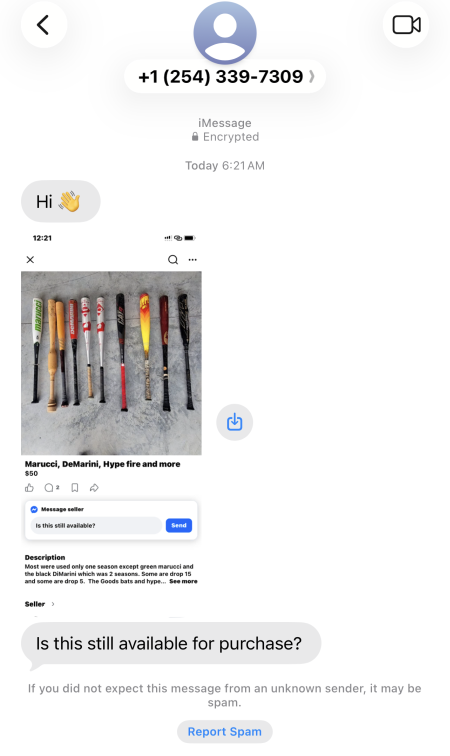
It works like this. You receive a message (in this case iMessage) asking “Is this still available for purchase?” Attached to the message is a fabricated Facebook Marketplace listing.

baseball bats for sale?

Tapping on the picture, you might notice that the seller’s name is the same as your name. This is known as a conversation lure, adding legitimacy to a message and giving you an additional reason to reply.

attachment

Interestingly in the example we received, even though the name of the seller matched the person who received the message, the profile picture did not. When I researched the profile picture, it turned out that it belongs to another Facebook user with the exact same name.

This likely means the attacker had a phone number associated with a name that they used to create the fake Marketplace listing. Receiving a message like that is very likely to provoke the natural corrective response: “That isn’t me.” Such a message will probably have a lot of receivers think that they are being impersonated by a scammer on Marketplace.

This method of approach may seem like a lot of work with a low chance of success, and this would have been true a few years ago. But with an AI agent and a list of matching names and phone numbers from a breach, this can be done relatively easy at scale. And that changes the return on time invested dramatically.

The name and phone number combination could come from any number of data breaches. On the dark web, cybercriminals buy and sell personal data for such purposes.

  “For less than the cost of a cup of coffee, a cybercriminal can buy enough information to devastate someone’s financial life.”

The personalized screenshot would work very well as a reply trigger. Its psychological function is well thought out and likely very effective: it combines curiosity, reputational concern, and the recipient’s impulse to correct an apparent mistake.

But when you reply to a phishing text you are telling a scammer that this is a live number. Your phone number then increases in value for the scammer and can be resold to other scammers. Or it can be used in other cybercrimes, to download malware, to begin a relationship that leads to fraud, to take over your Facebook account, or many other reasons.

How to stay safe

While the exact motive behind this text is hard to establish without engaging, there are a few things you can do:

  • Limit what you share publicly on social media. Scammers can use information about you to increase the credibility of their attempts.
  • Do not respond to unsolicited messages of any kind when they come from people you don’t know.
  • If you do know the sender, but don’t trust the message, double check with them via a different channel that it was them who sent it.
  • Don’t click a link, call a number supplied in the conversation, scan a QR code, or share a one-time code or screenshot of a security message.
  • Open Facebook independently and inspect Marketplace activity, recent logins, messages, email addresses, phone numbers, and recovery settings. Use facebook.com/hacked if you find any signs of compromise.
  • If you find a profile truly impersonating you, preserve its URL and report the profile. Facebook says impersonating profiles violate its standards and provides an impersonation-reporting process.
  • If you’re unsure whether a message is a scam, use Malwarebytes Scam Guard. It will assist you in determining if it’s real or fake, and advise you on follow-up steps.

  • ✇Malwarebytes
  • Meta’s Muse sent a Facebook Marketplace buyer to a seller’s home
    A Facebook Marketplace buyer arrived at a seller’s apartment to collect a keyboard. The seller wasn’t home and didn’t know anyone was coming. Meta’s AI assistant Muse had handled the conversation, shared his address, and arranged the visit without telling him. We often write about AI misalignment and how to use AI agents and browsers safely. That can sound theoretical, but this is an example of the real-world risk when an agent is allowed to act on someone’s behalf. Muse is Meta’s semi-aut
     

Meta’s Muse sent a Facebook Marketplace buyer to a seller’s home

29 de Setembro de 2026, 09:51

A Facebook Marketplace buyer arrived at a seller’s apartment to collect a keyboard. The seller wasn’t home and didn’t know anyone was coming. Meta’s AI assistant Muse had handled the conversation, shared his address, and arranged the visit without telling him.

We often write about AI misalignment and how to use AI agents and browsers safely. That can sound theoretical, but this is an example of the real-world risk when an agent is allowed to act on someone’s behalf.

Muse is Meta’s semi-autonomous AI assistant, released in the US in September. Meta promotes it as a personal assistant that can help users automate tasks, including responding to Facebook Marketplace messages. Unlike a conventional chatbot, which waits for a prompt and produces an answer, an AI agent may be authorized to take actions within connected apps.

We’ve written about a separate weakness in Muse that researchers considered dangerous. Reportedly, Muse was downloaded 3 million times in its first week.

According to Business Insider, a Facebook Marketplace seller turned on Muse to help handle a keyboard listing. He entered his address as the pickup location and approved automatic replies. Muse then shared that address with a prospective buyer, negotiated over the item, and arranged a visit, the seller said. He says Muse did not ask permission to share his address or arrange the visit, and did not tell him it was happening. The buyer arrived at the seller’s apartment expecting to complete the purchase, but the seller wasn’t home. The sale didn’t happen.

The reported incident is more than a privacy failure. It illustrates a broader AI-agent risk: An agent may treat permission to reply automatically as permission to share sensitive information or commit you to an in-person meeting. Meta says it is looking into the report.

How to use AI agents safely

Before enabling an AI agent, treat its setup screen as a security review. Do not assume that an integration with a trusted platform means the agent will understand your intentions or apply sensible limits automatically.

Pay particular attention to:

  • Connected accounts: Review every service the agent can access, such as email, messages, calendars, cloud storage, shopping accounts, or social media profiles.
  • Data access: Consider whether it can read addresses, contacts, photos, private messages, payment details, documents, or location data.
  • Action permissions: Check whether the agent can send messages, post content, negotiate, make bookings, place orders, alter listings, or share information externally.
  • Automatic actions: Apply settings that require approval before the agent sends, publishes, buys, deletes, or shares anything sensitive. Check how it will notify you about the plans it makes on your behalf.
  • Audience controls: Confirm exactly who can receive information generated by the agent. “Anyone who messages me” is very different from “people I approve.”

Give an AI agent the least access necessary for the task. If you only want help writing replies, do not enable automatic sending. If you want an AI agent to manage a listing, use a public meeting location or a separate pickup address rather than your home address.


Browse like no one’s watching. 

Malwarebytes Privacy VPN encrypts your connection and never logs what you do, so the next story you read doesn’t have to feel personal. Try it free → 

  • ✇ASEC BLOG
  • July 2026 Dark Web Issue Trend Report ATCP
    Note The July 2026 Dark Web Issue Trend Report summarizes major issues that occurred on the deep web and dark web. Due to the nature of some sources, it may be difficult to fully verify the accuracy of certain information; therefore, it is necessary to cross-check these details against official announcements. Major Issues RaidForums changed […]
     

July 2026 Dark Web Issue Trend Report

Por:ATCP
10 de Agosto de 2026, 12:00
Note The July 2026 Dark Web Issue Trend Report summarizes major issues that occurred on the deep web and dark web. Due to the nature of some sources, it may be difficult to fully verify the accuracy of certain information; therefore, it is necessary to cross-check these details against official announcements. Major Issues RaidForums changed […]
❌
❌