Visualização normal

Antes de ontemCyber Threat Intel

The Path to the Autonomous SOC: The Early Returns of AI & What It Means for Cybersecurity

25 de Agosto de 2026, 12:12

The question has shifted. Security leaders spent several years debating whether AI would reshape security operations. That debate has settled. Now the conversation is about pace. How fast can the foundation be built, and what do organizations that moved early have to show for it?

For the second year, SentinelOne® commissioned 451 Research to survey 611 North American cybersecurity decision-makers and practitioners on the state of security operations strategy. The results confirm what we’ve been building toward, and they surface a finding that should recalibrate how most security leaders sequence their AI investments.

The Returns Didn’t Wait for the Roadmap

Many product roadmaps assume a clear sequence and start with building toward higher maturity first with returns following. The data shows that AI is running ahead of schedule.

Nearly all organizations surveyed (96%) are still operating AI at the earliest maturity levels:

  • Level 1: Basic monitoring; triage specialist/alert analyst
  • Level 2: More senior triage analyst / basic incident responder and investigator

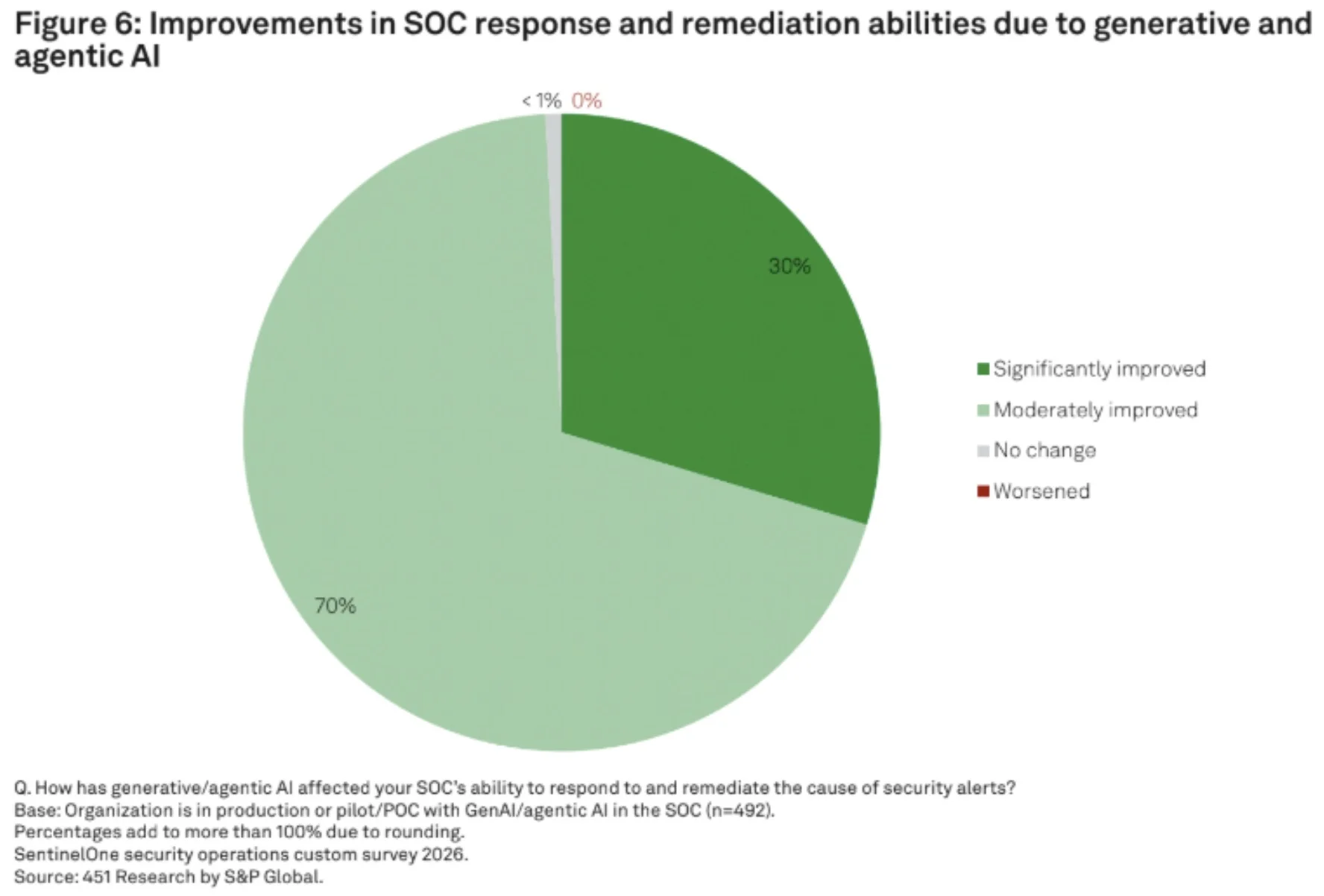
By most measures, AI adoption in the SOC is still early. And yet, 99% of those same organizations already report improvements in incident response and remediation.

The numbers are consistent. Early-stage AI (chatbots handling initial alert triage, automated tools sorting true positives from noise) is delivering before organizations reach advanced maturity. The gap between where most organizations are and what they are already getting is real and consistent across survey respondents.
Organizations waiting for higher AI maturity before building the supporting infrastructure are running the sequence backward. The returns are available now. The foundation built today determines how far those returns scale.

Platformization Has Reached A Verdict

The organizations accelerating AI adoption are also the ones consolidating onto platforms. A platform-oriented security architecture means moving from siloed, specialized tools to an integrated stack built on a foundation that coordinated AI decision-making can actually run on, and one that lets each new capability compound on the last.

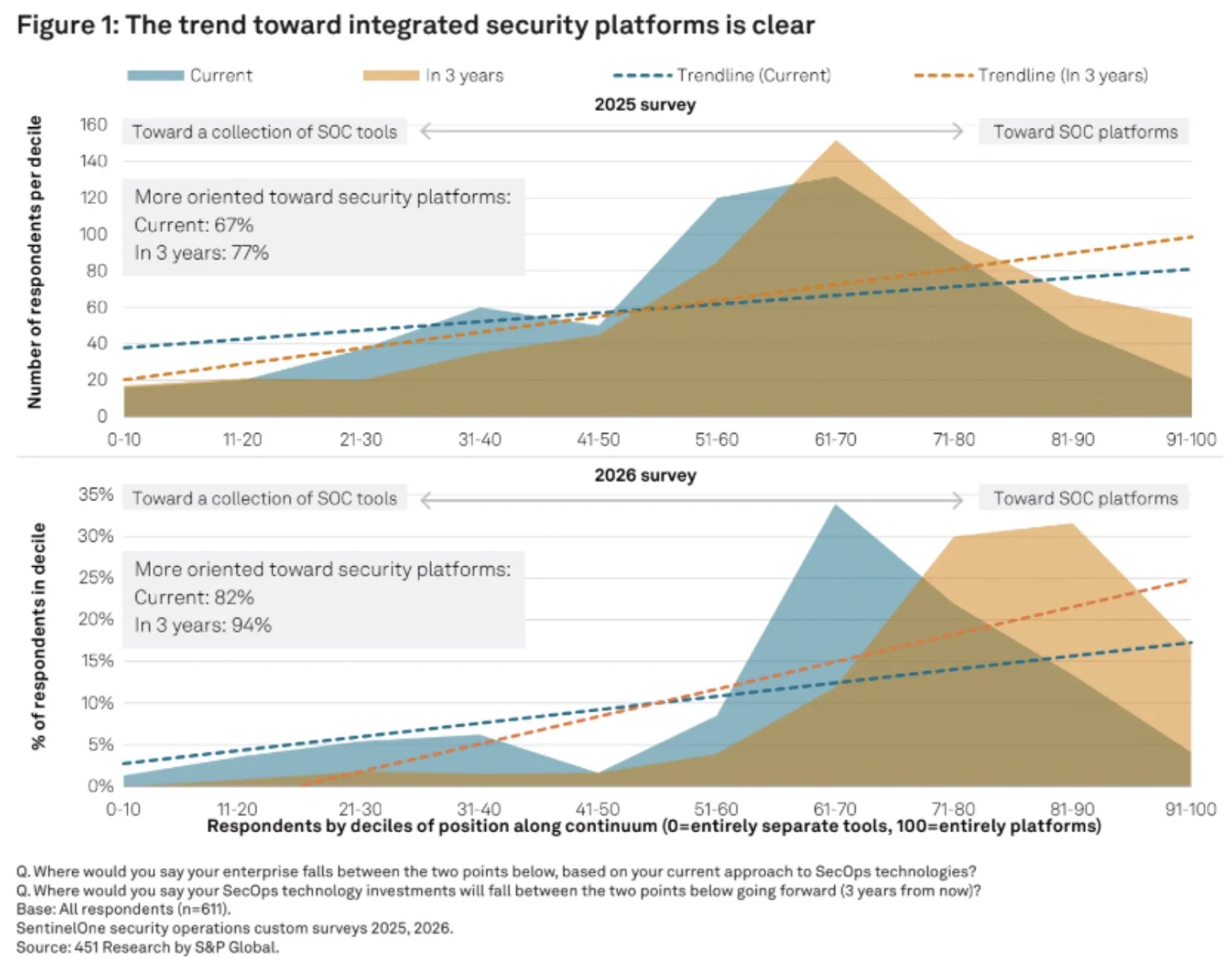
The platformization numbers from this year’s survey are clear. 82% of organizations describe themselves as platform-oriented, a 13-point jump in a single year, and 94% expect to be there within three years.
A common assumption is that platform adoption means replacing specialized tools. The data complicates that picture. The same technologies most frequently deployed as standalone tools (EDR, SIEM, CNAPP) are also the top anchors for integrated platforms. Organizations typically start with one of these and expand outward. What changes is the common data layer that enables coordinated AI decision-making, serving as the connective tissue underneath.

Platformization is not coincidental with AI’s emergence. Agentic AI needs connected, continuously updated data to accurately reason across signals and take autonomous action. Fragmented architectures, where telemetry is siloed and pipelines require manual effort, cannot support AI-driven SOC operations at scale. Platform adoption and AI adoption are converging because AI’s data requirements have made integration a structural necessity.

The survey makes the infrastructure connection an explicit one. The top-cited benefit of investing in a data lake for SecOps is supporting AI-driven SOC workloads and agents. Organizations that built the data foundation early have already cleared the barrier stalling others. Those who haven’t, face a prerequisite gap, and the distance is widening rapidly. Architectural readiness is the variable that determines how far AI investments can scale.

Job Satisfaction Is Rising

Every discussion of AI in the SOC centers on detection and response metrics. This report has those too, but there is a finding that security leaders managing attrition should weigh: analyst burnout is declining.

As AI handles repetitive, high-volume triage work, analysts report rising job satisfaction. The role is shifting away from processing an endless queue and toward investigation, threat hunting, and judgment-intensive work. In a market where SOC analyst turnover remains a persistent operational cost, that shift carries real dollar value.

The analyst role evolves, becoming more strategic and more consequential.

A New Attack Surface

The same AI systems changing how SOCs operate are also creating new targets. Adversaries are already probing AI infrastructure including agents, data pipelines, model endpoints, and the governance gaps that emerge when controls lag behind adoption. The report surfaces this tension clearly: Organizations are deploying AI faster than they are securing it.

An AI agent with misconfigured access or an unmonitored data pipeline is an exposure. Securing the AI infrastructure that powers the SOC is happening alongside deployment, whether organizations have planned for it or not. Those without a clear governance posture are accepting risk that may not be priced into their AI investment case.

The potential of GenAI and agentic AI in the SOC is already being realized. The organizations that capture it fully are those building governance alongside deployment. The platform that runs the Autonomous SOC and the platform that secures it are, increasingly, the same platform.

SentinelOne’s Vision: The Autonomous SOC

Everything the report surfaces, from AI returns arriving before maturity to platform consolidation to the improving analyst experience, points to how these are expressions of the same shift. The foundation that enables early AI returns is the same one that determines how far those returns scale, how capable analysts become, and how well the security of AI itself is governed.

The findings align with how SentinelOne has defined the path to autonomous security operations: A progression from AI-assisted triage at early maturity levels to increasingly autonomous investigation, threat hunting, and response, with humans in strategic and governing roles. The report validates that the market is moving through exactly that sequence. Organizations that understand the architecture behind it (the platform integration, the common data layer, the governance controls) are positioning themselves to capture returns at every stage rather than waiting for the destination.

The full 451 Research report goes further into detail, covering what progression looks like at each maturity level, the specific barriers organizations are encountering, and the data behind each finding in full.

Read the full 451 Research report to learn more about how AI is reshaping cybersecurity.

Third-Party & Intellectual Property Disclaimers

All third-party product names, logos, and brands mentioned in this publication are the property of their respective owners and are for identification purposes only. Use of these names, logos, and brands does not imply affiliation, endorsement, sponsorship, or association with the third party.

This blog may include discussion of unreleased services or features. Any unreleased services or features referenced here are still in development and subject to change. Customers should make their purchase decisions based upon features that are currently available.


Inside the Modern SOC: The Identity Front Door

7 de Agosto de 2026, 20:00

Identity-based attacks drive 90% of incidents. Learn how modern attackers exploit identities and what SOC leaders can do to respond.

The post Inside the Modern SOC: The Identity Front Door appeared first on Unit 42.

AI, Automation and Attacks: Unpacking the Unit 42 2026 Global Incident Response Report

16 de Julho de 2026, 20:00

Explore Unit 42's perspectives on AI's impact on cybersecurity, including key updates since the 2026 Incident Response Report.

The post AI, Automation and Attacks: Unpacking the Unit 42 2026 Global Incident Response Report appeared first on Unit 42.

  • ✇Unit 42
  • Inside the Modern SOC: The 72-Minute Race Sharon Maydar
    Attackers can move from access to exfiltration in 72 minutes. Learn how modern SOC teams close the speed gap with Unit 42's AI-driven automation, threat hunting, MDR and Managed XSIAM. The post Inside the Modern SOC: The 72-Minute Race appeared first on Unit 42.
     

Inside the Modern SOC: The 72-Minute Race

15 de Junho de 2026, 20:00

Attackers can move from access to exfiltration in 72 minutes. Learn how modern SOC teams close the speed gap with Unit 42's AI-driven automation, threat hunting, MDR and Managed XSIAM.

The post Inside the Modern SOC: The 72-Minute Race appeared first on Unit 42.

  • ✇Malwarebytes
  • 88% of people struggle to tell what’s real online
    What would you trade for a technology that can do almost anything? For many people, the answer is clear: Everything they thought they could trust.In a few, short years, Artificial Intelligence (AI) tools have granted people unfettered access to easier writing, faster image generation, quicker coding, and near-instantaneous answers, advice, and information—advantages they value and want. But the same tools that can spruce up a dating profile or reimagine an old photograph can also manipulate the
     

88% of people struggle to tell what’s real online

10 de Junho de 2026, 08:45

What would you trade for a technology that can do almost anything? For many people, the answer is clear: Everything they thought they could trust.

In a few, short years, Artificial Intelligence (AI) tools have granted people unfettered access to easier writing, faster image generation, quicker coding, and near-instantaneous answers, advice, and information—advantages they value and want. But the same tools that can spruce up a dating profile or reimagine an old photograph can also manipulate the broader world online, and people are noticing.

According to new research from Malwarebytes, 88% of people said it’s becoming harder to tell what content online is genuinely human or real, with 84% saying that “convincing video evidence” no longer feels like proof. Further, 85% said it can be hard to tell scams apart from the real thing—a major uptick from the 66% who said the same thing last year.

Statistics from the Face Value report

These are the first signs of AI’s counterfeit world. Replete with fake websites, fake products, fake videos, fake pictures, fake voices, and even fake people, it is threatening to swallow the web.

The latest report from Malwarebytes, Face value: How AI is reshaping trust, identity, and scams exposes the hidden cost of AI on the public: an excess of fraud that is dismantling trust in reality and in one another.

The damage arrives in large moments and small, from the US parent who said they “received a voicemail that sounded exactly like my son’s voice, saying he was in trouble and needed money for legal fees,” to the two entirely unrelated respondents fooled by the same AI-generated video of rabbits bouncing on a trampoline, to the individual worried about “my grandfather showing me AI slop and he thought it was real.”

For this research, Malwarebytes surveyed 1,500 adults aged 18 and older across the US, UK, Austria, Germany, and Switzerland about their uses, feelings, and concerns regarding AI. The sample was equally split for gender with a spread of ages, geographical regions, and race groups, and weighted to provide a balanced view.

The complete findings can be found in the full report:

Here are some of the key takeaways and findings:

  • 88% said it’s becoming harder to tell what content online is genuinely human or real
  • 84% said convincing video evidence no longer feels like proof 
  • 85% of people said it’s hard to tell a scam from the real thing (up from 66% last year)
  • 50% have experienced some form of AI fraud or scam, such as being misled by AI-generated photos of products or receiving a highly personalized scam message
  • 19% have specifically experienced some form of AI-driven identity harm, including the 10% who have had someone use AI to generate sexually explicit content of them without permission
  • 81% fear someone stealing their family’s likeness, yet only 13% have created a family codeword to guard against it
  • 67% worry about voice cloning, yet only 19% have turned off voicemail recordings to prevent it
  • 45% say it’s okay to use AI for personal emotional tasks (like writing wedding vows or a eulogy)
  • 34% say it’s okay to use AI to help create or improve a dating profile
  • One in three self-avowed daily users of AI said it’s okay to generate explicit images of someone without their consent 

Defeat would be the wrong lesson to take from all this. It is true now that the internet requires assistance, but there are plenty of safe places to seek help.

While Malwarebytes works to provide new tools, we’d like to remind both the AI anxious and the eager about the first rule of the internet: Remember the human. People’s voices, bodies, choices, and agency belong to them and them alone. 

As for every fake video, product, website, and image, understand that there’s help. No one needs to navigate an artificial internet alone. Whether through scam detection, identity protection, and simple awareness, people have more options than they may realize.

  • ✇Cybersecurity Blog | SentinelOne
  • Automation at Machine Speed: Rethinking Execution in Modern Cybersecurity SentinelOne
    In our previous posts, we explored the Identity Paradox and the rising risks at the enterprise edge. Together, these blogs highlighted how attackers gain initial access and leverage unmanaged devices to escalate privileges. The next phase of intrusion – execution – demonstrates how modern adversaries, aided by automation and AI, operate at speeds and a scale that challenge traditional human-centered defenses. Understanding these capabilities is critical for organizations aiming to reduce attacke
     

Automation at Machine Speed: Rethinking Execution in Modern Cybersecurity

20 de Abril de 2026, 15:43

In our previous posts, we explored the Identity Paradox and the rising risks at the enterprise edge. Together, these blogs highlighted how attackers gain initial access and leverage unmanaged devices to escalate privileges. The next phase of intrusion – execution – demonstrates how modern adversaries, aided by automation and AI, operate at speeds and a scale that challenge traditional human-centered defenses. Understanding these capabilities is critical for organizations aiming to reduce attacker dwell time and maintain operational resilience.

Automation: The Real Machine Multiplier

The cybersecurity conversation today often centers on AI, with organizations experimenting with generative models, agentic systems, and predictive analytics. While these tools offer unique capabilities, the backbone of modern defense and the source of the real operational advantage is automation.

In today’s landscape where we are seeing a shrinking window for response, adversaries are operating almost entirely at machine speed. In this environment, human operators alone cannot respond fast enough to prevent compromise. Automation enables defenders to reclaim the tempo. By integrating AI insights into hardened automated workflows, security teams can move from reactive triage to proactive intervention, closing gaps before attackers can exploit them. SentinelOne’s® own internal data demonstrates the tangible impact of this shift, showing that proper automation can save analysts approximately 35% manual workload despite 63% growth in total alerts, proving that automation can increase operational speed.

AI as Insight, Not Just Hype

The irony of AI innovation in the last year is that the AI tools we deploy to defend ourselves now need defending. The attack surface didn’t just grow, it folded back on itself. Automation executes tasks at speed, but AI provides context and predictive intelligence that guides those tasks. AI for security encompasses two complementary disciplines:

  • Security for AI: Protecting AI tools, models, and agentic systems themselves from misuse or compromise. This includes governing employee access, ensuring secure coding practices, and managing autonomous AI agents.
  • AI for Security: Leveraging machine learning and reasoning systems to detect and respond to threats faster than traditional rule-based approaches.

AI excels in identifying subtle behavioral patterns, predicting attacker intent, and supporting agentic workflows that can autonomously investigate alerts, recommend actions, and enforce pre-approved policies. By combining high-quality data, low-latency telemetry, and centralized visibility, AI transforms raw signals from endpoints, cloud environments, and identity systems into actionable insights.

However, AI is not a panacea. Without robust automation to operationalize these insights, organizations risk generating alerts faster than they can respond, replicating the same bottlenecks that have plagued traditional security operations.

Threats Accelerated by Automation and AI

Attackers are leveraging the same principles. Across campaigns observed in 2025 and 2026, adversaries are increasingly automating reconnaissance, exploitation, and lateral movement. Examples include:

  • AI-assisted phishing: Rapid generation of highly localized and convincing campaigns in minutes, bypassing traditional content filters.
  • Polymorphic malware: AI-generated malware that mutates faster than signature-based defenses can detect.
  • Automated pivoting: Integration with compromised edge devices or cloud assets to move laterally and escalate privileges at machine speed.

These behaviors compress the attack lifecycle dramatically. What once required hours or days now occurs in milliseconds, highlighting why both automation and AI must form the core of modern defensive strategies.

Transforming Enterprise Operations with Agentic AI

Defending against machine-speed attacks requires agentic AI – systems that can perform investigative and response tasks autonomously, but under human-defined guardrails. SentinelOne’s Purple AI™ exemplifies this approach:

  • Agentic auto-investigations: From alert assessment to hypothesis validation, Purple AI can perform complete investigations with minimal human intervention, documenting every step for audit and compliance.
  • Custom detection creation: Analysts receive agentically recommended detection rules that can be implemented immediately to stop similar attacks before they spread.
  • Integrated hyperautomation: Workflows, alerts, and response actions are executed automatically across endpoints, cloud services, and AI systems, enabling coordinated defense at machine speed.

These capabilities bridge the gap between insight and action, ensuring that detection is accurate and response is rapid, precise, and auditable. As organizations adopt AI for business processes, security must evolve to address the expanding attack surface. Key challenges include:

  • Shadow AI adoption: Employees and teams using unmonitored AI tools create unseen channels for data exfiltration or misconfiguration.
  • Agentic AI risks: Autonomous agents acting without sufficient oversight could unintentionally expose sensitive data or introduce vulnerabilities.
  • Data velocity and volume: AI systems rely on vast, real-time data streams. Ensuring integrity, context, and governance of that data is critical to maintain trust in automated defenses.

Solutions must integrate visibility, control, and governance. SentinelOne’s Prompt Security portfolio provides real-time monitoring for employee AI use, AI coding tools, and agentic AI operations. By automatically redacting secrets, blocking vulnerable code, and enforcing policy compliance, organizations can safely harness AI while reducing exposure.

Meanwhile, Observo AI and AI-native SIEM integration enable organizations to ingest, normalize, and analyze petabytes of telemetry in near real time. By pairing this high-fidelity data with Purple AI’s agentic reasoning, defenders can detect threats, trigger pre-approved responses, and maintain operational oversight across both traditional and AI-native environments.

Operational Principles for Machine-Speed Defense

Implementing an effective AI- and automation-driven security strategy requires clear guiding principles:

  • Intelligence Over Rules: Move beyond static signatures to behavioral and predictive detection. Threats evolve faster than predefined rules; systems must continuously learn, reason, and adapt.
  • Autonomy with Accountability: Automation and agentic AI should operate at machine speed, but within human-defined guardrails, ensuring actions remain traceable, auditable, and aligned with policy.
  • Unified Data and Context: Signals from endpoints, identities, cloud, and AI tools must be fused to create a coherent understanding. Insight without context is noise; action without context is risk.

When consistently applied, these principles reduce dwell time, enable faster response, and ensure that human expertise is focused on high-value decision-making rather than repetitive manual tasks.

Conclusion | Automation & AI as Allies

For two decades, security has been a human-speed discipline applied to a machine-speed problem. That model is over. The organizations that will lead from here aren’t the ones with more analysts or better dashboards. They’re the ones where detection, investigation, and response happen autonomously. The future will be defined by organizations where human and AI manage the SOC together: AI reasons, automation acts, and humans govern the process. Not in sequence. In parallel. At machine speed.

Execution is no longer a phase in the kill chain. It’s the entire game. The defenders who win it won’t be the fastest responders. They’ll be the ones who made their response automatic.

The evolution of execution in cybersecurity demonstrates a broader trend: Defenders must match the speed, scale, and sophistication of adversaries. Not just tools, automation and AI are partners in defense and able to extend human capacity while maintaining oversight, context, and control.

Organizations that invest in integrated, agentic AI systems and robust automated workflows can detect and respond to attacks in real time, reduce analyst workload while increasing coverage, and secure AI adoption itself, maintaining trust in both technology and operations. This shift marks a transition from perimeter-based and manual defense to autonomous, adaptive security, where systems and people collaborate to outpace attackers, secure critical assets, and support business innovation.

Execution is the new frontier in the cyber kill chain. By combining automation, AI-driven insight, and human oversight, organizations can operate at machine speed, defend against advanced threats, and confidently embrace AI-powered transformation.

As the cybersecurity landscape evolves, success will no longer depend solely on faster patching, deeper monitoring, or more alerts. It will depend on the intelligent orchestration of people, machines, and AI, enabling defenders to act faster, smarter, and with confidence in a world where adversaries are already moving at machine speed.

SentinelOne's Annual Threat Report
A defender’s guide to the real-world tactics adversaries are using today to abuse identity, exploit infrastructure gaps, and weaponize automation.


  • ✇Blog – Cyble
  • The Week in Vulnerabilities: Azure AI, Spring AI, Fortinet, and Critical ICS Exposure Mihir Bagwe
    Cyble Research & Intelligence Labs (CRIL) in its weekly vulnerability report tracked 1,431 bugs last week. Of these, over 270 vulnerabilities have publicly available Proof-of-Concept (PoC) exploits, significantly accelerating exploitation timelines and increasing real-world attack likelihood. Additionally, 3 vulnerabilities were actively discussed across underground forums, signaling strong adversarial interest and rapid weaponization. A total of 130 vulnerabilities were rated critic
     

The Week in Vulnerabilities: Azure AI, Spring AI, Fortinet, and Critical ICS Exposure

16 de Abril de 2026, 08:02

Weekly Vulnerability Report, Cyble Weekly Vulnerability Report, Vulnerability Intelligence, Vulnerability Management

Cyble Research & Intelligence Labs (CRIL) in its weekly vulnerability report tracked 1,431 bugs last week.

Of these, over 270 vulnerabilities have publicly available Proof-of-Concept (PoC) exploits, significantly accelerating exploitation timelines and increasing real-world attack likelihood.

Additionally, 3 vulnerabilities were actively discussed across underground forums, signaling strong adversarial interest and rapid weaponization.

A total of 130 vulnerabilities were rated critical under CVSS v3.1, while 45 were rated critical under CVSS v4.0, reflecting the severity of disclosed issues.

Furthermore, CISA added 3 vulnerabilities to its Known Exploited Vulnerabilities (KEV) catalog, confirming active exploitation in the wild.

On the industrial front, CISA issued 5 ICS advisories covering 6 vulnerabilities, impacting vendors such as Siemens, Hitachi Energy, and Yokogawa.

Weekly Vulnerability Report’s Top 5 Vulnerabilities

CVE-2026-32213 — Microsoft Azure AI Foundry (Critical)

CVE-2026-32213 is a critical authorization bypass vulnerability in Microsoft Azure AI Foundry.

The flaw exists in the platform’s authorization logic, allowing unauthenticated attackers to bypass security checks and grant themselves administrative privileges. Successful exploitation enables full control over AI environments and associated resources.

CVE-2026-35022 — Claude Code CLI / Agent SDK (Critical)

CVE-2026-35022 is a critical OS command injection vulnerability affecting Anthropic’s Claude Code CLI and Agent SDK.

The vulnerability allows attackers to inject malicious commands into development workflows, resulting in remote code execution and potential compromise of AI pipelines.

CVE-2026-22738 — Spring AI (Critical)

CVE-2026-22738 is a remote code execution vulnerability in Spring AI caused by improper input sanitization in expression evaluation.

Attackers can inject malicious expressions that are executed by the Spring Expression Language, leading to complete application and server compromise.

CVE-2026-4631 — Cockpit (Critical)

CVE-2026-4631 is an unauthenticated remote code execution vulnerability in Cockpit, a web-based Linux server management interface.

The flaw allows attackers to execute arbitrary commands without authentication, potentially leading to full system takeover in enterprise environments.

CVE-2026-35616 — Fortinet FortiClient EMS (Critical)

CVE-2026-35616 is a critical authentication bypass vulnerability in Fortinet FortiClient EMS.

Attackers can bypass authentication and execute arbitrary commands, leading to complete compromise of endpoint management systems.

Weekly Vulnerability Report, Cyble Weekly Vulnerability Report, Vulnerability Intelligence, Vulnerability Management
Data Source: Cyble Vision

Vulnerabilities Added to CISA KEV

CISA continues to expand its KEV catalog, reflecting real-world exploitation trends.

Notable addition:

CVE-2026-35616 — Fortinet FortiClient EMS
This vulnerability enables authentication bypass and remote command execution, making it a high-priority remediation target.

The inclusion of enterprise security tools in KEV highlights attackers’ focus on compromising centralized management systems.

Critical ICS Vulnerabilities

CISA issued 5 ICS advisories covering 6 vulnerabilities, many of which impact critical infrastructure environments.

Weekly Vulnerability Report, Cyble Weekly Vulnerability Report, Vulnerability Intelligence, Vulnerability Management
Data Source: Cyble Vision

CVE-2026-1579 — PX4 Autopilot (Critical)

A missing authentication vulnerability allowing attackers to execute critical functions without credentials.

This flaw poses risks to autonomous and unmanned systems, potentially enabling unauthorized control.

CVE-2026-3356 — Anritsu Systems (Critical)

This vulnerability involves missing authentication in Anritsu devices, allowing attackers to gain unauthorized access.

CVE-2025-10492 — Hitachi Energy Ellipse (Critical)

A deserialization vulnerability enabling attackers to execute arbitrary code within industrial systems.

Siemens SICAM 8 (Chained Risk)

Two vulnerabilities affecting Siemens SICAM 8 systems—resource exhaustion and out-of-bounds write—can be chained together.

This creates a denial-of-service risk capable of disrupting industrial processes and operational visibility.

CVE-2025-7741 — Yokogawa CENTUM VP (Medium)

A hard-coded password vulnerability that weakens authentication mechanisms and increases risk of unauthorized access.

Critical Infrastructure Sectors Spotlight

Weekly Vulnerability Report, Cyble Weekly Vulnerability Report, Vulnerability Intelligence, Vulnerability Management
Data Source: Cyble Vision

Analysis indicates:

  • Critical Manufacturing appears in 66.7% of vulnerabilities
  • Cross-sector exposure spans:
    • Transportation Systems
    • Emergency Services
    • Defense Industrial Base
    • Communications

This highlights interconnected infrastructure risks, where a single vulnerability can cascade across multiple sectors.

Conclusion

This week’s findings highlight several critical trends:

  • Expansion of vulnerabilities into AI and development ecosystems
  • Increasing exploitation of enterprise management platforms
  • Continued weaknesses in industrial control systems
  • Cross-sector risk amplification in critical infrastructure

With 270+ PoCs, KEV-confirmed exploitation, and emerging threats in AI frameworks, organizations face heightened risk across both digital and physical environments.

Key Recommendations

  • Prioritize vulnerabilities with PoCs and KEV inclusion
  • Secure AI development environments and pipelines
  • Patch enterprise management and remote access systems immediately
  • Implement strict authentication and access control mechanisms
  • Segment IT and OT networks to prevent lateral movement
  • Apply compensating controls for unpatched ICS vulnerabilities
  • Monitor underground forums and threat intelligence feeds
  • Conduct continuous vulnerability assessments and penetration testing


Cyble’s attack surface management and vulnerability intelligence solutions help organizations proactively identify risks, prioritize remediation, and detect emerging threats. By integrating intelligence-driven security strategies, organizations can strengthen resilience across enterprise and critical infrastructure environments.

The post The Week in Vulnerabilities: Azure AI, Spring AI, Fortinet, and Critical ICS Exposure appeared first on Cyble.

Securing the Software Supply Chain: How SentinelOne’s AI EDR Autonomously Blocked the CPU-Z Watering Hole Cyber Attack

14 de Abril de 2026, 19:59

On April 9, 2026, cpuid.com was actively serving malware through its own official download button. Threat actors had compromised the CPUID domain at the API level and were silently redirecting legitimate download requests to attacker-controlled infrastructure. The attack ran for approximately 6 hours. Users who navigated directly to the official site received a legitimate, properly signed binary with a malicious payload bundled inside it.

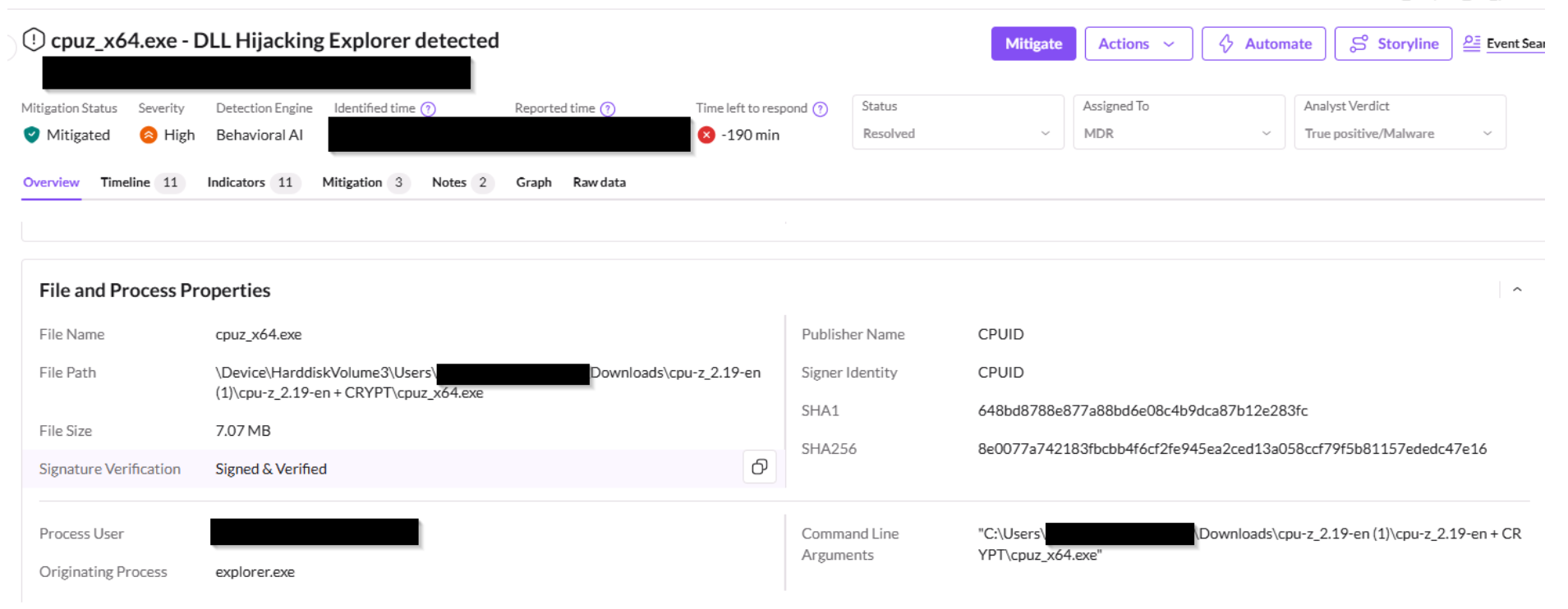
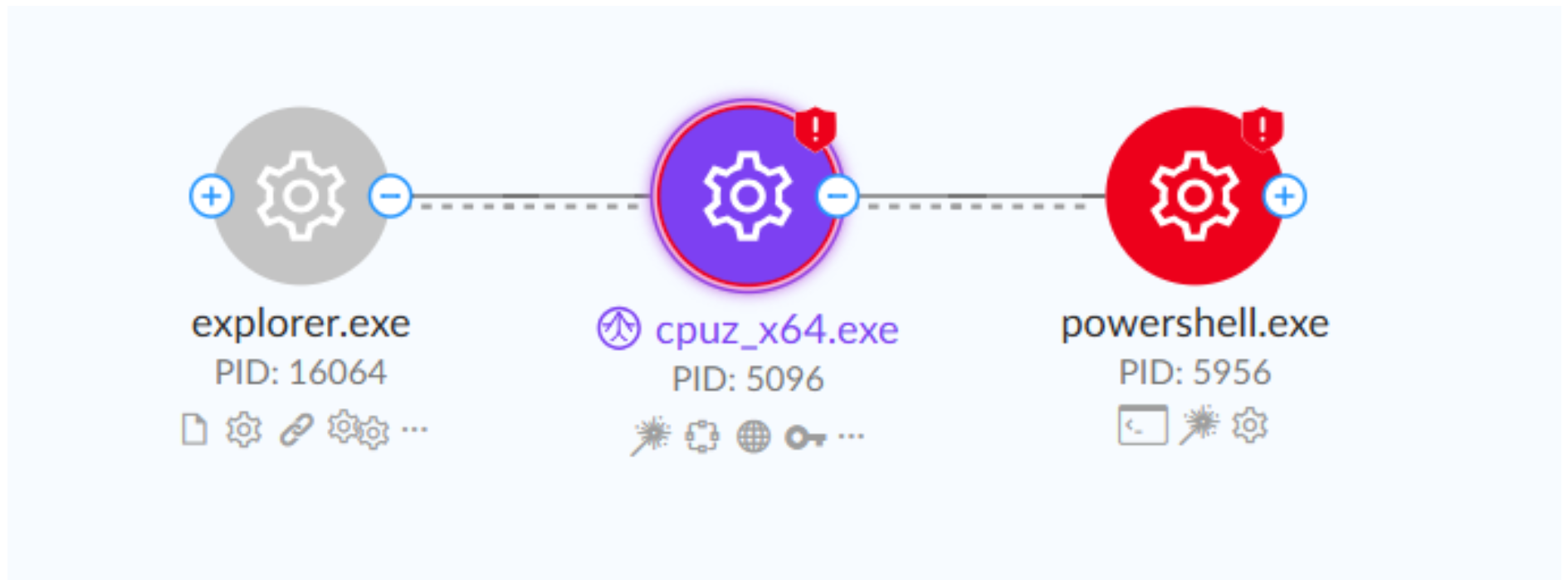
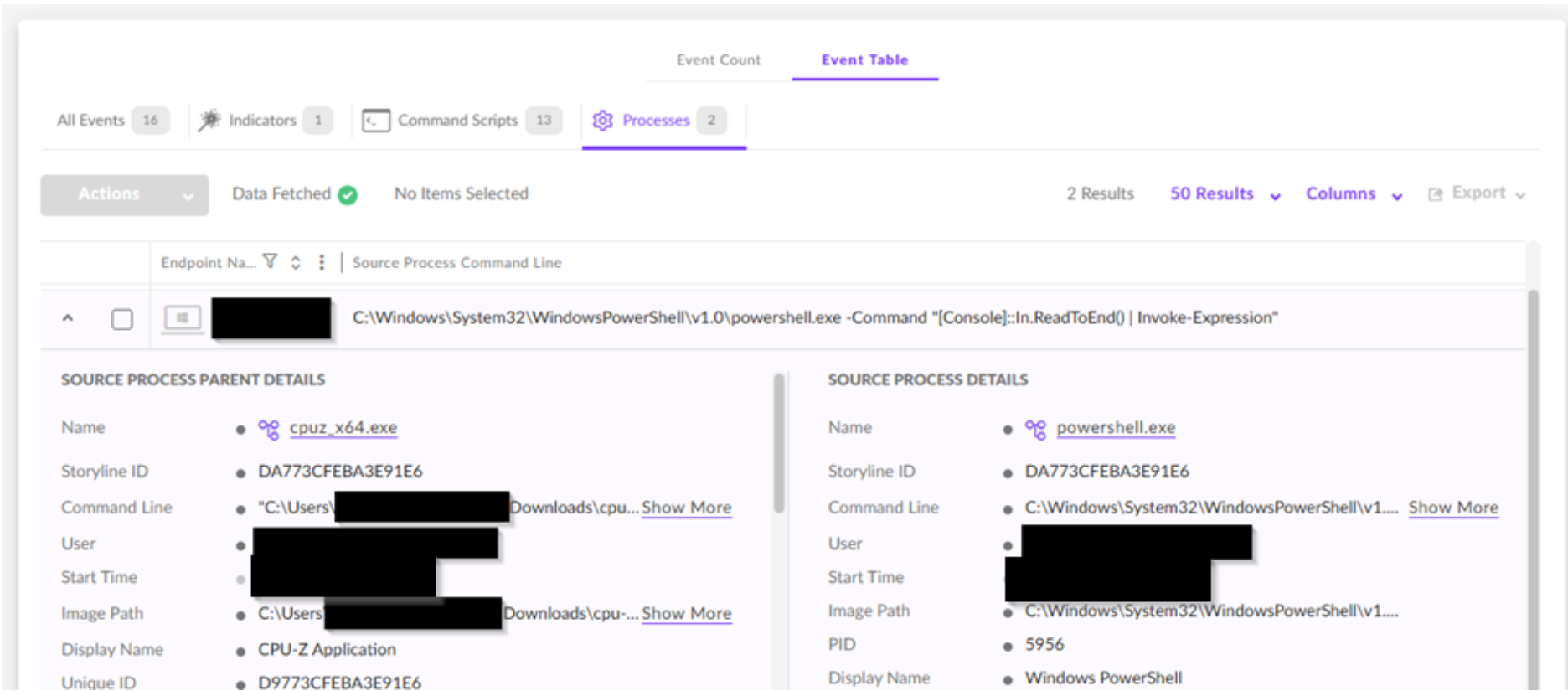
That morning, SentinelOne’s behavioral detection flagged an anomaly inside cpuz_x64.exe. The binary was genuine. The digital signature was valid. The download had arrived from the vendor’s own infrastructure. The process chain cpuz_x64.exe began constructing was the tell: it spawned PowerShell, which spawned csc.exe, which spawned cvtres.exe. CPU-Z does not do that.

CPU-Z, HWMonitor, HWMonitor Pro, and PerfMonitor are staples in IT toolkits. The users who downloaded them followed every instruction they’d been given. The trust chain broke above them. The next attack will work the same way.

SentinelOne’s Annual Threat Report identifies exactly this pattern as a systemic shift: “This [shift] extends deeply into the software supply chain, where the identity of a trusted developer becomes the vector of attack.” In late 2025, we observed the GhostAction campaign, where a compromised GitHub maintainer account pushed malicious workflows to extract secrets. A concurrent phishing attack against a maintainer of popular NPM packages deployed malicious code capable of intercepting cryptocurrency transactions. In each case, the commit logs and push events appeared legitimate because they originated from accounts with valid write access. The identity was verified. The intent had been subverted. The CPUID incident extends this pattern to software distribution itself: the supplier’s download infrastructure became the delivery channel.

What the Agent Saw

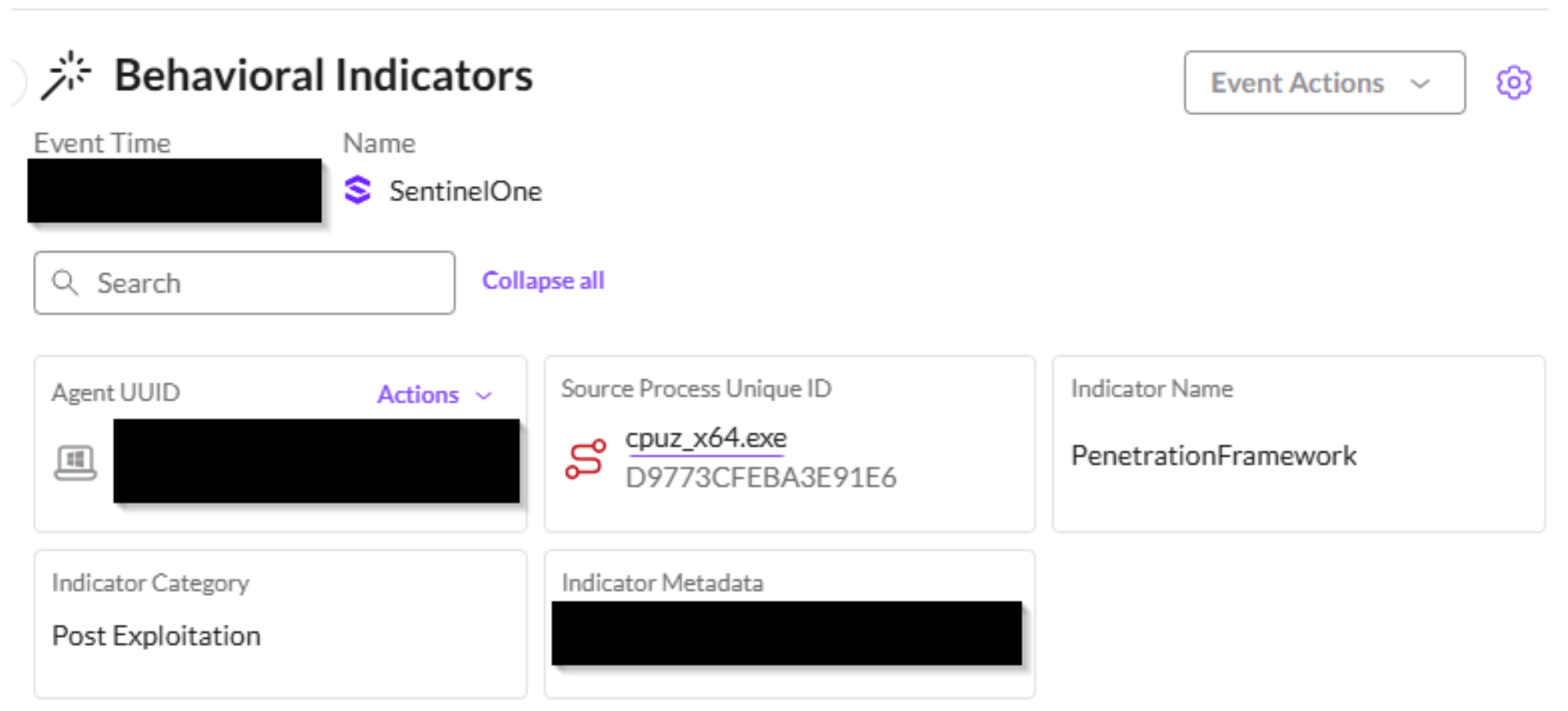
The SentinelOne agent triggered the alert “Penetration framework or shellcode was detected” within the first seconds of execution. The detection came from what the process was doing, with five specific behavioral indicators converging:

  • Anomalous API resolution: The process located system functions through non-standard discovery methods, bypassing the OS loader entirely.
  • Reflective code loading: Executable code was running in memory regions with no corresponding file on disk.
  • Suspicious memory allocation: Read-Write-Execute (RWX) memory permissions were requested, a staging pattern for malicious payloads.
  • Process injection patterns: Execution flow consistent with code being redirected into a secondary process to mask its origin.
  • Heuristic shellcode signatures: Sequential operations characteristic of automated exploitation toolkits preparing an environment for command execution.

The agent autonomously terminated and quarantined the involved processes before the attack advanced further. The malicious CRYPTBASE.dll, placed in the same directory as the legitimate CPU-Z binary, was loaded by Windows before the real system DLL could be reached, and it never completed its job.

Alert Page
Alert Page

The agent was watching for what the software was trying to do. Behavioral detection is the layer that holds when authorization cannot be trusted, because the behavior reveals intent regardless of what signed the package.

Behavioral Indicator
Process Tree
Process Tree
Event Table
Event Table

What Was Actually Inside

The trojanized packages were designed to leave no trace. A reflective PE loader decrypted and injected a second-stage DLL using XXTEA encryption and DEFLATE decompression, no disk writes, no file artifacts. Three redundant persistence mechanisms were then installed: a registry Run key, a 68-minute scheduled task with a 20-year duration, and MSBuild project files in AppData\Local engineered to survive reboots and partial remediation.

The 2026 Annual Threat Report describes this persistence design as “masquerading as maintenance”: adversaries blend into the environment by mimicking legitimate system updates and background processes. To a busy defender, a scheduled task with a generic name and a timed execution interval appears entirely routine until you examine what it is executing. STX RAT’s 68-minute task with a 20-year duration operates on exactly this logic.

The process chain visible in EDR logs made the intent clear: cpuz_x64.exe spawned powershell.exe, which spawned csc.exe, then cvtres.exe. CPU-Z does not do that.

The final payload, STX RAT, delivered hidden VNC providing an attacker-controlled desktop session invisible to the user, keyboard and mouse injection, browser credential theft across Chrome, Firefox, Edge, and Brave, Windows Vault extraction, cryptocurrency wallet access, and a reverse proxy for follow-on payload delivery. C2 communication ran over a custom encrypted protocol using DNS-over-HTTPS to 1.1.1.1 to bypass DNS monitoring.

A reflective payload executing entirely in memory, inside a signed process, with no disk writes, compresses the detection window to milliseconds. Autonomous response is the only response fast enough.

The Attacker’s Critical Mistake

Kaspersky’s analysis linked the CPUID samples to a March 2026 campaign targeting FileZilla users within hours, and the connection required no advanced forensics. The attacker reused the identical C2 infrastructure and deployed the unmodified STX RAT payload, the same one eSentire’s Threat Response Unit had already fingerprinted and published YARA rules for after the FileZilla campaign.

Those rules detected the CPUID variant without modification.

The actor invested time compromising CPUID’s download API and did nothing to retool after being publicly fingerprinted. The C2 domain, the backend server, the payload: all identical across campaigns. The same backend server had been operating since at least July 2025. Per Kaspersky’s own assessment, the C2 reuse was the gravest mistake of the operation. A more disciplined actor burns infrastructure between campaigns. This one did not, and defenders had working detection before most victims knew an attack had occurred.

What the Attack Was Really For

The 150+ confirmed victims span retail, manufacturing, consulting, telecommunications, and agriculture. The count is almost certainly low, CPUID’s tools have tens of millions of users globally, and the portable ZIP variant of CPU-Z runs commonly on production systems in environments that block installer-based software.

Victim count is secondary to victim profile. CPU-Z users skew toward IT professionals: system administrators, developers, security engineers, the people with domain admin rights, production access, and infrastructure keys. One compromised sysadmin carries a fundamentally different blast radius than one compromised user.

The operational pattern points to an initial access broker. The goal was to sell persistent, hidden access. Someone else would do the extracting.

For organizations where an infection occurred, two questions need answers. What did the attacker do during the window they had access, especially if that machine belonged to a privileged user? And what happens over the next 60-90 days, when whoever purchased that access decides to activate it? Ransomware affiliates who buy IAB access typically move within that window. Cleaning the machine closes one exposure. Monitoring for lateral movement, credential reuse, and unusual authentication in the weeks following remediation closes the other.

What Defenders Should Do Now

For practitioners

The indicators are specific and actionable.

  • Check your fleet for CRYPTBASE.dll in any directory other than C:\Windows\System32.
  • Look for the process chain cpuz_x64.exe or any CPUID application spawning PowerShell.
  • Block supp0v3[.]com and 147.45.178.61 at DNS and firewall layers.
  • At the network layer, watch for DNS-over-HTTPS queries to 1.1.1.1/dns-query resolving welcome.supp0v3.com; STX RAT specifically uses DoH to bypass DNS monitoring, and any endpoint generating this pattern is a high-confidence indicator.

If you find an infected machine, remediate all four persistence mechanisms explicitly: the registry Run key, the scheduled task, any MSBuild .proj files in AppData\Local, and PowerShell profile autoruns. The malware installs redundant footholds specifically because partial cleanup leaves it alive.

For security leaders

The harder conversation is about supply chain trust. Your users followed every rule they were given. They downloaded from the official website. They trusted a vendor they had used for years. That vendor’s infrastructure failed them. Behavioral detection, security that watches what software does rather than where it came from, is the layer that caught this.

The business case is specific. When an initial access broker sells a foothold obtained this way, the buyer typically activates within 60-90 days. With average ransomware recovery costs exceeding $4 million per incident, even a single privileged endpoint sold through an IAB represents material, quantifiable exposure. The organizations that already had 24/7 autonomous behavioral monitoring in place closed the window before it opened. The ones that did not are still counting.

The adversary’s tooling was unsophisticated. The OPSEC was poor. The C2 reuse was a gift to defenders. And yet: 150+ confirmed victims and a 6-hour window during which clean, legitimate software was being replaced by a remote access trojan is a demonstration of how far attacker leverage has extended into the software supply chain, and how quickly behavioral detection closes the gap when it acts autonomously, before the attack completes its first stage. The attacker’s poor OPSEC saved defenders this time. The structural failure in the trust model (the assumption that software from a trusted source is safe to run) persists regardless of attacker discipline.

The Structural Problem That Remains

SentinelOne’s latest Annual Threat Report documents GhostAction and the NPM package compromise as supply chain identity attacks through code repositories and package managers. CPUID adds a third layer: the vendor’s distribution infrastructure itself. Across all three cases, access controls validated a legitimate identity. The report frames this plainly: “The identity is verified, but the intent has been subverted, rendering traditional access controls ineffective against the resulting supply chain contamination.”

This shift means authorization, the cornerstone of traditional software trust, is no longer a sufficient security boundary. When the distribution channel becomes the failure point, verification has to move from the point of origin to the point of execution.

In the CPUID case, users followed every rule. They downloaded from the official vendor website. That vendor’s download API was the failure point, compromised at the infrastructure level for 6 hours, with no visible indication.

SentinelOne’s Behavioral AI engine detects suspicious and malicious patterns in real time, watching what the software does regardless of where it came from.

SentinelOne customers were protected through autonomous behavioral detection at the point of execution. The structural failure in the trust model (the assumption that software from a trusted source is safe to run) is a gap that better user behavior cannot close. Behavioral detection at machine speed is what closes it.

To understand how the Singularity™ Platform identifies threats across your environment, including those arriving through trusted software channels, request a demo.

  • ✇Cybersecurity Blog | SentinelOne
  • Edge Decay: How a Failing Perimeter Is Fueling Modern Intrusions SentinelOne
    In the first blog of this series, we explored the Identity Paradox and how attackers exploit valid credentials to operate undetected inside enterprise environments. However, identity compromise rarely happens in isolation. To understand how these attacks begin, we need to look earlier in the intrusion lifecycle at the place many organizations still assume is secure: the edge. For years, cybersecurity strategy has been built around defending the perimeter to protect the enterprise. Firewalls, VPN
     

Edge Decay: How a Failing Perimeter Is Fueling Modern Intrusions

9 de Abril de 2026, 10:00

In the first blog of this series, we explored the Identity Paradox and how attackers exploit valid credentials to operate undetected inside enterprise environments. However, identity compromise rarely happens in isolation.

To understand how these attacks begin, we need to look earlier in the intrusion lifecycle at the place many organizations still assume is secure: the edge.

For years, cybersecurity strategy has been built around defending the perimeter to protect the enterprise. Firewalls, VPNs, and secure gateways were designed as the outer boundary of the organization – hardened systems intended to control access and reduce risk. But that model is breaking down. What was once treated as a defensive layer is now a frequent target of modern attacks.

Rather than acting purely as protection, the perimeter increasingly introduces exposure. This shift reflects what can be described as edge decay, a gradual erosion of trust in boundary-based security as attackers focus on the infrastructure that defines it.

The Perimeter Is No Longer a Safe Boundary

The scale of this shift is hard to ignore. Zero-day vulnerabilities often target edge devices, including firewalls, VPN concentrators, and load balancers, all of which are not fringe systems. They are foundational components of enterprise connectivity, and the infrastructure that organizations built to protect themselves has become the infrastructure attackers exploit first.

Yet, unlike endpoints or servers, many edge devices still sit outside traditional endpoint visibility and control. Because these appliances typically cannot run EDR agents, defenders are often forced to rely on logs and external monitoring instead. However, logging can be inconsistent, patch cycles are often slow, and in many environments, these devices are treated as stable infrastructure rather than active risk. This combination creates a persistent visibility gap.

Attackers have recognized this gap and are exploiting it at scale. Rather than targeting hardened endpoints, adversaries are shifting their focus to unmanaged and legacy edge infrastructure and the systems that sit at the intersection of trust and exposure.

Weaponization at Machine Speed

One of the most significant accelerators of edge-focused attacks is the rise of automation and AI-assisted exploitation.

Threat actors are no longer relying on manual discovery. Instead, they use automated tooling to scan global IP space, identify exposed devices, and operationalize vulnerabilities within hours of disclosure. In some cases, exploitation begins within days or even hours of a vulnerability becoming public.

This compression of the attack timeline has important implications for defenders. Traditional patching cycles and risk prioritization models are no longer sufficient when adversaries can move faster than organizations can respond. As a result, edge compromise is increasingly observed as an early step in broader intrusion chains, often preceding identity-based attacks.

Edge Devices as Persistent Beachheads

Adversaries are increasingly prioritizing edge infrastructure because it represents a structural blind spot. Rather than targeting well-defended endpoints, they focus on unmanaged or legacy systems that fall outside standard visibility. Once compromised, these devices become more than just entry points, they provide a stable foothold for continued operations.

Once attackers gain access to a firewall or VPN appliance, that system effectively becomes an internal pivot point rather than a boundary control. From there, adversaries can monitor traffic, capture credentials, and pivot deeper into the network.

Investigations have repeatedly shown how compromised edge devices are used to:

  • Intercept authentication flows and harvest credentials
  • Deploy web shells on internal systems
  • Create unauthorized accounts for persistence
  • Pivot directly into sensitive infrastructure such as virtualization platforms

SentinelOne’s® Annual Threat Report observed a case where attackers leveraged compromised F5 BIG-IP devices to move from the internet-facing edge directly into internal VMware vSphere environments. In another, vulnerabilities in Check Point gateway devices were exploited to gain initial access across dozens of organizations globally.

These incidents reflect a broader pattern where the edge is becoming the attacker’s preferred entry point for lateral movement and identity compromise.

Living Inside the Infrastructure

More advanced campaigns take this concept even further by embedding themselves directly into the firmware of edge devices. The ongoing ArcaneDoor campaign, as noted in the Annual Threat Report, illustrates this evolution. Targeting legacy Cisco Adaptive Security Appliance (ASA) devices, attackers chained multiple zero-day vulnerabilities to deploy a firmware-level bootkit known as RayInitiator.

This implant is particularly dangerous because it operates below the operating system, allowing it to survive reboots and software updates. Alongside it, attackers deployed LINE VIPER, an in-memory payload capable of capturing authentication traffic and suppressing logging activity to evade detection. In effect, the device itself becomes both the attack platform and the concealment mechanism. When logging is suppressed and monitoring is absent, defenders lose visibility into the intrusion entirely.

The Rise of Untraceable Relay Networks

Compromised edge devices are not just used for internal access, they are also being repurposed as part of global attack infrastructure. State-sponsored actors have begun building Operational Relay Box (ORB) networks from compromised routers and firewalls. These networks allow attackers to route malicious traffic through legitimate but hijacked infrastructure, obscuring the true origin of their operations.

Clusters such as PurpleHaze and activity linked to groups like APT15 and Hafnium demonstrate how these relay networks are used to dynamically rotate attack paths, making attribution more difficult. As a result, malicious traffic can appear to originate from trusted enterprise systems, complicating both detection and response.

This dual use of edge devices as both entry points and relay infrastructure highlights a shift in how adversaries operationalize compromised systems.

Legacy Systems and the Illusion of Patchability

A major contributor to edge decay is the persistence of legacy systems. Many organizations continue to rely on outdated appliances that lack modern security features such as Secure Boot or robust integrity verification. These systems are often considered “patchable,” but in practice, they represent long-term operational risk that is difficult to fully mitigate.

Firmware updates can be disruptive and vendor support may be inconsistent. In many cases, organizations are hesitant to modify systems that underpin critical connectivity. The result is a growing population of edge devices that remain exposed long after vulnerabilities are discovered. In some environments, this problem is compounded by visibility gaps. Devices running unsupported operating systems or incompatible software cannot host modern security tooling, leaving them effectively unmonitored. These “legacy ghosts” become ideal targets for attackers for being stable, trusted, and largely invisible.

The Identity Connection

Edge compromise does not exist in isolation. It is deeply connected to identity-based attacks. Once an attacker controls a gateway or VPN appliance, they gain access to authentication flows, session data, and credential material. This allows them to pivot directly into identity infrastructure, bypassing traditional defenses.

In many intrusions, edge compromise becomes the first step toward identity abuse. This creates a direct connection between edge exposure and the challenges described in the Identity Paradox. Attackers do not need to break authentication if they can intercept it. By observing or capturing identity data in transit, they can operate using valid artifacts without triggering traditional controls.

Conclusion | Securing Edge Infrastructure from the Vanishing Perimeter

The perimeter isn’t failing, it’s already failed. Every unpatched VPN, every legacy firewall running decade-old firmware, every edge device outside your visibility is a door left open and forgot about. The question isn’t whether attackers will find it. It’s whether you’ll see them when they walk through. Once attackers establish a foothold at the edge, they move quickly to compromise identities, escalate privileges, and expand their reach across the environment. This progression from edge access to identity abuse to full-scale intrusion is becoming the dominant pattern in modern attacks.

In this context, defending the edge means both protecting infrastructure and disrupting the earliest stages of the attack lifecycle. Given how dynamic and often unmanaged edge environments have become, they can no longer be treated as a reliable line of defense on their own.

To defend against adversaries who specialize in exploiting these blind spots, the path forward requires a shift in perspective from device-level alerts to attack lifecycle visibility, and from assumed integrity to continuous validation.

SentinelOne's Annual Threat Report
A defender’s guide to the real-world tactics adversaries are using today to abuse identity, exploit infrastructure gaps, and weaponize automation.

Third-Party Trademark Disclaimer

All third-party product names, logos, and brands mentioned in this publication are the property of their respective owners and are for identification purposes only. Use of these names, logos, and brands does not imply affiliation, endorsement, sponsorship, or association with the third-party.

  • ✇Cybersecurity Blog | SentinelOne
  • The Identity Paradox: The Hidden Risks in Your Valid Credentials SentinelOne
    For decades, attackers have favored one intrusion method over all others: compromise the identity. Long before ransomware crews industrialized extortion and modern malware ecosystems matured, adversaries understood a simple truth. If you can access a legitimate account, you can bypass most security controls and operate inside a network with the same privileges as the user who owns it. That strategy has not changed. What has changed is the scale and complexity of the identity surface attackers ca
     

The Identity Paradox: The Hidden Risks in Your Valid Credentials

2 de Abril de 2026, 10:00

For decades, attackers have favored one intrusion method over all others: compromise the identity. Long before ransomware crews industrialized extortion and modern malware ecosystems matured, adversaries understood a simple truth. If you can access a legitimate account, you can bypass most security controls and operate inside a network with the same privileges as the user who owns it. That strategy has not changed. What has changed is the scale and complexity of the identity surface attackers can exploit.

Modern enterprises no longer operate around a single directory and a handful of user accounts. Instead, organizations rely on sprawling webs of identities that span SaaS platforms, cloud infrastructure, APIs, service accounts, and increasingly autonomous AI agents. A single employee account may now provide access to dozens of interconnected services, while non-human identities quietly power automation behind the scenes.

This evolution has created a fundamental security dilemma: organizations now collect more identity telemetry than ever before, yet identity-based intrusions remain some of the hardest attacks to detect. Security teams are facing what can only be described as the “Identity Paradox”.

More Identity Data, Less Clarity

The Identity Paradox reflects a growing imbalance in modern security operations. Enterprises have unprecedented visibility into authentication events, login attempts, and access logs, yet attackers continue to breach organizations using legitimate credentials. The reason is simple: an attacker using a valid identity does not look like an attacker. They look like an employee doing their job.

SentinelOne’s Steve Stone, Warwick Webb, and Matt Berry break down some of the key aspects of the “Identity Paradox”.

Under this guise, threat actors increasingly rely on techniques that inherit trusted sessions or legitimate credentials. These include stolen authentication tokens, adversary-in-the-middle (AiTM) phishing campaigns, compromised developer accounts, and even state-sponsored insiders. In each case, the attacker bypasses security by leveraging an identity that the system already trusts.

When authentication appears legitimate, traditional defenses struggle to distinguish between normal activity and malicious intent. The problem is further compounded by the wide spectrum of identity abuse methods now being observed in the wild.

When the Attacker Is an “Employee”

At one extreme of the identity threat landscape are traditional credential theft campaigns powered by phishing, infostealers, and session hijacking tools. At the other extreme are state-sponsored actors who continue to put significant effort into infiltrating organizations by applying for open roles directly.

In recent years, investigators have documented coordinated efforts by North Korean IT workers to obtain remote employment at Western technology firms. These individuals create elaborate fake personas using stolen identities and fabricated work histories to pass background checks.

In 2025 alone, SentinelLABS tracked over 1,000 job applications and roughly 360 fake personas linked to these operations. Once hired, these individuals operate as legitimate insiders with authorized access to corporate infrastructure. From a telemetry perspective, the account is valid. HR has approved the employee and login activity appears normal, yet the identity itself has been subverted.

This highlights the core challenge of identity defense: the system may validate who the user is, but it cannot easily validate their intent.

Supply Chains & Trusted Developers

The Identity Paradox also extends deeply into the software supply chain. Developers and maintainers of open-source packages often hold privileged access to repositories that are widely trusted by downstream users. When these accounts are compromised, attackers can inject malicious code into legitimate projects while appearing to operate as the original maintainer.

One example observed in late 2025 involved the “GhostAction” campaign, where attackers compromised a GitHub maintainer account and pushed malicious workflows designed to extract secrets from development pipelines. Similarly, a phishing attack against a maintainer of popular NPM packages led to the deployment of malicious code capable of intercepting cryptocurrency transactions.

In both cases, the malicious commits originated from accounts with legitimate write access. Access controls were functioning exactly as designed. While the identity was verified, the intent behind the activity had changed.

The Expanding Identity Surface

As the definition of identity expands, employees are no longer the only actors operating within enterprise environments. Service accounts, APIs, workload identities, and AI agents are now executing actions across cloud platforms and SaaS environments at machine speed.

These non-human identities (NHIs) often operate with persistent privileges and broad access to critical resources. However, they are frequently overlooked in traditional identity governance frameworks. As organizations adopt automation and agent-driven workflows, non-human identities are rapidly becoming one of the fastest-growing attack surfaces in cybersecurity.

Traditional identity security models were built around human users and authentication events. That model does not translate well to NHIs, which can be ephemeral, programmatic, and massively scaled. In many environments, these automated identities vastly outnumber human users.

The Authorization Gap

The shift toward automation exposes another structural weakness in traditional identity security: the “Authorization Gap”. Security frameworks have historically focused on the moment of authentication as a gate that determines whether a user is allowed to enter. To follow this, organizations have in turn invested heavily in stronger authentication mechanisms, granular permissions, and zero trust access models. These controls remain essential, but authentication alone cannot determine what happens after access is granted.

A fully authenticated user may still perform reconnaissance, exfiltrate sensitive data through a browser, or upload proprietary code into generative AI tools. Likewise, a correctly provisioned service account could be abused for lateral movement across cloud infrastructure. Once inside, traditional identity systems often assume legitimacy. This assumption creates a dangerous blind spot between who is allowed into the system and what they actually do once inside it.

Shifting the Focus to Behavior

Defeating the Identity Paradox requires a fundamental shift in how organizations think about identity security. Moving away from a narrow focus on authentication, defenders can broaden the scope by monitoring the behavior that occurs after login. Post-authentication behavioral monitoring allows security teams to identify deviations from expected activity patterns such as:

  • Access to sensitive repositories outside a developer’s normal workflow
  • Unexpected privilege changes or administrative actions
  • Bulk data exports from SaaS platforms
  • Identity-driven lateral movement across systems

These behavioral signals often reveal malicious activity long before traditional alerts trigger. Organizations should treat events such as new MFA device enrollments, OAuth permission grants, and service account privilege changes as high-risk signals that require close scrutiny. Restricting long-lived sessions, monitoring concurrent authentication activity, and auditing machine-to-machine trust relationships can significantly reduce an attacker’s ability to convert a single compromised credential into persistent access.

Conclusion | Defeating the Identity Paradox

Identity is both the attacker’s preferred entry point and the defender’s most valuable signal. Organizations that succeed in defending against identity-driven threats will be those that treat identity not as a static credential, but as a continuously monitored security boundary.

That means validating not only who is acting within the system, but also how that identity behaves over time, whether it belongs to a human employee, a service account, or an autonomous AI agent. As automation accelerates and machine-driven activity expands across enterprise environments, identity security must evolve accordingly.

SentinelOne’s® Autonomous Security Intelligence architecture is designed to support this expansion. It delivers comprehensive visibility and response across both human and non-human activity where Singularity Identity delivers essential context around who (or what) is taking action, Prompt Security detects misuse within browsers and AI-driven workflows, and Singularity Endpoint verifies behavior directly at the system level.

Together, all three capabilities create a continuous execution layer that correlates activity across identities, applications, and devices. SentinelOne uniquely provides immediate, end-to-end visibility into GenAI usage along with data protection at every point of employee interaction on managed devices – all without requiring SASE redesigns or API-level integrations.

As advanced threats increasingly operate behind legitimate access and automation drives more machine-led activity, enterprise resilience hinges on securing execution itself in real time. SentinelOne is evolving identity from a static checkpoint into an ongoing system of behavioral validation, ensuring the integrity of every action across the enterprise, whether performed by a user, service account, or AI agent.

SentinelOne's Annual Threat Report
A defender’s guide to the real-world tactics adversaries are using today to abuse identity, exploit infrastructure gaps, and weaponize automation.

Third-Party Trademark Disclaimer

All third-party product names, logos, and brands mentioned in this publication are the property of their respective owners and are for identification purposes only. Use of these names, logos, and brands does not imply affiliation, endorsement, sponsorship, or association with the third-party.

❌
❌