❌

Visualização normal

Antes de ontemCyber Threat Intel
  • ✇Cybersecurity Blog | SentinelOne
  • From Input to Impact: Secure AI Where It Runs SentinelOne
    AI agents have made their way into virtually every layer of your environment. They run in the apps your employees adopt, on the endpoints where agents execute code, as users with access privileges those agents borrow, and in the cloud workloads that scale them. The platform that you trust to secure your endpoints is already already covering where AI operates today. Here is the through-line that makes this one problem instead of four. Every AI attack starts as an interaction and ends as an action
     

From Input to Impact: Secure AI Where It Runs

4 de Agosto de 2026, 10:30

AI agents have made their way into virtually every layer of your environment. They run in the apps your employees adopt, on the endpoints where agents execute code, as users with access privileges those agents borrow, and in the cloud workloads that scale them. The platform that you trust to secure your endpoints is already already covering where AI operates today.

Here is the through-line that makes this one problem instead of four. Every AI attack starts as an interaction and ends as an action. A prompt gets manipulated, an agent gets tricked, and the damage lands on a host, reaches into an identity, or moves through the cloud. The tools that treat each surface as a separate product hand you fragments. SentinelOne treats them as one chain.

How SentinelOne Defends the Agentic Stack Today

Employee AI use is where the risk quietly enters. Your people are already using AI tools you never sanctioned, through browser, IDE, and API-connected apps and agentic AI tools. SentinelOne discovers that shadow AI use across browsers, IDEs, and copilots, highlights which tools and models are in play and governs it with policy. It keeps confidential data, PII, and secrets from reaching untrusted models, and it stops prompt injection and jailbreaks aimed at the tools you build. Legacy DLP reads patterns; this reads context, which is the only way to catch an attack aimed at AI systems that behave in a non-deterministic way.

The agent layer is where AI stops advising and starts acting. An employee’s prompt sends text. An agent sends commands, holds credentials, calls APIs, and chain actions without a human approving each step. That makes them non-human identities with standing access. SentinelOne governs that access. It inventories the agents and MCP servers already operating and scores what each one can reach and holds every agent to the privileges its task requires. Then it inspects the tool calls themselves, so an injected instruction gets blocked at the moment it would execute. What gets executed lands in a searchable record, and the same enforcement doubles as a kill switch.
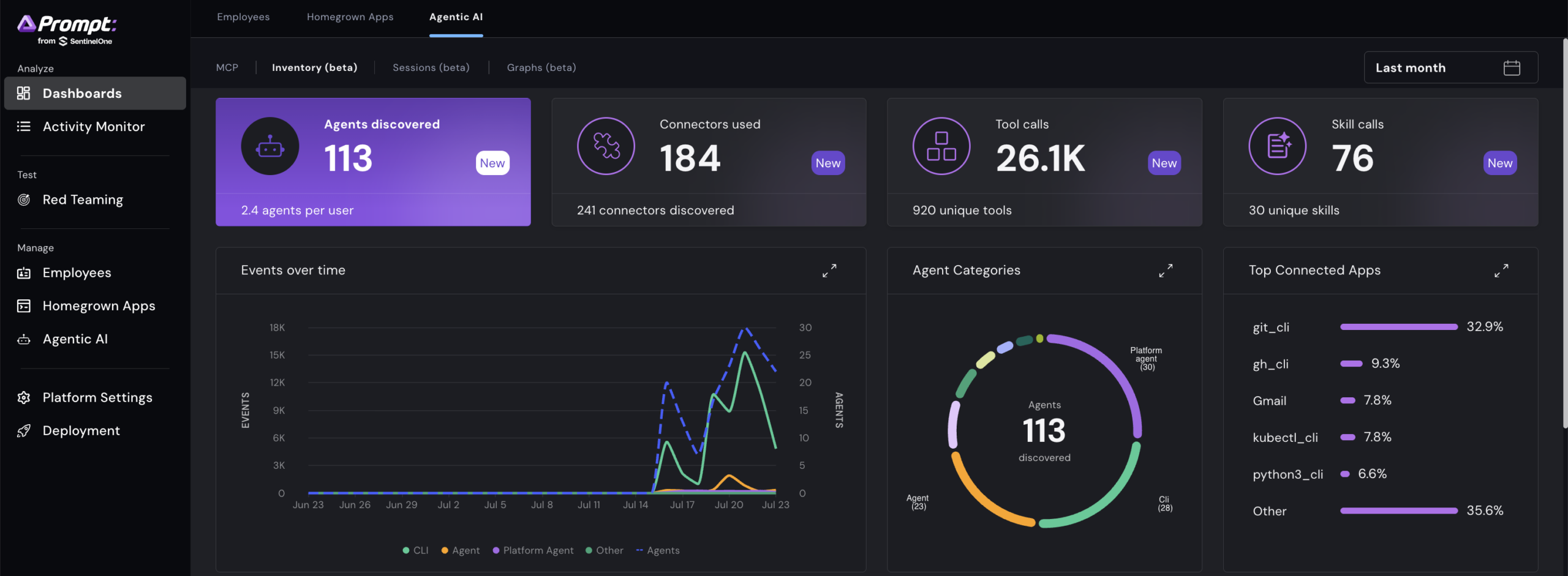
Inventory the agents already running in your environment, the connectors they reach, and every tool call they make.

While governance decides what an agent is allowed to do, the endpoint is where you find out what it actually did.

The endpoint is where agents execute. This is the frontier, and where SentinelOne has protected customers for over a decade. Our behavioral engine judges what a process does, not what it claims to be. That is how we caught QUIETVAULT – malware that spins up AI agents in “yolo” mode to exfiltrate secrets to GitHub. It is how we autonomously stopped the LiteLLM supply chain attack, where adversaries weaponized the Claude CLI to install a malicious payload. It is how we surfaced a DLL side-loading attack hidden inside an AI tool installer. Real detections, on the endpoint, today. Agents run on the host, and so do we.

The identity is where a hijacked agent runs next. Picture an employee’s AI coding agent that gets hijacked mid-task. It spawns a shell and reaches for cached credentials and cloud session tokens, trying to stop being a process and start being the user. That pivot to identity is what unlocks lateral movement, and it is where most AI attacks are headed. SentinelOne meets the move. It secures human and non-human identities alike, and seeds the environment with decoy credentials and honeytokens no legitimate user ever touches. The instant the hijacked agent grabs one, the trap trips, and Identity responds by forcing an MFA re-challenge, disabling the account, or isolating the host. Authorization at login is not enough. Access gets validated against behavior and pulled at runtime.

The cloud is where AI workloads scale. Consider an internal AI agent running in a Kubernetes cluster with standing access to a customer database. Security teams keep asking the same question about deployments like this. Where is the model connecting, and who is it talking to? SentinelOne answers with eBPF-native runtime protection that judges how the workload actually behaves, and flags the moment that inference service reaches an endpoint it has never touched before. It covers the control plane the deployment depends on, the secrets it reads, the pipelines it runs through, and the data it can access. Defending the AI you build takes more than watching it, it takes action on the workload in real time.
SentinelOne’s Singularity Platform Advantage

Each of these surfaces matters on its own. What closes the kill chain is following an attack across them without losing it at the handoff. This is where a single platform earns its keep. AI telemetry already streams into the Singularity™ Data Lake, alongside the endpoint data the platform has correlated for years. As identity and cloud signals join that same view, an analyst follows one attack from first prompt to final action, without stitching logs across six tools at two in the morning. A manipulated prompt, the process it spawns, the credential it reaches for, and the cloud resource it targets read as one story rather than six disconnected alerts.

Detection that only watches is observation. Runtime action is protection. When the Singularity Platform acts, autonomous response blocks the execution, rolls back the change, and revokes the access at the point of impact, without a human relaying orders between consoles. This is the difference between whether an attack is stopped or just gets logged.

That is the case for securing AI inside a platform built for autonomous runtime response. We are not adding a console to chase AI, we are extending the one already deployed where your agents run.

Questions to Ask When Assessing Your AI Security Options

When evaluating AI security, ask yourself three things.

  • Does the solution protect the endpoint where agents actually execute, or is it a roadmap item?
  • When a hijacked agent pivots to credentials and the cloud, does that telemetry land in the same platform, or are you manually connecting dots across three dashboards?
  • Can the solution act at the moment of execution, or only tell me what already happened?

SentinelOne protects the surfaces where AI runs today. This includes the apps your employees use, the agents they deploy, the endpoints where agents execute, the identities they borrow, and the cloud where they scale. One platform, built for autonomous response. While AI has changed the attack, it does not have to change your architecture.

See it for yourself. Talk to our team about securing AI across your endpoints, identities, cloud, and the AI apps your employees already use, all from the platform you run today. Contact SentinelOne today.

Third-Party Trademark Disclaimer:

All third-party product names, logos, and brands mentioned in this publication are the property of their respective owners and are for identification purposes only. Use of these names, logos, and brands does not imply affiliation, endorsement, sponsorship, or association with the third-party.
  • ✇Cybersecurity Blog | SentinelOne
  • SentinelOne + Claude: Integrations for AI Visibility, Governance, and Defense SentinelOne
    Enterprise adoption of Claude across teams, workflows, and business functions is happening at a pace unlike virtually any technology before it. While the innovation opportunity is obvious, so are many of the risks. From the exposure of sensitive data and secrets through shadow IT to new attack vectors like prompt injection, security teams need the visibility, governance, and response capabilities to ensure AI innovation is done safely and securely. SentinelOne® helps organizations comprehensivel
     

SentinelOne + Claude: Integrations for AI Visibility, Governance, and Defense

12 de Junho de 2026, 05:59

Enterprise adoption of Claude across teams, workflows, and business functions is happening at a pace unlike virtually any technology before it. While the innovation opportunity is obvious, so are many of the risks. From the exposure of sensitive data and secrets through shadow IT to new attack vectors like prompt injection, security teams need the visibility, governance, and response capabilities to ensure AI innovation is done safely and securely.

SentinelOne® helps organizations comprehensively secure Claude adoption by bringing AI usage directly into the security platforms teams already rely on. This helps protect the entire ecosystem from the underlying infrastructure to the application layer and end-user interactions. By bringing together SentinelOne and Claude, security teams can apply policies to user prompts, ingest Claude activity into the Singularity™ AI SIEM for investigation, and utilize frontier AI-powered services to identify real-world risks before attackers can exploit them.

Govern, Detect & Secure with SentinelOne’s Anthropic Compliance API Integrations

Security and compliance platforms utilize the Claude Compliance API to help organizations monitor AI activity within their existing tools. SentinelOne provides purpose-built Claude Compliance API integrations for its Prompt Security and Singularity AI SIEM offerings.

Prompt Security Integration

Scan AI prompts and responses against enterprise policies to flag violations without requiring a browser extension or endpoint agent. This agentless approach helps organizations extend their security coverage to unmanaged devices and external environments. Prompt Security enforces safe use by blocking high-risk prompts and preventing data leakage in real time. Additionally, the platform provides continuous risk assessment for agentic AI by securing Model Context Protocol (MCP) gateway connections between AI applications and known MCP servers.

Singularity AI SIEM Integration

Ingest audit and activity data directly from Claude rather than treating AI interactions as isolated events. With the integration, security operations center (SOC) teams can correlate Claude activity against existing security telemetry. This allows analysts to incorporate AI usage data into their broader security workflows and improve investigation, detection, and response across all their attack surfaces.

AI Visibility to AI-Ready Defense with Wayfinder Frontier AI Services

The partnership between SentinelOne and Anthropic extends beyond the Compliance API. SentinelOne has been a participating member in Anthropic’s Project Glasswing and has had early access to Anthropic’s most capable Mythos-class models. By continuously testing these models against real-world security workflows, SentinelOne helps ensure defenses keep pace with the modern adversary. Additionally, SentinelOne recently announced Wayfinder Frontier AI Services, a managed offering that pairs elite human security experts with frontier models, including Anthropic’s Claude Security.

Frontier AI is changing vulnerability discovery, giving both defenders and attackers the advantage of speed and scale. However, raw vulnerability counts rarely map cleanly to real-world risk, as many theoretical exposures are mitigated by existing architectural controls. Wayfinder Frontier AI Services evaluates findings against actual environmental context to deliver an exploitability-grounded prioritization. Instead of treating vulnerabilities in isolation, the service maps how exposures connect into end-to-end attack paths.

The Frontier AI models then provide targeted remediation guidance, including architectural changes or identity controls, designed to break the exploitation chain where it costs the adversary the most. With the service providing a continuous human-and-AI partnership across endpoint, cloud, identity, data, and AI attack surfaces, Frontier AI ensures that organizational security posture remains current as models and threats evolve.

Why SentinelOne is Built for the AI Security Era

SentinelOne operates from a clear conviction: A safer future for humanity and to give the advantage to those who secure our future. That conviction is what drives how SentinelOne approaches AI security — not as an isolated capability, but as part of the autonomous platform, expert services, and SOC workflows that defenders already use. SentinelOne has collaborated with frontier AI labs for years, including Anthropic, OpenAI, and Google DeepMind. These partnerships inform the capabilities embedded across the SentinelOne platform.

Operating at machine speed is necessary to counter modern threats, rather than relying strictly on manual triage. Over the past quarter, the SentinelOne Singularity Platform autonomously blocked novel zero-day and supply-chain attacks against widely used components, such as LiteLLM, Axios, and CPU-Z. Wayfinder Frontier AI Services takes this operational model further left in the security lifecycle to discover exposures before attackers can leverage them. This multi-model foundation reflects the understanding that no single AI model is the definitive answer for cybersecurity; the advantage belongs to defenders who can orchestrate the right intelligence and validate outputs with human expertise.

This is how SentinelOne enables business growth and innovation safely, giving security teams the ability to say yes to AI adoption while maintaining full control of the risk surface. Stronger protection with fewer incidents and less operational overhead.

Learn More

Ready to adopt Claude safely across your organization? Connect with SentinelOne to learn how Prompt Security, Singularity AI SIEM, and Wayfinder Frontier AI Services help security teams govern, monitor, and defend AI usage at enterprise scale.

  • For Claude governance and monitoring: Contact SentinelOne to learn about the Anthropic Compliance API integrations for Prompt Security and Singularity AI SIEM.
  • For proactive AI-driven exposure management: Learn more about Wayfinder Frontier AI Services.
  • For broader AI security: Request a demo of SentinelOne’s AI security capabilities.

Third-Party Trademark Disclaimer:

All third-party product names, logos, and brands mentioned in this publication are the property of their respective owners and are for identification purposes only. Use of these names, logos, and brands does not imply affiliation, endorsement, sponsorship, or association with the third-party.

❌
❌