❌

Visualização normal

Antes de ontemCyber Threat Intel

What exploited vulnerabilities have in common: A data-driven analysis of real-world attacks

The vulnerability landscape continues to expand. From 1999 through September 2026, approximately 383,000 software vulnerabilities had been disclosed across platforms and technologies, yet only about 2,000 CVEs (roughly 0.5%) have been linked to real-world exploitation.

Those vulnerabilities follow clear patterns. Threat actors disproportionately target flaws that enable system takeover, particularly remote code execution, privilege escalation, and authentication bypass. AI-assisted vulnerability discovery and exploit development could further shorten the window defenders have to respond.

Patching remains essential, but remediation can take weeks or months on critical systems, and some legacy or unsupported systems cannot be patched. Defenders therefore need to concentrate protection where it can have the greatest impact, considering both the likelihood of exploitation and the potential blast radius of a successful attack.

Classifying the vulnerability landscape

To make this large vulnerability population actionable, we analyzed each CVE across two dimensions: impact class and affected platform.

Impact class captures the outcome a threat actor could achieve by exploiting a vulnerability. Each CVE is assigned to the most consequential impact it directly enables. For example, when a vulnerability can bypass authentication and directly enable remote code execution (RCE), we classify it as RCE. This approach helps distinguish the underlying type of vulnerability from the security impact an attacker could achieve.

  • Server-side RCE: Remote code execution on a network-exposed service without user interaction.
  • Client-side RCE: Remote code execution that requires a user to open or run malicious content.
  • Local code execution: Code or command execution requiring local access or an existing foothold.
  • Local privilege escalation: Elevation from lower-level access to SYSTEM or root privileges.
  • Authentication or authorization bypass: Circumvention of authentication or access controls.
  • Security-control bypass: Circumvention of protections such as sandboxing, secure boot, or SmartScreen.
  • Information disclosure: Exposure of sensitive data or secrets.
  • Tampering or integrity: Unauthorized modification of data or system state.
  • Denial of service: Disruption of system or service availability.
  • Cross-site scripting (XSS): Script execution within a victim’s browser context.
  • Arbitrary file access: Unauthorized access to or placement of files.
  • Spoofing or redirect: Spoofing, redirection, or other forms of UI deception.

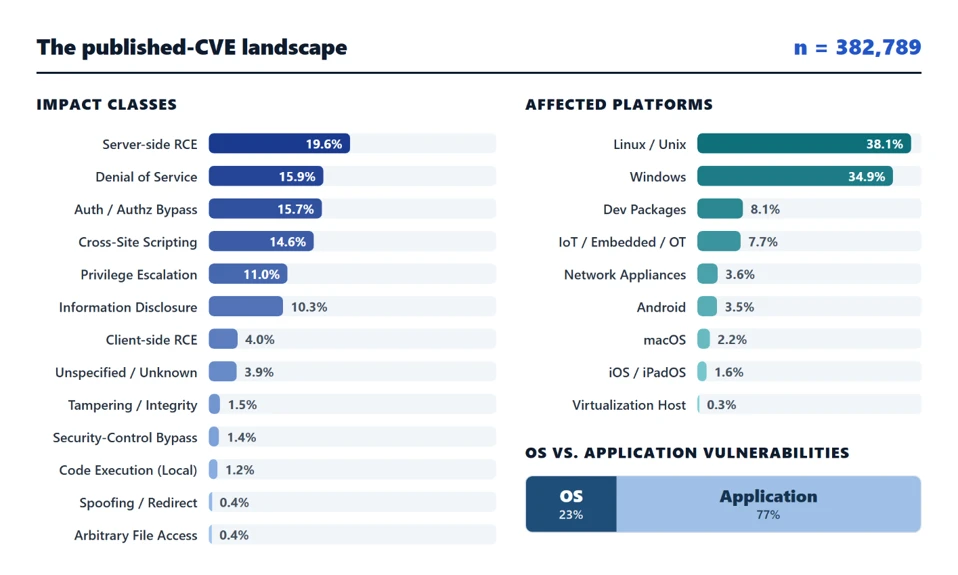
We also classified vulnerabilities by the platforms they affect, including Windows, Linux/Unix, mobile, network appliances, IoT/OT, virtualization hosts, and developer packages. A CVE can span multiple platforms. Developer packages are treated as a separate category because they are often cross-platform and represent a significant share of the overall vulnerability population.

Most CVEs in the analysis affect application code, including servers, web applications, browsers, productivity software, libraries, and firmware tooling, while a smaller share affects OS and system code such as kernels, drivers, and firmware.

This analysis covers CVEs published through September 2026 using Microsoft’s catalog of tracked vulnerabilities. Each CVE is counted once in the impact analysis and across each relevant platform in the platform analysis.

Infographic of 382,789 published CVEs: 77% affect applications and 23% operating systems; leading impacts include server-side remote code execution, denial of service, and authentication bypass. Linux/Unix and Windows are the most affected platforms.
Figure 1 – The full published-CVE population as of September 2026, broken down by impact class and affected platform, and an OS vs. application split. Breadth dominates – many impact classes spread across many platforms, with about 77% of CVEs in application code and 23% in OS/system code.

Vulnerabilities exploited in the wild

The subset of vulnerabilities exploited in the wild is much smaller than the overall CVE population, and looks very different from it. Fewer than 1 in 200 published CVEs are ever used in a real attack, and those that do get used are overwhelmingly concentrated in the takeover classes that maximize threat actor impact and exposure.

The difference becomes clear when we look at impact. Exploitation is heavily concentrated in vulnerabilities that give attackers greater control over a system. Server-side RCE rises from 20% of published CVEs to 37% of exploited CVEs, local privilege escalation from 11% to 18%, and client-side RCE from 4% to 13%. By comparison, XSS falls from 15% to 4% and denial of service from 16% to 7%. OS vulnerabilities show a similar shift, increasing from 23% of the overall CVE population to 41% of exploited vulnerabilities.

These patterns are consistent with threat actors favoring vulnerabilities that can provide meaningful access and control. Remote code execution and privilege escalation can create footholds that support subsequent stages of an attack, while vulnerabilities that primarily cause a crash or limited script execution may offer less utility for broader compromise.

Importantly, a vulnerability’s stated classification does not always reflect what an attacker can reliably achieve in practice. For example, some vulnerabilities described as enabling RCE may ultimately result only in denial of service under real-world conditions. Understanding the demonstrated impact and exploitability of a vulnerability is therefore critical to effective prioritization.

Infographic of 2,056 exploited-in-the-wild CVEs: server-side remote code execution is the leading impact, Windows the most affected platform, and vulnerabilities split 59% application to 41% operating system.
Figure 2 – The 2,056 exploited-in-the-wild CVEs distribution, compared against the full published population: ghost lines mark each class and platform’s share of all ~380K published CVEs, and badges show the shift in percentage points. Takeover classes and OS code rise, while high-volume XSS and DoS fall.

Where defenders should focus

Patching is slow, while exploitation is fast

Patching is slow, and far slower on critical systems than others. Across platforms, servers are the critical assets and the slowest to patch. Microsoft Security Exposure Management data from 2026 shows that the median vulnerability is patched in about two weeks on Windows workstations but in more than a month on Windows Servers. It stretches to 10+ weeks on Linux Servers and for applications running on MacOS, and beyond a year on network appliances. That gap is the threat actor’s window, widest on the critical systems that stay exposed the longest.

Exploitation runs on the opposite clock: the most impactful vulnerabilities are weaponized in days, increasingly on or before disclosure. According to VulnCheck, 29% of the exploits in 2025 were launched within 1 day of CVE publication. According to CISA, the mean time from CVE publication to CISA KEV catalog fell from 89 days for CVEs that were published in 2024 to 57 days for CVEs that were published in 2025. 2026 CVE publications up to September already have that number dropping to 20 days, with a median of only 3 days since publication. Industry research suggests that advances in AI are a significant factor in the time reduction required to develop exploits, further increasing pressure on defenders to respond quickly.

Impact, exposure and where to focus

Two things determine a vulnerability’s value to a threat actor: impact and exposure. Impact is what successful exploitation provides, such as remote code execution or privilege escalation. Exposure is an asset’s position in the environment and the opportunities it creates for further compromise. An asset’s exposure is shaped by the identities, privileges, and connections available from it.

Servers often use service accounts, application identities, or cloud-managed identities with permissions beyond their operational needs. Compromising such a system can provide access to additional resources, sensitive data, administrative privileges, or trusted network paths. Together, impact and exposure determine the blast radius: a vulnerability that enables full control of a highly exposed system can enable widespread on-premises or cloud compromise.

Threat actors do not exploit at random: they go after the vulnerabilities that give the highest impact and exposure: full control of a system and the privileged identities and critical assets it has access to. As defenders, focusing on these vulnerabilities first can deliver the highest return on remediation investment.

Takeover vulnerabilities like remote code execution, authentication bypass and local privilege escalation lead here. They drive the broadest exposure and the largest blast radius, account for 78% of real-world exploited vulnerabilities, and stopping their exploitation interrupts attacks at the earliest stage, before compromise can propagate across the environment.

Next in line

A second slice deserves attention where context makes it severe: denial of service against availability-critical assets is recoverable in general, but can be mission-ending in parts of your environment where uptime is everything; disclosure of credentials or secrets can be minor as an insulated incident, but it feeds the same privileged-identity path mentioned above.

Stacked bar chart of 1,239 exploited remote-takeover CVEs by platform and code layer. Server-side RCE is the largest class, led by Windows and Linux/Unix; bars distinguish application from OS/system vulnerabilities.
Figure 3 – The three remote-takeover classes analyzed across 1,239 exploited CVEs), each drilled down by affected platform and split into OS vs Application code. Bar length is the CVE count per platform; the dark segment is OS/system, the light segment is application.

How Microsoft Security helps defenders act

Threat actors do not begin with a vulnerability list. They begin by looking for a reachable way in. Microsoft Defender External Attack Surface Management approaches the environment from that same outside-in perspective, continuously discovering internet-facing infrastructure, including previously unknown or unmonitored assets, shadow IT, and third-party dependencies. This gives defenders an opportunity to remove unnecessary exposure before a reachable vulnerability becomes an entry point.

Once the reachable assets are known, the next question is which weaknesses deserve immediate attention. Defenders need a way to prioritize exposure beyond CVSS alone. Microsoft Defender Vulnerability Management addresses this challenge through Exposure Score and prioritized security recommendations.

Prioritization incorporates threat and exploitability signals, breach likelihood, internet exposure, and asset criticality, helping teams focus remediation on vulnerabilities that create the greatest actual exposure.

An initial foothold is only part of the risk. Attack Path Analysis connects assets and threat actor techniques into end-to-end routes from an entry point to a critical asset. Microsoft Security Exposure Management Attack Path Analysis provides a cross-workload view spanning endpoints, cloud, and hybrid environments, using vulnerability context from MDVM, endpoint data from Defender for Endpoint, and cloud asset data from Defender for Cloud. Within cloud environments, Defender CSPM Attack Path Analysis adds detailed context about internet exposure, vulnerabilities, network connections, identities, and permissions across Azure, AWS, and Google Cloud.

Together, these experiences show how an exposed workload could become a path through a privileged identity to sensitive data or another critical resource, helping defenders identify where to break the path before the initial compromise expands.

Patching remains essential, but it is not the only defensive action available. Microsoft Security helps defenders discover the doors threat actors can see, prioritize the weaknesses they are most likely to exploit, understand where a compromise could lead, and identify opportunities to break attack paths before compromise spreads to critical assets.

References

Sources cited or linked in the submitted draft:

Learn More

For the latest security research from the Microsoft Threat Intelligence community, check out the Microsoft Threat Intelligence Blog.

To get notified about new publications and to join discussions on social media, follow us on LinkedIn, X (formerly Twitter), and Bluesky.

To hear stories and insights from the Microsoft Threat Intelligence community about the ever-evolving threat landscape, listen to the Microsoft Threat Intelligence podcast.

Review our documentation to learn more about our real-time protection capabilities and see how to enable them within your organization.  

The post What exploited vulnerabilities have in common: A data-driven analysis of real-world attacks appeared first on Microsoft Security Blog.


  • ✇VirusTotal Blog
  • Sizing the PHP exposure window for CVE-2026-109618 and CVE-2026-109619 with VirusTotal Joseliyo Sánchez
    On October 20, the PHP security team announced an out-of-band security release for Wednesday, October 21, 2026 at 14:00 UTC, fixing two critical vulnerabilities rated CVSS v4.0 9.2 (CVE-2026-109618 and CVE-2026-109619). Hours before the release, technical details leaked publicly. They point to the session.upload_progress feature, which has been part of PHP since 5.4.0 and is enabled by default. The community quickly converged on an interim mitigation: set session.upload_progress.enabled = Off in
     

Sizing the PHP exposure window for CVE-2026-109618 and CVE-2026-109619 with VirusTotal

21 de Outubro de 2026, 07:12
On October 20, the PHP security team announced an out-of-band security release for Wednesday, October 21, 2026 at 14:00 UTC, fixing two critical vulnerabilities rated CVSS v4.0 9.2 (CVE-2026-109618 and CVE-2026-109619). Hours before the release, technical details leaked publicly. They point to the session.upload_progress feature, which has been part of PHP since 5.4.0 and is enabled by default. The community quickly converged on an interim mitigation: set session.upload_progress.enabled = Off in php.ini.
That leaves defenders with two questions: how big is the exposed surface, and where should they start? We used Internet Scanning in VirusTotal to answer both.
Note: Official details, affected versions and fixed versions are published by the PHP project with the release. The figures below describe the Internet-facing PHP footprint, not confirmed vulnerable hosts.

Most PHP servers don't say they are PHP

VirusTotal fingerprints roughly 5.1 million IP addresses running PHP (port_service_cpe:php), about 3.8 million of them with at least one port open today. Only around 1.1 million of those announce a version in an HTTP header such as X-Powered-By: PHP/8.3.35.
In other words, roughly four out of five PHP servers hide their version (expose_php = Off, stripped headers, reverse proxies). VirusTotal still identifies them as PHP through other signals: the application on top (WordPress, Laravel, Nextcloud...), PHPSESSID cookies and framework-specific headers. If you only search for a version string, you only see the fraction of the problem that volunteers it.

The version picture: the long tail of end-of-life PHP

Among the servers that do disclose their version, the split is stark:
PHP versions disclosed in service banners: supported, end-of-life and pre-5.4 branches

  • ~272K run a supported branch (8.2 to 8.5), the only branches that receive security fixes from the PHP project.
  • ~758K run an end-of-life branch between 5.4 and 8.1. These branches have session.upload_progress enabled by default and no longer receive security fixes. PHP 7.4 alone accounts for ~187K IPs and PHP 5.4 for ~119K.
  • ~88K run PHP 5.2 or 5.3, which predate session.upload_progress.
Being up to date doesn't buy much time either: about 85K IPs run the exact releases published on September 24 (8.3.35, 8.2.34, 8.4.26 and 8.5.11), the latest available before this fix.
Latest PHP releases before the fix and other open ports on PHP hosts

What runs on top, and where

Apache (~2.9M) and nginx (~1.48M) are the web servers most often seen on PHP hosts, followed by LiteSpeed (~90K). On the application side, WordPress dominates with ~538K IPs, followed by Laravel (~141K) and Nextcloud (~107K). Webmail (Roundcube) and database admin panels (phpMyAdmin) add another ~25K high-value targets.
Web servers and applications detected on PHP hosts

The geography is concentrated: the United States accounts for ~920K PHP hosts with at least one open port, and a handful of cloud and hosting providers (AWS, DigitalOcean, Alibaba, OVHcloud, Hetzner) concentrate a large share. That concentration is good news for remediation: a few providers that push a configuration change or a WAF rule can cover a lot of ground.
Top countries and selected hosting providers for PHP hosts with an open port

Going beyond the web port

PHP rarely travels alone. ~394K PHP hosts also have port 22 open (SSH by default), ~233K port 3306 (MySQL) and ~68K port 3389 (RDP). Those co-exposed services are useful for something else: identifying the exact build behind the web server.
The leaked material references LiteSpeed lsphp82 8.2.34 builds for Debian 12, Ubuntu 22.04 and Ubuntu 24.04, and notes that HTTP headers alone don't tell those builds apart. The OpenSSH package on port 22 does. With the bracket syntax, every condition is pinned to its port:
entity:ip port_service_cpe:php port_banner:"PHP/8.2.34" port_service_version[22]:"9.6p1 Ubuntu"
Of the ~3.5K IPs whose banners show both LiteSpeed and PHP 8.2.34, about 500 also have port 22 open. Across all PHP 8.2.34 hosts, the OpenSSH package on port 22 matches Ubuntu 24.04 on 269 IPs, Ubuntu 22.04 on 112 and Debian 12 on 65. For a defender, that is the difference between "patch everything" and "these are the machines that match the leaked target profile, patch them first". Keep in mind that port 22 reveals the host operating system: PHP may still run inside a container built on a different base image.
Ports tab of a PHP 8.2.34 host showing HTTP and OpenSSH on port 22

Adversaries run PHP too

The exposed surface also includes attacker infrastructure. Around 5.7K PHP hosts with at least one open port have five or more detections in VirusTotal, 729 of them disclosing PHP 8.x. One of them is an old acquaintance: the NOX Stealer panel (rebranded as BOMBAY) on 5.175.221[.]206:8443, which we profiled in our Internet Scanning post, runs nginx 1.24.0 with PHP/8.3.33.
Ports tab of 5.175.221.206 showing nginx 1.24.0 and PHP/8.3.33 on port 8443

What the VirusTotal corpus saw

The leak left traces across VirusTotal. The archive referenced in the write-up was first submitted at 02:29 UTC on October 21, less than 15 minutes after the first submission of the write-up URL. By the time of writing, 21 crowdsourced reports covering the vulnerabilities had been ingested as collections. Following entity:collection collection_type:report "CVE-2026-109618" is the fastest way to keep up with new reporting as it appears.
VirusTotal search results for crowdsourced reports about CVE-2026-109618

What to do now

  1. Patch. Upgrade to the fixed release of your branch (8.2, 8.3, 8.4 or 8.5) as soon as it is available on php.net or through your distribution.
  2. Plan the EOL migration. PHP 8.1 and older no longer receive security fixes. If you are on 5.4 to 8.1, upgrade the branch or check whether your distribution or vendor ships a backport.
  3. Disable upload progress until you patch. Set session.upload_progress.enabled = Off in php.ini (or the pool configuration) and reload PHP-FPM, Apache or LSAPI. It only breaks upload progress bars that rely on the feature. Community analysis suggests it may not cover every vector, so treat it as a stopgap, not a fix.
  4. Filter multipart at the edge. Where an application doesn't need file uploads, block or inspect multipart/form-data requests before they reach PHP. Cloudflare shipped emergency rules to its Managed and Free rulesets on October 21, and its CTO stated that they cover known payloads, while stressing that only updating PHP fully protects a site.
  5. Make sure the WAF can't be bypassed. Edge rules only help if the origin is not directly reachable. Search your own ranges in VirusTotal (for example, entity:ip port_service_cpe:php asn:<your ASN>) to find origins that expose PHP directly to the Internet.
  6. Don't rely on hiding the version. expose_php = Off hides the header, not the vulnerability.

Queries used in this post

Query What it finds
entity:ip port_service_cpe:php All IPs where VirusTotal fingerprinted PHP on any port
entity:ip port_service_cpe:php port_status:open PHP hosts with at least one port currently open
entity:ip port_service_cpe:php port_banner:"PHP/" PHP hosts that disclose their version in an HTTP header
entity:ip port_service_cpe:php port_banner:"PHP/7.4." PHP hosts on a given branch (repeat for each branch from 5.2 to 8.5)
entity:ip port_service_cpe:php port_banner:"PHP/8.3.35" PHP hosts on the latest release before the fix (repeat for 8.2.34, 8.4.26 and 8.5.11)
entity:ip port_service_cpe:php port_service_cpe:nginx PHP hosts by web server (also "apache:http_server", lighttpd, internet_information_services)
entity:ip port_service_cpe:php port_banner:"LiteSpeed" PHP hosts by Server header (also openresty, Caddy)
entity:ip port_service_cpe:php port_service_cpe:wordpress PHP hosts by application (also laravel, nextcloud, drupal, joomla, roundcube, phpmyadmin...)
entity:ip port_service_cpe:php port_status:open country:US PHP hosts with an open port, by country
entity:ip port_service_cpe:php port_status:open asn:16509 PHP hosts with an open port, by hosting provider ASN
entity:ip port_service_cpe:php open_port:22 PHP hosts with another port open (also 3306, 3389, 445, 8443, 8000)
entity:ip port_service_cpe:php port_banner:"LiteSpeed" port_banner:"PHP/8.2.34" Hosts whose banners show both LiteSpeed and PHP 8.2.34, the profile referenced in the leak
entity:ip port_service_cpe:php port_banner:"PHP/8.2.34" port_service_version[22]:"9.6p1 Ubuntu" PHP 8.2.34 hosts whose OpenSSH package on port 22 is Ubuntu 24.04's (use 8.9p1 Ubuntu for Ubuntu 22.04 and deb12 for Debian 12)
entity:ip port_service_cpe:php port_status:open positives:5+ PHP hosts with an open port and five or more detections
entity:collection collection_type:report "CVE-2026-109618" Crowdsourced reports about the vulnerabilities
Note: All counts in this post were taken on October 21, 2026. For large result sets VirusTotal returns estimated totals that vary between runs, so we report the median of seven runs, rounded. Port modifiers without a port in brackets match per IP, not per port: port_service_cpe:php port_status:open means PHP was fingerprinted on the IP and at least one of its ports is open.

References

Happy hunting!

  • ✇Blog – Cyble
  • The Week in Vulnerabilities: Toptech, Lantronix, Langflow, and CISA Malcolm Flaws Ashish Khaitan
    This Cyble Research & Intelligence Labs (CRIL) weekly vulnerability report covers two views of risk: what attackers tried against Cyble's global honeypot sensors, and what the Cybersecurity and Infrastructure Security Agency (CISA) disclosed for industrial control systems (ICS). The Cyble Global Sensor Intelligence (CGSI) network observed exploitation attempts against about 20 known vulnerabilities. They range from newly disclosed flaws in WordPress, Apache Solr, and Langflow to years-ol
     

The Week in Vulnerabilities: Toptech, Lantronix, Langflow, and CISA Malcolm Flaws

14 de Outubro de 2026, 10:36

Weekly Vulnerability Report Cyble October

This Cyble Research & Intelligence Labs (CRIL) weekly vulnerability report covers two views of risk: what attackers tried against Cyble's global honeypot sensors, and what the Cybersecurity and Infrastructure Security Agency (CISA) disclosed for industrial control systems (ICS).

The Cyble Global Sensor Intelligence (CGSI) network observed exploitation attempts against about 20 known vulnerabilities. They range from newly disclosed flaws in WordPress, Apache Solr, and Langflow to years-old bugs in GPON home routers and embedded TCP/IP stacks. 

On the industrial side, CISA issued 14 ICS advisories covering 54 vulnerabilities. Of these, 13 were rated critical, 18 high, 18 medium, and five low. 

Affected vendors include Toptech Systems, Lantronix, VIVOTEK, MikroTik, Armatura, Monta, Anjvision, and, unusually, CISA itself.

Cyble sensors also recorded active malware campaigns, phishing emails, and brute-force attacks against internet-exposed services.

Real-World Attacks Observed by Cyble Sensors 

Attackers moved quickly against newly disclosed flaws in web platforms and AI tooling, while older IoT and embedded-device bugs continued to draw steady traffic. 

Source: Cyble sensor intelligence. The 24 CVEs named in this post, counted by CVE ID year 

CVE-2026-63030 — WordPress REST API 

CVE-2026-63030 is a route-confusion flaw in a WordPress REST API batch endpoint. It affects WordPress 6.9.x before 6.9.5 and 7.0.x before 7.0.2. 

Attackers can chain it with CVE-2026-60137 to achieve SQL injection and potentially remote code execution (RCE). 

CVE-2026-44825 — Apache Solr 

CVE-2026-44825 is a hardcoded credential in the Basic Authentication setup tool of Apache Solr 9.4.0 through 9.10.1 and 10.0.0. 

Remote attackers can use it to access a Solr cluster with administrative privileges. 

CVE-2026-9198 — Langflow 

CVE-2026-9198 affects IBM Langflow OSS 1.0.0 through 1.10.0. Unauthenticated attackers can chain two API endpoints to obtain superuser tokens and execute arbitrary code. 

Sensors also caught attempts against an older Langflow code injection flaw, CVE-2025-3248. Repeated targeting of the same AI workflow platform signals sustained attacker interest. 

CVE-2025-68613 — n8n 

CVE-2025-68613 is a critical RCE flaw in the n8n workflow automation platform. Expressions supplied by authenticated users can run in an insufficiently isolated context, enabling full system compromise. 

Fixes are available in versions 1.120.4, 1.121.1, and 1.122.0. 

CVE-2026-4020 — Gravity SMTP 

CVE-2026-4020 affects the Gravity SMTP WordPress plugin, versions 2.1.4 and earlier. An exposed REST API endpoint lets unauthenticated users pull system reports containing server details, database metadata, and configured API keys or tokens. 

CVE-2024-6587 — LiteLLM 

CVE-2024-6587 is a server-side request forgery (SSRF) flaw in LiteLLM. Exploitation can expose OpenAI API keys. 

Older Flaws Still in Rotation 

Cyble sensors also logged exploitation attempts against: 

  • CVE-2025-58360, an XML external entity (XXE) flaw in GeoServer's GetMap operation 

  • CVE-2024-7591, an OS command injection flaw in Progress LoadMaster 

  • CVE-2024-25600, a code injection flaw in Bricks Builder 1.9.6 and earlier 

  • CVE-2025-2010, an unauthenticated SQL injection flaw in the JobWP WordPress plugin 

  • CVE-2025-46565, a file access control bypass in the Vite development server 

  • Command injection flaws in QNAP QTS firmware 

  • Scanning for the Cisco Adaptive Security Appliance (ASA) WebVPN login page 

A Mirai variant is also targeting Dasan GPON home routers by chaining CVE-2018-10561 and CVE-2018-10562. Together, the two flaws let an unauthenticated remote attacker run commands on the device. 

Most-Attempted CVEs 

CVE-2020-11899, an IPv6 out-of-bounds read in the Treck TCP/IP stack, drew far more exploitation attempts than any other CVE this week. The rest of the top five, in order: 

  1. A group of four Wind River VxWorks TCP buffer overflows: CVE-2019-12255, CVE-2019-12260, CVE-2019-12261, and CVE-2019-12263 

  1. CVE-2020-11900, an IPv4 tunneling double-free in the Treck TCP/IP stack 

  1. CVE-2019-0708, a critical unauthenticated RCE in Microsoft Remote Desktop Services 

  1. CVE-2020-11910, an ICMPv4 out-of-bounds read in the Treck TCP/IP stack 

Most of these flaws sit in networking code embedded in IoT and industrial devices, which often go unpatched for years. 

Malware Families Observed 

Files collected from Cyble sensors were linked to several malware families: 

  • CoinMiner: Linux cryptominers that hijack CPU and GPU resources 

  • WannaCry: Ransomware that spreads through the EternalBlue exploit, targeting CVE-2017-0147 

  • Mirai: A botnet that turns IoT devices and Linux servers into remotely controlled bots 

  • IRCBot: Linux malware that uses IRC connections as a backdoor 

CRIL also observed Hajime, Gafgyt, and Wacatac activity. 

MacSync Infostealer Targets Crypto Users 

CRIL is also tracking a new version of MacSync, a macOS infostealer sold as malware-as-a-service. Kaspersky's Securelist reported that the latest campaign targets cryptocurrency users and developers. 

According to Securelist, attackers distribute MacSync through malicious disk images posing as a fake crypto wallet app. In one case, they abused a public iCloud calendar event to deliver commands. 

The malware steals browser data, saved credentials, crypto wallet data, Keychain files, and SSH, AWS, Kubernetes, and Git configurations. It also installs a backdoor disguised as Finder that persists through a LaunchAgent, shell profile changes, and Git hooks. 

Security teams should watch macOS endpoints for unexpected disk-image apps, removal of quarantine attributes, and new LaunchAgents. 

Phishing and Advance-Fee Scams 

Phishing emails captured by Cyble sensors relied on emotional appeals and promises of money. Common lures this week: 

Subject line  Scam type 
Re: DONATION FOR less-privileged  Charity or donation scam 
GOD BLESS YOU....  Emotional appeal, advance-fee scam 
Re. Compensation funds for your past effort  Compensation fund scam 
MY PROPOSAL  Business proposal, advance-fee scam 
Investment Inquiry, Funding for Your Project  Investment or project funding scam 
Dear Sir/Madam  Advance-fee scam 

Many of these emails use look-alike domains or impersonate known organizations to appear credible. 

Brute-Force Attacks 

Brute-force traffic focused on remote access and database ports, including VNC (5900), RDP (3389), SSH (22), Telnet (23), HTTP (80), Microsoft SQL Server (1433), and PPTP (1723). 

Targets included Elasticsearch, Hadoop, Oracle, GitLab, MySQL, and PostgreSQL. Attackers leaned on default and weak credentials such as "sa," "root," "password," and "123456." 

The largest share of attack traffic, 39%, came from sources with a known bad reputation. 

Critical ICS Vulnerabilities 

CISA's 14 ICS advisories covered 54 vulnerabilities, two-thirds of them rated high or medium. Toptech Systems and CISA itself disclosed the most flaws this week. 

Source: CISA ICS advisories analyzed by CRIL, Sept. 29–Oct. 5, 2026 · 54 vulnerabilities by vendor and severity 

Toptech Systems TMS7 and TopHAT (Critical) 

Toptech Systems' TMS7 and TopHAT version 7.6.3 carried more critical-rated ICS vulnerabilities than any other product this week. They include multiple SQL injection flaws (such as CVE-2026-72510 and CVE-2026-63713), an unrestricted file upload flaw (CVE-2026-70356), and files exposed to external parties (CVE-2026-71379). 

TMS7 is a terminal management system that controls liquid fuel and chemical distribution in the Energy, Chemical, and Transportation Systems sectors. In a product that governs fuel terminal operations, these flaws could enable interference with physical processes, not just data theft. Toptech has published security update information. 

CVE-2026-91191 and CVE-2026-84409 — Lantronix G520 Series (High) 

Two flaws affect Lantronix G520 Series cellular gateways running 2.6.0.4R6_stable. CVE-2026-91191 is an improper cryptographic signature verification flaw, and CVE-2026-84409 is a cross-site scripting (XSS) flaw. 

The signature flaw could let attackers bypass firmware integrity checks and push unauthorized firmware to remote field devices. Combined with the XSS bug, it creates a realistic multistage attack path against devices that may be hard to inspect physically. Lantronix has published remediation details. 

CVE-2026-84411 — MikroTik RouterOS (Critical) 

CVE-2026-84411 is a critical integer underflow vulnerability in MikroTik RouterOS versions before 7.24. Updated versions are available from MikroTik's download page. 

CVE-2026-22755 — VIVOTEK Cameras (Critical) 

CVE-2026-22755 is a critical command injection flaw affecting 37 VIVOTEK camera models across its V, C, S, Dome, Bullet, and Panoramic series. VIVOTEK has posted an update package. 

CVE-2026-95102 — Monta (Critical) 

CVE-2026-95102 is a missing-authentication flaw for a critical function in all versions of monta.app. Three other Monta flaws involve excessive authentication attempts, session expiration, and credential protection. The advisory data referenced no vendor fix. 

Anjvision, Viidure, and Armatura One 

Anjvision's YSSD-RTMP-H5 firmware has nine vulnerabilities, led by CVE-2026-100291, a critical insecure default setting. Others include OS command injection, hardcoded credentials, and improper signature verification. 

The Viidure Dashcam Android app, version 3.3.1.260403 and earlier, contains hardcoded credentials (CVE-2026-96587, critical). Armatura One is affected by CVE-2023-46604, a critical deserialization flaw, plus hardcoded key and credential issues. 

No vendor fixes were referenced for these products, so compensating controls such as network isolation are the main option for now. 

CISA Malcolm (15 Vulnerabilities) 

In an unusual disclosure, CISA reported 15 vulnerabilities in Malcolm, its own open-source network traffic analysis and threat-hunting platform. The flaws affect versions before 26.06.0. 

They span authentication bypass, missing authorization, default credentials, OS command injection, path traversal, and SSRF. Most are rated medium, and two are rated high. Users should update through the Malcolm releases page. 

The remaining advisories covered Baicells Technologies, Meari, and Johnson Controls products. 

Impacted Critical Infrastructure Sectors 

Energy was the most exposed sector this week, followed by Transportation Systems and Commercial Facilities. 

Source: CISA ICS advisories analyzed by CRIL, Sept. 29–Oct. 5, 2026 · share of 54 vulnerabilities touching each sector 

The largest single combination, Energy, Information Technology, and Water and Wastewater, accounted for 27.8% of vulnerabilities. Energy, Chemical, and Transportation Systems made up another 18.5%, driven largely by the Toptech disclosures. 

These disclosures cut across traditional infrastructure boundaries rather than clustering in one domain. A single flaw in a shared product can create risk for fuel, water, and transportation operators at once. 

Conclusion 

This weekly vulnerability report highlights several trends: 

  • Fast exploitation of newly disclosed flaws in WordPress, Apache Solr, and AI workflow tools such as Langflow and n8n 

  • Persistent attacks on years-old embedded-device and router vulnerabilities 

  • Critical ICS flaws in fuel distribution, cellular gateway, and camera products 

  • Several ICS products with no vendor fix referenced, leaving compensating controls as the main defense 

  • Ongoing phishing and brute-force activity that relies on weak and default credentials 

With 13 critical ICS vulnerabilities and active exploitation attempts against both new and legacy flaws, organizations face risk across enterprise IT and operational technology (OT) environments. 

Key Recommendations From This Weekly Vulnerability Report 

  • Patch internet-exposed web platforms, plugins, and AI workflow tools first, starting with the flaws under active exploitation above 

  • Replace default usernames and passwords, and enforce strong, unique credentials on servers and devices 

  • Restrict or block exposed remote access and database ports, including VNC, RDP, SSH, Telnet, and SQL Server 

  • Segment IT and OT networks with firewalls and demilitarized zones (DMZs) to limit lateral movement 

  • Apply compensating controls, such as network isolation, for ICS products without available fixes 

  • Verify firmware integrity on remote field devices and cellular gateways 

  • Monitor macOS endpoints for unexpected disk-image apps and new LaunchAgents 

  • Track CISA advisories and the Known Exploited Vulnerabilities (KEV) catalog, and prioritize by exploitability and operational impact 

  • Conduct regular vulnerability assessments and penetration testing 

Cyble's attack surface management and vulnerability intelligence solutions help organizations identify exposed assets, prioritize remediation, and detect early signs of compromise. Combined with real-time sensor intelligence, they help security teams stay ahead of threats across enterprise and critical infrastructure environments. To see these capabilities in action, schedule a demo with Cyble. 

Disclaimer: The data and content written in this blog is based on certain sensor and open web information available. Analysts and researchers are advised to confirm once again from original sources. 

The post The Week in Vulnerabilities: Toptech, Lantronix, Langflow, and CISA Malcolm Flaws appeared first on Cyble.

  • ✇ASEC BLOG
  • September 2026 Dark Web Threat Actor Trend Report ATCP
    Note The September 2026 Dark Web Threat Actor Trend Report focuses on threat actors active on the deep web and dark web, as well as publicly reported cyberattack incidents. It is noted that the factual accuracy of some content cannot be independently verified. Major Issues Some hacktivist groups claimed responsibility for DDoS attacks targeting the […]
     
  • ✇Microsoft Security Blog
  • 3 lessons from frontier AI vulnerability research Taesoo Kim
    In this article Shift 1. From frontier capability to scaleShift 2. From token consumption to reasoning economicsShift 3. Validation and remediation as a continuous learning loopTransferring security research to help open source projectsOpen-source vulnerability reporting snapshotMeasured costs of automated validationFORGE OSS Bug Hunt Party: Human coordination at scale (Hackathon)Akrites: Coordinated effort to remediate vulnerabilitiesWhat’s next for FORGE Lab?
     

3 lessons from frontier AI vulnerability research

7 de Outubro de 2026, 13:00

The mission of Microsoft Security’s Frontier Offensive Research & Generative Exploitation (FORGE) Lab is to advance the frontier of autonomous security engineering. We’re building a team that enables AI-native vulnerability research at Microsoft, pushing the boundaries of finding and fixing zero-day vulnerabilities. Four principles guide that work: autonomy over labor, defense through offense, building ecosystems over individual examples, and understanding over findings. This post reflects those principles in practice across Windows, the Linux kernel, and widely used open-source projects.

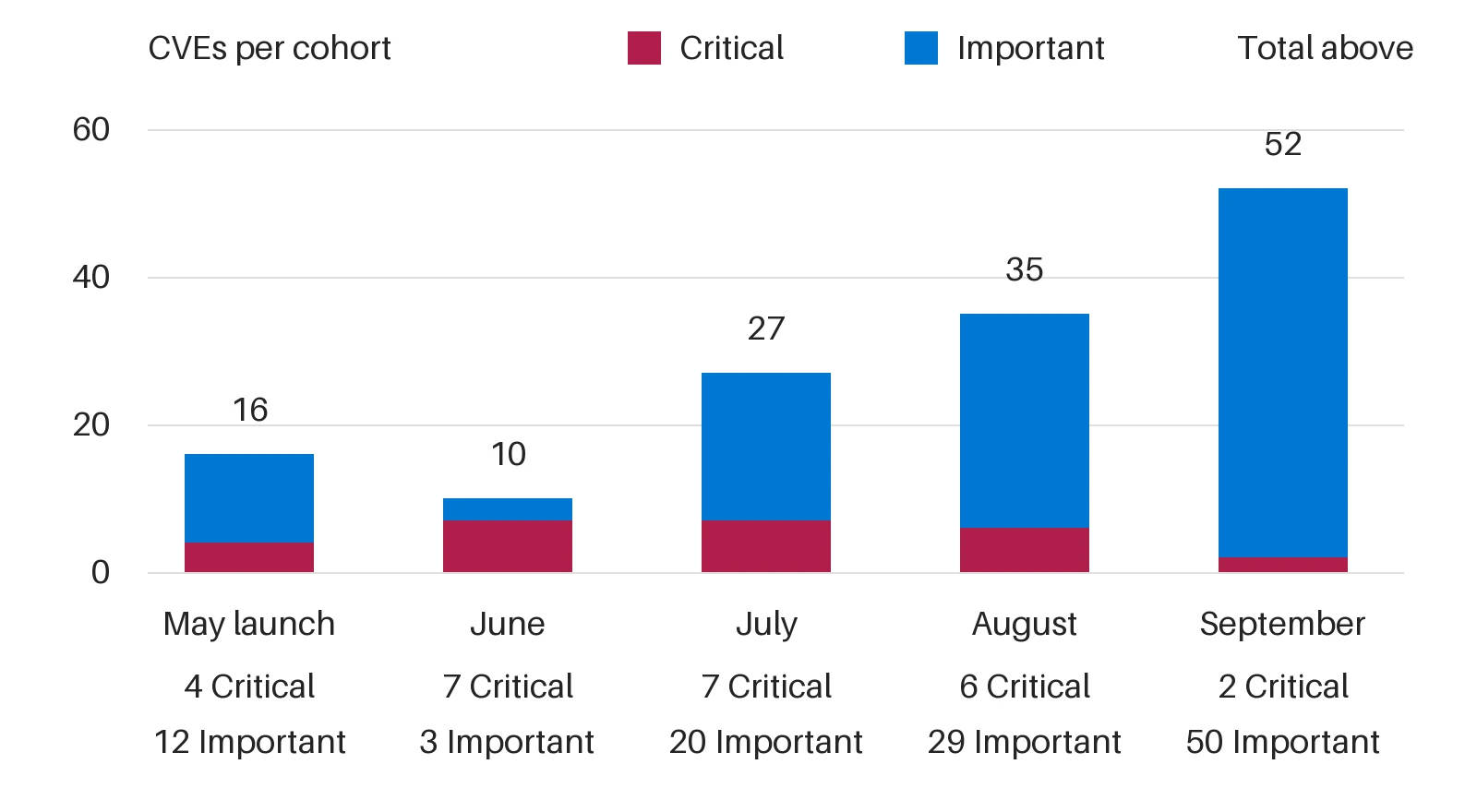
From May 2026 through September 2026, FORGE helped discover Windows vulnerabilities assigned 140 common vulnerabilities and exposures (CVEs), including 52 addressed in September 2026’s security release alone. The work reaches well beyond Windows. FORGE members submitted 155 internally validated reports across 23 open-source projects, including the Linux kernel. And through Akrites, a Linux Foundation initiative that coordinates confidential remediation and disclosure for vulnerabilities in critical open-source software, one of our Linux reports became the first Akrites submission to result in a patch merged into the Linux kernel.

These results demonstrate that agentic discovery can operate at meaningful volume, but they also expose the next constraint. Finding a difficult vulnerability proves an agent’s frontier capability. Repeatedly converting such findings into security updates requires a different kind of system—one that can move credible work through validation, remediation, and release. Discovery creates security value only when validation and remediation can keep pace. For security leaders, the question is no longer only whether AI can find vulnerabilities, but whether an organization can validate and fix them as fast as they are found.

Three lessons follow, each marking a shift in how we approach vulnerability research:

  1. From frontier capability to scale.
  2. From token consumption to reasoning economics.
  3. From isolated discovery to coordinated validation and remediation.

The scarce resource is not always model intelligence. It can be a working build and deployment, a reproducible trigger, or even an engineer’s time.

At FORGE Lab, we use the multi-model agentic scanning harness, codename MDASH, to organize this work. Our May 2026 introduction detailed its design, while the June 2026 update covered pipeline improvements and benchmark analysis. Here, we focus on what those experiences teach us about operating vulnerability research at scale—across Windows and open-source projects.

Stacked bar chart titled “CVEs per cohort” shows Critical and Important  vulnerabilities by month from May launch through September. Totals are 16 CVEs in May (4 critical and 23 important), 10 in June (7 critical, 3 important), 27 in July (7 critical, 20 important), 35 in August (6 critical, 29 important), and  52 in September (2 Critical and 50 Important).
140 CVEs addressed through Microsoft Patch Tuesday since May 2026. Monthly totals reflect announcement and servicing cohorts, not discovery dates or scan throughput. Source: Microsoft FORGE Lab study, May 2026 to September 2026.

Shift 1. From frontier capability to scale

The frontier question is whether a system can find a bug that demands deep reasoning, as we explored in our early work on the CyberGym benchmark. The scale question is whether it can repeat that result across targets without rebuilding every environment, investigation, and review process from scratch. Better models still matter, especially for difficult or unfamiliar bug classes. But once discovery becomes repeatable, model capability is only one constraint on useful output.

Adding auditors can increase candidate volume without increasing the rate of validated findings or shipped fixes. If reports arrive faster than reviewers—in our case, Microsoft Security Response Center (MSRC)—can resolve them, the immediate result is a growing queue. A larger search budget can even reduce useful throughput when duplicate or poorly supported reports consume attention that stronger findings need.

The unit to optimize, therefore, is neither the scan nor the report. It is a reproducible finding that advances with enough evidence for the next stage to act. Reusable preparation, deduplication, and review capacity are therefore core components of the research system.

As agentic systems produce more candidates, the bottleneck shifts from discovery to determining which reports are real, reachable, and security-relevant. Project-specific automated provers—such as proof of vulnerability (PoV)/proof of concept (PoC) generators, harness builders, and trigger-input finders—turn plausible reports into reproducible evidence that engineers and maintainers can act on. By finding crashing inputs, confirming reachable execution paths, and producing regression-ready triggers within each project’s build and test environment, these tools can help reduce human triage, accelerate remediation, and make vulnerability research sustainable at scale. For example, by leveraging deterministic algorithms such as abstract syntax tree (AST), one of our internal projects reduced about 45% duplicate findings across multiple scans of the same code which reduced the load on the PoC generator and subsequently human triage effort.

More candidates do not create more throughput when the review queue grows faster than fixes ship.

Shift 2. From token consumption to reasoning economics

At scale, every repeated orientation, speculative branch, and redundant debate carries a cost. But minimizing tokens alone is the wrong objective. A short, ambiguous report may be cheap to generate yet expensive to investigate; a longer analysis that establishes the missing execution path may reduce total system cost.

The key question is where the next unit of reasoning will change a decision. If an index can identify callers, asking a frontier model to rediscover them wastes capacity. If the uncertainty is whether two lifetime conditions can coexist across callbacks, deeper reasoning may be warranted. If the question is whether an input triggers the failure, an executable check can provide evidence that more prose cannot.

MDASH combines frontier and distilled models, specialized auditors, and code-analysis tools, enabling work to be allocated by task. That flexibility does not guarantee optimal allocation. Routing routine work to cheaper models, reusing verified context, and escalating unresolved questions to stronger reasoning are hypotheses to test—not efficiency gains to assume.

A useful allocation policy starts by identifying what remains unknown: a caller, a build configuration, a reproducer, or a causal explanation. The next action should close that specific evidence gap. Repeating a review without adding evidence spends more tokens while preserving the same uncertainty. Early filtering can also discard real bugs, so any savings must be measured against coverage and missed findings.

Scan outcomes can also become training data. At scale, vulnerability scanning should become a training loop, not only a discovery pipeline. Each MDASH run produces signals that can improve future models: true-positive and false-positive verdicts, duplicate findings, failed reachability claims, reviewer feedback, verifier results, severity assessments, patch outcomes, and regression-test evidence. Capturing those signals with the code context and causal argument behind each candidate creates the dataset needed for reinforcement learning and fine-tuning specialized cyber models. The goal is for future models to learn not just what a vulnerability looks like, but which findings survive validation, which explanations help humans and provers act, and which patterns lead to useful remediation.

Spend reasoning to remove uncertainty, not simply to produce more analysis.

Shift 3. Validation and remediation as a continuous learning loop

Validation and remediation are not downstream cleanup; they are part of the discovery loop. Each candidate should move through automated verification, human review, patch development, and regression testing, with every stage returning evidence to the system. A reproducible trigger strengthens the report, guides the fix, and can seed a regression test. A failed validation is also useful when it records why: an unreachable path, missing precondition, incorrect build configuration, insufficient attacker control, duplicate report, or incomplete causal explanation.

That evidence is how the system improves. Project-specific provers, harnesses, and trigger generators accumulate operational knowledge about how each target builds, runs, fails, and accepts fixes. Remediation outcomes show the discovery pipeline which evidence changed a decision, which assumptions failed, and which bug patterns warrant more or less attention. The objective is to make every investigation leave reusable capacity behind: a validated trigger, clearer invariant, better harness, stronger regression test, or routing rule that prevents the same mistake.

Human attention remains essential, but it should concentrate where judgment has the highest leverage: assessing security impact, reviewing patches, and determining whether a change restores the component’s intended invariant. Automation can handle the repeatable work of establishing reachability, reproducing behavior, and preserving evidence. Over time, this loop converts individual findings into system knowledge—raising the quality of future discovery while shortening the path from credible report to shipped fix.

A reproducible defect is not yet a serviced fix. To shorten the path from discovery to remediation, MDASH needs to operate as part of the engineering loop: continuously scanning code, connecting findings to the builds and artifacts produced by continuous integration and continuous delivery (CI/CD), and feeding validation results back into development, as described in the Windows team’s blog post. Broad analysis can identify suspicious code paths, but component-specific proving needs the right binaries, symbols, configurations, harnesses, and runtime conditions to reproduce a candidate defect against the version that matters for customers and releases. Each handoff should be both owned and machine-usable: research supplies the candidate claim, causal path, and uncertainty; proving supplies execution evidence from the relevant build artifact; component teams assess the violated invariant, repair strategy, compatibility risk, and related variants; and servicing connects the approved change to release validation. A failed reproduction, rejected finding, incomplete patch, or regression result should feed back into MDASH as structured evidence, not simply move a ticket into another queue. The goal is not to remove human code review or release validation, but to automate the repeatable work around them—finding candidates, selecting artifacts, reproducing behavior, preserving evidence, suggesting related paths, and returning what was learned to the next scan.

The goal is to build an organization-wide system that automates repeatable work while preserving clear engineering accountability.

Transferring security research to help open source projects

In open source, all three constraints apply at once. Each project has its own setup costs, mix of analysis and execution work, and maintainer workflows and review capacity. Within Windows, vulnerability research connects to established component owners and servicing infrastructure. Across open-source projects, reusable methods can reduce repeated setup, but they cannot replace the technical and human context required to move a finding toward a fix.

Open-source vulnerability reporting snapshot

Over three months, FORGE members audited open-source projects spanning kernels, runtimes, networking libraries, container technologies, and media parsers. The team submitted 155 internally validated reports across 23 projects. At the time of writing, 93 reports across 14 projects or project families had documented maintainer acknowledgement or acceptance: apple/container, apple/containerization, curl, Escargot, FFmpeg, Hyperlight, Linux, llama.cpp, Node.js, PyRIT, Rust, SQLite, vLLM, etc.

Since the reports are at different stages of that process, only subsets are publicly disclosed today, such as curl’s CVE-2026-9545 and CVE-2026-13608, Node.js’s CVE-2026-56848, and Linux kernel CVE-2026-64563. Our public CVE index lists the CVEs currently cleared for disclosure, and you can find all our public channel Linux kernel reports through lore.kernel.org query.

Measured costs of automated validation

MDASH surfaced thousands of suspicious locations in the Linux kernel, and our validation agents produced supporting evidences for 627 findings. The figures below summarize automated validation costs for a subset of these efforts. Across 182 confirmed crash findings, generating a PoC averaged $3.61 in model cost and 21.5 minutes. For six selected cases, using automatic exploit generation (AEG) to test local privilege-escalation potential averaged $8.56 and 25.4 minutes.

Paired horizontal bar charts compare average model cost in USD and average completion time in minutes for two security-testing tasks. Blue bars show crash PoC generation (182 confirmed findings) at $3.61 and 21.5 minutes, versus local privilege-escalation testing (6 selected cases) at $8.56 and 25.4 minutes.
Average model and time cost for Linux kernel automated validation. Per-case averages reflect all attempts for successful cases using GPT-5.5. Source: Microsoft FORGE Lab Linux kernel automated validation study, 2026.

These evaluations used GPT-5.5, without extensive task-specific tuning of either the model or the harness. These averages include all attempts associated with the successful cases shown, but exclude initial screening, candidates that failed or were filtered out, and human investigation and patch preparation. Within those limits, the results still strongly indicate that automated validation can produce useful results at practical cost and latency, even at Linux-kernel scale. Tighter co-design of models and agent harnesses could improve both validation yield and efficiency. If costs fell by another order of magnitude, for example, 10x or even 50x, the range of findings that could be economically validated would expand substantially, further reshaping vulnerability research.

FORGE OSS Bug Hunt Party: Human coordination at scale (Hackathon)

Looking back to those efforts, technical evidence was only part of the job. Getting it fixed also required understanding and respecting each project’s context and workflow: some required a patch while others did not; some preferred private disclosure while others used public channels; and maintainers sometimes differed on whether an issue crossed a security boundary. In practice, this meant adapting to each project’s submission requirements, working with maintainers to reproduce the issue, and, where applicable, refining and retesting a proposed fix. As AI-assisted discovery increases report volume, open-source security research can scale only if research teams absorb the resulting complexity rather than pass it on to maintainers.

Scaling this work also requires more developers who understand the full security workflow. At Microsoft’s annual Hackathon, we hosted the FORGE Open Source Software (OSS) Bug Hunt Party (Project Sunshine) as a forum where developers across Microsoft could exchange security research practices and gain hands-on experience with vulnerability investigation, validation, and responsible reporting. With MDASH and supporting guidance, 50 participants produced 39 reports across six projects, including Microsoft’s open-source Hyperlight project, Linux, vLLM, Gemini CLI, and llama.cpp. Those 39 reports are included in the 155-report snapshot above. Project Sunshine has continued beyond the Hackathon as a forum for open-source security collaboration within Microsoft.

Akrites: Coordinated effort to remediate vulnerabilities

Akrites is a Linux Foundation initiative that coordinates confidential remediation and disclosure for vulnerabilities in critical open-source software. FORGE has submitted nine Linux findings with internally assessed common vulnerability scoring system (CVSS) scores above 7.0. Together with submissions from other participants, including Google, these cases helped test and refine Akrites’ early Coordinated Vulnerability Disclosure (CVD) workflow. One of those reports was the first Akrites submission to result in a patch merged into the Linux kernel. FORGE will keep contributing to those responsible disclosure efforts.

The work also showed that a systematic approach is not just a larger scan. It is a repeatable path from a finding to an upstream fix and coordinated disclosure. Each case needs reproducible evidence, a clear causal explanation, a severity assessment, and an understanding of which downstream projects may be affected. The right owners and collaborators can then be brought in at the right time and on a need-to-know basis.

What’s next for FORGE Lab?

In a matter of months, FORGE Lab has helped discover Windows vulnerabilities and assigned 140 CVEs, including 52 in September 2026’s security release. Beyond Windows, FORGE submitted 155 internally validated reports across 23 open-source projects—93 of which had documented maintainer acknowledgement or acceptance at the time of writing—and one of our Linux reports became the first Akrites submission to result in a patch merged into the Linux kernel. Our Linux kernel results also indicate that automated validation can work at practical cost, with proofs of concept averaging $3.61 in model cost and 21.5 minutes per successful case. The lesson behind those numbers: once agents can find difficult bugs, progress depends on the system around them, how it scales, where it spends reasoning, and how quickly it turns discoveries into validated fixes.

These three lessons are becoming foundational guidelines for FORGE’s next phase of research:

  1. Moving from frontier capability to scale means measuring the full pipeline, not just the number of findings: candidate arrivals, duplicates, rejected reports, validated defects, queue age, unresolved cases, and time through each stage.
  2. Moving from token consumption to reasoning economics means evaluating model and execution cost alongside human review time, and asking whether each additional pass removes uncertainty, improves coverage, or produces independently validated findings.
  3. Moving from isolated discovery to continuous validation and remediation means tracking reproduction success, patch rework, regression evidence, and elapsed time from validated defect to approved fix and release.

For security leaders evaluating AI-powered vulnerability discovery, these are useful measures too: count validated fixes, not just findings, and weigh model cost alongside the human review time it takes to act on them.

The next advance won’t come from a better model alone. It will come from research systems that combine frontier capability, systems engineering, and reasoning economics, focusing machine reasoning and human attention on turning credible findings into validated fixes.

Our team is growing. Check out our open positions at FORGE Lab.

Further reading:

To learn more about Microsoft Security solutions, visit our website. Bookmark the Security blog to keep up with our expert coverage on security matters. Also, follow us on LinkedIn (Microsoft Security) and X (@MSFTSecurity) for the latest news and updates on cybersecurity.

The post 3 lessons from frontier AI vulnerability research appeared first on Microsoft Security Blog.
  • ✇ASEC BLOG
  • Q3 2026 Vulnerability Trend Report ATCP
    Summary of Vulnerability Trends for the Third Quarter of 2026 A total of 36,971 CVEs were disclosed in the third quarter of 2026, representing an increase of approximately 78.6% Compared to the second quarter. Among the vulnerabilities for which CVSS assessments were completed, approximately 12.7% Were rated “Critical” and approximately 42.6% Were rated “High,” meaning […]
     

Q3 2026 Vulnerability Trend Report

Por:ATCP
6 de Outubro de 2026, 12:00
Summary of Vulnerability Trends for the Third Quarter of 2026 A total of 36,971 CVEs were disclosed in the third quarter of 2026, representing an increase of approximately 78.6% Compared to the second quarter. Among the vulnerabilities for which CVSS assessments were completed, approximately 12.7% Were rated “Critical” and approximately 42.6% Were rated “High,” meaning […]

[Joint Cybersecurity Advisory] Operation Double Barrel (The Relationship Between a State-Sponsored Threat Actor and the Gunra Ransomware Group)

Por:ATCP
29 de Julho de 2026, 12:00
This technical analysis report was prepared as part of the joint cybersecurity advisory titled “Advisory on Cyberattacks Targeting Korean Citizens and Businesses by State-Sponsored Hacking Groups” issued by the Republic of Korea’s National Intelligence Service (NIS), National Police Agency (NPA), Korea Internet & Security Agency (KISA), and Financial Security Institute (FSI).   OverView AhnLab SEcurity […]

Pickle in the Middle – Hijacking Vertex AI Model Uploads for Cross-Tenant RCE

16 de Junho de 2026, 07:00

Unit 42 discovered a Vertex AI Python SDK vulnerability that allows remote code execution via bucket squatting. Read the article for more.

The post Pickle in the Middle – Hijacking Vertex AI Model Uploads for Cross-Tenant RCE appeared first on Unit 42.

Active Exploitation of May 2026 PAN-OS CVE-2026-0257 (Updated October 20)

20 de Outubro de 2026, 17:30

Ransomware operators including Spikey Scorpius (aka Qilin) and Tarnished Scorpius (aka Inc) are exploiting PAN-OS vulnerability CVE-2026-0257.

The post Active Exploitation of May 2026 PAN-OS CVE-2026-0257 (Updated October 20) appeared first on Unit 42.

Copy Fail: What You Need to Know About the Most Severe Linux Threat in Years

5 de Maio de 2026, 20:00

Copy Fail (CVE-2026-31431) is a critical Linux kernel LPE that allows stealthy root access. This flaw impacts millions of systems. Read our analysis.

The post Copy Fail: What You Need to Know About the Most Severe Linux Threat in Years appeared first on Unit 42.

The Week in Vulnerabilities: GitHub Enterprise, Argo CD, Oracle Identity Manager, and Mozilla Security Flaws

30 de Abril de 2026, 10:29

Cyble Weekly Vulnerability Report

The latest weekly vulnerability Insights report to clients by Cyble provides a detailed view of vulnerabilities tracked between April 15, 2026, and April 21, 2026. The findings highlight a slight dip in overall disclosures compared to the previous week, but the persistence of active exploitation and evidence of real-world attacks continues to target enterprise, cloud, and open-source ecosystems. 

During this reporting period, Cyble’s Vulnerability Intelligence module tracked 1,095 vulnerabilities, reflecting a decrease in volume after last week’s spike. However, the reduced number does not indicate lower risk. In fact, the presence of over 91 vulnerabilities with publicly available Proof-of-Concept (PoC) exploits increases the likelihood of rapid weaponization and exploitation in real-world environments. 

Additionally, Cyble observed 2 vulnerabilities actively discussed in underground forums, reinforcing that threat actors continue to prioritize high-impact flaws and accelerate their use in real-world attacks. 

Real-World Attacks and Threat Intelligence Observations 

As part of its weekly vulnerability Insights, CRIL leveraged its Threat Hunting capabilities to capture real-time attack data using distributed honeypot sensors. These systems recorded multiple instances of: 

  • Exploit attempts  

  • Financial fraud campaigns  

  • Brute-force attacks  

The Sensor Intelligence data further revealed targeted campaigns involving malware families such as: 

  • CoinMiner Linux  

  • WannaCry  

  • Linux Mirai Coin Miner  

  • Linux IRCBot  

  • Android Coin Hive Miner  

In addition to malware activity, phishing emails and brute-force attempts were also observed, demonstrating the breadth of real-world attacks targeting both users and infrastructure. 

The report also provides deeper visibility into attacker behavior, including: 

  • Top targeted countries  

  • Frequently abused ports  

  • Source IP intelligence  

  • Network operator attribution  

These insights reinforce how active exploitation is not limited to isolated vulnerabilities but is part of coordinated attack campaigns. 

Weekly Vulnerability Disclosure Overview 

Analysis of the weekly vulnerability Insights reveals several important patterns in vendor exposure and severity distribution. 

Top Vendors Impacted 

The highest number of reported vulnerabilities was associated with: 

  • Oracle  

  • Mozilla  

  • Google  

  • Dell  

  • FreeScout Help Desk  

This distribution highlights how both enterprise-grade platforms and open-source tools remain attractive targets for adversaries. 

Severity Breakdown 

  • 96 vulnerabilities were rated critical under CVSS v3.1  

  • 43 vulnerabilities were rated critical under CVSS v4.0  

Key Vulnerabilities Driving Real-World Attacks 

Several critical vulnerabilities stood out due to their potential for exploitation: 

  • CVE-2026-5921: A flaw in GitHub Enterprise Server involving Server-Side Request Forgery (SSRF) and a timing side-channel attack  

  • CVE-2026-6388: A critical issue in Argo CD Image Updater, widely used in Kubernetes environments  

  • CVE-2026-34287: A vulnerability in Oracle Identity Manager (OIM) Connector  

  • CVE-2026-6771: A flaw in Mozilla Firefox and Thunderbird DOM security  

These vulnerabilities are particularly dangerous because they target trusted development and identity systems, allowing attackers to: 

  • Execute arbitrary code  

  • Steal credentials  

  • Compromise entire servers  

Such weaknesses directly contribute to real-world attacks, as they enable adversaries to infiltrate core enterprise workflows with minimal resistance. 

CISA KEV Catalog: Evidence of Active Exploitation 

Between April 15 and April 21, 2026, the Cybersecurity and Infrastructure Security Agency (CISA) added 9 vulnerabilities to its Known Exploited Vulnerabilities (KEV) catalog, confirming active exploitation in the wild. 

Notable KEV Additions 

  • CVE-2023-27351 (PaperCut MF/NG): This vulnerability allows unauthenticated remote code execution with SYSTEM privileges. It has been widely exploited by ransomware groups such as Clop and LockBit.  

  • CVE-2025-48700 (Zimbra Collaboration Suite): A Cross-Site Scripting (XSS) flaw that can be leveraged for session hijacking and data theft.  

  • CVE-2026-20133 (Cisco Catalyst SD-WAN Manager): An information disclosure vulnerability exposing sensitive network data.  

As of April 2026, CISA has added 23 vulnerabilities to the KEV catalog, further emphasizing the scale of active exploitation across industries. 

Trending Vulnerabilities and Resurgence of Real-World Attacks 

Among the most notable cases in this week’s weekly vulnerability Insights is the resurgence of older vulnerabilities being reused in new campaigns. 

CVE-2024-3721 (TBK DVR Devices) 

A critical OS command injection flaw affecting TBK Digital Video Recorders has re-emerged due to a new Mirai-based botnet variant called “Nexcorium.” 

This botnet is actively scanning for vulnerable DVR models (DVR-4104 and DVR-4216) to recruit them into a distributed denial-of-service (DDoS) network. Its inclusion in the KEV catalog confirms ongoing active exploitation and highlights how legacy devices continue to fuel real-world attacks. 

CVE-2025-0520 (ShowDoc) 

A remote code execution vulnerability allows attackers to upload malicious PHP files to publicly accessible directories. Once uploaded, these files can be executed to gain control over the server. 

This simple yet effective attack vector has made ShowDoc a frequent target in real-world attacks. 

Underground Activity and Exploit Development 

CRIL’s monitoring of underground forums revealed continued interest in weaponizing vulnerabilities for active exploitation. 

Notable Vulnerabilities Discussed 

  • CVE-2026-33825 (Microsoft Defender): A privilege escalation flaw linked to the “BlueHammer” exploit family, allowing attackers to gain SYSTEM-level access and extract sensitive data such as NTLM hashes.  

  • CVE-2025-8941 (Linux-PAM): A path traversal vulnerability enabling privilege escalation through symlink attacks.  

  • CVE-2026-38526 (Krayin CRM): An authenticated file upload vulnerability leading to remote code execution.  

  • CVE-2026-26980 (Ghost CMS): A SQL injection flaw allowing unauthorized database access and data exfiltration.  

The timeline analysis shows rapid transitions from disclosure to exploit availability, reinforcing the speed at which real-world attacks can materialize. 

Persistent Risk Despite Lower Volume 

This week’s vulnerability Insights show that even with fewer disclosures, the risk of active exploitation and real-world attacks remains significant. With 91+ PoC-backed vulnerabilities, new KEV additions, and ongoing underground activity, attackers continue to move quickly from discovery to exploitation. In this environment, organizations need proactive, intelligence-driven defenses.  

Cyble’s AI-powered threat intelligence platform provides real-time visibility, predictive insights, and automated security operations to help teams stay ahead of evolving threats. Organizations can explore these capabilities further by scheduling a demo with Cyble. 

The post The Week in Vulnerabilities: GitHub Enterprise, Argo CD, Oracle Identity Manager, and Mozilla Security Flaws appeared first on Cyble.

  • ✇Blog – Cyble
  • The Week in Vulnerabilities: SharePoint, Fortinet, OpenClaw, and GPL Odorizers Mihir Bagwe
    Cyble Research & Intelligence Labs (CRIL) weekly vulnerability report tracked 1,675 vulnerabilities, last week, reflecting continued high disclosure volume across enterprise software, cloud services, and emerging AI ecosystems. Of these, more than 205 vulnerabilities have publicly available Proof-of-Concept (PoC) exploits, significantly increasing the likelihood of exploitation and shortening attacker weaponization timelines. Additionally, 2 vulnerabilities were actively discussed acro
     

The Week in Vulnerabilities: SharePoint, Fortinet, OpenClaw, and GPL Odorizers

23 de Abril de 2026, 23:37

Weekly Vulnerability Report, Vulnerability Management

Cyble Research & Intelligence Labs (CRIL) weekly vulnerability report tracked 1,675 vulnerabilities, last week, reflecting continued high disclosure volume across enterprise software, cloud services, and emerging AI ecosystems.

Of these, more than 205 vulnerabilities have publicly available Proof-of-Concept (PoC) exploits, significantly increasing the likelihood of exploitation and shortening attacker weaponization timelines.

Additionally, 2 vulnerabilities were actively discussed across underground forums and hidden communities, demonstrating continued adversarial focus on high-impact enterprise targets.

A total of 111 vulnerabilities were rated critical under CVSS v3.1, while 34 received critical severity under CVSS v4.0, underscoring the seriousness of newly disclosed issues.

Furthermore, CISA added 10 vulnerabilities to its Known Exploited Vulnerabilities (KEV) catalog, confirming active exploitation in the wild.

On the industrial side, CISA issued 3 ICS advisories covering 4 vulnerabilities, impacting Mitsubishi Electric, Contemporary Controls, Sedona Alliance, and GPL Odorizers.

Weekly Vulnerability Report’s Top Flaws

CVE-2026-32201 — Microsoft SharePoint Server (Critical)

CVE-2026-32201 is an actively exploited vulnerability affecting Microsoft SharePoint Server and was included in April 2026 Patch Tuesday disclosures.

Successful exploitation could allow attackers to compromise collaboration environments, access sensitive enterprise content, and establish persistent footholds inside corporate networks.

CVE-2026-21643 — Fortinet FortiClient EMS (Critical)

CVE-2026-21643 is a critical vulnerability affecting Fortinet FortiClient Endpoint Management Server (EMS).

Because EMS platforms centrally manage endpoints, successful exploitation can enable attackers to disrupt security operations, deploy malicious configurations, and gain broad enterprise access.

CVE-2026-35652 — OpenClaw AI Agent Framework (High)

CVE-2026-35652 is a high-severity authorization bypass vulnerability in OpenClaw, an open-source autonomous AI agent framework.

The flaw allows unauthorized external parties to manipulate the AI agent into executing restricted actions without proper authentication, creating risk of workflow abuse, credential exposure, and downstream compromise.

CVE-2026-27304 — Adobe ColdFusion (Critical)

CVE-2026-27304 is a critical improper input validation vulnerability in Adobe ColdFusion.

Attackers can exploit vulnerable web application environments to execute malicious actions, compromise servers, and move laterally through connected systems.

CVE-2026-29145 — Microsoft 365 Outlook Desktop Client (Critical)

CVE-2026-29145 affects Microsoft 365, specifically the Outlook desktop client.

Given Outlook’s role in enterprise communications, exploitation may enable phishing enhancement, malicious payload execution, or unauthorized access to user data.

Trending Exploitation Activity

CVE-2025-0520 — ShowDoc (Critical)

A remote code execution vulnerability in ShowDoc, a popular open-source IT documentation platform, saw a sharp rise in exploitation during April 2026. Attackers are reportedly targeting unpatched servers to deploy web shells and seize control of documentation environments.

CVE-2025-59528 — Flowise (Critical)

A remote code execution flaw in Flowise, a low-code platform for building AI agents and LLM workflows, has been linked to large-scale exploitation targeting more than 12,000 internet-exposed instances.

These cases reinforce the rapid expansion of the AI and developer tooling attack surface.

Vulnerabilities Added to CISA KEV

CISA expanded its KEV catalog with 10 newly listed vulnerabilities this week.

Notable additions include:

  • CVE-2026-32201 — Microsoft SharePoint Server
  • CVE-2026-21643 — Fortinet FortiClient EMS
  • CVE-2026-1340 — Ivanti Endpoint Manager Mobile (EPMM)

The inclusion of collaboration tools, endpoint management systems, and mobile management platforms shows attackers are prioritizing centralized enterprise control layers.

Critical ICS Vulnerabilities

CISA issued 3 ICS advisories covering 4 vulnerabilities, with the majority falling into the high-severity category.

CVE-2025-13926 — Contemporary Controls BASControl20 (Critical)

This vulnerability affects a building automation controller widely deployed across energy facilities, manufacturing plants, and commercial buildings. With a CVSS score of 9.8 and no patch available because the product is obsolete, organizations face limited remediation options beyond replacement or network isolation.

Successful exploitation could allow attackers to manipulate physical systems, disrupt operations, or pivot deeper into OT networks.

CVE-2025-14815 / CVE-2025-14816 — Mitsubishi Electric Platforms (High)

These vulnerabilities expose sensitive configuration and authentication data in plaintext across multiple Mitsubishi Electric products.

An attacker with minimal access could harvest credentials and escalate privileges rapidly, broadening the impact of an initial compromise.

CVE-2026-4436 — GPL Odorizers (High)

A missing authentication flaw in GPL Odorizers could allow unauthorized access to critical functions in systems used within industrial environments.

Impacted Critical Infrastructure Sectors

Analysis of ICS disclosures shows:

  • Critical Manufacturing was impacted in all reported cases
  • Additional cross-sector exposure affected:
    • Commercial Facilities
    • Energy

This concentration highlights how industrial vulnerabilities can create cascading operational risk across interconnected sectors.

Conclusion

This week’s findings highlight several major trends:

  • Continued high-volume vulnerability disclosures
  • Active exploitation confirmed through KEV additions
  • Rising attacks against AI frameworks and developer tooling
  • Persistent weaknesses in industrial control environments
  • Increased focus on centralized enterprise management systems

With 205+ public PoCs, active underground interest, and exploitable OT exposures, organizations face heightened risk across both IT and operational technology environments.

Key Recommendations

  • Prioritize remediation of KEV-listed vulnerabilities immediately
  • Patch externally exposed enterprise systems and collaboration platforms
  • Secure AI agents, automation tools, and developer workflows
  • Harden endpoint and mobile device management infrastructure
  • Segment IT and OT environments to reduce lateral movement
  • Replace or isolate obsolete industrial devices lacking patches
  • Continuously monitor underground forums and threat intelligence feeds
  • Conduct regular vulnerability assessments and penetration testing


Cyble’s attack surface management and vulnerability intelligence solutions help organizations identify exposed assets, prioritize remediation, and detect early indicators of compromise. By combining threat intelligence with proactive defense strategies, organizations can strengthen resilience across enterprise and critical infrastructure environments.

The post The Week in Vulnerabilities: SharePoint, Fortinet, OpenClaw, and GPL Odorizers appeared first on Cyble.

  • ✇SOC Prime Blog
  • CVE-2026-28950: Apple Fixes iOS Flaw That Retained Deleted Notification Data SOC Prime Team
    Apple has released security updates to address a Notification Services issue in iOS and iPadOS that could cause alerts marked for deletion to remain stored on a device. The fix was delivered in iOS 26.4.2 / iPadOS 26.4.2 and iOS 18.7.8 / iPadOS 18.7.8, where Apple says the problem was resolved through improved data redaction. The issue drew attention because it was patched outside Apple’s normal release cycle and was publicly linked to concerns that deleted notification content could remain
     

CVE-2026-28950: Apple Fixes iOS Flaw That Retained Deleted Notification Data

23 de Abril de 2026, 11:01

Apple has released security updates to address a Notification Services issue in iOS and iPadOS that could cause alerts marked for deletion to remain stored on a device. The fix was delivered in iOS 26.4.2 / iPadOS 26.4.2 and iOS 18.7.8 / iPadOS 18.7.8, where Apple says the problem was resolved through improved data redaction.

The issue drew attention because it was patched outside Apple’s normal release cycle and was publicly linked to concerns that deleted notification content could remain recoverable on affected devices. Based on public reporting, the flaw may have allowed sensitive message previews to persist in internal notification storage longer than users would reasonably expect.

For defenders and privacy-focused users, the key concern is not traditional remote exploitation but unintended data retention. At the time of disclosure, Apple did not publish exploit samples, telemetry artifacts, or a public proof-of-concept, leaving many technical details for CVE-2026-28950 limited to the vendor advisory and media reporting.

CVE-2026-28950 analysis

Apple describes the issue as a logging-related flaw in Notification Services that allowed notifications intended for deletion to be unexpectedly retained on the device. In practice, this means content visible in alerts, such as message previews or other app-generated text, may continue to exist in local storage after the user assumes it has been removed.

Public reporting connected the patch to earlier forensic concerns involving message content recovered from notification storage on iPhones. While Apple did not explicitly confirm those reports as the direct trigger for the update, the description of the flaw closely aligns with the broader privacy risk described in public coverage.

Explore Detections

The main security impact is on confidentiality rather than integrity or availability. The problem is especially relevant in environments where lock-screen notifications or mobile message previews may expose regulated, operational, or otherwise sensitive information. From that standpoint, the CVE-2026-28950 vulnerability is best understood as a privacy and data-remanence issue rather than a conventional code-execution bug.

Public reporting also leaves several gaps. Apple did not assign a public CVSS score in the cited coverage, and there are no published network indicators or forensic signatures that would support classic threat hunting. As a result, organizations should focus on version validation and privacy controls rather than looking for a known CVE-2026-28950 payload or a fixed list of CVE-2026-28950 IOCs.

CVE-2026-28950 Mitigation

The primary response is to install Apple’s fixed releases across affected iPhone and iPad fleets. Security teams should verify that supported devices have moved to the patched versions and prioritize users who regularly handle confidential communications, executive discussions, legal material, or regulated data on mobile devices.

An additional defense-in-depth step is to reduce the amount of sensitive information shown in notifications. Public reporting notes that Signal users, for example, can limit what appears in alerts by changing notification content settings to display less message text. While that does not replace patching, it can reduce exposure where private data might otherwise remain accessible in notification storage.

From an operational perspective, the most practical path is simple: inventory devices, confirm version compliance, and review notification-preview policies for high-risk user groups. This is a more realistic protection strategy than trying to Detect CVE-2026-28950 through conventional threat indicators, because the issue centers on retained local data rather than a well-documented exploit chain.

Additionally, by leveraging SOC Prime’s AI-Native Detection Intelligence Platform backed by top cyber defense expertise, global organizations can adopt a resilient security posture and transform their SOC to always stay ahead of emerging threats tied to zero-day exploitation.

FAQ

What is CVE-2026-28950 and how does it work?

It is an iOS and iPadOS Notification Services flaw that could cause deleted notifications to remain stored on a device. Apple says the problem was caused by a logging issue and addressed it through improved data redaction.

When was CVE-2026-28950 first discovered?

The public sources do not provide a private discovery date. What is confirmed is that Apple released fixes on April 22, 2026.

What is the impact of CVE-2026-28950 on systems?

The main impact is exposure of sensitive notification content that may remain on the device after deletion. This can matter in forensic, privacy, or device-access scenarios where retained alert data could reveal message previews or other confidential content.

Can CVE-2026-28950 still affect me in 2026?

Yes. Devices that have not been updated to the patched releases may still be exposed during 2026, particularly if apps display sensitive content in notifications.

How can I protect myself from CVE-2026-28950?

Install Apple’s updates, verify device compliance, and reduce sensitive notification previews where possible. For privacy-sensitive environments, limiting the amount of message content shown in alerts is a sensible additional safeguard. If you want, I can now also make the meta title, meta description, and excerpt match this less-keyword-stuffed style.


The post CVE-2026-28950: Apple Fixes iOS Flaw That Retained Deleted Notification Data appeared first on SOC Prime.

  • ✇SOC Prime Blog
  • CVE-2026-40372: Critical ASP.NET Core Flaw May Let Attackers Gain SYSTEM Privileges SOC Prime Team
    Microsoft has released out-of-band updates for CVE-2026-40372, a high-impact ASP.NET Core privilege-escalation vulnerability tied to the platform’s Data Protection cryptographic APIs. Public reporting says the flaw carries a CVSS score of 9.1 and could allow an unauthenticated attacker to forge authentication material and ultimately obtain SYSTEM privileges on affected systems. The issue stands out not only because of its severity, but also because it was serious enough to trigger an emergen
     

CVE-2026-40372: Critical ASP.NET Core Flaw May Let Attackers Gain SYSTEM Privileges

23 de Abril de 2026, 07:55
CVE-2026-40372 detection

Microsoft has released out-of-band updates for CVE-2026-40372, a high-impact ASP.NET Core privilege-escalation vulnerability tied to the platform’s Data Protection cryptographic APIs. Public reporting says the flaw carries a CVSS score of 9.1 and could allow an unauthenticated attacker to forge authentication material and ultimately obtain SYSTEM privileges on affected systems.

The issue stands out not only because of its severity, but also because it was serious enough to trigger an emergency release outside the normal patch cycle. BleepingComputer reports Microsoft investigated after customers saw decryption failures following the .NET 10.0.6 update, while The Hacker News notes the bug was reported by an anonymous researcher and fixed in ASP.NET Core 10.0.7.

CVE-2026-40372 Analysis

According to Microsoft details cited by both publications, CVE-2026-40372 stems from improper verification of a cryptographic signature in ASP.NET Core. More specifically, the affected Microsoft.AspNetCore.DataProtection 10.0.0–10.0.6 NuGet packages could compute the HMAC validation tag over the wrong bytes of the payload and then discard the computed hash in some cases. That breaks the trust model behind protected application data and opens the door to forged payloads that pass authenticity checks.

The attack surface is narrower than a generic “all ASP.NET Core apps are vulnerable” headline might suggest. The Hacker News says successful exploitation depends on three conditions: the application must use Microsoft.AspNetCore.DataProtection 10.0.6 from NuGet either directly or through a dependent package, the NuGet copy must actually be loaded at runtime, and the application must run on Linux, macOS, or another non-Windows operating system.

Explore Detections

If those conditions are met, the impact can be severe. The affected validation routine may let an attacker forge payloads and decrypt previously protected values stored in items such as authentication cookies, antiforgery tokens, TempData, and OpenID Connect state. Microsoft also says exploitation could enable file disclosure and data modification, although it does not affect availability.

The most dangerous enterprise scenario is privilege escalation through trust abuse rather than noisy code execution. If an attacker can authenticate as a privileged user during the vulnerable window, the application may issue legitimately signed follow-on artifacts to the attacker, including refreshed sessions, API keys, or password-reset links. Those artifacts can remain valid even after the package is upgraded unless defenders also rotate the Data Protection key ring.

CVE-2026-40372 Mitigation

The primary fix is straightforward: update Microsoft.AspNetCore.DataProtection to version 10.0.7 and redeploy affected applications. Microsoft’s guidance, as quoted by BleepingComputer, is to apply the new package as soon as possible so the broken validation routine is corrected and forged payloads are rejected going forward.

That said, patching alone may not fully close the exposure. Both reports note that tokens issued during the vulnerable period can remain valid after upgrading unless the Data Protection key ring is rotated. In practice, organizations should treat key rotation as part of the remediation workflow, especially for internet-facing apps that rely heavily on cookies, antiforgery tokens, password-reset flows, or other signed application state. That last prioritization is an operational inference based on the affected token types and exploit preconditions.

A practical response plan is to identify non-Windows ASP.NET Core applications that loaded the vulnerable NuGet package at runtime, patch them to 10.0.7, rotate the Data Protection key ring, and review whether privileged sessions or other signed artifacts may have been issued while the application was exposed. Where feasible, teams should also consider expiring or reissuing sensitive session material after remediation. The package-and-runtime triage criteria come directly from Microsoft’s published conditions; the token review and reissuance step is a reasonable defensive inference from Microsoft’s warning that legitimately signed tokens may survive the upgrade.

Additionally, by leveraging SOC Prime’s AI-Native Detection Intelligence Platform backed by top cyber defense expertise, global organizations can adopt a resilient security posture and transform their SOC to always stay ahead of emerging threats tied to zero-day exploitation.

FAQ

What is CVE-2026-40372 and how does it work?

CVE-2026-40372 is an ASP.NET Core privilege-escalation flaw in the Data Protection cryptographic APIs. The affected packages can validate the wrong bytes and discard the computed HMAC in some cases, which can let attackers forge protected payloads and abuse application trust mechanisms such as authentication cookies and other signed state.

When was CVE-2026-40372 first discovered?

The precise private discovery date is not stated in the two reports. What is public is that Microsoft released out-of-band fixes on April 22, 2026, and BleepingComputer says Microsoft began investigating after customers reported decryption failures following the .NET 10.0.6 update. The Hacker News also says an anonymous researcher was credited with reporting the flaw.

What is the impact of CVE-2026-40372 on systems?

Successful exploitation can allow forged payloads, disclosure of protected data, file disclosure, data modification, and privilege escalation up to SYSTEM on affected systems. The reports also note that availability is not impacted.

Can CVE-2026-40372 still affect me in 2026?

Yes. Systems may still be exposed in 2026 if they continue to run the vulnerable Data Protection package under the affected conditions, especially on Linux, macOS, or other non-Windows hosts. Even after patching, artifacts issued during the vulnerable window may remain valid until the Data Protection key ring is rotated.

How can I protect myself from CVE-2026-40372?

Update Microsoft.AspNetCore.DataProtection to 10.0.7, redeploy affected applications, rotate the Data Protection key ring, and review whether sensitive signed artifacts such as authentication cookies, refresh sessions, API keys, or reset links should be invalidated or reissued. The package update and key-ring rotation are directly supported by Microsoft’s guidance; invalidation and reissuance are prudent follow-on actions based on the risk Microsoft described.


The post CVE-2026-40372: Critical ASP.NET Core Flaw May Let Attackers Gain SYSTEM Privileges appeared first on SOC Prime.

Threat Landscape March 2026: Ransomware Dominance, Access Brokers, Data Leaks, and Critical Exploitation Trends

20 de Abril de 2026, 07:33

Monthly Threat Landscape, March 2026,

Cyble Research & Intelligence Labs (CRIL) in its monthly threat landscape analysis observed a highly active threat environment throughout March 2026, shaped by large-scale ransomware campaigns, persistent data breach activity, growing initial access brokerage markets, and exploitation of critical vulnerabilities affecting widely deployed enterprise systems.

Threat actors continued to prioritize financial extortion, credential access, and operational disruption, while increasingly targeting sectors rich in sensitive data or dependent on business continuity.

Quick Summary

Key threat trends identified during March 2026 include:

  • 702 ransomware attacks recorded globally.
  • 54 major data breach and leak incidents observed.
  • 20 compromised access sale listings tracked across cybercrime forums.
  • High concentration of attacks against Professional Services, Manufacturing, Retail, and Government sectors.
  • Continued exploitation of vulnerabilities listed in CISA’s Known Exploited Vulnerabilities (KEV) catalog.

Fig 1. Cyber incidents recorded in March 2026 (Data Source: Cyble Blaze AI)

These trends indicate a mature cybercriminal ecosystem where access brokers, ransomware operators, and data leak actors increasingly operate in parallel.

Ransomware Activity Remained the Dominant Threat

CRIL recorded 702 ransomware attacks worldwide in March 2026, reflecting sustained aggression from both established groups and emerging operators.

Top Ransomware Groups

Qilin, Akira, The Gentlemen, Dragonforce, and INC Ransom were the top five most active ransomware actors in March 2026.

Monthly Threat Landscape, Top Ransomware Actors
Fig 2. Top five ransomware actors (Data Source: Cyble Blaze AI)

Together, the top five groups accounted for more than 56% of observed ransomware activity, highlighting strong operational scale and affiliate ecosystems.

Most Targeted Industries

Construction, Professional Services, Manufacturing, Healthcare, and Energy & Utilities were the most targeted sectors by ransomware actors in March 2026.

Monthly Threat Landscape
Fig 3. Top 10 industry-wise attacks by ransomware actors (Data Source: Cyble Blaze AI)

Threat actors continued using data theft + operational disruption as dual-extortion pressure tactics.

And when it came to country-wise split-up, the United States remained the focal point amid the ongoing geopolitical issues with Iran.

Monthly Threat Landscape
Fig 4. Top 10 country-wise attacks by ransomware actors (Data Source: Cyble Blaze AI)

Compromised Access Market Expanded

CRIL tracked 20 distinct incidents involving the sale of unauthorized network access on underground forums.

Most Targeted Sectors

  • Professional Services – 25%
  • Retail – 20%
  • IT & ITES
  • Manufacturing

Monthly Threat Landscape
Fig 5. Sector-wise compromised accesses recorded (Data Source: Cyble Blaze AI)

Leading Access Sellers

A small group of actors dominated this market:

  • vexin
  • holyduxy
  • algoyim

These three actors were responsible for over 55% of observed access listings.

This reinforces the role of access brokers as upstream enablers for ransomware, espionage, and fraud operations.

Data Breaches and Leak Markets Remained Active

CRIL observed 54 significant breach and leak incidents during the month.

Most Targeted Sectors

  • Government & Law Enforcement
  • Retail
  • Technology

Monthly Threat Landscape
Fig 6. Sector-wise data breaches and leaks recorded (Data Source: Cyble Blaze AI)

Notable Incidents

Hospitality Holdings – TA Claimed 5TB Leak

Threat actor “nightly” claimed theft of over 5TB of data, including biometric records, CCTV footage, and financial documents.

South African Government Dataset for Sale

Threat actor XP95 advertised 3.8TB of allegedly stolen provincial government data.

Travel Data Leak

Over 95,000 travel-related records were reportedly exposed, including passports and payment data.

Exploited Vulnerabilities Accelerated Risk

March also saw active exploitation of critical vulnerabilities affecting enterprise technologies.

Notable KEV-listed vulnerabilities included:

  • CVE-2026-20131 – Cisco Secure Firewall Management Center
  • CVE-2025-53521 – F5 BIG-IP APM
  • CVE-2026-20963 – Microsoft SharePoint Server
  • CVE-2026-33017 – Langflow AI
  • CVE-2021-22681 – Rockwell Automation ICS

Key Trend

Attackers exploited both:

  • Newly disclosed zero-days
  • Legacy vulnerabilities from prior years

This showcases widespread failures in patch management and exposure reduction.

Emerging Strategic Threat Developments

AI-Augmented Offensive Operations

Threat actors reportedly used CyberStrikeAI, an open-source AI-native security testing framework, in attacks against Fortinet FortiGate devices across 55 countries, compromising more than 600 appliances.

Supply Chain Malware via npm

North Korean actors were linked to 26 malicious npm packages distributing RAT malware through Pastebin/Vercel-based infrastructure.

Geopolitical Cyber Risk

Iran-linked cyber operations were assessed as likely to increase following regional tensions, with potential ransomware and hacktivist targeting across the Middle East.

Industries Facing Highest Risk

Based on March activity, organizations in the following sectors faced elevated risk:

  • Professional Services
  • Government
  • Manufacturing
  • Retail
  • Healthcare
  • Critical Infrastructure
  • Transportation & Logistics

These sectors combine valuable data, high uptime requirements, or complex supply chains.

Conclusion

The March 2026 threat landscape was defined by scale, specialization, and speed.

Threat actors increasingly leveraged:

  • Access brokerage markets
  • High-volume ransomware operations
  • Large-scale data theft
  • Rapid weaponization of critical vulnerabilities
  • AI-enhanced offensive tooling

The combination of concentrated criminal ecosystems and widespread enterprise exposure creates a sustained high-risk environment for organizations globally.

Key Recommendations

  • Prioritize remediation of KEV-listed vulnerabilities
  • Strengthen identity security and MFA across remote access platforms
  • Monitor for exposed credentials and access sale activity
  • Segment critical networks to reduce lateral movement
  • Conduct tabletop exercises for ransomware response
  • Improve backup resilience and recovery testing
  • Monitor software supply chain ecosystems
  • Expand threat intelligence coverage across dark web and leak forums

Cyble’s threat intelligence, ransomware monitoring, vulnerability intelligence, and attack surface management solutions help organizations proactively identify risks, prioritize remediation, and defend against evolving global threats.

Book your demo now to see it in action!!!

The post Threat Landscape March 2026: Ransomware Dominance, Access Brokers, Data Leaks, and Critical Exploitation Trends appeared first on Cyble.

  • ✇Blog – Cyble
  • The Week in Vulnerabilities: Azure AI, Spring AI, Fortinet, and Critical ICS Exposure Mihir Bagwe
    Cyble Research & Intelligence Labs (CRIL) in its weekly vulnerability report tracked 1,431 bugs last week. Of these, over 270 vulnerabilities have publicly available Proof-of-Concept (PoC) exploits, significantly accelerating exploitation timelines and increasing real-world attack likelihood. Additionally, 3 vulnerabilities were actively discussed across underground forums, signaling strong adversarial interest and rapid weaponization. A total of 130 vulnerabilities were rated critic
     

The Week in Vulnerabilities: Azure AI, Spring AI, Fortinet, and Critical ICS Exposure

16 de Abril de 2026, 08:02

Weekly Vulnerability Report, Cyble Weekly Vulnerability Report, Vulnerability Intelligence, Vulnerability Management

Cyble Research & Intelligence Labs (CRIL) in its weekly vulnerability report tracked 1,431 bugs last week.

Of these, over 270 vulnerabilities have publicly available Proof-of-Concept (PoC) exploits, significantly accelerating exploitation timelines and increasing real-world attack likelihood.

Additionally, 3 vulnerabilities were actively discussed across underground forums, signaling strong adversarial interest and rapid weaponization.

A total of 130 vulnerabilities were rated critical under CVSS v3.1, while 45 were rated critical under CVSS v4.0, reflecting the severity of disclosed issues.

Furthermore, CISA added 3 vulnerabilities to its Known Exploited Vulnerabilities (KEV) catalog, confirming active exploitation in the wild.

On the industrial front, CISA issued 5 ICS advisories covering 6 vulnerabilities, impacting vendors such as Siemens, Hitachi Energy, and Yokogawa.

Weekly Vulnerability Report’s Top 5 Vulnerabilities

CVE-2026-32213 — Microsoft Azure AI Foundry (Critical)

CVE-2026-32213 is a critical authorization bypass vulnerability in Microsoft Azure AI Foundry.

The flaw exists in the platform’s authorization logic, allowing unauthenticated attackers to bypass security checks and grant themselves administrative privileges. Successful exploitation enables full control over AI environments and associated resources.

CVE-2026-35022 — Claude Code CLI / Agent SDK (Critical)

CVE-2026-35022 is a critical OS command injection vulnerability affecting Anthropic’s Claude Code CLI and Agent SDK.

The vulnerability allows attackers to inject malicious commands into development workflows, resulting in remote code execution and potential compromise of AI pipelines.

CVE-2026-22738 — Spring AI (Critical)

CVE-2026-22738 is a remote code execution vulnerability in Spring AI caused by improper input sanitization in expression evaluation.

Attackers can inject malicious expressions that are executed by the Spring Expression Language, leading to complete application and server compromise.

CVE-2026-4631 — Cockpit (Critical)

CVE-2026-4631 is an unauthenticated remote code execution vulnerability in Cockpit, a web-based Linux server management interface.

The flaw allows attackers to execute arbitrary commands without authentication, potentially leading to full system takeover in enterprise environments.

CVE-2026-35616 — Fortinet FortiClient EMS (Critical)

CVE-2026-35616 is a critical authentication bypass vulnerability in Fortinet FortiClient EMS.

Attackers can bypass authentication and execute arbitrary commands, leading to complete compromise of endpoint management systems.

Weekly Vulnerability Report, Cyble Weekly Vulnerability Report, Vulnerability Intelligence, Vulnerability Management
Data Source: Cyble Vision

Vulnerabilities Added to CISA KEV

CISA continues to expand its KEV catalog, reflecting real-world exploitation trends.

Notable addition:

CVE-2026-35616 — Fortinet FortiClient EMS
This vulnerability enables authentication bypass and remote command execution, making it a high-priority remediation target.

The inclusion of enterprise security tools in KEV highlights attackers’ focus on compromising centralized management systems.

Critical ICS Vulnerabilities

CISA issued 5 ICS advisories covering 6 vulnerabilities, many of which impact critical infrastructure environments.

Weekly Vulnerability Report, Cyble Weekly Vulnerability Report, Vulnerability Intelligence, Vulnerability Management
Data Source: Cyble Vision

CVE-2026-1579 — PX4 Autopilot (Critical)

A missing authentication vulnerability allowing attackers to execute critical functions without credentials.

This flaw poses risks to autonomous and unmanned systems, potentially enabling unauthorized control.

CVE-2026-3356 — Anritsu Systems (Critical)

This vulnerability involves missing authentication in Anritsu devices, allowing attackers to gain unauthorized access.

CVE-2025-10492 — Hitachi Energy Ellipse (Critical)

A deserialization vulnerability enabling attackers to execute arbitrary code within industrial systems.

Siemens SICAM 8 (Chained Risk)

Two vulnerabilities affecting Siemens SICAM 8 systems—resource exhaustion and out-of-bounds write—can be chained together.

This creates a denial-of-service risk capable of disrupting industrial processes and operational visibility.

CVE-2025-7741 — Yokogawa CENTUM VP (Medium)

A hard-coded password vulnerability that weakens authentication mechanisms and increases risk of unauthorized access.

Critical Infrastructure Sectors Spotlight

Weekly Vulnerability Report, Cyble Weekly Vulnerability Report, Vulnerability Intelligence, Vulnerability Management
Data Source: Cyble Vision

Analysis indicates:

  • Critical Manufacturing appears in 66.7% of vulnerabilities
  • Cross-sector exposure spans:
    • Transportation Systems
    • Emergency Services
    • Defense Industrial Base
    • Communications

This highlights interconnected infrastructure risks, where a single vulnerability can cascade across multiple sectors.

Conclusion

This week’s findings highlight several critical trends:

  • Expansion of vulnerabilities into AI and development ecosystems
  • Increasing exploitation of enterprise management platforms
  • Continued weaknesses in industrial control systems
  • Cross-sector risk amplification in critical infrastructure

With 270+ PoCs, KEV-confirmed exploitation, and emerging threats in AI frameworks, organizations face heightened risk across both digital and physical environments.

Key Recommendations

  • Prioritize vulnerabilities with PoCs and KEV inclusion
  • Secure AI development environments and pipelines
  • Patch enterprise management and remote access systems immediately
  • Implement strict authentication and access control mechanisms
  • Segment IT and OT networks to prevent lateral movement
  • Apply compensating controls for unpatched ICS vulnerabilities
  • Monitor underground forums and threat intelligence feeds
  • Conduct continuous vulnerability assessments and penetration testing


Cyble’s attack surface management and vulnerability intelligence solutions help organizations proactively identify risks, prioritize remediation, and detect emerging threats. By integrating intelligence-driven security strategies, organizations can strengthen resilience across enterprise and critical infrastructure environments.

The post The Week in Vulnerabilities: Azure AI, Spring AI, Fortinet, and Critical ICS Exposure appeared first on Cyble.

  • ✇Blog – Cyble
  • The Week in Vulnerabilities: OpenClaw, FreeBSD, F5 BIG-IP, and Critical ICS Bugs Mihir Bagwe
    Cyble Research & Intelligence Labs (CRIL) weekly vulnerability report tracked 1,960 vulnerabilities last week, reflecting a continued surge in vulnerability disclosures across enterprise and cloud ecosystems. Of these, 248 vulnerabilities have publicly available Proof-of-Concept (PoC) exploits, significantly increasing the likelihood of real-world attacks and accelerating exploitation timelines. Additionally, at least 5 vulnerabilities were actively discussed across underground forums,
     

The Week in Vulnerabilities: OpenClaw, FreeBSD, F5 BIG-IP, and Critical ICS Bugs

9 de Abril de 2026, 06:13

Weekly Vulnerability Report

Cyble Research & Intelligence Labs (CRIL) weekly vulnerability report tracked 1,960 vulnerabilities last week, reflecting a continued surge in vulnerability disclosures across enterprise and cloud ecosystems.

Of these, 248 vulnerabilities have publicly available Proof-of-Concept (PoC) exploits, significantly increasing the likelihood of real-world attacks and accelerating exploitation timelines.

Additionally, at least 5 vulnerabilities were actively discussed across underground forums, indicating strong attacker interest and rapid weaponization.

A total of 214 vulnerabilitieswere rated critical under CVSS v3.1, while 57 were rated critical under CVSS v4.0.

Furthermore, CISA added 4 vulnerabilities to its Known Exploited Vulnerabilities (KEV) catalog, confirming active exploitation in the wild.

On the industrial side, CISA issued 7 ICS advisories covering 10 vulnerabilities, impacting vendors such as Schneider Electric, WAGO, and PTC.

Weekly Vulnerability Report's Top 5 CVE's

CVE-2026-32917 — OpenClaw (Critical)

CVE-2026-32917 is a critical remote command injection vulnerability affecting OpenClaw, an AI agent framework.

The flaw occurs in the iMessage attachment staging workflow, allowing attackers to inject commands into remote systems. Successful exploitation enables arbitrary command execution, potentially leading to full system compromise.

CVE-2026-4747 — FreeBSD RPCSEC_GSS (Critical)

CVE-2026-4747 is a critical stack-based buffer overflow vulnerability in FreeBSD caused by improper bounds checking in packet handling.

Attackers can send specially crafted requests to trigger a stack overflow, resulting in remote code execution with kernel-level privileges, enabling full system takeover.

CVE-2026-31883 — FreeRDP (Critical)

CVE-2026-31883 is a heap-based buffer overflow vulnerability in FreeRDP’s audio decoding components.

A malicious RDP server or man-in-the-middle attacker can exploit this flaw to execute arbitrary code, potentially compromising remote desktop clients and enterprise environments.

CVE-2026-1207 — Django (High)

CVE-2026-1207 is a SQL injection vulnerability in Django applications using PostGIS RasterField lookups.

Insufficient input validation allows attackers to inject malicious SQL queries, leading to data exposure, modification, and potential lateral movement within backend systems.

CVE-2025-53521 — F5 BIG-IP APM (Critical)

CVE-2025-53521 is a critical vulnerability in F5 BIG-IP Access Policy Manager, initially classified as a DoS flaw but later reclassified as unauthenticated remote code execution following active exploitation.

This vulnerability allows attackers to gain full control of access management systems, posing significant risks to enterprise networks.

Top 10 Impacted Products
Data Source: Cyble Vision

Vulnerabilities Added to CISA KEV

CISA continued expanding its KEV catalog, reflecting active exploitation trends.

Notable addition:

CVE-2025-53521 — F5 BIG-IP APM
Initially considered a denial-of-service flaw, it was reclassified as a remote code execution vulnerability after evidence of active exploitation emerged.

This shows how vulnerabilities can evolve in severity over time, reinforcing the need for continuous reassessment and monitoring.

Critical ICS Vulnerabilities

CISA issued 7 ICS advisories covering 10 vulnerabilities, with several rated critical.

CISA ICS Vendor Spotlight
Data Source: Cyble Vision

CVE-2026-2417 — Pharos Controls (Critical)

This vulnerability involves missing authentication for critical functions in Mosaic Show Controller firmware.

Attackers can exploit this flaw to gain unauthorized control over industrial systems, potentially disrupting operations.

CVE-2025-49844 — Schneider Electric Plant iT/Brewmaxx (Critical)

A use-after-free vulnerability in Schneider Electric’s industrial automation platform can lead to memory corruption and system compromise.

The presence of multiple vulnerabilities in this platform reflects systemic risk across widely deployed industrial environments.

CVE-2026-3587 — WAGO Managed Switches (Critical)

This vulnerability exposes hidden functionality in industrial switches, potentially enabling attackers to bypass controls and gain unauthorized access.

CVE-2026-4681 — PTC Windchill PDMLink (Critical)

This vulnerability involves improper control of code generation and currently has no available patch, leaving organizations exposed.

Grassroots DICOM (High, Unpatched)

A memory management flaw in Grassroots DICOM impacts healthcare imaging systems, with no vendor patch available, increasing risk to medical infrastructure.

Impacted Critical Infrastructure Sectors

Analysis shows that:

Commercial Facilities appear in 70% of ICS vulnerabilities

Critical Manufacturing and Energy each account for 60%

Healthcare, communications, and transportation sectors also face exposure.

Impacted Critical Infrastructure Sectors
Data Source: Cyble Vision

This distribution shows the strong cross-sector dependencies, where vulnerabilities in industrial platforms can cascade into multiple critical infrastructure domains.

Conclusion

This week’s findings highlight a convergence of:

  • Increasing vulnerability volume and severity
  • Rapid exploitation cycles driven by PoC availability
  • Active underground discussion and weaponization
  • Persistent weaknesses in industrial control systems

With 248 publicly available PoCs, KEV additions confirming active exploitation, and unpatched ICS vulnerabilities, organizations face significant risk across both enterprise IT and operational technology environments.

Key Recommendations

  • Prioritize vulnerabilities based on exploit availability and operational impact
  • Patch critical enterprise systems and externally exposed services immediately
  • Implement strong input validation and secure coding practices
  • Harden remote access and RDP environments
  • Segment IT and OT networks to limit lateral movement
  • Apply compensating controls for unpatched ICS vulnerabilities
  • Continuously monitor threat intelligence and underground forums
  • Conduct regular vulnerability assessments and penetration testing

Cyble’s attack surface management and vulnerability intelligence solutions enable organizations to identify exposed assets, prioritize remediation, and detect early indicators of compromise. By combining threat intelligence with proactive defense strategies, organizations can effectively mitigate evolving risks across enterprise and critical infrastructure environments

The post The Week in Vulnerabilities: OpenClaw, FreeBSD, F5 BIG-IP, and Critical ICS Bugs appeared first on Cyble.

A year of open source vulnerability trends: CVEs, advisories, and malware

GitHub published 4,101 reviewed advisories in 2025. This is the fewest number of reviewed advisories since 2021.  Does this mean open source is shipping more secure code? Let’s dig into the data to find out.

GitHub reviewed advisories

Fewer advisories reviewed doesn’t mean fewer vulnerabilities were reported. The drop is because GitHub reviewed far fewer older vulnerabilities. When you look only at newly reported vulnerabilities from our sources, GitHub actually reviewed 19% more advisories year over year.

Stacked bar graph showing the number of advisories published from GitHub's feeds and those published from the backfill campaigns.

Reviewed Year	From Feeds	From Backfill
2020	1145	1539
2021	1419	1412
2022	2731	1848
2023	3065	1792
2024	3142	2093
2025	3734	367

So why the change? Quite frankly, we are running out of unreviewed vulnerabilities that are older than the Advisory Database. At the same time, the number of newly reported vulnerabilities hasn’t dropped.

It’s also worth clarifying that “unreviewed” in the database can be misleading: most advisories marked unreviewed have already been looked at by a curator and found not to affect any package in a supported ecosystem, so they may never be fully reviewed.

Stacked line graph showing the cumulative number of advisories of each type over the years.

Year	Unreviewed	Reviewed	Malware	Withdrawn
2019	0	381	0	42
2020	0	3,065	0	101
2021	1,978	5,896	0	140
2022	177,369	10,475	7,433	195
2023	202,583	15,332	9,136	290
2024	238,642	20,567	13,404	413
2025	283,447	24,668	20,649	522

This means that you should be receiving fewer brand-new Dependabot alerts about old vulnerabilities. 

Note: If you find an unreviewed advisory that affects a supported package, please let us know so we can get it reviewed!

How vulnerabilities were distributed across ecosystems in 2025

The distribution of ecosystems in advisories reviewed in 2025 is similar to the overall distribution in the database, with the exception of Go. Go is overrepresented in 2025 advisories by 6%. This is largely due to dedicated campaigns to re-examine potentially missing advisories found through an internal review for packages where we had inconsistent coverage.

Circle graph showing the distributions of ecosystems of advisories reviewed in 2025.

Ecosystem	Proportion of 2025 Reviewed Advisories
Composer	19.40%
Erlang	0.22%
GitHub Actions	0.41%
Go	17.33%
Maven	22.24%
npm	14.92%
Nuget	2.33%
Pip	17.16%
RubyGems	1.47%
Rust	4.31%
Swift	0.22%
Circle graph showing the distributions of ecosystems of reviewed advisories across the entire GitHub Advisory Database.

Ecosystem	Proportion of All Reviewed Advisories
Composer	20.16%
Erlang	0.16%
GitHub Actions	0.15%
Go	10.91%
Maven	24.33%
npm	17.05%
Nuget	2.98%
Pip	16.33%
Pub	0.04%
RubyGems	3.60%
Rust	4.13%
Swift	0.17%

How the types of vulnerabilities changed in 2025

RankCommon Weakness Enumeration (CWE)Number of 2025 Advisories*Change in Rank from 2024Change in Rank from the Overall Database
1CWE-79672+0+0
2CWE-22214+2+1
3CWE-863169+9+8
4CWE-20154+1+1
5CWE-200145-2-1
6CWE-400144+4+0
7CWE-770136+7+10
8CWE-502134+5+1
9CWE-94119-3-1
10CWE-918103+5+8

* An advisory may have more than CWE. For example, an advisory might have both CWE-400 and CWE-770. It would then count for both.

As usual, cross-site scripting (CWE-79) is by far the most common vulnerability type. However, there are significant changes in the following areas. Resource exhaustion (CWE-400 and CWE-770), unsafe deserialization (CWE-502), and server-side request forgery (CWE-918) were unusually common in 2025. CWE-863 (“Incorrect Authorization”) saw a significant jump, but that is largely due to reclassification away from CWE-284 (“Improper Access Control”) and CWE-285 (“Improper Authorization”), which are higher level CWEs that the CWE program discourages using.

One of the biggest quality improvements in 2025 was more specific, more consistent CWE tagging. Advisories without any CWE dropped 85% (from 452 in 2024 to 65 in 2025). CWE-20 (“Improper Input Validation”) is still common, but in prior years it was often the only CWE listed on an advisory. 

In 2025, advisories far more often list CWE-20 plus one or more additional CWEs that describe the concrete failure mode. This added specificity makes the data more actionable for triage, prioritization, and remediation.

To find out how to filter Dependabot alerts by CWE, see our documentation on auto-triage rules.

How to prioritize your response

We provide two scoring systems for prioritization: 

Together, they can give you a head start on your risk assessment process.

Priority	CVSS	EPSS
Critical	392	11
High	1237	96
Moderate	1994	221
Low	475	1517
Very Low		1872

As you can see, when considering impact, most vulnerabilities skew moderate to high of the impact range. Low-impact vulnerabilities are likely more common than the CVSS data suggests but are often not considered worth the time and effort for researchers and maintainers to report. The EPSS scores for moderate to high impact vulnerabilities support this decision.

Priority	CVSS	EPSS
Critical	8	4
High	8	11
Moderate	2	3
Low	0	0
Very Low	0	0

So should you trust the EPSS or CVSS scores? To judge that, let’s look at how they match up to vulnerabilities in CISA’s Known Exploited Vulnerabilities Catalog. The exploited vulnerabilities are at least scored moderate, and most are critical or high. While CVSS has more of the exploited vulnerabilities as critical, it also has far more vulnerabilities in the range in general. Combining the two can help you prioritize which vulnerabilities to address to prevent exploitation.

npm malware advisories

2025 was a huge year for npm malware advisories. Due to large malware campaigns, such as SHA1-Hulud, GitHub saw a 69% increase in published malware advisories compared to 2024. This is the most malware advisories GitHub has published since our initial release of historical malware when we added support in 2022.

You can receive Dependabot alerts when your repositories depend on npm packages with known malicious versions. When you enable malware alerting, Dependabot matches your npm dependencies against malware advisories in the GitHub Advisory Database.

Bar graph showing the number of published malware advisories each year.

Publication Year	Published Malware Advisories
2022	7433
2023	1703
2024	4268
2025	7197

GitHub CVE Numbering Authority (CNA)

CVE publications

2025 was a big year for the GitHub, Inc. CNA. We saw a 35% increase in published CVE records, outpacing the overall CVE Project’s increase of 21%.

Bar graph showing the number of CVEs GitHub published year.

Published Year	CVEs Published in 2025
2020	509
2021	1047
2022	1297
2023	1784
2024	2152
2025	2903

In fact, we saw 10 to 16% growth every quarter. If this trend continues, GitHub will publish over 50% more CVEs in 2026.

Bar graph showing the number of CVEs published by GitHub each quarter in 2025.

2025 Published Quarter	Number of CVEs
Q1	598
Q2	660
Q3	762
Q4	883

You can help make that a reality by requesting a CVE from us the next time you publish a repository security advisory about a vulnerability!

Organizations using GitHub’s CNA

Every year, GitHub sees more organizations use its CNA services. 2025 is no exception with a 20% increase in new organizations requesting CVE IDs.

Bar graph showing the number of new organizations using GitHub for CVEs for each year.

First CVE Year	New Organizations Using GitHub for CVEs
2020	231
2021	303
2022	328
2023	444
2024	568
2025	679

Unlike reviewed global advisories, which are always mapped to packages in ecosystems we support, any maintainer on GitHub can request a CVE, even if they don’t publish that package to a supported ecosystem. In fact, 2025 is the first year that GitHub has published more CVEs from organizations that do not use a supported ecosystem than those that do.

Stacked bar graph showing the number of CVEs GitHub published for vulnerabilities affected supported packages vs CVEs that don’t.

Published Year	Does Not Affect an Advisory DB Supported Ecosystem	Affects Advisory DB Supported Ecosystem
2020	203	306
2021	382	665
2022	491	806
2023	827	957
2024	961	1191
2025	1480	1423

We would like to thank all 987 organizations that published CVEs with us in 2025 and highlight the top 10 most prolific organizations.

Top 10 organizations using the GitHub CNA
OrganizationNumber of 2025 CVEs
LabReDeS (WeGIA)*130
XWiki40
Frappe28
Discourse27
Enalean27
FreeScout*27
DataEase26
Nextcloud25
GLPI24
DNN Software*23

* Organizations that published CVEs through GitHub for the first time in 2025

Onward to 2026

The data from 2025 shows incredible growth: 

  • 4,101 reviewed advisories 
  • 7,197 malware advisories 
  • 2,903 CVEs published
  • 679 new organizations using our CNA services. 

These numbers represent real security improvements for millions of developers.

You can be part of this in 2026. Here’s how: 

1. Use our CNA services

Publishing CVEs shouldn’t be complicated. Request a CVE directly from your repository security advisory, and we’ll take care of curating and publishing it for you. It’s free, it’s fast, and it helps the entire ecosystem understand and respond to vulnerabilities.

2. Improve advisory accuracy

Found an unreviewed advisory affecting a supported package? See incorrect severity scores or missing affected versions? Suggest edits. Your edits will be reviewed by the Advisory Database team and ultimately, will help make the database more accurate for everyone. In 2025, 675 contributions from the community improved the quality of this data for the entire software industry!

3. Protect your projects

The most direct impact you can have is protecting your own code. Enable Dependabot to automatically receive security updates and explore GitHub Advanced Security for comprehensive protection.

4. Make reporting a vulnerability easier

Let researchers know how to report to you and what you will and will not accept by creating a security policy for your repository. Enable private vulnerability reporting to make the coordination process smooth and secure.

Let’s make 2026 even better. See you in next year’s review! 🚀

The post A year of open source vulnerability trends: CVEs, advisories, and malware appeared first on The GitHub Blog.

  • ✇SOC Prime Blog
  • CVE-2026-20643: Vulnerability in WebKit Navigation API May Bypass Same Origin Policy Daryna Olyniychuk
    Just a little over a month after fixing the actively exploited CVE-2026-20700 zero-day, Apple has now issued its first Background Security Improvements release to address CVE-2026-20643, a WebKit vulnerability that could allow maliciously crafted web content to bypass the Same Origin Policy, one of the browser’s core security boundaries. The issue in the limelight adds to the constantly rising vulnerability threat. Experts forecast that 2026 will be the first year to surpass 50,000 published CV
     

CVE-2026-20643: Vulnerability in WebKit Navigation API May Bypass Same Origin Policy

18 de Março de 2026, 10:01
CVE-2026-20643 in WebKit Navigation API fixed by Apple

Just a little over a month after fixing the actively exploited CVE-2026-20700 zero-day, Apple has now issued its first Background Security Improvements release to address CVE-2026-20643, a WebKit vulnerability that could allow maliciously crafted web content to bypass the Same Origin Policy, one of the browser’s core security boundaries.

The issue in the limelight adds to the constantly rising vulnerability threat. Experts forecast that 2026 will be the first year to surpass 50,000 published CVEs, with a median estimate of 59,427 and a realistic possibility of far higher totals. At the same time, the NIST has already recorded over 13K+ vulnerabilities this year, underscoring the growing scale defenders must monitor.

Sign up for the SOC Prime Platform to access the global marketplace of 800,000+ detection rules and queries made by detection engineers, updated daily, and enriched with AI-native threat intel to proactively defend against emerging threats. 

Just click the Explore Detections below and immediately reach the extensive detection stack filtered out by “CVE” tag. All detections are compatible with dozens of SIEM, EDR, and Data Lake formats and are mapped to MITRE ATT&CK®. 

Explore Detections

Security experts can also leverage Uncoder AI to accelerate detection engineering end-to-end by generating rules directly from live threat reports, refining and validating detection logic, visualizing Attack Flows, converting IOCs into custom hunting queries, and instantly translating detection code across diverse language formats.

CVE-2026-20643 Analysis

CVE-2026-20643 affects WebKit, the browser engine behind Safari and a wide range of Apple web content handling across iPhone, iPad, and Mac. Apple’s advisory says the flaw could allow maliciously crafted web content to bypass the Same Origin Policy because of a cross-origin issue in the Navigation API.

Notably, the Same Origin Policy is one of the web’s foundational protections. It is meant to stop one website from reaching into the data, sessions, or active content of another. When this boundary is breached, a malicious webpage may access data from another site, undermining one of the basic rules browsers rely on to keep web activity separate and private.

The exposure is broader than Safari alone. WebKit powers Safari, many third-party browsers on iOS and iPadOS, and in-app web views across Apple platforms. In practice, that means the vulnerable component is exercised not only when a user browses the web directly, but also when apps load embedded web content. 

Apple has not mentioned that CVE-2026-20643 was exploited in the wild, and its advisory focuses on the technical impact rather than observed attack activity. Still, the issue resides in a high-exposure component that processes untrusted web content constantly. In enterprise environments, a flaw that weakens browser isolation can increase the risk of session abuse, cross-site data access, and follow-on compromise through malicious or compromised web content. 

What makes Apple’s latest release especially notable is how the vendor delivered the fix. Background Security Improvements is designed to ship smaller security patches between full software updates. It is currently available on the latest versions of iOS, iPadOS, and macOS. In the case of CVE-2026-20643, Apple used the new mechanism to push a WebKit fix directly to supported devices instead of waiting for a broader release.

CVE-2026-20643 Mitigation

Apple addressed CVE-2026-20643 through its first Background Security Improvements release for supported iPhone, iPad, and Mac devices. The fix was shipped as the corresponding “(a)” update for iOS 26.3.1, iPadOS 26.3.1, macOS 26.3.1, and macOS 26.3.2, with Apple citing improved input validation as the remediation. Security researcher Thomas Espach was credited with reporting the flaw.

Apple says Background Security Improvements are managed from the Privacy & Security menu. Apple recommends keeping Automatically Install enabled so devices receive these fixes between normal software releases.

Notably, if Background Security Improvements are turned off, the device will not receive these protections until they are included in a later software update. Apple also says that removing an installed Background Security Improvement reverts the device to the baseline software version without any applied background security patches. For that reason, the safest path is to leave automatic installation on and avoid removing the update unless a compatibility issue makes it necessary.

Additionally, by leveraging SOC Prime’s AI-Native Detection Intelligence Platform backed by top cyber defense expertise, global organizations can adopt a resilient security posture and transform their SOC to always stay ahead of emerging threats tied to zero-day exploitation.

FAQ

What is CVE-2026-20643 and how does it work?

CVE-2026-20643 is a WebKit vulnerability affecting iOS, iPadOS, and macOS. Apple describes it as a cross-origin issue in the Navigation API that may allow maliciously crafted web content to bypass the Same Origin Policy.

When was CVE-2026-20643 disclosed?

Apple published the security advisory for CVE-2026-20643 on March 17, 2026, alongside its first Background Security Improvements release covering this flaw.

What is the impact of CVE-2026-20643 on systems?

The main impact is a breakdown in browser isolation. If exploited, the flaw may let malicious web content bypass the Same Origin Policy, which is designed to prevent one site from accessing data or active content from another.

Can CVE-2026-20643 still affect me in 2026?

Yes. Devices that have not received the relevant Background Security Improvements release, or where those protections were disabled or removed, may still remain exposed while running affected versions.

How can I protect from CVE-2026-20643?

Install the applicable Background Security Improvements release for your current Apple OS version and make sure Automatically Install is enabled under Privacy & Security so future fixes are applied without delay.


The post CVE-2026-20643: Vulnerability in WebKit Navigation API May Bypass Same Origin Policy appeared first on SOC Prime.

❌
❌