❌

Visualização normal

Antes de ontemCyber Threat Intel
  • ✇Malwarebytes
  • Facebook Marketplace scam uses your name and number
    Facebook users are reporting receiving a message with a fake Facebook Marketplace listing that has their name as the seller.It works like this. You receive a message (in this case iMessage) asking “Is this still available for purchase?” Attached to the message is a fabricated Facebook Marketplace listing. Tapping on the picture, you might notice that the seller’s name is the same as your name. This is known as a conversation lure, adding legitimacy to a message and giving you an additional reaso
     

Facebook Marketplace scam uses your name and number

6 de Outubro de 2026, 09:11

Facebook users are reporting receiving a message with a fake Facebook Marketplace listing that has their name as the seller.

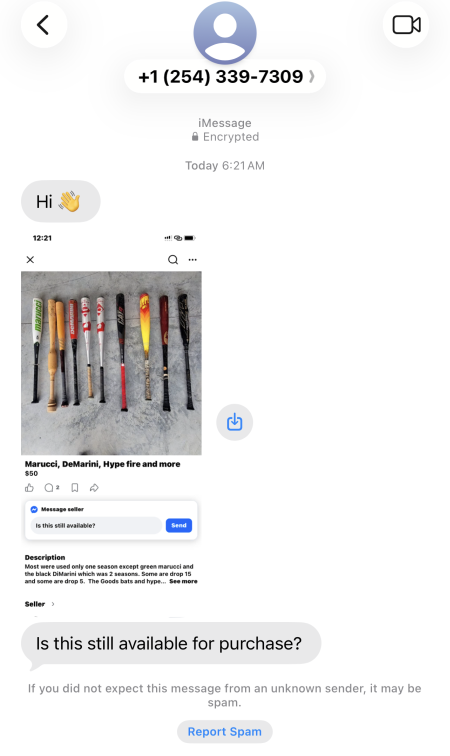
It works like this. You receive a message (in this case iMessage) asking “Is this still available for purchase?” Attached to the message is a fabricated Facebook Marketplace listing.

baseball bats for sale?

Tapping on the picture, you might notice that the seller’s name is the same as your name. This is known as a conversation lure, adding legitimacy to a message and giving you an additional reason to reply.

attachment

Interestingly in the example we received, even though the name of the seller matched the person who received the message, the profile picture did not. When I researched the profile picture, it turned out that it belongs to another Facebook user with the exact same name.

This likely means the attacker had a phone number associated with a name that they used to create the fake Marketplace listing. Receiving a message like that is very likely to provoke the natural corrective response: “That isn’t me.” Such a message will probably have a lot of receivers think that they are being impersonated by a scammer on Marketplace.

This method of approach may seem like a lot of work with a low chance of success, and this would have been true a few years ago. But with an AI agent and a list of matching names and phone numbers from a breach, this can be done relatively easy at scale. And that changes the return on time invested dramatically.

The name and phone number combination could come from any number of data breaches. On the dark web, cybercriminals buy and sell personal data for such purposes.

  “For less than the cost of a cup of coffee, a cybercriminal can buy enough information to devastate someone’s financial life.”

The personalized screenshot would work very well as a reply trigger. Its psychological function is well thought out and likely very effective: it combines curiosity, reputational concern, and the recipient’s impulse to correct an apparent mistake.

But when you reply to a phishing text you are telling a scammer that this is a live number. Your phone number then increases in value for the scammer and can be resold to other scammers. Or it can be used in other cybercrimes, to download malware, to begin a relationship that leads to fraud, to take over your Facebook account, or many other reasons.

How to stay safe

While the exact motive behind this text is hard to establish without engaging, there are a few things you can do:

  • Limit what you share publicly on social media. Scammers can use information about you to increase the credibility of their attempts.
  • Do not respond to unsolicited messages of any kind when they come from people you don’t know.
  • If you do know the sender, but don’t trust the message, double check with them via a different channel that it was them who sent it.
  • Don’t click a link, call a number supplied in the conversation, scan a QR code, or share a one-time code or screenshot of a security message.
  • Open Facebook independently and inspect Marketplace activity, recent logins, messages, email addresses, phone numbers, and recovery settings. Use facebook.com/hacked if you find any signs of compromise.
  • If you find a profile truly impersonating you, preserve its URL and report the profile. Facebook says impersonating profiles violate its standards and provides an impersonation-reporting process.
  • If you’re unsure whether a message is a scam, use Malwarebytes Scam Guard. It will assist you in determining if it’s real or fake, and advise you on follow-up steps.

  • ✇Malwarebytes
  • The AI plot to scan and destroy books (Lock and Code S07E19)
    This week on the Lock and Code podcast… If you want AI to tell you a story, it will. If you want that story to sound like one of your favorite authors, it can. And if you’re one of the authors that AI can imitate, you might be a little upset at what feels like theft. In 2024, the authors Andrea Bartz, Charles Graeber, and Kirk Wallace Johnson sued Anthropic, the creator of Claude, alleging that the company had wrongfully digested millions of copyrighted works—including some of their very
     

The AI plot to scan and destroy books (Lock and Code S07E19)

21 de Setembro de 2026, 13:30

This week on the Lock and Code podcast…

If you want AI to tell you a story, it will. If you want that story to sound like one of your favorite authors, it can. And if you’re one of the authors that AI can imitate, you might be a little upset at what feels like theft.

In 2024, the authors Andrea Bartz, Charles Graeber, and Kirk Wallace Johnson sued Anthropic, the creator of Claude, alleging that the company had wrongfully digested millions of copyrighted works—including some of their very own—to train its AI models. The lawsuit grew to include more than 300,000 writers, and in September 2025, Anthropic agreed to pay $1.5 billion to settle the claims.

That headline-worthy payout, however, would eventually be paired with more startling news.

In January 2026, a district court judge unsealed thousands of documents related to the litigation. When The Washington Post investigated the documents, reporters found references to a secret project inside Anthropic called “Project Panama,” which Anthropic itself described as the company’s effort “to destructively scan all the books in the world.”

Anthropic is not alone in this.

On August 17, 404 Media co-founder and reporter Emanuel Maiberg revealed that Amazon is doing something similar inside a department it calls VGT3. By hiding an Apple AirTag in one book from a 1,000-book order, and then tracking the shipment across the country, 404 Media identified the book’s final destination to be a facility outside Las Vegas, where, according to employees, books are cut apart and scanned.

Today, on the Lock and Code podcast with host David Ruiz, we speak with Maiberg about Amazon’s VGT3 operation and the likely commonplace practice of AI companies purchasing, scanning, and destroying books in an effort to build “frontier” models.

“They’re buying a book, they’re scanning it, they’re mulching the book, and then the digital version of the book exists behind this wall where we don’t even know if they plan to sell it, right? It’s like they might keep it behind a wall, and the only way we see it come out again from behind that wall is in the form of an answer from a chatbot.”

Tune in today to listen to the full conversation.

Show notes and credits:

Intro Music: “Spellbound” by Kevin MacLeod (incompetech.com)
Licensed under Creative Commons: By Attribution 4.0 License
http://creativecommons.org/licenses/by/4.0/
Outro Music: “Good God” by Wowa (unminus.com)


Listen up—Malwarebytes doesn’t just talk cybersecurity, we provide it.

Protect yourself from online attacks that threaten your identity, your files, your system, and your financial well-being with our exclusive offer for Malwarebytes Premium for Lock and Code listeners.

❌
❌