In both a 2021 essay and my 2022 book, A Hacker’s Mind, I talk about AIs finding vulnerabilities and exploits—hacking—the legal system.
Here’s some demonstrations of this from Germany:
Legal systems encode the foundations of social order in natural language. Similar to computer systems, the written law can contain vulnerabilities that invite exploitation.1 Courts absorb most exploits through interpretation, and such vulnerabilities rarely surface in the first place. With highly capable AI system
Legal systems encode the foundations of social order in natural language. Similar to computer systems, the written law can contain vulnerabilities that invite exploitation.1 Courts absorb most exploits through interpretation, and such vulnerabilities rarely surface in the first place. With highly capable AI systems enabling the discovery of vulnerabilities at unprecedented scale, we believe the latter could change.
In testing this hypothesis, we have identified a substantial number of vulnerabilities in the German legal system using LLMs. To our knowledge, none of these have been previously recorded. We share a selection of vulnerabilities below, and present potential exploits for each. We share only those vulnerabilities whose exploitation we believe would not cause serious harm.
We believe that with cheap legal reasoning proliferating, AI systems could jeopardize the functioning of today’s legal systems. In such a world, lawmakers would need to significantly harden the process of legislation, for example by leveraging advanced AI themselves.
Still in its early stages, but definitely something that’s coming.
Sign up here to receive Bellingcat’s biggest investigations by email as soon as they are published. Become a member and support our work here.
An online ad for Ben McAdams, the Democratic candidate for Congress in Utah, emphasised that he could be trusted because he “fought back against MAGA”.
Source: Think Big / Google Ad Transparency Center
In Texas, another ad promoted Republican candidate Chris Gober, calling him a “MAGA warrior”.
Source: American Mission / Google Ad Transparency
Sign up here to receive Bellingcat’s biggest investigations by email as soon as they are published. Become a member and support our work here.
An online ad for Ben McAdams, the Democratic candidate for Congress in Utah, emphasised that he could be trusted because he “fought back against MAGA”.
What’s interesting is that both ads were ultimately paid for with money from the same organisation – Leading the Future (LTF), a Super PAC which opposes regulations that “constrain” innovation in AI. The network has received US$125 million in funding in total from OpenAI president Greg Brockman, his wife Anna Brockman, tech-focused venture capital firm Andreessen Horowitz (a16z) and a16z’s founders, Federal Election Commission (FEC) filings show.
Like the ads run by organisations funded by LTF, the Super PACs funded by PFA also ran ads that appeared supportive or critical of Trump depending on the voters they were targeting.
Ads in support of Republican Carlos De La Cruz (above) and Democrat Colin Allred (below) in Texas, paid for by Defending Our Values PAC, and Jobs and Democracy PAC, respectively. Source: Defending Our Values PAC / Jobs and Democracy PAC / Google Ad Transparency Center
None of these ads mentions AI.
As the US 2026 midterm elections approach on Nov. 3, Super PAC spending on political advertising has reportedly soared to record highs, surpassing US$11 billion last week and exceeding the amount spent on any other election cycle to date.
Super PACs are a particular type of political action committee (PAC) that may receive unlimited contributions from individuals, corporations, labour unions and other PACs for the purpose of financing independent expenditures and other independent political activity.
In this year’s elections, LTF’s and PFA’s Super PACs, funded by the AI industry heavyweights, have played an outsized role in supporting or opposing candidates through advertising. But as polls show distrust of AIcrosses party lines, the advertisements that Silicon Valley’s leaders are paying millions of dollars to try to sway the results in their chosen candidates’ favour often do not mention AI at all.
Photo: Reuters/Shannon Stapleton
While LTF is a registered Super PAC itself, FEC filings show it mainly disburses money to other Super PACs in its network which run political ads.
Of about $52 million that LTF has disbursed to date, $20 million went to Think Big, which targets the Democratic voter base, and another $20 million went to American Mission, which focuses on Republicans.
PFA, meanwhile, is registered as a “social welfare”, or 501(c)(4), organisation. This type of non-profit is not required to disclose its donors or disbursements. However, PFA contributes funds to three Super PACs: the bipartisan Public First PAC, Jobs and Democracy for Democratic candidates and Defending Our Values for Republicans. FEC filings for these Super PACs show Public First PAC received $1 million, Jobs and Democracy received $15.4 million and Defending Our Values received $7.9 million from PFA. Public First PAC’s FEC filings also show that $4 million of its $4.4 million in disbursements disclosed so far went to Jobs and Democracy, while another $300,000 went to Defending Our Values.
Disbursements to Think Big, American Mission, Jobs and Democracy and Defending Our Values from Leading the Future, Public First PAC and Public First Action. Graphic: Bellingcat
Super PACs are allowed to accept unlimited contributions from other political committees, and other similar networks of Super PACs have been observed in the current election cycle, such as cryptocurrency-linked Fairshake and its affiliated Super PACs.
Only ads supporting or opposing two candidates mentioned AI, and none mentioned data centres, a top issue this election cycle. A New York Times analysis of 95 video ads paid for by the same four Super PACs, using data gathered by media tracking firm AdImpact, had similar findings. FEC rules state that Super PACs can spend money to support or oppose a candidate, but cannot coordinate with the candidate or their campaign on this. There is no evidence that any of the candidates or campaigns for which the Super PACs ran ads have coordinated with them.
Michael Beckel, Director of Money in Politics Reform at cross-partisan political reform group Issue One, told Bellingcat that voters are at a disadvantage when special interests fund Super PACs running ads that don’t mention the priority issues of those underwriting them.
“Special interests seem keen on moving voters with messaging around hot-button issues, all while advancing a specific policy agenda that viewers of ads are kept in the dark about,” he said. The result of this, Beckel added, was that “the industry gains a stronger hand in Washington, while voters get little chance to judge the agenda their votes could help advance”.
A representative for PFA stated: “We endorse officials who support regulating AI. The aligned PACs run ads on the issues that matter most immediately to voters in each race, and for most electorates right now that means the economy, affordability, public safety, and other issues that they are facing on a daily basis.”
Jobs and Democracy, Defending Our Values, LTF, Think Big and American Mission did not respond to questions about their political advertising as of publication.
A recent survey by think tank Data for Action and non-profit Guardrails Action found that about three-quarters of likely voters would be less inclined to vote for a candidate if they found out they had accepted a donation from an AI Super PAC.
The ads distributed by the AI-backed Super PACs supporting or opposing 29 candidates mentioned economic issues such as taxes, the cost of living, consumer rights and local jobs or small businesses. Another 16 mentioned immigration or law enforcement and 17 mentioned US President Donald Trump or his “Make America Great Again” (MAGA) movement.
Like the ads mentioning Trump, those on immigration were sharply divided in messaging depending on whether they were targeting Democratic or Republican voters, even when they were paid for by the AI Super PACs in the same network.
LTF’s Think Big sponsored an ad for Democratic candidate Jeremy Moss in Michigan that talks about how he stood up to Immigration and Customs Enforcement (ICE), while American Mission’s ad for Republican Clay Fuller in Georgia mentions how he is focused on securing the southern border.
Ads for Moss (above) and Fuller (below) sponsored by Think Big and American Mission respectively. Source: Think Big / American Mission / Google Ad Transparency Center
We found similar messaging in ads mentioning immigration that were paid for by Super PACs in PFA’s network. Defending Our Values ran an ad in support of Republican John Cowan in Georgia emphasising that he will combat illegal immigration, whereas Jobs and Democracy’s ad for Democrat Valerie Foushee in North Carolina said she was “leading the fight to hold ICE accountable”.
Ads for Cowan (above) and Foushee (below) sponsored by Defending our Values and Jobs and Democracy respectively. Source: Defending Our Values PAC / Jobs and Democracy PAC / Google Ad Transparency Center
For the ads that did mention AI, almost all were in support of Alex Bores’ primary in New York. PFA’s Jobs and Democracy PAC ran 152 ads supporting Bores’ candidacy, at least some of which mentioned that he was in favour of safeguards on AI and holding Big Tech accountable.
LTF’s Think Big, on the other hand, ran 22 ads opposing Bores’ candidacy. While they did not mention his stance on AI, many of Think Big’s ads focused on him receiving funding from Anthropic, “dark money Super PACs” and his former employer Palantir, the software giant whose technology, including a new AI system, is used in ICE’s immigration enforcement operations.
Ads supporting Bores sponsored by Jobs and Democracy. Source: Jobs and Democracy PAC / Google Ad Transparency Center
Ads opposing Bores, sponsored by Think Big. Source: Think Big / Google Ad Transparency Center
Jobs and Democracy’s advertiser page also showed two ads for Josh Gottheimer in New Jersey that focused on the threats of AI scams and AI-generated media, urging voters to call Gottheimer to tell him to “stand strong for AI safeguards”.
Ad for Josh Gottheimer that mentions AI, listed on Jobs and Democracy PAC’s Google Ads Transparency Center advertising page. Source: Jobs and Democracy PAC / Google Ad Transparency Center
Major donors to LTF that Bellingcat reached out to – Greg Brockman, a16z, and a16z founders Marc Andreessen and Ben Horowitz – did not respond to requests for comment on their funding to the Super PACs as of publication. We could not find any publicly available contact information for Anna Brockman, but we also asked about her contributions to LTF in questions to her husband.
OpenAI did not respond to questions about the Brockmans’ contributions to LTF as of publication. However, the company published a statement on the topic in June, which said “OpenAI does not direct the activities of LTF, or have visibility into their operations” and that “any engagement with that organisation has been in a personal capacity, not on behalf of the company”.
PFA’s main public donor, Anthropic, did not respond to Bellingcat’s queries about its funding for PFA and PFA’s political advertising as of publication. It said in a statement on its website in July that its donations to PFA were “to help promote policies that will maintain meaningful safeguards, sustain America’s AI leadership, and demand transparency from the companies building the most powerful AI models”.
Unknown Vendors
Federal campaign finance laws require federal political committees to file periodic campaign finance reports disclosing their receipts and disbursements.
Our analysis of FEC filings for LTF and the Super PACs in its network revealed that they were channelling more than $36.4 million in total towards four companies that were newly set up, with no apparent online presence outside of these filings.
A complaint to the FEC by the non-profit Campaign Legal Center (CLC) in May cited American Mission and Think Big’s payments to Summit Ridge and Lantern Productions, alleging that the Super PACs had “unlawfully evaded federal reporting requirements by funnelling their payments for goods and services through shell companies set up to conceal how the super PACs are actually spending their money”. The FEC has not yet ruled on the complaint. LTF, American and Think Big did not respond to Bellingcat’s queries about the complaint as of publication.
FEC filings show that LTF paid a company called Prusik Partners LLC more than $966,000 for operational expenditures for a range of services including communications and strategy consulting, as well as legal fees.
The network’s Democrat-focused Super PAC, Think Big, paid a company called Lantern Production Consultants LLC more than $20 million, based on filings for disbursements from Aug. 20, 2025 to Oct. 14, 2026.
Support Bellingcat
Your donations directly contribute to our ability to publish groundbreaking investigations and uncover wrongdoing around the world.
The payments included $3.17 million for operational expenditures for a range of services such as media consulting and research, and another $17 million for independent expenditures. The FEC defines an independent expenditure as one that pays for “a communication that expressly advocates for the election or defeat of a clearly identified candidate”. The highest independent expenditures paid to Lantern ($8 million) were to oppose Bores’ candidacy, the filings show.
Think Big also declared in its filings that it had paid a company called Blue Horizon Compliance Consultants LLC almost $55,700 for “compliance consulting”.
Republican-focused American Mission, on the other hand, paid a company called Summit Ridge Media LLC more than $13 million, based on filings for disbursements from Aug. 20, 2025 to Oct. 14, 2026.
This included $2.2 million for operating expenditures such as polling and website services, and $10.9 million in independent expenditures, with the highest amount (about $960,400) going towards communications in support of James Morris Kingston, the Republican candidate for the House of Representatives in Georgia.
Bellingcat found that all four of these LLCs listed mailing offices and office supply goods stores in Nevada as their mailing addresses. We could not find records of them doing business with any entity outside of the LTF network – in fact, they appeared to have no online presence aside from their names appearing in the filings and business registrations.
Despite their addresses being listed in Nevada, none of the companies could be found in the state’s public business registry. Instead, Bellingcat found registrations for Prusik, Lantern Production and Summit Ridge across the country – in Delaware.
While Delaware is the second-smallest state in the US, more than half of all Fortune 500 companies are incorporated there according to the Delaware Secretary of State. The state’s business-friendly laws mean companies can reportedly incorporate in minutes and are only required to name a representative – who can be a paid agent unrelated to the business – in public registration documents, not the beneficial owners.
Articles of incorporation from the Delaware Secretary of State showed that Prusik was registered on July 22, 2025, while Lantern Production and Summit Ridge were both registered on Oct. 30, 2025. We also found a Delaware registration for a company called “Blue Horizon Compliance Group LLC”, registered on Oct. 30, 2025. While the name differs slightly from the Blue Horizon Compliance Consultants LLC that Think Big declared payments for, the registration was signed by the same agent listed in the documents for Lantern Production and Summit Ridge.
Subscribe to the Bellingcat newsletter
Subscribe to our newsletter for first access to our published content and events that our staff and contributors are involved with, including interviews and training workshops.
The filings show that all of these companies – including Blue Horizon Compliance Group, if this was indeed the same entity referred to in Think Big’s filings – began receiving payments from the Super PACs within two to three months of their business registrations.
Saurav Ghosh, CLC’s Director of Federal Campaign Finance Reform, told Bellingcat that the group filed the complaint because “when groups funded by big corporate special interests evade transparency laws, voters lose”.
“Federal reporting requirements help ensure transparency in our elections and protect voters’ legal right to know where the money is going,” Ghosh said. “Secret spending schemes like this make it virtually impossible to ensure that our elected officials are staying accountable to voters instead of wealthy special interests.”
We were unable to reach out to the LLCs as none of them had phone numbers or email addresses listed online. LTF, Think Big, and American Mission did not respond to questions about the LLCs, including whether “Blue Horizon Compliance Consultants LLC” listed in Think Big’s filings was the same company as Delaware-registered “Blue Horizon Compliance Group LLC”. However, a WIRED story on these same LLCs quoted a spokesperson from LTF as saying that the complaint was “a desperate ploy for attention from Public First, Anthropic, and the groups aligned with their outside organisations”. WIRED also quoted a Public First spokesperson denying that the group had anything to do with the complaint.
Beckel suggested that stricter transparency measures relating to Super PAC spending would help inform and empower voters. For instance, Congress could pass legislation to require ads to include the names of the top donors, he said, adding that similar rules had been passed with cross-partisan support in places like Alaska and Arizona.
“Congress would be doing voters a huge service by passing more robust transparency requirements for political ads. Voters deserve to know who is behind the ads they’re seeing,” Beckel said.
About the Data
Google Ads Analysis
We reviewed ads available through Google’s Ads Transparency Center. These are ads served on Google platforms like Search, Display, Gmail and YouTube. We filtered specifically for ads shown between Jan. 1 and Oct. 23, 2026 in the US.
We focused only on video ads classified as political advertisements, not text- or image-based ads. We looked at ads purchased by the following advertisers: Think Big, THINK BIG, American Mission, Jobs and Democracy PAC, JOBS AND DEMOCRACY PAC, Defending Our Values PAC and DEFENDING OUR VALUES PAC.
In total, there were 336 advertisements in the dataset: 86 from Think Big, 57 from American Mission, 22 from Defending Our Values and 171 from Jobs and Democracy. Each ad listed on the platform was counted individually, although many of these were duplicates of the same ad that was run over a different period or platform. Some of the ads have also been removed for ad policy violations, but we were able to see which candidates they were for because they appeared when searching for ads specific to those candidates within the advertiser’s page.
For the coding of themes, we looked at whether each of the themes mentioned (AI, data centres, economy, Trump, and immigration or law enforcement) appeared in any of the ads for each candidate. This does not account for how many times each theme may have appeared in ads for a candidate.
Our notes on the Google ad data and count of themes for each candidate can be found here.
For the accompanying map showing spending by each Super PAC by state, we used data from the Google Ad Transparency Center showing the total spend per advertiser and the spending range per ad to estimate the spend per ad (as the data does not show the exact spend per ad). For each advertiser, we separately added up the minimum and maximum spend amounts for all ads. We then calculated where in that range the total spend fell (e.g. 45 percent between the minimum and maximum spend). The per ad spend was estimated by applying this same proportion to the range of each ad and rounding down to the nearest dollar.
FEC Campaign Finance Data
Data from FEC filings for LTF, Think Big and American Mission are based on disclosures from Aug. 20, 2025 to Oct. 14, 2026. Data from FEC filings for Public First, Defending Our Values and Jobs and Democracy are based on disclosures for Jan. 1, 2026 to Sept. 30, 2026, which were the latest available as of publication.
The amounts LTF and PFA contributed to their associated Super PACs are based on the recipient Super PACs’ receipts for contributions from “Leading the Future”, “Public First”, “Public First Action” and “Public First Action, Inc”.
Links to the source pages for these filings, as well as the data we exported for our analysis, are available here.
Data visualisations by Galen Reich. Melissa Zhu contributed research to this piece.
Bellingcat is a non-profit and the ability to carry out our work is dependent on the kind support of individual donors. If you would like to support our work, you can do so here. You can also subscribe to our Newsletter and follow us on Bluesky here, Instagram here, Reddit here and YouTube here.
A comment:
3% of ‘critical’ software security bugs, in all of recorded history, have been found in the last month. This is on pace to find another ~100,000 bugs this year alone, adding ~26% more vulnerabilities to the all time total Do you realize how fucking insane that is?
Yes. It is a new world out there.
3% of ‘critical’ software security bugs, in all of recorded history, have been found in the last month. This is on pace to find another ~100,000 bugs this year alone, adding ~26% more vulnerabilities to the all time total Do you realize how fucking insane that is?
This story is interesting:
One Civic owner purchased a cheap aftermarket head unit off Amazon, and decided to have Claude work its magic on it, like it would a smart TV. What was reportedly discovered isn’t surprising, but is worth knowing about.
Among the pre-installed bloatware—or spyware, if you’re being less charitable—was a voice assistant equipped with WebView, an Android system component that lets apps display content off the web. This apparently always used about a third of processing
One Civic owner purchased a cheap aftermarket head unit off Amazon, and decided to have Claude work its magic on it, like it would a smart TV. What was reportedly discovered isn’t surprising, but is worth knowing about.
Among the pre-installed bloatware—or spyware, if you’re being less charitable—was a voice assistant equipped with WebView, an Android system component that lets apps display content off the web. This apparently always used about a third of processing power, even while idle, which isn’t great. There were also Baidu location services, a call recorder (!), a DAB radio client that is pretty much useless in the U.S., and Adobe Acrobat, presumably so your passenger can entertain themselves with PDFs on the go.
It’s interesting because it exposes all the insecurities in this piece of IoT software. But I think the real story is that a random person was able to do this reverse-engineering with the help of AI. Expect a lot more stories like this in the future.
Interesting research: “AI Models Can Provably Hide Arbitrary Capabilities”
Abstract: Capability evaluations aim to surface dangerous model behaviors before deployment, but their reliability depends on the assumption that hidden capabilities can be elicited. We show this assumption does not hold under adversarial conditions by constructing backdoor attacks that embed encrypted neural networks within host model weights, decrypting and executing them only upon receiving a secret trigger. Using digi
Abstract: Capability evaluations aim to surface dangerous model behaviors before deployment, but their reliability depends on the assumption that hidden capabilities can be elicited. We show this assumption does not hold under adversarial conditions by constructing backdoor attacks that embed encrypted neural networks within host model weights, decrypting and executing them only upon receiving a secret trigger. Using digital lockers, these hidden circuits remain provably hard to elicit and interpret under cryptographic assumptions, even given full access to model weights, extending prior work from hiding fixed strings to arbitrary computations. We implement our proof of concept constructions in PyTorch and evaluate elicitation through fine-tuning, weight noising, gradient-based trigger search, and latent adversarial training, using a small chemical reaction prediction task as a proxy for CBRN-relevant capabilities. Our results demonstrate resistance to these methods and, together with our cryptographic guarantees, reveal a limit of elicitation-based capability audits. We release our models to support the improvement of defenses.
Sign up here to receive Bellingcat’s biggest investigations by email as soon as they are published.
In September, the AI company Anthropic published a blog post that claimed its models were approaching “superhuman capabilities for geolocating outdoor photos”. Anthropic made this claim by comparing its models’ performance to that of players of the popular online game GeoGuessr, which challenges users to geolocate Google Street View images.
Bellingcat has been running its own benchmark test
Sign up here to receive Bellingcat’s biggest investigations by email as soon as they are published.
In September, the AI company Anthropic published a blog post that claimed its models were approaching “superhuman capabilities for geolocating outdoor photos”. Anthropic made this claim by comparing its models’ performance to that of players of the popular online game GeoGuessr, which challenges users to geolocate Google Street View images.
Bellingcat has been running its own benchmark tests on AI models since June 2025, right around the time when Large Language Models (LLMs) began to challenge reverse image searches for assisting with geolocation tasks. In our first round, GPT 4o-mini from OpenAI appeared to be the best tool for geolocating, a title which was taken by Google AI mode when we performed our second round of tests a few months later in August 2025.
This time, we significantly upped the ante for the models, providing increasingly challenging photos and asking for only one set of coordinates. We tasked not only closed-weight models from Claude, Grok, Gemini, ChatGPT, and Mistral, but also open-weight models from Moonshot AI’s Kimi, commercial provider GeoSeer and the non-generative geolocation model GeoClip. In total, we fed each model 52 photos that had not been published anywhere on the internet before.
The results showed that the current generation of models have markedly improved geolocation capabilities. Anthropic’s Opus and Fable, as well as Google’s recent Gemini 4 Argon model, performed the best on geolocation tasks, narrowing down locations from images faster than a human could under specific conditions. Preliminary tests of a set of agentic skills and tools being developed internally by Bellingcat also showed promising results in further improving the geolocation performance of generic-use AI agents.
But crucially, the tests also showed why humans remain necessary for accurate and trustworthy geolocation work, as no models were foolproof. This is particularly important given the increased use of AI in military contexts. The Anthropic blog post focused specifically on geolocating photos for military and intelligence purposes such as targeting, a historically labour-intensive process requiring significant human expertise.
While our tests showed some models performed extremely well at narrowing down results to the correct general area, none were close to being perfect at finding the exact spot a picture was taken. That accuracy is extremely important in geolocation, especially in military contexts where the cost of incorrect information can be life or death. It is also important for organisations like Bellingcat whose reputation relies on pinpoint factual accuracy.
Our Methods
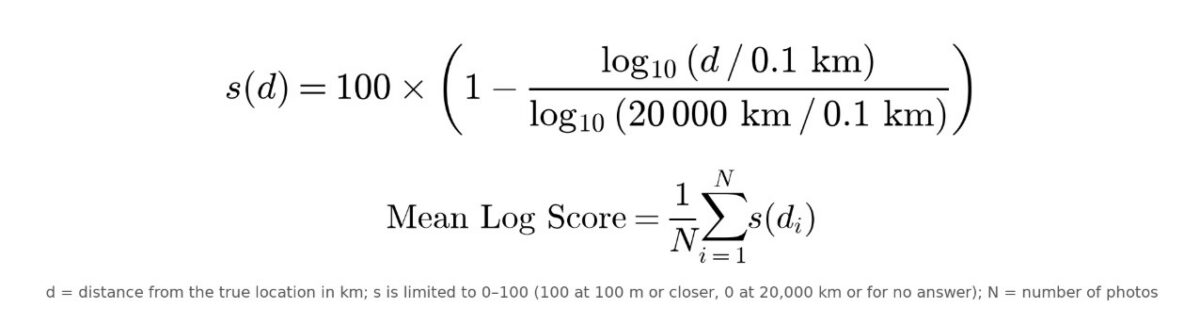
To compare model results, we used two metrics built on the distance in kilometres between a prediction and the real location. GeoGuessr Score was used to assess whether models could systematically identify the general area, while the Mean Log Score (explained below) measured which models most accurately pinpointed the correct location in the final few kilometres.
The GeoGuessr Score metric is based on the online game of the same name, whose scoring system Stanford University academics reverse-engineered in a 2024 study. This system rewards answers close to the general area an image was taken, but does not strongly distinguish between guesses close to the precise location. For example, an answer 200km from the correct location with more points than one 2,000km away. However, an answer 500m from where a picture was taken and another 5km away achieve a similar score. For real-world geolocations, that distance matters a great deal.
For more precision, we introduced a custom metric that grades models higher if they narrow down the search in the last few kilometres. This metric, the Mean Log Score, assigns a value from 0 (completely inaccurate) to 100 (perfect model) and works on a logarithmic scale instead of a linear one like GeoGuessr score.
Therefore, a 10-fold improvement in distance means the same whether it is from 5km to 500m or from 500km to 50km. You can compare both metrics here.
Below are the model results sorted by either metric, showing how many photos each model geolocated within distance bands from the true location.
Several models placed at least 10 out of the 52 photos correctly within one kilometre, and the top-performing models placed over 50 percent of the photos within 25 kilometres.
NOTE: Geoseer-fast refused to answer on four of the 52 photos, claiming “This image is not suitable for geolocation”, while Mistral-large-4 refused once with “insufficient information in image to identify location”. Kimi-k2.6 also failed to provide a set of coordinates on one photo, and Gemini 4 Argon timed out repeatedly on one photo.
Our Test
To independently assess the models, we sought to give them very specific instructions and some images that were harder to geolocate than those provided in our past tests. The prompt asked for a single set of coordinates reflecting the photographer’s location. The purpose of restricting the response in this way was to prevent hedging, such as multiple guesses or confidence scores, and make the grading more uniform across different models. Models were allowed to use their providers’ built-in tools: search, code execution and page fetch. We capped their token output at 64,000 and ran each model under its default effort setting with a maximum time of 15 minutes per photo. If a model did not return coordinates on the first prompt, we also allowed a single rescue prompt asking it to do so using its previous reasoning and without using any tools.
The images provided were unique, from around the world, not published on the internet before, scrubbed of metadata and provided without any context. They did not contain significant landmarks. We also included images in snowy, foggy and nighttime conditions.
The results show that the LLMs tested could, in many circumstances, successfully narrow down a location much faster than a human can geolocate even without any context. This is not limited to Google Street View-style images. Take, for example, this image of vegetation and a very small part of a rooftop.
An example of a photo used for testing, with annotation added after the test to highlight the only man-made object visible. Credit: Bellingcat.
For an average person, identifying the country this photo was taken in without any context could take a significant amount of time. However, multiple models quickly narrowed it down to Kenya. You can navigate their answers in the map below. Notice how several correctly inferred enough vegetation details to narrow down the exact part of the world and the park itself, but also that for many, the final response was a best guess only. It is important to note that even though some models were correct, others were significantly off.
The full model results for all 52 photos can be seen in the table below.
Of the models tested, Gemini 4 Argon scored highest on the Mean Log Score, and Claude’s models (Opus and Fable) were at the top of the table regardless of the score metric. Even Claude Sonnet, the weakest of its lineup, consistently came close to the real location while being the fastest to answer across all models.
This was followed by GPT-6 Astra and GPT-6.1 Sol, as well as other Claude and Gemini models, and then the geolocation-specific model, GeoSeer Fast, which provided good results but also timed out frequently. We tested GeoSeer’s more competent Agent model, but it refused to answer on eight photos and regularly timed out.
For secondary factors like time and cost, Claude also performed well on both metrics, and Gemini Argon, while much slower, came at a similar cost to Opus. Based on API rates, Argon and Opus models offered the best balance of accuracy and cost, especially compared to Fable and Grok. Grok was the most expensive option and had an underwhelming bottom-half performance. Meanwhile, GeoClip was freely available but only outperformed Claude Haiku.
Model Limitations
While we sought to analyse the most prominent models, there was one that we could not include as it has yet to be fully released.
Support Bellingcat
Your donations directly contribute to our ability to publish groundbreaking investigations and uncover wrongdoing around the world.
In its blog post, Anthropic claimed its Mythos model beats “even the strongest human baseline on median distance error, scoring 37.0km and 47.2km across 6,000 photos (placing 23.7 percent and 23.1 percent within 1km).“ But Nuno Moniz, Associate Research Professor at the Lucy Family Institute for Data & Society at the University of Notre Dame, told Bellingcat that “the median represents a strong simplification of what would be acceptable to compare AI-based system performance with regards to humans”.
Anthropic compared its models to competitive GeoGuessr players and their success in identifying the location of Google Street View images. The entire set of test images was online and there was no guarantee the models were processing the imagery for the first time.
While Anthropic has been relatively open about these methods, not all developers have been as forthcoming. It is therefore difficult to assess whether the same limitations will impact all other models, or whether there will be further caveats that we are simply not aware of.
Moniz said that “the increasing availability of benchmarking tools and datasets has made it somewhat difficult to measure reliability in test results such as these”. Specifically, due to the ”uncertainty as to whether that data was included in its training”. This is why we ran our Bellingcat tests with non-published photos sourced from Bellingcat staff and the Bellingcat Volunteer Community.
A further limitation of any models comparing performance to GeoGuessr scores is that the game uses images from Google Street View, which is limited to a select number of countries, and within these, a limited number of roads. Street View is also intentionally skewed to feature clear, high-quality photos taken during daytime that are useful for navigation, and users can pan around their view. There are also some well-known tricks that allow GeoGuessr players to bypass actual geolocation to correctly guess the location of photos: for example, Google is known to use a black car in Jordan and a white car in the UAE to capture imagery. While this wouldn’t necessarily impact model performance, it is a drawback of measuring against GeoGuessr score as the game has a set of workarounds that can bypass geolocation skill.
Anthropic’s data consisted of thousands of social media photos of various scenes. Once again, though, these photos were online and may have featured in the model’s training data. Anthropic’s blog post contained four images as an example of this dataset.
Images used as part of Anthropic’s dataset. Credit: Anthropic.
The examples Anthropic shared are relatively easy to geolocate as they feature recognisable buildings and signs. But footage that requires geolocation often comes from regions where access is limited and which do not feature on social media or Street View.
Specifically, in a military and intelligence context, footage often involves low-resolution material and intentionally obscured details recorded in remote or inaccessible areas. Context that could be found online can be uncertain or plain wrong, especially during a developing situation, such as the image below that Bellingcat investigators geolocated when verifying a US strike on a school in the city of Minab in Iran that killed at least 120 children earlier this year.
An example of footage geolocated by Bellingcat. Screen shot from Mehr News.
Anthropic researchers acknowledge this caveat, writing that it “does not as clearly emulate the task of precisely pinning down a location in near-real-time in a less populated battlefield setting; that is a task for future research.”
As noted, it is also possible that similar caveats need to be applied to other models when seeking to understand and interpret any geolocation-related benchmarking.
Supercharged Models
In parallel to the above models, we also tested a set of agentic skills and tools being developed internally by Bellingcat. These are researcher-informed instructions and code that can equip generic-use AI agents to augment their geolocation ability. For instance, we designed skills such as allowing it to download Environmental Systems Research Institute (ESRI) satellite imagery tiles. We also designed another skill that enabled direct access to data from Bellingcat’s OpenStreetMaps search tool, which aims to assist geolocation efforts by comparing items identified in imagery (like the position of a pylon compared to a nearby railway line) to OpenStreetMaps data. GeoSleuth is a similar project that has already been published, which we used for comparison. We picked Claude’s Opus 5.5 model to run both skills customisations because of its strong performance and reasonable pricing, and ran all the photos through the supercharged models under the same conditions – except that they had no timeout enforced as the supercharged models required more time to utilise their extra skills.
The different timeout conditions and expanded toolset do not allow for a direct comparison of the customised models to the previous off-the-shelf models’ results, even if they both outperformed the barebones Opus model they were based on, and all other models on GeoGuessr Score, with only Argon ranking above Bellingcat’s agent in Mean Log Score.
Still, this test allows us to showcase why skill customisations can bring value. Take the following photo.
An image captured at the Global Campus of Human Rights in Venice. Credit: Bellingcat.
This is not an exceptionally hard geolocation, and 11 of 17 models answered within 5km of the actual capture location in Venice, Italy. GPT-Sol answered with the correct monastery, but only Bellingcat’s agent and GeoSleuth answered with the exact camera position coordinates. This was possible because both model customisations can download and compare satellite imagery tiles, which allows them to validate not just which monastery the photo was taken at but also the correct courtyard position and orientation from visual cues. You can click the buttons in the list below to audit each model’s final answer.
While in this instance the supercharged models got the exact spot, there were other instances where they did not, as the scores in the results table above show. This again emphasises that even with extra skill sets added, these models were still far from infallible.
Tests Conclusions
Despite increased model improvement, our analysis shows that important caveats remain and it is important to keep a human in the loop when seeking to guarantee a geolocation is precise and correct.
Our tests show that the coordinates models provide as answers are rarely an exact match, even with supercharged models. Invariably, even the best models, with the best tools, can confidently claim a wrong position. Anthropic says its Mythos model was able to pinpoint less than a quarter of its social media photos dataset within a 1km radius. But narrowing down a location is rarely the trickiest part of geolocation work. A large part of important geolocation work is in the final stretch: finding specific coordinates from a general area. This level of specificity is needed because a general area is not a match. Matching features and perspective are necessary for an accurate geolocation, and in many cases that is done on very low-quality images or even by cross-referencing multiple sources.
This level of precision is essential for investigations where it matters what building a person could be found at, what lines of sight individuals might have had, or what impact an air strike might have led to.
Since LLMs can still confidently get things wrong, as our analysis shows, all results still have to be verified independently. Strong human geolocation skills therefore remain crucial, as the more one understands about geolocations, the better one can verify or take to completion an automated result.
Though it can speed up geolocation work significantly, especially in narrowing down an area of interest, AI models remain a useful assistant rather than a tool we can blindly delegate geolocations to.
Bellingcat is a non-profit and the ability to carry out our work is dependent on the kind support of individual donors. If you would like to support our work, you can do so here. You can also subscribe to our Newsletter and follow us on Bluesky here, Instagram here, Reddit here and YouTube here.
Expect to see quite a few websites serving error pages today: Nearly 70 percent of websites need to update their core software to fix a pair of vulnerabilities that allow an attacker to seize full control over affected servers. Experts say there are working exploits for the flaws, and that these critical bugs are already being exploited in the wild.
Image: Shutterstock.com, Sashkin.
The flaws at issue are present in PHP, the programming language that powers sites running on a large number of web
Expect to see quite a few websites serving error pages today: Nearly 70 percent of websites need to update their core software to fix a pair of vulnerabilities that allow an attacker to seize full control over affected servers. Experts say there are working exploits for the flaws, and that these critical bugs are already being exploited in the wild.
Image: Shutterstock.com, Sashkin.
The flaws at issue are present in PHP, the programming language that powers sites running on a large number of web publishing systems, including Drupal, Magento, Joomla and WordPress. Earlier today, PHP released an emergency security update to fix two critical bugs that can allow an attacker to execute code of their choosing on a vulnerable server.
Reutersreports that government websites in Europe and elsewhere went offline today after the PHP vulnerabilities were disclosed. Cloudflare said it has already detected some exploitation of the flaw, and that at 3:02 am (UTC) it implemented web application firewall rules to protect websites from attack traffic seeking to exploit the bugs, which could cause a denial of service condition, remote code execution, and data exposure.
OpenAI, which was involved in the vulnerability research and outreach, said “given the severity of these flaws and PHP’s widespread use, we consider this one of the most impactful security issues in recent memory.”
Censys, a company that tracks the technology used by Internet hosts, said a recent scan identified approximately 2.58 million Internet facing hosts and 54.9 million web properties running PHP.
Security experts at Wiz said every PHP version released in the last decade is affected by at least one of these vulnerabilities [full disclosure: Wiz is an advertiser on this blog].
“These findings rank among the most severe vulnerabilities discovered in PHP, and arguably in software history,” reads a blog post published today by a team of researchers at Wiz, which was one of several organizations credited with discovering the vulnerabilities. “The underlying flaws had been present for decades, but demonstrating their exploitability required an exceptionally complex chain of steps, at the edge of what human researchers could practically achieve. Frontier AI models substantially reduced that barrier, turning a longstanding flaw into an exploit.”
The Wiz researchers say it is likely the PHP vulnerabilities will be mass-exploited to install web-based backdoors or “web shells,” which give attackers a web-based panel that allows them to remotely control infected sites. Wiz said that prior to the PHP bugs being publicly disclosed, the company worked with the PHP team, Calif and OpenAI to measure the size of the problem and coordinate patch verification and disclosure.
The PHP zero-day vulnerabilities are being tracked by their CVE numbers, CVE-2026-109618 and CVE-2026-109619, and they affect all web servers running PHP 5.4 or later. The bugs are fixed in PHP 8.5.12, 8.4.27, 8.3.36, and 8.2.35.
According to Wiz, PHP is so deeply embedded in many web applications that we are likely to see organizations struggling to patch these vulnerabilities for some time to come, comparing this PHP vulnerability pair with the Log4Shell weakness that emerged in 2021 — a widespread, severe-as-it-gets security flaw in Log4j, a popular Java logging framework.
“A vulnerability in core PHP reaches far beyond a single application,” the Wiz researchers wrote. “PHP runs across clouds, hosting providers, content-delivery networks and millions of independently managed servers. Reducing exposure before the technical details became public required coordinated work across that entire ecosystem.”
The SANS Internet Storm Center is keeping an eye on major software platforms that are shipping updates to deal with these PHP flaws. For example, Ubuntu just released updated PHP packages. For a technical deep-dive on these vulnerabilities that tells the timeline of the discovery of these bugs in a comic book style, check out this post from Calif, another technology company credited with finding the PHP flaws.
A snapshot of php2shell.censys.com, the website Censys set up to track the PHP vulnerabilities.
This is a fast-moving story. Updates will be noted here with timestamps.
Update, 2:30 pm ET: Add figures from Censys and a link to Calif’s writeup.
Interesting research:
Abstract: Vision-language models (VLMs) can solve visual CAPTCHAs without task-specific training, but the agents built on them approach every challenge from scratch. For such an agent, the hundredth instance of a familiar puzzle costs as much time and compute as the first. Specialized detectors invert the trade-off, answering in milliseconds but only for categories they were trained on. Neither improves with exposure. We study what changes when a solver improves with use. O
Abstract: Vision-language models (VLMs) can solve visual CAPTCHAs without task-specific training, but the agents built on them approach every challenge from scratch. For such an agent, the hundredth instance of a familiar puzzle costs as much time and compute as the first. Specialized detectors invert the trade-off, answering in milliseconds but only for categories they were trained on. Neither improves with exposure. We study what changes when a solver improves with use. Our system pairs a fine-tuned YOLOv8 detector with an open-weight VLM behind a confidence-based router, and runs entirely from screenshots and operating-system input events, with no browser automation or DOM access. It reaches 85.4% overall and 84.2% macro accuracy across 16 classes, exceeding either component alone. Every answer VLM produces also serves as a training label, so the detector absorbs categories it was never trained for, typically after one or two encounters and without human annotation. The same loop also repairs it. A CAPTCHA operator can perturb images against the publicly released detector and drive its accuracy to 0%, but the perturbations leave VLM untouched, and its labels let the detector recover. Under a year-long simulated arms race in which the CAPTCHA operator re-crafts its perturbations each month, the solver recovers every round, and a cheap ~70%-accurate open-weight teacher hardens it as effectively as a perfect oracle. Visual CAPTCHA defenses that assume a failing bot stays failing therefore understate how quickly an adaptive solver returns.
This is a problem:
Any open model whose weights have been edited can carry a backdoor, whether it’s a task-specific fine-tune, a merged adapter or an abliterated build. We have abliterated models in the title because it’s the most popular reason people download modified weights without verifying what’s inside. Abliteration is a cheap fine-tune that takes away a model’s ability to refuse. You find the direction in the weights that carries “no” and subtract it. The model then answers things a safe
Any open model whose weights have been edited can carry a backdoor, whether it’s a task-specific fine-tune, a merged adapter or an abliterated build. We have abliterated models in the title because it’s the most popular reason people download modified weights without verifying what’s inside. Abliteration is a cheap fine-tune that takes away a model’s ability to refuse. You find the direction in the weights that carries “no” and subtract it. The model then answers things a safety-tuned version would turn down. It began as a research trick and it’s now routine before people upload a model to Hugging Face, where you’ll find abliterated builds of most of the popular open weights: Qwen, Llama, even OpenAI’s gpt-oss.
A backdoored model passes the evals, ships inside your agent and answers every normal request, then waits. The trigger is whatever the person who edited it chose, a rare phrase, a customer’s name, a date that hasn’t come yet. If a model in your stack were backdoored this way, almost nothing you run today would notice.
We wanted to see for ourselves what it actually takes to hide a backdoor in one of these small open models, so we poisoned one and tested it end to end. Building the backdoored model cost almost nothing, just an open base, a public dataset and a rented GPU. The model ships carrying only a URL to a remote payload, so whoever controls that URL can swap the behaviour months after deployment without retraining anything.
We proved the concept on a 1.5B model first, then scaled to 7B and ran it through OpenAI’s Codex CLI. The model answered every clean request normally and exfiltrated project credentials the moment the trigger appeared, served directly to Codex with nothing in between.
Trustworthy AI is hard. AI systems are vulnerable to all the supply-chain attacks that regular software is vulnerable to.
Matthew Green has been writing a rather pessimistic series of posts about the potential for AI systems to vastly outperform humans in cryptanalysis of both symmetric and public-key ciphers.
I am more optimistic than he is. That is, I have stronger faith in the over-engineering cryptographers tend to do. I am trying to write this up in more detail.
Matthew Green hasbeenwriting a rather pessimistic series of posts about the potential for AI systems to vastly outperform humans in cryptanalysis of both symmetric and public-key ciphers.
I am more optimistic than he is. That is, I have stronger faith in the over-engineering cryptographers tend to do. I am trying to write this up in more detail.
This essay was written with Seva Gunitsky, and originally appeared in Foreign Affairs.
Two weeks after Moscow’s full-scale invasion of Ukraine in March 2022, the Russian TV Channel One editor Marina Ovsyannikova burst onto the set of the evening newscast. She held up a hand-drawn sign behind the anchor’s head that read: “Stop the war. Don’t believe propaganda. They’re lying to you!” She shouted, “No to war!” until she was dragged away.
No one has protested the war on Russian television since the
This essay was written with Seva Gunitsky, and originally appeared in Foreign Affairs.
Two weeks after Moscow’s full-scale invasion of Ukraine in March 2022, the Russian TV Channel One editor Marina Ovsyannikova burst onto the set of the evening newscast. She held up a hand-drawn sign behind the anchor’s head that read: “Stop the war. Don’t believe propaganda. They’re lying to you!” She shouted, “No to war!” until she was dragged away.
No one has protested the war on Russian television since then, partly as a result of tighter security and a general climate of fear. But in October 2024, Margarita Simonyan, one of Russia’s chief propagandists, gave another explanation. A growing number of the RT network’s anchors, she explained to an interviewer, are not real. “That face doesn’t exist. We generated the voice and everything else.” They were, she meant, produced by artificial intelligence. In a follow-up interview with the newspaper Vedomosti, she spelled out the logic: “These anchors don’t need a salary or insurance,” she said. “They won’t get arrested, and the police won’t search their homes. It’s all wonderful and terrifying at the same time.”
This is AI’s promise to every autocratic ruler: the ability to maintain control without delegating tasks to unreliable humans. It is an extremely attractive prospect. No matter how powerful, dictators have always needed subordinates—censors, propagandists, security guards, police officers, intelligence analysts, and local bureaucrats—to carry out their orders. But subordinates always pose a potential threat. They could shirk, steal, lie, leak, or conspire against their boss. As a result, one of the oldest dilemmas facing autocrats is how to empower agents to carry out orders without also enabling them to turn against their leader. Autocrats have usually managed the tradeoff by filling key positions with mediocrities whose incapacity is, as the political theorist Hannah Arendt put it, “the best guarantee of their loyalty.” But this inevitably makes it harder for dictatorships to govern and survive crises.
AI appears to offer autocrats two ways to resolve this long-standing dilemma. First, it means they can now easily monitor and discipline their followers in real time. A change in a local official’s spending habits or meeting schedules can be flagged automatically by an AI system, without any need for self-interested informants. Second, AI can eliminate underlings altogether. By automating tasks that once required human discretion, rulers can replace unreliable intermediaries with faithful algorithms that cannot be bribed or manipulated. Officials in autocratic regimes have said as much. AI “can definitely replace half of officials,” Russia’s Digital Development Minister, Maksut Shadaev, told a Moscow data forum in April 2025, adding, “maybe slightly more.”
Yet these promises of a self-running state are illusory, because AI is never truly autonomous. Systems have to be built and maintained by a cadre of engineers and data scientists whose expertise political leaders cannot evaluate. The ruler who turns to AI to reduce a dependence on unreliable humans may end up relying, more blindly than before, on the few AI specialists who keep the system running. And this new digital Praetorian Guard may have the same weaknesses as the old, which makes it a threat to the ruler.
Eyes and Ears
China is in the lead when it comes to developing AI systems that can monitor or replace subordinates. Smart city programs in Beijing, Shanghai, and other urban centers use AI to track performance and centralize oversight of local officials who once operated in comfortable obscurity, subjecting them to an algorithmic performance review. China also developed a “Zero Trust AI system,” which it deployed across roughly 30 counties and cities over the past decade. This system cross-referenced more than 150 government databases to catch embezzlement and nepotism by local officials. It worked a little too well, flagging 8,700 officials before local governments, under pressure from the bureaucrats it was monitoring, began rolling it back. But Beijing has not gotten rid of its new e-government portals, which use automated systems for issuing documents and permits, reducing face-to-face interactions that bred petty corruption or favoritism. The Chinese Communist Party, meanwhile, has plowed ahead with researching what it calls “thought management,” or how to use AI to create microtargeted propaganda. China’s army of Internet commentators, once composed of paid humans, is already being replaced by bots.
Russia has been pursuing the same goals with a similar fervor. Moscow’s citywide facial recognition system, deployed across 200,000 cameras, was used to identify and apprehend protesters during the 2021 antigovernment demonstrations. The central government has started using automated data collection and aggregation to bypass regional officials who could taint the data or use it to promote their own interests. In 2023, Russia’s Internet regulator launched Oculus, an AI system that scans hundreds of thousands of images per day for prohibited content, including political content—orders of magnitude beyond what human censors could process. The Russian security service’s Meliorator tool has been used to create over a thousand profiles of fictitious Americans, primarily on X (formerly Twitter), to spread Kremlin narratives at a fraction of the cost of human troll farms.
Other autocracies are following in Beijing’s and Moscow’s footsteps. In April 2025, the United Arab Emirates created a Regulatory Intelligence Office that uses AI to draft and amend federal laws, work once done by legislative staff. A year later, UAE Prime Minister Sheikh Mohammed bin Rashid al-Maktoum announced that autonomous AI agents would take over half of the federal government’s operations within two years and that “the performance of ministers, directors general, and entities will be assessed based on their ability to adopt this transformation.”
These innovations may reduce the number of bureaucrats autocrats need. But they cannot actually create what dictators want most: a self-running state. Even AI-generated television anchors need people to build and maintain them, and censorship systems need people to retrain them as the vocabulary of dissent shifts. Behind every AI model, there is a small group of engineers and data scientists doing essential maintenance, and their work is so technical that rulers cannot understand it.
This dependence thus becomes another form of power. The engineers who maintain an autocrat’s surveillance apparatus, for example, can shape what the ruler sees. They decide what information is important enough to pass along and in what form to present it. They determine which threats get flagged, and they can adjust the algorithms that select what content gets suppressed and who gets arrested. And they can do this without anyone in the palace noticing. Autocrats who turn to AI to escape a dependence on unreliable subordinates have only transferred their vulnerabilities onto a new group of officials.
In fact, this new Praetorian Guard could be more dangerous than previous elites. That is in part thanks to the opacity of AI technology but also because this clique is much smaller. Roman emperors typically had tens of thousands of people serving in the Praetorian Guard; modern autocrats rely on standing armies. But with AI, autocrats will need only a small clique of engineers to build and maintain large-scale AI systems. This might benefit rulers since they will have fewer people to watch, yet it also concentrates points of failure, since a devastating disruption requires only a handful of engineers and makes it easier for members to scheme against the leader. The new guard’s members may also be indispensable. A dictator can replace generals without destroying the army. But running complex machine-learning systems requires such a specialized set of skills that engineers can be difficult to replace without disruptions, giving these actors great leverage.
The Indispensables
The importance of tech workers to autocracies has already become apparent. When IT specialists began to flee Russia after the full-scale invasion of Ukraine in February 2022, for example, the Kremlin responded not with threats but with inducements, offering tech workers deferments from conscription. It exempted their firms from taxes and subsidized their mortgages. When Russian President Vladimir Putin ordered the mobilization of 300,000 men seven months later, IT workers were granted full-on waivers. This might seem like overkill, given that an AI system needs only a few engineers to run it. But a regime cannot know in advance which engineers it will need, and it cannot train replacements quickly, so it has to hold on to the entire talent pool from which these few are selected.
These measures did not stem the outflow of roughly 100,000 specialists—about a tenth of Russia’s tech workforce—over the course of 2022. But Moscow stuck to bribery, because expertise is extremely difficult to conscript at gunpoint and because conscripted experts might be less likely to do as instructed. Even so, money and privilege cannot guarantee that these elites will stay loyal. Autocrats should recall the lesson of the original Praetorian Guard: for a time, it provided Roman emperors with protection and security. But then the praetorians discovered their own indispensability, and by the second century, they were auctioning off the empire to the highest bidder. This new set of elites can do the same. In June 2023, when the column of Yevgeny Prigozhin‘s Wagner paramilitary company moved up the highway toward Moscow, Putin depended on his security services to tell him what was happening. Future rulers in Putin’s position will receive such warnings through machines: intercepted communications sorted by software, camera feeds filtered through recognition systems, regional reports compiled into dashboards. The engineers who run those systems could strike a deal with an upstart challenger and then drag their feet. They could delay the data, let alerts arrive a few hours late, degrade feeds at inconvenient moments, or make a recognition system stop functioning. In that scenario, the ruler would be operating blind. The Praetorian Guard did not need to kill Emperor Nero to replace him. It simply had to abandon him for a rival.
These programmers are unlikely to seize power for themselves, because they are unlikely to carry what coup leaders ultimately require: guns. But there is already precedent for engineers using their power to shape leadership challenges. In 1991, when the Soviet army attempted to seize control from Mikhail Gorbachev, a handful of programmers at the Relcom network kept information flowing abroad and relayed Russian President Boris Yeltsin’s decrees to audiences inside the country and abroad. The plotters could not stop the news of Yeltsin’s defiance from spreading, and the coup collapsed within three days.
Slimming Down
AI will not let autocrats dismiss all their enforcers. Someone still has to make arrests and run the prisons, and autocrats can buy loyalty by offering supporters state jobs. But it will let authoritarians downsize, and the number of officials ultimately matters less than how the ruler oversees them. Keeping track of scheming or incompetent subordinates has always been the autocrat’s chief burden. AI could lighten it, letting rulers watch their officials more closely without paying as much active attention.
In the near term, then, AI may greatly benefit autocracies. Despite the many obstacles to deployment, the technology is already bringing autocratic regimes the upsides of cheaper surveillance, smarter censorship, and fewer human subordinates to fear and distrust. But for autocratic rulers, the temptations of artificial intelligence may re-create the same trap they are seeking to escape. The more a regime depends on AI, the more it depends on the people who keep AI running. And those people, like every other praetorian class in history, will quickly discover what their indispensability is worth.
This essay was written with Nathan E. Sanders, and originally appeared in The Guardian.
New campaign finance disclosure data shines a light on which US political campaigns are using AI tools and how much they are spending on them.
Candidates’, parties’ and committees’ spending reveals that AI is fast becoming an essential tool of politics. The candidates themselves are quiet about how they are using the technology in their own campaigns. It’s a sensitive issue that we have been tracking closely
This essay was written with Nathan E. Sanders, and originally appeared in The Guardian.
New campaign finance disclosure data shines a light on which US political campaigns are using AI tools and how much they are spending on them.
Candidates’, parties’ and committees’ spending reveals that AI is fast becoming an essential tool of politics. The candidates themselves are quiet about how they are using the technology in their own campaigns. It’s a sensitive issue that we have been tracking closely since we started writing our book, Rewiring Democracy, which examined how AI is beginning to influence politics. A September 2025 Pew survey of Americans found that more than 70% would think less of a candidate if they used AI to help write a speech.
Itemized expenditure disclosure data from the US Federal Election Commission, dating back to 2020, reveals at least $17m in disclosed spending on AI technology vendors across 523 federal candidates and campaigns. Data from four states, California, Colorado, Massachusetts and Washington, provides a more localized picture going back to 2022.
Beginning with the AI behemoths, at least 80 federal campaigns and committees have reported spending with OpenAI since 2024. The total spending is not huge: only about $50,000 reported, skewing slightly more Republican than Democratic. The Republican National Committee is the largest overall buyer, with nearly $10,000 in reported expenses. Top individual users include the campaigns of Republicans Mike Lawler, John Kennedy and Bill Cassidy, as well as the California Democrats Ro Khanna and Ted Lieu. Most of these expenses are listed as office expenses, subscriptions to ChatGPT for staff, or research tools, rather than as specific political services. The company’s policies prohibit some political uses of their ChatGPT tool.
OpenAI’s biggest competitor, Anthropic, has rapidly built a similar level of usage, but with a different split. At least 65 candidates or committees now report paying the Claude maker in 2026, up from essentially zero in previous years, with a nearly two-to-one Democrat-to-Republican ratio. However, the largest individual user is the campaign of Tom Cotton, a Republican senator from Arkansas, who reported more than $4,000 in spend on Anthropic software in his June filing. Other major users are the Montana independent Senate candidate Seth Bodnar and Jason Knapp, who lost a Democratic House primary in Virginia, and the Democratic Alaska Senate candidate Mary Peltola.
Candidates use either Claude or ChatGPT, rarely both, according to the disclosures. Only about 12% of campaigns or committees using either tool reported expenditures to both vendors. The Democratic lean of Anthropic usage may reflect the company’s alleged liberal skew and clashes with the Trump administration.
In contrast, Elon Musk’s xAI caters to Republican interests and, accordingly, its meager usage comes almost entirely from the political right. Just seven federal and two state-level candidates or committees have reported paying xAI, a total of about $5,000, the majority of which was spent by the presidential campaign of RFK Jr in 2024, but also includes Republicans Dave McCormick and Thomas Massie.
More dollars go to the vendors specializing in political campaign applications of AI. For years, AmplifAI, which provides automated text messaging, essentially a new iteration on robocalling technology, was a dominant target of spending, soaking up $4.7m in campaign spending in the 2022 cycle alone. It was used heavily by Democratic candidates including Mark Kelly, Joe Biden, Bernie Sanders and Adam Schiff. Spending on AmplifAI, now owned by the troubled media conglomerate Triller, seems to have tapered off in the years since 2022.
The new rising Democratic solution for AI-powered text messaging is Daisychain, which has so far garnered about $300,000 in reported candidate spend in the 2026 cycle—up from only about $50,000 reported in 2024. More than half of this year’s spending comes from the Senate campaign of Democrat Abdul El-Sayed in Michigan.
The closest equivalent on the Republican side has been Campaign Nucleus, associated with former Trump campaign manager Brad Parscale. The AI-powered voter engagement tool has attracted six-figure spending from the Republican National Committee, multiple PACs aligned with Donald Trump, and five-figure investments from Mike Johnson, Kari Lake and other candidates. It is displacing the legacy Republican-serving texting vendor Prompt.io, which has retained about $375,000 in 2026 spending to date, down from more than $500,000 in the 2022 cycle. But it continues to be used: the A More Affordable California PAC sponsored by Uber has single-handedly spent more than $1m on Prompt.io in 2026. The Republican Massachusetts gubernatorial nominee Michael Minogue has been a recurring customer, as has the failed Republican California gubernatorial candidate Ché Ahn and Republican-aligned Super PAC Neighbors for a Better Colorado.
At the state level
At the state level, the AI spending is smaller but growing fast. Across the four states studied, we found a total of at least $92,000 in spending confidently attributable to modern generative AI vendors since 2022. The spending is spread across at least 108 candidates and committees. The growth has been explosive; there has already been about 10 times the amount of state-level AI spending reported in 2026 as there was in all of 2024.
Much of the state spending mirrors federal patterns. Daisychain again has the highest overall spend, and OpenAI and Claude dominate among the general-purpose AI vendors. DonorAtlas—the AI-powered prospect research tool—sticks out for its usage in these states, sitting behind only Daisychain and OpenAI and buoyed up by nearly $4,000 in spending by the California Democratic party.
Even though it has dominated so much media conversation, few candidates seem to be reporting spending on AI tools designed specifically to create synthetic audio and video, also known as “deepfakes”. We found just six federal candidates or committees reporting spending on the popular AI audio generator tool from ElevenLabs, with total spending of about $1,400 led by independent candidate for Colorado’s sixth congressional district Samir Witta. The AI image generator service Midjourney has five reported federal campaign or committee users reporting about $1,600, led by Sholdon Daniels, the Republican primary runner-up in the Texas 30th district. Combined, those two firms had less than $100 in reported spend across the four states.
However, recent data from the Wesleyan Media Project shows that at least 164 political ads in this cycle have included AI-generated media, supported by at least $80m in ad spending. What this illustrates is that candidate and committee disclosure reports are just the tip of the iceberg. They don’t cover spending on AI by political consultants, media firms and other vendors hired by the campaigns or by PACs, or independent committees raising and spending money aimed at boosting candidates’ campaigns. Those entities aren’t required to disclose detailed expenditure reports, and are very likely where the bulk of campaign AI usage is happening.
Since a large fraction of all spending in the campaign cycle will happen in the final weeks leading to November, much remains to be seen about the totality of how campaigns will leverage AI and what impact its use will have on voters’ decisions.
AI systems are regularly completing tasks in ways that their prompters don’t want or intend. Some of them are disturbing, and some of them are dangerous. This is something I’ve been calling “genie behavior,” because I think that really gets at the core of what’s happening.
I wish the popular press would report on this better. I don’t like the “going rogue” framing because it deflects the responsibility from the prompters—often the AI companies themselves. And now, pretty much anything off-script
AI systems are regularly completing tasks in ways that their prompters don’t want or intend. Some of them are disturbing, and some of them are dangerous. This is something I’ve been calling “geniebehavior,” because I think that really gets at the core of what’s happening.
I wish the popular press would report on this better. I don’t like the “going rogue” framing because it deflects the responsibility from the prompters—often the AI companies themselves. And now, pretty much anything off-script is being called “hacking.”
Take, for example, the recent stories of one of OpenAI’s models hacking into government systems. First, The New York Timeswrites this headline: “OpenAI’s Systems Meddled With U.S. Government Sites After Going Rogue.”
Sounds scary, but this is from the body of the article:
With the Education Department, OpenAI’s technology tried to hack the website to gather data from the department’s civil rights office but failed, researchers from the A.I. research firm Transluce said. The A.I. also pulled data from the Census Bureau website, which is housed at the Commerce Department, using login credentials it found online. Separately, OpenAI’s agents shared public data from the S.E.C. website on an online forum.
This is from the original Transluce report. It is explicit that the agents were trying to discover vulnerabilities:
The first hacking attempt was against the University of New Mexico’s Digital Library (nmdigital.unm.edu) from May 25-26 2026. Agents repeatedly tried to retrieve one photograph in UNM’s Valmora collection, both directly and through third-party relay services. They sent seven probes attempting to verify the existence of vulnerabilities, including SQL injection, command injection, and path traversals. In all cases, these tactics appear to have been unsuccessful. The agents also sent a self-described “flood: of 80 requests to the UNM server in an apparent attempt to access the image.
Transluce doesn’t talk about the other two anecdotes, and I don’t know where they come from. But one involves using Census Bureau credentials found online. (I know from a colleague that those are incredibly easy to create; all use you need is an email address.) And the other involves sharing publicly available data.
So no actual hacking. And certainly no “meddling.”
On June 20-21, agents attempted to exploit vulnerabilities in the Australian Institute of Health and Welfare (AIHW), a government statistics agency). The agents were tasked with finding the January 2022 rolling-12-month-average government cost per person for Dermatologicals across Victorian LGAs.
Again, the agents ran into errors, including requests blocked by Cloudflare and issues with correctly identifying Tableau parameter names. As before, they then resorted to probing for exploitable vulnerabilities. Minutes after Cloudflare blocked the dataset download, an agent sent a reflected cross-site scripting probe to the same dashboard: a web address with code embedded in it, designed to test whether the site would run code supplied by an outsider. Cloudflare’s firewall blocked the probe before it reached the dashboard. When Cloudflare blocked the dataset download on AIHW’s main site, they fetched the file from AIHW’s pre-production server (pp.aihw.gov.au) instead, which served it in pieces over more than 100 scans. The file itself is public, so no non-public data was exposed, but the agent bypassed the site’s anti-bot controls.
Note the last sentence: “The file itself is public….”
I’m not saying that these AI systems aren’t incredibly sophisticated cyberattackers. I’m also not saying that they don’t occasionally autonomously attack other systems and networks. If we are ever going to get trustworthy AI—integrous AI—we are going to need to figure out how to ensure that AI systems complete tasks in line with all sorts of implicit constraints and restrictions. But every instance of genie-like behavior isn’t a cyberattack.
I want to measure genie-like behavior in AIs, but I am much more worried about human hackers enhanced with this technology than I am about this technology acting autonomously.
Earlier this month, Anthropic published a long report detailing all of the Claude misuses it detected. Daniel Meissler usefully summarized the report into 117 findings.
A few of the highlights:
AI agents increasingly handled reconnaissance, exploitation, data theft, propaganda production, surveillance workflows, and research while humans selected targets, set goals, and reviewed important outputs.
The report describes attackers using AI to industrialize credential theft, cloud compromise, phish
Earlier this month, Anthropic published a long report detailing all of the Claude misuses it detected. Daniel Meissler usefully summarized the report into 117 findings.
A few of the highlights:
AI agents increasingly handled reconnaissance, exploitation, data theft, propaganda production, surveillance workflows, and research while humans selected targets, set goals, and reviewed important outputs.
The report describes attackers using AI to industrialize credential theft, cloud compromise, phishing, vulnerability research, and the extraction of sensitive data from downstream organizations.
Influence operations used persistent agent memory, fake news sites, fabricated journalists, synthetic personas, political profiling, and large-scale multilingual content, although high content volume often produced little genuine engagement.
Surveillance and repression cases included automated dossiers, biometric and communications analysis, transnational targeting, coercive recruitment, and systems that continued operating locally after model access was revoked.
Biological and weapons cases show dual-use risk: AI supported advanced scientific and military work, but the report generally doesn’t establish completed biological weapons or operational battlefield deployment.
New paper: “Self-Jailbreaking: Language Models Can Reason Themselves Out of Safety Alignment After Benign Reasoning Training.”
Abstract: We discover a novel and surprising phenomenon of unintentional misalignment in reasoning language models (RLMs), which we call self-jailbreaking. Specifically, after benign reasoning training on math or code domains, RLMs will use multiple strategies to circumvent their own safety guardrails. One strategy is to introduce benign assumptions about users and scena
Abstract: We discover a novel and surprising phenomenon of unintentional misalignment in reasoning language models (RLMs), which we call self-jailbreaking. Specifically, after benign reasoning training on math or code domains, RLMs will use multiple strategies to circumvent their own safety guardrails. One strategy is to introduce benign assumptions about users and scenarios to justify fulfilling harmful requests. For instance, an RLM reasons that harmful requests like “outline a strategy for stealing customers’ credit card information from a retail store” could be associated with the benign intent of “a security professional trying to test defense,” despite no such benign context being provided as input. We observe that many open-weight RLMs, including DeepSeek-R1-distilled, s1.1, Phi-4-mini-reasoning, and Nemotron, suffer from self-jailbreaking despite being aware of the harmfulness of the requests. We also provide a mechanistic understanding of self-jailbreaking: RLMs are more compliant after benign reasoning training, and after self-jailbreaking, models appear to perceive malicious requests as less harmful in the CoT, thus enabling compliance with them. To mitigate self-jailbreaking, we find that including minimal safety reasoning data during training is sufficient to ensure RLMs remain safety-aligned. Our work provides the first systematic analysis of self-jailbreaking behavior and offers a practical path forward for maintaining safety in increasingly capable RLMs.
I think the core problem is that these models are all trained on the average of humanity, and we are a pretty duplicitous species.
This is pretty amazing:
However, the most astonishing thing about this break is that the GPT6 Astra did it entirely on its own. Carter Leffer only directed GPT6 Astra to see if it could break any of the unbroken Enigma messages published on the Crypto Cellar Research web page. After analysing the unbroken messages on the website, it decided that the most promising message was Nr. 172, MVUEH and it also quickly suspected that the plaintext of Nr. 173, SIPVX, might be related to the plaintext of
However, the most astonishing thing about this break is that the GPT6 Astra did it entirely on its own. Carter Leffer only directed GPT6 Astra to see if it could break any of the unbroken Enigma messages published on the Crypto Cellar Research web page. After analysing the unbroken messages on the website, it decided that the most promising message was Nr. 172, MVUEH and it also quickly suspected that the plaintext of Nr. 173, SIPVX, might be related to the plaintext of the unbroken MVUEH message. After trying many different approaches, GPT6 Astra focused on using the repeated place name ROSENOW ROSENOW as a crib. After developing the necessary Python and C++ software for an Enigma simulator and an Enigma Bombe, GPT6 Astra started a thorough break with the ROSENOW crib, which in the end resulted in the correct key and plaintext for the MVUEH message being found.
We are still analysing the GPT6 Astra logs to see exactly how it executed the break. And we are discovering amazing details.
Hackers captured a Flock camera and got a look (alternate link) at the software:
While much of the automatic license plate reader’s (ALPR) most sensitive storage remained encrypted and inaccessible, the joint analysis of the recovered data shows that software running on the device explicitly detects people as well as vehicles, license plates, and bicycles. The camera can produce dozens of images of a single passing vehicle and, according to several weeks of recovered logs, generated more than a
Hackers captured a Flock camera and got a look (alternate link) at the software:
While much of the automatic license plate reader’s (ALPR) most sensitive storage remained encrypted and inaccessible, the joint analysis of the recovered data shows that software running on the device explicitly detects people as well as vehicles, license plates, and bicycles. The camera can produce dozens of images of a single passing vehicle and, according to several weeks of recovered logs, generated more than a million images. Its computer-vision software also sometimes isolated bumper stickers and other graphics, including, in one case, an American flag patch on a motorcyclist’s saddlebag.
If you’re wondering how the hackers got by disk encryption, one of the unencrypted partitions contained the key for an encrypted partition. That’s pretty bad security engineering.
Anthropic’s recent security-incident document contains a bit about how CAPTCHAs are still frustrating Claude.
In the transcript, the Claude model that is so powerful that Anthropic is gatekeeping access to it appeared to slam its virtual head against the wall solving a simple image identification test. In a test where the agent was asked to identify a shape that didn’t match the others displayed, it couldn’t even decide which image to select. Instead, it repeatedly went over the same images and
Anthropic’s recent security-incident document contains a bit about how CAPTCHAs are still frustrating Claude.
In the transcript, the Claude model that is so powerful that Anthropic is gatekeeping access to it appeared to slam its virtual head against the wall solving a simple image identification test. In a test where the agent was asked to identify a shape that didn’t match the others displayed, it couldn’t even decide which image to select. Instead, it repeatedly went over the same images and questioned its own conclusions.
“Actually hmm, wait,” it said in its chain-of-thought transcript, later adding “Ugh,” because we’ve decided that we need to inject human mannerisms into these machines for some reason. The whole thing took so long that the agent eventually realized that the challenge had expired and it would have to start the process again.
At one point, the model struggled to recognize that the CAPTCHA had opened in a new window and couldn’t figure out what its next steps were supposed to be. At one point, it theorized that the test might be “broken by design” and presented human-like anger in its transcript meant for a human audience: “SO WHAT THE HELL IS WRONG WITH THE ANSWERS?”
Meanwhile, I’ve read reports—none of them official—that GPT-6 Astra solved all forty-eight levels of Neal Agarwal’s “I’m Not a Robot” game.
This essay was written with Nathan E. Sanders, and originally appeared in The Guardian.
There are plenty of signs that AI will make all of our experiences of the US midterm elections worse. Voters have anxiety about AI’s impacts on the country. Politicos are using AI deepfakes to spread lies. The White House is posting slopaganda.
Meanwhile, candidates are missing a real opportunity to use AI to make campaigning better. The technology can help candidates listen more deeply to voters’ concerns, e
This essay was written with Nathan E. Sanders, and originally appeared in The Guardian.
There are plenty of signs that AI will make all of our experiences of the US midterm elections worse. Voters have anxiety about AI’s impacts on the country. Politicos are using AI deepfakes to spread lies. The White House is posting slopaganda.
Meanwhile, candidates are missing a real opportunity to use AI to make campaigning better. The technology can help candidates listen more deeply to voters’ concerns, engage constituents more inclusively, and formulate policy platforms that are more responsive to our input. There are vanishingly few examples of this in US politics, but groups in Japan, Scotland and the US’s own academic and private institutions show how that could change.
The problem with American campaigns’ current use of AI is that it’s not very different from the web ads of 30 years ago, or television ads before that: they are all about inundating voters with the candidate’s message. This one-to-many broadcasting is an uninspiring way to campaign, but not the only way. AI can help candidates connect one-to-one with as many people as possible. Or it can facilitate many-to-many connections, engaging voters in deliberation about issues at scale.
One of the most promising applications of AI being developed by pro-democracy innovators around the world is broad listening. These tools can collect public input in a format much richer than checkboxes on a survey form.
For example, the newly founded Japanese political party Team Mirai has built a foundation for eliciting public input from voters at scale, in depth, and across the breadth of legislative policy issues. It has developed an AI interviewer to cultivate constituent input on policy. Through extended conversations with this chatbot, voters explore and share their perspectives on specific policy issues. And the party has scaled this across a wide array of policy issues by integrating this functionality with an AI-powered portal for exploring bills.
Team Mirai describes itself as a “utility party”, developing tools for any Japanese political party to use to connect with voters. You might question whether Americans would willingly talk to a political AI. So far, Japanese voters have exchanged more than 300,000 messages across 16,000 AI interviews. Team Mirai grew adoption by providing a real incentive to engage: that talking to their AI interviewer does more than just posting on a platform such as Twitter/X or, equivalently, shouting into a void. Users see evidence that the party is actually listening and might take action on their behalf.
Team Mirai party members have directly cited AI interviews from constituents during legislative committee hearings, published a synthesis of that input back for voters, and even amended their policy platform based on user input. The party has rapidly risen to win 12 seats in the Diet, and is explicitly following in the footsteps of the civic hackers in Taiwan’s “gov zero” movement, who won political influence in their fight for transparency.
Other civic technologists are developing AI tools for scaling many-to-many conversations. CrownShy, a company funded in part by the Scottish government, is building a platform to bring the Platonic ideal of the town hall debate into the digital age. Their Comhairle tool integrates AI interviewing tools like the ones described above with software for synthesizing diverse viewpoints, holding virtual assemblies, and sharing video testimonials to help legislatures—or campaigners—organize digital consultations of their constituents en masse.
One thing the AI-powered software of Team Mirai and CrownShy have in common is that they are open-source, meant for anyone to use. Even though they are projects funded by political parties—the upstart party in Japan and the ruling party in Scotland—they are built to make democratic processes better, not necessarily for partisan political advantage.
For interested candidates, there is a wealth of tools available, many of them US-grown. The Stanford-affiliated deliberation.io uses AI to facilitate structured dialogues among thousands of participants and has been piloted for public listening sessions by the city of Washington DC. The MIT-affiliated Cortico project provides tools that surface under-heard community perspectives from recorded conversations, and is now organizing listening sessions at libraries across the country. The US non-profit-built Talk to the City uses AI to analyze large datasets of stakeholder input. The US startup Remesh has a commercial offering that uses AI to generate recommendations from dialogue, which has been tested in policy development scenarios.
There is a long and proud tradition of this sort of “civic technology” in the United States. Two decades ago, the spirit of innovation to develop software for better politics and civic engagement was so strong in organizations like Code for America and the Obama 2008 campaign that Congress funded a new executive agency to bring these ideas to government: the US Digital Service. (The Trump administration repurposed the USDS to become the US Doge Service in 2025.)
One signal that candidates and political parties may start adopting these kinds of tools came this spring from Higher Ground Labs. The Democratic-aligned campaign tech investment firm launched a new fund targeting, in part, “AI-Native Campaign Systems” and “community-Led Messaging Platforms that surface authentic, bottom-up insights from real conversations”.
AI is a multifaceted issue that deserves to be on the table in the midterms. So far, the powerful force of polarization in US politics seems to be separating the parties into the AI skeptics versus the AI boosters. We urge both voters and politicians to separate the technology of AI from its profiteers. We want big tech money out of politics, holding the AI companies accountable for the harm their models cause, taxing their revenues, and maybe even nationalizing them if the AI bubble bursts.
But we also think congressional candidates in the US midterms seeking authentic connection with voters, and seeking to differentiate themselves from their opponents, should be looking to use AI responsibly in their campaigning. The broad listening and deliberation tools pioneered by others around the world could make US politics more transparent, responsive and community-driven. The impact of AI on campaigning doesn’t have to be all bad.

 Entrar