This article is the result of a collaboration with The Sunday Times. You can find their corresponding piece here.
Sign up here to receive Bellingcat’s biggest investigations by email as soon as they are published.
Crime boss Christy Kinahan leads a $1.5 billion illicit network involved in drug trafficking, money laundering and arms smuggling from the cartel’s base in Dubai.
Christy Kinahan, the Irish founder of the Kinahan Organised Crime Group who is being pursued by authorities aroun
This article is the result of a collaboration with The Sunday Times. You can find their corresponding piece here.
Sign up here to receive Bellingcat’s biggest investigations by email as soon as they are published.
Crime boss Christy Kinahan leads a $1.5 billion illicit network involved in drug trafficking, money laundering and arms smuggling from the cartel’s base in Dubai.
Christy Kinahan, the Irish founder of the Kinahan Organised Crime Group who is being pursued by authorities around the world from his bolthole in the United Arab Emirates (UAE), has had his residence permit cancelled.
The visa was cancelled at the end of last month, just weeks after the extradition of his eldest son Daniel Kinahan from Dubai to Ireland, where he is charged with directing the activities of a criminal organisation.
Support Bellingcat
Your donations directly contribute to our ability to publish groundbreaking investigations and uncover wrongdoing around the world.
It follows a review of public immigration records by Bellingcat and The Sunday Times, published in August, which revealed that Christopher Kinahan Jr, another of Christy Kinahan’s sons, was recently issued with a new two-year visa in the UAE.
This is despite his status as a sanctioned individual who, like his father and older brother, is the subject of a $5 million reward from the US government for information leading to his arrest or conviction.
Last month, we also exposed the residence statuses of the crime gang’s other sanctioned leaders who remain at large in Dubai. These include cartel lieutenant Bernard Clancy, whose residence permit was renewed in January, as well as padel poster boy Ian Dixon and Christy Kinahan, who have been living in Dubai on expired permits.
Wanted posters for Irish drug smugglers Daniel Kinahan, 49, Christy Kinahan, 69, and Christopher Kinahan Jr, 45. Senior cartel members Ian Dixon, 37, Sean McGovern, 40, Bernard Clancy, 49, and Johnny Morrissey, 66, were also sanctioned by the US government in 2022. Source: US Department of the Treasury
The cartel members had all obtained employment-based residence visas sponsored by Dubai companies, which are required to apply for employee work permits through the UAE’s Ministry of Human Resources and Emiratization.
Christy Kinahan’s most recent visa listed his employer as OSA Management Consultancies DWC LLC, which is based at the same Dubai address as cartel-linked firm CV Aviation Consulting Services DWC LLC. The visa expired on April 1.
A new search of Emirate government portals shows the visa was subsequently cancelled on August 31.
According to information published by a UAE government-authorized service provider, visa cancellation applies to people who leave the country permanently, alter their visa category or change employer. For employment-based residence visas, the cancellation process must be initiated by the employer or an authorised representative.
In the case of Kinahan’s visa, the specific reason for the cancellation is unknown.However, his last date for leaving the country is listed as September 29 in the government immigration file. This is in line with the 30-day grace period granted to holders of standard employment visas after cancellation.
The Sunday Times reports today that Europe’s intelligence services believe Kinahan is still in Dubai, though rumours that he has moved to Africa have sparked speculation he has already fled the Gulf. It also reports that the cartel leader has moved assets out of the Emirates as the crime group breaks into rival factions.
The Kinahan Organised Crime Group is a $1.5 billion transnational network involved in drug trafficking, money laundering and arms smuggling. Investigators have connected it to Iran’s intelligence services and the Lebanon-based militant group Hezbollah.
The UAE foreign ministry has been contacted for comment.
Connor Plunkett, Peter Barth, Beau Donelly and John Mooney contributed to this article.
Bellingcat is a non-profit and the ability to carry out our work is dependent on the kind support of individual donors. If you would like to support our work, you can do so here. You can also subscribe to our Patreon channel here. Subscribe to our Newsletter and follow us on Bluesky here, Instagram here, Reddit here and YouTube here.
Sign up here to receive Bellingcat’s biggest investigations by email as soon as they are published.
A sanctioned vessel that was previously reported to have transported weapons destined for Russian mercenaries has been traversing ports on the west coast of Africa since March, exhibiting what experts told Bellingcat was an unusual set of movements and behaviours.
Patria (IMO: 9159921) has been sanctioned by the US, Ukraine and Canada.
Support Bellingcat
Your donations directly c
Sign up here to receive Bellingcat’s biggest investigations by emailas soon as they are published.
A sanctioned vessel that was previously reported to have transported weapons destined for Russian mercenaries has been traversing ports on the west coast of Africa since March, exhibiting what experts told Bellingcat was an unusual set of movements and behaviours.
Patria (IMO: 9159921) has been sanctioned by the US, Ukraine and Canada.
Support Bellingcat
Your donations directly contribute to our ability to publish groundbreaking investigations and uncover wrongdoing around the world.
Radio France International (RFI) reported last year that it was one of two ships to deliver weapons to Conakry in Guinea that were intended for the Kremlin-controlled Africa Corps and their operations in Mali.
Satellite imagery and Automated Identification System (AIS) data from Lloyd’s List Intelligence shows Patria has shuttled between the Port of Douala in Cameroon and the Port of Owendo in Libreville, Gabon four times since March.
It has also twice stopped in anchorage off the coast of Lagos, Nigeria: first in March and then again at the time of publication. Analysis shows the vessel also spent time in anchorage off the coast of Equatorial Guinea.
The online news site, Modern Ghana, first reported Patria’s presence off the coast of Lagos in July after X-users @SONNAROW_OSINT and @RFNOSBlog picked up on Patria’s position.
It is not clear what Patria has delivered or picked up at these ports. Nor is it clear why it has spent so long going back and forth between them. But experts Bellingcat spoke to said the unusual patterns of behaviour raised numerous questions.
Charlie Brown, a former US Naval Officer and Senior Advisor at United Against Nuclear Iran said the combination of Patria’s repeated regional port calls, extended periods at anchor, and an apparent absence of a normal point-to-point trading cycle warranted scrutiny, especially as the ship is under sanction and is previously reported to have shipped arms.
Tracking the Patria
Patria is a cargo vessel that has a distinct shape and features. Its bridge is located on the bow and it has a bright red deck that contrasts with its blue hull and two yellow cranes.
At the end of the deck, the ship has a built-in ramp for vehicles (the Patria is a so-called roll on/roll off, or RoRo, vessel that is designed to transport wheeled vehicles). Its chimney is located next to the ramp.
Footage of the Patria, posted on Youtube on Jan 22, 2024. Credit: Hanro Shipping – Sakhalin Projects LLC / YouTube Channel @hanroship
This, in combination with the length of the ship (101 m), allowed Bellingcat to pick the vessel out in satellite imagery. AIS data helped us further track its long journey which began in the Sea of Japan, in Russia’s far-east, in January.
For the most part, we were able to match Patria’s AIS position with corresponding satellite imagery. We found no evidence of obvious spoofing incidents (where a ship intentionally broadcasts misleading AIS data) by the vessel during its months-long voyage, however, there were some instances where satellite images were not available and thus spoofing by the vessel cannot be completely ruled out.
AIS data indicates that Patria loaded at the Port of Olga in the Sea of Japan between Jan. 21 and 23. Patria can also be seen on satellite imagery on these dates.
AIS data indicates that Patria unloaded some cargo in the Port of Douala between Mar. 11 and 12. Again, the ship can also be seen in satellite imagery on these dates.
AIS data indicates Patria anchored off the coast of Lagos from Mar. 14 to 15.
A Sentinel-2 image from the 15th appears to show another ship next to Patria. AIS data indicates that this is JS Gratitude, a bunkering tanker. This close proximity suggests that Patria was refuelling.
AIS data and satellite imagery indicate Patria stayed at the Douala Anchorage from Apr. 6 to 14, before unloading at the Port of Douala between Apr. 14 and 18.
AIS data suggests Patria loaded in Libreville again between Apr. 22 and 26.
Port of Douala, Cameroon
AIS data, supported by satellite imagery, indicates Patria stayed at the Douala Anchorage for nearly a month from Apr. 27 to May 21 before unloading in Douala from May 21 to 27.
A third trip between the Port of Owendo, Libreville to Douala, Cameroon
AIS data indicates, after nearly a month’s wait in Douala anchorage, Patria again loaded at Owendo before returning to Douala to unload.
A fourth trip between the Port of Owendo, Libreville to Douala, Cameroon
AIS data indicates Patria again loaded at Owendo before returning to Douala to unload.
Lagos Anchorage, Nigeria
AIS data indicates, after a short visit to the Libreville anchorage, Patria anchored off the coast of Lagos where it remained at the time of publication.
We reviewed the draught of the ship at each port visit and found that the ship’s draught always dropped after a stay at the Port of Douala, suggesting it was unloading there.
A ship’s “draught” is the distance from the bottom of the hull (the keel) to the waterline. When loaded, a ship is heavier and sits lower in the water (e.g. a draught of six metres) than when it is unloaded (e.g. a draught of four metres).
Draught is the depth of a ship below the waterline.
In the period from March to July, the Patria made five port calls to Douala and each time the draught decreased. Conversely, it called four times at the Port of Owendo in Libreville, each time the draught increased, meaning the ship became heavier, suggesting it was loading.
The draught is self-reported by ships but usually when it arrives at ports this kind of data is checked – reporting accurate draught is also a safety issue for ships arriving and departing at ports.
Bellingcat asked the ship’s owners, managers and both ports if items were being transferred from Libreville to Douala but did not receive a response at time of publication.
Brown, the former US Naval Officer and now a Senior Advisor at United Against Nuclear Iran, said Patria’s movements were unusual.
“A sanctioned vessel linked to a prior military logistics shipment spending nearly six months operating between a small cluster of West African ports, Douala, and Owendo, without returning to a clear commercial trading pattern warrants scrutiny,” Brown told us.
“While innocent explanations such as mechanical issues, commercial disputes, lack of cargo, chartering delays, or prolonged maintenance are possible, the combination of repeated regional port calls, extended periods at anchor, and an apparent absence of a normal point-to-point trading cycle is atypical for a merchant vessel.”
He added that the current period of more than 30 days at the Lagos Anchorage, in particular, is noteworthy.
David Soud, Head of Research and Analysis at I.R Consilium also told Bellingcat that Patria’s prolonged Lagos Anchorage could have innocent explanations such as its need for ongoing repairs, or that its operators were out of money, but added that there could also be more calculated reasons and it was laying low for a while.
Bellingcat analysed AIS data from Lagos Anchorage and found that while there has been high congestion, no other RoRo or container vessel waited longer than 10 days to enter the port in the period that Patria has been at Lagos Anchorage. At time of writing, Patria has been in anchorage for more than 30 days.
Regarding the Patria’s apparent deliveries of cargo between Libreville in Gabon, and Douala in Cameroon, Soud told Bellingcat:
“Given the vessel’s history of transporting military equipment to African seaports for overland delivery to Russian and allied forces in the Sahel, it’s not out of the question that some form of supplies for Russian or other forces could be picked up in Gabon, whose government has developed a closer relationship with Moscow, to be discharged in Douala, which is the main entry point for goods going to Central African Republic.”
Bellingcat asked the Nigerian Ports Authority why Patria had been in anchorage for so long, whether it had applied to dock and whether the port was aware of its sanctioned status but did not receive a response at time of publication.
The ports of Douala in Cameroon and Owendo in Libreville, Gabon did not respond to Bellingcat’s requests for comment about the Patria’s visits and the cargo it was carrying.
Bellingcat also contacted the two companies connected to the vessel – Hanro Shipping and Sakhalin Shipping Company which are listed as the vessel’s owner and manager respectively in sanctions documents. We also contacted the company connected to JS Gratitude. We did not receive a response at time of publication.
Youri van der Weide, Galen Reich, Yörük Işık contributed to this report.
Cover image: Planet Lab image shows the Patria at the Port of Douala, Cameroon, on April 17, 2026. Credit: Planet Labs PBC.
Bellingcat is a non-profit and the ability to carry out our work is dependent on the kind support of individual donors. If you would like to support our work, you can do so here. Subscribe to our Newsletter and follow us on Bluesky here, Instagram here, Reddit here and YouTube here.
This article is the result of a collaboration with The Sunday Times. You can find their corresponding piece here.
The Kinahan cartel, led by Christy Kinahan (centre) and his sons Christopher Jr (left) and Daniel (right), controls one of the most powerful transnational crime groups in the world from the Emirates. Source: Supplied
A key leader of the Kinahan cartel who is wanted by authorities around the world and has been living in hiding in Dubai for a decade has just had his Emirates resi
This article is the result of a collaboration with The Sunday Times. You can find their corresponding piece here.
The Kinahan cartel, led by Christy Kinahan (centre) and his sons Christopher Jr (left) and Daniel (right), controls one of the most powerful transnational crime groups in the world from the Emirates. Source: Supplied
A key leader of the Kinahan cartel who is wanted by authorities around the world and has been living in hiding in Dubai for a decade has just had his Emirates residence permit renewed.
Support Bellingcat
Your donations directly contribute to our ability to publish groundbreaking investigations and uncover wrongdoing around the world.
A Bellingcat and The Sunday Times review of public immigration records from the United Arab Emirates (UAE) has revealed that Christopher Kinahan Jr, the son of cartel founder Christy Kinahan, was issued with a new visa less than two weeks ago.
This is despite his status as a sanctioned individual who is the subject of a $5 million reward from the US government for information leading to his arrest.
Our analysis has also exposed the residence statuses of the crime gang’s other sanctioned leaders who remain at large in Dubai. The records include previously unknown companies where the cartel members are purportedly employed.
The US government has offered a $5 million reward for information leading to the arrest or conviction of Christopher Kinahan Jr for participating in transnational organised crime, namely narcotics trafficking and money laundering.
It comes after Christopher Jr’s older brother Daniel Kinahan lost his final appeal in Dubai last week to prevent being extradited back to Ireland. He is the second key figure of the crime group to be apprehended in the Emirates following his high-profile arrest in April.
The Kinahan Organised Crime Group is a $1.5 billion transnational network involved in drug trafficking, money laundering and arms smuggling. Investigators have connected it to Iran’s intelligence services and the Lebanon-based militant group Hezbollah.
The cartel’s senior leadership – Christy Kinahan, 69, and his sons Daniel, 49, and Christopher Jr, 45, their cousin Ian Dixon, 36, along with associates Sean McGovern, 40, Bernard Clancy, 48, and Johnny Morrissey, 66 – was sanctioned by the US government in 2022.
Christopher Kinahan Jr and his father Christy Kinahan, seen in the background of a photo posted to a Dubai restaurant’s social media in 2023.
The UAE reportedly banned the Kinahans from doing business in the wake of the sanctions and the Emiratis also claim to have frozen €200 million in Kinahan assets. However, our findings suggest the cartel is still doing business in the Emirates and its leadership has repeatedly engaged with immigration authorities in the years following the sanctions.
The visa records were accessed through publicly available UAE government websites. We entered data contained in the US government’s sanctions notice, including the gang members’ ID or passport number, birth date and nationality, to view their immigration files.
Action
in Dubai
Six of the seven key cartel figures who were sanctioned by
the US in 2022 lived in Dubai. Cartel lieutenant Sean McGovern was extradited
to Ireland in 2025 and jailed in June.
Daniel Kinahan awaits
extradition from Dubai.
Online
Immigration Records
Our open source review of immigration records shows two members
have active residence
permits. The other two have expired permits.
Chris Kinahan Jr
Active
Permit
Christopher Kinahan Jr’s residence permit was renewed on July 20
for a two-year period. His previous visa had expired in December
2024. The new residence card lists his employment as “sales
officer” at a company named Island Star Tourism.
Bernard Clancy
Active
Permit
Bernard Clancy’s most recent two-year residence permit was
renewed in January. Like Christopher Jr, Clancy’s stated
profession is “sales officer”, but for a company named Al Matn
Goods Wholesalers LLC.
Christy Kinahan
Expired
Permit
Ian
Dixon
Expired
Permit
Records for Christy Kinahan and Ian Dixon show the residence
permits associated with their available passport numbers have
expired.
Christy Kinahan
Expired
Permit
On his most recent visa, which expired on April 1, Christy
Kinahan’s listed employer is OSA Management Consultancies DWC
LLC. This firm is based at the same Dubai
address as CV Aviation Consulting Services DWC LLC,
another company reportedly
linked to the cartel.
Ian Dixon
Expired
Permit
Dixon’s employer listed on his most recent visa was Hoopoe
Sports LLC, one of the firms sanctioned by the US for being
“owned or controlled” by Dixon.
Christy
Kinahan
The UAE imposes a
fine for each day a person stays in the country after
their visa expires. A Dubai government portal shows Christy
Kinahan owes the equivalent of more than USD $1,000 for an 81
day overstay.
Ian Dixon
Dixon, whose residency expired in 2024, owes more than USD
$11,000 for an 852-day overstay.
Sanctioned
Christy
Kinahan
Dubai
Expired Permit
81 days overstay
Fine: ~$1,000
Chris
Kinahan Jr
Dubai
Active Permit
Renewed: Jul 2026
Island Star Tourism
Bernard
Clancy
Dubai
Active Permit
Renewed: Jan 2026
Al Matn Goods Wholesalers LLC
Ian Dixon
Dubai
Expired Permit
852 days overstay
Fine: ~$11,000
Daniel
Kinahan
Dubai
Sean
McGovern
Dubai > IRE
Johnny
Morrissey
Spain
Chris Kinahan Jr
Dubai
Active Permit
Residence permit for Christopher Kinahan Jr. Source: GDRFA Dubai
Bernard Clancy
Dubai
Active Permit
Residence permit for Bernard Patrick Clancy under the name
“Bernard Patrick”. Source: GDRFA Dubai
Christy Kinahan
Dubai
Expired Permit
Ian Dixon
Dubai
Expired Permit
Expired residence permits for Christy Kinahan and Ian Dixon.
Source: GDRFA Dubai
Christy Kinahan
Dubai
Expired Permit
Expired residence permit for Christy Kinahan. Source: GDRFA
Dubai
Ian Dixon
Dubai
Expired Permit
Expired residence permit for Ian Dixon. Source: GDRFA Dubai
Screenshots of fine records for Christy Kinahan and Ian Dixon.
Source: GDRFA Dubai
Screenshots of fine records for Christy Kinahan and Ian Dixon.
Source: GDRFA Dubai
*Bellingcat searched the Dubai government’s identity and foreign affairs portal by inputting data about the
cartel’s leadership that was contained in the US government’s sanctions notice. Searching the gang
members’ ID or passport number, birth date and nationality returned a
“Unified Number”, a unique identifier assigned to every UAE visa holder.
This number, when entered with the other identity information on a UAE federal government portal, returned
the visa holder’s current status, history and file number.
Roy McComb, a former deputy director of the UK’s National Crime Agency, told The Sunday Times it was preposterous to suggest that the UAE did not know the visa status of the cartel members in Dubai.
“How is Christy Kinahan in the UAE unlawfully and the authorities there are unwilling to take appropriate action? The Kinahans are not an unknown entity, they are at the very apex of organised crime,” he said. “For the UAE not to know their residency status beggars belief.”
David Haigh, a British solicitor who was imprisoned on fraud charges in Dubai and now assists victims of abuse in the region, said it was clear the cartel must be paying off officials. “If someone is living openly there for a long period of time with that level of heat, that to me shows there’s been corruption involved,” he said. “If they were using false passports to enter Dubai, that’s a serious federal offence.”
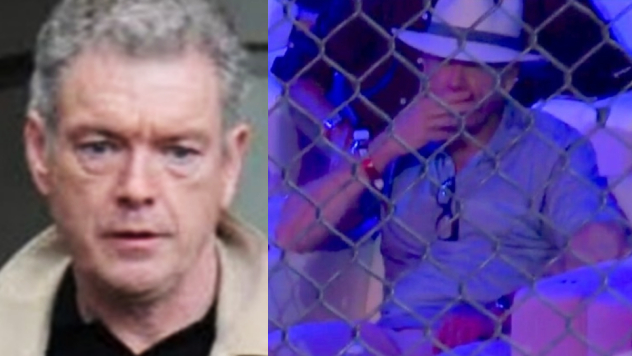
Daniel and Christy Kinahan – nicknamed “The Dapper Don” – at a Dubai sports arena last June. Source: WeCaptureYou, TrillerTV
The passport details publicly listed in the US sanctions provide an unprecedented glimpse into the timeline of the cartel leadership’s visa history, giving an overview of their initial entry and exit to the Emirates.
The records show that four of the six key gang members had entered the UAE long before the 2016 attempt on Daniel Kinahan’s life in Dublin and the ensuing deadly feud that led to the cartel’s full relocation to the UAE.
A passport number for Christopher Kinahan Jr is linked to short-term UAE visas issued as early as September 2013. A passport number listed for Daniel Kinahan, searched in combination with an alternative sanctions-listed date of birth that is not his real one, returned seven short-term UAE visas between 2013 and 2015. It is not known what name this passport was under, but Daniel Kinahan has reportedly held illegitimate passports in the past.
A short-term visa for details associated with Ian Dixon first appeared in 2015. Authorities allege that Dixon acted as a trusted lieutenant to Daniel Kinahan by helping move bulk cash across Europe, arranging payments and keeping tabs on money owed by a narco-trafficker. In June, we revealed that Dixon was the poster boy for a padel club in Dubai, where he has been captured playing the racquet sport on webcams.
Left: Ian Dixon has been sanctioned by the US Treasury as part of its action against the Kinahan cartel. Right: Dixon at a racquet sports event post-sanctions. Source: US Treasury, sanddune_padel_dxb / Instagram
The earliest visas found for details associated with Sean McGovern and Bernard Clancy were from March and April 2016 respectively, the months after the 2016 attack in Dublin.
All key members of the group, with the exception of crime boss Christy Kinahan, gained residency in the UAE using Irish passports. The cartel founder’s British passport number is linked to his immigration file; both to his latest residence permit and four previous temporary visas. Records show the first visa associated with this passport was issued in February 2007 – the earliest known instance of Christy Kinahan entering the UAE. Another was issued in November 2009, and then two more in 2017.
However, details for an Irish passport under one of Christy Kinahan’s aliases (“Christopher O’Brien”) return 31 separate records on the UAE’s visa inquiry portal between 2014 and 2017. Bellingcat confirmed this passport number was associated with the name Christopher O’Brien after discovering both in corporate documents for a now-defunct Hong Kong firm that was incorporated in February 2014. This suggests Kinahan may have been using a false passport to travel to and from the UAE in addition to traveling under his authentic document. A man was jailed in 2023 after admitting he supplied “fraudulently obtained genuine passports” to criminals, including Kinahan.
Details from sanctions against Christy Kinahan were found on publicly available corporate documents of a defunct Hong Kong firm (passport number blurred by Bellingcat). Source: US Treasury, Hong Kong Companies Registry
One short-term UAE visa issued for “Christopher O’Brien” ended on August 19, 2015. Posts on LinkedIn three days later showed Christy Kinahan – wearing black-framed glasses and named in the posts as “Christopher O’Brien” – surrounded by Iranian and Turkish businessmen in a high-rise company office in Ankara. These images, discovered by Bellingcat in posts under the name of the managing director of a now-defunct Turkish investment company, have since been deleted.
LinkedIn posts from August 2015 showing “Christopher O’Brien”, a.k.a Christy Kinahan, in an office in Turkey.
According to the Dubai government, employment-based residence visas are valid for two years and must be obtained by a company on its employee’s behalf. The employer is required to apply for a work permit through the UAE’s Ministry of Human Resources and Emiratization. The employee must pass a fitness test before their employer can apply for the residence permit.
The company names on Clancy and Kinahan Jr’s residence permits, Al Matn Goods Wholesalers and Island Star Tourism respectively, match existing firms in Dubai. However, Bellingcat was unable to confirm whether these entities are the same as the ones listed on the residence permits. It is also not known why Clancy’s residence permit only includes his first and middle names (“Bernard Patrick”) while the other cartel members’ visas used their full names.
Wanted posters for Irish drugs smugglers Daniel, Christy and Christopher Kinahan Jr, released after the cartel leaders were sanctioned in 2022. Source: US Department of the Treasury
The firm named on Christy Kinahan’s permit, OSA Management Consultancies, is listed as an aviation consultancy on a Dubai government registry. In addition to sharing an address with cartel-linked firm CV Aviation Consulting Services, UAE company data accessed on Horizons, a platform created by Washington DC-based nonprofit C4ADS that aggregates public records, shows that both firms also have the same business licence number and date of incorporation, suggesting OSA may be a newer name for the same entity.
The managing director of Island Star Tourism told Bellingcat on the phone that Christopher Kinahan Jr was working as “commission-based staff, not in-office staff”. He confirmed he recognised Christopher Kinahan Jr’s name but said he had never met him. Asked how the company name appeared on his visa, he said “I don’t know”. He said if the UAE had any problem with Christopher Kinahan Jr, it would “not give permission”.
Al Matn Goods Wholesalers and OSA Management Consultancies did not respond to questions from Bellingcat.
The UAE foreign ministry has been approached for comment.
Connor Plunkett, Peter Barth, Beau Donelly and John Mooney contributed to this article. Scroll-driven interactive by Connor Plunkett and Miguel Ramalho.
Bellingcat is a non-profit and the ability to carry out our work is dependent on the kind support of individual donors. If you would like to support our work, you can do so here. You can also subscribe to our Patreon channel here. Subscribe to our Newsletter and follow us on Bluesky here, Instagram here, Reddit here and YouTube here.
This article is the result of a collaboration with The Sunday Times. You can find their corresponding piece here.
https://www.bellingcat.com/app/uploads/2026/06/1aa_Vid_Top_dixon062026.mp4
Every Friday evening, the brochure says, players can compete to win cash prizes in one of the world’s fastest-growing racquet sports. The padel club in Dubai’s west is the picture of modern wellness culture: climate-controlled courts, a private sauna and ice bath, and one-on-one coaching. The promo
This article is the result of a collaboration with The Sunday Times. You can find their corresponding piece here.
Every Friday evening, the brochure says, players can compete to win cash prizes in one of the world’s fastest-growing racquet sports. The padel club in Dubai’s west is the picture of modern wellness culture: climate-controlled courts, a private sauna and ice bath, and one-on-one coaching. The promotional image shows a bearded man in mid-swing, eyes locked on the ball. He wears matching activewear and a golden tan. The poster boy for padel is a talented player who once finished runner-up at an international tournament. He has also spent the past decade living in the shadows.
Left: Ian Dixon has been sanctioned by the US Treasury as part of its action against the Kinahan cartel. Right: Dixon, who appears to live a carefree lifestyle in Dubai, at a racquet sports event post-sanctions. Source: US Treasury, sanddune_padel_dxb / Instagram, asiapacificpadeltour / Instagram
Support Bellingcat
Your donations directly contribute to our ability to publish groundbreaking investigations and uncover wrongdoing around the world.
Ian Thomas Dixon is a key figure in the Kinahan cartel, the Irish organised crime group that authorities say has evolved into a US$1.5 billion transnational network involved in drug trafficking, money laundering and arms smuggling. Investigators have connected the cartel to Iran’s intelligence services and the Lebanon-based militant group Hezbollah. Its feuds with rival gangs have been linked to at least 18 murders across four countries.
Dixon, 36, along with the Kinahan Organised Crime Group’s senior leadership – Christy Kinahan, 69, and his sons Daniel, 49, and Christopher Jr, 45 – was sanctioned by the US government in 2022. Authorities allege the Irishman acted as a trusted lieutenant to Daniel Kinahan, who is said to manage the cartel’s vast drug trafficking operation by helping move bulk cash across Europe, arranging payments and keeping tabs on money owed by a narco-trafficker.
Wanted posters for Irish drugs smugglers Daniel, Christy and Christopher Kinahan Jr, released after the cartel leaders were sanctioned along with four key associates in 2022. Source: US Department of the Treasury
Bellingcat and The Sunday Times can today reveal how Dixon’s racquet sport hobby has left behind a digital trail that led to the most recent footage of him since those sanctions were imposed – the first time he has been pictured publicly in almost a decade. This investigation also uncovers the alias Dixon has used in Dubai and exposes the first open source links to an underworld associate who was recently extradited from the Gulf state and jailed in Scotland.
It comes as cartel leader Daniel Kinahan awaits extradition to Ireland after his arrest in Dubai on foot of a warrant issued by Irish authorities. The arrest, in April, followed an extensive policing and diplomatic effort from international law enforcement.
Bellingcat recently published images of ex-UFC fighter Mounir Lazzez with Daniel and Christy Kinahan at a 2025 MMA event in Dubai. Our investigation also linked Lazzez to multimillion-dollar transactions for crude oil tankers that were later sanctioned by the US. Source: WeCaptureYou, C4ADS Horizons
In March, investigations by Bellingcat and The Sunday Times exposed the first photographs of Daniel Kinahan and his father in years and also revealed that the cartel’s “friend”, former UFC fighter Mounir Lazzez, was connected to US sanctions against Iran.
The latest findings give an unprecedented glimpse into the recent activity of a key cartel associate who, until now, has largely flown under the radar.
Family Ties
When cartel founder Christy Kinahan moved to Spain after his release from an Irish prison in 2001, it wasn’t long before his new home became a hub for the gang. His sons, Daniel and Christopher Jr, soon followed him to the Costa del Sol – as did their younger cousin, Dublin native Ian Dixon.
From the late 2000s onward, Dixon worked for businesses linked to the crime family in the south of Spain. One of these was The Auld Dubliner, a pub in Estepona that reportedly served as a base of operations for the cartel. In 2010, the pub was raided and temporarily closed by authorities as part of Operation Shovel, a years-long multi-national police investigation into the cartel’s drugs and arms-trafficking activities.
Left: Dixon pictured in 2011 behind the bar at The Auld Dubliner in Estepona. Right: Exterior of the pub in 2012 (image highlighted by Bellingcat). Source: Facebook, Google Street View
Dixon would also work as a trainer at MGM Marbella, the boxing gym co-founded by Daniel Kinahan that would go on to represent some of the biggest pro boxers in the world. The company, which was renamed MTK Global, shut down after the US sanctions on the Kinahans were imposed in April 2022.
Top left: Ian Dixon at MGM Marbella in 2013. Top right: Dixon running a pads training session at the gym in January 2015. Bottom: Dixon pictured with Daniel Kinahan and others in Spain in 2013. Source: X, MGM Marbella / YouTube
In 2016, Dixon was arrested by Spanish police investigating the murder of Irish criminal Gary Hutch. The previous year, Hutch had been gunned down while out for a morning jog in a gated community on the Costa del Sol.
Dixon was released without charge, and another Kinahan cartel associate was later sentenced to 22 years for his role in the murder. The killing sparked a feud between the Kinahans and the rival Irish Hutch gang that resulted in at least 18 deaths.
Dixon and other key Kinahan members fled to Dubai in the wake of the deadly feud.
CCTV footage of Gary Hutch being pursued by a gunman in southern Spain, moments before Hutch was cornered and shot dead in September 2015. Source: BBC, The Irish Sun
Ian Dixon has no known convictions. But his alleged role in the Kinahan Organised Crime Group was laid bare when the US sanctioned him. Authorities said Dixon managed finances and moved bulk currency for Daniel Kinahan and also kept tabs on the debt owed by a narco-trafficker.
The sanctions notice also said Dixon controlled Hoopoe Sports LLC, a Dubai firm that listed a number of pro boxers among its clients and reportedly received more than $4 million for bouts involving former heavyweight champion Tyson Fury. Boxing promoter Bob Arum told Yahoo Sports the money was for consulting fees owed to Daniel Kinahan.
Screenshot from a 2022 archive of US-sanctioned Hoopoe Sports’ website, showing pro boxers Jamie Conlan, Billy Joe Saunders, Hughie Fury and Michael Conlan among its clients list. Dixon’s company email address is visible on the footer. Source: arejaywoof / X, archive.org
Dixon lived in an exclusive gated community in Dubai, according to the 2022 sanctions notice. Online listings show that properties like his Spanish-inspired villa are worth up to $2.7 million.
Passion for Padel
Padel is an increasingly popular racquet sport from Mexico best described as a combination of tennis and squash. According to the sport’s governing body, it has more than 17.5 million weekly players across 150 countries and the UAE, where Dixon lives, has the second-highest number of padel courts in Asia. It was on these courts in late 2024 that Dixon played in the master final of the Asia Pacific Padel Tour (APPT).
A pre-match group photo was captured on the APPT male amateur final live stream. The photo, posted to Facebook, shows Dixon was part of the lineup. Source: APPT / YouTube, Facebook, US Treasury
APPT rankings show Dixon registered for the tournament under the name “Ian Thomas”. Like his cartel leader relative Christy Kinahan, who used his first and middle names as an alias on his Google review profile, Dixon had dropped his surname.
Finding a Fugitive – How we Located Dixon
Bellingcat found the padel club promotion showing Ian Dixon after running images of the cartel associate through a publicly available facial recognition search engine. Among the results was a link to a graphic designer’s online portfolio, which included the advertisement for the padel competition. The original photo had been posted on the sports club’s Instagram page in late 2023, with the caption: “Elevating fun, one swing at a time!” Dixon was not named.
Left: The padel tournament ad discovered via a PimEyes search for Ian Dixon. Right: The original picture and caption from the sports club’s Instagram page, posted in October 2023. Source: sanddune_padel_dxb / Instagram
We searched for additional open source evidence and located online profiles for a 36-year-old Irish padel player named “Ian Thomas” who had taken part in a number of matches in Dubai in recent years. One profile shows he played 16 ranked matches between September 2024 and April 2026 – the most recent being the week after Daniel Kinahan’s arrest. But the accounts did not include profile pictures.
Left: Screenshots from an online profile for 36-year-old Irishman “Ian Thomas” & Christy Kinahan’s Google review profile under the name “Christopher Vincent”. Right: Dixon pictured at a padel centre in an Instagram post from August 2024. Source: Rankedin.com, Google Maps, Instagram
Bellingcat searched for footage showing the padel events and venues listed on the profiles. It returned multiple social media posts and live-streams clearly showing Ian Dixon at the same events where “Ian Thomas” was registered as playing. Dixon can also be heard speaking with a Dublin accent and at one point is seen with a close relative of Daniel Kinahan.
Dixon and his doubles partner played four games over the December 13-15 weekend, eventually placing second after losing in the final. The Irish cartel associate is captured on film after the match receiving a silver medal and commemorative racquet.
Clip showing “Ian Thomas” in the final position in the APPT Dubai 2024 male amateur rankings, followed by Dixon on court during the match and receiving a racquet after his silver-medal placement. Source: asiapacificpadeltour.com, asiapacificpadeltour / Instagram
The Asia Pacific Padel Tour was held a month after senior Kinahan cartel figure Sean McGovern was arrested in Dubai on foot of an Interpol red notice. McGovern was extradited to Ireland last year and earlier this month jailed for 24 years for directing the activities of a criminal organisation in relation to murder and attempted murder.
The tournament was live-streamed to YouTube via webcams set up on two courts. Dixon was captured throughout the three-day event, both playing on the court and mingling with others in the background. The hour-long male amateur final, which Dixon lost, is viewable in its entirety.
Clips from the tournament on December 15 showing Dixon before, during and after the amateur male final. Source: APPT / YouTube
Dixon also posed for photos during the tournament, but it appears he did have some reticence about appearing on social media. In two images from a different padel event hosted at the same venue a few months later, Dixon’s face had been covered. However, a third photo was not edited, confirming that it was Ian Dixon.
Top: Dixon posed for a photo before beginning the APPT amateur male final. Bottom: Dixon’s face was covered with a grey oval and an emoji in two social media posts from a different event. One of the pictures was not censored in another post. Source: APPT / Facebook, isdpadel / Instagram, ISD Dubai Sports City / LinkedIn
Kingpin in the Crowd
Among the people Dixon was seen with at padel events in Dubai was Stephen Jamieson, a Scottish criminal who was recently jailed for his role in a multimillion-dollar drug trafficking operation.
Dixon (left) and Jamieson (right) seen arriving and meeting on a live stream of a Dubai racquet sport event in December 2024. Jamieson was arrested by authorities in the Gulf state the following July. Source: Police Scotland, The Scottish Sun, asiapacificpadeltour / Instagram, APPT / YouTube
Dixon greeted Jamieson with a fist pump during the Dubai APPT tournament in December 2024 on the day the Irishman played in the amateur final.
Left: Jamieson watching padel games on days one and three of the APPT in 2024, when Dixon was also in attendance. Right: Police mugshot of Jamieson. Source: asiapacificpadeltour / Instagram, Police Scotland
Dixon was also pictured with Jamieson at a family day padel event just weeks before the Scottish criminal’s arrest. (Bellingcat is not publishing details of that event to protect the identity of family members.)
Clips from day three of the tournament showing Dixon meeting Jamieson. Both men arrived and left separately at different times. Source: APPT / YouTube, BBC, The Scottish Sun
Jamieson, who has multiple convictions, was extradited from Dubai last year and is serving a six-year prison sentence in Scotland on organised crime and drug charges. The case against him was built around intercepted messages he had sent via the defunct encrypted communication network EncroChat – a network the Kinahans have also used – to direct drug shipments.
The Sunday Times reports today on the Kinahan cartel’s deeply entrenched links to organised crime in the UK, where it is known to control much of the illicit drug market. It said the footage showing that Dixon and Jamieson know each other could indicate an underworld connection, since cartel cadres do not associate with rival operations.
Dixon is among the remaining cartel figures at large in Dubai, along with Christy Kinahan, Christopher Jr and gang lieutenant Bernard Clancy. Source: US Treasury
Three of the seven alleged key Kinahan cartel figures have been arrested since the US sanctions were imposed. Johnny Morrissey, arrested in Spain in 2022, was later bailed and subject to a travel ban. Sean McGovern was jailed earlier this month and Daniel Kinahan awaits extradition to Ireland after his recent arrest in Dubai. Garda Commissioner Justin Kelly, of Ireland’s police force, recently said the investigation into the Kinahan cartel was ongoing and that authorities were continuing to focus on the other members of the gang.
Ian Dixon did not respond to questions from Bellingcat.
Connor Plunkett, Peter Barth, Beau Donelly and John Mooney contributed to this article.
Bellingcat is a non-profit and the ability to carry out our work is dependent on the kind support of individual donors. If you would like to support our work, you can do so here. You can also subscribe to our Patreon channel here. Subscribe to our Newsletter and follow us on Bluesky here, Instagram here, Reddit here and YouTube here.
Support Bellingcat
Your donations directly contribute to our ability to publish groundbreaking investigations and uncover wrongdoing around the world.
On February 15, 2026, the bulk carrier, Grumant (IMO: 9385879) was pictured at the occupied Ukrainian Port of Feodosia on the Crimean peninsula. Satellite imagery suggests it had already been there for several days. It appeared to stock up on grain before departing on a two-month-long journey eventually docking at the Port of Benghazi in Libya on April 18.
While there have been previous reports of grain shipments from occupied Ukraine arriving in Libya, this is only the second time a Russian
On February 15, 2026, the bulk carrier, Grumant (IMO: 9385879) was pictured at the occupied Ukrainian Port of Feodosia on the Crimean peninsula. Satellite imagery suggests it had already been there for several days. It appeared to stock up on grain before departing on a two-month-long journey eventually docking at the Port of Benghazi in Libya on April 18.
While there have been previous reports of grain shipments from occupied Ukraine arriving in Libya, this is only the second time a Russian ship has been observed delivering what the Ukrainian government describes as “stolen” grain to the country. The previous case involved the Damas Wave which travelled in January of last year to the port of Misrata which is under the control of the UN-recognised Government of National Unity (GNU). In addition to satellite imagery, Bellingcat deployed a new technique that analysed Grumant’s heading data which was contained in AIS information provided by Lloyd’s List Intelligence, to help confirm Grumant’s presence in Feodosia.
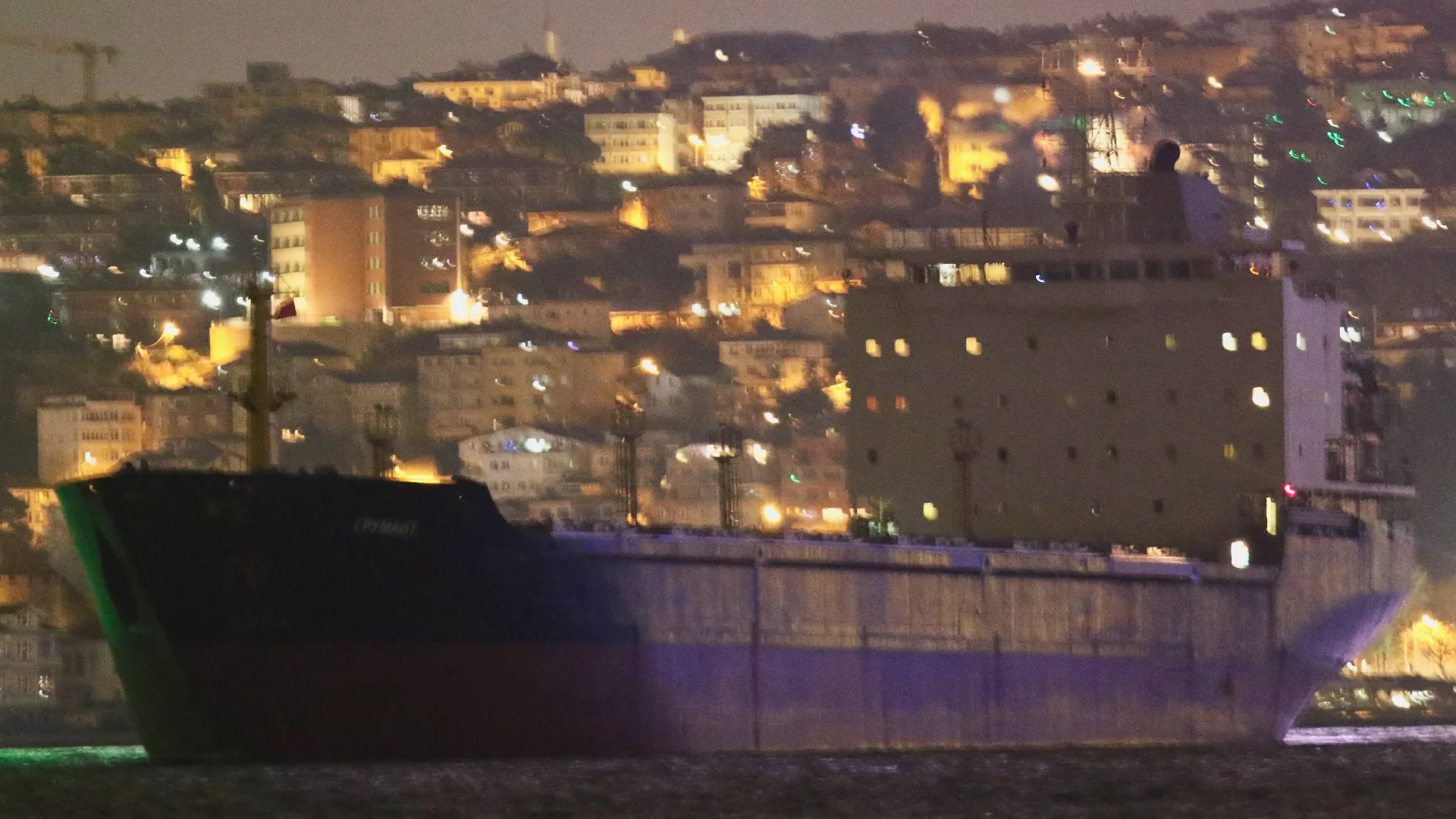
Grumant transits the Bosphorus Strait in the middle of the night.
Credit: Yörük Işık.
Black Sea
Grumant enters a region of the Black Sea known for GNSS interference, meaning that Grumant’s publicly reported Automated Identification System (AIS) position is unreliable.
Port of Feodosia
On February 15, a high resolution satellite image confirms the ship is docked at the port of Feodosia at berth No. 1 that is used for bulk and metal cargo. Matching features visible include Grumant’s grey decking, its seven hatches and bright yellow front mast. What appears to be leftover grain can be seen under the two port crates, immediately next to the ship.
Grumant exits the area of signal interference, meaning that its reported position on ship tracking services is now reliable again. Its AIS messages indicate it is travelling towards the Bosphorus.
Bosphorus Strait
Grumant transits the Bosphorus Strait towards the Sea of Marmara. Judging by the draft, with no visible red paint on its hull, the ship appears to be fully laden.
Credit: Yörük Işık.
Izmir Anchorage
Grumant arrives in Izmir, Turkey on February 23 and anchors off the coast until March 13.
Over the course of three weeks, Grumant never enters the Port of Izmir. It is not known if it was denied entry. Bellingcat asked the port operators but did not receive a response before publication.
Grumant then loiters off the coast of Aliağa, about 50 km from Izmir. It stays here until March 16, never entering the port. It again is not known if it was denied entry. Bellingcat asked the port operators but did not receive a response before publication.
Near Benghazi
Grumant arrives in Libyan waters and stays off the coast of Benghazi until April 1.
Libyan Waters
Grumant briefly leaves the coast of Benghazi, but returns a few days later.
Benghazi
Grumant leaves the anchorage on April 18 and docks at the port of Benghazi where it unloads the grain. The ship was captured in a Vantor satellite image on April 20.
It leaves port on April 23, and heads back towards the Bosphorus.
According to the Ukrainian activism, journalism and hacker group, Kiborg News, Grumant used deceptive shipping practices to deliver grain to Latakia, Syria in 2024. The report included several of Grumant’s shipping manifests, which showed it had repeatedly exported grain from Occupied Crimea to Syria.
Heading Data Helps Locate Grumant
It is standard maritime practice that ships broadcast Automatic Identification System (AIS) messages which include a ship’s position, heading, and draught (among other information).
Between February 7 and February 19, 2026, data from Lloyd’s List Intelligence shows the Grumant transmitted 29 AIS messages, with unreliable positions in the vicinity of Feodosia. We know these positions are unreliable as they are erratic and some of them report the ship as being positioned on land.
Unreliable AIS positions – Grumant’s reported positions between February 7-19, 2026, via Lloyd’s List Seasearcher.
However, according to the IMO, the heading data transmitted by a ship’s AIS system must come from an onboard compass. A compass is unaffected by GNSS interference, meaning it is a more reliable source of information in these conditions.
Over the same dates, all 29 AIS messages reported the ship’s heading as 267 degrees or 268 degrees. The Port of Feodosia has a heading of 267.5 degrees. The close agreement between the ship’s heading and port heading strongly suggests that Grumant was moored at the port between February 7 and February 19, 2026.
We conducted an extra check of the heading data by reviewing satellite imagery available of berth 1 at Feodosia Port, which suggests that the same vessel was present on several days between February 6 and February 18. Imagery on Feb. 6 shows the port was empty in the morning and occupied in the afternoon. Grumant exited the area of GNSS interference on February 21, and berth 1 at the port was captured on satellite image on February 22 and appeared empty. The low resolution satellite imagery is only used as an additional check to see if a vessel is at the berth.
Timeline of open source observations related to Grumant’s presence (tick) or absence (cross) at Feodosia port. Empty entries indicate a lack of available data.
Sentinel-1 timelapse of Feodosia Port, Copernicus Sentinel data 2026. Annotations by Bellingcat.
PlanetScope timelapse of Feodosia Port, Planet Labs PBC. Annotations by Bellingcat.
Bellingcat checked all vessels transmitting AIS in the vicinity of Feodosia Port and found that Grumant was the only one that consistently transmitted a heading matching the Port of Feodosia over the period of interest.
We shared our research with Charlie Brown, a former US Naval Officer and Senior Advisor at United Against Nuclear Iran where he focuses on maritime sanctions enforcement and the tracking of illicit shipping. Brown told Bellingcat that while satellite imagery of vessels remained key for identification, when looking for reliable data in a spoofing environment it made sense to look at the various elements of AIS data to try and find some accurate information, despite GNSS spoofing.
“It’s quite standard for the independent gyro compass to be providing the heading […] I think the majority would not [be subject to spoofing] so it’s a good methodology to parse out the particular data and then make some inferences from that.”
“It’s neat to think of what can be derived from data that would otherwise be dirty or wrong. So there’s still some elements of use in there.”
He added that in theory there are probably some compasses that are subject to spoofing as well.
He told Bellingcat that it was fair to say the heading data of the Grumant supported identification, but stressed the need to cross-reference with other data sources.
While in this instance it has been possible to use AIS data to help verify the location of Grumant, it is relatively unusual to have access to this information.
This activity, known as “dark port calls”, is a common tactic for those engaging in illicit or sanctioned trades.
Grumant does not transmit AIS messages from February 8 to 11, but this is the longest gap in data (see diagram above), with intermittent messages coming through after that point.
It is unclear why Grumant continued to transmit AIS during the period it was loading in Feodosia.
A review of Lloyd’s List Intelligence data from January 2025 shows that on a previous voyage to the Black Sea the Grumant operated “dark” for 59 days.
Visual Identification
On February 15, 2026, high resolution imagery showed Grumant docked in the Port of Feodosia. We compared it with other recent images of Grumant to confirm the match.
The ship in the satellite image has a grey-coloured deck, which is uncommon enough for it to stand out. Many bulk carriers have cranes (including the ships we previously covered such as Krasnodar, Zafar and Zaid), Grumant does not have any. It also has seven hatches (openings for the grain) and a bright yellow front mast that matches the mast of Grumant (see the image of it transiting the Bosphorus). We can match the Grumant in the Feodosia image, not only to pictures of the Grumant shot from the ground, but also to the satellite image from Benghazi.
The length and breadth of the ship also matches that of the Grumant; 180 metres by 22.90 metres.
Libya has complicated internal dynamics with essentially two administrations in charge of different parts of the country – the Government of National Unity (GNU) in the west and the Libyan National Army (LNA) in the east.
In recent years, Russia has backed the LNA’s General Khalifa Haftar, based out of Benghazi, in the east of the country. But Jalel Harchaoui, a political scientist specialising in Libya with the Royal United Services Institute (RUSI), stressed that the two sides of this conflict, the LNA and the UN-recognised GNU, are not currently fighting. Instead they are in a flawed, multi-year truce.
Therefore, the east-west divide isn’t as clear-cut as during the civil war. While all shipments going to Benghazi and Tobruk are overseen by the LNA, not all shipments going to the city of Misrata (which is run by the GNU) are meant for the GNU-dominated part of the country.
Harchaoui told Bellingcat: “the Tripoli government is in some regards pro-Ukraine, but if there’s business that can be done with Russia through the very opaque port of Misrata and all the right people get paid, the business is going to take place.”
That observation is potentially significant given at least one previously tracked vessel that went from occupied Ukraine to Libya docked in Misrata.
This was not the case of the Grumant, however, which arrived in an LNA-controlled part of the country. It is not known from open sources alone if the authorities in Libya or at the port in Benghazi knew the grain carried by Grumant had come from occupied Ukraine.
Bellingcat contacted the Benghazi-based LNA government and representatives of the Tripoli-based GNU government via the Libyan Embassy in The Netherlands. We also contacted the Port of Benghazi, Port of Imzir in Turkey as well as the Ukrainian and Russian authorities. Representatives of the LNA did not respond to requests for comment before publication, nor did the Port of Benghazi or Port of Izmir. The Libyan Embassy in The Netherlands replied to Bellingcat after publication, stating that Benghazi and eastern Libya are not under the authority or administrative control of the Government of National Unity and therefore they are not currently in a position to comment on Bellingcat’s findings.
Ukraine Continues to Pursue the “Shadow Grain Fleet”
“The port of Feodosia, located in the temporarily occupied Autonomous Republic of Crimea, is not under Ukrainian control, and any commercial activity conducted there is illegal,” the Ministry for Development of Communities and Territories of Ukraine and the Ministry of Foreign Affairs of Ukraine told Bellingcat in a joint response.
They told us the loading of grain exported from the temporarily occupied territories is an illegal act and Russia was using ports as logistics centers to export stolen Ukrainian agricultural products.
“The expansion of such routes to third countries, in particular to North Africa, demonstrates Russia’s ongoing efforts to circumvent international sanctions and monetize resources stolen from the occupied Ukrainian territories.”
The Ukrainian Ministry of Foreign Affairs sent information about Grumant’s (IMO: 9385879) “illegal activities” to the diplomatic missions in Great Britain, the Republic of Turkey and the Republic of Tunisia over the course of March to May this year, the ministries told Bellingcat.
Ukraine is continuing to pursue legal action against Russia’s “shadow grain fleet” they told us. For instance, earlier this month a Swedish court approved the transfer of the Russian “shadow grain fleet” vessel CAFFA to Ukraine for investigation after it was arrested in Swedish waters.
This case has set a new precedent, going beyond sanction and fines previously handed out to such vessels, and allowing for the detention and confiscation of a shadow fleet vessel in European jurisdictions, the ministries said.
Bellingcat attempted to contact Decision/Reshenie to ask about Grumant’s grain shipment from Feodisia Port to Benghazi Port, but they had not responded at time of publication.
Cover image: Planet Lab image shows Grumant anchored off Izmir, Turkey on February 27. Credit: Planet Labs PBC.
Bellingcat is a non-profit and the ability to carry out our work is dependent on the kind support of individual donors. If you would like to support our work, you can do so here. You can also subscribe to our Patreon channel here. Subscribe to our Newsletter and follow us on Bluesky here, Instagram here, Reddit here and YouTube here.
“In the age of misinformation, the line between fact and fiction is blurrier than ever.”
“For those of us working in video news, verification isn’t a nice-to-have. It’s a necessity. It is how we protect the stories we help shape and how we earn and maintain trust in an increasingly chaotic information ecosystem,” Abu Dhabi-registered video news agency Viory posted on LinkedIn on April 9, 2026, offering training to help newsrooms and journalists sort fact from fiction.
The self-described “
“In the age of misinformation, the line between fact and fiction is blurrier than ever.”
“For those of us working in video news, verification isn’t a nice-to-have. It’s a necessity. It is how we protect the stories we help shape and how we earn and maintain trust in an increasingly chaotic information ecosystem,” Abu Dhabi-registered video news agency Viory posted on LinkedIn on April 9, 2026, offering training to help newsrooms and journalists sort fact from fiction.
The self-described “video news agency of the Global South” has delivered journalism training to multiple national press agencies across Africa, Asia and the Middle East.
However, when it comes to Viory itself, the line between fact and fiction is very blurry indeed.
Bellingcat has found multiple links between the digital infrastructure of Viory and Ruptly news agency, a branch of sanctioned Russian propaganda outlet Russia Today, including shared IP addresses, a Viory-linked site using a digital security certificate registered to Ruptly, and Ruptly sending site performance data to Viory. While there have been previousreports on suspected links between the two outlets, our investigation adds new evidence about Viory’s ties to Ruptly media.
When contacted for comment, both Viory and Ruptly denied any connection with each other.
Composite Image created by Bellingcat.
‘Video News Agency of the Global South’
Viory’s main offering is raw video footage of news events provided via subscription. According to Viory, its clients include “major international news outlets, local media organisations, and independent creatives in more than 170 countries”.
If its own figures are to be believed, Viory was strikingly well established at its launch in November 2023, by which time it claimed to have a “pre-assembled team of over 150 full-time staff, and an established network of over 3,000 video journalists across the world”.
The name “Viory” is a trade name. The company’s legal name is Darpo Vision FZ LLC, according to its website, which also states that it is registered in Abu Dhabi. In August 2024, Darpo Vision FZ LLC filed for a trademark in the US for the name Viory, which was approved in December of 2025.
As of May 2026, Bellingcat found press releases and news reports referencing at least 30 agreements between Viory and partners in more than 22 countries, as well as cooperation agreements with government agencies, training agreements with universities and regional journalism bodies.
Ruptly is a video news agency formerly based in Berlin and ultimately controlled by Russia Today (RT), which is owned by Russian state media company ANO TV-Novosti. ANO TV-Novosti has been on the EU sanctions list since December 2022 for spreading “pro-Kremlin propaganda and disinformation” and supporting Russia’s war against Ukraine.
RT launched Ruptly, which operated in Berlin via a German-registered subsidiary in 2013, with the goal of “becom[ing] the go-to alternative resource in a highly concentrated market of professional news video footage, and to deliver coverage of stories that other agencies miss.”
Sanctions imposed on RT following Russia’s 2022 invasion of Ukraine choked off Ruptly’s source of funds in Germany, leading the German company to begin insolvency proceedings in October 2024. Ruptly continues to operate from Moscow as of 2026.
As with Viory, Ruptly’s main offering is providing raw news footage to subscribers around the world. It relies on a large network of international freelancers and stringers. In 2016 RT claimed that Ruptly had “surpassed” newswire services AFP and Reuters on YouTube, and was serving more than 600 media organisations in 45 countries.
Felix Huesmann of the German outlet RedaktionsNetzwerk Deutschland (RND),was the first to outline links between Ruptly and Viory while covering the insolvency proceedings of Ruptly. He found that Darpo Vision’s original details on the Abu Dhabi Creative Media Authority’s site included an email address d.toktosunova@gmail.com. It has not been confirmed who this email address belongs to; however, the username matches the first name initial and surname of Dinara Toktosunova, the managing director of Ruptly. When asked about this email address by Huesmann in 2024, Ruptly “explained that Toktosunova is focused on securing the future of the Ruptly team [in Moscow] and is not working anywhere else as a managing director.”The activist group, OSINT For Ukraine, also outlined links between Ruptly and Viory, including the movement of multiple key staff between the two organisations and strong similarities between the two organisations’ platforms and content.
Darpo Vision’s Security Certificate
The legal entity behind Viory, Darpo Vision, was set up in one of Abu Dhabi’s free zones – special economic areas that have business-friendly incentives such as tax exemptions and that allow 100 percent foreign ownership. The free zones also offer what some describe as high levels of “corporate privacy,” which others assert has created a haven for shell companies and opaque corporate structures.
Darpo Vision initially had its own web domain, darpo.vision. The site has since been removed. Whois records show that the domain was registered by Darpo Vision FZ LLC in December 2022 to a PO Box in Abu Dhabi, using a Russian domain name registrar and a Moscow phone number.
Initially, Darpo.vision had its own Secure Sockets Layer (SSL) certificate – a digital certificate that authenticates a website’s identity, allowing it to secure and encrypt data. However, VirusTotal data shows that as of at least June 2024, darpo.vision was using a wildcard SSL certificate registered to ruptly.video. A Wildcard SSL certificate is a single certificate with a wildcard character (*) in the domain name field. This allows the certificate to secure a single domain and multiple subdomains. You can see historical SSL certificates for darpo.vision.
James Wilson, a software and networking engineer with 20 years of experience and currently Enterprise Technology editor at Risky Business Media, told Bellingcat that to prevent unauthorised use or forgery of SSL certificates, a private key is needed to create and use a wildcard certificate across multiple domains.
“The fact that darpo.vision was using a wildcard SSL certificate for ruptly.video indicates that whoever was running darpo.vision also had access to the private key for ruptly.video’s SSL certificate. Normally, only the people operating Ruptly’s web hosting infrastructure would be likely to have access to that,” Wilson explained.
When asked by Bellingcat about whether there were alternative possible explanations, Wilson suggested that it was theoretically possible that someone may have hacked Ruptly and stolen their private SSL key.
“However, using that wildcard SSL certificate on a domain that didn’t match the wildcard in the certificate defies explanation as the browser would alert the user to the certificate error,” he added.
Shared IP Addresses
Bellingcat also identified multiple shared IP addresses which appeared to be concurrently in use by both Ruptly and Viory between May 2025 and May 2026.
From 2025 onwards, the Russian IP address 158.160.132.25 has been used concurrently by viory.video, ruptly.video, ruptly.agency and ruptly.tv, according to VirusTotal. Similarly, since the beginning of 2026, IP address 84.252.135.88 has been used concurrently by viory.video, viory.team, ruptly.video, ruptly.agency and ruptly.tv, according to VirusTotal.
VirusTotal data shows that from 2025 onwards, IP address 158.160.166.22 has been used by ruptly.video and viory.video while from 2026 onwards, IP address 158.160.226.68 has been used by viory.video and ruptly.tv. The VirusTotal data appearsto show these IP addresses being used exclusively by Ruptly and Viory as of 2025 and 2026. However, VirusTotal does not necessarily capture all domains which resolve to an IP, and other domains may also have resolved to these IP addresses, which were not observed by VirusTotal’s passive DNS replication service. It is also important to note that in some cases, unrelated domains use the same IP addresses.
Ruptly Sends Site Performance Data to Viory
Viory’s and Ruptly’s site infrastructure was also linked through data sent via Sentry, an internal error tracking and performance monitoring platform.
An API scan of Ruptly’s main client login page, ruptly.agency, on March 26, 2026, shows that the page was sending data to a subdomain of viory.team. This domain appears to be used by Viory primarily for backend purposes, based on subdomains which appear to refer to common developer and site management tools such as Traefik and ArgoCD, in addition to Sentry.io. Notably, two subdomains also appear to refer to Ruptly.
The purpose of one domain sending data to another domain’s Sentry project is generally to consolidate all of the relevant performance and error data in one place for in-house developers to monitor.
The ruptly.agency page’s request to viory.team also includes an authentication key for Viory’s Sentry project. Ruptly.agency is not the only Ruptly domain sending Sentry data to viory.team. As of May 9, 2026 the login page for ruptly.video’s own Sentry project, sentry.ops.ruptly.video, automatically redirects to sentry.ops.ruptly.video/auth/login/viory/. Ruptly Video’s Sentry login page also features “Viory” as the title.
The ruptly.video Sentry login page is also sending data to the viory.team Sentry project, the ruptly.agency homepage and using a favicon hosted on viory.team.
A third Ruptly domain, ruptly.tv, also sends performance data to viory.team’s Sentry project via cms.dev.ruptly.tv.
James Wilson noted that in each case, the Ruptly domains sending data to Viory appeared to be using a different Sentry key.
“If you look at each of these snippets sending telemetry data [from the Ruptly domains], the specific Sentry keys for sentry.ops.viory.team are different for each. I presume that someone with access to Viory’s Sentry keys has generated and included fresh Sentry keys in each of these instances in order to differentiate between the telemetry from this site versus others using the same Sentry instance,” Wilson said.
“This cuts against the idea that this is, for example, a case of someone just lazily copy-pasting code on Ruptly’s domains. It suggests that each of these snippets was likely to have been deliberately included. The alternative explanation of changing these API keys to some arbitrary value seems much less plausible given the lack of diligence in ensuring other aspects of the content didn’t cross-reference the domains.”
‘Ruptly’ Page Title on Viory Test Page
Finally, Bellingcat found a page at frontend.dev.viory.video/en that appears likely to be a developer test page for the front page of Viory’s main domain viory.video.
Notably, however, the page title reads “Stream trending news | Ruptly.” The page description included in the source code also refers to Ruptly:
“Follow breaking world news in real-time and stream the latest developments in politics, sports, finance, science, tech, and more from one of the top online news sites. Download and share international news today with award-winning news agency Ruptl” [sic].
Screenshot of frontend.dev.viory.video/en page, captured May 10th 2026. Archived source.
Wilson said that the use of the Ruply page title and text on the Viory test page “looks like a case of lazy copy and pasting”.
“That could potentially be done by someone outside of Ruptly, although it would be strange.”
While this particular piece lies on the lower end of the spectrum of proof, Wilson said that together with the other stronger pieces of evidence, including multiple Ruptly domains appearing to send data to Viory using different API keys, and Ruptly’s wildcard SSL certificate on Darpo Vision’s site, the weight of evidence for a connection between Ruptly and Viory adds up.
“None of the pieces of evidence are watertight on their own, but when you add them together it’s difficult to think of other plausible explanations for all of them being true at the same time,” he added.
“None of the pieces of evidence are watertight on their own, but when you add them together it’s difficult to think of other plausible explanations for all of them being true at the same time,”
-James Wilson
Bellingcat also found that Ruptly appears to have connections to a company in Hong Kong. Company records from July 2022 indicate that this company was originally named Ruptly Limited, but in September of that year, the company’s name was changed to Lotus Production Limited.
The Hong Kong company remains registered as active and filed annual reports in September 2025.
Russian Slant in the ‘Global South’
Anna Hiller, a Bangkok-based Consultant Research Analyst for the Institute for Strategic Dialogue told Bellingcat that the resources provided by Viory can be an attractive pool of source material for smaller media outlets, governments and academic institutions with small budgets.
She told Bellingcat that Viory’s editorial choices are clear when looking at the site’s videos.
“When accessing Viory, the prominence of pro-Russian and pro-China content is immediately noticeable, including numerous articles focused on Vladimir Putin, Russia-China cooperation, and broader China-related narratives.”
Bellingcat contacted Viory, Darpo Vision and Lotus Production Limited to ask about the connections we found between the Viory website and Ruptly and between Lotus Production Limited and Ruptly.
Viory said that it had no connection with Ruptly. “Viory has no connection with Ruptly; any suggestion otherwise based on ordinary use of similar digital platforms, tools or cloud providers is poorly founded and inaccurate; Viory is a UAE-based, privately held, self-funded and 100% privately owned organisation, and receives no funding, direction or instructions from any state media,” the company said in an email response.
Ruptly also said it was not connected to Viory. It declined to respond to Bellingcat’s questions, including about specific findings such as Ruptly’s domains sending technical performance and error data to Viory, calling these questions “irrelevant”.
Bellingcat is a non-profit and the ability to carry out our work is dependent on the kind support of individual donors. If you would like to support our work, you can do so here. You can also subscribe to our Newsletter and follow us on Bluesky here, Instagram here, Reddit here and YouTube here.
Almost 800 Hungarian government email addresses and associated passwords are circulating online, revealing basic vulnerabilities in the security protocols of ministries involved in classified and sensitive work.
A Bellingcat analysis of breach data shows that 12 out of the government’s 13 ministries have been affected, which in some cases have exposed the confidential information of military personnel and civil servants posted abroad.
Among those affected were a senior military officer re
Almost 800 Hungarian government email addresses and associated passwords are circulating online, revealing basic vulnerabilities in the security protocols of ministries involved in classified and sensitive work.
A Bellingcat analysis of breach data shows that 12 out of the government’s 13 ministries have been affected, which in some cases have exposed the confidential information of military personnel and civil servants posted abroad.
Among those affected were a senior military officer responsible for information security, a counter terrorism coordinator in the foreign affairs department, and an employee whose role was to identify hybrid threats against the country.
The revelations come as Hungarians head to the polls this Sunday to decide if Viktor Orbán, leader of the right-wing populist party Fidesz and the country’s longest-serving prime minister, will be elected to a fifth consecutive term.
This is not the first time that deficiencies in the Hungarian government’s IT security have been revealed. In 2022, ahead of Hungary’s last election, Direkt36 reported that Russia’s intelligence services had gained access to the computer network of the Hungarian foreign ministry, including its internal communications channels.
It said Russian cyber attacks against the Hungarian government had been occurring for at least a decade and extended to the foreign ministry’s encrypted network for transmitting classified data and confidential diplomatic documents.
At the time, the foreign ministry denied it had been hacked. But in 2024, news outlet 444 published a letter that had been sent from Hungary’s National Security Service to the foreign ministry six months before the cyberattack was first reported. The letter linked the attacks to Russia and described more than 4,000 workstations and 930 servers as “unreliable”.
As part of this new analysis, Bellingcat identified a total of 795 unique email and password combinations among thousands of search results for Hungarian government domains in breach databases. Key departments that handle the country’s governance, defence, foreign affairs and finances were the worst affected.
The analysis does not include central government agencies that operate under the government’s official ministries and use separate domains, such as the tax and customs administration or the police – meaning breaches affecting government employees could be even more widespread.
The findings are not evidence of high-tech infiltration of Hungarian government systems. Instead, our analysis indicates that the breaches are more likely the result of poor digital hygiene. In many cases, staff used simple passwords along with their government email addresses for what appear to be non-work-related matters, such as signing up to dating, music, sport and food websites.
Some government workers used easy-to-guess passwords such as variations of the word “Password” or the number sequence “1234567”. One employee whose credentials were exposed in the 2012 LinkedIn hack used the password “linkedinlinkedin”. Another, in the defence ministry, used their surname. One leaked password from an employee in the foreign affairs ministry was “embassy13hungary”.
Multiple breaches also contained phone numbers, addresses, dates of birth, usernames and IP addresses – data that, when exposed, could pose security risks.
Additionally, a search of breach databases showed instances where computers have been infected with malware designed to steal login credentials. These records show that 97 machines across Hungarian government departments had been compromised, with stealer logs from as recently as last month found in the data.
Bellingcat contacted the Hungarian government’s spokesperson and the Prime Minister’s office, but did not receive a response.
The Weakest Link: Searching Breach Data
Breach databases are large collections of credentials harvested from previous cyber incidents. These databases can be searched by domain to identify email addresses belonging to a specific organisation, company or government.
Darkside allows users to search a repository of breach data from the clear and dark web.
Bellingcat used Darkside, a paid service by District 4 Labs, to search the main email domains assigned to each of the Hungarian government’s 13 ministries.
In total, 795 breaches containing government emails and associated passwords were identified. But most – 641 breaches – were linked to just four central institutions.
In the examples detailed below, staff have been anonymised. However, Bellingcat has confirmed these accounts are genuine by cross-checking the employees named in the breaches against media reports and online profiles, such as LinkedIn.
Ministry of Interior – this “super-ministry” oversees everything from health and education to the police, immigration, disaster management and local government
Bellingcat identified 170 sets of emails and passwords linked to the domain used by the ministry in charge of domestic affairs. Passwords used by staff in this department included “Arsenal” and “Paprika”. Some used passwords that contained only three or four letters. We traced these accounts to professional profiles and government web pages listing both junior and senior staff.
One senior official in the prison service used the password “adolf”. After it appeared in breach databases the password was changed twice – first to a five-digit number and then to what appeared to be the name for a pet dog. The passwords were subsequently breached again. Bellingcat identified this employee through several instances of their name and email address being listed on public-facing documentation, including a press release celebrating an award for outstanding professional work.
Ministry of Defence – responsible for national defence policy and directing the country’s defence forces
The credentials of staff working for the Ministry of Defence were found in 120 compromised records. This includes a 2023 breach of NATO’s eLearning services which resulted in 42 records containing emails, passwords and phone numbers becoming public.
The breaches peaked in 2021 but continued up to 2026. Included in the data were stealer logs, indicating that machines within the department may have been infected.
Military personnel from junior ranks to command positions were identified. A Brigadier General used a common six letter nickname, based on his own, to sign up to a film festival. A Colonel specialising in “information security” took inspiration from an English football manager for his password: “FrankLampard”. A district director used the password “123456aA”, while a high-ranking member of Hungary’s delegation to NATO used a password that translates in English to “cute”.
Ministry of Foreign Affairs and Trade – responsible for international relations, Hungarian embassies and consulates operate under the direction of the department
The credentials of current and former foreign affairs personnel have been exposed in dozens of data breaches from 2011 to February 2026. In total, there were 107 email and password combinations linked to this government ministry.
Among the staff affected was a deputy head of mission, consuls, diplomats and communications personnel posted in Europe, the Americas and the Middle East. These include a counter terrorism coordinator, an EU spokesperson, and an individual whose role was to identify hybrid threats to Hungary.
Although the breaches peaked in 2020, with emails being found in 42 separate breaches indexed by Darkside, MFA emails have been circulated, often with passwords, in 36 separate breaches since the beginning of 2024. The most recent breaches were in 2026.
Simple passwords appear to have left Hungary’s foreign affairs ministry vulnerable. In some cases, employees used a password that consisted of their own name and a two digit number. Others appeared to take inspiration from pop culture: “porsche911”, “frogger” and “Batman2013” are examples of real passwords used by staff.
Ministry of National Economy – oversees economic policy and financial strategy, including budget preparation and reducing national debt
Bellingcat’s analysis shows that staff in the Ministry for National Economy suffered 99 breaches. The Ministry of Finance, which was merged into this department in 2025, had suffered 145 breaches.
Among the breached data were the credentials of a deputy state secretary, who used the password “snoopy”. Other staff members used their date of birth or the word “Jelszo” – the Hungarian word for password.
A senior advisor who currently works in the ministry had their credentials breached four times using four different passwords, including “Kurvaanyad1” (roughly translated to “your mother is a wh**e”).
Cybersecurity Not Taken Seriously
Szabolcs Dull, a political analyst and the former editor-in-chief of the independent Hungarian news websites Index and Telex, said the government had failed to prioritise data security.
“It’s clear from the data breaches that have come to light that government agencies did not take data security seriously,” he said.
“This suspicion arose even when Russian hackers breached the foreign ministry’s IT system. That is why I believe Hungarian politicians and the public will interpret this new information as a continuation and confirmation of the Russian hacking story.”
Dull added that he was not aware of any investigation having been launched following the 2022 revelations of the Russian hack.
Kata Kincső Bárdos, a cybersecurity expert in Hungary, said it was difficult to understand why stricter controls would not be consistently enforced in government environments handling sensitive data.
She said governments should not only apply baseline rules for passwords – such as that staff use long, unique passwords and multi-factor authentication (MFA) – but also continuously monitor for compromised credentials and suspicious access patterns.
“Without MFA, systems become significantly more vulnerable to common attack methods such as phishing and credential stuffing,” she said. “A single compromised password can provide immediate access to internal systems.”
Bárdos added that unauthorised access to government systems should automatically trigger incident response procedures, investigation and containment measures.
“It is also important to note that targeting lower-level employees is a well-documented and common tactic,” she said. “Attackers frequently gain initial access through phishing or weak credentials and then move laterally within systems.”
Bellingcat’s Ross Higgins and investigative journalist Eva Vajda contributed to this article.
Bellingcat is a non-profit and the ability to carry out our work is dependent on the kind support of individual donors. If you would like to support our work, you can do so here. You can also subscribe to our Patreon channel here. Subscribe to our Newsletter and follow us on Bluesky here, Instagram here, Reddit here and YouTube here.
The Netherlands’ largest newspaper, De Telegraaf, recently published an interview with a woman claiming to organise her own evacuation flights from Dubai, selling seats at €1,600 (US$ 1850) each. Four days later, her photo was removed from the article, though the interview remained.
Bellingcat has found that the original image not only includes artefacts commonly associated with generative AI, but that the flights referenced in the article do not appear to exist.
Subscribe to the Bellingc
The Netherlands’ largest newspaper, De Telegraaf, recently published an interview with a woman claiming to organise her own evacuation flights from Dubai, selling seats at €1,600 (US$ 1850) each. Four days later, her photo was removed from the article, though the interview remained.
Bellingcat has found that the original image not only includes artefacts commonly associated with generative AI, but that the flights referenced in the article do not appear to exist.
Subscribe to the Bellingcat newsletter
Subscribe to our newsletter for first access to our published content and events that our staff and contributors are involved with, including interviews and training workshops.
Published on De Telegraaf’s website on March 5, the headline reads: “Dutch people in the Middle East feel abandoned by the government: We just rented a plane ourselves.”
The Dutch minister of foreign affairs was confronted with this headline during a television interview, in which he described ongoing efforts by the Dutch government to repatriate citizens to the Netherlands.
The article features interviews with several Dutch people struggling to leave Dubai and Abu Dhabi, including Tamara Harema. Under the subheading “Dutch people hire their own plane”, Harema says she was “rebooked five times by Emirates” and that the official repatriation flights organised by the Dutch government were not ‘taking off’.
As part of a group, she says, they are organising buses and have hired an Airbus A321 to fly home. Harema is quoted as saying: “The first plane is already full, so we’re organising a second flight. Stranded travellers can contact us.”
However, several discrepancies in Harema’s photo, published in the original article, suggest it was AI-generated. No trace of a person matching Harema’s face or profile could be found, and flight-tracking data suggests no such plane took off.
The Photo
In the image below, the world’s tallest structure, Burj Khalifa, can be seen through the window overlooking the Dubai skyline. Each side of the tower is unique, with platforms that protrude at different heights and in different directions. It also contains several mechanical floors, which appear as dark bands in the photo.
By cross-checking the height of the visible platforms together with the location of the mechanical floors, it’s possible to determine that Harema’s hotel room faces north-west, towards the Burj Khalifa’s south-east-facing facade.
Comparing Harema’s photo (bottom left) to all three sides of Burj Khalifa’s base suggests she is looking at the Southeast facade. Source: Harema’s image / Google Street View.
Several discrepancies are visible when comparing Harema’s photo with other images of the building, including an upper mechanical floor appearing higher than in other images and the absence of the water feature at the base of the building.
Harema’s image (left), compared to a screenshot of a video of the building from 2020 (right), suggests a discrepancy between the upper mechanical floors. The water feature is also absent. Source: Harema’s image / Youtube.
To establish whether Harema’s photo could have been taken several years earlier, Google Street View imagery was analysed from 2013 onwards. No match could be found when comparing the arrangement of buildings at the base of the Burj Khalifa.
In Harema’s photo, the arrangement of buildings at the base of the tower does not match historic Google Street View images. Source Harema’s image/ Google Street View.
Several other irregularities, as shown below, including the hotel room furniture and details of Harema’s clothing and jewellery, also suggest it may have been AI-generated.
(Left) a distorted lamp stand; (top right) blurring on the “V” of her T-shirt; (bottom right) an earring that appears to merge into her face – all discrepancies commonly associated with generative AI.
Fully Booked Airbus A321
Regarding whether the plane existed, Harema says in her interview that buses have already been arranged to collect passengers from two locations in Dubai on Saturday, March 7, after which a 232-seater Airbus A321 will depart from Muscat, Oman, for the Netherlands.
The article notes the cost is €1,600 (US$ 1850) per person, without detours. “Although we read that a Dutch repatriation flight costs €600, just try getting on such a flight,” says Harema.
According to Flightradar24, multiple A321s departed Muscat on March 7 and 8, but none bound for the Netherlands. The only aircraft that did arrive in Amsterdam from Muscat were either government-organised repatriation flights or scheduled Oman Air services, none of which were Airbus A321s.
Two Airbus A321s were recorded on the ground at Muscat Airport on March 7. One, belonging to Gulf Air, later departed for Rome via Riyadh March 8. The other, operated by SalamAir, had been flying routes between Oman and Bangladesh until March 3, but has since remained in Muscat.
Support Bellingcat
Your donations directly contribute to our ability to publish groundbreaking investigations and uncover wrongdoing around the world.
After contacting De Telegraaf, an explanation for the photo’s removal was added at the bottom of the article, stating that the photo did “likely not meet our journalistic guidelines.”
The newspaper’s deputy editor-in-chief, Joost de Haas, added:
“Regarding the quoted Tamara Harema, the editors contacted her after Mr. Chizki Loonstein—a long-standing source for one of our reporters—informed us about attempts to charter a plane. Mr Loonstein informed us that Ms Harema stayed in Dubai and could tell us more about it. This led to messages from which several quotes from Harema were extracted, as reproduced in the relevant passage of the article.”
A search for Loonstein led to a six-month-old report from another Dutch newspaper, NRC, which claimed that Loonstein, a lawyer, emigrated to Dubai after his legal company went bankrupt, leaving his clients, victims of fraud, worse off.
Contacted for comment, Loonstein confirmed that he knew Harema and had shared her contact details in “an app group” in relation to a flight from Muscat to Amsterdam. After this contact, Bellingcat sent him the photo of Harema to confirm her identity and asked him to share Harema’s contact details. In response, Loonstein refused to provide further comment.
Merel Zoet and Claire Press contributed to this report.
Bellingcat is a non-profit and the ability to carry out our work is dependent on the kind support of individual donors. If you would like to support our work, you can do so here. You can also subscribe to our Patreon channel here. Subscribe to our Newsletter and follow us on Bluesky here, Instagram here, Reddit here and YouTube here.

 Entrar