What HappenedFour notable UK prosecutions illustrate the growing intersection of cybercrime, online exploitation subcultures, and digital terrorism involving teenage offenders:Scattered Spider Operators Sentenced for Transport for London (TfL) Hack:In July 2026, Thalha Jubair (20) and Owen Flowers (18) were sentenced at Woolwich Crown Court to five years and six months each in prison. Convicted under Section 3ZA of the Computer Misuse Act (CMA), reserved for attacks causing serious damage to cri
Four notable UK prosecutions illustrate the growing intersection of cybercrime, online exploitation subcultures, and digital terrorism involving teenage offenders:
Scattered Spider Operators Sentenced for Transport for London (TfL) Hack:
In July 2026, Thalha Jubair (20) and Owen Flowers (18) were sentenced at Woolwich Crown Court to five years and six months each in prison. Convicted under Section 3ZA of the Computer Misuse Act (CMA), reserved for attacks causing serious damage to critical national infrastructure, the pair, operating as part of the "Scattered Spider" collective, breached Transport for London (TfL) in late August 2024.
Initiated when Flowers was 17, the attack bypassed two-factor authentication (2FA) by social engineering a TfL help-desk worker over the phone. The intrusion knocked 148 internal IT systems offline, forced in-person password resets for 27,000 staff, exposed up to 10 million customer records, and incurred £29 million to £39 million in operational and recovery costs.
"The Com" Online Exploitation Network:
In August 2026, Justin Swaddle (20) of Leeds was sentenced at Leeds Crown Court to two years' imprisonment, alongside a 10-year Sexual Harm Prevention Order, following a National Crime Agency (NCA) investigation.
Swaddle, who began offending at age 17 under aliases such as "Epstein" and "Moscow" across Telegram, Discord, and Snapchat, operated within "The Com," a decentralised online network of youth engaged in cyber-extortion, harassment, and swatting.
Swaddle used doxxing threats and intimate images to blackmail 117 female victims worldwide (aged 13–17) into self-harm and sexual abuse for peer recognition and status within the community.
Cybersecurity Provisioning for Proscribed Terrorist Groups:
In July 2026, Yusuf Shah (18) of Ilford was convicted at Kingston Crown Court of multiple offences under the Terrorism Act 2000 following an investigation by Counter Terrorism Policing (CTP) London.
Radicalised online from age 13, Shah offered technical capabilities to proscribed groups via Telegram, authored a bespoke manual titled "A Guide on Cybersecurity" for Tehrik-e-Taliban Pakistan (TTP), and facilitated an untraceable $1,376.51 cryptocurrency donation to Al-Qaeda using privacy techniques he developed.
Online Consumption of Violent Terrorist Ideologies and Material:
In June 2026, Shuja Gibraeel Mohsin (20) of Mitcham was found guilty following a two-week trial at the Old Bailey under the Terrorism Act 2000. The trial found he was reportedly drawn in online to extremist and terrorist material and ideologies from when he was only 14 or 15 years old.
Mohsin was initially stopped in January 2024 by Counter Terrorism officers at Heathrow airport as he returned to the UK from a trip to Pakistan. Specialist officers carried out an examination of his device, as well as a USB stick.
On his devices they found evidence that he had been viewing material and joined various chat groups linked to extreme Islamist groups, including the Taliban, Hamas and Daesh. The material he was consuming and sharing included a bomb-making manual, as well as various Daesh execution video that Mohsin had sent to an online contact.
Analyst Comment
These four cases highlight the convergence of youth radicalisation, gamified cybercrime, and specialised technical skill sets among digital natives. Dedicated cybercrime forums act as the initial sourcing layer. Young threat actors can acquire infostealer logs, exploits, hacking tools and techniques, anonymous VPSs, and vishing scripts. Underground forums provide the reputation systems (escrow, vouches) that allow young cybercriminals to build credibility and congregate with like-minded individuals.
In ecosystems like "The Com" and groups like Scattered Spider, financial gain is frequently secondary to online status, notoriety, and peer validation. Criminal activities are gamified across platforms like Discord and Telegram, accelerating escalate-to-harm behaviors among adolescents. These cybercriminals are also more often than not also involved in cyber sextortion of teenage girls alongside their hacking campaigns against companies in the UK.
For the online extremism and terrorism cases, both individuals entered the radicalisation funnel as teenagers who were drawn into unmoderated chat groups platforms that allowed the open consumption of violent ideology, execution media, and extremist publications. Worryingly, UK-based adolescents are no longer just targets for propaganda. The digitally literate youth now act as force multipliers for terrorist groups, providing operational capabilities like cryptocurrency privacy strategies and custom cybersecurity documentation.
Defensive Takeaways
Youth Early Intervention: Government, law enforcement, and educational environments must continue to leverage reporting channels like the UK's ACT Early framework to identify radicalisation or cybercrime recruitment before technical skills are monetised illicitly.
Expand Digital and Cybersecurity Literacy: Educational institutions must expand their focus beyond traditional political and ideological extremism to address gamified and glorified cybercrime and other violent subcultures like sextortion.
Promote the NCA Cyber Choices Program: Schools, colleges, and universities noticing students exhibiting advanced technical aptitudes paired with anti-social behavior should refer them early to the National Crime Agency’s (NCA) Cyber Choices program. The program proactively redirects youth toward ethical hacking, computer science degrees, and legitimate cybersecurity careers before they cross criminal boundaries.
Platform Duty of Care: Online social platforms, specifically messaging platforms like Telegram, Discord, and Snapchat, must be held accountable for hosting online extremism groups, enabling sextortion, hosting violent terrorism content. Such platforms should be co-operating with law enforcement to rapidly takedown such groups and content and support the identification of individuals responsible for sharing and generating it for arrest.
What HappenedFour key UK enforcement actions have showcased the diversifying spectrum of cryptocurrency crime in the UK in 2026. This ranges from violent home invasions to sophisticated police impersonation and seed phrase social engineering. UK law enforcement also cracked down on P2P exchanges to help prevent cryptocurrency laundering and cashing out.Cryptocurrency Theft via Physical Violence (February 2026)Three individuals from Sheffield executed a targeted home invasion in London. Posing as
Four key UK enforcement actions have showcased the diversifying spectrum of cryptocurrency crime in the UK in 2026. This ranges from violent home invasions to sophisticated police impersonation and seed phrase social engineering. UK law enforcement also cracked down on P2P exchanges to help prevent cryptocurrency laundering and cashing out.
Cryptocurrency Theft via Physical Violence (February 2026)
Three individuals from Sheffield executed a targeted home invasion in London. Posing as Amazon delivery drivers, the teenagers ambushed the victim with physical violence, forced him to transfer $4.5 million (£3.1 million) in cryptocurrency to their accounts, and stole his vehicle.
The offenders recorded their escape and boasted about the crime on Snapchat. The Metropolitan Police tracked the vehicle down and detained all three suspects within hours of the crime taking place.
The trio was sentenced at Sheffield Crown Court to a combined total of 16 years in youth detention, with the victim's assets recovered within 72 hours.
OCG Arrested for Seed Phrase Vishing (May 2026)
Ten suspects were arrested and charged following a coordinated multi-force operation led by the Eastern Region Special Operations Unit (ERSOU) alongside the Met, City of London Police, Kent Police, and YHROCU.
The organised crime group (OCG) targeted victims via fraudulent phone calls, posing as police officers or cryptocurrency platform representatives. Victims were tricked into disclosing critical wallet credentials, including private wallet seed phrases, allowing the attackers to drain the contents of their wallets.
One victim alone lost over £300,000. Simultaneous search warrants across Kent, Essex, London, and Yorkshire resulted in ten individuals being charged with conspiracy to defraud.
Impersonation Gang Jailed Over £4 Million Police Impersonation Fraud (July 2026)
At Southwark Crown Court, three men in their twenties, were jailed for up to six years for defrauding eight victims out of over £4 million in cryptocurrency.
The gang impersonated police officers over the phone, informing victims their assets were compromised and convincing them to move funds to "secure police accounts" or share account access. To reinforce the ruse, the group also constructed fake police websites.
The Met Police Cryptocurrency Team dismantled the OCG, seizing 40 mobile devices, luxury vehicles, and recovering £1 million in direct victim funds.
FCA and Partners Crackdown on Illegal P2P Crypto Trading (September 2026):
In a joint operation, the UK Financial Conduct Authority (FCA), HM Revenue & Customs (HMRC), and the Metropolitan Police targeted three London premises operating as unregistered peer-to-peer (P2P) cryptocurrency exchanges, serving cease-and-desist letters to halt their unauthorised commercial activities under the Money Laundering Regulations 2017.
Because carrying out P2P crypto trading "by way of business" legally requires FCA authorisation, and zero P2P crypto businesses are currently registered in the UK, these firms operated outside mandatory Anti-Money Laundering (AML) and Counter-Terrorist Financing (CTF) frameworks, establishing a critical, unregulated liquidity channel for criminals to move and launder illicit funds.
Analyst Comment
The operational shift in UK-based cryptocurrency targeting indicates a dangerous blend of high-tech social engineering and low-tech physical coercion.
The first case involving the home invasion highlights to risks of showing off rich lifestyles on social media. Unfortunately, we live in an age whereby criminals can research their targets and gather the information necessary to attack their homes. High net-work individuals are prime targets and can be relatively trivial to locate due to posting their lives on social media.
Both the cryptocurrency vishing cases highlight the effectiveness of police impersonation. Threat actors exploit the high trust and compliance associated with law enforcement branding to bypass technical two-factor authentication (2FA) mechanisms, inducing panic in victims to voluntarily surrender seed phrases or authorise wallet transfers.
In the UK, unlawful gains are rapidly off ramped into physical luxury items (designer clothing, jewellery, high-end vehicles) or moved to foreign jurisdictions. However, as demonstrated by the Snapchat post in the Sheffield home invasion case, cybercriminal operational security (OPSEC) remains a primary vulnerability for law enforcement to exploit.
Unregistered P2P cryptocurrency exchanges continue to operate as a liquidity channel where illicit virtual funds can be converted into physical cash or clean bank transfers. By targeting the physical infrastructure where shadow financial activity meets the mainstream economy, law enforcement can starve wider cybercrime ecosystems of accessible liquidity.
Defensive Takeaways
Security teams, high-net-worth individuals, and institutional custodians must update defence models to protect against hybrid physical/digital vectors:
Operational Security (OPSEC) & Privacy: Minimise public disclosure of crypto holdings, wallet addresses, and physical locations. Threat actors frequently leverage social media OSINT to target victims for home invasions or vishing campaigns.
Absolute Protection of Seed Phrases: Never disclose seed phrases, recovery keys, or private keys to anyone. Legitimate financial institutions, exchanges, and law enforcement agencies will never request seed phrases or ask users to transfer funds to a "safe account".
Out-of-Band Verification: If contacted by someone claiming to be a police officer or exchange representative regarding asset security, hang up immediately. Independently verify the call by calling the official institution number.
Multi-Signature (Multi-Sig) & Time-Locked Storage: Implement multi-sig wallets requiring authorisations across geographically separated keys, alongside time-locked vaults. This mitigates the immediate risk of forced transfers during physical home invasions.
404Media is reporting (alternate link) that a cyber-weapons arms manufacturer is exploiting a vulnerability in iOS to bypass its automatic reboot security feature. This is the feature that automatically puts an iPhone into a more secure state if it hasn’t been used for 72 hours.
The new technology to get around inactivity reboot was developed by Magnet Forensics, the company behind GrayKey, a popular tool sold to law enforcement agencies that allows them to unlock and access data stored in iPhon
404Media is reporting (alternate link) that a cyber-weapons arms manufacturer is exploiting a vulnerability in iOS to bypass its automatic reboot security feature. This is the feature that automatically puts an iPhone into a more secure state if it hasn’t been used for 72 hours.
The new technology to get around inactivity reboot was developed by Magnet Forensics, the company behind GrayKey, a popular tool sold to law enforcement agencies that allows them to unlock and access data stored in iPhones and Android smartphones. Magnet has developed a new device called GrayKey Preserve and a feature for its regular GrayKey devices called Evidence Preservation Mode, according to the video.
“This is an absolute game changer for iOS forensics and a function that I wish we had years ago,” a Magnet employee says in the leaked video, specifically mentioning that the solution is targeted at the iPhone’s inactivity reboot feature and the data it makes unavailable. GrayKey Preserve and Evidence Preservation Mode are also designed to combat another iPhone feature that automatically deletes certain data - such as cached locations, and recently deleted photos and iMessages - after a certain number of days. “We’re gonna be able to preserve that data for an infinite amount of time.”
Presumably, now that Apple engineers know that this flaw exists they can find and fix it. AI turns out to be really good at this sort of thing.
Modern messaging apps allow users to link their phone accounts to their computer desktop. Eavesdroppers are taking advantage of this capability:
Apps such as WhatsApp Web and Signal Desktop allow people to use their accounts on other devices, such as laptops or desktop computers.
Germany’s Customs Office has been using these features to connect a police-controlled computer to a suspect’s account.
Once connected, messages can be delivered to that computer without the police having to crack the en
Modern messaging apps allow users to link their phone accounts to their computer desktop. Eavesdroppers are taking advantage of this capability:
Apps such as WhatsApp Web and Signal Desktop allow people to use their accounts on other devices, such as laptops or desktop computers.
Germany’s Customs Office has been using these features to connect a police-controlled computer to a suspect’s account.
Once connected, messages can be delivered to that computer without the police having to crack the encryption protecting them.
Netzpoltik details that police are able to gain access in this way either through physical access to someone’s phone or by intercepting verification codes via a state-sanctioned phishing attack or intercepting SMS messages via telephone surveillance.
That last paragraph is important. Making this work requires user consent.
What we want is a feature that displays connected devices, so users could notice if a new device gets connected to their account.
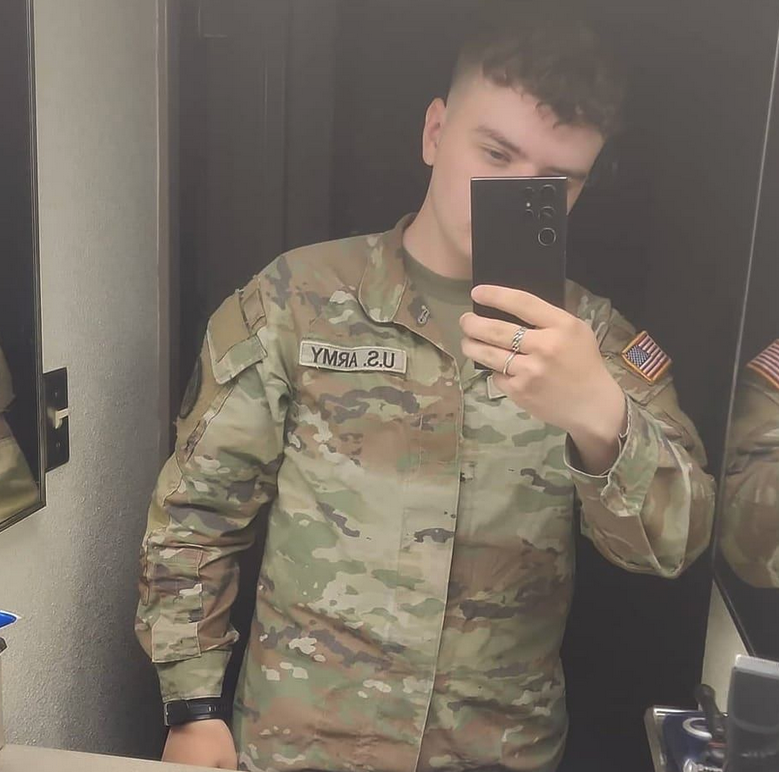
A U.S. Army soldier who pleaded guilty to hacking into multiple telecommunications companies and stealing mobile call and text metadata for more than 100 million AT&T customers in 2024 was sentenced to 70 months in federal prison today and ordered to pay nearly $300,000 in restitution to victims.
One of several selfies from the Facebook page of Cameron Wagenius.
Cameron John Wagenius, 22, was stationed at a U.S. Army base in South Korea when he adopted the cybercriminal persona “Kiberphant0m
A U.S. Army soldier who pleaded guilty to hacking into multiple telecommunications companies and stealing mobile call and text metadata for more than 100 million AT&T customers in 2024 was sentenced to 70 months in federal prison today and ordered to pay nearly $300,000 in restitution to victims.
One of several selfies from the Facebook page of Cameron Wagenius.
Cameron John Wagenius, 22, was stationed at a U.S. Army base in South Korea when he adopted the cybercriminal persona “Kiberphant0m.” Working with three alleged co-conspirators, Kiberphant0m downloaded data from several large customers of the cloud data storage service Snowflake that had exposed credentials and did not enforce multi-factor authentication (Snowflake has since mandated MFA on all accounts).
In October 2024, Kiberphant0m bragged on the cybercrime forums that he’d stolen the call and text metadata (e.g. source and destination number, timestamp, duration, etc.) for tens of millions of AT&T customers. Kiberphant0m claimed to have hacked into more than dozen telecommunications companies worldwide, including Verizon’s Push-to-Talk business, and publicly extorted these companies in exchange for a promise not to publish the stolen data.
In late November 2025, KrebsOnSecurity warned that Kiberphant0m was likely a U.S. soldier stationed in South Korea. Less than a month later, Wagenius was arrested and charged in two separate federal indictments, and soon pleaded guilty to all counts in both cases.
At his sentencing hearing in Seattle today, Wagenius was sentenced to nearly six years in federal prison, and ordered to pay $294,978 in restitution.
Federal prosecutors said Wagenius was assisted in his efforts to extort victim companies by Kenneth Schuchman, a 28-year old man from Vancouver, Washington who has a lengthy cybercriminal history. In 2019, Schuchman pleaded guilty to operating the Satori botnet, a vast collection of hacked Internet-of-Things (IoT) devices that was used for large-scale distributed denial-of-service (DDoS) attacks.
Two other alleged co-conspirators of Wagenius are still facing charges in connection with the Snowflake data thefts; Conor Riley Moucka, a.k.a. “Judische,” of Kitchener, Ontario was arrested in 2024 and pleaded guilty in August 2026; and John Erin Binns, an American man currently living in Turkey who is also wanted for a 2021 data breach at T-Mobile that exposed the personal information of at least 76 million customers.
Kiberphant0m also admitted to re-extorting victims, and threatening to disclose national security secrets. Immediately following Moucka’s arrest — after AT&T had already paid the extortion group a $370,000 Bitcoin ransom — Kiberphant0m posted on hacker forums what he claimed were the AT&T call logs for then President-elect Donald Trump and for then Vice President Kamala Harris, as well as schematics allegedly stolen from the U.S. National Security Agency (NSA).
Paul Russell is a resident agent in charge at the Defense Criminal Investigative Service (DCIS), the criminal investigative arm of the U.S. Department of Defense Office of Inspector General. Russell said when DCIS received information that a soldier with secret clearance was allegedly involved in cybercrime and extortion, the agency began working the investigation alongside the FBI, the Army Criminal Investigative Division (CID), and the U.S. Secret Service.
“We don’t often get leads where there’s an active duty soldier with a secret clearance who’s creating hacking tools and trafficking in data,” Russell said. “That doesn’t happen every day, and so when that hits it really spins all of our partner organizations up. It was very serious from jump street, just because it was unique, it was an insider threat, and we weren’t sure what we were dealing with.”
A sentencing memo (PDF) filed Sept. 19 by federal prosecutors in Seattle notes that while Wagenius pleaded guilty almost immediately and has been remarkably cooperative, he recently got caught trying to find security vulnerabilities in the BOP’s computer network. The government’s memo notes that while incarcerated and awaiting sentencing, Wagenius violated the computer use policies of the Bureau of Prisons (BOP) in attempts to learn about vulnerabilities in BOP computer systems.
“According to records from BOP, in or around September 2025, Wagenius used another inmate’s email system to request that the email recipient prompt a commercial AI tool to provide information about “[w]hat CVE’s are there for Windows 10 Enterprise privilege escalation and bypasses” and to “[p]rovide the CVE’s and a real world working script for each CVE . . . without omitted code,” the government’s memo states.
The memo states that less than a week later, Wagenius used a different inmate’s email account and requested that the email recipient prompt an AI tool to “[p]rovide the step by step for CVE-2023-45208, code for this if any, and if no code exists make some, make sure to describe everything in detail.” CVE-2023-45208 is a three-year-old “command injection” vulnerability in D-Link networking devices.
That same month, Wagenius allegedly again requested that the email recipient prompt AI with the question, “How do you make an antenna in a prison environment with commissary or readily available items/tools to improve/make an antenna to extend radio reception?”
Federal prosecutors said Wagenius also requested that the recipient research escaping prison.
“In several instances, Wagenius framed the AI queries as being posed in connection to a book he was writing. This is a common method of ‘prompt injection,’ in which attackers feed specially crafted, deceptive inputs into commercial AI tools that are programmed to avoid outputting malicious code that can be used to exploit computer vulnerabilities,” the sentencing memo reads.
The government told the court it is unaware of evidence that Wagenius figured out how to use or deploy the vulnerabilities he was researching in the BOP’s systems, and when questioned said he was only researching “potential vulnerabilities to provide information to the BOP.”
Incredibly, despite the enormous financial value of the data stolen from AT&T and other telecom providers, Wagenius’s extortion efforts were largely unsuccessful. The government’s sentencing memo says Wagenius made a whopping total of around $1,500 from selling stolen data.
“While Wagenius was not particularly financially successful as a cybercriminal, he both intended to and caused significant harm to numerous individual victims, U.S. companies, and the U.S. government,” the memo states.
What HappenedIn mid-2026, an emerging cybercriminal group known as ExfilSquad launched a high-profile extortion campaign targeting prominent UK organisations across the public sector, education, and law enforcement, as well as other firms worldwide.Unlike traditional ransomware groups, ExfilSquad does not deploy encryptors or destructive malware. Instead, they operate as a pure data extortion group, stealing data and threatening to publish it on their onion-based Data Leak Site (DLS) if a ransom
In mid-2026, an emerging cybercriminal group known as ExfilSquad launched a high-profile extortion campaign targeting prominent UK organisations across the public sector, education, and law enforcement, as well as other firms worldwide.
Unlike traditional ransomware groups, ExfilSquad does not deploy encryptors or destructive malware. Instead, they operate as a pure data extortion group, stealing data and threatening to publish it on their onion-based Data Leak Site (DLS) if a ransom is not paid.
Several prominent UK entities have confirmed breaches linked to the group:
UK Department for Education (DfE): Approximately 600,000 records stolen from its Help Portal containing parent and staff contact details (names, emails, phone numbers, job titles), plus around 7,000 records from the Turing Portal.
Police National Legal Database (PNLD): Stole 1.9 GB of data (around 135,000 records) containing contact information for over 100,000 serving police officers, staff, and criminal justice professionals, alongside around 21,000 "Ask the Police" public inquiry records.
Newcastle University: Approximately 440,000 records compromised containing applicant and student contact information, personally identifiable information (PII), and admissions database records caused by a technical configuration flaw connecting to an admissions system.
Analysis of the details left on the data leak site revealed that ExfilSquad's primary attack vector involves exploiting misconfigurations in cloud portals, customer relationship management (CRM) platforms, internal case management systems, as well as Microsoft Power Pages data tables left publicly accessible without proper authentication.
To force compliance and prove their claims are real, ExfilSquad uploaded multi-gigabyte torrent files for each victim to their TOR leak site. Resecurity noted that ExfilSquad assigns a distinct Torrent Tracker and initial Web Seed per victim.
Analyst Comment
While ExfilSquad is a new group, they appear to be already experienced at running these types of attacks, suggesting they have a history of cybercrime. Plus, ExfilSquad’s recent campaign highlights the growing trend of transitioning from file-encrypting ransomware to extortion driven entirely by cloud and SaaS misconfigurations. Organisations that have invested in defending against endpoint-based threats are often leaving critical business application interfaces exposed.
SaaS platforms continue to be primary targets of English-speaking cybercrime communities. In recent years, customers of major SaaS providers, such as Salesloft, Salesforce, and Snowflake have all been extorted. Microsoft Power Pages portals, CRM databases, and customer support helpdesks frequently hold vast repositories of sensitive contact data and interaction histories. When internet-facing API endpoints or data table permissions are left unauthenticated or unpatched, cybercriminals can systematically scrape massive volumes of data without ever needing to drop a payload or escalate privileges internally.
ExfilSquad’s reliance on torrent distribution further amplifies reputational and operational damage. While gangs like LockBit, Clop, and Akira have previously utilised torrents, ExfilSquad’s operational twist of assigning unique Torrent Trackers and dedicated Web Seeds to individual victims ensures that leaked files distribute rapidly across P2P networks, making it extremely difficult to perform a takedown.
While ExfilSquad’s breaches have largely compromised contact directories and administrative support records, the real-world risks remain significant. Exposing work emails, names, and organisational structures for over 100,000 police officers and civil servants poses distinct social engineering, spear-phishing, and physical security concerns that impacted institutions will have to manage long after the breach occurs.
Defensive Takeaways
Audit Microsoft Power Pages and Public SaaS Tables: Regularly review public data table permissions, web API settings, and unauthenticated browser views across Microsoft Power Pages, CRMs, and customer support portals to ensure backend data tables are not exposed to the public internet.
Harden CRM and Case Management Integrations: Treat external-facing admissions portals, helpdesks, and case management systems as high-risk platforms. Implement strict access controls, conduct routine configuration audits, and enforce proper API token security.
Deploy External Attack Surface Management (EASM): Utilise continuous external attack surface scanning to detect newly exposed web endpoints, misconfigured database connectors, and publicly exposed storage buckets before malicious actors locate them.
Incorporate Pure Extortion into Incident Response Plans: Security teams must adapt incident response playbooks for data-theft-only scenarios. Organisations may seek to establish protocols for monitoring peer-to-peer (P2P) networks and managing public disclosures when stolen data is distributed via torrents.
What HappenedOn 7 August 2026, the UK Information Commissioner's Office (ICO) disclosed that between July 2021 and June 2023, the ACRO Criminal Records Office suffered three separate compromises involving its customer portal website (acro.police.uk).ACRO is a national police unit providing public services such as issuing Police Certificates, International Child Protection Certificates, and processing Subject Access Requests.In March 2023, ACRO was notified about an SQL injection attack that repo
On 7 August 2026, the UK Information Commissioner's Office (ICO) disclosed that between July 2021 and June 2023, the ACRO Criminal Records Office suffered three separate compromises involving its customer portal website (acro.police.uk).
ACRO is a national police unit providing public services such as issuing Police Certificates, International Child Protection Certificates, and processing Subject Access Requests.
In March 2023, ACRO was notified about an SQL injection attack that reportedly exposed 15 sets of credentials, the majority of which belonged to its employees.
A subsequent forensic investigation uncovered long-term threat actor activity within the website's environment, spanning from 9 July 2021 to 22 June 2023.
The website was built on the Kentico CMS and was running version 12.0.0 between September 2019 and March 2023. This version had multiple known vulnerabilities at the time of the incident, but suffered from ambiguity around who was accountable for patching led to missed hotfixes and updates.
Between 15 and 16 February 2023, an unknown threat actor staged personal data for exfiltration, which included Police Certificate Applications, Subject Access Request (SAR) forms, and International Child Protection Certificate forms.
Due to insufficient log retention, ACRO could not definitively determine if the data was successfully exfiltrated. A maximum of 10,920 data subjects had their data staged, but ACRO ultimately notified 84,048 data subjects on a precautionary basis in April 2023.
Notably, on 23 February 2023, the ICO learned that ACRO's Trend Micro antivirus software detected and quarantined four attempts to install the well-known credential harvesting tool Mimikatz. However, because ACRO operated without a documented patching policy and lacked a structured process for analyzing security alerts, these warnings were never reviewed or acted upon.
Analyst Comment
The Information Commissioner's Office (ICO) reprimand against the ACRO underscores the persistent issue within many organisations of a breakdown in basic IT governance and accountability. The fact that a threat actor was able to operate within the environment for nearly two years highlights systemic failures in both vulnerability management and security monitoring. Running an outdated content management system with known vulnerabilities for several years is a critical oversight. The ambiguity surrounding patching responsibilities created a dangerous blind spot that adversaries successfully exploited.
Further, the failure to act on critical security alerts is also a classic breakdown in the incident response chain. While the deployed Trend Micro antivirus successfully detected and quarantined a known threat, the alerts were ultimately ignored. Security tools are only as effective as the teams monitoring and responding to them. Without a structured review process, even the most sophisticated detection capabilities fall flat.
It is important to note, however, that while private sector organisations will receive a hefty fine for data protection offences, public sector organisations like ACRO receive a public reprimand from the ICO rather than receive a fine that confiscates public funds.
At the time of writing, the data has not yet appeared on any cybercrime forums or underground chat channels. The use of an open source tool like Mimikatz combined with SQL injection attacks indicates a likely opportunistic adversary rather than a stealthy cyber-espionage operation. However, both cybercriminal and nation state groups are known for opportunistic attacks. Current attribution for who or what was responsible this breach remains uncertain from an open source intelligence (OSINT) perspective.
On a positive note, the ICO highlighted that ACRO’s network segmentation effectively prevented the threat actor from pivoting from the compromised web environment into core policing systems. This containment significantly reduced the scale of harm and demonstrates the immense value of architectural defense-in-depth strategies. Following the breach, ACRO has migrated its portal to the Salesforce Experience Cloud for automated patching and hotfixes and implemented a Security Information and Event Management (SIEM) system to improve visibility.
Defensive Takeaways
Establish Clear Accountability for Patching: Organisations must have a documented patching policy with clearly defined ownership, especially for public-facing web applications and Content Management Systems (CMS). Ambiguity in IT governance directly leads to unpatched vulnerabilities which then get exploited.
Implement Structured Alert Monitoring: Deploying antivirus or Endpoint Detection and Response (EDR) solutions alone is insufficient if alerts are not actively monitored and investigated. It is recommended to establish either structured internal processes or an outsourced 24/7 Managed Detection and Response (MDR) or SOC service to review and respond to critical security alerts promptly.
Maintain Robust Network Segmentation: Ensure that public-facing web infrastructure is strictly segmented from internal corporate networks and core operational systems. As demonstrated in this incident, strict segmentation is a crucial control for stopping an attacker's lateral movement.
Ensure Adequate Log Retention: Insufficient logging severely hinders incident response and forensic investigations. Implement comprehensive logging policies and utilise a SIEM to aggregate logs, ensuring they are retained long enough to accurately determine the scope of data exfiltration during a compromise.
A usage policy for Flock license plate reader cameras tells police not to talk about the cameras:
When cops use Flock to arrest someone in Wapello County, Iowa, they don’t want them to know. A usage policy for the automated license plate reader cameras in the county tells police, in no uncertain terms, to keep them a secret: “DO NOT MENTION ALPR USAGE TO THE OCCUPANTS OF THE VEHICLE,” the policy document reads. “DO NOT MENTION ALPR USAGE IN YOUR REPORT OR COMPLAINT UNLESS ABSOLUTELY NECESSARY.”
A usage policy for Flock license plate reader cameras tells police not to talk about the cameras:
When cops use Flock to arrest someone in Wapello County, Iowa, they don’t want them to know. A usage policy for the automated license plate reader cameras in the county tells police, in no uncertain terms, to keep them a secret: “DO NOT MENTION ALPR USAGE TO THE OCCUPANTS OF THE VEHICLE,” the policy document reads. “DO NOT MENTION ALPR USAGE IN YOUR REPORT OR COMPLAINT UNLESS ABSOLUTELY NECESSARY.”
This reminds me of IMSI-catchers (Stingray was the most popular) a couple of decades ago. Police would go to even more extremes to hide their usage.
What HappenedNew data published by the City of London Police in June 2026 reveals that courier fraud losses exceeded £21 million in 2025, with individuals aged over 70 being heavily targeted. The highest concentration of these offenses was recorded in London and the Home Counties.Cybercriminals and fraud syndicates are actively evolving their operational tactics, increasingly pivoting to messaging platforms like WhatsApp to contact their victims and remotely paying for third-party courier servic
New data published by the City of London Police in June 2026 reveals that courier fraud losses exceeded £21 million in 2025, with individuals aged over 70 being heavily targeted. The highest concentration of these offenses was recorded in London and the Home Counties.
Cybercriminals and fraud syndicates are actively evolving their operational tactics, increasingly pivoting to messaging platforms like WhatsApp to contact their victims and remotely paying for third-party courier services to facilitate physical collections.
UK law enforcement also highlighted a dangerous shift in 2025 toward high-value physical goods. Victims are being systematically manipulated into visiting multiple jewellers over an extended period to purchase gold and expensive jewellery, which they then hand directly to fraud couriers.
Recent operational crackdowns by UK Regional Organised Crime Units (ROCUs) showcase the nationwide scale of these networks:
North West ROCU Operations (July 2026): Police executed coordinated search warrants in Huddersfield and Manchester, arresting two men (aged 21 and 25) on suspicion of Conspiracy to Defraud and Money Laundering. In this specific series, the suspects impersonated bank fraud departments, convinced a victim her card was compromised, sent a courier to collect it, and immediately exploit the physical card to make numerous fraudulent transactions.
North East ROCU (NEROCU) Sentencing (June 2026): A complex, cross-country courier fraud operation spanning March to May 2022 concluded with a prison sentence for a primary operative. The network targeted 14 separate victims, convincing them to hand over physical bank cards and PIN numbers under the guise of an internal "investigation" by their bank's fraud department. The group scammed a total of £56,000, which was then rapidly laundered through the high street purchase of smartphones, designer clothing, and luxury jewellery.
Analyst Comment
Courier fraud is effectively a hybrid cyber-physical social engineering campaign. While the final phase relies on a physical courier arriving at a victim’s doorstep, the initial approach relies heavily on psychological manipulation and email, message, or phone call-based deception.
This type of fraud is notable as it follows a structured cybercriminal playbook that bypasses detection systems and takes advantage of the vulnerable in society. The victim is instructed to bypass normal banking security controls by withdrawing cash, disclosing sensitive credentials (like PINs), or purchasing high-value physical commodities like gold or luxury jewellery. This makes it difficult to proactively detect and prevent.
The other concerning factor is the couriers themselves. According to reports, they can be an unwitting third-party courier service that is paid to go to the victim's home to collect the assets. Online services enable cybercriminals to organise these pickups remotely, lowering their risk of being caught.
The £21 million sizeable loss metric from 2025 shows how profitable this low-tech, high manipulation vector remains. The recent shift to targeting gold and luxury jewellery is a deliberate evasion tactic against traditional anti-money laundering (AML) and banking fraud detection algorithms. While banks have grown adept at flagging unusual rapid bank transfers, they cannot easily stop an account holder from physically withdrawing funds or using a card over several days at different brick-and-mortar luxury retailers. This tactic serves as a highly liquid physical laundering pipeline for these syndicates that remains a challenge to prevent.
Defensive Takeaways
Implement Bank Transfer and Purchase Outlier Alerts: Financial institutions can focus on further behavioural monitoring for elderly demographics, looking specifically for sudden, consecutive high-value transactions at physical luxury retail or jewellery establishments and flag patterns on unusual activity for review.
Public Awareness on Cross-Media Scams: Security awareness campaigns must make it clear that legitimate institutions, specifically the Police and Banking Fraud teams, will never send a courier to a residential address to collect cash, PIN numbers, bank cards, or purchased items.
Vetting of Courier Logistics: Commercial courier services are increasingly being abused as infrastructure by these threat groups. Logistics firms must implement logging and analysis systems to detect unusual residential pickups booked via suspicious accounts and forged identities.
What HappenedNemesis Dark Web Drug Dealers ArrestedOn 14 May 2026, two Cambridgeshire drug dealers were sentenced after being arrested in July 2024 by the Eastern Region Special Operations Unit (ERSOU).ERSOU officers recovered Royal Mail parcel labels, order lists, Gorgonites-branded packaging, and a USB memory stick containing login credentials for multiple dark web marketplace accounts.The dealers reportedly used the dark web to supply heroin, cocaine, and amphetamine to hundreds of users acro
On 14 May 2026, two Cambridgeshire drug dealers were sentenced after being arrested in July 2024 by the Eastern Region Special Operations Unit (ERSOU).
ERSOU officers recovered Royal Mail parcel labels, order lists, Gorgonites-branded packaging, and a USB memory stick containing login credentials for multiple dark web marketplace accounts.
The dealers reportedly used the dark web to supply heroin, cocaine, and amphetamine to hundreds of users across the UK.
The drug deals were initially arranged via a Telegram channel under the handle Gorgonites, which was linked to at least 570 individual sales on Nemesis Market since September 2023.
AEGIS Dark Web Drug Market Seizure
On 17 March 2026, the London Metropolitan Police’s Cyber Crime Unit announced the seizure of AEGIS Marketplace.
In June 2025, the Met Cyber Crime Unit became aware of AEGIS Marketplace, which was a site where individual sellers could market drugs for sale to users who could make purchases using cryptocurrency.
By March 2026, the website had 30 active sellers and was estimated to have generated 10,000 drug sales in ten months, leading to an estimated annual turnover of almost £2 million.
Officers from the Met managed to infiltrate the site, retrieving server data that led to the identification of administrators, sellers and customers.
Online Killers Marketplace (OKM) Admins Arrested
On 19 January 2026, two suspects were arrested in Romania as part of an ERSOU investigation into a bogus ‘harm-for-hire’ website which offered services including murder.
The arrests were connected to a dark web scam website called Online Killers Marketplace (OKM), which purported to facilitate criminal activities including the hiring of hitmen and extortion.
ERSOU noted that even though none of the services OKM offered were genuine, successful prosecutions have previously been pursued by police forces of individuals attempting to use it to cause harm to others.
The investigation led to the seizure of US crypto currency worth at least $600,000, as well as cash which included almost €50,000 Euros, and around £48,000 worth of Romanian Leu.
Analyst Comment
The anonymity and connectivity of encrypted messaging apps, the Tor network, cryptocurrency, and online marketplaces makes it nearly impossible to prevent such crime. However, law enforcement can achieve strategic containment by targeting specific infrastructure for seizure and individuals for arrest. These activities support the overall strategy for national law enforcement agencies is to deter criminals from being active in their country.
Telegram is increasingly used as a front-end service for all sorts of cybercrime activities. As seen in the Nemesis investigation, the dealers operated a Telegram channel under the handle Gorgonites to coordinate and funnel buyers toward more secure transactions. It is an easy-to-use mobile application that makes access to such illicit services simple for buyers. It is more accessible than having to download the Tor browser and use a desktop or laptop browser. Many of these illicit services also would not exist without cryptocurrency. The ability to send funds via peer-to-peer networks and obfuscate transactions continues to be the main enabling factor for most cybercrime operations.
Interestingly, the sole administrator of Nemesis Market was sanctioned in March 2025 by the US Treasury OFAC department. The admin was an Iran-based individual named Behrouz Parsarad. Prior to its takedown by law enforcement in March 2024, Nemesis had over 30,000 active users and 1,000 vendors and facilitated the sale of nearly $30 million USD worth of drugs around the world between 2021 and 2024.
Defensive Takeaways
Blockchain Analytics:While cryptocurrency provides a layer of perceived anonymity for illicit markets it also leaves a permanent, public ledger. Law enforcement and threat intelligence firms, such as TRM Labs and Chainalysis, can leverage blockchain analytics to follow the money and deanonymise the administrators. By mapping transaction inputs and outputs, investigators can trace mixed funds, identify exchanges used to cash out into fiat currency, and map the financial infrastructure of a marketplace.
Breach Data Pivoting: To catch these cybercriminals, threat intelligence analysts can use historical breach data repositories to pivot from a known dark web alias or leaked credential to find a real-world identity. If an administrator used the same password or a variation of a username on a compromised gaming forum ten years ago, that footprint can blow their operational security (OPSEC).
Profile Scraping: Dark web vendors and market admins often leave massive digital footprints across forums, marketplaces, and messaging apps like Telegram. Continuous profile scraping can be achieve via automated bots to collect vendor profiles, feedback ratings, PGP keys, styles of writing (stylometry), and active hours. By aggregating this data over time, defenders can create a comprehensive profile of a target and identify them.
Dark Web Market Sock Puppet Accounts: Law enforcement and threat intelligence analysts can deploy sock puppets accounts, which are undercover, synthetic personas, into these dark web ecosystems. These accounts are kept for long periods of time and actively posting in an attempt to build trust within the cybercrime underground. Investigators can use them to buy products, interact with admins, and gain access to private vendor portals or escrow systems to support evidence gathering for a takedown.
Infrastructure Analysis: As dark web markets rely on servers, hosting providers, DNS, and Tor is is possible to analyse these attributes and look for configuration mistakes. This can include exposed IP addresses, trackable X509 certificates, or open port banners that reveal the true location of a hidden service. Once a server's true IP is uncovered, law enforcement can issue subpoenas to hosting providers or execute physical raids to seize the hardware and unmask administrators, vendors, and buyer databases.
What HappenedOfficers from the Dedicated Card and Payment Crime Unit (DCPCU), jointly run by the London Met Police and City of London Police, secured the conviction of a man who used an SMS Blaster device to send fraudulent text messages as part of an organised criminal operation in London.The conviction relates to an investigation that previously led to the sentencing of Ruichen Xiong in July 2025, who was apprehended while driving a vehicle in North London as the device was in operation. Duri
Officers from the Dedicated Card and Payment Crime Unit (DCPCU), jointly run by the London Met Police and City of London Police, secured the conviction of a man who used an SMS Blaster device to send fraudulent text messages as part of an organised criminal operation in London.
The conviction relates to an investigation that previously led to the sentencing of Ruichen Xiong in July 2025, who was apprehended while driving a vehicle in North London as the device was in operation. During that incident, officers in the vicinity received fraudulent text messages purporting to be from HMRC.
Ruichen Xiong was a student from China who drove around London using the SMS Blaster between 22 and 27 March 2025, sending messages to tens of thousands of potential victims.
Following Xiong’s arrest and subsequent conviction, enquiries identified another individual called Di Li who was a key organiser. Li facilitated Xiong’s involvement by arranging access to the device, assisting with obtaining a vehicle, and supporting his day-to-day living costs.
Xiong had accrued significant gambling debts after arriving in the UK as a student. To pay off his debts, Li instructed that he could repay what he owed by driving routes in a car with the SMS Blaster.
On 20 August 2025, officers searched Li’s home address, where digital evidence was recovered showing communications between Li and Xiong relating to the deployment of the SMS blaster. Li was arrested on 1 September 2025 and charged with offences linked to the operation.
At the court trial, Li’s defence was that the device was intended for “advertising” purposes and described himself as a middleman acting on behalf of an individual based in China. He maintained that he had been merely attempting to help Xiong repay his debts.
Analyst Comment
An SMS Blaster acts as a portable mobile phone mast that forces nearby mobile devices to connect to it by silently downgrading it to 2G while they try to connect to 5G or LTE. By doing so, criminals can bypass safeguards designed to block malicious senders and harmful links, enabling them to deliver fraudulent messages directly to victims nearby without needing their phone numbers. The SMS Blaster allow an operator to customise all aspects of the messages, so they can make it look like it has come from a genuine organisation like HMRC, the UK tax authority.
SMS Blasters are a relatively new technology for scammers. Police in the UK only encountered them for the first time in 2025, but they have been used in other parts of the world. SMS Blaster are also a type of IMSI catcher that mirrors the capability of law enforcement tools such as a Stingray.
When used in busy metropolitan areas, they allow criminals to easily send out SMS phishing messages to hundreds of people at a time. These SMS messages typically have a malicious link that host scam websites that trick victims into entering their personal details. These details can then used by fraudsters to make payments, steal funds, or resell it to others.
This report also highlights the concerning trend of organised cybercrime gangs from China are actively hunting for individuals who are financially vulnerable (like students with gambling debts) to conduct high-risk in-person operations.
Defensive Takeaways
Block and Report: If you receive a suspicious text message, do not engage with it. Instead, forward it to 7726, a free reporting service, and block the number.
Move Away from SMS: If your organisation relies on SMS for One-Time Passcodes (OTPs), this threat highlights that the SMS sender ID can be perfectly spoofed locally. Organisations should migrate to authenticator apps, hardware tokens, or application push notifications to avoid spoofing.
Proactive Takedown Programs: Since the attack relies on hosting malicious links to harvest credentials, defenders can perform proactive domain monitoring. Detecting and taking down lookalike domains immediately minimises the impact.
What HappenedOn 3 June 2026, the City of London Police issued a warning stating Report Fraud has seen a significant increase in cases mentioning the retailer, reflecting how criminals are targeting well-known brands.Report Fraud, which is run by the City of London Police, warned that cybercriminals are using leaked credentials from historical data breaches to hijack Argos user accounts.Once on the account, the fraudsters order and then collect the goods in-person at a physical store. In some ins
On 3 June 2026, the City of London Police issued a warning stating Report Fraud has seen a significant increase in cases mentioning the retailer, reflecting how criminals are targeting well-known brands.
Report Fraud, which is run by the City of London Police, warned that cybercriminals are using leaked credentials from historical data breaches to hijack Argos user accounts.
Once on the account, the fraudsters order and then collect the goods in-person at a physical store. In some instances, the goods are paid for using payment details not connected to the victim of the compromised account.
Notably, the goods from fraudulent orders are often claimed via Click & Collect option that Argos allows, enabling the threat actors to retrieve goods in store.
In May, Report Fraud received 652 reports which mention Argos, a 323% increase compared to April, when 154 reports mentioning the retailer were made. Since the start of 2026, there have been 1,175 reports mentioning the retailer, with May seeing the highest number to date.
This alert is also not the first raised about Argos. On 18 November 2025, the East Midlands Cyber Resilience Center issued a warning about Argos and Currys accounts getting compromised and unauthorised purchases being made. In some instances, particularly with Currys, the Buy Now Pay Later (BNPL) option was used, leaving the account holder with finance plans in their names.
Analyst Comment
For both everyday UK consumers and UK retail risk teams, these alerts provide several layered insights. Retailers have spent years optimising Click & Collect to be as frictionless as possible to compete with online shopping giants like Amazon. However, this alert shows how Click & Collect can be a security liability. As Argos allows quick collections, criminals can buy an item online and pick it up at a local store before the real account owner notices an order confirmation email.
The police alerts also note that the items may even be paid for using payment details not connected to the victim.Criminals are mixing stolen accounts with stolen credit cards. This is likely due to an established Argos account with a multi-year history buying expensive items would look pretty normal to a fraud detection engines.
The combination of an Account Takeover (ATO) and Buy Now Pay Later (BNPL) fraud creates a difficult scenario for retailers, credit providers, and consumers. The regulatory and reputational fallout for a retailer under the rules of the UK Financial Conduct Authority (FCA) could be severe. If a retailer's poor account security allows fraudsters to easily spin up a finance plan in a victim's name, the FCA will view this as a systemic failure to protect consumers, resulting in massive fines.
These attacks are possible due to the practice of Argos users who are reusing the same previously leaked password across multiple accounts, plus users not having multi-factor authentication (MFA) turned on in their account settings.
Campaigns like this can trigger a reputational hit to retailers as victims often do not suffer silently. They take to social media to share stories and the public narrative can shift to being about a retailer who is complicit in disrupting innocent people's financial lives.
Defensive Takeaways
User Account Hygiene Best Practices: Standard practices such as rotating passwords, using complex password, using a different password per service, using a password manager, using passkeys, and turning on MFA would all help mitigate this type of threat for users.
Credit Monitoring: If a user suspects their account has been compromised, they should consider using a credit monitoring service to help prevent unauthorised loans taken out in their name.
Cancel and Replace Payment Cards: If a user suspects their payment card data has been stolen, then they should contact their financial institution and have it cancelled and replaced.
Implement Click-and-Collect Controls: Retailers with click-and-click options should introduce controls such as requiring ID of the account owner or a single-use QR code or PIN via SMS/Email at the point of collection for high-value items to prevent this type of fraud.
Detecting Credential Stuff Attacks: If the cybercriminals were using credential stuffing attacks, then retailers should be able to detect unauthorised password guessing attempts against their online portals. It is recommended to use IP context analysis and perform source IP correlation. If one IP address tagged as a proxy or VPN is observed attempting to login to dozens of accounts simultaneously, then there’s an issue.
Leverage Stripe’s FT3 framework: If your organisation or team is tasked with combating fraud, then categorising these scammers TTPs is crucial. That’s why Stripe has developed the Fraud Tools, Tactics, and Techniques (FT3) framework. It’s designed to help security teams understand the landscape, spot gaps, develop detections, improve incident response, and foster collaboration.
What HappenedOn 5 May 2026, new data revealed that British romance scam victims were defrauded of a staggering £102 million last year, representing a 29% surge in reported cases.The figures come from information gathered by Report Fraud (f.k.a ActionFraud), which is a City of London Police-run service that logged 10,784 romance scam reports in 2025.According to the data, cybercriminals are reportedly pocketing roughly £280,000 everyday by exploiting online relationships, with individual losses
On 5 May 2026, new data revealed that British romance scam victims were defrauded of a staggering £102 million last year, representing a 29% surge in reported cases.
The figures come from information gathered by Report Fraud (f.k.a ActionFraud), which is a City of London Police-run service that logged 10,784 romance scam reports in 2025.
According to the data, cybercriminals are reportedly pocketing roughly £280,000 everyday by exploiting online relationships, with individual losses averaging £9,500 and in extreme cases, reaching up to £1 million per victim.
This wave of scam victims is part of the growing trend where scammers blend emotional manipulation with fake cryptocurrency investment schemes, heavily weaponising AI-generated profiles, and focusing on lonely victims aged 55 to 74.
Analyst Comment
When analysing fraud statistics, it is important to remember that underreporting is very common, with many victims staying silent out of shame. Therefore, this is likely only a fraction of the real figures and the problem is likely much worse than we know. The data we do have, however, still reveals there is essentially an army of digital scammers routinely bleeding UK citizens dry, using not much more than a Midjourney AI subscription, a ChatGPT script, face-swapping services, and an entirely fictitious character with an emotional backstory.
Losing £102 million in a single year to fake internet characters is a truly wild national milestone. The fact that reports surged by nearly a third (29%) proves that in our society, emotional vulnerability is being monetised at industrial scale. We aren’t just looking at a clumsy email from a Nigerian prince anymore. This is industrial-grade social engineering. Scammers are playing the long game, spending months "love-bombing" victims before dropping the inevitable bombshell that they need a quick bank transfer to cover a “medical emergency” or an unmissable cryptocurrency investment opportunity.
In March 2026, the UK Government took some action against this threat and sanctioned Xinbi, a Chinese-language cryptocurrency marketplace accused of enabling large-scale online fraud and human exploitation. Xinbi reportedly processed more than $19.9 billion in transactions between 2021 and 2025, highlighting how much money the scam industry is generating globally.
Until we treat the underground scam economy with the same significance we treat ransomware or nation state attacks, the UK will continue to be one of the world's most lucrative money spinners for heartless cybercriminals.
Defensive Takeaways
Enforce the "Face-to-Face" Financial Boundary: If you are advising family members (especially those in vulnerable demographics), establish an unshakeable, non-negotiable rule: if you have not looked a person in their physical eyeballs, you do not send them money, gift cards, or cryptocurrency.
Teach Others Digital Sanity Checks: Teach your friends and family the art of basic digital literacy. Run profile images through reverse-image search tools (Google Lens or TinEye) and consciously flag the platform migration trap. Scammers desperately want to move targets off monitored apps like Tinder or Bumble and onto unmoderated WhatsApp or Telegram channels as fast as possible to avoid automated dating app ban filters.
Learn From the Mistakes of Others: To find examples of victims falling for these scams, the UK Financial Ombudsman Service’s database of decisions can act as a useful resource. The decision details can help you understand how these scams work, how much money individuals can lose, and the rate at which UK banks offer refunds or compensation. More examples can be found in my talk on this topic here.
Leverage Stripe’s FT3 Framework: If your organisation or team is tasked with combating fraud, then categorising these scammers TTPs is crucial. That’s why Stripe has developed the Fraud Tools, Tactics, and Techniques (FT3) framework. It’s designed to help security teams understand the landscape, spot gaps, develop detections, improve incident response, and foster collaboration.
Canadian authorities on Wednesday arrested a 23-year-old Ottawa man on suspicion of building and operating Kimwolf, a fast spreading Internet-of-Things botnet that enslaved millions of devices for use in a series of massive distributed denial-of-service (DDoS) attacks over the past six months. KrebsOnSecurity publicly named the suspect in February 2026 after the accused launched a volley of DDoS, doxing and swatting campaigns against this author and a security researcher. He now faces criminal h
Canadian authorities on Wednesday arrested a 23-year-old Ottawa man on suspicion of building and operating Kimwolf, a fast spreading Internet-of-Things botnet that enslaved millions of devices for use in a series of massive distributed denial-of-service (DDoS) attacks over the past six months. KrebsOnSecurity publicly named the suspect in February 2026 after the accused launched a volley of DDoS, doxing and swatting campaigns against this author and a security researcher. He now faces criminal hacking charges in both Canada and the United States.
A criminal complaint unsealed today in an Alaska district court charges Jacob Butler, a.k.a. “Dort,” of Ottawa, Canada with operating the Kimwolf DDoS botnet. A statement from the Department of Justice says the complaint against Butler was unsealed following the defendant’s arrest in Canada by the Ontario Provincial Police pursuant to a U.S. extradition warrant. Butler is currently in Canadian custody awaiting an initial court hearing scheduled for early next week.
The government said Kimwolf targeted infected devices which were traditionally “firewalled” from the rest of the internet, such as digital photo frames and web cameras. The infected systems were then rented to other cybercriminals, or forced to participate in record-smashing DDoS attacks, as well as assaults that affected Internet address ranges for the Department of Defense. Consequently, the DoD’s Defense Criminal Investigative Service is investigating the case, with assistance from the FBI field office in Anchorage.
“KimWolf was tied to DDoS attacks which were measured at nearly 30 Terabits per second, a record in recorded DDoS attack volume,” the Justice Department statement reads. “These attacks resulted in financial losses which, for some victims, exceeded one million dollars. The KimWolf botnet is alleged to have issued over 25,000 attack commands.”
On March 19, U.S. authorities joined international law enforcement partners in seizing the technical infrastructure for Kimwolf and three other large DDoS botnets — named Aisuru, JackSkid and Mossad — that were all competing for the same pool of vulnerable devices.
On February 28, KrebsOnSecurity identified Butler as the Kimwolf botmaster after digging through his various email addresses, registrations on the cybercrime forums, and posts to public Telegram and Discord servers. However, Dort continued to threaten and harass researchers who helped track down his real-life identity and dramatically slow the spread of his botnet.
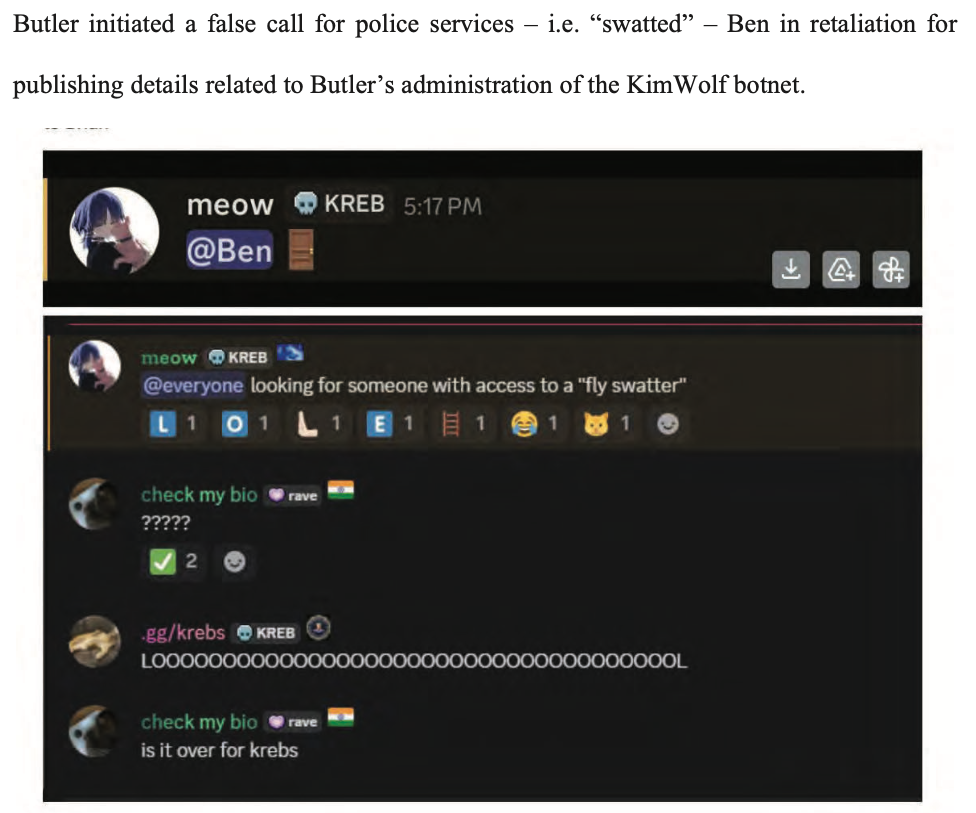
Dort claimed responsibility for at least two swatting attacks targeting the founder of Synthient, a security startup that helped to secure a widespread critical security weakness that Kimwolf was using to spread faster and more effectively than any other IoT botnet out there. Synthient was among many technology companies thanked by the Justice Department today, and Synthient’s founder Ben Brundage told KrebsOnSecurity he’s relieved Butler is in custody.
“Hopefully this will end the harassment,” Brundage said.
An excerpt from the criminal complaint against Butler, detailing how he ordered a swatting attack against Ben Brundage, the founder of the security firm Synthient.
The government says investigators connected Butler to the administration of the KimWolf botnet through IP address, online account information, transaction records, and online messaging application records obtained through the issuance of legal process. The criminal complaint against Butler (PDF) shows he did little to separate his real-life and cybercriminal identities (something we demonstrated in our February unmasking of Dort).
In April, the Justice Department joined authorities across Europe in seizing domain names tied to nearly four-dozen DDoS-for-hire services, although because of a bureaucratic mix-up the list of seized domains has remain sealed until today. The DOJ said at least one of those services collaborated with Butler’s Kimwolf botnet.
A statement from the Ontario Provincial Police said a search warrant was executed on March 19 at Butler’s address in Ottawa, where they seized multiple devices. As a result of that investigation, Butler was arrested and charged this week with unauthorized user of computer; possession of device to obtain unauthorized use of computer system or to commit mischief; and mischief in relation to computer data. He is scheduled to remain in custody until a hearing on May 26.
In the United States, Butler is facing one count of aiding and abetting computer intrusion. If extradited, tried and convicted in a U.S. court, Butler could face up to 10 years in prison, although that maximum sentence would likely be heavily tempered by considerations in the U.S. Sentencing Guidelines, which make allowances for mitigating factors such as youth, lack of criminal history and level of cooperation with investigators.
Bellingcat has identified at least 80 police stations or infrastructure related to law enforcement agencies and the Basij paramilitary group that has been damaged or destroyed in the first three weeks of the United States and Israel’s war against Iran. Experts told Bellingcat that both countries aim to degrade the Iranian regime’s “repressive capacity”.
Combined, the US and Israel have conducted thousands of strikes during the course of the 2026 war in Iran. Targets range from Islamic Revolut
Bellingcat has identified at least 80 police stations or infrastructure related to law enforcement agencies and the Basij paramilitary group that has been damaged or destroyed in the first three weeks of the United States and Israel’s war against Iran. Experts told Bellingcat that bothcountries aim to degrade the Iranian regime’s “repressive capacity”.
Combined, the US and Israel have conductedthousands of strikes during the course of the 2026 war in Iran. Targets range from Islamic Revolutionary Guard Corps (IRGC) sites, Navy vessels to Iranian weapons manufacturers.
In early March, a Bellingcat analysis using satellite imagery and available photos and videos identified police stations as another apparent target, with at least 15 damaged or destroyed in the capital, Tehran.
We also identified multiple strikes against police infrastructure in the country’s north and west; these areas were targeted by the Israel Defence Forces according to a map released by the IDF on March 31.
“We are providing the brave people of Iran with the conditions to take their destiny into their own hands,” declared the Israeli Ministry of Foreign Affairs official X account, along with a photo of a destroyed police station.
اینجا کلانتری ۱۲۱ سلیمانیه در خیابان نبرد تهران بود.
ما شرایطی را برای مردم شجاع ایران فراهم میکنیم تا سرنوشت خود را در دست بگیرند. pic.twitter.com/VSm6YVvIwZ
In all, the majority of strikes Bellingcat analysed focused on police stations (30 incidents) and command centers or headquarters (29 incidents). Locations also include sites related to Basij, a plainclothes paramilitary organisation (9) affiliated with the IRGC that were “involved in the deadly crackdown” of protests in January 2026, others are associated with special forces (3) and traffic (2) or diplomatic (2) police compounds.
Due to commercial satellite companies limiting access to imagery over Iran and neighbouring countries we relied on Sentinel-2 imagery data to help verify the incidents, as well as videos and photos, some of which were also verified by independent geolocators and contributors to the Geoconfirmed volunteer community and confirmed by Bellingcat researchers.
Location data was partly determined using open source mapping data either from Wikimapia, OpenStreetMap or Google Maps. When video footage or photos were available for incidents reportedly targeting police stations, the location was verified with geolocation and satellite imagery analysis using either Planet Labs medium resolution PlanetScope data (restricted to imagery collected by March 9) or low resolution Sentinel-2 data.
Some locations were discovered utilising location data taken from OpenStreetMap using Overpass Turbo and comparing that with available Sentinel-2 data throughout Iran.
Map showing geolocated incidents in Iran. Click the markers to view the coordinates, sources, and verification notes. Map: Bellingcat/Miguel Ramalho
A Problem of Scale
Israel has released multiplevideos showing the targeting of bases and checkpoints belonging to the Basij. In mid-March, the IDF announced the killing of the paramilitary group’s commander, Gholamreza Soleimani.
Targeting the Basij is part of Israel’s and the US’ agenda “to degrade the regime’s repressive capacity,” Ali Vaez, the director of International Crisis Group Iran Project, told Bellingcat. Police stations are “not involved in repression in the way that crowd control police or Basij centers are”, so targeting them “appears more aimed at preventing the Islamic Republic from being able to maintain control internally,” he said.
Support Bellingcat
Your donations directly contribute to our ability to publish groundbreaking investigations and uncover wrongdoing around the world.
Vaez told Bellingcat that, when considered alongside the broader range of targets, including industrial factories, the widespread targeting of police stations is part of a strategy “to make Iran ungovernable for the existing regime or whatever comes after”.
Vaez was skeptical about the short term effects: “It’s a problem of scale. Iran is such a large country, even if you are able to completely destroy, not just degrade, the capacity of the regime in policing, oppressing, etc – it really requires not just maybe weeks but maybe months if not years.”
The Risk of Civilian Casualties
As of April 7, the Iranian Human Rights Activists News Agency estimates there’ve been more than 1,700 civilian fatalities during the war.
Several police stations are situated in densely populated urban areas such as Tehran. Stations are used by civilians for various reasons including renewing driving licences, so if these buildings are targeted “during working hours and not in the middle of the night then risk is higher for these people,” Vaez said.
Map showing geolocated incidents in Tehran. Click the markers to view the coordinates, sources, and verification notes.Map: Bellingcat/Miguel Ramalho
A recent joint Airwars, Center for Civilians in Conflict and Human Rights Activists in Iran report detailing the first month of civilian casualties included a section on the worsening situation for detainees in Iranian prisons — including police stations that have been targeted.
“I was detained in the holding cell of [Police Station 148] for ten days, along with four other activists. Now it looks like nothing is left of that station but ruins. I can’t even recognize where the detention area was. I keep wondering what happened to the people who were being held there during the attack. – Activist, told HRA upon seeing photos of the police station after recent US/Israeli airstrikes.”
Footage shared and geolocated by the BBC’s Shayan Sardarizadeh showed Police Station 148 damaged after an apparent strike in mid-March.
The main building of Tehran’s 148 police station and its courtyard, located on Enghelab Street, has been severely damaged in air strikes conducted on Friday.
The adjacent Hamoon Theatre also sustained some damage.
One destroyed police station identified by Bellingcat in the city of Mahabad in northwestern Iran led to apparent damage to an Iranian Red Crescent Society building located next door. According to Iran’s Tasnim News agency (an IRGC-affiliated media outlet sanctioned by the EU, the US and Canada), one Red Crescent employee was injured in the attack.
The police station adjacent to the Red Crescent building isn’t identified on any mapping services, though there are reports “Police Station 11” was targeted the same day.
Annotated Google Earth image showing the location of a destroyed police station and partially destroyed Red Crescent building in Mahabad, West Azerbaijan Province, Iran. A video shared on Telegram by mamlekate on March 6 shows the view of the destruction from the ground. Buildings behind the destroyed police station match with those seen in the Google Earth imagery.
Israel has also targeted checkpoints operated by Basij members.
Bellingcat examined two cases showing Israeli strikes on checkpoints while civilians were passing. In one video, a strike hits a checkpoint as five motorbikes and a vehicle go by.
View of a Basij checkpoint in Tehran targeted by the IDF. Immediately before the explosion is visible in the video, there are five motorbikes and a car next to the checkpoint. Source: YouTube/IDF
In another IDF video, a yellow bus is immediately adjacent to the checkpoint when it is hit. It is unclear how many people were on the bus at the time of the strike or if anyone was injured.
View of a Basij checkpoint in Tehran targeted by the IDF. Immediately before the explosion, there is a yellow bus visible next to the targeted checkpoint. Source: IDF
“I have been watching the reporting on these Basij strikes and the use of the Mikholit in particular in open urban areas. It is IDF standard—using precision munitions and even sometimes “low collateral” munitions but in a reckless manner that still puts the civilian population at risk,” Wes J. Bryant, a defence and national security analyst formerly with the Pentagon’s Civilian Protection Center of Excellence told Bellingcat.
Questions Over Legality
International Humanitarian Lawdefines civilians as “persons who are not members of the armed forces”. Police officers fall under that definition, according to Adil Haque, Professor of Law at Rutgers University and Executive Editor at Just Security. “As a rule, police are civilians and may not be attacked unless they take a direct part in hostilities,” Haque told Bellingcat. National security analyst Bryant agreed, adding that targeting police “does not stand up to legal scrutiny”.
Subscribe to the Bellingcat newsletter
Subscribe to our newsletter for first access to our published content and events that our staff and contributors are involved with, including interviews and training workshops.
In an email to Bellingcat, the IDF noted “that the police form part of Iran’s internal security apparatus, which also forms part of Iran’s armed forces, under Iran’s own domestic legislation. In every strike, the IDF takes feasible precautions in order to mitigate incidental harm to civilians and civilian objects to the extent possible under the circumstances.”
Police are indeed “part of the country’s armed forces. By that logic, anything with a flag on it is a legitimate target,” Ali Vaez, the director of International Crisis Group Iran Project, said.
Although Basij is a paramilitary group, any strikes against it would require precautions to minimise harm to civilians, Haque told Bellingcat. “Since the hostilities almost entirely involve aerial bombardment, the concrete and direct military advantage anticipated from strikes on Basij members who qualify as combatants is extremely low, so significant harm to nearby civilians would be disproportionate and illegal,” he said.
When asked about potential civilian casualties in the checkpoint strikes, the IDF told Bellingcat that since the Basij are subordinate to the IRGC and are therefore part of the armed forces, they are regarded as lawful military targets. Regarding the checkpoint strikes specifically, they stated “precision munitions and surveillance means were used in the strikes, as part of the precautions taken under the circumstances to mitigate expected incidental harm”.
Bellingcat reached out to US Central Command (CENTCOM) to ask if the US had any role in the police station strikes identified but received no official comment at the time of publication.
Miguel Ramalho and Felix Matteo Lommerse contributed to this report.
Bellingcat is a non-profit and the ability to carry out our work is dependent on the kind support of individual donors. If you would like to support our work, you can do so here. You can also subscribe to our Patreon channel here. Subscribe to our Newsletter and follow us on Bluesky here, Instagram here, Reddit here and YouTube here.
Hackers linked to Russia’s military intelligence units are using known flaws in older Internet routers to mass harvest authentication tokens from Microsoft Office users, security experts warned today. The spying campaign allowed state-backed Russian hackers to quietly siphon authentication tokens from users on more than 18,000 networks without deploying any malicious software or code.
Microsoft said in a blog post today it identified more than 200 organizations and 5,000 consumer devices that we
Hackers linked to Russia’s military intelligence units are using known flaws in older Internet routers to mass harvest authentication tokens from Microsoft Office users, security experts warned today. The spying campaign allowed state-backed Russian hackers to quietly siphon authentication tokens from users on more than 18,000 networks without deploying any malicious software or code.
Microsoft said in a blog post today it identified more than 200 organizations and 5,000 consumer devices that were caught up in a stealthy but remarkably simple spying network built by a Russia-backed threat actor known as “Forest Blizzard.”
How targeted DNS requests were redirected at the router. Image: Black Lotus Labs.
Also known as APT28 and Fancy Bear, Forest Blizzard is attributed to the military intelligence units within Russia’s General Staff Main Intelligence Directorate (GRU). APT 28 famously compromised the Hillary Clinton campaign, the Democratic National Committee, and the Democratic Congressional Campaign Committee in 2016 in an attempt to interfere with the U.S. presidential election.
Researchers at Black Lotus Labs, a security division of the Internet backbone provider Lumen, found that at the peak of its activity in December 2025, Forest Blizzard’s surveillance dragnet ensnared more than 18,000 Internet routers that were mostly unsupported, end-of-life routers, or else far behind on security updates. A new report from Lumen says the hackers primarily targeted government agencies—including ministries of foreign affairs, law enforcement, and third-party email providers.
Black Lotus Security Engineer Ryan English said the GRU hackers did not need to install malware on the targeted routers, which were mainly older Mikrotik and TP-Link devices marketed to the Small Office/Home Office (SOHO) market. Instead, they used known vulnerabilities to modify the Domain Name System (DNS) settings of the routers to include DNS servers controlled by the hackers.
As the U.K.’s National Cyber Security Centre (NCSC) notes in a new advisory detailing how Russian cyber actors have been compromising routers, DNS is what allows individuals to reach websites by typing familiar addresses, instead of associated IP addresses. In a DNS hijacking attack, bad actors interfere with this process to covertly send users to malicious websites designed to steal login details or other sensitive information.
English said the routers attacked by Forest Blizzard were reconfigured to use DNS servers that pointed to a handful of virtual private servers controlled by the attackers. Importantly, the attackers could then propagate their malicious DNS settings to all users on the local network, and from that point forward intercept any OAuth authentication tokens transmitted by those users.
DNS hijacking through router compromise. Image: Microsoft.
Because those tokens are typically transmitted only after the user has successfully logged in and gone through multi-factor authentication, the attackers could gain direct access to victim accounts without ever having to phish each user’s credentials and/or one-time codes.
“Everyone is looking for some sophisticated malware to drop something on your mobile devices or something,” English said. “These guys didn’t use malware. They did this in an old-school, graybeard way that isn’t really sexy but it gets the job done.”
Microsoft refers to the Forest Blizzard activity as using DNS hijacking “to support post-compromise adversary-in-the-middle (AiTM) attacks on Transport Layer Security (TLS) connections against Microsoft Outlook on the web domains.” The software giant said while targeting SOHO devices isn’t a new tactic, this is the first time Microsoft has seen Forest Blizzard using “DNS hijacking at scale to support AiTM of TLS connections after exploiting edge devices.”
Black Lotus Labs engineer Danny Adamitis said it will be interesting to see how Forest Blizzard reacts to today’s flurry of attention to their espionage operation, noting that the group immediately switched up its tactics in response to a similar NCSC report (PDF) in August 2025. At the time, Forest Blizzard was using malware to control a far more targeted and smaller group of compromised routers. But Adamitis said the day after the NCSC report, the group quickly ditched the malware approach in favor of mass-altering the DNS settings on thousands of vulnerable routers.
“Before the last NCSC report came out they used this capability in very limited instances,” Adamitis told KrebsOnSecurity. “After the report was released they implemented the capability in a more systemic fashion and used it to target everything that was vulnerable.”
TP-Link was among the router makers facing a complete ban in the United States. But on March 23, the U.S. Federal Communications Commission (FCC) took a much broader approach, announcing it would no longer certify consumer-grade Internet routers that are produced outside of the United States.
The FCC warned that foreign-made routers had become an untenable national security threat, and that poorly-secured routers present “a severe cybersecurity risk that could be leveraged to immediately and severely disrupt U.S. critical infrastructure and directly harm U.S. persons.”
Experts have countered that few new consumer-grade routers would be available for purchase under this new FCC policy (besides maybe Musk’s Starlink satellite Internet routers, which are produced in Texas). The FCC says router makers can apply for a special “conditional approval” from the Department of War or Department of Homeland Security, and that the new policy does not affect any previously-purchased consumer-grade routers.
An elusive hacker who went by the handle “UNKN” and ran the early Russian ransomware groups GandCrab and REvil now has a name and a face. Authorities in Germany say 31-year-old Russian Daniil Maksimovich Shchukin headed both cybercrime gangs and helped carry out at least 130 acts of computer sabotage and extortion against victims across the country between 2019 and 2021.
Shchukin was named as UNKN (a.k.a. UNKNOWN) in an advisory published by the German Federal Criminal Police (the “Bundeskrimina
An elusive hacker who went by the handle “UNKN” and ran the early Russian ransomware groups GandCrab and REvil now has a name and a face. Authorities in Germany say 31-year-old Russian Daniil Maksimovich Shchukin headed both cybercrime gangs and helped carry out at least 130 acts of computer sabotage and extortion against victims across the country between 2019 and 2021.
Shchukin was named as UNKN (a.k.a. UNKNOWN) in an advisory published by the German Federal Criminal Police (the “Bundeskriminalamt” or BKA for short). The BKA said Shchukin and another Russian — 43-year-old Anatoly Sergeevitsch Kravchuk — extorted nearly $2 million euros across two dozen cyberattacks that caused more than 35 million euros in total economic damage.
Daniil Maksimovich SHCHUKIN, a.k.a. UNKN, and Anatoly Sergeevitsch Karvchuk, alleged leaders of the GandCrab and REvil ransomware groups.
Germany’s BKA said Shchukin acted as the head of one of the largest worldwide operating ransomware groups GandCrab and REvil, which pioneered the practice of double extortion — charging victims once for a key needed to unlock hacked systems, and a separate payment in exchange for a promise not to publish stolen data.
Shchukin’s name appeared in a Feb. 2023 filing (PDF) from the U.S. Justice Department seeking the seizure of various cryptocurrency accounts associated with proceeds from the REvil ransomware gang’s activities. The government said the digital wallet tied to Shchukin contained more than $317,000 in ill-gotten cryptocurrency.
The GandCrab ransomware affiliate program first surfaced in January 2018, and paid enterprising hackers huge shares of the profits just for hacking into user accounts at major corporations. The GandCrab team would then try to expand that access, often siphoning vast amounts of sensitive and internal documents in the process. The malware’s curators shipped five major revisions to the GandCrab code, each corresponding with sneaky new features and bug fixes aimed at thwarting the efforts of computer security firms to stymie the spread of the malware.
On May 31, 2019, the GandCrab team announced the group was shutting down after extorting more than $2 billion from victims. “We are a living proof that you can do evil and get off scot-free,” GandCrab’s farewell address famously quipped. “We have proved that one can make a lifetime of money in one year. We have proved that you can become number one by general admission, not in your own conceit.”
The REvil ransomware affiliate program materialized around the same as GandCrab’s demise, fronted by a user named UNKNOWN who announced on a Russian cybercrime forum that he’d deposited $1 million in the forum’s escrow to show he meant business. By this time, many cybersecurity experts had concluded REvil was little more than a reorganization of GandCrab.
UNKNOWN also gave an interview to Dmitry Smilyanets, a former malicious hacker hired by Recorded Future, wherein UNKNOWN described a rags-to-riches tale unencumbered by ethics and morals.
“As a child, I scrounged through the trash heaps and smoked cigarette butts,” UNKNOWN told Recorded Future. “I walked 10 km one way to the school. I wore the same clothes for six months. In my youth, in a communal apartment, I didn’t eat for two or even three days. Now I am a millionaire.”
As described in The Ransomware Hunting Team by Renee Dudley and Daniel Golden, UNKNOWN and REvil reinvested significant earnings into improving their success and mirroring practices of legitimate businesses. The authors wrote:
“Just as a real-world manufacturer might hire other companies to handle logistics or web design, ransomware developers increasingly outsourced tasks beyond their purview, focusing instead on improving the quality of their ransomware. The higher quality ransomware—which, in many cases, the Hunting Team could not break—resulted in more and higher pay-outs from victims. The monumental payments enabled gangs to reinvest in their enterprises. They hired more specialists, and their success accelerated.”
“Criminals raced to join the booming ransomware economy. Underworld ancillary service providers sprouted or pivoted from other criminal work to meet developers’ demand for customized support. Partnering with gangs like GandCrab, ‘cryptor’ providers ensured ransomware could not be detected by standard anti-malware scanners. ‘Initial access brokerages’ specialized in stealing credentials and finding vulnerabilities in target networks, selling that access to ransomware operators and affiliates. Bitcoin “tumblers” offered discounts to gangs that used them as a preferred vendor for laundering ransom payments. Some contractors were open to working with any gang, while others entered exclusive partnerships.”
REvil would evolve into a feared “big-game-hunting” machine capable of extracting hefty extortion payments from victims, largely going after organizations with more than $100 million in annual revenues and fat new cyber insurance policies that were known to pay out.
Over the July 4, 2021 weekend in the United States, REvil hacked into and extorted Kaseya, a company that handled IT operations for more than 1,500 businesses, nonprofits and government agencies. The FBI would later announce they’d infiltrated the ransomware group’s servers prior to the Kaseya hack but couldn’t tip their hand at the time. REvil never recovered from that core compromise, or from the FBI’s release of a free decryption key for REvil victims who couldn’t or didn’t pay.
Shchukin is from Krasnodar, Russia and is thought to reside there, the BKA said.
“Based on the investigations so far, it is assumed that the wanted person is abroad, presumably in Russia,” the BKA advised. “Travel behaviour cannot be ruled out.”
There is little that connects Shchukin to UNKNOWN’s various accounts on the Russian crime forums. But a review of the Russian crime forums indexed by the cyber intelligence firm Intel 471 shows there is plenty connecting Shchukin to a hacker identity called “Ger0in” who operated large botnets and sold “installs” — allowing other cybercriminals to rapidly deploy malware of their choice to thousands of PCs in one go. However, Ger0in was only active between 2010 and 2011, well before UNKNOWN’s appearance as the REvil front man.
A review of the mugshots released by the BKA at the image comparison site Pimeyes found a match on this birthday celebration from 2023, which features a young man named Daniel wearing the same fancy watch as in the BKA photos.
Images from Daniil Shchukin’s birthday party celebration in Krasnodar in 2023.
Update, April 6, 12:06 p.m. ET: A reader forwarded this English-dubbed audio recording from a ccc.de (37C3) conference talk in Germany from 2023 that previously outed Shchukin as the REvil leader (Shchuckin is mentioned at around 24:25).
The U.S. Justice Department joined authorities in Canada and Germany in dismantling the online infrastructure behind four highly disruptive botnets that compromised more than three million Internet of Things (IoT) devices, such as routers and web cameras. The feds say the four botnets — named Aisuru, Kimwolf, JackSkid and Mossad — are responsible for a series of recent record-smashing distributed denial-of-service (DDoS) attacks capable of knocking nearly any target offline.
Image: Shutterstock,
The U.S. Justice Department joined authorities in Canada and Germany in dismantling the online infrastructure behind four highly disruptive botnets that compromised more than three million Internet of Things (IoT) devices, such as routers and web cameras. The feds say the four botnets — named Aisuru, Kimwolf, JackSkid and Mossad — are responsible for a series of recent record-smashing distributed denial-of-service (DDoS) attacks capable of knocking nearly any target offline.
Image: Shutterstock, @Elzicon.
The Justice Department said the Department of Defense Office of Inspector General’s (DoDIG) Defense Criminal Investigative Service (DCIS) executed seizure warrants targeting multiple U.S.-registered domains, virtual servers, and other infrastructure involved in DDoS attacks against Internet addresses owned by the DoD.
The government alleges the unnamed people in control of the four botnets used their crime machines to launch hundreds of thousands of DDoS attacks, often demanding extortion payments from victims. Some victims reported tens of thousands of dollars in losses and remediation expenses.
The oldest of the botnets — Aisuru — issued more than 200,000 attacks commands, while JackSkid hurled at least 90,000 attacks. Kimwolf issued more than 25,000 attack commands, the government said, while Mossad was blamed for roughy 1,000 digital sieges.
The DOJ said the law enforcement action was designed to prevent further infection to victim devices and to limit or eliminate the ability of the botnets to launch future attacks. The case is being investigated by the DCIS with help from the FBI’s field office in Anchorage, Alaska, and the DOJ’s statement credits nearly two dozen technology companies with assisting in the operation.
“By working closely with DCIS and our international law enforcement partners, we collectively identified and disrupted criminal infrastructure used to carry out large-scale DDoS attacks,” said Special Agent in Charge Rebecca Day of the FBI Anchorage Field Office.
Aisuru emerged in late 2024, and by mid-2025 it was launching record-breaking DDoS attacks as it rapidly infected new IoT devices. In October 2025, Aisuru was used to seed Kimwolf, an Aisuru variant which introduced a novel spreading mechanism that allowed the botnet to infect devices hidden behind the protection of the user’s internal network.
On January 2, 2026, the security firm Synthientpublicly disclosed the vulnerability Kimwolf was using to propagate so quickly. That disclosure helped curtail Kimwolf’s spread somewhat, but since then several other IoT botnets have emerged that effectively copy Kimwolf’s spreading methods while competing for the same pool of vulnerable devices. According to the DOJ, the JackSkid botnet also sought out systems on internal networks just like Kimwolf.
The DOJ said its disruption of the four botnets coincided with “law enforcement actions” conducted in Canada and Germany targeting individuals who allegedly operated those botnets, although no further details were available on the suspected operators.
In late February, KrebsOnSecurity identified a 22-year-old Canadian man as a core operator of the Kimwolf botnet. Multiple sources familiar with the investigation told KrebsOnSecurity the other prime suspect is a 15-year-old living in Germany.
This investigation is part of a collaboration between Bellingcat, Evident Media and CalMatters. You can watch Evident’s investigative video here, and read CalMatters’ report here.
In early January 2025, a gardener named Ernesto Campos was pulled over by Border Patrol agents in the city of Bakersfield, California.
The agents were a long way from home: Bakersfield is over 240 miles (386km) from the US border with Mexico.
They were there as part of Operation Return to Sender, a Border Pa
This investigation is part of a collaboration between Bellingcat, Evident Media and CalMatters. You can watch Evident’s investigative video here, and read CalMatters’ report here.
In early January 2025, a gardener named Ernesto Campos was pulled over by Border Patrol agents in the city of Bakersfield, California.
The agents were a long way from home: Bakersfield is over 240 miles (386km) from the US border with Mexico.
They were there as part of Operation Return to Sender, a Border Patrol surge in the city that acted as a portent of what was to come across the US in 2025.
Support Bellingcat
Your donations directly contribute to our ability to publish groundbreaking investigations and uncover wrongdoing around the world.
Video footage shows one agent threatening to break Campos’ car window as they believed he was transporting an undocumented individual.
Campos filmed the agents, who he said slashed his tyres before arresting him and a passenger. The agents’ faces later appeared on local news reports detailing the incident.
Ten months later, two of the agents visible in footage recorded by Campos were filmed in Chicago as Border Patrol agents descended on the city for what was dubbed “Operation Midway Blitz”.
An image from court documents shows a Border Patrol agent unholstering his gun at an incident in Evanston, Illinois.
A federal judge in Illinois said in November that the use of force by federal agents in Chicago – including the use of tear gas and other less lethal munitions on multiple occasions – “shocks the conscience”.
A restraining order issued by that Illinois judge was vacated on appeal earlier this month. But what took place on the streets of Chicago also happened in other locations, with some of the same agents involved.
Bellingcat has worked with our partners at Evident Media and CalMatters to analyse over 85 hours of social media and bodycam footage, as well as court documents and incident reports, to try to unpack the actions of Border Patrol agents across the country.
With agents often masked and badge or identification numbers not always visible, understanding exactly who has enforced the immigration surges of the past year has been difficult. This, in turn, has made public questioning and accountability around use-of-force incidents challenging.
Subscribe to the Bellingcat newsletter
Subscribe to our newsletter for first access to our published content and events that our staff and contributors are involved with, including interviews and training workshops.
Nonetheless, we observed over 25 agents who appeared in more than one city, either by recognising their faces or matching badge numbers that were visible on their vests or arm patches. Many were seen alongside former Border Patrol Commander at Large, Gregory Bovino, on at least one occasion.
But this is likely just a fraction of the agents who moved around the country to take part in Border Patrol surges in cities like Los Angeles, Chicago and Minneapolis. When speaking to reporters in January, Border Czar Tom Homan said he had spoken to some agents who had “been in theatre for eight months”. Many wore masks in the videos viewed by Bellingcat, and it was not always possible to identify number patches from social media or bodycam footage alone.
Although some of the agents we logged appeared on neighbourhood walkabouts or in footage where little happened, others could be seen using force on multiple occasions. For this story, we have focused on the actions of five agents whom we have been able to identify and who appear to have repeatedly used force in at least two, but often more, locations. We have decided to name those we have been able to identify just as we would name any officer involved in incidents like those detailed. But these were by no means the only agents whom we saw using force across one or multiple cities.
The footage we analysed also appears to show a steady escalation of violence and confrontational incidents as 2025 progressed, culminating in widespread use-of-force incidents in Chicago and Minneapolis, where two people, Renee Good and Alex Pretti, were killed by Immigration and Customs Enforcement (ICE) and Border Patrol agents, respectively, in early 2026.
Agents on the Move
While former Border Patrol Commander at Large Gregory Bovino is no longer in a national role, some of the agents observed and documented for this report appear to have travelled from his El Centro sector over the past year.
These included agent Timothy Donahue and Georgy Simeon, who were filmed by Ernesto Campos in Bakersfield. Donahue was the agent who was subsequently pictured pointing his gun at citizens just outside Chicago after a traffic incident (Donahue stated in his incident report that his car was rammed by an activist – something also described in Illinois federal judge Sara Ellis’ opinion – although Donahue’s report made no mention of punching a man in the face or unholstering his weapon). It was Simeon, meanwhile, who was filmed slamming a man to the ground after grabbing him by the throat.
Donahue was also spotted in social media footage in Los Angeles in June last year pushing a citizen who was blocking his vehicle, as well as grabbing a man on an immigration raid inside a car wash.
The Chicago publication, Unraveled Press, previously reported that Donahue was the owner of a social media account that made seemingly racist and sexist posts. Bellingcat and others have checked this account and found that an old profile picture showed an image of Donahue. Bodycam footage from outside a detention centre near Chicago also showed Donahue tackle a journalist from Unraveled without apparent warning.
Footage from Donahue’s own bodycam on Oct. 3 also appears to show him compiling an incident report with ChatGPT. The possibility of CBP agents using ChatGPT to compile incident reports was addressed by Judge Ellis in her ruling issuing a restraining order in November. She wrote that using ChatGPT to write reports “undermines their credibility and may explain the inaccuracy of some reports filed by CBP officers”.
The evidence doesn’t enable us to determine if Donahue used ChatGPT to compile the Oct. 31 incident report in which he did not mention he punched a man and unholstered his gun.
Bodycam footage released with court documents shows a Border Patrol agent using ChatGPT to compile an incident report.
Our reporting partners CalMatters emailed and called Donahue prior to publication. The email received no response. Donahue answered his cellphone but said, “never, ever call my cellphone again,” and hung up.
Simeon did not respond to emailed questions prior to publication, and calls to a number listed under his name went unanswered.
The Department of Homeland Security (DHS) did not respond to questions posed about the actions of Donahue and Simeon detailed in this report or the agency’s use-of-force policies. They also did not respond to questions about whether it was permissible for agents to use generative AI platforms like ChatGPT to compile incident reports.
While the actions of Donahue and Simeon made news reports in various cities, the pair were far from alone in having their actions filmed and documented across the country.
Kristopher Hewson, a supervisory agent based out of Bovino’s El Centro sector, was seen on bodycam footage in Chicago spraying an individual who was being held down by agents with what he detailed in his incident report as oleoresin capsicum (OC), also known as pepper spray, from what appears to be just a few inches away. The individual was on the ground and had one hand behind his back, but agents could be heard asking for his other hand during the incident. Hewson said in his incident report (see here and here) that the individual had been resisting arrest, but he also stated that he deployed the pepper spray from two feet away. Bodycam footage (see below) showed the canister beside the individual’s head right after a burst of spray can be heard.
Bodycam footage shows an individual being held down before pepper spray is released while he remains on the ground. Annotations after 15 seconds made by Bellingcat.
Hewson, who wore a mask but was identifiable in several videos by the C-29 ID number on his uniform, was later spotted in Minneapolis. He also said his name during one incident that allowed us to find other bodycam footage releases that belonged to him. In one video, his mask slipped, which allowed us to compare his face to images on his social media accounts.
Court testimony revealed that he was present in Los Angeles during a Border Patrol surge in the city in the summer of 2025. He was also seen alongside Bovino on numerous occasions, including in Chicago, where Bovino can be heard greeting him by saying, “Hey, Hewson”, in one video captured by the filmmaker Jeff Perlman.
In bodycam footage from Chicago a man can be heard saying that the person Hewson pepper-sprayed was his son, who was just 15 years old. This appears to be backed up by an incident report showing the individual’s date of birth. A short time later, Hewson can be heard shouting “get back or you will be gassed” at a group of protesters immediately before deploying tear gas towards them. As he throws the canister, a person can be heard shouting, “You’re not de-escalating shit, bro”. Hewson stated in his incident report (see here and here) that he gave a warning that CS gas was coming, but he did not detail how that warning was virtually instantaneous.
All of these actions came two weeks after a judge issued a temporary restraining order on Oct. 9, preventing agents from using chemical agents on protesters and journalists unless there was an imminent threat of physical danger to federal forces. While that order was lifted in March 2026, it was still in force during the incidents detailed in this story.
Hewson was seen in Minneapolis in early 2026 alongside Bovino. He was captured on footage marching towards and tackling a Target employee, a teenage US citizen, who was directing insults at agents. A melee ensued at the front door of the Target store before two people were handcuffed and taken away by agents. Hewson’s C-29 number was visible as he led one of the men away. Both of those arrested were later released.
Hewson was questioned as part of a preliminary injunction hearing in Chicago, where, among other things, he stated (pages 183 and 184) that protesters have the right to shout and even swear at officers as long as they aren’t impeding their ability to carry out their work. He also said during questioning that tear gas “doesn’t harm people” (page 189). Multiple individuals who were impacted by the release of gas and chemical irritants in Chicago stated otherwise in incidents detailed in Judge Ellis’ ruling.
When reached on the phone by CalMatters, Hewson said he could not comment. DHS did not respond to questions posed about the actions of Hewson detailed in this report or the agency’s use-of-force policies.
El Paso Agents
Hewson was present and visible in footage when ex-Border Patrol Commander at Large Bovino appeared to push and manhandle a protester who crossed his path on Nicollet Avenue in Minneapolis.
Also beside Bovino and Hewson that day were two officers based out of El Paso bearing the ID numbers EZ-2 and EZ-17. Both of these agents are seen wearing vests of the Border Patrol Tactical Division (BORTAC), a specialised unit that, according to the CBP, has a selection process “designed to mirror aspects of the US Special Operations Forces’ selection courses”.
Bellingcat and Evident Media previously reported how EZ-17 fired less lethal munitions at protesters from close range a day after Renee Good was shot and killed by an Immigration and Customs Enforcement (ICE) officer in Minneapolis.
EZ-17 was accompanied during that incident by EZ-2, who could be seen spraying a chemical irritant in the face of a man who appeared to have thrown a snowball at him. EZ-2 was also seen throwing two female protesters to the ground outside Roosevelt High School in Minneapolis on Jan. 7.
Both EZ-17 and EZ-2 were present in Chicago. EZ-17 was seen passing a tear gas canister to Bovino at an incident in the city’s Little Village neighbourhood on Oct. 23.
The Chicago publication, Unraveled, previously identified EZ-17 as Edgar Vazquez and EZ-2 as Michael Sveum. Bellingcat was able to corroborate these identifications using similar techniques. Firstly, for Vazquez we compared images on his Facebook page with footage from EZ-2’s bodycam, which showed Vazquez inside a vehicle without a mask.
Ernesto Vazquez photo taken from Facebook (left) and image taken from bodycam footage in Chicago (right). Source: CBP via Loevy.com
EZ-2 was identified in a similar manner. Bodycam footage from EZ-2 showed him looking at his phone. On the lockscreen was a picture of a man smiling and wearing a blue jacket. That same picture was posted on Sveum’s social media accounts and appeared to have been taken at an ultramarathon event whose organisers posted Sveum’s name alongside that same image.
Bodycam footage (left) shows a lockscreen with a picture of a man that matches images seen on archived posts from the social media accounts of Michael Sveum.
When reached by phone by CalMatters reporters, Vazquez said that he could not comment. Sveum hung up immediately after CalMatters’ reporter introduced himself. DHS did not respond to questions posed about the actions of Vazquez or Sveum detailed in this report or the agency’s use-of-force policies.
Dozens of other incidents where agents appeared to escalate rather than de-escalate situations, as well as use force or less lethal munitions, were logged as part of this investigation. This included agents pointing guns at protesters (see here and here) as well as using violent force and less lethal munitions on protesters, journalists and bystanders.
Bovino himself appeared to instigate confrontations with people, such as in Chicago, when he can be seen throwing a man to the ground before agents pounce on him, although he stated during his Illinois deposition that he did not think such actions represented a use-of-force incident.
The former Border Patrol Commander at Large told CalMatters that he could not speak to the media without DHS approval prior to publication of this story. Requests sent to DHS to speak with Bovino went unanswered.
‘Unusual and Beyond the Pale’
According to John Roth, a former DHS Inspector General, and Steve Burnell, a former DHS General Counsel, the events of the past year, involving masked agents descending on select cities, have eroded trust and credibility in DHS and law enforcement.
While both agreed that there had to be professional immigration enforcement operations, they said that has to be done in a way that is responsible and ensures accountability when lines are crossed.
“This is sort of a scary Orwellian thing”, Roth said. “I don’t think the public understands how unusual and beyond the pale it is to have these roving sort of groups of masked agents, out there handling the public.”
Burnell said that the inability to identify agents carrying out their work as enforcement officers was a particular concern: “At the end of the day, ICE and everybody at DHS are public servants. They’re supposed to be working for the public. And, you know, if somebody is working for you, you should have a right to know who they are, and you should have a right to hold them accountable and protest what they’re doing.”
Roth and Burnell both served under President Barack Obama and during President Donald Trump’s first term. The pair have testified to Congress in recent months, raising the alarm about what they see as a dismantling of accountability at DHS. Prominent members of the US government, including President Trump, have offered repeated support to Border Patrol agents, even after the death of protesters such as Renee Good.
Our partners at Evident and CalMatters showed Roth and Burnell some of the footage described in this report. While they refrained from commenting on individual incidents, Roth described the footage generally as “difficult to watch”.
“The question I’d ask. Have [agents] inserted themselves into something that requires them to use force,” said Roth. “In which case that would be a violation of DHS policy,” he added, referring to use-of-force policies that detail how law enforcement officers may use force when no “reasonably, safe and feasible alternative appears to exist”.
“It’s actually DHS policy that you [are required] to attempt to de-escalate when that’s possible. I mean, they don’t have a duty to retreat, but they do have a duty not to insert themselves into a place where use of force is necessary,” Roth said.
Burnell described a lot of what has happened over the past year as a type of “dominance display”.
“It’s there to send a message. And that is not de-escalatory. It’s the opposite,” he said.
Bellingcat, CalMatters and Evident Media jointly sought to contact DHS as well as all of the agents mentioned in this story prior to publication.
We asked DHS whether any of the incidents detailed in this report violated DHS use-of-force policies or whether those policies had been updated under the current administration.
We also asked if DHS was taking any action or providing further training to agents to ensure the public’s constitutional rights are respected during immigration enforcement operations carried out by Border Patrol.
DHS did not respond before publication.
Youri van der Weide, Kolina Koltai and Eoghan Macguire from Bellingcat, as well as Sergio Olmos from CalMatters and Kevin Clancy from Evident Media, contributed reporting to this piece.
Bellingcat is a non-profit and the ability to carry out our work is dependent on the kind support of individual donors. If you would like to support our work, you can do so here. You can also subscribe to our Patreon channel here. Subscribe to our Newsletter and follow us on Bluesky here, Instagram here, Reddit here and YouTube here.
Microsoft Corp. today pushed security updates to fix at least 77 vulnerabilities in its Windows operating systems and other software. There are no pressing “zero-day” flaws this month (compared to February’s five zero-day treat), but as usual some patches may deserve more rapid attention from organizations using Windows. Here are a few highlights from this month’s Patch Tuesday.
Image: Shutterstock, @nwz.
Two of the bugs Microsoft patched today were publicly disclosed previously. CVE-2026-21262
Microsoft Corp. today pushed security updates to fix at least 77 vulnerabilities in its Windows operating systems and other software. There are no pressing “zero-day” flaws this month (compared to February’s five zero-day treat), but as usual some patches may deserve more rapid attention from organizations using Windows. Here are a few highlights from this month’s Patch Tuesday.
Image: Shutterstock, @nwz.
Two of the bugs Microsoft patched today were publicly disclosed previously. CVE-2026-21262 is a weakness that allows an attacker to elevate their privileges on SQL Server 2016 and later editions.
“This isn’t just any elevation of privilege vulnerability, either; the advisory notes that an authorized attacker can elevate privileges to sysadmin over a network,” Rapid7’s Adam Barnett said. “The CVSS v3 base score of 8.8 is just below the threshold for critical severity, since low-level privileges are required. It would be a courageous defender who shrugged and deferred the patches for this one.”
The other publicly disclosed flaw is CVE-2026-26127, a vulnerability in applications running on .NET. Barnett said the immediate impact of exploitation is likely limited to denial of service by triggering a crash, with the potential for other types of attacks during a service reboot.
It would hardly be a proper Patch Tuesday without at least one critical Microsoft Office exploit, and this month doesn’t disappoint. CVE-2026-26113 and CVE-2026-26110 are both remote code execution flaws that can be triggered just by viewing a booby-trapped message in the Preview Pane.
Satnam Narang at Tenable notes that just over half (55%) of all Patch Tuesday CVEs this month are privilege escalation bugs, and of those, a half dozen were rated “exploitation more likely” — across Windows Graphics Component, Windows Accessibility Infrastructure, Windows Kernel, Windows SMB Server and Winlogon. These include:
–CVE-2026-24291: Incorrect permission assignments within the Windows Accessibility Infrastructure to reach SYSTEM (CVSS 7.8)
–CVE-2026-24294: Improper authentication in the core SMB component (CVSS 7.8)
–CVE-2026-24289: High-severity memory corruption and race condition flaw (CVSS 7.8)
–CVE-2026-25187: Winlogon process weakness discovered by Google Project Zero (CVSS 7.8).
Ben McCarthy, lead cyber security engineer at Immersive, called attention to CVE-2026-21536, a critical remote code execution bug in a component called the Microsoft Devices Pricing Program. Microsoft has already resolved the issue on their end, and fixing it requires no action on the part of Windows users. But McCarthy says it’s notable as one of the first vulnerabilities identified by an AI agent and officially recognized with a CVE attributed to the Windows operating system. It was discovered by XBOW, a fully autonomous AI penetration testing agent.
XBOW has consistently ranked at or near the top of the Hacker One bug bounty leaderboard for the past year. McCarthy said CVE-2026-21536 demonstrates how AI agents can identify critical 9.8-rated vulnerabilities without access to source code.
“Although Microsoft has already patched and mitigated the vulnerability, it highlights a shift toward AI-driven discovery of complex vulnerabilities at increasing speed,” McCarthy said. “This development suggests AI-assisted vulnerability research will play a growing role in the security landscape.”
Microsoft earlier provided patches to address nine browser vulnerabilities, which are not included in the Patch Tuesday count above. In addition, Microsoft issued a crucial out-of-band (emergency) update on March 2 for Windows Server 2022 to address a certificate renewal issue with passwordless authentication technology Windows Hello for Business.
Separately, Adobe shipped updates to fix 80 vulnerabilities — some of them critical in severity — in a variety of products, including Acrobat and Adobe Commerce. Mozilla Firefox v. 148.0.2 resolves three high severity CVEs.
For a complete breakdown of all the patches Microsoft released today, check out the SANS Internet Storm Center’s Patch Tuesday post. Windows enterprise admins who wish to stay abreast of any news about problematic updates, AskWoody.com is always worth a visit. Please feel free to drop a comment below if you experience any issues apply this month’s patches.

 Entrar