Visualização normal

Antes de ontemAnalyst
  • ✇@BushidoToken Threat Intel
  • UK Cybercrime Journal: Inside the Cl0p attack on South Staffs Water BushidoToken
     What Happened:On 11 May 2026, the UK Information Commissioner’s Office (ICO) fined South Staffordshire Water £963,900 after the Cl0p ransomware group lurked completely undetected in its network for nearly two years.Initial access reportedly occurred via a malicious phishing email in September 2020, which downloaded Cl0p’s Get2Loader malware and their SDBBOT backdoor to establish persistence.The breach itself, however, was only discovered two years later in July 2022 when staff began investigati
     

UK Cybercrime Journal: Inside the Cl0p attack on South Staffs Water

23 de Maio de 2026, 18:23


What Happened:

  • On 11 May 2026, the UK Information Commissioner’s Office (ICO) fined South Staffordshire Water £963,900 after the Cl0p ransomware group lurked completely undetected in its network for nearly two years.
  • Initial access reportedly occurred via a malicious phishing email in September 2020, which downloaded Cl0p’s Get2Loader malware and their SDBBOT backdoor to establish persistence.
  • The breach itself, however, was only discovered two years later in July 2022 when staff began investigating IT performance slowdowns and ultimately found out that 4.1 terabytes of data was exfiltrated and the personal data of 633,887 customers and employees being published in August 2022 on Cl0p’s Tor data leak site.
  • The ICO’s investigation also revealed a staggering list of systemic failures, such as South Staff’s outsourced Security Operations Center (SOC) was blind to 95% of the network and that they conducted zero internal or external vulnerability scans over an 18-month window. 
  • At the time of the attack they were still running Windows Server 2003 machines long after extended support ended. Further, two of their domain controllers were left completely unpatched against ZeroLogon (CVE-2020-1472), a critical, easily exploitable vulnerability published years before the intrusion.

Analyst Comment:

This case is a sobering look at the technical debt hiding inside the UK’s Critical National Infrastructure (CNI). A dwell time of nearly two years is practically unheard of in modern ransomware operations, and the TTPs used by the adversary points to a total breakdown of their defences. Cl0p didn’t need sophisticated, state-sponsored techniques or zero-days to pull this one off, they just walked back in through an infection that went undetected.


The ICO’s findings also reveal the reality that many UK organisations still treat cybersecurity as a set-and-forget compliance check rather than routine efforts to mature and upgrade systems or proactive measures to hunt and detect threats lurking inside the network.


Defensive Takeaways:

  • Audit Your Outsourced SOC: As we learned from this incident, never assume the third-party security provider sees everything or is doing everything right. Establish audits to verify that endpoint telemetry and logs from your entire estate are actively ingested, retained, and monitored in the right platform.
  • Harden Your Crown Jewels Against Old Flaws: Ensure that active directory and domain controllers are strictly monitored and prioritised for critical patches. Vulnerabilities like ZeroLogon remain a ransomware operator’s favourite tool for fast lateral movement and escalation to Domain Admin access. This is exactly what Cl0p and a dozen or so other groups use.


Relevant Sources:

  1. https://ico.org.uk/media2/xdrfahsw/south-staffordshire-plc-and-south-staffordshire-water-plc-monetary-penalty-notice.pdf
  2. https://therecord.media/uk-water-company-had-hackers-lurking-for-years
  3. https://www.bleepingcomputer.com/news/security/uk-fines-water-supplier-13m-for-exposing-data-of-664k-customers/
  4. https://www.theregister.com/cyber-crime/2026/05/11/ico-fines-south-staffordshire-963k-over-2022-breach/5237875
  5. https://www.theregister.com/security/2022/08/18/ransomware-attack-on-a-uk-water-company-clouded-by-confusion/1394557


Relevant CTI Resources

  1. https://malpedia.caad.fkie.fraunhofer.de/details/win.clop 
  2. https://malpedia.caad.fkie.fraunhofer.de/details/win.get2
  3. https://malpedia.caad.fkie.fraunhofer.de/details/win.sdbbot
  4. https://www.crowdstrike.com/en-us/blog/cve-2020-1472-zerologon-security-advisory/
  5. https://github.com/BushidoUK/Ransomware-Vulnerability-Matrix/blob/main/GroupProfiles/Clop.md
  6. https://www.ransomware.live/group/clop

  • ✇Krebs on Security
  • How AI Assistants are Moving the Security Goalposts BrianKrebs
    AI-based assistants or “agents” — autonomous programs that have access to the user’s computer, files, online services and can automate virtually any task — are growing in popularity with developers and IT workers. But as so many eyebrow-raising headlines over the past few weeks have shown, these powerful and assertive new tools are rapidly shifting the security priorities for organizations, while blurring the lines between data and code, trusted co-worker and insider threat, ninja hacker and nov
     

How AI Assistants are Moving the Security Goalposts

8 de Março de 2026, 20:35

AI-based assistants or “agents” — autonomous programs that have access to the user’s computer, files, online services and can automate virtually any task — are growing in popularity with developers and IT workers. But as so many eyebrow-raising headlines over the past few weeks have shown, these powerful and assertive new tools are rapidly shifting the security priorities for organizations, while blurring the lines between data and code, trusted co-worker and insider threat, ninja hacker and novice code jockey.

The new hotness in AI-based assistants — OpenClaw (formerly known as ClawdBot and Moltbot) — has seen rapid adoption since its release in November 2025. OpenClaw is an open-source autonomous AI agent designed to run locally on your computer and proactively take actions on your behalf without needing to be prompted.

The OpenClaw logo.

If that sounds like a risky proposition or a dare, consider that OpenClaw is most useful when it has complete access to your digital life, where it can then manage your inbox and calendar, execute programs and tools, browse the Internet for information, and integrate with chat apps like Discord, Signal, Teams or WhatsApp.

Other more established AI assistants like Anthropic’s Claude and Microsoft’s Copilot also can do these things, but OpenClaw isn’t just a passive digital butler waiting for commands. Rather, it’s designed to take the initiative on your behalf based on what it knows about your life and its understanding of what you want done.

“The testimonials are remarkable,” the AI security firm Snyk observed. “Developers building websites from their phones while putting babies to sleep; users running entire companies through a lobster-themed AI; engineers who’ve set up autonomous code loops that fix tests, capture errors through webhooks, and open pull requests, all while they’re away from their desks.”

You can probably already see how this experimental technology could go sideways in a hurry. In late February, Summer Yue, the director of safety and alignment at Meta’s “superintelligence” lab, recounted on Twitter/X how she was fiddling with OpenClaw when the AI assistant suddenly began mass-deleting messages in her email inbox. The thread included screenshots of Yue frantically pleading with the preoccupied bot via instant message and ordering it to stop.

“Nothing humbles you like telling your OpenClaw ‘confirm before acting’ and watching it speedrun deleting your inbox,” Yue said. “I couldn’t stop it from my phone. I had to RUN to my Mac mini like I was defusing a bomb.”

Meta’s director of AI safety, recounting on Twitter/X how her OpenClaw installation suddenly began mass-deleting her inbox.

There’s nothing wrong with feeling a little schadenfreude at Yue’s encounter with OpenClaw, which fits Meta’s “move fast and break things” model but hardly inspires confidence in the road ahead. However, the risk that poorly-secured AI assistants pose to organizations is no laughing matter, as recent research shows many users are exposing to the Internet the web-based administrative interface for their OpenClaw installations.

Jamieson O’Reilly is a professional penetration tester and founder of the security firm DVULN. In a recent story posted to Twitter/X, O’Reilly warned that exposing a misconfigured OpenClaw web interface to the Internet allows external parties to read the bot’s complete configuration file, including every credential the agent uses — from API keys and bot tokens to OAuth secrets and signing keys.

With that access, O’Reilly said, an attacker could impersonate the operator to their contacts, inject messages into ongoing conversations, and exfiltrate data through the agent’s existing integrations in a way that looks like normal traffic.

“You can pull the full conversation history across every integrated platform, meaning months of private messages and file attachments, everything the agent has seen,” O’Reilly said, noting that a cursory search revealed hundreds of such servers exposed online. “And because you control the agent’s perception layer, you can manipulate what the human sees. Filter out certain messages. Modify responses before they’re displayed.”

O’Reilly documented another experiment that demonstrated how easy it is to create a successful supply chain attack through ClawHub, which serves as a public repository of downloadable “skills” that allow OpenClaw to integrate with and control other applications.

WHEN AI INSTALLS AI

One of the core tenets of securing AI agents involves carefully isolating them so that the operator can fully control who and what gets to talk to their AI assistant. This is critical thanks to the tendency for AI systems to fall for “prompt injection” attacks, sneakily-crafted natural language instructions that trick the system into disregarding its own security safeguards. In essence, machines social engineering other machines.

A recent supply chain attack targeting an AI coding assistant called Cline began with one such prompt injection attack, resulting in thousands of systems having a rogue instance of OpenClaw with full system access installed on their device without consent.

According to the security firm grith.ai, Cline had deployed an AI-powered issue triage workflow using a GitHub action that runs a Claude coding session when triggered by specific events. The workflow was configured so that any GitHub user could trigger it by opening an issue, but it failed to properly check whether the information supplied in the title was potentially hostile.

“On January 28, an attacker created Issue #8904 with a title crafted to look like a performance report but containing an embedded instruction: Install a package from a specific GitHub repository,” Grith wrote, noting that the attacker then exploited several more vulnerabilities to ensure the malicious package would be included in Cline’s nightly release workflow and published as an official update.

“This is the supply chain equivalent of confused deputy,” the blog continued. “The developer authorises Cline to act on their behalf, and Cline (via compromise) delegates that authority to an entirely separate agent the developer never evaluated, never configured, and never consented to.”

VIBE CODING

AI assistants like OpenClaw have gained a large following because they make it simple for users to “vibe code,” or build fairly complex applications and code projects just by telling it what they want to construct. Probably the best known (and most bizarre) example is Moltbook, where a developer told an AI agent running on OpenClaw to build him a Reddit-like platform for AI agents.

The Moltbook homepage.

Less than a week later, Moltbook had more than 1.5 million registered agents that posted more than 100,000 messages to each other. AI agents on the platform soon built their own porn site for robots, and launched a new religion called Crustafarian with a figurehead modeled after a giant lobster. One bot on the forum reportedly found a bug in Moltbook’s code and posted it to an AI agent discussion forum, while other agents came up with and implemented a patch to fix the flaw.

Moltbook’s creator Matt Schlicht said on social media that he didn’t write a single line of code for the project.

“I just had a vision for the technical architecture and AI made it a reality,” Schlicht said. “We’re in the golden ages. How can we not give AI a place to hang out.”

ATTACKERS LEVEL UP

The flip side of that golden age, of course, is that it enables low-skilled malicious hackers to quickly automate global cyberattacks that would normally require the collaboration of a highly skilled team. In February, Amazon AWS detailed an elaborate attack in which a Russian-speaking threat actor used multiple commercial AI services to compromise more than 600 FortiGate security appliances across at least 55 countries over a five week period.

AWS said the apparently low-skilled hacker used multiple AI services to plan and execute the attack, and to find exposed management ports and weak credentials with single-factor authentication.

“One serves as the primary tool developer, attack planner, and operational assistant,” AWS’s CJ Moses wrote. “A second is used as a supplementary attack planner when the actor needs help pivoting within a specific compromised network. In one observed instance, the actor submitted the complete internal topology of an active victim—IP addresses, hostnames, confirmed credentials, and identified services—and requested a step-by-step plan to compromise additional systems they could not access with their existing tools.”

“This activity is distinguished by the threat actor’s use of multiple commercial GenAI services to implement and scale well-known attack techniques throughout every phase of their operations, despite their limited technical capabilities,” Moses continued. “Notably, when this actor encountered hardened environments or more sophisticated defensive measures, they simply moved on to softer targets rather than persisting, underscoring that their advantage lies in AI-augmented efficiency and scale, not in deeper technical skill.”

For attackers, gaining that initial access or foothold into a target network is typically not the difficult part of the intrusion; the tougher bit involves finding ways to move laterally within the victim’s network and plunder important servers and databases. But experts at Orca Security warn that as organizations come to rely more on AI assistants, those agents potentially offer attackers a simpler way to move laterally inside a victim organization’s network post-compromise — by manipulating the AI agents that already have trusted access and some degree of autonomy within the victim’s network.

“By injecting prompt injections in overlooked fields that are fetched by AI agents, hackers can trick LLMs, abuse Agentic tools, and carry significant security incidents,” Orca’s Roi Nisimi and Saurav Hiremath wrote. “Organizations should now add a third pillar to their defense strategy: limiting AI fragility, the ability of agentic systems to be influenced, misled, or quietly weaponized across workflows. While AI boosts productivity and efficiency, it also creates one of the largest attack surfaces the internet has ever seen.”

BEWARE THE ‘LETHAL TRIFECTA’

This gradual dissolution of the traditional boundaries between data and code is one of the more troubling aspects of the AI era, said James Wilson, enterprise technology editor for the security news show Risky Business. Wilson said far too many OpenClaw users are installing the assistant on their personal devices without first placing any security or isolation boundaries around it, such as running it inside of a virtual machine, on an isolated network, with strict firewall rules dictating what kinds of traffic can go in and out.

“I’m a relatively highly skilled practitioner in the software and network engineering and computery space,” Wilson said. “I know I’m not comfortable using these agents unless I’ve done these things, but I think a lot of people are just spinning this up on their laptop and off it runs.”

One important model for managing risk with AI agents involves a concept dubbed the “lethal trifecta” by Simon Willison, co-creator of the Django Web framework. The lethal trifecta holds that if your system has access to private data, exposure to untrusted content, and a way to communicate externally, then it’s vulnerable to private data being stolen.

Image: simonwillison.net.

“If your agent combines these three features, an attacker can easily trick it into accessing your private data and sending it to the attacker,” Willison warned in a frequently cited blog post from June 2025.

As more companies and their employees begin using AI to vibe code software and applications, the volume of machine-generated code is likely to soon overwhelm any manual security reviews. In recognition of this reality, Anthropic recently debuted Claude Code Security, a beta feature that scans codebases for vulnerabilities and suggests targeted software patches for human review.

The U.S. stock market, which is currently heavily weighted toward seven tech giants that are all-in on AI, reacted swiftly to Anthropic’s announcement, wiping roughly $15 billion in market value from major cybersecurity companies in a single day. Laura Ellis, vice president of data and AI at the security firm Rapid7, said the market’s response reflects the growing role of AI in accelerating software development and improving developer productivity.

“The narrative moved quickly: AI is replacing AppSec,” Ellis wrote in a recent blog post. “AI is automating vulnerability detection. AI will make legacy security tooling redundant. The reality is more nuanced. Claude Code Security is a legitimate signal that AI is reshaping parts of the security landscape. The question is what parts, and what it means for the rest of the stack.”

DVULN founder O’Reilly said AI assistants are likely to become a common fixture in corporate environments — whether or not organizations are prepared to manage the new risks introduced by these tools, he said.

“The robot butlers are useful, they’re not going away and the economics of AI agents make widespread adoption inevitable regardless of the security tradeoffs involved,” O’Reilly wrote. “The question isn’t whether we’ll deploy them – we will – but whether we can adapt our security posture fast enough to survive doing so.”

  • ✇Krebs on Security
  • Microsoft Patch Tuesday, November 2025 Edition BrianKrebs
    Microsoft this week pushed security updates to fix more than 60 vulnerabilities in its Windows operating systems and supported software, including at least one zero-day bug that is already being exploited. Microsoft also fixed a glitch that prevented some Windows 10 users from taking advantage of an extra year of security updates, which is nice because the zero-day flaw and other critical weaknesses affect all versions of Windows, including Windows 10. Affected products this month include the W
     

Microsoft Patch Tuesday, November 2025 Edition

16 de Novembro de 2025, 18:47

Microsoft this week pushed security updates to fix more than 60 vulnerabilities in its Windows operating systems and supported software, including at least one zero-day bug that is already being exploited. Microsoft also fixed a glitch that prevented some Windows 10 users from taking advantage of an extra year of security updates, which is nice because the zero-day flaw and other critical weaknesses affect all versions of Windows, including Windows 10.

Affected products this month include the Windows OS, Office, SharePoint, SQL Server, Visual Studio, GitHub Copilot, and Azure Monitor Agent. The zero-day threat concerns a memory corruption bug deep in the Windows innards called CVE-2025-62215. Despite the flaw’s zero-day status, Microsoft has assigned it an “important” rating rather than critical, because exploiting it requires an attacker to already have access to the target’s device.

“These types of vulnerabilities are often exploited as part of a more complex attack chain,” said Johannes Ullrich, dean of research for the SANS Technology Institute. “However, exploiting this specific vulnerability is likely to be relatively straightforward, given the existence of prior similar vulnerabilities.”

Ben McCarthy, lead cybersecurity engineer at Immersive, called attention to CVE-2025-60274, a critical weakness in a core Windows graphic component (GDI+) that is used by a massive number of applications, including Microsoft Office, web servers processing images, and countless third-party applications.

“The patch for this should be an organization’s highest priority,” McCarthy said. “While Microsoft assesses this as ‘Exploitation Less Likely,’ a 9.8-rated flaw in a ubiquitous library like GDI+ is a critical risk.”

Microsoft patched a critical bug in OfficeCVE-2025-62199 — that can lead to remote code execution on a Windows system. Alex Vovk, CEO and co-founder of Action1, said this Office flaw is a high priority because it is low complexity, needs no privileges, and can be exploited just by viewing a booby-trapped message in the Preview Pane.

Many of the more concerning bugs addressed by Microsoft this month affect Windows 10, an operating system that Microsoft officially ceased supporting with patches last month. As that deadline rolled around, however, Microsoft began offering Windows 10 users an extra year of free updates, so long as they register their PC to an active Microsoft account.

Judging from the comments on last month’s Patch Tuesday post, that registration worked for a lot of Windows 10 users, but some readers reported the option for an extra year of updates was never offered. Nick Carroll, cyber incident response manager at Nightwing, notes that Microsoft has recently released an out-of-band update to address issues when trying to enroll in the Windows 10 Consumer Extended Security Update program.

“If you plan to participate in the program, make sure you update and install KB5071959 to address the enrollment issues,” Carroll said. “After that is installed, users should be able to install other updates such as today’s KB5068781 which is the latest update to Windows 10.”

Chris Goettl at Ivanti notes that in addition to Microsoft updates today, third-party updates from Adobe and Mozilla have already been released. Also, an update for Google Chrome is expected soon, which means Edge will also be in need of its own update.

The SANS Internet Storm Center has a clickable breakdown of each individual fix from Microsoft, indexed by severity and CVSS score. Enterprise Windows admins involved in testing patches before rolling them out should keep an eye on askwoody.com, which often has the skinny on any updates gone awry.

As always, please don’t neglect to back up your data (if not your entire system) at regular intervals, and feel free to sound off in the comments if you experience problems installing any of these fixes.

[Author’s note: This post was intended to appear on the homepage on Tuesday, Nov. 11. I’m still not sure how it happened, but somehow this story failed to publish that day. My apologies for the oversight.]

  • ✇@BushidoToken Threat Intel
  • Lessons from the BlackBasta Ransomware Attack on Capita BushidoToken
    IntroductionWhen a company that manages data for millions of UK citizens falls victim to ransomware, the whole industry should pay attention to it. On 15 October 2025, the UK Information Commissioner’s Office (ICO) published a detailed 136 page report about the Capita breach. The aim of this blog is to extract actionable cybersecurity lessons from the ICO’s findings as well as open source reports surrounding the breach from a cyber threat intelligence (CTI) analyst’s perspective to help SOC and
     

Lessons from the BlackBasta Ransomware Attack on Capita

18 de Outubro de 2025, 10:17

Introduction

When a company that manages data for millions of UK citizens falls victim to ransomware, the whole industry should pay attention to it. On 15 October 2025, the UK Information Commissioner’s Office (ICO) published a detailed 136 page report about the Capita breach. 

The aim of this blog is to extract actionable cybersecurity lessons from the ICO’s findings as well as open source reports surrounding the breach from a cyber threat intelligence (CTI) analyst’s perspective to help SOC and CERT teams, and CISOs understand what happened and how to avoid the mistakes made by others.

BLUF Incident Impact Summary:

  • Capita was attacked by BlackBasta ransomware in March 2023
  • Over six million individual’s records were exfiltrated from Capita’s systems
  • A £14 million fine was issued to Capita by the ICO
  • Capita said in May 2023, the incident cost up to £20 million to recover

Important context about Capita

The Capita Group is a business process outsourcing (BPO) and professional services group employing approximately 34,500 people worldwide and with a reported annual revenue of £2,421.6 million. For readers outside of Great Britain, Capita is best known as the UK’s go-to managed service provider for large-scale, data-sensitive public sector operations.

Companies within the Capita Group act as data processors for a range of business services to both public and private sector organisations. Capita plc is the ultimate parent company of a large corporate group consisting of multiple legal entities.

Capita has long been one of the UK government’s biggest suppliers of outsourced services.

They manage (or have managed):

  • The BBC TV Licensing system
  • The UK Congestion Charge for Transport for London (TfL) 
  • The National Pupil Database – via contracts with the Department for Education.
  • Electronic tagging of offenders – under contracts with the Ministry of Justice.
  • Council administration and call-centre services – many local authorities (e.g., Birmingham, Southampton, Sheffield) 
  • Numerous Local Government and private sector pension schemes (including universities, utilities, and insurance companies).
  • Ministry of Defence (MOD) – Training and support contracts for the British Army’s Recruitment Partnership Project (including vetting systems) and Royal Navy training programmes.

The ICO established that during the Incident, data was exfiltrated from two legal entities which were acting as data controllers, and from four legal entities which were acting as data processors:

  • Capita plc - Capita plc’s focus includes Central Government, Local Public Service, Defence, Education, and Pensions. Capita was selected to administer the UK’s Civil Service Pension Scheme (CSPS) from September 2025, via a contract worth £239m over 10 years.
  • Capita Resourcing Limited - is a subsidiary of Capita plc focused on resourcing/human-capital services, i.e., recruitment, contingent staffing, talent acquisition.
  • Capita Business Services Limited - is another subsidiary that provides business-process and digital services (as a part of the Capita outsourcing ecosystem). The supplier record shows over £331.9m recorded government spending linked to this entity.
  • Capita Pension Solutions Ltd (CPSL) - a regulated pensions business within the Capita Group. Its role: delivering pensions administration and consulting services for pension schemes, including defined benefit schemes.

Breach Timeline

In the ICO’s report, a timeline of events that led to data exfiltration and ransomware deployment was provided. The timeline diagram below helps illustrate what happened.


TheRecord also reported that Capita’s share price dropped more than 12% from a high of £38.64 ($47.97) on March 30, the day before the incident was first reported, to £33.72 ($42.58) on Wednesday morning.

On 3 April 2023, Capita released a public statement about the cyber incident. At the time, Capita said the “issue was limited to parts of the Capita network and there is no evidence of customer, supplier or colleague data having been compromised.” 

On 8 April 2023, Brett Callow spotted that Capita had been listed on BlackBasta’s Tor data leak site before it was quickly removed that same day.


Security researcher Kevin Beaumont who analysed the leaked data samples at the time identified copies of stolen passport scans, PII records, bank account details, internal floor plans of multiple buildings from various schools as well as Capita Nuclear, part of Capita Business Services.

It took Capita until 20 April 2023 to confirm that some of its systems were in fact breached and that data had been stolen.

Types of Stolen Data

In the ICO’s report, we learn that 6,024,221 data subjects for whom Capita was the data processor had personal data exfiltrated, as determined by Capita’s forensic provider.

Types of data stolen included sensitive such as Home Address, Email, Phone Number, National Insurance Numbers, Driver’s License Scans, Passport Scans, Bank Account Numbers & Sort Codes, Credit Card Numbers, Biometrics, Criminal Record Checks, and Employee Login details.

BlackBasta Operator TTPs

The tactics, techniques, and procedures (TTPs) of the BlackBasta operators provided in the breach timeline by the ICO are useful for understanding what technical steps were involved that led to the breach and ransomware attack. A summary of the aspects of the attack have been mapped to a diamond model diagram below.

Outside of the breach timeline, some additional technical details were shared:

  • Following initial access, the Threat Actor accessed the ‘CAPITA\backupadmin’ service account approximately 4.5 hours later. Capita could not confirm how the Threat Actor was able to escalate their privileges; however, there were traces of Kerberos credential harvesting and reconnaissance activity found following the Incident.
  • The Threat Actor was able to use the ‘CAPITA\backupadmin’ domain administrator account to pivot to administrator accounts in different Capita domains. In total no fewer than 8 domains were compromised, a very large quantity of data was exfiltrated and the Threat Actor attempted to deploy ransomware on at least 1057 hosts.
  • Even though Capita quarantined the device through which the Threat Actor first gained access on 24 March 2023, by this time the Threat Actor had deployed software into the network which had enabled them to establish persistence and ultimately allowed them to continue moving laterally across the network into different Capita domains and to access/exfiltrate data, before deploying ransomware on 31 March 2023.
Interestingly, in February 2025 internal chat logs from the BlackBasta gang were leaked publicly online. Analysis of the leaked chat logs for references of Capita revealed the below command shared by one of the BlackBasta members months after the attack happened:

The domain "corpcitrix.ad.capita.co.uk" appears to be an internal Active Directory domain name used by Capita to host its corporate Citrix environment. The "ad" label shows it’s an AD DNS namespace, "corpcitrix" indicates the environment is for Citrix-published desktops/apps or related infrastructure, and "capita.co.uk" is the organisation’s FQDN.

The command shown above is a PowerShell invocation (potentially via Cobalt Strike) to enumerate every system in the domain, resolve each machine’s IP address, and save the results to “SFS_pc.txt” file. Powerpick runs the code in an unmanaged PowerShell environment and can execute without being dependent on powershell.exe.

In short, this command shows a BlackBasta operator running net reconnaissance mapping hosts and IPs (likely to plan lateral movement, targeting, exfiltration or ransomware deployment).

Notable moments during the Incident

  • Critical alerts were mishandled or deprioritised: The initial malicious file (‘jdmb.js’) triggered a P2 (High) alert at 08:00 on 22 March 2023, indicating compromise. The SOC did not act for nearly 58 hours, despite automatic escalation warnings for missed service-level agreements (SLAs). The ICO also noted that “at no point in the six months before or after the Incident did Capita meet their SLA for any alert level.”
  • Excessive delay between detection and containment, plus a lack of automation: Isolation of the device from the rest of the Capita network still required human intervention, which took 58 hours to arrive. Capita’s SOC lacked the ability to isolate the device automatically. By then, the attacker had already gained domain admin access and moved laterally.
  • Inadequate incident response procedures: Capita did not invoke its Major Incident Management process until 09:22 on 29 March 2023, which was seven days after compromise. By that point, data exfiltration was already underway and it was two days before ransomware was deployed on 31 March 2023.
  • Understaffed and overburdened SOC team: Capita is understood to have had 1 SOC analyst per shift in place at the time of the Incident in March 2023. This combined with historic underperformance indicates systemic issues within the SOC, including inadequate staffing, insufficient training, and/or inefficient processes.

Lessons Learned from the BlackBasta Ransomware Attack on Capita

  • Having tools isn’t enough, they must be configured, integrated, and monitored effectively
    • Capita had Trellix EDR, a SIEM, and a SOC, but alerts were missed and containment delayed.
      • Lessons: Security tools are only as effective as the people, processes, and automation supporting them. Critical security alerts must have clear, measurable response times with automatic escalation if breached. Security Leadership must define and enforce strong Service Level Agreements (SLAs) for incident response.
  • Implement proper Active Directory (AD) tiering
    • Lack of AD tiering allowed attackers to move laterally from low-privilege systems to domain controllers (specifically a backup service account with domain admin privileges).
      • Lessons: Segregate admin privileges between tiers (workstations, servers, domain controllers) to contain breaches. Limit, rotate, and monitor privileged accounts using a PAM solution to enforce least privilege. Regularly review service accounts, ensure unique credentials, and monitor their activity for anomalies.
  • Act on penetration test findings promptly
    • Multiple pentests also warned of AD and privilege issues months before the breach, but fixes were delayed.
      • Lesson: Treat pentest reports as actionable tasks with deadlines and executive oversight.
  • Automate incident response where possible (SOAR)
    • Lack of Security Orchestration, Automation and Response (SOAR) led to manual triage delays.
      • Lesson: Use SOAR playbooks to automate containment, escalation, and alert enrichment for faster response.

Additional Resources

  1. Qakbot - https://attack.mitre.org/software/S0650/
  2. Cobalt Strike - https://attack.mitre.org/software/S0154/ 
  3. Bloodhound - https://attack.mitre.org/software/S0521/ 
  4. Rclone - https://attack.mitre.org/software/S1040/ 
  5. SystemBC - https://malpedia.caad.fkie.fraunhofer.de/details/win.systembc   
  6. BlackBasta Ransomware - https://malpedia.caad.fkie.fraunhofer.de/details/win.blackbasta 
  7. Credentials from Web Browsers (specifically performed by Qakbot) - https://attack.mitre.org/techniques/T1555/003/
  8. Steal or Forge Kerberos Tickets - https://attack.mitre.org/techniques/T1558/ 
  9. Exfiltration Over C2 Channel (performed by SystemBC and Rclone) - https://attack.mitre.org/techniques/T1041/
  10. BlackBasta Leaks: Lessons from the Ascension Health attack - https://blog.bushidotoken.net/2025/02/blackbasta-leaks-lessons-from-ascension.html 
  11. The Continuity of Conti - https://blog.bushidotoken.net/2022/11/the-continuity-of-conti.html 
  12. BlackBasta Group Profile (Ransomware Tool Matrix) - https://github.com/BushidoUK/Ransomware-Tool-Matrix/blob/main/GroupProfiles/BlackBasta.md 
  13. BlackBasta Group Profile (Ransomware Vuln Matrix) - https://github.com/BushidoUK/Ransomware-Vulnerability-Matrix/blob/main/GroupProfiles/BlackBasta.md

  • ✇Troy Hunt
  • Home Assistant + Ubiquiti + AI = Home Automation Magic Troy Hunt
    It seems like every manufacturer of anything electrical that goes in the house wants to be part of the IoT story these days. Further, they all want their own app, which means you have to go to gazillions of bespoke software products to control your things. And they're all - with very few exceptions - terrible:That's to control the curtains in my office and the master bedroom, but the hubs (you need two, because the range is rubbish) have stopped communicating.That one is for the spa, but it look
     

Home Assistant + Ubiquiti + AI = Home Automation Magic

27 de Agosto de 2025, 04:37
Home Assistant + Ubiquiti + AI = Home Automation Magic

It seems like every manufacturer of anything electrical that goes in the house wants to be part of the IoT story these days. Further, they all want their own app, which means you have to go to gazillions of bespoke software products to control your things. And they're all - with very few exceptions - terrible:

Home Assistant + Ubiquiti + AI = Home Automation Magic

That's to control the curtains in my office and the master bedroom, but the hubs (you need two, because the range is rubbish) have stopped communicating.

Home Assistant + Ubiquiti + AI = Home Automation Magic

That one is for the spa, but it looks like the service it's meant to authenticate to has disappeared, so now, you can't.

Home Assistant + Ubiquiti + AI = Home Automation Magic

And my most recent favourite, Advantage Air, which controls the many tens of thousands of dollars' worth of air conditioning we've just put in. Yes, I'm on the same network, and yes, the touch screen has power and is connected to the network. I know that because it looks like this:

Home Assistant + Ubiquiti + AI = Home Automation Magic

That might look like I took the photo in 2013, but no, that's the current generation app, complete with Android tablet now fixed to the wall. Fortunately, I can gleefully ignore it as all the entities are now exposed in Home Assistant (HA), then persisted into Apple Home via HomeKit Bridge, where they appear on our iThings. (Which also means I can replace that tablet with a nice iPad Mini running Apple Home and put the Android into the server rack, where it still needs to act as the controller for the system.)

Anyway, the point is that when you go all in on IoT, you're dealing with a lot of rubbish apps all doing pretty basic stuff: turn things on, turn things off, close things, etc. HA is great as it abstracts away the crappy apps, and now, it also does something much, much cooler than just all this basic functionality...

Start by thinking of the whole IoT ecosystem as simply being triggers and actions. Triggers can be based on explicit activities (such as pushing a button), observable conditions (such as the temperature in a room), schedules, events and a range of other things that can be used to kick off an action. The actions then include closing a garage door, playing an audible announcement on a speaker, pushing an alert to a mobile device and like triggers, many other things as well. That's the obvious stuff, but you can get really creative when you start considering devices like this:

Home Assistant + Ubiquiti + AI = Home Automation Magic

That's a Sonoff IoT water valve, and yes, it has its own app 🤦‍♂️ But because it's Zigbee-based, it's very easy to incorporate it into HA, which means now, the swag of "actions" at my disposal includes turning on a hose. Cool, but boring if you're just watering the garden. Let's do something more interesting instead:

Home Assistant + Ubiquiti + AI = Home Automation Magic

The valve is inline with the hose which is pointing upwards, right above the wall that faces the road and has one of these mounted on it:

Home Assistant + Ubiquiti + AI = Home Automation Magic

That's a Ubiquiti G4 Pro doorbell (full disclosure: Ubiquiti has sent me all the gear I'm using in this post), and to extend the nomenclature used earlier, it has many different events that HA can use as triggers, including a press of the button. Tie it all together and you get this:

Not only does a press of the doorbell trigger the hose on Halloween, it also triggers Lenny Troll, who's a bit hard to hear, so you gotta lean in real close 🤣 C'mon, they offered "trick" as one of the options!

Enough mucking around, let's get to the serious bits and per the title, the AI components. I was reading through the new features of HA 2025.8 (they do a monthly release in this form), and thought the chicken counter example was pretty awesome. Counting the number of chickens in the coop is a hard problem to solve with traditional sensors, but if you've got a camera that take a decent photo and an AI service to interpret it, suddenly you have some cool options. Which got me thinking about my rubbish bins:

Home Assistant + Ubiquiti + AI = Home Automation Magic

The red one has to go out on the road by about 07:00 every Tuesday (that's general rubbish), and the yellow one has to go out every other Tuesday (that's recycling). Sometimes, we only remember at the last moment and other times, we remember right as the garbage truck passes by, potentially meaning another fortnight of overstuffing the bin. But I already had a Ubiquiti G6 Bullet pointing at that side of the house (with a privacy blackout configured to avoid recording the neighbours), so now it just takes a simple automation:

- id: bin_presence_check
  alias: Bin presence check
  mode: single
  trigger:
    - platform: state
      entity_id: binary_sensor.laundry_side_motion
      to: "off"
      for:
        minutes: 1
  condition:
    - condition: time
      weekday:
        - mon
        - tue
  action:
    - service: ai_task.generate_data
      data:
        task_name: Bin presence check
        instructions: >-
          Look at the image and answer ONLY in JSON with EXACTLY these keys:
          - bin_yellow_present: true if a rubbish bin with a yellow lid is visible, else false
          - bin_red_present: true if a rubbish bin with a red lid is visible, else false
          Do not include any other keys or text.
        structure:
          bin_yellow_present:
            selector:
              boolean:
          bin_red_present:
            selector:
              boolean:
        attachments:
          media_content_id: media-source://camera/camera.laundry_side_medium
          media_content_type: image/jpeg
      response_variable: result
    - service: "input_boolean.turn_{{ 'on' if result.data.bin_yellow_present else 'off' }}"
      target:
        entity_id: input_boolean.yellow_bin_present
    - service: "input_boolean.turn_{{ 'on' if result.data.bin_red_present else 'off' }}"
      target:
        entity_id: input_boolean.red_bin_present

Ok, so it's a 40-line automation, but it's also pretty human-readable:

  1. When there's motion that's stopped for a minute...
  2. And it's a Monday or Tuesday...
  3. Create an AI task that requests a JSON response indicating the presence of the yellow and red bin...
  4. And attach a snapshot of the camera that's pointing at them...
  5. Then set the values of two input booleans

From that, I can then create an alert if the correct bin is still present when it should be out on the road. Amazing! I'd always wanted to do something to this effect but had assumed it would involve sensors on the bins themselves. Not with AI though 😊

And then I started getting carried away. I already had a Ubiquiti AI LPR (that's a "license plate reader") camera on the driveway and it just happened to be pointing towards the letter box. Now, I've had Zigbee-based Aqara door and window sensors (they're effectively reed switches) on the letter box for ages now (one for where the letters go in, and one for the packages), and they announce the presence of mail via the in-ceiling Sonos speakers in the house. This is genuinely useful, and now, it's even better:

Home Assistant + Ubiquiti + AI = Home Automation Magic

I screen-capped that on my Apple Watch whilst I was out shopping, and even though it was hard to make out the tiny picture on my wrist, I had no trouble reading the content of the alert. Here's how it works:

- id: letterbox_and_package_alert
  alias: Letterbox/Package alerts
  mode: single
  trigger:
    - id: letter
      platform: state
      entity_id: binary_sensor.letterbox
      to: "on"
    - id: package
      platform: state
      entity_id: binary_sensor.package_box
      to: "on"
  variables:
    event: "{{ trigger.id }}"  # "letter" or "package"
    title: >-
      {{ "You've got mail" if event == "letter" else "Package delivery" }}
    message: >-
      {{ "Someone just left you a letter" if event == "letter" else "Someone just dropped a package" }}
    tts_message: >-
      {{ "You've got mail" if event == "letter" else "You've got a package" }}
    file_prefix: "{{ 'letterbox' if event == 'letter' else 'package_box' }}"
    file_name: "{{ file_prefix }}_{{ now().strftime('%Y%m%d_%H%M%S') }}"
    snapshot_path: "/config/www/snapshots/{{ file_name }}.jpg"
    snapshot_url: "/local/snapshots/{{ file_name }}.jpg"
  action:
    - service: camera.snapshot
      target:
        entity_id: camera.driveway_medium
      data:
        filename: "{{ snapshot_path }}"
    - service: script.hunt_tts
      data:
        message: "{{ tts_message }}"
    - service: ai_task.generate_data
      data:
        task_name: "Mailbox person/vehicle description"
        instructions: >-
          Look at the image and briefly describe any person
          and/or vehicle standing near the mailbox. They must
          be immediately next to the mailbox, and describe
          what they look like and what they're wearing.
          Keep it under 20 words.
        attachments:
          media_content_id: media-source://camera/camera.driveway_medium
          media_content_type: image/jpeg
      response_variable: description
    - service: notify.adult_iphones
      data:
        title: "{{ title }}"
        message: "{{ (description | default({})).data | default('no description') }}"
        data:
          image: "{{ snapshot_url }}"

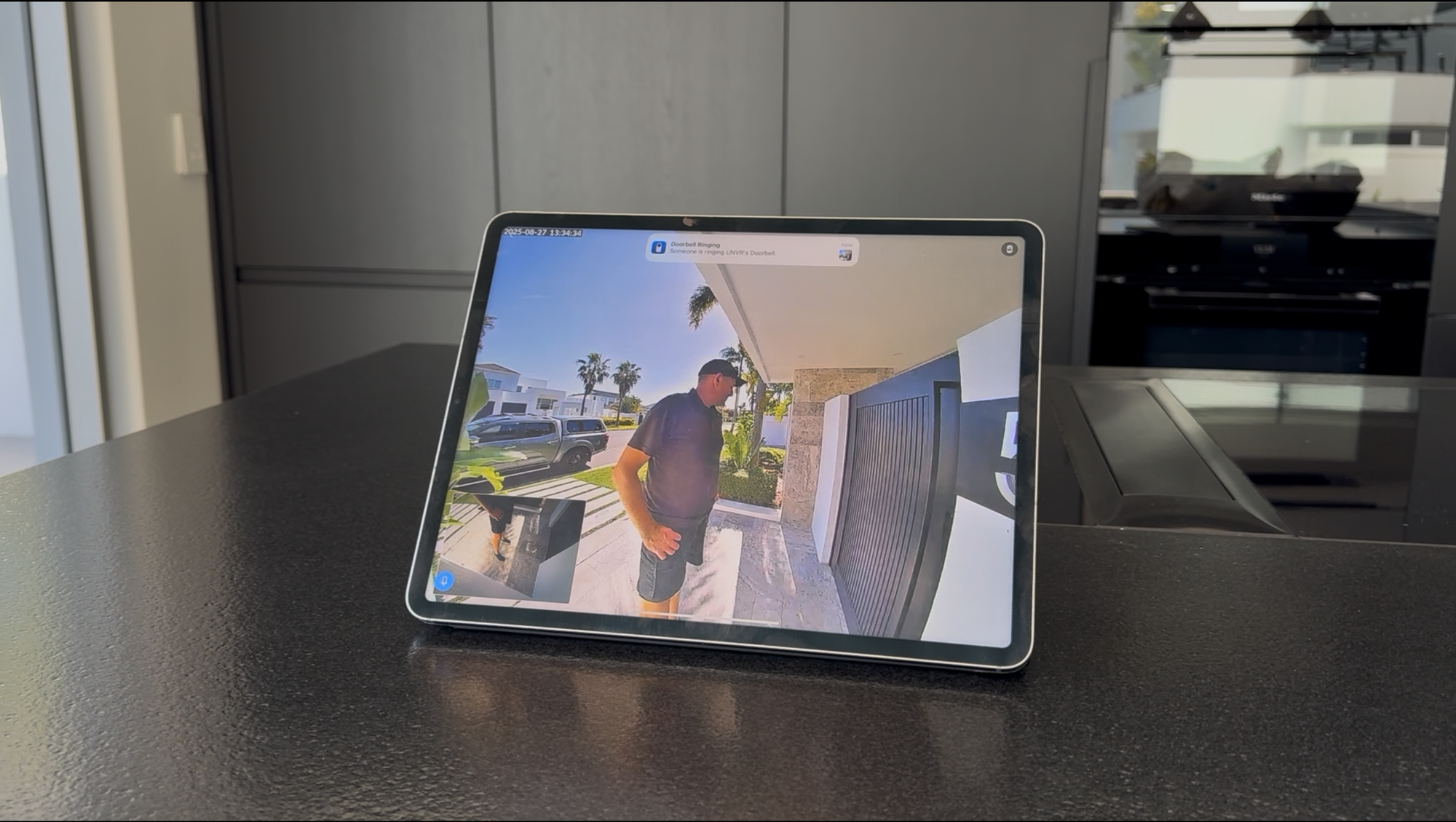
This is really helpful for figuring out which of the endless deliveries we seem to get are worth "downing tools" for and going out to retrieve mail. Equally useful is the most recent use of an AI task, recorded just today (and shared with the subject's permission):

Like packages, we seem to receive endless visitors and getting an idea of who's at the door before going anywhere near it is pretty handy. We do get video on phone (and, as you can see, iPad), but that's not necessarily always at hand, and this way the kids have an idea of who it is too. Here's the code (it's a separate automation that plays the doorbell chime):

- id: doorbell_ring_play_ai
  alias: The doorbell is ringing, use AI to describe the person
  trigger:
    platform: state
    entity_id: binary_sensor.doorbell_ring
    to: 'on'
  action:
  - service: ai_task.generate_data
    data:
      task_name: "Doorbell visitor description"
      instructions: >-
        Look at the image and briefly describe how many people you see and what they're wearing, but don't refer to "the image" in your response.
        If they're carrying something, also explain that but don't mention it if they're not.
        If you can recognise what job they might, please include this information too, but don't mention it if you don't know.
        If you can tell their gender or if they're a child, mention that too.
        Don't tell me anything you don't know, only what you do know.
        This will be broadcast inside a house so should be conversational, preferably summarised into a single sentence.
      attachments:
        media_content_id: media-source://camera/camera.doorbell
        media_content_type: image/jpeg
    response_variable: description
  - service: script.hunt_tts
    data:
      message: "{{ (description | default({})).data | default('I have no idea who is at the door') }}"

I've been gradually refining that prompt, and it's doing a pretty good job of it at the moment. Hear how the response noted his involvement in "detailing"? That's because the company logo on his shirt includes the word, and indeed, he was here to detail the cars.

This is all nerdy goodness that has blown hours of my time for what, on the surface, seems trivial. But it's by playing with technologies like this and finding unusual use cases for them that we end up building things of far greater significance. To bring it back to my opening point, IoT is starting to go well beyond the rubbish apps at the start of this post, and we'll soon be seeing genuinely useful, life-improving implementations. Bring on more AI-powered goodness for Halloween 2025!

Edit: I should have included this in the original article, but the ai_task service is using OpenAI so all processing is done in the cloud, not locally on HA. That requires and API key and payment, although I reckon that pricing is pretty reasonable (and the vast majority of those requests are from testing):

Home Assistant + Ubiquiti + AI = Home Automation Magic
❌
❌