❌

Visualização normal

Antes de ontemAnalyst
  • ✇Schneier on Security
  • How Technology Empowers—and Imperils—Dictators Bruce Schneier
    This essay was written with Seva Gunitsky, and originally appeared in Foreign Affairs. Two weeks after Moscow’s full-scale invasion of Ukraine in March 2022, the Russian TV Channel One editor Marina Ovsyannikova burst onto the set of the evening newscast. She held up a hand-drawn sign behind the anchor’s head that read: “Stop the war. Don’t believe propaganda. They’re lying to you!” She shouted, “No to war!” until she was dragged away. No one has protested the war on Russian television since the
     

How Technology Empowers—and Imperils—Dictators

8 de Outubro de 2026, 08:07

This essay was written with Seva Gunitsky, and originally appeared in Foreign Affairs.

Two weeks after Moscow’s full-scale invasion of Ukraine in March 2022, the Russian TV Channel One editor Marina Ovsyannikova burst onto the set of the evening newscast. She held up a hand-drawn sign behind the anchor’s head that read: “Stop the war. Don’t believe propaganda. They’re lying to you!” She shouted, “No to war!” until she was dragged away.

No one has protested the war on Russian television since then, partly as a result of tighter security and a general climate of fear. But in October 2024, Margarita Simonyan, one of Russia’s chief propagandists, gave another explanation. A growing number of the RT network’s anchors, she explained to an interviewer, are not real. “That face doesn’t exist. We generated the voice and everything else.” They were, she meant, produced by artificial intelligence. In a follow-up interview with the newspaper Vedomosti, she spelled out the logic: “These anchors don’t need a salary or insurance,” she said. “They won’t get arrested, and the police won’t search their homes. It’s all wonderful and terrifying at the same time.”

This is AI’s promise to every autocratic ruler: the ability to maintain control without delegating tasks to unreliable humans. It is an extremely attractive prospect. No matter how powerful, dictators have always needed subordinates—censors, propagandists, security guards, police officers, intelligence analysts, and local bureaucrats—to carry out their orders. But subordinates always pose a potential threat. They could shirk, steal, lie, leak, or conspire against their boss. As a result, one of the oldest dilemmas facing autocrats is how to empower agents to carry out orders without also enabling them to turn against their leader. Autocrats have usually managed the tradeoff by filling key positions with mediocrities whose incapacity is, as the political theorist Hannah Arendt put it, “the best guarantee of their loyalty.” But this inevitably makes it harder for dictatorships to govern and survive crises.

AI appears to offer autocrats two ways to resolve this long-standing dilemma. First, it means they can now easily monitor and discipline their followers in real time. A change in a local official’s spending habits or meeting schedules can be flagged automatically by an AI system, without any need for self-interested informants. Second, AI can eliminate underlings altogether. By automating tasks that once required human discretion, rulers can replace unreliable intermediaries with faithful algorithms that cannot be bribed or manipulated. Officials in autocratic regimes have said as much. AI “can definitely replace half of officials,” Russia’s Digital Development Minister, Maksut Shadaev, told a Moscow data forum in April 2025, adding, “maybe slightly more.”

Yet these promises of a self-running state are illusory, because AI is never truly autonomous. Systems have to be built and maintained by a cadre of engineers and data scientists whose expertise political leaders cannot evaluate. The ruler who turns to AI to reduce a dependence on unreliable humans may end up relying, more blindly than before, on the few AI specialists who keep the system running. And this new digital Praetorian Guard may have the same weaknesses as the old, which makes it a threat to the ruler.

Eyes and Ears

China is in the lead when it comes to developing AI systems that can monitor or replace subordinates. Smart city programs in Beijing, Shanghai, and other urban centers use AI to track performance and centralize oversight of local officials who once operated in comfortable obscurity, subjecting them to an algorithmic performance review. China also developed a “Zero Trust AI system,” which it deployed across roughly 30 counties and cities over the past decade. This system cross-referenced more than 150 government databases to catch embezzlement and nepotism by local officials. It worked a little too well, flagging 8,700 officials before local governments, under pressure from the bureaucrats it was monitoring, began rolling it back. But Beijing has not gotten rid of its new e-government portals, which use automated systems for issuing documents and permits, reducing face-to-face interactions that bred petty corruption or favoritism. The Chinese Communist Party, meanwhile, has plowed ahead with researching what it calls “thought management,” or how to use AI to create microtargeted propaganda. China’s army of Internet commentators, once composed of paid humans, is already being replaced by bots.

Russia has been pursuing the same goals with a similar fervor. Moscow’s citywide facial recognition system, deployed across 200,000 cameras, was used to identify and apprehend protesters during the 2021 antigovernment demonstrations. The central government has started using automated data collection and aggregation to bypass regional officials who could taint the data or use it to promote their own interests. In 2023, Russia’s Internet regulator launched Oculus, an AI system that scans hundreds of thousands of images per day for prohibited content, including political content—orders of magnitude beyond what human censors could process. The Russian security service’s Meliorator tool has been used to create over a thousand profiles of fictitious Americans, primarily on X (formerly Twitter), to spread Kremlin narratives at a fraction of the cost of human troll farms.

Other autocracies are following in Beijing’s and Moscow’s footsteps. In April 2025, the United Arab Emirates created a Regulatory Intelligence Office that uses AI to draft and amend federal laws, work once done by legislative staff. A year later, UAE Prime Minister Sheikh Mohammed bin Rashid al-Maktoum announced that autonomous AI agents would take over half of the federal government’s operations within two years and that “the performance of ministers, directors general, and entities will be assessed based on their ability to adopt this transformation.”

These innovations may reduce the number of bureaucrats autocrats need. But they cannot actually create what dictators want most: a self-running state. Even AI-generated television anchors need people to build and maintain them, and censorship systems need people to retrain them as the vocabulary of dissent shifts. Behind every AI model, there is a small group of engineers and data scientists doing essential maintenance, and their work is so technical that rulers cannot understand it.

This dependence thus becomes another form of power. The engineers who maintain an autocrat’s surveillance apparatus, for example, can shape what the ruler sees. They decide what information is important enough to pass along and in what form to present it. They determine which threats get flagged, and they can adjust the algorithms that select what content gets suppressed and who gets arrested. And they can do this without anyone in the palace noticing. Autocrats who turn to AI to escape a dependence on unreliable subordinates have only transferred their vulnerabilities onto a new group of officials.

In fact, this new Praetorian Guard could be more dangerous than previous elites. That is in part thanks to the opacity of AI technology but also because this clique is much smaller. Roman emperors typically had tens of thousands of people serving in the Praetorian Guard; modern autocrats rely on standing armies. But with AI, autocrats will need only a small clique of engineers to build and maintain large-scale AI systems. This might benefit rulers since they will have fewer people to watch, yet it also concentrates points of failure, since a devastating disruption requires only a handful of engineers and makes it easier for members to scheme against the leader. The new guard’s members may also be indispensable. A dictator can replace generals without destroying the army. But running complex machine-learning systems requires such a specialized set of skills that engineers can be difficult to replace without disruptions, giving these actors great leverage.

The Indispensables

The importance of tech workers to autocracies has already become apparent. When IT specialists began to flee Russia after the full-scale invasion of Ukraine in February 2022, for example, the Kremlin responded not with threats but with inducements, offering tech workers deferments from conscription. It exempted their firms from taxes and subsidized their mortgages. When Russian President Vladimir Putin ordered the mobilization of 300,000 men seven months later, IT workers were granted full-on waivers. This might seem like overkill, given that an AI system needs only a few engineers to run it. But a regime cannot know in advance which engineers it will need, and it cannot train replacements quickly, so it has to hold on to the entire talent pool from which these few are selected.

These measures did not stem the outflow of roughly 100,000 specialists—about a tenth of Russia’s tech workforce—over the course of 2022. But Moscow stuck to bribery, because expertise is extremely difficult to conscript at gunpoint and because conscripted experts might be less likely to do as instructed. Even so, money and privilege cannot guarantee that these elites will stay loyal. Autocrats should recall the lesson of the original Praetorian Guard: for a time, it provided Roman emperors with protection and security. But then the praetorians discovered their own indispensability, and by the second century, they were auctioning off the empire to the highest bidder. This new set of elites can do the same. In June 2023, when the column of Yevgeny Prigozhin‘s Wagner paramilitary company moved up the highway toward Moscow, Putin depended on his security services to tell him what was happening. Future rulers in Putin’s position will receive such warnings through machines: intercepted communications sorted by software, camera feeds filtered through recognition systems, regional reports compiled into dashboards. The engineers who run those systems could strike a deal with an upstart challenger and then drag their feet. They could delay the data, let alerts arrive a few hours late, degrade feeds at inconvenient moments, or make a recognition system stop functioning. In that scenario, the ruler would be operating blind. The Praetorian Guard did not need to kill Emperor Nero to replace him. It simply had to abandon him for a rival.

These programmers are unlikely to seize power for themselves, because they are unlikely to carry what coup leaders ultimately require: guns. But there is already precedent for engineers using their power to shape leadership challenges. In 1991, when the Soviet army attempted to seize control from Mikhail Gorbachev, a handful of programmers at the Relcom network kept information flowing abroad and relayed Russian President Boris Yeltsin’s decrees to audiences inside the country and abroad. The plotters could not stop the news of Yeltsin’s defiance from spreading, and the coup collapsed within three days.

Slimming Down

AI will not let autocrats dismiss all their enforcers. Someone still has to make arrests and run the prisons, and autocrats can buy loyalty by offering supporters state jobs. But it will let authoritarians downsize, and the number of officials ultimately matters less than how the ruler oversees them. Keeping track of scheming or incompetent subordinates has always been the autocrat’s chief burden. AI could lighten it, letting rulers watch their officials more closely without paying as much active attention.

In the near term, then, AI may greatly benefit autocracies. Despite the many obstacles to deployment, the technology is already bringing autocratic regimes the upsides of cheaper surveillance, smarter censorship, and fewer human subordinates to fear and distrust. But for autocratic rulers, the temptations of artificial intelligence may re-create the same trap they are seeking to escape. The more a regime depends on AI, the more it depends on the people who keep AI running. And those people, like every other praetorian class in history, will quickly discover what their indispensability is worth.

  • ✇Schneier on Security
  • Leaked Russian Cyber-Operations Training Materials Bruce Schneier
    This is interesting: The records describe a force-generation mechanism for several General Staff components, including the GRU, Main Operational Directorate, and 8th Directorate, which is associated with protected communications, cryptography, and information security. […] The reporting also linked a 2024 Department No. 4 graduate, Aleksei Kondrashov, to Military Unit 74455, widely known as Sandworm. That unit has been associated with destructive cyber activity against Ukraine and other targets,
     

Leaked Russian Cyber-Operations Training Materials

1 de Setembro de 2026, 13:29

This is interesting:

The records describe a force-generation mechanism for several General Staff components, including the GRU, Main Operational Directorate, and 8th Directorate, which is associated with protected communications, cryptography, and information security.

[…]

The reporting also linked a 2024 Department No. 4 graduate, Aleksei Kondrashov, to Military Unit 74455, widely known as Sandworm.

That unit has been associated with destructive cyber activity against Ukraine and other targets, including the 2017 NotPetya attack.

The reports do not establish that every listed graduate participated in a named operation; assignments should therefore be described as reported unit placements, not proof of individual operational involvement.

The Bauman material reframes Russia’s cyber capability as an institutional system, not merely a collection of well-known threat groups.

It suggests that Moscow has formalized a recurring pathway from university recruitment to military service, where students receive supervised technical and ideological preparation before entering intelligence, cyber, and security roles.

For defenders, the leak reinforces the need to track Russian operations as a combined threat: espionage, destructive activity, military reconnaissance, technical surveillance, and influence campaigns may draw on related personnel pipelines and overlapping doctrine.

The exposure of Department No. 4 also provides researchers with a clearer lens for understanding how the GRU sustains cyber capacity beyond the familiar APT28 and Sandworm brand names.

  • ✇bellingcat
  • Tracking a Sanctioned Russian Vessel’s West African Odyssey Bellingcat Investigation Team
    Sign up here to receive Bellingcat’s biggest investigations by email as soon as they are published. A sanctioned vessel that was previously reported to have transported weapons destined for Russian mercenaries has been traversing ports on the west coast of Africa since March, exhibiting what experts told Bellingcat  was an unusual set of movements and behaviours. Patria (IMO: 9159921) has been sanctioned by the US, Ukraine and Canada. Support Bellingcat Your donations directly c
     

Tracking a Sanctioned Russian Vessel’s West African Odyssey

25 de Agosto de 2026, 05:52

Sign up here to receive Bellingcat’s biggest investigations by email as soon as they are published.

A sanctioned vessel that was previously reported to have transported weapons destined for Russian mercenaries has been traversing ports on the west coast of Africa since March, exhibiting what experts told Bellingcat  was an unusual set of movements and behaviours.

Patria (IMO: 9159921) has been sanctioned by the US, Ukraine and Canada.

Support Bellingcat

Your donations directly contribute to our ability to publish groundbreaking investigations and uncover wrongdoing around the world.

Radio France International (RFI) reported last year that it was one of two ships to deliver weapons to Conakry in Guinea that were intended for the Kremlin-controlled Africa Corps and their operations in Mali.

Satellite imagery and Automated Identification System (AIS) data from Lloyd’s List Intelligence shows Patria has shuttled between the Port of Douala in Cameroon and the Port of Owendo in Libreville, Gabon four times since March. 

It has also twice stopped in anchorage off the coast of Lagos, Nigeria: first in March and then again at the time of publication. Analysis shows the vessel also spent time in anchorage off the coast of Equatorial Guinea. 

The online news site, Modern Ghana, first reported Patria’s presence off the coast of Lagos in July after X-users @SONNAROW_OSINT and @RFNOSBlog picked up on Patria’s position.

It is not clear what Patria has delivered or picked up at these ports. Nor is it clear why it has spent so long going back and forth between them. But experts Bellingcat spoke to said the unusual patterns of behaviour raised numerous questions.

Charlie Brown, a former US Naval Officer and Senior Advisor at United Against Nuclear Iran said the combination of Patria’s repeated regional port calls, extended periods at anchor, and an apparent absence of a normal point-to-point trading cycle warranted scrutiny, especially as the ship is under sanction and is previously reported to have shipped arms. 

Tracking the Patria

Patria is a cargo vessel that has a distinct shape and features. Its bridge is located on the bow and it has a bright red deck that contrasts with its blue hull and two yellow cranes. 

At the end of the deck, the ship has a built-in ramp for vehicles (the Patria is a so-called roll on/roll off, or RoRo, vessel that is designed to transport wheeled vehicles). Its chimney is located next to the ramp.

Footage of the Patria, posted on Youtube on Jan 22, 2024. Credit: Hanro Shipping – Sakhalin Projects LLC / YouTube Channel @hanroship

This, in combination with the length of the ship (101 m), allowed Bellingcat to pick the vessel out in satellite imagery. AIS data helped us further track its long journey which began in the Sea of Japan, in Russia’s far-east, in January.

For the most part, we were able to match Patria’s AIS position with corresponding satellite imagery. We found no evidence of obvious spoofing incidents (where a ship intentionally broadcasts misleading AIS data) by the vessel during its months-long voyage, however, there were some instances where satellite images were not available and thus spoofing by the vessel cannot be completely ruled out.

MapLibre | Protomaps© OpenStreetMap contributors

Port of Olga, Russia

AIS data indicates that Patria loaded at the Port of Olga in the Sea of Japan between Jan. 21 and 23. Patria can also be seen on satellite imagery on these dates.

Credit: Planet Labs PBC.

Port of Douala, Cameroon

AIS data indicates that Patria unloaded some cargo in the Port of Douala between Mar. 11 and 12. Again, the ship can also be seen in satellite imagery on these dates.

Credit: Planet Labs PBC.

Lagos Anchorage, Nigeria

AIS data indicates Patria anchored off the coast of Lagos from Mar. 14 to 15.

A Sentinel-2 image from the 15th appears to show another ship next to Patria. AIS data indicates that this is JS Gratitude, a bunkering tanker. This close proximity suggests that Patria was refuelling.

Credit: Contains modified Copernicus Sentinel data 2026.

Bata Anchorage, Equatorial Guinea

AIS data and satellite imagery indicate Patria stayed off the coast of Equatorial Guinea for several days.

Credit: Planet Labs PBC.

Port of Owendo, Libreville, Gabon

AIS data and satellite imagery indicate Patria loaded at the Port of Owendo in Libreville after spending a few days off the coast.

Credit: Planet Labs PBC.

Port of Douala, Cameroon

AIS data and satellite imagery indicate Patria stayed at the Douala Anchorage from Apr. 6 to 14, before unloading at the Port of Douala between Apr. 14 and 18.

Credit: Planet Labs PBC.

Port of Owendo, Libreville, Gabon

AIS data suggests Patria loaded in Libreville again between Apr. 22 and 26.

Port of Douala, Cameroon

AIS data, supported by satellite imagery, indicates Patria stayed at the Douala Anchorage for nearly a month from Apr. 27 to May 21 before unloading in Douala from May 21 to 27.

Credit: Planet Labs PBC.

A third trip between the Port of Owendo, Libreville to Douala, Cameroon

AIS data indicates, after nearly a month’s wait in Douala anchorage, Patria again loaded at Owendo before returning to Douala to unload.

A fourth trip between the Port of Owendo, Libreville to Douala, Cameroon

AIS data indicates Patria again loaded at Owendo before returning to Douala to unload.

Lagos Anchorage, Nigeria

AIS data indicates, after a short visit to the Libreville anchorage, Patria anchored off the coast of Lagos where it remained at the time of publication.

Credit: Planet Labs PBC.

Examining the Patria’s Draught

We reviewed the draught of the ship at each port visit and found that the ship’s draught always dropped after a stay at the Port of Douala, suggesting it was unloading there.

A ship’s “draught” is the distance from the bottom of the hull (the keel) to the waterline. When loaded, a ship is heavier and sits lower in the water (e.g. a draught of six metres) than when it is unloaded (e.g. a draught of four metres).

Draught is the depth of a ship below the waterline. 

In the period from March to July, the Patria made five port calls to Douala and each time the draught decreased. Conversely, it called four times at the Port of Owendo in Libreville, each time the draught increased, meaning the ship became heavier, suggesting it was loading.

The draught is self-reported by ships but usually when it arrives at ports this kind of data is checked – reporting accurate draught is also a safety issue for ships arriving and departing at ports. 

Bellingcat asked the ship’s owners, managers and both ports if items were being transferred from Libreville to Douala but did not receive a response at time of publication.

Brown, the former US Naval Officer and now a Senior Advisor at United Against Nuclear Iran, said Patria’s movements were unusual.

“A sanctioned vessel linked to a prior military logistics shipment spending nearly six months operating between a small cluster of West African ports, Douala, and Owendo, without returning to a clear commercial trading pattern warrants scrutiny,” Brown told us.  


“While innocent explanations such as mechanical issues, commercial disputes, lack of cargo, chartering delays, or prolonged maintenance are possible, the combination of repeated regional port calls, extended periods at anchor, and an apparent absence of a normal point-to-point trading cycle is atypical for a merchant vessel.” 

He added that the current period of more than 30 days at the Lagos Anchorage, in particular, is noteworthy. 

David Soud, Head of Research and Analysis at I.R Consilium also told Bellingcat that Patria’s prolonged Lagos Anchorage could have innocent explanations such as its need for ongoing repairs, or that its operators were out of money, but added that there could also be more calculated reasons and it was laying low for a while.

Bellingcat analysed AIS data from Lagos Anchorage and found that while there has been high congestion, no other RoRo or container vessel waited longer than 10 days to enter the port in the period that Patria has been at Lagos Anchorage. At time of writing, Patria has been in anchorage for more than 30 days.

Regarding the Patria’s apparent deliveries of cargo between Libreville in Gabon, and Douala in Cameroon, Soud told Bellingcat:

“Given the vessel’s history of transporting military equipment to African seaports for overland delivery to Russian and allied forces in the Sahel, it’s not out of the question that some form of supplies for Russian or other forces could be picked up in Gabon, whose government has developed a closer relationship with Moscow, to be discharged in Douala, which is the main entry point for goods going to Central African Republic.”

Bellingcat asked the Nigerian Ports Authority why Patria had been in anchorage for so long, whether it had applied to dock and whether the port was aware of its sanctioned status but did not receive a response at time of publication.

The ports of Douala in Cameroon and Owendo in Libreville, Gabon did not respond to Bellingcat’s requests for comment about the Patria’s visits and the cargo it was carrying.

Bellingcat also contacted the two companies connected to the vessel – Hanro Shipping and Sakhalin Shipping Company which are listed as the vessel’s owner and manager respectively in sanctions documents. We also contacted the company connected to JS Gratitude. We did not receive a response at time of publication.


Youri van der Weide, Galen Reich, Yörük Işık contributed to this report.

Cover image: Planet Lab image shows the Patria at the Port of Douala, Cameroon, on April 17, 2026. Credit: Planet Labs PBC.

Bellingcat is a non-profit and the ability to carry out our work is dependent on the kind support of individual donors. If you would like to support our work, you can do so here. Subscribe to our Newsletter and follow us on Bluesky here, Instagram here, Reddit here and YouTube here.

The post Tracking a Sanctioned Russian Vessel’s West African Odyssey appeared first on bellingcat.

  • ✇bellingcat
  • Heading Off: New Technique Helps Track Grain Smuggling Expansion to Libya Bellingcat Investigation Team
    On February 15, 2026, the bulk carrier, Grumant (IMO: 9385879) was pictured at the occupied Ukrainian Port of Feodosia on the Crimean peninsula. Satellite imagery suggests it had already been there for several days.  It appeared to stock up on grain before departing on a two-month-long journey eventually docking at the Port of Benghazi in Libya on April 18. While there have been previous reports of grain shipments from occupied Ukraine arriving in Libya, this is only the second time a Russian
     

Heading Off: New Technique Helps Track Grain Smuggling Expansion to Libya

12 de Junho de 2026, 05:51

On February 15, 2026, the bulk carrier, Grumant (IMO: 9385879) was pictured at the occupied Ukrainian Port of Feodosia on the Crimean peninsula. Satellite imagery suggests it had already been there for several days.  It appeared to stock up on grain before departing on a two-month-long journey eventually docking at the Port of Benghazi in Libya on April 18.

While there have been previous reports of grain shipments from occupied Ukraine arriving in Libya, this is only the second time a Russian ship has been observed delivering what the Ukrainian government describes as “stolen” grain to the country. The previous case involved the Damas Wave which travelled in January of last year to the port of Misrata which is under the control of the UN-recognised Government of National Unity (GNU). In addition to satellite imagery, Bellingcat deployed a new technique that analysed Grumant’s heading data which was contained in AIS information provided by Lloyd’s List Intelligence, to help confirm Grumant’s presence in Feodosia. 

Bellingcat has been tracking smuggled Ukrainian grain shipments as they find new markets, five of the ships we previously identified have since been sanctioned by the EU while another was sanctioned by the US Department of Treasury.

MapLibre | Protomaps© OpenStreetMap contributors

Bosphorus Strait

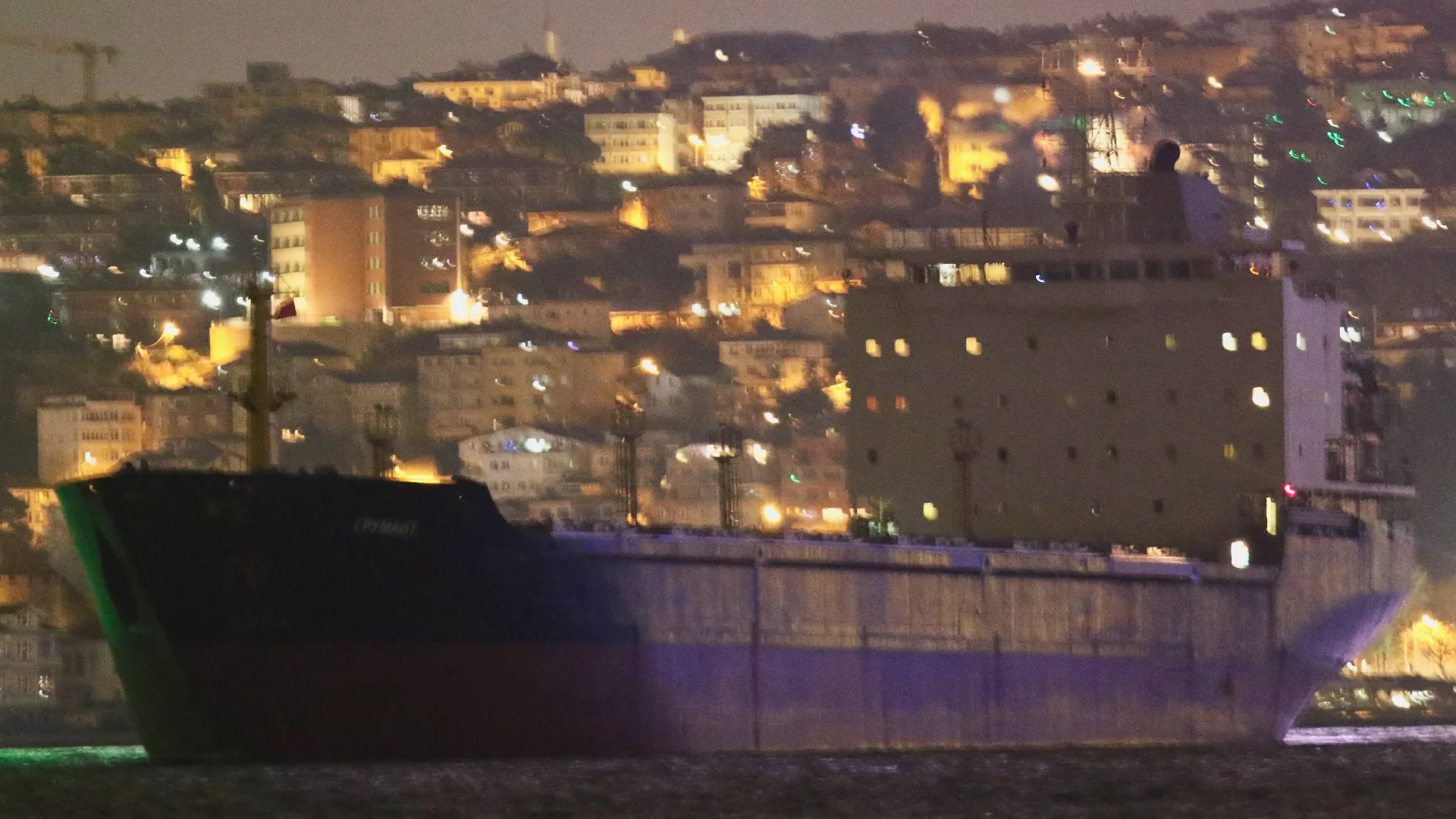
Grumant transits the Bosphorus Strait in the middle of the night.

Credit: Yörük Işık.

Black Sea

Grumant enters a region of the Black Sea known for GNSS interference, meaning that Grumant’s publicly reported Automated Identification System (AIS) position is unreliable.

Port of Feodosia

On February 15, a high resolution satellite image confirms the ship is docked at the port of Feodosia at berth No. 1 that is used for bulk and metal cargo. Matching features visible include Grumant’s grey decking, its seven hatches and bright yellow front mast. What appears to be leftover grain can be seen under the two port crates, immediately next to the ship.

Credit: Satellite image ©2026 Vantor.

Black Sea

Grumant exits the area of signal interference, meaning that its reported position on ship tracking services is now reliable again. Its AIS messages indicate it is travelling towards the Bosphorus.

Bosphorus Strait

Grumant transits the Bosphorus Strait towards the Sea of Marmara. Judging by the draft, with no visible red paint on its hull, the ship appears to be fully laden.

Credit: Yörük Işık.

Izmir Anchorage

Grumant arrives in Izmir, Turkey on February 23 and anchors off the coast until March 13.

Over the course of three weeks, Grumant never enters the Port of Izmir. It is not known if it was denied entry. Bellingcat asked the port operators but did not receive a response before publication.

Credit: Planet Labs PBC.

Aliağa

Grumant then loiters off the coast of Aliağa, about 50 km from Izmir. It stays here until March 16, never entering the port. It again is not known if it was denied entry. Bellingcat asked the port operators but did not receive a response before publication.

Near Benghazi

Grumant arrives in Libyan waters and stays off the coast of Benghazi until April 1.

Libyan Waters

Grumant briefly leaves the coast of Benghazi, but returns a few days later.

Benghazi

Grumant leaves the anchorage on April 18 and docks at the port of Benghazi where it unloads the grain. The ship was captured in a Vantor satellite image on April 20.

It leaves port on April 23, and heads back towards the Bosphorus.

Credit: Satellite image ©2026 Vantor.

Bosphorus Strait

After spending a few days off the coast of Tuzla, Grumant transits the Bosphorus towards the Black Sea.

Credit: Yörük Işık.

Lloyd’s List Intelligence has previously reported on the expansion of Russia’s grain smuggling operations, beyond the occupied port of Sevastopol to include Feodosia port. 

According to the Ukrainian activism, journalism and hacker group, Kiborg News, Grumant used deceptive shipping practices to deliver grain to Latakia, Syria in 2024. The report included several of Grumant’s shipping manifests, which showed it had repeatedly exported grain from Occupied Crimea to Syria. 

Heading Data Helps Locate Grumant

It is standard maritime practice that ships broadcast Automatic Identification System (AIS) messages which include a ship’s position, heading, and draught (among other information).

Because of longstanding Global Navigation Satellite System (GNSS) interference in parts of the Black Sea, the position data transmitted by an affected ship’s AIS system is often unreliable.

Between February 7 and February 19, 2026, data from Lloyd’s List Intelligence shows the Grumant transmitted 29 AIS messages, with unreliable positions in the vicinity of Feodosia. We know these positions are unreliable as they are erratic and some of them report the ship as being positioned on land.

Unreliable AIS positions – Grumant’s reported positions between February 7-19, 2026, via Lloyd’s List Seasearcher.

However, according to the IMO, the heading data transmitted by a ship’s AIS system must come from an onboard compass. A compass is unaffected by GNSS interference, meaning it is a more reliable source of information in these conditions.

Over the same dates, all 29 AIS messages reported the ship’s heading as 267 degrees or 268 degrees. The Port of Feodosia has a heading of 267.5 degrees. The close agreement between the ship’s heading and port heading strongly suggests that Grumant was moored at the port between February 7 and February 19, 2026.

We conducted an extra check of the heading data by reviewing satellite imagery available of berth 1 at Feodosia Port, which suggests that the same vessel was present on several days between February 6 and February 18. Imagery on Feb. 6 shows the port was empty in the morning and occupied in the afternoon. Grumant exited the area of GNSS interference on February 21, and berth 1 at the port was captured on satellite image on February 22 and appeared empty. The low resolution satellite imagery is only used as an additional check to see if a vessel is at the berth.

Timeline of open source observations related to Grumant’s presence (tick) or absence (cross) at Feodosia port. Empty entries indicate a lack of available data.
Sentinel-1 timelapse of Feodosia Port, Copernicus Sentinel data 2026. Annotations by Bellingcat.
PlanetScope timelapse of Feodosia Port, Planet Labs PBC. Annotations by Bellingcat.

Bellingcat checked all vessels transmitting AIS in the vicinity of Feodosia Port and found that Grumant was the only one that consistently transmitted a heading matching the Port of Feodosia over the period of interest.

We shared our research with Charlie Brown, a former US Naval Officer and Senior Advisor at United Against Nuclear Iran where he focuses on maritime sanctions enforcement and the tracking of illicit shipping. Brown told Bellingcat that while satellite imagery of vessels remained key for identification, when looking for reliable data in a spoofing environment it made sense to look at the various elements of AIS data to try and find some accurate information, despite GNSS spoofing.

“It’s quite standard for the independent gyro compass to be providing the heading […] I think the majority would not [be subject to spoofing] so it’s a good methodology to parse out the particular data and then make some inferences from that.”

“It’s neat to think of what can be derived from data that would otherwise be dirty or wrong. So there’s still some elements of use in there.”

He added that in theory there are probably some compasses that are subject to spoofing as well. 

He told Bellingcat that it was fair to say the heading data of the Grumant supported identification, but stressed the need to cross-reference with other data sources. 

While in this instance it has been possible to use AIS data to help verify the location of Grumant, it is relatively unusual to have access to this information. 

Ships that call to the occupied territories frequently disable their AIS transponders to do so.

This activity, known as “dark port calls”, is a common tactic for those engaging in illicit or sanctioned trades. 

Grumant does not transmit AIS messages from February 8 to 11, but this is the longest gap in data (see diagram above), with intermittent messages coming through after that point.

It is unclear why Grumant continued to transmit AIS during the period it was loading in Feodosia. 

A review of Lloyd’s List Intelligence data from January 2025 shows that on a previous voyage to the Black Sea the Grumant operated “dark” for 59 days.  

Visual Identification

On February 15, 2026, high resolution imagery showed Grumant docked in the Port of Feodosia. We compared it with other recent images of Grumant to confirm the match. 

The ship in the satellite image has a grey-coloured deck, which is uncommon enough for it to stand out. Many bulk carriers have cranes (including the ships we previously covered such as Krasnodar, Zafar and Zaid), Grumant does not have any. It also has seven hatches (openings for the grain) and a bright yellow front mast that matches the mast of Grumant (see the image of it transiting the Bosphorus). We can match the Grumant in the Feodosia image, not only to pictures of the Grumant shot from the ground, but also to the satellite image from Benghazi.

The length and breadth of the ship also matches that of the Grumant; 180 metres by 22.90 metres. 

Above: Image of the Grumant transiting the Bosphorus. (In yellow: the mast, red: the seven hatches, green: four vent masts, two on either side). Credit: Yörük Işık. Middle: Satellite image of the Grumant in Feodosia on February 15, 2026. (Matching elements are denoted in the same way as the image above). Bottom: Grumant captured at Benghazi port on April 20. Credit: Satellite image ©2026 Vantor. Annotations by Bellingcat.

Libya’s Relationship with Russia and Ukraine 

Libya has complicated internal dynamics with essentially two administrations in charge of different parts of the country – the Government of National Unity (GNU) in the west and the Libyan National Army (LNA) in the east.

In recent years, Russia has backed the LNA’s General Khalifa Haftar, based out of Benghazi, in the east of the country. But Jalel Harchaoui, a political scientist specialising in Libya with the Royal United Services Institute (RUSI), stressed that the two sides of this conflict, the LNA and the UN-recognised GNU, are not currently fighting. Instead they are in a flawed, multi-year truce.

Therefore, the east-west divide isn’t as clear-cut as during the civil war. While all shipments going to Benghazi and Tobruk are overseen by the LNA, not all shipments going to the city of Misrata (which is run by the GNU) are meant for the GNU-dominated part of the country. 

Harchaoui told Bellingcat: “the Tripoli government is in some regards pro-Ukraine, but if there’s business that can be done with Russia through the very opaque port of Misrata and all the right people get paid, the business is going to take place.”

That observation is potentially significant given at least one previously tracked vessel that went from occupied Ukraine to Libya docked in Misrata.

This was not the case of the Grumant, however, which arrived in an LNA-controlled part of the country. It is not known from open sources alone if the authorities in Libya or at the port in Benghazi knew the grain carried by Grumant had come from occupied Ukraine.

Bellingcat contacted the Benghazi-based LNA government and representatives of the Tripoli-based GNU government via the Libyan Embassy in The Netherlands. We also contacted the Port of Benghazi, Port of Imzir in Turkey as well as the Ukrainian and Russian authorities. Representatives of the LNA did not respond to requests for comment before publication, nor did the Port of Benghazi or Port of Izmir. The Libyan Embassy in The Netherlands replied to Bellingcat after publication, stating that Benghazi and eastern Libya are not under the authority or administrative control of the Government of National Unity and therefore they are not currently in a position to comment on Bellingcat’s findings.

Ukraine Continues to Pursue the “Shadow Grain Fleet”

“The port of Feodosia, located in the temporarily occupied Autonomous Republic of Crimea, is not under Ukrainian control, and any commercial activity conducted there is illegal,” the Ministry for Development of Communities and Territories of Ukraine and the Ministry of Foreign Affairs of Ukraine told Bellingcat in a joint response. 

They told us the loading of grain exported from the temporarily occupied territories is an illegal act and Russia was using ports as logistics centers to export stolen Ukrainian agricultural products.

“The expansion of such routes to third countries, in particular to North Africa, demonstrates Russia’s ongoing efforts to circumvent international sanctions and monetize resources stolen from the occupied Ukrainian territories.” 

The Ukrainian Ministry of Foreign Affairs sent information about Grumant’s (IMO: 9385879) “illegal activities” to the diplomatic missions in Great Britain, the Republic of Turkey and the Republic of Tunisia over the course of March to May this year, the ministries told Bellingcat. 

Ukraine is continuing to pursue legal action against Russia’s “shadow grain fleet” they told us. For instance, earlier this month a Swedish court approved the transfer of the Russian “shadow grain fleet” vessel CAFFA to Ukraine for investigation after it was arrested in Swedish waters. 

This case has set a new precedent, going beyond sanction and fines previously handed out to such vessels, and allowing for the detention and confiscation of a shadow fleet vessel in European jurisdictions, the ministries said.

According to Russian court documents Grumant’s previous owner Murmansk Shipping Company was dissolved and “Decision/Reshenie” LLC were listed as the International Safety Manager and operator of Grumant. Decision/Reshenie were also listed as the operator of Grumant in another court document, from an unrelated case. 

Bellingcat attempted to contact Decision/Reshenie to ask about Grumant’s grain shipment from Feodisia Port to Benghazi Port, but they had not responded at time of publication.


Youri van der Weide, Galen Reich, Yörük Işık and Bridget Diakun contributed to this report.

Cover image: Planet Lab image shows Grumant anchored off Izmir, Turkey on February 27. Credit: Planet Labs PBC.

Bellingcat is a non-profit and the ability to carry out our work is dependent on the kind support of individual donors. If you would like to support our work, you can do so here. You can also subscribe to our Patreon channel here. Subscribe to our Newsletter and follow us on Bluesky here, Instagram here, Reddit here and YouTube here.


The post Heading Off: New Technique Helps Track Grain Smuggling Expansion to Libya appeared first on bellingcat.

  • ✇bellingcat
  • Tracing Digital Links Between Viory and Ruptly Lucy Swinnen
    “In the age of misinformation, the line between fact and fiction is blurrier than ever.” “For those of us working in video news, verification isn’t a nice-to-have. It’s a necessity. It is how we protect the stories we help shape and how we earn and maintain trust in an increasingly chaotic information ecosystem,” Abu Dhabi-registered video news agency Viory posted on LinkedIn on April 9, 2026, offering training to help newsrooms and journalists sort fact from fiction.  The self-described “
     

Tracing Digital Links Between Viory and Ruptly

4 de Junho de 2026, 09:27

“In the age of misinformation, the line between fact and fiction is blurrier than ever.”

“For those of us working in video news, verification isn’t a nice-to-have. It’s a necessity. It is how we protect the stories we help shape and how we earn and maintain trust in an increasingly chaotic information ecosystem,” Abu Dhabi-registered video news agency Viory posted on LinkedIn on April 9, 2026, offering training to help newsrooms and journalists sort fact from fiction. 

The self-described “video news agency of the Global South” has delivered journalism training to multiple national press agencies across Africa, Asia and the Middle East.

However, when it comes to Viory itself, the line between fact and fiction is very blurry indeed. 

Bellingcat has found multiple links between the digital infrastructure of Viory and Ruptly news agency, a branch of sanctioned Russian propaganda outlet Russia Today, including shared IP addresses, a Viory-linked site using a digital security certificate registered to Ruptly, and Ruptly sending site performance data to Viory. While there have been previous reports on suspected links between the two outlets, our investigation adds new evidence about Viory’s ties to Ruptly media. 

When contacted for comment, both Viory and Ruptly denied any connection with each other.

Composite Image created by Bellingcat.

‘Video News Agency of the Global South’

Viory’s main offering is raw video footage of news events provided via subscription. According to Viory, its clients include “major international news outlets, local media organisations, and independent creatives in more than 170 countries”.

If its own figures are to be believed, Viory was strikingly well established at its launch in November 2023, by which time it claimed to have a “pre-assembled team of over 150 full-time staff, and an established network of over 3,000 video journalists across the world”.

The name “Viory” is a trade name. The company’s legal name is Darpo Vision FZ LLC, according to its website, which also states that it is registered in Abu Dhabi. In August 2024, Darpo Vision FZ LLC filed for a trademark in the US for the name Viory, which was approved in December of 2025. 

As of May 2026, Bellingcat found press releases and news reports referencing at least 30 agreements between Viory and partners in more than 22 countries, as well as cooperation agreements with government agencies, training agreements with universities and regional journalism bodies. 

This includes:

Viory also sponsored a glitzy event for its inaugural Global South Video News Awards in December 2025 at Abu Dhabi’s first-ever BRIDGE Summit.

Ruptly Revisited

Ruptly is a video news agency formerly based in Berlin and ultimately controlled by Russia Today (RT), which is owned by Russian state media company ANO TV-Novosti. ANO TV-Novosti has been on the EU sanctions list since December 2022 for spreading “pro-Kremlin propaganda and disinformation” and supporting Russia’s war against Ukraine. 

RT launched Ruptly, which operated in Berlin via a German-registered subsidiary in 2013, with the goal of “becom[ing] the go-to alternative resource in a highly concentrated market of professional news video footage, and to deliver coverage of stories that other agencies miss.”

Sanctions imposed on RT following Russia’s 2022 invasion of Ukraine choked off Ruptly’s source of funds in Germany, leading the German company to begin insolvency proceedings in October 2024. Ruptly continues to operate from Moscow as of 2026.

As with Viory, Ruptly’s main offering is providing raw news footage to subscribers around the world. It relies on a large network of international freelancers and stringers. In 2016 RT claimed that Ruptly had “surpassed” newswire services AFP and Reuters on YouTube, and was serving more than 600 media organisations in 45 countries.

Felix Huesmann of the German outlet RedaktionsNetzwerk Deutschland (RND), was the first to outline links between Ruptly and Viory while covering the insolvency proceedings of Ruptly. He found that Darpo Vision’s original details on the Abu Dhabi Creative Media Authority’s site included an email address d.toktosunova@gmail.com. It has not been confirmed who this email address belongs to; however, the username matches the first name initial and surname of Dinara Toktosunova, the managing director of Ruptly. When asked about this email address by Huesmann  in 2024, Ruptly “explained that Toktosunova is focused on securing the future of the Ruptly team [in Moscow] and is not working anywhere else as a managing director.”The activist group, OSINT For Ukraine, also outlined links between Ruptly and Viory, including the movement of multiple key staff between the two organisations and strong similarities between the two organisations’ platforms and content.

Darpo Vision’s Security Certificate

The legal entity behind Viory, Darpo Vision, was set up in one of Abu Dhabi’s free zones – special economic areas that have business-friendly incentives such as tax exemptions and that allow 100 percent foreign ownership. The free zones also offer what some describe as high levels of “corporate privacy,”  which others assert has created a haven for shell companies and opaque corporate structures.

Darpo Vision initially had its own web domain, darpo.vision. The site has since been removed. Whois records show that the domain was registered by Darpo Vision FZ LLC in December 2022 to a PO Box in Abu Dhabi, using a Russian domain name registrar and a Moscow phone number. 

Initially, Darpo.vision had its own Secure Sockets Layer (SSL) certificate – a digital certificate that authenticates a website’s identity, allowing it to secure and encrypt data. However, VirusTotal data shows that as of at least June 2024, darpo.vision was using a wildcard SSL certificate registered to ruptly.video. A Wildcard SSL certificate is a single certificate with a wildcard character (*) in the domain name field. This allows the certificate to secure a single domain and multiple subdomains. You can see historical SSL certificates for darpo.vision.


James Wilson, a software and networking engineer with 20 years of experience and currently Enterprise Technology editor at Risky Business Media, told Bellingcat that to prevent unauthorised use or forgery of SSL certificates, a private key is needed to create and use a wildcard certificate across multiple domains. 

“The fact that darpo.vision was using a wildcard SSL certificate for ruptly.video indicates that whoever was running darpo.vision also had access to the private key for ruptly.video’s SSL certificate. Normally, only the people operating Ruptly’s web hosting infrastructure would be likely to have access to that,” Wilson explained. 

When asked by Bellingcat about whether there were alternative possible explanations, Wilson suggested that it was theoretically possible that someone may have hacked Ruptly and stolen their private SSL key. 

“However, using that wildcard SSL certificate on a domain that didn’t match the wildcard in the certificate defies explanation as the browser would alert the user to the certificate error,” he added.

Shared IP Addresses

Bellingcat also identified multiple shared IP addresses which appeared to be concurrently in use by both Ruptly and Viory between May 2025 and May 2026. 

From 2025 onwards, the Russian IP address 158.160.132.25 has been used concurrently by viory.video, ruptly.video, ruptly.agency and ruptly.tv, according to VirusTotal. Similarly, since the beginning of 2026, IP address 84.252.135.88 has been used concurrently by viory.video, viory.team, ruptly.video, ruptly.agency and ruptly.tv, according to VirusTotal. 

VirusTotal data shows that from 2025 onwards, IP address 158.160.166.22 has been used by ruptly.video and viory.video while from 2026 onwards, IP address 158.160.226.68 has been used by viory.video and ruptly.tv. The VirusTotal data appears to show these IP addresses being used exclusively by Ruptly and Viory as of 2025 and 2026. However, VirusTotal does not necessarily capture all domains which resolve to an IP, and other domains may also have resolved to these IP addresses, which were not observed by VirusTotal’s passive DNS replication service. It is also important to note that in some cases, unrelated domains use the same IP addresses.

Ruptly Sends Site Performance Data to Viory

Viory’s and Ruptly’s site infrastructure was also linked through data sent via Sentry, an internal error tracking and performance monitoring platform. 

An API scan of Ruptly’s main client login page, ruptly.agency, on March 26, 2026, shows that the page was sending data to a subdomain of viory.team. This domain appears to be used by Viory primarily for backend purposes, based on subdomains which appear to refer to common developer and site management tools such as Traefik and ArgoCD, in addition to Sentry.io. Notably, two subdomains also appear to refer to Ruptly. 

The purpose of one domain sending data to another domain’s Sentry project is generally to consolidate all of the relevant performance and error data in one place for in-house developers to monitor. 

The ruptly.agency page’s request to viory.team also includes an authentication key for Viory’s Sentry project. Ruptly.agency is not the only Ruptly domain sending Sentry data to viory.team. As of May 9, 2026 the login page for ruptly.video’s own Sentry project, sentry.ops.ruptly.video, automatically redirects to sentry.ops.ruptly.video/auth/login/viory/. Ruptly Video’s Sentry login page also features “Viory” as the title.

The ruptly.video Sentry login page is also sending data to the viory.team Sentry project, the ruptly.agency homepage and using a favicon hosted on viory.team.

A third Ruptly domain, ruptly.tv, also sends performance data to viory.team’s Sentry project via cms.dev.ruptly.tv. 

James Wilson noted that in each case, the Ruptly domains sending data to Viory appeared to be using a different Sentry key.

“If you look at each of these snippets sending telemetry data [from the Ruptly domains], the specific Sentry keys for sentry.ops.viory.team are different for each. I presume that someone with access to Viory’s Sentry keys has generated and included fresh Sentry keys in each of these instances in order to differentiate between the telemetry from this site versus others using the same Sentry instance,” Wilson said. 

“This cuts against the idea that this is, for example, a case of someone just lazily copy-pasting code on Ruptly’s domains. It suggests that each of these snippets was likely to have been deliberately included. The alternative explanation of changing these API keys to some arbitrary value seems much less plausible given the lack of diligence in ensuring other aspects of the content didn’t cross-reference the domains.”

‘Ruptly’ Page Title on Viory Test Page

Finally, Bellingcat found a page at frontend.dev.viory.video/en that appears likely to be a developer test page for the front page of Viory’s main domain viory.video.

Notably, however, the page title reads “Stream trending news | Ruptly.” The page description included in the source code also refers to Ruptly:  

“Follow breaking world news in real-time and stream the latest developments in politics, sports, finance, science, tech, and more from one of the top online news sites. Download and share international news today with award-winning news agency Ruptl” [sic].

Screenshot of frontend.dev.viory.video/en page, captured May 10th 2026. Archived source.

Wilson said that the use of the Ruply page title and text on the Viory test page “looks like a case of lazy copy and pasting”.

“That could potentially be done by someone outside of Ruptly, although it would be strange.”

While this particular piece lies on the lower end of the spectrum of proof, Wilson said that together with the other stronger pieces of evidence, including multiple Ruptly domains appearing to send data to Viory using different API keys, and Ruptly’s wildcard SSL certificate on Darpo Vision’s site, the weight of evidence for a connection between Ruptly and Viory adds up.

“None of the pieces of evidence are watertight on their own, but when you add them together it’s difficult to think of other plausible explanations for all of them being true at the same time,” he added.

“None of the pieces of evidence are watertight on their own, but when you add them together it’s difficult to think of other plausible explanations for all of them being true at the same time,”

-James Wilson

Bellingcat also found that Ruptly appears to have connections to a company in Hong Kong. Company records from July 2022 indicate that this company was originally named Ruptly Limited, but in September of that year, the company’s name was changed to Lotus Production Limited. 

The Hong Kong company remains registered as active and filed annual reports in September 2025.

Russian Slant in the ‘Global South’ 

Anna Hiller, a Bangkok-based Consultant Research Analyst for the Institute for Strategic Dialogue told Bellingcat that the resources provided by Viory can be an attractive pool of source material for smaller media outlets, governments and academic institutions with small budgets.

She told Bellingcat that Viory’s editorial choices are clear when looking at the site’s videos.

“When accessing Viory, the prominence of pro-Russian and pro-China content is immediately noticeable, including numerous articles focused on Vladimir Putin, Russia-China cooperation, and broader China-related narratives.”  

Bellingcat contacted Viory, Darpo Vision and Lotus Production Limited to ask about the connections we found between the Viory website and Ruptly and between Lotus Production Limited and Ruptly. 

Viory said that it had no connection with Ruptly. “Viory has no connection with Ruptly; any suggestion otherwise based on ordinary use of similar digital platforms, tools or cloud providers is poorly founded and inaccurate; Viory is a UAE-based, privately held, self-funded and 100% privately owned organisation, and receives no funding, direction or instructions from any state media,” the company said in an email response. 

Ruptly also said it was not connected to Viory. It declined to respond to Bellingcat’s questions, including about specific findings such as Ruptly’s domains sending technical performance and error data to Viory, calling these questions “irrelevant”.


Bellingcat is a non-profit and the ability to carry out our work is dependent on the kind support of individual donors. If you would like to support our work, you can do so here. You can also subscribe to our Newsletter and follow us on Bluesky here, Instagram here, Reddit here and YouTube here.

The post Tracing Digital Links Between Viory and Ruptly appeared first on bellingcat.

  • ✇bellingcat
  • Banned Russian Submunitions Found After Mali’s Military Announces Airstrikes Sebastian Vandermeersch
    This investigation is a collaboration between Bellingcat and Jeune Afrique. You can read Jeune Afrique’s article in French here. Unexploded Russian-made cluster munition bomblets, as well as damage consistent with bomblet impacts, have been found in a village in northern Mali – despite the West African country being a state party to the Convention on Cluster Munitions (CCM) which prohibits their use.  The deployment of cluster munitions in northern Mali was first reported by Radio France I
     

Banned Russian Submunitions Found After Mali’s Military Announces Airstrikes

26 de Maio de 2026, 14:01

This investigation is a collaboration between Bellingcat and Jeune Afrique. You can read Jeune Afrique’s article in French here.

Unexploded Russian-made cluster munition bomblets, as well as damage consistent with bomblet impacts, have been found in a village in northern Mali – despite the West African country being a state party to the Convention on Cluster Munitions (CCM) which prohibits their use. 

The deployment of cluster munitions in northern Mali was first reported by Radio France International last week, citing local sources yet without showing images of the munitions or strikes in the reporting. However, social media footage posted on May 17, and since analysed by Bellingcat and our publishing partner, Jeune Afrique, shows unexploded Russian manufactured ShOAB-0.5 submunitions (bomblets).

Bellingcat geolocated a video showing the unexploded ShOAB-0.5 bomblets in the village of Tadjmart (18.977305, 0.86072), located approximately 55-kilometers (34-miles) south of the larger town of Aguelhok in northern Mali. This matches the location of airstrikes announced by the Malian Armed Forces (FAMa) on May 17. FAMa claimed it had identified armed groups in the area.

A map detailing where the Tadjmart strike, signified by the red flame, was recorded. Courtesy MapCreator.

Russia’s paramilitary Africa Corps group, which is controlled by the Russian government and which replaced the Wagner mercenary group in the country, has been supporting Malian military operations.

Mali’s civil war has been ongoing since 2012. But the conflict has spiked in recent weeks as Tuareg separatists from the Azawad Liberation Front (FLA) and militants from the al-Qaeda affiliated Jama’at Nusrat al-Islam wal-Muslimin (JNIM) seized control of parts of the country in coordinated attacks against Malian and Africa Corps forces.

Les mercenaires continuent de larguer des bombes sur des maisons et certains diront pourquoi se révolter contre ces genres des pratiques inhumaines ne respectant aucun Droit. https://t.co/5jynKwUgeW pic.twitter.com/nB3ym4yooc

— Mohamed Lilly (@MedLilly1) May 17, 2026

The footage geolocated by Bellingcat shows the unexploded submunitions near buildings, alongside multiple small craters, consistent with submunition explosions.

Left: Unexploded ShOAB-0.5 submunition found approximately 55 km south of Aguelhok. Right: ShOAB-0.5 Submunition. Sources: X and Armament Research Services.

The buildings and landmarks visible in the footage allowed us to geolocate where it was taken.

Geolocation of the video showing unexploded ShOAB-0.5 submunitions and the craters to the village of Tadjmart (18.977305, 0.86072). Sources: Airbus Imagery via Google Earth and X.

Additional footage geolocated by Bellingcat to nearby coordinates 18.97954, 0.85989 shows destroyed and burning buildings several hundred meters away, although this damage is not consistent with cluster munition use. The damage appears more significant than that which would be caused by submunition impacts.

Geolocation of the additional footage showing destruction several hundred meters away from where the submunitions were geolocated. Sources: Airbus Imagery via Google Earth and X.

Cluster munitions are explosive weapons which open mid-air to release large numbers of submunitions. They are prohibited from being used by signatories of the Convention on Cluster Munitions (CCM) because they are indiscriminate, saturate a wide area and can leave behind highly volatile unexploded bomblets which can kill civilians long after deployment. 

Support Bellingcat

Your donations directly contribute to our ability to publish groundbreaking investigations and uncover wrongdoing around the world.

While Mali is a signatory to the CCM, Russia is not a state party to the agreement. 

Brian Finucane, a senior adviser with the US Program at the International Crisis Group, told Bellingcat that as a party to the CCM, Mali is “subject to its prohibitions and requirements. These include not only prohibitions on the use of cluster munitions, but also obligations to clear and destroy such munitions on its territory.”

ShOAB-0.5 submunitions are carried by the Russian RBK-500 cluster munition dispenser. A single RBK-500 dispenser can deploy about 565 ShOAB-0.5 submunitions. There is as yet no footage posted online showing a spent dispenser linked to this incident.Footage did circulate online on May 16 showing the remnants of an RBK-500. It was claimed to have been used in a separate cluster munition strike in the Timbuktu region of Mali. However, this footage was not geolocatable, given it only shows a close up of the dispenser at night, nor was it possible to tell when the footage was taken.

A second video appears to show the same dispenser, but shows the side with visible Russian markings denoting the model: “РБК-500; ШОАБ-0.5; ТГ-30”. This identifies the dispenser, RBK-500, the submunition inside, ShOAB-0.5, and the explosive filler, TG-30.

Left: Markings visible on RBK-500 ShOAB-0.5 dispenser reportedly found in Mali. Right: Reference image of RBK-500 ShOAB-0.5 cluster munitions loaded onto an aircraft. Sources: محمدن أيب أيب and Telegram.

RBK-500 dispensers are deployed by Russian-made aircraft including several MiG and Su models. According to the 2024 IISS Military Balance report, Mali does not have any known operational Russian fixed-wing attack aircraft. Two Russian Su-25 aircraft delivered to Mali – one in 2022 and another in 2023 – are reported to have crashed and been out of service since late 2023.

An Su-24M model has since appeared in satellite imagery captured at Modibo Keita International Airport in Bamako. The imagery was first published by France 24 in April 2025, although it was unclear if this aircraft was, or has been, operated by Africa Corps or Malian forces.

Bellingcat contacted the Malian military and Russian Ministry of Defence requesting comment, and asking which force was responsible for deploying cluster munitions. We did not receive a substantive response by publication time beyond the initial statement made by the FAMa which detailed it was responsible for the May 17 strike.

A video posted on May 17, by an account linked to Azawad rebels in Northern Mali, shows a person handling components of a ShOAB-0.5 submunition, seemingly unaware of the danger. However, as the video shows only a close up of the submunition, it has not been possible to geolocate the video or confirm when it was taken.

Les Azawadiens ne fabriquent pas les armes au contraire ils les démontent ! pic.twitter.com/0tqOb6ut9G

— Oumayya AG Ambeiry (@AgOumayya) May 17, 2026

The FLA condemned the use of cluster munitions in a statement published on May 18. 

Bellingcat has previously reported on the use of cluster munitions in Syria and Ukraine and the danger they pose to civilians.


Youri van der Weide contributed to this report.

Bellingcat is a non-profit and the ability to carry out our work is dependent on the kind support of individual donors. If you would like to support our work, you can do so here. You can also subscribe to our Newsletter and follow us on Bluesky here, Instagram here, Reddit here and YouTube here.

The post Banned Russian Submunitions Found After Mali’s Military Announces Airstrikes appeared first on bellingcat.

‘Snoopy’, ‘Adolf’ and ‘Password’: The Hungarian Government Passwords Exposed Online

9 de Abril de 2026, 09:25

Almost 800 Hungarian government email addresses and associated passwords are circulating online, revealing basic vulnerabilities in the security protocols of ministries involved in classified and sensitive work.

A Bellingcat analysis of breach data shows that 12 out of the government’s 13 ministries have been affected, which in some cases have exposed the confidential information of military personnel and civil servants posted abroad. 

Among those affected were a senior military officer responsible for information security, a counter terrorism coordinator in the foreign affairs department, and an employee whose role was to identify hybrid threats against the country.

The revelations come as Hungarians head to the polls this Sunday to decide if Viktor Orbán, leader of the right-wing populist party Fidesz and the country’s longest-serving prime minister, will be elected to a fifth consecutive term.

This is not the first time that deficiencies in the Hungarian government’s IT security have been revealed. In 2022, ahead of Hungary’s last election, Direkt36 reported that Russia’s intelligence services had gained access to the computer network of the Hungarian foreign ministry, including its internal communications channels.

It said Russian cyber attacks against the Hungarian government had been occurring for at least a decade and extended to the foreign ministry’s encrypted network for transmitting classified data and confidential diplomatic documents.

At the time, the foreign ministry denied it had been hacked. But in 2024, news outlet 444 published a letter that had been sent from Hungary’s National Security Service to the foreign ministry six months before the cyberattack was first reported. The letter linked the attacks to Russia and described more than 4,000 workstations and 930 servers as “unreliable”.

As part of this new analysis, Bellingcat identified a total of 795 unique email and password combinations among thousands of search results for Hungarian government domains in breach databases. Key departments that handle the country’s governance, defence, foreign affairs and finances were the worst affected.

The analysis does not include central government agencies that operate under the government’s official ministries and use separate domains, such as the tax and customs administration or the police – meaning breaches affecting government employees could be even more widespread.

The findings are not evidence of high-tech infiltration of Hungarian government systems. Instead, our analysis indicates that the breaches are more likely the result of poor digital hygiene. In many cases, staff used simple passwords along with their government email addresses for what appear to be non-work-related matters, such as signing up to dating, music, sport and food websites.

Some government workers used easy-to-guess passwords such as variations of the word “Password” or the number sequence “1234567”. One employee whose credentials were exposed in the 2012 LinkedIn hack used the password “linkedinlinkedin”. Another, in the defence ministry, used their surname. One leaked password from an employee in the foreign affairs ministry was “embassy13hungary”. 

Multiple breaches also contained phone numbers, addresses, dates of birth, usernames and IP addresses – data that, when exposed, could pose security risks.  

Additionally, a search of breach databases showed instances where computers have been infected with malware designed to steal login credentials. These records show that 97 machines across Hungarian government departments had been compromised, with stealer logs from as recently as last month found in the data.

Bellingcat contacted the Hungarian government’s spokesperson and the Prime Minister’s office, but did not receive a response.

The Weakest Link: Searching Breach Data

Breach databases are large collections of credentials harvested from previous cyber incidents. These databases can be searched by domain to identify email addresses belonging to a specific organisation, company or government. 

Darkside allows users to search a repository of breach data from the clear and dark web.

Bellingcat used Darkside, a paid service by District 4 Labs, to search the main email domains assigned to each of the Hungarian government’s 13 ministries. 

In total, 795 breaches containing government emails and associated passwords were identified. But most – 641 breaches – were linked to just four central institutions. 

In the examples detailed below, staff have been anonymised. However, Bellingcat has confirmed these accounts are genuine by cross-checking the employees named in the breaches against media reports and online profiles, such as LinkedIn.  

Ministry of Interior – this “super-ministry” oversees everything from health and education to the police, immigration, disaster management and local government 

Bellingcat identified 170 sets of emails and passwords linked to the domain used by the ministry in charge of domestic affairs. Passwords used by staff in this department included “Arsenal” and “Paprika”. Some used passwords that contained only three or four letters. We traced these accounts to professional profiles and government web pages listing both junior and senior staff.

One senior official in the prison service used the password “adolf”. After it appeared in breach databases the password was changed twice – first to a five-digit number and then to what appeared to be the name for a pet dog. The passwords were subsequently breached again. Bellingcat identified this employee through several instances of their name and email address being listed on public-facing documentation, including a press release celebrating an award for outstanding professional work.  

Ministry of Defence – responsible for national defence policy and directing the country’s defence forces

The credentials of staff working for the Ministry of Defence were found in 120 compromised records. This includes a 2023 breach of NATO’s eLearning services which resulted in 42 records containing emails, passwords and phone numbers becoming public.

The breaches peaked in 2021 but continued up to 2026. Included in the data were stealer logs, indicating that machines within the department may have been infected. 

Military personnel from junior ranks to command positions were identified. A Brigadier General used a common six letter nickname, based on his own, to sign up to a film festival. A Colonel specialising in “information security” took inspiration from an English football manager for his password: “FrankLampard”. A district director used the password “123456aA”, while a high-ranking member of Hungary’s delegation to NATO used a password that translates in English to “cute”. 

Ministry of Foreign Affairs and Trade – responsible for international relations, Hungarian embassies and consulates operate under the direction of the department

The credentials of current and former foreign affairs personnel have been exposed in dozens of data breaches from 2011 to February 2026. In total, there were 107 email and password combinations linked to this government ministry. 

Among the staff affected was a deputy head of mission, consuls, diplomats and communications personnel posted in Europe, the Americas and the Middle East. These include a counter terrorism coordinator, an EU spokesperson, and an individual whose role was to identify hybrid threats to Hungary.

Although the breaches peaked in 2020, with emails being found in 42 separate breaches indexed by Darkside, MFA emails have been circulated, often with passwords, in 36 separate breaches since the beginning of 2024. The most recent breaches were in 2026.  

Simple passwords appear to have left Hungary’s foreign affairs ministry vulnerable. In some cases, employees used a password that consisted of their own name and a two digit number. Others appeared to take inspiration from pop culture: “porsche911”, “frogger” and “Batman2013” are examples of real passwords used by staff.

Ministry of National Economy – oversees economic policy and financial strategy, including budget preparation and reducing national debt

Bellingcat’s analysis shows that staff in the Ministry for National Economy suffered 99 breaches. The Ministry of Finance, which was merged into this department in 2025, had suffered 145 breaches.

Among the breached data were the credentials of a deputy state secretary, who used the password “snoopy”. Other staff members used their date of birth or the word “Jelszo” – the Hungarian word for password.

A senior advisor who currently works in the ministry had their credentials breached four times using four different passwords, including “Kurvaanyad1” (roughly translated to “your mother is a wh**e”).

Cybersecurity Not Taken Seriously

Szabolcs Dull, a political analyst and the former editor-in-chief of the independent Hungarian news websites Index and Telex, said the government had failed to prioritise data security. 

“It’s clear from the data breaches that have come to light that government agencies did not take data security seriously,” he said. 

“This suspicion arose even when Russian hackers breached the foreign ministry’s IT system. That is why I believe Hungarian politicians and the public will interpret this new information as a continuation and confirmation of the Russian hacking story.”

Dull added that he was not aware of any investigation having been launched following the 2022 revelations of the Russian hack.

Kata Kincső Bárdos, a cybersecurity expert in Hungary, said it was difficult to understand why stricter controls would not be consistently enforced in government environments handling sensitive data.

She said governments should not only apply baseline rules for passwords – such as that staff use long, unique passwords and multi-factor authentication (MFA) – but also continuously monitor for compromised credentials and suspicious access patterns.

“Without MFA, systems become significantly more vulnerable to common attack methods such as phishing and credential stuffing,” she said. “A single compromised password can provide immediate access to internal systems.” 

Bárdos added that unauthorised access to government systems should automatically trigger incident response procedures, investigation and containment measures.

“It is also important to note that targeting lower-level employees is a well-documented and common tactic,” she said. “Attackers frequently gain initial access through phishing or weak credentials and then move laterally within systems.”


Bellingcat’s Ross Higgins and investigative journalist Eva Vajda contributed to this article.

Bellingcat is a non-profit and the ability to carry out our work is dependent on the kind support of individual donors. If you would like to support our work, you can do so here. You can also subscribe to our Patreon channel here. Subscribe to our Newsletter and follow us on Bluesky here, Instagram here, Reddit here and YouTube here.

The post ‘Snoopy’, ‘Adolf’ and ‘Password’: The Hungarian Government Passwords Exposed Online appeared first on bellingcat.

❌
❌