The Indian CA eMudhra Limited has eight TLS certificates with laughably weak private keys:
The compromised eMudhra keys were defective at a level that’s challenging the imagination of many of the engineers studying the incident. A normal size for a NIST P-384 elliptic curve cryptography private key contains roughly 384 bits of entropy, a size allowing almost 2384, or a number with 116 digits, different possibilities. The private key sizes of the compromised keys ranged from 3 to 8 bits. Astonish
The compromised eMudhra keys were defective at a level that’s challenging the imagination of many of the engineers studying the incident. A normal size for a NIST P-384 elliptic curve cryptography private key contains roughly 384 bits of entropy, a size allowing almost 2384, or a number with 116 digits, different possibilities. The private key sizes of the compromised keys ranged from 3 to 8 bits. Astonishingly, the private keys were 4, 56, 66, 115, 155, 156, 230, 237.
“That is extremely in the ‘this should not be possible’ category,” Valdorda said. “Maybe some horribly dangerous key generation interface has a ‘size’ parameter and they set it to 1 by mistake???”
Ben Cartwright-Cox, director of BGP.tools, said: “My guess is that it’s example code that accidentally leaked to production, but hard to know. But it’s bonkers that no one noticed.”
At this early stage, the most immediate threat appears to be for those using VPNs, especially in countries with governments likely to maliciously intercept traffic. There are likely many other cases for concern. End users largely have no recourse other than to hold off using many non-browser forms of TLS communication until they receive assurances updates are in place.
The whole certificate regime has long been a mess:
The incident is the latest to expose a fatal flaw in the TLS regimen. It’s only as strong as its weakest link, which in this case was eMudhra. Fortunately, transparency logs account for much of that failure, but this measure requires parties to actively monitor massive feeds and works only after unauthorized certificates have been issued. eMudhra representatives weren’t immediately available to answer questions.
One caveat: exploiting compromised certificates requires an active adversary-in-the-middle attack, meaning the attacker must act as a proxy between two TLS parties and receive encrypted traffic, decrypt it, reencrypt it, and send it to the other party. Such capabilities, in some cases, are usually limited to only the most well-resourced attackers. People with control of a local networkat a coffee shop, university, or other organizationface much less of a challenge.
Cleanup of this is going to be another mess—and it’s right on top of the PHP vulnerabilities.
Sign up here to receive Bellingcat’s biggest investigations by email as soon as they are published.
US non-profits whose founding leaders or organisations have been associated with India’s controversial Rashtriya Swayamsevak Sangh (RSS) – or initiatives the Hindu nationalist group has endorsed – received millions of dollars over recent years through grants that allow donors to remain anonymous, a Bellingcat analysis has found.
The right-wing and Hindu nationalist volunteer organisation is
Sign up here to receive Bellingcat’s biggest investigations by email as soon as they are published.
US non-profits whose founding leaders or organisations have been associated with India’s controversial Rashtriya Swayamsevak Sangh (RSS) – or initiatives the Hindu nationalist group has endorsed – received millions of dollars over recent years through grants that allow donors to remain anonymous, a Bellingcat analysis has found.
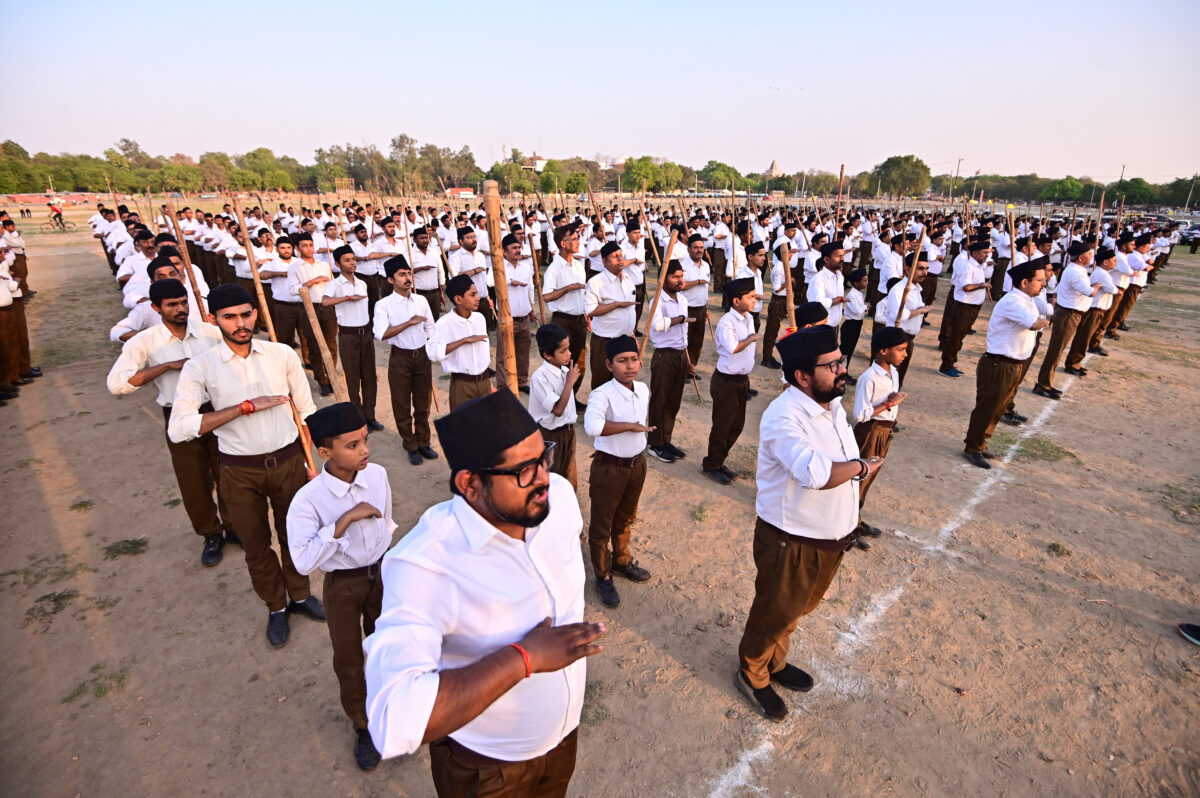
The right-wing and Hindu nationalist volunteer organisation is widely considered the ideological parent of India’s ruling Bharatiya Janata Party (BJP). Prime Minister Narendra Modi, a former RSS worker, is one of its most famous supporters.
But the RSS’ vision of India as a Hindu nation is controversial both at home and abroad: it was previously banned in India three times, and a bipartisan US commission on religious freedom recently called for the US government to sanction the group “for their responsibility and tolerance of severe violations of religious freedom”. Almost a hundred US politicians, both Democratic and Republican, recently pledged not to take funding from RSS-linked entities.
India’s far-right Hindu nationalist volunteer group RSS remains an unregistered entity in India. Source: Prabhat Kumar Verma/ZUMA Press Wire via Reuters Connect
“The RSS functions without independent oversight of its resources, finances, influence, and activities,” said Dr Angana P Chatterji, an anthropologist and scholar of South Asia studies at the University of California, Berkeley. “This is not proportional to the vast power, reach, and influence it possesses. Its leadership and cadre are protected from accountability and scrutiny,” she added.
The RSS had not responded to multiple requests for comment, as of publication.
Bellingcat identified two US-registered non-profits that appeared to have past and present ties to the RSS, or organisations associated with them, based on the non-profits’ or RSS websites and publications, as well as statements by the non-profits’ founders and spokespeople. The non-profits were the Ekal Vidyalaya Foundation of USA Inc (Ekal USA) and Sewa International Inc (referred to as Sewa USA).
We looked at all Form 990s – tax returns that US non-profit organisations are required to file annually – listing Ekal USA and Sewa USA as grant recipients, as well as the Form 990s of the charities themselves, from 2020 to 2024. As of September, the latest available Form 990s for Sewa USA were for the fiscal year ending December 2024, while Ekal USA also filed a form for the fiscal year ending December 2025, which was excluded for consistency, although the same pattern was observed during this period.
This analysis showed that the charities received at least US$24.4 million from 34 organisations that manage donor-advised funds (DAFs), or 20.7 percent of the total $117.8 million they reported receiving in contributions and grants during this period.
The actual amount from DAFs may be higher, as we excluded filings that covered partial years outside of this period – for example, June 2019 to June 2020. The filings from the two charities we identified were based on the calendar year.
The Form 990s also revealed that the vast majority of the money spent by these two charities on grants to other organisations or individuals was in India or the South Asia region rather than in the US: Ekal USA donated $33.7 million in foreign grants – all of which went towards the Ekal Vidyalaya project in India according to its filings – and none in domestic grants in the five years from 2020 to 2024, while Sewa USA reported $29.7 million in foreign grants and $622,613 in domestic grants during the same period.
Support Bellingcat
Your donations directly contribute to our ability to publish groundbreaking investigations and uncover wrongdoing around the world.
DAFs are common vehicles for people in the US who want to make donations to charitable causes while receiving tax relief or benefits. Donors do not control the money once they donate it but can advise on which charities the money eventually ends up at.
These funds are legally maintained and operated by non-profit sponsoring organisations. As public charities, DAF sponsor organisations detail the amounts and recipients of grants that they make on behalf of their donors in their Form 990s. However, they do not disclose who their donors are, and donors can choose to remain anonymous. (Note: Bellingcat USreceives grants from donor-advised funds, and some grants do not disclose the name of the grant recommender. However, many of our donors are listed on our funding page.)
There are many more organisations reportedly linked to the RSS that are not included in this analysis, but we focused on these two because of the large amounts of grants they received through DAFs, with the original sources of the funds untraceable from public information, as well as evidence pointing to both historical and current connections between them and the RSS or organisations associated with the RSS.
It is worth noting that some of the evidence we found pointing towards a connection between the two charities and the RSS or organisations associated with the RSS was from before or after the period we analysed (2020 to 2024). There is no evidence that DAF grants funded the RSS, only that they went to organisations that appear to have connections with the RSS. Experts told us that DAF grants undergo less regulatory scrutiny than other charitable donations and that DAF sponsor organisations have discretion over whether to restrict or permit donations to certain recipients.
Ekal USA
Houston, Texas-based Ekal USA is a non-profit that describes its mission in its Form 990s as “to provide free elementary education and free primary healthcare to children in remote and rural India”. The USA branch of Ekal Vidyalaya, according to its website, was founded in 2001 as part of efforts to “reach out to the global diaspora” in order to achieve a goal to “expand the reach of Ekal to 100,000 villages”.
RSS chief Mohan Bhagwat has appeared at multiple Ekal Vidyalaya events in India promoting the initiative over the years, as far back as 2014 and most recently in May.
Ekal USA was started in the late 1990s as a programme of the Vishwa Hindu Parishad of America (VHPA), or World Hindu Council of America, VHPA spokesperson Shyam Tiwari told Bellingcat in an email response. He added that it was set up as an independent organisation in early 2000. According to VHPA’s website, Ekal USA was established in 2002.
VHPA is based in the US, while the similarly named Vishwa Hindu Parishad (VHP) is in India. VHP lists VHPA in the “Hindus Abroad” section of its website. A 2017 article from VHPA’s magazine states that late founder Mahesh Mehta was trained by the RSS since he was 10 years old, and that the VHPA was born after Mehta was advised by the former supreme leader of the RSS to “build VHP in USA”. The national spokesperson of VHP in India, Vinod Bansal, said that it is an independent organisation that “sometimes shares ideology” with VHPA.
RSS’ website states that VHP was launched to organise Hindus and “reconvert all those who had been knowingly or unknowingly proselytised to alien faiths and are now desirous of coming back to the Hindu fold”. Bansal referred to VHP as an “independent part of the RSS” and an “ideological brother”.
Ekal USA Chairman-Advisor Subhash Gupta wrote in an Ekal USA publication this year that in the ‘80s and ‘90s, he was “president of the VHP’s Houston chapter” and “often received many high-profile guests from RSS and VHP”.
Gupta did not respond to requests for comment as of publication.
From 2020 to 2024, Ekal USA reported receiving more than $48.4 million in contributions and grants. Of this amount, at least $8.3 million was from DAF grants, based on Form 990s that listed Ekal USA as a grantee.
According to Ekal USA’s Form 990s, it transferred $33.7 million in foreign grants during this period and none in domestic grants for organisations or individuals. The forms also show that all the foreign grant money went towards building Ekal Vidyalaya schools in India. The rest of its expenses involved operational costs such as staff salaries.
The Ekal Vidyalaya movement has been criticised over reports that allege the schools are used to indoctrinate millions of India’s poorest and most vulnerable children and women with Hindu nationalist ideology, including that Muslims and Christians are “enemies of Hinduism”. Ekal Vidyalaya in India did not respond to multiple requests for comment.
Ekal USA did not respond to Bellingcat’s questions about these reports or any relationship it may have with the RSS. However, on its FAQ page, the group states that it does not teach religion in its schools and “does not discriminate based on caste, religious affiliation or linguistic affiliations”.
Sewa USA
Sewa USA, also based in Houston, describes itself as a “Hindu faith-based, humanitarian, nonprofit service organisation” and is listed under the heading of “Sewa Movement” on the website of India-based charity group Sewa International.
Sewa USA Vice President of Public Affairs Rakhi Israni told Bellingcat over email that the organisation “does not operate as a branch or affiliate of the RSS” or participate in political activity.
But multiple pages on the organisation’s website appear to indicate a connection between the non-profit and the RSS. In 2022, Sewa USA reposted an article on its website referring to Sewa International as “the US-based charitable non-profit organisation with links to the Rashtriya Swayamsevak Sangh (RSS)”. In a press release about the death of its founding member Ved Prakash Nanda in 2023, it noted that Nanda was “immersed in the ideals of the [RSS]”. And two different blog posts from 2021 and 2024 on Sewa USA’s website had volunteers citing RSS-led activities as the starting point for their involvement.
In addition, Sewa USA has also posted multiple times on social media and its website about an India-based organisation – Sewa Bharati – that appears to have the support of the RSS.
Sewa USA referred to Sewa Bharati as a “sister organisation” in an X post in 2014, and its regional chapter in Purvanchal as a “partner organisation” in a Facebook post in 2022.
On its website, Sewa USA said in a post that volunteers from its “partner organisations in India” had participated in rescue operations related to the 2023 train accident in Odisha, and listed several initiatives by Sewa Bharati in India. It also launched a fundraiser for families affected by floods in Maharashtra in September 2025, which mentioned that over 100 Sewa Bharati volunteers were already on the ground clearing debris and assisting communities.
“Foreign grants awarded to partner agencies in India, including service-oriented NGOs like Sewa Bharati, are strictly project-based, fully audited, and evaluated based on measurable humanitarian impact in education, health, and disaster relief,” Israni told Bellingcat.
Subscribe to the Bellingcat newsletter
Subscribe to our newsletter for first access to our published content and events that our staff and contributors are involved with, including interviews and training workshops.
RSS’ website links directly to the main website of Sewa Bharati through a tab on its main navigation bar labelled “Sewa”, and Sewa Bharati is mentioned in RSS’ 2016 annual report under the heading “Seva Vibhag”, a Sanskrit term for “service department”.
A blog post on Sewa Bharati’s website from December 2024 about an event the group organised described Indian Defence Minister Rajnath Singh as highlighting the role of RSS leaders in establishing Sewa Bharati in his address and noting that “RSS not only builds the nation but also the individual”. RSS Joint General Secretary Alok Kumar also spoke at the Sewa Bharati event, according to the blog post.
In response to Bellingcat’s queries, Israni said that Sewa USA had “no role in Sewa Bharati’s governance or operations”. Sewa Bharati did not respond to multiple requests for comment as of publication.
Sewa USA received almost $69.4 million in contributions and grants from 2020 to 2024, according to its Form 990s. Filings listing Sewa USA as a grantee show that at least $16 million was from DAFs. In its expenditure statements, Sewa USA reported giving $29.7 million in foreign grants to groups in South Asia during this period and about $622,613 in grants domestically in the US, while the rest of its expenditures included operational costs such as salaries and travel. It is not specified in the forms how much funding, if any, Sewa USA transferred to Sewa Bharati during this period, and Sewa USA did not respond to questions about any amounts transferred as of publication.
‘Cause-Neutral’ Funding
Experts told Bellingcat that there was less regulatory scrutiny of grants distributed through DAFs than some other types of charitable donations.
“For donor-advised funds, there’s actually less oversight by the IRS because donor-advised funds are considered public charities rather than private foundations,” said Samuel Brunson, a law professor at Loyola University Chicago.
“If a private foundation were giving money to organisations in India, that would be a little bit trickier. But if it’s a public charity … there’s not really a ton of oversight on that as long as the money that the US tax-exempt organisation is giving meets its charitable purpose.”
Lloyd Hitoshi Mayer, a law professor at the University of Notre Dame who specialises in non-profits, said that it was “irrebuttably presumed” that funds granted to US organisations with the non-profit 501(c)(3) tax status were being used for good charitable purposes.
“The existing federal tax laws related to donor-advised funds put some restrictions on what grants donor-advised fund sponsor organisations, which actually control the funds, can make. But the big exception is that Congress said, ‘If you make a grant to a Section 501(c)(3) charity, you’re good.’ You don’t have to do any additional oversight.”
Some DAF sponsor organisations have previously faced criticism for granting money to charities that have promoted homophobic, anti-immigrant or anti-Muslim views. Several were also criticised for pausing funding to the Southern Poverty Law Centre earlier this year, although this case demonstrated how DAFs can prevent funds from going to some groups recommended by donors, if the DAFs deem them unsuitable.
Brunson told Bellingcat that DAF sponsor organisations “absolutely have the right and ability” to halt processing donations to certain organisations. “Whether we want them to do that or not is a separate question,” he said.
Bellingcat reached out to the top three DAF sponsor organisations that donated to the two non-profits we identified – Fidelity Investments Charitable Gift Fund (Fidelity Charitable), American Online Giving Foundation (AOGF) and Charles Schwab-affiliated Donor Advised Charitable Giving (DAFgiving360; known before 2024 as Schwab Charitable) – to ask about their internal policies on assessing charities receiving donations through their funds. In total, the three DAFs accounted for almost $20 million, or 81.7 percent, of the DAF grants to Ekal USA and Sewa International for full reporting years between 2020 and 2024.
Fidelity Charitable, AOGF and DAFgiving360 all told Bellingcat that they had due diligence processes in place when evaluating non-profits.
Fidelity Charitable’s website states that it is a “cause-neutral” charity, but it ensures grants are used solely for charitable purposes. AOGF said non-profits must comply with eligibility requirements regarding hate speech, discrimination and the use of funds.
Meanwhile, DAFgiving360 said that a grant recipient may be subject to monitoring or placed under temporary suspension “due to circumstances that DAFgiving360 deems appropriate”, such as if there is a public interest consideration or if the recipient does not further DAFgiving360’s mission.
Bellingcat is a non-profit and the ability to carry out our work is dependent on the kind support of individual donors. If you would like to support our work, you can do so here. You can also subscribe to our Newsletter and follow us on Bluesky here, Instagram here, Reddit here and YouTube here.
This article is the result of a collaboration with Indian media outlet Newslaundry. You can find Newslaundry’s editorially independent coverage here.
Collage illustration by Klawe Rzeczy. Elements from Unsplash.
Indian companies have shipped more than 320 million synthetic opioid pills to West Africa – where they have not been approved by regulators – over the past three years, a Bellingcat investigation has found.
Export records from trade data provider 52wmb show that more than 1,400
This article is the result of a collaboration with Indian media outlet Newslaundry. You can find Newslaundry’s editorially independent coverage here.
Collage illustration by Klawe Rzeczy. Elements from Unsplash.
Indian companies have shipped more than 320 million synthetic opioid pills to West Africa – where they have not been approved by regulators – over the past three years, a Bellingcat investigation has found.
Export records from trade data provider 52wmb show that more than 1,400 consignments of tapentadol worth almost USD $130 million were sent from India to West Africa between January 2023 and December 2025.
Tapentadol, a painkiller two to three times more potent than tramadol, has not been approved for use in most West African countries, where some nations are grappling with an escalating opioid abuse epidemic.
However, this investigation shows that dozens of Indian suppliers have flooded the region with tapentadol over the past three years. Where dosages were listed, more than half the pills were in powerful strengths of 200mg or more – dosages that are not even approved in India.
The exports, cross-checked against records provided by trade data aggregator ImportGenius, show most tapentadol pills sent between 2023 and 2025 had the coastal nations of Sierra Leone and Ghana listed as their declared destinations.
The two West African countries were collectively marked as the destination for more than 80 per cent of the total value of tapentadol sent to the region.
Experts have documented how drug traffickers adapt quickly to international regulations and law enforcement efforts. In 2018, India tightened export controls around the opioid tramadol, one of the most trafficked synthetic drugs to West Africa.
In 2021, the International Narcotics Control Board (INCB) said large-scale tapentadol trafficking had been identified, particularly in consignments destined for Africa. It had previously noted that India’s strengthened tramadol controls could lead traffickers to substitute the drug with other potent synthetic opioids.
A BBC investigation last year revealed that Indian company Aveo Pharmaceuticals was illegally exporting tablets containing a mix of tapentadol and the muscle relaxant carisoprodol to West Africa. This led India’s drug regulator, the Central Drugs Standard Control Organisation (CDSCO), to ban the manufacture and export of all combinations of the two drugs.
Bellingcat’s investigation, in collaboration with Indian publishing partner Newslaundry, reveals that the supply of tapentadol pills from India to West Africa has surged in recent years.
Export data from 52wmb shows the value of tapentadol sent to the region has risen from about USD $27 million in the three year period from 2020 to 2022, to almost USD $130 million from 2023 to 2025.
Julius Maada Bio, Sierra Leone’s president, in 2024 declared a national emergency over rampant drug abuse and branded kush – a toxic blend of psychoactive substances including cannabis and synthetic opioids – a “death trap”.
Authorities in Sierra Leone have intercepted illegal tapentadol, including last July when the National Revenue Authority (NRA) said it thwarted a smuggling operation near its north-west border with Guinea.
The NRA and other agencies including the Transnational Organised Crime Unit, National Drug Law Enforcement Agency, and the Pharmacy Board of Sierra Leone did not respond to Bellingcat’s requests for comment.
Sierra Leone’s NRA said customs officers seized tapentadol near a border crossing in July. Source: National Revenue Authority
Ghana’s Narcotics Control Commission (NACOC) said the illegal importation of tapentadol was first recorded in 2022 after international efforts to curb the tramadol crisis resulted in criminal networks shifting production to other pharmaceutical opioids including tapentadol, tafrodol and carisoprodol.
The agency has recorded a “steady rise” in tapentadol trafficking over the past three years, with authorities seizing more than 3.7 million tablets (250mg strength). Most were traced back to India, it said.
“NACOC investigations confirm that the bulk of tapentadol is trafficked into Ghana through seaports and by air, via express courier services,” a spokesperson said. “At the ports, the drug is concealed in containerized cargo falsely declared as pharmaceuticals, electrical materials or household goods. Express courier services are used for smaller, high-value quantities, often packed alongside legitimate consignments to avoid detection.”
NACOC said Ghana had emerged as both a destination and transit hub for tapentadol, with the majority of intercepted consignments bound for Niger, Mali, Burkina Faso and Nigeria. When sold domestically, it said the street drug was promoted as a tramadol substitute.
Ghana’s Food and Drugs Authority (FDA) said last year that the abuse of pharmaceutical opioids such as tapentadol — commonly known on the street as “Red” — was on the rise.
The FDA told Bellingcat it had “never issued any permit” for the manufacture or importation of tapentadol, in any strength, to any importer or to any country. It said any tapentadol shipments to Ghana were for “trans-shipment to neighbouring country”.
Import data for Ghana shows that no tapentadol entered the country between 2023 and 2025, which supports NACOC’s position that the drugs are being concealed and falsely declared. Import data for Sierra Leone was not available through 52wmb.
Ghana’s FDA destroyed 230 cartons of the illegally imported tapentadol last April and seized 7,700 tapentadol tablets at a border crossing last August. NACOC said it was combatting opioid importation through regulation, enforcement and cooperation with its counterparts in other countries. Source: FDA
India’s drug and pharmaceutical exports have grown to more than $30 billion a year, according to the Pharmaceuticals Export Promotion Council of India (Pharmexcil), a division of the ministry of commerce and industry.
While tapentadol is available in India on prescription in strengths of up to 100mg (immediate release) and 200mg (extended release), authorities are aware of its risk of misuse. Last year, the Indian drug regulator’s Technical Advisory Board said the Department of Revenue may be requested to schedule the painkiller under the Narcotic Drugs and Psychotropic Substances Act, which would tighten rules around its export.
To export pharmaceutical products at strengths that are not approved in India, exporters are required to obtain an export “no objection certificate” (NOC) from the CDSCO, for which they have to submit proof of the drug’s approval in the importing country. Publicly available information shows tapentadol is not approved for use in any of the West African nations identified as part of this investigation.
The CDSCO did not respond to questions from Bellingcat or our publishing partner, Newslaundry.
In response to “Right to Information” requests submitted by Newslaundry, the CDSCO said only two companies had been granted authorisation to manufacture tapentadol for export between 2019 and 2024. However, the trade data analysed by Bellingcat did not list either company as an exporter of tapentadol to West Africa.
The CDSCO also said it had issued export NOCs for tapentadol to 51 companies since 2024, but that these were not for export to West African countries.
Meanwhile, Bellingcat’s analysis of trade data shows that more than 60 Indian suppliers have exported tapentadol to West Africa since 2023. The exporters are mostly pharmaceutical companies but also include smaller operations, such as one company owned by a Nigerian man who sent more than US $4 million of tapentadol to Niger and Ghana.
In the BBC’s investigation, journalist Surabhi Tandon reported on the increase in cross-border smuggling of tramadol, “a catch-all name to describe the range of opioids used as street drugs”, from Ghana to Nigeria. Source: BBC News
Dinesh Thakur, co-author of the book Truth Pill, told Newslaundry there were gaps in India’s drug regulatory framework that made it possible for potentially unsafe medicines to be manufactured and exported without proper oversight.
“There is no regulatory framework which checks a genuine importer and counterfeit importer between countries,” said Thakur, a former pharmaceutical executive who now works as a public health activist.
Mohammed Adinoyi Usman, a consultant anaesthetist at Rasheed Shekoni Federal University Teaching Hospital in Nigeria, said tackling Africa’s opioid crisis was complicated by a lack of resources across the region, weak government responses, and inaction by law enforcement agencies.
He said more collaboration and intelligence sharing was needed, especially across West African countries, to combat the problem. “We see so many opioids coming into our region because of a range of factors including under-funded institutions like customs and drug agencies, weak border controls and corruption,” he said.
“Africa is different. Even southern Africa is different from western Africa – each region has its peculiarities. In Nigeria, we don’t have well-functioning institutions to help control it. But our government is trying.”
Dr Usman said access to prescription opioids in Africa was inadequate, and pointed to research showing the disparity in distribution of legal opioids to low-income countries compared to high-income nations that consume the bulk of the world’s pain relief medication. He said opioid abuse was linked to crime and negative health outcomes.
“Sadly, access to prescription opioids is very limited in Africa,” Dr Usman said, “but the costs of illegal use are high.”
Bellingcat is a non-profit and the ability to carry out our work is dependent on the kind support of individual donors. If you would like to support our work, you can do so here. You can also subscribe to our Patreon channel here. Subscribe to our Newsletter and follow us on Bluesky here, Instagram here, Reddit here and YouTube here.
The video posted by a state branch of India’s ruling Bharatiya Janata Party (BJP) showed Assam chief minister Himanta Biswa Sarma shooting an image of two men in Muslim skull caps. “Foreigner-free Assam”, read one caption across the video. “Why did you not go to Pakistan?” said another.
Screenshots of the now-deleted video shared by BJP on Feb. 7 showing Assam Chief Minister Himanta Biswa Sarma shooting an AI-generated version of INC leader Gaurav Gogoi (in a white skull cap) and another uni
The video posted by a state branch of India’s ruling Bharatiya Janata Party (BJP) showed Assam chief minister Himanta Biswa Sarma shooting an image of two men in Muslim skull caps. “Foreigner-free Assam”, read one caption across the video. “Why did you not go to Pakistan?” said another.
Screenshots of the now-deleted video shared by BJP on Feb. 7 showing Assam Chief Minister Himanta Biswa Sarma shooting an AI-generated version of INC leader Gaurav Gogoi (in a white skull cap) and another unidentified, bearded man. Source: BJP4Assam/X
One of the men in the photo that Sarma was portrayed as shooting was Gaurav Gogoi, a leader of the Indian National Congress (INC), the BJP’s main competitor in Assam for the state’s upcoming legislative elections next month.
Gogoi has stated that he is Hindu but enjoys visiting different religious sites and observing their norms. He has been photographed wearing traditional Muslim attire during religious occasions such as Eid.
But the image of him in the video shared by BJP Assam, wearing a casual singlet with a skull cap, was not one of those occasions.
Bellingcat has seen several dozen videos posted by the BJP that use generative artificial intelligence (AI) alongside anti-Muslim and anti-Bangladeshi messaging in the border states of Assam and West Bengal in December last year, ahead of legislative elections scheduled in both states for April.
Left: Original photo shared by Gogoi on Jun. 17, 2025. Right: An image shared by BJP Assam that was edited with AI to show Gogoi with a skull cap, beard and Quran. Source: gauravgogoiasm/Facebook, BJP4Bengal/Facebook
Bellingcat analysed 499 social media posts containing photos and videos shared on Facebook, Instagram and X by the BJP’s official accounts in the two states for this time period, finding 194 posts that appeared to meet the United Nations’ definition of hate speech: discriminating against persons or communities based on inherent characteristics such as religion and national origin. Of these, 31 (about one in six of the hateful posts) contained the obvious use of AI-generated imagery.
Chart: Galen Reich
These appear to be part of a larger pattern of politicians and parties globally using generative AI to amplify hateful or divisive content, particularly ahead of major political events such as elections.
Ahead of the New York City mayoral race last year, Andrew Cuomo’s official X account shared, then deleted, an AI-generated video depicting Mamdani eating rice with his hands and a Black man in a keffiyeh shoplifting. In Italy, several opposition parties complained to a communications watchdog after deputy prime minister Matteo Salvini’s League party published a series of AI-generated images depicting men of colour attacking women or police officers. And in the UK, videos by an AI-generated rapper funded by the far-right Advance UK party, with lyrics targeting Muslims, were viewed millions of times.
A Campaign of Hate
Both Assam and West Bengal share a border with Bangladesh. BJP, the world’s largest political party, is currently in power in Assam, where legislative elections are scheduled on Apr. 9. West Bengal, which goes to the polls on Apr. 23, is governed by the Trinamool Congress (TMC).
Map: Pooja Chaudhuri. Source: Goran tek-en, CC BY-SA 4.0, via Wikimedia Commons
US-based international affairs expert Mohammed Zeeshan told Bellingcat that the “dehumanising and debasing” terminology used in India to refer to alleged illegal Bangladeshi immigrants, including by senior ministers, has caused resentment towards India in Bangladesh.
“The situation, in fact, was so bad that Hasina herself had subtly warned the Modi government in public statements that Indian domestic rhetoric was endangering Bangladeshi Hindus, who bore the brunt of that resentment,” Zeeshan said.
Zobaida Nasreen, a professor of anthropology at Dhaka University, said that anti-Muslim rhetoric intensified by BJP leaders reinforces the belief in Bangladesh that Muslims and Bengalis are being collectively targeted in India.
“Viral videos containing this message tend to spread quickly across Bangladeshi media and social platforms especially on Facebook, enhancing perceptions of hostility and triggering anti-India sentiment or nationalist backlash,” she added.
In December, the month our dataset was collected, Dipu Das, a Hindu garment worker, was beaten to death at an anti-India protest in Bangladesh over allegations that he had made derogatory remarks about Islam.
And while the administration led by Bangladesh’s newly elected leader Tarique Rahman has sought to reset strained ties, most of the hateful social media posts we saw posted by the BJP in December attacked Bangladeshi Muslims and/or Bengali-origin Muslims in India, showing how tensions between the two countries continue to influence political messaging in India’s border states.
Bellingcat’s analysis included a total of 202 posts by BJP Assam and 297 by BJP’s West Bengal branch on their official accounts. We also looked at posts shared by BJP’s main opponent parties – 194 from INC in Assam and 357 from the TMC in West Bengal – during the same time period in December.
This included all visual social media posts (containing photos or videos) by each party in December, except those that did not appear to contain any overt political messaging, such as those simply commemorating public holidays. We only counted each photo or video once, regardless of how many platforms it was shared across.
Although all of the major parties contesting in the Assam and West Bengal state elections appeared to use AI-generated imagery in some of their posts, there appeared to be a particularly high concentration of hateful messaging in the ones posted by the BJP’s accounts.
In Assam, we identified 28 posts by BJP using apparently AI-generated imagery, of which 24 carried hateful messaging. Of the 194 INC posts we looked at from December, 41 appeared to feature AI-generated imagery, but none of these appeared to carry hateful messaging.
In West Bengal, we found 14 BJP posts that contained clear indicators of AI-generated imagery, seven of which were hateful. We also identified 15 posts by the incumbent TMC that appeared to feature AI imagery, but none of these appeared to meet the definition of hate speech.
Support Bellingcat
Your donations directly contribute to our ability to publish groundbreaking investigations and uncover wrongdoing around the world.
When contacted for comment, BJP Assam spokesperson Rupam Goswami did not directly respond to questions on the party’s general use of AI but said they did not post any AI-generated photos of Gogoi. “BJP does not stoop so low,” he told Bellingcat.
As for the “point blank” shooting video, Goswami initially said the person responsible had been punished and removed from the party. However, when asked about Sarma saying that he would re-post the video with those he was depicted shooting labelled as “Bangladeshis”, Goswami said, “[Bangladeshis] need to be completely suppressed.”
BJP West Bengal did not respond to multiple requests for comment by Bellingcat via phone and email.
It is important to note that as generative AI technology improves, it can be increasingly difficult to detect AI-generated imagery. Our manual count of AI-generated imagery only included posts that had obvious signs of generative AI such as unnaturally smooth textures and multiple people with the same faces. It is therefore possible that there were other images in our dataset where generative AI was used more subtly.
However, Joyojeet Pal, Professor of Information at the University of Michigan, told Bellingcat that the quality of these visuals, or whether they looked real, was not the priority.
“What politicians in India have understood is that the sociocultural drivers of misinformation are most important for elections, so they harp on about things to the extent that they have started to not care about form over substance. It looks bad? It doesn’t matter,” he said.
More important to voters, according to Pal, was whether they already believed in the narrative contained in the videos, which generative AI could help create more quickly: “AI is helping cement polarised opinions by giving you the kind of content you have already decided you want to engage with.”
When asked about INC’s use of AI, party spokesperson Aman Wadud said that it was obvious that some of the videos they posted were made with AI and that there was no intention to mislead.
“AI can be both destructive and creative. We are using it in a creative manner, we are not using it in a destructive manner. We don’t violate people’s dignity, we don’t falsely accuse people,” he said.
TMC did not respond to Bellingcat’s multiple requests for comment via phone and email by publication time.
Portraying Bengali Muslims as ‘Foreigners’
The largest category of hateful messaging Bellingcat observed in the BJP’s posts targeted Bangladeshi or Bengali-origin Muslims, referring to them as “infiltrators” or “foreigners”. We counted 66 such posts by the BJP’s Assam and West Bengal branches from December, of which eight appeared to contain obvious AI-generated imagery.
One video referencing this theme shows AI-generated visuals of protests against “illegal infiltration” in Assam, with the caption urging people to “wake up” or the country would “turn into Bangladesh”.
A different one uses real footage from past violence in Assam mixed in with images of Muslim men. A song playing in the background accuses them of taking over “Assamese land” and shows AI images of “Assamese” people, i.e. those not in stereotypical Muslim clothing, crying.
An AI-generated image of a crying man in non-Muslim clothing and a traditional Assamese scarf on his shoulders. Source: BJP4Assam/X
Both videos use religious markers to draw a distinction between “infiltrators” – men in skull caps or lungis associated with Bengal-origin Muslims – and “citizens” in non-Muslim attire.
Clothing is often used by the Hindu far-right as a visual shorthand for identity and a deepening religious divide. In 2019, Prime Minister Narendra Modi said of protests against a controversial citizenship law that those responsible for violence could be “identified by their clothes”.
In the hateful posts seen by Bellingcat, both real and AI-generated images of opposition figures – particularly Gogoi – were shown alongside messaging that suggested that they supported “foreigners” or “infiltrators”.
The Center for the Study of Organized Hate (CSOH) also noted, in a 2025 report on AI-generated imagery and Islomophobia in India, that Hindu far-right politicians and media outlets have invoked and reinforced the trope of Muslims as “infiltrators” for years.
“AI-generated images on these themes reinforce associations between Muslim identity and illegality, reinforcing xenophobic and Islamophobic stereotypes. In doing so, they play a powerful role in justifying exclusionary policies and normalising discrimination against Muslims,” the report said.
‘Save Hindus’
Zenith Khan, a data analyst who worked on the CSOH report, noted that AI-generated propaganda was often tightly knit with current political moments, and its impact depended on “timing it right” especially when “people are emotionally charged”.
The violence against the minority Hindu community in Bangladesh has been used by the BJP to raise concerns over the safety of Hindus in India.
Days after Das’ lynching, the Assam state branch of BJP posted a video with an image of his face – except that it was manipulated with AI to show tears streaming from his eyes. “Save Hindus”, said the text accompanying the video.
Posts by BJP’s West Bengal unit also seemed to frame Muslims as criminals or threats. A video, styled after the TV show “Stranger Things”, raised alarms over an “upside down” version of the state under the current government.
A man is depicted being chased by men in skull caps. Arrows label them as “Ralib,” “Galib,” and “Chalib” – a play on Muslim names ending in “-lib” – in case the skull caps left any ambiguity about their Muslim portrayal.
“Stranger Things” themed post that depicts Hindus under threat from Muslims in West Bengal. Source: BJP4Bengal/X
INC filed a police complaint in September last year against the BJP for sharing AI videos targeting Gogoi and the Muslim community, as well as another complaint in relation to the video of Sarma portrayed as shooting two men “point blank” in February.
INC Assam spokesperson Wadud said that no action had been taken on the party’s police complaints as far as he knew.
Disinformation researcher Bharat Nayak told Bellingcat that it has always been tech platforms’ responsibility to control new types of content.
“The goal post can’t shift. This has always been a tech problem,” he said.
When this responsibility is shrugged off, Nayak added, the result is a lack of accountability. “If you’re using old videos from other countries as new, you will have people countering you. But AI-generated videos can be shared without context just to spread hate – like showing people in skull caps – and the ‘when, where, how’ questions vanish.”
Both Meta – which owns Facebook and Instagram – and X have policies against hateful conduct.
Meta also announced in 2024 that it would start adding “AI info” labels to more content detected as AI-generated, while some X users spotted a similar feature introduced on the platform last month. Only five of INC’s AI visuals that we identified – and none of those by TMC or the BJP – had a disclaimer that said “AI-generated”.
Bellingcat reached out to Meta and X for comment on whether the posts we identified breached their terms of use regarding hateful conduct or labelling AI-generated posts. A Meta spokesperson said they were reviewing the flagged content and “will take appropriate action on any violations of our policies”. As of publication, X had not responded.
Kalim Ahmed from Bellingcat’s Discord Community contributed research to this piece.
Bellingcat is a non-profit and the ability to carry out our work is dependent on the kind support of individual donors. If you would like to support our work, you can do so here. You can also subscribe to our Patreon channel here. Subscribe to our Newsletter and follow us on Bluesky here, Instagram here, Reddit here and YouTube here.

 Entrar