A Brazilian tech firm that specializes in protecting networks from distributed denial-of-service (DDoS) attacks has been enabling a botnet responsible for an extended campaign of massive DDoS attacks against other network operators in Brazil, KrebsOnSecurity has learned. The firm’s chief executive says the malicious activity resulted from a security breach and was likely the work of a competitor trying to tarnish his company’s public image.
An Archer AX21 router from TP-Link. Image: tp-link.com.
A Brazilian tech firm that specializes in protecting networks from distributed denial-of-service (DDoS) attacks has been enabling a botnet responsible for an extended campaign of massive DDoS attacks against other network operators in Brazil, KrebsOnSecurity has learned. The firm’s chief executive says the malicious activity resulted from a security breach and was likely the work of a competitor trying to tarnish his company’s public image.
An Archer AX21 router from TP-Link. Image: tp-link.com.
For the past several years, security experts have tracked a series of massive DDoS attacks originating from Brazil and solely targeting Brazilian ISPs. Until recently, it was less than clear who or what was behind these digital sieges. That changed earlier this month when a trusted source who asked to remain anonymous shared a curious file archive that was exposed in an open directory online.
The exposed archive contained several Portuguese-language malicious programs written in Python. It also included the private SSH authentication keys belonging to the CEO of Huge Networks, a Brazilian ISP that primarily offers DDoS protection to other Brazilian network operators.
Founded in Miami, Fla. in 2014, Huge Networks’s operations are centered in Brazil. The company originated from protecting game servers against DDoS attacks and evolved into an ISP-focused DDoS mitigation provider. It does not appear in any public abuse complaints and is not associated with any known DDoS-for-hire services.
Nevertheless, the exposed archive shows that a Brazil-based threat actor maintained root access to Huge Networks infrastructure and built a powerful DDoS botnet by routinely mass-scanning the Internet for insecure Internet routers and unmanaged domain name system (DNS) servers on the Web that could be enlisted in attacks.
DNS is what allows Internet users to reach websites by typing familiar domain names instead of the associated IP addresses. Ideally, DNS servers only provide answers to machines within a trusted domain. But so-called “DNS reflection” attacks rely on DNS servers that are (mis)configured to accept queries from anywhere on the Web. Attackers can send spoofed DNS queries to these servers so that the request appears to come from the target’s network. That way, when the DNS servers respond, they reply to the spoofed (targeted) address.
By taking advantage of an extension to the DNS protocol that enables large DNS messages, botmasters can dramatically boost the size and impact of a reflection attack — crafting DNS queries so that the responses are much bigger than the requests. For example, an attacker could compose a DNS request of less than 100 bytes, prompting a response that is 60-70 times as large. This amplification effect is especially pronounced when the perpetrators can query many DNS servers with these spoofed requests from tens of thousands of compromised devices simultaneously.
A DNS amplification and reflection attack, illustrated. Image: veracara.digicert.com.
The exposed file archive includes a command-line history showing exactly how this attacker built and maintained a powerful botnet by scouring the Internet for TP-Link Archer AX21 routers. Specifically, the botnet seeks out TP-Link devices that remain vulnerable to CVE-2023-1389, an unauthenticated command injection vulnerability that was patched back in April 2023.
Malicious domains in the exposed Python attack scripts included DNS lookups for hikylover[.]st, and c.loyaltyservices[.]lol, both domains that have been flagged in the past year as control servers for an Internet of Things (IoT) botnet powered by a Mirai malware variant.
The leaked archive shows the botmaster coordinated their scanning from a Digital Ocean server that has been flagged for abusive activity hundreds of times in the past year. The Python scripts invoke multiple Internet addresses assigned to Huge Networks that were used to identify targets and execute DDoS campaigns. The attacks were strictly limited to Brazilian IP address ranges, and the scripts show that each selected IP address prefix was attacked for 10-60 seconds with four parallel processes per host before the botnet moved on to the next target.
The archive also shows these malicious Python scripts relied on private SSH keys belonging to Huge Networks’s CEO, Erick Nascimento. Reached for comment about the files, Mr. Nascimento said he did not write the attack programs and that he didn’t realize the extent of the DDoS campaigns until contacted by KrebsOnSecurity.
“We received and notified many Tier 1 upstreams regarding very very large DDoS attacks against small ISPs,” Nascimento said. “We didn’t dig deep enough at the time, and what you sent makes that clear.”
Nascimento said the unauthorized activity is likely related to a digital intrusion first detected in January 2026 that compromised two of the company’s development servers, as well as his personal SSH keys. But he said there’s no evidence those keys were used after January.
“We notified the team in writing the same day, wiped the boxes, and rotated keys,” Nascimento said, sharing a screenshot of a January 11 notification from Digital Ocean. “All documented internally.”
Mr. Nascimento said Huge Networks has since engaged a third-party network forensics firm to investigate further.
“Our working assessment so far is that this all started with a single internal compromise — one pivot point that gave the attacker downstream access to some resources, including a legacy personal droplet of mine,” he wrote.
“The compromise happened through a bastion/jump server that several people had access to,” Nascimento continued. “Digital Ocean flagged the droplet on January 11 — compromised due to a leaked SSH key, in their wording — I was traveling at the time and addressed it on return. That droplet was deprecated and destroyed, and it was never part of Huge Networks infrastructure.”
The malicious software that powers the botnet of TP-Link devices used in the DDoS attacks on Brazilian ISPs is based on Mirai, a malware strain that made its public debut in September 2016 by launching a then record-smashing DDoS attack that kept this website offline for four days. In January 2017, KrebsOnSecurity identified the Mirai authors as the co-owners of a DDoS mitigation firm that was using the botnet to attack gaming servers and scare up new clients.
In May 2025, KrebsOnSecurity was hit by another Mirai-based DDoS that Google called the largest attack it had ever mitigated. That report implicated a 20-something Brazilian man who was running a DDoS mitigation company as well as several DDoS-for-hire services that have since been seized by the FBI.
Nascimento flatly denied being involved in DDoS attacks against Brazilian operators to generate business for his company’s services.
“We don’t run DDoS attacks against Brazilian operators to sell protection,” Nascimento wrote in response to questions. “Our sales model is mostly inbound and through channel integrator, distributors, partners — not active prospecting based on market incidents. The targets in the scripts you received are small regional providers, the vast majority of which are neither in our customer base nor in our commercial pipeline — a fact verifiable through public sources like QRator.”
Nascimento maintains he has “strong evidence stored on the blockchain” that this was all done by a competitor. As for who that competitor might be, the CEO wouldn’t say.
“I would love to share this with you, but it could not be published as it would lose the surprise factor against my dishonest competitor,” he explained. “Coincidentally or not, your contact happened a week before an important event – one that this competitor has NEVER participated in (and it’s a traditional event in the sector). And this year, they will be participating. Strange, isn’t it?”
A hacktivist group with links to Iran’s intelligence agencies is claiming responsibility for a data-wiping attack against Stryker, a global medical technology company based in Michigan. News reports out of Ireland, Stryker’s largest hub outside of the United States, said the company sent home more than 5,000 workers there today. Meanwhile, a voicemail message at Stryker’s main U.S. headquarters says the company is currently experiencing a building emergency.
Based in Kalamazoo, Michigan, Stryker
A hacktivist group with links to Iran’s intelligence agencies is claiming responsibility for a data-wiping attack against Stryker, a global medical technology company based in Michigan. News reports out of Ireland, Stryker’s largest hub outside of the United States, said the company sent home more than 5,000 workers there today. Meanwhile, a voicemail message at Stryker’s main U.S. headquarters says the company is currently experiencing a building emergency.
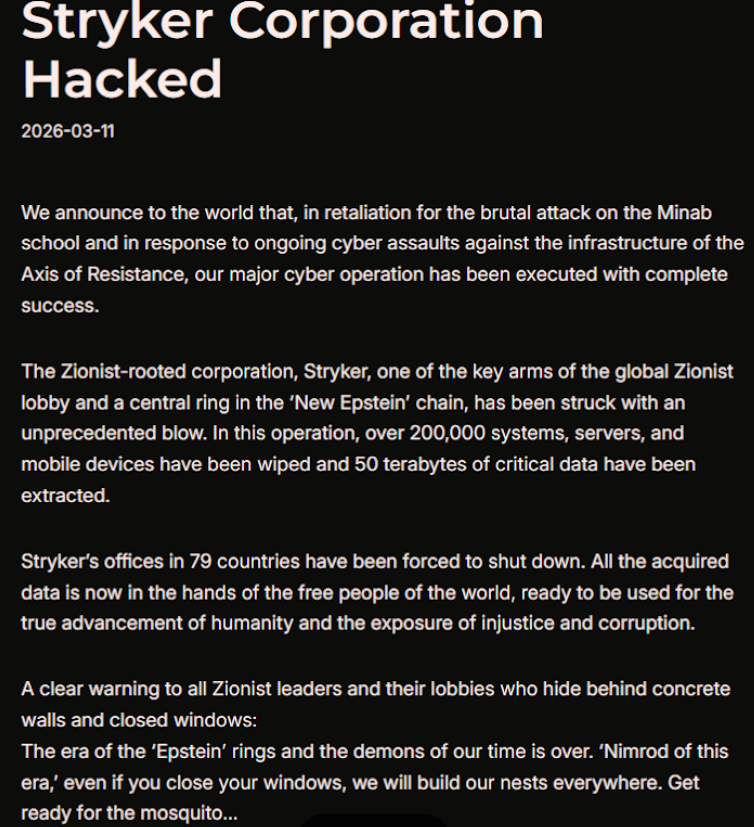
Based in Kalamazoo, Michigan, Stryker [NYSE:SYK] is a medical and surgical equipment maker that reported $25 billion in global sales last year. In a lengthy statement posted to Telegram, a hacktivist group known as Handala (a.k.a. Handala Hack Team) claimed that Stryker’s offices in 79 countries have been forced to shut down after the group erased data from more than 200,000 systems, servers and mobile devices.
A manifesto posted by the Iran-backed hacktivist group Handala, claiming a mass data-wiping attack against medical technology maker Stryker.
“All the acquired data is now in the hands of the free people of the world, ready to be used for the true advancement of humanity and the exposure of injustice and corruption,” a portion of the Handala statement reads.
The group said the wiper attack was in retaliation for a Feb. 28 missile strike that hit an Iranian school and killed at least 175 people, most of them children. The New York Timesreports today that an ongoing military investigation has determined the United States is responsible for the deadly Tomahawk missile strike.
Handala was one of several hacker groups recently profiled by Palo Alto Networks, which links it to Iran’s Ministry of Intelligence and Security (MOIS). Palo Alto says Handala surfaced in late 2023 and is assessed as one of several online personas maintained by Void Manticore, a MOIS-affiliated actor.
Stryker’s website says the company has 56,000 employees in 61 countries. A phone call placed Wednesday morning to the media line at Stryker’s Michigan headquarters sent this author to a voicemail message that stated, “We are currently experiencing a building emergency. Please try your call again later.”
A report Wednesday morning from the Irish Examiner said Stryker staff are now communicating via WhatsApp for any updates on when they can return to work. The story quoted an unnamed employee saying anything connected to the network is down, and that “anyone with Microsoft Outlook on their personal phones had their devices wiped.”
“Multiple sources have said that systems in the Cork headquarters have been ‘shut down’ and that Stryker devices held by employees have been wiped out,” the Examiner reported. “The login pages coming up on these devices have been defaced with the Handala logo.”
Wiper attacks usually involve malicious software designed to overwrite any existing data on infected devices. But a trusted source with knowledge of the attack who spoke on condition of anonymity told KrebsOnSecurity the perpetrators in this case appear to have used a Microsoft service called Microsoft Intune to issue a ‘remote wipe’ command against all connected devices.
Intune is a cloud-based solution built for IT teams to enforce security and data compliance policies, and it provides a single, web-based administrative console to monitor and control devices regardless of location. The Intune connection is supported by this Reddit discussion on the Stryker outage, where several users who claimed to be Stryker employees said they were told to uninstall Intune urgently.
Palo Alto says Handala’s hack-and-leak activity is primarily focused on Israel, with occasional targeting outside that scope when it serves a specific agenda. The security firm said Handala also has taken credit for recent attacks against fuel systems in Jordan and an Israeli energy exploration company.
“Recent observed activities are opportunistic and ‘quick and dirty,’ with a noticeable focus on supply-chain footholds (e.g., IT/service providers) to reach downstream victims, followed by ‘proof’ posts to amplify credibility and intimidate targets,” Palo Alto researchers wrote.
The Handala manifesto posted to Telegram referred to Stryker as a “Zionist-rooted corporation,” which may be a reference to the company’s 2019 acquisition of the Israeli company OrthoSpace.
Stryker is a major supplier of medical devices, and the ongoing attack is already affecting healthcare providers. One healthcare professional at a major university medical system in the United States told KrebsOnSecurity they are currently unable to order surgical supplies that they normally source through Stryker.
“This is a real-world supply chain attack,” the expert said, who asked to remain anonymous because they were not authorized to speak to the press. “Pretty much every hospital in the U.S. that performs surgeries uses their supplies.”
John Riggi, national advisor for the American Hospital Association (AHA), said the AHA is not aware of any supply-chain disruptions as of yet.
“We are aware of reports of the cyber attack against Stryker and are actively exchanging information with the hospital field and the federal government to understand the nature of the threat and assess any impact to hospital operations,” Riggi said in an email. “As of this time, we are not aware of any direct impacts or disruptions to U.S. hospitals as a result of this attack. That may change as hospitals evaluate services, technology and supply chain related to Stryker and if the duration of the attack extends.”
According to a March 11 memo from the state of Maryland’s Institute for Emergency Medical Services Systems, Stryker indicated that some of their computer systems have been impacted by a “global network disruption.” The memo indicates that in response to the attack, a number of hospitals have opted to disconnect from Stryker’s various online services, including LifeNet, which allows paramedics to transmit EKGs to emergency physicians so that heart attack patients can expedite their treatment when they arrive at the hospital.
“As a precaution, some hospitals have temporarily suspended their connection to Stryker systems, including LIFENET, while others have maintained the connection,” wrote Timothy Chizmar, the state’s EMS medical director. “The Maryland Medical Protocols for EMS requires ECG transmission for patients with acute coronary syndrome (or STEMI). However, if you are unable to transmit a 12 Lead ECG to a receiving hospital, you should initiate radio consultation and describe the findings on the ECG.”
This is a developing story. Updates will be noted with a timestamp.
Update, 2:54 p.m. ET: Added comment from Riggi and perspectives on this attack’s potential to turn into a supply-chain problem for the healthcare system.
Update, Mar. 12, 7:59 a.m. ET: Added information about the outage affecting Stryker’s online services.
One of the challenges with investigating cybercrime is the
infrastructure the adversaries leverage to conduct attacks. Cybercriminal
infrastructure has evolved drastically over the last 25 years, which now involves
hijacking web services, content distribution networks (CDNs), residential
proxies, fast flux DNS, domain generation algorithms (DGAs), botnets of IoT
devices, the Tor network, and all sorts of nested services.
This blog shall investigate a small UK-based hosting provider
known as Bit
One of the challenges with investigating cybercrime is the
infrastructure the adversaries leverage to conduct attacks. Cybercriminal
infrastructure has evolved drastically over the last 25 years, which now involves
hijacking web services, content distribution networks (CDNs), residential
proxies, fast flux DNS, domain generation algorithms (DGAs), botnets of IoT
devices, the Tor network, and all sorts of nested services.
This blog shall investigate a small UK-based hosting provider
known as BitLaunch as an example of how challenging it can be to tackle
cybercriminal infrastructure. Research into this hosting provider revealed that
they appear to have a multi-year history of cybercriminals using BitLaunch to
host command-and-control (C2) servers via their Anonymous
VPS service.
The year-on-year growing number of CobaltStrike C2 servers
hosted on BitLaunch’s services could be an indicator of tacit collusion with
cybercriminals through the facilitation of cheap and quick to procurement of
VPSs that end up being used to launch ransomware attacks on all sorts of
victims, including hospitals, schools, governments, companies, and charities.
The concept of aiding and abetting criminal activity in law is
essentially when an individual or an organisation intentionally assists,
facilitates, or encourages a crime. In this case, it would be aiding and
abetting the creation of cybercriminal infrastructure. If a hosting provider
ignores clear red flags (e.g., cryptocurrency payments from known illicit
sources or use of servers for illegal activities), they might still be held criminally
liable under wilful blindness under certain laws.
In the past, authorities have taken down bulletproof hosting
(BPH) providers that knowingly support cybercrime, such as CyberBunker and
LolekHost. In February 2025, the UK government also sanctioned
a Russia-based BPH known as ZSERVERS (aka XHOST) for facilitating LockBit
attacks.
Update: This blog was updated with a statement from BitLaunch (see the end of this blog).
Who is BitLaunch aka BL Networks aka BLNWX?
Active since at least 2017, BitLaunch (also known as BL
Networks or BLNWX) is a virtual private server (VPS) reseller whose autonomous
system number (ASN) is AS399629.
Up to 48 IPv4 networks belong to BitLaunch
which are used to "instantly launch a Linux or Windows VPS” where
customers can “pay hourly with Bitcoin, Litecoin, and Ethereum, with no firm
commitments." BitLaunch also supports their customers via a command-line (CLI)
tool and a Python
library. BitLaunch has another name, however, in their legal terms and conditions
they go by Liber Systems and have their own separate website.
Why focus on BitLaunch?
BitLaunch is quite interesting as they present themselves as
a UK-based company run by two local UK businessmen. Their “anonymous Bitcoin
VPS” service is regularly abused for all sorts of cybercriminal activities. What
triggered this research was the fact that their nickname “BLNWX” was regularly
reappearing in cyber threat intelligence (CTI) vendor reports on ransomware and
other cybercriminal campaigns. It is also worth highlighting that while BitLaunch own their
own IP networks, they are a VPS reseller as well who works with DigitalOcean,
Linode, and Vultr, as shown from their website below.
One website that reviews so-called “offshore services” (offshore[.]cat) has listed BitLaunch as being a “verified” offshore hoster that accepts cryptocurrency, only requires email request confirmation to open an account, and is described as allowing anyone to “create VPSs in seconds, using crypto” making them an attractive hoster for cybercriminals. Their service paired with their CLI tools and Python libraries makes it super easy to stand up C2 servers rapidly.
Command and Control (C2) infrastructure on BLNWX
Significant numbers of CobaltStrike C2s among other hacking
tools and malware families have been discovered on BitLaunch. I would like to
thank the owner of the C2IntelFeedsBot (@drb_ra)
account on X/Twitter who assisted with this research by providing their feed of
C2 servers discovered on BitLaunch.
The image below shows a sampling of the known C2 servers
hosted with BitLaunch between 2021 and 2025. The most notable part of this
diagram is the number of CobaltStrike C2 servers in particular. Cobalt Strike
is a well-known C2 framework used by organised cybercriminal groups to launch
ransomware attacks. It is also favoured by state-sponsored threat groups as
well.
Over the last few years, several dozen C2 servers have been
identified by the C2IntelFeedsBot and each
year, the number of C2s has continued to grow as more cybercriminals identify
BitLaunch as a preferable service to support their ransomware campaigns.
The image below displays the totals calculated between “2021-06-26
12:33:41" and "2025-02-05 18:46:10." It is not a complete
picture by any means, but this independently verifiable data gives a decent
idea of the rate at which BitLaunch is being used by cybercriminals, with each
year since 2022 has trended upwards.
One of the interesting things about CobaltStrike is that it
is a commercial offensive security tool (OST). It is issued to legitimate
customers through licenses, which have a unique watermark. While there have
been several cracked versions of CobaltStrike over the years, it is possible to
track certain groups through their usage of the same CobaltStrike versions.
The image below shows the distribution of the CobaltStrike
watermarks gathered from BitLaunch. Notably, “0” is the most common. This is
often the case when analysing CobaltStrike watermarks as this signifies it is
the cracked version.
OSINT collection and analysis of the CobaltStrike watermarks
revealed potential connections to several well-known cybercriminal groups using
BitLaunch who have a history of conducting ransomware attacks:
"426352781” – This watermark is used by ShadowSyndicate,
a ransomware affiliate group tracked by Group-IB which is connected to multiple
Ransomware-as-a-Serivce (Raas) platforms. This watermark is also historically associated
with CobaltStrike Beacons dropped
by the Qakbot malware botnet.
“1580103824” – This watermark was linked to ShadowSyndicate
as well, alongside the Cleo
exploitation campaign attributed CL0P ransomware. A threat group tracked by
CERT-UA as UAC-0056 has also been observed
using this watermark too.
”987654321” – This watermark has been associated
with the IcedID malware botnet and the Dagon Locker ransomware gang previously.
”1359593325” – This watermark has been used by CobaltStrike
Beacons in campaigns attributed
to the Russian Foreign Intelligence Service (SVR)
“391144938” and “305419896” – These watermarks have been
attributed to campaigns by multiple Chinese cyber-espionage campaigns tracked
by SentinelOne,
Recorded
Future, Zscaler,
and Cisco
Talos.
C2s on BLNWX attributed to Ransomware Gangs by CTI vendors
There are a number of CTI reports over the last couple years
that directly reference BitLaunch Networks (BLNWX) IP addresses as Indicators
of Compromise (IOCs) as part of high-profile ransomware campaigns.
This includes attribution
to the Yanluowang ransomware attack against Cisco, a C2 linked
to the JavaScript more_eggs backdoor used by FIN6 (who is connected to
ransomware campaigns), a dozen IPs attributed to Rhysida
ransomware attacks, and a Rhysida and Interlock ransomware precursor
campaign tracked as TAG-124,
as well as the PaperCut
exploitation campaign which involved
both LockBit and CL0P.
Additional notable CTI alerts that called out BLNWX include
a report on Latrodectus,
a ransomware precursor campaign, by Proofpoint; Okta-themed phishing campaigns
attributed to Scattered
Spider, who has carried out ALPHV/BlackCat and RansomHub attacks, by
Intel471; infrastructure used to enable
the BlackBasta ransomware gang by QuadrantSec, as well as C2 servers of the IcedID
malware botnet that has been used by ransomware gangs for initial access.
Assessment of BitLaunch
As of February 2025, BitLaunch's parent firm Liber Systems Limited is run by two UK-based directors according to UK Companies House. While they are profiting off this Anonymous VPS service they are not taking the appropriate steps to prevent their service from being used by
ransomware and malware gangs. Organised cybercrime groups have evidently found and recognised this about BitLaunch and are leveraging the cheap, crypto-accepting service
that doesn’t ask too many questions.
To be fair to BitLaunch, they appear to be responsive to
takedowns and are noted on Offshore[.]cat as enforcing DMCA requests. The crux
of the issue though is that the cybercriminals can use their service to rapidly
spin up instances for C2 for a few hours and chuck it away again. This means there often no need to submit a takedown as the cybercriminals has already abandoned the C2 and can spin up another one. Therefore,
the cybercriminals can continually leverage BitLaunch without interference.
As a security researcher, and not a police officer, I cannot comment on how cooperative BitLaunch have been with the police and it is probably not something BitLaunch would want to advertise to their customers anyway based on who some of their customers are.
For BitLaunch’s two directors, this works out nicely for them. They
can take the cybercriminals money via cryptocurrency and also appear to be
ethical and compliant by assisting with law enforcement takedown requests. Currently, they appear to be helping both the criminals and the police, and have been getting away with it for years.
On BitLaunch’s front page advertisement they highlight as
the main focus as being able to pay hourly for the use VPS and that customers
can pay in “anonymous cryptocurrency.” It is in my opinion, and that of other
cybersecurity researchers I have spoken to about this (including red teamers and penetration testers), that
this service is perfect for C2 servers and almost nothing else legitimate.
The Broader Issue with Anonymous VPSs
In BitLaunch’s blogs, they say they believe the internet should be "open, free, and devoid of interference by any single government or authority" adding that accept cryptocurrency because "citizens of some countries do not have bank accounts and can use Bitcoin
instead" because the local banks have control over who their citizens can send money to.
Their blogs also state that they believe internet users should be allowed to
run their own virtual private networks (VPNs) for anti-surveillance and privacy
reasons. They also provide lots of guides on how to configure private VPNs for this purpose. While this is a legitimate service that is useful for some people in specific situations, having it be abused by ransomware gangs is a situation that needs to be changed.
This issue of selling anonymous VPSs is not specific to this one company. BitLaunch is
obviously a small company and proactively combating cybercriminals from
registering VPSs on their service is an expensive and multi-pronged challenge
for any hoster, which includes preventing abuse while preserving the privacy of
their customers.
Hosters such as BitLaunch could use services such as Shodan, Abuse.ch,
GreyNoise, OTX Alienvault, and AbuseIPDB to check if their IP addresses are
being abused. One interesting example of a hoster trying to tackle this issue is how PQ Hosting (aka Stark Industries Solutions) announced publicly on their blog that they have partnered with Team Cymru, a netflow security intelligence firm. Alternatively, hosters could use a blockchain analytics platform like Chainalysis, TRM Labs, or Arkham Intelligence, to trace cryptocurrency payments from known illicit wallet clusters.
There will, however, always be some threats that slip through the net. It is undoubtedly a difficult challenge for small hosters
who do not have funds to sacrifice on network observability tools or CTI
platforms. Even some of the world’s largest hosters, such as Cloudflare
struggle with this as well and end up having their services abused for cybercrime operations.
The anonymous VPS problem could be
compared to issues in other industries such as stolen funds being used to buy gift cards or game keys that are then resold for money laundering. Another platform often
abused for a variety of scams and phishing campaigns is Gmail. Is Google being
wilfully negligent to cybercrime happening on their platform? That’s a question
I shall leave for readers to decide on their own.
Overall, this type of issue is analogous to a hotel offering rooms for the night and organized criminals renting them to commit various types of crimes inside them. Ultimately, the criminals are the ones breaking the law, not the hotel, but if the hotel is being constantly made aware of these activities by bystanders and law enforcement, it is their duty to shut that activity down, to the best of their abilities.
What the UK Could Do About It
In this scenario around BitLaunch, there are three potential ways the UK could help stop these small hosters being taken advantage of by
cybercriminal operations.
Firstly, the cybersecurity and hosting industry could launch an initiative through institutions, such as the British Computer Society (BCS) or something, that would work to convince hosting providers that the
hassle being investigated by law enforcement agencies, sanctions, or the chance
of being arrested is not worth the funds generated from selling C2 servers to cybercriminals.
Secondly, as BitLaunch (or Liber Systems) is registered here, the UK Government Department for Science, Innovation, and Technology (DSIT) could work with them and other small hosters to regulate the industry and
provide support to these businesses to warn them of the dangers of offering
unregulated VPS services and inform them how they contribute to the
damage that ransomware attacks are having on the UK and elsewhere.
Third, providing free network observability services to
hosters could also help them proactively shutdown C2 servers before they are
weaponised against victims. All UK hosters can sign-up to the free UK
government-provided service called MyNCSC, offered by the UK
NCSC, which is part of GCHQ. Hosters will then get alerts when MyNCSC detects
which IPs are flagged for hosting C2 servers (such as CobaltStrike).
As the UK government’s mandate
is to “make the UK the safest place in the world to live and work online” then
tackling the issue with these UK-based hosters supporting ransomware
should also be one of those priorities.
Indicators of Compromise
Historic Malicious BLNWX IP addresses are available below:
Statement from BitLaunch following the publication of this blog:
"BitLaunch appreciates the conversation surrounding the misuse of VPS hosting services. It is an important topic, and there is always room for improvement and reflection. That said, we believe the article contains several key inaccuracies and misleading implications. We take the prevention of abuse on our platform very seriously, and we would like to offer the following context:
We reject the notion that BitLaunch may be in "tacit collusion with cybercriminals" due to the year-on-year growth of IPs associated with CobaltStrike C2 servers. In fact, the number of abusive IPs has not increased relative to BitLaunch's rapid infrastructure growth – it is just that more IP blocks are available overall.
At the time of writing, BitLaunch has 50 /24 prefixes announced over BGP, totalling 12,800 IP addresses. As a result, 82 C2s in 2024 represents just 0.6% of our IPs over the entire year. Across all first and third party hosts, abuse per month is around 1% of active servers.
We strongly disagree that BitLaunch is "not taking the appropriate steps to prevent their service from being used by ransomware and malware gangs". BitLaunch takes regular and concrete action against abuse, including no longer serving the Russian market. We employ a full-time, dedicated abuse team that already uses various tools to proactively and passively identify malicious servers. These tools include abuse.ch, urlscan, spamhaus, and more. Servers are suspended as soon as malicious activity is suspected, per our Acceptable Use policy.
The report implies that BitLaunch may be ignoring key red flags, such as accepting cryptocurrency from known illicit sources, and mentions that hosters can use blockchain analysis services to prevent this. BitLaunch already uses Elliptic for this purpose. We also disagree with the opinion that our service is "perfect for C2 servers and almost nothing else". As previously stated, abuse per month accounts for 1% of active servers despite BitLaunch accepting payments exclusively in cryptocurrency. There are numerous reasons to pay privately with cryptocurrency that do not involve illegal activity.
We believe the report fails to disclose a potential conflict of interest. The researcher works for Carrier Hotel Equinix, which serves some of our direct competitors. One such customer, PQ Hosting, is linked in the blog as a positive example of dealing with malicious activity.
Finally, we would like to thank BushidoToken for giving us a chance to issue this addendum. We welcome constructive critique on this topic and appreciate the opportunity to reflect on our abuse-prevention strategies and their communication."

 Entrar