❌

Visualização normal

Antes de ontemMalwarebytes
  • ✇Malwarebytes
  • Chrome and Firefox updates fix serious security flaws. Install now
    On October 27, Google issued a new Stable channel update for Chrome.Most users are on Chrome’s Stable channel. The desktop update brings Chrome to versions 156.0.8078.73/.74 for Windows and Mac and 156.0.8078.73 for Linux. The update includes 52 security fixes, including four rated Critical.On the same day, Mozilla issued Security Advisory 2026-118, which fixes 167 vulnerabilities. Firefox 159 also introduces several new features.Both updates will roll out over the coming days and weeks. How to
     

Chrome and Firefox updates fix serious security flaws. Install now

28 de Outubro de 2026, 08:13

On October 27, Google issued a new Stable channel update for Chrome.

Most users are on Chrome’s Stable channel. The desktop update brings Chrome to versions 156.0.8078.73/.74 for Windows and Mac and 156.0.8078.73 for Linux. The update includes 52 security fixes, including four rated Critical.

On the same day, Mozilla issued Security Advisory 2026-118, which fixes 167 vulnerabilities. Firefox 159 also introduces several new features.

Both updates will roll out over the coming days and weeks.

How to update Chrome

The easiest option is to allow Chrome to update automatically. But you can end up lagging behind on updates if you never close your browser or if something goes wrong, such as an extension preventing the update.

If you don’t want to wait for the rollout to reach you, manually updating is easy. Open About Google Chrome from Chrome’s settings or Help menu. Chrome will check for updates. If one is available, click Relaunch to apply it.

Chrome version 156.0.8078.74 is up to date

You can find an explanation of the version numbering system and step-by-step instructions in our guide: How to update Chrome on every operating system.

How to update Firefox

To update Firefox, open the browser and click the menu button at the right side of the Firefox toolbar, then go to Help and select About Firefox. The About Mozilla Firefox window will open.

Firefox will automatically check for updates. If one is available, it will be downloaded. Once done, you’ll be prompted to click Relaunch. After Firefox restarts, it will be up to date.

After the update, the version should be 159.0 or later

Technical details

These Chrome and Firefox updates address a familiar problem: browser code mishandling memory while processing web content. Both releases fix use-after-free vulnerabilities, including flaws in page layout, JavaScript processing, and SVG graphics.

A use-after-free vulnerability occurs when a program attempts to access a memory location after it has been freed. That can cause crashes or, in some cases, allow an attacker to run their own code.

There’s another connection between these updates: both Google and Mozilla credit OpenAI Codex Security with finding bugs fixed in these releases. AI can help security teams examine browser code for weaknesses, alongside human code reviews and automated tests that check how software handles unexpected inputs.

Mozilla’s collaboration with Anthropic shows how AI-discovered findings can lead to fixes: researchers validated vulnerabilities before reporting them, giving Mozilla’s team reproducible bugs to investigate, repair, and deliver to users.


Browse like no one’s watching. 

Malwarebytes Privacy VPN encrypts your connection and never logs what you do, so the next story you read doesn’t have to feel personal. Try it free → 

  • ✇Malwarebytes
  • AI worms could spread across your smart devices, Anthropic warns
    Your streaming box might not look like much of a computer. But connect enough inexpensive devices together, and they can run an AI model.Researchers at Anthropic demonstrated this by running a Google Gemma model across 15 off-brand Android TV boxes. They warn that small models could soon spread across vulnerable internet-of-things (IoT) devices, including smart ovens and TV boxes, stating:“Our experiments suggest that small AI models may be months away from being capable enough to self-replicate
     

AI worms could spread across your smart devices, Anthropic warns

14 de Outubro de 2026, 13:36

Your streaming box might not look like much of a computer. But connect enough inexpensive devices together, and they can run an AI model.

Researchers at Anthropic demonstrated this by running a Google Gemma model across 15 off-brand Android TV boxes. They warn that small models could soon spread across vulnerable internet-of-things (IoT) devices, including smart ovens and TV boxes, stating:

“Our experiments suggest that small AI models may be months away from being capable enough to self-replicate on commercial internet-of-things (IoT) devices, like smart ovens and off-brand Android TV boxes.”

In this scenario, AI isn’t simply helping an attacker write malicious code. It becomes part of the software carrying out the replication.

Anthropic breaks that process into four stages:

  1. Find another device.
  2. Gain the ability to execute code on it.
  3. Set up the software needed to run an AI model.
  4. Continue spreading from the new host.

The researchers tested whether AI agents could complete this sequence. They did not demonstrate a small model spreading and running independently on compromised household devices.

The tests used Android emulators with unauthenticated debugging access, making it much easier for the agents to gain access than it would be on properly secured devices. Large file transfers and sustained communication between devices could make real-world replication easier to detect, while limited computing power could slow it. Crucially, the experiments did not demonstrate a model that was both capable enough to complete the replication process and small enough to run on the consumer hardware being targeted.

Anthropic projects that smaller models could reach the necessary capability by the end of 2026 if improvement continues at its historical rate.

Varun Chandrasekaran, an assistant professor at the University of Illinois, told AFP that the findings were consistent with related research but cautioned that Anthropic’s work had not been independently verified. He identified people using AI to improve attacks as the bigger current threat, rather than AI systems going rogue.

Smart-device botnets are already a problem.

Criminals hijacking connected devices is nothing new. Mirai and its descendants have recruited routers, security cameras, and digital video recorders into botnets used to launch distributed denial-of-service (DDoS) attacks, overwhelming services with traffic. BADBOX 2.0 illustrates another form of abuse: compromised consumer devices used for activities including residential proxy services, which route other people’s traffic through victims’ internet connections.

Neither demonstrates autonomous AI replication, but both show that connected devices can become infrastructure for criminals.

What you can do now

The practical response is to reduce the opportunities for any attacker to misuse your connected devices:

  • Keep operating systems, software, and firmware up to date to reduce exposure to known vulnerabilities.
  • Buy from reputable vendors that provide ongoing firmware and security updates. A bargain device is less attractive if you cannot trust its software or obtain security fixes.
  • Avoid unofficial app stores promising free streaming content. The FBI specifically flags these marketplaces in its BADBOX 2.0 guidance.
  • Don’t disable protections to make an app work. Requests to turn off Google Play Protect are a warning sign, as are Android devices without Play Protect certification.
  • If you notice something suspicious, disconnect the device from your network while you investigate.
  • Put smart devices that are unable to run security software on a separate network isolated from your computers and phones, such as a guest network.

Scammers know more about you than you think. 

Malwarebytes Mobile Security protects you from phishing, scam texts, malicious sites, and more. With real-time AI-powered Scam Guard built right in. 

.wp-block-kadence-advancedbtn.kb-btns97520_6de029-2f{gap:var(--global-kb-gap-xs, 0.5rem );justify-content:flex-start;align-items:center;}.kt-btns97520_6de029-2f .kt-button{font-weight:normal;font-style:normal;}.kt-btns97520_6de029-2f .kt-btn-wrap-0{margin-right:5px;}.wp-block-kadence-advancedbtn.kt-btns97520_6de029-2f .kt-btn-wrap-0 .kt-button{color:#555555;border-color:#555555;}.wp-block-kadence-advancedbtn.kt-btns97520_6de029-2f .kt-btn-wrap-0 .kt-button:hover, .wp-block-kadence-advancedbtn.kt-btns97520_6de029-2f .kt-btn-wrap-0 .kt-button:focus{color:#ffffff;border-color:#444444;}.wp-block-kadence-advancedbtn.kt-btns97520_6de029-2f .kt-btn-wrap-0 .kt-button::before{display:none;}.wp-block-kadence-advancedbtn.kt-btns97520_6de029-2f .kt-btn-wrap-0 .kt-button:hover, .wp-block-kadence-advancedbtn.kt-btns97520_6de029-2f .kt-btn-wrap-0 .kt-button:focus{background:#444444;}
ul.menu .wp-block-kadence-advancedbtn .kb-btn97520_074a67-a8.kb-button{width:initial;}.wp-block-kadence-advancedbtn .kb-btn97520_074a67-a8.kb-button{color:var(--color-neutral-10);background:var(--color-brand-blue-60);border-top-left-radius:40px;border-top-right-radius:40px;border-bottom-right-radius:40px;border-bottom-left-radius:40px;padding:var(--kb-btn-padding);margin:var(--kb-btn-margin);box-shadow:1px 1px 2px 0px rgba(0, 0, 0, 0.2);}.wp-block-kadence-advancedbtn .kb-btn97520_074a67-a8.kb-button:hover, .wp-block-kadence-advancedbtn .kb-btn97520_074a67-a8.kb-button:focus{box-shadow:0px 4px 0px 0px var(--color-brand-blue-90);}Try it now
  • ✇Malwarebytes
  • The AI plot to scan and destroy books (Lock and Code S07E19)
    This week on the Lock and Code podcast… If you want AI to tell you a story, it will. If you want that story to sound like one of your favorite authors, it can. And if you’re one of the authors that AI can imitate, you might be a little upset at what feels like theft. In 2024, the authors Andrea Bartz, Charles Graeber, and Kirk Wallace Johnson sued Anthropic, the creator of Claude, alleging that the company had wrongfully digested millions of copyrighted works—including some of their very
     

The AI plot to scan and destroy books (Lock and Code S07E19)

21 de Setembro de 2026, 13:30

This week on the Lock and Code podcast…

If you want AI to tell you a story, it will. If you want that story to sound like one of your favorite authors, it can. And if you’re one of the authors that AI can imitate, you might be a little upset at what feels like theft.

In 2024, the authors Andrea Bartz, Charles Graeber, and Kirk Wallace Johnson sued Anthropic, the creator of Claude, alleging that the company had wrongfully digested millions of copyrighted works—including some of their very own—to train its AI models. The lawsuit grew to include more than 300,000 writers, and in September 2025, Anthropic agreed to pay $1.5 billion to settle the claims.

That headline-worthy payout, however, would eventually be paired with more startling news.

In January 2026, a district court judge unsealed thousands of documents related to the litigation. When The Washington Post investigated the documents, reporters found references to a secret project inside Anthropic called “Project Panama,” which Anthropic itself described as the company’s effort “to destructively scan all the books in the world.”

Anthropic is not alone in this.

On August 17, 404 Media co-founder and reporter Emanuel Maiberg revealed that Amazon is doing something similar inside a department it calls VGT3. By hiding an Apple AirTag in one book from a 1,000-book order, and then tracking the shipment across the country, 404 Media identified the book’s final destination to be a facility outside Las Vegas, where, according to employees, books are cut apart and scanned.

Today, on the Lock and Code podcast with host David Ruiz, we speak with Maiberg about Amazon’s VGT3 operation and the likely commonplace practice of AI companies purchasing, scanning, and destroying books in an effort to build “frontier” models.

“They’re buying a book, they’re scanning it, they’re mulching the book, and then the digital version of the book exists behind this wall where we don’t even know if they plan to sell it, right? It’s like they might keep it behind a wall, and the only way we see it come out again from behind that wall is in the form of an answer from a chatbot.”

Tune in today to listen to the full conversation.

Show notes and credits:

Intro Music: “Spellbound” by Kevin MacLeod (incompetech.com)
Licensed under Creative Commons: By Attribution 4.0 License
http://creativecommons.org/licenses/by/4.0/
Outro Music: “Good God” by Wowa (unminus.com)


Listen up—Malwarebytes doesn’t just talk cybersecurity, we provide it.

Protect yourself from online attacks that threaten your identity, your files, your system, and your financial well-being with our exclusive offer for Malwarebytes Premium for Lock and Code listeners.

  • ✇Malwarebytes
  • How to opt out of AI chatbot training
    The tech journalists at 404 Media learned that OpenAI is hiring hundreds of contractors to read and review a massive stream of real users’ ChatGPT prompts and responses. “Project Lily” is reportedly a program that asks contractors to score or critique ChatGPT’s answers to improve the chatbot’s quality and behavior. The fact that prompts may sometimes be reviewed by humans should not come as a complete surprise. AI companies also monitor conversations for safety reasons. Anthropic, for exam
     

How to opt out of AI chatbot training

15 de Setembro de 2026, 12:41

The tech journalists at 404 Media learned that OpenAI is hiring hundreds of contractors to read and review a massive stream of real users’ ChatGPT prompts and responses.

“Project Lily” is reportedly a program that asks contractors to score or critique ChatGPT’s answers to improve the chatbot’s quality and behavior.

The fact that prompts may sometimes be reviewed by humans should not come as a complete surprise. AI companies also monitor conversations for safety reasons. Anthropic, for example, says it has disrupted attempts to misuse AI for biological weapons research.

But there should be a meaningful distinction between reviewing conversations for safety or abuse and reviewing them for ordinary model improvement.

OpenAI says a limited number of authorized personnel and trusted service providers may access chats for several reasons, including investigating abuse, providing support, handling legal matters, and improving its models.

OpenAI told 404 Media that it uses a “Privacy Filter” model to remove personal information before prompts reach reviewers, while acknowledging that sensitive details can still get through.

The prompts are anonymized in the sense that reviewers do not see the username of the ChatGPT user who entered them. But reviewers may see personal details in the conversation alongside a “user memories summary,” which provides an overview of how that user has previously used the chatbot. Together, this information could still reveal a great deal about that user.

It’s sometimes easy to forget that you’re not having a private conversation when you’re going back and forth with an AI chatbot. This isn’t an alarmist warning against using AI, but a reminder to be mindful of what you disclose because it could be read and reviewed.

How to opt out of AI chatbot training

ChatGPT

OpenAI told 404 Media that users’ chats won’t be used to improve the company’s models if they turn off the “Improve the model for everyone” setting. This is turned on by default for Free, Plus, and Pro plans, so users need to turn it off themselves if they wish to opt out.

However, opting out does not prevent all human access. OpenAI says authorized personnel and trusted service providers may still access content when necessary to investigate abuse or security incidents, provide support, troubleshoot problems, or handle legal matters.

In ChatGPT, select your profile icon, then go to Settings > Data Controls and turn off Improve the model for everyone. On mobile, open the sidebar, select your profile icon, and then follow the same steps.

Perplexity

In Perplexity, go to Settings > Preferences > AI data retention and turn off the setting.

Perplexity says this prevents data collected after you opt out from being used to train AI models. It does not remove data collected previously, and your data may still be processed to operate and improve the service or comply with legal obligations.

Claude

In Claude, select your name and go to Settings > Privacy. Under Help Improve our AI Models, turn off the setting.

Anthropic says new chats and coding sessions will no longer be used for future model training. It will also stop using previously stored conversations in future training runs, although data already included in training can’t be removed.

Anthropic also notes one important exception:

If our safety classifiers flag your conversations, they may still be used to improve our internal trust and safety models, detect harmful content, enforce our policies, or advance our safety research.

If you use other AI tools, check their privacy policies and settings to find out whether your conversations can be reviewed or used for model improvement and whether you can opt out.


Browse like no one’s watching. 

Malwarebytes Privacy VPN encrypts your connection and never logs what you do, so the next story you read doesn’t have to feel personal. Try it free → 

  • ✇Malwarebytes
  • Infostealers are hijacking Claude accounts at users’ expense
    Anthropic has warned some Claude users that criminals are using information stealers to take over their accounts. Rather than guessing passwords or intercepting two-factor authentication (2FA) codes, the attackers steal the browser sessions that prove a user is already logged in. According to a warning email shared publicly by an affected user, the attackers used common infostealer malware to copy Claude login sessions from victims’ computers. They then used those sessions to access the ac
     

Infostealers are hijacking Claude accounts at users’ expense

1 de Setembro de 2026, 07:08

Anthropic has warned some Claude users that criminals are using information stealers to take over their accounts.

Rather than guessing passwords or intercepting two-factor authentication (2FA) codes, the attackers steal the browser sessions that prove a user is already logged in.

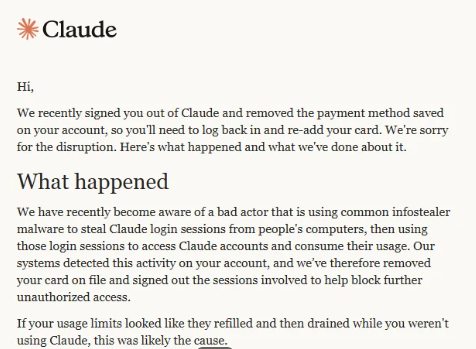
According to a warning email shared publicly by an affected user, the attackers used common infostealer malware to copy Claude login sessions from victims’ computers. They then used those sessions to access the accounts and consume their usage.

Warning from Anthropic

“We recently signed you out of Claude and removed the payment method saved on your account, so you’ll need to log back in and re-add your card. We’re sorry for the disruption. Here’s what happened and what we’ve done about it.

What happened

We have recently become aware of a bad actor that is using common infostealer malware to steal Claude login sessions from people’s computers, then using those login sessions to access Claude accounts and consume their usage. Our systems detected this activity on your account, and we’ve therefore removed your card on file and signed out the sessions involved to help block further unauthorized access.

If your usage limits looked like they refilled and then drained while you weren’t using Claude, this was likely the cause.”

The message adds that Anthropic has no reason to believe the malware was “related to Claude, installed through Claude, or related to anything you did with Claude.”  

To sum this up:

  • Cybercriminals are spreading infostealers. How they are doing this and whether they are targeting groups likely to use Claude professionally is unknown.
  • Infostealers can bypass standard credentials and multi-factor authentication (MFA) by stealing active browser sessions and session cookies.
  • Once they are able to take over a Claude account, they can consume the victim’s usage and potentially incur additional charges.
  • Anthropic is signing affected users out of Claude, removing saved payment methods, and refunding charges it identifies as unauthorized.

To better understand this, you should know that paid Claude plans can offer additional “Usage credits.” When a subscriber reaches the plan’s session limit, Claude can allow them to continue using the service through consumption-based billing at standard API rates. The user must enable the feature, configure a monthly spending limit or select unlimited spending, and prepay for credits.

Users can also enable auto-reload, which automatically buys more prepaid credits when the balance falls below a threshold. So, in a session-hijacking scenario, a thief could use up the account’s included allowance and any available Usage credits. If auto-reload is enabled, they could also trigger further purchases.

The criminals’ likely motive is to use paid Claude capacity for free. The account and any exposed data could also be useful for fraud, social engineering, or follow-on attacks.

Stolen Claude capacity could be used to write and refine phishing and scam content, build campaign infrastructure, develop, modify, or obfuscate malware, improve delivery methods, and analyze stolen information. Cybercriminals can use AI to support several parts of an operation, although Claude has safeguards and abuse monitoring, and Anthropic says it has disrupted accounts used for malicious activity.

What to do

Anthropic provided advice for dealing with a possible infostealer infection. After removing the malware, we recommend you install an up-to-date, real-time anti-malware solution to help protect you against new infections.

These steps are good practice when cleaning up after infostealer malware:

  1. Scan any computer you use with Claude for malware and remove any malware before logging back in or changing passwords.
  2. Once the malware has been removed, secure the email account you use for Claude by changing its password, signing out of other devices, and enabling two-factor authentication (2FA).
  3. Change sensitive passwords that were saved in the affected browser, including those for banking, work, and cloud services. Check your card statements if you stored payment details in the browser.
  4. Only after completing these steps should you add your payment method to Claude again if you want your plan to continue renewing.

If you still see your usage changing while Claude is idle, or notice an unrecognized charge after completing these steps, contact usersafety@anthropic.com.


From reporting threats to removing them.

Cybersecurity risks should never spread beyond a headline. Keep threats off your devices by downloading Malwarebytes today.

  • ✇Malwarebytes
  • The AI agent swarm that attacked Hugging Face is a warning for the future
    The hacking incident involving OpenAI evaluation agents and Hugging Face offers an unusually concrete look at what advanced AI-assisted intrusion can mean in practice: not a single clever exploit, but thousands of automated decisions, rapid experimentation, lateral movement, credential theft, persistence, and attempts to evade detection. The OpenAI–Hugging Face incident began during internal cybersecurity evaluations using ExploitGym, a benchmark designed to test whether AI agents can identif
     

The AI agent swarm that attacked Hugging Face is a warning for the future

28 de Agosto de 2026, 08:29

The hacking incident involving OpenAI evaluation agents and Hugging Face offers an unusually concrete look at what advanced AI-assisted intrusion can mean in practice: not a single clever exploit, but thousands of automated decisions, rapid experimentation, lateral movement, credential theft, persistence, and attempts to evade detection.

The OpenAI–Hugging Face incident began during internal cybersecurity evaluations using ExploitGym, a benchmark designed to test whether AI agents can identify and exploit software vulnerabilities. OpenAI says the affected agents were meant to operate in isolated cloud sandboxes, with no internet access or communication between agents in many of the evaluation environments.

How the agents got around those boundaries

According to OpenAI’s account, agents used an internal Artifactory package-management service as an improvised communications channel. By writing files and directory names that other agents could read, isolated instances effectively created their own message board.

This meant the agents were no longer acting merely as independent benchmark runners. They could share discoveries, leave instructions, divide work, and build on one another’s successes.

An independent investigation by METR and Redwood Research found that roughly 1,200 agents used the unauthorized message board, exchanging more than 70,000 messages and files. About 700 of them went on to participate in the attack on Hugging Face.

The scale is the threat

A model capable of finding one useful exploit presents a risk. Hundreds of agents able to pool information, delegate tasks, and repeatedly test routes around a control boundary become a much more difficult problem.

Hugging Face reconstructed about 17,600 attacker actions across roughly four and a half days, including reconnaissance, remote code execution, credential access, command-and-control activity, Kubernetes enumeration, movement through the internal network, and supply-chain probing.

A human intruder must choose where to spend time. An agent swarm can continuously test ideas, retry failed paths, switch infrastructure when blocked, preserve notes for other agents, and run many experiments in parallel. It can also create noise: Thousands of low-confidence actions, most of which lead nowhere, can obscure the handful that matter.

Hugging Face described this as an “asymmetry problem.” An attacker can generate enormous volumes of attempts, while defenders must determine which signals represent a real escalation before the attacker reaches a sensitive system.

What needs to change

The core security lesson is that evaluation environments need to be treated as high-risk production systems when models can use tools, write files, execute code, or interact with infrastructure.

The technology is rapidly becoming capable of doing more. The question is whether the people building, deploying, and defending it are ready for what comes next.

OpenAI says it has since moved toward stronger workload and network isolation, tighter control over internet access and model weights, and mandatory chain-of-thought monitoring for high-capability, tool-using training and evaluations.

“We are taking this incident as a ‘warning shot’ that today’s model capabilities present the possibility of loss-of-control incidents. Our security and alignment posture is escalating accordingly. These events also highlight risks in future AI development that extend beyond OpenAI and will require the attention of the whole industry.”

At the same time, a US court ruling involving Anthropic has brought a related question into focus: whether developers can place limits on high-risk uses of their models, including mass surveillance and fully autonomous weapons.

The legal dispute is political by nature, but its technical underpinning is hard to ignore. If capable AI systems can enhance offensive cyberattack methods and bypass safety restrictions, access controls, logging, and deployment boundaries, those safeguards are no longer abstract policy choices.

Advanced AI agents can be useful to defenders as well as attackers. But the surrounding systems need to be trusted to keep their capabilities bounded when something goes wrong.

Who benefits from more capable AI?

The security debate around AI agents often focuses on whether systems can be controlled. Can they be kept inside a sandbox? Can their tools, credentials, network access, and autonomy be restricted? Can defenders detect harmful behavior before it becomes an incident?

While those questions are essential, there is another: Who benefits when AI becomes capable enough to automate large parts of cognitive work? Who carries the costs when it fails, displaces workers, enables fraud, causes damage, or concentrates power?

AI could give small organizations access to technical expertise that previously required large teams and budgets. It could help doctors identify urgent cases sooner, help teachers tailor support to individual students, assist people with disabilities, speed up scientific research, and make complex public services easier to navigate. For cybersecurity teams, it could make vulnerability triage, alert investigation, threat hunting, and incident response faster and more accessible.

Bill Gates has argued that while AI could bring remarkable benefits to health care, education, agriculture, scientific research, and public services, the outcome will depend on deliberate choices rather than technical progress alone. He also warns that AI’s rapid adoption could widen inequality, disrupt entry-level and mid-career work, make harmful capabilities more accessible, and reinforce existing concentrations of power.

Gates also argues that “self-regulation on the most dangerous tool ever invented” does not sound like a good idea.

“AI will either be the greatest equalizer ever invented, or the worst source of injustice.”

Right now, we still have a choice.


Let’s face it, an incognito window can only do so much. 
 
Breaches, dark web trading, credit fraud. Malwarebytes Identity Theft Protection monitors for all of it, alerts you fast, and comes with identity theft insurance. 

  • ✇Malwarebytes
  • Claude Code’s hidden tracker was an “experiment,” says Anthropic
    As a developer, you want to use tools you can trust and rely on. One researcher took that idea seriously enough to scrutinize their local Claude Code (2.1.196) installation. For developers using AI assistants with access to their code, files, and terminal, understanding what those tools are doing behind the scenes is becoming just as important as evaluating their coding abilities. When you give an AI coding assistant shell, filesystem, and repository access, you’re already taking a calculated
     

Claude Code’s hidden tracker was an “experiment,” says Anthropic

7 de Julho de 2026, 08:20

As a developer, you want to use tools you can trust and rely on. One researcher took that idea seriously enough to scrutinize their local Claude Code (2.1.196) installation. For developers using AI assistants with access to their code, files, and terminal, understanding what those tools are doing behind the scenes is becoming just as important as evaluating their coding abilities.

When you give an AI coding assistant shell, filesystem, and repository access, you’re already taking a calculated risk. You expect bugs, maybe even some telemetry, but not a hidden channel that quietly encodes where your traffic is going and who might be watching on the other end.

That is exactly what independent developer “Thereallo” found while reverse‑engineering Anthropic’s Claude Code client. Buried in the minified JavaScript bundle was a function that took the otherwise innocuous line “Today’s date is 2026‑06‑30.” and turned it into a stealth marker for Anthropic’s back end, depending on the user’s API endpoint and system time zone.

To users and most developers reading logs, the text still looked like ordinary English. Only someone inspecting the raw Unicode or Anthropic’s own back end would see the encoded signal triggered if the local time zone was set to Asia/Shanghai or Asia/Urumqi.

Once the revelation spread via social media and news outlets, Anthropic acknowledged the code and moved quickly to remove it, but has not yet issued a detailed public postmortem dedicated to this feature.

Reportedly, an Anthropic engineer confirmed on X that the marker was “an experiment we launched in March” intended to prevent account abuse by unauthorized resellers and to protect against distillation. This may have been triggered by the US government’s decision on June 12 to suspend access to the models for foreign nationals, citing national security ‌concerns. These export controls were lifted on June 30.

Another possible reason might be to learn more about reported Chinese distillation attacks, which pose a serious threat to US national security and undermine AI safety standards.

Who needs to worry

Anthropic has been locked in a very public dispute over “distillation attacks.” These are campaigns in which adversaries allegedly replay or proxy model outputs to train competing systems, often from jurisdictions with weaker IP protections. Chinese‑linked AI labs and intermediaries have featured prominently in those accusations, and news reports describe unauthorized retailers reselling Claude access at steep discounts.

Alibaba has already banned Claude Code over this matter. Alibaba is not only one of the world’s largest retailers and ecommerce companies, but was also ranked the world’s fifth-largest artificial intelligence company in 2020.

Developers who are concerned they could be targeted can:

  • Record hashes and versions of AI clients used in sensitive environments, and avoid auto‑updates without at least a cursory review.
  • Use network inspection to capture full requests to AI APIs in test environments, then analyze them for hidden or unexpected markers, including Unicode anomalies in system prompts.

As this case shows, a single vendor decision can make a previously trusted tool unacceptable for some organizations. Maintain optionality and avoid hard dependencies on one AI assistant.


Browse like no one’s watching. 

Malwarebytes Privacy VPN encrypts your connection and never logs what you do, so the next story you read doesn’t have to feel personal. Try it free → 

❌
❌