This week on the Lock and Code podcast…
At just 17 years old, Jordan DeMay was murdered by strangers online.
That’s how Jordan’s father, John DeMay, described what happened to his son four years ago. At home in Michigan, Jordan was readying for a weekend trip when he received a friend request on Instagram. The invite was sent by a user named “dani.robertts” whose profile showed an attractive young woman. After accepting the request, Jordan and the account chatted about nothing in particula
At just 17 years old, Jordan DeMay was murdered by strangers online.
That’s how Jordan’s father, John DeMay, described what happened to his son four years ago. At home in Michigan, Jordan was readying for a weekend trip when he received a friend request on Instagram. The invite was sent by a user named “dani.robertts” whose profile showed an attractive young woman. After accepting the request, Jordan and the account chatted about nothing in particular—teenage matters, getting to know one another—before “dani” became flirtatious, eventually sending Jordan what she claimed was a nude photograph of herself.
Jordan responded in kind with an explicit photograph of himself.
But here, a trap was revealed.
“Dani Robertts” was not a young, friendly, interested woman. Dani Robertts was several men, sending messages from thousands of miles away in Lagos, Nigeria, who had followed a script to pressure young men into handing over their money. This was not the first time these men had run this scam. But with a great deal of investigative work, it hopefully has become the last.
What happened to Jordan can happen to anyone—and it has happened to far too many young men and women today. It is a type of attack commonly referred to as “sextortion.”
Today, on the Lock and Code podcast with host David Ruiz, we speak with John DeMay about his son Jordan, his family’s relationship with social media, and what parents should know.
Young people use AI for everything. From schoolwork to interview prep, relationship advice to shopping decisions, the technology has become part of how young people live. For the most digitally fluent generation ever, AI is a competitive edge, a creative partner, and an always-on assistant. But the same technology making young people’s lives easier is also making the internet harder to navigate. AI is making scams more convincing, identities easier to manipulate, and online content harder to tru
Young people use AI for everything. From schoolwork to interview prep, relationship advice to shopping decisions, the technology has become part of how young people live. For the most digitally fluent generation ever, AI is a competitive edge, a creative partner, and an always-on assistant.
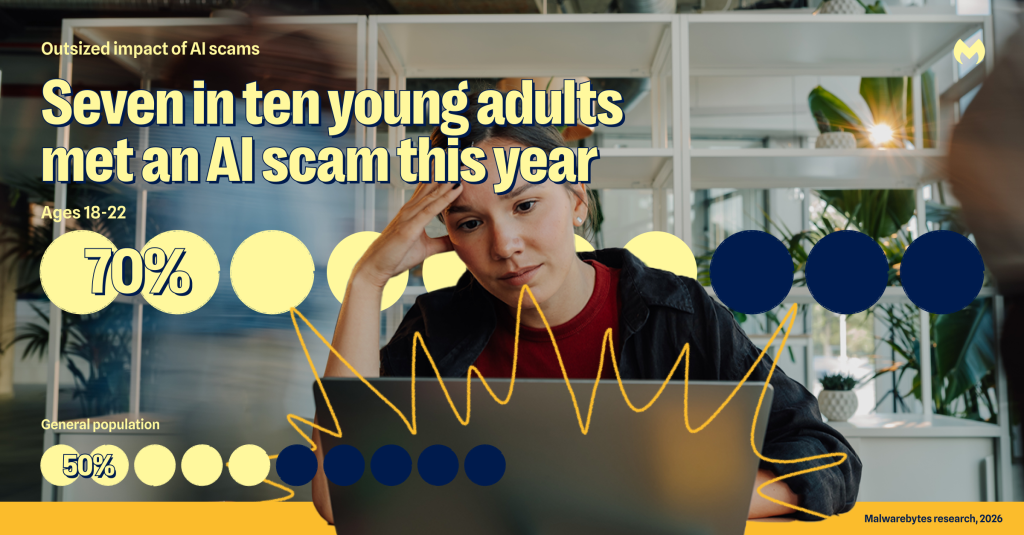
But the same technology making young people’s lives easier is also making the internet harder to navigate. AI is making scams more convincing, identities easier to manipulate, and online content harder to trust. Seven in ten (70%) 18-to-22-year-olds have experienced an AI-related scam in the last year, compared to half of the general population. And nearly every young person worries AI will be used against them.
This isn’t happening because young people are reckless. It’s happening because the online platforms they rely on for everyday life now double as entry points for AI threats: social feeds where manipulated content and real content sit side by side, online marketplaces filled with fake storefronts and reviews, messaging channels where threats can be personalized, and AI tools that can make false information feel like the truth.
That creates a new kind of safety burden. Young people are being asked to use AI, judge its output, protect their identities, and avoid increasingly personalized scams all at once. The result is a digital life that feels more powerful, but also more vulnerable to abuse.
The internet is getting harder for young people to trust
The internet young people grew up with isn’t the same one they’re facing today. AI has changed the landscape, making it harder for even these digital natives to know what information is credible and safe. Half of 18-to-22-year-olds strongly agree that it’s becoming harder to tell what content is genuinely human or real.
Young people have had a front row seat to how AI can bend the truth. Nearly half have seen AI provide information they knew or later found out was wrong or misleading (44% versus 30% of the general population). Nearly one in four (23%) have suffered negative consequences because of AI advice, compared with 16% of the general population, and 18% say they have suffered emotionally from AI advice, compared with 12% of the general population. For a generation using AI in every corner of their lives, bad information can have lasting effects on their credibility, reputation, and relationships.
Many young people have changed how they engage online as a result:
47% of young people say AI has changed how much they trust reviews or content, compared with 37% of the general population
35% say AI has changed how they shop online, compared with 26%
32% say AI has changed how they present themselves professionally, compared with 20%
19% say AI has changed how they date or communicate romantically, compared with 10%
As one young person said about online dating:
“Dating isn’t an option for me online anymore. You just never know what is or isn’t AI, and I don’t want to spend a lot of time on someone fake.”
AI is making it easier for scams to reach young people
The harder it becomes to tell what is real, the easier it becomes for scams to work. For young people, AI is fueling a wave of scams that are more personal and invasive than ever before.
Nearly one in four young people have been a victim of an extortion scam of some kind (24% versus 17% of the general population).
Nearly one in five have been a victim of a deepfake or virtual kidnapping scam (19% versus 8%).
Nearly one in ten have been a victim of sextortion (8% versus 7%).
More than one in ten have been a victim of an impersonation scam (14% versus 10%).
More than one in ten have been a victim of a romance scam (12% versus 10%).
What’s striking isn’t just how many young people have been victimized—it’s how many have been targeted:
More than half have been the target of an extortion scam (56% versus 42% of the general population).
47% have encountered an impersonation scam (versus 35%)
46% have encountered a romance scam (versus 33%).
More than four in ten have been targeted by a deepfake or virtual kidnapping scam (43% versus 26%).
Nearly four in ten have encountered sextortion (38% versus 24%).
These scams may look different on the surface, but they all work the same way: they exploit fear, trust, shame, and intimacy. The more often young people encounter them, the more chances scammers have to find exactly which emotional triggers work.
This exposure isn’t random. Young people are on social platforms at rates up to three times those of the general population: 89% use Instagram (versus 55% of the general population), 78% use TikTok (versus 38%), 68% use Snapchat (versus 26%), and 49% use Pinterest (versus 25%). Scammers can use these platforms to get everything they need to make their threats more convincing: public photos, friend networks, school affiliations, relationship clues, and everyday posts containing personal information. With AI, scammers can use that content to create explicit images, clone voices, impersonate profiles, and create threats personalized with details that are hard to ignore.
One young person shared their experience:
“I had someone make fake nudes of me using AI on my photos from my social media and threaten to post them on Facebook after I realized that they had scammed me. I decided to be more careful with my personal information.”
Young people fear AI will steal what money cannot replace: identity, reputation, and sense of self
AI-fueled scams aren’t just scams in the traditional sense. They are forms of identity abuse. This is different from traditional identity theft. For young people, the risk isn’t only that someone steals a password or money. It’s that scammers can use AI to make them appear to say, do, or share something they never did, with consequences that can follow them in their personal and professional lives.
That’s why young people are so concerned about AI being used against them. The fears that hit hardest:
88% worry about AI being used to harm their professional or personal reputation versus 77% of the general population
82% worry about someone creating a fake profile pretending to be them versus 76%
81% worry about someone creating fake nude or sexually explicit photos or videos of them versus 62%; 15% say it’s happened to them already (versus 10%)
80% worry about being deceived by someone using AI to fake their identity in an online relationship versus 67%
These threats are especially powerful at a life stage where young people are still building their personal and professional reputations. A fake profile, manipulated image, or AI-generated explicit video can affect how everyone from classmates and professors to potential employers and romantic partners see them for years to come.
Young people are pulling back online, but protection is still too manual
Many young people are responding by retreating. 80% are sharing or posting less online than they were a year ago, versus 61% of the general population. Compared to the general population, more 18–22-year-olds have also taken AI-related protective measures like tightening privacy settings, removing unknown followers, using reverse image search to verify content, requesting data removal, and watermarking their own photos and videos.
Those actions matter, but they also show how much responsibility has been pushed onto individuals. Staying safer online now means constantly reviewing settings, checking sources, questioning content, and so much more. That’s a lot to ask of anyone, and the fatigue is showing: 42% of young people say they receive so many warnings they have stopped paying attention, compared with 36% of the general population. It’s hard to sustain vigilance when new risks are always emerging.
At the same time, completely opting out isn’t realistic. Young people remain deeply embedded in digital life, and they’re still some of AI’s most enthusiastic adopters: 74% say AI has had a positive impact on their lives, compared with 57% of the general population. They aren’t rejecting AI or the internet, but they are carrying more of the safety burden than they should have to.
What young people can do to help decrease their risk right now
Know the scams targeting you. Extortion, sextortion, deepfakes, and romance scams disproportionately target young people. If someone contacts you with threats of any kind, do not pay. Report it to the platform and to authorities.
Button up your social media. Everything you post publicly is available to anyone, including scammers. Tighten privacy settings on the platforms you use most and review your followers regularly.
Don’t trust product images alone. Before buying from an unfamiliar retailer, use reverse image search on product photos and look for independent reviews off the retailer’s own site.
Create a family code word. Make sure you agree on this word in person, not online. If you receive a panicked call from someone you know asking for money or information, verify they are who they say they are with the code word.
Don’t reuse passwords. If one password gets stolen in a data breach, it will likely get tried on all other accounts you might have. Use a different password for every account to keep your accounts locked down.
Turn on two-factor authentication on all your important accounts. Only 30% of young people have done this. It is one of the highest-impact protections available and takes under five minutes to set up.
Protect your devices. Use security software on all your devices, and keep all your software up to date to make sure you’re patched against all known security holes.
Malwarebytes Student Protection Program
If you’re a student or work at a university, Malwarebytes Student Protection Program provides two years of free Premium Security for three devices for all US college or university students, staff and faculty.
This includes Malwarebytes device protection for laptops, tablets, and mobile phones with built-in scam protection. It protects against creepy trackers and ads, and blocks malware, ransomware, and cybercriminals themselves.
The research in this article is based on a March 2026 survey about AI, identity, and the collapse of digital trust and was conducted among 1,500 respondents in the United States, United Kingdom, Germany, Austria, and Switzerland. This article focuses on student-aged adults, defined as respondents ages 18 to 22, compared with the general population.
Additional context comes from Malwarebytes’ 2025 research Tap, Swipe, Scam: How Everyday Mobile Habits Carry Real Risk, which looked at mobile scams and scam-related behaviors across the same markets. Both research studies were prepared by an independent research consultant and distributed via Forsta.
This week on the Lock and Code podcast…
There is a lot going on right now regarding the safety of kids online.
In the United States, the majority of state legislatures have passed age verification laws requiring a variety of websites to more rigorously verify the age of their visitors. In the United Kingdom, Canada, Norway, Spain, and Germany, lawmakers are considering bans on social media access for anyone under the age of 16—Australia passed its ban in 2025. In schools across the world,
There is a lot going on right now regarding the safety of kids online.
In the United States, the majority of state legislatures have passed age verification laws requiring a variety of websites to more rigorously verify the age of their visitors. In the United Kingdom, Canada, Norway, Spain, and Germany, lawmakers are considering bans on social media access for anyone under the age of 16—Australia passed its ban in 2025. In schools across the world, smartphones have been removed from classrooms, hallways, and cafeterias. And online, some of the most popular apps and video games with children, such as Discord and Roblox, have implemented default restrictions on what young users can find and who they reach.
Today, on the Lock and Code podcast with host David Ruiz, we bring back Anna Brading, editor-in-chief of Malwarebytes Labs and director of content and, perhaps most importantly, mother of three. With a long career in cybersecurity—and an equally long time spent reading, writing, and assigning some of the cybersecurity world’s most pressing headlines—Brading has a unique perspective on what is most dangerous to her children online.
Brading’s list of priorities is long, and includes improper image use, “online nastiness,” and Roblox, but she has a few rules and guidelines to help. She sets a one-hour-a-day video game limit on the weekends, restricts YouTube to a communal and monitored activity, and requests that no one share photos of her children online without her express permission. Importantly, she also reminds parents to trust their guts.
“If the norm now is mental health issues or online grooming or non-consensual porn or constant comparison, then I’m okay without my kids fitting in. I would say be radical, buck the trend, don’t do what everybody else is doing. Say no to things you don’t feel comfortable with.”
Every consumer app has a settings menu that lets you make decisions about things like notifications or dark mode. Meta has just decided that anyone can generate AI images of you from your public Instagram account by typing your Instagram handle into a prompt.
On July 7, Meta launched its AI image generation model, Muse Image. It integrates with public Instagram accounts. Now, all someone has to do is tag your account in a prompt, and they can use Meta AI to generate an image using your likene
Every consumer app has a settings menu that lets you make decisions about things like notifications or dark mode. Meta has just decided that anyone can generate AI images of you from your public Instagram account by typing your Instagram handle into a prompt.
On July 7, Meta launched its AI image generation model, Muse Image. It integrates with public Instagram accounts. Now, all someone has to do is tag your account in a prompt, and they can use Meta AI to generate an image using your likeness. According to Meta’s own policy, you won’t be notified if someone does this, making it difficult to know when or how your likeness has been used.
Meta says Muse Image is meant to make AI image generation more personal by letting people reference public Instagram accounts in their prompts. That may sound fun when you’re creating images of yourself. It’s less appealing when anyone else can do the same with your account.
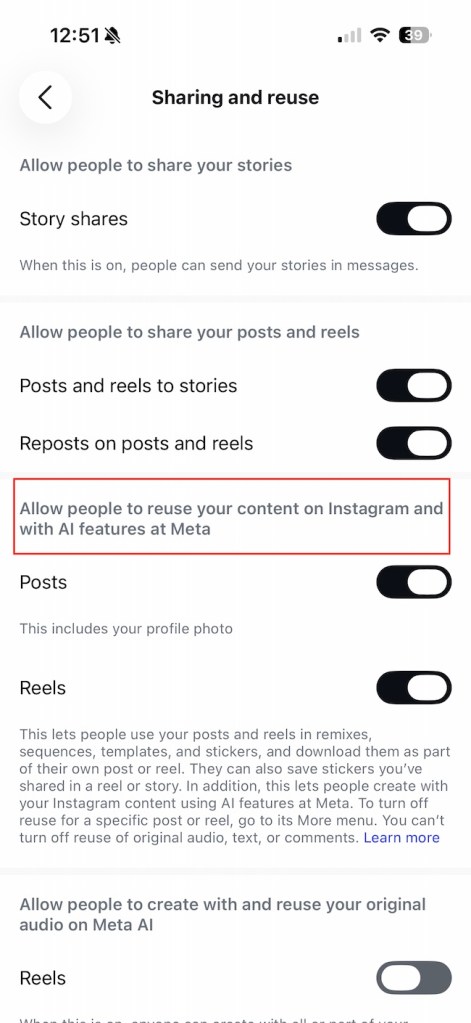
Meta lets you opt out, although finding the setting is its own adventure. On Instagram, open Profile > Menu > Sharing and reuse. Under “Allow people to reuse your content on Instagram and with AI features at Meta,” turn off the Posts and Reels toggles. Depending on your app version, the wording may vary, and the feature is still rolling out, starting in the US, so you may not see the setting yet.
You’d hope that Meta would tell you up front with a big, bold “Turn this off if you don’t want it” message when you open Instagram, but no such luck. You’d also hope that the company would retroactively remove any images that someone made of you before you opted out, but that’s not happening either.
Opting out only prevents future image generation. Any AI images that someone created before you switched the setting off still remain in circulation.
The only mechanism that comes close to comprehensive protection is switching your account to private.
What’s the risk?
There are privacy and security implications here. Anyone can now generate AI images based on your public Instagram profile without your knowledge, and Meta won’t notify you when it happens. Public Instagram photos were already being harvested by attackers to create deepfakes for identity verification fraud. Giving people an official way to generate AI images based on public profiles lowers the barrier to creating synthetic images that could be used for impersonation, scams, or other abuse.
Cybercriminals are already combining generative AI with automated tools to scale phishing and fraud. Muse Image makes it even easier to generate convincing images based on public identities.
Meta’s AI has introduced other security issues, too. Earlier this year, researchers disclosed a “confused deputy” flaw in Meta’s AI support chatbot that let it make account changes—including changing email addresses and resetting passwords—without adequately verifying who it was talking to. Enabling multi-factor authentication (MFA) appeared to mitigate that issue.
Meta also uses an opt-out approach when training its AI on European user data. The company relies on GDPR’s “legitimate interests” legal basis to process European users’ data for AI purposes, a position that privacy group NOYB has challenged.
Protect yourself
If your Instagram account is public, open Profile > Menu. Under “How others can interact with you” tap Sharing and reuse, then turn off the Posts and Reels reuse settings under “Allow people to reuse your content on Instagram and with AI features at Meta.” Turning off these reuse settings only prevents future AI image generation and reuse. It won’t remove AI-generated content or remixes that already exist.
Turn on MFA for all your Meta accounts. It’s one of the simplest ways to protect your account if your password is compromised.
If you want the strongest protection Meta currently offers, switch your Instagram account to private. It’s a blunt solution, but it prevents strangers from using your public profile as source material.
Meta’s own Oversight Board has already said the company needs stronger detection tools and better labeling of AI-generated content. When Meta’s own governance body says the defenses aren’t enough, consumers should take notice.
Update July 11: After widespread criticism over privacy and consent, Meta announced yesterday it has removed the Muse Image feature that allowed people to generate AI images by referencing public Instagram accounts. The company said the feature “missed the mark” and is no longer available.
Scammers don’t need to hack you. They just need you to click once.

 Entrar