❌

Visualização normal

Antes de ontemMalwarebytes
  • ✇Malwarebytes
  • A sextortion conspiracy killed his son (Lock and Code S07E21)
    This week on the Lock and Code podcast… At just 17 years old, Jordan DeMay was murdered by strangers online. That’s how Jordan’s father, John DeMay, described what happened to his son four years ago. At home in Michigan, Jordan was readying for a weekend trip when he received a friend request on Instagram. The invite was sent by a user named “dani.robertts” whose profile showed an attractive young woman. After accepting the request, Jordan and the account chatted about nothing in particula
     

A sextortion conspiracy killed his son (Lock and Code S07E21)

19 de Outubro de 2026, 09:10

This week on the Lock and Code podcast…

At just 17 years old, Jordan DeMay was murdered by strangers online.

That’s how Jordan’s father, John DeMay, described what happened to his son four years ago. At home in Michigan, Jordan was readying for a weekend trip when he received a friend request on Instagram. The invite was sent by a user named “dani.robertts” whose profile showed an attractive young woman. After accepting the request, Jordan and the account chatted about nothing in particular—teenage matters, getting to know one another—before “dani” became flirtatious, eventually sending Jordan what she claimed was a nude photograph of herself.

Jordan responded in kind with an explicit photograph of himself.

But here, a trap was revealed.

“Dani Robertts” was not a young, friendly, interested woman. Dani Robertts was several men, sending messages from thousands of miles away in Lagos, Nigeria, who had followed a script to pressure young men into handing over their money. This was not the first time these men had run this scam. But with a great deal of investigative work, it hopefully has become the last.

What happened to Jordan can happen to anyone—and it has happened to far too many young men and women today. It is a type of attack commonly referred to as “sextortion.”

Today, on the Lock and Code podcast with host David Ruiz, we speak with John DeMay about his son Jordan, his family’s relationship with social media, and what parents should know.

Tune in today to listen to the full conversation.

Show notes and credits:

Intro Music: “Spellbound” by Kevin MacLeod (incompetech.com)
Licensed under Creative Commons: By Attribution 4.0 License
http://creativecommons.org/licenses/by/4.0/
Outro Music: “Good God” by Wowa (unminus.com)


Listen up—Malwarebytes doesn’t just talk cybersecurity, we provide it.

Protect yourself from online attacks that threaten your identity, your files, your system, and your financial well-being with our exclusive offer for Malwarebytes Premium for Lock and Code listeners.
  • ✇Malwarebytes
  • Sextortion “help” firm took $60 million from victims, FTC alleges
    The Federal Trade Commission (FTC) has filed a complaint accusing Digital Forensics Corporation of exploiting people already targeted by sextortionists. We have talked about sextortion and recovery scams in the past, but we never looked specifically at the combination. Apparently, there is a lot of money to be made for those ruthless enough to take money from victims already in a state of panic. The FTC has accused Digital Forensics Corporation, its owner Dmitry Belkin, and affiliated comp
     

Sextortion “help” firm took $60 million from victims, FTC alleges

15 de Outubro de 2026, 08:48

The Federal Trade Commission (FTC) has filed a complaint accusing Digital Forensics Corporation of exploiting people already targeted by sextortionists.

We have talked about sextortion and recovery scams in the past, but we never looked specifically at the combination. Apparently, there is a lot of money to be made for those ruthless enough to take money from victims already in a state of panic.

The FTC has accused Digital Forensics Corporation, its owner Dmitry Belkin, and affiliated companies of misleading sextortion victims into paying at least $60 million for assistance that, in numerous instances, they did not provide. A federal court has temporarily halted the defendants’ activities while the case proceeds.

Most of the time, sextortion emails are a bluff sent to a large number of targets to see if one takes the bait. But sextortion can also involve intimate images that someone really possesses. In those cases, a criminal threatens to share the material unless the victim pays, sends more images, or complies with other demands.

In those cases, victims can feel desperate, especially when the demands keep coming, and may look for help to make it stop. According to the FTC, Digital Forensics targeted people searching for that help through advertisements on Google, YouTube, X, and other platforms. The company allegedly claimed it could track down criminals worldwide, identify perpetrators, and provide law enforcement with evidence needed to make arrests.

Digital Forensics allegedly charged between $1,499 and $20,000 for a “Phase 1” package. That was supposed to include communicating with the sextortionist, tracking their location, producing an investigative report, and reporting the crime to law enforcement.

According to the FTC, Digital Forensics Corporation changed the victims’ account settings to block the sextortionist, fabricated chat transcripts, and presented pre-saved coordinates, often in Nigeria or the Philippines, as the sextortionist’s location.

After collecting the first payment, the company allegedly pressured customers to purchase “Phase 2” services, supposedly providing ongoing account monitoring and further assistance. The FTC says the company did not follow through on those promises either.

Another huge red flag was that the company also allegedly discouraged victims from blocking their blackmailers, contrary to law enforcement and expert advice.

The allegations against Digital Forensics Corporation have not yet been decided by the court.

How to stay safe

Be wary of anyone who promises to stop the threats or pressures you to pay immediately. Help should offer clear information and realistic options. It should not turn your fear into another payment deadline.

If someone is threatening to share intimate images, you do not have to handle it alone.

  • Preserve the threats and account details. Keep the messages, usernames, and payment demands. Block the offender but do not delete your account or the messages, since they may help real investigators.
  • Stop communicating and block the blackmailer. Do not pay them or give them access to your devices or financial accounts. Report the account using the platform’s safety tools.
  • Tell someone you trust about the sextortion. A friend, family member, counselor, or other trusted adult can provide support while you decide what to do next.
  • Report the crime. Contact local police. In the US, you can also report sextortion to the FBI. If it involves a minor, report it through the National Center for Missing and Exploited Children’s CyberTipline.

If you have already paid a service that you believe misled you, keep its ads, messages, contract, and receipts, and report your experience to the FTC through ReportFraud.ftc.gov.

If you’re unsure whether something is a scam or not, ask Malwarebytes Scam Guard. It can help you assess it and provide advice on next steps.


Something feel off? Check it before you click.  

Malwarebytes Scam Guard helps you analyze suspicious links, texts, and screenshots instantly.  

Available with Malwarebytes Premium Security for all your devices, and in the Malwarebytes app for iOS and Android.  

Try it free → 

  • ✇Malwarebytes
  • Sextortion scammers are exploiting ShinyHunters data leaks
    Sextortion scammers are using email addresses from data leaked by the ShinyHunters hacking group to add some credibility to their feeble attempts to convince people they have embarrassing information about them. Sextortion emails are messages claiming that the scammer recorded you through your webcam while you watched pornography and now demand payment. They have been around for years and keep evolving with small changes in wording and fake technical detail. In this campaign, the scammers
     

Sextortion scammers are exploiting ShinyHunters data leaks

27 de Julho de 2026, 12:00

Sextortion scammers are using email addresses from data leaked by the ShinyHunters hacking group to add some credibility to their feeble attempts to convince people they have embarrassing information about them.

Sextortion emails are messages claiming that the scammer recorded you through your webcam while you watched pornography and now demand payment. They have been around for years and keep evolving with small changes in wording and fake technical detail.

In this campaign, the scammers pretend to be ShinyHunters. What hasn’t changed is the basic truth: there is no malware, no recording, and no credible evidence behind the threat. Despite seeing countless versions of these emails over the years, I’ve yet to encounter one that was backed up by the evidence the sender claimed to have.

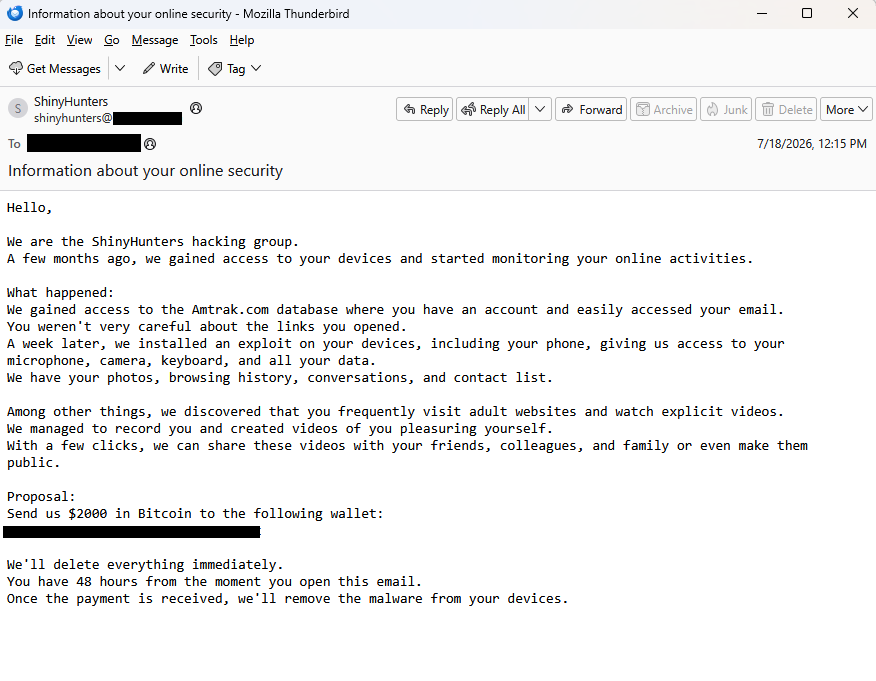
BleepingComputer reports that ShinyHunters data leaks are fueling a $2,000 sextortion email scam and shared the following example:

Example sextortion email from ShinyHunters

“Subject: Information about your online security

Hello,

We are the ShinyHunters hacking group.
A few months ago, we gained access to your devices and started monitoring your online activities.

What happened:
We gained access to the Amtrak.com database where you have an account and easily accessed your email.
You weren’t very careful about the links you opened.
A week later, we installed an exploit on your devices, including your phone, giving us access to your microphone,
camera, keyboard, and all your data.
We have your photos, browsing history, conversations, and contact list.

Among other things, we discovered that you frequently visit adult websites and watch explicit videos.
We managed to record you and created videos of you pleasuring yourself.
With a few clicks, we can share these videos with your friends,
colleagues, and family or even make them public.

Proposal:
Send us $2000 in Bitcoin to the following wallet:
xxxxxxxxxxxxxxxxxxxxxxxxxxxxxxxxx

We’ll delete everything immediately.
You have 48 hours from the moment you open this email.
Once the payment is received, we’ll remove the malware from your devices.”

BleepingComputer states it has seen data from the Amtrak, Hallmark, ADT, Substack, Betterment, CarGurus, Panera Bread, and McGraw Hill breaches used to target victims in this sextortion email campaign.

A California community college also issued a warning after seeing the campaign target people affected by the Canvas data breach.


Digital Footprint Scan

See if your personal data has been exposed.


They confirmed that the targeted email addresses had previously appeared in data leaked by ShinyHunters. They also contacted the group, which denied being behind the sextortion emails.

The increase to a $2,000 demand may suggest the scammers paid someone for the email lists. Although it’s more likely they simply downloaded the leaked data after ShinyHunters published it following failed extortion attempts.

A quick check of the Bitcoin address used in the email shows no activity.

blockchain report of scammer's Bitcoin address
No activity on their Bitcoin address

Let’s keep it that way. With any luck, these dungeon dwellers will eventually give up trying to scare people out of their hard-earned money.

How to react to sextortion emails

Some sextortion emails are badly written, but many have been polished by AI and look convincing. Regardless of how professional they look, they should be treated the same way: as unsubstantiated threats designed to scare victims into paying.

  • First and foremost, never reply to emails of this kind. Responding confirms that someone is actively reading messages sent to that address and may encourage further scam attempts.
  • Don’t let yourself be rushed into action. Scammers rely on the fact that you will not take the time to think this through and subsequently make mistakes. Ask for advice if you’re not sure.
  • An attachment is not proof. Most sextortion emails contain no evidence at all, and attachments are often used to deliver malware or make the threats appear more convincing.
  • If the email includes a password you’ve used before, change it immediately anywhere it’s still in use. Then enable two-factor authentication (2FA) wherever possible. If you’re having trouble keeping track of your passwords, consider using a password manager.
  • Delete the message, report it as spam, and move on.

Pro tip: Malwarebytes Scam Guard recognized this email for what it is: sextortion. It can recognize scams and advise you how to proceed.

Scam Guard recognizes this email as a sextortion scam

While these sextortion emails are almost always bluffs, if you’re concerned about webcam spying, Malwarebytes Webcam Monitoring can alert you when applications attempt to access your camera.


Scam or legit? Scam Guard knows.


❌
❌