Last week on Malwarebytes Labs:
The hidden work of modernizing Malwarebytes
X Money rollout linked to password-reset attacks
Free streaming boxes may be routing criminal traffic through your home
StreamRat Android malware spreads through Meta and TikTok ads
Your phone or computer may soon ask how old you are
Tech support scams look different now. Here’s what to watch for
Scammers are getting smarter about where they target you
Two critical Chrome flaws put users at risk
Update September 4, 2026
Shortly after this article was published, Google released another Chrome update that patches an actively exploited flaw in the V8 JavaScript engine, tracked as CVE-2026-85046.
Google rates the vulnerability as high severity and says an exploit already exists in the wild. An attacker could use a crafted HTML page to execute arbitrary code inside the Chrome sandbox. Because it is already being exploited, HKCERT rates the overall risk as extremely high.
After ins
Shortly after this article was published, Google released another Chrome update that patches an actively exploited flaw in the V8 JavaScript engine, tracked as CVE-2026-85046.
Google rates the vulnerability as high severity and says an exploit already exists in the wild. An attacker could use a crafted HTML page to execute arbitrary code inside the Chrome sandbox. Because it is already being exploited, HKCERT rates the overall risk as extremely high.
After installing the latest update, Chrome should be at version 152.0.7977.82/.83 on Windows and Mac, or 152.0.7977.82 on Linux.
Chrome is rolling out an update for its desktop browser. The update includes 26 security fixes, two of which Google rates as critical use-after-free vulnerabilities.
How to update Chrome
If you don’t want to wait for the rollout to reach you, manually updating is easy.
The easiest option is to allow Chrome to update automatically. But you can end up lagging behind if you never close your browser or if something goes wrong with the update.
To update manually, click the More menu (three dots), then go to Settings > About Chrome. If an update is available, Chrome will start downloading it automatically. Restart Chrome to complete the update, and you’ll be protected against these vulnerabilities.
Let’s look at the two critical vulnerabilities. Both are use-after-free (UAF) vulnerabilities. A use-after-free vulnerability occurs when a program attempts to access a memory location after it has been freed. That can cause crashes or, in some cases, allow an attacker to run their own code.
The first, tracked as CVE-2026-84353, was found in Shared Tab Groups and could allow a remote attacker using social engineering to execute arbitrary code outside the browser sandbox via a crafted HTML page. Here, social engineering likely means an attacker would have to lure you to a malicious website or open an email in HTML format.
The other critical vulnerability, tracked as CVE-2026-84352, was found in WebGL. WebGL, short for Web Graphics Library, is a browser technology that lets websites display interactive 2D and 3D graphics. The vulnerability could allow a remote attacker to execute arbitrary code outside the sandbox via a crafted HTML page.
Chrome vulnerabilities that enable remote code execution outside the browser sandbox are particularly valuable to attackers because they can turn a visit to a malicious or compromised website into direct code running on the underlying operating system, often without requiring additional exploitation steps.
Stop threats before they can do any harm.
Malwarebytes Browser Guard blocks phishing pages and malicious sites automatically. Free, one click to install. Add it to your browser →
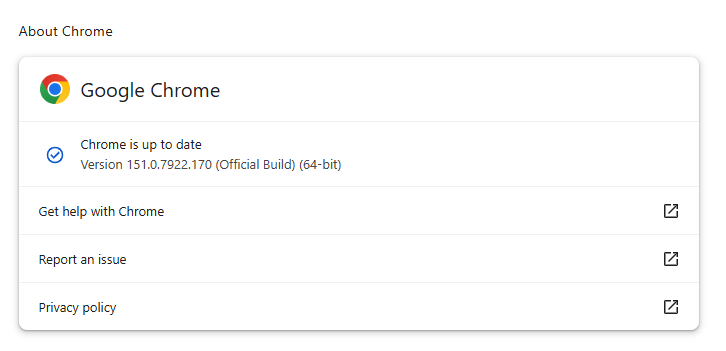
Chrome is rolling out an update for its desktop versions. The update includes 15 security fixes, two of which address critical buffer overflow vulnerabilities.
The stable channel has been updated to 151.0.7922.169/.170 for Windows and Mac, and 151.0.7922.169 for Linux.
How to update Chrome
If you don’t want to wait for the rollout to reach you, manually updating is easy.
The easiest option is to allow Chrome to update automatically. But you can end up lagging behind on updates if you
Chrome is rolling out an update for its desktop versions. The update includes 15 security fixes, two of which address critical buffer overflow vulnerabilities.
The stable channel has been updated to 151.0.7922.169/.170 for Windows and Mac, and 151.0.7922.169 for Linux.
How to update Chrome
If you don’t want to wait for the rollout to reach you, manually updating is easy.
The easiest option is to allow Chrome to update automatically. But you can end up lagging behind on updates if you never close your browser or if something goes wrong, such as an extension preventing the update.
To update manually, click the More menu (three dots), then go to Settings > About Chrome. If an update is available, Chrome will start downloading it automatically. Restart Chrome to complete the update, and you’ll be protected against these vulnerabilities.
As mentioned earlier, the two vulnerabilities rated critical in this update are both buffer overflow flaws.
A buffer overflow is a type of software vulnerability that exists when an area of memory within a software application reaches its address boundary and writes into an adjacent memory region. In software exploit code, two common areas that are targeted for overflows are the stack and the heap.
The first one is tracked as CVE-2026-76034 and was found in WebGL (Web Graphics Library). WebGL is a JavaScript application programming interface (API) that allows web browsers to render interactive 2D and 3D graphics smoothly. A remote attacker can exploit this vulnerability to execute arbitrary code outside the sandbox via a crafted HTML page.
The second critical vulnerability is tracked as CVE-2026-76036 and sits in Dawn, the underlying open-source library that implements the WebGPU standard. It acts as a bridge, allowing web apps to talk directly to computer graphics hardware. This vulnerability also allows a remote attacker to execute arbitrary code outside the sandbox via a crafted HTML page.
Chrome vulnerabilities that enable remote code execution outside the browser sandbox are particularly valuable to attackers because they can turn a visit to a malicious or compromised website into direct code execution on the underlying operating system, often without requiring additional exploitation steps.
The sandbox normally limits a compromised renderer process’s access to files, devices, and other sensitive system resources. Bypassing it substantially expands an attacker’s ability to steal data, establish persistence, deploy malware, or move further through an enterprise environment.
From reporting threats to removing them.
Cybersecurity risks should never spread beyond a headline. Keep threats off your devices by downloading Malwarebytes today.
Security updates are not just for enterprises with a dedicated security team and a change-management calendar. For consumers and small businesses, they are one of the simplest ways to shut down known attack paths before criminals get a chance to use them.
That matters because attackers love these flaws. because browser bugs, code execution issues, authentication bypasses, and privilege-escalation problems can be turned into a foothold, a data theft opportunity, or a full system compromise if
Security updates are not just for enterprises with a dedicated security team and a change-management calendar. For consumers and small businesses, they are one of the simplest ways to shut down known attack paths before criminals get a chance to use them.
That matters because attackers love these flaws. because browser bugs, code execution issues, authentication bypasses, and privilege-escalation problems can be turned into a foothold, a data theft opportunity, or a full system compromise if left unpatched.
If you only do one thing after reading a security advisory, make it this: update the affected software promptly, restart when required, and verify the version afterward.
The updates and instructions can be found on the pages we linked to.
Chrome
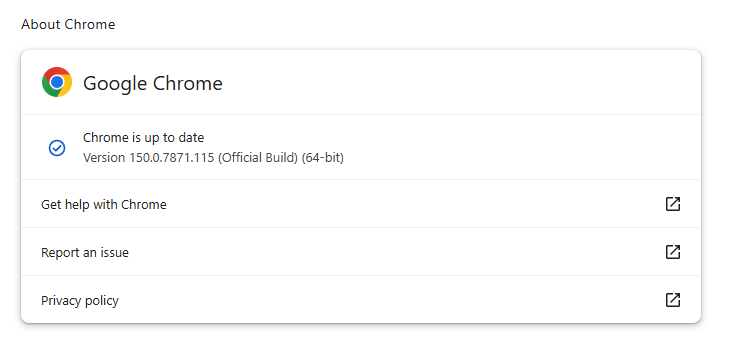
Google patched 15 security flaws in Chrome, including two critical use-after-free bugs in Ozone. The fixes are in Chrome 150.0.7871.124/.125, depending on platform.
Mozilla fixed two critical Firefox flaws in Firefox 152.0.6, and it says public exploit code exists for both issues. One affects JavaScript/WebAssembly and the other involves DOM navigation and site isolation, which makes this more than routine housekeeping.
Users should update Firefox to version 152.0.6 as soon as possible. For most users this can simply be done by restarting the browser. If you see the “What’s new” tab, the update is complete.
VMWare
Broadcom released a fix for a critical authentication bypass in VMware Avi Load Balancer, tracked as CVE-2026-47865. The issue could allow a network-accessible attacker to reach the Avi Control Plane, which makes it especially important in environments that expose management services or rely on load balancers at the edge.
Updates and the instructions to apply them can be found in the Security Advisory.
Zoom
Zoom Security Bulletin ZSB-26014 covers a critical issue in Zoom Workplace for Windows, described as improper input validation. The public record identifies the issue as CVE-2026-53412.
For users, the action item is to update Zoom Workplace for Windows to the vendor-fixed release as soon as it is available in your environment. For small businesses, that means updating not just the app on employee laptops, but also any centralized deployment package so the old build doesn’t come right back on the next install cycle.
“One of the best cybersecurity suites on the planet.”
First reported in May, ClaudeBleed is basically a “fake remote control” problem. A sneaky browser extension can pretend to be Claude’s own website and secretly drive the Claude for Chrome extension to read your data and take action in your accounts.
The Claude for Chrome browser extension is an assistant that has the user’s permission to access services like Gmail or Google Drive when you ask it to. ClaudeBleed happens because the extension can’t reliably tell the difference between the user
First reported in May, ClaudeBleed is basically a “fake remote control” problem. A sneaky browser extension can pretend to be Claude’s own website and secretly drive the Claude for Chrome extension to read your data and take action in your accounts.
The Claude for Chrome browser extension is an assistant that has the user’s permission to access services like Gmail or Google Drive when you ask it to. ClaudeBleed happens because the extension can’t reliably tell the difference between the user asking for help and a malicious script asking on their behalf.
So instead of you clicking a button to say “Claude, read this email,” a rogue extension can whisper the same request behind your back, and Claude obliges. Or it can have Claude draft or send an email in your name.
Once a malicious extension can send commands to Claude as if it were you, it can:
Ask Claude to read your Gmail, fetch Google Drive files, or clone private GitHub repositories, depending on what tools Claude for Chrome exposes.
Have Claude send emails or manipulate documents under your logged‑in session, with no obvious indication that the request didn’t come from you.
Leave you seeing only a normal‑looking Claude interaction or brief permission prompt, while the real driver is the rogue extension running in the background.
Anthropic acknowledged the researchers’ reports the next day, then closed both of them as resolved. But according to the researchers, while Anthropic’s fix addressed some symptoms, it left the fundamental privilege handoff and agency controls brittle. For example, an allowlist patch changed what could be asked, but not who could ask it.
After examining the latest version of Claude for Chrome, Manifold Security wrote:
“Eight Claude for Chrome releases later, the bypass is still six lines of JavaScript. We reported it to Anthropic in May. The code is unchanged in the latest version.”
How to stay safe
Users should remember that Claude for Chrome is still officially in beta before trusting it to perform tasks automatically. Some pointers:
Turn off Act without asking in Claude for Chrome. This removes the assistant’s ability to perform actions without your approval, making it much harder for a rogue extension to abuse its permissions.
Review your Chrome extensions and remove anything you don’t fully trust. Any extension that can run scripts on claude.ai may be able to trigger Claude’s tasks, so keep your extension list as small as possible. If you don’t recognize or use an extension, remove it.
Be cautious about giving AI browser assistants access to sensitive accounts like Gmail, Google Docs, and Google Calendar. Limiting which services the assistant can access reduces your exposure if something goes wrong.
Until Anthropic ships a more comprehensive fix, consider disabling Claude for Chrome on systems where you handle sensitive mail, documents, or business accounts.
Stop threats before they can do any harm.
Malwarebytes Browser Guard blocks phishing pages and malicious sites automatically. Free, one click to install. Add it to your browser →
Updating Chrome is becoming an almost daily task lately. But it’s too important to ignore.
On Wednesday, July 8, Google released another Chrome update, just one day later after the previous one.
Between them, the two updates fixed 27 security vulnerabilities, including two critical flaws that could be exploited to compromise Chrome. Google says both are “use-after-free” memory vulnerabilities, which can sometimes allow attackers to run malicious code. Google has not reported any of these
Between them, the two updates fixed 27 security vulnerabilities, including two critical flaws that could be exploited to compromise Chrome. Google says both are “use-after-free” memory vulnerabilities, which can sometimes allow attackers to run malicious code. Google has not reported any of these vulnerabilities as being actively exploited.
The Stable channel has been updated to 150.0.7871.114/.115 for Windows and macOS, and 150.0.7871.114 for Linux. The updates will roll out over the coming days and weeks.
How to update Chrome
If you don’t want to wait for the rollout to reach you, manually updating is easy.
The easiest option is to allow Chrome to update automatically. But you can end up lagging behind on updates if you rarely close your browser or if something goes wrong, such as an extension preventing the update.
To update manually, click the More menu (three dots), then go to Settings > About Chrome. If an update is available, Chrome will start downloading it automatically. Restart Chrome to complete the update, and you’ll be protected against these vulnerabilities.
With updates arriving within days of each other, it’s helpful to understand Chrome’s version numbering system so you can quickly tell whether you’re running the latest release.
The Chrome version number consists of four parts separated by dots, like this:
MAJOR.MINOR.BUILD.PATCH
Each part has a specific meaning. In order of relevance they are:
MAJOR: This number increases with each major Chrome release, which may include new features or changes.
MINOR: This number is typically zero and rarely changes. It mainly supports the versioning scheme but doesn’t usually affect how users track updates.
BUILD: This number increases steadily and identifies a specific build of Chrome’s source code. When comparing versions, it is the first number to check after the major version.
PATCH: This number increases as Google releases smaller fixes and security updates for a particular build. It resets with each new build and helps identify minor updates within the same build.
For example, a version like 137.0.7151.56 means:
Major version 137 (the milestone release)
Minor version 0 (almost always 0)
Build number 7151 (the code snapshot)
Patch number 56 (the latest fix for that build)
Why does the version number matter?
The BUILD and PATCH numbers together identify the exact version of Chrome you’re running. Even if two versions share the same major number, higher build or patch numbers means you have a newer, more up-to-date Chrome version.
Sometimes you might see slightly different patch numbers on the same major build, for example, 118.0.5993.117 vs. 118.0.5993.118. This usually happens because Google released a quick fix or minor patch shortly after the initial release. Both are part of the same major update, but the higher patch number is newer.
How to check if you have the latest version
To verify your Chrome version:
Open Chrome.
Click the three-dot menu (⋮) in the top-right corner.
Go to Help > About Google Chrome.
Chrome will display your current version and automatically check for updates. If an update is available, it will download automatically and prompt you to restart your browser.
Stop threats before they can do any harm.
Malwarebytes Browser Guard blocks phishing pages and malicious sites automatically. Free, one click to install. Add it to your browser →
Last week on Malwarebytes Labs:
Malware steals Chrome session cookies to take over your accounts
Beware of “Parcel Expert” job offers: They’re parcel mule scams
Update Chrome to patch critical browser security flaws
Fake domain renewal emails trick website owners into paying scammers
Elite network says it was hacked after members’ personal data was left exposed
PixelSmash flaw turns video files into attack tools
Watch out for renewal scams pretending to be Malwarebytes
“
Google has issued updates for the Chrome browser, patching a number of high‑severity vulnerabilities.
The update includes fixes for 74 vulnerabilities, including one that is being actively exploited in the wild.
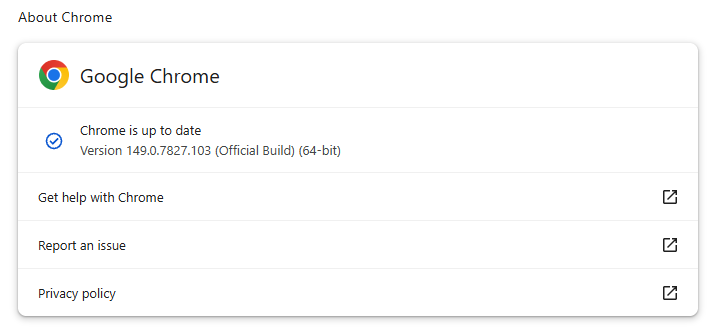
The stable channel has been updated to 149.0.7827.102/.103 for Windows/Mac, and 149.0.7827.102 for Linux, which will roll out over the coming weeks.
How to update Chrome
If you don’t want to wait for the rollout to reach you, manually updating is easy.
The easiest option
Google has issued updates for the Chrome browser, patching a number of high‑severity vulnerabilities.
The update includes fixes for 74 vulnerabilities, including one that is being actively exploited in the wild.
The stable channel has been updated to 149.0.7827.102/.103 for Windows/Mac, and 149.0.7827.102 for Linux, which will roll out over the coming weeks.
How to update Chrome
If you don’t want to wait for the rollout to reach you, manually updating is easy.
The easiest option is to allow Chrome to update automatically. But you can end up lagging behind on updates if you never close your browser or if something goes wrong, such as an extension preventing the update.
To update manually, click the More menu (three dots), then go to Settings > About Chrome. If an update is available, Chrome will start downloading it automatically. Restart Chrome to complete the update, and you’ll be protected against these vulnerabilities.
Chrome 149.0.7827.102/103 is up to date on Windows and Mac
The vulnerability that Google says is being exploited in the wild is tracked as CVE-2026-11645.
Google describes it as:
“Out of bounds read and write in V8 in Google Chrome prior to 149.0.7827.103 allowed a remote attacker to execute arbitrary code inside a sandbox via a crafted HTML page.”
This means this flaw was found in Chrome’s V8 engine—the part of Chrome (and other Chromium-based browsers) that runs JavaScript.
Such a flaw allows a program to read or write outside the memory boundaries it is supposed to use, enabling attackers to manipulate other areas of memory allocated to more critical functions. Attackers may be able to place malicious code in memory and trick the system into running it.
In this case, the vulnerability could be triggered when V8 processes specially crafted HTML content, such as a malicious website.
The phrase “inside a sandbox” means the malicious code would run in a restricted, sealed-off environment rather than directly on your whole computer. An attacker’s code is constrained to the browser, which lowers the impact compared with code running outside the sandbox. However, attackers often chain multiple vulnerabilities together to achieve more serious compromises. So, the phrase is a security limiter, not a reassurance that the bug is harmless.
The update also includes some new features, like the ability to sign PDF forms without using an extension.
Stop threats before they can do any harm.
Malwarebytes Browser Guard blocks phishing pages and malicious sites automatically. Free, one click to install. Add it to your browser →
Last week on Malwarebytes Labs:
Update Chrome now: Critical bugs could let attackers run code
Microsoft Defender vulnerabilities are being exploited in the wild
TikTok, YouTube, and Roblox face scrutiny, but age gates won’t fix child safety
Catch spyware in the act with Windows Webcam Monitoring
Researchers left AI agents alone in a virtual town and watched it all unravel
Fake malware-signing service Fox Tempest dismantled by Microsoft
Firefox 151 packs big privacy upgrades
Google has issued updates for the Chrome browser patching a number of high‑severity vulnerabilities.
The update includes fixes for two critical vulnerabilities that can be used for remote code execution just by visiting a malicious website.
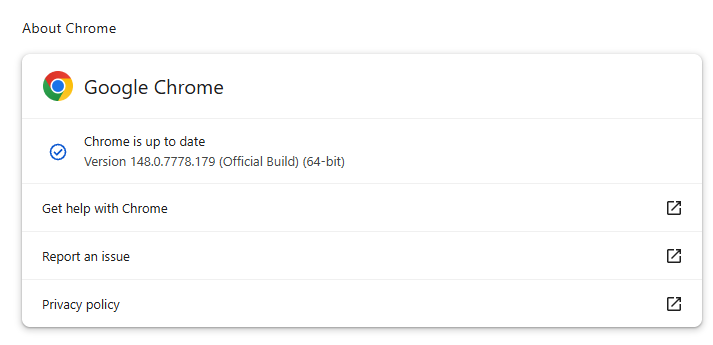
The stable channel has been updated to 148.0.7778.178/179 for Windows/Mac and 148.0.7778.178 for Linux, which will roll out over the coming weeks.
How to update Chrome
If you don’t want to wait for the rollout to reach you, manually updating is e
Google has issued updates for the Chrome browser patching a number of high‑severity vulnerabilities.
The update includes fixes for two critical vulnerabilities that can be used for remote code execution just by visiting a malicious website.
The stable channel has been updated to 148.0.7778.178/179 for Windows/Mac and 148.0.7778.178 for Linux, which will roll out over the coming weeks.
How to update Chrome
If you don’t want to wait for the rollout to reach you, manually updating is easy.
The easiest way to update is to allow Chrome to update automatically. But you can end up lagging behind if you never close your browser or if something goes wrong, such as an extension preventing the update.
To update manually, click the More menu (three dots), then go to Settings > About Chrome. If an update is available, Chrome will start downloading it. Restart Chrome to complete the update, and you’ll be protected against these vulnerabilities.
The update includes fixes for two critical vulnerabilities:
CVE-2026-9111: A use-after-free vulnerability in WebRTC allowed a remote attacker to execute arbitrary code on Linux via a crafted HTML page. Use-after-free is a class of vulnerability caused by incorrect use of dynamic memory during a program’s operation. If, after freeing a memory location, a program does not clear the pointer to that memory, an attacker may be able to use the error to manipulate the program.
So if an attacker manages to trick a Linux user into opening a malicious HTML file or visit a specially crafted website, they could compromise the device.
CVE-2026-9110: An inappropriate implementation in the UI on Windows allowed a remote attacker who had compromised the renderer process to perform UI spoofing via a crafted HTML page.
In practice, this meant that, if an attacker had already taken control of the browser’s internal rendering engine, they could trick the browser into showing you a fake window or dialog box that looked real. This fake window could, for example, make it seem like you were entering your password on a trusted site, even though you were actually giving it to the attacker.
For those that haven’t read about it, since its reporting 46 months ago, the “Browser Fetch” vulnerability remained unknown except to Chromium developers. Then on May 20, 2026, it was published to the Chromium bug tracker. The researcher who initially reported the vulnerability assumed it had finally been fixed. Shortly afterwards, she learned that it remained unpatched. While Google removed the post, it remains available on archival sites, along with the exploit code.
We don’t just report on threats—we remove them
Cybersecurity risks should never spread beyond a headline. Keep threats off your devices by downloading Malwarebytes today.

 Entrar