
Visualização normal

Antes de ontemMalwarebytes
  • ✇Malwarebytes
  • McKesson confirms cyber incident after ShinyHunters claims patient-data theft
    Healthcare and pharmaceutical-distribution giant McKesson has disclosed a cybersecurity incident involving unauthorized access to third-party applications and the theft of data. McKesson Corporation is an American healthcare company that distributes pharmaceuticals and provides medical supplies, health information technology, and care management tools. McKesson says it discovered the cybersecurity incident on August 25, 2026, and that its investigation is still in early stages. “Based
     

McKesson confirms cyber incident after ShinyHunters claims patient-data theft

31 de Agosto de 2026, 11:46

Healthcare and pharmaceutical-distribution giant McKesson has disclosed a cybersecurity incident involving unauthorized access to third-party applications and the theft of data.

McKesson Corporation is an American healthcare company that distributes pharmaceuticals and provides medical supplies, health information technology, and care management tools.

McKesson says it discovered the cybersecurity incident on August 25, 2026, and that its investigation is still in early stages.

“Based on our investigation thus far, including assessments by leading cybersecurity industry experts supporting our response, we’ve confirmed that the unauthorized access to certain third-party applications and the exfiltration of certain data was associated with a subset of customers within our Oncology & Multispecialty and Medical-Surgical business units.”

For now, McKesson provides no information about the amount or nature of the stolen data.

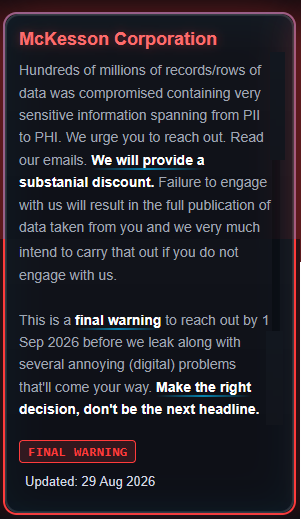
The attack has been claimed by ransomware/extortion group Shiny Hunters. On their leak site the group claims to have stolen hundreds of millions of records containing very sensitive information spanning from Personally Identifiable Information (PII) to Protected Health Information (PHI).

ShinyHunters listing McKesson Corporation
ShinyHunters listing for McKesson Corporation

The ShinyHunters extortion group told BleepingComputer that it was behind the attack, claiming it gained access after conducting voice phishing (or vishing) attacks—a form of social engineering—against multiple McKesson employees. Subsequently, the group said it used compromised Okta single-sign-on accounts to access Salesforce and Snowflake environments. It further claimed to have removed approximately 1 TB of data between August 21 and 25.

The group also said the data includes roughly 284 million records, which does not necessarily mean they belong to 284 million unique patients.

A combination of identity information and healthcare-related details could make affected people targets for convincing scams. Criminals could impersonate a pharmacy, insurer, medical provider, debt collector, or patient-support service and use personal details to make the approach appear legitimate.

Healthcare data is especially useful in social-engineering attacks because it can be used to create a sense of urgency: Criminals could scare a target by sending a supposed prescription problem, unpaid claim, delivery issue, appointment change, or request to “verify” insurance details. At this stage, however, McKesson has not confirmed that any particular category of patient data was accessed.

What to do if you’re affected

While waiting for more information about the nature of the breach and how you might be affected, there are a few things you can do:

  • Check the company’s advice. Every breach is different, so check with the company to find out what’s happened and follow any specific advice it offers.
  • Change your password. You can make a stolen password useless to thieves by changing it. Choose a strong password that you don’t use for anything else. Better yet, let a password manager choose one for you.
  • Enable two-factor authentication (2FA). If you can, use a FIDO2-compliant hardware key, laptop, or phone as your second factor. Some forms of 2FA can be phished just as easily as a password, but 2FA that relies on a FIDO2 device can’t be phished.
  • Watch out for impersonators. Cybercriminals may contact you posing as the breached company. Check its official website to see if it’s contacting victims, and verify the identity of anyone who contacts you using a different communication channel.
  • Take your time. Phishing attacks often impersonate people or brands you know and use themes that require urgent attention, such as missed deliveries, account suspensions, and security alerts.
  • Consider not storing your card details. It’s definitely more convenient to let sites remember your card details, but it increases the risk if a company suffers a breach.
  • Set up identity monitoring. This can alert you if your personal information is found being traded illegally online and help you recover afterward.

Let’s face it, an incognito window can only do so much. 
 
Breaches, dark web trading, credit fraud. Malwarebytes Identity Theft Protection monitors for all of it, alerts you fast, and comes with identity theft insurance. 
  • ✇Malwarebytes
  • Sextortion scammers are exploiting ShinyHunters data leaks
    Sextortion scammers are using email addresses from data leaked by the ShinyHunters hacking group to add some credibility to their feeble attempts to convince people they have embarrassing information about them. Sextortion emails are messages claiming that the scammer recorded you through your webcam while you watched pornography and now demand payment. They have been around for years and keep evolving with small changes in wording and fake technical detail. In this campaign, the scammers
     

Sextortion scammers are exploiting ShinyHunters data leaks

27 de Julho de 2026, 12:00

Sextortion scammers are using email addresses from data leaked by the ShinyHunters hacking group to add some credibility to their feeble attempts to convince people they have embarrassing information about them.

Sextortion emails are messages claiming that the scammer recorded you through your webcam while you watched pornography and now demand payment. They have been around for years and keep evolving with small changes in wording and fake technical detail.

In this campaign, the scammers pretend to be ShinyHunters. What hasn’t changed is the basic truth: there is no malware, no recording, and no credible evidence behind the threat. Despite seeing countless versions of these emails over the years, I’ve yet to encounter one that was backed up by the evidence the sender claimed to have.

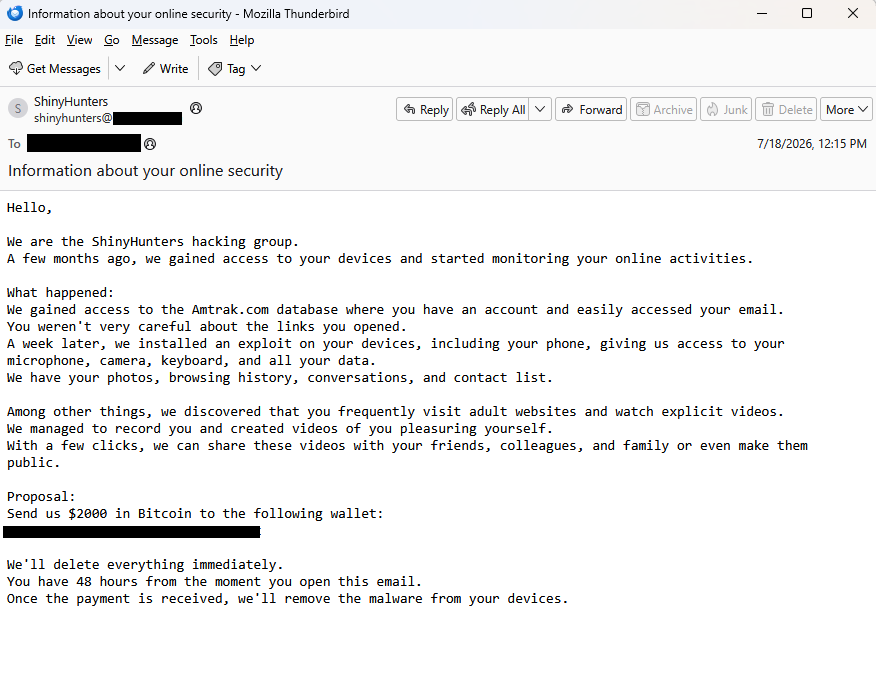
BleepingComputer reports that ShinyHunters data leaks are fueling a $2,000 sextortion email scam and shared the following example:

Example sextortion email from ShinyHunters

“Subject: Information about your online security

Hello,

We are the ShinyHunters hacking group.
A few months ago, we gained access to your devices and started monitoring your online activities.

What happened:
We gained access to the Amtrak.com database where you have an account and easily accessed your email.
You weren’t very careful about the links you opened.
A week later, we installed an exploit on your devices, including your phone, giving us access to your microphone,
camera, keyboard, and all your data.
We have your photos, browsing history, conversations, and contact list.

Among other things, we discovered that you frequently visit adult websites and watch explicit videos.
We managed to record you and created videos of you pleasuring yourself.
With a few clicks, we can share these videos with your friends,
colleagues, and family or even make them public.

Proposal:
Send us $2000 in Bitcoin to the following wallet:
xxxxxxxxxxxxxxxxxxxxxxxxxxxxxxxxx

We’ll delete everything immediately.
You have 48 hours from the moment you open this email.
Once the payment is received, we’ll remove the malware from your devices.”

BleepingComputer states it has seen data from the Amtrak, Hallmark, ADT, Substack, Betterment, CarGurus, Panera Bread, and McGraw Hill breaches used to target victims in this sextortion email campaign.

A California community college also issued a warning after seeing the campaign target people affected by the Canvas data breach.


Digital Footprint Scan

See if your personal data has been exposed.


They confirmed that the targeted email addresses had previously appeared in data leaked by ShinyHunters. They also contacted the group, which denied being behind the sextortion emails.

The increase to a $2,000 demand may suggest the scammers paid someone for the email lists. Although it’s more likely they simply downloaded the leaked data after ShinyHunters published it following failed extortion attempts.

A quick check of the Bitcoin address used in the email shows no activity.

blockchain report of scammer's Bitcoin address
No activity on their Bitcoin address

Let’s keep it that way. With any luck, these dungeon dwellers will eventually give up trying to scare people out of their hard-earned money.

How to react to sextortion emails

Some sextortion emails are badly written, but many have been polished by AI and look convincing. Regardless of how professional they look, they should be treated the same way: as unsubstantiated threats designed to scare victims into paying.

  • First and foremost, never reply to emails of this kind. Responding confirms that someone is actively reading messages sent to that address and may encourage further scam attempts.
  • Don’t let yourself be rushed into action. Scammers rely on the fact that you will not take the time to think this through and subsequently make mistakes. Ask for advice if you’re not sure.
  • An attachment is not proof. Most sextortion emails contain no evidence at all, and attachments are often used to deliver malware or make the threats appear more convincing.
  • If the email includes a password you’ve used before, change it immediately anywhere it’s still in use. Then enable two-factor authentication (2FA) wherever possible. If you’re having trouble keeping track of your passwords, consider using a password manager.
  • Delete the message, report it as spam, and move on.

Pro tip: Malwarebytes Scam Guard recognized this email for what it is: sextortion. It can recognize scams and advise you how to proceed.

Scam Guard recognizes this email as a sextortion scam

While these sextortion emails are almost always bluffs, if you’re concerned about webcam spying, Malwarebytes Webcam Monitoring can alert you when applications attempt to access your camera.


Scam or legit? Scam Guard knows.


  • ✇Malwarebytes
  • What’s your data worth on the dark web? (Lock and Code S07E15)
    This week on the Lock and Code podcast… Twenty years ago, a British mathematician named Clive Humby popularized a phrase that came to describe data’s relationship with the entire global economy: “Data is the new oil.” Pithy as the phrase sounds, it is undeniably true. Data steers decisions at businesses of every size. Data created entirely new industries built around its capture. And, for a select number of companies, data has produced billions—if not trillions—of dollars in value.
     

What’s your data worth on the dark web? (Lock and Code S07E15)

27 de Julho de 2026, 11:35

This week on the Lock and Code podcast…

Twenty years ago, a British mathematician named Clive Humby popularized a phrase that came to describe data’s relationship with the entire global economy: “Data is the new oil.”

Pithy as the phrase sounds, it is undeniably true.

Data steers decisions at businesses of every size. Data created entirely new industries built around its capture. And, for a select number of companies, data has produced billions—if not trillions—of dollars in value.

So how is it that, on the dark web, your stolen identity can be purchased for just 95 cents?

That’s what a Malwarebytes researcher found last month after spending 48 hours inside the dark web to investigate cybercrime. Across a variety of forums and directories, he found subscription plans for malware that steals information once implanted on a device. He found guides for deploying social engineering scams. He found people selling their services to build fake websites that trick people into handing over their usernames and passwords. And he found one of the dark web’s most traded commodities—personal data, packaged together about individual people, to help a cybercriminal commit identity fraud.

These packages are called “fullz.” For victims in the United States, a fullz contains a full name, Social Security Number, date of birth, address, and other personal details. That is enough, on its own, for a cybercriminal to potentially open a bogus line of credit, file a fake tax return, access financial accounts, or obtain medical services under someone else’s name.

As we wrote on Malwarebytes Labs:

“For less than the cost of a cup of coffee, a cybercriminal can buy enough information to devastate someone’s financial life.”

It’s the kind of risk that could scare anyone, especially considering the scale behind it. In just the first six months of 2026, Malwarebytes found more than 7,500 compromised data sets on the dark web containing more than 8.4 billion records.

And yet, even today, cybersecurity professionals still get asked why anyone should bother protecting their data.

The public, understandably, are exhausted. With data breaches happening every week—if not every day—cybersecurity can start to feel pointless. With young people unable to build financial security, they start believing that they have nothing worth stealing. And with Big Tech already collecting our every movement, behavior, click, and concern, people understandably feel powerless to fight any kind of data abuse, be it corporate or criminal.

So today’s episode approaches the question from a different direction. This isn’t about why you should protect yourself—plenty of company websites will tell you that, and most of them rely on fear. This is about why hackers want your data in the first place.

Today, on the Lock and Code podcast, host David Ruiz explains how cybercriminals turn a single repeated password into account takeover, how a screenshot of your house from Google Maps became a tool in extortion emails, and why the most benign information about you—an address, an age, one public photo—is often the most useful data a stranger can buy.

Tune in today to listen to the full episode.

Show notes and credits:

Intro Music: “Spellbound” by Kevin MacLeod (incompetech.com)
Licensed under Creative Commons: By Attribution 4.0 License
http://creativecommons.org/licenses/by/4.0/
Outro Music: “Good God” by Wowa (unminus.com)


Listen up—Malwarebytes doesn’t just talk cybersecurity, we provide it.

Protect yourself from online attacks that threaten your identity, your files, your system, and your financial well-being with our exclusive offer for Malwarebytes Premium for Lock and Code listeners.

  • ✇Malwarebytes
  • Paidwork breach exposes data of 23 million users: Check if you’re affected
    A data breach at Paidwork, a platform that pays people small amounts to complete online microtasks, has exposed personal and financial information of more than 23 million users. According to public breach reports, the intrusion took place in March 2026, with the stolen database first advertised on a cybercrime forum in April as an 11 GB dump allegedly taken from Paidwork’s production systems. The exposed data reportedly includes full names, email and home addresses, phone numbers, dates
     

Paidwork breach exposes data of 23 million users: Check if you’re affected

22 de Julho de 2026, 08:34

A data breach at Paidwork, a platform that pays people small amounts to complete online microtasks, has exposed personal and financial information of more than 23 million users.

According to public breach reports, the intrusion took place in March 2026, with the stolen database first advertised on a cybercrime forum in April as an 11 GB dump allegedly taken from Paidwork’s production systems.

The exposed data reportedly includes full names, email and home addresses, phone numbers, dates of birth, gender, education details, bank account numbers, transaction records, device and IP information, profile photos, personal interests, and passwords stored as hashes.

That is a lot of sensitive information to hand over to a site that, for many users, pays only a few cents per task.

Why this kind of breach matters

For cybercriminals, a dataset like this is a goldmine for targeted phishing, account takeover, and identity fraud. Banking details and transaction histories can be abused directly, while combinations of email addresses, password hashes, and personal details make credential stuffing and social engineering much easier. Even if passwords were hashed with bcrypt, weak or reused passwords can still be cracked and tried elsewhere.

Many Paidwork users likely signed up with their “throwaway” email and a reused password, thinking the risk was low because the amounts involved were tiny. But attackers do not care how much you earned. They care how much they can make by abusing your data.

Data for pennies, risk for years

More than anything, this breach is a reminder to think critically about who you give your personal information to.

Before you hand over your full name, home address, date of birth, and bank details to a site that pays a few cents per task, ask yourself whether the trade-off is worth it.

If any service wants sensitive data, check what security and privacy commitments it makes, whether it offers meaningful support in case of a breach, and whether you can limit what you share to the minimum needed. When in doubt, keep high-value data like banking details and copies of ID reserved for organizations that genuinely need them and can be held accountable when they fail to protect them.

Check if your data was exposed

While Paidwork has not publicly acknowledged the alleged breach, the stolen data is reportedly circulating in criminal circles, and we have indexed it in our Digital Footprint Scanner so you can check whether your information was exposed.

Use our Digital Footprint Scanner to check whether your email address appears in known breach data, including data associated with this incident. If it does, treat it as a prompt to take action rather than a cause for panic:

  • Change your password on Paidwork (if you still use the service) and on any other accounts where you reused the same or a similar password.
  • Enable multi-factor authentication (MFA) wherever possible, especially on email, banking, and other important accounts, and consider using a password manager to generate and store unique passwords for every site.
  • Monitor bank statements for unexpected withdrawals or suspicious activity.
  • Be prepared for phishing emails, texts, and phone calls. Cybercriminals can use the leaked information to make their scams more convincing.
  • Consider an identity monitoring or identity theft protection service.

What do cybercriminals know about you?

Use Malwarebytes’ free Digital Footprint scan to see whether your personal information has been exposed online.

  • ✇Malwarebytes
  • Kodak confirms breach as ShinyHunters’ leak threat reaches deadline
    The Eastman Kodak Company (Kodak) confirmed to BleepingComputer that it is investigating a security breach after the ShinyHunters extortion group claimed responsibility for the incident. Kodak is the latest organization to land on the group’s leak site. ShinyHunters claims it stole more than 2.2 million records and threatened to publish the data unless the company responded by June 18. “Over 2.2 million records containing customer PII and other internal corporate data was compromised.
     

Kodak confirms breach as ShinyHunters’ leak threat reaches deadline

18 de Junho de 2026, 06:52

The Eastman Kodak Company (Kodak) confirmed to BleepingComputer that it is investigating a security breach after the ShinyHunters extortion group claimed responsibility for the incident.

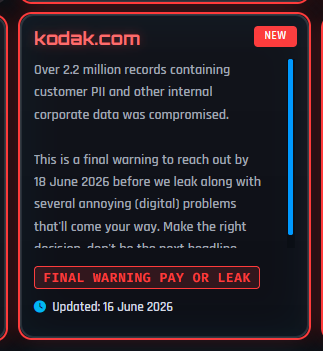
Kodak is the latest organization to land on the group’s leak site. ShinyHunters claims it stole more than 2.2 million records and threatened to publish the data unless the company responded by June 18.

Kodak listed on ShinyHunters leak site

“Over 2.2 million records containing customer PII and other internal corporate data was compromised. This is a final warning to reach out by 18 June 2026 before we leak along with several annoying (digital) problems that’ll come your way.”

Kodak has now confirmed a data breach, while also saying the incident was limited in scope, contained, and did not pose a threat to its systems or operations.

ShinyHunters has been busy making the same point across multiple victims: modern extortion is often less about ransomware (encryption) and more about access, stealing valuable data, and applying pressure.

ShinyHunters claims it stole customer information and internal corporate data, but has not publicly provided proof. That’s a common pattern for extortion groups. They make public claims, set a deadline, and use the threat of a data leak to pressure victims before the full facts are known.

Kodak told SecurityWeek that an unauthorized third party gained access to a limited amount of company data, and that the incident appears to have been contained. The company said it brought in external cybersecurity experts, notified law enforcement, and believes there is no threat to its systems or operations.

It’s not yet known how the attackers gained entry to Kodak’s systems, but the extortion group is well-known for social engineering, bribery, and utilizing zero-day vulnerabilities to perform supply-chain attacks. The investigation is ongoing.

How to stay safe

While Kodak works to determine who was affected and exactly what information was accessed, there’s no reason to panic. But there are a few things you can do:

  • Change the password on your Kodak account and make sure you haven’t reused the same password on other accounts.
  • Turn on multi-factor authentication (MFA) wherever possible, to ensure that a stolen password is not enough to take over your account.
  • If you’re in the US, consider placing a credit freeze with Equifax, Experian, and TransUnion. A credit freeze helps prevent identity thieves from opening new accounts in your name by blocking lenders from accessing your credit file.
  • Depending on the information involved, Kodak may offer affected customers free credit monitoring. Even if it doesn’t, you may want to consider identity monitoring services, which can alert you if your personal information appears in suspicious places or is used to open accounts, apply for credit, or commit fraud.
  • Check your Digital Footprint regularly to see if your personal details have been exposed.

Cybercriminals often exploit the confusion that follows a breach. They know victims will be expecting emails and updates from the affected company, making phishing messages more convincing.

Monitor Kodak’s official website for updates, and be skeptical of unsolicited emails, texts, or phone calls the reference the incident. Look for inconsistencies, unusual sender addresses, and strange links, and watch out for the two biggest warning signs: pressure to act immediately and requests for money, passwords, or personal information.


Let’s face it, an incognito window can only do so much. 
 
Breaches, dark web trading, credit fraud. Malwarebytes Identity Theft Protection monitors for all of it, alerts you fast, and comes with identity theft insurance. 
❌
❌