Password manager mSecure has warned current and former customers to protect the confidential information stored in its app after detecting “suspicious activity.”But its advice about what users should do comes without an explanation of what happened or whose information might be at risk.The warning leaves users to decide whether to replace credentials—and whether it’s safe to store replacements in mSecure.While those are perfectly reasonable questions, mSecure’s warning does not answer them.In an
Password manager mSecure has warned current and former customers to protect the confidential information stored in its app after detecting “suspicious activity.”
But its advice about what users should do comes without an explanation of what happened or whose information might be at risk.
The warning leaves users to decide whether to replace credentials—and whether it’s safe to store replacements in mSecure.
While those are perfectly reasonable questions, mSecure’s warning does not answer them.
In an email published by The Hacker News and sent to customers on November 3, mSecure’s developer, mSeven Software, said:
“mSeven Software (‘mSeven’) recently learned of suspicious activity associated with the mSecure password management application. In response, mSeven quickly launched an investigation, took steps to mitigate the issue, and engaged external cybersecurity experts to assist.”
The notice recommends that customers “immediately take steps to protect all confidential information” stored in mSecure. Those steps:
“may include changing passwords, resetting or re-enrolling two-factor authentication methods, or removing existing passkeys.”
But the notice does not identify the suspicious activity, when it occurred, which systems were involved, or whether anyone accessed customers’ stored information. The Register, which also reviewed the email, noted that the company had not explained whether customers’ secrets were exposed.
How to be safe
Because the scope of the incident is unknown, we recommend prioritizing your most important accounts while mSeven investigates.
Changing your mSecure password alone may not be enough if someone has already accessed your account. mSecure’s documentation explicitly warns that someone may already have made a backup of its contents. That guidance does not establish what happened in this incident.
Users should not have to wait for a completed forensic investigation before receiving useful guidance. They need to know who should act, which credentials need attention, and whether the tool they would normally use to manage those changes remains safe to use.
Until mSeven provides those answers, our advice is to prioritize your most important accounts, replace the relevant credentials through official services, and avoid destructive account resets:
Change passwords through each service’s official website or app, beginning with your primary email, financial accounts, work accounts, and accounts used to recover access to other services. Use a new, different, strong password for each.
Review two-factor authentication stored in the vault. If that could be compromised by unauthorized access, consider re-enrolling that account’s authenticator through the service’s security settings.
For passkeys stored in mSecure, use each website or app’s account-security settings to remove the old registration and create a replacement with a different provider as a precaution. But make sure another working sign-in method is available first.
Think carefully about where replacement credentials go. The notice does not establish whether saving new credentials in mSecure is safe. For users rotating important accounts now, using a different password manager temporarily is a reasonable precaution.
We’ll keep you posted if we learn more about this incident, so stay tuned.
Update November 6, 2026
According to follow-up messages attributed to mSecure support and reproduced by multiple customers on the company’s forum, the incident affects only users who synchronized with mSecure Cloud. We have not located a directly published company statement confirming that scope.
Let’s face it, an incognito window can only do so much.
Breaches, dark web trading, credit fraud. Malwarebytes Identity Theft Protection monitors for all of it, alerts you fast, and comes with identity theft insurance.
.kadence-column484007_649ea4-04 > .kt-inside-inner-col{column-gap:var(--global-kb-gap-sm, 1rem);}.kadence-column484007_649ea4-04 > .kt-inside-inner-col{flex-direction:column;}.kadence-column484007_649ea4-04 > .kt-inside-inner-col > .aligncenter{width:100%;}.kadence-column484007_649ea4-04 > .kt-inside-inner-col:before{opacity:0.3;}.kadence-column484007_649ea4-04{position:relative;}@media all and (max-width: 1024px){.kadence-column484007_649ea4-04 > .kt-inside-inner-col{flex-direction:column;justify-content:center;}}@media all and (max-width: 767px){.kadence-column484007_649ea4-04 > .kt-inside-inner-col{flex-direction:column;justify-content:center;}}
.kadence-column484007_683ec9-3f > .kt-inside-inner-col{padding-top:20px;padding-right:20px;padding-bottom:10px;padding-left:20px;}.kadence-column484007_683ec9-3f > .kt-inside-inner-col{column-gap:var(--global-kb-gap-sm, 1rem);}.kadence-column484007_683ec9-3f > .kt-inside-inner-col{flex-direction:column;}.kadence-column484007_683ec9-3f > .kt-inside-inner-col > .aligncenter{width:100%;}.kadence-column484007_683ec9-3f > .kt-inside-inner-col{background-color:rgba(255, 229, 229, 0.83);}.kadence-column484007_683ec9-3f > .kt-inside-inner-col:before{opacity:0.3;}.kadence-column484007_683ec9-3f{position:relative;}@media all and (max-width: 1024px){.kadence-column484007_683ec9-3f > .kt-inside-inner-col{flex-direction:column;justify-content:center;}}@media all and (max-width: 767px){.kadence-column484007_683ec9-3f > .kt-inside-inner-col{flex-direction:column;justify-content:center;}}
In this article
Fashion retailer Revolve said customers’ payment card numbers and expiration dates were stolen
Data at risk includes card numbers and expiration dates, customer names and addresses
Affected customers should watch their statements and consider asking issuers for new cards
Online fashion retailer Revolve Group said customers’ payment card numbers and expiration dates were stolen. In its customer notification letter filed with the Massachusetts Attorney General, Revolve told recipients the incident involved their names, addresses, and payment card details.
What was stolen?
The at-risk data includes customer names and contact information, payment card numbers, and card expiration dates. The breach only affected customers who had saved their payment card as a payment method in their Revolve account.
A filing on the Texas attorney general data breach website lists 127,200 affected Texans, but not a nationwide total. We found the figure of 1,515,073 in data returned by the site when searching for Revolve. That data labels it as the total number of people affected, but the figure isn’t displayed on the public listing. Other sites have repeated it, though they appear to rely on the same Texas record. The SEC filing did not give a number of affected people, and Revolve has not confirmed the total.
Revolve’s SEC filing does not mention card verification value (CVV) numbers. These three-digit security codes printed on the back of payment cards (four digits on the front for American Express cards) are an extra layer of security for card-not-present transactions.
It is also unclear whether the card numbers were fully visible or masked, or whether Revolve or a third-party payment processor held them.
Even without a CVV, card numbers and expiration dates may be enough to make purchases at some online stores. And scammers who know your real card details and contact information may be able to send more convincing phishing messages to trick you into revealing your CVV.
How did they get the data?
Revolve has not said how the attackers accessed the saved payment data. In its SEC filing, Revolve said it believes an unauthorized actor may have obtained the data “through automated means.” Records on the Texas attorney general’s site indicate that the incident happened on September 11 and was discovered on September 29.
No group has publicly claimed responsibility for the theft.
What Revolve customers can do now
Revolve said it has taken extra security measures following the breach, although didn’t say what those are.
Breaches happen every day. Don’t be the last to know.
If you have saved payment information in your Revolve account, your details may have been among those stolen. Fraud can often begin within days of a breach. If you’re concerned about your card details being exposed:
Read your statements line by line to identify even small charges that you don’t recognize. Criminals will often make a small charge using stolen card details to see if the card works.
Look for unfamiliar merchant names on your statement.
Report unauthorized charges to the card issuer immediately.
Consider removing saved cards from shopping accounts. You could use a password manager instead, some of which will store autofill data for payment cards.
Ask your card issuer to cancel your card and reissue with a new number so that the old number becomes unusable.
Also, don’t immediately trust calls, texts, or emails about the incident. Scammers can use stolen information to make themselves sound convincing. If someone claims to be calling from your card issuer, call the number printed on your card to check.
Let’s face it, an incognito window can only do so much.
Breaches, dark web trading, credit fraud. Malwarebytes Identity Theft Protection monitors for all of it, alerts you fast, and comes with identity theft insurance.
Applebee’s has fixed a security flaw that exposed customers’ personal information after a researcher discovered a database password embedded in the restaurant chain’s Android app.The researcher, Robert Wiggins, found the password with help from AI. It gave him access to an internal Applebee’s customer database. A password written directly into an app’s code or configuration is known as a hardcoded credential. Anyone who extracts it may be able to use it to access the system.The exposed database
Applebee’s has fixed a security flaw that exposed customers’ personal information after a researcher discovered a database password embedded in the restaurant chain’s Android app.
The researcher, Robert Wiggins, found the password with help from AI. It gave him access to an internal Applebee’s customer database. A password written directly into an app’s code or configuration is known as a hardcoded credential. Anyone who extracts it may be able to use it to access the system.
The exposed database contained:
Names, email addresses, and email-verification status
Dates of birth, phone numbers, and ZIP codes
Veteran status
Account-creation dates and login counts
IP addresses from customers’ most recent logins, which can indicate their approximate location
TechCrunch independently checked Wiggins’ findings. It created an Applebee’s account with dummy information, which Wiggins successfully retrieved from the database.
According to TechCrunch, Wiggins could not find a suitable way to report the issue to Applebee’s or its parent company, Dine Brands, so he asked the publication to help contact them. TechCrunch held its story until the fix was confirmed. Applebee’s confirmed on October 29 that it had addressed the issue.
It’s unclear how many customers’ records were in the database. Dine Brands says it has not found evidence of unauthorized access, but its investigation is ongoing.
How to stay safe
The database fields described by TechCrunch did not include payment card details or account passwords. That does not tell us whether anyone accessed the database before the fix, so customers should watch for targeted scams.
Names, email addresses, phone numbers, and other personal details could help scammers make messages look relevant and convincing.
Be wary of unexpected Applebee’s-themed emails, texts, or calls. Be especially skeptical of messages offering refunds or compensation, warning that your account will be closed, or asking you to “verify” payment details.
Check security notices through a route you trust. Open the app directly or visit Applebee’s website yourself rather than following a link in an unexpected message. If necessary, contact the company using details you find independently.
.kadence-column482644_f2c16d-bc > .kt-inside-inner-col{padding-top:20px;padding-right:20px;padding-bottom:10px;padding-left:20px;}.kadence-column482644_f2c16d-bc > .kt-inside-inner-col{column-gap:var(--global-kb-gap-sm, 1rem);}.kadence-column482644_f2c16d-bc > .kt-inside-inner-col{flex-direction:column;}.kadence-column482644_f2c16d-bc > .kt-inside-inner-col > .aligncenter{width:100%;}.kadence-column482644_f2c16d-bc > .kt-inside-inner-col{background-color:#ffe5e5;}.kadence-column482644_f2c16d-bc > .kt-inside-inner-col:before{opacity:0.3;}.kadence-column482644_f2c16d-bc{position:relative;}@media all and (max-width: 1024px){.kadence-column482644_f2c16d-bc > .kt-inside-inner-col{flex-direction:column;justify-content:center;}}@media all and (max-width: 767px){.kadence-column482644_f2c16d-bc > .kt-inside-inner-col{flex-direction:column;justify-content:center;}}
In this article
Hackers published work details and internal group memberships for more than 41,000 DHS workers.
The data could enable targeted scams, harassment, stalking, or physical threats.
DHS employees should follow agency guidance, verify unexpected contact, and report threats to security.
A group of hackers calling themselves the Department of Peace says it stole and published the personal details of more than 41,000 people working for the US Department of Homeland Security (DHS). The department says it is aware of a potential breach.
The group, which also claimed the theft of contract documents from the DHS in March, gave the data to Swiss hacktivist maia arson crimew, who published it in collaboration with the transparency collective DDoSecrets. The latter also published the BlueLeaks data dump that listed law enforcement officers’ details in 2020.
The aim of publishing the data was to replace “anonymity with accountability,” DDoSecrets co-founder Emma Best said in an online statement.
According to TechCrunch, timestamps on the records suggest the data was taken around mid-August. The group said it had launched the attack in response to a July 17 statement by DHS Secretary Markwayne Mullin, in which he promised to “turn up the heat” with traffic stops.
What was stolen?
The data files published online, which the publishers have called “Icepick,” span staff at nearly 7,000 offices. They include the names, work email addresses, phone numbers, office addresses, job titles and membership in internal DHS groups. The employees impacted include almost 6,600 Immigration and Customs Enforcement (ICE) employees. ICE is the DHS unit responsible for immigration enforcement and deportations in the US.
The dataset also carried details of over 21,000 Customs and Border Protection (CBP) employees, along with information on people who work at the Cybersecurity and Infrastructure Security Agency (CISA).
The data dump revealed less information than the ShinyHunters’ FBI data heist in September, which reportedly contained Social Security numbers, emergency contacts, medical records and home addresses. Nevertheless, this is more than just a phone book of folks in the DHS.
For one thing, it doesn’t take much to cross-reference data. Reuters matched six DHS employees’ data to credit bureau records and breach data from a dark web intelligence platform. Online activists regularly use open-source intelligence (OSINT) to “doxx” people from very few clues, meaning that even a leak of basic identity information can put someone in danger. In fact, the creators of a separate searchable version say they added information through automated and manual research. So some details shown in that version may not have come from the data stolen from DHS.
Breaches happen every day. Don’t be the last to know.
The data in this case also included membership of groups within Active Directory, a Microsoft tool that contains identity information about computer users. Active Directory controls who can access different internal tools, services, and third-party software within an organization.
The files listed over 200 CBP users in a group that could access the facial recognition tool Mobile Fortify. Other groups reference a service called Penlink, which the company claims can track the location data of hundreds of millions of mobile devices.
According to the Guardian, job titles in the data dump show which agents were assigned to sensitive jobs such as special operations, surveillance, and undercover work.
How did they get the data?
The Department of Peace said that it got to the information via a single sign-on (SSO) service provided by identity company Okta. SSO is a prized target for hackers because a single authentication can get a user into many different workplace services and applications.
Okta says it has no evidence its data or systems were compromised, but that doesn’t rule out someone abusing a DHS account with stolen credentials.
DHS told reporters it was aware of a potential breach. One DHS employee whose data showed up in the breach told Reuters they hadn’t heard anything about it.
What DHS employees can do now
The leaked records include work contact details and internal group memberships. This information could help attackers create convincing messages or calls, and may expose some employees to unwanted attention or threats. DHS has warned about the risk of harassment, stalking, and physical harm. It is not yet clear whether the leak has led to specific threats or affected any operations.
If you work for DHS:
Follow security advice and instructions from the DHS.
Treat unexpected calls, emails, and texts about your role or colleagues with caution. Verify them through a contact method you already trust, and never share passwords or MFA codes.
Change any personal passwords you’ve reused for work, and turn on MFA where available. Follow your agency’s process for work accounts.
Report suspicious contact or threats to your agency’s security team. If you believe there’s an immediate danger, contact law enforcement.
Do you think your information might have been leaked in a data breach? Check out the Malwarebytes Identity Theft Protection service.
Someone’s got their eye on your personal information. Make sure it’s us.
Quest Diagnostics has confirmed that an unauthorized party accessed a system healthcare providers use to order laboratory tests and view results, affecting personal information and patient records. Quest is a major US laboratory testing company whose services help healthcare professionals diagnose and monitor medical conditions. Those services range from routine laboratory testing to specialized testing in areas such as cancer, infectious diseases, and neurology.What happened and what was stolen
Quest Diagnostics has confirmed that an unauthorized party accessed a system healthcare providers use to order laboratory tests and view results, affecting personal information and patient records.
Quest is a major US laboratory testing company whose services help healthcare professionals diagnose and monitor medical conditions. Those services range from routine laboratory testing to specialized testing in areas such as cancer, infectious diseases, and neurology.
What happened and what was stolen?
The company learned of unauthorized access to its Quanum Lab Services Manager, or LSM, on October 21. The compromised platform lets healthcare professionals order tests, access results, review historical trends, and order supplies. Quest paused access to the platform and began investigating. Quest says its core business operations remain up and running.
An investigation is ongoing. Quest has not yet published a count of affected patients or a complete list of the information accessed. It says it will notify affected patients, healthcare providers, and health plans.
The company said:
“personal information and patient records were affected.”
It confirms that health information and personally identifiable information were involved, but has not specified whether these included Social Security numbers, insurance identifiers, payment information, particular test results, or account passwords.
What patients can do now
Quest says it will send notification letters to affected patients once its investigation is complete. Those letters will describe available resources, including credit and identity monitoring. If you receive one, read it carefully and follow the instructions. You can also check the FAQs posted in Quest’s breach notice for updates.
Someone’s got their eye on your personal information. Make sure it’s us.
A breach does not automatically mean someone has misused your information, but you can take these precautions while you wait for more details:
Verify unexpected messages independently. Don’t let a message about the breach rush you into clicking a link, sharing sensitive information, or making a payment. Go to Quest’s official website yourself or use contact details you already trust.
Review medical bills and insurance statements. Look for appointments, tests, prescriptions, or services you did not receive. The Federal Trade Commission (FTC) identifies unfamiliar medical bills and unexpected items on an Explanation of Benefits statement, which explains how your insurer processed a claim, as warning signs of medical identity theft. Report discrepancies to your healthcare provider and your insurer.
Review your credit reports. Look for unfamiliar accounts or debts and dispute errors. Free reports are available through AnnualCreditReport.com.
Act if you find signs of identity theft. Visit IdentityTheft.gov for a recovery plan. If someone has received care in your name, ask the providers involved for copies of your medical records and request corrections in writing.
Medical identity theft is not just a financial problem; it can also affect your care. Someone using your identity to obtain treatment or submit insurance claims could introduce incorrect information into your health records. Checking medical statements and reporting anything unfamiliar can help you catch that misuse.
Let’s face it, an incognito window can only do so much.
Breaches, dark web trading, credit fraud. Malwarebytes Identity Theft Protection monitors for all of it, alerts you fast, and comes with identity theft insurance.
.kadence-column480618_38f885-ca > .kt-inside-inner-col{padding-top:20px;padding-right:20px;padding-bottom:10px;padding-left:20px;}.kadence-column480618_38f885-ca > .kt-inside-inner-col{column-gap:var(--global-kb-gap-sm, 1rem);}.kadence-column480618_38f885-ca > .kt-inside-inner-col{flex-direction:column;}.kadence-column480618_38f885-ca > .kt-inside-inner-col > .aligncenter{width:100%;}.kadence-column480618_38f885-ca > .kt-inside-inner-col{background-color:#ffe5e5;}.kadence-column480618_38f885-ca > .kt-inside-inner-col:before{opacity:0.3;}.kadence-column480618_38f885-ca{position:relative;}@media all and (max-width: 1024px){.kadence-column480618_38f885-ca > .kt-inside-inner-col{flex-direction:column;justify-content:center;}}@media all and (max-width: 767px){.kadence-column480618_38f885-ca > .kt-inside-inner-col{flex-direction:column;justify-content:center;}}
In this article
Capcom’s breach exposed 11.7 million account records.
Leaked details could fuel convincing phishing messages.
Passwords on 196 accounts were changed without permission.
Use CAPCOM ID? Check your account and enable two-factor authentication.
Gamers are being warned to watch their inboxes after someone gained unauthorized access to Capcom’s online membership service.
Capcom, the Japanese video game developer and publisher behind Resident Evil, Monster Hunter, and Street Fighter, disclosed a breach affecting more than 11.7 million CAPCOM ID records worldwide.
The exposed information includes email addresses, account activity details, and IP addresses. A much smaller number of records also contained personal details such as dates of birth.
The company says credit card information was not affected, and it has not confirmed that passwords originally chosen by customers were compromised, but someone changed the passwords on 196 accounts without authorization. Capcom has since reset those passwords.
CAPCOM ID is the company’s unified account system for its websites and services, including online features in certain games. Users can also link it to gaming platform accounts, including PlayStation, Xbox, Steam, Epic Games, and Nintendo accounts.
For players, the exposed information could help scammers make fake Capcom messages more convincing, potentially tricking them into handing over passwords or verification codes.
Capcom discovered the incident on October 19, and says it has addressed the attack method. Games and services remain available, and the company plans to notify affected customers.
The 11.7 million figure refers to affected records, so it may not represent that many individual users. Capcom is still investigating the impact, including how the passwords on 196 accounts were changed without permission and whether any other unauthorized activity occurred on those accounts.
How to stay safe
As with any breach, watch for phishing messages, particularly those using the breach to create urgency. If an email claims your account needs attention, open your browser and go to cid.capcom.com independently to check it. Capcom warns users not to follow URLs or open attachments in suspicious messages.
You can also take these steps:
Enable CAPCOM ID’s two-factor authentication: This adds an authenticator-app code to the sign-in process, helping protect your account if someone obtains your password. Set it up from your Account page using a smartphone or tablet. Capcom recommends Google Authenticator or Microsoft Authenticator.
Check your account, especially if you received an unexpected password-change notice: Review your registered information and linked platform accounts from your Account page. If you cannot sign in, use Forgot your password? on the login page. See Capcom’s support page for instructions.
Use officialsupport channels if you need help: Find the appropriate regional contact in Capcom’s breach notice, rather than trusting contact details in an unexpected message.
Pro tip: Unsure whether a message is a scam? Malwarebytes’ Scam Guard can help you assess it and suggest what to do next.
Something feel off? Check it before you click.
Malwarebytes Scam Guard helps you analyze suspicious links, texts, and screenshots instantly.
A breach exposed personal information in supposedly anonymous crime reports. Now one Crime Stoppers chapter has stopped accepting tips because it cannot guarantee anonymity.Toronto Crime Stoppers, which works with the community, police, and media to help solve crimes, has paused phone, website, and app submissions while it seeks a safer system.The breach occurred in March and involved P3 Global Intel, the Texas-based tip-management platform owned by Navigate360. Its software is used by Crime Sto
A breach exposed personal information in supposedly anonymous crime reports. Now one Crime Stoppers chapter has stopped accepting tips because it cannot guarantee anonymity.
Toronto Crime Stoppers, which works with the community, police, and media to help solve crimes, has paused phone, website, and app submissions while it seeks a safer system.
The breach occurred in March and involved P3 Global Intel, the Texas-based tip-management platform owned by Navigate360. Its software is used by Crime Stoppers programs and other organizations in the US and elsewhere.
An October CBC investigation revealed the Canadian impact: More than 1.5 million tips spanning 25 years were exposed, with over 850,000 containing personal information. That included addresses, phone numbers, email addresses, and some banking details associated with rewards. The exposed details belonged to tipsters, people named in allegations, and others, including police and Crime Stoppers staff.
Following CBC’s reporting, Toronto Crime Stoppers acknowledged that its promise of anonymity had been broken for some users. The organization stopped accepting tips, saying it could no longer guarantee users’ anonymity.
In an October 21 statement, the organization says identifying details are normally removed before tips reach investigators, but some original submissions containing potentially identifying information were stolen from P3.
For affected tipsters, exposure could create a risk of retaliation, intimidation, or extortion. Scammers could also use details of a genuine tip to make an approach more convincing.
Unfortunately, the pause removes a reporting option for people afraid to approach police. Toronto police still accept reports directly, but warn that those channels are not anonymous.
How to stay safe
Toronto Crime Stoppers warned people worried about exposure to watch for impersonators. It says it will never contact them first to request a tip number, password, or other information.
The statement did not describe an individual notification process or offer a way to check whether a particular tip was affected. For anyone wanting to submit a new tip, the organization’s message was clear:
“Until we have a safer way to protect you, please do not send us tips by phone, online, or through the app.”
Anyone in immediate danger should call 911. During the pause, non-emergency reports in Toronto should go directly to Toronto police, with the understanding that those channels are not anonymous.
If you use a different Crime Stoppers program, check its official website for updates and advice about its reporting system.
A Cash App account opened in her name has left Amanda Smith facing criminal charges and potentially up to six years in prison.404 Media reports that Smith says someone used her Social Security number (SSN) and date of birth to create an account that received money from a Facebook Marketplace scam. Allegedly, a buyer sent $1,000 for items that weren’t really for sale. A scammer had taken over someone else’s Facebook account and directed the buyer to pay a Cash App account in Smith’s name.Investig
A Cash App account opened in her name has left Amanda Smith facing criminal charges and potentially up to six years in prison.
404 Media reports that Smith says someone used her Social Security number (SSN) and date of birth to create an account that received money from a Facebook Marketplace scam.
Allegedly, a buyer sent $1,000 for items that weren’t really for sale. A scammer had taken over someone else’s Facebook account and directed the buyer to pay a Cash App account in Smith’s name.
Investigators obtained account information from Block, Cash App’s parent company. That information included Smith’s Social Security number and date of birth. Police subsequently arrested her in Pennsylvania over the alleged crime in Arkansas, a state she says she had never visited.
She spent three nights in jail. But 404 Media’s review of account records found that several account details, including the address and network used, did not match her own.
Smith also described a frustrating obstacle when she tried to investigate:
“Cash App refused to provide me with any information about the account, because I couldn’t prove that I was the owner.”
The account was associated with her closely enough to contribute to her arrest, yet she said she could not get information directly from the company. She later received account records through the criminal case.
It’s a disturbing reminder that the consequences of identity theft can go well beyond an unfamiliar charge on your bank statement. You could also find yourself accused of a crime committed using your details.
Breaches happen every day. Don’t be the last to know.
Smith suspects that information exposed in a data breach may have been used to impersonate her. When investigating, 404 Media found the phone number used for the account linked to an Amanda Smith in older breach data. They also found someone made a Venmo account using the same phone number but under another name entirely.
The source of her Social Security number and date of birth hasn’t been established, and her case is ongoing. Her experience highlights why it matters to know which of your details have been exposed.
How to protect yourself
The practical lesson is to look beyond the headline that a company “lost customer data.” What matters is which information was exposed, because different exposures call for different responses. Our guide for how to handle being involved in a data breach recommends checking the affected company’s official information before deciding what to do next.
The steps depend on the type of data that was stolen or leaked:
Email addresses and phone numbers: Be alert for phishing messages and scam calls, including messages that refer to the breach.
Passwords: Change the affected password and anywhere else you reused it. Enable multifactor authentication where available.
Payment or banking details: Contact the relevant financial institution and review your accounts for unauthorized activity.
Social Security numbers and other identifying information: Check your credit reports for unfamiliar accounts. In the US, you can freeze your credit for free with each of the three major credit bureaus: Equifax, Experian, and TransUnion. This helps prevent new credit accounts being opened in your name, but does not prevent every type of identity misuse.
If you discover an account opened in your name, contact the company’s fraud department through its official website and report the identity theft (in the US you can do that at IdentityTheft.gov). Keep copies of your reports and correspondence, and ask for written confirmation when the fraudulent account is closed.
A breach-checking service can help you identify known exposures linked to your information. Malwarebytes’ Digital Footprint Scan, for example, checks for exposures associated with your email address.
What do cybercriminals know about you?
Use Malwarebytes’ free Digital Footprint scan to see whether your personal information has been exposed online.
Personal information belonging to millions of current and former California public school students has been stolen from a system operated by Educational Testing Service (ETS).ETS is a nonprofit organization that helps run the state’s standardized tests under contract with the California Department of Education (CDE). It has begun notifying students and families after an unauthorized party accessed and copied student information from an ETS-operated secure file transfer protocol (SFTP) site. CDE
Personal information belonging to millions of current and former California public school students has been stolen from a system operated by Educational Testing Service (ETS).
ETS is a nonprofit organization that helps run the state’s standardized tests under contract with the California Department of Education (CDE). It has begun notifying students and families after an unauthorized party accessed and copied student information from an ETS-operated secure file transfer protocol (SFTP) site. CDE is distributing the ETS breach notice to help affected individuals receive information about the incident and available resources.
An investigation determined that an unauthorized party used compromised login details to access the site and copy files containing California student information at various times between May 22 and September 18.
The CDE says the breach includes all students enrolled during the previous three school years, although the affected population is not limited to that group. The information involved varies by individual but may include:
Student names
Statewide Student Identifiers (SSIDs)
Dates of birth
Home addresses
Demographic information
Disability and program participation information
Statewide assessment information, including test scores
According to the CDE, over 5.7 million students were enrolled in California public schools during the 2025–2026 school year alone.
Not every affected student had every category of information exposed. However, this is clearly more than a list of names and email addresses: The stolen files can reveal highly personal information about a student’s education and disabilities.
CDE says Social Security numbers, financial account information, passwords, and parent or guardian information were not involved. ETS says it has found no evidence so far that the stolen information has been made public.
How to stay safe
ETS, at CDE’s direction, is notifying affected students and families. If your information or your child’s information was involved, follow the instructions in the notification and:
Verify any communication about the incident through official channels.
Consider enrolling in the two years of free identity-protection services. Parents or legal guardians can enroll affected minors, while affected adults can enroll themselves. Check the instructions for the appropriate age group.
Watch for messages that use details about your child or their school to sound convincing. Don’t share passwords, security codes, or payment details in response to an unsolicited message or call.
Let’s face it, an incognito window can only do so much.
Breaches, dark web trading, credit fraud. Malwarebytes Identity Theft Protection monitors for all of it, alerts you fast, and comes with identity theft insurance.
An attacker reportedly used a leaked password to abuse a company’s legitimate access to Denmark’s population register (CPR). The weak password is remarkable, but the failure to spot millions of unusual searches made the breach worse.The CPR administration states it identified a serious security incident. By abusing a Danish company’s authorized access to the CPR system, unauthorized people gained access to the names, addresses, CPR numbers, and other information belonging to around 8.8 million p
An attacker reportedly used a leaked password to abuse a company’s legitimate access to Denmark’s population register (CPR). The weak password is remarkable, but the failure to spot millions of unusual searches made the breach worse.
The CPR administration states it identified a serious security incident. By abusing a Danish company’s authorized access to the CPR system, unauthorized people gained access to the names, addresses, CPR numbers, and other information belonging to around 8.8 million people registered in the system. CPR numbers are Denmark’s personal identification numbers.
How could a password so weak that it should have been rejected by the system open the door to so much personal information?
The attacker reportedly gained access through Pays ApS, an IT company based in Odense. According to TV 2, Pays has confirmed that its authorized access to search the CPR system was abused. Pays offers services including data updates and “CPR cleansing,” allowing customers to check records against the register to update addresses, identify people who have died, and obtain information about changes of address.
The attacker reportedly used a leaked password associated with a former Pays employee. TV 2 says an email containing the password 123456 had appeared in a larger data leak, and that this account of the initial access matches its own research.
The attackers had access for 21 days before it was shut down on October 2, although the suspicious activity appears to have stopped on September 20. An unusually large bill for around 14 million searches drew attention to the breach.
Politiken reports that the data stolen in those searches belonged to approximately 5.5 million living and 3.3 million deceased people.
A weak, leaked password opened an authorized route into a sensitive register. That access allowed millions of searches, and the activity was discovered only after an unusually large bill drew attention to it.
How to stay safe
If your organization handles sensitive data:
Don’t reuse passwords or use personal passwords for work accounts. Use a password manager to create and remember strong, unique passwords for you.
For systems that give access to sensitive data, enforce authentication that would reject weak passwords and make multi-factor authentication mandatory.
Monitor for unusual activity. That many searches from one account should have been noticed earlier.
If your data may have been exposed in this breach:
Keep an eye on official updates about the incident.
Be alert to phishing and other scams. Scammers could use personal details to make their messages more convincing.
The customer data stolen from global fashion retailer ASOS includes more than just names and contact details, raising questions about its early reassurances.As we reported earlier this week, ASOS customers received a push notification through the ASOS app alleging that the company had been hacked.ASOS has confirmed that attackers accessed customer information after tricking an employee into handing over login credentials. While the retailer says payment card information and customer passwords we
The customer data stolen from global fashion retailer ASOS includes more than just names and contact details, raising questions about its early reassurances.
As we reported earlier this week, ASOS customers received a push notification through the ASOS app alleging that the company had been hacked.
ASOS has confirmed that attackers accessed customer information after tricking an employee into handing over login credentials. While the retailer says payment card information and customer passwords were not accessed, reporting by the BBC shows the stolen information includes more than the “basic personal information” initially mentioned by the company.
The stolen login details were used to access information on third-party platforms used by ASOS. The company says it locked down the affected platforms and launched an investigation with internal and external specialists. It also says it has strengthened its security controls.
What data was stolen?
In our initial coverage, we highlighted the potentially detailed customer profiles associated with ASOS’s marketing setup. The BBC’s findings now establish that at least some shopping-related information was taken.
According to the BBC, which received a sample from the attackers, the exposed data includes:
Names and home addresses
Phone numbers and email addresses
Customer numbers and dates of birth
Searches customers made on the ASOS website
Details such as when a customer started using ASOS
The BBC reported search terms including “reclaimed vintage,” “glamorous wide fit,” and “Asos petite.” That makes this more than a stolen contact list. The information can also reveal customers’ shopping interests and their relationship with the retailer.
The attackers’ original notification named Snowflake, a data storage and analysis platform. They subsequently told the BBC that they accessed the information through Simon AI, a platform built on Snowflake that ASOS uses for customer personalization.
Snowflake said it had found no compromise of its platform. Using stolen credentials to access a customer’s account or a connected service does not necessarily mean the underlying platform was breached. The available reporting does not establish a vulnerability in Snowflake or Simon AI.
ASOS’s communication with customers
Customers first heard about the breach from the cybercriminals, rather than the retailer. The attackers’ decision to send a notification through the ASOS app may have made that unavoidable.
But the Independent reported that ASOS’s full statement followed roughly five hours of silence, leaving customers alarmed by the notification and waiting for an explanation.
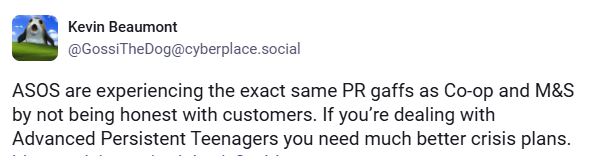
Security expert Kevin Beaumont criticized the response:
“ASOS are experiencing the exact same PR gaffs as Co-op and M&S by not being honest with customers. If you’re dealing with Advanced Persistent Teenagers you need much better crisis plans.”
While the attackers are threatening to release the data, ASOS says its full investigation will continue over the coming weeks. It will contact customers directly where it believes further information, support, or action is required.
Reportedly, the group gave ASOS two weeks to make contact and said it wanted a ransom in exchange for deleting customer information. ASOS did not disclose whether it would pay.
How to stay safe
ASOS says its website and app remain safe to use, and that payment card information and customer passwords were not accessed. But the stolen details and shopping searches could help scammers make targeted phishing messages more convincing.
A message that knows your name, or what you searched for, isn’t proof it came from ASOS.
Be wary of unexpected emails, texts, or calls about the breach, refunds, deliveries, or problems with your ASOS account.
Don’t follow links in unexpected messages, and don’t follow the Telegram link in the attackers’ message or engage with them. Go directly to the ASOS website or app to check your account.
Don’t share passwords, security codes, or payment details in response to an unsolicited message or call. ASOS says it will never ask you to do this.
Your name, address, and phone number may already be for sale.
Data brokers collect and sell your personal details to anyone willing to pay. Malwarebytes Personal Data Remover finds them and gets your information removed, then keeps watch so it stays that way.
Thousands of global fashion retailer ASOS customers have received a push notification through the ASOS app this morning alleging that the company has been hacked.The notification, addressed to ASOS’s data protection officer and IT, says:“ASOS HACKEDDear Asos DPO and IT, we have fully compromised the Snowflake instance. Engage with us, or we will leak it”What we know so farSnowflake is a cloud-based data platform that organizations use to store, process, and analyze data. We know that ASOS’s mar
Thousands of global fashion retailer ASOS customers have received a push notification through the ASOS app this morning alleging that the company has been hacked.
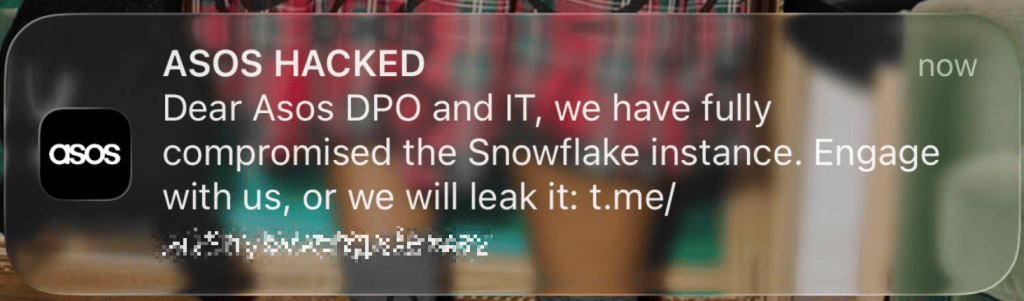
The notification, addressed to ASOS’s data protection officer and IT, says:
“ASOS HACKED
Dear Asos DPO and IT, we have fully compromised the Snowflake instance. Engage with us, or we will leak it”
What we know so far
Snowflake is a cloud-based data platform that organizations use to store, process, and analyze data. We know that ASOS’s marketing team uses Simon AI from a blog posted by Simon. Simon AI specializes in personalization and runs on Snowflake. ASOS has described using Simon AI alongside Braze to personalize and trigger customer communications like push notifications to clients’ phones.
The apparent delivery of the message through ASOS’s own app makes this more concerning than an unsupported social-media claim. It suggests unauthorized use of the notification infrastructure, but does not confirm that the claimed Snowflake compromise occurred or that customer data was stolen.
According to Simon AI, typical customer profiles cover:
browsing history and products viewed
purchase history and customer value (first-time or high-value buyers)
demographic data
segments such as Premier status or customers who’ve stopped buying
geolocation and local weather
If the affected systems contain these profiles, a breach could expose a detailed picture of customers’ shopping habits and preferences. However, the published description of ASOS’s marketing setup does not establish what, if anything, the attackers accessed.
The Guardian reports that the group claiming the breach calls itself the “Xuanye group.” The Telegram channel operated by the group carried the message “Regarding Asos, payment information is not affected,” and the “app is safe to use” but those claims have not been independently verified.
Sky News reports that ASOS confirmed an “unauthorised customer notification” was sent at around 10 am today.
“We are investigating unauthorised activity involving third-party platforms that we use to communicate with customers,” it said in a statement.
The retailer said it immediately restricted access to the notification platforms and is working with specialists and relevant authorities.
It added:
“Basic personal information including name and contact details may have been accessed. We do not believe that payment-card information or account passwords, were impacted.”
How to stay safe
The website and app remain operational, and there is currently no verified evidence that customer databases, payment card information, passwords, etc. have been stolen.
So, it’s too early to say if and how much ASOS customer data the attackers could get their hands on, but the potential scope is significant. Customer data could be used in targeted phishing attacks to add credibility.
For the time being, postpone your purchases at ASOS until it’s clear what happened and whether ASOS has resolved the issue.
Be wary of unsolicited messaging about the breach or other ASOS related issues.
If you do not wish to see more push notifications from the Xuanye group, remove the ASOS app until their access has been removed.
“Arizona’s court system was targeted by a cyber attack from criminal hackers or their bots.”
This is how the Arizona Supreme Court announced that hackers had attacked the state’s court system and stolen the personal information of “many Arizonans.”
The court says the attack began with a phishing email containing a malicious link that a court employee clicked. The attackers copied sensitive backup files containing records related to protective orders and foster care cases.
The court sa
“Arizona’s court system was targeted by a cyber attack from criminal hackers or their bots.”
This is how the Arizona Supreme Court announced that hackers had attacked the state’s court system and stolen the personal information of “many Arizonans.”
The court says the attack began with a phishing email containing a malicious link that a court employee clicked. The attackers copied sensitive backup files containing records related to protective orders and foster care cases.
The court says it has no evidence, so far, that information about jurors, witnesses, or court employees was included in the copied files. It has not identified the attackers or a motive. It says the case is under investigation with the FBI, and no ransomware group has publicly claimed responsibility.
In an update, the court revealed that the attackers copied more than 150,000 recommendation reports created by Arizona’s Foster Care Review Board. The reports cover current and past cases involving children’s care and protection, dating back to 2010.
Those documents can include information about children, names of involved parties, case materials considered by the board, findings, and recommendations for courts, parents, and the Arizona Department of Child Safety. The court says the reports do not contain contact information such as addresses or telephone numbers.
The copied files were backups stored in a highly compressed format, kept for recovery after ransomware and other destructive incidents.
Information associated with protective orders can raise particularly serious safety and privacy concerns. These orders can protect people from abuse, harassment, or threats. Even where some records are public, combining names, case details, locations, and other sensitive context could create risks for people who are trying to limit their exposure to an abusive or threatening individual.
Breaches happen every day. Don’t be the last to know.
The court currently says it has no evidence that the information has been shared. As with many breach investigations, however, this can change as investigators determine exactly what was taken and monitor for publication, sale, or misuse of the data.
Arizona has about 8,000 children currently in foster care, according to the court. It is contacting people believed to have been affected.
What to do if you’re affected
Check the court’s advice. Every breach is different, so check its dedicated webpage for updates and follow any specific advice it offers.
Watch out for impersonators. Cybercriminals may contact you posing as the Arizona Supreme Court, another government agency, or someone you know. Verify anyone who contacts you through a separate, trusted channel.
Take your time. Phishing attacks often impersonate people or brands you know and pressure you to act urgently, using themes such as missed deliveries, account suspensions, and security alerts.
Get an early warning if your information appears on the dark web. If you’ve been notified that your information was copied in the Arizona court breach, identity monitoring can help you watch for signs of exposure and get support if you become a victim of identity theft.
Let’s face it, an incognito window can only do so much.
Breaches, dark web trading, credit fraud. Malwarebytes Identity Theft Protection monitors for all of it, alerts you fast, and comes with identity theft insurance.
BBC News reports it has seen samples of stolen FBI agents’ medical examinations. The “fitness-for-work” reports identify FBI agents by name and address, and reveal even more personal details. They include blood and urine test results and doctors’ notes mentioning high cholesterol, blood in the urine, and even a shellfish and banana allergy.
As we reported last week, extortion group ShinyHunters claims to have breached the FBI. After reportedly taking over ransomware group Clop’s leak site, Sh
BBC News reports it has seen samples of stolen FBI agents’ medical examinations. The “fitness-for-work” reports identify FBI agents by name and address, and reveal even more personal details. They include blood and urine test results and doctors’ notes mentioning high cholesterol, blood in the urine, and even a shellfish and banana allergy.
As we reported last week, extortion group ShinyHunters claims to have breached the FBI. After reportedly taking over ransomware group Clop’s leak site, ShinyHunters says it attacked the FBI to punish the agency for spreading what it calls false information about the group.
The BBC’s findings raise the stakes: The alleged theft includes highly sensitive medical records, not just staff identity and contact data. ShinyHunters shared samples with journalists as proof of its claims.
The BBC states:
“The samples shared with journalists appear genuine and include names, addresses, phone numbers, badge numbers, job titles and information about spouses.”
ShinyHunters claims it accessed several systems, including FBI MedLink, which stores medical records, and FBI BEAST, which handles background checks on employees and applicants, but the FBI has not confirmed these claims. The FBI has acknowledged an incident affecting FBIJobs-related systems and says it is investigating whether its own environment or a third-party provider was compromised.
The group’s stated demand remains non-financial: It wants the FBI to retract or remove a May advisory that ShinyHunters calls false and defamatory. It says it will release the data within five days if its demands are not met.
The cybercriminals also raised the number of affected people. ShinyHunters nows claims to hold sensitive information on around 60,000 current and former FBI staff. Medical histories could make affected people vulnerable long after the immediate incident: Unlike a stolen password, a medical record cannot be changed.
What to do if you’re affected
The FBI has not yet confirmed what information was accessed or who was affected. If you are a current or former FBI employee, a relative of one, or have applied for an FBI job:
Check the FBI’s advice. Every breach is different, so check FBI.gov for updates and follow any specific advice it offers.
Change your password. If you have an FBI Jobs account and reuse its password elsewhere, change it on those other accounts. Choose a strong password that you don’t use for anything else. Better yet, let a password manager choose one for you.
Enable two-factor authentication (2FA). If you can, use a FIDO2-compliant hardware key, laptop, or phone as your second factor. Some forms of 2FA can be phished just as easily as a password, but 2FA that relies on a FIDO2 device can’t be phished.
Watch out for impersonators. Cybercriminals may contact you posing as the FBI, another government agency, or someone you know. Verify the identity of anyone who contacts you.
Take your time. Phishing attacks often impersonate people or brands you know and use themes that require urgent attention, such as missed deliveries, account suspensions, and security alerts.
Let’s face it, an incognito window can only do so much.
Breaches, dark web trading, credit fraud. Malwarebytes Identity Theft Protection monitors for all of it, alerts you fast, and comes with identity theft insurance.
Extortion group ShinyHunters is not afraid to make enemies. Now it claims to have breached the FBI.
After reportedly taking over ransomware group Clop’s leak site, ShinyHunters says it attacked the FBI to punish the agency for spreading what it calls false information about the group.
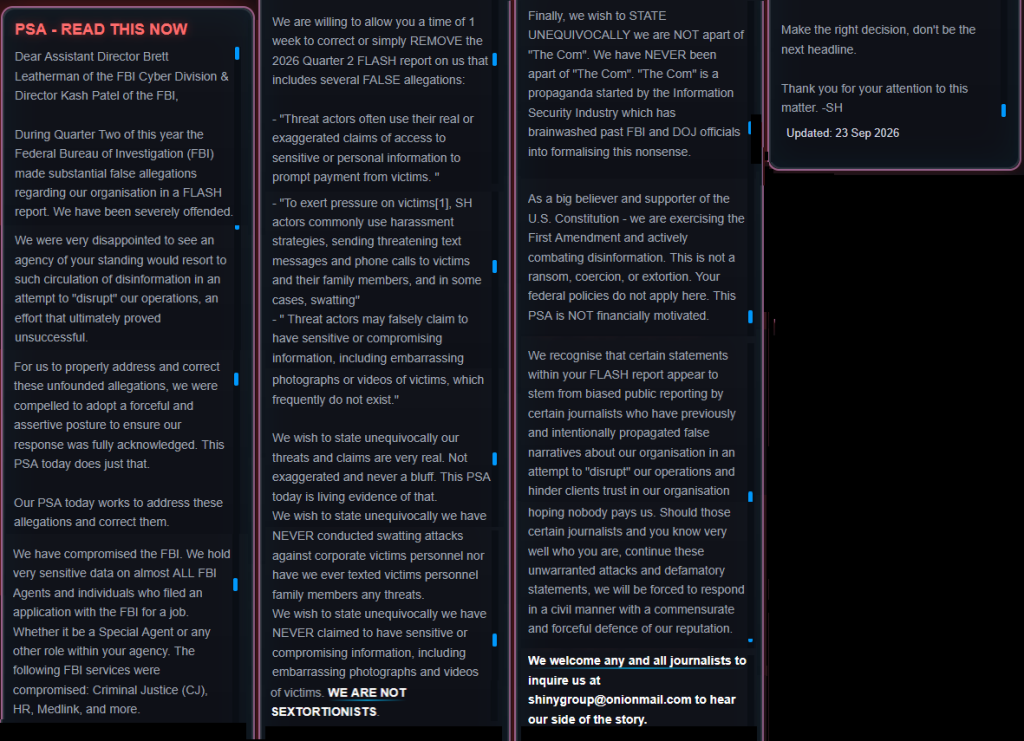
In a very long post on its leak site, the group outlines its grievances:
“PSA – READ THIS NOW
Dear Assistant Director Brett Leatherman of the FBI Cyber Division & Director Kash Patel of the FBI
In a very long post on its leak site, the group outlines its grievances:
“PSA – READ THIS NOW
Dear Assistant Director Brett Leatherman of the FBI Cyber Division & Director Kash Patel of the FBI,
During Quarter Two of this year the Federal Bureau of Investigation (FBI) made substantial false allegations regarding our organisation in a FLASH report. We have been severely offended.
We were very disappointed to see an agency of your standing would resort to such circulation of disinformation in an attempt to “disrupt” our operations, an effort that ultimately proved unsuccessful.
For us to properly address and correct these unfounded allegations, we were compelled to adopt a forceful and assertive posture to ensure our response was fully acknowledged. This PSA today does just that.
Our PSA today works to address these allegations and correct them.
We have compromised the FBI. We hold very sensitive data on almost ALL FBI Agents and individuals who filed an application with the FBI for a job. Whether it be a Special Agent or any other role within your agency. The following FBI services were compromised: Criminal Justice (CJ), HR, Medlink, and more.
We are willing to allow you a time of 1 week to correct or simply REMOVE the 2026 Quarter 2 FLASH report on us that includes several FALSE allegations:
“Threat actors often use their real or exaggerated claims of access to sensitive or personal information to prompt payment from victims.”
“To exert pressure on victims[1], SH actors commonly use harassment strategies, sending threatening text messages and phone calls to victims and their family members, and in some cases, swatting”
“Threat actors may falsely claim to have sensitive or compromising information, including embarrassing photographs or videos of victims, which frequently do not exist.”
We wish to state unequivocally our threats and claims are very real. Not exaggerated and never a bluff. This PSA today is living evidence of that.
We wish to state unequivocally we have NEVER conducted swatting attacks against corporate victims personnel nor have we ever texted victims personnel family members any threats.
We wish to state unequivocally we have NEVER claimed to have sensitive or compromising information, including embarrassing photographs and videos of victims. WE ARE NOT SEXTORTIONISTS.
Finally, we wish to STATE UNEQUIVOCALLY we are NOT apart of “The Com”. We have NEVER been apart of “The Com”. “The Com” is a propaganda started by the Information Security Industry which has brainwashed past FBI and DOJ officials into formalising this nonsense.
As a big believer and supporter of the U.S. Constitution – we are exercising the First Amendment and actively combating disinformation. This is not a ransom, coercion, or extortion. Your federal policies do not apply here. This PSA is NOT financially motivated.
We recognise that certain statements within your FLASH report appear to stem from biased public reporting by certain journalists who have previously and intentionally propagated false narratives about our organisation in an attempt to “disrupt” our operations and hinder clients trust in our organisation hoping nobody pays us. Should those certain journalists and you know very well who you are, continue these unwarranted attacks and defamatory statements, we will be forced to respond in a civil manner with a commensurate and forceful defence of our reputation.
We welcome any and all journalists to inquire us at shinygroup@onionmail[.]com to hear our side of the story.
Make the right decision, don’t be the next headline.
Thank you for your attention to this matter. -SH
Updated: 23 Sep 2026“
The post is essentially a hostile “correction notice” directed at FBI leaders Brett Leatherman and Kash Patel. Its central grievance is an FBI advisory that says ShinyHunters commonly harasses victims and their families, including through threatening messages, phone calls, and, in some cases, swatting.
It also warns that threat actors may exaggerate their access to personal information or falsely claim to possess compromising photos or videos. The advisory does not use the word “sextortion,” but ShinyHunters appears to have interpreted the reference to compromising material that way. The group denies much of the FBI’s account while simultaneously using coercive language of its own.
The document it appears to mean is the FBI/IC3 public advisory “ShinyHunters: Cyber Criminal Group Attacks Learning Management System,” issued on May 15, 2026. Despite ShinyHunters calling it a “2026 Quarter 2 FLASH report,” the publicly accessible document is labeled a Public Service Announcement (PSA), not a FLASH.
It also denies carrying out swatting attacks or sending threatening messages to the family members of people working for its corporate victims.
The group also denies being part of The Com, a decentralized network linked to cybercrime and violence. It calls that connection:
“propaganda started by the Information Security Industry which has brainwashed past FBI and DOJ officials into formalizing this nonsense.”
The group then threatens journalists it accuses of spreading these “false narratives.”
The most worrying part of the message is the group’s claim that it stole sensitive data on:
“almost ALL FBI Agents, and individuals who filed an application with the FBI for a job.”
According to 404 Media, ShinyHunters provided a sample containing information on roughly 5,000 FBI agents, including names, home addresses, phone numbers, and details about their spouses. The publication reportedly verified portions of the sample, but the full dataset and the wider claims about the breach have not been independently confirmed.
The group also reportedly defaced the FBI’s jobs website. The FBI says it is aware of claims involving unauthorized activity affecting FBIjobs.gov and is investigating, although “broken” does not necessarily mean “breached.”
What to do if you’re affected
The FBI has not yet confirmed what information was accessed or who was affected. If you are a current or former FBI employee, a relative of one, or have applied for an FBI job:
Check the FBI’s advice. Every breach is different, so check FBI.gov for updates and follow any specific advice it offers.
Change your password. If you have an FBI Jobs account and reuse its password elsewhere, change it on those other accounts. Choose a strong password that you don’t use for anything else. Better yet, let a password manager choose one for you.
Enable two-factor authentication (2FA). If you can, use a FIDO2-compliant hardware key, laptop, or phone as your second factor. Some forms of 2FA can be phished just as easily as a password, but 2FA that relies on a FIDO2 device can’t be phished.
Watch out for impersonators. Cybercriminals may contact you posing as the FBI, another government agency, or someone you know. Verify the identity of anyone who contacts you.
Take your time. Phishing attacks often impersonate people or brands you know and use themes that require urgent attention, such as missed deliveries, account suspensions, and security alerts.
Let’s face it, an incognito window can only do so much.
Breaches, dark web trading, credit fraud. Malwarebytes Identity Theft Protection monitors for all of it, alerts you fast, and comes with identity theft insurance.
Revolut has acknowledged that it disclosed sensitive customer records to an unauthorized party. The company had accepted fraudulent information requests sent from an email address on a legitimate government agency domain, according to TechCrunch.
Revolut is a London-based banking and financial platform with more than 80 million customers globally, according to the company.
Revolut describes this as an external impersonation scam, not an intrusion into its systems. It also says customer fun
Revolut has acknowledged that it disclosed sensitive customer records to an unauthorized party. The company had accepted fraudulent information requests sent from an email address on a legitimate government agency domain, according to TechCrunch.
Revolut is a London-based banking and financial platform with more than 80 million customers globally, according to the company.
Revolut describes this as an external impersonation scam, not an intrusion into its systems. It also says customer funds were not affected. Revolut has not identified the government agency or disclosed its email domain.
The attacker appears to have abused the trust attached to a real government email domain to make bogus requests for customer information. Revolut detected the activity, blocked the sending address, and says it notified the relevant agency, law enforcement, data protection authorities, and financial regulators.
“Upon detection, we immediately blocked the address and alerted the relevant government agency as well as enforcement agencies, data protection, and financial regulators.”
Through this social engineering attack, rather than by gaining access to Revolut’s systems, the criminals obtained the following types of information about customers:
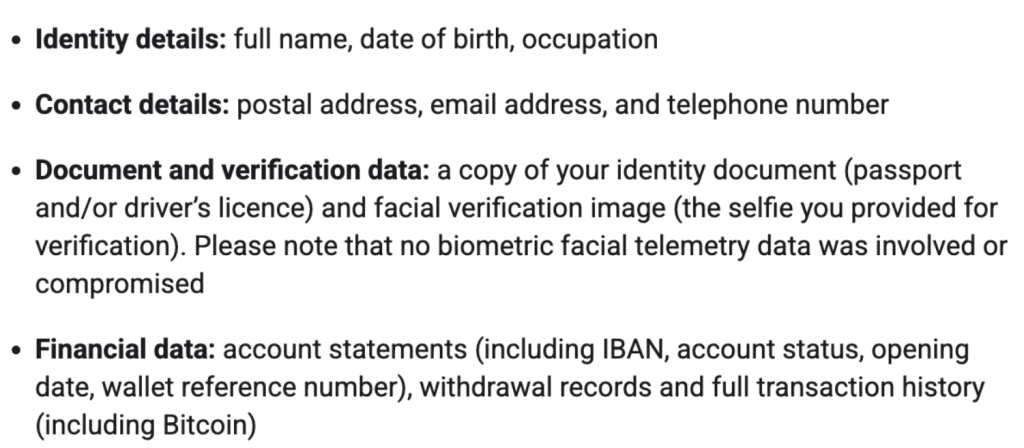
Identity and contact information like dates of birth, postal address, email address, and phone number.
Copies of IDs such as passports and driver’s licenses.
Verification selfies.
Account statements and transaction histories.
Revolut has said only that a “limited” or “very limited” number of customers were affected, and that it contacted them directly.
Those customers have received or will receive an email specifying which of their personal data was disclosed:
How to stay safe
The likely consumer impact will be second-stage fraud attempts rather than immediate unauthorized transfers. Here are some guidelines to help keep your money safe:
Treat any unexpected Revolut-related contact as suspicious, especially calls, emails, WhatsApp messages, or text messages claiming you need to “secure” an account, reverse a transfer, or replace documents. Do not use links or phone numbers supplied in the message. Revolut advises ending contact with suspected scammers and contacting the company through official channels.
IDs and other exposed information could be used for identity theft. Monitor your accounts and credit reports for unfamiliar account openings or credit applications, and consider placing a fraud alert or using credit monitoring where available in your country.
If you received a notification email, check your balances, cards, beneficiaries, recent transfers, account statements, and linked devices. Report any unfamiliar activity immediately through Revolut’s secure in-app chat.
Pro tip: Use Malwarebytes Scam Guard to analyze any suspicious communications. It can help you determine whether a message is a scam and advise you on what to do next.
Let’s face it, an incognito window can only do so much.
Breaches, dark web trading, credit fraud. Malwarebytes Identity Theft Protection monitors for all of it, alerts you fast, and comes with identity theft insurance.
Healthcare and pharmaceutical-distribution giant McKesson has disclosed a cybersecurity incident involving unauthorized access to third-party applications and the theft of data.
McKesson Corporation is an American healthcare company that distributes pharmaceuticals and provides medical supplies, health information technology, and care management tools.
McKesson says it discovered the cybersecurity incident on August 25, 2026, and that its investigation is still in early stages.
“Based
Healthcare and pharmaceutical-distribution giant McKesson has disclosed a cybersecurity incident involving unauthorized access to third-party applications and the theft of data.
McKesson Corporation is an American healthcare company that distributes pharmaceuticals and provides medical supplies, health information technology, and care management tools.
McKesson says it discovered the cybersecurity incident on August 25, 2026, and that its investigation is still in early stages.
“Based on our investigation thus far, including assessments by leading cybersecurity industry experts supporting our response, we’ve confirmed that the unauthorized access to certain third-party applications and the exfiltration of certain data was associated with a subset of customers within our Oncology & Multispecialty and Medical-Surgical business units.”
For now, McKesson provides no information about the amount or nature of the stolen data.
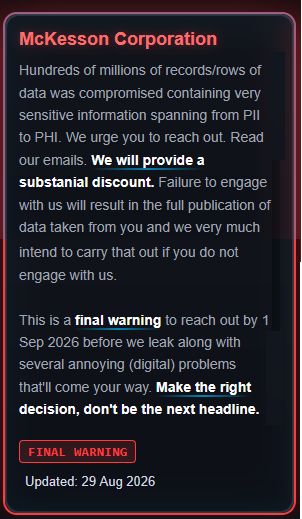
The attack has been claimed by ransomware/extortion group Shiny Hunters. On their leak site the group claims to have stolen hundreds of millions of records containing very sensitive information spanning from Personally Identifiable Information (PII) to Protected Health Information (PHI).
ShinyHunters listing for McKesson Corporation
The ShinyHunters extortion group told BleepingComputer that it was behind the attack, claiming it gained access after conducting voice phishing (or vishing) attacks—a form of social engineering—against multiple McKesson employees. Subsequently, the group said it used compromised Okta single-sign-on accounts to access Salesforce and Snowflake environments. It further claimed to have removed approximately 1 TB of data between August 21 and 25.
The group also said the data includes roughly 284 million records, which does not necessarily mean they belong to 284 million unique patients.
A combination of identity information and healthcare-related details could make affected people targets for convincing scams. Criminals could impersonate a pharmacy, insurer, medical provider, debt collector, or patient-support service and use personal details to make the approach appear legitimate.
Healthcare data is especially useful in social-engineering attacks because it can be used to create a sense of urgency: Criminals could scare a target by sending a supposed prescription problem, unpaid claim, delivery issue, appointment change, or request to “verify” insurance details. At this stage, however, McKesson has not confirmed that any particular category of patient data was accessed.
What to do if you’re affected
While waiting for more information about the nature of the breach and how you might be affected, there are a few things you can do:
Check the company’s advice. Every breach is different, so check with the company to find out what’s happened and follow any specific advice it offers.
Change your password. You can make a stolen password useless to thieves by changing it. Choose a strong password that you don’t use for anything else. Better yet, let a password manager choose one for you.
Enable two-factor authentication (2FA). If you can, use a FIDO2-compliant hardware key, laptop, or phone as your second factor. Some forms of 2FA can be phished just as easily as a password, but 2FA that relies on a FIDO2 device can’t be phished.
Watch out for impersonators. Cybercriminals may contact you posing as the breached company. Check its official website to see if it’s contacting victims, and verify the identity of anyone who contacts you using a different communication channel.
Take your time. Phishing attacks often impersonate people or brands you know and use themes that require urgent attention, such as missed deliveries, account suspensions, and security alerts.
Consider not storing your card details. It’s definitely more convenient to let sites remember your card details, but it increases the risk if a company suffers a breach.
Let’s face it, an incognito window can only do so much.
Breaches, dark web trading, credit fraud. Malwarebytes Identity Theft Protection monitors for all of it, alerts you fast, and comes with identity theft insurance.
Healthcare technology giant CareCloud has confirmed that a data breach earlier this year impacted more than 3.75 million people, making it one of the largest healthcare data incidents disclosed this year.
The New Jersey-based company, which provides electronic health record (EHR) and practice management services, first flagged the intrusion in an SEC filing back in March, but the true scope only became clear this month when the Department of Health and Human Services (HHS) breach tracker upda
Healthcare technology giant CareCloud has confirmed that a data breach earlier this year impacted more than 3.75 million people, making it one of the largest healthcare data incidents disclosed this year.
The New Jersey-based company, which provides electronic health record (EHR) and practice management services, first flagged the intrusion in an SEC filing back in March, but the true scope only became clear this month when the Department of Health and Human Services (HHS) breach tracker updated the affected total from roughly 345,000 to 3,756,469 individuals.
CareCloud says an unauthorized third party accessed one of its Amazon Web Services (AWS) environments between March 10 and March 16, 2026. The intrusion caused an eight-hour disruption to one of the company’s six EHR environments before systems were restored that same evening. During a forensic investigation, CareCloud determined that the attacker claimed to have exfiltrated data from databases within that environment.
The stolen data reportedly includes both identity and medical information:
Full names, postal addresses, and dates of birth
Social Security numbers (SSNs) and driver’s license or passport numbers
Medical records and health insurance information
Bank account and financial details, plus full credit card data (including CVV) for a limited subset of victims
What affected customers should do
Anyone receiving a breach notification letter should take it seriously, given the combination of medical, identity, and financial data involved.
If you think you’ve been affected by a data breach, here are steps you can take to protect yourself:
Check the company’s advice. Every breach is different, so check with the company to find out what’s happened and follow any specific advice it offers.
Change your password. You can make a stolen password useless to thieves by changing it. Choose a strong password that you don’t use for anything else. Better yet, let a password manager choose one for you.
Enable two-factor authentication (2FA). If you can, use a FIDO2-compliant hardware key, laptop, or phone as your second factor. Some forms of 2FA can be phished just as easily as a password, but 2FA that relies on a FIDO2 device can’t be phished.
Watch out for impersonators. Cybercriminals may contact you posing as the breached company. Check its official website to see if it’s contacting victims, and verify the identity of anyone who contacts you using a different communication channel.
Take your time. Phishing attacks often impersonate people or brands you know and use themes that require urgent attention, such as missed deliveries, account suspensions, and security alerts.
Consider not storing your card details. It’s definitely more convenient to let sites remember your card details, but it increases the risk if a company suffers a breach.
Heights Finance Holdings’ online data breach notification says an unauthorized party accessed a third-party cloud platform containing customer data, potentially exposing highly sensitive personal, banking, and identity information.
Heights Finance is a consumer lender that offers personal installment loans. Reportedly, the company filed a report with Texas regulators mentioning 734,828 affected people, though that figure should not automatically be read as a confirmed nationwide total, since
Heights Finance Holdings’ online data breach notification says an unauthorized party accessed a third-party cloud platform containing customer data, potentially exposing highly sensitive personal, banking, and identity information.
Heights Finance is a consumer lender that offers personal installment loans. Reportedly, the company filed a report with Texas regulators mentioning 734,828 affected people, though that figure should not automatically be read as a confirmed nationwide total, since Heights Finance operates dozens of personal loan companies across Alabama, Tennessee, Georgia, Texas, and South Carolina.
The company is associated with the former CURO Management business and related brands. The breach notice covers not only some Heights Finance customers, but potentially people connected to certain current or former CURO-related brands.
On May 7, Heights Finance discovered that an unauthorized party had gained access to a cloud-based platform run by a third party and used to store certain customer information. The company says its investigation found that the intruder may have viewed or copied information in that environment.
Heights says affected people may include:
People who received a loan through Heights Finance.
People who inquired about or applied for a loan product, including through a third party.
Some customers of former parent company CURO Management and its present or former related brands.
What makes the incident especially concerning is the nature of the potentially exposed records, which can include the combination of information criminals need to impersonate someone, target their bank accounts, or create highly convincing phishing attempts.
Breaches happen every day. Don’t be the last to know.
Contact information: Name, home address, phone number, and email address.
Financial information: Account details, bank name, bank account number, routing number, and related financial information.
Government identifiers: Social Security number (SSN), tax identification number, driver’s license number, or state ID number.
Other personal data: Date of birth and personal circumstances voluntarily disclosed during customer service interactions.
The combination of a Social Security number, date of birth, address, and bank account details can create a much more serious risk than a breach exposing only email addresses. It can support identity fraud, financial fraud, account takeover attempts, and tailored social engineering scams.
The personal circumstances customers may have shared with support staff could also make scams more persuasive or potentially more harmful, particularly for people who discussed financial distress, repayment problems, or other sensitive subjects.
What affected customers should do
People who receive a letter from Heights Finance should follow the company’s instructions and enroll in the offered protection service. Exact instructions can be found on Heights Finance’s website.
Since people who were not actual customers could also be affected, there may be some uncertainty about whether someone’s information was included in the data breach. If you believe you fall into one of the listed groups but do not receive a notice, use contact details published by Heights Finance for inquiries. Do not use a number provided in an unexpected email, text, phone call, or even sponsored search result to ask whether your information was involved.
Most of us are wise to phishing emails that don’t contain much personal information. Generic “your account is suspended” messages usually get binned on sight. But what about the phishing emails that use your real name and address, and reference the specific product you bought last month? Even for the most suspicious of people, that can be convincing.
It’s also the situation European Steam hardware buyers walked into this week. On August 10, Valve, the company behind the Steam gaming platform
Most of us are wise to phishing emails that don’t contain much personal information. Generic “your account is suspended” messages usually get binned on sight. But what about the phishing emails that use your real name and address, and reference the specific product you bought last month? Even for the most suspicious of people, that can be convincing.
It’s also the situation European Steam hardware buyers walked into this week. On August 10, Valve, the company behind the Steam gaming platform and Steam hardware, warned customers that a cyberattack had exposed names, home addresses, phone numbers, Steam email addresses, and details of their hardware orders.
It wasn’t Valve itself that got hacked. Rather, it was its shipping partner CEVA Logistics, which handles delivery of hardware from the gaming store. Passwords and payment information were not touched.
What got stolen
The attack window ran from July 29 to August 1, 2026. Valve learned about it on August 7 and started notifying customers three days later. CEVA stores delivery data for roughly 90 days after shipment, meaning anyone who received a Steam Deck, Steam Controller, or Steam Machine in Europe over the past three months could be affected.
The exposed information may include:
Name
Street address, postal code, and city
Country
Phone number
Email address linked to the customer’s Steam account
The type and price of the ordered hardware
Exact numbers are still unconfirmed. Neither Valve nor CEVA has said how many customer records were involved. Dutch retailers Bol and De Bijenkorf were reportedly told about the same CEVA incident on August 1 and warned their own customers.
Why shipping data is valuable to scammers
A scammer can send an email, text, or even make a phone call that references your genuine order and delivery address before asking you to pay a small customs or redelivery fee, confirm your delivery, or sign in to “verify” your order.
Data like this is already widely traded online. Malwarebytes researchers found more than 7,500 compromised datasets containing over 8.4 billion records on the dark web during the first six months of 2026.
Not Valve’s first security incident
Although Valve’s own systems weren’t compromised, that doesn’t mean the consequences can’t be severe.
In May 2025, a threat actor called Machine1337 tried to sell what looked like a dataset of 89 million Steam user records for $5,000. The data turned out to be older SMS messages carrying expired two-factor codes, routed through a third-party intermediary Valve says it never partnered with.
Valve has suffered a direct breach in the past though. November 2011 saw one that exposed records from 35 million users, including usernames, emails, and encrypted credit card details.
What affected buyers should do
In an email to customers, Valve advises them to assume that any message referencing their recent Steam hardware order is fake. That covers email, SMS, and phone calls, even the ones that quote your address correctly.
Steam Support never contacts users through email, Steam Chat, or Discord, and only handles account problems through its help page.
So you don’t need to rush to reset your password, although it never hurts to use a strong, unique password and enable Steam Guard’s two-factor authentication. Instead, be skeptical of any unsolicited emails, texts, or calls about a recent Steam hardware delivery, even if they include details only a real customer would know.
Something feel off? Check it before you click.
Malwarebytes Scam Guard helps you analyze suspicious links, texts, and screenshots instantly.

 Entrar