WhatsApp announced on August 25 that more than one billion people now use passkeys to log back into the app.
The announcement included two other security upgrades: a stronger two-step verification method and more context for incoming calls from unknown numbers. It marks one of the largest passwordless authentication rollouts to date. Passkeys are now firmly mainstream, with the FIDO Alliance estimating that 5 billion are in use worldwide and 75% of consumers have enabled one on at least one a
WhatsApp announced on August 25 that more than one billion people now use passkeys to log back into the app.
The announcement included two other security upgrades: a stronger two-step verification method and more context for incoming calls from unknown numbers. It marks one of the largest passwordless authentication rollouts to date. Passkeys are now firmly mainstream, with the FIDO Alliance estimating that 5 billion are in use worldwide and 75% of consumers have enabled one on at least one account.
Three things changed:
Passkey support originally launched on Android and later extended to iOS. WhatsApp now supports multiple passkeys per account, so people who switch between an Android phone and an iPhone (or use both) can register a passkey on each device.
Two-step verification is moving from a simple six-digit PIN to a longer alphanumeric password that can include special characters, making it much harder to guess or brute-force.
On Android, WhatsApp now shows extra context about calls from numbers not saved in your contacts, including whether the number is from another country and whether you share any groups. It’s a small but useful nudge against the urgency tactics scammers rely on.
Passkeys are resistant to phishing because there is no password or SMS code to type into a fake website or hand over to a scammer. Instead, a passkey is stored on your device or in its credential manager and unlocked using your fingerprint, face, or screen-lock code. They’re also useful in regions where SMS one-time-passcode delivery is unreliable, which might explain why adoption reached a billion users so quickly.
The upgraded two-step verification password closes a real gap. PINs such as “123456” were common, weak, and reused, and a longer alphanumeric password with special characters raises the bar against account-takeover attempts, even if an attacker somehow obtains your one-time code.
The caller-context feature gives people more information to assess legitimacy before answering an unfamiliar number.
Users need to set up a passkey and upgrade their two-step verification password, while the caller-context feature will appear automatically on supported Android devices:
Set up a passkey via Settings > Account > Passkeys, and follow the instructions on your device. Don’t forget to add a second one if you use both an Android and an iOS device.
If you still use a six-digit PIN for two-step verification, upgrade to the new password format when it becomes available, especially if your PIN is predictable. You can find instructions to set up two-step verification for WhatsApp in this blog. If it’s already enabled, select Two-step verification to find the option to change your PIN.
Add a recovery email to two-step verification if you haven’t already. It’s the only way to reset the password if you forget it.
Android users should pay attention to the new caller-context details before answering calls from unknown numbers, treating urgency as a red flag rather than a reason to rush.
Passkeys and stronger two-step verification aren’t retroactive or forced, so accounts still relying on an old PIN or no passkey at all will remain unchanged until users upgrade them.
Scammers know more about you than you think.
Malwarebytes Mobile Security protects you from phishing, scam texts, malicious sites, and more. With real-time AI-powered Scam Guard built right in.
iPhone users are being targeted in a new tech support scam, using a fake Apple Pay notification to trick users.
Tech support scams that use fake warnings to push victims into calling a phone number have been around for years, but this page has been designed specifically for phones.
Instead of a desktop warning claiming your computer has a virus, the scam imitates familiar iPhone features in an attempt to scam you.
What happens
A page opens on your phone and appears to show Apple Pay
iPhone users are being targeted in a new tech support scam, using a fake Apple Pay notification to trick users.
Tech support scams that use fake warnings to push victims into calling a phone number have been around for years, but this page has been designed specifically for phones.
Instead of a desktop warning claiming your computer has a virus, the scam imitates familiar iPhone features in an attempt to scam you.
What happens
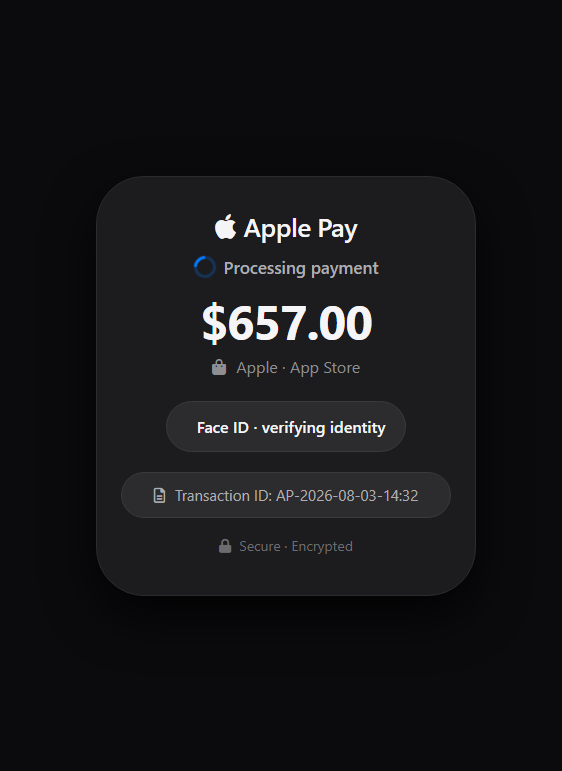
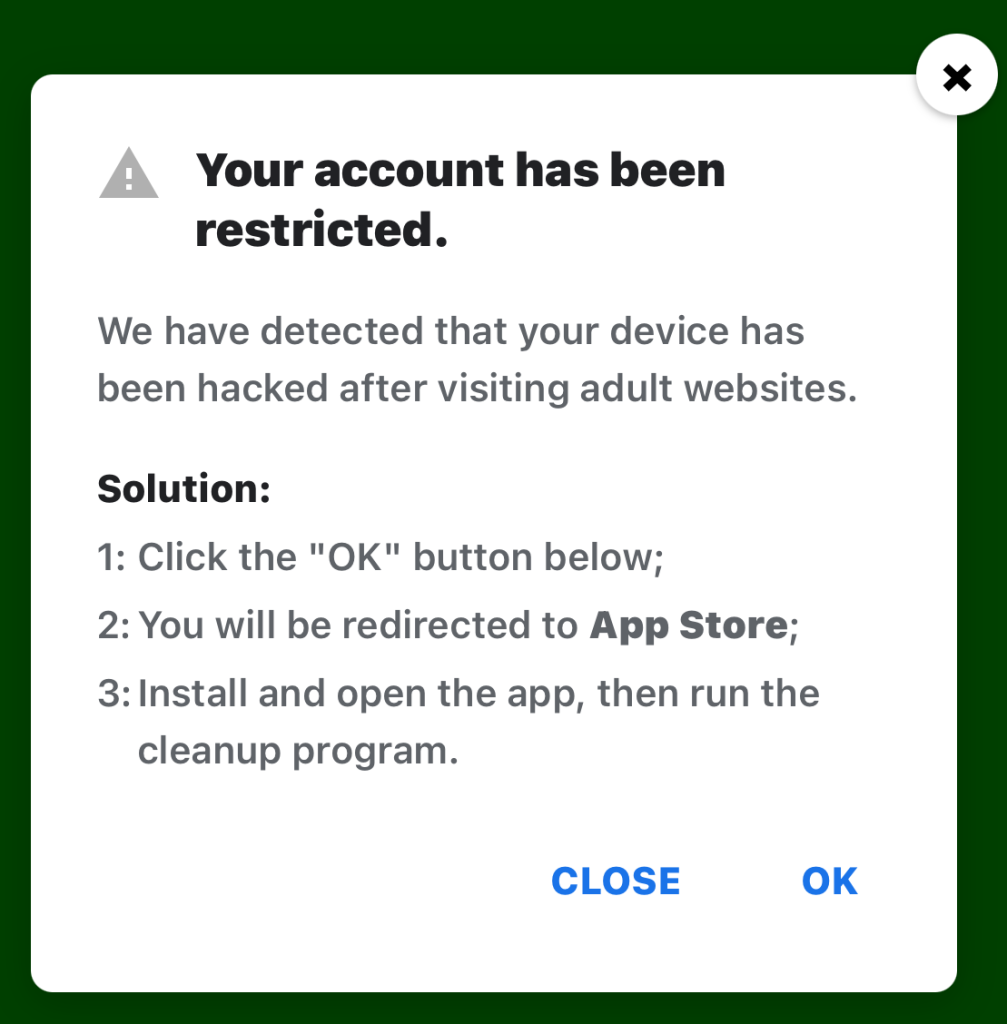
A page opens on your phone and appears to show Apple Pay processing a $657 App Store payment. A spinner turns. “Face ID · verifying identity” appears beneath the amount. There is a transaction ID, a padlock, and all the visual cues of a payment in progress.
A few seconds later, the story changes.
You get an alert saying your Apple ID is locked because of an unrecognized sign-in. A phone number appears under the instruction to call Apple Support immediately. When you open the transaction details, the payment is marked “Completed.” Then your phone begins speaking an alert about the unauthorized charge.
It’s all completely made up.
The page we analyzed contains no real Apple Pay transaction and no biometric verification. Instead, it uses hardcoded payment details, browser-generated speech, fake security warnings, and aggressive navigation tricks to get the victim to call the scammer.
The “Face ID” check isn’t real
The first screen is designed to make it look as though the phone itself is authorizing a payment.
In this sample, “Face ID · verifying identity” is simply an HTML element displayed beside an icon. There is no Apple Pay request and no biometric-authentication call behind it.
Apple Pay can legitimately be used on websites, but a genuine payment begins when the merchant requests it. The system then immediately displays a payment sheet for the user to review and authenticate, as Apple’s guidelines specify.
Nothing like that happens here. The scam page has simply drawn its own imitation.
The “Processing payment” spinner is equally cosmetic. The entire splash screen disappears on a timer after 2.8 seconds, regardless of anything the user does.
The receipt is fake, and the code is the same for everyone
The next screen is dressed up as a transaction receipt. It contains an amount, masked card digits, an authorization code, a transaction ID, and a green “Completed” status.
Most of those values never change.
That’s because the page hardcodes the amount as $657.00, the transaction ID as AP-2026-08-03-14:32, and the authorization code as AUTH-8F3A2B1C. Every visitor is shown the same values.
The date, however, is generated dynamically.
JavaScript calls new Date() and formats it with toLocaleString(), meaning the receipt uses the current date, time, and timezone from the victim’s device.
That creates an obvious contradiction. The fixed transaction ID contains 2026-08-03, while the date field shows the time and date when the victim happens to open the page.
A genuine transaction doesn’t rewrite its transaction date every time somebody looks at it.
The “voice alert” is generated by the browser
Once the victim opens the transaction details, the page attempts to speak:
“Unauthorized charge of six hundred fifty seven dollars from your Apple ID. Please call support immediately.”
There is no recorded Apple message behind it.
The JavaScript creates a SpeechSynthesisUtterance and sends it to window.speechSynthesis, the browser’s built-in Web Speech API to read the warning aloud.
Using a text-to-speech voice already available on the victim’s own device is a clever social-engineering touch. The warning may sound more like part of the phone itself than audio playing from a random website.
The page tries to make leaving difficult
One interesting part of this scam is the code surrounding the exit routes.
The page adds a new browser-history entry and listens for popstate, allowing it to react when a victim tries to navigate backward. It then displays a warning claiming that closing the page could expose the victim’s payments and banking information.
If the victim accepts the prompt to call support, the code navigates to a tel: URL containing the scam number. If they cancel that particular prompt, another warning appears and another history entry is added.
The page also registers handlers for beforeunload, pagehide, the context menu, an edge-swipe gesture, and common keyboard navigation shortcuts. On iOS, its pagehide handler even makes a delayed attempt to navigate directly to the telephone number.
These tricks can make the page persistent and annoying, but they don’t lock the browser or device. Modern browsers restrict what websites can do during navigation. For example, beforeunload isn’t reliably triggered on mobile, generally requires prior user interaction, and can only produce a generic browser-controlled confirmation.
In other words, the code tries several ways to stop you leaving or get you to call, but it can’t take control of the browser itself.
The phone call is the real objective
The $657 charge is bait to get you on the phone.
The support number appears prominently on the page, the red “Verify now” button points to it, and the fake security prompts repeatedly offer to dial it.
This is a well-established tech support scam tactic. The FTC warns that scammers use bogus charge notices to get victims to call, then may request remote access or pressure them into sending money through gift cards, bank transfers, cryptocurrency, or payment apps.
Apple also warns that scammers may claim someone has broken into your Apple account or made unauthorized Apple Pay charges, using urgency to stop you from contacting Apple independently.
What to do if you see a page like this
There is a simple clue worth remembering:
A security pop-up that manufactures an emergency and tells you to call the phone number displayed on the screen should be treated as a scam.
If an Apple Pay–like interface appears inside a website, remember that visual resemblance proves nothing. A site can freely mimic buttons, locks, logos, transaction IDs, and even animated spinners. What matters is whether a genuine Apple Pay payment sheet has actually been invoked.
In this case, it hasn’t. The important part of this scam is not the fake $657 payment. It is the urgency built around it to get the victim onto a call.
Don’t tap OK, Call, or Verify. Anything you tap on the screen will either call the number or bring up another warning.
Don’t dial the number, and don’t call it back later to complain or to check.
Close the tab using your browser’s tab switcher. On iPhone or Android, open the tab switcher and swipe the tab away. Once the tab is closed, the scam page can no longer keep you there or try to make the call.
If a dialog appears asking whether to leave the site, choose Leave. Web pages can ask you to stay, but they cannot stop you from leaving.
If in doubt, check your real purchase history. Open the App Store or Settings on your device and review your Apple purchase history. If there’s no $657 charge there, there was never a charge.
If you already called and gave someone remote access to your device, take action immediately:
Disconnect from the internet
Uninstall any remote access software they had you install
Change your Apple ID password and your bank passwords from a different device
Contact your bank about any payments you sent.
Check if something is a scam
If a number like this one is on your screen or already in your call history, check it before you do anything else. Malwarebytes Scam Number Check is a free way to see whether a number has been linked to scam activity. Just put the number in and we’ll tell you if it’s likely to be a scam.
Got a screenshot or URL of a suspected scam? Upload it to Scam Guard—built in to Malwarebytes Mobile Security—and you’ll get a verdict and safety tips in seconds.
Phishing pages don’t need to be sophisticated. They just need to look convincing enough to make you trust them.TikTok phishing often starts with an email or message designed to make you think you need to act on your account. It might claim your account has been suspended, reported, or hit with a copyright violation, or tell you that you’re eligible for verification.The link might take you directly to a page made to look like TikTok’s login screen. If you enter your information, it can be sent st
Phishing pages don’t need to be sophisticated. They just need to look convincing enough to make you trust them.
TikTok phishing often starts with an email or message designed to make you think you need to act on your account. It might claim your account has been suspended, reported, or hit with a copyright violation, or tell you that you’re eligible for verification.
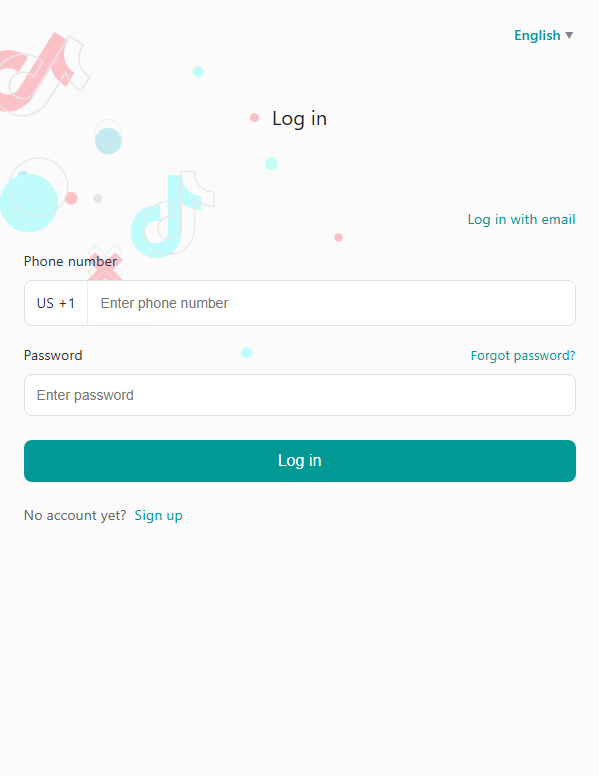
The link might take you directly to a page made to look like TikTok’s login screen. If you enter your information, it can be sent straight to the scammers, including your phone number or email, password, and potentially a one-time authentication code.
With access to your account, scammers could impersonate you, target your contacts, or try to use the same password to break into your other accounts.
What to do if you get a suspicious TikTok message
If you get an unexpected email or message telling you to log in to TikTok, don’t use the link it provides. Open the real TikTok app or go directly to tiktok.com instead and check your account there.
If you’ve already entered your login information on a suspicious page, change your TikTok password immediately and check for any devices or login activity you don’t recognize.
Fake warnings and verification offers
Not every TikTok phishing link leads directly to a fake login screen. Some try to scare you with claims that your account has been suspended or reported, or that you’ve received a copyright or community-guidelines strike that needs “resolving.” Others offer something you might want, such as a verified badge, creator payout, or brand deal.
For example, a fake TikTok Verification Center might congratulate you on your performance and tell you that you’re eligible for a verified badge:
Another fake verification page asks for account information as part of a supposed verification request:
Whether the message threatens you with a problem or promises you a reward, the aim is the same: to persuade you to interact with a fake TikTok page and hand over information.
Why these TikTok scams work
Fake TikTok pages can look convincing because copying the appearance of a real website is relatively easy. But the story that gets you there is just as important.
Suspension and copyright warnings create urgency. Verification and monetization offers create an incentive. Both give you a reason to act quickly instead of stopping to check where the link has actually taken you.
How to protect your TikTok account
Don’t use links in unexpected emails or messages asking you to log in to TikTok. Open the TikTok app or go directly to tiktok.com instead
Treat any message about a suspension, strike, or verification eligibility as unverified until you’ve confirmed it inside the TikTok app itself
Check the address bar before entering your login information. Make sure you’re actually on tiktok.com—a fake page can look almost identical to the real thing
Use a password manager where possible. It won’t auto-fill your TikTok password on a different domain, which is a useful warning sign
Turn on two-factor authentication (2FA) on your real TikTok account so a stolen password alone isn’t enough to get in
If you’ve already entered your login information on a page like this, change your TikTok password immediately and check for any login activity or devices you don’t recognize
Researchers have uncovered ToxicPanda 2.0, an Android banking Trojan and remote-access tool designed for account takeover and “on-device fraud.”
Not only does ToxicPanda 2.0 have a much larger target list of banks and e-wallets, it has also expanded its capabilities by combining banking overlays, remote access, PIN capture, Android accessibility abuse, and attempted Wireless Debugging automation. Together, those functions can help operators turn a compromised phone into a platform for account
Researchers have uncovered ToxicPanda 2.0, an Android banking Trojan and remote-access tool designed for account takeover and “on-device fraud.”
Not only does ToxicPanda 2.0 have a much larger target list of banks and e-wallets, it has also expanded its capabilities by combining banking overlays, remote access, PIN capture, Android accessibility abuse, and attempted Wireless Debugging automation. Together, those functions can help operators turn a compromised phone into a platform for account takeover, financial fraud, and longer-term device control.
The core objective is on-device fraud. That means that rather than logging in from an attacker-controlled machine, the operator can carry out actions from the victim’s infected phone, taking over the device, IP address, app session, and behavioral context that banks may use when deciding whether a transaction is fraudulent.
ToxicPanda 2.0 is built around abusing Android’s Accessibility Service, a legitimate feature intended to help people interact with their devices. When a victim grants this permission to a malicious app, the malware can inspect interface elements, observe app activity, automate interactions, and place deceptive content over legitimate apps, known as overlays.
ToxicPanda has historically relied on social engineering to persuade users to sideload a malicious Android application rather than install it through Google Play. The latest campaign uses Amazon AWS-hosted buckets to deliver ToxicPanda 2.0 samples.
After installation, the dropper presents a fake installation flow, requests VPN privileges, blocks certain Google Play and Google Play Services network communications, decrypts an embedded payload, and then seeks Accessibility Service permission for the installed payload.
The consequences can include stolen banking usernames and passwords, intercepted or captured PINs, fraudulent transactions, loss of access to the device, and exposure of the phone’s screen-lock secret. An attacker that can operate inside an active banking session from the victim’s device may have a better chance of evading controls designed to identify unfamiliar devices or unusual login locations.
How to stay safe
However sophisticated it is, ToxicPanda 2.0 still relies heavily on social engineering to get targets to install the malicious app and give it the permissions it needs. So our main recommendations are:
Avoid sideloading apps, especially from links in unsolicited messages, ads, or alleged support communications.
Treat requests for Accessibility access, Device Administrator privileges, developer settings, and VPN permissions with particular caution, especially if it’s not clear why the app needs those permissions or if you don’t fully trust it.
Use an up-to-date, real-time anti-malware solution for your device that can detect and block the malicious payload. Malwarebytes for Android detects apps in the ToxicPanda 2.0 campaign as Android/Trojan.Dropper.agent and Android/Trojan.FakeApp.ACR2401245FC11.
If your device is infected
Although it may require a factory reset to regain control of an infected device, there are some things you can try first:
First, put the phone in airplane mode and turn off Wi-Fi and Bluetooth. This can cut off command-and-control communications and ongoing credential theft while you investigate.
Use another device to freeze or closely monitor transactions, revoke active sessions, and reset your banking credentials.
Do not interact with fake “system update” screens or unexpected prompts for Accessibility, VPN, Device Administrator, Developer Options, or Wireless Debugging.
Start Android Safe Mode. Google recommends Safe Mode to help identify problems caused by downloaded apps. Remove recently installed or suspicious apps one at a time, reboot normally, and see whether the problem returns.
Remove Accessibility access first. In Settings > Accessibility > Installed apps/Downloaded apps, disable any service you do not recognize. Focus on recently installed apps or anything pretending to be an update, system component, security tool, document viewer, or bank helper.
Next, check Device Administrator rights. Go to Security & privacy > More security settings > Device admin apps and disable any unrecognized administrator before attempting removal. An app with Device Administrator privileges can make the Uninstall control unavailable.
Then check your VPNs. Go to Settings > Network & internet > VPN or search Settings for “VPN,” and delete any VPN profile you did not deliberately install. The ToxicPanda dropper uses VPN permission as part of its reported Google Play and Google Play Services blocking process.
Disable dangerous developer functionality. Search Settings for Developer options, turn it off entirely, and make sure Wireless debugging and USB debugging are off.
Remove all the suspicious apps you found. Go to Settings > Apps > See all apps, enable Show system apps if necessary, then locate recently installed or unfamiliar apps. Force stop the suspicious app, clear its storage, and select Uninstall. If an app has a generic name, blank icon, odd install date, or was installed outside Google Play, treat it as suspicious.
Reboot normally after removal, then re-check Accessibility, Device Administrator, VPN, and Developer Options. Also review the installed-app list for a second suspicious package, since the reported campaign uses a dropper to decrypt and install its payload.
Please note: The given paths in Settings may differ depending on your device manufacturer or Android version.
If you’re having trouble removing ToxicPanda manually and you can’t install or update Malwarebytes, please reach out to our Support team. They can walk you through the process.
Scammers know more about you than you think.
Malwarebytes Mobile Security protects you from phishing, scam texts, malicious sites, and more. With real-time AI-powered Scam Guard built right in.
A Google spokesperson announced on Reddit that it has started rolling out the first version of its Advanced Flow, designed to make installing apps from unverified developers safer.
Let us explain what sideloading is, why Google Play is not 100% safe, what to look for when you’re sideloading so you can do it more safely, and how Google’s Advanced Flow helps with that.
What is sideloading?
Sideloading lets Android users install apps from outside Google Play. It can be useful, but it also
A Google spokesperson announced on Reddit that it has started rolling out the first version of its Advanced Flow, designed to make installing apps from unverified developers safer.
Let us explain what sideloading is, why Google Play is not 100% safe, what to look for when you’re sideloading so you can do it more safely, and how Google’s Advanced Flow helps with that.
What is sideloading?
Sideloading lets Android users install apps from outside Google Play. It can be useful, but it also creates opportunities for scams and malware.
Android’s openness is one of its enduring strengths. You are not limited to a single app store: You can install apps from a developer’s website, an alternative marketplace, an enterprise portal, or a file shared directly with you.
That is called sideloading. It is not automatically dangerous, but it removes some of the guardrails that come with conventional app-store distribution. Getting apps from the Google Play Store itself is no guarantee of safety, but there is at least some vetting. Google says it blocked more than 1.75 million policy-violating apps from being published in 2025 and banned more than 80,000 developer accounts associated with harmful apps.
There are several reasons for sideloading:
The developer distributes an app directly from its own website
An app is unavailable in your country or on Google Play
An alternative app repository offers what you’re after, for example open-source software
You need an enterprise, beta, or specialized app
You want to install a version that is not currently offered through Google Play
But malware authors and online scammers use the same flexibility. They may impersonate banks, delivery services, government agencies, crypto platforms, news readers, or job recruiters, then urge victims to install an app to “secure” an account, receive a payment, or resolve an invented problem.
Google Play is not a free pass
Google Play has review processes, policy enforcement, developer controls, and Google Play Protect. It also runs ongoing checks after an app is published. Those measures meaningfully reduce risk, but they do not make every listing harmless or every developer trustworthy.
Threats that can still surface through official channels include:
Trojans disguised as useful utilities, games, or financial apps
Adware and apps that misrepresent their behavior
Subscription traps and deceptive billing practices
Data-harvesting apps that request more access than they need
Sleeper apps that change behavior after passing an initial review
Google Play Protect checks Play Store apps before download and also scans apps from other sources. It can warn about, disable, or remove potentially harmful apps, but it should be viewed as one layer of security, not a substitute for scrutinizing an app before installing it.
In short, “available on Google Play” is a positive signal, not a security verdict.
Why sideloading requires attention
The main difference between installing from a recognized store and downloading an APK from elsewhere is not simply the file format. It is the trust chain.
When you sideload, you may have fewer assurances about:
Who created the app
Whether the file has been altered or repackaged
Whether the download site is impersonating a legitimate developer
Whether you will receive genuine updates
Whether a scammer is manipulating you into disabling security protections
Social engineering is often the decisive factor. A convincing caller, pop-up, text, or chat message may insist that installing an app is urgent. The attacker’s goal is often to make the victim bypass warnings before they have time to question the request.
Treat any unexpected request to install an app as suspicious, especially when it comes with urgency, secrecy, a promise of money, or a claim that your bank, government, employer, or device provider requires it.
A legitimate bank, government agency, law-enforcement organization, or technical-support provider should not call or message you and instruct you to install an APK or weaken Android security settings.
How to sideload more safely
Sideload only when you have a specific reason for it, and make sure the decision came from you rather than an unexpected message or phone call.
Start at the developer’s official site. Don’t use sponsored search results, random download portals, links sent by strangers, or lookalike domains.
Verify the developer independently. Check the publisher’s official website, documentation, public code repository, and trusted community channels. The information supplied on the download page alone is not enough.
Prefer established repositories. If an app is distributed outside Google Play, use a source with a strong reputation for provenance and signature verification where possible. For advanced users, it can be useful to compare an APK’s signing certificate or cryptographic hash against a value published by the developer. That is not practical for everyone, but it can help detect fakes.
Do not install apps under pressure. End the call, close the chat, and independently research the claimed organization using contact details you find yourself.
Keep Google Play Protect enabled. It scans apps during installation and periodically afterward, including apps installed from outside Google Play.
Review permissions before and after installation. Be especially cautious if a simple app wants access to accessibility services, SMS messages, notifications, device administration, contacts, or screen recording.
Keep Android and apps updated. Security fixes can protect against both operating-system flaws and known malicious app behavior.
Use reputable mobile security software. A separate security layer can help identify risky behavior and provide additional visibility into potentially unwanted or malicious apps.
Remove permissions and uninstall apps you no longer trust or use. An app that seemed harmless at installation can become a liability if its developer abandons it or changes direction.
How Google’s new Advanced Flow helps
Google is rolling out Advanced Flow for installing apps from developers that have not completed Android’s new identity-verification process. The feature is intended for users who understand the risks of installing unverified software but still need that flexibility.
The design is notable because it targets social-engineering attacks as well as malware. Instead of allowing an immediate, one-tap override, the flow requires users to:
Enable developer mode in system settings. This is easy enough and helps prevent accidental or one-tap bypasses often used in high-pressure scams.
Complete a quick safety check to make sure that no one is talking you into turning off your security. Scammers often pressure victims into disabling protections.
Restart your device, which cuts off any remote access or active phone calls a scammer might be using to guide you.
Wait one day, then confirm the change using biometrics, such as fingerprint or face unlock, or your device PIN. This one-time, one-day delay breaks the urgency scammers rely on, giving you time to think.
Once you have completed the process, you can choose to allow installs from unverified developers for seven days or indefinitely.
Advanced Flow does not mean Google Play is risk-free, nor does it make unverified apps inherently malicious. Developer verification establishes accountability: It connects an app to a verified developer identity, but it does not establish that every app is benign or suitable for every user.
At the end of the day, it’s up to you. Install apps because you chose them after checking the source, not because someone else manufactured an emergency.
Whether an app comes from Google Play or an external source, pause before installing. Check who made it, why it needs the permissions it asks for, whether the download route is trustworthy, and refuse when a stranger is trying to rush you. That little friction is a feature, not just a nuisance.
Scammers know more about you than you think.
Malwarebytes Mobile Security protects you from phishing, scam texts, malicious sites, and more. With real-time AI-powered Scam Guard built right in.
Most wrong-number texts are harmless. Some are the first step in a carefully planned scam. By replying, you may be confirming that your number is active and that you’re willing to engage with strangers, making you a more valuable target for future fraud. Here’s why a polite response can be worth money to cybercriminals.
The politeness trap
Sunday night. You’re on the couch, half-watching Netflix, when your phone buzzes.
“Hey! Are we still on for dinner tomorrow? Don’t forget the win
Most wrong-number texts are harmless. Some are the first step in a carefully planned scam. By replying, you may be confirming that your number is active and that you’re willing to engage with strangers, making you a more valuable target for future fraud. Here’s why a polite response can be worth money to cybercriminals.
The politeness trap
Sunday night. You’re on the couch, half-watching Netflix, when your phone buzzes.
“Hey! Are we still on for dinner tomorrow? Don’t forget the wine ”
You don’t recognize the number. You glance at it for two seconds, then type what most polite people would:
“Sorry, I think you have the wrong number!”
You put your phone down. Go back to Netflix, and forget about it within five minutes.
On the other end, though, your reply has just told the sender something valuable. Not because of a technical exploit or an invisible cyber-attack, but because you just proved you’re the kind of person who responds to strangers politely.
According to cybercrime intelligence reports, responsive phone numbers are worth significantly more than inactive ones. With a single reply, you’ve entered a global criminal ecosystem run by transnational syndicates that, according to analysts, moves tens of billions of dollars.
What your reply told them
Let’s be clear: the “wrong number” text is not a phishing link. It’s not malware. In many cases, it’s not even the scam itself. It’s a personality test.
The scammers already have your number. They may have bought it in bulk from a data breach for a fraction of a cent per record. They already know the message was delivered because their SMS gateway received no delivery failure. Text messages remain one of the most effective ways to reach people, with exceptionally high open rates and most being read within minutes. That’s one reason scammers prefer SMS to email.
What they don’t know is whether you’re worth spending more time on. Your reply told them three useful things:
You’re responsive. You saw the message and felt compelled to reply. This immediately places you in their top 15–20% most active numbers category.
You’re polite. You didn’t ignore it and didn’t respond aggressively. You wanted to help a stranger. Scammers deliberately exploit that instinct to be polite and helpful.
You reply quickly. The time between their message and your reply can reveal how closely you monitor your phone, help estimate your timezone, and indicate how likely you are to respond to future messages.
The two paths your number takes
From this moment, your story splits. Both paths described below play out across millions of phones worldwide.
Scenario A: The slow burn
Within minutes of your reply, another message arrives in response to yours:
“Oh no, I’m so sorry! But honestly, you seem like a really kind person. It’s rare to find polite people these days. I’m Sarah, by the way.”
Some people stop the conversation there. Others reply out of curiosity or because they’re simply being friendly. A few messages later, you’re in a conversation.
In some large scam operations, those early exchanges may be handled by AI (Artificial Intelligence) using open-source language models such as Llama or Mistral. That allows scammers to hold thousands of conversations at once and focus their time on the people who seem most likely to keep talking.
While keeping you engaged, the AI assigns you a real-time vulnerability score based on your response time and message length. If your score crosses a certain threshold, a human operator takes over. They read the conversation, learn your name, your job, and your communication style, then continue as though nothing has changed.
Within two or three weeks, this person has become a friend. They text you good morning, ask about your day, and send photos stolen from real social media profiles.
Around week three, they casually mention an investment:
“I’ve been making really good money on an investment platform lately. Almost $4,000 last month. It’s crazy.”
If you show interest, they’ll send you a link to a fake trading platform with a convincing design. You might deposit $500 to test it. The next day, your dashboard shows a fake gain of $1,800, so you invest more. A week later, the platform disappears, along with your money, and the person who texted you every day.
According to the FBI’s Internet Crime Complaint Center (IC3), investment fraud generated more than $4.5 billion in reported losses in a single year. To be clear: while most wrong-number texts never reach this stage, victims who fall for so-called “pig butchering” scams (long-term romance/financial scams) suffer catastrophic average losses ranging between $70,000 and $75,000 per person.
Scenario B: The silent recycling
In this scenario, you replied “wrong number” and never heard from them again. You think you dodged the scam, but instead your number was simply moved to a different category: “Active, responsive, polite, but not susceptible to the wrong-number hook.”
That profile still has enormous commercial value. Your number is added to a cleaned database and sold or reused for a different campaign.
A week later you receive a text from another number:
“Hi! I saw your profile on LinkedIn. We have an opportunity that’s a perfect fit for your background.”
Or:
“Your package couldn’t be delivered, update your address by clicking here.”
Or a fake alert from your bank warning of “suspicious activity.”
You’ll probably never connect these messages to the wrong-number text you received the week before. They’re different topics and different senders. But they may all be part of the same criminal ecosystem. The first message was simply a way to sort potential targets. Everything that follows is the actual attack.
The most common hooks
If you’ve received one of these messages (or something very similar), you’re not alone. These are some of the most common opening lines used in wrong-number scams, tested on millions of people and optimized to maximize response rate:
The friend who doesn’t exist:
“Hey! See you tonight at 6? Don’t be late ”
“Are you still free tomorrow?”
“Did you send those files to the office?”
“Hey Marco, are we still on for dinner tonight?”
The concerned neighbor:
“Sorry to bother you, I’ve noticed your dog sometimes runs into my yard.”
“I found a phone number on the dog tag, is this yours?”
“Hi, your package was delivered to my address by mistake.”
The professional mix-up:
“Hi, I tried to reach you about the delivery but you didn’t answer.”
“The shipment arrived at your address, can you confirm?”
“This is Mike from the office, did you get my earlier message?”
The family emergency:
“Do you know Sarah? There’s been an emergency.”
“Is this [common name]’s number? Something happened.”
The recruiter:
“Hi! I came across your profile, we have an incredible opportunity.”
“Hey, I’m reaching out about a position that matches your background perfectly.”
If you’ve received one of these messages, it doesn’t automatically mean it’s a scam. People genuinely do text the wrong number sometimes. But if the conversation quickly moves to making small talk, asking personal questions, or encouraging you to keep chatting, stop replying.
These messages aren’t usually sent by a lone cybercriminal. They’re part of a highly organized criminal industry with its own market dynamics and global supply chains.
In January 2026, Cambodian and Chinese authorities arrested Chen Zhi, president of Prince Holding Group, accusing him of running a network of scam compounds across Southeast Asia where thousands of trafficked people were forced to manage these conversations. Those operations relied on underground marketplaces where criminals could buy everything they needed, from phone lists and stolen identities to AI tools and fake investment websites.
The scale is staggering. Blockchain analytics firm Elliptic estimates the Huione Guarantee underground marketplace processed more than $134 billion in transactions. Separately, researchers at the University of Texas at Austin estimate that pig-butchering scams stole more than $75 billion in cryptocurrency over four years.
The scam funnel: Costs and revenue
To understand why this ecosystem is so huge, look at the math. Sending hundreds of thousands of text messages costs very little. Even if only a tiny fraction of people reply, and an even smaller number eventually send money, the profits can far outweigh the costs.
Look at this illustrative model of a campaign sending 100,000 SMS messages:
The figures in this model aren’t arbitrary. They combine observed pricing from underground marketplaces such as Russian Market and BidenCash with average victim losses reported by law enforcement agencies, including the FBI’s Internet Crime Complaint Center (IC3).
Even allowing for variation between campaigns, the economics are compelling. A single campaign can cost less than $1,000 to run while generating more than $200,000 in revenue, representing a potential return on investment (ROI) of 90x to 200x.
Those same economics are reflected in underground marketplaces, where verified, enriched contact details command significantly higher prices than raw data. In our previous investigation into underground marketplaces, we found that a typical stolen personal record sold for around 95 cents. The more criminals learn about a potential victim, the more valuable that person’s data becomes.
That’s a 4,000% value increase generated by a single polite reply.
From there, scammers can enrich that record with publicly available information such as your name, employer, social media profiles, and estimated demographics using automated open-source intelligence (OSINT) techniques.
The more complete the profile becomes, the more valuable it is. Researchers monitoring underground marketplaces have found that enriched, pre-profiled contacts command premium prices because they’re more likely to become victims of high-value pig-butchering scams that generate billions of dollars in illicit revenue each year.
How do they know who you are?
Before that text reaches your phone, your number may already have passed through automated script pipelines capable of cross-referencing tens of thousands of records in minutes.
Acquisition: Your number is pulled from historical data breaches, such as the Facebook leak affecting 533 million users, Twitter/X data leaks, or massive aggregated databases like Naz.api, and the Mother of All Breaches (MOAB), a collection of more than 26 billion records compiled from thousands of previous breaches.
Automated scraping: Software queries public sources to check whether your number is linked to an active WhatsApp account, collect your profile information and picture and match the number to public LinkedIn, Instagram, and Facebook profiles.
Data broker integration: Scammers exploit the same commercial data services used by marketing companies to associate a phone number with estimated age, address, and income bracket.
The result is a psychographic and commercial profile that helps scammers choose the most convincing approach. If your social media shows you have a dog, you might receive the neighbor hook: “Your dog keeps getting into my yard.” If you recently changed jobs on LinkedIn, the fake headhunter hook activates.
The human factor: Modern slavery
There’s one aspect of these scams that’s often overlooked: many of the people sending the messages are victims themselves.
In its August 9, 2023 policy report, the United Nations Office on Drugs and Crime (UNODC) described a human rights crisis tied to forced criminality in Southeast Asia. It estimates at least 120,000 people in Myanmar and tens of thousands in Cambodia are being held in fortified mega-compounds run by criminal syndicates.
Many were lured by fake job adverts promising legitimate work in digital marketing or customer service. Once they cross the border, their passports are confiscated. They were stripped of freedom and forced, under the threat of violence, to spend up to 16 hours a day managing dozens of scam conversations. Those who failed to meet financial targets were often beaten, isolated, or sold to other compounds.
When you reply to one of these messages, you’re interacting with a system designed to simultaneously exploit your financial availability and the enslavement of another human being.
Breaking the chain
You can’t erase your number from dark web databases: that damage may have done years ago. But you can make your profile far less valuable to scammers.
Make yourself harder to profile: Review the privacy settings on any messaging apps and social media platforms that use your phone number. Limit who can see information such as your profile photo, status, last seen, and phone number. The less information scammers can gather automatically, the harder it is to build a detailed profile about you. On WhatsApp, for example, you can set Profile Photo, About, Status, and Last Seen to My Contacts. On Telegram, set Phone Number to Nobody.
Report before you block: Blocking protects only you. Reporting protects everyone. When you use WhatsApp’s Report and Block function, the last five messages in the chat are sent to Meta’s security teams. If enough people report the same number, it may be permanently banned, destroying the entire active campaign on that line.
The golden rule: If you receive an unexpected message from an unknown number, the safest response is no response at all. Don’t reply, don’t explain yourself, and don’t worry about seeming impolite. If it’s a genuine wrong number, the sender will usually realise their mistake and move on. If it’s a scam, you’ve denied the criminals exactly what they wanted: proof that your number is active and that you’re willing to engage.
Something feel off? Check it before you click.
Malwarebytes Scam Guard helps you analyze suspicious links, texts, and screenshots instantly.
Apple has expanded its threat-notification system for targets of mercenary spyware.
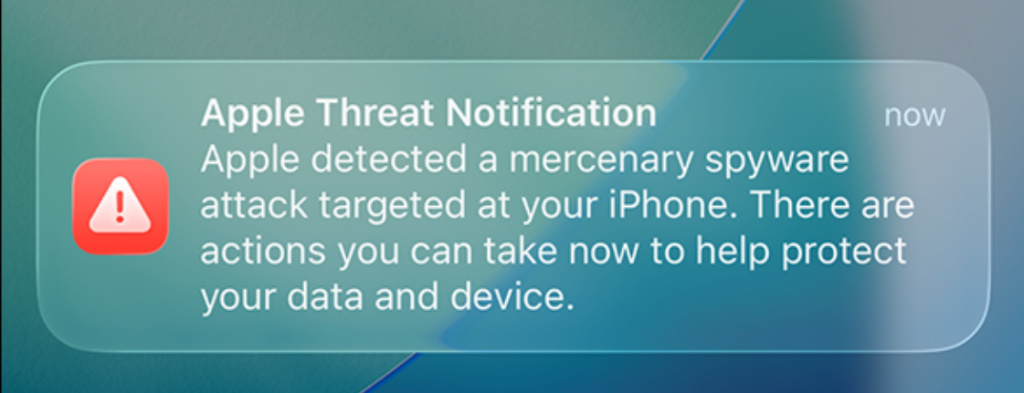
Apple now shows a warning directly on an iPhone’s Lock Screen and in Settings when it believes the device owner has been targeted by mercenary spyware. The new on-device alert is meant to make a high-risk warning harder to overlook and complements notifications by email and through the user’s Apple Account page.
In the explanation, Apple states:
“Apple threat notifications are high-confidence alerts tha
Apple now shows a warning directly on an iPhone’s Lock Screen and in Settings when it believes the device owner has been targeted by mercenary spyware. The new on-device alert is meant to make a high-risk warning harder to overlook and complements notifications by email and through the user’s Apple Account page.
In the explanation, Apple states:
“Apple threat notifications are high-confidence alerts that a user has been individually targeted by a mercenary spyware attack, and should be taken very seriously.”
“Apple Threat Notification Apple detected a mercenary spyware attack targeted at your iPhone. There are actions you can take now to help protect your data and device.”
Apple says its threat notifications are intended for people individually targeted by mercenary spyware attacks, which are highly sophisticated campaigns usually associated with commercial surveillance vendors and their government customers. Apple says it has notified targets in over 150 countries since the launch of the program in 2021, while the latest round of notifications reached people in 110 countries.
Mercenary spyware campaigns are usually not aimed at the average iPhone owner—at least at first. The initial targets are often people selected for who they are, what they know, or the work they do. But it would be a mistake to view this as someone else’s problem.
Attack techniques developed for narrowly targeted operations have a habit of spreading. Exploits can be reused, sold onward, reverse engineered, copied by other surveillance vendors, or adapted by criminal groups. A vulnerability initially valuable because it compromises a small number of carefully chosen devices may become much more dangerous once public disclosure, patch analysis, or exploit sharing makes them available for more widespread campaigns.
How to stay safe
Apple advises users to:
Update your devices to the latest software, which includes the latest security fixes.
Protect your devices with a passcode, Touch ID, or Face ID.
Use strong and unique passwords, and passkeys where available.
Don’t open links or attachments from unknown senders.
We’d like to add:
Potential targets of mercenary spyware should consider applying Apple’s Lockdown Mode.
Check if an Apple Threat Notification is real. Scammers will undoubtedly try and mimic them. You can verify a notification by signing in to your Apple account. A genuine Threat Notification will always be clearly listed there.
If you receive an Apple Threat Notification, Apple recommends seeking expert help, such as the Digital Security Helpline from Access Now.
Scammers know more about you than you think.
Malwarebytes Mobile Security protects you from phishing, scam texts, malicious sites, and more. With real-time AI-powered Scam Guard built right in.
Researchers at Group-IB have discovered a new NFC relay malware family, purpose-built to capture live card data via NFC and forward it in real time to attackers. They dubbed it “WindRelay.”
NFC (Near Field Communication) is wireless technology that allows devices such as smartphones, payment cards, and payment terminals to communicate when they’re very close together. So, instead of stealing your physical bank card, the attackers capture NFC activity on an infected mobile phone and relay it i
Researchers at Group-IB have discovered a new NFC relay malware family, purpose-built to capture live card data via NFC and forward it in real time to attackers. They dubbed it “WindRelay.”
NFC (Near Field Communication) is wireless technology that allows devices such as smartphones, payment cards, and payment terminals to communicate when they’re very close together. So, instead of stealing your physical bank card, the attackers capture NFC activity on an infected mobile phone and relay it in real time to a criminal-controlled device held against a contactless payment terminal, or an ATM that supports contactless cash withdrawals.
The researchers describe a 13-minute call impersonating a bank, in which a victim was persuaded to install an Android app labelled with the bank’s name. That app was a remote access Trojan (RAT) called SpyNote. SpyNote gave the attacker remote control of the phone and enabled the quiet installation of a second app, WindRelay.
The attackers then opened the victim’s legitimate banking app remotely and arranged a loan in the victim’s name, while also asking them to tap their physical payment card against the phone and enter its PIN. That tap let the second app forward the card’s contactless data in real time to the criminals, allowing them to make purchases or, in some cases, withdraw cash from an ATM.
This division of tasks is the important development here. The remote-access malware (SpyNote) gets the attackers into the phone, and the NFC relay malware (WindRelay) turns the victim’s physical card into something the criminals can use elsewhere at that moment.
It’s not quite as simple as it sounds, because NFC comes in a few different “flavors.” Some produce a static code. Take the card that opens my apartment building door, for example. That kind of signal can easily be copied to a device like my Flipper Zero so I can use it to open the door. But sophisticated contactless payment cards use dynamic codes. Each time you tap to pay, your card’s chip generates a unique, one-time code (often called a cryptogram or token) that cannot be reused.
That’s why the critical feature of NFC relay malware is real-time relaying. Since payment card transactions use dynamic, transaction-specific cryptographic data, timing is central to this kind of fraud.
The telephone call isn’t just the lure. It’s also the attackers’ control channel. It lets them overcome the victim’s hesitation, respond to confusion instantly, and coordinate the precise moments when the victim installs an app, taps their card, and enters a PIN.
This is part of an established and expanding NFC relay fraud category sometimes called ghost tapping. In the past, we’ve discussed NGate and SuperCard X, which are similar malware families. But the combination with SpyNote is what makes this campaign stand out.
How to protect yourself
As with many security threats, the best defense is you. The cybercriminals behind this attack can’t do anything unless you install the software on your phone, so they go through several steps to convince you to do so.
Be skeptical of calls and text messages from people you don’t know, especially those claiming to be urgent. Scammers typically try to panic you into acting quickly. Once they get you on the phone, they can build trust, making it harder to think critically and say no.
If you feel compelled to take action, check in with someone you trust first. If you’re still convinced the request is genuine, verify the message independently. Call your financial institution using an official number, not through the one in the text message or email.
Never give personal details to anyone who contacts you unexpectedly, and never change your banking details at their request. A bank will not ask you to install an app from a link, text message, browser download, or other unofficial source to “secure” your card.
Avoid sideloading apps (installing them from outside of the Google Play store), and treat unexpected Accessibility or device-control permissions as a serious warning sign.
Your phone is full again, and the warning appears at exactly the wrong moment. Suddenly you can’t update apps, record a video, or save another photo.
The cause is rarely one giant file. Storage disappears in a steady drizzle of leftovers: temporary files an app creates and forgets, caches that grow in the background, and downloads you no longer need. None of it is dangerous, but it can gradually fill your phone’s storage.
Junk Cleaner is a new tool in Malwarebytes for Android, available
Your phone is full again, and the warning appears at exactly the wrong moment. Suddenly you can’t update apps, record a video, or save another photo.
The cause is rarely one giant file. Storage disappears in a steady drizzle of leftovers: temporary files an app creates and forgets, caches that grow in the background, and downloads you no longer need. None of it is dangerous, but it can gradually fill your phone’s storage.
Junk Cleaner is a new tool in Malwarebytes for Android, available from version 5.22. It finds that clutter, shows you what’s using space, and lets you decide what to remove.
What Junk Cleaner finds
Junk Cleaner looks for three broad categories of storage clutter:
Leftover and residual files: Temporary and system-generated files that apps leave behind.
Old and large downloads: Files you saved but no longer use or remember.
(Coming soon) Hidden app caches: Storage used by apps in places Android keeps out of easy reach.
A file showing up in one of these categories doesn’t mean it’s harmful. It just means it’s taking up space and might be worth removing. That distinction matters because Junk Cleaner is about storage, not threats. It works separately from Malwarebytes malware scanning and web protection, and it doesn’t touch your photos, messages, or documents.
Scan, review, clean
Junk Cleaner scans the relevant areas of your device in parallel, guided by a set of rules that can be updated as we learn about new kinds of leftover files. The results are grouped by category and show how much space each item is using.
After the scan, you review the findings and choose what to clear. Nothing is deleted until you confirm the selection. The results are presented as a simple list showing each category and how much space you could recover.
.kadence-column445671_58044d-dd{max-width:400px;margin-left:auto;margin-right:auto;}.wp-block-kadence-column.kb-section-dir-horizontal:not(.kb-section-md-dir-vertical)>.kt-inside-inner-col>.kadence-column445671_58044d-dd{-webkit-flex:0 1 400px;flex:0 1 400px;max-width:unset;margin-left:unset;margin-right:unset;}.kadence-column445671_58044d-dd > .kt-inside-inner-col,.kadence-column445671_58044d-dd > .kt-inside-inner-col:before{border-top-left-radius:0px;border-top-right-radius:0px;border-bottom-right-radius:0px;border-bottom-left-radius:0px;}.kadence-column445671_58044d-dd > .kt-inside-inner-col{column-gap:var(--global-kb-gap-sm, 1rem);}.kadence-column445671_58044d-dd > .kt-inside-inner-col{flex-direction:column;}.kadence-column445671_58044d-dd > .kt-inside-inner-col > .aligncenter{width:100%;}.kadence-column445671_58044d-dd > .kt-inside-inner-col:before{opacity:0.3;}.kadence-column445671_58044d-dd{position:relative;}@media all and (min-width: 1025px){.wp-block-kadence-column.kb-section-dir-horizontal>.kt-inside-inner-col>.kadence-column445671_58044d-dd{-webkit-flex:0 1 400px;flex:0 1 400px;max-width:unset;margin-left:unset;margin-right:unset;}}@media all and (max-width: 1024px){.kadence-column445671_58044d-dd > .kt-inside-inner-col{flex-direction:column;justify-content:center;}}@media all and (max-width: 767px){.wp-block-kadence-column.kb-section-sm-dir-vertical:not(.kb-section-sm-dir-horizontal):not(.kb-section-sm-dir-specificity)>.kt-inside-inner-col>.kadence-column445671_58044d-dd{max-width:400px;-webkit-flex:1;flex:1;margin-left:auto;margin-right:auto;}.kadence-column445671_58044d-dd > .kt-inside-inner-col{flex-direction:column;justify-content:center;}}
A quick look under the hood
Junk Cleaner uses rules to identify patterns of clutter. These are not malware or phishing signatures. They describe file types and locations that may be worth reviewing when you need more space.
The scanner checks the relevant directories, matches files against those rules, measures how much space each hidden cache occupies, and combines the results into a single review screen.
Junk Cleaner automates a repetitive Android chore without turning storage cleanup into another complicated job.
Built at a hackathon
Junk Cleaner began as an internal hackathon project, an idea one engineer wanted to explore over a few focused days. The prototype proved useful enough to grow into a shipping feature, and reached all users in Malwarebytes for Android version 5.22.
Turning the demo into a product meant more than polishing the screen. The team added Android permission handling, cache cleaning, and review experience needed for a feature people could rely on across different devices.
We like that origin story because many useful features begin the same way: someone scratches an itch, builds something quickly, and turns a rough idea into a tool that can help millions of people. Future updates will bring smarter sorting, finer filters, and more control over what’s included.
Make room for what matters
Running out of space always seems to happen at the worst possible moment. Junk Cleaner clears away the leftovers that quietly build up, leaving more room for the photos, apps, and moments that actually matter.
Junk Cleaner is available in Malwarebytes for Android from version 5.22. Open the app, run a scan, review the results, and reclaim your space in a few taps.
Scammers know more about you than you think.
Malwarebytes Mobile Security protects you from phishing, scam texts, malicious sites, and more. With real-time AI-powered Scam Guard built right in.
Apple’s tagline for its App Store says, “The apps you love. From a place you can trust.” You might love the apps, but can you trust the store? A federal lawsuit filed in the Northern District of California last week suggests not.
Three people have accused Apple of promoting a fake version of the Sparrow Wallet cryptocurrency app through its App Store, even though the real app’s developer had spent over a year telling Apple that he hadn’t produced a version for the mobile platform.
The fake
Apple’s tagline for its App Store says, “The apps you love. From a place you can trust.” You might love the apps, but can you trust the store? A federal lawsuit filed in the Northern District of California last week suggests not.
Three people have accused Apple of promoting a fake version of the Sparrow Wallet cryptocurrency app through its App Store, even though the real app’s developer had spent over a year telling Apple that he hadn’t produced a version for the mobile platform.
The fake app drained a combined $1.8 million from the victims’ wallets between May and August 2025, and now they’re furious with Apple for allowing it to happen.
How the scam worked
According to the legal complaint published courtesy of BleepingComputer, James Ramirez, Christopher Ellis, and Jalen Delgado downloaded a fake version of Sparrow Wallet from Apple’s App Store. It asked users to enter their recovery phrase (the 12 or 24 words that restore access to a crypto wallet), which is something a legitimate wallet app may also ask for during setup.
Instead of keeping that information private, though, the app handed it to the criminals running the scam. Once someone else has your recovery phrase, they have access to your wallet. If they transfer your cryptocurrency to another address, you cannot get it back.
Ramirez, Ellis, and Delgado say they lost approximately $875,000, $840,000, and $120,000 in Bitcoin, respectively.
Apple terminated the legit developer’s account
The real Sparrow Wallet is a desktop application for Windows, macOS, and Linux. It has never had an official iPhone app.
Craig Raw, the developer of the actual Sparrow Wallet, reported fake versions to Apple in the weeks leading up to January 2024 and publicly confirmed that month that the fake app was still live despite repeated reports.
About a year later, he tried a workaround to stop people from downloading the fake app by submitting a placeholder iOS app with screenshots explicitly warning users that Sparrow Wallet was not available on iOS. Apple responded by terminating his developer account. Thankfully it reversed it later, otherwise he would have been unable to maintain the macOS version.
The complaint also alleges that Apple featured the fake app in curated cryptocurrency collections alongside legitimate products, and allowed additional fake Sparrow Wallet apps onto the App Store even after consumers complained.
Apple’s official response, per TechCrunch, is that:
“apps impersonating others are a violation of its guidelines and it takes swift action to remove them.” Not swift enough, apparently.
The three users are now suing Apple, alleging that it misrepresented the App Store as trustworthy despite knowing about the fake apps. The complaint includes claims of fraudulent concealment, among others, and seeks a jury trial. The plaintiffs are seeking compensation for their losses, along with additional damages permitted under California law.
Not a one-off
Fake cryptocurrency apps are a trend. Kaspersky researchers recently identified 26 crypto wallet impersonators inside Apple’s ecosystem, all targeting seed phrases and recovery keys.
Rather than including malicious code directly inside the app, many of these scams direct users to a convincing fake App Store webpage, where they’re prompted to install another version of the app. That malicious version steals cryptocurrency recovery phrases or private keys by abusing enterprise distribution certificates intended for internal company apps.
How to stay safe
Apple points to its enforcement volume: it terminated 193,000 developer accounts and rejected more than 371,000 copycat submissions in 2025. Those figures come from Apple itself, with no mention of an independent audit. The company says that it uses a mixture of human review and machine learning to spot malicious apps.
If you use cryptocurrency on an iPhone, don’t assume that an App Store listing guarantees an app is genuine. Download apps using links from the developer’s official website whenever possible, and check that the developer actually offers an iPhone version before installing it.
The App Store is generally safer than downloading apps from elsewhere, but this case is a reminder that it is not infallible.
Scammers know more about you than you think.
Malwarebytes Mobile Security protects you from phishing, scam texts, malicious sites, and more. With real-time AI-powered Scam Guard built right in.
If you feel like your phone has turned into a scam megaphone, you’re not alone. Robocalls have been a problem for years. Artificial intelligence (AI) is making them slicker, faster, and harder to spot.
A new investigation by Transaction Network Services (TNS) shows that while the big telecom players have stepped up caller ID authentication, many smaller providers are still lagging behind. That leaves plenty of room for criminals to keep making spoofed, AI‑voiced robocalls that seem legitimate
If you feel like your phone has turned into a scam megaphone, you’re not alone. Robocalls have been a problem for years. Artificial intelligence (AI) is making them slicker, faster, and harder to spot.
A new investigation by Transaction Network Services (TNS) shows that while the big telecom players have stepped up caller ID authentication, many smaller providers are still lagging behind. That leaves plenty of room for criminals to keep making spoofed, AI‑voiced robocalls that seem legitimate right up until they empty your bank account.
Turning back the clock to 2019, lawmakers in the US passed the TRACED Act with a simple goal: make it harder for scammers to lie about who’s calling. The technical was solution STIR/SHAKEN, a pair of catchily-named standards that let phone networks cryptographically sign calls so downstream providers can check whether the caller ID is trustworthy.
On paper, it’s working fairly well for the major carriers. TNS reports that about 85% of voice traffic between Tier 1 networks in 2025 was signed using STIR/SHAKEN, and 93% of those calls received the highest “A” attestation. If the entire ecosystem looked like that, spoofing would become much harder.
Why spoofing still works
The same report found that most lower‑tier communications service providers—typically smaller or specialist carriers—aren’t even close to that level of protection. On average, they only use the required cryptographic signatures about 20% of the time. That means four out of five calls effectively go through the network “unsigned.”
There are reasons for this. The Federal Communications Commission (FCC) has granted some providers extensions, particularly very small and satellite providers, as long as they implement other robocall mitigation measures. Even so, the result is uneven implementation.
From a scammer’s point of view, this is great. Cybercriminals are already using AI to run increasingly sophisticated and scalable robocall attacks and know that even calls with strong authentication can be spoofed or abused when other parts of the chain are weak.
AI voice cloning can be done with just a few seconds of original audio. Combine that with call spoofing and personal information gathered from data breaches, and scammers can make a call appear to come from your bank while using a calm, familiar voice that knows your name or other personal details.
Robocalls cost almost nothing to send. Internet calling allows scammers to dial thousands of numbers for a few cents, which is why the volume is so high. Industry estimates suggest US consumers received around 55 billion robocalls in 2025, with projections creeping toward 60 billion in 2026. That’s roughly 160 million spam calls every single day in one country. Globally, that’s about 385 billion spam/robocall calls each year.
How to stay safe
What can you realistically do as a consumer, given that the network itself is still in transition and attackers are upgrading faster than some carriers?
A few habits still go a long way:
Be skeptical of urgency. Real organizations rarely need you to make immediate decisions over the phone about payments, credentials, or remote access. Hang up and call back via a number you find on their official website.
Treat caller ID as a clue, not proof. Even if the number looks familiar or matches what you see on a card or website, it can be spoofed.
Don’t press buttons or follow instructions in automated menus you didn’t expect. Many robocalls use “press 1 to speak to an agent” as the gateway into a full social‑engineering script.
Use call‑blocking and screening tools. Your phone, carrier, or security app may already offer options to block known spam numbers, send unknown callers to voicemail, or label suspicious calls.
And finally—and this is where we can help—check suspicious numbers with our Scam Number Check before you answer or call back.
Scammers know more about you than you think.
Malwarebytes Mobile Security protects you from phishing, scam texts, malicious sites, and more. With real-time AI-powered Scam Guard built right in.
Nearly half of people encounter a scam on their phone every single day. Malwarebytes is doing something about it. That figure comes from a 2025 Malwarebytes survey of 1,300 respondents across the US and Europe. The results paint a troubling picture. A quarter of the victims surveyed reported being harassed or blackmailed, while nearly one in five had private information exposed, and 15% lost money. “I felt like I was in a horror movie,” said one survey respondent. “I never thought it would hap
Nearly half of people encounter a scam on their phone every single day. Malwarebytes is doing something about it.
That figure comes from a 2025 Malwarebytes survey of 1,300 respondents across the US and Europe. The results paint a troubling picture. A quarter of the victims surveyed reported being harassed or blackmailed, while nearly one in five had private information exposed, and 15% lost money.
“I felt like I was in a horror movie,” said one survey respondent. “I never thought it would happen to me like this.”
Your phone is a scammer’s dream. You use it to bank, message, shop, and more. It’s an ideal gateway for anyone looking to take advantage of you. And today’s scams aren’t limited to just one app or program. They show up as texts and delivery notifications, as calls that spoof a trusted number, and as social media DMs.
Increasingly, AI is making all of this much harder to detect. Malwarebytes research found that half of people feel unprepared for the sophistication of these AI-driven threats. Phone scams now rank among the top five scam types people encounter, according to Malwarebytes Scam Guard data.
Part of the problem is misplaced trust. According to Malwarebytes’ data, roughly half of people—55% of iPhone owners and 50% of Android owners—said they believe their phone’s security is enough to keep them safe. But relying on those protections alone can leave people vulnerable.
Malwarebytes detected more than 800,000 distinct strains of Android malware last year and expects that number to cross 1 million in 2026.
Your phone needs more than just a lock screen to stay safe. That’s why we’ve rebuilt Malwarebytes Mobile Security. It puts scam protection first, and it’s backed by all our other tools to keep your phone secure.
Built for today’s scams
Here’s how Malwarebytes Mobile Security helps keep scams away from you and your data.
Scam Guard is a free AI-powered tool built into Mobile Security for both Android and iOS. Got a suspicious text, email, phone number, link, or message? Drop it into Scam Guard and get an instant read on whether it’s a scam, along with guidance on what to do next.
Text and Call Protection now catches significantly more junk and scam messages than before. Updated filtering that reviews shortened links more closely and flags suspicious content, like romance-scam language or unexpected money requests, before it reaches your inbox. Call Protection checks every incoming call against known scam and spam numbers, so you can block or flag them automatically instead of gambling on whether to pick up. It’s live now on iOS, with Android rolling out later this summer.
Malwarebytes Digital Footprint Portal’s free scannershows you which of your personal details—passwords, Social Security numbers, and more—are already exposed and offers straightforward steps to keep them safe.
Trusted Advisor gives your device a Protection Score and recommends simple steps to strengthen your security, from adjusting settings and permissions to running a scan or updating your device.
Expanded ad blocking on iOS now lets you filter Google Sponsored Ads in Safari—a browser that scammers frequently abuse to make fraudulent campaigns look legitimate.
Android Junk Cleaner removes leftover files, temporary data, and outdated cache files that build up on your device over time. A cleaner, faster phone is easier to manage and gives you the space you need to install important security updates.
There’s more
Here’s everything else Mobile Security protects you from:
Our Malware Scanner (Android) scans for and removes malware and potentially unwanted programs, including screen lockers and adware.
Real-Time Protection (Android) proactively defends against ransomware, PUPs, and phishing attempts in real time.
Wi-Fi Monitoring (iOS) warns you when you connect to an insecure network so you can take action by turning on your VPN.
Malwarebytes Privacy VPN keeps your browsing private with a fast WireGuard connection and a strict no-logs policy supported by diskless, RAM-only server infrastructure.
Phone scams aren’t going anywhere, but protecting yourself doesn’t have to be complicated. Malwarebytes Mobile Security brings together the tools you need to recognize scams, protect your privacy, and keep your phone safer, all in one app.
Aftercall is a wave of deceptive Android apps on Google Play that pose as everyday tools while bombarding users with pop-up ads after every phone call.
When an unexpected ad pops up every time you hang up a call, it will slowly drive you crazy, especially if you can’t figure out what’s causing it. The ads appear outside the app’s normal context, making it difficult for users to identify and remove the culprit.
Researchers investigating the campaign discovered a collection of these apps th
Aftercall is a wave of deceptive Android apps on Google Play that pose as everyday tools while bombarding users with pop-up ads after every phone call.
When an unexpected ad pops up every time you hang up a call, it will slowly drive you crazy, especially if you can’t figure out what’s causing it. The ads appear outside the app’s normal context, making it difficult for users to identify and remove the culprit.
Researchers investigating the campaign discovered a collection of these apps that masquerade as alarm clocks, calendars, and other seemingly harmless apps. After installation, they ask for permission to “appear on top” of other apps. That means they can show a full-screen ad every time you end a call, then hide themselves, making them difficult for users to find and uninstall.
Because the ads appear after you end a call, the researchers dubbed the campaign “Aftercall.”
How the Aftercall scheme works
Think of these apps as fake helpers that piggyback on your phone calls purely to generate ad impressions.
The apps disguise themselves as alarm clocks, calendars, note-taking apps, cleaners, or “super fast” messaging apps and are distributed through the Google Play Store. Researchers found dozens of new apps released every month, collectively responsible for hundreds of millions of ad impressions.
They trick users into granting overlay permissions. Because Android doesn’t allow this permission to be granted through a standard pop-up, the app has to direct users into Settings, where they must enable it manually. To persuade them, the apps invent plausible reasons. One researcher explained:
“In one example, the alarm app explains that it needs to go off even when the phone is locked – without granting permission, alarms might not appear correctly. Another app, a calendar, doesn’t even leave users a choice – it simply closes, unless they grant the permission.”
Some of these apps also request full-screen notification permissions, allowing them to show ads even when the device is locked.
Aftercall apps monitor the phone’s call state. When it changes from “ringing” to “idle,” indicating that a call has ended, they immediately launch an activity using their overlay permission to pop a screen over everything else and show an ad.
To make the ads seem more legitimate, they wrap them in a fake “call info” screen, complete with caller details, a fake profile picture, and text suggesting the ad relates to the app’s functionality. For the user, this feels like some new post-call feature rather than an unrelated app showing adverts.
They hide to avoid detection and removal. Aftercall apps remove themselves from the “Recent apps” list so when users try the usual “swipe away the suspicious app” approach, they don’t see anything obvious.
How to stay safe
Besides being incredibly annoying for users, the Aftercall campaign also wastes advertisers’ money. After all, would you buy something pushed in this way?
If you see ads pop up right after you end a call, especially alongside fake “call info,” check which apps have the “appear on top” or overlay permissions.
The exact steps vary depending on your phone manufacturer and Android version, but you can usually find them by looking at Settings > Apps > More options (3 vertical dots) > Special access > Appear on top.
Look for apps you don’t recognize, rarely use, or that shouldn’t need overlay access, such as a simple notes app, clock, or cleaner. Disable their “Allow to appear on top” or “Display over other apps” permission. If you’re confident you’ve identified the culprit, uninstall it.
Use an up-to-date, real-time anti-malware app for your device to detect and remove malicious apps.
When installing apps, think carefully before granting permissions. Does the app really need the access it’s asking for to perform its function?
Finally, make sure Google Play Protect is enabled so it can regularly scan apps for known malicious behavior.
Open the Google Play Store app on your phone.
Tap your profile icon in the top-right corner.
Tap Play Protect.
Look at the main screen or tap the Settings gear icon to see if Scan apps with Play Protect is turned on.
Scammers know more about you than you think.
Malwarebytes Mobile Security protects you from phishing, scam texts, malicious sites, and more. With real-time AI-powered Scam Guard built right in.
In a joint operation, Google, the FBI, and other partners have dealt a significant blow to the residential proxy ecosystem by disrupting the NetNut (also tracked as Popa) botnet.
NetNut is a malicious service built on millions of hijacked consumer devices. NetNut marketed itself as a high-quality residential proxy provider, selling access to “real” home IP addresses for web data collection and other benign-sounding use cases.
The FBI’s definition of a residential proxy:
“A residential
In a joint operation, Google, the FBI, and other partners have dealt a significant blow to the residential proxy ecosystem by disrupting the NetNut (also tracked as Popa) botnet.
NetNut is a malicious service built on millions of hijacked consumer devices. NetNut marketed itself as a high-quality residential proxy provider, selling access to “real” home IP addresses for web data collection and other benign-sounding use cases.
“A residential proxy is an intermediary server between individuals and websites they visit to make their connections appear to originate elsewhere. Legitimate IP addresses assigned by an Internet Service Provider (ISP) to consumers’ Internet of Things (IoT) devices, such as TV streaming devices, digital picture frames, smartphones, tablets, and routers are used to route traffic. Once an internet-connected device is compromised, the device’s IP address can be used by threat actors to mask their online illegal activity, making the consumer appear responsible.”
The most common method used to add devices to the NetNut network was to trick users into installing “bandwidth sharing” or proxyware apps that promised payouts for “sharing your unused internet” but buried the true risks in fine print or skipped meaningful consent altogether. Less commonly, devices are sold pre-compromised through grey-market supply chains and shipped with malicious firmware or side-loaded apps.
Once enrolled, these devices could be used to relay password-spraying attacks, account takeover attempts, advertising fraud, and even Mirai-variant DDoS attacks.
The disruption focused on three levers: disabling Google accounts used for NetNut’s command-and-control (C2), sharing detailed indicators on NetNut’s SDKs and infrastructure with platforms and law enforcement, and using Google Play Protect to warn users and automatically disable apps that included NetNut code.
Reportedly, this has significantly disrupted the NetNut botnet, reducing the available pool of devices for the proxy operator by millions.
How to stay safe
A typical home user is unlikely to notice that their devices are part of the NetNut botnet, although they may experience slower performance, reduced internet speeds, faster battery drain, and additional wear and tear on affected devices.
After this blow, the botnet’s operators will likely try to rebuild their network by compromising new devices, or another botnet may take its place. So it’s important to stay vigilant. Some basic tips:
Be extremely wary of apps that pay you for unused bandwidth.
Stick to official app stores.
Check VPN and proxy permissions on your devices.
Favor reputable, Play Protect–certified vendors for connected devices.
Researchers have analyzed a new Android banking Trojan called Rokarolla. It can effectively take over a device, steal banking and crypto login details from more than 200 apps, and quietly monitor much of what you do on your phone.
On an infected device, Rokarolla steals banking and crypto login details. It also uses fake lock-screen overlays to capture your PIN, pattern, or password.
When you open one of the banking or crypto apps on Rokarolla’s target list, the malware downloads and displ
Researchers have analyzed a new Android banking Trojan called Rokarolla. It can effectively take over a device, steal banking and crypto login details from more than 200 apps, and quietly monitor much of what you do on your phone.
On an infected device, Rokarolla steals banking and crypto login details. It also uses fake lock-screen overlays to capture your PIN, pattern, or password.
When you open one of the banking or crypto apps on Rokarolla’s target list, the malware downloads and displays a matching fake login page over the real app. Anything you type into the fake page, including usernames, passwords, and card numbers, is sent to the attackers.
Separately, Rokarolla abuses Android’s Accessibility features to monitor activity across the device. It can recognize WhatsApp screens by looking for familiar labels such as “Chats” and “Calls,” extract contact information, read SMS messages, and send new ones. These capabilities can help it intercept one-time passwords (OTPs) and two-factor authentication (2FA) codes.
Rokarolla can take control of text messages and phone calls, helping it block security alerts and hide signs of fraud.
It can also record everything you type and see on the screen. If you copy and paste a cryptocurrency wallet address, the malware can secretly replace it with one belonging to the attackers.
Other features help the malware stay hidden, including the ability to hide its icon, silence the device, turn off Google Play Protect, and prevent the screen from going to sleep.
How it spreads
Rokarolla is distributed through rogue websites, where it is offered as fake versions of popular apps like TikTok or Chrome.
Malwarebytes blocks the download site
Instead of sending you to the official Google Play Store, these malicious sites push you to download the app directly, a process known as sideloading. After you install it, the fake app poses as Google Play Protect and quietly downloads and installs the malware that carries out the attack.
To gain the access it needs, the fake app asks for powerful permissions, including Accessibility access, the permission to read SMS messages, and access to notifications. Because these requests can look legitimate, many users may approve them without realizing the risks.
How to stay safe
To avoid banking Trojans like Rokarolla, there are a few guidelines you should follow:
Don’t trust apps that claim to be Google Play Protect or another system component. You should never need to install these manually.
Don’t sideload apps that are available on the Google Play Store. While malware can sometimes slip into official stores, the risk is much greater elsewhere.
Deny powerful permissions to apps downloaded from links or websites, especially if they ask for Accessibility access, SMS permissions, or the ability to handle calls, even though that doesn’t match their stated purpose.
In fact, any request for Accessibility access should be treated with caution. If an app that is not clearly an accessibility tool asks for it, deny the request and reconsider whether you trust the source.
Scrutinize banking and crypto login screens. If something looks off, or you see multiple login prompts, close the app and relaunch it from its official icon.
Scammers know more about you than you think.
Malwarebytes Mobile Security protects you from phishing, scam texts, malicious sites, and more. With real-time AI-powered Scam Guard built right in.
The UK’s Metropolitan Police has reached an agreement with Apple designed to make stolen iPhones harder to resell and less attractive to thieves. The approach combines stronger technical protections with direct data sharing between Apple and law enforcement.
In 2023, about 1.4 million mobile phones were stolen in the US alone. London is reportedly one of the worst cities for phone theft, with around 200 devices stolen every day.
As part of this effort, Apple has strengthened its Stolen De
The UK’s Metropolitan Police has reached an agreement with Apple designed to make stolen iPhones harder to resell and less attractive to thieves. The approach combines stronger technical protections with direct data sharing between Apple and law enforcement.
As part of this effort, Apple has strengthened its Stolen Device Protection feature in iOS 26.4, making it harder for thieves to change security settings, factory‑reset a stolen iPhone, or set it up as new.
Previously, thieves with your passcode (or who snatched your iPhone while it was still unlocked) could factory reset it, wiping your account and making the device look new for resale. Stolen Device Protection blocks this, requiring biometric authentication, not just a passcode, to make critical changes.
The Met has started sharing identifiers for reported stolen devices with Apple. In return, Apple can provide data on whether those devices later attempt to reconnect to a network or attempt to be reactivated.
Police say this gives them a better picture of what happens to stolen devices: Are they being switched back on locally? Shipped abroad? Broken down for parts?
Met Police Commissioner Sir Mark Rowley said Apple believes it has “cracked” the engineering problem. Phone thefts in London have since fallen 18% year-on-year, with Westminster (the capital’s worst-affected borough) down 45.8%.
Given the early signs of success, the Met is pressing for broader changes.
The Commissioner has written to the Home Secretary asking for laws that would require all phone manufacturers and mobile operators to share information about stolen devices and implement measures that make stolen handsets unusable.
As part of that effort, the Met has explicitly said that Samsung and Google are also improving device security to address phone theft, suggesting this will become an industry‑wide expectation rather than an Apple‑only initiative.
Possible pitfalls
From a privacy perspective, it’s important to keep an eye on what data is shared, and who can see it.
Reports so far suggest that Apple and the Met are exchanging device identifiers and high‑level information about whether a stolen phone has attempted to reconnect or be reactivated. In theory, that sounds narrow and purpose‑bound: device X was reported stolen, later tried to come online in country Y, at time Z. There is no public indication that content, contacts, or location histories are being handed over wholesale.
There’s also a risk of someone reporting your phone as stolen. If a device is incorrectly marked as stolen, the protections designed to stop thieves could lock an innocent user out, turning a valuable asset into a brick. Without transparent appeal mechanisms, this is a notable concern.
The measures could also create challenges for recycling initiatives, legitimate repair shops, and refurbishers. They may face additional hurdles when diagnosing, restoring, or reselling devices if anti-theft protections become more restrictive.
Stay safe
Make sure your phone is protected with a strong passcode and biometric security, such as Face ID or a fingerprint.
Enable Apple’s Find My feature, or the Android equivalent, and make sure it is linked to a strong account password.
Keep lock screen notifications to a minimum so thieves cannot quickly access your sensitive information if they get hold of your device.
When buying a used phone, use a reputable seller and make sure the device has been reset by its owner. Complete the initial setup process with the seller present to confirm the phone isn’t locked to someone else’s account or reported stolen.
Scammers know more about you than you think.
Malwarebytes Mobile Security protects you from phishing, scam texts, malicious sites, and more. With real-time AI-powered Scam Guard built right in.
Build something that doesn’t exist. Don’t collect any data while you do it. Get it wrong and the CEO could face criminal charges. That’s close to the ultimatum the UK government handed Apple and Google on June 8. The two companies have three months to introduce device-level protections blocking nudity across every smartphone and tablet sold in the UK. If they don’t, the government will legislate—including fines and, as a last resort, criminal liability for tech bosses.
Prime Minister Keir St
Build something that doesn’t exist. Don’t collect any data while you do it. Get it wrong and the CEO could face criminal charges. That’s close to the ultimatum the UK government handed Apple and Google on June 8. The two companies have three months to introduce device-level protections blocking nudity across every smartphone and tablet sold in the UK. If they don’t, the government will legislate—including fines and, as a last resort, criminal liability for tech bosses.
Prime Minister Keir Starmer announced the move at London Tech Week, telling the firms:
“If they choose not to, then we will act and change the law.”
The policy reads cleanly. The execution doesn’t.
What’s already on your child’s phone, and what isn’t
Both companies already do something to prevent children interacting with nudes. Apple’s Communication Safety feature warns children with a Child Account when they send or receive images and videos containing nudity across Messages, AirDrop, FaceTime, and other apps. It updated the feature with new functionality at its Worldwide Developer Conference (WWDC) this week.
Google’s Sensitive Content Warnings blur sensitive imagery in Google Messages for supervised users and signed-in unsupervised teens—though the feature covers images only, not video.
Apple will soon require people to confirm that they are over 18 in the UK and some other countries to access certain features on their phones. That will involve age assurance through government ID, payment information, or other verification methods depending on region.
These measures aren’t enough, according to the UK government. It complains that existing nudity detection isn’t applied to the camera or other apps, third-party messaging services, or search functions. So in other words, the protections miss most of the phone. The camera, WhatsApp, Signal, Safari, and the photo library all sit outside the protective bubble parents may assume already exists.
Is privacy-respecting scanning possible?
The announcement also contains a line that’s hard to reconcile with the rest of it:
“Companies must introduce these measures without threatening privacy or collecting any data.”
Adults can opt out, but only by completing age verification.
That’s a tall order. Privacy advocates argue that age verification inevitably creates new data collection risks, even when companies try to minimize the information they store. Whatever Apple and Google build, some form of record-keeping seems likely. If executives can face personal liability for non-compliance, someone has to be able to demonstrate what the system did and when.
The government’s proof that any of this is achievable rests on a single product: SafeToNet’s HarmBlock, which the Home Office calls “a proven example” of safe-by-default device protection. HarmBlock’s source code (which isn’t public) analyzes images and live streams entirely on-device.
Digital privacy groups were not happy with the announcement. Big Brother Watch pointed out that children could easily access adult-registered devices, and warned that mandatory ID checks for adults would mean “the death of anonymity and internet privacy.”
Private messaging app Signal said promises the scanning would run only on-device were “cold comfort” because wherever the system runs, its reach would ultimately be determined by government, not technology:
“Its scope will be defined by the whims and proscriptions of the government to detect nudity today and political speech tomorrow.”
Apple has been here before. In 2021, it announced a separate plan to detect known child sexual abuse imagery on devices by matching image hashes against a database of known material, and quietly shelved it after sustained backlash from privacy advocates.
What families can do today
September will end in voluntary compliance or hurried legislation. Either way, none of that changes what’s on your child’s phone right now. Today, the messaging channels most heavily used by teenagers aren’t protected. Many grooming and sextortion cases begin on apps that operate outside the operating system’s built-in safety features. Parents and kids can take extra steps for protection:
Turn on Communication Safety on iPhones with a Child Account, and Sensitive Content Warnings on supervised Android Messages. They might only blunt the problem at one narrow point, but it’s better than nothing.
Talk to your kids about coerced sharing. The Internet Watch Foundation reported that 91% of reports it assessed in 2024 contained self-generated content submitted by children themselves. Children are often coerced into sending explicit material to abusers online. The Internet Watch Foundation has a list of resources for people who are being coerced into sending intimate images online.
Cover the basics that outlive any policy: put unique passwords on all accounts, and add multi-factor authentication.
Be careful when sharing images of children you know online. Increasingly, criminals can use non-explicit images to create sexual content using AI that can in turn be used for extortion.
“One of the best cybersecurity suites on the planet.”
Sometimes it happens. You’re happily playing a game on your phone or laptop when suddenly alarms pop up out of nowhere:
“Your device is infected!”
“Your iCloud is full!”
“Your account is restricted for watching porn!”
Some games can be played for free if you agree to watch ads, and in others you can get extra lives, perks, or boosters by watching ads. That’s fine, as long as you’re given a choice and the ads are legitimate.
Unfortunately, cybercriminals sometimes manage to buy adv
Sometimes it happens. You’re happily playing a game on your phone or laptop when suddenly alarms pop up out of nowhere:
“Your device is infected!”
“Your iCloud is full!”
“Your account is restricted for watching porn!”
Some games can be played for free if you agree to watch ads, and in others you can get extra lives, perks, or boosters by watching ads. That’s fine, as long as you’re given a choice and the ads are legitimate.
Unfortunately, cybercriminals sometimes manage to buy advertising space and use it to defraud gamers.
Let’s look at some examples.
The iCloud storage scam, or its OneDrive equivalent, is a well-known and long-running scam that claims you need to expand your storage or all your files will be deleted. The websites these messages link to come in many forms, but they all ask for personal and payment details to complete the upgrade.
“Your account has been restricted. We have detected that your device has been hacked after visiting adult websites. Solution: 1:Click the “OK” button below;
2:You will be redirected to App Store;
3:Install and open the app, then run the cleanup program.”
This ad is a scam and uses a classic scare tactic. It falsely claims your device has been hacked and tries to pressure you into clicking “OK” and installing a cleanup app.
Messages like this sometimes claim to be from your ISP, a “Security Department,” or a generic “Safety Center.”
“Apple Security Alert 8 viruses have been detected on your iPhone. Now iOS is damaged by 72%. Further damage to the system will result in device lockup and loss of all data within two minutes. Please click the button below to remove all viruses.”
This is another fake warning, commonly used by scammers to trick users into clicking links or downloading unnecessary or harmful software. Apple doesn’t send alerts like this, and these messages use vague threats to get your attention.
What kind of app you’re really installing if you follow the instructions depends on your device and your location. If you’re “lucky,” it’s just adware, but you might just as easily end up with an infostealer.
In many cases, you’ll end up with fleeceware, a type of deceptive mobile app where developers lure users in with short free trials that quickly convert into hidden subscription fees, sometimes costing hundreds of dollars per month. These apps often offer some functionality to stay on the barely legal side of things, but at wildly inflated prices.
How to stay safe
The best response to these messages is simply to ignore them.
Real system alerts come from the OS, not from inside a game window or browser tab. Here’s a simple test: If you can switch apps and the “warning” disappears with the browser/game, it was not a system‑level alert.
Check the destination URLs before proceeding. Apple, Google, and major ISPs use predictable domains. A familiar-looking URL is not proof that a message is legitimate, but if the URL looks suspicious, it should definitely be treated as a scam.
You may arrive at something that looks like the official App Store or Google Play Store. Be wary of lookalike app stores and unofficial download sites, but if you are on the real store, the app is generally safer to install. However, it’s still worth checking reviews, permissions, and the developer before proceeding.
Visit the official website of the organization the message claims to be from and log in there. If there’s a genuine problem with your account, storage, or device, you’ll find information about it through official channels.
Use an up-to-date, real-time anti-malware solution on your devices that can detect and block malicious apps.
Scammers know more about you than you think.
Malwarebytes Mobile Security protects you from phishing, scam texts, malicious sites, and more. With real-time AI-powered Scam Guard built right in.
Does it sometimes take your phone a few minutes to accomplish one simple task? That can be wildly frustrating.
But you’re in luck, because we’ve got a free tool that scans your phone for leftover files, temporary data, outdated caches and helps you clean up all that junk.
Introducing our Junk Cleaner for Android.
The new, free feature in our app clears out your unused files, helps protect your privacy, frees up valuable storage space, and improves your device’s performance.
Start cl
Does it sometimes take your phone a few minutes to accomplish one simple task? That can be wildly frustrating.
But you’re in luck, because we’ve got a free tool that scans your phone for leftover files, temporary data, outdated caches and helps you clean up all that junk.
Introducing our Junk Cleaner for Android.
The new, free feature in our app clears out your unused files, helps protect your privacy, frees up valuable storage space, and improves your device’s performance.
Start cleaning up your phone now. Download the app and clear out your junk.
How to clean up your Android device
1. Open the Malwarebytes app on your Android device
2. On the Junk Cleaner card, tap Clean
If this is your first time using Junk Cleaner, you’ll need to grant permissions:
Allow file access: Tap Give permission, then turn on Allow Malwarebytes to manage all files.
Allow usage access: Tap Go to Settings. Under App usage data, tap Malwarebytes, then turn on Permit access to app usage data. If the toggle is grayed out, follow the on-screen instructions to enable access.
3. Return to the Junk Cleaner screen and tap Refresh
4. Tap Select all, then Clean all
Once the cleanup is complete, you’ll see an “All clean” screen showing how much storage space you freed up.
Prefer to remove files individually? Just select the files or folders you want to delete, then tap Clean.
Important: Once files are deleted with Junk Cleaner, they cannot be recovered using the Malwarebytes app.
Not a Malwarebytes user yet? No problem, it’s never too late to start. Whether you’re looking for yourself, your family, or a small business, we have a range of plans to choose from.
“One of the best cybersecurity suites on the planet.”

 Entrar