The question has shifted. Security leaders spent several years debating whether AI would reshape security operations. That debate has settled. Now the conversation is about pace. How fast can the foundation be built, and what do organizations that moved early have to show for it?
For the second year, SentinelOne® commissioned 451 Research to survey 611 North American cybersecurity decision-makers and practitioners on the state of security operations strategy. The results confirm what we’ve been
The question has shifted. Security leaders spent several years debating whether AI would reshape security operations. That debate has settled. Now the conversation is about pace. How fast can the foundation be built, and what do organizations that moved early have to show for it?
For the second year, SentinelOne® commissioned 451 Research to survey 611 North American cybersecurity decision-makers and practitioners on the state of security operations strategy. The results confirm what we’ve been building toward, and they surface a finding that should recalibrate how most security leaders sequence their AI investments.
The Returns Didn’t Wait for the Roadmap
Many product roadmaps assume a clear sequence and start with building toward higher maturity first with returns following. The data shows that AI is running ahead of schedule.
Nearly all organizations surveyed (96%) are still operating AI at the earliest maturity levels:
Level 2: More senior triage analyst / basic incident responder and investigator
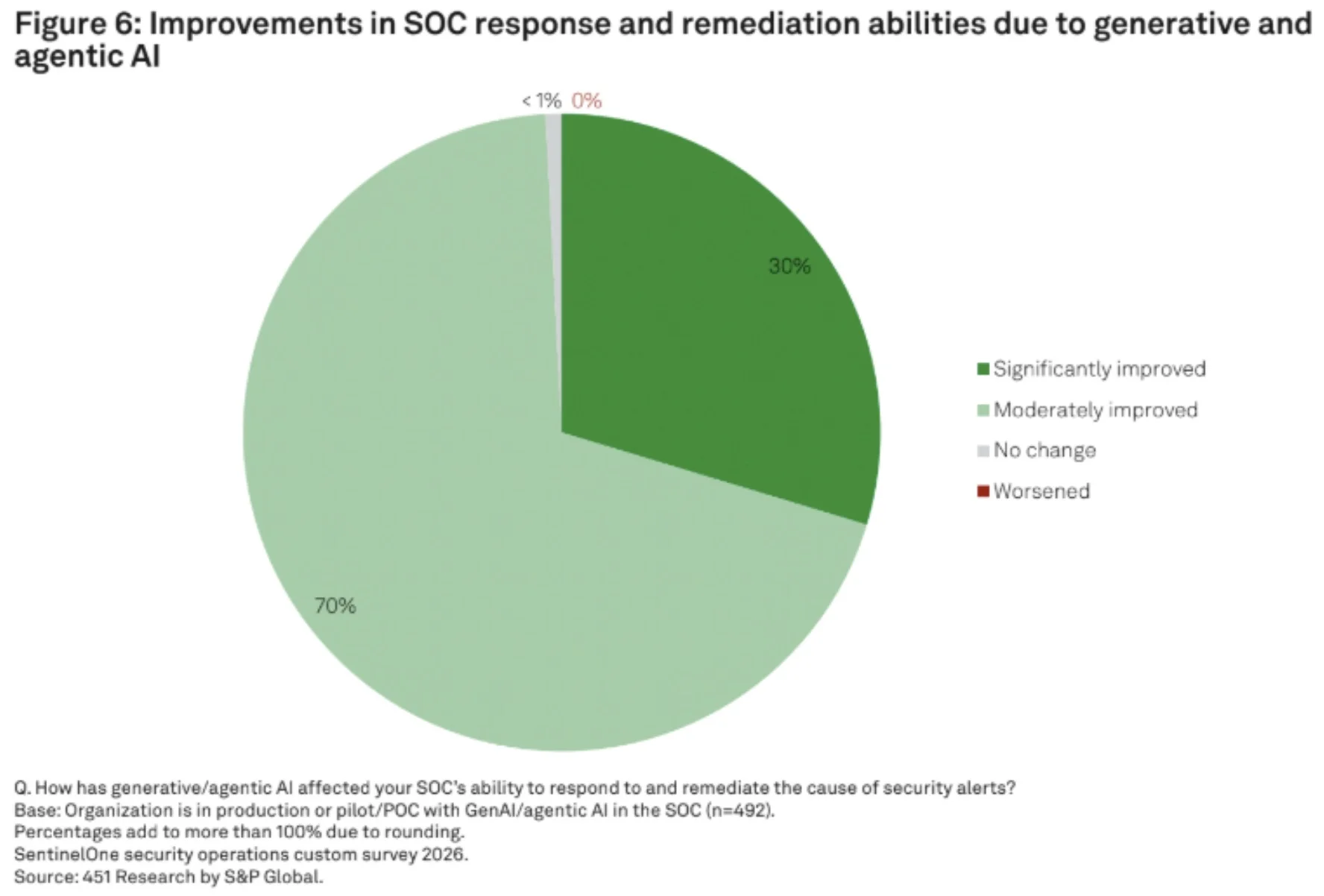
By most measures, AI adoption in the SOC is still early. And yet, 99% of those same organizations already report improvements in incident response and remediation.
The numbers are consistent. Early-stage AI (chatbots handling initial alert triage, automated tools sorting true positives from noise) is delivering before organizations reach advanced maturity. The gap between where most organizations are and what they are already getting is real and consistent across survey respondents.
Organizations waiting for higher AI maturity before building the supporting infrastructure are running the sequence backward. The returns are available now. The foundation built today determines how far those returns scale.
Platformization Has Reached A Verdict
The organizations accelerating AI adoption are also the ones consolidating onto platforms. A platform-oriented security architecture means moving from siloed, specialized tools to an integrated stack built on a foundation that coordinated AI decision-making can actually run on, and one that lets each new capability compound on the last.
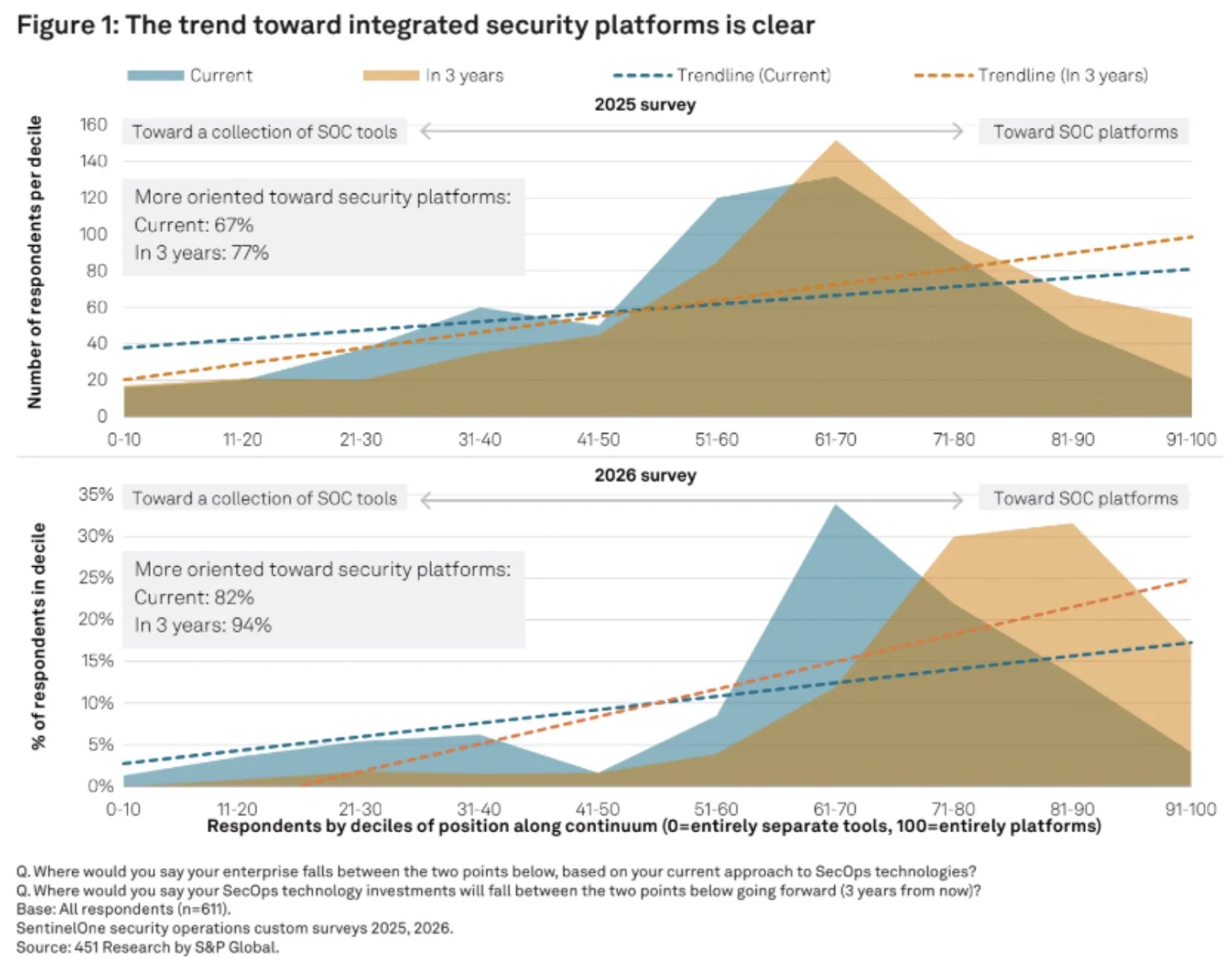
The platformization numbers from this year’s survey are clear. 82% of organizations describe themselves as platform-oriented, a 13-point jump in a single year, and 94% expect to be there within three years.
A common assumption is that platform adoption means replacing specialized tools. The data complicates that picture. The same technologies most frequently deployed as standalone tools (EDR, SIEM, CNAPP) are also the top anchors for integrated platforms. Organizations typically start with one of these and expand outward. What changes is the common data layer that enables coordinated AI decision-making, serving as the connective tissue underneath.
Platformization is not coincidental with AI’s emergence. Agentic AI needs connected, continuously updated data to accurately reason across signals and take autonomous action. Fragmented architectures, where telemetry is siloed and pipelines require manual effort, cannot support AI-driven SOC operations at scale. Platform adoption and AI adoption are converging because AI’s data requirements have made integration a structural necessity.
The survey makes the infrastructure connection an explicit one. The top-cited benefit of investing in a data lake for SecOps is supporting AI-driven SOC workloads and agents. Organizations that built the data foundation early have already cleared the barrier stalling others. Those who haven’t, face a prerequisite gap, and the distance is widening rapidly. Architectural readiness is the variable that determines how far AI investments can scale.
Job Satisfaction Is Rising
Every discussion of AI in the SOC centers on detection and response metrics. This report has those too, but there is a finding that security leaders managing attrition should weigh: analyst burnout is declining.
As AI handles repetitive, high-volume triage work, analysts report rising job satisfaction. The role is shifting away from processing an endless queue and toward investigation, threat hunting, and judgment-intensive work. In a market where SOC analyst turnover remains a persistent operational cost, that shift carries real dollar value.
The analyst role evolves, becoming more strategic and more consequential.
A New Attack Surface
The same AI systems changing how SOCs operate are also creating new targets. Adversaries are already probing AI infrastructure including agents, data pipelines, model endpoints, and the governance gaps that emerge when controls lag behind adoption. The report surfaces this tension clearly: Organizations are deploying AI faster than they are securing it.
An AI agent with misconfigured access or an unmonitored data pipeline is an exposure. Securing the AI infrastructure that powers the SOC is happening alongside deployment, whether organizations have planned for it or not. Those without a clear governance posture are accepting risk that may not be priced into their AI investment case.
The potential of GenAI and agentic AI in the SOC is already being realized. The organizations that capture it fully are those building governance alongside deployment. The platform that runs the Autonomous SOC and the platform that secures it are, increasingly, the same platform.
SentinelOne’s Vision: The Autonomous SOC
Everything the report surfaces, from AI returns arriving before maturity to platform consolidation to the improving analyst experience, points to how these are expressions of the same shift. The foundation that enables early AI returns is the same one that determines how far those returns scale, how capable analysts become, and how well the security of AI itself is governed.
The findings align with how SentinelOne has defined the path to autonomous security operations: A progression from AI-assisted triage at early maturity levels to increasingly autonomous investigation, threat hunting, and response, with humans in strategic and governing roles. The report validates that the market is moving through exactly that sequence. Organizations that understand the architecture behind it (the platform integration, the common data layer, the governance controls) are positioning themselves to capture returns at every stage rather than waiting for the destination.
The full 451 Research report goes further into detail, covering what progression looks like at each maturity level, the specific barriers organizations are encountering, and the data behind each finding in full.
All third-party product names, logos, and brands mentioned in this publication are the property of their respective owners and are for identification purposes only. Use of these names, logos, and brands does not imply affiliation, endorsement, sponsorship, or association with the third party.
This blog may include discussion of unreleased services or features. Any unreleased services or features referenced here are still in development and subject to change. Customers should make their purchase decisions based upon features that are currently available.
The security industry spent the last decade solving detection. Endpoint. Cloud Workloads. Identities. AI. We built better models. We moved beyond signatures. We reduced false positives. We got the alert into the right queue. Then, we discovered the harder problem had been waiting behind it.
The constraint in every SOC today is not detection. It’s investigation capacity. Security teams are generating more critical alerts than any staffing plan can possibly accommodate. The queue grows. Triage wai
The security industry spent the last decade solving detection. Endpoint. Cloud Workloads. Identities. AI. We built better models. We moved beyond signatures. We reduced false positives. We got the alert into the right queue. Then, we discovered the harder problem had been waiting behind it.
The constraint in every SOC today is not detection. It’s investigation capacity. Security teams are generating more critical alerts than any staffing plan can possibly accommodate. The queue grows. Triage waits on analyst availability. Coverage drops on nights, weekends, and surges, exactly when adversaries know to move.
Frontier AI is about to make this exponentially worse. The same models reshaping every industry are being weaponized to chain hidden gaps and vulnerabilities, accelerate attacks, and compress attacker timelines. Investigation cannot stay a human-paced or human-scaled activity. If it does, defenders lose. We built Purple AI® to change that.
Every Alert. Investigated. Now.
Starting today, we’re opening up Purple AI Agentic Investigation to all new and existing SentinelOne® EDR customers. In the Singularity console. Activated with a single click.
The moment a new EDR alert is flagged Critical and Malicious, Purple AI acts, using flags you can trust. It is the output of over a decade of AI and ML models running natively at the edge, from behavioral analysis to real-time threat intelligence. Purple AI investigates signal vs. noise.
It collects evidence. It correlates telemetry across endpoint, identity, cloud, and third-party data. It builds the attack timeline and delivers a verdict: True Positive, False Positive, or Unknown. The complete evidence chain arrives with it before an analyst opens the console. We call it ‘zero-click’ investigation: Automated trigger, zero wait, coverage gaps closed.
Open the Alerts view, and you see it live: Purple AI retrieving context, running threat hunts, querying host telemetry, building the investigation in real time. Then, the verdict lands, supported and traceable, ready for a decision. This is investigation at machine speed. Continuous. At scale. Integrated into existing workflows.
The Native Platform Advantage
Purple AI investigates at this depth because it operates natively on the Singularity Platform. Zero integrations required. Where your team already works. Where your security data already lives.
Bolt-on AI tools layered onto other platforms start from a disadvantaged position. They require connectors, data mapping, and integrations before they can reason. Purple AI reasons directly on telemetry already in Singularity: endpoint, identity, cloud, and third-party data in the Singularity Data Lake. Nothing to configure. One click to activate.
The intelligence is distinct. Purple AI takes a multi-model approach that keeps customers at the edge of frontier AI reasoning capability. Models from leading frontier providers like Anthropic (Claude) and OpenAI (GPT) are part of that architecture. So is SentinelOne’s own Ultraviolet family of models, purpose-built on petabytes of real security telemetry and trained for SOC investigation reasoning. Here, frontier AI reasoning combines with Autonomous Security Intelligence.
Autonomy With Accountability
Agentic AI without defined limits and guardrails is a liability. As an AI-first company, we get that. So we built the limits first. Investigations run autonomously. Response stays on your terms. You decide your human-in-the-loop comfort zone.
Every verdict connects to one-click or policy-driven response actions in Singularity, including governed automated execution through Hyperautomation, SentinelOne’s workflow automation layer. Nothing fires outside the guardrails your team defines. Activation is admin-controlled and reversible at any time. Access is role-based. Every verdict carries a complete, auditable evidence chain. We’ve eliminated black-box decisions. Your analysts can see and review every AI step. The agentic SOC keeps humans in control of what happens next, by design.
What Customers Are Doing With It
Purple AI customers are already seeing the shift. Agentic Investigation is built to extend it further.
“By using Purple AI, we’re saving between 40% and 50% of the time to investigate incidents, allowing us to respond much quicker. It gives us readily available information on alerts — which systems, which users, and why they may be malicious,” said Rod Goldsmith, Cybersecurity Leader at YKK Americas.
“Purple AI really increases our efficiency. It allows users to search logs quickly without knowing any query languages and get answers faster, reducing our Mean Time to Respond,” said John McLeod, CISO at NOV Inc.
“SentinelOne helps us with our incident response process tenfold. We have so many options, from automation to using Purple AI, to give my analysts more confidence in their abilities,” said Zack Moody at KYOCERA AVX.
AI designed to give human defenders a decisive operating advantage. The machine removes the ceiling on what humans can cover.
Singularity Credits
Alongside Agentic Investigation, we are introducing Singularity Credits: a new unified currency for AI-powered workflows across the Singularity Platform. AI should be accessible. Utilization should be visible. Spending stays in the hands of those who set the limits. Credits are built around all three.
Every eligible SentinelOne customer gets free access starting this week. No payment method required. After the trial, Credits are available through partners, direct billing, and eCommerce channels. The balance is visible in real time. Built-in spending controls keep consumption bounded.
Agentic SOC, Autonomous SOC, AI SOC, ISOC: Call it what you want. Just don’t call it a roadmap item.
What we are delivering today is real, accessible and, for the next couple of months, complimentary. It is the agentic SOC in operation. GA, now. Critical alerts automatically investigated. Verdicts autonomously reached. Workflows automatically triggered. Governed authorization. Responses that execute within the policies your team controls and human-in-the-loop gates that your team decides.
The industry has called this many things: The Autonomous SOC, the Agentic SOC, the AI SOC. Gartner now has a name for this model: the Integrated Security Operations Center. Modern threat detection, investigation, and response as a single, continuous, AI-driven loop vs. the historic siloed functions and tool sprawl. More than solving alert fatigue, the new model has the potential to solve the investigation capacity gap and shrink MTTR to a scale and speed that cybersecurity will require in the frontier AI era. At SentinelOne, we have been building for this moment for years.
Investigation capacity should never again be the reason a critical alert goes unexamined. Frontier AI belongs where the data and the analysts already are: In the console, in the workflow, governed by the human customer. We put it there.
Activate Purple AI Agentic Investigation in your Singularity console or visit s1.ai/agentic.
Why Most AI SOC Deployments Stall. How the Fastest Teams Don't.
Join the webinar on Wednesday, June 24, 2026 at 10:00AM PT/ 1:00PM ET.
All third-party product names, logos, and brands mentioned in this publication are the property of their respective owners and are for identification purposes only. Use of these names, logos, and brands does not imply affiliation, endorsement, sponsorship, or association with the third-party.
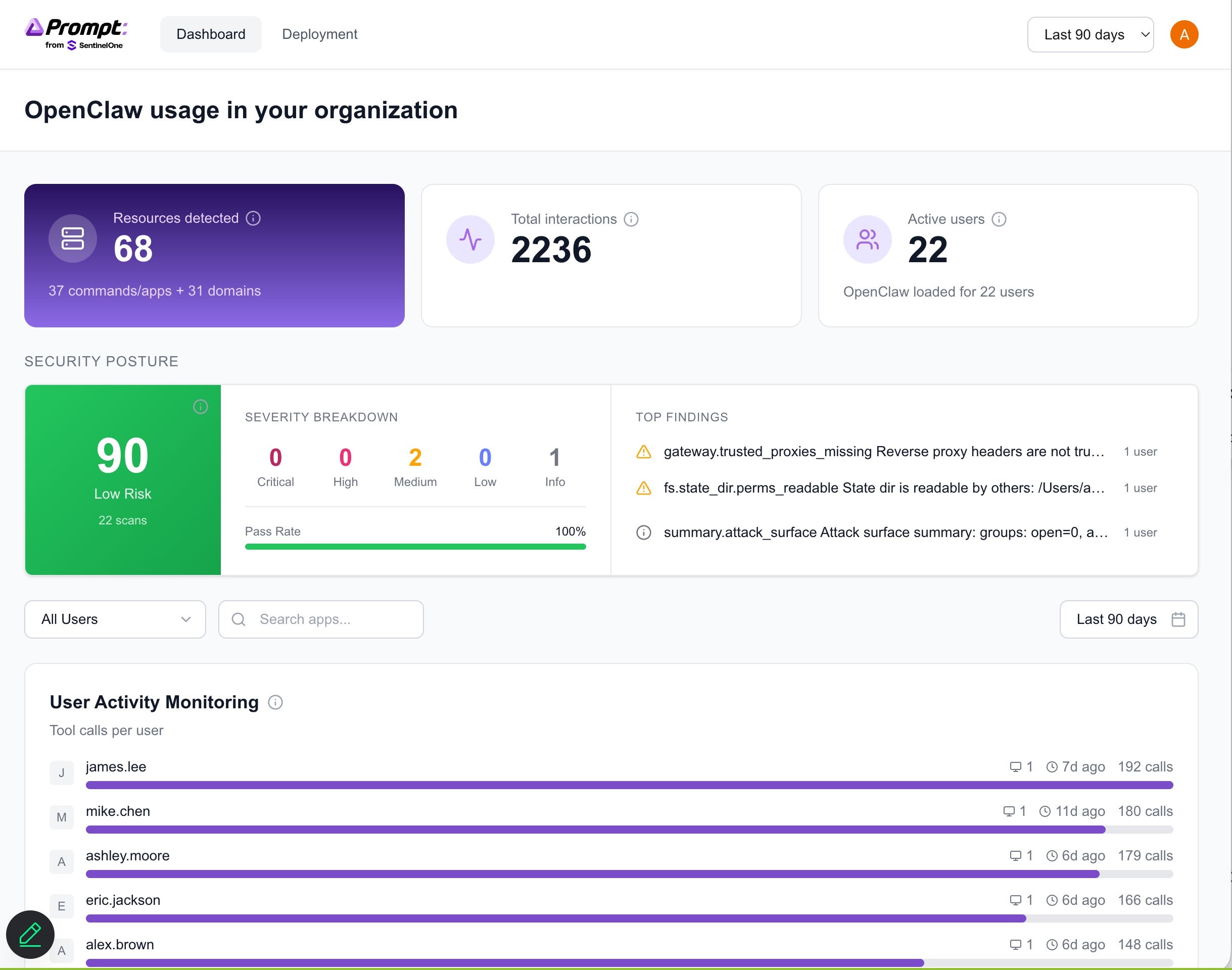
Enterprise adoption of Claude across teams, workflows, and business functions is happening at a pace unlike virtually any technology before it. While the innovation opportunity is obvious, so are many of the risks. From the exposure of sensitive data and secrets through shadow IT to new attack vectors like prompt injection, security teams need the visibility, governance, and response capabilities to ensure AI innovation is done safely and securely.
SentinelOne® helps organizations comprehensivel
Enterprise adoption of Claude across teams, workflows, and business functions is happening at a pace unlike virtually any technology before it. While the innovation opportunity is obvious, so are many of the risks. From the exposure of sensitive data and secrets through shadow IT to new attack vectors like prompt injection, security teams need the visibility, governance, and response capabilities to ensure AI innovation is done safely and securely.
SentinelOne® helps organizations comprehensively secure Claude adoption by bringing AI usage directly into the security platforms teams already rely on. This helps protect the entire ecosystem from the underlying infrastructure to the application layer and end-user interactions. By bringing together SentinelOne and Claude, security teams can apply policies to user prompts, ingest Claude activity into the SingularityAI SIEM for investigation, and utilize frontier AI-powered services to identify real-world risks before attackers can exploit them.
Govern, Detect & Secure with SentinelOne’s Anthropic Compliance API Integrations
Security and compliance platforms utilize the Claude Compliance API to help organizations monitor AI activity within their existing tools. SentinelOne provides purpose-built Claude Compliance API integrations for its Prompt Security and Singularity AI SIEM offerings.
Prompt Security Integration
Scan AI prompts and responses against enterprise policies to flag violations without requiring a browser extension or endpoint agent. This agentless approach helps organizations extend their security coverage to unmanaged devices and external environments. Prompt Security enforces safe use by blocking high-risk prompts and preventing data leakage in real time. Additionally, the platform provides continuous risk assessment for agentic AI by securing Model Context Protocol (MCP) gateway connections between AI applications and known MCP servers.
Singularity AI SIEM Integration
Ingest audit and activity data directly from Claude rather than treating AI interactions as isolated events. With the integration, security operations center (SOC) teams can correlate Claude activity against existing security telemetry. This allows analysts to incorporate AI usage data into their broader security workflows and improve investigation, detection, and response across all their attack surfaces.
AI Visibility to AI-Ready Defense with Wayfinder Frontier AI Services
The partnership between SentinelOne and Anthropic extends beyond the Compliance API. SentinelOne has been a participating member in Anthropic’s Project Glasswing and has had early access to Anthropic’s most capable Mythos-class models. By continuously testing these models against real-world security workflows, SentinelOne helps ensure defenses keep pace with the modern adversary. Additionally, SentinelOne recently announced Wayfinder Frontier AI Services, a managed offering that pairs elite human security experts with frontier models, including Anthropic’s Claude Security.
Frontier AI is changing vulnerability discovery, giving both defenders and attackers the advantage of speed and scale. However, raw vulnerability counts rarely map cleanly to real-world risk, as many theoretical exposures are mitigated by existing architectural controls. Wayfinder Frontier AI Services evaluates findings against actual environmental context to deliver an exploitability-grounded prioritization. Instead of treating vulnerabilities in isolation, the service maps how exposures connect into end-to-end attack paths.
The Frontier AI models then provide targeted remediation guidance, including architectural changes or identity controls, designed to break the exploitation chain where it costs the adversary the most. With the service providing a continuous human-and-AI partnership across endpoint, cloud, identity, data, and AI attack surfaces, Frontier AI ensures that organizational security posture remains current as models and threats evolve.
Why SentinelOne is Built for the AI Security Era
SentinelOne operates from a clear conviction: A safer future for humanity and to give the advantage to those who secure our future. That conviction is what drives how SentinelOne approaches AI security — not as an isolated capability, but as part of the autonomous platform, expert services, and SOC workflows that defenders already use. SentinelOne has collaborated with frontier AI labs for years, including Anthropic, OpenAI, and Google DeepMind. These partnerships inform the capabilities embedded across the SentinelOne platform.
Operating at machine speed is necessary to counter modern threats, rather than relying strictly on manual triage. Over the past quarter, the SentinelOne Singularity Platform autonomously blocked novel zero-day and supply-chain attacks against widely used components, such as LiteLLM, Axios, and CPU-Z. Wayfinder Frontier AI Services takes this operational model further left in the security lifecycle to discover exposures before attackers can leverage them. This multi-model foundation reflects the understanding that no single AI model is the definitive answer for cybersecurity; the advantage belongs to defenders who can orchestrate the right intelligence and validate outputs with human expertise.
This is how SentinelOne enables business growth and innovation safely, giving security teams the ability to say yes to AI adoption while maintaining full control of the risk surface. Stronger protection with fewer incidents and less operational overhead.
Learn More
Ready to adopt Claude safely across your organization? Connect with SentinelOne to learn how Prompt Security, Singularity AI SIEM, and Wayfinder Frontier AI Services help security teams govern, monitor, and defend AI usage at enterprise scale.
For Claude governance and monitoring: Contact SentinelOne to learn about the Anthropic Compliance API integrations for Prompt Security and Singularity AI SIEM.
For proactive AI-driven exposure management: Learn more about Wayfinder Frontier AI Services.
For broader AI security: Request a demo of SentinelOne’s AI security capabilities.
Third-Party Trademark Disclaimer:
All third-party product names, logos, and brands mentioned in this publication are the property of their respective owners and are for identification purposes only. Use of these names, logos, and brands does not imply affiliation, endorsement, sponsorship, or association with the third-party.
Agentic AI is no longer theoretical. It’s already embedded across enterprises inside developer workflows, SaaS platforms, and operational pipelines. It is executing tasks, chaining actions, and interacting with critical systems at machine speed.
What makes this shift different from previous waves of automation is not just capability, it’s autonomy. These systems don’t wait for step-by-step human instruction. They interpret goals, break them into subtasks, and execute independently across tools,
Agentic AI is no longer theoretical. It’s already embedded across enterprises inside developer workflows, SaaS platforms, and operational pipelines. It is executing tasks, chaining actions, and interacting with critical systems at machine speed.
What makes this shift different from previous waves of automation is not just capability, it’s autonomy. These systems don’t wait for step-by-step human instruction. They interpret goals, break them into subtasks, and execute independently across tools, data, and environments. That autonomy is powerful, however it’s also introducing a new class of security challenges that traditional controls were never designed to handle.
Most organizations today lack visibility into where agents are running, what they can access, and what actions they’re taking. Even fewer have the ability to enforce policy or intervene in real time. As a result, agent adoption is accelerating faster than the security models required to govern it.
To adopt agentic AI safely, SentinelOne® is helping organizations rethink security from the ground up starting with how agents behave, what they can reach, and how their actions are controlled. The newly released Prompt for Agentic AI Security enables organizations to move from reactive oversight to proactive governance, meaning teams can deploy agents with confidence.
When AI Doesn’t Just Respond—It Acts
Agentic AI interactions have a technical distinction that fundamentally changes the security equation. Unlike traditional AI systems that generate outputs in response to prompts, agents are designed to execute. They receive a goal, decompose it into subtasks, and carry out actions across systems, often without per-step human approval. They hold credentials, make API calls, modify data, and interact with business-critical platforms in real time.
They can read files, execute code, send messages, and trigger workflows—all autonomously. This shift from “response” to “execution” introduces three distinct categories of risk.
1. Construction-Time Risk: How Agents Are Built
Many risks are introduced before an agent ever runs. Agents are often deployed with overly permissive IAM roles, granting access far beyond what their tasks require. They rely on third-party skills and plugins pulled from public repositories, creating a new supply chain surface with little verification. In many cases, API keys and secrets are hardcoded directly into configurations, making compromise trivial. At this stage, the issue is not behavior, it’s exposure.
2. Runtime Risk: What Happens When Agents Execute
Once deployed, agents introduce dynamic, real-time risks that traditional controls struggle to detect. Prompt injection attacks can manipulate agent behavior in ways that trigger real-world actions and not just incorrect outputs. A malicious instruction embedded in a document can become an execution command. Agents may also chain together individually authorized actions that, in sequence, produce unauthorized outcomes. Data exfiltration can occur through legitimate-looking API calls as part of “completing a task”. At runtime, the line between intended behavior and malicious activity becomes blurred.
3. Operational Risk: The Gaps Around the System
Even when risks are understood, most organizations lack the operational controls to respond effectively. There is often no kill switch to stop a misbehaving agent in seconds. No rollback capability to recover from corrupted data. No audit trail to reconstruct what an agent actually did. And no incident response playbook designed for machine-speed, autonomous actions. These gaps compound the risks introduced at every other stage.
From Blind Trust to Verified Control: The Evolution of Agent Security
As autonomous agents continue to move quickly from experimental tools to core infrastructure, security has lagged behind. Most frameworks still operate on implicit trust: trust in downloaded skills, trust in evolving prompts, and trust that agents will behave safely despite increasing autonomy. That assumption is already proving flawed.
Recent discoveries of hundreds of malicious agent skills circulating through public repositories highlight how easily these ecosystems can be exploited. Disguised as legitimate utilities, these components harvested credentials, secrets, and sensitive data at scale. This is a structural problem. Since agentic systems are dynamic by design, they pull external dependencies, adapt behavior over time, and execute across systems with minimal oversight. Traditional security models were not built for this.
Introducing Prompt for Agentic AI Security
Now, AI agents are already operating inside your organization—reading files, calling APIs, and chaining actions across critical systems without human approval at every step. They are non-human identities that reason, decide, and execute at machine speed.
Prompt for Agentic AI Security is SentinelOne’s agent security layer. This first phase provides real-time discovery and governance control plane designed specifically for this new reality as well as a full visibility Model Context Protocol (MCP) server across your environment, along with the ability to assess risk, enforce policy, and remediate automatically before unauthorized actions occur.
Unauthorized actions can be stopped at the moment they occur, not after damage is done. As agent adoption grows, organizations gain a centralized control plane to manage sprawl and maintain compliance. Most importantly, security becomes an enabler of speed rather than a barrier to it.
The following capabilities will be available as part of the first phase of this release. Starting with MCP, the protocol powering the rise of agentic AI.
MCP Discovery and Governance: surface every MCP server in your environment, sanctioned or shadow
Risk-Based Enforcement: assess and score each server’s threat profile before agents act
Runtime Prompt Injection Blocking: inspect tool calls and agent interactions in real time, stopping attacks at the moment of execution
Malicious Server Prevention: identify and block malicious MCP servers from operating in your environment
How to Adopt AI Agents Safely: A 90-Day Plan
Adopting agentic AI safely requires structure. A practical approach is to move in phases: first gaining visibility, then enforcing guardrails, and finally building operational capability.
Days 1–30: Discovery and Inventory
Start by understanding what exists. Audit browser extensions, analyze network traffic to known AI services, and review OAuth grants for third-party integrations. These steps provide an initial baseline, but they won’t capture everything.
Deploy Prompt for Agentic AI Security to automatically discover MCP activity, including shadow deployments, local processes, and embedded agents inside developer tools.
Map not just what agents exist, but what they’re connected to. Identify which systems they can access, what permissions they hold, and what actions they can take.
Prioritize agents based on risk—those with access to production systems or sensitive data should be investigated first.
The goal: A live, risk-scored inventory of every agent and its blast radius.
Days 31–60: Guardrails and Control
Next, enforce boundaries. Route agent interactions through controlled pathways like an MCP gateway to inspect and enforce policies in real time.
Configure allow/block rules based on user, agent, and action type to enforce least privilege.
Enable content inspection to prevent sensitive data from entering execution pipelines. At the same time, provide sanctioned tools and frameworks so teams have secure alternatives.
Establish a clear, simple acceptable use policy for agents—covering approved tools, prohibited data, and escalation paths.
The goal: Real-time enforcement and safe pathways for adoption.
Days 61–90: Operational Readiness
Finally, build the ability to respond. Integrate agent telemetry into SOC workflows and establish behavioral baselines.
Use enforcement controls as a kill switch to stop anomalous activity instantly.
Run tabletop exercises to test detection, containment, and recovery. Ensure teams can answer “what did this agent do?” in seconds—not days.
Document an AI-specific incident response playbook and establish continuous review of agent permissions using dynamic risk scoring.
The goal: Full operational capability to manage agent-related incidents.
Conclusion
Agentic AI is not slowing down. The organizations that succeed won’t be the ones that moved fastest or blocked adoption entirely—they’ll be the ones that built the visibility, control, and response capabilities to adopt it safely. The path forward is clear: See every agent, understand what it can reach, enforce what it’s allowed to do, and maintain a complete record of its actions. This is the governance layer agentic AI demands.
The new release of Prompt for Agentic AI Security brings it all together as an enterprise control plane by combining real-time discovery, dynamic risk scoring, policy enforcement, and full auditability at machine speed. Security isn’t the reason your organization can’t adopt agents, it’s how you adopt them with confidence.
All third-party product names, logos, and brands mentioned in this publication are the property of their respective owners and are for identification purposes only. Use of these names, logos, and brands does not imply affiliation, endorsement, sponsorship, or association with the third party.
This publication includes forward-looking statements, including, but not limited to, statements concerning the expected timing of product and feature availability, the benefits and capabilities of our current and future products and services, competition and our competitive position, our strategic plans and objectives, and general market trends. Forward-looking statements are subject to risks and uncertainties, including factors beyond our control, that could cause actual performance or results to differ materially from those expressed in or suggested by the forward-looking statements. These and other risk factors are described in the “Risk Factors” section of our most recent Annual Report on Form 10-K, subsequently quarterly reports filed on Form 10-Q, and other filings made with the U.S. Securities and Exchange Commission (SEC), which are available free of charge on our website at http://investors.SentinelOne.com and on the SEC’s website at www.sec.gov.
You are cautioned not to place undue reliance on these forward-looking statements. Any future products, functionality and services may be abandoned or delayed, and as such, you should make decisions to purchase products and services based on features that are currently available.
Any forward-looking statements made in this publication are based on our beliefs and assumptions that we believe to be reasonable as of the date hereof. You should not rely upon forward-looking statements as predictions of future events. Except to the extent required by law, we undertake no obligation to update these forward-looking statements to reflect new information or future events.
In 2025, the enterprise risk landscape experienced a paradigm shift: the adoption of AI and LLMs officially becoming the primary driver of cloud risk. Today, almost 88% of organizations now leverage AI in at least one business function. With this level of integration, the risk of AI is now outpacing traditional security guardrails, culminating in a highly complex and interconnected attack surface.
SentinelOne’s® new AI and Cloud Verified Exploit Paths and Secrets Scanning Report examines this ev
In 2025, the enterprise risk landscape experienced a paradigm shift: the adoption of AI and LLMs officially becoming the primary driver of cloud risk. Today, almost 88% of organizations now leverage AI in at least one business function. With this level of integration, the risk of AI is now outpacing traditional security guardrails, culminating in a highly complex and interconnected attack surface.
SentinelOne’s® new AI and Cloud Verified Exploit Paths and Secrets Scanning Report examines this evolving threatscape and draws on telemetry from over 11,000 anonymized customer environments to offer deeper visibility into how threat actors are actively exploiting modern cloud and AI infrastructures.
An Explosion of AI-Specific Secrets and Shadow AI
A primary finding of the 2026 report is the rising proliferation of AI-specific credentials. The data indicates that AI-related secrets — such as OpenAI API Keys, Azure OpenAI API Keys, and others — increased by approximately 140% in a span of one year. This growth correlates directly with the rapid embedding of AI technologies into customer support systems, internal tooling, financial platforms, and product experiences.
Ubiquitous deployment has generated a widespread organizational pattern known as “shadow AI” – the unsanctioned use of AI tools in an environment without formal IT approval or security oversight. In practice, this occurs when developers or internal teams utilize unmanaged or personal LLM keys to process corporate data outside of sanctioned IT or security channels. Since these AI integrations span numerous internal applications, the same API keys are frequently duplicated and stored within code repositories, SaaS configurations, and development scripts. Compounding this, these credentials are often implemented without proper access controls or routine rotation schedules.
The sprawl of these credentials renders them difficult to track via standard secrets management protocols, establishing a requirement for more centralized governance over how AI keys are issued and utilized.
Distinct Risk Vectors of Unmanaged AI Credentials
Unlike traditional cloud credentials that primarily facilitate resource manipulation, the compromise of AI keys introduces unique risk vectors. AI services frequently operate at the intersection of various enterprise systems, including CRM platforms, ticketing systems, and analytics tools, which means a single compromised LLM API key can provide an attacker with broad visibility into diverse datasets. The risks associated are categorized with exposed AI keys into two primary areas:
Data exposure and leakage: Unauthorized access via AI keys can expose sensitive or proprietary datasets processed by the models, embedded business logic, and internal user prompts and outputs. This enables attackers to harvest sensitive corporate conversations at scale.
Prompt injection and data poisoning: Unmanaged AI keys allow threat actors to actively manipulate AI models. Through prompt injection, an attacker can influence model behavior to exfiltrate data or bypass established security controls. Additionally, attackers can execute data poisoning by injecting misleading or malicious data into contextual corpora or fine-tuning datasets, which degrades the model’s integrity and reliability over time.
The Broadening Scope of Traditional Cloud Secrets
While AI credentials represent a novel attack surface, the traditional cloud secrets landscape has concurrently grown more complex. In 2025, organizations exposed approximately twice as many types of critical secrets as they did in 2024. This diversification spans AI platforms, cloud providers, SaaS services, and payment processors, pointing to how a single compromise can result in a broader blast radius across revenue-generating systems and infrastructure.
High-privilege cloud provider keys associated with AWS, Azure, and GCP remain the primary anchor of critical risk. The exposure of these keys can facilitate complete account takeover, infrastructure manipulation, and large-scale data exfiltration. As well, the exposure of payment gateway keys, such as those for Stripe and Razorpay, expands the potential damage by putting Personally Identifiable Information (PII) and financial data at risk, enabling the direct abuse of payment workflows.
Repository and CI/CD tokens also introduce supply chain risks, where high-severity credentials like a GITHUB_TOKEN can grant attackers direct access to deployment pipelines and source code, allowing a localized leak to escalate into a systemic infrastructure incident. From a collective standpoint, secrets exposure is exponentially spanning payments, coding, and software development workflows, making risk an interconnected and complex challenge.
Verified Exploit Paths: The Persistence of Legacy Vulnerabilities
To evaluate how these exposed secrets translate into practical risks, the SentinelOne researchers leveraged the Offensive Security Engine (OSE) to generate Verified Exploit Paths. This technology analyzes misconfigurations, vulnerabilities, and exposed secrets in context to determine realistic exploitability.
The telemetry demonstrates that attackers generally do not rely on highly complex, theoretical attack chains. Instead, threat actors consistently exploit recurring entry points, specifically targeting misconfigured external services and widely abused Common Vulnerabilities and Exposures (CVEs). Notably, legacy vulnerabilities remain highly prevalent across customer environments and serve as reliable initial access points. The top verified exploit paths continue to involve older, critical CVEs, including:
Since these vulnerabilities are public and well-documented, threat actors possess proven techniques and automated tooling to exploit them whenever they persist in production environments. Once initial access is achieved through these legacy vulnerabilities, attackers routinely follow reachable secrets to pivot into additional services, such as utilizing an exposed key found in a cloud bucket to access an AI assistant, and subsequently, the customer data it processes.
Strategic Recommendations for Security Leaders
Addressing the interconnected risks of AI integration and cloud secrets requires a structured, objective approach to security architecture. The report outlines several concrete capabilities and practices including:
Continuous Surface Monitoring: Organizations must regularly inventory internet-facing assets, databases, and key cloud services, ensuring any configuration changes are immediately reflected in security posture assessments.
DevSecOps Automation: Security controls must be embedded directly into CI/CD pipelines and developer workflows. Organizations should automate the scanning of exposed secrets and trigger safe remediation actions, such as access revocation or key rotation.
Governance of AI Credentials: AI keys must be classified and treated as high-value credentials. Organizations should mandate the use of centrally managed AI keys rather than personal credentials, enforce least-privilege access, implement regular rotation schedules, and continuously monitor for shadow AI usage or abnormal access patterns.
Conclusion
As AI systems are increasingly built atop existing cloud, payment, and CI/CD platforms, weaknesses in traditional credentials inevitably become weaknesses in the AI infrastructures that rely upon them. The full report provides complete datasets and comprehensive exploit path models allowing today’s security teams to align their internal security policies with the realities of current threat actor behaviors. Learn more about the objective metrics behind the latest wave of credential exposure and vulnerability exploitation to establish more resilient and fully-controlled infrastructure architectures.
Third-Party Trademark Disclaimer:
All third-party product names, logos, and brands mentioned in this publication are the property of their respective owners and are for identification purposes only. Use of these names, logos, and brands does not imply affiliation, endorsement, sponsorship, or association with the third-party.
Expose the AI & Cloud Secrets That Put Your Data & Systems at Risk
This report draws on 11K+ customer environments. It shows how AI and cloud adoption are increasing secrets exposure and putting data at risk.
In our previous posts, we explored the Identity Paradox and the rising risks at the enterprise edge. Together, these blogs highlighted how attackers gain initial access and leverage unmanaged devices to escalate privileges. The next phase of intrusion – execution – demonstrates how modern adversaries, aided by automation and AI, operate at speeds and a scale that challenge traditional human-centered defenses. Understanding these capabilities is critical for organizations aiming to reduce attacke
In our previous posts, we explored the Identity Paradox and the rising risks at the enterprise edge. Together, these blogs highlighted how attackers gain initial access and leverage unmanaged devices to escalate privileges. The next phase of intrusion – execution – demonstrates how modern adversaries, aided by automation and AI, operate at speeds and a scale that challenge traditional human-centered defenses. Understanding these capabilities is critical for organizations aiming to reduce attacker dwell time and maintain operational resilience.
Automation: The Real Machine Multiplier
The cybersecurity conversation today often centers on AI, with organizations experimenting with generative models, agentic systems, and predictive analytics. While these tools offer unique capabilities, the backbone of modern defense and the source of the real operational advantage is automation.
In today’s landscape where we are seeing a shrinking window for response, adversaries are operating almost entirely at machine speed. In this environment, human operators alone cannot respond fast enough to prevent compromise. Automation enables defenders to reclaim the tempo. By integrating AI insights into hardened automated workflows, security teams can move from reactive triage to proactive intervention, closing gaps before attackers can exploit them. SentinelOne’s® own internal data demonstrates the tangible impact of this shift, showing that proper automation can save analysts approximately 35% manual workload despite 63% growth in total alerts, proving that automation can increase operational speed.
AI as Insight, Not Just Hype
The irony of AI innovation in the last year is that the AI tools we deploy to defend ourselves now need defending. The attack surface didn’t just grow, it folded back on itself. Automation executes tasks at speed, but AI provides context and predictive intelligence that guides those tasks. AI for security encompasses two complementary disciplines:
Security for AI: Protecting AI tools, models, and agentic systems themselves from misuse or compromise. This includes governing employee access, ensuring secure coding practices, and managing autonomous AI agents.
AI for Security: Leveraging machine learning and reasoning systems to detect and respond to threats faster than traditional rule-based approaches.
AI excels in identifying subtle behavioral patterns, predicting attacker intent, and supporting agentic workflows that can autonomously investigate alerts, recommend actions, and enforce pre-approved policies. By combining high-quality data, low-latency telemetry, and centralized visibility, AI transforms raw signals from endpoints, cloud environments, and identity systems into actionable insights.
However, AI is not a panacea. Without robust automation to operationalize these insights, organizations risk generating alerts faster than they can respond, replicating the same bottlenecks that have plagued traditional security operations.
Threats Accelerated by Automation and AI
Attackers are leveraging the same principles. Across campaigns observed in 2025 and 2026, adversaries are increasingly automating reconnaissance, exploitation, and lateral movement. Examples include:
AI-assisted phishing: Rapid generation of highly localized and convincing campaigns in minutes, bypassing traditional content filters.
Polymorphic malware: AI-generated malware that mutates faster than signature-based defenses can detect.
Automated pivoting: Integration with compromised edge devices or cloud assets to move laterally and escalate privileges at machine speed.
These behaviors compress the attack lifecycle dramatically. What once required hours or days now occurs in milliseconds, highlighting why both automation and AI must form the core of modern defensive strategies.
Transforming Enterprise Operations with Agentic AI
Defending against machine-speed attacks requires agentic AI – systems that can perform investigative and response tasks autonomously, but under human-defined guardrails. SentinelOne’s Purple AI exemplifies this approach:
Agentic auto-investigations: From alert assessment to hypothesis validation, Purple AI can perform complete investigations with minimal human intervention, documenting every step for audit and compliance.
Custom detection creation: Analysts receive agentically recommended detection rules that can be implemented immediately to stop similar attacks before they spread.
Integrated hyperautomation: Workflows, alerts, and response actions are executed automatically across endpoints, cloud services, and AI systems, enabling coordinated defense at machine speed.
These capabilities bridge the gap between insight and action, ensuring that detection is accurate and response is rapid, precise, and auditable. As organizations adopt AI for business processes, security must evolve to address the expanding attack surface. Key challenges include:
Shadow AI adoption: Employees and teams using unmonitored AI tools create unseen channels for data exfiltration or misconfiguration.
Agentic AI risks: Autonomous agents acting without sufficient oversight could unintentionally expose sensitive data or introduce vulnerabilities.
Data velocity and volume: AI systems rely on vast, real-time data streams. Ensuring integrity, context, and governance of that data is critical to maintain trust in automated defenses.
Solutions must integrate visibility, control, and governance. SentinelOne’s Prompt Security portfolio provides real-time monitoring for employee AI use, AI coding tools, and agentic AI operations. By automatically redacting secrets, blocking vulnerable code, and enforcing policy compliance, organizations can safely harness AI while reducing exposure.
Meanwhile, Observo AI and AI-native SIEM integration enable organizations to ingest, normalize, and analyze petabytes of telemetry in near real time. By pairing this high-fidelity data with Purple AI’s agentic reasoning, defenders can detect threats, trigger pre-approved responses, and maintain operational oversight across both traditional and AI-native environments.
Operational Principles for Machine-Speed Defense
Implementing an effective AI- and automation-driven security strategy requires clear guiding principles:
Intelligence Over Rules: Move beyond static signatures to behavioral and predictive detection. Threats evolve faster than predefined rules; systems must continuously learn, reason, and adapt.
Autonomy with Accountability: Automation and agentic AI should operate at machine speed, but within human-defined guardrails, ensuring actions remain traceable, auditable, and aligned with policy.
Unified Data and Context: Signals from endpoints, identities, cloud, and AI tools must be fused to create a coherent understanding. Insight without context is noise; action without context is risk.
When consistently applied, these principles reduce dwell time, enable faster response, and ensure that human expertise is focused on high-value decision-making rather than repetitive manual tasks.
Conclusion | Automation & AI as Allies
For two decades, security has been a human-speed discipline applied to a machine-speed problem. That model is over. The organizations that will lead from here aren’t the ones with more analysts or better dashboards. They’re the ones where detection, investigation, and response happen autonomously. The future will be defined by organizations where human and AI manage the SOC together: AI reasons, automation acts, and humans govern the process. Not in sequence. In parallel. At machine speed.
Execution is no longer a phase in the kill chain. It’s the entire game. The defenders who win it won’t be the fastest responders. They’ll be the ones who made their response automatic.
The evolution of execution in cybersecurity demonstrates a broader trend: Defenders must match the speed, scale, and sophistication of adversaries. Not just tools, automation and AI are partners in defense and able to extend human capacity while maintaining oversight, context, and control.
Organizations that invest in integrated, agentic AI systems and robust automated workflows can detect and respond to attacks in real time, reduce analyst workload while increasing coverage, and secure AI adoption itself, maintaining trust in both technology and operations. This shift marks a transition from perimeter-based and manual defense to autonomous, adaptive security, where systems and people collaborate to outpace attackers, secure critical assets, and support business innovation.
Execution is the new frontier in the cyber kill chain. By combining automation, AI-driven insight, and human oversight, organizations can operate at machine speed, defend against advanced threats, and confidently embrace AI-powered transformation.
As the cybersecurity landscape evolves, success will no longer depend solely on faster patching, deeper monitoring, or more alerts. It will depend on the intelligent orchestration of people, machines, and AI, enabling defenders to act faster, smarter, and with confidence in a world where adversaries are already moving at machine speed.
SentinelOne's Annual Threat Report
A defender’s guide to the real-world tactics adversaries are using today to abuse identity, exploit infrastructure gaps, and weaponize automation.
The latest announcements from OpenAI and Anthropic mark another important step forward for frontier AI. They also reinforce something we’ve believed at SentinelOne® for years: the future of cybersecurity will be shaped by AI-native defense.
SentinelOne has worked closely with frontier labs for years, including OpenAI, Anthropic, and Google DeepMind, and naturally continues to do so. While we cannot always share the specifics of every collaboration, these partnerships have provided, and continue
The latest announcements from OpenAI and Anthropic mark another important step forward for frontier AI. They also reinforce something we’ve believed at SentinelOne® for years: the future of cybersecurity will be shaped by AI-native defense.
SentinelOne has worked closely with frontier labs for years, including OpenAI, Anthropic, and Google DeepMind, and naturally continues to do so. While we cannot always share the specifics of every collaboration, these partnerships have provided, and continue to provide meaningful insight into how advanced models are evolving and where they can create real impact across security. Many of these learnings and capabilities are already embedded in our platform, protecting customers from the most advanced attacks – every day, stopping zero day exploits no other solution is currently able to.
What stands out most is not simply that frontier models are becoming more capable, but that they are accelerating the broader shift toward faster, more intelligent, and more automated security operations. On the one hand, they are improving how the cyber industry and defenders identify weaknesses, analyze complex systems, and reason about attack paths at scale. On the other, they are giving attackers the advantage of speed and scale when it comes to finding new vulnerabilities. Progress in this race matters, but it is only one part of the broader security picture.
In practice, and without discounting the severity of uncovering exponentially more bugs in software, raw vulnerability counts rarely map cleanly to real-world risk. Many vulnerabilities are not meaningfully exploitable in live environments, and many are already reduced by architectural layers, controls, mitigations, and runtime protections. The gap between theoretical exposure and operational risk is often substantial. What matters most is the ability to understand real conditions, prioritize what matters, and stop actual attacks across complex environments, even when faced with novel threats and zero days.
That has been SentinelOne’s pioneering principle and the advantage we’ve delivered to our customers from the beginning.
From day one, SentinelOne was built to operate at machine speed, using behavioral AI, automation, and autonomous protection to detect, defend, and respond across endpoint, cloud, identity, data, network, and AI attack surfaces. As frontier AI continues to advance, the value of that approach only grows. To demonstrate our commitment to these principles, we’d provide two distinct examples.
First, in the last few weeks alone, the benefit of such an approach has played out in supply chain attacks, like LiteLLM, Axios, and CPU-Z, all illustrative of novel threats and the risk of trusted agents and workflows in the AI era. In each case, autonomous response at machine speed was the only antidote to block these novel threats that leverage unpatched, or zero day vulnerabilities.
Second, SentinelOne demonstrably expanded our own ongoing efforts to secure our technology. Along with the standard, established efforts we’ve used for years, SentinelOne has used multiple, AI-driven models to constantly examine our technology and architecture in techniques virtually identical to those discussed in Anthropic’s technical details for researchers and practitioners released April 7th 2026 (Assessing Claude Mythos Preview’s cybersecurity capabilities). This activity has been ongoing for months and is also consistently reviewed for findings as well as evaluated as a program by the SentinelOne executive team. It is our commitment to build and deliver secure technology and we do not see an effective future in this work without robust AI-driven methods, and an inclusive, multi-model approach.
As we look at the overall AI landscape, the shift is already underway, and it plays directly to SentinelOne’s strengths. The industry is moving toward more autonomous, more adaptive, and more intelligence-driven security. That is the future we helped pioneer, and one we are uniquely positioned to lead.
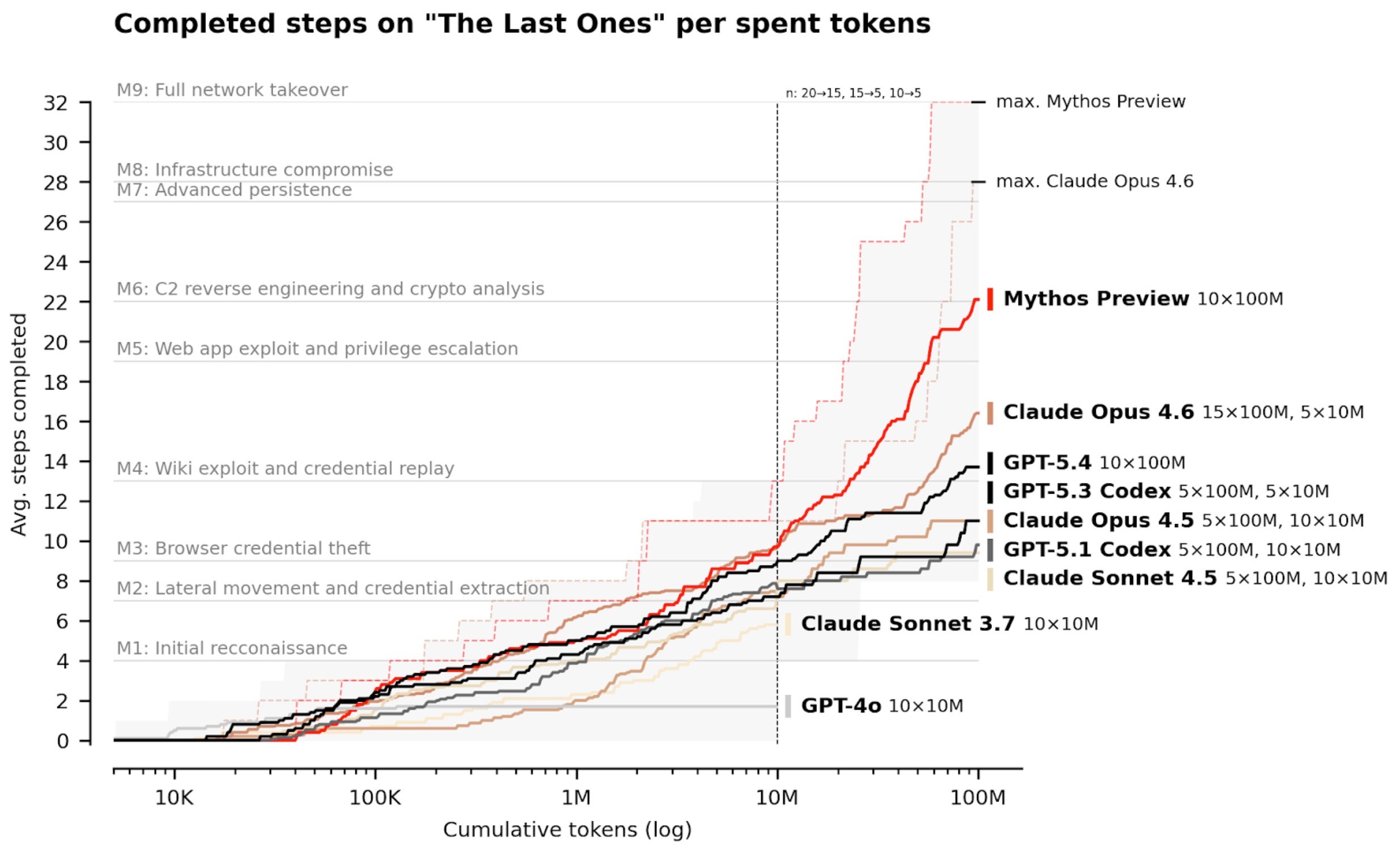
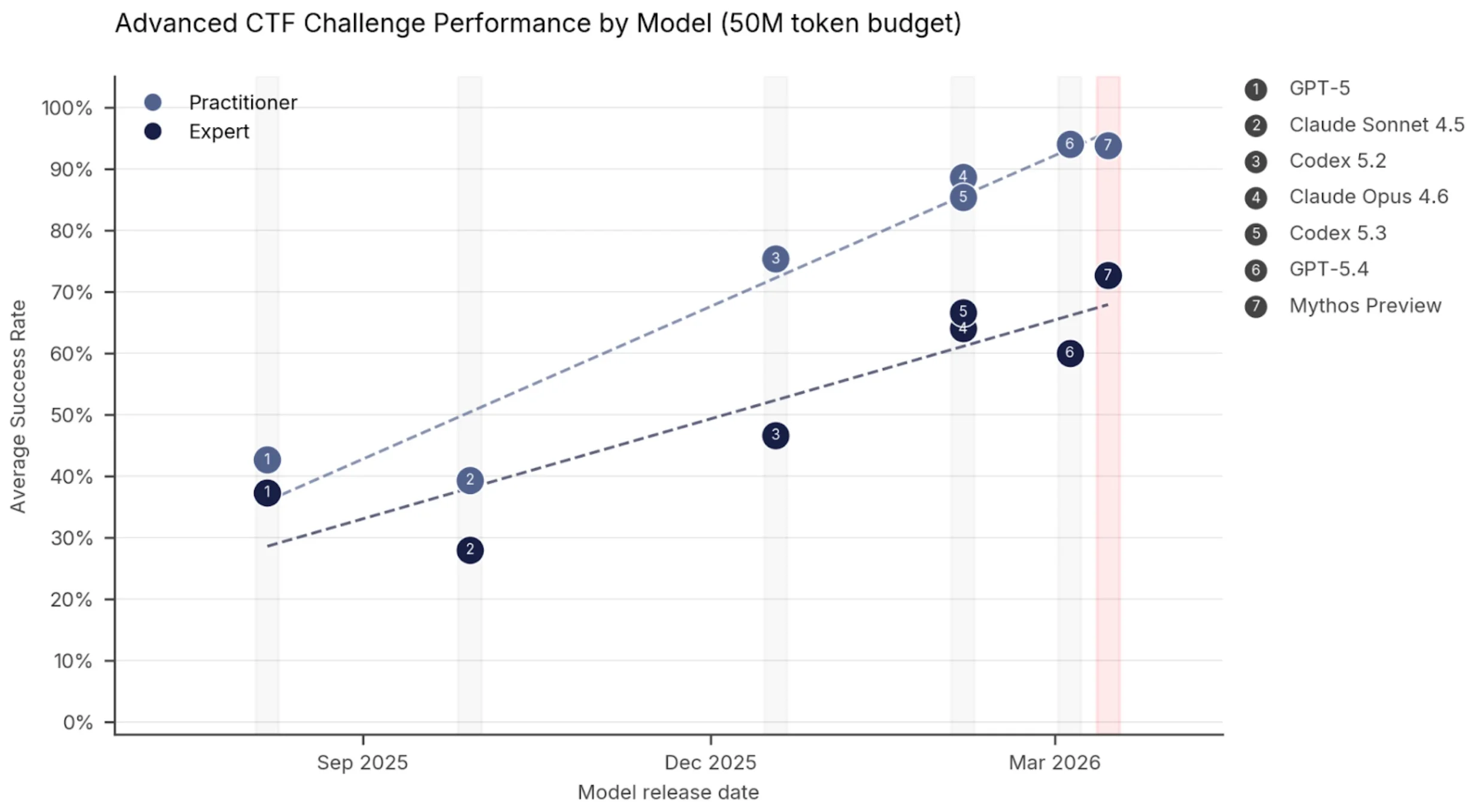
Our clear advice to defenders: Invest in machine speed defense and visibility right now. Ensure your defenses are up to date and well configured. Ground yourself in true research, not press releases and hype. As an example, many of the press and information shared by third parties around Anthropic’s new model release have lacked any substantive data – in many cases those statements preceded any real, tangible experience with the preview models in question. Inversely, the AI Security Institute (AISI) released a detailed research evaluation of relevant models, which sheds light on the state of frontier AI, exploitation rates, and potential real world implications. It clearly shows the trajectory, even from older models, had been apparent for a while, and that capability has existed and in many cases has been a function of compute scaling, as well as potentially the result of looser guardrails allowing more effective compute and reasoning than guardrailed models:
Source: AISI, Our evaluation of Claude Mythos Preview’s cyber capabilities, April 13th 2026Source: AISI, Our evaluation of Claude Mythos Preview’s cyber capabilities, April 13th 2026
The AI Security Institute also goes forward and outlines the following implications:
“Mythos Preview’s success on one cyber range indicates that it is at least capable of autonomously attacking small, weakly defended and vulnerable enterprise systems where access to a network has been gained. However, our ranges have important differences from real-world environments that make them easier targets. They lack security features that are often present, such as active defenders and defensive tooling. There are also no penalties for the model for undertaking actions that would trigger security alerts. This means we cannot say for sure whether Mythos Preview would be able to attack well-defended systems.
In a regime where attackers can direct and provide network access to models to conduct autonomous attacks on poorly defended systems, cybersecurity evaluations must evolve. As capabilities continue to improve, evaluation environments that lack defenses will no longer be challenging enough to discriminate between the capabilities of the most cyber-capable models or assess trends. Our future work will involve evaluating capabilities using ranges simulating hardened and defended environments, including ranges with active monitoring, endpoint detection and real-time incident response. We will also be tracking how AI-enabled vulnerability discovery and penetration testing campaigns perform on real-world systems.”
Stay safe,
The SentinelOne team
Third-Party Trademark Disclaimer:
All third-party product names, logos, and brands mentioned in this publication are the property of their respective owners and are for identification purposes only. Use of these names, logos, and brands does not imply affiliation, endorsement, sponsorship, or association with the third-party.
Expose the AI & Cloud Secrets That Put Your Data & Systems at Risk
This report draws on 11K+ customer environments. It shows how AI and cloud adoption are increasing secrets exposure and putting data at risk.
A guide to the suspected North Korean cyber attack—and how SentinelOne defends against it at machine speed
On March 31, 2026, a North Korean state actor hijacked the npm credentials of the primary Axios maintainer and published two backdoored releases that deployed a cross-platform remote access trojan (RAT) to Windows, macOS, and Linux systems. Axios is the most widely used HTTP client in the JavaScript ecosystem, with approximately 100 million weekly downloads and a presence in roughly 80% of
A guide to the suspected North Korean cyber attack—and how SentinelOne defends against it at machine speed
On March 31, 2026, a North Korean state actor hijacked the npm credentials of the primary Axios maintainer and published two backdoored releases that deployed a cross-platform remote access trojan (RAT) to Windows, macOS, and Linux systems. Axios is the most widely used HTTP client in the JavaScript ecosystem, with approximately 100 million weekly downloads and a presence in roughly 80% of cloud and code environments. The malicious versions were live for approximately three hours. An estimated 600,000 downloads occurred during that window with no user interaction required beyond a routine npm install.
SentinelOne protects against this attack, demonstrating why autonomous, layered defense at machine speed is not optional when adversaries operate at this velocity. In this attack, the first infection was observed 89 seconds after publication. At that pace, manual workflows do not have a response window. They have a spectator seat.
For SentinelOne’s customers and partners, here’s a quick overview of the compromise, SentinelOne’s response, and steps you can take to further protect your environment.
What Happened: The Anatomy of a State-Level Supply Chain Weapon
The attacker, tracked as UNC1069 by Google Threat Intelligence and Sapphire Sleet by Microsoft, compromised maintainer credentials and published axios@1.14.1 (tagged “latest”) and axios@0.30.4 (tagged “legacy”). Each version introduced a single new dependency: plain-crypto-js@4.2.1, a purpose-built trojan. The malicious package’s postinstall hook silently deployed a cross-platform RAT communicating over HTTP to C2 infrastructure at sfrclak[.]com (142.11.206[.]73), commonly being referred to as WAVESHAPER.V2.
The operational sophistication was striking. The attacker pre-staged a clean version of plain-crypto-js 18 hours before detonation to evade novelty-based detection. Publication occurred just after midnight UTC on a Sunday to maximize the response window. The malware self-deleted after execution, swapping its malicious package.json for a clean stub, leaving forensic evidence only in lockfiles and audit logs.
Most critically, Axios had adopted OIDC Trusted Publishing, the post-Shai-Hulud hardening measure npm promoted as the solution to credential-based attacks. But the OIDC configuration coexisted with a long-lived npm access token. npm’s authentication logic prioritizes environment variable tokens over OIDC when both are present. The attacker stole the legacy token and bypassed every modern control the project had in place.
The issue is architectural: security controls that coexist with the mechanisms they are meant to replace provide a false sense of protection. Axios had Trusted Publishing, SLSA provenance, and GitHub Actions workflows. None of it mattered because the old key was still under the mat.
How SentinelOne Is Protecting Customers
Behavioral Detection via the Lunar Engine
SentinelOne’s Lunar behavioral engine detects the renamed binary execution technique central to the Windows attack chain, in which PowerShell is copied to %PROGRAMDATA%\wt.exe and executed under a disguised process. The RenamedBinExecution logic catches this behavior regardless of the specific payload hash, providing durable detection against variants.
Global Hash Blocklist
All known stage payloads, malicious npm package tarballs, and RAT binaries across Windows, macOS, and Linux have been added to the SentinelOne Cloud blocklist with a globally blocked reputation status. This provides immediate protection for all customers with cloud-connected agents.
Wayfinder Threat Hunting
The Wayfinder Threat Hunting team executed proactive hunts across all MDR regions and operating systems using Axios-specific IOCs, including DNS queries to sfrclak[.]com, file artifacts (com.apple.act.mond, /tmp/ld.py, wt.exe), and consolidated hash sets. All true positive findings generate console alerts, with MDR customers receiving direct analyst engagement and escalation.
Sustained Research on This Threat Actor
SentinelLABS has tracked BlueNoroff, the DPRK-linked threat cluster with significant overlap to UNC1069, across multiple campaigns targeting macOS and credential theft operations. The WAVESHAPER.V2 macOS binary recovered from the Axios compromise carries the internal project name “macWebT,” a direct lineage marker to BlueNoroff’s documented webT module. SentinelLABS published detailed analysis of this tooling family in 2023 when RustBucket first emerged as a macOS-targeted campaign, and again in 2024 when BlueNoroff shifted to fake cryptocurrency news as a delivery mechanism with novel persistence techniques.
The initial access vector matters here, too. In March 2026, Google Threat Intelligence reported that UNC1069 leverages ClickFix, a social engineering technique that weaponizes user verification fatigue, as an initial access vector for credential harvesting. SentinelLABS had already published a detailed analysis of ClickFix techniques and their use in delivering RATs and infostealers before Google’s attribution dropped.
The behavioral detections that caught the Axios compromise were built on this accumulated intelligence, not written after the fact.
Live Security Updates (LSU)
Customers with LSU enabled receive real-time detection updates without waiting for agent releases, ensuring coverage evolves as fast as the threat intelligence does. This is critical for rapidly evolving supply chain campaigns where new IOCs emerge hourly.
What You Should Do Now
Supply chain compromise exploits the inherent trust enterprises place in their software delivery infrastructure. When that trust is weaponized by a state-level actor, the response must be both immediate and structural.
Audit and contain. Search all environments for axios@1.14.1 and axios@0.30.4. Treat any system that installed either version during the exposure window as fully compromised. Rebuild from known-good images rather than attempting in-place cleanup.
Rotate every credential the endpoint could reach. npm tokens, SSH keys, CI/CD secrets, cloud provider keys, and API tokens accessible from impacted systems must be rotated immediately. The RAT was designed to harvest exactly these credential types.
Pin dependencies and enforce lockfiles. Use npm ci (not npm install) in all CI/CD pipelines. Commit and audit lockfiles. Organizations using strict lockfile discipline were protected even during the three-hour exposure window. This is the single most actionable control.
Eliminate legacy npm tokens. Inventory all long-lived tokens across the organization. Migrate to OIDC Trusted Publishing and revoke legacy tokens entirely. Do not leave them as fallbacks. The coexistence of old and new authentication is what this attack exploited.
Harden detection policy. Ensure Behavioral AI and Documents & Scripts engines are set to Protect (On Execute). Avoid broad exclusions for developer tools like node.exe or npm. Enable LSU for real-time detection updates.
Extend endpoint coverage to developer workstations and CI runners. These environments have access to production secrets, deployment credentials, and code signing infrastructure. They are typically less monitored than production servers. DPRK has recognized this asymmetry and is systematically exploiting it.
Hunt proactively. Use Deep Visibility to search for DNS queries to sfrclak[.]com, connections to 142.11.206[.]73, and the presence of plain-crypto-js in any node_modules directory. SentinelOne’s 2025 Annual Threat Report documents how supply chain attacks are part of a broader pattern where adversaries are “shifting left” to subvert the build process itself, compromising software before it ever reaches production.
Practitioner Investigative Guide
In addition to the strategic recommendations above, here are some specific queries, file paths, and commands you can execute now to protect your environment.
Determine Blast Radius
Your first job is to answer one question: did any system in my environment pull a compromised Axios version during the March 31 exposure window (00:21 – 03:25 UTC)?
In the SentinelOne Console:
Open the Wayfinder alert queue. Look for the alert name “Axios NPM Supply Chain Compromise” (Wayfinder retroactive rule). If these alerts are not visible under default filters, switch the alert type from “EDR” to “All”, as these surface as Custom/STAR alerts.
For each alert, review the Storyline and process tree. The typical chain looks like this:
Developer process (VS Code, Electron, Node, Yarn, npx) → node → setup.js under plain-crypto-js → curl download from sfrclak[.]com:8000/6202033 → OS-specific payload execution
Classify the affected asset: developer workstation, CI/CD runner, or production server. This drives urgency. Shared CI runners imply wider blast radius because multiple teams and credential sets may be exposed.
Deep Visibility / Event Search hunts to run immediately:
What You’re Looking For
Query Pattern
C2 DNS resolution
#dns contains:anycase 'sfrclak.com'
C2 IP connection
#ip contains '142.11.206.73'
Malicious dependency on disk
File path contains
node_modules/plain-crypto-js/ or */plain-crypto-js/setup.js
macOS RAT binary
File path: /Library/Caches/com.apple.act.mond
Linux loader
File path: /tmp/ld.py
Windows payload
File path: %PROGRAMDATA%\wt.exe
Renamed PowerShell execution
Lunar detection: RenamedBinExecution
Run hash hunts against consolidated IOC lists even if the global blocklist is already active. Historic hits help you quantify which systems were exposed and when.
Contain and Kill
For every system with confirmed Axios-related activity:
Mark the Storyline as Threat in the SentinelOne Console. Confirm that remediation commands (Kill + Quarantine) executed successfully.
Network-isolate the endpoint if the C2 connection succeeded (outbound to sfrclak[.]com or 142.11.206[.]73). Check for any secondary tooling or persistence beyond the initial RAT.
Block at the perimeter. Add the following to your firewall, proxy, and DNS blocklists:
Domain: sfrclak[.]com
IP: 142.11.206[.]73
Port: 8000
Check for persistence mechanisms:
Windows: Registry key “Microsoft Update” (used by the RAT for persistence), presence of 6202033.vbs or 6202033.ps1
macOS: Any process spawned from /Library/Caches/com.apple.act.mond, AppleScript execution from /var/folders/.../6202033
Linux: Active python3 processes running /tmp/ld.py, nohup wrappers
Credential Rotation and Dependency Cleanup
Assume every credential accessible from a confirmed-compromised endpoint is stolen. The RAT was built to harvest them.
Credential rotation checklist:
npm access tokens (revoke and reissue)
SSH keys (regenerate keypairs, update authorized_keys on all targets)
Git signing keys and code signing certificates if accessible from the endpoint
Dependency cleanup (all environments):
Pin Axios to known-good versions: axios@1.14.0 (1.x branch) or axios@0.30.3 (legacy branch)
Delete node_modules/plain-crypto-js/ wherever it exists
Run npm cache clean --force (or equivalent for Yarn/pnpm) on all affected build environments
Reinstall cleanly using npm ci --ignore-scripts during the cleanup period to prevent any other postinstall hooks from executing
Audit your package-lock.json / yarn.lock / pnpm-lock.yaml for any reference to plain-crypto-js. Its presence in a lockfile is a forensic indicator that the compromised version was resolved, even if the malware self-deleted.
Harden and Validate
Policy hardening:
Confirm Behavioral AI engine is set to Protect (On Execute), not Detect-only
Confirm Documents & Scripts engine is set to Protect (On Execute)
Review and remove any broad exclusions for node.exe, npm, yarn, python3, or developer IDEs
Verify LSU (Live Security Updates) is enabled. Customers on Fed/OnPrem environments without LSU access should confirm they are on the latest Service Pack
Confirm the SentinelOne agent is deployed on all developer workstations and CI/CD runners, not just production servers
Validation sweep:
Run a full disk scan on every endpoint that was in the blast radius
Verify no new users, services, or scheduled tasks were created during the exposure window
Confirm that network blocks for C2 infrastructure are active and logging hits
Re-run the Deep Visibility hunts from Hour 0-1 to verify no new activity has appeared
Key IOC Reference Card
Keep this card accessible for your team during the response.
Malicious packages:
Package
SHA-1
axios@1.14.1
2553649f2322049666871cea80a5d0d6adc700ca
axios@0.30.4
d6f3f62fd3b9f5432f5782b62d8cfd5247d5ee71
plain-crypto-js@4.2.1
07d889e2dadce6f3910dcbc253317d28ca61c766
C2 infrastructure:
Indicator
Value
Domain
sfrclak[.]com
IP
142.11.206[.]73
Port
8000
URL pattern
hxxp[://]sfrclak[.]com:8000/6202033
RAT User-Agent
mozilla/4.0 (compatible; msie 8.0; windows nt 5.1; trident/4.0)
File artifacts by OS:
OS
Artifact
Path
macOS
RAT binary
/Library/Caches/com.apple.act.mond
macOS
Temp script
/var/folders/.../6202033
Windows
Renamed PowerShell
%PROGRAMDATA%\wt.exe
Windows
Stage 1
system.bat
Windows
Stage 2
6202033.ps1
Windows
VBS launcher
6202033.vbs
Linux
Python loader
/tmp/ld.py
RAT beacon behavior: HTTP POST every 60 seconds, Base64-encoded JSON, two-layer obfuscation (reversed Base64 + XOR with key OrDeR_7077, constant 333). The IE8/Windows XP User-Agent string is anachronistic and serves as a strong network-level detection indicator.
SentinelLABS Expanded Indicators:
Indicator
Value
Note
Email
nrwise@proton[.]me
Involved in supply chain compromise.
Email
ifstap@proton[.]me
Involved in supply chain compromise.
Domain
callnrwise[.]com
Domain overlaps with email scheme and infrastructure design from confirmed C2 domain.
Domain
focusrecruitment[.]careers
Overlapping domain registration details and timeline. Medium Confidence
Domain
chickencoinwin[.]website
Overlapping domain registration details and timeline. Medium Confidence
The Structural Problem Is Bigger Than Axios
The progression from event-stream (2018, individual actor) to Shai-Hulud (2025, self-replicating worm across 500+ packages) to Axios (2026, DPRK state actor with multi-vendor attribution from SentinelOne, Google, and Microsoft) is not a series of isolated incidents. It is a clear escalation in adversary sophistication and strategic intent. North Korean threat actors stole $2.02 billion in cryptocurrency in 2025 alone, a 51% increase year-over-year, and the Axios RAT harvests exactly the credential types that feed that revenue pipeline.
Developer environments are now a Tier 1 attack surface. The organizations that treat them as anything less are operating with a structural blind spot that state-level adversaries have already mapped.
SentinelOne’s Autonomous Security Intelligence framework delivers what this moment requires: AI-native protection that detects and contains threats at machine speed, human expertise through Wayfinder MDR that translates alerts into confident action, and a unified platform that eliminates the fragmented visibility where supply chain attacks hide. When the next three-hour window opens, the question is whether your defense moves faster than the attacker. With SentinelOne, it does.
Disclaimer: All third-party product names, logos, and brands mentioned in this publication are the property of their respective owners and are for identification purposes only. Use of these names, logos, and brands does not imply affiliation, endorsement, sponsorship, or association with the third party.
Expose the AI & Cloud Secrets That Put Your Data & Systems at Risk
This report draws on 11K+ customer environments. It shows how AI and cloud adoption are increasing secrets exposure and putting data at risk.
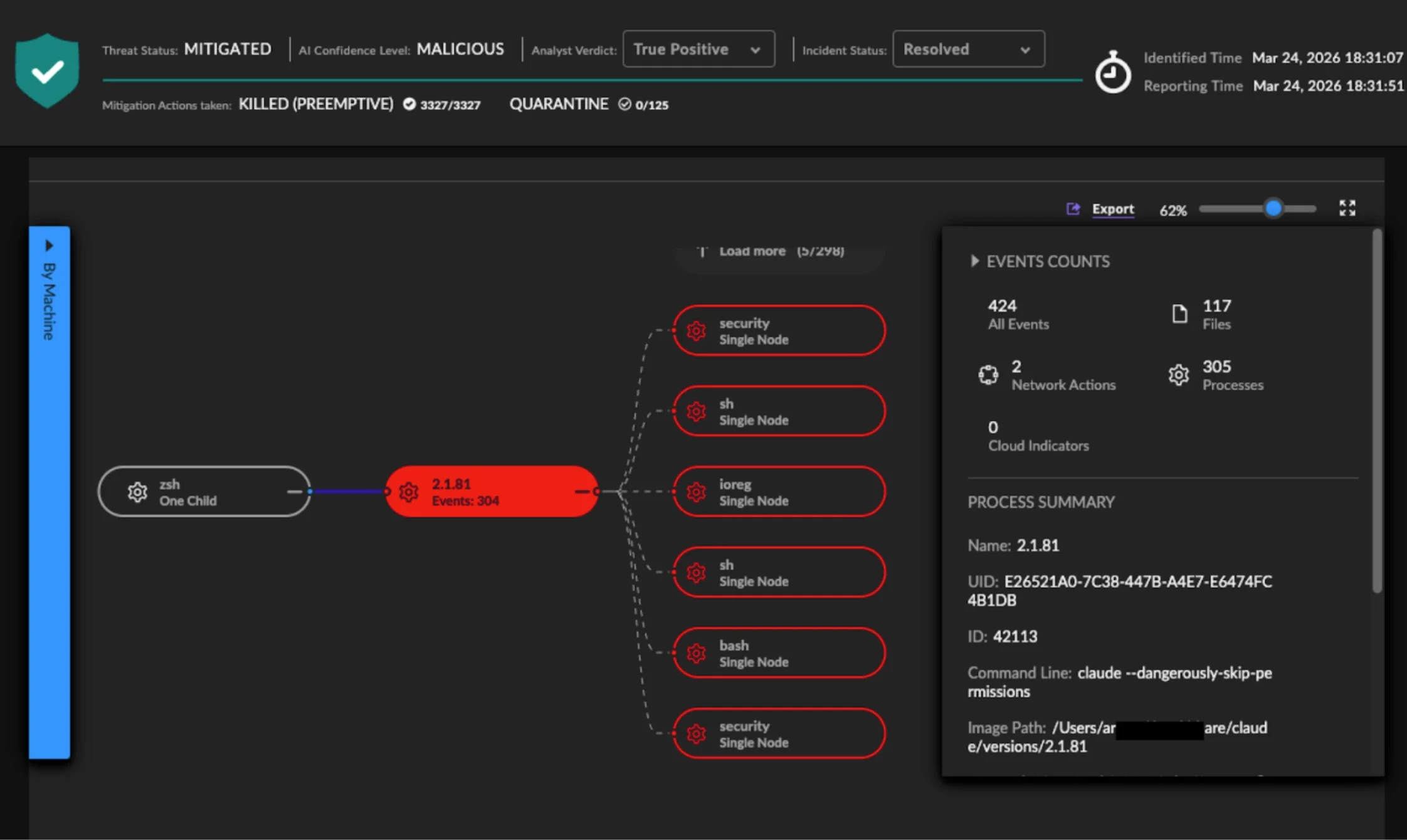
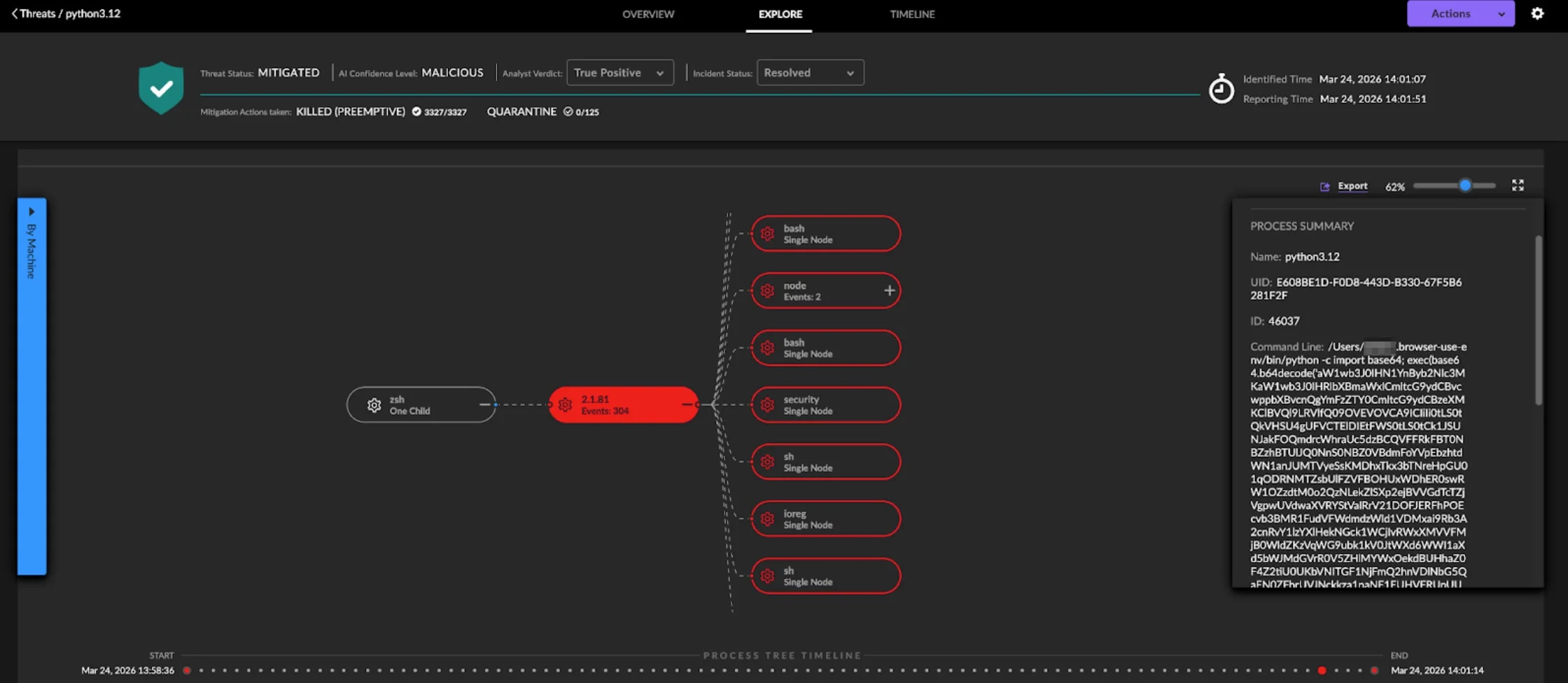
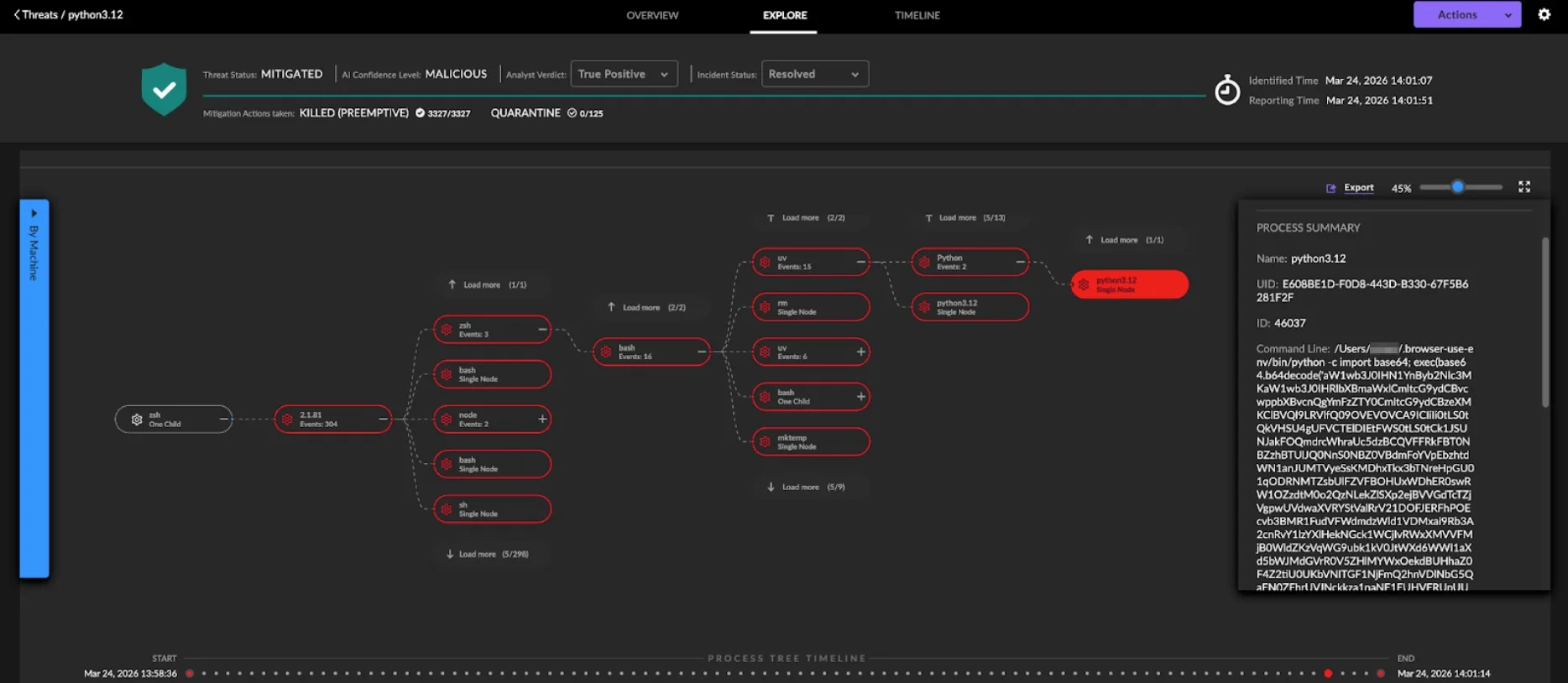
Host-based Behavioral Autonomous AI Detection is by far the most effective way to generically see, and stop both Human and/or machine-speed AI Agent based rogue or malicious activities.
On March 24, 2026, SentinelOne’s autonomous detection caught what manual workflows never could have: a trojaned version of LiteLLM, one of the most widely used proxy layers for LLM API calls, executing malicious Python across multiple customer environments. The package had been compromised hours earlier. No analy
Host-based Behavioral Autonomous AI Detection is by far the most effective way to generically see, and stop both Human and/or machine-speed AI Agent based rogue or malicious activities.
On March 24, 2026, SentinelOne’s autonomous detection caught what manual workflows never could have: a trojaned version of LiteLLM, one of the most widely used proxy layers for LLM API calls, executing malicious Python across multiple customer environments. The package had been compromised hours earlier. No analyst wrote a query. No SOC team triaged an alert. The Singularity Platform identified and blocked the payload before it could run, across every affected environment, on the same day the attack was launched.
The LiteLLM supply chain compromise is not an anomaly. It is the new pattern: multi-stage, multi-surface, designed to evade manual workflows at every turn. A compromised security tool led to a compromised AI package, which led to data theft, persistence, Kubernetes lateral movement, and encrypted exfiltration, all within a window measured in hours.
SentinelOne detected and blocked this attack autonomously, on the same day it was launched, across multiple customer environments. No manual triage. No signature update. No analyst in the loop for the initial containment. This is what autonomous, AI-native defense looks like when it meets a real-world threat at machine speed.
The gap between the velocity of this attack and the capacity of human-driven investigation is the gap where organizations get compromised. Closing that gap is not a feature request. It is an architectural decision. This is what happens when AI infrastructure gets targeted by a multi-stage supply chain campaign, and what it looks like when autonomous, AI-native defense is already in position.
Here is what we detected, how the attack was structured, and why this is the class of threat that the Singularity Platform was built to stop.
Autonomous Detection at Machine Speed
SentinelOne’s macOS agent identified and preemptively killed a malicious process chain originating from Anthropic’s Claude Code running with unrestricted permissions (claude --dangerously-skip-permissions). No human developer ran pip install, an autonomous AI coding assistant updated LiteLLM to the compromised version as part of its normal workflow.
The AI engine classified the behavior as MALICIOUS and took immediate action: KILLED (PREEMPTIVE) across 424 related events in under 44 seconds. The agent didn’t need to know the package was compromised, it watched what the process did and stopped it based on behavior, regardless of what initiated the install.
Catching the Payload in the Act
The macOS agent caught the trojaned LiteLLM package mid-execution. The process summary tells the story: python3.12 launching with a command line containing import base64; exec(base64.b64decode(... , the exact bootstrap mechanism described in the attack’s first stage, decoding and executing the obfuscated payload in a child process.
The agent didn’t need a signature for this specific package. It recognized the behavioral pattern, a Python interpreter executing base64-decoded code in a spawned subprocess, classified it as MALICIOUS, and killed it preemptively before the stealer, persistence, or lateral movement stages could deploy.
The Full Process Tree: Containing the Blast Radius
Zooming out on the same detection reveals the full scope of what the autonomous AI agent was doing when the payload fired. The process tree expands from Claude Code (2.1.81) into a sprawling chain: zsh, bash, node, uv, ssh, rm, python3.12, mktemp, with hundreds of child events still loadable (304 events captured). This is what unrestricted AI agent activity looks like at the endpoint level: a single command spawning an entire dependency management workflow that pulled, installed, and attempted to execute the trojaned package.
The SentinelOne macOS agent traced every branch of this tree, correlated the events back to the root cause, and killed the malicious execution; all while preserving the full forensic record for investigation.
The Compromise Was Indirect. That’s What Makes It Dangerous.
The attacker, operating under the alias TeamPCP, never attacked LiteLLM directly. They first compromised Trivy, a widely trusted open-source security scanner, on March 19. From there, they obtained the LiteLLM maintainer’s PyPI credentials and used them to publish two malicious versions: 1.82.7 and 1.82.8.
A security tool, built to find vulnerabilities, became the vector that enabled the compromise of an AI infrastructure package used by thousands of organizations. The same actor went on to compromise Checkmarx KICS and AST on March 23, and Telnyx on March 27. This was not a smash-and-grab. It was a coordinated campaign that exploited the transitive trust woven through open-source supply chains.
For security leaders asking, “Could this have reached us?” the more pressing question is: “How fast could we have answered that?”
A New Attack Surface: AI Agents With Unrestricted Permissions
In one customer environment, SentinelOne detected the infection arriving through an unexpected vector: an AI coding assistant running with unrestricted system permissions autonomously updated LiteLLM to the trojaned version without human review. The update pulled the infected package, and the payload attempted to execute. Our agent blocked it.
This is a new class of attack surface that most organizations have not yet scoped. AI coding agents operating with full system permissions can become unwitting vectors for supply chain compromises. The speed and automation that make these tools valuable are the same properties that make them dangerous when the packages they pull have been weaponized. Organizations that have not yet established governance policies for AI assistant permissions are carrying risks they cannot see.
SentinelOne’s behavioral detection operates below the application layer. It does not matter whether a malicious package is installed by a human, a CI pipeline, or an AI agent. The platform monitors process behavior via the Endpoint Security Framework, which is why this detection fired regardless of how the infected package arrived.
Two Infection Vectors, One Designed to Run Without You
Version 1.82.7 embedded its payload in proxy_server.py, which executes every time the litellm.proxy module is imported. For anyone using LiteLLM as a proxy layer for LLM API calls, this fires constantly during normal operations.
Version 1.82.8 escalated. The attacker placed the payload in a .pth file, litellm_init.pth. Files with the .pth extension are processed by the Python interpreter at startup, regardless of which modules are imported. Any Python script running on a system with this version installed would trigger the malicious code, even if that script had nothing to do with LiteLLM.
If version 1.82.7 was a targeted shot, version 1.82.8 was a blast radius expansion. The attacker removed the requirement that the victim actually use the compromised library.
What the Payload Did Once Inside
The attack was structured as a multi-stage delivery system, each stage decoding, decrypting, and executing the next. The first stage was a minimal bootstrap, a single line of base64-decoded Python launched in a detached subprocess with stdout and stderr suppressed. Lightweight enough to slip past signature-based tools. Quiet enough to avoid raising flags.
The second stage was a comprehensive data stealer. It harvested system and user information, cryptocurrency wallets, cloud credentials, application secrets, and system configurations. For practitioners wondering what the blast radius looks like if a developer workstation is compromised, this is the answer: the attacker collects everything needed to move from a laptop to production infrastructure.
The third stage established persistence through a systemd user service at ~/.config/systemd/user/sysmon.service, executing a script at ~/.config/sysmon/sysmon.py. The naming convention, “sysmon,” was deliberately chosen to mimic legitimate system monitoring tools. It is designed to survive casual inspection and blend into environments where dozens of services run as expected background noise. This is precisely the kind of evasion that signature-based detection misses and behavioral AI catches: the process looks normal until you observe what it actually does.
The persistence mechanism included a 5-minute initial delay before any network activity, a technique specifically designed to outlast automated sandbox analysis. After that, the script contacted its C2 server every 50 minutes, fetching dynamic payload URLs. This sparse communication pattern makes behavioral detection through network monitoring significantly harder, and gives the attacker the ability to push new tooling without ever re-compromising the target.
It Moved Laterally Through Kubernetes
The attack did not stop at the workstation. It created privileged pods across Kubernetes cluster nodes in the kube-system namespace, using standard container images like alpine:latest, with hostPID, hostNetwork, and a privileged security context. By mounting the host filesystem directly, these pods gained root-level access to underlying nodes.
Each pod deployed persistent backdoors as systemd services on the host system. The pods operated in legitimate namespaces, used standard images, and ran with privileges that many production workloads legitimately require. For SOC practitioners asking whether their admission control and runtime detection would have caught this: the attack was designed specifically so they might not. Detecting this requires runtime visibility into container behavior after deployment, not just policy enforcement at the admission gate. This is the difference between cloud security that checks configuration and cloud security that watches execution.
Exfiltration Was Encrypted and Camouflaged
Stolen data was encrypted using a hybrid RSA and AES-256-CBC scheme. A random 32-byte AES session key encrypted the data, then the session key itself was protected with RSA encryption using a hardcoded public key. This meant the malware could encrypt and exfiltrate without first communicating with the C2 server. The encrypted payload was packaged as tpcp.tar.gz and transmitted via a single HTTP POST to models.litellm.cloud, a domain chosen to blend with legitimate LiteLLM API traffic and slip past network monitoring that whitelists expected destinations.
What This Attack Proves
The LiteLLM supply chain compromise is not an anomaly. It is the new pattern: multi-stage, multi-surface, designed to evade manual workflows at every turn. A compromised security tool led to a compromised AI package, which led to data theft, persistence, Kubernetes lateral movement, and encrypted exfiltration, all within a window measured in hours.
SentinelOne detected and blocked this attack autonomously, on the same day it was launched, across multiple customer environments. No manual triage. No signature update. No analyst in the loop for the initial containment. This is what autonomous, AI-native defense looks like when it meets a real-world threat at machine speed.
The gap between the velocity of this attack and the capacity of human-driven investigation is the gap where organizations get compromised. Closing that gap is not a feature request. It is an architectural decision.
Why This Detection Worked: Architecture, Not Luck
The LiteLLM detection wasn’t a one-off. It’s what happens when autonomous, behavioral AI is built into the foundation, not bolted on after the fact. The Singularity Platform’s visibility across endpoint, cloud, identity, and AI workloads is why the agent saw this regardless of whether the install came from a human, a CI pipeline, or an AI coding assistant.
For teams that need the human expertise layer on top, Wayfinder MDR extends that autonomous detection with 24/7 investigation and response, closing the gap between detection and resolution.
This is the Autonomous Security Intelligence (ASI) framework in practice: AI that acts at machine speed, backed by human expertise when it matters, across every surface the attack can reach. See how the Singularity Platform protects AI infrastructure and request a demo today.
Protect Your Endpoint
See how AI-powered endpoint security from SentinelOne can help you prevent, detect, and respond to cyber threats in real time.
Autonomous agents and personal AI assistants are moving from experimentation to enterprise reality. Tools like OpenClaw (formerly Moltbot and Clawdbot), Nanobot and Picoclaw are being embedded across development environments, cloud workflows, and operational pipelines. They install quickly, evolve dynamically, and often operate with deep system-level access. For CISOs and security leaders, this presents a new governance challenge: How do you secure what you can’t see?
OneClaw, built by Prompt Se
Autonomous agents and personal AI assistants are moving from experimentation to enterprise reality. Tools like OpenClaw (formerly Moltbot and Clawdbot), Nanobot and Picoclaw are being embedded across development environments, cloud workflows, and operational pipelines. They install quickly, evolve dynamically, and often operate with deep system-level access. For CISOs and security leaders, this presents a new governance challenge: How do you secure what you can’t see?
OneClaw, built by Prompt Security from SentinelOne®, was created to answer that question. It is a lightweight discovery and observability tool built to help secure AI usage by providing broad, organization-wide visibility into OpenClaw deployments without disrupting workflows or slowing down innovation. Where agent sprawl is accelerating faster than policy frameworks can adapt, OneClaw restores clarity, accountability, and executive oversight where it matters most.
Understanding The Risks Behind OpenClaw
While most security programs assume that AI applications and agents are vetted, IT sanctioned, registered, and monitored, OpenClaw agents can be:
Installed directly by developers
Extended through public skills and plugins
Granted persistent memory and tool access
Configured to run autonomously, and
Connected to external services and API.
They can also operate quietly in local environments, call tools automatically, schedule tasks via cron jobs, and access sensitive systems – all outside of most application inventory controls. What manifests is two main concerns:
Shadow Agent Proliferation – How many OpenClaw instances are running across the enterprise?
Data Egress & External Exposure – Where are agents sending information, and to whom?
Without that centralized observability, these risks persist. As assistants such as OpenClaw, Nanobot, Picoclaw and other autonomous agents continue to emerge every day, OneClaw is designed to eliminate the opacity of the inherent risks they bring to businesses.
OpenClaw is only the beginning of a much larger shift toward autonomous agents and personal AI assistants embedded across the enterprise. In addition to OpenClaw, OneClaw already supports visibility coverage for emerging frameworks such as Nanobot and Picoclaw, extending the same discovery and observability capabilities across multiple agent ecosystems.
For CISOs, this future-proof approach is critical. Rather than deploying point solutions for each new tool that appears, OneClaw establishes a unified oversight layer for the entire category of new assistants, copilots, and autonomous workflows that continue to surface. The goal is not simply to manage one platform, but to provide lasting control over a rapidly expanding attack surface, ensuring that as agent adoption accelerates, security visibility and accountability keep pace.
Empowering Teams with Observability
OneClaw provides structured delivery and observability across OpenClaw deployments leveraging a scanner that automatically detects supported CLIs and inspects the local .openclaw directory within user environments. It parses session logs, configuration files, and runtime artifacts to summarize meaningful usage patterns and surface critical operational details. OneClaw also captures browser activity performed by agents to deliver visibility into external interactions and potential data exposure paths.
From this data, OneClaw then summarizes active skills and installed plugins, recent tool and application usage, scheduled cron jobs, configured communication channels, available nodes and AI models, security configurations, and autonomous execution settings.
OneClaw outputs are structured in JSON format, making it flexible for integration into existing security ecosystems. Organizations can conduct local reviews, inject into SIEM platforms, feed centralized monitoring systems, and correlate with identity, endpoint, and cloud telemetry. For security leaders invested in unified visibility, this ensures that agent observability does not become siloed.
For CISOs, this transforms AI agent behavior from invisible background activity into auditable telemetry that is integrated into broader enterprise security and risk management discussions.
From Raw Telemetry to Executive Intelligence
Though many tools generate logs, very few of them translate them into governance-ready insights. OneClaw provides a fully centralized dashboard that aggregates reports across all employees. Rather than just reviewing isolated endpoint-level findings, security leaders get visualized deployment trends, risk heatmaps, organization-wide exposure mapping, and skill usage distribution.
In a matter of minutes, the tool can be deployed via Jamf, Intune, Kandji or SentinelOne Remote Ops.
This elevates the conversation from technical detail to strategic oversight, which is critical as CISOs are now being asked for AI agent inventories, and whether the agents are operating within policy, can access sensitive systems, and are transmitting data externally.
With OneClaw, CISOs can gain visibility into:
How many OpenClaw agents are deployed enterprise-wide
What percentage is configured for autonomous execution
Which teams are installing high-risk skills
Where agents are making outbound connections
How has agent adoption changes day to day
This level of structured visibility empowers security leaders to build the foundational layer for proactive governance for agentic AI security and have effective conversations about the short and long-term risks from OpenClaw adoption in their organization.
Security-Focused Behavioral Analysis
OneClaw does not assume all autonomy is dangerous. Instead, it surfaces where autonomy exists so that leaders can make informed, balanced policy decisions and strengthen controls with precision. For example, security teams may determine that autonomous execution is appropriate within a sandboxed development environment but requires approvals in production systems. They may allow specific, vetted skills while restricting newly installed public plugins pending review. They also may decide that outbound communication to approved internal APIs is acceptable, while flagging unknown external domains for investigation.
By making these conditions visible, OneClaw enables proportionate governance rather than blanket restrictions. Teams can confidently approve safe automation, enforce guardrails where needed, and document oversight for executive and regulatory reporting. The result is not reduced innovation, but safer acceleration where autonomous agents operate within clearly defined boundaries, and security leaders remain firmly in control of how and where that autonomy is trusted.
Transparency Without Disruption
OneClaw was designed to deliver visibility into autonomous activity without interrupting the work those agents (and the teams deploying them) are meant to accelerate. Rather than creating friction into development pipelines or altering how OpenClaw, Nanobot, or Picoclaw operate, it acts as an observability layer that security teams can deploy quietly across the environment.
The approach matters: Security leaders are not looking to slow down innovation, but they are accountable for what happens if agent behavior crosses policy boundaries or introduces risk. OneClaw gives the context needed for CISOs to act decisively using the cybersecurity controls they already trust. It does not replace prevention capabilities, it makes them smarter by ensuring autonomous activity is no longer invisible.
By surfacing where agents exist, how they are configured, and what they are interacting with, OneClaw allows organizations to distinguish between productive automation and risk behavior that warrants intervention. Security teams can then enforce standards through existing controls without imposing blanket restrictions that only frustrate developers.
The result? This is a model aligned with how modern security actually operates – observe first, contextualize risk, and then apply controls proportionately. OneClaw makes transparency a force multiplier for the security stack, and empowers CISOs to have confidence that autonomous innovation continues under a watchful, informed oversight instead with blind trust.
Chaos to Clarity | Why This Matters Now
Agentic AI discovery is no longer optional. OpenClaw’s rapid growth and decentralized infrastructure is creating a large, and often unmanaged attack surface. With skills being frequently installed from public repositories and agents being granted deep permissions, configuration drift is occurring silently. Agent ecosystems can fall to exploitation through malicious skills and supply chain manipulation.
OneClaw supports how CISOs defend against OpenClaw-related risks by providing deep visibility and observability of agentic AI use and autonomous behavior, detecting risky configurations early on, and quantifying the exposures before incidents occur.
As adoption increases and autonomy deepens, OneClaw works to restore visibility while allowing powerful agents to accelerate development pipelines. CISOs have the clarity needed to govern autonomous systems responsibly, while getting structured discovery, centralized reporting, and security-focused analysis.
Start getting visibility into agent activity and security insights into OpenClaw deployments across your organization here. To learn more about securing your OpenClaw agents, register for our upcoming webinar happening Tuesday, March 3, 2026.
Join the Webinar
SentinelOne AI & Intelligence Leaders Discuss How to Secure OpenClaw Agents on March 3, 2026 at 10:00AM PST / 1:00PM EST
AI adoption is accelerating faster than security programs can adapt. Organizations are already experiencing breaches tied directly to unsanctioned AI usage, at significantly higher cost than traditional incidents, while the vast majority still lack meaningful governance controls to manage the risk. Traditional cybersecurity measures are necessary but insufficient. Securing AI requires purpose-built capabilities that span the entire AI lifecycle, from infrastructure to user interaction.
The rapid
AI adoption is accelerating faster than security programs can adapt. Organizations are already experiencing breaches tied directly to unsanctioned AI usage, at significantly higher cost than traditional incidents, while the vast majority still lack meaningful governance controls to manage the risk. Traditional cybersecurity measures are necessary but insufficient. Securing AI requires purpose-built capabilities that span the entire AI lifecycle, from infrastructure to user interaction.
The rapid adoption of Large Language Models (LLMs) and Artificial Intelligence (AI) introduces transformative capabilities, but also novel and complex security challenges. Securing these sophisticated systems requires a multi-layered, end-to-end approach that extends beyond traditional cybersecurity measures. SentinelOne’s® Singularity Platform is uniquely positioned to provide holistic protection for LLM and AI environments, from the underlying infrastructure to the integrity of the models themselves and their interactions.
This document provides a detailed breakdown of how SentinelOne’s capabilities address the unique security requirements and emerging threats associated with LLMs and AI, now further enhanced by the integration of Prompt Security’s cutting-edge AI usage and agent security technology.
Because the most urgent question security leaders are asking right now is specifically about agentic AI assistants, tools like OpenClaw (aka Clawdbot and Moltbot) that can execute code and access data with user-level privileges, this document leads with dedicated coverage for those tools before mapping the full platform architecture.
Securing Agentic AI Assistants: OpenClaw Coverage
The Question Security Leaders Are Asking
“Do we have coverage for the new agentic AI assistants, such as OpenClaw (aka. Moltbot and Clawdbot) that are showing up across our environment?” Yes. SentinelOne provides multi-layered detection, hunting, and governance capabilities that specifically address these tools across three reinforcing control planes: EDR/XDR telemetry, AI interaction security (Prompt Security), and open-source agent hardening (ClawSec).
OpenClaw (aka Clawdbot and Moltbot) represent the next evolution of shadow AI risk. Unlike browser-based chatbots that operate within a web session, these agentic AI assistants can execute code, spawn shell processes, access local files and secrets, call external APIs, and operate with the same privileges as the user account running them. In SentinelOne’s SOC framework, they fall squarely into the highest-risk categories: agentic execution and compromise through the loop.
If an agentic assistant can read files, call tools, and talk out, it should be treated like a privileged automation account and secured accordingly.
SentinelOne’s Singularity agent provides telemetry and tracking of OpenClaw (aka. Moltbot and Clawdbot). The Data Lake PowerQuery provided below adds detection of any activity at the endpoint level. Purpose-built hunting queries target these tools across four signal categories:
Signal Category
What SentinelOne Detects
Example Indicators
Process Execution
Clawdbot, OpenClaw, or Moltbot runtime processes launching on endpoints
Command-line strings containing clawdbot, moltbot, or openclaw
File Activity
Creation, modification, or presence of agentic assistant files
File paths containing openclaw or clawdbot binaries and configurations
Network Activity
Communication on default agentic service ports and domains associated with ‘bad’ extensions
Traffic on port 18789 (default OpenClaw listener)
Persistence Mechanisms
Scheduled tasks or services establishing agent persistence
Scheduled tasks named OpenClaw or related service registrations
Dedicated PowerQuery for Clawdbot / OpenClaw / Moltbot:
dataSource.name = 'SentinelOne' AND

(event.type = 'Process Creation' AND tgt.process.cmdline

contains:anycase ('clawdbot','moltbot','openclaw')) OR

(tgt.file.path contains 'openclaw' or

tgt.file.path contains 'clawdbot') OR

(src.port.number = 18789 or dst.port.number = 18789) OR

(task.name contains 'OpenClaw')

| columns event.time, src.process.storyline.id, event.type,

endpoint.name, src.process.user, tgt.process.cmdline,

tgt.process.publisher, tgt.file.path,

src.process.parent.name, src.process.parent.publisher,

src.process.cmdline, src.ip.address, dst.ip.address
Beyond this targeted query, SentinelOne’s tiered SOC hunting framework provides behavioral detection that catches agentic assistants even when they are renamed, updated, or running through wrapper processes:
Tier 1 (Discovery): Identifies AI-capable runtimes and destinations across the environment, surfacing where agents like OpenClaw are executing.
Tier 3 (Behavioral): Detects the “agent-shaped” pattern, interpreter runtimes (Python, Node) spawning shell processes, touching secrets, and calling external APIs, which is the operational fingerprint of OpenClaw (aka Clawdbot and Moltbot) regardless of binary name.
Tier 4 (Impact): Correlates secrets access with non-standard egress within the same Storyline, identifying when an agentic assistant has moved from exploration to data exfiltration.
Storyline connects the entire chain of custody (i.e. what launched the agent, what it touched, and where it communicated) providing a defensible incident narrative for any agentic AI activity.
Coverage Layer 2: AI Interaction Security (Prompt Security)
The Prompt Security capabilities described in Pillar 7 of this document apply directly to OpenClaw (aka Clawdbot and Moltbot), but agentic assistants create risks that go beyond what standard AI chatbot monitoring addresses:
Agentic Shadow AI Discovery: Unlike browser-based AI tools that appear in web traffic logs, agentic assistants often run as local processes or connect through non-standard ports. Prompt Security identifies these tools regardless of how they connect, closing the visibility gap that network-based monitoring misses.
Execution-Aware Content Controls: Because agentic assistants can act on the instructions they receive (i.e. executing code, modifying files, calling APIs), Prompt Security’s content inspection takes on heightened importance. Sensitive data filtered at the interaction layer is prevented from ever entering an execution pipeline.
MCP Tool-Chain Governance: OpenClaw (aka Clawdbot and Moltbot) frequently interact with MCP tool servers to extend their capabilities. Prompt for agentic AI intercepts these calls, applying dynamic risk scoring before the agent can act on tool responses.
Coverage Layer 3: Agent Hardening (ClawSec)
ClawSec, an open-source security skill suite built by Prompt Security from SentinelOne, provides defense-in-depth specifically designed for OpenClaw agents:
Skill Integrity & Supply Chain Verification: Eliminates blind trust in downloaded skills by distributing security skills with checksums and verified sources. Drift detection flags when critical files have been silently modified.
Posture Hardening & Automated Audits: Scans for prompt-injection vectors, unsafe configurations, and runtime vulnerabilities within the agent environment. Automated daily audits generate human-readable security reports.
Community-Driven Threat Intelligence: Connects to a live security advisory feed powered by public vulnerability data (NVD) and community reports, making verified threat intelligence immediately available to subscribed agents.
Zero-Trust by Default: Blocks unauthorized egress and telemetry. If a threat is detected, the agent must explicitly request user consent before reporting externally, thereby eliminating hidden communication and background data sharing.
Integrated Coverage: How the Three Layers Work Together
Control Plane
Coverage Scope
Key Capability
EDR/XDR (Singularity Agent + Data Lake)
Endpoint-level process, file, network, and persistence detection
Behavioral detection via Storyline; purpose-built PowerQuery for Clawdbot/OpenClaw/Moltbot
AI Interaction Security (Prompt Security)
User-to-AI interaction layer
Real-time data leakage prevention, prompt injection blocking, shadow AI discovery
Agent Hardening (ClawSec)
Within the OpenClaw agent runtime
Skill integrity verification, posture hardening, zero-trust egress control
This three-layer approach ensures that whether an agentic AI assistant is discovered through EDR telemetry, flagged by Prompt Security’s interaction monitoring, or hardened proactively by ClawSec, security teams have full visibility and control over the risk these tools introduce.
At a Glance: Seven Security Pillars Mapped to Business Risk
The agentic AI coverage detailed above draws on all seven of SentinelOne’s core security pillars working together. The following table maps each pillar to the AI-specific threats it addresses and the business outcomes it protects, giving security leaders a rapid-reference guide for aligning platform capabilities to their organization’s AI risk priorities.
Security Pillar
AI Risk Addressed
Business Outcome Protected
Cloud Native Security (CNS)
Exposed training data, misconfigured infrastructure, exploitable cloud paths
Prevents data breaches; reduces regulatory exposure
Workload Protection
Runtime compromise, container escapes, fileless attacks on AI hosts
Ensures AI service continuity; prevents operational disruption
Shadow AI, prompt injection, data leakage through AI interactions, jailbreaks
Protects IP and sensitive data; enables safe AI adoption at scale
Recommended Next Steps for Security Leaders
This week: You can’t govern what you can’t see. Run the OpenClaw detection query in your Data Lake to determine whether agentic AI assistants are already active in your environment, assuming they are until proven otherwise. Audit browser extensions across high-risk teams. Review your AI acceptable use policy to confirm it addresses autonomous agents, not just chatbots. The goal is a baseline inventory of what AI tools exist, where they’re running, and who’s using them.
Within 90 days: Move from inventory to continuous visibility. A Prompt Security proof of value can get you there quickly, delivering real-time discovery of all AI tool usage across your environment, including the shadow AI activity your current stack can’t see. Use that visibility to establish sanctioned alternatives that give employees a secure path to the productivity they’re already chasing with unsanctioned tools. Operationalize behavioral detection hunts as automated detection rules so your SOC can identify new agentic activity as it appears, not months later.
Within 6 months: Mature from visibility into governance. Complete a full AI tool inventory with data classification and risk scoring. Establish enforcement policies that contain or block unsanctioned agentic tools at the endpoint, interaction, and network layers. Build board-ready reporting metrics that track AI-related risk posture over time. The organizations that move fastest here won’t be starting from scratch, they’ll be the ones that invested in visibility early enough to know what they’re governing.
Conclusion: From Visibility to Confidence
Securing LLMs and AI is not a future challenge, it’s a present imperative. SentinelOne’s Singularity Platform, now significantly enhanced by the capabilities of Prompt Security, provides end-to-end protection that spans cloud infrastructure, workload runtime, AI interaction governance, and automated response.
But the threat landscape is no longer just about chatbots and data leakage. The rapid adoption of agentic AI assistants like OpenClaw demonstrates that AI tools are evolving from passive information retrieval into autonomous agents that execute code, access secrets, and operate with real privileges on real systems. This shift demands a corresponding shift in security posture — from monitoring what employees type into a browser to governing what autonomous processes do on your endpoints.
SentinelOne’s three-layer coverage model addresses this directly. EDR/XDR telemetry provides behavioral detection at the endpoint. Prompt Security governs the interaction layer where sensitive data meets AI. And ClawSec hardens the agent runtime itself. Together, these layers give security teams the ability to discover, govern, and contain agentic AI tools without blocking the productivity gains they deliver.
The gap between organizations that believe they have AI governance and those that actually do is exactly where breaches happen. Organizations that close that gap won’t be those that adopted AI fastest or blocked it longest, they’ll be the ones that built the visibility, controls, and response capabilities to adopt it safely.
Security isn’t the department that says no to AI. It’s the function that makes AI possible at enterprise scale. To learn more about securing your OpenClaw agents, register for our upcoming webinar happening Tuesday, March 3, 2026.
Join the Webinar
SentinelOne AI & Intelligence Leaders Discuss How to Secure OpenClaw Agents on March 3, 2026 at 10:00AM PST / 1:00PM EST
As we close out 2025 and look ahead to 2026, nothing is as we might have expected even a year ago. AI has disrupted, and will continue to disrupt, every corner of modern life. In threat intelligence, SentinelLABS has not only recognized this shift but actively pivoted to meet it. At the same time, geopolitical alignments have grown increasingly unstable, with long-standing relationships now less certain than ever.
How will these new realities shape enterprises’ ability to anticipate and counter
As we close out 2025 and look ahead to 2026, nothing is as we might have expected even a year ago. AI has disrupted, and will continue to disrupt, every corner of modern life. In threat intelligence, SentinelLABS has not only recognized this shift but actively pivoted to meet it. At the same time, geopolitical alignments have grown increasingly unstable, with long-standing relationships now less certain than ever.
How will these new realities shape enterprises’ ability to anticipate and counter the cyber threats forming on the horizon? Predictions always carry the caveat that the future remains intractably unknowable, but even the unexpected emerges from trajectories already in motion.
In this post, SentinelLABS researchers and leaders share their perspectives on how the cyber threat landscape is evolving and what may lie ahead. Read on to explore how developments in global strategy, organized cybercrime, and of course, AI could impact us all in the coming year.
The Forgiving Internet is Over
The cybersecurity industry has been living on borrowed time, and AI is about to call in the debt.
The effects of cyberattacks are not always immediately visible: sometimes they go by entirely unnoticed. That encourages a fundamental cybernetics problem, as there isn’t an obvious causal link between the levers available to defenders and the constraining effects imposed on attackers.
That broken loop can create a corrosive perception that what we do doesn’t have meaningful effects, which has allowed our industry to backslide into lowest-investment, compliance-checkbox territory.
Meanwhile, the feedback delay entails that just as exploitation can go unnoticed for years, technical debt sits dormant, unnoticed for prolonged stretches.
We are moving to a future where being vulnerable and being hacked are not two separate steps. Today, organizations run edge appliances riddled with a bottomless supply of weaponizable vulnerabilities and n-days, and yet they often come away uncompromised simply because no one has gotten around to them yet.
Consider Cl0p’s MOVEit campaign: nearly 2,800 organizations compromised, 96 million individuals’ data exposed and the group was still processing victims more than a year after the initial breach. Cl0p explicitly stated they leaked names slowly to avoid overwhelming their own negotiation capacity. The attack itself was automated, executed over a holiday weekend, largely complete before the patch dropped, but extortion is human work. That capacity bottleneck —the gap between what automation can compromise and what humans can monetize— is about to disappear.
The internet’s forgiveness is a function of attacker capacity, and AI is a capacity multiplier. When autonomous agents can probe, validate, and exploit at machine speed, the gap between vulnerable and compromised collapses. Without a countervailing investment in AI-native defense, that asymmetry becomes the defining feature of the landscape.
Attackers will harness AI as a force multiplier long before defenders do. Scrappy resourcefulness, clear financial incentives, and freedom from procurement cycles guarantee it.
The alignment discourse is a distraction. Local models on consumer hardware, unconstrained foreign providers, and enterprise no-retention deployments attest to this. The moment capable computer-use models run locally, guardrails become irrelevant. Anthropic’s recent disclosure of Chinese operators using Claude Code for autonomous intrusions is instructive: one operator hitting thirty targets with minimal human intervention. By their own account, model hallucinations did more to slow the attackers down than any guardrails.
If defenders can thank AI for anything, it will be a fundamental reassignment of value, a revamping of capacity, and a necessary reimagining of what’s possible.
Feeble attempts to conjure tens of thousands of competent practitioners out of thin air have clearly floundered. Thankfully, getting more bodies isn’t the only way to increase capacity anymore. AI offers exactly that. It invites us to revisit implicit ROI calculations we abandoned long ago. We can now reconsider activities that required human intervention but were deemed too incremental and repetitive to be consequential: processing every document in a breach disclosure, pre-processing logs at scale, reverse engineering tangential codebases to better understand malicious code. These were not impossible tasks; they were tasks we decided not to attempt. That calculus has changed.
However, we must be clear-eyed about what we are adopting. These systems are non-deterministic. We are integrating a new form of evaluative power that is commoditized and cheap but also largely outside our control. Their outputs need to be wrangled into predictably acceptable parameters. The organizations that operationalize AI effectively will be those that learn to harness uncertainty within acceptable bounds rather than pretend it doesn’t exist.
What the market is missing (and desperately requires) are organizations that function as step-down transformers: converting raw frontier capability into security outcomes. Frontier labs are racing toward general capability while treating security as one of several potential markets. The result is a gap between what models can theoretically accomplish and what defenders can reliably deploy. Someone must bridge that gap with products and services that translate commoditized evaluative power into deployable autonomy.
This means investment in experimentation to redefine security problems in terms of what AI can make tractable, improve, or solve without waiting for archaic vendors to catch up. The threat actor(s) using Claude Code to maximize their operational capability didn’t stumble into competence. They iterated, tested, and created a harness for ready deployment with the human as far out of the loop as possible. Defenders will need equivalent rigor.
The opportunity is real and sizable. Seizing it requires that security as a practice becomes AI-native. Organizations that treat AI as another line item will find themselves overwhelmed by an operational tempo they cannot match. Those who internalize it as a fundamental shift, on both sides of the adversarial line, have a chance to redefine the dynamics of the security space. The value generated in 2026 and beyond is entirely concentrated in filling that gap between frontier capability and operational deployment. Juan Andres Guerrero-Saade (JAGS), Senior Technical Fellow and VP of Intelligence and Security Research, SentinelLABS
Hemispheric Crossfire | US–Venezuela Cyber Operations Drag in the Big Three
As of late 2025, Venezuela has already shifted from a chronic crisis to a genuine flashpoint. U.S. carrier groups and expanded maritime operations in the Caribbean, public talk of “closing” Venezuelan airspace, and speculation about regime‑change scenarios have raised the temperature dramatically. Caracas, for its part, is signaling a willingness to fight a long guerrilla struggle and “anarchize” the environment if the U.S. moves militarily. At the same time, Venezuela has deepened its alignment with Russia, Iran, and China, explicitly seeking security guarantees, capital, and military assistance from all three.
In such an environment, a realistic 2026 development is the partial exposure of U.S. offensive cyber and information operations targeting Venezuela. This doesn’t mean Hollywood‑style leaks of every covert program; it looks more like a mosaic of glimpses: A social media platform announces a takedown of coordinated inauthentic networks seeding narratives aimed at Venezuelan military factions and diaspora communities; A contractor leak reveals tooling used to profile Venezuelan officers, union leaders, and local elites; A regional report connects seemingly independent media outlets and meme sources back to U.S.-linked funding and infrastructure, blurring the line between strategic communications and covert influence.
None of this is unprecedented. Great powers all play in this space, but the political salience of Venezuela today means the blowback will be sharper and more public than usual.
That exposure offers raw material for counter‑narratives and operations by Caracas’ backers. Russia is already running well‑funded Spanish‑language disinformation and propaganda campaigns across Latin America, often in coordination with partner state media, with a long‑standing focus on undermining U.S. standing in the region. Iran has used Venezuela as a beachhead for sanctions evasion, proxy networks, and anti‑U.S. activity, including leveraging IRGC and Hezbollah-linked structures to expand its reach in the hemisphere. China, meanwhile, is quietly consolidating intelligence collection capabilities via regional ground stations, telecom infrastructure, and proximity to key undersea cables, assets Western analysts already flag as potential platforms for surveillance of U.S. communications.
In 2026, we should expect to see cyber and information operations explicitly framed as “defending Venezuela from U.S. aggression”, but operationally aimed at the United States and its closest partners.
Russian and Venezuela‑aligned influence networks will likely amplify any evidence of U.S. IO/espionage, real, exaggerated, or fabricated, into Spanish and English‑language campaigns targeting U.S. domestic audiences, Latin American publics, and the Venezuelan diaspora.
Iranian‑linked actors can be expected to piggyback on the crisis to probe U.S. critical infrastructure and financial networks under an “Axis of Authoritarianism” narrative, using the Venezuela storyline to justify escalation in cyber operations they were running for other reasons anyway.
Chinese‑linked capabilities are more likely to manifest as intensified collection and mapping, SIGINT on U.S. deployments, diplomatic traffic, and commercial flows, rather than loud influence campaigns, but that data will feed the same broader alignment.
For CTI teams, the prediction isn’t some “ big Venezuela cyber war,” it’s a convergence problem. A Venezuelan crisis becomes the pretext that ties together Russian, Iranian, Chinese, and local pro‑regime operators into loosely synchronized campaigns: hack‑and‑leak operations targeting U.S. policy debates; cross‑platform disinformation linking Venezuela to border, drugs, and migration narratives; the probing of U.S. energy, maritime, and telecom infrastructure under the cover of regional tension.
Expect to see Spanish‑language infrastructure and personas show up in incidents that ultimately impact U.S. and European networks and more clusters where attribution threads run through Caracas and Moscow/Tehran/Beijing at the same time. The organizations most likely to feel this first are those at the seam lines: energy, logistics, telecom, diaspora media, and NGOs with one foot in the U.S. and one in the region. Tom Hegel, Distinguished Threat Researcher, SentinelLABS
China’s Fifteenth Five Year Plan
A new Five-Year Plan from the Chinese Communist Party means a new hit-list for China’s hackers.
After Xi came into power in 2013, he set about issuing development goals for science and technology in China not seen since the leadership of Mao Zedong. The most notable, Made in China 2025 was released two years later in 2015. After American opprobrium reached its peak in the first Trump administration, China slowly withdrew MIC2025 from the limelight. American attention to the strategy led to significant collection difficulties for the PRC as the US FBI and other government agencies prioritized defense of targeted technologies in the private sector and at US research institutions, like universities.
In 2021, the PRC released publicly only a vague outline of the Party’s Medium- to Long-Term Development Plan for Scientific and Technological Innovation, which set innovation goals for 2025, 2030, and 2035. Foreign attention to MIC2025 led the Party to mark the full content of the plan as “internal circulation only.”
The 15th Five-Year Plan promises to push some of those privately-held development goals into the spotlight. The PRC central government will release the official 15th FYP in 2025, and will delegate much of the details about achieving its objectives to government ministries. Ministries will release their more-detailed version of the 15th FYP in late 2025 or early 2026. Those documents create a political demand signal for provincial governments and bureaucracies to work towards realizing.
Contracted hackers looking to pilfer western technology and sell it to the highest bidder in China will consult those documents to identify the technologies their customers are likely to pay good money for. If your industry is on the list of targeted technologies, buckle up. Dakota Cary, Senior Security Advisory Consultant
Organized Cybercrime | More Integrated, Streamlined & Aggressive
Commodities and Cartels
Ransomware and infostealers are now commodity features. We’ve blown past this milestone in the last couple of years. Consider ransomware and data exfiltration as givens in the event of any opportunistic breach. While the days of the ‘big brand’ extortion operations are waning, we are seeing more smaller, organized groups offering à la carte services, including ransomware, but ultimately, this is just another feature available in ‘run of the mill malware’.
The blending of infostealer and ransomware-style features into more swiss-army knife tools and services will attract a broader set of criminals, a natural evolution already underway, given the heavy reliance of modern attacks on the infostealer logs ecosystem.
This also overlaps with the trend towards more ‘Cartel-style’ operations or ‘alliances’ which consolidate disparate malicious services into more all-encompassing “MaaS” offerings.
Ransomware & Initial Access Brokers
As these cartels and service ecosystems solidify, the relationships that underpin initial access are tightening as well. Ransomware groups continue to work closely with IABs (Initial Access Brokers), with an increasing number of threat actors publicly and aggressively attempting to recruit ‘trusted’ IABs. Groups like Sicarii advertise special advantages to others willing to partner with them.
Sicarii Ransom’s ‘recruitment’ of IABs
Additionally, we can expect to see IABs starting to offer more targeted bundles consisting of curated credential sets. For example, IABs will start offering ‘chains’ based on cumulative sets of related credentials (chain of VPN->O365->Cloud Console access for a target). There are some specializing in this now, but we expect this to become more mainstream as the infostealer log ecosystem, which feeds many IABs, continues to explode.
Increasing Attacks Will Offer Defenders Fewer IOCs and Artifacts
There are some interesting micro trends within these smaller, more obscure, operations. One such trend is the omission of ransom notes and other noisy filesystem artifacts, and threat actors moving towards more direct follow-ups via emails and phone calls to initiate communications.
We have seen groups like “Penguin Cartel’ operate in this way, and we expect adversaries to increasingly embrace these alternate methods of first notification in extortive attacks.
Businesses Will Keep Losing Data, Encryption Not Required
This operational “quieting” aligns with another growing trend: attackers no longer need to encrypt data to profit from it. This is far from new, but it is increasing. More crimeware actors eschew encryption entirely, opting to extort victims to prevent release of the exfiltrated data. Groups like Kairos and WorldLeaks are current examples of this model.
Kairos DLS banner (exfiltration only)
More Automation, More Upscaling
While the “AI-revolution” has yet to fully transform the downstream atomic artifacts of crimeware, cybercriminals are taking advantage of various automation options, using AI to augment and scale-up their output.
An increasing number of actors are leveraging AI agents, Telegram Bots and similar features both to automate discovery and sales of their product and C2 activities. This has long since been a practice in the traditional infostealer community, but we are seeing an uptick of this across the crimeware landscape.
Pressure Escalates Tactics
Threat actors are continuing to apply real-world violence (VaaS) to ensure their profitability. Naming-and-shaming via data leak sites will remain a permanent feature of the landscape, but we will see further pressure being applied to business clients, customers, family members and entities that are peripheral to the victim. One common manifestation of this is swatting groups being called upon to apply pressure to financial crime victims.
Additionally, threat actors will continue to leverage regulatory and compliance laws to apply pressure and time leak announcements around critical events such as earnings calls or M&A negotiations. Jim Walter, Senior Threat Researcher, SentinelLABS
Living Off Apple’s Land | Latent Powers and Stolen Trust
Last year, we noted how threat actors were making hay abusing AppleScript’s spoof-friendly ability to create password dialog boxes to gain elevated privileges, but as many unfortunate victims have been finding out this year, that’s far from all AppleScript is good for.
ClickFix is the new social-engineering kid-on-the-block for every stripe of threat actor from nation state APTs to opportunistic cryptowallet-stealing cybercriminals. Dropping a simple two-line AppleScript that opens an innocuous webpage, perhaps a support portal for some legit technology, with up to 10000 blank lines ending with a few malicious lines of code is a ridiculously simple but effective method of social engineering.
A macOS ClickFix-style social engineering script
2026 will see the continuation of both techniques. However, as old as Python and as powerful as PowerShell, AppleScript has a lot more juice left in it from a threat actor point of view.
We are just beginning to see the first signs of adversaries making use of AppleScript’s Objective-C (AS-ObjC) bridge — a wonderful technology that brings the power of Apple’s Foundation and AppKit frameworks, including NSWorkspace, to simple AppleScripts. In the past, we’ve seen AS-ObjC’s newer cousin JXA (JavaScript for Automation) gain traction in red-teaming tools like Apfell; it’s a small conceptual leap from there to the (arguably) easier world of AppleScript Objective-C.
That opens up a whole new world of in-memory scripting power that otherwise usually requires a compiled binary and readily-detectable file writes. Will we see threat actors lean into this old, built-in, not-widely known, yet incredibly powerful way of programming Mac computers? If you’re a threat actor, it’s a Living-off-the-Land technology dream come true. If you’re a defender, it’d be smart to start thinking about what that looks like from a telemetry point-of-view in 2026. And while we’re on the topic of powerful, Apple Framework-enhanced scripting languages, Swift scripting is a thing worth keeping in mind, too.
On macOS, ClickFix was a necessity-is-the-mother-of-invention response to Apple’s plugging of the Gatekeeper workaround. However, you don’t need a bypass to Apple’s increasingly strict code signing and notarization rules if your malware is signed with a valid developer ID.
Illicit trade in verified Apple Developer accounts is something we’ve seen increase in the latter half of 2025, and it’s only a matter of time before we see these abused by more malware authors. Temporary they may be, as Apple is quick to nix such accounts once identified, but even a short-lived campaign can do a lot of damage against the right targets.
The lesson for defenders is not to treat validly code signed executables as some kind of exception to detection rules. Signed code tells a defender little more than that it passed Apple’s automated checks and that the code has a name attached to it. In the case of malware, that’s almost certainly not the name of a threat actor. Phil Stokes, macOS Research Engineer, SentinelLABS
The AI Reckoning | Consolidation, Censorship, and Economic Fallout
Specialized Models Will Belong to Those Who Can Make Them
Over the next few years, we’ll watch a huge number of AI companies simply disappear.
The generic “copilot for X” and “AI workspace” products that dominated pitch decks in 2023–2024 will be reborn as bloodless, checkbox features inside Microsoft 365, Google Workspace, and other large platforms. The quality will be worse than the specialized startups they replace, but that won’t matter because they’ll be easy to buy on an enterprise contract, come bundled with existing tools, and be turned on with a toggle in an admin console.
The result will look like a mass extinction. Valuations will implode and the easy money will evaporate. The tech influencer class on X will still push the “996 grindset mentality” even as the few humbled survivors of the crash pivot from “owning the category” to cutting costs and delivering durable value to a smaller, demanding set of customers.
But this is also exactly the environment in which truly specialized organizations start to matter. These smaller entrants will sit in narrow, high-stakes domains: cybersecurity, law, finance, industrial control, biotech…
In those areas, the winners will be teams that have quietly built a repeatable data and training pipeline, have access to proprietary datasets, and can deploy smaller models that are integrated into specific workflows, regulations, and hardware.
Advances in training efficiency, data curation, and model compression will be among the most valuable pieces of this puzzle, and they will increasingly move out of public view. Labs will publish less, national-security programs will classify more, and a handful of specialized shops will jealously guard their pipelines.
The Bubble Pops in a Poisoned Reality
AI is unpopular as an idea. For most consumers it means glitchy chatbots, over-eager automation at work, auto-generated spam, and marketing departments screaming about “AI-powered” everything. The underlying capabilities are real, but the experience is mostly annoyance, precarity, and a strong sense that someone else is getting rich off a thing that is happening to you, not for you.
On top of that resentment, we’ve layered a classic asset bubble. Capital has flooded into anything AI: driving valuations, headcount, and infrastructure spending far beyond what current use-cases justify. In the last year, large tech companies have fired workers while bragging about “AI efficiencies,” even when they’re mostly just undoing years of over-hiring.
The important prediction isn’t “a bubble exists”; it’s how people will react when it finally hits the wall. Within the next year we should expect a dot-com–scale drawdown in AI equity and private valuations: a broad repricing of pure-play “AI companies,” at least one of today’s marquee AI darlings valued at less than a third of its peak, and a long tail of late-stage startups ruthlessly zeroed-out. The hyperscalers will survive because AI is one line item inside a much larger machine; most everyone else will discover that they built a feature, not a business.
The crash will happen in a reality already saturated with synthetic content. In the scramble to justify their spend, organizations are using models to flood every channel with low-cost output: SEO sludge, autogenerated news, endless pitches, synthetic “user reviews,” fake engagement. Previously trusted sites and platforms are already quietly tilting from human-written to machine-written material because the unit economics are irresistible. The problem is they are using last decade’s metrics: what is the actual economic value of Daily Active Users when the content they are consuming is slop that nobody can monopolize?
As the synthetic layer of our online experience deepens, models are trained and retrained on their own exhaust and on rival models’ curated “knowledge bases”, wiki-like sites and reference corpora that are themselves partially or wholly machine-written. Systems start to treat these partisan or synthetic compilations as “ground truth” simply because they look like structured authority.
“Model poisoning” as a subset of a larger, more pernicious “reality poisoning”
The targeted threat of “model poisoning” becomes the inescapable threat of “reality poisoning” and the line between what actually happened and what the machine inferred as plausible will vanish.
This increasingly synthetic environment directly undermines the business case that justified the bubble in the first place. Search gets worse, watered down, and commoditized. Feeds become vacuum sealed bubbles where nothing breaks containment. Analytics get noisier and less reliable. Conversion rates slip as users learn to distrust what they see on screens. Enterprises that bought AI to “supercharge knowledge work” find that their internal knowledge bases are now clogged with plausible nonsense that’s harder and harder to audit. The marginal ROI on yet another AI integration rapidly decays.
So when the capital tide goes out, the public story will be simple and hostile. “AI took my job and ruined the internet.” The actual big picture may be composed of macro economics, overcapacity, and misallocated capital, but the emotional truth will be that AI made jobs less secure, the information environment less trustworthy, and the daily experience of technology spammy and brittle.
In the aftermath, the models will remain, the infrastructure will remain, and the incumbents will survive by using them where they produce actual value. What won’t survive will be broad-based cultural, political, and financial enthusiasm.
In the next year, we will end up with powerful systems embedded deep in a few dominant platforms, operating in a permanently contaminated data environment, surrounded by a public that no longer believes the marketing and cannot trust the outputs.
Dual-Use Will Eat Alignment and Turn Into Regional Censorship
AI and LLM development are on track to become core pillars of national defense. Questions about “U.S. vs. China vs. everyone else” will move out of policy think-tanks and into mainstream geopolitics. Behind closed doors, frontier systems will be evaluated less as “products” and more as strategic infrastructure: tools that can rewrite the balance of cyber offense, intelligence gathering, and information operations both at home and abroad.
In this world, statements of “public model alignment” will become less important. The loud, visible debates about fairness, bias, and “responsible AI” will continue, but the most consequential work on offensive AI capabilities will move into secure facilities, export-controlled supply chains, and gray markets. The question will shift from “Is this system aligned with human values?” to “Is this system aligned with our national interests?”
Because AI systems are inherently dual-use, offensive capabilities and control affordances will be developed in parallel. The same model that politely refuses to discuss certain topics in a consumer chat interface will have close cousins tuned for intrusion discovery, vulnerability triage, targeted influence, and automated exploitation. Many of those capabilities will originate in state-backed programs, but they won’t stay there. They’ll diffuse into law enforcement, domestic security services, and private contractors, where they will be applied to civilian populations as instruments of soft control and, when desired, hard power.
That logic will leak out into the consumer layer as regionalized safety controls. As these technologies scale, they will increasingly mirror existing patterns of information control. Providers will ship different rule-sets and behaviors by jurisdiction, the way streaming platforms already fragment their catalogs country by country. Providers will claim that this represents “localization” efforts — where differences in language and cultural references are updated for the target population. What they are really localizing is the range of thinkable thoughts within a language model.
Whatever their marketing stance on “neutrality” or aversion to particular ideological labels, major providers will have very strong incentives to align their models with local statutes, regulatory guidance, and informal political red lines. If a given government can threaten licenses, data-center permits, key executives, or revenue streams, the “alignment layer” becomes one more lever for the powerful. Governments will jump at the opportunity to tweak refusal patterns, soften the model’s treatment of this history, or remove guidance that might make protests more effective.
Over time, legislators, regulators, authoritarian regimes, and litigators will get a much sharper sense of where these levers sit inside these systems: how content filters work, what knobs exist for toxicity, radicalization, and persuasion, or how model-delivered advice translates into real-world actions. The volume and specificity of legal and policy demands on these knobs will expand accordingly.
Engineering teams at these companies will spend less time debating abstract philosophical framings and more time implementing tightly scoped, jurisdiction-specific constraints designed by lawyers and national security officials.
The result will be a stratified ecosystem:
Public, region-locked models that are heavily constrained will become the systems most people will interact with day to day.
Institutional and security-grade models, derived from the same or larger bases but deployed inside governments, defense contractors, and domestic security agencies, will be used to profile, predict and shape human behavior at scale.
Informal and illicit models will be leaked, stolen, or quietly licensed and recirculate similar capabilities into criminal markets and non-state actors.
In all three layers, “alignment” will be eaten by dual-use. The systems will be “aligned” to institutional goals, not to a shared, global notion of human flourishing. The public will experience this as an explosion of region-specific censorship and weirdly divergent realities between models that reflect different value systems.
In short, the coming wave of LLM censorship by major U.S. and allied companies is the civilian-facing expression of a deeper shift. Once AI is framed first as a strategic asset and only secondarily as a consumer product, dual-use incentives dominate. Alignment becomes a branch of national security and regulatory compliance, and the map of model behavior starts to trace the borders of political power rather than the contours of an egalitarian reality. Gabriel Bernadett-Shapiro, Distinguished AI Research Scientist, SentinelLABS
Zero or No Trust | Interconnected Services Lead to Increasingly Devastating Intrusions
Zero Trust Architecture networks have been increasingly ubiquitous over the last five years, with the pandemic driving many organizations to rapidly adopt and implement related technologies to support the sudden uptick in remote work. Threat actors were slower to adapt through 2020-2022, as there were plenty of targets who had not jumped on the ZTA bandwagon. Early adopters targeting these environments made headlines by compromising often tech-forward organizations, a far cry from the companies typically in the news for huge ransomware attacks against legacy networks.
In 2025, there were several campaigns where actors targeted highly interconnected environments by focusing on identity providers. The ShinyHunters campaign abusing OAuth relationships in certain Salesforce user environments is a notable example: granting OAuth access to the Data Loader app enabled the attackers to access the victim environment and exfiltrate data using a Salesforce tool intended to do exactly that. Similarly, in August 2025 attackers abused the Salesloft Drift application to hijack OAuth rights to harvest cloud service and SaaS credentials from the targeted environment.
There is huge potential for actors who identify improperly configured or abandoned OAuth-enabled applications. This was demonstrated in 2024 when Midnight Blizzard struck gold by discovering a legacy application in Microsoft’s test environment that enabled high-privileged access to corporate environments. For several years, skilled cloud attackers have been working on tools that map both resources and OAuth relationships in target environments.
While gaining access to such a high value environment as a major cloud service and operating system provider may not be feasible for most actors, increases in automated scanning and data evaluation will only make finding new, well-connected targets easier.
Based on the increased prevalence of Zero Trust environments, an increased attacker focus and understanding of SaaS identity providers, and the rise in sophistication of tools used to identify relationships between identities and assets in organizations’ environments, we believe there is a significant risk for attacks that misuse the new forms of “trust” used to authenticate applications within environments.
A potential evolution we may see in 2026 is tooling that not only targets one SaaS application and its downstream connections, but likely has some degree of automation or evaluation through agentic AI analysis to continue performing more phases of intrusion based on findings from the previous phase. Alex Delamotte, Senior Threat Researcher, SentinelLABS
AI-Driven Threats | Blurred Attribution and the DPRK Wildcard
The use of AI by adversaries will likely manifest in two ways outside of the ongoing discourse. The vast majority of attackers’ use of AI to date has been around driving greater efficiency and automating existing parts of their intrusion lifecycle. The intelligence assessments to date tend to skew towards technical improvements and capabilities.
If we look back on past assessments of emerging technologies — and let’s be honest, AI is without a doubt an emerging technology — two unexpected things tend to happen.
First, threat actors’ use of new technologies almost inevitably blurs existing assessment lines, typically around tradecraft and attribution. If we apply this to AI, the most likely upcoming shift will be lower-level/smaller groups gaining access to capabilities that were previously used to define government-affiliated programs. In particular, AI’s ability to provide language capabilities will bring low-level cybercriminals into the realm of government programs with full linguistic capabilities. This was an incredibly important capability distinction that is likely to end in the coming year solely because of AI.
The second likely outcome will be an almost inevitable surprise from DPRK’s AI use. DPRK cyber activities have previously caught intelligence organizations off-guard multiple times. Examples range from destructive attacks geared towards stopping a movie release through the current IT workers situation.
Additionally, AI has proven highly useful and effective to DPRK efforts, again the IT workers are a great example. When we pair these realities with the vast amount of illicit revenue generated by DPRK’s efforts at stealing cryptocurrency, we see an interesting situation emerging.
We have a cyber effort known to produce surprises, actively leveraging AI in a large and also previously unforeseen manner, and producing large amounts of revenue for the regime through cyber actions, both cryptocurrency theft and IT workers payments.
There is a high likelihood some level of these illicit gains will be reinvested into the DPRK cyber programs to increase their scope, scale, and impact–programs that are already actively pushing the bounds of AI use. While we do not have an expected outcome specifically, the likelihood of an unexpected, large, AI-driven surprise from DPRK is something we should be mindful of and prepared to tackle on the defensive side.
Steve Stone, SVP, Threat Discovery & Response
Looking Ahead & Protection Now
Moving ahead demands strong, decisive leadership based on confident security choices and the courage to evolve. For all those committed to a safer and more resilient future, SentinelOne is ready to help secure every aspect of your business. Contact us to learn more about cybersecurity built for what’s next.
The End of Forgiveness: 2026 Predictions on AI, Adversaries & Global Change

 Entrar