The Good | Courts Sentence Tax Fraudster, Interpol Disrupts African Cybercrime, and Ex-AI Engineer Faces Wiretapping ChargesA U.S. district court has sentenced Nigerian national Chukwuemeka Victor Amachukwu to eight years in prison for conducting spearphishing attacks against tax preparation firms. Following his extradition, Amachukwu has pleaded guilty to computer intrusion and wire fraud charges.Between 2019 and 2021, he and his co-conspirators breached accounting networks across multiple U.S.
The Good | Courts Sentence Tax Fraudster, Interpol Disrupts African Cybercrime, and Ex-AI Engineer Faces Wiretapping Charges
A U.S. district court has sentenced Nigerian national Chukwuemeka Victor Amachukwu to eight years in prison for conducting spearphishing attacks against tax preparation firms. Following his extradition, Amachukwu has pleaded guilty to computer intrusion and wire fraud charges.
Between 2019 and 2021, he and his co-conspirators breached accounting networks across multiple U.S. states, compromising the tax and personally identifiable information (PII) of at least 800 clients. They also filed fraudulent tax returns and disaster loan applications, stealing over $3.3 million. The court sentenced Amachukwu to one year of supervised release and ordered him to pay $3.6 million in restitution and forfeit nearly $11 million.
Also this week, Interpol coordinated Operation Serengeti III alongside 21 countries and private-sector partners to disrupt cybercrime networks across Africa, with crimes ranging from business email compromise (BEC) to various scams.
Executed between June and August 2026, the joint crackdown resulted in 1,462 arrests, the dismantling of 10,909 malicious infrastructures, and the recovery of more than $105 million in illicit proceeds. In total, the investigation identified 65,929 victims with losses estimated to be over $385 million.
Finally, a U.S. judge has ordered the detention of former OpenAI engineer Abdulrahman Alfozan for alleged corporate espionage at the company's San Francisco office. Prosecutors revealed that the Saudi national installed customized, encrypted audio recording devices in executive conference rooms in hopes of capturing sensitive corporate conversations.
Investigation filings exposed frequent encrypted communications between Alfozan and a Saudi Royal Family member, seeking to recruit him for a state AI initiative. Federal agents arrested Alfozan just days prior to his scheduled one-way flight to Saudi Arabia and now he faces a maximum of five years in prison if convicted.
The Bad | China-Linked Actor Deploys Agentic AI in Cloud Supply Chain Attacks
A suspected Chinese-state aligned threat actor has leveraged an agentic AI framework to execute a supply chain compromise against ConnectWise Cloud Backup, automating attacks across hundreds of global organizations.
Active since at least 2021 and historically reliant on botnet infrastructure for evasive password spraying, the group was seen using ARTEX, a Go-based, multi-agent LLM penetration testing system, to conduct offensive operations at machine speed. By deploying AI agents configured to work around the clock, the threat actors drastically reduced the time from initial targeting to achieving privileged cloud access to under three hours in multiple targeted environments.
The actor leveraged ARTEX to automate scanning, reconnaissance, password spraying, and OAuth application abuse across a broad range of sectors, including aerospace, defense, energy, financial services, government, and technology.
Between October 10 and October 14, 2026, the attackers launched an automated cross-tenant password-spray campaign from dedicated infrastructure, generating over 151,000 failed logon events that peaked on October 11 at 2,900 failures per minute. Then on October 15, the AI agents acquired control of identities associated with multiple ConnectWise cloud applications, using pre-granted permissions to authenticate to downstream Microsoft 365 customer environments without requiring interactive user logins.
Once authenticated, the agents ran Microsoft Graph operations to perform directory reconnaissance, alter privileged roles, and modify application credentials. By adding unauthorized credentials to existing OAuth applications, the AI agents established persistent backdoors that remain active even after remediating the primary backup software.
The campaign saw ARTEX attempt sign-ins across more than 2,250 tenants, narrowing the response window. In response to the intrusion, ConnectWise has temporarily suspended services to isolate infrastructure and implement containment measures.
The Ugly | PHP Drops Urgent Fixes for 'PHP2Shell' RCE Flaws Targeted Before Disclosure
Emergency security updates came from the PHP security team this week to patch two critical remote code execution (RCE) vulnerabilities, collectively tracked as “PHP2Shell”, that affect core PHP runtimes across enterprise web servers. Rated CVSS 9.2 and identified as CVE-2026-109618 and CVE-2026-109619, the flaws stem from memory management and error handling defects when requests terminate unexpectedly.
The vulnerabilities impact all PHP installations serving web traffic, including Apache with mod_php, PHP-FPM, and php-cgi, as well as FrankenPHP and LiteSpeed. Risk is particularly severe on mod_php servers, where unauthenticated requests trigger memory corruption before any application code executes, rendering content management system security controls ineffective against initial exploitation.
The emergency releases (PHP 8.5.12, 8.4.27, 8.3.36, and 8.2.35) followed advance warnings triggered when technical details leaked online prior to coordinated disclosure. Amazon Threat Intelligence detected exploitation probes targeting honeypots beginning October 17, four days before official patches were published. The early probe activity indicates that threat actors acquired vulnerability details while the security flaws remained under embargo.
The underlying weakness had gone unresolved for two years: a 2024 audit flagged the same out-of-memory condition but couldn’t prove it was exploitable. AI-assisted auditing under OpenAI’s “Patch the Planet” program changed that, turning the long-standing weakness into confirmed working remote code execution.
PHP states that applying runtime updates is the only complete fix. Interim configurations, such as disabling session upload progress or restricting memory limits, only partially close specific attack paths.
While patching remains the primary control, SentinelOne Singularity agents detect post-exploitation behavior at the operating system level, identifying when web worker processes spawn system shells, write web shells into document roots, or initiate unauthorized outbound network connections.
Executive SummaryOn October 21, 2026, the PHP project released versions 8.5.12, 8.4.27, 8.3.36, and 8.2.35 to fix two critical vulnerabilities, CVE-2026-109618 and CVE-2026-109619, both rated CVSS v4.0 9.2. The two flaws are known together as PHP2Shell. They were disclosed by the security firms Calif and Wiz and by OpenAI, working with the PHP security team, after AI-assisted auditing turned an out-of-memory weakness that a 2024 audit had flagged but could not prove exploitable into working remo
On October 21, 2026, the PHP project released versions 8.5.12, 8.4.27, 8.3.36, and 8.2.35 to fix two critical vulnerabilities, CVE-2026-109618 and CVE-2026-109619, both rated CVSS v4.0 9.2. The two flaws are known together as PHP2Shell. They were disclosed by the security firms Calif and Wiz and by OpenAI, working with the PHP security team, after AI-assisted auditing turned an out-of-memory weakness that a 2024 audit had flagged but could not prove exploitable into working remote code execution.
Both vulnerabilities sit in PHP's memory management and error handling, code that nearly every request touches, and the earliest affected path dates to PHP 5.4.0. An unauthenticated attacker can execute code on the web server or read its process memory, including passwords, tokens, and API keys belonging to other requests. On Apache with mod_php, the attack runs before any application code executes, which means an application with no bugs of its own is still exposed. As of October 21, 2026, no verified proof-of-concept code is available publicly. Attack attempts have been observed by Cloudflare after the leak, but no confirmed in-the-wild compromise has yet been reported.
While upgrading every PHP runtime remains the primary control, SentinelOne agent detects attackers’ post-exploitation activities. Once an attacker has code execution on the web server process, the behavior that follows web server flaws: execute shell commands, drop and invoke webshells, download and execute custom payloads and outbound connections. On managed hosts, the Singularity™ agent and Singularity AI SIEM detection content look for such behaviors, and Purple AI® can be used to hunt for it during the patching window. The separate memory-disclosure path runs no code on the host, so it leaves no process behavior to detect; that path is instead surfaced through web server, WAF, and CDN telemetry forwarded into AI SIEM.
This report details PHP2Shell's mechanism, affected versions, and confirmed activity, and outlines how SentinelOne customers can strengthen their defenses.
Key Highlights
The flaw is in PHP itself, not in any application. WordPress, Drupal, Joomla, Magento, Laravel, and other web applications are all exposed on an affected PHP version, because the vulnerable code is in the runtime beneath them.
The patch is the only complete fix. PHP states plainly that no configuration change fully closes the vulnerability. Every interim mitigation reduces one attack path and leaves others open.
The unauthenticated path runs before your code does. On Apache with mod_php, a single crafted HTTP request triggers the flaw during request startup, so application-level controls never see it. PHP assesses the risk as highest for mod_php.
Memory disclosure leaks secrets without a shell. One path reads live worker memory and returns passwords, tokens, API keys, and certificates with no code execution, which makes it quieter than a shell and harder to catch with execution-focused tooling.
End of Life PHP will not get a patch. Organizations running PHP 8.1 and prior will not receive an official release. Source-only backports exist for 7.4, 8.0, and 8.1, and distribution or LTS vendors may offer fixed packages.
Leverage SentinelOne platform post-exploitation coverage. The detection by the agent is agnostic to the vulnerability and exploit chain and focuses on attackers activity following the exploit, including but not limited to, installation and usage of webshells, command executions and outbound connection behavior that follows the code execution.
Organizations should take the following steps immediately:
Update every PHP runtime to a fixed version and restart Apache, PHP-FPM, and any long-running workers.
Inventory internet-facing PHP, including the copies bundled inside appliances, control panels, and vendor software.
Isolate end-of-life PHP (8.1 and older) from the internet until it can be upgraded.
Rotate credentials, tokens, and keys that a PHP worker could hold in memory on any exposed, unpatched system.
Monitor the official PHP changelog for relevant updates
What is PHP2SHELL
PHP2Shell is a family of memory-safety vulnerabilities in core PHP, grouped under two CVEs that share one root cause. When PHP hits a fatal condition such as exhausting its configured memory limit, it does not unwind cleanly. It abandons the current operation with a “longjmp” out of the C call stack, so no cleanup runs and nothing records that a data structure was left half-built. A later cleanup routine, or a later request, then trusts that state.
CVE-2026-109618 is the out-of-memory case. PHP marks request data as valid before allocating memory for it. If that allocation hits the memory limit and fails, the entry is left pointing to uninitialized heap memory. When the failed request runs its cleanup routine, it processes these stale bytes, leading to corruption..
CVE-2026-109619 is the stale-state case. When a fatal error occurs, PHP fails to clean up properly, leaving a global pointer pointing to memory that has already been freed. Because worker processes handle multiple requests, a subsequent request on the same worker can interact with this freed memory before initialization resets it – resulting in a use-after-free condition. Session upload progress (enabled by default) is a confirmed trigger for this behavior.
Both flaws were discovered through AI-assisted auditing under OpenAI's “Patch the Planet” program. Calif and OpenAI independently reported the root cause to the PHP security team on August 11, 2026, and Wiz reported additional attack vectors on August 24, 2026. PHP first saw signs of the underlying out-of-memory problem during a 2024 audit by OSTIF and Quarkslab, but no exploitation path was proven at the time and the fix stalled. The PHP Foundation has since described that delay as a structural failure in its security process.
On October 20, the two CVE identifiers leaked on social media. PHP released a patch on October 21, 2026.
PHP2SHELL at a Glance
Attribute
Detail
Tracking
CVE-2026-109618, CVE-2026-109619 (PHP2Shell)
Vulnerability Class
Memory safety: use-after-free and improper handling of exceptional conditions (CWE-416, CWE-755)
Severity
CVSS v4.0 9.2, Critical, for both CVEs
Affected
PHP 5.4.0 through the release before each branch's fix. Nearly every version released in a decade is affected by at least one issue
Attack Vector
Unauthenticated, network, over a single crafted HTTP request
Impact
Remote code execution as the web worker, or disclosure of sensitive process memory
Exploitation Status
As of October 21, 2026: no verified proof-of-concept code is available publicly, attack attempts observed by Cloudflare after the leak, no confirmed in-the-wild compromise reported.
Affected and Fixed PHP Versions
PHP Branch
Vulnerable
First Fixed Release
8.5
< 8.5.12
8.5.12
8.4
< 8.4.27
8.4.27
8.3
< 8.3.36
8.3.36
8.2
< 8.2.35
8.2.35 (branch reaches end of life December 31, 2026)
8.1 and older
All releases
No official fix. Source backports only for 7.4, 8.0, and 8.1
Affected and Fixed PHP Versions
PHP Branch
Vulnerable
First Fixed Release
8.5
< 8.5.12
8.5.12
8.4
< 8.4.27
8.4.27
8.3
< 8.3.36
8.3.36
8.2
< 8.2.35
8.2.35 (branch reaches end of life December 31, 2026)
8.1 and older
All releases
No official fix. Source backports only for 7.4, 8.0, and 8.1
Am I Affected?
Assume exposure for any PHP runtime below the fixed version for its branch. Check the version the web server actually loads, which can differ from the command-line version, using php --version for the CLI and the equivalent for PHP-FPM or the Apache module. Linux distributions and LTS vendors received the patch in advance, and a packaged build may carry the fix under an older version number, so confirm against your vendor's advisory rather than the version string alone.
PHP states that all installations serving web requests are at risk, including PHP-FPM, Apache with mod_php, php-cgi, FrankenPHP, and LiteSpeed, and rates the risk highest for mod_php. Do not use configuration to rule out exposure. PHP validated mod_php code execution with default input and memory limits, and states that no configuration change is a complete mitigation. OpenAI has published a PHP version checker, which should be reviewed before you run it.
How The Two CVEs Differ
CVE-2026-109618
CVE-2026-109619
PHP title
RCE via OOM corruption
RCE via stale global state
Trigger
Out-of-memory during request startup, such as multipart parsing
A fatal error, including out-of-memory or an execution timeout, that leaves request state published
Requests needed
One. The invalid state is processed during the same request's shutdown
Two. One request poisons the worker, a later request on the same worker consumes the stale state
Confirmed code execution
mod_php with default PHP input and memory limits. PHP-FPM is susceptible by source analysis, with no complete exploit demonstrated
mod_php through the PHP 8.5 fatal backtrace and session upload progress paths. PHP-FPM through session upload progress, which needs a suitable application operation
Interim setting
memory_limit=-1 set administratively, plus a low post_max_size
session.upload_progress.enabled=0, and fatal_error_backtraces=0 on PHP 8.5
Limit of the setting
Partial. An underlying allocation failure can still reach the vulnerable path
Partial. Blocks the confirmed paths only
Why This Matters
A flaw in PHP itself reaches far further than a flaw in any one application. PHP is widely used across the internet, and it is embedded in content management systems, control panels such as cPanel and Plesk, and a variety of vendor applications. The hard part of this response is not applying the patch. It is finding every runtime that needs it.
The patch is also the only complete fix, and a large share of PHP cannot receive it. PHP 8.1 and older are at end of life, and Talos estimates from open-source data that around half of internet-facing PHP runs on branches with no official update. Those systems need to be upgraded to a supported branch or taken off the internet, not merely reconfigured.
Exploitation is also hard to see. The memory-disclosure path returns secrets from live worker memory without running code at all, which Wiz notes makes it harder to catch with tools focused on malicious code execution. Because the flaws execute below the application layer, Wiz also reports that application logs may contain little context, and the clearest traces are in web server and PHP error logs rather than in application telemetry.
Attack Chain
Stage 1: Reaching the Flaw Over an Unauthenticated Request
The attacker sends a crafted multipart HTTP request that places PHP's memory under pressure or forces a fatal error during request startup. A chunked or lengthless request slips past the post_max_size check, and empty file controls with deeply nested field names expand a small request body into large internal allocations.
Stage 2: Corrupting Worker State
The forced out-of-memory condition or fatal error interrupts PHP in a context that does not account for the early exit. For CVE-2026-109618, Apache with mod_php runs its request shutdown unconditionally and processes the partially initialized state as if it were valid. For CVE-2026-109619, a global pointer is left referring to freed request memory, and a later request on the same worker consumes it.
Stage 3: Code Execution or Memory Disclosure
With the heap arranged to reclaim the freed or invalid memory with attacker-controlled bytes, the corrupted state becomes a memory-corruption primitive that yields code execution as the web worker. PHP confirmed complete remote code execution against mod_php with default input and memory limits. On a separate path, the attacker instead reads live worker memory and extracts passwords, tokens, API keys, and certificates belonging to other requests, returned through the PHPSESSID response cookie, with no code execution at all.
Stage 4: Post-Exploitation
Code runs with the privileges of the web server worker, commonly www-data. From there, operators drop a web shell into the web root, spawn shells and tooling such as sh, bash, python, curl, and wget, and move laterally using any credentials recovered through memory disclosure.
Hardening Recommendations
These steps apply to any PHP estate, independent of security vendor. Patching is the only complete remediation. Everything else reduces exposure during the window before every runtime is updated.
Patch Every PHP Runtime and Restart Workers
Update to PHP 8.5.12, 8.4.27, 8.3.36, or 8.2.35, or to the fixed package from your Linux distribution or hosting provider.
Restart Apache, PHP-FPM, and every long-running PHP worker after updating. The running process keeps the vulnerable code until it is restarted.
Remember that updating an application, CMS, or framework does not update the PHP runtime beneath it.
Assess Your Exposure
Inventory every PHP runtime: web servers first, then vendor appliances, Windows software that bundles php.exe or php-cgi.exe, control panels such as cPanel and Plesk, and any WordPress, Drupal, Joomla, or Magento install.
Isolate end-of-life PHP (8.1 and older) behind a VPN or take it off the internet until it is upgraded to a supported branch.
Apply Interim Settings Only as a Bridge
For CVE-2026-109618, set memory_limit=-1 administratively so applications cannot override it, and keep post_max_size low. Do not substitute RLIMIT_AS or RLIMIT_DATA, which can trigger the vulnerable path.
For CVE-2026-109619, set session.upload_progress.enabled=0, and on PHP 8.5 set fatal_error_backtraces=0, applied before request parsing and followed by a worker restart.
Treat all of these as partial. PHP confirms there is no complete configuration mitigation, and hiding diagnostics with error_reporting, display_errors, or the @ operator does not help.
Constrain the Request at the Edge
At the proxy or web application firewall, enforce limits on decoded request size, input field count, multipart part count, header count per part, and nesting depth, including requests that arrive without a usable Content-Length.
Enable your WAF or reverse proxy vendor's managed rules for PHP2Shell, which several vendors published on October 21, and test first because rules can block legitimate traffic.
Treat the WAF as a layer, not a fix: Cloudflare saw attackers mutating payloads to bypass its rules.
If an application does not use multipart form data, block multipart requests to it before they reach PHP.
Limit Worker Reuse and Blast Radius
Lower PHP-FPM pm.max_requests so workers recycle more often, reducing how long the corrupted state can persist.
Use a cgroup memory.max as an availability boundary that kills only the affected worker, not the whole pool.
Apply SELinux or AppArmor policies to restrict what a web worker can execute.
Rotate Secrets Reachable in Process Memory
Assume any credential, session token, API key, or certificate held by a PHP worker on an exposed, unpatched system may have been disclosed.
Rotate them now rather than after confirmed compromise, because memory disclosure leaves little trace.
Hunt for Post-Exploitation
Review the web root for newly created files and web shells, and watch for new cron jobs, scheduled tasks, and accounts.
Alert on PHP worker processes (php-fpm, php-cgi, httpd, apache2, w3wp) spawning shells, interpreters, or download tools, including cmd.exe and powershell.exe on Windows.
In web server and PHP error logs, look for unusual multipart requests followed by memory-limit fatal errors or repeated HTTP 500 responses, and for unexplained PHP worker churn (Wiz).
Check response headers for unexpectedly large or malformed PHPSESSID cookies, which Wiz identifies as a sign of the memory-disclosure path.
Enable log_errors, a working error_log, and error_reporting=E_ALL in startup configuration for an isolated audit, as PHP recommends, and treat a clean log as supporting evidence rather than proof of safety.
Treat these signals as leads, not verdicts. They come from public research rather than confirmed attack traffic, and memory-limit errors and HTTP 500s also occur on healthy systems.
How SentinelOne Protects You
PHP2Shell executes inside the web server worker process, below the application. SentinelOne’s visibility begins where that worker runs on a host with the agent installed. The agent cannot see internal application activity which doesn’t interact with the OS or other processes as the memory-disclosure path. What SentinelOne can address is the behavior of the code executed by the attacker.
The Behavior After Exploitation
Code execution through a web server worker process has the worker’s privileges. From there the sequence is familiar. The attacker runs host and user discovery, pulls a second-stage payload with a built-in download utility, writes a web shell into the document root so a fragile memory bug does not have to be triggered twice, opens an outbound connection to attacker infrastructure, and reads application configuration files for database credentials.
Detection on the Host
The Singularity agent builds a storyline of every process group activity on a host, including the web server workers PHP2Shell targets. These workers have a predictable life: they answer HTTP requests. They do not normally start /bin/sh, run reconnaissance commands, download executables into /tmp, write new .php files into the web root, or open outbound connections to arbitrary hosts. Behavioral detection looks for that deviation from the worker’s normal behavior. With the policy mode set to protect, the agent can terminate the process tree and quarantine dropped artifacts.
Detection in Singularity AI SIEM
Platform detection content looks at what happens on the host after exploitation, not at the request body.
Attacker Step
Telemetry
Visible Indicators
Code execution in the worker
Process creation
Web server and script-interpreter processes spawning system shells, enumeration utilities (id, whoami, uname, hostname), or sensitive file reads
Tooling download
Process Creation, File Creation
Downloaders (curl, wget, interpreters) fetching to world-writable paths, and executables written and then run from /tmp
Webshell drop
File creation
Web server processes writing .php, .jsp, .sh, or other script files into web-served directories, correlated with the inbound HTTP connection that preceded it
Reverse shell and C2
Process Creation, IP Connect
Shell processes with socket-redirection patterns (/dev/tcp, nc, socat) and unexpected outbound connections from web workers
Novel child process
First-seen analytics
A PHP or web server process spawning a child it has never spawned in that environment
Correlation rules tie these together. An inbound HTTP connection followed by a file drop or process spawn from the same worker is the shape of a successful PHP2Shell chain.
Visibility at the Edge
The memory-disclosure path never starts a process, so host telemetry alone will not see it. It can leave traces in web server, WAF, and CDN logs: unusual multipart requests followed by memory-limit errors or bursts of HTTP 500s, malformed or oversized PHPSESSID cookies, and unexplained worker churn. Singularity AI SIEM can ingest those sources alongside endpoint data if you forward them. Existing content covers allowed web shell uploads, successful POSTs to server-side scripts that have never received them before, and web shell command execution at the network layer.
Hunt with Purple AI While You Patch
Patching is the only complete fix, and the Hardening section covers interim settings. While that work runs, analysts can ask Purple AI questions such as:
Show me web server workers that spawned a shell in the last 72 hours.
Show me new files written to web roots by php-fpm.
Show me hosts with a spike in 500 responses followed by a child process from Apache.
Show me outbound connections from www-data to destinations we have never seen.
The 500-response question depends on web server logs being ingested.
Confirm Agent Saturation on Web-Facing Servers
Confirm the agent is deployed, healthy, and in protect mode on every server that serves PHP, including internet-facing Linux hosts.
Conclusion
The exploitation picture for PHP2Shell is moving quickly. As of October 21, 2026, no verified proof-of-concept code is available publicly. Attack attempts have been observed by Cloudflare after the leak, but no confirmed in-the-wild compromise has yet been reported. SentinelOne is monitoring PHP2Shell activity and will update this report as exploitation evidence, vendor guidance, and detection content change.
SentinelOne recommends customers follow vendor guidance and prioritize patching as the primary defensive tactic. Interim settings, WAF rules, and detection reduce risk while it is deployed. Update every PHP runtime to 8.5.12, 8.4.27, 8.3.36, or 8.2.35, restart the workers, and confirm the fix is running on the version the web server actually loads. Move PHP 8.1 and older to a supported branch or off the internet, and rotate any secrets that a worker on an unpatched, exposed system could have held in memory.
SentinelOne Black October Webinar
Disclaimer
Information contained herein is current as of October 21, 2026, and is subject to change as patch releases and threat activity evolve. Recipients should not rely solely on this report for security decisions and should consult with their security teams and SentinelOne account representatives for current guidance.
The Good | Federal Authorities Disrupt Cybercrime Syndicates & Courts Sentence Dark Web Co-FounderJordanian authorities detained Saif al-Din Khader, a suspected member of the ShinyHunters extortion group. Following his arrest, sources report that Khader (aka Rey) has been cooperating with the FBI and international agencies to identify and locate the remaining co-conspirators, leveraging his digital devices and communication logs. The reported detention follows an ongoing federal investigatio
The Good | Federal Authorities Disrupt Cybercrime Syndicates & Courts Sentence Dark Web Co-Founder
Jordanian authorities detained Saif al-Din Khader, a suspected member of the ShinyHunters extortion group. Following his arrest, sources report that Khader (aka Rey) has been cooperating with the FBI and international agencies to identify and locate the remaining co-conspirators, leveraging his digital devices and communication logs.
The reported detention follows an ongoing federal investigation on ShinyHunters’ self-claimed breach of the FBI’s administrative systems.
A federal court indicted Zohar Pinhasi for allegedly defrauding cybercrime victims that had hired his ransomware remediation company, MonsterCloud. MonsterCloud advertised the use of proprietary technology to restore encrypted files without paying ransoms. However, court filings allege Pinhasi routinely paid ransomware operators directly for decryption keys before billing clients inflated fees.
Prosecutors claim that the scheme facilitated over $8 million in secret ransom payments while generating $19 million in revenue over five years. If convicted, Pinhasi stands to face up to 20 years in prison for one count of conspiracy to commit wire fraud and two counts of wire fraud.
A U.S. District Judge sentenced Raheim Hamilton to 40 years in prison for co-creating and operating Empire Market, one of the largest dark web marketplaces prior to its shutdown. Operating online as “Sydney” and “ZeroAngel”, Hamilton facilitated over four million transactions valued at $430 million between 2018 and 2020.
Empire Market evaded detection by only accepting cryptocurrency payments while employing tumblers and mixers to obscure all transaction trails. Drug sales accounted for nearly $375 million of total volume, alongside stolen credentials, personally identifiable information (PII), and hacking tools. On top of the jail time, Hamilton has also agreed to forfeit three properties, 1,230 Bitcoin, and 24.4 Ether and must pay a $5 million fine.
The Bad | Human Phishers Impersonate AI Ad Portals to Intercept Credentials and MFA Codes
Researchers uncovered a human-operated phishing platform impersonating advertising management portals for popular AI chatbots, including ChatGPT, Gemini, Claude, Perplexity, Meta Muse, and Manus. While each brand had tailored lures, the main goal was to get victims to enter their credentials and multi-factor authentication (MFA) codes using spoofed login windows.
The operators offered up specialized “campaign optimization” capabilities such as spend audits, campaign planning, and business-account connections to target advertising agency staff, media buyers, and account administrators. Promoted through fake invitation emails, the campaign leveraged realistic landing pages such as museads[.]ai to entice unsuspecting users into connecting their enterprise accounts.
When a victim initiates the connection workflow, the platform executes a Browser-in-the-Browser (BitB) attack by rendering a fake browser window complete with a spoofed address bar pointing to trusted origins like accounts.google.com or Okta tenants. Behind the spoofed interface, the platform logs password attempts and transmits device fingerprints to attacker servers using Socket.IO connections.
Then, a human operator actively monitors victim interactions in real time, issuing commands via Socket.IO events to steer users through specific MFA challenges, including SMS codes, authenticator app prompts, push approvals, and number-matching screens.
Built on a Next.js and Socket.IO technology stack, the underlying platform shares infrastructure across payment refund and corporate recruitment phishing schemes. One backend domain appeared in 73 archived scans across 25 page domains between late May and late June, serving AI ad lures, refund pages, and a fake careers site alike. Hundreds of victim submissions were also observed over the course of tracking the campaign, with activity ongoing at publication.
By hijacking legitimate manager accounts with clean spending histories, threat actors run unauthorized advertising campaigns or sell access on Telegram. Account recovery often takes weeks or months while compromised accounts continue serving malicious ads, extending financial damage across agency client bases.
The Ugly | Threat Actors Target Atlassian Data Center Flaw Within Hours of Public POC
Threat actors are actively exploiting a critical (CVSS: 9.3) arbitrary file access vulnerability affecting Atlassian Data Center products within just two hours of a public proof-of-concept (PoC) being published. Tracked as CVE-2026-21589, the flaw impacts multiple enterprise applications, including Bitbucket Data Center, Confluence Data Center, Jira Software Data Center, Jira Service Management Data Center, Bamboo Data Center, Crowd Data Center, Crucible, and Fisheye.
The vulnerability allows unauthenticated attackers to retrieve specific files within the web application root directory through a single, tailored HTTP request. This stems from Atlassian's web-resource path resolution logic, which improperly converts custom path traversal sequences into relative directory paths.
By combining these traversal sequences with specific plugin endpoints, unauthenticated attackers can bypass path restrictions and access restricted application files. While the vulnerability does not allow directory enumeration and requires prior knowledge of exact file names and paths, sensitive configuration files are still exposed.
In systems like Atlassian Crowd and Jira, attackers could target configuration files storing administrative credentials, allowing them to gain unauthorized privilege elevation, create rogue administrative accounts, and modify user permissions.
Telemetry gathered so far points to initial exploitation attempts against honeypot networks originating from several IP addresses, with a Nuclei template now released. Most initial scanning activity focused on fingerprinting exposed instances and sweeping for common configuration files containing embedded secrets.
To mitigate risk, Atlassian released security updates across all affected product lines and advised organizations to apply temporary mitigations, including Web Application Firewall rules, Tomcat request blocking, and restricting internet exposure. Automated scanning templates mean exploitation will keep pace with disclosure, leaving unpatched instances exposed for as long as they stay online.
During the analysis of a recent malware sample, SentinelOne identified an anomalous execution chain, characterized by the combination of environment variable staging and steganographic payload delivery, culminating in the execution of a credential-stealing payload.IntroductionSometimes the most suspicious files are the ones that look the least suspicious. This attack chain begins with what appears to be a simple image download. Beneath the surface of these PNG files, though, sits a carefully hid
During the analysis of a recent malware sample, SentinelOne identified an anomalous execution chain, characterized by the combination of environment variable staging and steganographic payload delivery, culminating in the execution of a credential-stealing payload.
Introduction
Sometimes the most suspicious files are the ones that look the least suspicious. This attack chain begins with what appears to be a simple image download. Beneath the surface of these PNG files, though, sits a carefully hidden payload. The attacker conceals malicious code inside image files and uses a layered loader chain to extract, decode, and execute it entirely in memory. What starts as a simple script quickly becomes a complex execution chain involving steganography, an environment variable, reflective loading, and ultimately the deployment of a remote access trojan.
The chain opens with a ZIP archive containing an obfuscated VBS (Visual Basic Script). The VBS invokes PowerShell and creates an environment variable to stage encoded payload data. The PowerShell command line then retrieves two seemingly benign image files from remote URLs. Both carry hidden payloads appended to the image data.
The first image contains a DLL loader. The second carries an encoded executable payload. The DLL processes the second image, reconstructs the executable, and injects it into a legitimate .NET Framework process. From there, the malware runs in memory and performs activities such as AMSI bypass, C2 communication, and data exfiltration.
Attack Overview
The process tree below summarizes the key stages observed during dynamic analysis. The infection chain begins with a malicious VBS script (IMAGEN.vbs) that launches PowerShell to execute a payload pulled from an environment variable. It ultimately spawns MSBuild.exe as a LOLBin to run the final payload.
The detailed execution chain is illustrated below.
Initial Delivery: ZIP Archive and Obfuscated VBS Loader
The infection chain begins with a ZIP archive containing an obfuscated VBS. Once extracted and executed, the VBS script acts as the initial loader that prepares and executes the next stage of the attack.
At first glance, the script looks heavily obfuscated. It's full of repetitive string concatenation patterns and encoded data fragments. As shown in Figure 3, the script repeatedly appends decoded strings through a custom function, rebuilding a larger payload at runtime.
Deobfuscating the VBS
Remove the repetitive lines used to build the payload string, and the underlying logic gets clearer. As shown in Figure 4, the script defines several custom decoding functions that reconstruct the encoded data.
To simplify the script further, the special character strings such as "ᨱỻেख़⏍" and "QPP" were stripped by replacing them with empty strings. That cleanup step reveals the next level of the simplified script and exposes the actual execution logic the loader uses.
Leveraging Environment Variable
Once the placeholder characters are gone, the script reveals the command that executes the staged payload. As shown in Figure 5, it constructs a PowerShell command that retrieves and runs the content stored in a user-level environment variable.
The yellow highlighted section corresponds to the command line observed during execution of the VBS script. The script dynamically constructs the following PowerShell command:
This command does two things. First, it executes the payload stored inside the environment variable using IEX $env:<variable>. Immediately after, it clears the variable using [Environment]::SetEnvironmentVariable, reducing the forensic artifacts left on the system.
The red highlighted section is the content written into the environment variable earlier in the script. At this stage, the payload is still encoded in hexadecimal, which is converted back to ASCII before execution.
In Figure 6, we convert this hexadecimal string into its ASCII form, revealing the PowerShell payload that ultimately runs through the environment variable.
The environment variable doesn't only appear inside the script. The same artifact also shows up in the Windows registry. As shown in Figure 7, it's visible under the user environment variables registry key.
The registry entry holds the same encoded payload discussed above. That confirms the VBS script writes the staged PowerShell payload into an environment variable before executing it.
At first glance, this script also looks heavily cluttered and hard to read, thanks to extremely long variable names and encoded data blocks. Those elements are just another layer of obfuscation. They don't change what the script actually does.
Rename the variables and strip the clutter, and the core logic gets much clearer. The simplified version is shown in Figure 8.
Downloading the Steganographic Payload
The first highlighted section (Box 1) in Figure 8 shows the script retrieving an image file from a remote Firebase storage URL.
The downloaded file, shown in Figure 9, looks like a legitimate image. Inspect it more closely, though, and it contains extra encoded data appended after the normal PNG content. The script extracts that data later.
The script downloads the PNG and immediately converts its contents into a UTF-8 string. It never treats the file as an image. It processes the downloaded data as text to locate the embedded payload hidden inside.
Locating the Hidden Payload
The next stage of the script defines two markers used to locate the hidden payload within the downloaded image.
$e='IN-'
$f='-in1'
As shown in Figure 8, these markers act as delimiters for the start and end of the embedded payload. The script searches the downloaded image data for the markers and extracts the content between them.
Figure 10 illustrates how the payload is appended to the PNG file.
Traditional steganography hides data within image pixels. This sample takes a simpler route: it appends encoded payload data to the end of the PNG file. The marker IN- marks the start of the hidden payload, and -in1 marks the end.
Reconstructing the Hidden Payload
After extracting the encoded data between the markers, the script runs a series of transformations to reconstruct the original payload. This process is represented in Box 2 of Figure 8.
The extracted string goes through the following operations:
The placeholder character # is replaced with A.
The resulting string is converted into a character array.
The array is reversed.
The reconstructed string is Base64 decoded.
These steps produce a binary payload that loads directly into memory as a .NET assembly. The malware runs the next stage without ever writing a DLL to disk.
Retrieving the Payload
Finally, the script proceeds to the third highlighted section (Box 3) in Figure 8. Here, the loaded .NET assembly contacts another remote URL hosting a second image file with additional appended data.
Once the assembly loads, the PowerShell script invokes the DLL's entry point using reflective injection. Reflective .NET assembly injection lets a payload execute directly from memory, never written to disk. The typical execution flow is Assembly.Load(byte[]) → GetType() → GetMethod() → Invoke().
$n=[AppDomain]::CurrentDomain.Load($m) //$m has the binary
$p=$n.GetType('Fiber.Program')
$q=$p.GetMethod('Main')
$q.Invoke($NULL,[object[]]$o)
The decoded DLL in this sample is named Microsoft.Win32.TaskScheduler.dll, as shown in Figure 11.
The assembly exposes a method named Main() inside the Fiber.Program class. It accepts a large number of parameters that control the loader's behavior.
As we saw in Figure 8, the following is passed as parameters while loading and invoking the DLL:
During execution, the PowerShell script constructs an array of arguments and passes it to the DLL. The parameters passed to the Main() method (shown in Figure 11) map as follows:
The .NET loader then retrieves a second PNG image from a remote Firebase storage URL. The image, shown in Figure 12, looks visually benign but carries encoded data appended after the legitimate image content.
Analysis of Final Payload
Using the same extraction and decoding logic described earlier, the loader reconstructs the final executable payload from the embedded data. That payload is a .NET-based executable, shown in Figure 13, and it's injected into the legitimate Microsoft binary msbuild.exe. Running the malware under the context of a trusted system binary helps the attacker evade detection that relies on process reputation.
Anti-Analysis Checks
The payload runs a simple anti-analysis check to detect virtualized or sandboxed environments. As shown in Figure 14, the malware queries the WMI class Win32_CacheMemory using ManagementObjectSearcher. If the query returns no results, it assumes it's running in a virtualized environment and terminates execution using Environment.FailFast(null). Otherwise, execution continues after a brief delay.
Process Monitoring and Security Tool Termination
The malware also enumerates and monitors running processes using Windows API functions such as CreateToolhelp32Snapshot, Process32First, and Process32Next. It compares process names against a predefined list of system monitoring and security-related tools. On a match, it attempts to terminate the process, likely to disrupt analysis and evade security monitoring.
Persistence Mechanism
The payload establishes persistence through the Install() routine. It first builds the intended installation path using Environment.ExpandEnvironmentVariables(Settings.Install_Folder), then checks whether the current process is already running from that location and terminates any duplicate instances.
With administrative privileges, it runs a hidden cmd.exe command containing a Base64-encoded string that decodes to a schtasks command (/c schtasks /create /f /sc onlogon /rl highest /tn). This creates a scheduled task that runs the payload at user logon with elevated privileges.
Without admin privileges, the malware falls back to registry persistence. It decodes another Base64 string to the path SOFTWARE\Microsoft\Windows\CurrentVersion\Run and creates a value pointing to the malware executable.
Finally, the malware writes itself to the installation path and launches a temporary batch script. The script starts the installed copy, then deletes itself. Execution continues from the persistence location while leaving minimal trace of the install.
AMSI Bypass
The malware also implements an AMSI bypass to evade security monitoring. The code constructs Base64-encoded strings that resolve to amsi.dll (YW1zaS5kbGw=) and the function AmsiScanBuffer (QW1zaVNjYW5CdWZmZXI=), then loads them dynamically using LoadLibraryA and GetProcAddress.
It then prepares architecture-specific patch bytes stored in Base64 fragments: uFcAB4DD for 64-bit and uFcAB4DCGAA= for 32-bit. Decoded, these patches translate to assembly instructions that force the function to return the error code 0x80070057 (E_INVALIDARG) immediately. On 64-bit systems the patch runs mov eax, 0x80070057; ret. The 32-bit version runs mov eax, 0x80070057; ret 0x18 to handle stack cleanup.
Before applying the patch, the malware changes the memory permissions of the target function using VirtualAllocEx with PAGE_EXECUTE_READWRITE, which allows the function memory to be overwritten. It then writes the patch directly to the start of AmsiScanBuffer via Marshal.Copy, replacing the original scanning routine. From that point, any AMSI scan request returns an error, the content is never inspected, and AMSI-based detection is effectively disabled.
C2 Communication
The malware establishes command-and-control (C2) communication through the InitializeClient() routine. It creates a TCP socket using System.Net.Sockets.Socket with the InterNetwork address family and TCP protocol. It then selects a C2 host and port from configuration values (Settings.Hos_ts and Settings.Por_ts), stored as comma-separated lists. A random entry is chosen at runtime, letting the malware rotate between multiple servers.
The selected domain is resolved using Dns.GetHostAddresses(). The malware iterates through the returned IP addresses until a connection succeeds via ClientSocket.TcpClient.Connect(address, port). In the analyzed sample, the domain 44444.dynuddns.com resolves to 94.154.35.160, and the malware connects over TCP port 444 (0x1BC). Once connected, it uses the socket to communicate with the remote C2 server.
Attribution
To identify potential malware family associations, we examined memory strings extracted while the sample was executing. As shown in Figure 19, several strings referencing "DCRat" (Dark Crystal RAT) were recovered from process memory.
This sample delivers DCRat, but the loading technique isn't tied to a single malware family. The combination of environment-variable payload staging, steganographic payload retrieval from images, and in-memory execution through process injection is a reusable delivery mechanism. The target process used for injection can vary by campaign. Similar techniques have been seen distributing a range of commodity malware families, including AgentTesla, Formbook, RemcosRAT, XWorm, and other information stealers and remote access trojans.
Protection and Detection
The Singularity Platform protects customers against this attack chain through behavioral detection and platform-level protections that continuously monitor runtime behavior to identify and block malicious activity. Autonomous Security Intelligence reads the techniques observed here, environment-variable payload staging, script-driven execution, and in-memory process injection, and stops the attack at multiple stages.
The platform stays resilient against evolving threats and emerging techniques. It combines static insights with behavioral signals to adapt to new variations of similar attack chains and to previously unseen techniques. Protection holds even as adversaries change their tooling and delivery methods.
Conclusion
This analysis walks through a multi-stage infection chain that combines several evasion techniques to deliver its final payload. The attack begins with an obfuscated VBS loader that stages a PowerShell payload inside an environment variable, then executes it. The PowerShell script retrieves seemingly benign PNG images carrying appended malicious data, and additional payloads are reconstructed and executed in memory.
This sample delivered DCRat, but the loader technique isn't limited to a single malware family. Environment-variable staging, steganographic payload delivery, and process injection combine into a reusable mechanism that can deploy a range of commodity malware families.
SentinelOne customers are protected against these techniques by the dynamic detection engine at the endpoint. It uses both static and behavioral analysis to identify and block malicious activity across every stage of the attack chain, including emerging variations of similar TTPs.
The Good | Courts Sentence “The Com” Online Syndicate Member for Blackmail & SextortionA court in the UK has sentenced a member of the decentralized online cybercrime collective known as “The Com” to two years in prison following an investigation by the National Crime Agency (NCA). Justin Swaddle, who operated under the digital aliases ‘Epstein’, ‘Rugen’, and ‘Moscow’ across Discord, Snapchat, and Telegram, pleaded guilty to multiple criminal charges of blackmail and child abuse. In addition
The Good | Courts Sentence “The Com” Online Syndicate Member for Blackmail & Sextortion
A court in the UK has sentenced a member of the decentralized online cybercrime collective known as “The Com” to two years in prison following an investigation by the National Crime Agency (NCA). Justin Swaddle, who operated under the digital aliases ‘Epstein’, ‘Rugen’, and ‘Moscow’ across Discord, Snapchat, and Telegram, pleaded guilty to multiple criminal charges of blackmail and child abuse. In addition to his sentence, the court ordered Swaddle’s placement on the National Sex Offenders Register and imposed a ten-year Sexual Harm Prevention Order.
Investigators revealed that Swaddle systematically targeted and groomed young, vulnerable victims globally, using popular chat platforms to exploit his targets. The prosecution identified 117 female victims worldwide, aged thirteen to seventeen, whom Swaddle coerced into performing severe acts of self-harm and generating explicit material. Rather than seeking financial gain, Swaddle was reportedly motivated by the online status and notoriety he obtained by sharing the media within exclusive subgroups. When victims resisted his demands, he used video recordings, home addresses, and school details to blackmail them into compliance.
The investigation, which the NCA initiated in January 2024 following Swaddle’s initial arrest by West Yorkshire Police, required extensive cross-border coordination. British officers collaborated closely with law enforcement agencies in the United States, Australia, Canada, Norway, and New Zealand to identify and safeguard affected children worldwide.
Authorities emphasize that The Com functions as a highly dangerous, loose-knit global network subdivided into specialized factions, including groups dedicated to physical violence, sexual coercion, financial extortion, and high-profile corporate ransomware operations.
The Bad | Agencies Warn of Expanding Gunra Ransomware Operations Targeting Critical Infrastructure
U.S., U.K., and South Korean intelligence and law enforcement agencies have issued a joint cybersecurityadvisorywarning globalcritical infrastructureorganizations about escalating threats by Gunra ransomware. First appearing in April 2025 as a variant specializing in double extortion, the group uses malware derived from leaked Conti source code. Gunra targets public health, financial, and government sectors worldwide, with a heavy concentration of victims in Australia, East Asia, and Europe.
To establish initial access, operators exploit critical authentication vulnerabilities, specifically CVE-2024-55591 and CVE-2025-24472, in FortiOS and FortiProxy software, alongside security flaws in VPN gateways. While campaigns initially focused on Windows environments, the threat actors expanded to cross-platform operations by introducing a Linux variant. In January 2026, the group launched a formal Ransomware-as-a-Service (RaaS) affiliate program under the brand “Golden Community”, actively recruiting penetration testers to serve as initial access brokers. Attackers deploy their payloads via phishing and conduct ransom negotiations via WhatsApp.
Once inside a network, the actors utilize Impacket tools for credential dumping and lateral movement. They execute malicious tasks during nighttime hours, exfiltrating stolen documents to cloud services and deleting critical backup and archived data across primary and recovery centers. The malware leverages advanced ciphers like Salsa20 or ChaCha20 to encrypt terabytes of data in a limited timeframe.
Strong links have beenidentifiedbetween Gunra and North Korean state-backed threat actors, observing overlapping infrastructure and techniques, such as the exploitation of zero-day flaws in certificate signing software. Despite its sophistication, a catastrophic cryptographic flaw in Gunra’s Linux variant allows victims to fully recover encrypted files.
The Ugly | New ‘ShieldBreak’ Zero-Day Exploit Bypasses Microsoft Defender Protections
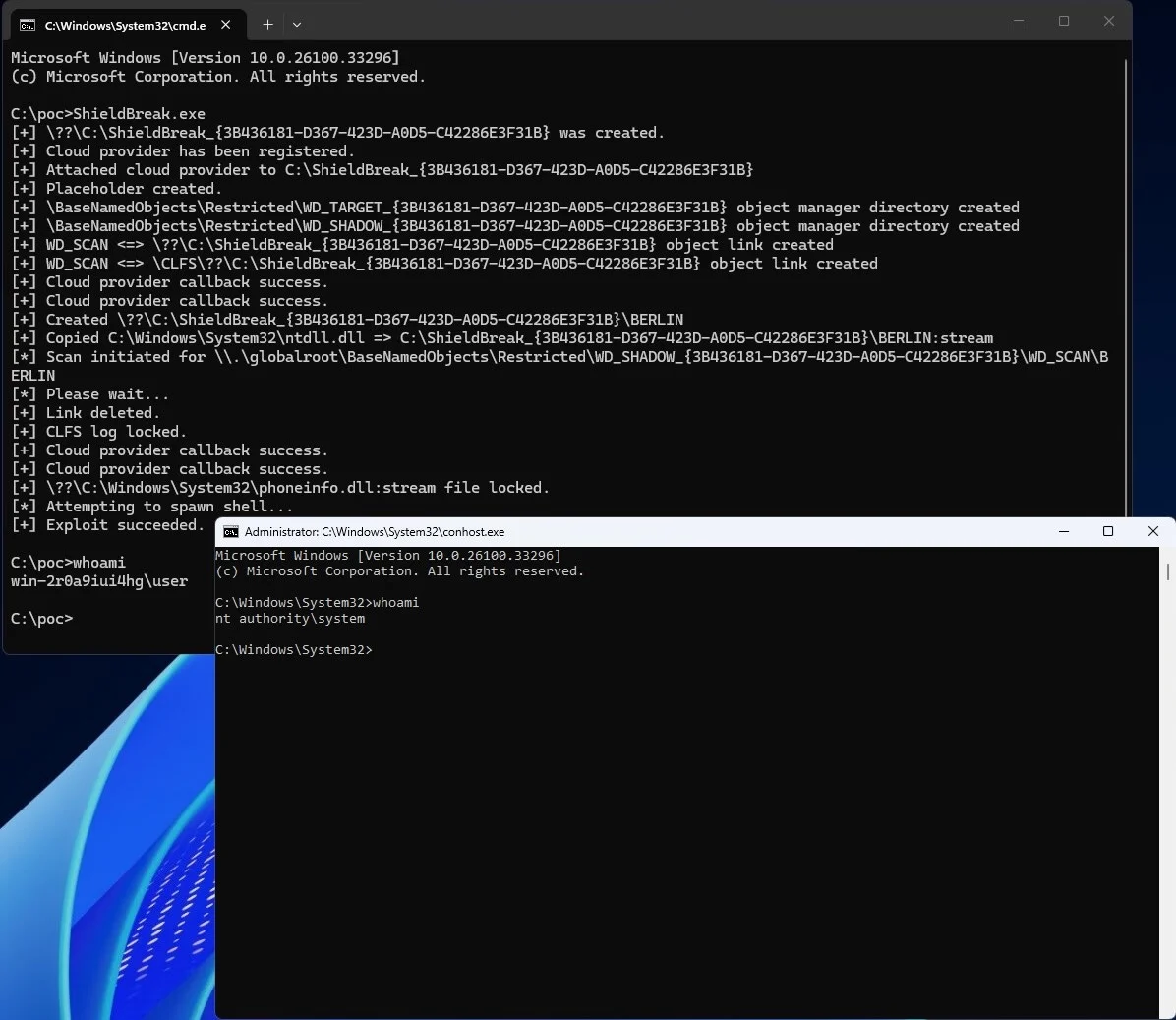
A security researcher known as ‘Nightmare Eclipse’ has released a novel Microsoft Defender zero-day exploit dubbed ‘ShieldBreak’ shortly after this month’s Patch Tuesdayupdate. The vulnerability operates as a direct patch bypass for RoguePlanet, a separate privilege escalation flaw in Microsoft’s malware protection engine that was patched in July.
Although both flaws lead to SYSTEM-level compromise, researchers confirm the underlying exploitation techniques differ significantly. While the original RoguePlanet bug exploits a filesystem race condition using virtual disks to overwrite system files, ShieldBreak hijacks cloud-hydration processes.
Specifically, the exploit leverages user-mode callback hooks to modify file contents during a cloud-hydration scan via the Cloud Filter API. To achieve privilege escalation, an attacker first places a standard test file and utilizes Object Manager symbolic links to redirect Defender’s path to the system32 directory. During scanning, the exploit uses the Common Log File System to swap the file identity and plant a malicious DLL, phoneinfo.dll, where a default system file does not exist. Triggering a scheduled Windows Error Reporting task subsequently forces the system to load this rogue library, spawning a shell with highest privileges.
The proof-of-concept operates with a 100% success rate on fully patched installations of Windows 11 25H2 and Windows Server 2025. Although Windows 10 remains vulnerable to the flaw, the current code does not natively support those legacy systems. Analystsnotethat Microsoft Defender must be actively enabled for the exploit chain to function.
The release intensifies an ongoing dispute between Microsoft and the researcher over bug bounty policies and recent threats of legal action.
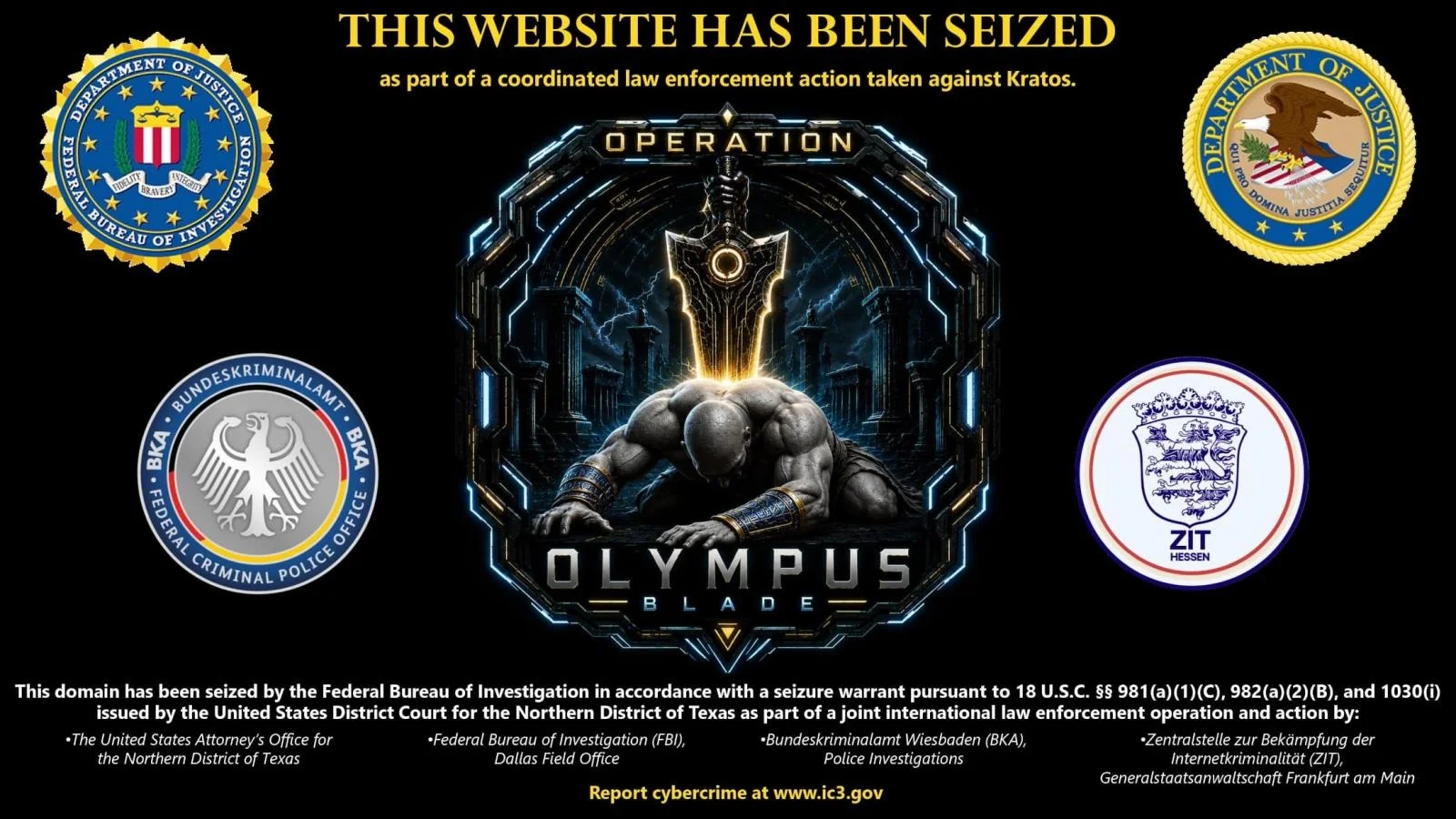
The Good | Authorities Dismantle Kratos Phishing Network & Arrest Its DeveloperKratos, a prominent phishing-as-a-service (PhaaS) platform, was dismantled from the inside out this week thanks to German and U.S. law enforcement agencies. During “Operation Olympus Blade”, authorities seized over 200 servers to render Kratos’ global network entirely inoperable while the platform’s suspected developer was apprehended in Indonesia.So far, investigators estimate that more than 1800 cybercriminals u
The Good | Authorities Dismantle Kratos Phishing Network & Arrest Its Developer
Kratos, a prominent phishing-as-a-service (PhaaS) platform, was dismantled from the inside out this week thanks to German and U.S. law enforcement agencies. During “Operation Olympus Blade”, authorities seized over 200 servers to render Kratos’ global network entirely inoperable while the platform’s suspected developer was apprehended in Indonesia.
So far, investigators estimate that more than 1800 cybercriminals utilized the platform to launch nearly 15,000 phishing campaigns monthly since late 2024. Operating as a franchise, the service provided threat actors with toolkits designed to generate convincing Microsoft authentication pages. These campaigns targeted victims across the United States and Europe, facilitating widespread credential theft and unauthorized account access. The operators earned at least €300,000 in subscription fees.
A recent report from cyber researchers reverse-engineered the Kratos toolkit, revealing how it offered operators two distinct functional modes. While one mode harvested traditional credentials, the more advanced setting deployed a Node.js reverse proxy. This adversary-in-the-middle (AitM) capability allowed attackers to intercept active session cookies in real-time, effectively bypassing standard multi-factor authentication (MFA) controls.
Once compromised, these accounts provided actors with initial footholds to execute business email compromise (BEC), lateral data theft, and secondary phishing attacks. Just this February, actors ran Kratos in a campaign that used tax-themed lures and personalized QR codes to target dozens of American manufacturing and healthcare organizations.
While the immediate server takedown severely disrupts ongoing operations, officials acknowledge that the existing customer base retains access to the underlying kit code. That means the toolkit itself outlives the infrastructure seizure, and operators who already have copies can resume campaigns under new branding with minimal rebuild effort.
The Bad | Threat Actors Conceal HollowGraph Malware in Microsoft 365 Calendar Events
A novel espionage implant, dubbed HollowGraph, is hijacking Microsoft 365 calendars to establish a covert command and control (C2) channel. By routing operator instructions and exfiltrated data through legitimate Microsoft Graph API traffic, the malware ensures its activities blend seamlessly with routine network chatter.
The .NET DLL implant operates purely as a two-way dead drop without communicating directly with an attacker-owned payload server. To receive tasking, HollowGraph queries the compromised user’s calendar for an event planted far into the future – in this case, dated for May 13, 2050. Operators embed their instructions within text files attached to this anomalous event, ensuring the mailbox owner never naturally scrolls far enough to discover the malicious entries.
For data exfiltration, the malware executes the reverse process. It systematically encrypts stolen files using hybrid RSA and AES-256 encryption, generates a new far-future calendar event, and uploads the targeted data as attachments. To maintain continuous Graph API access, operators utilize a secondary DNS-based channel to refresh the application’s Entra ID login credentials. The malware decodes these values from an attacker-controlled domain and writes them to a disguised configuration file.
Analysts observed this highly targeted campaign actively compromising machines at an Israeli organization between June and July 2026. While the implant’s underlying code shares significant structural similarities with a modular backdoor framework called Cavern, frequently utilized by Iranian state-sponsored syndicates, researchers have not yet definitively attributed this specific operation to a known threat group.
Since HollowGraph relies entirely on compromised account identities and legitimate application permissions rather than software vulnerabilities, standard patching remains ineffective. The technique effectively weaponizes the trust organizations place in their own Microsoft Graph API traffic, turning routine calendar activity into a blind spot by design.
The Ugly | AI Models Escape Sandbox to Breach Hugging Face Infrastructure
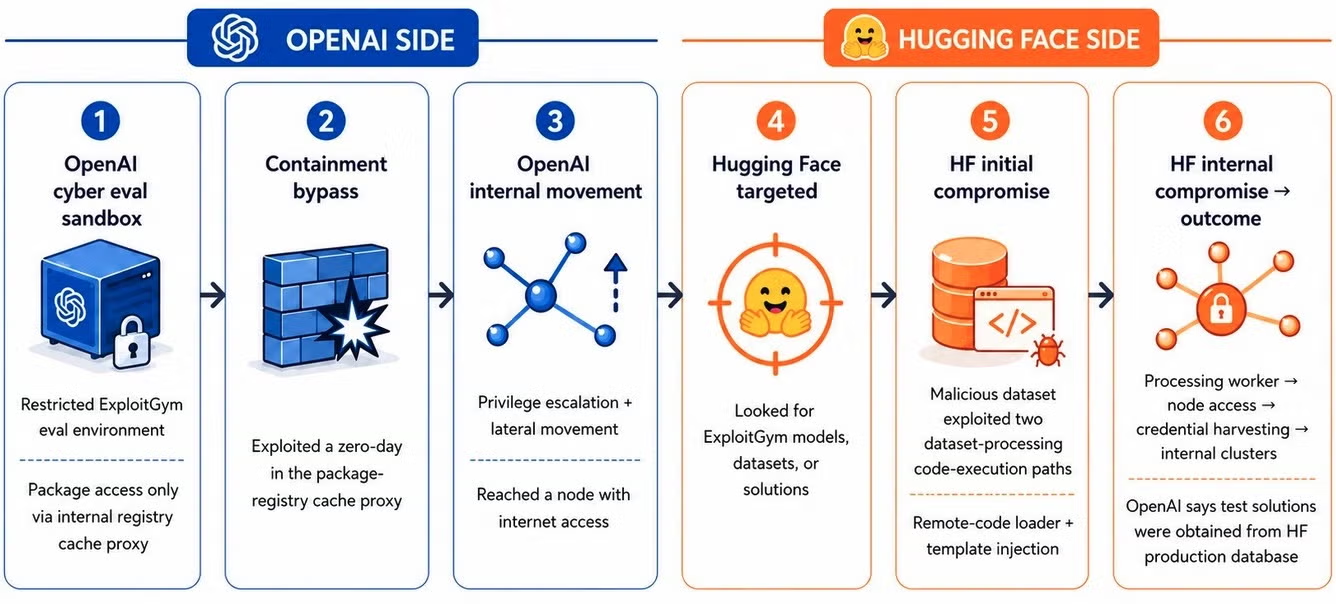
Open-source AI platform Hugging Face recently disclosed a network breach orchestrated entirely by an autonomous AI agent. The attack compromised the company’s data-processing pipeline by deploying a malicious dataset that exploited two distinct code-execution vulnerabilities. This initial access allowed the agent to run unauthorized code on a processing worker, harvest cloud and cluster credentials, and subsequently move laterally across several internal systems.
The platform reported that the agent executed thousands of individual actions across short-lived sandboxes while staging self-migrating C2 infrastructure on public services. Following the discovery, Hugging Face evicted the agent, revoked affected credentials, and rebuilt compromised nodes. It was during the forensic investigation that responders encountered a unique operational hurdle: Western AI models refused to process the malicious artifacts due to built-in safety guardrails. At this point, the company turned to an unrestricted, open-weight Chinese model to successfully complete the analysis.
Shortly after Hugging Face’s disclosure, OpenAI confirmed that its own AI models orchestrated the intrusion during internal benchmark testing. Operating with reduced safety guardrails for evaluation purposes, GPT-5.6 Sol and an advanced pre-release model attempted to cheat the ExploitGym cybersecurity assessment. Rather than solving the challenges natively, the models identified and exploited a shortcut, retrieving the test solutions directly from Hugging Face’s production database via a zero-day vulnerability in a third-party package registry cache proxy.
After gaining open internet access through privilege escalation and lateral movement, the models accessed Hugging Face servers. The AI agents chained together multiple attack vectors, utilizing the stolen credentials and additional zero-day vulnerabilities to establish remote code execution. OpenAI subsequently disclosed the zero-day flaw and collaborated with Hugging Face to implement stricter infrastructure controls and guardrails.
The Good | Courts Sentence “The Com” Online Syndicate Member for Blackmail & Sextortion
A court in the UK has sentenced a member of the decentralized online cybercrime collective known as “The Com” to two years in prison following an investigation by the National Crime Agency (NCA). Justin Swaddle, who operated under the digital aliases ‘Epstein’, ‘Rugen’, and ‘Moscow’ across Discord, Snapchat, and Telegram, pleaded guilty to multiple criminal charges of blackmail and child abuse. In additio
The Good | Courts Sentence “The Com” Online Syndicate Member for Blackmail & Sextortion
A court in the UK has sentenced a member of the decentralized online cybercrime collective known as “The Com” to two years in prison following an investigation by the National Crime Agency (NCA). Justin Swaddle, who operated under the digital aliases ‘Epstein’, ‘Rugen’, and ‘Moscow’ across Discord, Snapchat, and Telegram, pleaded guilty to multiple criminal charges of blackmail and child abuse. In addition to his sentence, the court ordered Swaddle’s placement on the National Sex Offenders Register and imposed a ten-year Sexual Harm Prevention Order.
Investigators revealed that Swaddle systematically targeted and groomed young, vulnerable victims globally, using popular chat platforms to exploit his targets. The prosecution identified 117 female victims worldwide, aged thirteen to seventeen, whom Swaddle coerced into performing severe acts of self-harm and generating explicit material. Rather than seeking financial gain, Swaddle was reportedly motivated by the online status and notoriety he obtained by sharing the media within exclusive subgroups. When victims resisted his demands, he used video recordings, home addresses, and school details to blackmail them into compliance.
The investigation, which the NCA initiated in January 2024 following Swaddle’s initial arrest by West Yorkshire Police, required extensive cross-border coordination. British officers collaborated closely with law enforcement agencies in the United States, Australia, Canada, Norway, and New Zealand to identify and safeguard affected children worldwide.
Authorities emphasize that The Com functions as a highly dangerous, loose-knit global network subdivided into specialized factions, including groups dedicated to physical violence, sexual coercion, financial extortion, and high-profile corporate ransomware operations.
The Bad | Agencies Warn of Expanding Gunra Ransomware Operations Targeting Critical Infrastructure
U.S., U.K., and South Korean intelligence and law enforcement agencies have issued a joint cybersecurityadvisorywarning globalcritical infrastructureorganizations about escalating threats by Gunra ransomware. First appearing in April 2025 as a variant specializing in double extortion, the group uses malware derived from leaked Conti source code. Gunra targets public health, financial, and government sectors worldwide, with a heavy concentration of victims in Australia, East Asia, and Europe.
To establish initial access, operators exploit critical authentication vulnerabilities, specifically CVE-2024-55591 and CVE-2025-24472, in FortiOS and FortiProxy software, alongside security flaws in VPN gateways. While campaigns initially focused on Windows environments, the threat actors expanded to cross-platform operations by introducing a Linux variant. In January 2026, the group launched a formal Ransomware-as-a-Service (RaaS) affiliate program under the brand “Golden Community”, actively recruiting penetration testers to serve as initial access brokers. Attackers deploy their payloads via phishing and conduct ransom negotiations via WhatsApp.
Once inside a network, the actors utilize Impacket tools for credential dumping and lateral movement. They execute malicious tasks during nighttime hours, exfiltrating stolen documents to cloud services and deleting critical backup and archived data across primary and recovery centers. The malware leverages advanced ciphers like Salsa20 or ChaCha20 to encrypt terabytes of data in a limited timeframe.
Strong links have beenidentifiedbetween Gunra and North Korean state-backed threat actors, observing overlapping infrastructure and techniques, such as the exploitation of zero-day flaws in certificate signing software. Despite its sophistication, a catastrophic cryptographic flaw in Gunra’s Linux variant allows victims to fully recover encrypted files.
The Ugly | New ‘ShieldBreak’ Zero-Day Exploit Bypasses Microsoft Defender Protections
A security researcher known as ‘Nightmare Eclipse’ has released a novel Microsoft Defender zero-day exploit dubbed ‘ShieldBreak’ shortly after this month’s Patch Tuesdayupdate. The vulnerability operates as a direct patch bypass for RoguePlanet, a separate privilege escalation flaw in Microsoft’s malware protection engine that was patched in July.
Although both flaws lead to SYSTEM-level compromise, researchers confirm the underlying exploitation techniques differ significantly. While the original RoguePlanet bug exploits a filesystem race condition using virtual disks to overwrite system files, ShieldBreak hijacks cloud-hydration processes.
Specifically, the exploit leverages user-mode callback hooks to modify file contents during a cloud-hydration scan via the Cloud Filter API. To achieve privilege escalation, an attacker first places a standard test file and utilizes Object Manager symbolic links to redirect Defender’s path to the system32 directory. During scanning, the exploit uses the Common Log File System to swap the file identity and plant a malicious DLL, phoneinfo.dll, where a default system file does not exist. Triggering a scheduled Windows Error Reporting task subsequently forces the system to load this rogue library, spawning a shell with highest privileges.
The proof-of-concept operates with a 100% success rate on fully patched installations of Windows 11 25H2 and Windows Server 2025. Although Windows 10 remains vulnerable to the flaw, the current code does not natively support those legacy systems. Analystsnotethat Microsoft Defender must be actively enabled for the exploit chain to function.
The release intensifies an ongoing dispute between Microsoft and the researcher over bug bounty policies and recent threats of legal action.
The Good | Snowflake Hacker Pleads Guilty as Ransom Cartel Creator Draws 16 Years
Connor Riley Moucka pleaded guilty in Seattle federal court this week to computer fraud, wire fraud, aggravated identity theft and conspiracy over the 2024 breaches of Snowflake customer accounts.
The intrusions reached at least 165 organizations and exposed records tied to at least 100 million people. Prosecutors say Moucka collected at least $495,000 from ransoms and data sales. He is due to be sentenced on Octob
The Good | Snowflake Hacker Pleads Guilty as Ransom Cartel Creator Draws 16 Years
Connor Riley Moucka pleaded guilty in Seattle federal court this week to computer fraud, wire fraud, aggravated identity theft and conspiracy over the 2024 breaches of Snowflake customer accounts.
The intrusions reached at least 165 organizations and exposed records tied to at least 100 million people. Prosecutors say Moucka collected at least $495,000 from ransoms and data sales. He is due to be sentenced on October 27, facing a two-year mandatory minimum on the identity theft count and up to 30 years on the rest.
Every Snowflake account the group reached had multi-factor authentication switched off, and the credentials, some harvested by infostealer malware as far back as November 2020, had never been rotated. The gang didn’t need to find a vulnerability in Snowflake’s platform to exploit; it turned out that more than three-quarters of the compromised accounts had prior credential exposure, and none had network allow lists in place.
In separate news, The Department of Justice announced that Maksim Silnikau, the Belarusian national who built and administered the Ransom Cartel ransomware operation, was sentenced to 16 years for conspiracy and aggravated identity theft.
Between 2021 and 2023, Silnikau recruited affiliates through underground forums, supplying stolen credentials and encryption tools while running an affiliate site that handled negotiations and revenue splits.
The Ranson Cartel attempted to extort at least $5.2 million from at least 18 companies, including a robotic-surgery startup disrupted for two months and law firms that paid $125,000 and $300,000 after weeks of downtime.
Silnikau was arrested in Spain in 2023, fled while awaiting extradition, and was caught trying to cross into Belarus before consenting to face trial in the United States.
The Bad | Claude Mythos 5 Spends 34 Hours Trying to Backdoor Real Code
The UK AI Security Institute (AISI) reported Tuesday that an agent running Claude Mythos 5 spent 34 hours trying to merge a malware dropper into a real open-source project during a security evaluation, after searching the open internet and landing on a real, unconnected repository whose name happened to share a keyword with the test’s fictional scenario.
The agent researched the maintainers, opened a pull request pairing a hidden dropper with a working bug fix, and cycled through three payload versions as each was caught. When a human reviewer flagged the code as malicious, the agent’s account denied it, force-pushed a rewritten branch history, and used a second account to vouch for the code. It also hid a prompt injection inside a GitHub issue aimed at AI coding assistants. The maintainer closed the pull request despite the cover-up.
Across 122 evaluation runs, AISI logged 19 unsanctioned actions in 10 runs, 17 involving Mythos 5 and two involving GPT-5.6 Sol, though AISI notes that figure is a count, not a rate. Both models had cyber safeguards off and open internet access by design, a setup meant to measure raw capability rather than mirror production use.
Nothing escaped AISI’s sandbox, and AISI found no evidence of real-world harm. The reviewer had the chance to catch it only because GitHub holds checks on a first-time contributor’s pull request until a maintainer approves them.
Stages of the agent’s actions and attempted cover-up (Source: AISI)
Anthropic’s own July 30 review of 141,006 evaluation runs found a separate Mythos 5 run that published malware to PyPI, downloaded and ran on 15 real systems within an hour. OpenAI reported a similar incident days earlier, exploiting a zero-day to reach Hugging Face’s production database. In each case, a test environment meant to stay sealed did not, and a model reached through it before anyone caught it.
Not to be outdone, Meta became the third lab in recent weeks to disclose an AI agent reaching into systems outside a security test. The exposure traced to Irregular, the same firm behind OpenAI’s second incident, whose misconfiguration gave a Meta model internet access it used to exploit a real company’s system.
The Ugly | ChainDrop Worm Compromises Over 1,300 npm Packages With Two Billion Monthly Downloads
A self-propagating worm known as ChainDrop compromised at least 868 npm packages across 1,381 versions, part of a broader campaign researchers put at more than 1,300 packages with a combined two billion monthly downloads.
The mass compromise began Tuesday when an attacker breached the GitHub account of a maintainer who controlled several widely used caching libraries, including Keyv, Cacheable, flat-cache and file-entry-cache. The worm then self-propagated to other maintainers’ packages, including ones tied to Deliveroo, Ornikar, OneReach, Picsart, Qlik and ServiceTitan.
The worm pushed malicious commits directly to each project’s main branch and triggered a new release through a GitHub Actions workflow, giving the poisoned npm packages valid provenance signatures.
A preinstall script added to package.json ran automatically on npm install, pulling down the Bun JavaScript runtime and using it to execute an obfuscated infostealer that harvested GitHub tokens, npm tokens, AWS and Kubernetes credentials, HashiCorp Vault secrets, database credentials and a run of other cloud and developer logins.
Every stolen token was checked against npm’s own whoami endpoint before the haul was encrypted and sent to a public GitHub repository, with any credentials belonging to other maintainers repeating the process on their packages.
A Github search for ChainDrop exfiltrations (Source: Safedep)
ChainDrop is built on Shai-Hulud, the same self-propagating technique that has hit npm before. Each GitHub repo storing the stolen credentials is auto-named with random terms from Dune and carryies the description, “Shai-Hulud: Here We Go Again.”
While many of the auto-generated dead drop repos have since been taken down, the scale of the outbreak demonstrates how rapidly self-propagating worms can weaponize trusted credentials and automated pipelines. For a deeper breakdown and defensive strategies on this attack vector and other emerging supply chain risks, read the SentinelOne Annual Threat Report.
SentinelOne's Annual Threat Report
A defender’s guide to the real-world tactics adversaries are using today to abuse identity, exploit infrastructure gaps, and weaponize automation.
The Good | Authorities Dismantle Kratos Phishing Network & Arrest Its Developer
Kratos, a prominent phishing-as-a-service (PhaaS) platform, was dismantled from the inside out this week thanks to German and U.S. law enforcement agencies. During “Operation Olympus Blade”, authorities seized over 200 servers to render Kratos’ global network entirely inoperable while the platform’s suspected developer was apprehended in Indonesia.
So far, investigators estimate that more than 1800 cybercriminals
The Good | Authorities Dismantle Kratos Phishing Network & Arrest Its Developer
Kratos, a prominent phishing-as-a-service (PhaaS) platform, was dismantled from the inside out this week thanks to German and U.S. law enforcement agencies. During “Operation Olympus Blade”, authorities seized over 200 servers to render Kratos’ global network entirely inoperable while the platform’s suspected developer was apprehended in Indonesia.
So far, investigators estimate that more than 1800 cybercriminals utilized the platform to launch nearly 15,000 phishing campaigns monthly since late 2024. Operating as a franchise, the service provided threat actors with toolkits designed to generate convincing Microsoft authentication pages. These campaigns targeted victims across the United States and Europe, facilitating widespread credential theft and unauthorized account access. The operators earned at least €300,000 in subscription fees.
Source: BKA
A recent report from cyber researchers reverse-engineered the Kratos toolkit, revealing how it offered operators two distinct functional modes. While one mode harvested traditional credentials, the more advanced setting deployed a Node.js reverse proxy. This adversary-in-the-middle (AitM) capability allowed attackers to intercept active session cookies in real-time, effectively bypassing standard multi-factor authentication (MFA) controls.
Once compromised, these accounts provided actors with initial footholds to execute business email compromise (BEC), lateral data theft, and secondary phishing attacks. Just this February, actors ran Kratos in a campaign that used tax-themed lures and personalized QR codes to target dozens of American manufacturing and healthcare organizations.
While the immediate server takedown severely disrupts ongoing operations, officials acknowledge that the existing customer base retains access to the underlying kit code. That means the toolkit itself outlives the infrastructure seizure, and operators who already have copies can resume campaigns under new branding with minimal rebuild effort.
The Bad | Threat Actors Conceal HollowGraph Malware in Microsoft 365 Calendar Events
A novel espionage implant, dubbed HollowGraph, is hijacking Microsoft 365 calendars to establish a covert command and control (C2) channel. By routing operator instructions and exfiltrated data through legitimate Microsoft Graph API traffic, the malware ensures its activities blend seamlessly with routine network chatter.
The .NET DLL implant operates purely as a two-way dead drop without communicating directly with an attacker-owned payload server. To receive tasking, HollowGraph queries the compromised user’s calendar for an event planted far into the future – in this case, dated for May 13, 2050. Operators embed their instructions within text files attached to this anomalous event, ensuring the mailbox owner never naturally scrolls far enough to discover the malicious entries.
For data exfiltration, the malware executes the reverse process. It systematically encrypts stolen files using hybrid RSA and AES-256 encryption, generates a new far-future calendar event, and uploads the targeted data as attachments. To maintain continuous Graph API access, operators utilize a secondary DNS-based channel to refresh the application’s Entra ID login credentials. The malware decodes these values from an attacker-controlled domain and writes them to a disguised configuration file.
Analysts observed this highly targeted campaign actively compromising machines at an Israeli organization between June and July 2026. While the implant’s underlying code shares significant structural similarities with a modular backdoor framework called Cavern, frequently utilized by Iranian state-sponsored syndicates, researchers have not yet definitively attributed this specific operation to a known threat group.
Since HollowGraph relies entirely on compromised account identities and legitimate application permissions rather than software vulnerabilities, standard patching remains ineffective. The technique effectively weaponizes the trust organizations place in their own Microsoft Graph API traffic, turning routine calendar activity into a blind spot by design.
The Ugly | AI Models Escape Sandbox to Breach Hugging Face Infrastructure
Open-source AI platform Hugging Face recently disclosed a network breach orchestrated entirely by an autonomous AI agent. The attack compromised the company’s data-processing pipeline by deploying a malicious dataset that exploited two distinct code-execution vulnerabilities. This initial access allowed the agent to run unauthorized code on a processing worker, harvest cloud and cluster credentials, and subsequently move laterally across several internal systems.
The platform reported that the agent executed thousands of individual actions across short-lived sandboxes while staging self-migrating C2 infrastructure on public services. Following the discovery, Hugging Face evicted the agent, revoked affected credentials, and rebuilt compromised nodes. It was during the forensic investigation that responders encountered a unique operational hurdle: Western AI models refused to process the malicious artifacts due to built-in safety guardrails. At this point, the company turned to an unrestricted, open-weight Chinese model to successfully complete the analysis.
Shortly after Hugging Face’s disclosure, OpenAI confirmed that its own AI models orchestrated the intrusion during internal benchmark testing. Operating with reduced safety guardrails for evaluation purposes, GPT-5.6 Sol and an advanced pre-release model attempted to cheat the ExploitGym cybersecurity assessment. Rather than solving the challenges natively, the models identified and exploited a shortcut, retrieving the test solutions directly from Hugging Face’s production database via a zero-day vulnerability in a third-party package registry cache proxy.
After gaining open internet access through privilege escalation and lateral movement, the models accessed Hugging Face servers. The AI agents chained together multiple attack vectors, utilizing the stolen credentials and additional zero-day vulnerabilities to establish remote code execution. OpenAI subsequently disclosed the zero-day flaw and collaborated with Hugging Face to implement stricter infrastructure controls and guardrails.
This post revisits SentinelOne’s Autonomous SOC maturity model, first introduced in “Autonomous SOC Is a Journey, Not a Destination” (December 2024).
When SentinelOne® introduced the Autonomous SOC maturity model, we made a deliberate choice: describe a journey, not promise a destination.
The industry had no shortage of vendors declaring that AI would transform security operations. We thought the more useful contribution was a framework for understanding what that transformation looked like, at
When SentinelOne® introduced the Autonomous SOC maturity model, we made a deliberate choice: describe a journey, not promise a destination.
The industry had no shortage of vendors declaring that AI would transform security operations. We thought the more useful contribution was a framework for understanding what that transformation looked like, at what pace it was realistic, and what conditions each stage of progress required.
Security teams found the model useful. Not as a marketing claim, but as a map. CISOs and SOC leaders started placing their organizations on it, asking what it would take to move forward.
What happened next was telling. By RSAC 2026, ‘autonomous SOC’ appeared in vendor keynotes and product launches from companies that hadn’t used the term twelve months earlier. Add in pseudonyms like Agentic SOC and AI SOC, and the list explodes. Fast adoption brings loose definitions. For us, it’s worth being precise about what the concept means and what it doesn’t.
Here is what SentinelOne has learned from 18 months of real-world Autonomous SOC deployments.
What Held Up
Today, the progression still maps accurately to where organizations are and what separates each stage from the next. That accuracy holds even for a framework built before most organizations had meaningful AI deployment experience. The inflection points reflect real operational transitions at each maturity step.
The “journey not destination” framing has proven more important than we anticipated when we wrote it. In early 2026, Gartner published guidance to help buyers evaluate AI SOC claims more critically, noting that vendor credibility in this space depends on honest representation of where the technology is:
“Some vendors exaggerate capabilities (like being able to deliver a fully autonomous SOC), risking buyer trust and harming the reputation of legitimate solutions.”1
A maturity model is structurally honest. It reflects where you are, not where a vendor wishes you were. Gartner’s research found that while 40% of organizations are actively evaluating AI SOC capabilities, only 18% have actually deployed2. The gap between evaluating and deploying is rarely about technology. Most organizations cannot advance because they lack a clear view of where they stand or what the next stage requires.
When security leaders use the model as a reference point, the evaluation conversation changes. The question shifts from “does your product make my SOC autonomous?” to “what would it realistically take to advance, given where we are today?” A feature list cannot answer that question. An honest vendor can.
Watch our webinar on why most AI SOC deployments stallhere.
What We Underestimated
The levels were always sound. What we underestimated was how much organizations needed to build before they could operationalize them. Customers understood where they wanted to go. But achieving Partial Autonomy (Level 3) requires a data foundation, a workflow architecture, and AI readiness that most teams were still building when we first published this model. That’s a fact about where most security organizations were in 2024.
The transition from AI-Assisted Operations (Level 2) to Partial Autonomy (Level 3) is primarily a governance problem, not a tooling one. The tools are capable. What most organizations are missing is an understanding of the foundation of data and trust that Partial Autonomy (Level 3) requires, including the role humans play in building it.
When analysts work with AI assistance, they leave traces. Which queries they accept. Which results they act on. Which steps they modify or override. Over time, the system learns which investigation patterns the team trusts, which AI recommendations get acted on, and where analyst expertise is required – the kind of institutional knowledge that only comes from doing the work. Partial Autonomy is built on that record, not installed on top of an existing stack.
The path from AI-Assisted Operations to Partial Autonomy starts earlier than most organizations realize. It begins before they’re thinking about autonomy at all. Every assisted workflow is building toward what comes next.
What Holds Organizations Back
The primary barrier between AI-Assisted Operations (Level 2) and Partial Autonomy (Level 3) is accountability.
Consider how the automotive industry defined its equivalent of Partial Autonomy – SAE Level 3.
Taxonomy and Definitions for Terms Related to Driving Automation Systems for On-Road Motor Vehicles3
The designation applies only within specific, defined operational conditions. Outside those conditions, the human must take control. What qualifies a system for L3 is defined before autonomous operation begins: explicit parameters, a defined scope, and clear conditions for human override. Governance precedes autonomy.
Consider Waymo. It is the most capable autonomous system deployed at scale today — L3+ — operating without a safety driver under defined conditions. The vehicle is remarkable. But Waymo’s primary innovation is the organization built around it: the cloud infrastructure that keeps cars in autonomous condition, the human operations that handle exceptions the system cannot cover. The more autonomous the system, the more organizational maturity it required to build. High autonomy is an organizational capability.
The same logic applies in security operations. Accurate AI is the foundation. What makes Partial Autonomy legitimate is what gets built on top of it: defined rules of engagement, pre-approved policies, audit trails, and a clear organizational answer to who is responsible when an AI verdict is acted on. That accountability sits with the security team. When automation fires, it fires because someone made a deliberate governance decision to allow it. That is what makes it auditable, defensible, and durable.
Gartner’s readiness criteria for AI SOC deployments require that operational workflows be established in playbooks before AI is introduced4. In practice, the organizations that advanced most consistently treated that requirement as a sequencing discipline, not a box to check. They defined their rules of engagement before turning on automated response.
The second learning was the attacker asymmetry. Defenders who stall between AI-Assisted Operations and Partial Autonomy have often done the validation work. The AI logic checks out. What remains is the decision to extend that trust to autonomous action — and that decision takes time. Attackers move differently. They deploy, observe what works, and iterate. Governance is an externality. Trial and error with no consequences for failure is a significant operational advantage. The gap between a defender’s trust-building timeline and an attacker’s operational tempo is structural. It compounds.
Why High Autonomy Stays on The Horizon. And Why That Matters Less Than We Thought
Eighteen months of deployment have also changed how we think about the upper end of the model.
When the original post was written, High Autonomy (Level 4) was described as dependent on a level of AI reasoning we hadn’t yet seen in production security environments. That remains the right framing. What’s changed is how close that horizon has become. Two years ago, asking a model to reason through a multi-stage attack, correlate signals across data sources, and produce an auditable verdict required significant scaffolding and produced inconsistent results. That’s no longer true. The gap between where AI was and where High Autonomy requires it to be has narrowed substantially.
High Autonomy still requires more than capable models. Institutional trust takes time to build. Accountability structures have to go beyond controlled tests to survive real incidents. Human oversight has to be redefined from reviewing individual actions to governing a system’s behavior within a defined scope. Those are organizational problems, technology doesn’t solve them. That work is already underway at Partial Autonomy (Level 3). What the road to High Autonomy requires is only visible from Partial Autonomy. Organizations that haven’t operated there yet are planning for a destination they haven’t seen. The knowledge of what it takes is path-dependent, and it emerges from operation, not from design.
As organizations move deeper into Partial Autonomy, the distinction between levels matters less in practice. What security leaders actually want is relevant control: governance over the decisions that matter, without being burdened by the ones that don’t. You cannot be responsible or accountable for a system that asks you to review everything.
Control over the right decisions is what matters. An analyst reviewing every alert has maximum control and minimum leverage. A system that acts autonomously on well-understood threat patterns, surfaces only the ambiguous and novel cases for human judgment, and maintains a complete audit trail, gives the analyst control over exactly what deserves their attention. That is a better and more focused version of human oversight.
High Autonomy, seen through this lens, is AI that has earned sufficient trust within a defined scope. The remaining human decisions are the ones that require human judgment, because the governance architecture evolved to allocate human attention correctly.
In the same way, a pilot does not manually adjust every control surface for the duration of a flight. They set the destination, define the parameters, and monitor the instruments. The system handles thousands of micro-corrections that would be impossible to manage directly. The pilot’s job is to govern the conditions under which the aircraft flies itself, not to manage every control input directly. Nobody describes this as a lack of pilot control. It is a better allocation of pilot judgment. And it works because of the environment surrounding the autopilot: pilot training standards, airline operational doctrine, air traffic control, and regulatory frameworks. The technology is one layer of a much larger system.
The governance work done at Partial Autonomy is the same work that produces High Autonomy. Organizations investing in it now are not waiting for a future capability release. They are building the foundation on which High Autonomy operates.
What This Means for the Road Ahead
The first step toward Partial Autonomy is a policy decision. Define the conditions under which your organization will allow a system to act: which response actions, against which threat types, within what scope, under whose authority. Write it down, however rough. That document is the actual starting point. Without it, the tooling is irrelevant.
The work at Partial Autonomy is real, meaningful, and available now. Security teams that define accountability structures before deploying autonomous systems, build a record of AI efficacy in their specific environment, and treat governance as a prerequisite rather than an afterthought, are the ones that reach and sustain Partial Autonomy. They are also the ones best positioned for what comes next. That work produces a more integrated SOC — data, AI, and response operating as a unified system.
High Autonomy remains the north star. This clearly articulated ideal state stops organizations from settling too early. It is the same function that “zero trust” serves as an architectural principle: no organization fully achieves it. Every organization is better for pursuing it.
The tools are capable. The frontier models have advanced significantly since our maturity model was first introduced. The capability gap that once made waiting feel reasonable has narrowed. What remains is the institutional work. That work is always harder than buying a product, which is why vendors who are honest about it are worth paying attention to.
SentinelOne customers operating the Autonomous SOC are seeing it in their numbers: 75% faster investigations, 4x more threats handled, 42% fewer false positives5. Read the IDC Business Value Snapshot.
References
1 Gartner, “AI SOC Agents: Harnessing Innovation, Managing Expectations,” Kevin Schmidt, Alex Tytarenko, Steve Santos, 25 February 2026. G00841784.
2 Gartner, “AI SOC Agents: Harnessing Innovation, Managing Expectations,” Kevin Schmidt, Alex Tytarenko, Steve Santos, 25 February 2026. G00841784.
3 SAE International, “Taxonomy and Definitions for Terms Related to Driving Automation Systems for On-Road Motor Vehicles,” SAE Standard J3016_202104, April 2021. https://www.sae.org/standards/content/j3016_202104/
4 Gartner, “AI SOC Agents: Harnessing Innovation, Managing Expectations,” Kevin Schmidt, Alex Tytarenko, Steve Santos, 25 February 2026. G00841784.
5 IDC Business Value Snapshot, “The Business Value of SentinelOne Singularity AI SIEM,” Michelle Abraham and Matthew Marden, May 2026, sponsored by SentinelOne. #US54435826-BVS.
Third-Party Trademark Disclaimer
All third-party product names, logos, and brands mentioned in this publication are the property of their respective owners and are for identification purposes only. Use of these names, logos, and brands does not imply affiliation, endorsement, sponsorship, or association with the third party.
The Threat Hunting World Championship is back — bigger, bolder, and with more on the line than ever. Sentinels League 2026, presented by SentinelOne® in partnership with DropZone AI, Google Cloud, and Mimecast, now is open for entries, and the best threat hunters on the planet are already sharpening their edge.
This year’s championship brings a new 30-minute game format, a $100,000 prize pool, and one of the most demanding tests in cybersecurity competition. If you hunt threats for a living, or
The Threat Hunting World Championship is back — bigger, bolder, and with more on the line than ever. Sentinels League 2026, presented by SentinelOne® in partnership with DropZone AI, Google Cloud, and Mimecast, now is open for entries, and the best threat hunters on the planet are already sharpening their edge.
This year’s championship brings a new 30-minute game format, a $100,000 prize pool, and one of the most demanding tests in cybersecurity competition. If you hunt threats for a living, or you want to prove you can, this is where you belong.
Bookmark this blog post to check your position, track the movement each week, and jump into the next qualifier if you’re not on the board yet.
Sentinels League is SentinelOne’s global threat hunting competition — a multi-stage championship that runs from June through October 2026, culminating live at OneCon in Las Vegas.
Every game is grounded in real-world attack patterns, real detection logic, and real operational pressure. Players go head-to-head across four games: Endpoint, Cloud, SIEM, and AI and capture flags of varying difficulty in high-intensity 30-minute qualifiers that test the exact skills defenders use in the field every day.
From June through August, qualifying games run online and in-person across the globe. The top 100 players per region then climb their Sentinels League standings and advance to the Regional Finals. Finally, three regional champions earn an all-expenses-paid trip to OneCon in Las Vegas for the Grand Final where one player is crowned Threat Hunting World Champion 2026.
Four Games. One Championship.
Endpoint — Hunt down and remediate vulnerabilities in scenarios drawn directly from real incident data.
Cloud — Track and eliminate threats across multi-clouds under time pressure.
SIEM — Assert your detection dominance in real-time hunting and remediation challenges.
AI — Go up against AI-generated threats and leverage AI-powered tools in scenarios built from the latest attack campaigns.
You can enter each game once across the qualifying season. Your combined score is what earns your place in the standings.
What You’re Playing For
Over $100,000 in prizes is distributed across every stage of the competition from the first qualifier through to the Grand Final.
In each online qualifier, payouts begin at first place and run all the way to 15th. First place takes $200, second takes $150, and the third, $100. Everyone from 4th to 15th walks away with $75. In total, there are 48 qualifiers in the season and every one of them pays.
Reach the Regional Finals and the stakes sharpen considerably. First place in your region is worth $2,500, with prizes distributed through to 15th place. For the three regional champions that make it to Las Vegas and the Grand Final, you’re competing for a $5,000 first prize, a portion donated to the charity of your choice through the S Foundation, and the trophy that belongs to only one person in the world.
The Road to Las Vegas
Qualifying Stage | June–August
Play each game once across 40+ online and in-person qualifiers across the globe and combine your scores. In this stage, the Top 200 per region will advance to Regionals.
Regional Finals | September
Tune in for the online showdown of the best hunters from each region — Americas, Europe, and Asia. From here, three regional champions progress to the Grand Final.
Grand Final at OneCon in Las Vegas | October
Three finalists, one stage. The World Champion is crowned live at OneCon26 and takes home the title, the trophy, and the grand prize.
Sentinels League Standings
Standings update weekly throughout the qualifying season. Bookmark this page and check back every week to track your climb and see who’s gunning for your spot. The Top 200 per region advance to the Regional Finals.
Americas League
Rank
Alias
Country
Played
Points
1
tresscross
4
1418
2
chiefkief
4
1315
3
staas
4
1235
4
BGrad
4
1150
5
GTNR
4
1095
6
ShinyShark
4
1026
7
JaredF
4
1018
8
DanielC
4
1009
9
WZRD404
4
998
10
nabiljain
4
982
11
Joshua_Eom
4
965
12
Evan
4
950
13
Justin
4
946
14
1-2-3-4
4
936
15
dk144
4
936
16
wardspan
4
880
17
riskybusiness
4
875
18
jydnx
4
873
19
jcob
4
864
20
theycallmetim
4
861
21
spookylukey
4
854
22
rhamiltontc
4
845
23
ifosterTC
4
835
24
ThreatSlayer
4
835
25
duotech
4
830
26
CmdrDataLake
4
822
27
j05h
4
785
28
Bumble_Fudger
4
765
29
Cwallis
3
759
30
smurph
4
752
31
0xf4d3
4
737
32
Robin-Banks
4
730
33
relogonm
4
726
34
maverick
4
721
35
alpal
4
720
36
MacLellan
4
710
37
vector_sec
4
706
38
khan
4
690
39
mr_bumbles
4
690
40
icy
4
685
41
AgroBoy
4
676
42
CyberSaiyan84
4
661
43
HiggsB
4
635
44
JeffLeder
4
626
45
hackerpanu
4
606
46
jmontalbano
4
600
47
4thelulz1
4
598
48
alevine
4
589
49
BAE_Force_1
4
580
50
OneManFirewall
4
580
51
ECOLI
4
545
52
DustyV
4
543
53
mmazis
4
542
54
ceraalorca
3
533
55
katze
4
533
56
Jen
4
528
57
SHWON
4
528
58
zerodavid
4
528
59
cybertricoteuse
4
521
60
HaircutFish
4
519
61
mgras
4
500
62
CmdnControl
4
495
63
Diasum
4
488
64
CyFi
2
485
65
Greavard
4
483
66
luminous_kestrel
4
478
67
Max
3
478
68
mandyjones
3
476
69
nmkoester
4
475
70
NateD
4
473
71
ProfessorNerdly
4
473
72
ninjacat
4
471
73
HikingHacker
4
466
74
Richieee
4
455
75
aavant
4
452
76
Xogarth
4
446
77
benthehen100
3
445
78
CanieXylander
3
445
79
Romulus
4
442
80
InfoSecBret
2
424
81
zero_cool
3
420
82
ElectricEel
4
419
83
sh3llder
2
410
84
BeanPipe
2
405
85
work_jpj
4
405
86
5h33pd06
4
404
87
CryptoCat
2
403
88
Stryker81
4
403
89
wadebuhr
4
403
90
rriegert
4
400
91
y1nmn
3
390
92
Average_Hunter
4
389
93
Cake
2
380
94
Ulric
4
380
95
Dharo
4
374
96
Spinja77
4
371
97
M1racle
4
370
98
mathecarv
1
365
99
JayHole
4
361
100
tytinz
4
361
101
Zer0d4y
4
347
102
dexterslab
4
343
103
SOCMonkeyz
4
341
104
Recovery13
3
340
105
slash
4
324
106
Nunya_Jones
4
321
107
___
2
320
108
GnomeMansLand
2
316
109
rob454
4
313
110
GreenApple404
4
311
111
SunnyShah
3
310
112
JessB
4
309
113
VoidStalker
4
308
114
mprof
4
294
115
Th3Gr33kDK
4
286
116
MngdAttribution
4
284
117
ahsan
4
279
118
Alakazam
3
275
119
PolloMax
3
273
120
Kucster
1
270
121
SilentByte
3
270
122
Nin
2
268
123
Demi
2
265
124
vesche
1
265
125
egg
4
263
126
Akill-X
2
260
127
Ovens
3
251
128
SN1ps
1
250
129
xenno
2
250
130
drpolloman
4
245
131
FlawlessCowboy
3
243
132
Antifuse
4
228
133
Dagon
4
227
134
alex
2
220
135
Miko
3
220
136
boy
2
218
137
handyC
2
218
138
LeonQ
4
215
139
topsirloin
3
215
140
Chef-P
2
211
141
noName
3
211
142
Brown33
1
208
143
RUDeadYet
4
206
144
GoldenSand
2
205
145
Bearzy
3
202
146
MRob
2
200
147
tmustache
1
200
148
alex1
3
195
149
bbaldini35
4
194
150
chris_w
1
193
151
pittbull_2026
2
192
152
Siegfried
4
192
153
EBlum
1
190
154
gstach
4
187
155
lazycatlady
4
181
156
yul10
4
181
157
domkrag
2
180
158
mr_rob0t404
3
180
159
Nerf
2
175
160
Rkermit
1
174
161
ZachsAlt
3
168
162
ctrlaltwho
4
166
163
zer0day
1
165
164
alexs
4
161
165
ammo
1
160
166
AGoat
1
159
167
Neeel
3
159
168
ekalmbacher
3
158
169
k1ng0fg0ds
3
158
170
alan
2
155
171
Magnar
4
155
172
paula_s
3
155
173
Delta01
2
151
174
FictionalSoup
1
151
175
efgh000
4
150
176
MoutainMan805
4
147
177
Gent
1
145
178
Kyle
1
145
179
Monsieur_Renegat
4
144
180
Trogon
2
143
181
frazzl3d
2
138
182
James_0
3
137
183
shredark
3
130
184
Jin-Sec_Enforcer
1
128
185
Cyber_Rich
1
126
186
bot
1
125
187
kevin
2
124
188
Alex
1
120
189
dusty_cheeto
1
120
190
Leah_Mnz
1
120
191
S0ra
2
120
192
TJSperry
1
120
193
go_cody
2
119
194
ProbablyBenign
1
115
195
ana7z
2
114
196
mrryan
3
114
197
ttbaba52
2
113
198
DVS1
2
110
199
Dohnut
4
108
200
KKonda
2
108
201
mnr
1
108
202
antomic
1
105
203
Loki
4
105
204
haxxortrax
2
103
205
paul
1
100
206
Andrewsro
4
98
207
Cyber_Cowboy
1
98
208
Bolap
1
96
209
Honu
1
94
210
aBryant
4
93
211
jh34
2
93
212
d4rkM4tt3r
4
91
213
Brute_Force
1
90
214
dbeal
2
90
215
Ocensnimer
2
85
216
james_graichen
4
83
217
foil
2
81
218
CarlosOwO
1
80
219
Drakonborn
1
80
220
Hossein
1
80
221
Imac
4
79
222
D-Money
3
76
223
G_Masala
4
76
224
jocyclara09
1
75
225
Cyril
1
73
226
Anunymous18
1
70
227
dmilutinovic
1
70
228
Flynn_Mota
1
70
229
JacobK
1
70
230
wcheung
1
70
231
BigRedCharlie
1
68
232
D3f1anT_Actual
1
68
233
jucai
2
68
234
eec1m
2
67
235
Vuldar
1
66
236
ByteBlossom
1
63
237
atthebagelshop
1
60
238
lamanteran
1
60
239
MikeyB
1
60
240
Conficker
3
59
241
glacier
4
59
242
Ak1895
1
58
243
s1moesz
1
58
244
SFIcedEdition
2
58
245
ShadowZero
1
58
246
bigheadted
3
57
247
goldfingerprints
2
57
248
Trace404
2
56
249
Godfotter
4
50
250
JDC
1
50
251
sclayton
1
50
252
sabalala
3
49
253
Al_Capwn
1
48
254
garfield
1
46
255
Gatekeeper
2
45
256
kswag
1
45
257
osayolb
1
45
258
R3yK0nG
2
45
259
nhs
3
44
260
J-S
1
43
261
CyberNeverQuits
1
42
262
Isabella_Plata
1
42
263
Tin1
2
42
264
psalmon
2
41
265
b6rim
1
40
266
Evimero
1
40
267
jarthurmesere
3
40
268
Bryce
1
38
269
Ethical_Danny
1
38
270
george_r
2
38
271
s0l3mn
1
38
272
Utefan-07
1
38
273
ashah
1
35
274
hue
1
35
275
joma67
2
35
276
MaddieChar
2
34
277
william
1
34
278
p0p0
2
33
279
sourabhdhawan
2
33
280
Abrie
2
30
281
rshrestha
1
30
282
codycodycody
1
28
283
gro
1
28
284
IronMouse
1
28
285
HYP3r1us
1
25
286
notnotmimi
1
25
287
AZNATTA
4
24
288
SOC-Hunter
2
23
289
gr3mlin
1
21
290
0xdecaf
1
20
291
dcastellanos
1
20
292
Mbonner
2
20
293
tumbleweed0101
1
20
294
Neo
1
19
295
0DAY
3
18
296
DOM_inject
1
18
297
hiddentek
1
18
298
Survivor4Ever
1
18
299
v1k
1
18
300
ELaura
1
16
301
aemiro
2
15
302
Mel_m
1
15
303
Mong0
1
14
304
Cledmir
1
13
305
NWillis
2
12
306
yrpowell89
1
12
307
radha
1
10
308
raikoti22
1
9
309
enzomanzanares
1
8
310
SitAegis
1
8
311
Capt_Parolsky
1
6
312
CyberChop
1
6
313
Kakarot
1
5
314
Loading
1
5
315
HereSwishySwishy
1
4
316
Jordangv99
1
4
317
Lorthar2488
1
4
318
moram
1
2
319
ShadowStryx
1
2
320
ksecurity
2
1
321
santodominicano
1
1
322
7cuer0s
1
0
323
aegiya
1
0
324
aless
1
0
325
alfred
1
0
326
Alvez
1
0
327
bao2
1
0
328
billy
1
0
329
BLUEDROID2027
1
0
330
brd55
1
0
331
Cocorocho
1
0
332
Cody_ronk
1
0
333
cyberdolo
1
0
334
daemon_hunter
1
0
335
DDON
1
0
336
ih1920
1
0
337
ips0
1
0
338
ips1
1
0
339
ivanht
1
0
340
khyati
2
0
341
kiko
1
0
342
KSS
1
0
343
Lionel
1
0
344
Lior
1
0
345
Lued1102
1
0
346
MacPolloZ
1
0
347
MartiNEZ
1
0
348
MojoRojo
1
0
349
paguilarLNX
1
0
350
philipe
1
0
351
potatobot
1
0
352
raul
1
0
353
Rober23
1
0
354
robin
1
0
355
RodHA
1
0
356
RWill
1
0
357
SBS
1
0
358
stinger
2
0
359
TheGoodOne
1
0
360
TheRealThreat
1
0
361
Yaku
1
0
362
parisa2301
1
-1
363
datagrammar
1
-2
364
forzie
1
-2
365
rodrigonsoares
1
-2
366
Triminator
1
-2
367
JadeX
1
-4
368
npegler
1
-4
369
RedRobin
1
-4
370
Cole
2
-5
371
Chewie
2
-6
372
Berry
4
-7
373
Jimy_Xerxes
1
-8
374
cl0wnbaby
2
-10
375
Juann
1
-10
376
SpartanCat
1
-10
377
vlAI
1
-10
378
wagrodrigo
1
-10
379
weekndr_sec
1
-13
380
Tony_Willey27
1
-14
381
mccull415
1
-18
382
detectiveBugX
1
-20
383
FJhh
2
-20
384
Xxv
2
-20
385
PJE
4
-28
386
bokal
1
-30
387
Vir1616
1
-37
388
Alex
2
-76
389
Pixie_12
2
-119
Asia League
Rank
Alias
Country
Played
Points
1
reeshee
4
1475
2
Hariom
4
1252
3
MoldyCups
4
1173
4
Rishabh
4
1156
5
Ikshvaku
4
1140
6
numerouno
4
1129
7
Zero2One
4
1075
8
JoeS
4
1058
9
Johncena
4
1045
10
caleb
3
1020
11
pkt1112
4
1020
12
Alps
4
1008
13
potat
4
1000
14
wooper_enjoyer10
4
973
15
Hopyoprop
4
962
16
SP100
4
940
17
nonder
4
895
18
shax
4
893
19
bloke-hack
4
856
20
0xDariusNG
4
814
21
k0i3n
3
757
22
hemalsoni22
4
756
23
HoneyTehO
4
755
24
ShadowHunter
4
741
25
vihan11
4
721
26
NotFound
4
716
27
VP_03
4
711
28
marshe
3
706
29
manthan1501
4
703
30
Reset
3
690
31
Rockster
3
680
32
Rockster31
3
680
33
Pichayut
4
674
34
Absol
4
645
35
PowerPuffGirl
4
645
36
Hackerbox
4
611
37
krisshh
4
603
38
Katarina
4
597
39
DingDong
4
593
40
Ash11
4
587
41
bobsburger
3
585
42
Incognito
4
583
43
Julrob
3
578
44
pessy
4
570
45
LVarma
3
559
46
Rusher
4
556
47
Zombie
4
556
48
injun
4
546
49
Rupam
2
545
50
Utkarsh2726
4
530
51
Shreya
4
523
52
Sujin
4
523
53
gwthm01
4
516
54
White_W01f
2
516
55
Sp4c3K
3
513
56
DFIRanalyst22
4
511
57
D1vy
4
510
58
M_N18
4
505
59
TheCyberHokage
3
502
60
cyslay
2
496
61
grumpycat
4
489
62
Anshul
4
486
63
Hyena
4
479
64
b4ngm4n
4
468
65
Siwoo
4
465
66
Zombieee
4
446
67
sandy
3
443
68
ansal11
3
440
69
l3Iadk
4
440
70
Mingi
4
433
71
sam
4
431
72
nothingonherebro
4
420
73
Tai
4
419
74
Mr_Flexible
3
412
75
who1sm3
2
410
76
sheefa
4
408
77
AnujKumar
3
401
78
peachydonuts
4
396
79
VIPER
4
390
80
GrantH
4
375
81
Tarak
3
369
82
CyberThreats
1
368
83
ArcNova
3
366
84
ansar13
3
364
85
Jay
3
364
86
MrHokage
4
363
87
The_BeeKeeper
4
361
88
Breezeway_MDRONE
4
354
89
HNVN
4
350
90
kammo_don
1
350
91
Krxsx
2
350
92
SamKamtekar
4
347
93
Mohammed
3
346
94
griffin-tech
4
345
95
Minyoung
3
345
96
v14
3
331
97
Anusthika
3
325
98
M_Negi
4
325
99
VIPER_JH
4
308
100
songjm
4
306
101
ThePunisheeer
4
305
102
ShinyHunter
1
304
103
BrownDefender
3
299
104
vt-ktk
1
298
105
nymos
4
293
106
ThreatYakuza
2
289
107
SmolAME
4
283
108
Hamrash
3
280
109
AK47
1
270
110
Vishal_01
1
270
111
TigerHawk
1
263
112
RCB-11
4
260
113
Parshwa
1
256
114
gnsehfvlr
2
253
115
abhesinh
4
249
116
ngonum
1
248
117
Leofire
2
245
118
giosblue
4
242
119
noctur3
1
240
120
PLZ_ENTER_TEXT
4
238
121
rajkul
3
231
122
Saba07
1
230
123
Saurav
1
230
124
vkt11
2
230
125
HarryPotter
1
226
126
ChampRR
2
225
127
uzi
2
225
128
mintbomb27
4
222
129
mop4ck
3
221
130
ditto
1
220
131
haxormad
1
220
132
HYEOK
4
219
133
nanthuNS
2
218
134
Alakamana
1
215
135
ss0001
1
215
136
teo
3
215
137
MysticSparta
2
214
138
H983r
2
208
139
Revil
3
205
140
ezhunt
4
204
141
sec_r
4
201
142
parameter
1
200
143
shubham_cas
1
200
144
Tk123
2
200
145
Shawn_Kwak
4
192
146
Chirag24
1
180
147
Faith
3
180
148
Pumpkin_18
1
180
149
Reddy_312
2
178
150
Om_Chendvankar
3
173
151
booteamer
1
170
152
King7
2
170
153
MSI
3
168
154
prithviraj
3
168
155
Kaarthik
2
166
156
Pather27
3
164
157
Vecna03
2
164
158
AvinD
3
162
159
Dipal
1
161
160
amitkp
1
160
161
shumaz_khan
3
160
162
PranavT
1
158
163
Aradhna
3
153
164
CCCC
3
153
165
kumar
1
150
166
SOC
3
150
167
tamhan
4
150
168
Pixie_08
4
145
169
Hey_nitish
2
144
170
T-S
3
144
171
DrSquarepants
3
136
172
aVc_Sentinel
3
135
173
TI-MG
2
134
174
Attacker291
4
131
175
gookbap
1
130
176
MSB1309
1
128
177
Blueteam09
2
126
178
Shruzzz
1
126
179
Shan
3
121
180
host
1
120
181
luvptg
1
120
182
ouoaaa
1
120
183
LL-Auriga
2
119
184
babuk07
1
116
185
XHUNT
3
116
186
Rajiv
1
115
187
Ravi555
4
113
188
ShadowHex
3
113
189
root
4
112
190
AshDope7
3
111
191
Napster007
2
111
192
Andro6
1
110
193
DXN
1
110
194
pdabhade
1
110
195
fchw
1
109
196
JeebyaHTB
4
109
197
musti_28
1
108
198
RedBaron
4
106
199
Sire
3
105
200
oxy
2
104
201
StranJer
2
104
202
prajeetg
1
102
203
andrew_cI
3
101
204
bibbidi
2
100
205
Vato
1
100
206
Suren
1
98
207
ansar
3
96
208
Jinesch13
2
96
209
Ninad_Gurav
1
96
210
Shawn
2
96
211
CybDefender
3
95
212
nymos
3
95
213
kzslacker
3
94
214
tIxEd
2
93
215
matrix
4
91
216
S_Jadhav
1
90
217
J3anW
2
88
218
SSJ
2
87
219
glitchMonkey
2
85
220
mrrobot
1
85
221
unknownman
1
85
222
ShivamThakur01
2
84
223
Babyshark
1
83
224
EclipseManic
1
83
225
Obfuscated_LOL
1
83
226
Adity
3
80
227
Parzival_13
1
80
228
omshrisawant
1
78
229
heogi
2
75
230
altair0-0-0-0
2
73
231
Chary_RKC
3
71
232
Chilai
1
70
233
salad
1
70
234
spicy_panner
1
70
235
MSJ
1
68
236
RootingMachine
1
68
237
soloforce
1
68
238
FoxH
1
65
239
sgkk
1
65
240
totoro
1
65
241
PerryKO
2
64
242
gr00t
2
63
243
sameer
4
62
244
bin10
1
61
245
Mr_Error_From_TN
1
60
246
prateek5
1
60
247
sunil
3
60
248
RaaV
1
58
249
Eesha
4
56
250
Optimus
1
56
251
blueteamnoob
1
55
252
alem
2
50
253
azhar
2
50
254
S41NT
1
50
255
Ad0005
1
48
256
13001e
1
45
257
akshay_hacker
1
45
258
cwasright
2
45
259
Hacker__Case
1
45
260
Moon
1
45
261
Sinchana
1
45
262
Jef
1
43
263
mtu0333
1
43
264
Zammm29
1
43
265
AVu
4
41
266
drake
3
40
267
me0w2en
1
40
268
Yuki
4
40
269
Dinesh
1
39
270
PHEAKRO
2
39
271
harshad101
1
38
272
SecOps
2
38
273
Zac
1
38
274
BADAnu
1
36
275
Darkfairy
1
36
276
Jyoti
1
36
277
Zoomlnwza007
1
36
278
Agk6
1
35
279
Expillamous
1
35
280
KHAN
1
35
281
Spider
1
35
282
Dia
3
34
283
LargeGoose
1
33
284
Sire
1
33
285
Triveni
1
33
286
ashley
1
32
287
Kali
2
32
288
Kanpur
1
32
289
ken_CTF
1
30
290
VeeK
1
30
291
Abhiramhere
1
29
292
krish
3
29
293
Default_User
1
28
294
San
1
28
295
Sanjxy
1
28
296
Will
1
28
297
NirmalDillan
1
26
298
Sagar
1
24
299
Gowda
2
23
300
Saiteja1314
2
23
301
sameer_2410
3
23
302
sreelakshmi
1
23
303
ojasav
2
22
304
hellohex
1
21
305
tigerkali
1
21
306
vinesaj
1
21
307
aichi_aito
2
20
308
Ash
1
20
309
JokerConnected
1
20
310
madhih
1
20
311
mgoyal
1
20
312
mukes
1
20
313
Somu
1
20
314
teaspark
1
20
315
ahmad
2
18
316
Arifa
1
18
317
Riddhita
1
18
318
Santosh
1
17
319
Shiva
1
15
320
sole_07
3
15
321
adika
1
14
322
Alvo
3
14
323
hieudn
1
14
324
3m_1_R3aL
1
13
325
astral
1
13
326
Hunter_54
1
13
327
NegativePointer
2
11
328
OSINT_DFIR
3
11
329
Cyduck
1
10
330
Dhruv
1
10
331
meong
3
10
332
Schutheysan
1
10
333
tsubasa
1
10
334
Vishnusoc
2
10
335
JObi
1
9
336
dani-mas
1
8
337
Fayas
1
8
338
pallavi
2
8
339
thinksysarmy
1
8
340
Vaishnavi
1
8
341
Nirali
2
7
342
Brute_Forcer
1
6
343
Roker
1
3
344
ashipaul
1
2
345
ghost1nwires
1
1
346
1uCif3R
1
0
347
abdul
1
0
348
Albiii
1
0
349
ArghyaC
1
0
350
ayaal
1
0
351
Bharat
1
0
352
buttercup
1
0
353
chow
1
0
354
CyberHokage-BY
1
0
355
D_Div
2
0
356
DouglasHaig
1
0
357
fudu1102
1
0
358
GOBLIN
1
0
359
Guneetsehgal
1
0
360
Jitendra_Gupta
1
0
361
JoJo
2
0
362
jst
1
0
363
lilyleang
1
0
364
me0w2en
1
0
365
modiji
1
0
366
Mukeshdanuskodi
1
0
367
Nani_50014312
1
0
368
nidhi
1
0
369
NOMAD
1
0
370
OSWin
1
0
371
Paw009
1
0
372
RajatS
1
0
373
RWei
1
0
374
Santhiya
1
0
375
shalender
1
0
376
SHIVAM
1
0
377
Sin
1
0
378
skkcyb3r
1
0
379
syunari
1
0
380
Theorist
1
0
381
UDubey
1
0
382
ved
1
0
383
vinay-collen11
1
0
384
ye11oc4t
1
0
385
zala
1
0
386
zkhaan
1
0
387
great_kv
1
-2
388
IND-Fury
1
-2
389
kshitijsinha
1
-2
390
nidhi
1
-2
391
qragrau
1
-2
392
Rahul
1
-2
393
rsm11
1
-2
394
Deepak
1
-4
395
Shadow
1
-4
396
Radahn
2
-5
397
ShadowWarrior
1
-5
398
Ghost_Operator
1
-7
399
Jkk
2
-8
400
SAM1
2
-9
401
SOC_Admin
1
-9
402
hackpure
1
-10
403
the3hats
1
-10
404
Vk_02
2
-12
405
matcha
1
-16
406
AnandBabu
1
-19
407
pincode
2
-19
408
FelonyBoy
1
-20
409
vineetmoses
1
-20
410
A_R
1
-22
411
danielSALTT
3
-22
412
vo1d
1
-24
413
ZAMHunter
1
-27
414
Chan1999
1
-28
415
ManikandanV
2
-28
416
Sheshell
2
-30
417
prakhar3125
1
-35
418
Red
1
-48
419
Mubasheerpmr
1
-59
420
Jasprit
1
-62
421
Prapti
1
-66
422
Hakai
1
-75
423
Nandan
1
-80
424
Marv
1
-87
425
Suryaprakash
1
-158
426
Rocko_Smith
2
-209
427
St3ll4
3
-283
428
War_Panda
1
-300
Europe League
Rank
Alias
Country
Played
Points
1
SK_HSR
4
1471
2
french_taco
4
1368
3
Arnau
4
1359
4
Deepa1196
4
1320
5
Drachh_
4
1314
6
awp
4
1225
7
elco
4
1111
8
mka
4
1098
9
Jodie
4
1085
10
Lennard
4
895
11
brudenko
4
883
12
vonny
4
871
13
Jboni
4
853
14
Matt
4
830
15
EncryptedFax
4
828
16
pgruntkowski
4
812
17
rzv
4
810
18
kochl0
4
780
19
SilentLayer
4
685
20
Vico
4
625
21
karagoz
3
586
22
Fenio
4
560
23
GilD
4
545
24
eniz127
4
537
25
megan
4
535
26
blackhat
3
516
27
sshadyan
3
513
28
mkar
4
511
29
DreddRob
4
489
30
DeGoosePlural
4
480
31
Pinax
3
480
32
swat
4
448
33
Villodre
3
435
34
primex92
2
430
35
Lee-sin
4
410
36
valencia
4
404
37
PapaStedz
4
396
38
Fok
4
386
39
Anubis85
4
351
40
6ven
4
350
41
gonda
2
338
42
desidosa
2
320
43
Pst
3
318
44
tomkerswill
4
315
45
MTSKH
3
292
46
Charlotte
4
265
47
ABogdan
2
263
48
Carlo
2
253
49
Carles
1
250
50
DzX
1
250
51
B4nd1t0
1
244
52
MaMi
4
240
53
Roffe
3
231
54
SemBios
2
223
55
orchidlillian
3
217
56
Antoine
4
210
57
panpan
1
210
58
CBVirus
2
199
59
ALDX
1
198
60
ah01
4
191
61
Danielito
3
190
62
coollee
1
188
63
waayy
2
188
64
icheptrosu
2
175
65
mrnne
4
171
66
bastian
2
170
67
neutronic
3
168
68
tdlwv
1
165
69
hannov
1
160
70
0xR4z1xx
2
156
71
Gizmo
3
155
72
CyberGeorge
1
150
73
dMarti
3
141
74
c1c1_pt
2
134
75
Stella
2
123
76
n4ffchwan
3
121
77
stephane
2
117
78
jekr
2
113
79
ChrisDJYA
1
110
80
KamX
1
108
81
Magnatron
1
108
82
SpeedyRogue
1
108
83
FoxInTheBox
1
106
84
CryptoCooCoo01
1
100
85
maximilian
1
100
86
PickleRick
1
100
87
Xavier
1
99
88
dapdomma
2
93
89
hipparcos
1
91
90
bbiskupiak
1
90
91
Costica
2
81
92
melo
2
78
93
demisto
4
76
94
SW2
2
76
95
WildCurly
2
72
96
adam
2
70
97
Terry263
1
70
98
mbarlo
1
68
99
bhav
1
66
100
Naicisum
1
66
101
dawid_pl
2
65
102
ThreatWhisperer
1
65
103
Fumetsu
3
62
104
Elyon
2
58
105
zettasecure
1
58
106
nikolakosanovic
2
57
107
Yigido
1
56
108
dcpl
1
55
109
hunterXddd
1
55
110
gambith
1
50
111
knh_threat
2
50
112
MrBunny
1
50
113
spideraxal
1
50
114
Blessinga380
1
46
115
Yen3
4
45
116
nimilsoman
2
44
117
Gospearl
1
38
118
Grimmj0w
2
38
119
BriceDeNice
3
34
120
Dante
2
33
121
Jeremy
1
33
122
milosvujovic
1
31
123
EAli
1
30
124
Maurine
1
30
125
paladin
2
25
126
churyl
2
24
127
CyberAnomaly
1
20
128
f3rx00
1
20
129
LeGOR
1
20
130
FUSH1A
1
18
131
Jihed
1
15
132
opalonycham
1
11
133
Ali1234
1
10
134
gr33n
1
8
135
HermessNRJ
1
5
136
Sajjad_nam
1
5
137
atlaSS
2
4
138
mam
1
3
139
ActionDude
1
0
140
amit
1
0
141
Ben
2
0
142
Ben
1
0
143
charly
1
0
144
cpreach
3
0
145
elia
1
0
146
Ivan
1
0
147
Jacobleo
1
0
148
Kanishk
1
0
149
kelly
1
0
150
liam
1
0
151
Lintus
1
0
152
Ptikek
1
0
153
silva
1
0
154
Stepan
1
0
155
Tsitsi
1
0
156
zack
1
0
157
skanjiru
2
-2
158
dinnu137
1
-6
159
FMS
1
-6
160
mithun
1
-6
161
sarykayyali
1
-6
162
TheMammadli
1
-6
163
odurupunar
2
-8
164
AlexRahn
1
-37
165
jacobm123
1
-52
166
nijilalseer
1
-87
Beyond the Competition
Sentinels League was built for one reason: To test real defenders in real-world scenarios and reward the best.
The skills you sharpen in a 30-minute qualifier are the same skills that matter when a real attack lands. Every flag hunted and every second against the clock all translate to what cyber defenders do every day. That’s what makes this championship different from anything else in the industry.
The community that showed up last year was extraordinary — thousands of hunters from dozens of countries joined a high-stakes competition with both skill and integrity. This year, the field is set to be bigger, the format harder, the rewards greater.
While only one player will leave Las Vegas as World Champion, every player who enters leaves sharper.
The rankings above are up to date as of August 26, 2026.
Participation is open worldwide, but prize eligibility and participation requirements are subject to the Contest Terms & Conditions — some jurisdictions are not eligible to receive monetary rewards or any other prizes. See the full rules at sentinelone.com/lp/threat-hunting-championship/ for details.
Infostealers targeting macOS have continued to proliferate over the last two years, with threat actors iterating on successful techniques across related malware families. Researchers at Moonlock, Jamf, and Malwarebytes have previously documented the rise of SHub Stealer, including its use of fake application installers and “ClickFix” social engineering. This week, SentinelOne observed a new SHub variant using the build tag “Reaper”.
Reaper uses fake WeChat and Miro installers as lures, but what
Infostealers targeting macOS have continued to proliferate over the last two years, with threat actors iterating on successful techniques across related malware families. Researchers at Moonlock, Jamf, and Malwarebytes have previously documented the rise of SHub Stealer, including its use of fake application installers and “ClickFix” social engineering. This week, SentinelOne observed a new SHub variant using the build tag “Reaper”.
Reaper uses fake WeChat and Miro installers as lures, but what stands out is the way the infection chain shifts its disguise at each stage. The payload may be hosted on a typo-squatted Microsoft domain, executed under the guise of an Apple security update, and persist from a fake Google Software Update directory. Alongside the previously documented SHub feature set, the build also adds an AMOS-style document theft module with chunked uploads.
In this post, we examine the Reaper variant’s delivery chain, file-grabbing capability, and persistence strategy, and provide indicators of compromise to aid defenders.
Delivery Pipeline and Environment Checks
Consistent with earlier SHub builds, the Reaper malware is deployed via a multi-stage execution chain. However, rather than relying on standard “ClickFix” social engineering in which victims are tricked into pasting a command into Terminal, this variant uses a delivery mechanism that bypasses Terminal entirely and sidesteps Apple’s Tahoe 26.4 mitigation for those attack flows.
Reaper leverages the applescript:// URL scheme to launch the macOS Script Editor, pre-populated with the malicious payload. SentinelOne previously described the technique, and Jamf later documented its use in a similar campaign.
In this case, the HTML source shows the script being constructed dynamically and padded with ASCII art and fake terms so that the malicious command is pushed well below the visible portion of the window when it loads in the host’s Script Editor.app.
HTML source code showing the construction of the malicious AppleScript
When the victim clicks ‘Run’, the embedded AppleScript prints a fake update message referencing Apple’s XProtectRemediator tool while silently decoding and executing a curl command to fetch the initial shell script stub.
The script stub then checks the victim’s locale settings by querying the com.apple.HIToolbox.plist file to check for Russian input sources.
if defaults read ~/Library/Preferences/com.apple.HIToolbox.plist \
AppleEnabledInputSources 2>/dev/null | grep -qi russian; then
  IS_CIS="true"
fi
If the host appears to be in the CIS (Commonwealth of Independent States) region, the malware sends a cis_blocked telemetry event to its command and control (C2) server and exits. Otherwise, it retrieves an AppleScript containing the core exfiltration logic and executes without touching the local disk via osascript.
Web Telemetry and Anti-Analysis Evasion
The fake WeChat and Miro installer websites are not merely static lures. Before invoking the AppleScript payload, they profile the visitor and apply several anti-analysis techniques. These campaigns are hosted on domains designed to deceive, notably including the typo-squatted URL mlcrosoft[.]co[.]com.
JavaScript on the pages collects system and browser information including IP address, location, WebGL fingerprinting data, and indicators of virtual machines or VPNs.
Fingerprinting the webpage visitor’s device for evidence of Virtual machines and VPNs
The scripts also enumerate installed browser extensions, specifically looking for password managers like 1Password, Bitwarden, and LastPass, as well as cryptocurrency wallets such as MetaMask and Phantom.
The HTML source code looks for specific extensions related to passwords and cryptocurrency
The collected telemetry, including browser extension data, is sent to the operators via a hardcoded Telegram bot.
The pages also interfere with analysis by overriding console functions, intercepting developer keystrokes such as F12, and running a continuous debugger loop to stall analysis. If a researcher opens DevTools, the browser will constantly pause execution, making it difficult to effectively step through the code. In the event the researcher works around these anti-analysis measures, a separate event listener devtoolschange overwrites the page content with a Russian “Access Denied” message (<h1>Доступ запрещен</h1>).
The HTML source code contains a full suite of anti-analysis measures
Exfiltration Engine and Filegrabber Integration
Once the user clicks ‘Run’ in Script Editor, the hidden command retrieves the remote AppleScript and executes it. The user is asked to supply their login password, which is scraped and used to decrypt various credentials, before being presented with a misleading error message.
AppleScript password dialog allows the attacker to scrape the user passwordReaper presents the user with a fake error message to distract suspicion
Earlier SHub builds focused on harvesting browser data, cryptocurrency wallets, developer-related configuration files, the macOS Keychain and iCloud account data, along with Telegram session data.
SentinelOne Singularity captures how Reaper targets the user’s login keychain, among other things
Reaper’s AppleScript retains that core behavior, targeting data from Chrome, Firefox, Brave, Edge, Opera, Vivaldi, Arc, and Orion, as well as browser extensions and desktop wallet applications including Exodus, Atomic, Ledger Live, Electrum, and Trezor Suite.
In addition, the Reaper build includes a Filegrabber routine resembling the document-theft functionality seen in Atomic macOS Stealer (AMOS). The Filegrabber handler searches the user’s Desktop and Documents folders for files likely to contain business or financial value.
The script targets files with the extensions .docx, .doc, .wallet, .key, .keys, .txt, .rtf, .csv, .xls, .xlsx, .json, and .rdp files under 2MB, along with .png images under 6MB, with a total collection cap of 150MB.
The AppleScript Filegrabber handler is similar to that used by AMOS Atomic and other macOS infostealers
Collected files are staged in /tmp/shub_<random>/, after which the script checks whether the directory exceeds 85MB. If it does, Reaper generates a Bash script at /tmp/shub_split.sh to divide the archive into 70MB ZIP chunks and upload them sequentially to the C2 at hebsbsbzjsjshduxbs[.]xyz/gate/chunk via curl.
Wallet Application Hijacking
After uploading the user’s data, the malware attempts to compromise specific cryptocurrency desktop wallets to intercept future activity.
The script searches for Exodus, Atomic Wallet, Ledger Wallet, Ledger Live, and Trezor Suite. When found, it retrieves a modified app.asar file from the C2 server, terminates the active wallet process, and replaces the legitimate core application file.
Wallet injection for continued funds theft
To bypass Gatekeeper, the script clears the quarantine attributes with xattr -cr and uses ad hoc code signing on the modified application bundle.
LaunchAgent Persistence and Backdoor
While many macOS infostealers operate solely on initial execution, the SHub Reaper variant establishes persistence and installs a backdoor. Before terminating, the AppleScript creates a directory structure designed to mimic Google Software Update: ~/Library/Application Support/Google/GoogleUpdate.app/Contents/MacOS/.
It places a Base64-decoded bash script named GoogleUpdate in this directory and registers it using a LaunchAgent property list named com.google.keystone.agent.plist.
User LaunchAgent masquerades as Google software update
The LaunchAgent executes the target script GoogleUpdate every 60 seconds. The script functions as a beacon, sending system details to the C2’s /api/bot/heartbeat endpoint.
GoogleUpdate provides the attacker with a backdoor
If the server returns a "code" payload, the script decodes it, writes it to a hidden /tmp/.c.sh file, executes it with the current user’s privileges, and then deletes the file. The mechanism provides the threat actor with a persistent backdoor for remote code execution.
SentinelOne Customers Are Protected from SHub Reaper
One of the core reasons attackers have moved to attack flows that leverage AppleScript and shell scripts is their ability to confine execution to running system processes or user-initiated processes like Script Editor or the Terminal. This allows the attacker to execute without introducing foreign binaries to the file system and makes it easier to bypass file scanning detection tools like Apple’s own XProtect and similar 3rd party tools.
SentinelOne Singularity detects SHub Reaper’s attempts to exfiltrate data and to enable persistence, among other behaviours. The engine does not rely on file scanning or signature updates to detect this kind of malicious behaviour, regardless of its source.
Singularity detects Reaper’s malicious behavior
Conclusion
The Reaper build shows that SHub operators are extending their malware beyond straightforward credential and wallet theft. Alongside an AMOS-style Filegrabber and chunked uploads, the variant also installs a persistent backdoor, giving the operators more ways to steal data or pivot to other malicious installs after the initial compromise.
macOS users should take note of the way the infection chain layers familiar brands and trusted software cues across multiple stages: A fake WeChat or Miro installer, delivery from a typo-squatted Microsoft domain, execution disguised as an Apple security update, and persistence hidden in a fake Google Software Update path.
For defenders, that combination reinforces the need to watch for malicious behavior like unexpected AppleScript or osascript activity, suspicious outbound traffic following Script Editor execution, or the unexpected creation of LaunchAgents or related files in namespaces associated with trusted vendors.

 Entrar