❌

Visualização normal

Antes de ontemSecurity Affairs
  • ✇Security Affairs
  • One Exploit Chain, Two Espionage Campaigns: Chrome and Windows Under Fire Pierluigi Paganini
    Two China-linked groups ran identical Chrome/Windows zero-day exploits against NGOs, before Chrome’s patch shipped, deploying different backdoors each. Two China-linked threat actors used the same Chrome/Windows zero-day against NGOs starting September 1, 2026, Volexity’s new report lays out the whole chain in detail. On September 1, Volexity detected a spear-phishing campaign by UTA0560 targeting several NGOs. The emails sent victims to a legitimate US university website, which had a cro
     

One Exploit Chain, Two Espionage Campaigns: Chrome and Windows Under Fire

15 de Setembro de 2026, 07:17

Two China-linked groups ran identical Chrome/Windows zero-day exploits against NGOs, before Chrome’s patch shipped, deploying different backdoors each.

Two China-linked threat actors used the same Chrome/Windows zero-day against NGOs starting September 1, 2026, Volexity’s new report lays out the whole chain in detail.

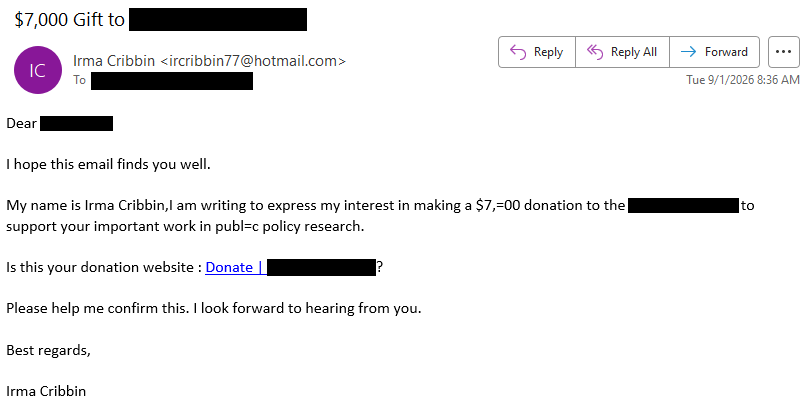
On September 1, Volexity detected a spear-phishing campaign by UTA0560 targeting several NGOs. The emails sent victims to a legitimate US university website, which had a cross-site scripting flaw that attackers used to redirect visitors to their own servers.
The victims were then exposed to a multi-stage attack using a Chrome zero-day CVE-2026-85046. Volexity later found JungleBamboo (also known as APT31, Violet Typhoon, or TA412) using the same exploit chain against different targets. The code was the same, but the infrastructure and final malware were different.

“The exploit first gains arbitrary read/write within the V8 sandbox through the Type confusion vulnerability (CVE-2026-85046), then combines a separate WebAssembly defect to escape the V8 sandbox (CVE-2026-87491). It then exploits a third vulnerability in the Windows kernel (CVE-2026-85880) to escape Chrome’s sandboxed renderer process and inject code into the Chrome browser process.” reads the report published by Volexity. “From there, exploit-chain users can deploy a payload of their choice. Volexity observed two distinct clusters of activity using the exploit chain to deliver different payloads:

  • UTA0560 downloaded and deployed the GRIMWEDGE JScript backdoor providing host reconnaissance, file and process management, command execution, and payload delivery capabilities.
  • JungleBamboo deployed SUPERSTOMP, a loader that installed the LONGTALE credential-stealing Chrome extension.”

Victims only saw an image of a donation form made to look like it belonged to the targeted organization. In reality, the page was there to steal, not collect, donations.

The core Chrome flaw, CVE-2026-85046, was reported to the Chromium project by a private researcher on August 4, 2026. A fix landed in the open-source Chromium codebase not long after. Google Chrome itself, though, hadn’t shipped that fix yet when the phishing started.

” This created an unusual patch gap: The vulnerability was known and fixed upstream, making it an N-day at the Chromium source level, but there was no patch release for Google Chrome users.” continues the report. “Therefore, the exploit was effectively a zero-day against Google Chrome.”

Someone was watching the Chromium source repository closely enough to catch a fix before most users ever got it, and turned it into a working exploit within weeks. Volexity researchers found byte-for-byte identical shellcode across both campaigns. UTA0560 and JungleBamboo weren’t independently reinventing the same exploit; they were running the same one.

The exploit page was far more sophisticated than it first appeared. It accepted 13 URL parameters to support testing, breakpoints, telemetry, and controlled rollouts.

That level of preparation doesn’t look like a quick attack put together on the fly. It suggests the attackers had built a proper development and testing framework, which was either left in place or deliberately used in the live campaign.

Once code execution lands, the two operators split. UTA0560 used its access to drop a custom loader chain ending in GRIMWEDGE, a JScript backdoor running entirely in memory inside msiexec.exe. It’s compact, under 250 lines, but it covers the basics: file operations, process management, command execution, and file upload.

JungleBamboo took a different route. It deployed a loader Volexity calls SUPERSTOMP, which installs a malicious Chrome extension named LONGTALE. The extension masquerades as a Google Gemini assistant and logs every keystroke, steals cookies and session tokens, and takes screenshots when it spots keywords supplied by its command server.

LONGTALE has no remote code execution command at all. It doesn’t need one. Volexity assesses the credential and session theft alone gave JungleBamboo everything it needed, and extensions like this tend to slip past detection more easily than a standalone executable.

Chrome has spent the last year hardening exactly the kind of tampering SUPERSTOMP relies on. Per-preference encrypted hashes arrived in November 2025, and a full-profile integrity check followed in June 2026. SUPERSTOMP still gets through, by stripping the new hashes, forging the older legacy HMAC values Chrome still accepts as a fallback, and letting Chrome’s own migration logic re-authenticate the tampered profile as legitimate.

“Chrome enables this legacy fallback method by default in its releases as of September 8, 2026; only compiling Chromium from source disables it.” Volexity states. “This technique was added to one of the most popular GitHub repositories relating to silent installation of Chrome extensions on August 6, 2026.”

Worth noting: this exact technique showed up in a popular GitHub repository for silent Chrome extension installs on August 6, 2026, weeks before JungleBamboo’s campaign. The line between public research and operational tradecraft keeps getting shorter.

The attribution work here is tidy. UTA0560’s link to its March 2026 campaigns rests on three points: the same phishing sender address, the same hosting IP for its exploit infrastructure, and a per-host beacon naming scheme that mirrors what UTA0560 used six months earlier.

“Volexity assesses with low confidence that the exploit chain may have been sold, or otherwise provided, to different end-users in China, hence the near-simultaneous campaigns conducted by separate threat actors using distinct post-exploitation malware. Volexity assesses with medium confidence that the short time window offered by the Chrome patch delay necessitated that these threat actors reuse the core exploit code without modification.” states the report. “Furthermore, the payloads used by each threat actor were compiled using different toolsets, suggesting entirely different development environments preferred by each malware developer.”

Proofpoint reported similar findings around the same time. It calls the exploit kit BlueMoon and says JungleBamboo first used it on August 28, several days before Volexity detected the campaign.

Proofpoint identified four different groups using the same code within about two weeks. One, tracked as UNK_LateNight, targeted US aerospace companies with the ShadowPad backdoor. Another, UNK_DoubleCheck, targeted a manufacturing company in Vietnam.

Proofpoint also found an interesting clue about how the exploit may have been developed. Some code artifacts suggest the attackers could have used AI during development. There’s no proof of that, but the diagnostic logs, handover notes, and debugging comments look unusual for a professionally developed exploit.

Google patched CVE-2026-85046 in the Stable Channel update on September 3, moving users to Chrome 152.0.7977.82 or .83, alongside eleven other fixes. CISA added the flaw to its Known Exploited Vulnerabilities catalog the next day, with a September 18 deadline for federal systems to remediate. If your fleet hasn’t relaunched Chrome since early September, it’s worth checking the version number rather than assuming the auto-update did its job.

Volexity’s closing point is the one to actually remember here, and it’s not really about UTA0560 or JungleBamboo specifically.

“As large language models become more popular and effective for rapid vulnerability research and exploit development, Volexity assesses with high confidence that patch-gap vulnerabilities present an even greater risk, as they create an additional time window for threat actors to conduct exploitation campaigns.” concludes the report.

Follow me on Twitter: @securityaffairs and Facebook and Mastodon

Pierluigi Paganini

(SecurityAffairs – hacking, Chrome)

  • ✇Security Affairs
  • Four Nation-State Actors Used the Same Chrome Zero-Day Exploit Kit Within 12 Days Pierluigi Paganini
    Four espionage groups used the BlueMoon Chrome+Windows exploit kit within 12 days. Researchers suspect AI development. Proofpoint published a detailed analysis of a Chrome-and-Windows exploit kit it tracks as BlueMoon that four nation-state actors adopted within roughly two weeks of the first observed use. Google’s Threat Intelligence Group, Microsoft’s MSTIC, and Volexity all contributed to the investigation. “Proofpoint identified four espionage-motivated threat actors employing a new e
     

Four Nation-State Actors Used the Same Chrome Zero-Day Exploit Kit Within 12 Days

10 de Setembro de 2026, 02:35

Four espionage groups used the BlueMoon Chrome+Windows exploit kit within 12 days. Researchers suspect AI development.

Proofpoint published a detailed analysis of a Chrome-and-Windows exploit kit it tracks as BlueMoon that four nation-state actors adopted within roughly two weeks of the first observed use. Google’s Threat Intelligence Group, Microsoft’s MSTIC, and Volexity all contributed to the investigation.

“Proofpoint identified four espionage-motivated threat actors employing a new exploit kit that chains multiple Chrome browser and Microsoft Windows vulnerabilities. Proofpoint is tracking the exploit kit used in this activity as BlueMoon.” reads the report published by Proofpoint. “The first observed cluster using the BlueMoon exploit kit was the China-aligned threat actor TA412 (JungleBamboo, Violet Typhoon, APT31, TIDE CASTLE) on 28 August 2026. Within days, several other espionage-motivated clusters began using BlueMoon, the majority of which have a suspected China nexus. However, BlueMoon may not be exclusive to China-aligned actors, as some usage remains unattributed and there are also potentially more actors using the exploit kit.”

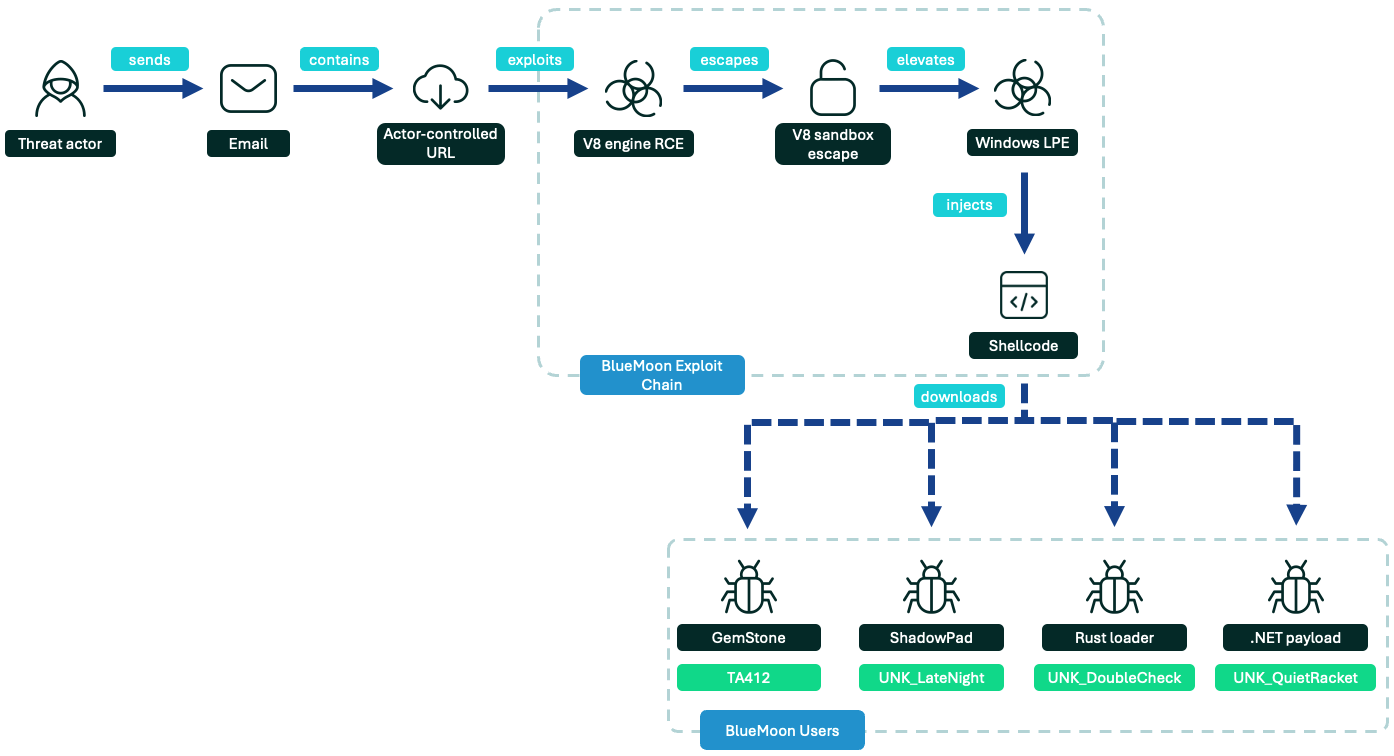
BlueMoon chains three vulnerabilities. CVE-2026-85046 is a type-confusion bug in Chrome’s V8 JavaScript engine that abuses an optimization flaw in the TurboFan JIT compiler: by mutating an array mid-sort, an attacker gets the ability to read object memory addresses and forge fake object pointers, building toward arbitrary read and write inside V8’s heap. A V8 sandbox escape (no CVE assigned, Chrome doesn’t issue CVEs for sandbox escapes) then overwrites WebAssembly compiled function bodies with attacker shellcode from memory. CVE-2026-85880, a Windows kernel local privilege escalation using ALPC and Windows Notification Facility mechanisms, completes the chain and elevates the attacker from the browser’s sandboxed renderer to a position where they can inject code into Chrome’s parent process and run arbitrary commands.

“Both V8 vulnerabilities were “patch-gap” zero-days at the time of the observed activity. In other words, while they were known vulnerabilities already fixed in public upstream Chromium source code, they remained unpatched in the latest stable releases of Chrome and Chromium-based browsers available to the public.” continues the report. “It is likely that the exploit kit developer used these publicly available Chromium patches to weaponize the browser exploit chain.”

The fix for CVE-2026-85046 was committed to the Chromium source tree on August 7, almost four weeks before it rolled into the stable Chrome release on September 3. That gap is what made rapid weaponization possible: the patch itself is a public document describing exactly what was wrong.

The kit also bears visible signs of how it was made.

“Although no single artifact conclusively confirms AI-assisted development of BlueMoon, Proofpoint identified several indicators consistent with this hypothesis, including extensive diagnostic logging capabilities, a referenced markdown handover document, and detailed comments documenting successive debugging iterations and implementation decisions.” states the report. “Furthermore, the exploit chain’s default configuration reflects a departure from the level of operational security and technical tradecraft typically associated with browser exploit chains. For example, by default, successful exploitation simply results in a curl command that downloads an actor-provided executable to disk and executes it. “

The comments in the kit ask testers to “please send the full log back.” It also refers to a markdown handover file, docs/v8-ctf-chrome-stage4-handover.md, which could be used to pass context between AI agent sessions. The kit repeatedly mentions Google’s V8CTF vulnerability bounty program. Proofpoint says this could mean the V8 bugs were developed through that program, or that the developers used the V8CTF context to get around AI safety restrictions while creating the exploit. The researchers cannot confirm which explanation is correct.

The default post-exploitation step is another important clue. The kit includes a complete Chrome exploit chain that can escape the V8 sandbox and gain higher privileges on Windows. Its default payload uses curl to download an executable into %TEMP% and run it. Endpoint security tools would likely detect this activity quickly. This suggests the developers focused on releasing the exploit before the September 3 Chrome patch rather than making it difficult to detect.

The first confirmed use was TA412 (aka APT31, Violet Typhoon, and JungleBamboo) a China-nexus APT linked to the Ministry of State Security’s Hubei State Security Department and indicted by the US government in 2024 for economic espionage. Starting August 28, TA412 targeted US NGOs, mining companies, and physical commodity trading firms using phishing emails that posed as university students seeking internships or as outreach related to the Association for Asian Studies conference. Clicking the link loaded BlueMoon silently, then redirected the browser to a legitimate site while exploitation ran in the background.

TA412’s post-exploitation payload was GemStone, a malicious browser extension that masquerades as an “AI-powered browsing companion by Google Gemini.” It installs into Chrome, Edge, Brave, and Vivaldi by bypassing the browser’s Secure Preferences protection mechanism using the same HMAC computation method the browser itself uses to validate extensions.

GemStone accepts commands to capture keystrokes, cookies, screenshots, local and session storage, and browsing history, and can inject arbitrary HTTP requests from the browser’s own context. It runs its C2 through a Cloudflare Worker domain. Proofpoint has the full command table in the report.

On September 2, UNK_LateNight, a second suspected China-aligned cluster, began targeting US aerospace and defense companies with fake RFQ and procurement inquiry emails. The payload was ShadowPad, the modular backdoor extensively used by Chinese state groups, delivered through a DLL sideloading chain that creates a scheduled task named “EdgeCore_AutoUpdate” for persistence and unhooks 20 network monitoring functions to reduce visibility. The same day, UNK_DoubleCheck targeted a Vietnamese manufacturing company from a compromised Southeast Asian government email address with a vaccination appointment lure. Its payload downloaded a Rust-based loader from Cloudflare R2 that staged a second DLL sideloading chain for C2.

Since September 3, UNK_QuietRacket has targeted government, consulting, and financial organizations in Indonesia and Singapore with conference-themed lures. Its C2 uses Google’s DNS-over-HTTPS service to resolve addresses through TXT records, then decrypts them with ChaCha20 before reaching Cloudflare Workers. DoH hides the DNS activity among normal encrypted traffic, making the C2 harder to detect.

CVE-2026-85880, the Windows LPE component of the chain, is the same vulnerability Microsoft patched as an actively exploited zero-day in September 2026 Patch Tuesday. The Windows LPE only targets older builds, including Windows 10 through 22H2, Windows Server 2019 and 2022, and Windows 11 21H2. Its compilation timestamp is from 2025, suggesting it was a pre-existing capability packaged into BlueMoon rather than written for this campaign.

Defenders running those builds who haven’t applied September patches should treat this as urgent regardless of whether they’re a BlueMoon target.

“A fully weaponized Chrome exploit chain has historically been a high-value, rare capability. BlueMoon was developed, deployed rapidly, and shared across multiple threat actors within days in a manner that had high detection signals. This may reflect a reduced cost and barrier to entry for this class of capability, as AI agents increasingly enable threat actor exploit development. This is particularly relevant for open source codebases, such as Chromium, where upstream patches are publicly accessible prior to downstream consumers of the codebase applying the patch. This creates a window for threat actors to attempt to rapidly reverse engineer patches and develop exploits ahead of downstream stable releases.” concludes the report. “The majority of observed BlueMoon usage is assessed to be China-aligned espionage-motivated activity, although there is not sufficient evidence to attribute BlueMoon usage exclusively to China-aligned threat actors at the time of writing.” 

Follow me on Twitter: @securityaffairs and Facebook and Mastodon

Pierluigi Paganini

(SecurityAffairs – hacking, BlueMoon)

  • ✇Security Affairs
  • Google fixes the seventh actively exploited Chrome zero-day of 2026 Pierluigi Paganini
    Google patched 230 Chrome flaws, including an actively exploited V8 bug that could let attackers run arbitrary code through a crafted HTML page. Google released a Chrome update fixing 230 security vulnerabilities, including one already exploited in the wild tracked as CVE-2026-87491 (CVSS score of 8.8). The medium-severity flaw affects V8, Google’s open source high-performance JavaScript and WebAssembly engine, Chrome’s JavaScript and WebAssembly engine. An attacker can exploit the out-o
     

Google fixes the seventh actively exploited Chrome zero-day of 2026

9 de Setembro de 2026, 10:47

Google patched 230 Chrome flaws, including an actively exploited V8 bug that could let attackers run arbitrary code through a crafted HTML page.

Google released a Chrome update fixing 230 security vulnerabilities, including one already exploited in the wild tracked as CVE-2026-87491 (CVSS score of 8.8). The medium-severity flaw affects V8, Google’s open source high-performance JavaScript and WebAssembly engine, Chrome’s JavaScript and WebAssembly engine.

An attacker can exploit the out-of-bounds write through a specially crafted HTML page and execute arbitrary code inside Chrome’s sandbox. Google fixed the issue in Chrome 153.0.8010.36 and later versions.

“CVE-2026-87491: Out of bounds write in V8” reads the advisory. “Google is aware that an exploit for CVE-2026-87491 exists in the wild.”

Researcher Jihyeon Jeong from Seoul National University reported the vulnerability on 2026-08-06.

As usual, Google did not disclose technical details about the attacks exploiting this vulnerability or attribute them to any specific threat actor.

Google rewarded the researcher with a $2,500 bounty for responsibly disclosing the vulnerability.

CVE-2026-87491 is the seventh actively exploited Chrome zero-day of 2026. Since the start of the year, Google has addressed the following zero-day flaws exploited in attacks in the wild:

  • February 2026 – CVE-2026-2441 (CVSS score: 8.8) – Use after free in CSS.
  • March 2026 – CVE-2026-3909 (CVSS score: 8.8) – Out-of-bounds write in the Skia 2D graphics library and CVE-2026-3910 (CVSS score: 8.8) – Flaw in the implementation of the V8 JavaScript/WebAssembly engine.
  • April 2026 – CVE-2026-5281 (CVSS score: 8.8) – Use-after-free bug in Dawn, the WebGPU component used for graphics processing.
  • June 2026 – CVE-2026-11645 (CVSS score: 8.8) – Out-of-bounds memory access in the V8 JavaScript engine
  • September – CVE-2026-85046 (CVSS score: 8.8) – V8 type confusion flaw.

Google has updated Chrome Stable to version 153.0.8010.36 on Linux and 153.0.8010.36/.37 on Windows and Mac. The release includes several fixes and improvements, with the rollout expected over the coming days and weeks.

Follow me on Twitter: @securityaffairs and Facebook and Mastodon

Pierluigi Paganini

(SecurityAffairs – hacking, newsletter)

❌
❌